In This Article
What a resilience authority is, what Maryland's law lets one do, how the first multi-jurisdictional authority runs in practice, and when to create one.
Last updated
What is a resilience authority, and when do you need one?
A resilience authority is a financing and delivery vehicle, not another planning office. Maryland's 2020 law defines a resilience infrastructure project as a project "to finance or refinance the capital costs" of infrastructure such as flood barriers, green space, building elevation and stormwater systems. The legislature's stated aim was to accelerate infrastructure financing and reduce the cost of implementation.
A resilience authority is a public body created by local law to finance and deliver resilience infrastructure. In Maryland, counties and municipalities can create one alone or together; it can take grants, issue tax-exempt bonds and, with local approval, charge fees, but it cannot levy taxes or take property by eminent domain. Two exist in the state so far.
We know the model from the inside. Council Fire was an implementation partner on the Resilience Authority of Annapolis and Anne Arundel County's Annapolis Maritime Resilience Initiative, where the project team evaluated 38 sites of concern over 18 months and advanced ten to concept design. Alongside that work we built Aptation, the resilience planning platform behind the Authority's public portfolio, Resilient & Ready Anne Arundel.
What can a resilience authority do?
It can do almost everything needed to get a project built, except tax. Under Maryland law an authority holds all powers necessary or convenient to undertake, finance, manage, own and operate resilience infrastructure projects. It can buy property, but not by eminent domain, and with the local government's approval it can charge fees to back its bonds.
Its bonds are limited obligations, tax-exempt and not backed by the full faith and credit of the government that created it. The authority cannot levy a tax, but the county or city may dedicate any of its own revenues to the authority's bonds, operations or projects. Capital costs, as the law defines them, include planning and design, which matters: an authority can pay for the engineering that makes a project fundable.
The local law that creates an authority can narrow these powers and set its revenue sources, including general fund revenue and general obligation bonds. That makes the founding ordinance the most important design decision a county will make about it; our guide to resilience governance models for municipalities covers the choices.
How is it different from a planning department or a special district?
A planning department decides what should be built; a resilience authority exists to get it financed and delivered, often across a county and city line. The comparison below covers the models a county is most likely to weigh.
Model | How it raises money | What it delivers | Limits |
|---|---|---|---|
Planning department | The general fund and grants it applies for | Plans, studies and permits | Rarely holds delivery or financing capacity |
Maryland resilience authority | Grants, tax-exempt bonds, fees with local approval, revenue the local government dedicates | Financing and delivery of resilience infrastructure, across jurisdictions | Cannot tax or use eminent domain; bonds are limited obligations |
California climate resilience district | Benefit assessments, special taxes and fees within constitutional limits, bonds, tax increment | Projects within the district | Taxes subject to the state's voter-approval rules |
Regional parcel-tax authority | A voter-approved parcel tax, such as the San Francisco Bay Restoration Authority's $12 a year, about $25 million annually | Grants for shoreline restoration and flood protection | Fixed by the measure's term and purpose |
Countywide flood district | Inherited flood-district powers, as with OneShoreline in San Mateo County, created by state law in 2019 | Sea level rise and flood projects across many cities | Requires state legislation to create |
Who this is for: county and city officials, resilience directors and finance officers weighing whether a new entity would deliver more than their existing departments.
Where do resilience authorities exist?
So far, mainly in Maryland, and only two there. The state's 2026 resilience strategy confirms the Resilience Authority of Annapolis and Anne Arundel County and the Resilience Authority of Charles County. The Annapolis–Anne Arundel authority, created by County Bill 31-21 in 2021, is described by the County as the first multi-jurisdictional resilience authority in the nation.
Charles County shows the smaller version. Its authority, created by local law in December 2020, hired its first executive director in 2023 and reported $5.7 million secured in total for nature-based solutions by 2025. Maryland's strategy recommends tools to help more localities create authorities, and even a statewide one, noting that no comparable state entity exists.
Outside Maryland the closest relatives go by other names. California authorized climate resilience districts in 2022, and the Bay Area and San Mateo County run regional bodies with their own revenue. The National Academy of Public Administration calls Maryland's authorities a new governance model for financing and cross-boundary delivery, while noting they lack taxing and eminent domain powers. Our Maryland climate risk profiles show the hazards each county faces.
What does running one look like in practice?
It looks like a grant shop that has not yet used its bonding power. Through FY2025, the Annapolis–Anne Arundel authority raised $50.3 million, of which $49 million was grants and $1.24 million private investment, with nothing from taxes or fees. Its audit reports no capital assets or debt.
Grant dependence makes budgets swing, which is why a blended finance model belongs in the founding plan. The authority adopted a $49.6 million FY2025 budget, then cut it to $6.5 million because awards and spending fell out of step and some anticipated grants were not won. NAPA research presented to finance officers in 2026 named the barriers such bodies face: fragmented authority, backward-looking data, disconnected funding streams and plans without implementation authority.
The authority is candid about its role. Its strategic plan states that it is not a planning entity; its job is to turn the community's plans into an investment and financing strategy. That is the lesson for anyone setting one up: the financing powers are only as useful as the pipeline of ranked, ready projects behind them. Our guides on how to prioritize climate resilience projects and building resilience into the capital improvement plan cover how to build that pipeline.
How should an authority show the public what it is doing?
From one record, published on a schedule. Maryland law requires each authority to report every year to four legislative committees, including a description of the projects it funded and the sources of revenue. Boards, funders and residents want the same story, at different levels of detail, and our guide to measuring climate resilience progress covers what belongs in it.
That is the problem Aptation was built to solve. It keeps every project, score, funding source, budget line and delivery status in one portfolio, with benefits recorded as potential until they are measured, and shares the result through printed reports, view-only links and a public portfolio. Resilient & Ready Anne Arundel, the Authority's public portfolio, is built on it.
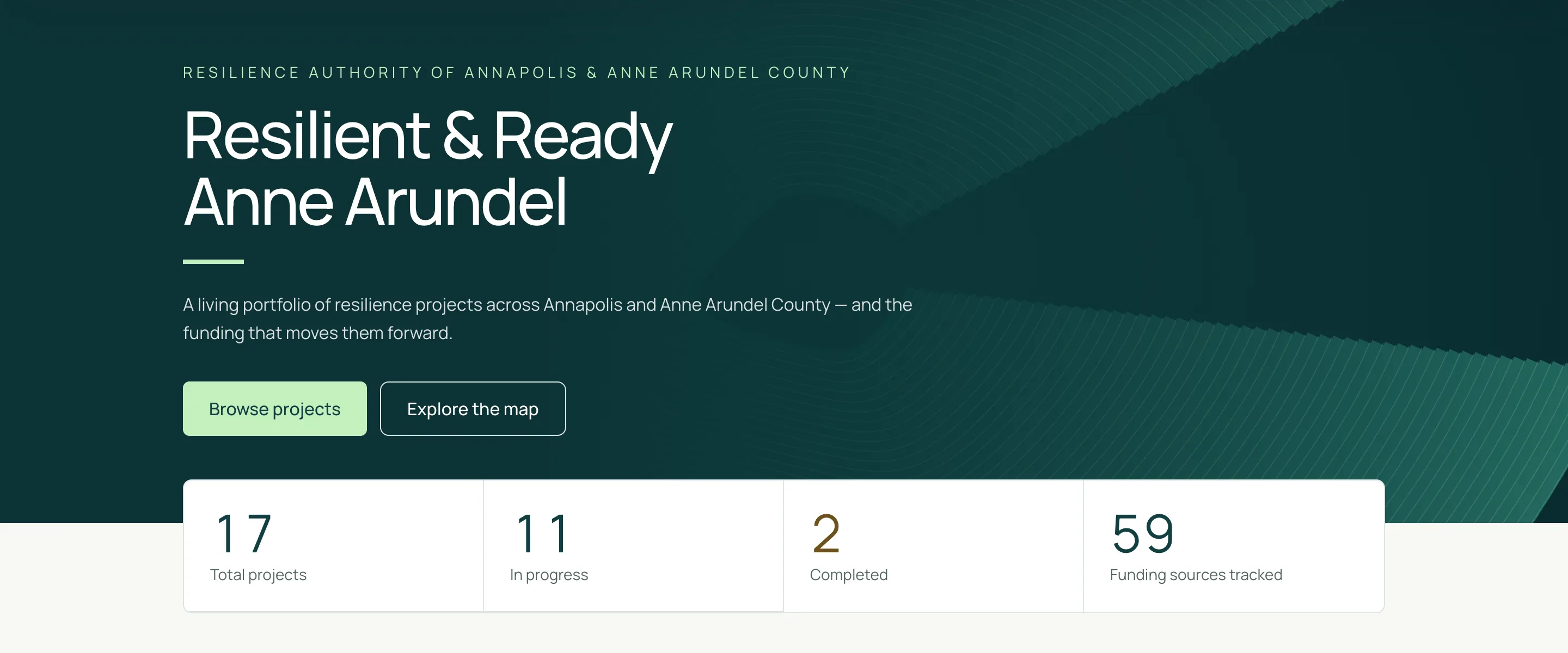
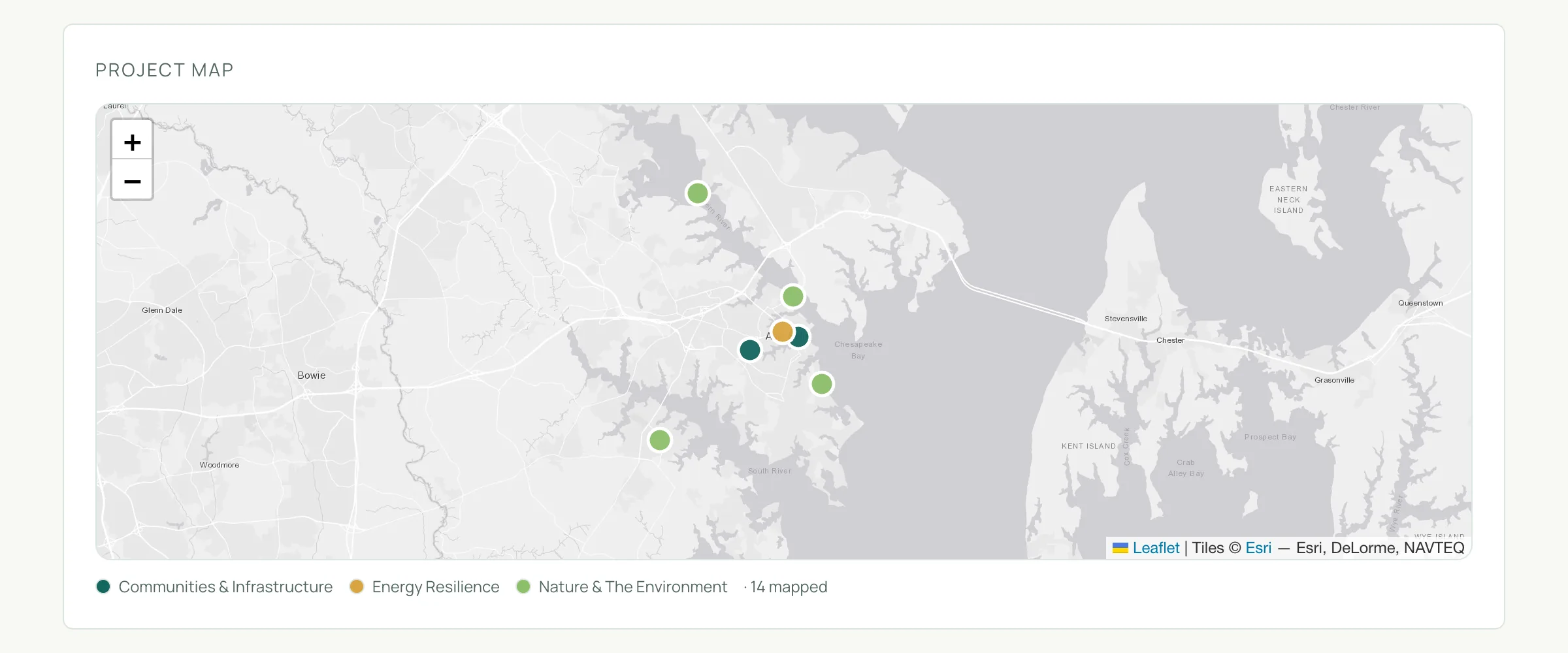
The Annapolis case study and the Anne Arundel County climate risk profile show the hazards and the projects behind that portfolio.
Should your community create one?
Create one when you have more fundable projects than your capital budget can carry, a coastal flood risk or other hazard that crosses jurisdictional lines, and the staff to run a pipeline. Hold off when you have none of those, because the powers alone will not deliver a project.
Create an authority when | Hold off when |
|---|---|
Several jurisdictions share the same flood or shoreline risk | One department can deliver the work through the existing capital program |
You have a ranked pipeline of projects beyond the capital budget's capacity | There is no project list yet, only a plan |
You need a vehicle that can take grants, private capital and bond proceeds together | You need taxing power, which Maryland authorities do not have |
You can fund an executive director and a small finance team for several years | Staffing would depend on a single grant or a borrowed salary |
If you are weighing it, start with the money. Our guides to resilience funding, funding resilience without federal grants and writing an RFP for a resilience funding strategy cover the options, and Council Fire works with municipalities and government agencies on the strategy and governance. When the authority needs a system no product offers, Council Fire Labs builds it.
Frequently asked questions
01What is a resilience authority?
A resilience authority is a public body created by local law to finance and deliver climate resilience infrastructure such as flood barriers, living shorelines and stormwater systems. Maryland's 2020 law lets counties and municipalities create one alone or together. It can take grants, issue tax-exempt bonds and charge fees with local approval, but cannot levy taxes.
02Can a resilience authority issue bonds?
Yes. Maryland resilience authorities can issue tax-exempt bonds, but they are limited obligations, not backed by the full faith and credit or taxing power of the government that created the authority. The county or city may dedicate its own revenues to repay them. As of its latest audit, the Annapolis–Anne Arundel authority had no debt.
03Can a resilience authority levy taxes?
No, not in Maryland. The state law says nothing in it authorizes a resilience authority to levy a tax, and authorities cannot use eminent domain. With the local government's approval an authority can charge fees to back its bonds. California's climate resilience districts differ: they can levy assessments and special taxes within constitutional limits.
04How many resilience authorities are in Maryland?
Two, according to Maryland's 2026 resilience strategy: the Resilience Authority of Annapolis and Anne Arundel County and the Resilience Authority of Charles County. Baltimore County began studying a framework in 2023. The state strategy recommends tools to help more localities create authorities and a possible statewide resilience authority.
05Which was the first multi-jurisdictional resilience authority?
The Resilience Authority of Annapolis and Anne Arundel County, created when the County Council passed Bill 31-21 in 2021 with the City of Annapolis as a partner. The County describes it as the first multi-jurisdictional resilience authority in the nation. It began operating on June 30, 2022, under a 12-member appointed board.
06How are resilience authorities funded in practice?
Mostly by grants so far. Through FY2025, the Annapolis–Anne Arundel authority raised $50.3 million, $49 million of it grants, with no taxes, fees or debt. That dependence makes budgets volatile: its FY2025 budget was cut from $49.6 million to $6.5 million. A diversified funding strategy reduces the swing.
07What software do resilience authorities use to manage projects?
Many start with spreadsheets, GIS maps and grant trackers. Aptation keeps planning, scoring, funding, budgets, delivery status and public sharing in one record, and Resilient & Ready Anne Arundel, the Annapolis–Anne Arundel authority's public portfolio, is built on it. Council Fire Labs builds custom systems when a workflow needs one.
Related Resources
Resilience finance
- Funding climate resilience guides: the programs and funding tools we track.
- Funding resilience without federal grants: the local options when federal money stalls.
- Navigating federal climate funding in 2026: a resilience finance playbook for municipalities.
- How to write an RFP for a resilience funding strategy: getting outside help with the money.
Planning and prioritizing
- How to build resilience into your capital improvement plan: getting projects into the capital budget.
- How to implement a hazard mitigation plan between updates: keeping mitigation actions moving.
- How to measure climate resilience progress, honestly: reporting what the portfolio delivers.
- How to prioritize climate resilience projects that get done: building the pipeline an authority finances.
- Climate resilience planning guides: the library's planning guides.
- Maryland climate risk by county: hazard profiles for every county.
Proof and tools
- Annapolis Maritime Resilience Initiative: our work with the Resilience Authority.
- Anne Arundel County climate risk and resilience profile: the hazards behind the portfolio.
- Aptation: the resilience planning and delivery platform.
- Sustainability strategy for municipalities and government: how Council Fire works with public agencies.
Talk through the model before you write the ordinance
If your county or city is weighing a resilience authority, start with the project pipeline and the founding law, because those decide what the authority can do. Talk to us on our contact page and choose Climate resilience or Software & AI (CF Labs).
About the Author
George Chmael II is Council Fire's Founder & CEO. He has led the firm since its founding and through its B Corp certification in 2010. Council Fire's climate resilience practice works with cities, counties, ports and authorities on planning, funding and delivery, and Council Fire Labs builds the software that holds that work together.
Cover photograph: Pexels — Colorful Portofino Harbor in Liguria, Italy, by Ismail Abou Khalil. Illustrative stock photograph, not a Council Fire project.





FAQ