In This Article
Hazard mitigation plans stall after adoption. What FEMA requires between updates, why actions stall, and how to track each one to the five-year update.
Last updated
How to implement a hazard mitigation plan between updates
Hazard mitigation plans rarely fail at adoption. They fail in the five years after it. Vermont's State Auditor found that the state had implemented only 33% of the 96 actions in its 2018 hazard mitigation plan by 2023, and New York's State Comptroller found that 55% of New York City's 755 mitigation actions had no finish date. New York's statewide portal lists 94% of 15,682 local actions as "Proposed – Not Started", as of September 2026 data.
To implement a hazard mitigation plan, treat each action as a project with an owner, a start and finish date, a cost, a funding source and a status, and update that status at least twice a year. Fold the actions into the capital improvement plan and the grant calendar. Then the five-year update becomes a report of progress instead of a reconstruction of it.
In our experience, the hazard mitigation plan is often the longest list of projects a county has and the one least connected to its budget. On the Annapolis Maritime Resilience Initiative, the project team evaluated 38 sites of concern over 18 months and advanced ten to concept design. We built Aptation so a list like that keeps moving after the plan is adopted.
What does FEMA require between hazard mitigation plan updates?
More than most plans deliver. FEMA's Local Mitigation Planning Policy Guide, effective April 11, 2025 for all plan approvals, requires a plan to identify how, when and by whom it will be tracked for implementation over its five-year cycle. FEMA's own example of monitoring is a system for tracking the status of each mitigation action.
The guide calls the plan a living document and says plainly that continually documenting the process makes the next update easier. The underlying rule, 44 CFR § 201.6, requires a process for incorporating the plan into other planning mechanisms such as land-use master plans and capital improvement plans. Here is what the 2025 guide asks for, and what a jurisdiction has to keep current to answer it.
Requirement (2025 Policy Guide) | What the plan must show | What to keep year-round |
|---|---|---|
Monitoring | How, when and by whom actions will be tracked | A named owner and a dated status for every action |
Evaluation | How the plan's effectiveness will be assessed, and against which criteria | Written criteria and an annual evaluation note |
Action details | A responsible office, potential funding sources and expected time frames for each action, with terms like "short-term" defined | Dates and funding sources, updated as they change |
Status of prior actions (E2 in the 2025 guide) | Whether each previous action was completed; unfinished ones dropped or carried forward | A status history, so the update reports rather than reconstructs |
Integration | How the plan fed budgets, land-use master plans and capital improvement plans | The budget year or capital project each action landed in |
Who this is for: emergency managers, planners and resilience staff who own a local or multi-jurisdictional hazard mitigation plan and answer for its update.
Many existing plans and state crosswalks still use the element letters from FEMA's 2011 guide, which requested the status of previous actions too. The requirement is not new.
Why do hazard mitigation plans stall after adoption?
Because the energy goes into writing the plan and nobody owns the follow-through. FEMA's 2025 Local Mitigation Planning Handbook says it directly: after the plan is finished, that energy can fade. The audits show what fading looks like.
Vermont's auditor found the state's action status data were not always reliable because staff turnover meant the people tracking the plan had not written it, and the effectiveness evaluation the plan promised never happened. In New York City, the Comptroller found action data that were incomplete, inaccurate or out of date, self-reported by agencies, with 53% of actions missing a start date and 37% missing a cost estimate. A follow-up found that by December 2023, 50% of 1,042 actions still had no finish date.
Research points the same way. A study of more than 100 local hazard mitigation plans found implementation of their policies was only moderate and varied widely, and a 2025 review of 61 Pennsylvania county plans found implementation was the lowest-scoring element. Mitigation planning is often isolated from the plans that govern land use and development in hazard areas, and when those plans pull the other way the cost is real: after Hurricane Harvey, researchers found that some Houston plans and policies increased flood vulnerability by encouraging development without enough attention to flood risk. Land-use rules are where local climate policy and mitigation planning have to meet.
What should you track for each mitigation action?
Enough to answer FEMA, a funder and a council member without a records search. The fields below come from the 2025 guide's requirements and from what went missing in the audits.
Field | Why it matters | What goes wrong without it |
|---|---|---|
Owner (office and person) | FEMA requires a responsible office for each action | Vermont's status data became unreliable after staff turnover |
Start and finish dates | FEMA requires expected time frames; dates make pace visible | 55% of New York City's actions had no finish date |
Cost estimate | Needed for grant applications and the capital plan | 37% of New York City's actions had no cost estimate |
Funding source and status | FEMA requires potential funding sources; it shows the path to money | Actions stay "proposed" with no route to a budget |
Status, with the date it changed | The update must report the status of every prior action | Statewide databases list most actions as not started |
Capital plan or budget link | FEMA counts integration with other plans as proof of progress | The plan sits apart from the budget |
Benefit, labeled as potential | Supports benefit-cost analysis and ranking | Modeled benefits get reported as results |
Who this is for: the person who will write the next plan update, and the departments that own the actions.
FEMA's handbook includes an action monitoring form with four statuses: complete, in progress with an anticipated completion date, not started, and canceled. Its example schedule collects status updates twice a year and evaluates the plan once a year or after a disaster. Our glossary entry on flood risk management, our guide to coastal resilience and flood mitigation for municipalities and the flooding and coastal resilience library cover what the actions themselves should be.
How do you connect mitigation actions to funding and the capital plan?
By giving each action a funding source, a readiness level and a place in the capital program, so it can move when money appears. The 2025 guide defines planning mechanisms as budgets, land-use master plans, capital improvement plans and other long-range plans, and the update must show how the plan was integrated into them as a demonstration of progress. FEMA's handbook example has mitigation actions considered in the next five-year capital improvements planning process. Our guide to building resilience into your capital improvement plan covers the screening and scoring.
Readiness decides who wins federal money. In the reopened FY2024–25 BRIC competition, projects at 90% design or greater earn 30 points, the largest single criterion. That $1 billion round, reopened under court order, closed July 23, 2026, and as of FEMA's September 2026 update it was still reviewing submissions. In January 2026, the Congressional Research Service reported that HMGP had not been approved for a new major disaster declaration since March 18, 2025.
With federal programs in flux, actions need more than one possible funding source. Our guides to funding resilience without federal grants and federal climate funding in 2026 cover the options, and How to prioritize climate resilience projects that get done covers ranking the actions that compete for them. When you need outside help with an application, our RFP guide for FEMA mitigation grant support shows how to scope it.
How do you make the five-year update easy?
Keep the record current between updates, and watch the expiration date. FEMA's handbook says tracking progress on mitigation actions reduces the work of the five-year update, and that each agency assigned an action is responsible for tracking and reporting on it. The 2025 guide sets a plan's expiration at five years after FEMA's approval date, shared by every jurisdiction in a multi-jurisdictional plan, and a draft of the next update must be submitted before that period ends.
Lapses are common and costly. For BRIC and FMA project grants, a local applicant needs an approved plan both by the application deadline and when FEMA obligates the funds; for HMGP, at obligation. A plan that is approvable but still awaiting local adoption does not count. FEMA reports 21,451 local governments with approved plans, covering 77.7% of the population.
Council Fire's analysis of FEMA's raw plan-tracking data, which FEMA cautions is subject to human error and delayed entry, finds about 3,500 local jurisdictions with only expired plan records and no update underway. It also finds 541 of 2,781 approved local plans, about one in five, expiring within the next 12 months. If yours is one of them, our RFP guide for a hazard mitigation plan update covers scoping the work.
What tools keep a hazard mitigation plan moving?
A shared, dated record that the action owners update themselves. After its audit, Vermont Emergency Management built an online platform where action leads update the status of their actions, and Massachusetts publishes a public action tracker for its state hazard mitigation and climate adaptation plan. On October 26, 2026 it listed 183 actions: 38 complete, 103 in progress, 18 in development and 24 not started.
Aptation is built for the local version of that job. Your hazard mitigation plan and the studies behind it can be uploaded and read for candidate projects, which wait in a review queue for staff to confirm. Each project then sits on a map with its scores, its funding sources, its budget by fiscal year and its application deadlines, and moves from planning to in progress to completed.
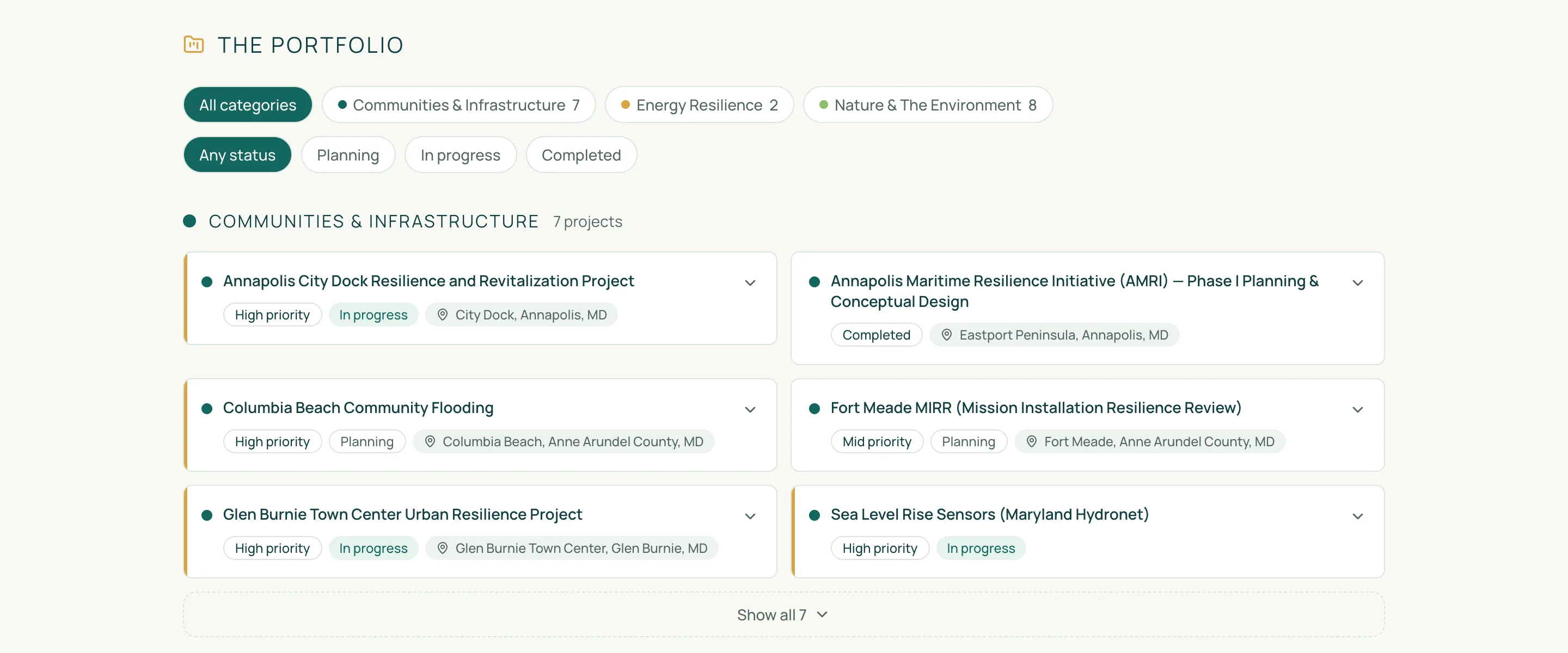
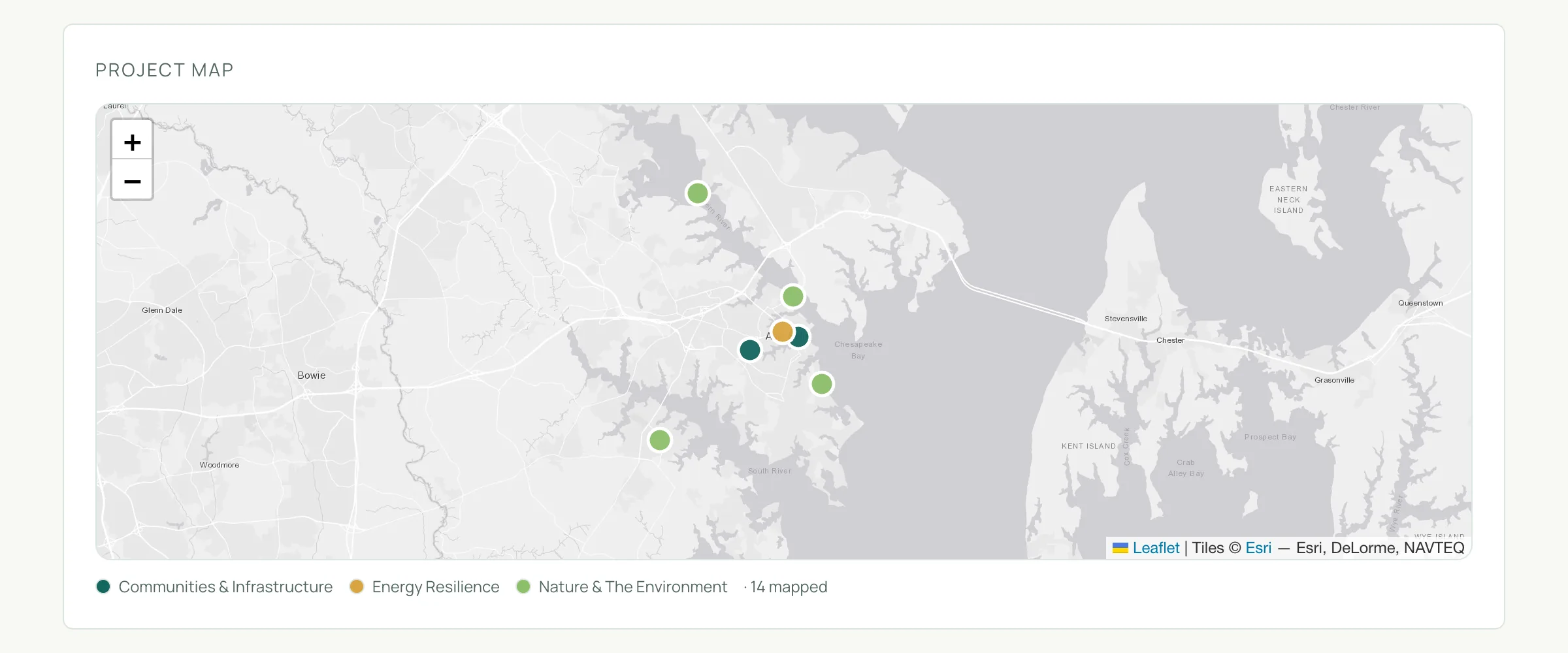
Status reports go to the board in print, to partners through view-only links and to residents through a public portfolio, as Resilient & Ready Anne Arundel does for the Resilience Authority of Annapolis and Anne Arundel County. Our Maryland climate risk profiles show the hazards each county's plan has to address. Council Fire's climate resilience practice helps municipalities and government agencies set up the process, and Council Fire Labs builds custom systems when a state or county needs one.
Frequently asked questions
01What is hazard mitigation plan implementation?
Hazard mitigation plan implementation is carrying out the actions a plan lists, such as elevating structures, upgrading stormwater systems or changing development rules, between FEMA-approved updates. It includes assigning owners, funding and scheduling each action, tracking its status, and folding the plan into budgets and capital improvement plans so the actions get built.
02How often must a hazard mitigation plan be updated?
Every five years. Under FEMA's 2025 Local Mitigation Planning Policy Guide, a plan expires five years after FEMA approves it, and a draft of the next update must be submitted before then. FEMA also expects plans to be revisited after major disasters or when new conditions significantly change risk. Our hazard mitigation plan update RFP guide helps scope it.
03What happens if a hazard mitigation plan expires?
The jurisdiction loses eligibility for FEMA mitigation project grants until a new plan is approved and adopted. For BRIC and Flood Mitigation Assistance, an approved plan is needed by the application deadline and when funds are obligated; for HMGP, at obligation. A plan approvable but awaiting local adoption does not meet the requirement.
04What does FEMA require for monitoring a hazard mitigation plan?
The plan must say how, when and by whom it will be tracked for implementation over its five-year cycle, how it will be evaluated against stated criteria, and how it will be updated. FEMA's example of monitoring is a system that tracks the status of each mitigation action. FEMA's current guide, effective April 11, 2025, sets these out.
05How do you report the status of previous mitigation actions?
The plan update must say whether each action in the previous plan was completed. Unfinished actions are either dropped as no longer relevant or carried into the new plan. FEMA's handbook offers an action monitoring form with four statuses: complete, in progress with an anticipated completion date, not started, and canceled.
06How does a hazard mitigation plan connect to the capital improvement plan?
Federal rules require a process for incorporating the mitigation plan into other planning mechanisms such as land-use master plans and capital improvement plans, and FEMA's 2025 guide treats that integration as a demonstration of progress. In practice, it means each action has a budget year or capital project, so funding follows the plan. Prioritizing the actions comes first.
07What software can track hazard mitigation actions?
Many jurisdictions use spreadsheets or a state portal; New York and Massachusetts publish statewide trackers. Aptation reads a hazard mitigation plan for candidate projects that staff confirm, then tracks each project's scores, funding, fiscal-year budget, deadlines and status, and shares progress through reports and a public portfolio. Council Fire Labs builds custom systems.
Related Resources
Hazard mitigation planning
- How to measure climate resilience progress, honestly: reporting outputs, potential benefits and outcomes.
- How to write an RFP for a hazard mitigation plan update: scoping the five-year update.
- How to write an RFP for FEMA mitigation grant support: outside help with applications.
- How to write an RFP for a nuisance flood plan: planning for frequent, low-level flooding.
- Flooding and coastal resilience guides: the library's flood and shoreline guides.
Funding and prioritizing
- How to build resilience into your capital improvement plan: where mitigation actions meet the budget.
- What is a resilience authority, and when do you need one?: a vehicle for financing the projects.
- How to prioritize climate resilience projects that get done: ranking the actions that compete for money.
- Funding resilience without federal grants: the local options when federal money stalls.
- Navigating federal climate funding in 2026: a resilience finance playbook for municipalities.
- Funding climate resilience guides: the programs and funding tools we track.
Proof and tools
- Annapolis Maritime Resilience Initiative: our work with the Resilience Authority.
- Maryland climate risk by county: hazard profiles for every county.
- Aptation: the resilience planning and delivery platform.
Turn your mitigation plan into a working project list
Send us your current hazard mitigation plan and its action table. We will show you which actions are missing an owner, a date, a cost or a funding source, and what it would take to keep them current to the next update. Talk to us on our contact page and choose Climate resilience or Software & AI (CF Labs).
About the Author
George Chmael II is Council Fire's Founder & CEO. He has led the firm since its founding and through its B Corp certification in 2010. Council Fire's climate resilience practice works with cities, counties, ports and authorities on planning, funding and delivery, and Council Fire Labs builds the software that holds that work together.
Cover photograph: Pexels — Asperitas dark clouds in gloomy sky, by Andrew Beatson. Illustrative stock photograph, not a Council Fire project.





FAQ