
May 25, 2026
How to Build a Blended Finance Model for Sustainability Initiatives for Municipalities & Government Agencies
Sustainability Strategy
In This Article
Design blended finance to combine public, philanthropic and private capital for municipal sustainability projects.
How to Build a Blended Finance Model for Sustainability Initiatives for Municipalities & Government Agencies
Blended finance is a powerful way for municipalities to fund sustainability projects by combining public, philanthropic, and private capital. This approach helps address the $2.6 trillion U.S. infrastructure funding gap projected by 2030. By strategically layering funds - such as federal grants, philanthropic guarantees, and private investments - municipalities can reduce financial risks, improve credit ratings, and attract large-scale private funding.
Key takeaways include:
How Blended Finance Works: Public funds absorb initial risks, making projects more appealing to private investors.
Capital Types: Public, philanthropic, private, and government funds play distinct roles in funding structures.
Financial Tools: Guarantees, concessional loans, and junior tranches address risks and attract private capital.
Implementation Steps: Define goals, map stakeholders, select financial instruments, and ensure strong governance.
Critical Conditions: Regulatory clarity, project readiness, and institutional capacity are essential for success.
Blended finance can mobilize $4–$8 of private investment for every $1 of concessional funding, enabling municipalities to fund critical projects like renewable energy, water systems, and clean transportation while saving on borrowing costs.
Core Components of a Blended Finance Model
Understanding Capital Sources and Their Characteristics
Municipal blended finance models rely on three distinct capital sources, each tailored to balance risk and return in sustainable projects. These sources are consolidated into blocks to better align their roles with varying levels of risk tolerance and return expectations.
Capital Source | Risk Tolerance | Return Expectation | Typical Role |
|---|---|---|---|
Public/Philanthropic | High | Low to none | First-loss tranches, grants, technical assistance |
DFIs/Public Development Banks | Moderate | Below-market to market | Subordinated loans, junior equity, anchor investment |
Private/Commercial | Low | Market-rate | Senior debt, senior equity, protected tranches |
The key is to apply only the minimum subsidy necessary to make the deal appealing to private investors. Over-subsidizing risks wasting public resources and can compromise the model's credibility in the long term.
"The objective is to unlock investment that the private sector would not have done on its own, and to do this with minimum concessionality or subsidy." - UN/DESA Policy Brief #100 [1]
Once the roles of these capital sources are defined, the next step is to choose financial instruments that effectively manage the associated risks.
Key Financial Instruments for Risk Sharing
The selection of financial instruments should directly address the barriers to private investment. Depending on the project's specific risks and return challenges, guarantees, concessional loans, or junior tranches may be the most suitable tools.
Guarantees are highly efficient for closing the risk perception gap between public and private sectors. They can mobilize capital at a ratio 6 to 25 times higher than loans, making them particularly effective for green infrastructure projects [5].
Concessional loans are ideal for projects where low expected returns are the primary obstacle. This is often the case in sectors like water, sanitation, and affordable housing, which collectively attract only 2.4% of OECD-reported private finance mobilization [1].
Junior tranches shield senior private investors from credit risk, while viability gap funding - a grant mechanism - addresses revenue shortfalls in infrastructure projects where raising user fees would be prohibitive for the public [1][4].
"SBF [Structured Blended Finance] uses concessional capital and sophisticated tranche structuring to align the different goals of public and private investors, balancing financial return with social impact." - Amundi Research Center [4]
Additionally, technical assistance facilities are essential for preparing early-stage projects. Often, the main barrier to private investment isn’t a lack of capital but a shortage of "bankable" projects [3].
Enabling Conditions for Effective Blended Finance
For a blended finance model to succeed, the right environment must be in place. Municipalities must focus on three critical conditions to ensure their projects are viable and attractive to investors.
Regulatory and Governance Clarity
Local governments need clear legal authority to manage transactions, control revenue streams, and issue debt independently. A region's level of decentralization heavily influences what municipalities can achieve. Additionally, municipalities must address potential conflicts with sovereign guarantees, as national governments sometimes block local initiatives to protect their own debt ratios
[5].
Project Readiness
Investors require credible revenue projections, detailed financial data, and a clear repayment plan. Municipalities that prioritize financial reporting standards and credit rating processes are more likely to attract institutional capital. For example, earning an investment-grade credit rating from firms like Moody’s or S&P is often a prerequisite for securing large private investments.
Institutional Capacity
Managing complex, multi-stakeholder projects requires strong institutional capabilities. Partnering with Development Finance Institutions (DFIs) can help bridge capacity gaps. For instance, the
Inter-American Development Bank's 2025 pilot program allocated $1 billion to support subnational governments with loans, guarantees, and technical assistance for projects ranging from $20 million to $100 million [5]. These partnerships not only provide immediate support but also help build long-term local expertise.
Leveraging blended finance instruments for public infrastructure
Step-by-Step Guide to Designing a Blended Finance Model
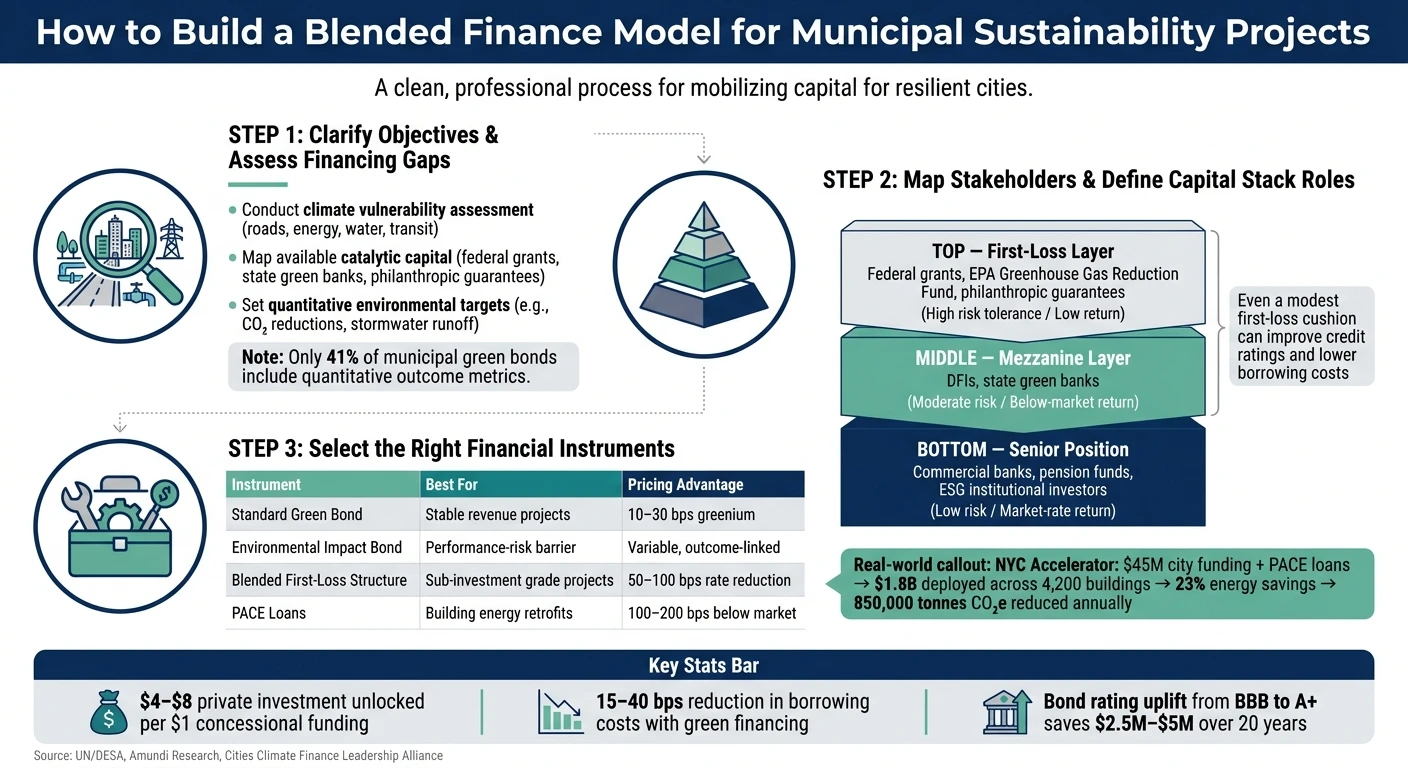
How to Build a Blended Finance Model for Municipal Sustainability Projects
Turning foundational work into a practical financing structure requires a methodical approach. The steps below outline how to convert sustainability objectives into a viable, investor-ready model.
Step 1: Clarify Objectives and Assess Financing Gaps
Start by defining your funding goals and pinpointing financing gaps. Conduct a climate vulnerability assessment across key infrastructure categories - such as roads, energy systems, water networks, and transit. This helps identify projects eligible for green financing and those at the highest risk if not addressed.
Next, map out your available "catalytic" capital. This might include federal grants, state green bank programs, or philanthropic guarantees, which can serve as the concessional layer in your financing model. Given the substantial U.S. infrastructure funding shortfall through 2030, most municipalities will need to combine multiple funding sources to advance even a single project.
Quantitative environmental targets are crucial for attracting impact investors. For example, specify goals like reducing stormwater runoff or cutting CO2 emissions. Currently, only 41% of municipal green bonds include quantitative outcome metrics in their reporting [2]. Municipalities that establish these metrics early on are better positioned to stand out.
Finally, map stakeholders and assign financial roles to ensure clarity and alignment.
Step 2: Map Stakeholders and Define Roles
Once financing gaps are identified, outline the stakeholders involved and assign them specific financial roles. This step goes beyond listing participants - it's about aligning each stakeholder's risk tolerance and return expectations to the right position in the capital stack.
Determine who will provide the first-loss layer, often funded by federal grants, EPA Greenhouse Gas Reduction Fund allocations, or philanthropic guarantees. Identify entities suited for the mezzanine layer, such as Development Finance Institutions or state green banks. Finally, designate the senior position for commercial banks, pension funds, or institutional ESG investors. Even a modest first-loss cushion can improve credit ratings and lower borrowing costs, often making the difference between a project that secures private capital and one that doesn't [2]. Clear role assignments also set the stage for selecting the right financial instruments.
Step 3: Select the Right Financial Instruments
With stakeholder roles defined, the next step is to choose financial instruments that effectively address risks. This decision hinges on three key questions: What primary risk is deterring private investment? What revenue model supports the project? And is the project large enough to justify transaction costs?
Instrument | Ideal For | Pricing Advantage |
|---|---|---|
Standard Green Bond | Projects with stable revenue streams | 10–30 bps greenium |
Environmental Impact Bond (EIB) | Projects where performance risk is a barrier | Variable, outcome-linked |
Blended First-Loss Structure | Sub-investment grade projects needing credit uplift | 50–100 bps rate reduction |
PACE Loans | Building-level energy efficiency retrofits | 100–200 bps below market |
A real-world example of effective instrument selection comes from the NYC Accelerator program. New York City combined $45 million in city-funded technical assistance with private PACE loans, enabling building owners to access financing at rates 100 to 200 basis points below commercial lending. By 2025, this initiative had deployed $1.8 billion across 4,200 buildings, achieving 23% verified energy savings and reducing citywide building emissions by 850,000 tonnes of CO2e annually [2].
Keep in mind that green bonds typically require a minimum issuance of $10–$15 million to cover costs like framework development and annual reporting [2]. Environmental Impact Bonds, while effective, add roughly $800,000 in transaction costs due to their monitoring complexity [2]. As a result, they work best for projects where performance-linked returns genuinely attract impact investors, rather than serving as a novel structuring feature.
Practical Steps for Implementation
With your financial tools in place and stakeholder roles clearly outlined, the next step is bringing the plan to life - turning a well-designed model into a program that attracts funding and delivers measurable outcomes.
Build a Pipeline of Fundable Projects
A single project often can't justify the overhead involved in creating a blended finance structure. A smarter approach is to group multiple projects into a pipeline. This strategy spreads transaction costs, gives investors access to a diversified portfolio, and makes the program more appealing to institutional capital.
The key to attracting private capital is ensuring that projects are “bankable.” As the Cities Climate Finance Leadership Alliance explains:
"Private financiers require bankable projects that have a high probability of success and a reasonable expectation of sufficient cost recovery." [6]
To achieve this, projects should be screened based on three main factors:
Revenue or cost-recovery potential: Is there a credible model for generating returns?
Sector alignment: Does the project belong to a sector with proven private finance interest, such as renewable energy, energy-efficient buildings, or clean transportation?
Technical capacity: Can the municipality effectively manage the financing?
Matching projects to the right type of capital enhances their readiness. For instance, pension funds and insurers are drawn to sectors with stable, long-term demand, while early-stage infrastructure projects often attract funds or development finance institutions with a higher tolerance for risk [6].
One challenge to address is the minimum ticket size required by large institutional investors, which often excludes smaller city projects. By aggregating several smaller initiatives into a single vehicle, you can lower per-project due diligence costs and meet these thresholds.
Structure Financing Vehicles and Governance
Once the project portfolio is developed, the next step is creating a solid governance and financing structure. Common vehicles include Special Purpose Vehicles (SPVs) and revolving loan funds, each tailored to specific project types and investor needs. These vehicles depend on the earlier-defined stakeholder roles and financial tools to operate efficiently.
The capital stack should follow a clear hierarchy:
First-loss equity or junior debt: Typically provided by public or philanthropic sources.
Mezzanine tranches: Often offered by development finance institutions.
Senior debt: Supplied by commercial banks or institutional investors.
Successful deals rely on clear waterfall mechanics, which dictate how cash flows and losses are allocated. Such clarity can significantly speed up transactions - deals with pre-agreed frameworks for cash flow and impact measurement close 40% faster than those negotiated on a case-by-case basis [7].
Governance is equally critical. Decisions about asset sales, project restructuring, or strategic shifts should be clearly assigned from the outset. Embedding impact covenants into legal agreements ensures accountability is contractual rather than voluntary. A good rule of thumb is to apply only the minimum level of public subsidy needed to attract private investors, avoiding excessive subsidization that could undermine the project’s long-term commercial viability [7].
Monitor, Evaluate, and Report on Impact
After the financing structure is in place, continuous monitoring and impact evaluation are vital for accountability and future funding. Impact reporting is more than a compliance task - it builds investor trust and lays the groundwork for future capital raises. The foundation of effective reporting lies in agreeing on key performance indicators (KPIs), baselines, and reporting schedules before financial close.
Digital Monitoring, Reporting, and Verification (MRV) tools can streamline this process, offering near real-time tracking of metrics like CO₂ emissions avoided, energy capacity installed, or stormwater volume reduced. Third-party verification of these metrics further strengthens credibility, especially for investors needing to meet their own ESG reporting obligations.
The Cities Climate Finance Leadership Alliance highlights the stakes:
"Cities' ability to mobilize private finance at scale will determine whether they can transition to low-carbon, resilient pathways." [6]
Sharing results publicly not only builds transparency but also establishes a track record that can accelerate future fundraising efforts.
Conclusion and Key Takeaways
Summary of Blended Finance Benefits
Blended finance offers a practical solution for municipalities striving to meet their sustainability goals despite budget constraints. By combining public grants, concessional loans, and private capital into a unified financial structure, cities can move forward with projects that might otherwise remain stalled. This approach also spreads financial risk among multiple stakeholders, making ambitious projects more feasible.
On average, blended finance structures attract $4 in private investment for every $1 of concessional funding [7]. Additionally, well-structured green financing can reduce borrowing costs by 15 to 40 basis points compared to traditional rates. By incorporating subordinated public capital to absorb initial losses, municipalities can elevate bond ratings from BBB to A or higher, potentially saving between $2.5 million and $5 million in interest over a 20-year period [2]. Real-world examples, such as the NYC Accelerator and green bond initiatives, consistently show how this model can unlock private capital on a large scale. These measurable outcomes provide a strong foundation for municipalities to take action.
Next Steps for Municipalities and Agencies
To capitalize on these benefits, municipalities must act with purpose and strategy. Begin by identifying projects with clear revenue potential and determine available concessional capital sources, such as EPA Greenhouse Gas Reduction Fund allocations or state revolving funds. Once these elements are in place, map out key stakeholders and structure the financing vehicle accordingly.
From there, focus on essential groundwork. Establish clear environmental metrics before engaging with investors. Secure a second-party opinion provider, such as Sustainalytics, at least six months before issuing any financing instruments. Additionally, invest in training for internal finance and sustainability teams to ensure they are prepared to meet impact reporting requirements [2]. By revisiting the step-by-step guidance and foundational elements discussed earlier, municipalities can move from concept to implementation, building credibility and creating scalable, fundable programs.
FAQs
What’s the fastest way to make a project “bankable” for private investors?
To make a project appealing to private investors as quickly as possible, prioritize thorough early-stage preparation. This involves carrying out feasibility studies, conducting impact assessments, and crafting detailed technical designs. Leveraging blended finance can provide crucial support during this phase, helping to develop a pipeline of well-structured projects.
Additionally, engaging private stakeholders from the outset is essential. By maintaining transparency, adhering to standardized processes, and implementing strategies to mitigate risks, you can build investor confidence. These efforts showcase the potential for clear and dependable returns, making the project more attractive to private capital.
How do we decide whether to use a guarantee, concessional loan, or first-loss tranche?
The decision hinges on the specific risks, market gaps, and objectives of the project. Guarantees help reduce risks, making it easier to draw in private investors. Concessional loans tackle market inefficiencies by reducing costs and promoting long-term financial stability. First-loss tranches take on early losses, creating a safety net that encourages private sector involvement. The right choice will depend on the project's risk assessment, financial requirements, and intended outcomes.
When should projects be bundled into a single financing vehicle instead of funded individually?
Bundling projects works best when they share similar risk levels, complementary payback timelines, or when grouping them together cuts transaction costs and maximizes efficiency. This approach is particularly helpful for smaller or higher-risk projects, as it draws in larger pools of capital and makes investments more accessible. By aligning projects in terms of risk, payback periods, or industry focus, bundling creates well-structured portfolios that are more attractive and easier to manage strategically.
Related Blog Posts
Latest Articles
©2026

Narrative Change and Power Building: The Missing Half of Advocacy
Narrative change is the process of disrupting dominant narratives that normalize inequity and advancing new narratives from historically marginalized communities.

Funding Resilience Without Federal Grants
BRIC is unreliable and FEMA is shrinking. Here's how cities fund climate resilience with dedicated revenue, blended finance, and a coordinating authority.

The ESG Blind Spot: How AI Is Finding Risks in Companies Nobody Else Is Watching
Norway's sovereign wealth fund uses AI to screen 7,200 portfolio companies for forced labor and corruption within 24 hours. The real story is the emerging-market coverage gap that traditional ESG data vendors miss — and what it means for any company with a global supply chain.
Narrative Change and Power Building: The Missing Half of Advocacy
Narrative change is the process of disrupting dominant narratives that normalize inequity and advancing new narratives from historically marginalized communities.
Funding Resilience Without Federal Grants
BRIC is unreliable and FEMA is shrinking. Here's how cities fund climate resilience with dedicated revenue, blended finance, and a coordinating authority.
The ESG Blind Spot: How AI Is Finding Risks in Companies Nobody Else Is Watching
Norway's sovereign wealth fund uses AI to screen 7,200 portfolio companies for forced labor and corruption within 24 hours. The real story is the emerging-market coverage gap that traditional ESG data vendors miss — and what it means for any company with a global supply chain.
FAQ
01
What does it really mean to “redefine profit”?
02
What makes Council Fire different?
03
Who does Council Fire work with?
04
What does working with Council Fire actually look like?
05
How does Council Fire help organizations turn big goals into action?
06
How does Council Fire define and measure success?
07
How does technology fit into Council Fire’s work?
May 25, 2026
How to Build a Blended Finance Model for Sustainability Initiatives for Municipalities & Government Agencies
Sustainability Strategy
In This Article
Design blended finance to combine public, philanthropic and private capital for municipal sustainability projects.
How to Build a Blended Finance Model for Sustainability Initiatives for Municipalities & Government Agencies
Blended finance is a powerful way for municipalities to fund sustainability projects by combining public, philanthropic, and private capital. This approach helps address the $2.6 trillion U.S. infrastructure funding gap projected by 2030. By strategically layering funds - such as federal grants, philanthropic guarantees, and private investments - municipalities can reduce financial risks, improve credit ratings, and attract large-scale private funding.
Key takeaways include:
How Blended Finance Works: Public funds absorb initial risks, making projects more appealing to private investors.
Capital Types: Public, philanthropic, private, and government funds play distinct roles in funding structures.
Financial Tools: Guarantees, concessional loans, and junior tranches address risks and attract private capital.
Implementation Steps: Define goals, map stakeholders, select financial instruments, and ensure strong governance.
Critical Conditions: Regulatory clarity, project readiness, and institutional capacity are essential for success.
Blended finance can mobilize $4–$8 of private investment for every $1 of concessional funding, enabling municipalities to fund critical projects like renewable energy, water systems, and clean transportation while saving on borrowing costs.
Core Components of a Blended Finance Model
Understanding Capital Sources and Their Characteristics
Municipal blended finance models rely on three distinct capital sources, each tailored to balance risk and return in sustainable projects. These sources are consolidated into blocks to better align their roles with varying levels of risk tolerance and return expectations.
Capital Source | Risk Tolerance | Return Expectation | Typical Role |
|---|---|---|---|
Public/Philanthropic | High | Low to none | First-loss tranches, grants, technical assistance |
DFIs/Public Development Banks | Moderate | Below-market to market | Subordinated loans, junior equity, anchor investment |
Private/Commercial | Low | Market-rate | Senior debt, senior equity, protected tranches |
The key is to apply only the minimum subsidy necessary to make the deal appealing to private investors. Over-subsidizing risks wasting public resources and can compromise the model's credibility in the long term.
"The objective is to unlock investment that the private sector would not have done on its own, and to do this with minimum concessionality or subsidy." - UN/DESA Policy Brief #100 [1]
Once the roles of these capital sources are defined, the next step is to choose financial instruments that effectively manage the associated risks.
Key Financial Instruments for Risk Sharing
The selection of financial instruments should directly address the barriers to private investment. Depending on the project's specific risks and return challenges, guarantees, concessional loans, or junior tranches may be the most suitable tools.
Guarantees are highly efficient for closing the risk perception gap between public and private sectors. They can mobilize capital at a ratio 6 to 25 times higher than loans, making them particularly effective for green infrastructure projects [5].
Concessional loans are ideal for projects where low expected returns are the primary obstacle. This is often the case in sectors like water, sanitation, and affordable housing, which collectively attract only 2.4% of OECD-reported private finance mobilization [1].
Junior tranches shield senior private investors from credit risk, while viability gap funding - a grant mechanism - addresses revenue shortfalls in infrastructure projects where raising user fees would be prohibitive for the public [1][4].
"SBF [Structured Blended Finance] uses concessional capital and sophisticated tranche structuring to align the different goals of public and private investors, balancing financial return with social impact." - Amundi Research Center [4]
Additionally, technical assistance facilities are essential for preparing early-stage projects. Often, the main barrier to private investment isn’t a lack of capital but a shortage of "bankable" projects [3].
Enabling Conditions for Effective Blended Finance
For a blended finance model to succeed, the right environment must be in place. Municipalities must focus on three critical conditions to ensure their projects are viable and attractive to investors.
Regulatory and Governance Clarity
Local governments need clear legal authority to manage transactions, control revenue streams, and issue debt independently. A region's level of decentralization heavily influences what municipalities can achieve. Additionally, municipalities must address potential conflicts with sovereign guarantees, as national governments sometimes block local initiatives to protect their own debt ratios
[5].
Project Readiness
Investors require credible revenue projections, detailed financial data, and a clear repayment plan. Municipalities that prioritize financial reporting standards and credit rating processes are more likely to attract institutional capital. For example, earning an investment-grade credit rating from firms like Moody’s or S&P is often a prerequisite for securing large private investments.
Institutional Capacity
Managing complex, multi-stakeholder projects requires strong institutional capabilities. Partnering with Development Finance Institutions (DFIs) can help bridge capacity gaps. For instance, the
Inter-American Development Bank's 2025 pilot program allocated $1 billion to support subnational governments with loans, guarantees, and technical assistance for projects ranging from $20 million to $100 million [5]. These partnerships not only provide immediate support but also help build long-term local expertise.
Leveraging blended finance instruments for public infrastructure
Step-by-Step Guide to Designing a Blended Finance Model
How to Build a Blended Finance Model for Municipal Sustainability Projects
Turning foundational work into a practical financing structure requires a methodical approach. The steps below outline how to convert sustainability objectives into a viable, investor-ready model.
Step 1: Clarify Objectives and Assess Financing Gaps
Start by defining your funding goals and pinpointing financing gaps. Conduct a climate vulnerability assessment across key infrastructure categories - such as roads, energy systems, water networks, and transit. This helps identify projects eligible for green financing and those at the highest risk if not addressed.
Next, map out your available "catalytic" capital. This might include federal grants, state green bank programs, or philanthropic guarantees, which can serve as the concessional layer in your financing model. Given the substantial U.S. infrastructure funding shortfall through 2030, most municipalities will need to combine multiple funding sources to advance even a single project.
Quantitative environmental targets are crucial for attracting impact investors. For example, specify goals like reducing stormwater runoff or cutting CO2 emissions. Currently, only 41% of municipal green bonds include quantitative outcome metrics in their reporting [2]. Municipalities that establish these metrics early on are better positioned to stand out.
Finally, map stakeholders and assign financial roles to ensure clarity and alignment.
Step 2: Map Stakeholders and Define Roles
Once financing gaps are identified, outline the stakeholders involved and assign them specific financial roles. This step goes beyond listing participants - it's about aligning each stakeholder's risk tolerance and return expectations to the right position in the capital stack.
Determine who will provide the first-loss layer, often funded by federal grants, EPA Greenhouse Gas Reduction Fund allocations, or philanthropic guarantees. Identify entities suited for the mezzanine layer, such as Development Finance Institutions or state green banks. Finally, designate the senior position for commercial banks, pension funds, or institutional ESG investors. Even a modest first-loss cushion can improve credit ratings and lower borrowing costs, often making the difference between a project that secures private capital and one that doesn't [2]. Clear role assignments also set the stage for selecting the right financial instruments.
Step 3: Select the Right Financial Instruments
With stakeholder roles defined, the next step is to choose financial instruments that effectively address risks. This decision hinges on three key questions: What primary risk is deterring private investment? What revenue model supports the project? And is the project large enough to justify transaction costs?
Instrument | Ideal For | Pricing Advantage |
|---|---|---|
Standard Green Bond | Projects with stable revenue streams | 10–30 bps greenium |
Environmental Impact Bond (EIB) | Projects where performance risk is a barrier | Variable, outcome-linked |
Blended First-Loss Structure | Sub-investment grade projects needing credit uplift | 50–100 bps rate reduction |
PACE Loans | Building-level energy efficiency retrofits | 100–200 bps below market |
A real-world example of effective instrument selection comes from the NYC Accelerator program. New York City combined $45 million in city-funded technical assistance with private PACE loans, enabling building owners to access financing at rates 100 to 200 basis points below commercial lending. By 2025, this initiative had deployed $1.8 billion across 4,200 buildings, achieving 23% verified energy savings and reducing citywide building emissions by 850,000 tonnes of CO2e annually [2].
Keep in mind that green bonds typically require a minimum issuance of $10–$15 million to cover costs like framework development and annual reporting [2]. Environmental Impact Bonds, while effective, add roughly $800,000 in transaction costs due to their monitoring complexity [2]. As a result, they work best for projects where performance-linked returns genuinely attract impact investors, rather than serving as a novel structuring feature.
Practical Steps for Implementation
With your financial tools in place and stakeholder roles clearly outlined, the next step is bringing the plan to life - turning a well-designed model into a program that attracts funding and delivers measurable outcomes.
Build a Pipeline of Fundable Projects
A single project often can't justify the overhead involved in creating a blended finance structure. A smarter approach is to group multiple projects into a pipeline. This strategy spreads transaction costs, gives investors access to a diversified portfolio, and makes the program more appealing to institutional capital.
The key to attracting private capital is ensuring that projects are “bankable.” As the Cities Climate Finance Leadership Alliance explains:
"Private financiers require bankable projects that have a high probability of success and a reasonable expectation of sufficient cost recovery." [6]
To achieve this, projects should be screened based on three main factors:
Revenue or cost-recovery potential: Is there a credible model for generating returns?
Sector alignment: Does the project belong to a sector with proven private finance interest, such as renewable energy, energy-efficient buildings, or clean transportation?
Technical capacity: Can the municipality effectively manage the financing?
Matching projects to the right type of capital enhances their readiness. For instance, pension funds and insurers are drawn to sectors with stable, long-term demand, while early-stage infrastructure projects often attract funds or development finance institutions with a higher tolerance for risk [6].
One challenge to address is the minimum ticket size required by large institutional investors, which often excludes smaller city projects. By aggregating several smaller initiatives into a single vehicle, you can lower per-project due diligence costs and meet these thresholds.
Structure Financing Vehicles and Governance
Once the project portfolio is developed, the next step is creating a solid governance and financing structure. Common vehicles include Special Purpose Vehicles (SPVs) and revolving loan funds, each tailored to specific project types and investor needs. These vehicles depend on the earlier-defined stakeholder roles and financial tools to operate efficiently.
The capital stack should follow a clear hierarchy:
First-loss equity or junior debt: Typically provided by public or philanthropic sources.
Mezzanine tranches: Often offered by development finance institutions.
Senior debt: Supplied by commercial banks or institutional investors.
Successful deals rely on clear waterfall mechanics, which dictate how cash flows and losses are allocated. Such clarity can significantly speed up transactions - deals with pre-agreed frameworks for cash flow and impact measurement close 40% faster than those negotiated on a case-by-case basis [7].
Governance is equally critical. Decisions about asset sales, project restructuring, or strategic shifts should be clearly assigned from the outset. Embedding impact covenants into legal agreements ensures accountability is contractual rather than voluntary. A good rule of thumb is to apply only the minimum level of public subsidy needed to attract private investors, avoiding excessive subsidization that could undermine the project’s long-term commercial viability [7].
Monitor, Evaluate, and Report on Impact
After the financing structure is in place, continuous monitoring and impact evaluation are vital for accountability and future funding. Impact reporting is more than a compliance task - it builds investor trust and lays the groundwork for future capital raises. The foundation of effective reporting lies in agreeing on key performance indicators (KPIs), baselines, and reporting schedules before financial close.
Digital Monitoring, Reporting, and Verification (MRV) tools can streamline this process, offering near real-time tracking of metrics like CO₂ emissions avoided, energy capacity installed, or stormwater volume reduced. Third-party verification of these metrics further strengthens credibility, especially for investors needing to meet their own ESG reporting obligations.
The Cities Climate Finance Leadership Alliance highlights the stakes:
"Cities' ability to mobilize private finance at scale will determine whether they can transition to low-carbon, resilient pathways." [6]
Sharing results publicly not only builds transparency but also establishes a track record that can accelerate future fundraising efforts.
Conclusion and Key Takeaways
Summary of Blended Finance Benefits
Blended finance offers a practical solution for municipalities striving to meet their sustainability goals despite budget constraints. By combining public grants, concessional loans, and private capital into a unified financial structure, cities can move forward with projects that might otherwise remain stalled. This approach also spreads financial risk among multiple stakeholders, making ambitious projects more feasible.
On average, blended finance structures attract $4 in private investment for every $1 of concessional funding [7]. Additionally, well-structured green financing can reduce borrowing costs by 15 to 40 basis points compared to traditional rates. By incorporating subordinated public capital to absorb initial losses, municipalities can elevate bond ratings from BBB to A or higher, potentially saving between $2.5 million and $5 million in interest over a 20-year period [2]. Real-world examples, such as the NYC Accelerator and green bond initiatives, consistently show how this model can unlock private capital on a large scale. These measurable outcomes provide a strong foundation for municipalities to take action.
Next Steps for Municipalities and Agencies
To capitalize on these benefits, municipalities must act with purpose and strategy. Begin by identifying projects with clear revenue potential and determine available concessional capital sources, such as EPA Greenhouse Gas Reduction Fund allocations or state revolving funds. Once these elements are in place, map out key stakeholders and structure the financing vehicle accordingly.
From there, focus on essential groundwork. Establish clear environmental metrics before engaging with investors. Secure a second-party opinion provider, such as Sustainalytics, at least six months before issuing any financing instruments. Additionally, invest in training for internal finance and sustainability teams to ensure they are prepared to meet impact reporting requirements [2]. By revisiting the step-by-step guidance and foundational elements discussed earlier, municipalities can move from concept to implementation, building credibility and creating scalable, fundable programs.
FAQs
What’s the fastest way to make a project “bankable” for private investors?
To make a project appealing to private investors as quickly as possible, prioritize thorough early-stage preparation. This involves carrying out feasibility studies, conducting impact assessments, and crafting detailed technical designs. Leveraging blended finance can provide crucial support during this phase, helping to develop a pipeline of well-structured projects.
Additionally, engaging private stakeholders from the outset is essential. By maintaining transparency, adhering to standardized processes, and implementing strategies to mitigate risks, you can build investor confidence. These efforts showcase the potential for clear and dependable returns, making the project more attractive to private capital.
How do we decide whether to use a guarantee, concessional loan, or first-loss tranche?
The decision hinges on the specific risks, market gaps, and objectives of the project. Guarantees help reduce risks, making it easier to draw in private investors. Concessional loans tackle market inefficiencies by reducing costs and promoting long-term financial stability. First-loss tranches take on early losses, creating a safety net that encourages private sector involvement. The right choice will depend on the project's risk assessment, financial requirements, and intended outcomes.
When should projects be bundled into a single financing vehicle instead of funded individually?
Bundling projects works best when they share similar risk levels, complementary payback timelines, or when grouping them together cuts transaction costs and maximizes efficiency. This approach is particularly helpful for smaller or higher-risk projects, as it draws in larger pools of capital and makes investments more accessible. By aligning projects in terms of risk, payback periods, or industry focus, bundling creates well-structured portfolios that are more attractive and easier to manage strategically.
Related Blog Posts
Latest Articles
©2026
Narrative Change and Power Building: The Missing Half of Advocacy
Narrative change is the process of disrupting dominant narratives that normalize inequity and advancing new narratives from historically marginalized communities.
Funding Resilience Without Federal Grants
BRIC is unreliable and FEMA is shrinking. Here's how cities fund climate resilience with dedicated revenue, blended finance, and a coordinating authority.
The ESG Blind Spot: How AI Is Finding Risks in Companies Nobody Else Is Watching
Norway's sovereign wealth fund uses AI to screen 7,200 portfolio companies for forced labor and corruption within 24 hours. The real story is the emerging-market coverage gap that traditional ESG data vendors miss — and what it means for any company with a global supply chain.
FAQ
01
What does it really mean to “redefine profit”?
02
What makes Council Fire different?
03
Who does Council Fire work with?
04
What does working with Council Fire actually look like?
05
How does Council Fire help organizations turn big goals into action?
06
How does Council Fire define and measure success?
07
How does technology fit into Council Fire’s work?
May 25, 2026
How to Build a Blended Finance Model for Sustainability Initiatives for Municipalities & Government Agencies
Sustainability Strategy
In This Article
Design blended finance to combine public, philanthropic and private capital for municipal sustainability projects.
How to Build a Blended Finance Model for Sustainability Initiatives for Municipalities & Government Agencies
Blended finance is a powerful way for municipalities to fund sustainability projects by combining public, philanthropic, and private capital. This approach helps address the $2.6 trillion U.S. infrastructure funding gap projected by 2030. By strategically layering funds - such as federal grants, philanthropic guarantees, and private investments - municipalities can reduce financial risks, improve credit ratings, and attract large-scale private funding.
Key takeaways include:
How Blended Finance Works: Public funds absorb initial risks, making projects more appealing to private investors.
Capital Types: Public, philanthropic, private, and government funds play distinct roles in funding structures.
Financial Tools: Guarantees, concessional loans, and junior tranches address risks and attract private capital.
Implementation Steps: Define goals, map stakeholders, select financial instruments, and ensure strong governance.
Critical Conditions: Regulatory clarity, project readiness, and institutional capacity are essential for success.
Blended finance can mobilize $4–$8 of private investment for every $1 of concessional funding, enabling municipalities to fund critical projects like renewable energy, water systems, and clean transportation while saving on borrowing costs.
Core Components of a Blended Finance Model
Understanding Capital Sources and Their Characteristics
Municipal blended finance models rely on three distinct capital sources, each tailored to balance risk and return in sustainable projects. These sources are consolidated into blocks to better align their roles with varying levels of risk tolerance and return expectations.
Capital Source | Risk Tolerance | Return Expectation | Typical Role |
|---|---|---|---|
Public/Philanthropic | High | Low to none | First-loss tranches, grants, technical assistance |
DFIs/Public Development Banks | Moderate | Below-market to market | Subordinated loans, junior equity, anchor investment |
Private/Commercial | Low | Market-rate | Senior debt, senior equity, protected tranches |
The key is to apply only the minimum subsidy necessary to make the deal appealing to private investors. Over-subsidizing risks wasting public resources and can compromise the model's credibility in the long term.
"The objective is to unlock investment that the private sector would not have done on its own, and to do this with minimum concessionality or subsidy." - UN/DESA Policy Brief #100 [1]
Once the roles of these capital sources are defined, the next step is to choose financial instruments that effectively manage the associated risks.
Key Financial Instruments for Risk Sharing
The selection of financial instruments should directly address the barriers to private investment. Depending on the project's specific risks and return challenges, guarantees, concessional loans, or junior tranches may be the most suitable tools.
Guarantees are highly efficient for closing the risk perception gap between public and private sectors. They can mobilize capital at a ratio 6 to 25 times higher than loans, making them particularly effective for green infrastructure projects [5].
Concessional loans are ideal for projects where low expected returns are the primary obstacle. This is often the case in sectors like water, sanitation, and affordable housing, which collectively attract only 2.4% of OECD-reported private finance mobilization [1].
Junior tranches shield senior private investors from credit risk, while viability gap funding - a grant mechanism - addresses revenue shortfalls in infrastructure projects where raising user fees would be prohibitive for the public [1][4].
"SBF [Structured Blended Finance] uses concessional capital and sophisticated tranche structuring to align the different goals of public and private investors, balancing financial return with social impact." - Amundi Research Center [4]
Additionally, technical assistance facilities are essential for preparing early-stage projects. Often, the main barrier to private investment isn’t a lack of capital but a shortage of "bankable" projects [3].
Enabling Conditions for Effective Blended Finance
For a blended finance model to succeed, the right environment must be in place. Municipalities must focus on three critical conditions to ensure their projects are viable and attractive to investors.
Regulatory and Governance Clarity
Local governments need clear legal authority to manage transactions, control revenue streams, and issue debt independently. A region's level of decentralization heavily influences what municipalities can achieve. Additionally, municipalities must address potential conflicts with sovereign guarantees, as national governments sometimes block local initiatives to protect their own debt ratios
[5].
Project Readiness
Investors require credible revenue projections, detailed financial data, and a clear repayment plan. Municipalities that prioritize financial reporting standards and credit rating processes are more likely to attract institutional capital. For example, earning an investment-grade credit rating from firms like Moody’s or S&P is often a prerequisite for securing large private investments.
Institutional Capacity
Managing complex, multi-stakeholder projects requires strong institutional capabilities. Partnering with Development Finance Institutions (DFIs) can help bridge capacity gaps. For instance, the
Inter-American Development Bank's 2025 pilot program allocated $1 billion to support subnational governments with loans, guarantees, and technical assistance for projects ranging from $20 million to $100 million [5]. These partnerships not only provide immediate support but also help build long-term local expertise.
Leveraging blended finance instruments for public infrastructure
Step-by-Step Guide to Designing a Blended Finance Model
How to Build a Blended Finance Model for Municipal Sustainability Projects
Turning foundational work into a practical financing structure requires a methodical approach. The steps below outline how to convert sustainability objectives into a viable, investor-ready model.
Step 1: Clarify Objectives and Assess Financing Gaps
Start by defining your funding goals and pinpointing financing gaps. Conduct a climate vulnerability assessment across key infrastructure categories - such as roads, energy systems, water networks, and transit. This helps identify projects eligible for green financing and those at the highest risk if not addressed.
Next, map out your available "catalytic" capital. This might include federal grants, state green bank programs, or philanthropic guarantees, which can serve as the concessional layer in your financing model. Given the substantial U.S. infrastructure funding shortfall through 2030, most municipalities will need to combine multiple funding sources to advance even a single project.
Quantitative environmental targets are crucial for attracting impact investors. For example, specify goals like reducing stormwater runoff or cutting CO2 emissions. Currently, only 41% of municipal green bonds include quantitative outcome metrics in their reporting [2]. Municipalities that establish these metrics early on are better positioned to stand out.
Finally, map stakeholders and assign financial roles to ensure clarity and alignment.
Step 2: Map Stakeholders and Define Roles
Once financing gaps are identified, outline the stakeholders involved and assign them specific financial roles. This step goes beyond listing participants - it's about aligning each stakeholder's risk tolerance and return expectations to the right position in the capital stack.
Determine who will provide the first-loss layer, often funded by federal grants, EPA Greenhouse Gas Reduction Fund allocations, or philanthropic guarantees. Identify entities suited for the mezzanine layer, such as Development Finance Institutions or state green banks. Finally, designate the senior position for commercial banks, pension funds, or institutional ESG investors. Even a modest first-loss cushion can improve credit ratings and lower borrowing costs, often making the difference between a project that secures private capital and one that doesn't [2]. Clear role assignments also set the stage for selecting the right financial instruments.
Step 3: Select the Right Financial Instruments
With stakeholder roles defined, the next step is to choose financial instruments that effectively address risks. This decision hinges on three key questions: What primary risk is deterring private investment? What revenue model supports the project? And is the project large enough to justify transaction costs?
Instrument | Ideal For | Pricing Advantage |
|---|---|---|
Standard Green Bond | Projects with stable revenue streams | 10–30 bps greenium |
Environmental Impact Bond (EIB) | Projects where performance risk is a barrier | Variable, outcome-linked |
Blended First-Loss Structure | Sub-investment grade projects needing credit uplift | 50–100 bps rate reduction |
PACE Loans | Building-level energy efficiency retrofits | 100–200 bps below market |
A real-world example of effective instrument selection comes from the NYC Accelerator program. New York City combined $45 million in city-funded technical assistance with private PACE loans, enabling building owners to access financing at rates 100 to 200 basis points below commercial lending. By 2025, this initiative had deployed $1.8 billion across 4,200 buildings, achieving 23% verified energy savings and reducing citywide building emissions by 850,000 tonnes of CO2e annually [2].
Keep in mind that green bonds typically require a minimum issuance of $10–$15 million to cover costs like framework development and annual reporting [2]. Environmental Impact Bonds, while effective, add roughly $800,000 in transaction costs due to their monitoring complexity [2]. As a result, they work best for projects where performance-linked returns genuinely attract impact investors, rather than serving as a novel structuring feature.
Practical Steps for Implementation
With your financial tools in place and stakeholder roles clearly outlined, the next step is bringing the plan to life - turning a well-designed model into a program that attracts funding and delivers measurable outcomes.
Build a Pipeline of Fundable Projects
A single project often can't justify the overhead involved in creating a blended finance structure. A smarter approach is to group multiple projects into a pipeline. This strategy spreads transaction costs, gives investors access to a diversified portfolio, and makes the program more appealing to institutional capital.
The key to attracting private capital is ensuring that projects are “bankable.” As the Cities Climate Finance Leadership Alliance explains:
"Private financiers require bankable projects that have a high probability of success and a reasonable expectation of sufficient cost recovery." [6]
To achieve this, projects should be screened based on three main factors:
Revenue or cost-recovery potential: Is there a credible model for generating returns?
Sector alignment: Does the project belong to a sector with proven private finance interest, such as renewable energy, energy-efficient buildings, or clean transportation?
Technical capacity: Can the municipality effectively manage the financing?
Matching projects to the right type of capital enhances their readiness. For instance, pension funds and insurers are drawn to sectors with stable, long-term demand, while early-stage infrastructure projects often attract funds or development finance institutions with a higher tolerance for risk [6].
One challenge to address is the minimum ticket size required by large institutional investors, which often excludes smaller city projects. By aggregating several smaller initiatives into a single vehicle, you can lower per-project due diligence costs and meet these thresholds.
Structure Financing Vehicles and Governance
Once the project portfolio is developed, the next step is creating a solid governance and financing structure. Common vehicles include Special Purpose Vehicles (SPVs) and revolving loan funds, each tailored to specific project types and investor needs. These vehicles depend on the earlier-defined stakeholder roles and financial tools to operate efficiently.
The capital stack should follow a clear hierarchy:
First-loss equity or junior debt: Typically provided by public or philanthropic sources.
Mezzanine tranches: Often offered by development finance institutions.
Senior debt: Supplied by commercial banks or institutional investors.
Successful deals rely on clear waterfall mechanics, which dictate how cash flows and losses are allocated. Such clarity can significantly speed up transactions - deals with pre-agreed frameworks for cash flow and impact measurement close 40% faster than those negotiated on a case-by-case basis [7].
Governance is equally critical. Decisions about asset sales, project restructuring, or strategic shifts should be clearly assigned from the outset. Embedding impact covenants into legal agreements ensures accountability is contractual rather than voluntary. A good rule of thumb is to apply only the minimum level of public subsidy needed to attract private investors, avoiding excessive subsidization that could undermine the project’s long-term commercial viability [7].
Monitor, Evaluate, and Report on Impact
After the financing structure is in place, continuous monitoring and impact evaluation are vital for accountability and future funding. Impact reporting is more than a compliance task - it builds investor trust and lays the groundwork for future capital raises. The foundation of effective reporting lies in agreeing on key performance indicators (KPIs), baselines, and reporting schedules before financial close.
Digital Monitoring, Reporting, and Verification (MRV) tools can streamline this process, offering near real-time tracking of metrics like CO₂ emissions avoided, energy capacity installed, or stormwater volume reduced. Third-party verification of these metrics further strengthens credibility, especially for investors needing to meet their own ESG reporting obligations.
The Cities Climate Finance Leadership Alliance highlights the stakes:
"Cities' ability to mobilize private finance at scale will determine whether they can transition to low-carbon, resilient pathways." [6]
Sharing results publicly not only builds transparency but also establishes a track record that can accelerate future fundraising efforts.
Conclusion and Key Takeaways
Summary of Blended Finance Benefits
Blended finance offers a practical solution for municipalities striving to meet their sustainability goals despite budget constraints. By combining public grants, concessional loans, and private capital into a unified financial structure, cities can move forward with projects that might otherwise remain stalled. This approach also spreads financial risk among multiple stakeholders, making ambitious projects more feasible.
On average, blended finance structures attract $4 in private investment for every $1 of concessional funding [7]. Additionally, well-structured green financing can reduce borrowing costs by 15 to 40 basis points compared to traditional rates. By incorporating subordinated public capital to absorb initial losses, municipalities can elevate bond ratings from BBB to A or higher, potentially saving between $2.5 million and $5 million in interest over a 20-year period [2]. Real-world examples, such as the NYC Accelerator and green bond initiatives, consistently show how this model can unlock private capital on a large scale. These measurable outcomes provide a strong foundation for municipalities to take action.
Next Steps for Municipalities and Agencies
To capitalize on these benefits, municipalities must act with purpose and strategy. Begin by identifying projects with clear revenue potential and determine available concessional capital sources, such as EPA Greenhouse Gas Reduction Fund allocations or state revolving funds. Once these elements are in place, map out key stakeholders and structure the financing vehicle accordingly.
From there, focus on essential groundwork. Establish clear environmental metrics before engaging with investors. Secure a second-party opinion provider, such as Sustainalytics, at least six months before issuing any financing instruments. Additionally, invest in training for internal finance and sustainability teams to ensure they are prepared to meet impact reporting requirements [2]. By revisiting the step-by-step guidance and foundational elements discussed earlier, municipalities can move from concept to implementation, building credibility and creating scalable, fundable programs.
FAQs
What’s the fastest way to make a project “bankable” for private investors?
To make a project appealing to private investors as quickly as possible, prioritize thorough early-stage preparation. This involves carrying out feasibility studies, conducting impact assessments, and crafting detailed technical designs. Leveraging blended finance can provide crucial support during this phase, helping to develop a pipeline of well-structured projects.
Additionally, engaging private stakeholders from the outset is essential. By maintaining transparency, adhering to standardized processes, and implementing strategies to mitigate risks, you can build investor confidence. These efforts showcase the potential for clear and dependable returns, making the project more attractive to private capital.
How do we decide whether to use a guarantee, concessional loan, or first-loss tranche?
The decision hinges on the specific risks, market gaps, and objectives of the project. Guarantees help reduce risks, making it easier to draw in private investors. Concessional loans tackle market inefficiencies by reducing costs and promoting long-term financial stability. First-loss tranches take on early losses, creating a safety net that encourages private sector involvement. The right choice will depend on the project's risk assessment, financial requirements, and intended outcomes.
When should projects be bundled into a single financing vehicle instead of funded individually?
Bundling projects works best when they share similar risk levels, complementary payback timelines, or when grouping them together cuts transaction costs and maximizes efficiency. This approach is particularly helpful for smaller or higher-risk projects, as it draws in larger pools of capital and makes investments more accessible. By aligning projects in terms of risk, payback periods, or industry focus, bundling creates well-structured portfolios that are more attractive and easier to manage strategically.
Related Blog Posts
Latest Articles
©2026
Narrative Change and Power Building: The Missing Half of Advocacy
Narrative change is the process of disrupting dominant narratives that normalize inequity and advancing new narratives from historically marginalized communities.
Funding Resilience Without Federal Grants
BRIC is unreliable and FEMA is shrinking. Here's how cities fund climate resilience with dedicated revenue, blended finance, and a coordinating authority.
The ESG Blind Spot: How AI Is Finding Risks in Companies Nobody Else Is Watching
Norway's sovereign wealth fund uses AI to screen 7,200 portfolio companies for forced labor and corruption within 24 hours. The real story is the emerging-market coverage gap that traditional ESG data vendors miss — and what it means for any company with a global supply chain.
FAQ
What does it really mean to “redefine profit”?
What makes Council Fire different?
Who does Council Fire work with?
What does working with Council Fire actually look like?
How does Council Fire help organizations turn big goals into action?
How does Council Fire define and measure success?
How does technology fit into Council Fire’s work?