In This Article
Resilience projects fall out of capital plans that never score climate risk. How to screen, score, phase and fund them, with examples from four states.
Last updated
How to build resilience into your capital improvement plan
A resilience plan becomes infrastructure only when its projects reach the capital improvement plan with a year and a funding source. The need is not in doubt: the American Society of Civil Engineers' 2025 Report Card finds a $3.7 trillion infrastructure investment gap for 2024–2033, grades stormwater a D, and puts wastewater and stormwater together at a $690 billion gap. NOAA projects that U.S. coastal sea level will rise as much from 2020 to 2050 as it did over the last 100 years, well inside the life of a pipe, a pump station or a bridge approved this year.
To build climate resilience into a capital improvement plan, screen every proposed project for climate exposure before it enters the plan, score resilience alongside safety and asset condition, design to the climate expected at the end of each asset's useful life, and phase resilience projects across fiscal years with named funding sources. Resilience then shapes every capital decision instead of waiting on a separate list.
In our resilience funding work, the projects that get built are the ones with a fiscal year and a funding source in the capital program; the rest stay in the plan. Council Fire was an implementation partner with the Resilience Authority of Annapolis and Anne Arundel County on the Annapolis Maritime Resilience Initiative, and we built Aptation, the platform behind the Authority's public portfolio, to carry projects from ranking to budget.
Why do resilience projects fall out of capital plans?
Because most capital scoring was built for asset condition and safety, and climate risk is not on the scoresheet. GFOA's multi-year capital planning best practice tells governments to rank capital requests first on health and safety, asset preservation and needed expansion, and to use a rating system. Those categories can carry resilience, but only if someone writes climate exposure into them.
Many do not. Baltimore, which Maryland's 2026 strategy credits with linking its capital plan to its disaster preparedness and climate plans, publishes capital scoring criteria whose environmental question asks about air quality, water quality and greenhouse gas emissions; its published criteria do not name flood or climate exposure. Maryland's strategy calls climate-informed capital planning an emerging best practice and recommends developing it for local governments.
Money is the other gap. The Annapolis–Anne Arundel Resilience Authority's own strategic plan warns that unless new revenues are found, resilience projects will compete with existing community programs and capital projects. ASCE adds that owners may hesitate to pay for resilient design without assurance that funding will last.
How do you screen capital projects for climate risk?
Ask two questions of every proposed project before it enters the plan: is it in a climate hazard zone, and how long will it last? The places that do this well set a simple trigger and a deadline in the design process.
Jurisdiction | What is screened | Trigger | When | Status |
|---|---|---|---|---|
San Francisco | Exposure to sea level rise | Projects over $10 million in the sea level rise vulnerability zone | Before entering the 10-year Capital Plan; checklist by 30% design | Capital planning guidance |
New York City | Design for projected climate over the asset's life | All City capital projects except coastal protection | During design | Design guidelines; a resiliency scoring mandate is scheduled to follow |
Maryland (Coast Smart) | Siting and design for sea level rise and coastal flooding | State and local projects at least 50% state-funded and $500,000 or more | Screened years before funding | State law, with regulations effective December 2025 |
Florida | Ranking of state-funded flood and sea level rise projects | Eligible projects submitted to the statewide plan | Every year, on a three-year horizon | State law; funding subject to appropriation |
Who this is for: capital planners, public works directors and budget officers deciding where a climate screen belongs in their process.
San Francisco's guidance has departments check whether a project costing more than $10 million sits in the sea level rise vulnerability zone and complete a checklist no later than 30% design. Maryland's Coast Smart law requires covered projects to withstand the storm surge of a Category 2 hurricane. The state's budget office screens state capital projects while building the five-year Capital Improvement Program, and its 2025 report notes that projects are typically screened several years in advance of funding.
Screening needs a hazard baseline. Our climate risk assessment tool and Maryland climate risk profiles are a starting point, and our glossary entry on sea level rise explains the scenarios.
How do you score resilience alongside other capital priorities?
Make it a weighted criterion in the same scoresheet as safety and condition, not a separate list that competes for leftovers. GFOA has recommended since 2008 that resiliency be among the factors considered in prioritizing the construction, maintenance or replacement of assets, that governments establish a scoring system for it, and that funding decisions follow prioritization. In 2026, NAPA research presented to finance officers called for integrating resilience into routine capital planning rather than treating it as a standalone initiative.
Florida shows a working formula. Its law requires a ranked statewide plan that scores every eligible project on risk reduction (40%), current conditions, readiness and cost-effectiveness (30%), matching funds and prior commitment (20%), and innovation and disadvantaged communities (10%). Readiness sits inside the score: a top-ranked project that cannot start this year would tie up money another could spend.
Our guide on how to prioritize climate resilience projects that get done covers criteria, weights and tiers in depth. In Aptation, a portfolio is scored on the government's own criteria and weights, and tiers come from the ranking across the whole portfolio, so a capital committee can see why a project ranks where it does.
How do you design for the climate an asset will live in?
Design to the climate at the end of the asset's useful life, not the climate on opening day. New York City's guidelines, which apply to all City capital projects, say facilities should withstand climate conditions projected for the end of their full useful life: 2080s projections for most buildings, and 2100 and beyond for bridges, tunnels, wastewater plants and subgrade sewers.
The projections move fast against those lifetimes. NOAA projects 0.6 to 2.2 meters of sea level rise by 2100, measured from 2000, and expects moderate high tide flooding nationally to rise from about 0.3 events a year in 2020 to about four a year by 2050. In Annapolis, NOAA expects 15 to 19 high tide flood days in 2026–27 and 75 to 115 a year by 2050.
FEMA builds the same logic into its grants. Its mitigation guide will fund projects that include sea level change estimates, and for elevation projects it says to add projected sea level change over the project's useful life when local freeboard rules fall short. Our guides to coastal resilience and flood mitigation for municipalities and stormwater basins and climate resilience cover the design choices.
How do you phase and fund resilience projects across fiscal years?
Put each project's phases in the years they will actually be funded, with every source named, and protect multiyear projects once they start. Florida's law requires that a multiyear project funded in its first year be funded until it is complete. Its proposed FY2026–27 plan ranked 123 eligible projects and proposed the top 15 for Year 1, with $738.7 million requested from the state against a $100 million first year.
Funding route | Example | What to plan for |
|---|---|---|
Voter-approved bonds | Virginia Beach's $567.5 million flood protection bonds, approved in 2021 | Costs rise between concept and construction |
General obligation bond program | Miami Forever Bond: $192 million of $400 million for sea level rise and flood prevention | Bond programs run in tranches; report progress against each |
Federal mitigation grants | Annapolis City Dock: a $33 million grant applied for in 2023, released in March 2026 | Award and obligation can lag by years; FEMA generally covers up to 75% |
Maryland authorities can combine grants, bonds and dedicated local revenue | No taxing power; grant timing swings budgets |
Who this is for: budget officers and finance directors matching resilience projects to the money that can pay for them.
The examples show why. Virginia Beach voters approved $567.5 million in flood protection bonds in 2021; by August 2025 the program's estimated cost had risen from $1.1 billion to $1.55 billion, with $131.7 million spent. Miami's general obligation bond program puts $192 million of $400 million toward sea level rise mitigation and flood prevention. In Annapolis, FEMA released the City Dock project's $33 million hazard mitigation grant in March 2026, three years after the city first applied.
Federal money is moving slowly. As of March 2026, only 21.6% of the $4.6 billion selected for BRIC in FY2020–23 had been obligated. Our guides to funding resilience without federal grants, financing green and nature-based infrastructure and green bond issuer governance cover the alternatives.
Aptation tracks this year by year. Each project carries its cost, awarded, encumbered, spent and available funds by fiscal year, linked to the grants, bonds and other sources in a shared funding library, with application deadlines sorted soonest first and the portfolio's funding gap in view.
How do you show the board and the public where the capital goes?
From the same record the capital committee uses. GFOA advises bond issuers to disclose environmental risks and adaptation efforts because rating agencies, analysts and investors increasingly look for that information. Residents want to see what is being built near them, and boards want the gap between need and funding. Our guide to measuring climate resilience progress covers what to report.
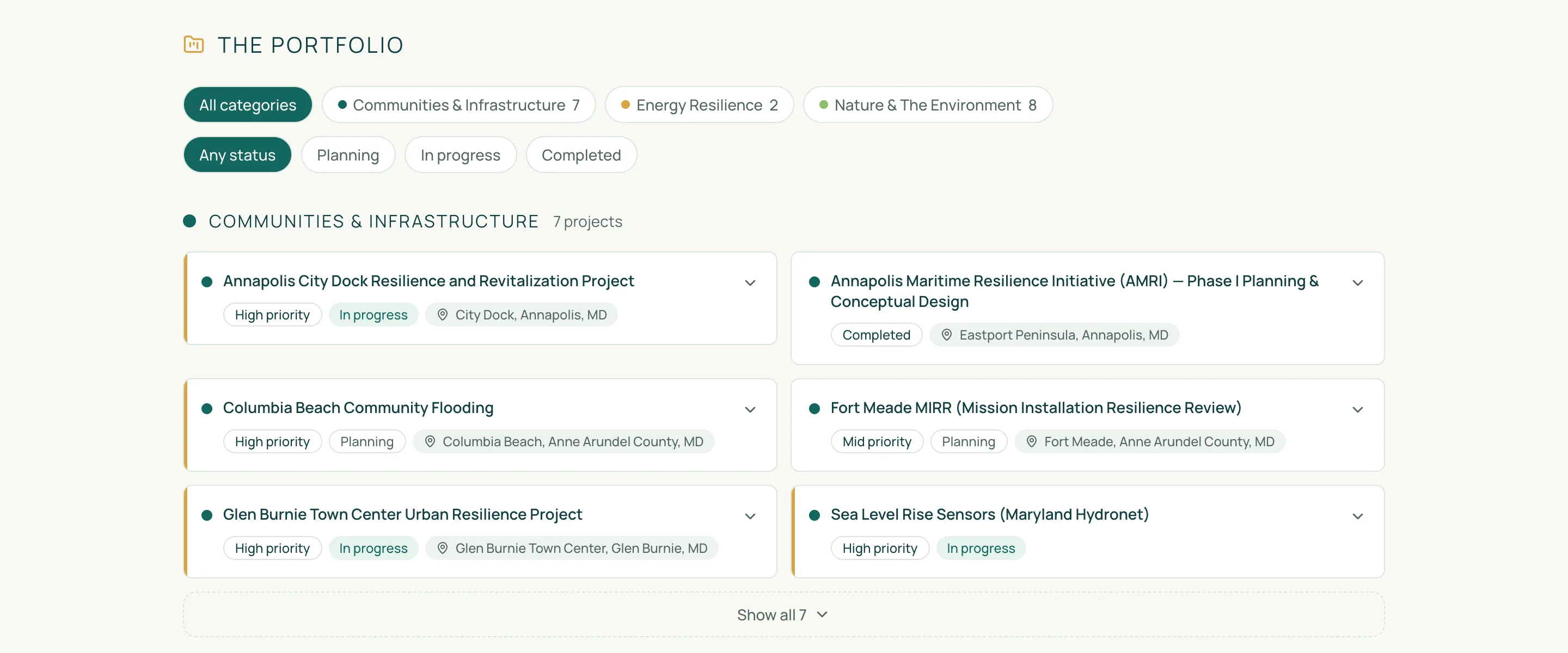
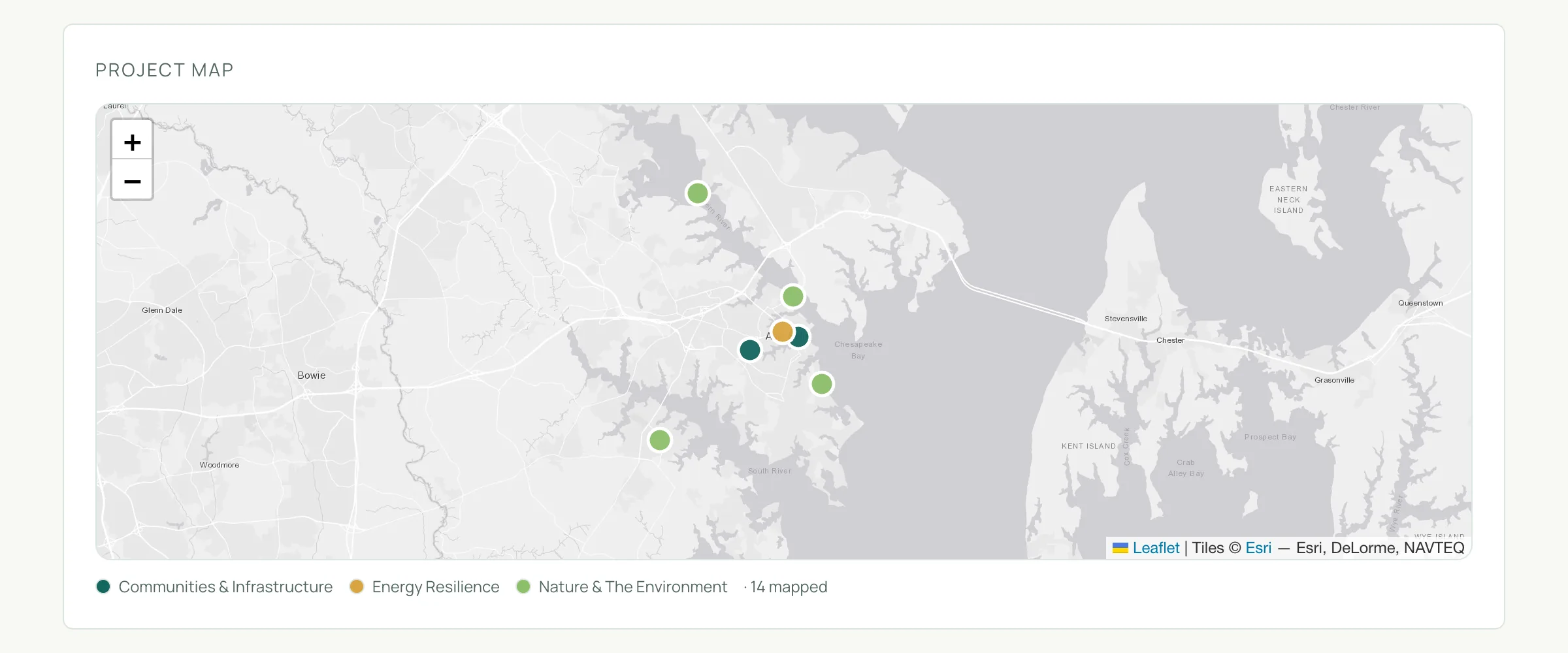
Aptation produces printed portfolio and project reports for the board, view-only links for partners, and a public portfolio and map for residents. Resilient & Ready Anne Arundel is that public portfolio for the Resilience Authority of Annapolis and Anne Arundel County.
Council Fire's climate resilience and energy and water infrastructure practices help municipalities and government agencies set the criteria, screens and funding strategy, and our RFP guide for a resilience funding strategy shows how to scope that work. When the capital process needs a system no product offers, Council Fire Labs builds it.
Frequently asked questions
01What is a climate-resilient capital improvement plan?
A climate-resilient capital improvement plan screens every proposed project for climate exposure, scores resilience alongside safety and asset condition, designs assets for the climate expected over their useful life, and phases resilience projects across fiscal years with named funding sources. Maryland's 2026 resilience strategy calls climate-informed capital planning an emerging best practice.
02How do you add climate risk to capital project scoring?
Add a weighted resilience criterion to the existing scoresheet, covering hazard exposure, consequence of failure and risk reduced, instead of keeping a separate list. GFOA has recommended scoring resilience in capital prioritization since 2008. Florida's statewide plan weights risk reduction at 40%. Our prioritization guide covers criteria and weights.
03Which governments screen capital projects for climate risk?
San Francisco screens projects over $10 million in its sea level rise zone before they enter its 10-year capital plan. New York City's design guidelines cover all City capital projects. Maryland's Coast Smart law covers projects at least 50% state-funded and $500,000 or more, and Florida ranks state-funded flood projects every year.
04What design life should resilience projects plan for?
Plan for the climate at the end of the asset's useful life. New York City's guidelines use 2080s projections for most buildings and 2100 and beyond for bridges, tunnels and sewers. FEMA's mitigation guide says projected sea level change over a project's useful life should be added when local freeboard rules fall short.
05How should resilience projects be phased in a capital plan?
Phase each project by the fiscal year its funding will realistically arrive, with every source named, and protect multiyear projects once they start. Florida's law requires that a multiyear project funded in year one be funded until complete. Federal grants can take years: Annapolis waited three years for a $33 million mitigation grant.
06How do cities pay for resilience capital projects?
With a mix of bonds, grants, local fees and dedicated revenue. Virginia Beach voters approved $567.5 million in flood protection bonds in 2021, and Miami's bond program puts $192 million toward sea level rise. FEMA mitigation grants generally cover up to 75% of eligible costs. Our funding guide covers local options.
07What software helps manage resilience in a capital plan?
Capital planning software handles budgets and schedules. Aptation is built for the resilience portfolio: it scores projects on a government's own criteria, links them to a funding library, tracks cost, awarded, spent and available funds by fiscal year, and shares progress through reports and a public portfolio. Council Fire Labs builds custom systems when needed.
Related Resources
Capital planning and prioritizing
- How to implement a hazard mitigation plan between updates: tracking mitigation actions between updates.
- How to measure climate resilience progress, honestly: reporting what the portfolio delivers.
- How to prioritize climate resilience projects that get done: criteria, weights and tiers.
- Climate risk assessment tool: a first screen for hazard exposure.
- Climate adaptation cost calculator: avoided losses and benefit-cost estimates by hazard.
- Coastal resilience and flood mitigation for municipalities: designing the projects.
Financing resilience
- What is a resilience authority, and when do you need one?: financing and delivery across jurisdictions.
- Funding resilience without federal grants: the local options when federal money stalls.
- Navigating federal climate funding in 2026: a resilience finance playbook for municipalities.
- How to finance green and nature-based infrastructure for municipalities: financing models for green infrastructure.
- Funding climate resilience guides: the programs and funding tools we track.
Proof and tools
- Annapolis Maritime Resilience Initiative: our work with the Resilience Authority.
- Maryland climate risk by county: hazard profiles for every county.
- Aptation: the resilience planning and delivery platform.
Get resilience into next year's capital plan
Send us your capital improvement plan and its scoring criteria. We will show you where a climate screen and a resilience criterion would fit, which projects they would move, and what funding each could reach. Talk to us on our contact page and choose Climate resilience or Software & AI (CF Labs).
About the Author
George Chmael II is Council Fire's Founder & CEO. He has led the firm since its founding and through its B Corp certification in 2010. Council Fire's climate resilience practice works with cities, counties, ports and authorities on planning, funding and delivery, and Council Fire Labs builds the software that holds that work together.
Cover photograph: Pexels — Gray Suspension Bridge Under Gray Sky, by Guilherme Rossi. Illustrative stock photograph, not a Council Fire project.



FAQ