
Sep 14, 2026
Green Bond Principles: Issuer Governance Guide
Governance
In This Article
Issuer controls for green bonds: eligibility policy, approval rights, proceeds tracking, and annual allocation and impact reporting.
Green Bond Principles: Issuer Governance Guide
A green bond program works only if I can prove three things: what counts, who approves it, and where the money goes. If those controls are weak, the green label can break down fast.
Here’s the short version: I need a written framework tied to the four ICMA Green Bond Principles - use of proceeds, project selection, proceeds tracking, and reporting. Then I need to connect that framework to board review, treasury rules, legal checks, finance records, and audit testing.
If I’m setting up or reviewing issuer governance, these are the main takeaways:
Write eligibility rules into policy. I need clear project categories, hard exclusions, and matching language across the framework and bond documents.
Set approval rights in advance. A green bond committee should review projects, keep records, and handle edge cases or removals.
Track proceeds with controls. I can use a subaccount, sub-portfolio, or internal coding, but the method must support reconciliation and audit trails.
Deal with unallocated proceeds in writing. I should state where funds can sit, who approves placements, and when full allocation is expected.
Report at least annually. Allocation updates, unallocated balances, and impact metrics should follow one timetable and one review chain.
Use outside review as a check. Pre-issuance and post-issuance review can test whether the framework and allocations match what investors were told.
A few facts anchor the process:
The GBP are built on 4 core parts
Reporting is expected at least once a year
Issuers often split duties across treasury, finance, legal, risk, sustainability, audit, and the board
The core point is simple: a green bond is not just a labeled debt issue. It is a control system. If I cannot show policy, approval records, cash tracking, and annual reporting, the program is weak no matter how strong the headline sounds.
Green Bond Principles Explained Simply (7 Minutes)
Use of Proceeds: Writing Eligibility Rules Into Issuer Policy
The GBP require an amount equal to the net proceeds to finance or refinance eligible green projects, and that commitment needs to show up in both the legal documentation and internal policy.[9] In practice, that means treasury, sustainability consulting, and legal should jointly own the eligibility matrix and review it on a set schedule, not just when a deal is about to launch.
Eligible Project Categories and Exclusion Criteria
The GBP recognize a broad range of eligible categories, including renewable energy, energy efficiency, clean transportation, pollution prevention and control, sustainable water and wastewater management, circular economy projects, green buildings, and climate change adaptation.[12] Each category should be tied to clear thresholds, certifications, or technical screens so teams are not left guessing what qualifies and what does not.
An exclusion list matters just as much. It should cover fossil fuel extraction and distribution, coal power, high-emissions projects, and any activity barred by law or international convention, using the exact same language in the Green Bond Framework and the bond documents.[11][15][16] That consistency keeps the rules from shifting between policy and execution. Exclusions should function as hard stop criteria in the approval process, not as broad statements that sit in the background.
These screens should flow straight into project review and approval.
Earmarking, Ring-Fencing, and Tracking Net Proceeds
Once the eligibility rules are on paper, the issuer needs a way to enforce them at the cash level. The GBP require the net proceeds, or an amount equal to them, to be credited to a subaccount, placed in a sub-portfolio, or tracked through a formal internal process tied to the issuer's lending and investment operations.[1][8][17] The tracked balance should then be reconciled on a regular basis to reflect allocations already made to eligible projects while the bond remains outstanding.[1][8][18]
There are a few common ways to do this:
Dedicated subaccount: Keeps green bond proceeds separate from general corporate cash and makes audit trails easier to maintain.[3][13][14]
Green sub-portfolio: Works well when proceeds move through existing lending or investment operations. The issuer assigns a pool of eligible assets equal in value to the net proceeds, even if the cash itself is commingled.[3][13][14]
Internal coding systems: Project codes or deal tags inside an ERP or treasury management platform link each eligible asset to the bond and support reporting.[13][14]
Cross-functional sign-off: Treasury, sustainability, legal, and finance confirm allocations through an approval workflow and management certification.[13][14]
Policy should also spell out permitted temporary investments, duration limits, and concentration limits.[9] It should name the person or committee that can approve redeployment and require disclosure of any unallocated balance in annual allocation reporting.[9]
Once proceeds are being tracked, the next governance question is simple: who reviews projects, and who has authority to approve allocations? Project review and fund management are where these policy rules start operating as day-to-day controls.
Project Review and Fund Management: Decision Rights, Controls, and Assurance
Once eligibility rules are set, governance moves from theory to authority: who can approve a project, who controls the proceeds, and who signs off on the evidence.
Project Evaluation and Selection Governance
The GBP expect issuers to use a clear, written process for project evaluation and selection. That process should cover environmental objectives, eligibility criteria, and the way material environmental and social risks are found and managed. In practice, that means the Green Bond Committee should have binding approval authority, not a loose advisory role.
A good committee structure spells out who sits at the table. That often includes the Head of Sustainability, Treasurer, Chief Risk Officer, and Legal Counsel. It should also set quorum rules, voting rules, and any veto rights. Just as important, the business units that bring projects forward should not be the same group that approves them. That separation helps keep decisions clean.
Each project should come with a standard approval file. At a minimum, that file should include:
an eligibility memo tied to the framework
a risk assessment
an impact estimate
a compliance check
A standard intake form and review checklist linked to the GBP makes decisions repeatable and easier to audit. It also gives external reviewers a clear paper trail.
This is the point where the Green Bond Principles stop being disclosure language and start acting like day-to-day operating rules.
If a project is borderline, high-risk, or disputed, the committee charter should send that decision to senior risk and legal leadership instead of leaving it with the sustainability team alone. Those approval records should then move straight into treasury controls and reconciliation.
The same documents and controls used at selection should carry through allocation and impact reporting. That continuity matters. If teams use one set of records for approval and another for reporting, gaps tend to show up fast.
Management of Proceeds and Temporary Unallocated Proceeds
Tracking proceeds is more than a treasury task. It is a core governance control.
Duties should be split across functions:
treasury allocates proceeds
finance reconciles them
internal audit tests the process
Temporary unallocated proceeds are common when a bond is issued before all funds are assigned. Because of that, issuers need a written policy that explains how those funds will be handled. The policy should name who can approve temporary placements. It should also require regular internal reports to the green bond committee showing the unallocated balance, the instruments holding it, and the expected timeline to full allocation.
Projects do not always stay eligible. A regulatory change, an operational shift, or a stakeholder controversy can knock a project out of scope. When that happens, the committee should already have a written removal and replacement process. That process should include scheduled eligibility reviews, clear triggers for ad hoc review, and a formal record of the committee’s decision to remove and replace the project, including dates, rationale, and responsible parties. Treasury should then update the allocation records, and finance should adjust the tracked balance to match.
External Review and Verification as Governance Tools
Independent review should test the same controls the committee relies on inside the organization.
External review pressure-tests the framework before issuance and confirms allocations after issuance. An SPO provider, brought in well before issuance, reviews whether the framework aligns with all four GBP components. The provider also looks at the strength of the project selection process and the issuer’s environmental risk controls. In other words, the review checks project selection, proceeds tracking, and reporting against the framework itself.
If the SPO provider finds gaps in the eligibility criteria or weak spots in the proceeds tracking method, the issuer has a chance to fix them before issuance instead of finding out later during post-issuance verification. Post-issuance verification then gives investors an independent check that allocations match framework commitments and that impact reporting reflects actual outcomes.
External review works best when it feeds back into internal governance rather than sitting off to the side as a separate compliance exercise. That loop helps keep internal policy in step with market guidance.
Reporting: Annual Allocation, Impact Metrics, and Ongoing Oversight
Governance does not stop once the bond is issued. Reporting creates the evidence trail for use-of-proceeds commitments and fund-management controls. In plain terms, it turns the framework from a set of promises into a repeatable oversight process.
Allocation Reporting and Disclosure of Unallocated Proceeds
The GBP expect issuers to update use-of-proceeds information at least once a year until all net proceeds are fully allocated.[2][28] Annual reporting should include financed projects or a portfolio-level summary, along with project descriptions, allocation amounts, and expected impact.[2][7][28]
Year-end reporting should also show any unallocated balance, explain how that amount is being held, and state when full allocation is expected.[10][27] Issuers should disclose changes in the pool of eligible assets too, including projects that no longer qualify under the framework and any new categories that have been added. That gives investors a clear view of how the portfolio changes over time.[2][5][1]
A good way to handle allocation data is to treat it like a controlled ledger. Treasury should own the balances, sustainability should confirm eligibility, and a cross-functional committee should approve the final report.[5][7] For U.S. public companies, folding these steps into SOX-style documentation makes it possible to test green bond data alongside normal financial reporting controls.[7][24]
Impact Reporting Methods, Assumptions, and Documentation
Choosing KPIs is not just a reporting task; it is a governance call. A cross-functional committee should approve the metric set, decide whether reporting will be based on expected or actual results, and document why those choices were made.[20][9][24] ICMA's Harmonised Framework for Impact Reporting gives issuers a practical starting point with common indicators such as annual energy savings in MWh, GHG emissions reduced or avoided in metric tons of CO₂e, and, for green buildings, final energy use in kWh/m² per year and annual GHG emissions in kg CO₂/m².[4][23][20][26][25]
Allocation reporting shows where the money went. Impact reporting shows what the money did. Each KPI needs a methodology note that spells out the baseline scenario, calculation formula, emission factors, data sources, and whether the result is measured or estimated.[20][5][24] That may sound technical, but it matters. If one year’s numbers are built one way and the next year’s numbers are built another way, trend lines can become shaky fast.
Version control is a big part of this. Methodology documents should be archived so any change from one reporting year to the next is fully traceable, which matters for trend analysis and external assurance.[21][22][9] U.S. issuers should also line up the reporting cut-off with the fiscal year-end so impact figures and allocation data use the same reporting date across financial and sustainability reports.[7][24]
Embedding Green Bond Reporting Into Enterprise Governance
The programs that last do not treat green bond reporting as a side project for investor relations. They place it inside the company’s main risk and disclosure system. Allocation and impact tables should sit in annual sustainability or ESG reports, while narrative disclosure should appear in annual financial reports or MD&A when the information is material. Eligibility drift, data-quality gaps, and impact shortfalls should be tracked in the enterprise risk register.[5][7] Internal audit and external auditors should also consider green bond data within the scope of non-financial reporting controls.[21][5][24]
Those disclosures then become the record reviewed by board committees each year. Reporting ownership should be assigned across treasury, sustainability, finance, legal, risk, internal audit, and the board through a clear approval and disclosure chain.
The reporting cycle should also match the fiscal year-end so governance, disclosure, and assurance all run on the same timetable. That cadence sets up the internal governance structure discussed next.
Aligning Internal Governance With Market Guidance and Key Takeaways
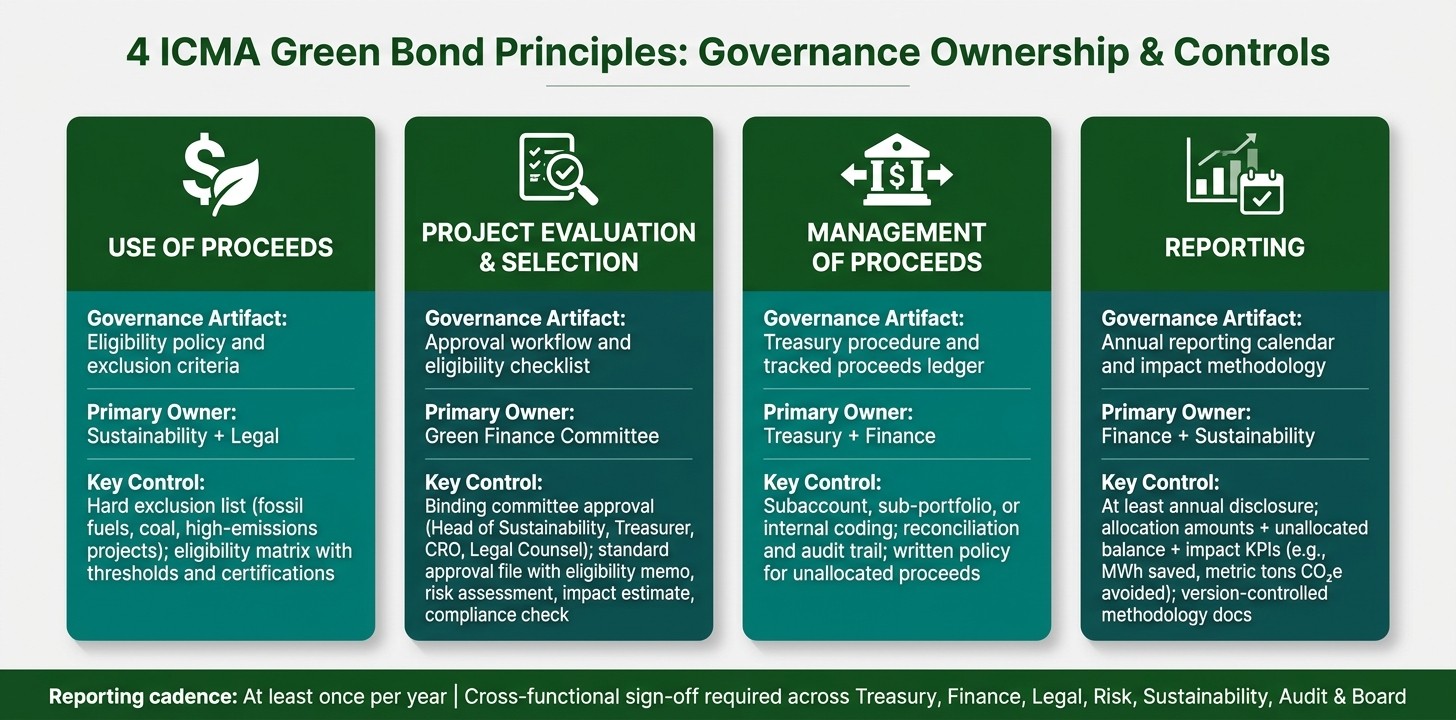
4 ICMA Green Bond Principles: Governance Ownership & Controls
Turning the Four Green Bond Principles Into an Operating Framework
Once reporting controls are set, the next move is to line up the Green Bond Framework with day-to-day governance. A single, board-approved Green Bond Framework can turn the four GBP pillars into clear policy, control, and reporting duties.[6][9][7] Keep those requirements in one controlled framework, then cross-reference it across policy, treasury, and disclosure documents. That keeps everyone working from the same playbook instead of chasing rules across separate files.
Cross-functional governance helps the framework stay steady over time. In practice, that usually means a Green Finance Committee led by the CFO or Treasurer, with responsibility for project approval, allocation sign-off, and report review.[4][19]
The table below shows how the four GBP pillars connect to internal ownership and control points. A simple rule helps here: assign each pillar to one owner and one control point.
GBP Pillar | Governance Artifact | Primary Owner |
|---|---|---|
Use of Proceeds | Eligibility policy and exclusion criteria | Sustainability + Legal |
Project Evaluation & Selection | Approval workflow and eligibility checklist | Green Finance Committee |
Management of Proceeds | Treasury procedure and tracked proceeds ledger | Treasury + Finance |
Reporting | Annual reporting calendar and impact methodology | Finance + Sustainability |
Use existing systems to track green bond allocations.[19][7]
Where Council Fire Can Support Issuers
After the operating model is defined, many issuers need help turning it into a process people can repeat without friction. That’s where Council Fire steps in. Council Fire helps issuers turn green bond strategy into an operating framework: policies, decision rights, workflows, and reporting routines aligned to climate, resilience, and circular-economy goals. The focus is practical execution, not documentation alone.
FAQs
Who should be on a green bond committee?
A Green Bond Committee, or a similar body, should include people from treasury, sustainability, and the business units tied to the projects under review.
That mix matters. A cross-functional group can assess and approve eligible projects, track them over time, and check that each one stays in line with the framework criteria. It also helps make sure bond proceeds remain properly earmarked for green initiatives, rather than drifting into general spending.
How should unallocated proceeds be handled?
Unallocated proceeds should sit in temporary investments that match the issuer’s green bond framework. That can include cash equivalents, money market instruments, or other green-labeled investments.
Issuers should keep a clear record of any unallocated balance and report it in annual allocation reports until all proceeds are deployed. The aim is to direct those funds to eligible green projects within 24 months.
What evidence do investors expect to see?
Investors want clear proof that green bond commitments are credible and not greenwashing. In practice, they usually look for a few things right away:
A green bond framework aligned with the ICMA Green Bond Principles
An external second-party opinion that reviews governance, project selection, and fit with the company’s strategy
Transparent annual reporting on both fund allocation and environmental impact
Independent third-party verification can add another layer of trust. So can a sustainability strategy that connects the bond to the issuer’s broader climate commitments. Together, these signals make it easier for investors to see that the bond is backed by more than good intentions.
Related Blog Posts
Latest Articles
©2025

Narrative Change and Power Building: The Missing Half of Advocacy
Narrative change is the process of disrupting dominant narratives that normalize inequity and advancing new narratives from historically marginalized communities.

Funding Resilience Without Federal Grants
BRIC is unreliable and FEMA is shrinking. Here's how cities fund climate resilience with dedicated revenue, blended finance, and a coordinating authority.

The ESG Blind Spot: How AI Is Finding Risks in Companies Nobody Else Is Watching
Norway's sovereign wealth fund uses AI to screen 7,200 portfolio companies for forced labor and corruption within 24 hours. The real story is the emerging-market coverage gap that traditional ESG data vendors miss — and what it means for any company with a global supply chain.
Narrative Change and Power Building: The Missing Half of Advocacy
Narrative change is the process of disrupting dominant narratives that normalize inequity and advancing new narratives from historically marginalized communities.
Funding Resilience Without Federal Grants
BRIC is unreliable and FEMA is shrinking. Here's how cities fund climate resilience with dedicated revenue, blended finance, and a coordinating authority.
The ESG Blind Spot: How AI Is Finding Risks in Companies Nobody Else Is Watching
Norway's sovereign wealth fund uses AI to screen 7,200 portfolio companies for forced labor and corruption within 24 hours. The real story is the emerging-market coverage gap that traditional ESG data vendors miss — and what it means for any company with a global supply chain.
FAQ
01
What does it really mean to “redefine profit”?
02
What makes Council Fire different?
03
Who does Council Fire work with?
04
What does working with Council Fire actually look like?
05
How does Council Fire help organizations turn big goals into action?
06
How does Council Fire define and measure success?
Sep 14, 2026
Green Bond Principles: Issuer Governance Guide
Governance
In This Article
Issuer controls for green bonds: eligibility policy, approval rights, proceeds tracking, and annual allocation and impact reporting.
Green Bond Principles: Issuer Governance Guide
A green bond program works only if I can prove three things: what counts, who approves it, and where the money goes. If those controls are weak, the green label can break down fast.
Here’s the short version: I need a written framework tied to the four ICMA Green Bond Principles - use of proceeds, project selection, proceeds tracking, and reporting. Then I need to connect that framework to board review, treasury rules, legal checks, finance records, and audit testing.
If I’m setting up or reviewing issuer governance, these are the main takeaways:
Write eligibility rules into policy. I need clear project categories, hard exclusions, and matching language across the framework and bond documents.
Set approval rights in advance. A green bond committee should review projects, keep records, and handle edge cases or removals.
Track proceeds with controls. I can use a subaccount, sub-portfolio, or internal coding, but the method must support reconciliation and audit trails.
Deal with unallocated proceeds in writing. I should state where funds can sit, who approves placements, and when full allocation is expected.
Report at least annually. Allocation updates, unallocated balances, and impact metrics should follow one timetable and one review chain.
Use outside review as a check. Pre-issuance and post-issuance review can test whether the framework and allocations match what investors were told.
A few facts anchor the process:
The GBP are built on 4 core parts
Reporting is expected at least once a year
Issuers often split duties across treasury, finance, legal, risk, sustainability, audit, and the board
The core point is simple: a green bond is not just a labeled debt issue. It is a control system. If I cannot show policy, approval records, cash tracking, and annual reporting, the program is weak no matter how strong the headline sounds.
Green Bond Principles Explained Simply (7 Minutes)
Use of Proceeds: Writing Eligibility Rules Into Issuer Policy
The GBP require an amount equal to the net proceeds to finance or refinance eligible green projects, and that commitment needs to show up in both the legal documentation and internal policy.[9] In practice, that means treasury, sustainability consulting, and legal should jointly own the eligibility matrix and review it on a set schedule, not just when a deal is about to launch.
Eligible Project Categories and Exclusion Criteria
The GBP recognize a broad range of eligible categories, including renewable energy, energy efficiency, clean transportation, pollution prevention and control, sustainable water and wastewater management, circular economy projects, green buildings, and climate change adaptation.[12] Each category should be tied to clear thresholds, certifications, or technical screens so teams are not left guessing what qualifies and what does not.
An exclusion list matters just as much. It should cover fossil fuel extraction and distribution, coal power, high-emissions projects, and any activity barred by law or international convention, using the exact same language in the Green Bond Framework and the bond documents.[11][15][16] That consistency keeps the rules from shifting between policy and execution. Exclusions should function as hard stop criteria in the approval process, not as broad statements that sit in the background.
These screens should flow straight into project review and approval.
Earmarking, Ring-Fencing, and Tracking Net Proceeds
Once the eligibility rules are on paper, the issuer needs a way to enforce them at the cash level. The GBP require the net proceeds, or an amount equal to them, to be credited to a subaccount, placed in a sub-portfolio, or tracked through a formal internal process tied to the issuer's lending and investment operations.[1][8][17] The tracked balance should then be reconciled on a regular basis to reflect allocations already made to eligible projects while the bond remains outstanding.[1][8][18]
There are a few common ways to do this:
Dedicated subaccount: Keeps green bond proceeds separate from general corporate cash and makes audit trails easier to maintain.[3][13][14]
Green sub-portfolio: Works well when proceeds move through existing lending or investment operations. The issuer assigns a pool of eligible assets equal in value to the net proceeds, even if the cash itself is commingled.[3][13][14]
Internal coding systems: Project codes or deal tags inside an ERP or treasury management platform link each eligible asset to the bond and support reporting.[13][14]
Cross-functional sign-off: Treasury, sustainability, legal, and finance confirm allocations through an approval workflow and management certification.[13][14]
Policy should also spell out permitted temporary investments, duration limits, and concentration limits.[9] It should name the person or committee that can approve redeployment and require disclosure of any unallocated balance in annual allocation reporting.[9]
Once proceeds are being tracked, the next governance question is simple: who reviews projects, and who has authority to approve allocations? Project review and fund management are where these policy rules start operating as day-to-day controls.
Project Review and Fund Management: Decision Rights, Controls, and Assurance
Once eligibility rules are set, governance moves from theory to authority: who can approve a project, who controls the proceeds, and who signs off on the evidence.
Project Evaluation and Selection Governance
The GBP expect issuers to use a clear, written process for project evaluation and selection. That process should cover environmental objectives, eligibility criteria, and the way material environmental and social risks are found and managed. In practice, that means the Green Bond Committee should have binding approval authority, not a loose advisory role.
A good committee structure spells out who sits at the table. That often includes the Head of Sustainability, Treasurer, Chief Risk Officer, and Legal Counsel. It should also set quorum rules, voting rules, and any veto rights. Just as important, the business units that bring projects forward should not be the same group that approves them. That separation helps keep decisions clean.
Each project should come with a standard approval file. At a minimum, that file should include:
an eligibility memo tied to the framework
a risk assessment
an impact estimate
a compliance check
A standard intake form and review checklist linked to the GBP makes decisions repeatable and easier to audit. It also gives external reviewers a clear paper trail.
This is the point where the Green Bond Principles stop being disclosure language and start acting like day-to-day operating rules.
If a project is borderline, high-risk, or disputed, the committee charter should send that decision to senior risk and legal leadership instead of leaving it with the sustainability team alone. Those approval records should then move straight into treasury controls and reconciliation.
The same documents and controls used at selection should carry through allocation and impact reporting. That continuity matters. If teams use one set of records for approval and another for reporting, gaps tend to show up fast.
Management of Proceeds and Temporary Unallocated Proceeds
Tracking proceeds is more than a treasury task. It is a core governance control.
Duties should be split across functions:
treasury allocates proceeds
finance reconciles them
internal audit tests the process
Temporary unallocated proceeds are common when a bond is issued before all funds are assigned. Because of that, issuers need a written policy that explains how those funds will be handled. The policy should name who can approve temporary placements. It should also require regular internal reports to the green bond committee showing the unallocated balance, the instruments holding it, and the expected timeline to full allocation.
Projects do not always stay eligible. A regulatory change, an operational shift, or a stakeholder controversy can knock a project out of scope. When that happens, the committee should already have a written removal and replacement process. That process should include scheduled eligibility reviews, clear triggers for ad hoc review, and a formal record of the committee’s decision to remove and replace the project, including dates, rationale, and responsible parties. Treasury should then update the allocation records, and finance should adjust the tracked balance to match.
External Review and Verification as Governance Tools
Independent review should test the same controls the committee relies on inside the organization.
External review pressure-tests the framework before issuance and confirms allocations after issuance. An SPO provider, brought in well before issuance, reviews whether the framework aligns with all four GBP components. The provider also looks at the strength of the project selection process and the issuer’s environmental risk controls. In other words, the review checks project selection, proceeds tracking, and reporting against the framework itself.
If the SPO provider finds gaps in the eligibility criteria or weak spots in the proceeds tracking method, the issuer has a chance to fix them before issuance instead of finding out later during post-issuance verification. Post-issuance verification then gives investors an independent check that allocations match framework commitments and that impact reporting reflects actual outcomes.
External review works best when it feeds back into internal governance rather than sitting off to the side as a separate compliance exercise. That loop helps keep internal policy in step with market guidance.
Reporting: Annual Allocation, Impact Metrics, and Ongoing Oversight
Governance does not stop once the bond is issued. Reporting creates the evidence trail for use-of-proceeds commitments and fund-management controls. In plain terms, it turns the framework from a set of promises into a repeatable oversight process.
Allocation Reporting and Disclosure of Unallocated Proceeds
The GBP expect issuers to update use-of-proceeds information at least once a year until all net proceeds are fully allocated.[2][28] Annual reporting should include financed projects or a portfolio-level summary, along with project descriptions, allocation amounts, and expected impact.[2][7][28]
Year-end reporting should also show any unallocated balance, explain how that amount is being held, and state when full allocation is expected.[10][27] Issuers should disclose changes in the pool of eligible assets too, including projects that no longer qualify under the framework and any new categories that have been added. That gives investors a clear view of how the portfolio changes over time.[2][5][1]
A good way to handle allocation data is to treat it like a controlled ledger. Treasury should own the balances, sustainability should confirm eligibility, and a cross-functional committee should approve the final report.[5][7] For U.S. public companies, folding these steps into SOX-style documentation makes it possible to test green bond data alongside normal financial reporting controls.[7][24]
Impact Reporting Methods, Assumptions, and Documentation
Choosing KPIs is not just a reporting task; it is a governance call. A cross-functional committee should approve the metric set, decide whether reporting will be based on expected or actual results, and document why those choices were made.[20][9][24] ICMA's Harmonised Framework for Impact Reporting gives issuers a practical starting point with common indicators such as annual energy savings in MWh, GHG emissions reduced or avoided in metric tons of CO₂e, and, for green buildings, final energy use in kWh/m² per year and annual GHG emissions in kg CO₂/m².[4][23][20][26][25]
Allocation reporting shows where the money went. Impact reporting shows what the money did. Each KPI needs a methodology note that spells out the baseline scenario, calculation formula, emission factors, data sources, and whether the result is measured or estimated.[20][5][24] That may sound technical, but it matters. If one year’s numbers are built one way and the next year’s numbers are built another way, trend lines can become shaky fast.
Version control is a big part of this. Methodology documents should be archived so any change from one reporting year to the next is fully traceable, which matters for trend analysis and external assurance.[21][22][9] U.S. issuers should also line up the reporting cut-off with the fiscal year-end so impact figures and allocation data use the same reporting date across financial and sustainability reports.[7][24]
Embedding Green Bond Reporting Into Enterprise Governance
The programs that last do not treat green bond reporting as a side project for investor relations. They place it inside the company’s main risk and disclosure system. Allocation and impact tables should sit in annual sustainability or ESG reports, while narrative disclosure should appear in annual financial reports or MD&A when the information is material. Eligibility drift, data-quality gaps, and impact shortfalls should be tracked in the enterprise risk register.[5][7] Internal audit and external auditors should also consider green bond data within the scope of non-financial reporting controls.[21][5][24]
Those disclosures then become the record reviewed by board committees each year. Reporting ownership should be assigned across treasury, sustainability, finance, legal, risk, internal audit, and the board through a clear approval and disclosure chain.
The reporting cycle should also match the fiscal year-end so governance, disclosure, and assurance all run on the same timetable. That cadence sets up the internal governance structure discussed next.
Aligning Internal Governance With Market Guidance and Key Takeaways
4 ICMA Green Bond Principles: Governance Ownership & Controls
Turning the Four Green Bond Principles Into an Operating Framework
Once reporting controls are set, the next move is to line up the Green Bond Framework with day-to-day governance. A single, board-approved Green Bond Framework can turn the four GBP pillars into clear policy, control, and reporting duties.[6][9][7] Keep those requirements in one controlled framework, then cross-reference it across policy, treasury, and disclosure documents. That keeps everyone working from the same playbook instead of chasing rules across separate files.
Cross-functional governance helps the framework stay steady over time. In practice, that usually means a Green Finance Committee led by the CFO or Treasurer, with responsibility for project approval, allocation sign-off, and report review.[4][19]
The table below shows how the four GBP pillars connect to internal ownership and control points. A simple rule helps here: assign each pillar to one owner and one control point.
GBP Pillar | Governance Artifact | Primary Owner |
|---|---|---|
Use of Proceeds | Eligibility policy and exclusion criteria | Sustainability + Legal |
Project Evaluation & Selection | Approval workflow and eligibility checklist | Green Finance Committee |
Management of Proceeds | Treasury procedure and tracked proceeds ledger | Treasury + Finance |
Reporting | Annual reporting calendar and impact methodology | Finance + Sustainability |
Use existing systems to track green bond allocations.[19][7]
Where Council Fire Can Support Issuers
After the operating model is defined, many issuers need help turning it into a process people can repeat without friction. That’s where Council Fire steps in. Council Fire helps issuers turn green bond strategy into an operating framework: policies, decision rights, workflows, and reporting routines aligned to climate, resilience, and circular-economy goals. The focus is practical execution, not documentation alone.
FAQs
Who should be on a green bond committee?
A Green Bond Committee, or a similar body, should include people from treasury, sustainability, and the business units tied to the projects under review.
That mix matters. A cross-functional group can assess and approve eligible projects, track them over time, and check that each one stays in line with the framework criteria. It also helps make sure bond proceeds remain properly earmarked for green initiatives, rather than drifting into general spending.
How should unallocated proceeds be handled?
Unallocated proceeds should sit in temporary investments that match the issuer’s green bond framework. That can include cash equivalents, money market instruments, or other green-labeled investments.
Issuers should keep a clear record of any unallocated balance and report it in annual allocation reports until all proceeds are deployed. The aim is to direct those funds to eligible green projects within 24 months.
What evidence do investors expect to see?
Investors want clear proof that green bond commitments are credible and not greenwashing. In practice, they usually look for a few things right away:
A green bond framework aligned with the ICMA Green Bond Principles
An external second-party opinion that reviews governance, project selection, and fit with the company’s strategy
Transparent annual reporting on both fund allocation and environmental impact
Independent third-party verification can add another layer of trust. So can a sustainability strategy that connects the bond to the issuer’s broader climate commitments. Together, these signals make it easier for investors to see that the bond is backed by more than good intentions.
Related Blog Posts
Latest Articles
©2025
Narrative Change and Power Building: The Missing Half of Advocacy
Narrative change is the process of disrupting dominant narratives that normalize inequity and advancing new narratives from historically marginalized communities.
Funding Resilience Without Federal Grants
BRIC is unreliable and FEMA is shrinking. Here's how cities fund climate resilience with dedicated revenue, blended finance, and a coordinating authority.
The ESG Blind Spot: How AI Is Finding Risks in Companies Nobody Else Is Watching
Norway's sovereign wealth fund uses AI to screen 7,200 portfolio companies for forced labor and corruption within 24 hours. The real story is the emerging-market coverage gap that traditional ESG data vendors miss — and what it means for any company with a global supply chain.
FAQ
01
What does it really mean to “redefine profit”?
02
What makes Council Fire different?
03
Who does Council Fire work with?
04
What does working with Council Fire actually look like?
05
How does Council Fire help organizations turn big goals into action?
06
How does Council Fire define and measure success?
Sep 14, 2026
Green Bond Principles: Issuer Governance Guide
Governance
In This Article
Issuer controls for green bonds: eligibility policy, approval rights, proceeds tracking, and annual allocation and impact reporting.
Green Bond Principles: Issuer Governance Guide
A green bond program works only if I can prove three things: what counts, who approves it, and where the money goes. If those controls are weak, the green label can break down fast.
Here’s the short version: I need a written framework tied to the four ICMA Green Bond Principles - use of proceeds, project selection, proceeds tracking, and reporting. Then I need to connect that framework to board review, treasury rules, legal checks, finance records, and audit testing.
If I’m setting up or reviewing issuer governance, these are the main takeaways:
Write eligibility rules into policy. I need clear project categories, hard exclusions, and matching language across the framework and bond documents.
Set approval rights in advance. A green bond committee should review projects, keep records, and handle edge cases or removals.
Track proceeds with controls. I can use a subaccount, sub-portfolio, or internal coding, but the method must support reconciliation and audit trails.
Deal with unallocated proceeds in writing. I should state where funds can sit, who approves placements, and when full allocation is expected.
Report at least annually. Allocation updates, unallocated balances, and impact metrics should follow one timetable and one review chain.
Use outside review as a check. Pre-issuance and post-issuance review can test whether the framework and allocations match what investors were told.
A few facts anchor the process:
The GBP are built on 4 core parts
Reporting is expected at least once a year
Issuers often split duties across treasury, finance, legal, risk, sustainability, audit, and the board
The core point is simple: a green bond is not just a labeled debt issue. It is a control system. If I cannot show policy, approval records, cash tracking, and annual reporting, the program is weak no matter how strong the headline sounds.
Green Bond Principles Explained Simply (7 Minutes)
Use of Proceeds: Writing Eligibility Rules Into Issuer Policy
The GBP require an amount equal to the net proceeds to finance or refinance eligible green projects, and that commitment needs to show up in both the legal documentation and internal policy.[9] In practice, that means treasury, sustainability consulting, and legal should jointly own the eligibility matrix and review it on a set schedule, not just when a deal is about to launch.
Eligible Project Categories and Exclusion Criteria
The GBP recognize a broad range of eligible categories, including renewable energy, energy efficiency, clean transportation, pollution prevention and control, sustainable water and wastewater management, circular economy projects, green buildings, and climate change adaptation.[12] Each category should be tied to clear thresholds, certifications, or technical screens so teams are not left guessing what qualifies and what does not.
An exclusion list matters just as much. It should cover fossil fuel extraction and distribution, coal power, high-emissions projects, and any activity barred by law or international convention, using the exact same language in the Green Bond Framework and the bond documents.[11][15][16] That consistency keeps the rules from shifting between policy and execution. Exclusions should function as hard stop criteria in the approval process, not as broad statements that sit in the background.
These screens should flow straight into project review and approval.
Earmarking, Ring-Fencing, and Tracking Net Proceeds
Once the eligibility rules are on paper, the issuer needs a way to enforce them at the cash level. The GBP require the net proceeds, or an amount equal to them, to be credited to a subaccount, placed in a sub-portfolio, or tracked through a formal internal process tied to the issuer's lending and investment operations.[1][8][17] The tracked balance should then be reconciled on a regular basis to reflect allocations already made to eligible projects while the bond remains outstanding.[1][8][18]
There are a few common ways to do this:
Dedicated subaccount: Keeps green bond proceeds separate from general corporate cash and makes audit trails easier to maintain.[3][13][14]
Green sub-portfolio: Works well when proceeds move through existing lending or investment operations. The issuer assigns a pool of eligible assets equal in value to the net proceeds, even if the cash itself is commingled.[3][13][14]
Internal coding systems: Project codes or deal tags inside an ERP or treasury management platform link each eligible asset to the bond and support reporting.[13][14]
Cross-functional sign-off: Treasury, sustainability, legal, and finance confirm allocations through an approval workflow and management certification.[13][14]
Policy should also spell out permitted temporary investments, duration limits, and concentration limits.[9] It should name the person or committee that can approve redeployment and require disclosure of any unallocated balance in annual allocation reporting.[9]
Once proceeds are being tracked, the next governance question is simple: who reviews projects, and who has authority to approve allocations? Project review and fund management are where these policy rules start operating as day-to-day controls.
Project Review and Fund Management: Decision Rights, Controls, and Assurance
Once eligibility rules are set, governance moves from theory to authority: who can approve a project, who controls the proceeds, and who signs off on the evidence.
Project Evaluation and Selection Governance
The GBP expect issuers to use a clear, written process for project evaluation and selection. That process should cover environmental objectives, eligibility criteria, and the way material environmental and social risks are found and managed. In practice, that means the Green Bond Committee should have binding approval authority, not a loose advisory role.
A good committee structure spells out who sits at the table. That often includes the Head of Sustainability, Treasurer, Chief Risk Officer, and Legal Counsel. It should also set quorum rules, voting rules, and any veto rights. Just as important, the business units that bring projects forward should not be the same group that approves them. That separation helps keep decisions clean.
Each project should come with a standard approval file. At a minimum, that file should include:
an eligibility memo tied to the framework
a risk assessment
an impact estimate
a compliance check
A standard intake form and review checklist linked to the GBP makes decisions repeatable and easier to audit. It also gives external reviewers a clear paper trail.
This is the point where the Green Bond Principles stop being disclosure language and start acting like day-to-day operating rules.
If a project is borderline, high-risk, or disputed, the committee charter should send that decision to senior risk and legal leadership instead of leaving it with the sustainability team alone. Those approval records should then move straight into treasury controls and reconciliation.
The same documents and controls used at selection should carry through allocation and impact reporting. That continuity matters. If teams use one set of records for approval and another for reporting, gaps tend to show up fast.
Management of Proceeds and Temporary Unallocated Proceeds
Tracking proceeds is more than a treasury task. It is a core governance control.
Duties should be split across functions:
treasury allocates proceeds
finance reconciles them
internal audit tests the process
Temporary unallocated proceeds are common when a bond is issued before all funds are assigned. Because of that, issuers need a written policy that explains how those funds will be handled. The policy should name who can approve temporary placements. It should also require regular internal reports to the green bond committee showing the unallocated balance, the instruments holding it, and the expected timeline to full allocation.
Projects do not always stay eligible. A regulatory change, an operational shift, or a stakeholder controversy can knock a project out of scope. When that happens, the committee should already have a written removal and replacement process. That process should include scheduled eligibility reviews, clear triggers for ad hoc review, and a formal record of the committee’s decision to remove and replace the project, including dates, rationale, and responsible parties. Treasury should then update the allocation records, and finance should adjust the tracked balance to match.
External Review and Verification as Governance Tools
Independent review should test the same controls the committee relies on inside the organization.
External review pressure-tests the framework before issuance and confirms allocations after issuance. An SPO provider, brought in well before issuance, reviews whether the framework aligns with all four GBP components. The provider also looks at the strength of the project selection process and the issuer’s environmental risk controls. In other words, the review checks project selection, proceeds tracking, and reporting against the framework itself.
If the SPO provider finds gaps in the eligibility criteria or weak spots in the proceeds tracking method, the issuer has a chance to fix them before issuance instead of finding out later during post-issuance verification. Post-issuance verification then gives investors an independent check that allocations match framework commitments and that impact reporting reflects actual outcomes.
External review works best when it feeds back into internal governance rather than sitting off to the side as a separate compliance exercise. That loop helps keep internal policy in step with market guidance.
Reporting: Annual Allocation, Impact Metrics, and Ongoing Oversight
Governance does not stop once the bond is issued. Reporting creates the evidence trail for use-of-proceeds commitments and fund-management controls. In plain terms, it turns the framework from a set of promises into a repeatable oversight process.
Allocation Reporting and Disclosure of Unallocated Proceeds
The GBP expect issuers to update use-of-proceeds information at least once a year until all net proceeds are fully allocated.[2][28] Annual reporting should include financed projects or a portfolio-level summary, along with project descriptions, allocation amounts, and expected impact.[2][7][28]
Year-end reporting should also show any unallocated balance, explain how that amount is being held, and state when full allocation is expected.[10][27] Issuers should disclose changes in the pool of eligible assets too, including projects that no longer qualify under the framework and any new categories that have been added. That gives investors a clear view of how the portfolio changes over time.[2][5][1]
A good way to handle allocation data is to treat it like a controlled ledger. Treasury should own the balances, sustainability should confirm eligibility, and a cross-functional committee should approve the final report.[5][7] For U.S. public companies, folding these steps into SOX-style documentation makes it possible to test green bond data alongside normal financial reporting controls.[7][24]
Impact Reporting Methods, Assumptions, and Documentation
Choosing KPIs is not just a reporting task; it is a governance call. A cross-functional committee should approve the metric set, decide whether reporting will be based on expected or actual results, and document why those choices were made.[20][9][24] ICMA's Harmonised Framework for Impact Reporting gives issuers a practical starting point with common indicators such as annual energy savings in MWh, GHG emissions reduced or avoided in metric tons of CO₂e, and, for green buildings, final energy use in kWh/m² per year and annual GHG emissions in kg CO₂/m².[4][23][20][26][25]
Allocation reporting shows where the money went. Impact reporting shows what the money did. Each KPI needs a methodology note that spells out the baseline scenario, calculation formula, emission factors, data sources, and whether the result is measured or estimated.[20][5][24] That may sound technical, but it matters. If one year’s numbers are built one way and the next year’s numbers are built another way, trend lines can become shaky fast.
Version control is a big part of this. Methodology documents should be archived so any change from one reporting year to the next is fully traceable, which matters for trend analysis and external assurance.[21][22][9] U.S. issuers should also line up the reporting cut-off with the fiscal year-end so impact figures and allocation data use the same reporting date across financial and sustainability reports.[7][24]
Embedding Green Bond Reporting Into Enterprise Governance
The programs that last do not treat green bond reporting as a side project for investor relations. They place it inside the company’s main risk and disclosure system. Allocation and impact tables should sit in annual sustainability or ESG reports, while narrative disclosure should appear in annual financial reports or MD&A when the information is material. Eligibility drift, data-quality gaps, and impact shortfalls should be tracked in the enterprise risk register.[5][7] Internal audit and external auditors should also consider green bond data within the scope of non-financial reporting controls.[21][5][24]
Those disclosures then become the record reviewed by board committees each year. Reporting ownership should be assigned across treasury, sustainability, finance, legal, risk, internal audit, and the board through a clear approval and disclosure chain.
The reporting cycle should also match the fiscal year-end so governance, disclosure, and assurance all run on the same timetable. That cadence sets up the internal governance structure discussed next.
Aligning Internal Governance With Market Guidance and Key Takeaways
4 ICMA Green Bond Principles: Governance Ownership & Controls
Turning the Four Green Bond Principles Into an Operating Framework
Once reporting controls are set, the next move is to line up the Green Bond Framework with day-to-day governance. A single, board-approved Green Bond Framework can turn the four GBP pillars into clear policy, control, and reporting duties.[6][9][7] Keep those requirements in one controlled framework, then cross-reference it across policy, treasury, and disclosure documents. That keeps everyone working from the same playbook instead of chasing rules across separate files.
Cross-functional governance helps the framework stay steady over time. In practice, that usually means a Green Finance Committee led by the CFO or Treasurer, with responsibility for project approval, allocation sign-off, and report review.[4][19]
The table below shows how the four GBP pillars connect to internal ownership and control points. A simple rule helps here: assign each pillar to one owner and one control point.
GBP Pillar | Governance Artifact | Primary Owner |
|---|---|---|
Use of Proceeds | Eligibility policy and exclusion criteria | Sustainability + Legal |
Project Evaluation & Selection | Approval workflow and eligibility checklist | Green Finance Committee |
Management of Proceeds | Treasury procedure and tracked proceeds ledger | Treasury + Finance |
Reporting | Annual reporting calendar and impact methodology | Finance + Sustainability |
Use existing systems to track green bond allocations.[19][7]
Where Council Fire Can Support Issuers
After the operating model is defined, many issuers need help turning it into a process people can repeat without friction. That’s where Council Fire steps in. Council Fire helps issuers turn green bond strategy into an operating framework: policies, decision rights, workflows, and reporting routines aligned to climate, resilience, and circular-economy goals. The focus is practical execution, not documentation alone.
FAQs
Who should be on a green bond committee?
A Green Bond Committee, or a similar body, should include people from treasury, sustainability, and the business units tied to the projects under review.
That mix matters. A cross-functional group can assess and approve eligible projects, track them over time, and check that each one stays in line with the framework criteria. It also helps make sure bond proceeds remain properly earmarked for green initiatives, rather than drifting into general spending.
How should unallocated proceeds be handled?
Unallocated proceeds should sit in temporary investments that match the issuer’s green bond framework. That can include cash equivalents, money market instruments, or other green-labeled investments.
Issuers should keep a clear record of any unallocated balance and report it in annual allocation reports until all proceeds are deployed. The aim is to direct those funds to eligible green projects within 24 months.
What evidence do investors expect to see?
Investors want clear proof that green bond commitments are credible and not greenwashing. In practice, they usually look for a few things right away:
A green bond framework aligned with the ICMA Green Bond Principles
An external second-party opinion that reviews governance, project selection, and fit with the company’s strategy
Transparent annual reporting on both fund allocation and environmental impact
Independent third-party verification can add another layer of trust. So can a sustainability strategy that connects the bond to the issuer’s broader climate commitments. Together, these signals make it easier for investors to see that the bond is backed by more than good intentions.
Related Blog Posts
Latest Articles
©2025
Narrative Change and Power Building: The Missing Half of Advocacy
Narrative change is the process of disrupting dominant narratives that normalize inequity and advancing new narratives from historically marginalized communities.
Funding Resilience Without Federal Grants
BRIC is unreliable and FEMA is shrinking. Here's how cities fund climate resilience with dedicated revenue, blended finance, and a coordinating authority.
The ESG Blind Spot: How AI Is Finding Risks in Companies Nobody Else Is Watching
Norway's sovereign wealth fund uses AI to screen 7,200 portfolio companies for forced labor and corruption within 24 hours. The real story is the emerging-market coverage gap that traditional ESG data vendors miss — and what it means for any company with a global supply chain.
FAQ
What does it really mean to “redefine profit”?
What makes Council Fire different?
Who does Council Fire work with?
What does working with Council Fire actually look like?
How does Council Fire help organizations turn big goals into action?
How does Council Fire define and measure success?