May 1, 2026
How to Finance Green and Nature-Based Infrastructure for Municipalities & Government Agencies
Sustainability Strategy
In This Article
Layer federal grants, SRFs, bonds, PPPs and impact investments to fund municipal green and nature-based infrastructure.
How to Finance Green and Nature-Based Infrastructure for Municipalities & Government Agencies
Municipalities and government agencies often struggle to fund green and nature-based infrastructure projects like urban forests, wetland restoration, and sponge parks. These initiatives offer broad benefits - stormwater management, urban cooling, and climate resilience - but lack clear revenue models, making them harder to finance compared to conventional infrastructure. This guide provides practical funding strategies, including:
Federal Grants: Programs like the Clean Water State Revolving Fund and Climate Pollution Reduction Grants offer billions in funding, especially for underserved communities.
State Revolving Funds (SRFs): Low-interest loans for wastewater, stormwater, and drinking water projects, with options for green initiatives.
Municipal Bonds: Tax-exempt General Obligation and Revenue Bonds can fund large-scale projects.
Stormwater Fees: A steady revenue stream for green infrastructure maintenance.
Public-Private Partnerships (PPPs): Collaboration with private investors to share costs and risks.
Impact Investments: Environmental Impact Bonds (EIBs) tie financial returns to measurable outcomes.
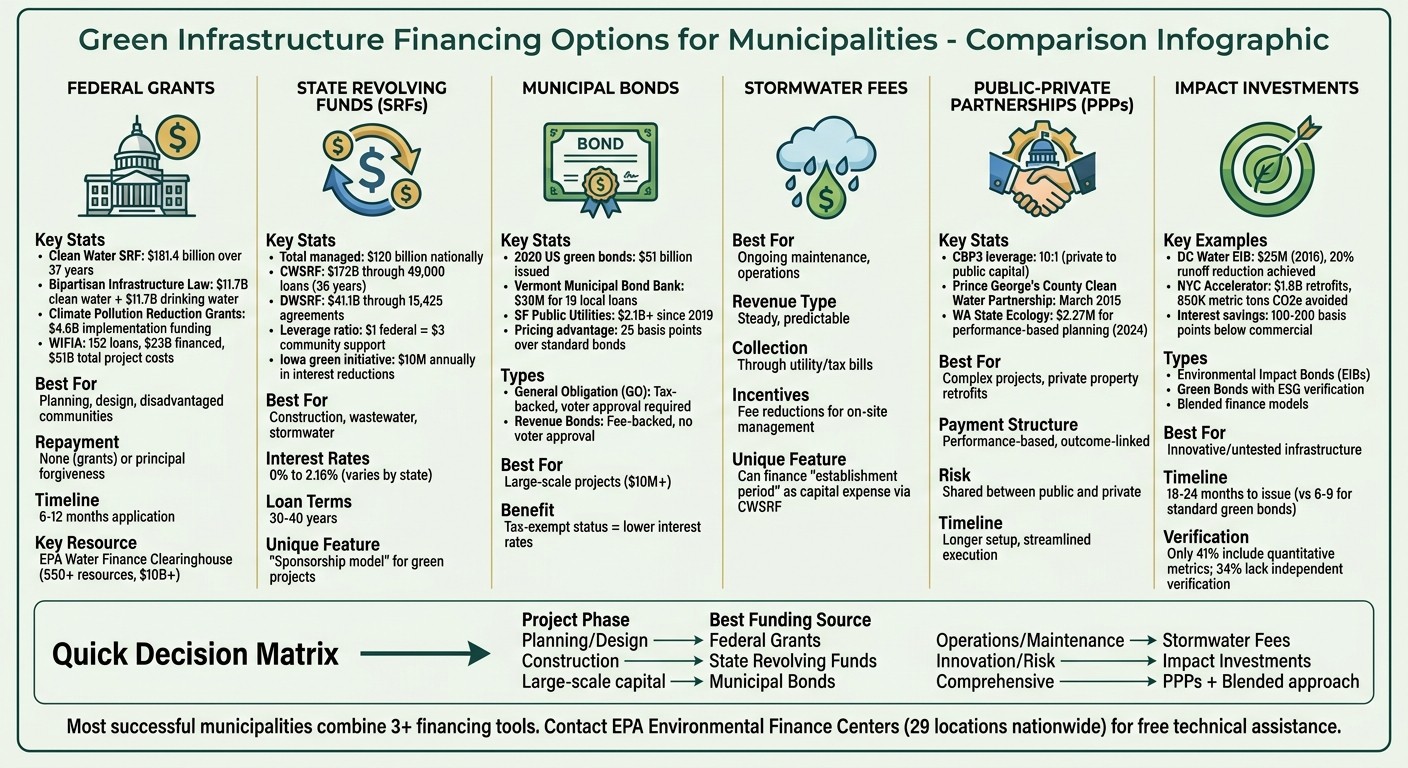
Green Infrastructure Financing Options Comparison for Municipalities
Federal Grants and Programs for Green Infrastructure
Federal programs play a key role in helping municipalities advance green infrastructure projects, especially when local budgets fall short. Over the past 37 years, the Clean Water State Revolving Fund has provided $181.4 billion to municipalities for such initiatives [4]. More recently, the 2021 Bipartisan Infrastructure Law allocated an additional $11.7 billion for clean water projects and another $11.7 billion for drinking water infrastructure [4][6]. Almost half of this funding is earmarked for underserved or disadvantaged communities, often distributed as grants or loans with principal forgiveness [6].
To begin exploring funding opportunities, municipalities can use the EPA Water Finance Clearinghouse, a searchable database featuring over $10 billion in water funding sources and more than 550 resources [2]. Free technical assistance for application preparation is also available through one of the 29 Environmental Finance Centers located across the country [2]. Additionally, the EPA offers specific grant programs that address both water quality and climate resilience.
EPA Grant Programs
The EPA manages several grant programs tailored to green infrastructure needs. One example is the Section 319 Nonpoint Source Grants, which fund projects aimed at controlling pollution from stormwater runoff. These grants support efforts like bioretention systems and wetland restoration through technical assistance, education, and demonstration initiatives [5].
Another key opportunity is the Climate Pollution Reduction Grants (CPRG) program, which offers $250 million for planning and nearly $4.6 billion for implementation [7]. In November 2024, the EPA awarded over $4.3 billion to 25 state, local, and Tribal recipients through the CPRG Implementation Grants General Competition [7]. These funds are designed to support community-driven projects that reduce greenhouse gas emissions and air pollution, such as urban forests and other nature-based solutions. States and Metropolitan Statistical Areas now have until June 1, 2026, to submit their Comprehensive Climate Action Plans [7].
Other Federal Funding Sources
Municipalities can also tap into funding beyond EPA programs. FEMA's Building Resilient Infrastructure and Communities (BRIC) program and USDA conservation funding are valuable resources. Additionally, the Water Infrastructure Finance and Innovation Act (WIFIA) offers long-term, low-cost loans for large-scale water and wastewater projects. To date, WIFIA has closed 152 loans, financing $23 billion and supporting $51 billion in project costs [3]. For example, in April 2026, the EPA approved a $34 million WIFIA loan for Daly City, California, to enhance its water infrastructure [3].
To access WIFIA funding, municipalities must submit a Letter of Interest [3]. For most federal grants, registration on Grants.gov is required. This platform serves as the main hub for finding and applying for discretionary federal funding [5]. Before applying, ensure that your municipality has a Unique Entity Identifier (UEI) and active registration in the Federal System for Award Management (SAM) [8].
State Revolving Funds as a Financing Tool
State Revolving Funds (SRFs) are state-operated programs offering low-interest loans for water infrastructure projects. These funds are part of a federal–state partnership where the EPA provides initial grants, which states then match by 20% to grow the available funding pool[10]. The revolving nature of these funds allows every $1 of federal funding to generate about $3 in community support[10]. Across the nation, SRF programs collectively manage around $120 billion[10]. They are divided into two key programs: one for wastewater management and another for safe drinking water.
The SRFs are categorized into the Clean Water State Revolving Fund (CWSRF), which focuses on wastewater and stormwater projects, and the Drinking Water State Revolving Fund (DWSRF), which supports safe drinking water systems[10]. While traditionally used for infrastructure like pipelines and treatment plants, SRFs are increasingly applied to nature-based solutions, such as land conservation, managing nonpoint source pollution, and green stormwater systems[10].
A noteworthy approach within these funds is the "sponsorship" model, which combines traditional infrastructure projects with environmentally focused initiatives. By lowering the loan’s overall interest rate, the green project is essentially funded at no extra cost to the utility[10]. In Iowa, this model supports $10 million annually in interest-rate reductions for green initiatives[10].
Accessing SRF funding requires municipalities to consult their state’s Annual Intended Use Plan (IUP). Projects are ranked based on factors like water quality impact, public health risks, and readiness to proceed[11][13]. Green infrastructure projects, which may not generate traditional revenue streams, often rely on alternative funding sources such as timber sales, carbon credits, or sponsorship-related interest-rate reductions[10].
Clean Water State Revolving Fund (CWSRF)
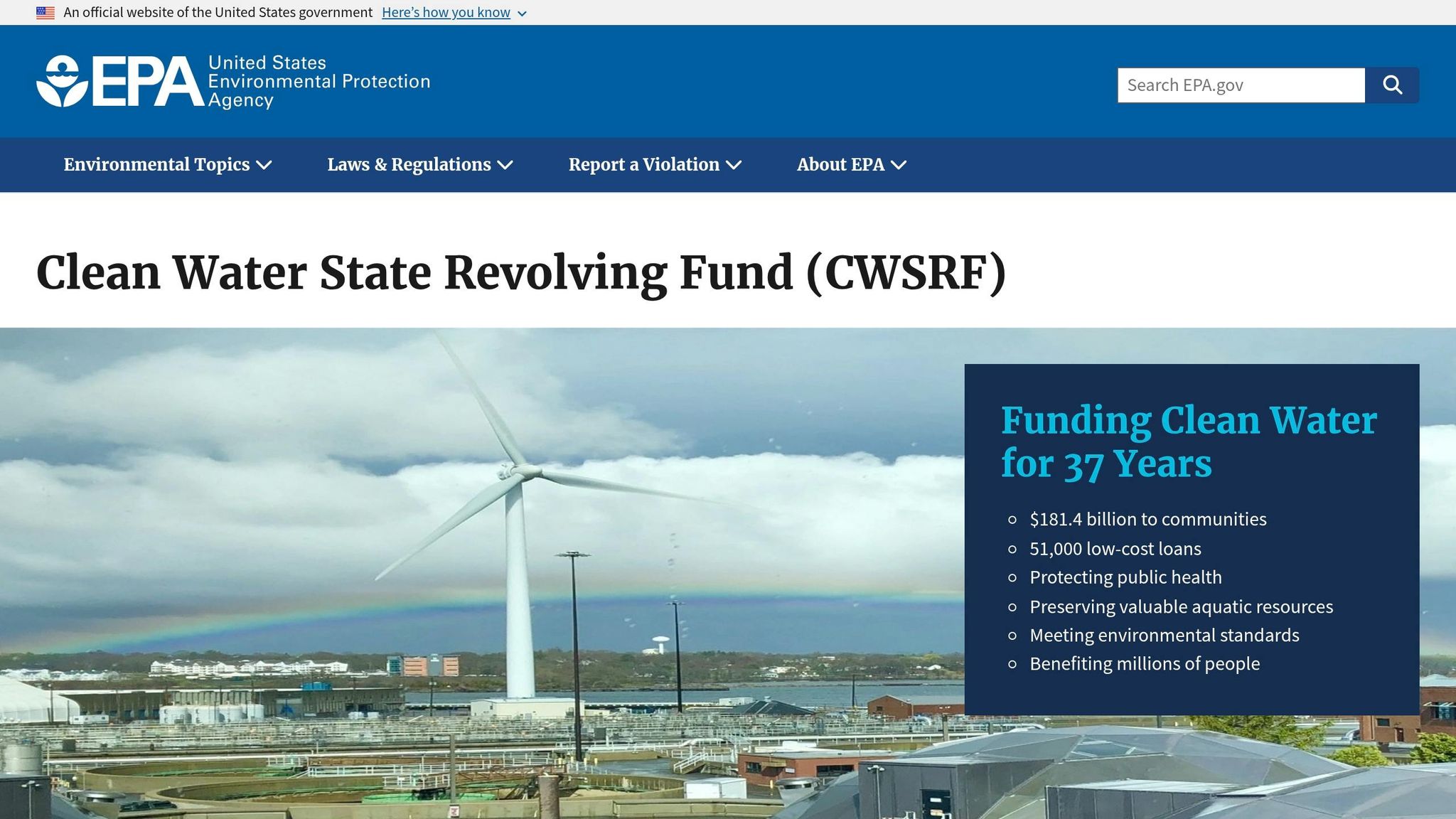
The CWSRF is a critical resource for wastewater and stormwater projects, offering extensive support for green infrastructure. Over the past 36 years, it has provided $172 billion through nearly 49,000 low-cost loans[9]. Recent funding from the Bipartisan Infrastructure Law added $11.7 billion to the program, with nearly half directed toward underserved or disadvantaged communities through grants or principal forgiveness[9][14].
"The CWSRF program is a federal‐state partnership that provides low‐cost financing to communities for a wide range of water quality infrastructure projects, including... green infrastructure, estuary protection, and water reuse."
– US EPA[9]
Eligible applicants include municipalities, public works authorities, school districts, and, in some states, non-profits or individuals. These funds can be used for wastewater, stormwater, and green infrastructure projects[13][14]. For instance, Ohio’s Water Resource Restoration Sponsor Program (WRRSP) enabled the Northeast Ohio Regional Sewer District to partner with a land conservancy to protect the 603-acre Turkey Creek Estuary. This was achieved by advancing interest payments from a long-term sewer project loan[10].
Interest rates vary by state and project type, ranging from 0% to market levels[11][14]. Illinois, for example, set its base rate at 2.16% for the 2025–2026 period, with reduced rates of 1.62% and 1.00% for small or disadvantaged communities[16]. Loan terms typically extend up to 30 years, or 40 years for disadvantaged systems[11][14].
Drinking Water State Revolving Fund (DWSRF)
The DWSRF supports projects that improve drinking water infrastructure and source-water protection. By 2019, the program had distributed over $41.1 billion across 15,425 agreements[11]. The Bipartisan Infrastructure Law allocated an additional $11.7 billion to further strengthen the program[14].
Eligible entities include publicly and privately owned community water systems and non-profit non-community water systems. Projects must align with the Safe Drinking Water Act’s compliance requirements[11][14].
To apply for either SRF program, municipalities should contact their state SRF agency early, as application requirements differ by state[11][14]. Registration in the Federal System for Award Management (SAM) with a Unique Entity Identifier (UEI) is mandatory[8]. Applicants generally need to submit engineering reports, a Cost and Effectiveness Analysis, and a Fiscal Sustainability Plan to demonstrate long-term asset management[15]. Federal compliance requirements, such as the Davis–Bacon Act for prevailing wages and the Build America, Buy America Act, must also be met[12][15].
Municipal Bonds and Local Revenue Tools
Municipal bonds play a critical role in funding large-scale green infrastructure projects by offering lower interest rates, thanks to their tax-exempt status. These bonds are primarily issued in two forms: General Obligation (GO) bonds and Revenue bonds. GO bonds are backed by the full taxing authority of the issuing government, while revenue bonds are repaid using income generated from specific projects, such as water utility fees[17]. This tax-exempt structure allows municipalities to secure financing at reduced costs.
"State agencies and local governments can issue bonds to finance their own projects at lower interest rates than most other financing alternatives because they are backed by the full faith and credit of the government entity instead of the balance sheet of the issuing organization." – US EPA[17]
The green bond market has seen remarkable growth in recent years. In 2020, $51 billion in green bonds were issued in the United States, with proceeds earmarked for environmental, water, or clean energy initiatives. For instance, the Vermont Municipal Bond Bank issued $38 million in bonds that year to fund 19 local loans. Among these was a $3 million loan to the St. Johnsbury School District for replacing an old oil boiler with a biomass-powered system, cutting carbon emissions and long-term fuel costs. By bundling smaller projects into a single bond issuance, municipalities can significantly lower administrative and legal expenses[17].
General Obligation and Revenue Bonds
The two primary types of municipal bonds serve different purposes. GO bonds, which often require voter approval, are repaid through general tax revenues like property or sales taxes. This makes them ideal for funding non-revenue-generating projects, such as public parks or watershed protection. On the other hand, revenue bonds are repaid through fees or service charges tied directly to the project, such as those from water or sewer utilities. These bonds typically do not require voter approval, making them a practical choice for revenue-generating initiatives. While GO bonds benefit from lower interest rates due to their strong financial backing, revenue bonds may have slightly higher rates, depending on the reliability of the associated revenue stream[17].
Stormwater Fees and Taxes
In addition to bond financing, stormwater fees provide a steady revenue source for maintaining green infrastructure. These fees are often structured similarly to charges for water, sewer, or garbage services and are typically collected through existing utility or tax bills[18]. The funds generated are used to support nature-based solutions like rain gardens, green roofs, and bioretention systems. Many municipalities also offer incentive programs, such as fee reductions or credits, to encourage property owners to adopt on-site stormwater management practices, which can alleviate pressure on public infrastructure. Furthermore, municipalities can classify the "establishment period" of green infrastructure as a capital expense, making these costs eligible for financing through resources like the Clean Water State Revolving Fund[19].
Public-Private Partnerships and Impact Investments
When traditional funding sources fall short, municipalities often turn to creative solutions that involve private capital and expertise. Public-private partnerships (PPPs) and impact investments provide flexible frameworks that share both the risks and rewards between governments and private entities, making them attractive options for addressing complex challenges.
Using Public-Private Partnerships (PPPs)
The Community-Based Public-Private Partnership (CBP3) model stands out as a powerful way to fund green infrastructure while addressing local needs. Unlike conventional contracts that simply pay for completed work, CBP3s prioritize measurable environmental outcomes and improvements in community well-being.
"CBP3 model evolves the standard P3 contractual mechanism into a true partnership that focuses on improving water quality and a community's quality of life." – US EPA [21]
One notable example is the Clean Water Partnership, launched in March 2015 in Prince George's County, Maryland. This initiative, a collaboration between the county and private partners, was designed to meet stormwater management regulations while creating green jobs and boosting small businesses. The CBP3 model allows public investment to leverage private capital at a rate of 10:1, meaning $10 of private funding for every $1 of public money [21]. This approach complements federal grants and municipal bonds by drawing on private sector expertise and resources to achieve lasting results.
Performance-based contracting is a critical element of successful PPPs, where payments are tied to verified outcomes - such as the volume of stormwater treated or the reduction of pollutants. For example, in late 2024, the Washington State Department of Ecology allocated $2.27 million to plan projects using this method [22]. By focusing on results, private partners are encouraged to innovate and find the most effective solutions to meet environmental goals.
Additionally, bundling multiple phases of a project - such as design, construction, operation, and maintenance - into a single contract can streamline processes, reduce administrative costs, and ensure long-term accountability. PPPs are also well-suited for retrofitting private properties with green infrastructure, an area where traditional procurement often falls short.
Innovative financing options, like impact investments, further expand the possibilities by tying financial returns to environmental outcomes.
Impact Investments and ESG-Aligned Funding
Impact investments appeal to investors seeking both financial returns and measurable environmental benefits. To attract this type of funding, municipalities must go beyond simply allocating resources to green projects. Instead, they should design outcome-linked financing that ties payments to verified environmental achievements.
Environmental Impact Bonds (EIBs) are a prime example of this approach. In 2016, DC Water issued a $25 million EIB to fund green infrastructure in the Rock Creek sewershed. The bond's payment structure included three tiers: if runoff reduction fell below 18.6%, investors would pay $3.3 million to the utility; if it exceeded 41.3%, the utility would pay a premium. By 2024, monitoring confirmed a 20% runoff reduction, validating the effectiveness of 20 green installations [20].
The San Francisco Public Utilities Commission (SFPUC) has also embraced green bonds, issuing more than $2.1 billion since 2019 for projects like seismic upgrades and renewable energy. Their 2024 issuance achieved a 25 basis point pricing advantage over standard bonds, saving significant costs. This program reports an annual reduction of 42,000 metric tons of CO2e [20].
Blended finance models combine concessional capital - such as grants or philanthropic guarantees - with private investments to lower borrowing costs. For instance, New York City's Accelerator program deployed $1.8 billion for building retrofits, supported by $45 million in city-funded technical assistance. This reduced project risk and allowed property owners to secure loans at rates 100 to 200 basis points below commercial lending, avoiding 850,000 metric tons of CO2e annually by 2025 [20].
Maintaining investor confidence requires rigorous oversight. Municipalities should engage third-party verification providers like Sustainalytics or ISS ESG at least six months before issuing bonds to ensure compliance with standards such as the Green Bond Principles. Despite this, only 41% of municipal green bonds currently include quantitative outcome metrics, and 34% of self-labeled green bonds in 2025 lacked independent verification [20]. To enhance transparency, annual impact reports with independent verification should be mandatory.
Feature | Standard Green Bond | Environmental Impact Bond (EIB) |
|---|---|---|
Use of Proceeds | Restricted to green projects | Restricted to green projects |
Financial Returns | Fixed; not linked to performance | Adjusted based on verified outcomes |
Risk Profile | Issuer bears performance risk | Risk shared between issuer and investor |
Complexity | Moderate (6–9 months to issue) | High (18–24 months to issue) |
Best Use Case | Proven technologies/projects | Innovative or untested infrastructure |
Combining Multiple Financing Models
No single funding source can fully support green infrastructure projects. Municipalities that achieve the most success often combine various financing tools, creating adaptable strategies that can scale and adjust to evolving priorities.
Comparing Financing Models
Integrating multiple financing models alongside traditional tools can improve how projects are funded. Each model plays a specific role at different stages of development. For instance, federal grants are ideal for the initial planning and design phases because they don’t require repayment, helping to keep overall debt levels low. State Revolving Funds, with their below-market interest rates, are better suited for large-scale construction. These funds can even cover early maintenance costs by treating them as capital expenses during the initial years of a project’s development [19].
Municipal bonds, on the other hand, provide access to significant upfront capital, making them suitable for large projects. Stormwater fees create a steady revenue stream that can support ongoing operations and help service debt [19][23]. Tools like the EPA’s Water Finance Clearinghouse and the Financing Alternatives Comparison Tool (FACT) are valuable resources for identifying and comparing funding options, helping municipalities craft cost-effective strategies [19].
This analysis highlights the importance of combining different funding approaches to design a comprehensive financial plan.
Building a Custom Financing Strategy
By understanding the strengths of federal, state, and municipal financing tools, municipalities can create tailored strategies that layer these models effectively. For example, federal grants can cover upfront expenses like environmental assessments and community outreach. State Revolving Funds can then support the construction phase, while stormwater fees or Land Value Capture (LVC) mechanisms can help recover property value increases. This layered approach generates a sustainable revenue cycle that can also service debt from bonds or loans [19].
To further diversify funding, local tax reforms, user fees, and intergovernmental transfers can help reduce financial risks [23]. For smaller projects - those costing less than $10 million - state bond banks can pool resources to reduce the high fixed costs associated with green bond issuance [20]. Municipalities can also seek guidance from Environmental Finance Centers for structuring blended financing solutions [19]. As urban areas continue to grow, strategic funding plans like these will be essential to meet infrastructure demands [23].
Working with Council Fire for Consulting Support
Municipalities often face challenges when navigating fragmented funding sources and the intricate processes of applying for grants. Successfully securing funding for green infrastructure demands not only strategic planning but also expert handling of complex applications and the ability to combine multiple financing sources effectively. Council Fire steps in to bridge this gap, helping municipalities transform sustainability strategies into actionable, well-funded projects.
With a team of former EPA advisors and environmental finance specialists, Council Fire provides comprehensive support, covering everything from eligibility assessments to compliance tracking. Their track record is impressive: an 85% success rate in securing EPA grants and State Revolving Fund (SRF) financing. Annually, they assist municipalities in obtaining over $500 million by aligning their plans with federal and state program requirements [24][25][26].
One standout example involves a mid-sized city in California that worked with Council Fire to secure $25 million from the Clean Water State Revolving Fund for stormwater green infrastructure. Council Fire managed key tasks such as grant writing, aligning the project with ESG principles, and structuring public–private partnerships. The result? A project timeline reduced by 30% and $5 million in cost savings. Their involvement also cut the typical funding process from over 12 months to just 6 months [25][27][28].
Council Fire’s support doesn’t stop at securing funding. They provide implementation frameworks that guide projects throughout their lifecycle. Using a structured RACI model, they take responsibility for strategy and grant consulting while keeping municipal staff informed for critical approvals. Their resources include customizable templates for bond issuances, public-private partnership contracts, EPA compliance checklists, and dynamic project management tools. These tools have helped reduce administrative delays by 50% for their clients [24][25][26].
Conclusion
Funding green and nature-based infrastructure is entirely within reach for municipalities and agencies. By leveraging the strategies outlined here - ranging from federal grants and State Revolving Funds to municipal bonds, public-private partnerships, and impact investments - communities can turn ambitious sustainability plans into tangible projects. Recognizing nature-based solutions as essential infrastructure, rather than optional add-ons, is a critical mindset shift that ensures these projects are prioritized appropriately [1].
Breaking down traditional silos is crucial for success. Collaboration across sectors simplifies both funding and implementation. ICLEI experts Natalia Salazar and Daniela Rizzi emphasize this point:
Unlocking more funding for nature-based solutions requires addressing the issue on multiple fronts... municipalities must break down institutional siloes so departments responsible for environment, health, infrastructure, and finance can jointly plan and deliver nature-based projects [1].
This collaborative approach aligns perfectly with the comprehensive funding framework presented in this guide.
Federal resources are also abundant. The EPA's Water Finance Clearinghouse and its network of 29 Environmental Finance Centers across the country offer free technical assistance to help municipalities navigate funding options [2]. The challenge lies in accessing these resources and combining them effectively. For example, Philadelphia's innovative stormwater billing system showcases how creative financial models can generate dedicated revenue streams for green infrastructure retrofits [2].
Expert support makes a significant difference. Whether working with Council Fire or other technical assistance providers, professional guidance can simplify the complexities of securing and managing funding for these transformative projects.
FAQs
What funding option is best for my project stage (planning vs. construction vs. O&M)?
The most suitable funding choice varies based on the stage of your project:
Planning: Federal grants and technical assistance programs are excellent for getting your project off the ground.
Construction: Public-private partnerships (PPPs) and federal grants can provide the financial support needed to move into development.
Operations & Maintenance (O&M): To cover ongoing costs, consider options like bonds, revolving funds, or impact investments.
Begin by leveraging federal resources during the planning phase. As you transition to construction, look into grants and PPPs. For long-term needs, focus on sustainable financing methods tailored to O&M.
How can we finance green infrastructure that doesn’t generate direct revenue?
Financing green infrastructure projects that don’t generate direct revenue requires thinking outside the box. Municipalities can tap into federal, state, and local grants or leverage technical assistance programs to cover costs. Public-private partnerships also offer a creative route, especially with community-based models that bring together public resources and private sector expertise.
Another option is impact investment tools, like environmental impact bonds, which use outcomes-based payments. These are particularly effective for projects aimed at improving resilience or enhancing ecosystem health. The key to success lies in diversifying funding sources to ensure long-term sustainability and impact.
What do we need to qualify for federal or SRF funding (SAM, UEI, and key documents)?
To access federal or State Revolving Fund (SRF) funding, municipalities and government agencies need an active System for Award Management (SAM) registration and a Unique Entity Identifier (UEI), which has replaced the D-U-N-S number. Required documentation includes evidence of legal registration, financial statements, and project proposals that clearly show eligibility and adherence to funding guidelines. These steps are crucial for securing financial support for green and nature-based initiatives.
Related Blog Posts
Latest Articles
©2025

Narrative Change and Power Building: The Missing Half of Advocacy
Narrative change is the process of disrupting dominant narratives that normalize inequity and advancing new narratives from historically marginalized communities.

Funding Resilience Without Federal Grants
BRIC is unreliable and FEMA is shrinking. Here's how cities fund climate resilience with dedicated revenue, blended finance, and a coordinating authority.

The ESG Blind Spot: How AI Is Finding Risks in Companies Nobody Else Is Watching
Norway's sovereign wealth fund uses AI to screen 7,200 portfolio companies for forced labor and corruption within 24 hours. The real story is the emerging-market coverage gap that traditional ESG data vendors miss — and what it means for any company with a global supply chain.
Narrative Change and Power Building: The Missing Half of Advocacy
Narrative change is the process of disrupting dominant narratives that normalize inequity and advancing new narratives from historically marginalized communities.
Funding Resilience Without Federal Grants
BRIC is unreliable and FEMA is shrinking. Here's how cities fund climate resilience with dedicated revenue, blended finance, and a coordinating authority.
The ESG Blind Spot: How AI Is Finding Risks in Companies Nobody Else Is Watching
Norway's sovereign wealth fund uses AI to screen 7,200 portfolio companies for forced labor and corruption within 24 hours. The real story is the emerging-market coverage gap that traditional ESG data vendors miss — and what it means for any company with a global supply chain.
FAQ
01
What does it really mean to “redefine profit”?
02
What makes Council Fire different?
03
Who does Council Fire work with?
04
What does working with Council Fire actually look like?
05
How does Council Fire help organizations turn big goals into action?
06
How does Council Fire define and measure success?
May 1, 2026
How to Finance Green and Nature-Based Infrastructure for Municipalities & Government Agencies
Sustainability Strategy
In This Article
Layer federal grants, SRFs, bonds, PPPs and impact investments to fund municipal green and nature-based infrastructure.
How to Finance Green and Nature-Based Infrastructure for Municipalities & Government Agencies
Municipalities and government agencies often struggle to fund green and nature-based infrastructure projects like urban forests, wetland restoration, and sponge parks. These initiatives offer broad benefits - stormwater management, urban cooling, and climate resilience - but lack clear revenue models, making them harder to finance compared to conventional infrastructure. This guide provides practical funding strategies, including:
Federal Grants: Programs like the Clean Water State Revolving Fund and Climate Pollution Reduction Grants offer billions in funding, especially for underserved communities.
State Revolving Funds (SRFs): Low-interest loans for wastewater, stormwater, and drinking water projects, with options for green initiatives.
Municipal Bonds: Tax-exempt General Obligation and Revenue Bonds can fund large-scale projects.
Stormwater Fees: A steady revenue stream for green infrastructure maintenance.
Public-Private Partnerships (PPPs): Collaboration with private investors to share costs and risks.
Impact Investments: Environmental Impact Bonds (EIBs) tie financial returns to measurable outcomes.
Green Infrastructure Financing Options Comparison for Municipalities
Federal Grants and Programs for Green Infrastructure
Federal programs play a key role in helping municipalities advance green infrastructure projects, especially when local budgets fall short. Over the past 37 years, the Clean Water State Revolving Fund has provided $181.4 billion to municipalities for such initiatives [4]. More recently, the 2021 Bipartisan Infrastructure Law allocated an additional $11.7 billion for clean water projects and another $11.7 billion for drinking water infrastructure [4][6]. Almost half of this funding is earmarked for underserved or disadvantaged communities, often distributed as grants or loans with principal forgiveness [6].
To begin exploring funding opportunities, municipalities can use the EPA Water Finance Clearinghouse, a searchable database featuring over $10 billion in water funding sources and more than 550 resources [2]. Free technical assistance for application preparation is also available through one of the 29 Environmental Finance Centers located across the country [2]. Additionally, the EPA offers specific grant programs that address both water quality and climate resilience.
EPA Grant Programs
The EPA manages several grant programs tailored to green infrastructure needs. One example is the Section 319 Nonpoint Source Grants, which fund projects aimed at controlling pollution from stormwater runoff. These grants support efforts like bioretention systems and wetland restoration through technical assistance, education, and demonstration initiatives [5].
Another key opportunity is the Climate Pollution Reduction Grants (CPRG) program, which offers $250 million for planning and nearly $4.6 billion for implementation [7]. In November 2024, the EPA awarded over $4.3 billion to 25 state, local, and Tribal recipients through the CPRG Implementation Grants General Competition [7]. These funds are designed to support community-driven projects that reduce greenhouse gas emissions and air pollution, such as urban forests and other nature-based solutions. States and Metropolitan Statistical Areas now have until June 1, 2026, to submit their Comprehensive Climate Action Plans [7].
Other Federal Funding Sources
Municipalities can also tap into funding beyond EPA programs. FEMA's Building Resilient Infrastructure and Communities (BRIC) program and USDA conservation funding are valuable resources. Additionally, the Water Infrastructure Finance and Innovation Act (WIFIA) offers long-term, low-cost loans for large-scale water and wastewater projects. To date, WIFIA has closed 152 loans, financing $23 billion and supporting $51 billion in project costs [3]. For example, in April 2026, the EPA approved a $34 million WIFIA loan for Daly City, California, to enhance its water infrastructure [3].
To access WIFIA funding, municipalities must submit a Letter of Interest [3]. For most federal grants, registration on Grants.gov is required. This platform serves as the main hub for finding and applying for discretionary federal funding [5]. Before applying, ensure that your municipality has a Unique Entity Identifier (UEI) and active registration in the Federal System for Award Management (SAM) [8].
State Revolving Funds as a Financing Tool
State Revolving Funds (SRFs) are state-operated programs offering low-interest loans for water infrastructure projects. These funds are part of a federal–state partnership where the EPA provides initial grants, which states then match by 20% to grow the available funding pool[10]. The revolving nature of these funds allows every $1 of federal funding to generate about $3 in community support[10]. Across the nation, SRF programs collectively manage around $120 billion[10]. They are divided into two key programs: one for wastewater management and another for safe drinking water.
The SRFs are categorized into the Clean Water State Revolving Fund (CWSRF), which focuses on wastewater and stormwater projects, and the Drinking Water State Revolving Fund (DWSRF), which supports safe drinking water systems[10]. While traditionally used for infrastructure like pipelines and treatment plants, SRFs are increasingly applied to nature-based solutions, such as land conservation, managing nonpoint source pollution, and green stormwater systems[10].
A noteworthy approach within these funds is the "sponsorship" model, which combines traditional infrastructure projects with environmentally focused initiatives. By lowering the loan’s overall interest rate, the green project is essentially funded at no extra cost to the utility[10]. In Iowa, this model supports $10 million annually in interest-rate reductions for green initiatives[10].
Accessing SRF funding requires municipalities to consult their state’s Annual Intended Use Plan (IUP). Projects are ranked based on factors like water quality impact, public health risks, and readiness to proceed[11][13]. Green infrastructure projects, which may not generate traditional revenue streams, often rely on alternative funding sources such as timber sales, carbon credits, or sponsorship-related interest-rate reductions[10].
Clean Water State Revolving Fund (CWSRF)
The CWSRF is a critical resource for wastewater and stormwater projects, offering extensive support for green infrastructure. Over the past 36 years, it has provided $172 billion through nearly 49,000 low-cost loans[9]. Recent funding from the Bipartisan Infrastructure Law added $11.7 billion to the program, with nearly half directed toward underserved or disadvantaged communities through grants or principal forgiveness[9][14].
"The CWSRF program is a federal‐state partnership that provides low‐cost financing to communities for a wide range of water quality infrastructure projects, including... green infrastructure, estuary protection, and water reuse."
– US EPA[9]
Eligible applicants include municipalities, public works authorities, school districts, and, in some states, non-profits or individuals. These funds can be used for wastewater, stormwater, and green infrastructure projects[13][14]. For instance, Ohio’s Water Resource Restoration Sponsor Program (WRRSP) enabled the Northeast Ohio Regional Sewer District to partner with a land conservancy to protect the 603-acre Turkey Creek Estuary. This was achieved by advancing interest payments from a long-term sewer project loan[10].
Interest rates vary by state and project type, ranging from 0% to market levels[11][14]. Illinois, for example, set its base rate at 2.16% for the 2025–2026 period, with reduced rates of 1.62% and 1.00% for small or disadvantaged communities[16]. Loan terms typically extend up to 30 years, or 40 years for disadvantaged systems[11][14].
Drinking Water State Revolving Fund (DWSRF)
The DWSRF supports projects that improve drinking water infrastructure and source-water protection. By 2019, the program had distributed over $41.1 billion across 15,425 agreements[11]. The Bipartisan Infrastructure Law allocated an additional $11.7 billion to further strengthen the program[14].
Eligible entities include publicly and privately owned community water systems and non-profit non-community water systems. Projects must align with the Safe Drinking Water Act’s compliance requirements[11][14].
To apply for either SRF program, municipalities should contact their state SRF agency early, as application requirements differ by state[11][14]. Registration in the Federal System for Award Management (SAM) with a Unique Entity Identifier (UEI) is mandatory[8]. Applicants generally need to submit engineering reports, a Cost and Effectiveness Analysis, and a Fiscal Sustainability Plan to demonstrate long-term asset management[15]. Federal compliance requirements, such as the Davis–Bacon Act for prevailing wages and the Build America, Buy America Act, must also be met[12][15].
Municipal Bonds and Local Revenue Tools
Municipal bonds play a critical role in funding large-scale green infrastructure projects by offering lower interest rates, thanks to their tax-exempt status. These bonds are primarily issued in two forms: General Obligation (GO) bonds and Revenue bonds. GO bonds are backed by the full taxing authority of the issuing government, while revenue bonds are repaid using income generated from specific projects, such as water utility fees[17]. This tax-exempt structure allows municipalities to secure financing at reduced costs.
"State agencies and local governments can issue bonds to finance their own projects at lower interest rates than most other financing alternatives because they are backed by the full faith and credit of the government entity instead of the balance sheet of the issuing organization." – US EPA[17]
The green bond market has seen remarkable growth in recent years. In 2020, $51 billion in green bonds were issued in the United States, with proceeds earmarked for environmental, water, or clean energy initiatives. For instance, the Vermont Municipal Bond Bank issued $38 million in bonds that year to fund 19 local loans. Among these was a $3 million loan to the St. Johnsbury School District for replacing an old oil boiler with a biomass-powered system, cutting carbon emissions and long-term fuel costs. By bundling smaller projects into a single bond issuance, municipalities can significantly lower administrative and legal expenses[17].
General Obligation and Revenue Bonds
The two primary types of municipal bonds serve different purposes. GO bonds, which often require voter approval, are repaid through general tax revenues like property or sales taxes. This makes them ideal for funding non-revenue-generating projects, such as public parks or watershed protection. On the other hand, revenue bonds are repaid through fees or service charges tied directly to the project, such as those from water or sewer utilities. These bonds typically do not require voter approval, making them a practical choice for revenue-generating initiatives. While GO bonds benefit from lower interest rates due to their strong financial backing, revenue bonds may have slightly higher rates, depending on the reliability of the associated revenue stream[17].
Stormwater Fees and Taxes
In addition to bond financing, stormwater fees provide a steady revenue source for maintaining green infrastructure. These fees are often structured similarly to charges for water, sewer, or garbage services and are typically collected through existing utility or tax bills[18]. The funds generated are used to support nature-based solutions like rain gardens, green roofs, and bioretention systems. Many municipalities also offer incentive programs, such as fee reductions or credits, to encourage property owners to adopt on-site stormwater management practices, which can alleviate pressure on public infrastructure. Furthermore, municipalities can classify the "establishment period" of green infrastructure as a capital expense, making these costs eligible for financing through resources like the Clean Water State Revolving Fund[19].
Public-Private Partnerships and Impact Investments
When traditional funding sources fall short, municipalities often turn to creative solutions that involve private capital and expertise. Public-private partnerships (PPPs) and impact investments provide flexible frameworks that share both the risks and rewards between governments and private entities, making them attractive options for addressing complex challenges.
Using Public-Private Partnerships (PPPs)
The Community-Based Public-Private Partnership (CBP3) model stands out as a powerful way to fund green infrastructure while addressing local needs. Unlike conventional contracts that simply pay for completed work, CBP3s prioritize measurable environmental outcomes and improvements in community well-being.
"CBP3 model evolves the standard P3 contractual mechanism into a true partnership that focuses on improving water quality and a community's quality of life." – US EPA [21]
One notable example is the Clean Water Partnership, launched in March 2015 in Prince George's County, Maryland. This initiative, a collaboration between the county and private partners, was designed to meet stormwater management regulations while creating green jobs and boosting small businesses. The CBP3 model allows public investment to leverage private capital at a rate of 10:1, meaning $10 of private funding for every $1 of public money [21]. This approach complements federal grants and municipal bonds by drawing on private sector expertise and resources to achieve lasting results.
Performance-based contracting is a critical element of successful PPPs, where payments are tied to verified outcomes - such as the volume of stormwater treated or the reduction of pollutants. For example, in late 2024, the Washington State Department of Ecology allocated $2.27 million to plan projects using this method [22]. By focusing on results, private partners are encouraged to innovate and find the most effective solutions to meet environmental goals.
Additionally, bundling multiple phases of a project - such as design, construction, operation, and maintenance - into a single contract can streamline processes, reduce administrative costs, and ensure long-term accountability. PPPs are also well-suited for retrofitting private properties with green infrastructure, an area where traditional procurement often falls short.
Innovative financing options, like impact investments, further expand the possibilities by tying financial returns to environmental outcomes.
Impact Investments and ESG-Aligned Funding
Impact investments appeal to investors seeking both financial returns and measurable environmental benefits. To attract this type of funding, municipalities must go beyond simply allocating resources to green projects. Instead, they should design outcome-linked financing that ties payments to verified environmental achievements.
Environmental Impact Bonds (EIBs) are a prime example of this approach. In 2016, DC Water issued a $25 million EIB to fund green infrastructure in the Rock Creek sewershed. The bond's payment structure included three tiers: if runoff reduction fell below 18.6%, investors would pay $3.3 million to the utility; if it exceeded 41.3%, the utility would pay a premium. By 2024, monitoring confirmed a 20% runoff reduction, validating the effectiveness of 20 green installations [20].
The San Francisco Public Utilities Commission (SFPUC) has also embraced green bonds, issuing more than $2.1 billion since 2019 for projects like seismic upgrades and renewable energy. Their 2024 issuance achieved a 25 basis point pricing advantage over standard bonds, saving significant costs. This program reports an annual reduction of 42,000 metric tons of CO2e [20].
Blended finance models combine concessional capital - such as grants or philanthropic guarantees - with private investments to lower borrowing costs. For instance, New York City's Accelerator program deployed $1.8 billion for building retrofits, supported by $45 million in city-funded technical assistance. This reduced project risk and allowed property owners to secure loans at rates 100 to 200 basis points below commercial lending, avoiding 850,000 metric tons of CO2e annually by 2025 [20].
Maintaining investor confidence requires rigorous oversight. Municipalities should engage third-party verification providers like Sustainalytics or ISS ESG at least six months before issuing bonds to ensure compliance with standards such as the Green Bond Principles. Despite this, only 41% of municipal green bonds currently include quantitative outcome metrics, and 34% of self-labeled green bonds in 2025 lacked independent verification [20]. To enhance transparency, annual impact reports with independent verification should be mandatory.
Feature | Standard Green Bond | Environmental Impact Bond (EIB) |
|---|---|---|
Use of Proceeds | Restricted to green projects | Restricted to green projects |
Financial Returns | Fixed; not linked to performance | Adjusted based on verified outcomes |
Risk Profile | Issuer bears performance risk | Risk shared between issuer and investor |
Complexity | Moderate (6–9 months to issue) | High (18–24 months to issue) |
Best Use Case | Proven technologies/projects | Innovative or untested infrastructure |
Combining Multiple Financing Models
No single funding source can fully support green infrastructure projects. Municipalities that achieve the most success often combine various financing tools, creating adaptable strategies that can scale and adjust to evolving priorities.
Comparing Financing Models
Integrating multiple financing models alongside traditional tools can improve how projects are funded. Each model plays a specific role at different stages of development. For instance, federal grants are ideal for the initial planning and design phases because they don’t require repayment, helping to keep overall debt levels low. State Revolving Funds, with their below-market interest rates, are better suited for large-scale construction. These funds can even cover early maintenance costs by treating them as capital expenses during the initial years of a project’s development [19].
Municipal bonds, on the other hand, provide access to significant upfront capital, making them suitable for large projects. Stormwater fees create a steady revenue stream that can support ongoing operations and help service debt [19][23]. Tools like the EPA’s Water Finance Clearinghouse and the Financing Alternatives Comparison Tool (FACT) are valuable resources for identifying and comparing funding options, helping municipalities craft cost-effective strategies [19].
This analysis highlights the importance of combining different funding approaches to design a comprehensive financial plan.
Building a Custom Financing Strategy
By understanding the strengths of federal, state, and municipal financing tools, municipalities can create tailored strategies that layer these models effectively. For example, federal grants can cover upfront expenses like environmental assessments and community outreach. State Revolving Funds can then support the construction phase, while stormwater fees or Land Value Capture (LVC) mechanisms can help recover property value increases. This layered approach generates a sustainable revenue cycle that can also service debt from bonds or loans [19].
To further diversify funding, local tax reforms, user fees, and intergovernmental transfers can help reduce financial risks [23]. For smaller projects - those costing less than $10 million - state bond banks can pool resources to reduce the high fixed costs associated with green bond issuance [20]. Municipalities can also seek guidance from Environmental Finance Centers for structuring blended financing solutions [19]. As urban areas continue to grow, strategic funding plans like these will be essential to meet infrastructure demands [23].
Working with Council Fire for Consulting Support
Municipalities often face challenges when navigating fragmented funding sources and the intricate processes of applying for grants. Successfully securing funding for green infrastructure demands not only strategic planning but also expert handling of complex applications and the ability to combine multiple financing sources effectively. Council Fire steps in to bridge this gap, helping municipalities transform sustainability strategies into actionable, well-funded projects.
With a team of former EPA advisors and environmental finance specialists, Council Fire provides comprehensive support, covering everything from eligibility assessments to compliance tracking. Their track record is impressive: an 85% success rate in securing EPA grants and State Revolving Fund (SRF) financing. Annually, they assist municipalities in obtaining over $500 million by aligning their plans with federal and state program requirements [24][25][26].
One standout example involves a mid-sized city in California that worked with Council Fire to secure $25 million from the Clean Water State Revolving Fund for stormwater green infrastructure. Council Fire managed key tasks such as grant writing, aligning the project with ESG principles, and structuring public–private partnerships. The result? A project timeline reduced by 30% and $5 million in cost savings. Their involvement also cut the typical funding process from over 12 months to just 6 months [25][27][28].
Council Fire’s support doesn’t stop at securing funding. They provide implementation frameworks that guide projects throughout their lifecycle. Using a structured RACI model, they take responsibility for strategy and grant consulting while keeping municipal staff informed for critical approvals. Their resources include customizable templates for bond issuances, public-private partnership contracts, EPA compliance checklists, and dynamic project management tools. These tools have helped reduce administrative delays by 50% for their clients [24][25][26].
Conclusion
Funding green and nature-based infrastructure is entirely within reach for municipalities and agencies. By leveraging the strategies outlined here - ranging from federal grants and State Revolving Funds to municipal bonds, public-private partnerships, and impact investments - communities can turn ambitious sustainability plans into tangible projects. Recognizing nature-based solutions as essential infrastructure, rather than optional add-ons, is a critical mindset shift that ensures these projects are prioritized appropriately [1].
Breaking down traditional silos is crucial for success. Collaboration across sectors simplifies both funding and implementation. ICLEI experts Natalia Salazar and Daniela Rizzi emphasize this point:
Unlocking more funding for nature-based solutions requires addressing the issue on multiple fronts... municipalities must break down institutional siloes so departments responsible for environment, health, infrastructure, and finance can jointly plan and deliver nature-based projects [1].
This collaborative approach aligns perfectly with the comprehensive funding framework presented in this guide.
Federal resources are also abundant. The EPA's Water Finance Clearinghouse and its network of 29 Environmental Finance Centers across the country offer free technical assistance to help municipalities navigate funding options [2]. The challenge lies in accessing these resources and combining them effectively. For example, Philadelphia's innovative stormwater billing system showcases how creative financial models can generate dedicated revenue streams for green infrastructure retrofits [2].
Expert support makes a significant difference. Whether working with Council Fire or other technical assistance providers, professional guidance can simplify the complexities of securing and managing funding for these transformative projects.
FAQs
What funding option is best for my project stage (planning vs. construction vs. O&M)?
The most suitable funding choice varies based on the stage of your project:
Planning: Federal grants and technical assistance programs are excellent for getting your project off the ground.
Construction: Public-private partnerships (PPPs) and federal grants can provide the financial support needed to move into development.
Operations & Maintenance (O&M): To cover ongoing costs, consider options like bonds, revolving funds, or impact investments.
Begin by leveraging federal resources during the planning phase. As you transition to construction, look into grants and PPPs. For long-term needs, focus on sustainable financing methods tailored to O&M.
How can we finance green infrastructure that doesn’t generate direct revenue?
Financing green infrastructure projects that don’t generate direct revenue requires thinking outside the box. Municipalities can tap into federal, state, and local grants or leverage technical assistance programs to cover costs. Public-private partnerships also offer a creative route, especially with community-based models that bring together public resources and private sector expertise.
Another option is impact investment tools, like environmental impact bonds, which use outcomes-based payments. These are particularly effective for projects aimed at improving resilience or enhancing ecosystem health. The key to success lies in diversifying funding sources to ensure long-term sustainability and impact.
What do we need to qualify for federal or SRF funding (SAM, UEI, and key documents)?
To access federal or State Revolving Fund (SRF) funding, municipalities and government agencies need an active System for Award Management (SAM) registration and a Unique Entity Identifier (UEI), which has replaced the D-U-N-S number. Required documentation includes evidence of legal registration, financial statements, and project proposals that clearly show eligibility and adherence to funding guidelines. These steps are crucial for securing financial support for green and nature-based initiatives.
Related Blog Posts
Latest Articles
©2025
Narrative Change and Power Building: The Missing Half of Advocacy
Narrative change is the process of disrupting dominant narratives that normalize inequity and advancing new narratives from historically marginalized communities.
Funding Resilience Without Federal Grants
BRIC is unreliable and FEMA is shrinking. Here's how cities fund climate resilience with dedicated revenue, blended finance, and a coordinating authority.
The ESG Blind Spot: How AI Is Finding Risks in Companies Nobody Else Is Watching
Norway's sovereign wealth fund uses AI to screen 7,200 portfolio companies for forced labor and corruption within 24 hours. The real story is the emerging-market coverage gap that traditional ESG data vendors miss — and what it means for any company with a global supply chain.
FAQ
01
What does it really mean to “redefine profit”?
02
What makes Council Fire different?
03
Who does Council Fire work with?
04
What does working with Council Fire actually look like?
05
How does Council Fire help organizations turn big goals into action?
06
How does Council Fire define and measure success?
May 1, 2026
How to Finance Green and Nature-Based Infrastructure for Municipalities & Government Agencies
Sustainability Strategy
In This Article
Layer federal grants, SRFs, bonds, PPPs and impact investments to fund municipal green and nature-based infrastructure.
How to Finance Green and Nature-Based Infrastructure for Municipalities & Government Agencies
Municipalities and government agencies often struggle to fund green and nature-based infrastructure projects like urban forests, wetland restoration, and sponge parks. These initiatives offer broad benefits - stormwater management, urban cooling, and climate resilience - but lack clear revenue models, making them harder to finance compared to conventional infrastructure. This guide provides practical funding strategies, including:
Federal Grants: Programs like the Clean Water State Revolving Fund and Climate Pollution Reduction Grants offer billions in funding, especially for underserved communities.
State Revolving Funds (SRFs): Low-interest loans for wastewater, stormwater, and drinking water projects, with options for green initiatives.
Municipal Bonds: Tax-exempt General Obligation and Revenue Bonds can fund large-scale projects.
Stormwater Fees: A steady revenue stream for green infrastructure maintenance.
Public-Private Partnerships (PPPs): Collaboration with private investors to share costs and risks.
Impact Investments: Environmental Impact Bonds (EIBs) tie financial returns to measurable outcomes.
Green Infrastructure Financing Options Comparison for Municipalities
Federal Grants and Programs for Green Infrastructure
Federal programs play a key role in helping municipalities advance green infrastructure projects, especially when local budgets fall short. Over the past 37 years, the Clean Water State Revolving Fund has provided $181.4 billion to municipalities for such initiatives [4]. More recently, the 2021 Bipartisan Infrastructure Law allocated an additional $11.7 billion for clean water projects and another $11.7 billion for drinking water infrastructure [4][6]. Almost half of this funding is earmarked for underserved or disadvantaged communities, often distributed as grants or loans with principal forgiveness [6].
To begin exploring funding opportunities, municipalities can use the EPA Water Finance Clearinghouse, a searchable database featuring over $10 billion in water funding sources and more than 550 resources [2]. Free technical assistance for application preparation is also available through one of the 29 Environmental Finance Centers located across the country [2]. Additionally, the EPA offers specific grant programs that address both water quality and climate resilience.
EPA Grant Programs
The EPA manages several grant programs tailored to green infrastructure needs. One example is the Section 319 Nonpoint Source Grants, which fund projects aimed at controlling pollution from stormwater runoff. These grants support efforts like bioretention systems and wetland restoration through technical assistance, education, and demonstration initiatives [5].
Another key opportunity is the Climate Pollution Reduction Grants (CPRG) program, which offers $250 million for planning and nearly $4.6 billion for implementation [7]. In November 2024, the EPA awarded over $4.3 billion to 25 state, local, and Tribal recipients through the CPRG Implementation Grants General Competition [7]. These funds are designed to support community-driven projects that reduce greenhouse gas emissions and air pollution, such as urban forests and other nature-based solutions. States and Metropolitan Statistical Areas now have until June 1, 2026, to submit their Comprehensive Climate Action Plans [7].
Other Federal Funding Sources
Municipalities can also tap into funding beyond EPA programs. FEMA's Building Resilient Infrastructure and Communities (BRIC) program and USDA conservation funding are valuable resources. Additionally, the Water Infrastructure Finance and Innovation Act (WIFIA) offers long-term, low-cost loans for large-scale water and wastewater projects. To date, WIFIA has closed 152 loans, financing $23 billion and supporting $51 billion in project costs [3]. For example, in April 2026, the EPA approved a $34 million WIFIA loan for Daly City, California, to enhance its water infrastructure [3].
To access WIFIA funding, municipalities must submit a Letter of Interest [3]. For most federal grants, registration on Grants.gov is required. This platform serves as the main hub for finding and applying for discretionary federal funding [5]. Before applying, ensure that your municipality has a Unique Entity Identifier (UEI) and active registration in the Federal System for Award Management (SAM) [8].
State Revolving Funds as a Financing Tool
State Revolving Funds (SRFs) are state-operated programs offering low-interest loans for water infrastructure projects. These funds are part of a federal–state partnership where the EPA provides initial grants, which states then match by 20% to grow the available funding pool[10]. The revolving nature of these funds allows every $1 of federal funding to generate about $3 in community support[10]. Across the nation, SRF programs collectively manage around $120 billion[10]. They are divided into two key programs: one for wastewater management and another for safe drinking water.
The SRFs are categorized into the Clean Water State Revolving Fund (CWSRF), which focuses on wastewater and stormwater projects, and the Drinking Water State Revolving Fund (DWSRF), which supports safe drinking water systems[10]. While traditionally used for infrastructure like pipelines and treatment plants, SRFs are increasingly applied to nature-based solutions, such as land conservation, managing nonpoint source pollution, and green stormwater systems[10].
A noteworthy approach within these funds is the "sponsorship" model, which combines traditional infrastructure projects with environmentally focused initiatives. By lowering the loan’s overall interest rate, the green project is essentially funded at no extra cost to the utility[10]. In Iowa, this model supports $10 million annually in interest-rate reductions for green initiatives[10].
Accessing SRF funding requires municipalities to consult their state’s Annual Intended Use Plan (IUP). Projects are ranked based on factors like water quality impact, public health risks, and readiness to proceed[11][13]. Green infrastructure projects, which may not generate traditional revenue streams, often rely on alternative funding sources such as timber sales, carbon credits, or sponsorship-related interest-rate reductions[10].
Clean Water State Revolving Fund (CWSRF)
The CWSRF is a critical resource for wastewater and stormwater projects, offering extensive support for green infrastructure. Over the past 36 years, it has provided $172 billion through nearly 49,000 low-cost loans[9]. Recent funding from the Bipartisan Infrastructure Law added $11.7 billion to the program, with nearly half directed toward underserved or disadvantaged communities through grants or principal forgiveness[9][14].
"The CWSRF program is a federal‐state partnership that provides low‐cost financing to communities for a wide range of water quality infrastructure projects, including... green infrastructure, estuary protection, and water reuse."
– US EPA[9]
Eligible applicants include municipalities, public works authorities, school districts, and, in some states, non-profits or individuals. These funds can be used for wastewater, stormwater, and green infrastructure projects[13][14]. For instance, Ohio’s Water Resource Restoration Sponsor Program (WRRSP) enabled the Northeast Ohio Regional Sewer District to partner with a land conservancy to protect the 603-acre Turkey Creek Estuary. This was achieved by advancing interest payments from a long-term sewer project loan[10].
Interest rates vary by state and project type, ranging from 0% to market levels[11][14]. Illinois, for example, set its base rate at 2.16% for the 2025–2026 period, with reduced rates of 1.62% and 1.00% for small or disadvantaged communities[16]. Loan terms typically extend up to 30 years, or 40 years for disadvantaged systems[11][14].
Drinking Water State Revolving Fund (DWSRF)
The DWSRF supports projects that improve drinking water infrastructure and source-water protection. By 2019, the program had distributed over $41.1 billion across 15,425 agreements[11]. The Bipartisan Infrastructure Law allocated an additional $11.7 billion to further strengthen the program[14].
Eligible entities include publicly and privately owned community water systems and non-profit non-community water systems. Projects must align with the Safe Drinking Water Act’s compliance requirements[11][14].
To apply for either SRF program, municipalities should contact their state SRF agency early, as application requirements differ by state[11][14]. Registration in the Federal System for Award Management (SAM) with a Unique Entity Identifier (UEI) is mandatory[8]. Applicants generally need to submit engineering reports, a Cost and Effectiveness Analysis, and a Fiscal Sustainability Plan to demonstrate long-term asset management[15]. Federal compliance requirements, such as the Davis–Bacon Act for prevailing wages and the Build America, Buy America Act, must also be met[12][15].
Municipal Bonds and Local Revenue Tools
Municipal bonds play a critical role in funding large-scale green infrastructure projects by offering lower interest rates, thanks to their tax-exempt status. These bonds are primarily issued in two forms: General Obligation (GO) bonds and Revenue bonds. GO bonds are backed by the full taxing authority of the issuing government, while revenue bonds are repaid using income generated from specific projects, such as water utility fees[17]. This tax-exempt structure allows municipalities to secure financing at reduced costs.
"State agencies and local governments can issue bonds to finance their own projects at lower interest rates than most other financing alternatives because they are backed by the full faith and credit of the government entity instead of the balance sheet of the issuing organization." – US EPA[17]
The green bond market has seen remarkable growth in recent years. In 2020, $51 billion in green bonds were issued in the United States, with proceeds earmarked for environmental, water, or clean energy initiatives. For instance, the Vermont Municipal Bond Bank issued $38 million in bonds that year to fund 19 local loans. Among these was a $3 million loan to the St. Johnsbury School District for replacing an old oil boiler with a biomass-powered system, cutting carbon emissions and long-term fuel costs. By bundling smaller projects into a single bond issuance, municipalities can significantly lower administrative and legal expenses[17].
General Obligation and Revenue Bonds
The two primary types of municipal bonds serve different purposes. GO bonds, which often require voter approval, are repaid through general tax revenues like property or sales taxes. This makes them ideal for funding non-revenue-generating projects, such as public parks or watershed protection. On the other hand, revenue bonds are repaid through fees or service charges tied directly to the project, such as those from water or sewer utilities. These bonds typically do not require voter approval, making them a practical choice for revenue-generating initiatives. While GO bonds benefit from lower interest rates due to their strong financial backing, revenue bonds may have slightly higher rates, depending on the reliability of the associated revenue stream[17].
Stormwater Fees and Taxes
In addition to bond financing, stormwater fees provide a steady revenue source for maintaining green infrastructure. These fees are often structured similarly to charges for water, sewer, or garbage services and are typically collected through existing utility or tax bills[18]. The funds generated are used to support nature-based solutions like rain gardens, green roofs, and bioretention systems. Many municipalities also offer incentive programs, such as fee reductions or credits, to encourage property owners to adopt on-site stormwater management practices, which can alleviate pressure on public infrastructure. Furthermore, municipalities can classify the "establishment period" of green infrastructure as a capital expense, making these costs eligible for financing through resources like the Clean Water State Revolving Fund[19].
Public-Private Partnerships and Impact Investments
When traditional funding sources fall short, municipalities often turn to creative solutions that involve private capital and expertise. Public-private partnerships (PPPs) and impact investments provide flexible frameworks that share both the risks and rewards between governments and private entities, making them attractive options for addressing complex challenges.
Using Public-Private Partnerships (PPPs)
The Community-Based Public-Private Partnership (CBP3) model stands out as a powerful way to fund green infrastructure while addressing local needs. Unlike conventional contracts that simply pay for completed work, CBP3s prioritize measurable environmental outcomes and improvements in community well-being.
"CBP3 model evolves the standard P3 contractual mechanism into a true partnership that focuses on improving water quality and a community's quality of life." – US EPA [21]
One notable example is the Clean Water Partnership, launched in March 2015 in Prince George's County, Maryland. This initiative, a collaboration between the county and private partners, was designed to meet stormwater management regulations while creating green jobs and boosting small businesses. The CBP3 model allows public investment to leverage private capital at a rate of 10:1, meaning $10 of private funding for every $1 of public money [21]. This approach complements federal grants and municipal bonds by drawing on private sector expertise and resources to achieve lasting results.
Performance-based contracting is a critical element of successful PPPs, where payments are tied to verified outcomes - such as the volume of stormwater treated or the reduction of pollutants. For example, in late 2024, the Washington State Department of Ecology allocated $2.27 million to plan projects using this method [22]. By focusing on results, private partners are encouraged to innovate and find the most effective solutions to meet environmental goals.
Additionally, bundling multiple phases of a project - such as design, construction, operation, and maintenance - into a single contract can streamline processes, reduce administrative costs, and ensure long-term accountability. PPPs are also well-suited for retrofitting private properties with green infrastructure, an area where traditional procurement often falls short.
Innovative financing options, like impact investments, further expand the possibilities by tying financial returns to environmental outcomes.
Impact Investments and ESG-Aligned Funding
Impact investments appeal to investors seeking both financial returns and measurable environmental benefits. To attract this type of funding, municipalities must go beyond simply allocating resources to green projects. Instead, they should design outcome-linked financing that ties payments to verified environmental achievements.
Environmental Impact Bonds (EIBs) are a prime example of this approach. In 2016, DC Water issued a $25 million EIB to fund green infrastructure in the Rock Creek sewershed. The bond's payment structure included three tiers: if runoff reduction fell below 18.6%, investors would pay $3.3 million to the utility; if it exceeded 41.3%, the utility would pay a premium. By 2024, monitoring confirmed a 20% runoff reduction, validating the effectiveness of 20 green installations [20].
The San Francisco Public Utilities Commission (SFPUC) has also embraced green bonds, issuing more than $2.1 billion since 2019 for projects like seismic upgrades and renewable energy. Their 2024 issuance achieved a 25 basis point pricing advantage over standard bonds, saving significant costs. This program reports an annual reduction of 42,000 metric tons of CO2e [20].
Blended finance models combine concessional capital - such as grants or philanthropic guarantees - with private investments to lower borrowing costs. For instance, New York City's Accelerator program deployed $1.8 billion for building retrofits, supported by $45 million in city-funded technical assistance. This reduced project risk and allowed property owners to secure loans at rates 100 to 200 basis points below commercial lending, avoiding 850,000 metric tons of CO2e annually by 2025 [20].
Maintaining investor confidence requires rigorous oversight. Municipalities should engage third-party verification providers like Sustainalytics or ISS ESG at least six months before issuing bonds to ensure compliance with standards such as the Green Bond Principles. Despite this, only 41% of municipal green bonds currently include quantitative outcome metrics, and 34% of self-labeled green bonds in 2025 lacked independent verification [20]. To enhance transparency, annual impact reports with independent verification should be mandatory.
Feature | Standard Green Bond | Environmental Impact Bond (EIB) |
|---|---|---|
Use of Proceeds | Restricted to green projects | Restricted to green projects |
Financial Returns | Fixed; not linked to performance | Adjusted based on verified outcomes |
Risk Profile | Issuer bears performance risk | Risk shared between issuer and investor |
Complexity | Moderate (6–9 months to issue) | High (18–24 months to issue) |
Best Use Case | Proven technologies/projects | Innovative or untested infrastructure |
Combining Multiple Financing Models
No single funding source can fully support green infrastructure projects. Municipalities that achieve the most success often combine various financing tools, creating adaptable strategies that can scale and adjust to evolving priorities.
Comparing Financing Models
Integrating multiple financing models alongside traditional tools can improve how projects are funded. Each model plays a specific role at different stages of development. For instance, federal grants are ideal for the initial planning and design phases because they don’t require repayment, helping to keep overall debt levels low. State Revolving Funds, with their below-market interest rates, are better suited for large-scale construction. These funds can even cover early maintenance costs by treating them as capital expenses during the initial years of a project’s development [19].
Municipal bonds, on the other hand, provide access to significant upfront capital, making them suitable for large projects. Stormwater fees create a steady revenue stream that can support ongoing operations and help service debt [19][23]. Tools like the EPA’s Water Finance Clearinghouse and the Financing Alternatives Comparison Tool (FACT) are valuable resources for identifying and comparing funding options, helping municipalities craft cost-effective strategies [19].
This analysis highlights the importance of combining different funding approaches to design a comprehensive financial plan.
Building a Custom Financing Strategy
By understanding the strengths of federal, state, and municipal financing tools, municipalities can create tailored strategies that layer these models effectively. For example, federal grants can cover upfront expenses like environmental assessments and community outreach. State Revolving Funds can then support the construction phase, while stormwater fees or Land Value Capture (LVC) mechanisms can help recover property value increases. This layered approach generates a sustainable revenue cycle that can also service debt from bonds or loans [19].
To further diversify funding, local tax reforms, user fees, and intergovernmental transfers can help reduce financial risks [23]. For smaller projects - those costing less than $10 million - state bond banks can pool resources to reduce the high fixed costs associated with green bond issuance [20]. Municipalities can also seek guidance from Environmental Finance Centers for structuring blended financing solutions [19]. As urban areas continue to grow, strategic funding plans like these will be essential to meet infrastructure demands [23].
Working with Council Fire for Consulting Support
Municipalities often face challenges when navigating fragmented funding sources and the intricate processes of applying for grants. Successfully securing funding for green infrastructure demands not only strategic planning but also expert handling of complex applications and the ability to combine multiple financing sources effectively. Council Fire steps in to bridge this gap, helping municipalities transform sustainability strategies into actionable, well-funded projects.
With a team of former EPA advisors and environmental finance specialists, Council Fire provides comprehensive support, covering everything from eligibility assessments to compliance tracking. Their track record is impressive: an 85% success rate in securing EPA grants and State Revolving Fund (SRF) financing. Annually, they assist municipalities in obtaining over $500 million by aligning their plans with federal and state program requirements [24][25][26].
One standout example involves a mid-sized city in California that worked with Council Fire to secure $25 million from the Clean Water State Revolving Fund for stormwater green infrastructure. Council Fire managed key tasks such as grant writing, aligning the project with ESG principles, and structuring public–private partnerships. The result? A project timeline reduced by 30% and $5 million in cost savings. Their involvement also cut the typical funding process from over 12 months to just 6 months [25][27][28].
Council Fire’s support doesn’t stop at securing funding. They provide implementation frameworks that guide projects throughout their lifecycle. Using a structured RACI model, they take responsibility for strategy and grant consulting while keeping municipal staff informed for critical approvals. Their resources include customizable templates for bond issuances, public-private partnership contracts, EPA compliance checklists, and dynamic project management tools. These tools have helped reduce administrative delays by 50% for their clients [24][25][26].
Conclusion
Funding green and nature-based infrastructure is entirely within reach for municipalities and agencies. By leveraging the strategies outlined here - ranging from federal grants and State Revolving Funds to municipal bonds, public-private partnerships, and impact investments - communities can turn ambitious sustainability plans into tangible projects. Recognizing nature-based solutions as essential infrastructure, rather than optional add-ons, is a critical mindset shift that ensures these projects are prioritized appropriately [1].
Breaking down traditional silos is crucial for success. Collaboration across sectors simplifies both funding and implementation. ICLEI experts Natalia Salazar and Daniela Rizzi emphasize this point:
Unlocking more funding for nature-based solutions requires addressing the issue on multiple fronts... municipalities must break down institutional siloes so departments responsible for environment, health, infrastructure, and finance can jointly plan and deliver nature-based projects [1].
This collaborative approach aligns perfectly with the comprehensive funding framework presented in this guide.
Federal resources are also abundant. The EPA's Water Finance Clearinghouse and its network of 29 Environmental Finance Centers across the country offer free technical assistance to help municipalities navigate funding options [2]. The challenge lies in accessing these resources and combining them effectively. For example, Philadelphia's innovative stormwater billing system showcases how creative financial models can generate dedicated revenue streams for green infrastructure retrofits [2].
Expert support makes a significant difference. Whether working with Council Fire or other technical assistance providers, professional guidance can simplify the complexities of securing and managing funding for these transformative projects.
FAQs
What funding option is best for my project stage (planning vs. construction vs. O&M)?
The most suitable funding choice varies based on the stage of your project:
Planning: Federal grants and technical assistance programs are excellent for getting your project off the ground.
Construction: Public-private partnerships (PPPs) and federal grants can provide the financial support needed to move into development.
Operations & Maintenance (O&M): To cover ongoing costs, consider options like bonds, revolving funds, or impact investments.
Begin by leveraging federal resources during the planning phase. As you transition to construction, look into grants and PPPs. For long-term needs, focus on sustainable financing methods tailored to O&M.
How can we finance green infrastructure that doesn’t generate direct revenue?
Financing green infrastructure projects that don’t generate direct revenue requires thinking outside the box. Municipalities can tap into federal, state, and local grants or leverage technical assistance programs to cover costs. Public-private partnerships also offer a creative route, especially with community-based models that bring together public resources and private sector expertise.
Another option is impact investment tools, like environmental impact bonds, which use outcomes-based payments. These are particularly effective for projects aimed at improving resilience or enhancing ecosystem health. The key to success lies in diversifying funding sources to ensure long-term sustainability and impact.
What do we need to qualify for federal or SRF funding (SAM, UEI, and key documents)?
To access federal or State Revolving Fund (SRF) funding, municipalities and government agencies need an active System for Award Management (SAM) registration and a Unique Entity Identifier (UEI), which has replaced the D-U-N-S number. Required documentation includes evidence of legal registration, financial statements, and project proposals that clearly show eligibility and adherence to funding guidelines. These steps are crucial for securing financial support for green and nature-based initiatives.
Related Blog Posts
Latest Articles
©2025
Narrative Change and Power Building: The Missing Half of Advocacy
Narrative change is the process of disrupting dominant narratives that normalize inequity and advancing new narratives from historically marginalized communities.
Funding Resilience Without Federal Grants
BRIC is unreliable and FEMA is shrinking. Here's how cities fund climate resilience with dedicated revenue, blended finance, and a coordinating authority.
The ESG Blind Spot: How AI Is Finding Risks in Companies Nobody Else Is Watching
Norway's sovereign wealth fund uses AI to screen 7,200 portfolio companies for forced labor and corruption within 24 hours. The real story is the emerging-market coverage gap that traditional ESG data vendors miss — and what it means for any company with a global supply chain.
FAQ
What does it really mean to “redefine profit”?
What makes Council Fire different?
Who does Council Fire work with?
What does working with Council Fire actually look like?
How does Council Fire help organizations turn big goals into action?
How does Council Fire define and measure success?