Jul 12, 2026
Stormwater Basins and Climate Resilience
Sustainability Strategy
In This Article
Detention and retention basins cut flood peaks and remove pollutants, but require future-rainfall design, upkeep, and watershed planning.
Stormwater Basins and Climate Resilience
U.S. flood losses now top $46 billion a year, and many stormwater basins were built for storms that no longer match today’s rain. I see the research pointing to one clear takeaway: basins still help cut flood peaks and clean runoff, but they work well only when cities design for future rainfall, keep up with maintenance, and plan at the watershed scale.
If you want the short version, here it is:
Detention basins slow runoff and lower peak flow.
Retention basins hold water longer and do more for water treatment.
Basin performance drops when sediment fills storage space or outlets are undersized.
Wet ponds often remove 80–88% of total suspended solids, while nutrient removal is more mixed at about 40% nitrogen and 50% phosphorus.
Many agencies now need to size or retrofit basins for 2050–2070 rainfall, not old rainfall records.
Hybrid systems that combine basins with infiltration or vegetated features tend to do better under harder storms.
The big issue is not just design. It is whether communities fund inspections, dredging, retrofits, and watershed planning over time.
What stands out to me is simple: a basin is not a one-time fix. It is part flood-control asset, part water-treatment system, and part long-term public works commitment. That is the lens I would use to read the research and make planning choices.
Flood Risk Reduction: What Studies Show About Basin Hydraulic Performance
Peak Flow Reduction in Detention and Retention Basins
The main question isn't whether basins cut runoff at all. It's how well they keep working when storms get bigger.
Hydraulic performance turns heavily on outlet control, especially pipes and culverts. Detention basins are built to reduce peak flows by storing runoff for a short time and then releasing it at a controlled rate. Retention basins hold water longer, which helps with both flow reduction and water quality.
When basins are paired with nature-based features like infiltration areas or vegetated buffers, results can improve. But there's a catch: the engineered outlet structures still have to be sized for the combined load. Studies of hybrid green-gray systems show stronger performance across a range of storm intensities than either approach on its own [2]. That extra capacity becomes most important when future storms go beyond the rainfall assumptions used in older designs.
Basin Performance Under Projected Rainfall Conditions
A lot of jurisdictions still size basins using past rainfall records rather than projected midcentury storms. That's a problem for assets expected to stay in service through 2050–2070. In practice, resilience planning now depends more and more on testing basin performance against future precipitation scenarios, not just historical data [2].
The EPA's CLASIC (Community-enabled Lifecycle Analysis of Stormwater Infrastructure Costs) tool helps with that kind of planning. It compares green infrastructure options against future precipitation scenarios through GIS-based analysis [2].
Methods Used to Measure Flood Resilience
Researchers measure basin resilience with tools that look at both future precipitation and the condition of drainage infrastructure, including the outlet structures that directly control basin performance. A 2023 University of Minnesota Duluth tool rates buried drainage structures for flood vulnerability and helps agencies decide where retrofits should happen first [1]. One finding stands out: 94% of surveyed state DOTs had replaced drainage infrastructure specifically because of flood damage [1].
The tool sorts drainage structures into three risk bands:
Vulnerability Rating | Risk Level | Recommended Action |
|---|---|---|
0–33 | Low Risk | No action |
34–66 | Medium Risk | Mitigate |
67–100 | High Risk | Redesign |
"The resiliency of a material has a direct impact on climate change itself: Replacing a structure repeatedly can lead to excessive energy use, which in turn contributes to greenhouse gas emissions." - Michael Pluimer, Associate Professor, University of Minnesota Duluth [1]
Hydraulic performance is only one piece of resilience. The next issue is what these basins mean for water quality and long-term urban function.
Expanding Stormwater Infrastructure Data for Climate Resilience | DSI + @GOTO2040
Water Quality and Urban Sustainability: Documented Benefits and Trade-Offs
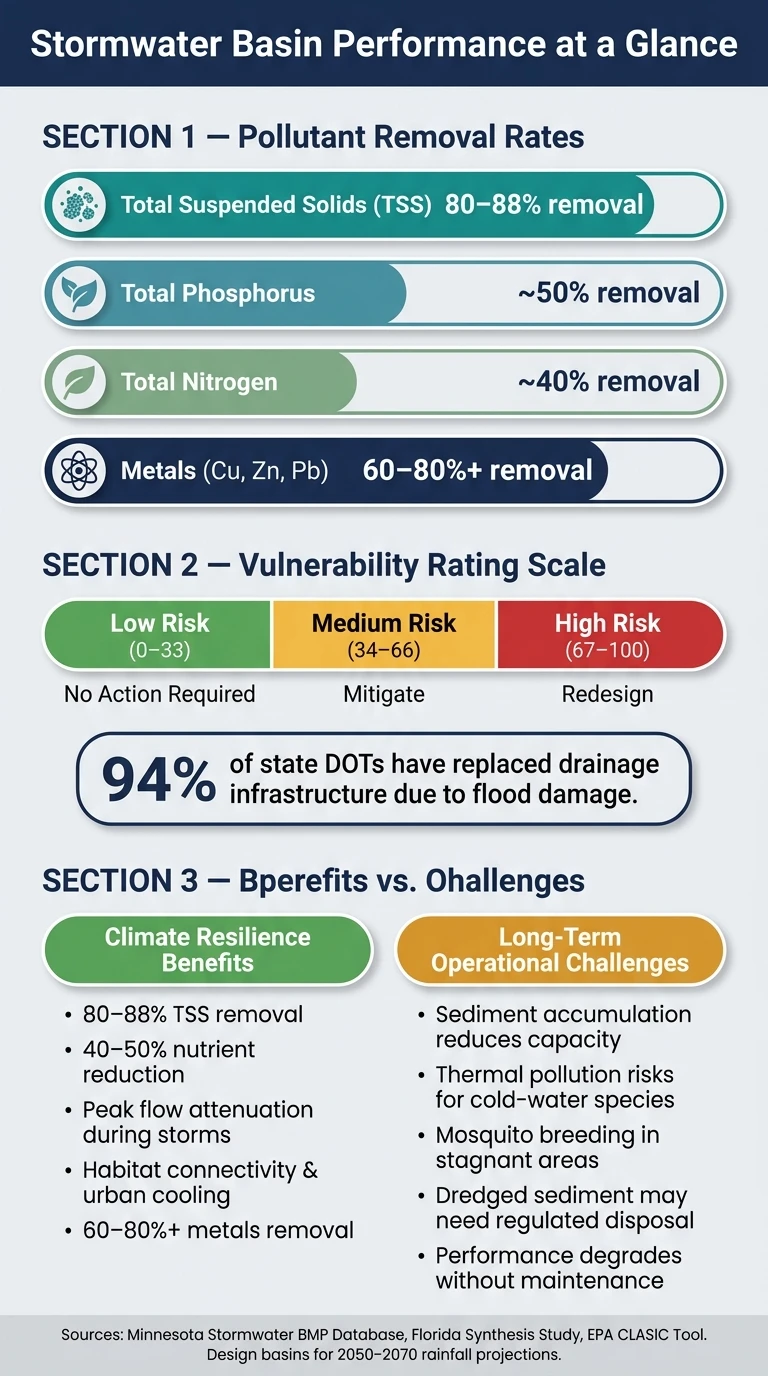
Stormwater Basin Performance: Pollutant Removal Rates & Climate Resilience Metrics
Pollutant Removal: Sediment, Nutrients, Metals, and Hydrocarbons
If hydraulic performance is the first test, water quality is the second. Flood control matters, but that’s only part of the job. When wet ponds and retention basins are designed well, they remove a large share of the sediment and pollutants in urban runoff before that water reaches streams, rivers, and lakes.
These basins do their strongest work on total suspended solids (TSS). The Minnesota Stormwater BMP database reports median removal rates of 80–88% for standard wet pond designs, with outflow concentrations often falling to 10–20 mg/L [3]. A Florida synthesis found about 85% TSS removal on an annual average basis [6].
Nutrient removal is less consistent. Under typical conditions, removal is roughly 40% for total nitrogen and 50% for total phosphorus [6]. Dissolved forms are harder to remove than pollutants attached to particles, which helps explain the swing in results from site to site [6].
For metals such as copper, zinc, and lead, wet ponds often reach 60–80%+ removal of total concentrations when residence time is long enough and sorption media or filtration layers are part of the design [4][6]. Hydrocarbon removal tends to work through the same main processes - sedimentation and sorption - though reported rates vary more.
A few design choices make a clear difference [3][6]:
Longer residence time
Forebays
Inlet and outlet placement on opposite sides of the basin
Shallow planted shelves with native emergent species add another treatment layer. They help trap fine sediment and support the processing of dissolved nutrients [3][7].
Ecosystem Services Beyond Drainage
Basins can do more than move and store stormwater. With varied depths, native plantings, and vegetated edges, they can support habitat, improve ecological links across urban land, and help cool nearby areas [9][12].
That cooling effect matters more as heat waves hit harder. Open water and surrounding vegetation can lower near-surface air temperatures through evaporative cooling and shade [7][9]. In dense urban areas, even small temperature drops can make outdoor spaces feel less punishing.
Trade-Offs and Operational Risks
None of these gains stick on autopilot. They depend on upkeep, and the weak points are well documented.
Sediment accumulation is the most predictable issue. As sediment builds up, the basin loses flood storage and treatment performance at the same time [3][6]. Dredging can also get messy from a cost and compliance standpoint, since removed material may need to be handled as regulated waste [4][6].
Thermal pollution gets less attention, but it is a documented concern. Deep, unshaded ponds can heat up in summer and send warmer water downstream, which can stress cold-water species. Shoreline tree planting and bottom-draw outlet structures can help limit that effect [8].
Mosquito control is another steady maintenance task. Any structure that holds water - whether all the time or only part of the time - can turn into breeding habitat, especially where shallow stagnant pockets develop. The practical fix is integrated mosquito management with regular inspections and biological controls [5][10].
The table below sums up the main gains and the long-term operating issues that come with them:
Category | Climate Resilience & Sustainability Benefit | Long-Term Operational Challenge |
|---|---|---|
Water quality | Sediment accumulation reduces volume and treatment capacity [3][6] | |
Flood attenuation | Storage buffers peak flows during intense storms | Capacity degrades without regular sediment removal and inspection |
Ecosystem services | Unmanaged vegetation can clog inlets and displace native species [7][9] | |
Metals & hydrocarbons | Dredged sediments may require regulated waste disposal [4][6] |
Maintenance is not optional here. Agencies that plan for inspections, sediment testing, vegetation management, and dredging from the start are far more likely to keep both water-quality and flood-control results in place over time [3][6][10][11].
Climate-Resilient Design, Retrofits, and U.S. Implementation
When routine maintenance stops being enough, retrofit design becomes the deciding factor in whether detention basins can handle heavier storms. That puts the next issue front and center: how can existing basins stay effective as rainfall shifts over time?
Design Choices That Improve Long-Term Basin Performance
A few design moves can give older basins more room to perform under tougher storm conditions.
Add 1 to 2 feet of freeboard above Base Flood Elevation to increase the storm safety margin and cut flood-insurance exposure [2].
Use upstream bioretention and infiltration features to reduce inflow and protect basin capacity for larger storms [2].
In retrofit work, focus first on upstream volume reduction so basin storage stays available for extreme events.
Design basins using 2050–2070 rainfall projections and line up upgrades with ASCE 24-24 and FEMA standards [2].
This approach matters because storage is finite. If smaller, more frequent runoff volumes fill the system too early, the basin has less room left when the big storm hits.
Retrofits, Governance, and Watershed Planning
Better design helps, but governance decides whether those upgrades happen across an entire system.
Most U.S. municipalities are not building from a blank slate. They are managing groups of basins built decades ago, and many systems designed in the 20th century are now nearing the end of their 50-year lifespan [14]. Public budgets show how large the retrofit need has become, from King County's $114.1 million flood-risk reduction budget to North Carolina's $877 million resilience commitment [2].
Upgrades only matter if agencies can sort priorities, secure funding, and keep assets maintained over time. Regional watershed plans give agencies a way to line up permits, funding, and resilience targets across jurisdictional lines [13]. GIS-based prioritization tools, including the EPA's CLASIC lifecycle analysis tool, can help rank retrofit investments using future precipitation scenarios instead of relying only on past basin performance [2].
The hard part is not writing the guidance. It is turning that guidance into funded projects that agencies can maintain, monitor, and govern over the long haul.
Conclusion: What the Research Means for Climate Resilience Planning
Taken together, the research makes one point clear: detention and retention basins help climate resilience only when design, maintenance, and watershed conditions work together. Studies show these basins can cut peak flows and remove pollutants, but that performance weakens when old design assumptions stay in place or routine maintenance slips. In plain terms, the basin itself matters, but so do the choices around it. Hybrid green-gray systems also handle heavier, less predictable rainfall better than gray infrastructure on its own.
Recent studies push planners toward non-stationary design. That means sizing for rainfall expected in 2050–2070, not relying on historic averages. With annual U.S. flood losses now above $46 billion [2], waiting comes with a clear price tag.
The harder part now is governance. The work is not just about knowing what improves basin performance; it is about turning that data into projects that get funded, built, and maintained. Watershed-scale governance helps shift basin upgrades from isolated fixes to system-level resilience. Council Fire helps translate basin research, design standards, and governance goals into field-ready projects.
Basins last as resilience assets when they are backed by smart design, steady operations, and watershed-scale planning.
FAQs
How do detention and retention basins differ?
Detention basins hold stormwater for a short time, then let it out at a controlled rate. The goal is to cut downstream peak flows during storms and ease pressure on pipes, channels, and nearby low-lying areas.
Retention basins keep a permanent pool of water. Because water stays in the basin longer, these systems can support more treatment and offer habitat benefits as well.
Why should basins be designed for future rainfall?
Climate change is driving more frequent and heavier extreme rainfall, which means basins sized only from past records can end up too small and more exposed to failure.
Designing for future climate conditions gives engineers room to plan for what’s ahead, not just what’s already happened. It helps them add the capacity and backup needed for shifting risk, so projects stay resilient over time instead of becoming outdated too soon.
How often do stormwater basins need maintenance?
Stormwater basins need regular maintenance if they’re going to keep doing the job they were built to do. How often that work happens depends on two main things: the type of basin and the conditions at the site.
Conventional gray infrastructure often runs on fixed engineering schedules. Nature-based systems, by contrast, usually need more hands-on attention over time. Constructed wetlands and swales may need vegetation trimming, sediment removal, and routine checkups to stay in good shape. One practical upside is visibility: because these systems sit out in the open, crews can inspect them more easily than buried pipe networks.
Related Blog Posts
Latest Articles
©2026

Narrative Change and Power Building: The Missing Half of Advocacy
Narrative change is the process of disrupting dominant narratives that normalize inequity and advancing new narratives from historically marginalized communities.
Funding Resilience Without Federal Grants
BRIC is unreliable and FEMA is shrinking. Here's how cities fund climate resilience with dedicated revenue, blended finance, and a coordinating authority.

The ESG Blind Spot: How AI Is Finding Risks in Companies Nobody Else Is Watching
Norway's sovereign wealth fund uses AI to screen 7,200 portfolio companies for forced labor and corruption within 24 hours. The real story is the emerging-market coverage gap that traditional ESG data vendors miss — and what it means for any company with a global supply chain.
Narrative Change and Power Building: The Missing Half of Advocacy
Narrative change is the process of disrupting dominant narratives that normalize inequity and advancing new narratives from historically marginalized communities.
Funding Resilience Without Federal Grants
BRIC is unreliable and FEMA is shrinking. Here's how cities fund climate resilience with dedicated revenue, blended finance, and a coordinating authority.
The ESG Blind Spot: How AI Is Finding Risks in Companies Nobody Else Is Watching
Norway's sovereign wealth fund uses AI to screen 7,200 portfolio companies for forced labor and corruption within 24 hours. The real story is the emerging-market coverage gap that traditional ESG data vendors miss — and what it means for any company with a global supply chain.
FAQ
01
What does it really mean to “redefine profit”?
02
What makes Council Fire different?
03
Who does Council Fire work with?
04
What does working with Council Fire actually look like?
05
How does Council Fire help organizations turn big goals into action?
06
How does Council Fire define and measure success?
07
How does technology fit into Council Fire’s work?
Jul 12, 2026
Stormwater Basins and Climate Resilience
Sustainability Strategy
In This Article
Detention and retention basins cut flood peaks and remove pollutants, but require future-rainfall design, upkeep, and watershed planning.
Stormwater Basins and Climate Resilience
U.S. flood losses now top $46 billion a year, and many stormwater basins were built for storms that no longer match today’s rain. I see the research pointing to one clear takeaway: basins still help cut flood peaks and clean runoff, but they work well only when cities design for future rainfall, keep up with maintenance, and plan at the watershed scale.
If you want the short version, here it is:
Detention basins slow runoff and lower peak flow.
Retention basins hold water longer and do more for water treatment.
Basin performance drops when sediment fills storage space or outlets are undersized.
Wet ponds often remove 80–88% of total suspended solids, while nutrient removal is more mixed at about 40% nitrogen and 50% phosphorus.
Many agencies now need to size or retrofit basins for 2050–2070 rainfall, not old rainfall records.
Hybrid systems that combine basins with infiltration or vegetated features tend to do better under harder storms.
The big issue is not just design. It is whether communities fund inspections, dredging, retrofits, and watershed planning over time.
What stands out to me is simple: a basin is not a one-time fix. It is part flood-control asset, part water-treatment system, and part long-term public works commitment. That is the lens I would use to read the research and make planning choices.
Flood Risk Reduction: What Studies Show About Basin Hydraulic Performance
Peak Flow Reduction in Detention and Retention Basins
The main question isn't whether basins cut runoff at all. It's how well they keep working when storms get bigger.
Hydraulic performance turns heavily on outlet control, especially pipes and culverts. Detention basins are built to reduce peak flows by storing runoff for a short time and then releasing it at a controlled rate. Retention basins hold water longer, which helps with both flow reduction and water quality.
When basins are paired with nature-based features like infiltration areas or vegetated buffers, results can improve. But there's a catch: the engineered outlet structures still have to be sized for the combined load. Studies of hybrid green-gray systems show stronger performance across a range of storm intensities than either approach on its own [2]. That extra capacity becomes most important when future storms go beyond the rainfall assumptions used in older designs.
Basin Performance Under Projected Rainfall Conditions
A lot of jurisdictions still size basins using past rainfall records rather than projected midcentury storms. That's a problem for assets expected to stay in service through 2050–2070. In practice, resilience planning now depends more and more on testing basin performance against future precipitation scenarios, not just historical data [2].
The EPA's CLASIC (Community-enabled Lifecycle Analysis of Stormwater Infrastructure Costs) tool helps with that kind of planning. It compares green infrastructure options against future precipitation scenarios through GIS-based analysis [2].
Methods Used to Measure Flood Resilience
Researchers measure basin resilience with tools that look at both future precipitation and the condition of drainage infrastructure, including the outlet structures that directly control basin performance. A 2023 University of Minnesota Duluth tool rates buried drainage structures for flood vulnerability and helps agencies decide where retrofits should happen first [1]. One finding stands out: 94% of surveyed state DOTs had replaced drainage infrastructure specifically because of flood damage [1].
The tool sorts drainage structures into three risk bands:
Vulnerability Rating | Risk Level | Recommended Action |
|---|---|---|
0–33 | Low Risk | No action |
34–66 | Medium Risk | Mitigate |
67–100 | High Risk | Redesign |
"The resiliency of a material has a direct impact on climate change itself: Replacing a structure repeatedly can lead to excessive energy use, which in turn contributes to greenhouse gas emissions." - Michael Pluimer, Associate Professor, University of Minnesota Duluth [1]
Hydraulic performance is only one piece of resilience. The next issue is what these basins mean for water quality and long-term urban function.
Expanding Stormwater Infrastructure Data for Climate Resilience | DSI + @GOTO2040
Water Quality and Urban Sustainability: Documented Benefits and Trade-Offs
Stormwater Basin Performance: Pollutant Removal Rates & Climate Resilience Metrics
Pollutant Removal: Sediment, Nutrients, Metals, and Hydrocarbons
If hydraulic performance is the first test, water quality is the second. Flood control matters, but that’s only part of the job. When wet ponds and retention basins are designed well, they remove a large share of the sediment and pollutants in urban runoff before that water reaches streams, rivers, and lakes.
These basins do their strongest work on total suspended solids (TSS). The Minnesota Stormwater BMP database reports median removal rates of 80–88% for standard wet pond designs, with outflow concentrations often falling to 10–20 mg/L [3]. A Florida synthesis found about 85% TSS removal on an annual average basis [6].
Nutrient removal is less consistent. Under typical conditions, removal is roughly 40% for total nitrogen and 50% for total phosphorus [6]. Dissolved forms are harder to remove than pollutants attached to particles, which helps explain the swing in results from site to site [6].
For metals such as copper, zinc, and lead, wet ponds often reach 60–80%+ removal of total concentrations when residence time is long enough and sorption media or filtration layers are part of the design [4][6]. Hydrocarbon removal tends to work through the same main processes - sedimentation and sorption - though reported rates vary more.
A few design choices make a clear difference [3][6]:
Longer residence time
Forebays
Inlet and outlet placement on opposite sides of the basin
Shallow planted shelves with native emergent species add another treatment layer. They help trap fine sediment and support the processing of dissolved nutrients [3][7].
Ecosystem Services Beyond Drainage
Basins can do more than move and store stormwater. With varied depths, native plantings, and vegetated edges, they can support habitat, improve ecological links across urban land, and help cool nearby areas [9][12].
That cooling effect matters more as heat waves hit harder. Open water and surrounding vegetation can lower near-surface air temperatures through evaporative cooling and shade [7][9]. In dense urban areas, even small temperature drops can make outdoor spaces feel less punishing.
Trade-Offs and Operational Risks
None of these gains stick on autopilot. They depend on upkeep, and the weak points are well documented.
Sediment accumulation is the most predictable issue. As sediment builds up, the basin loses flood storage and treatment performance at the same time [3][6]. Dredging can also get messy from a cost and compliance standpoint, since removed material may need to be handled as regulated waste [4][6].
Thermal pollution gets less attention, but it is a documented concern. Deep, unshaded ponds can heat up in summer and send warmer water downstream, which can stress cold-water species. Shoreline tree planting and bottom-draw outlet structures can help limit that effect [8].
Mosquito control is another steady maintenance task. Any structure that holds water - whether all the time or only part of the time - can turn into breeding habitat, especially where shallow stagnant pockets develop. The practical fix is integrated mosquito management with regular inspections and biological controls [5][10].
The table below sums up the main gains and the long-term operating issues that come with them:
Category | Climate Resilience & Sustainability Benefit | Long-Term Operational Challenge |
|---|---|---|
Water quality | Sediment accumulation reduces volume and treatment capacity [3][6] | |
Flood attenuation | Storage buffers peak flows during intense storms | Capacity degrades without regular sediment removal and inspection |
Ecosystem services | Unmanaged vegetation can clog inlets and displace native species [7][9] | |
Metals & hydrocarbons | Dredged sediments may require regulated waste disposal [4][6] |
Maintenance is not optional here. Agencies that plan for inspections, sediment testing, vegetation management, and dredging from the start are far more likely to keep both water-quality and flood-control results in place over time [3][6][10][11].
Climate-Resilient Design, Retrofits, and U.S. Implementation
When routine maintenance stops being enough, retrofit design becomes the deciding factor in whether detention basins can handle heavier storms. That puts the next issue front and center: how can existing basins stay effective as rainfall shifts over time?
Design Choices That Improve Long-Term Basin Performance
A few design moves can give older basins more room to perform under tougher storm conditions.
Add 1 to 2 feet of freeboard above Base Flood Elevation to increase the storm safety margin and cut flood-insurance exposure [2].
Use upstream bioretention and infiltration features to reduce inflow and protect basin capacity for larger storms [2].
In retrofit work, focus first on upstream volume reduction so basin storage stays available for extreme events.
Design basins using 2050–2070 rainfall projections and line up upgrades with ASCE 24-24 and FEMA standards [2].
This approach matters because storage is finite. If smaller, more frequent runoff volumes fill the system too early, the basin has less room left when the big storm hits.
Retrofits, Governance, and Watershed Planning
Better design helps, but governance decides whether those upgrades happen across an entire system.
Most U.S. municipalities are not building from a blank slate. They are managing groups of basins built decades ago, and many systems designed in the 20th century are now nearing the end of their 50-year lifespan [14]. Public budgets show how large the retrofit need has become, from King County's $114.1 million flood-risk reduction budget to North Carolina's $877 million resilience commitment [2].
Upgrades only matter if agencies can sort priorities, secure funding, and keep assets maintained over time. Regional watershed plans give agencies a way to line up permits, funding, and resilience targets across jurisdictional lines [13]. GIS-based prioritization tools, including the EPA's CLASIC lifecycle analysis tool, can help rank retrofit investments using future precipitation scenarios instead of relying only on past basin performance [2].
The hard part is not writing the guidance. It is turning that guidance into funded projects that agencies can maintain, monitor, and govern over the long haul.
Conclusion: What the Research Means for Climate Resilience Planning
Taken together, the research makes one point clear: detention and retention basins help climate resilience only when design, maintenance, and watershed conditions work together. Studies show these basins can cut peak flows and remove pollutants, but that performance weakens when old design assumptions stay in place or routine maintenance slips. In plain terms, the basin itself matters, but so do the choices around it. Hybrid green-gray systems also handle heavier, less predictable rainfall better than gray infrastructure on its own.
Recent studies push planners toward non-stationary design. That means sizing for rainfall expected in 2050–2070, not relying on historic averages. With annual U.S. flood losses now above $46 billion [2], waiting comes with a clear price tag.
The harder part now is governance. The work is not just about knowing what improves basin performance; it is about turning that data into projects that get funded, built, and maintained. Watershed-scale governance helps shift basin upgrades from isolated fixes to system-level resilience. Council Fire helps translate basin research, design standards, and governance goals into field-ready projects.
Basins last as resilience assets when they are backed by smart design, steady operations, and watershed-scale planning.
FAQs
How do detention and retention basins differ?
Detention basins hold stormwater for a short time, then let it out at a controlled rate. The goal is to cut downstream peak flows during storms and ease pressure on pipes, channels, and nearby low-lying areas.
Retention basins keep a permanent pool of water. Because water stays in the basin longer, these systems can support more treatment and offer habitat benefits as well.
Why should basins be designed for future rainfall?
Climate change is driving more frequent and heavier extreme rainfall, which means basins sized only from past records can end up too small and more exposed to failure.
Designing for future climate conditions gives engineers room to plan for what’s ahead, not just what’s already happened. It helps them add the capacity and backup needed for shifting risk, so projects stay resilient over time instead of becoming outdated too soon.
How often do stormwater basins need maintenance?
Stormwater basins need regular maintenance if they’re going to keep doing the job they were built to do. How often that work happens depends on two main things: the type of basin and the conditions at the site.
Conventional gray infrastructure often runs on fixed engineering schedules. Nature-based systems, by contrast, usually need more hands-on attention over time. Constructed wetlands and swales may need vegetation trimming, sediment removal, and routine checkups to stay in good shape. One practical upside is visibility: because these systems sit out in the open, crews can inspect them more easily than buried pipe networks.
Related Blog Posts
Latest Articles
©2026
Narrative Change and Power Building: The Missing Half of Advocacy
Narrative change is the process of disrupting dominant narratives that normalize inequity and advancing new narratives from historically marginalized communities.
Funding Resilience Without Federal Grants
BRIC is unreliable and FEMA is shrinking. Here's how cities fund climate resilience with dedicated revenue, blended finance, and a coordinating authority.
The ESG Blind Spot: How AI Is Finding Risks in Companies Nobody Else Is Watching
Norway's sovereign wealth fund uses AI to screen 7,200 portfolio companies for forced labor and corruption within 24 hours. The real story is the emerging-market coverage gap that traditional ESG data vendors miss — and what it means for any company with a global supply chain.
FAQ
01
What does it really mean to “redefine profit”?
02
What makes Council Fire different?
03
Who does Council Fire work with?
04
What does working with Council Fire actually look like?
05
How does Council Fire help organizations turn big goals into action?
06
How does Council Fire define and measure success?
07
How does technology fit into Council Fire’s work?
Jul 12, 2026
Stormwater Basins and Climate Resilience
Sustainability Strategy
In This Article
Detention and retention basins cut flood peaks and remove pollutants, but require future-rainfall design, upkeep, and watershed planning.
Stormwater Basins and Climate Resilience
U.S. flood losses now top $46 billion a year, and many stormwater basins were built for storms that no longer match today’s rain. I see the research pointing to one clear takeaway: basins still help cut flood peaks and clean runoff, but they work well only when cities design for future rainfall, keep up with maintenance, and plan at the watershed scale.
If you want the short version, here it is:
Detention basins slow runoff and lower peak flow.
Retention basins hold water longer and do more for water treatment.
Basin performance drops when sediment fills storage space or outlets are undersized.
Wet ponds often remove 80–88% of total suspended solids, while nutrient removal is more mixed at about 40% nitrogen and 50% phosphorus.
Many agencies now need to size or retrofit basins for 2050–2070 rainfall, not old rainfall records.
Hybrid systems that combine basins with infiltration or vegetated features tend to do better under harder storms.
The big issue is not just design. It is whether communities fund inspections, dredging, retrofits, and watershed planning over time.
What stands out to me is simple: a basin is not a one-time fix. It is part flood-control asset, part water-treatment system, and part long-term public works commitment. That is the lens I would use to read the research and make planning choices.
Flood Risk Reduction: What Studies Show About Basin Hydraulic Performance
Peak Flow Reduction in Detention and Retention Basins
The main question isn't whether basins cut runoff at all. It's how well they keep working when storms get bigger.
Hydraulic performance turns heavily on outlet control, especially pipes and culverts. Detention basins are built to reduce peak flows by storing runoff for a short time and then releasing it at a controlled rate. Retention basins hold water longer, which helps with both flow reduction and water quality.
When basins are paired with nature-based features like infiltration areas or vegetated buffers, results can improve. But there's a catch: the engineered outlet structures still have to be sized for the combined load. Studies of hybrid green-gray systems show stronger performance across a range of storm intensities than either approach on its own [2]. That extra capacity becomes most important when future storms go beyond the rainfall assumptions used in older designs.
Basin Performance Under Projected Rainfall Conditions
A lot of jurisdictions still size basins using past rainfall records rather than projected midcentury storms. That's a problem for assets expected to stay in service through 2050–2070. In practice, resilience planning now depends more and more on testing basin performance against future precipitation scenarios, not just historical data [2].
The EPA's CLASIC (Community-enabled Lifecycle Analysis of Stormwater Infrastructure Costs) tool helps with that kind of planning. It compares green infrastructure options against future precipitation scenarios through GIS-based analysis [2].
Methods Used to Measure Flood Resilience
Researchers measure basin resilience with tools that look at both future precipitation and the condition of drainage infrastructure, including the outlet structures that directly control basin performance. A 2023 University of Minnesota Duluth tool rates buried drainage structures for flood vulnerability and helps agencies decide where retrofits should happen first [1]. One finding stands out: 94% of surveyed state DOTs had replaced drainage infrastructure specifically because of flood damage [1].
The tool sorts drainage structures into three risk bands:
Vulnerability Rating | Risk Level | Recommended Action |
|---|---|---|
0–33 | Low Risk | No action |
34–66 | Medium Risk | Mitigate |
67–100 | High Risk | Redesign |
"The resiliency of a material has a direct impact on climate change itself: Replacing a structure repeatedly can lead to excessive energy use, which in turn contributes to greenhouse gas emissions." - Michael Pluimer, Associate Professor, University of Minnesota Duluth [1]
Hydraulic performance is only one piece of resilience. The next issue is what these basins mean for water quality and long-term urban function.
Expanding Stormwater Infrastructure Data for Climate Resilience | DSI + @GOTO2040
Water Quality and Urban Sustainability: Documented Benefits and Trade-Offs
Stormwater Basin Performance: Pollutant Removal Rates & Climate Resilience Metrics
Pollutant Removal: Sediment, Nutrients, Metals, and Hydrocarbons
If hydraulic performance is the first test, water quality is the second. Flood control matters, but that’s only part of the job. When wet ponds and retention basins are designed well, they remove a large share of the sediment and pollutants in urban runoff before that water reaches streams, rivers, and lakes.
These basins do their strongest work on total suspended solids (TSS). The Minnesota Stormwater BMP database reports median removal rates of 80–88% for standard wet pond designs, with outflow concentrations often falling to 10–20 mg/L [3]. A Florida synthesis found about 85% TSS removal on an annual average basis [6].
Nutrient removal is less consistent. Under typical conditions, removal is roughly 40% for total nitrogen and 50% for total phosphorus [6]. Dissolved forms are harder to remove than pollutants attached to particles, which helps explain the swing in results from site to site [6].
For metals such as copper, zinc, and lead, wet ponds often reach 60–80%+ removal of total concentrations when residence time is long enough and sorption media or filtration layers are part of the design [4][6]. Hydrocarbon removal tends to work through the same main processes - sedimentation and sorption - though reported rates vary more.
A few design choices make a clear difference [3][6]:
Longer residence time
Forebays
Inlet and outlet placement on opposite sides of the basin
Shallow planted shelves with native emergent species add another treatment layer. They help trap fine sediment and support the processing of dissolved nutrients [3][7].
Ecosystem Services Beyond Drainage
Basins can do more than move and store stormwater. With varied depths, native plantings, and vegetated edges, they can support habitat, improve ecological links across urban land, and help cool nearby areas [9][12].
That cooling effect matters more as heat waves hit harder. Open water and surrounding vegetation can lower near-surface air temperatures through evaporative cooling and shade [7][9]. In dense urban areas, even small temperature drops can make outdoor spaces feel less punishing.
Trade-Offs and Operational Risks
None of these gains stick on autopilot. They depend on upkeep, and the weak points are well documented.
Sediment accumulation is the most predictable issue. As sediment builds up, the basin loses flood storage and treatment performance at the same time [3][6]. Dredging can also get messy from a cost and compliance standpoint, since removed material may need to be handled as regulated waste [4][6].
Thermal pollution gets less attention, but it is a documented concern. Deep, unshaded ponds can heat up in summer and send warmer water downstream, which can stress cold-water species. Shoreline tree planting and bottom-draw outlet structures can help limit that effect [8].
Mosquito control is another steady maintenance task. Any structure that holds water - whether all the time or only part of the time - can turn into breeding habitat, especially where shallow stagnant pockets develop. The practical fix is integrated mosquito management with regular inspections and biological controls [5][10].
The table below sums up the main gains and the long-term operating issues that come with them:
Category | Climate Resilience & Sustainability Benefit | Long-Term Operational Challenge |
|---|---|---|
Water quality | Sediment accumulation reduces volume and treatment capacity [3][6] | |
Flood attenuation | Storage buffers peak flows during intense storms | Capacity degrades without regular sediment removal and inspection |
Ecosystem services | Unmanaged vegetation can clog inlets and displace native species [7][9] | |
Metals & hydrocarbons | Dredged sediments may require regulated waste disposal [4][6] |
Maintenance is not optional here. Agencies that plan for inspections, sediment testing, vegetation management, and dredging from the start are far more likely to keep both water-quality and flood-control results in place over time [3][6][10][11].
Climate-Resilient Design, Retrofits, and U.S. Implementation
When routine maintenance stops being enough, retrofit design becomes the deciding factor in whether detention basins can handle heavier storms. That puts the next issue front and center: how can existing basins stay effective as rainfall shifts over time?
Design Choices That Improve Long-Term Basin Performance
A few design moves can give older basins more room to perform under tougher storm conditions.
Add 1 to 2 feet of freeboard above Base Flood Elevation to increase the storm safety margin and cut flood-insurance exposure [2].
Use upstream bioretention and infiltration features to reduce inflow and protect basin capacity for larger storms [2].
In retrofit work, focus first on upstream volume reduction so basin storage stays available for extreme events.
Design basins using 2050–2070 rainfall projections and line up upgrades with ASCE 24-24 and FEMA standards [2].
This approach matters because storage is finite. If smaller, more frequent runoff volumes fill the system too early, the basin has less room left when the big storm hits.
Retrofits, Governance, and Watershed Planning
Better design helps, but governance decides whether those upgrades happen across an entire system.
Most U.S. municipalities are not building from a blank slate. They are managing groups of basins built decades ago, and many systems designed in the 20th century are now nearing the end of their 50-year lifespan [14]. Public budgets show how large the retrofit need has become, from King County's $114.1 million flood-risk reduction budget to North Carolina's $877 million resilience commitment [2].
Upgrades only matter if agencies can sort priorities, secure funding, and keep assets maintained over time. Regional watershed plans give agencies a way to line up permits, funding, and resilience targets across jurisdictional lines [13]. GIS-based prioritization tools, including the EPA's CLASIC lifecycle analysis tool, can help rank retrofit investments using future precipitation scenarios instead of relying only on past basin performance [2].
The hard part is not writing the guidance. It is turning that guidance into funded projects that agencies can maintain, monitor, and govern over the long haul.
Conclusion: What the Research Means for Climate Resilience Planning
Taken together, the research makes one point clear: detention and retention basins help climate resilience only when design, maintenance, and watershed conditions work together. Studies show these basins can cut peak flows and remove pollutants, but that performance weakens when old design assumptions stay in place or routine maintenance slips. In plain terms, the basin itself matters, but so do the choices around it. Hybrid green-gray systems also handle heavier, less predictable rainfall better than gray infrastructure on its own.
Recent studies push planners toward non-stationary design. That means sizing for rainfall expected in 2050–2070, not relying on historic averages. With annual U.S. flood losses now above $46 billion [2], waiting comes with a clear price tag.
The harder part now is governance. The work is not just about knowing what improves basin performance; it is about turning that data into projects that get funded, built, and maintained. Watershed-scale governance helps shift basin upgrades from isolated fixes to system-level resilience. Council Fire helps translate basin research, design standards, and governance goals into field-ready projects.
Basins last as resilience assets when they are backed by smart design, steady operations, and watershed-scale planning.
FAQs
How do detention and retention basins differ?
Detention basins hold stormwater for a short time, then let it out at a controlled rate. The goal is to cut downstream peak flows during storms and ease pressure on pipes, channels, and nearby low-lying areas.
Retention basins keep a permanent pool of water. Because water stays in the basin longer, these systems can support more treatment and offer habitat benefits as well.
Why should basins be designed for future rainfall?
Climate change is driving more frequent and heavier extreme rainfall, which means basins sized only from past records can end up too small and more exposed to failure.
Designing for future climate conditions gives engineers room to plan for what’s ahead, not just what’s already happened. It helps them add the capacity and backup needed for shifting risk, so projects stay resilient over time instead of becoming outdated too soon.
How often do stormwater basins need maintenance?
Stormwater basins need regular maintenance if they’re going to keep doing the job they were built to do. How often that work happens depends on two main things: the type of basin and the conditions at the site.
Conventional gray infrastructure often runs on fixed engineering schedules. Nature-based systems, by contrast, usually need more hands-on attention over time. Constructed wetlands and swales may need vegetation trimming, sediment removal, and routine checkups to stay in good shape. One practical upside is visibility: because these systems sit out in the open, crews can inspect them more easily than buried pipe networks.
Related Blog Posts
Latest Articles
©2026
Narrative Change and Power Building: The Missing Half of Advocacy
Narrative change is the process of disrupting dominant narratives that normalize inequity and advancing new narratives from historically marginalized communities.
Funding Resilience Without Federal Grants
BRIC is unreliable and FEMA is shrinking. Here's how cities fund climate resilience with dedicated revenue, blended finance, and a coordinating authority.
The ESG Blind Spot: How AI Is Finding Risks in Companies Nobody Else Is Watching
Norway's sovereign wealth fund uses AI to screen 7,200 portfolio companies for forced labor and corruption within 24 hours. The real story is the emerging-market coverage gap that traditional ESG data vendors miss — and what it means for any company with a global supply chain.
FAQ
What does it really mean to “redefine profit”?
What makes Council Fire different?
Who does Council Fire work with?
What does working with Council Fire actually look like?
How does Council Fire help organizations turn big goals into action?
How does Council Fire define and measure success?
How does technology fit into Council Fire’s work?