In This Article
How to track AI referral traffic from ChatGPT, Perplexity, Gemini and Claude in GA4 and Search Console, what goes missing, and how to tie it to revenue.
Last updated
How to track AI referral traffic from ChatGPT & Perplexity
AI assistants still send a small share of web traffic, but it is the share that arrives having already read about you. Across 115,254 sites in Ahrefs' September 2026 benchmark, AI assistants sent 0.43% of visits, with ChatGPT alone at 0.34%. Over the 2025 holiday season, Adobe's analytics data showed AI-referred traffic to tech and software sites up 120% year over year.
To track AI referral traffic, start with the "AI Assistant" channel Google Analytics 4 added in May 2026, then add a custom channel group for the assistants it misses. Read Google's own AI Overviews and AI Mode in Search Console, and connect visits to leads in your CRM. Expect gaps: app clicks often arrive with no referrer.
Council Fire has spent more than 15 years helping companies turn sustainability strategy into growth and communicate it, and we have been a certified B Corp since 2010. We made the case for AI as a marketing advantage in 2024, and built Trovance partly because this measurement problem kept coming up: buyers were finding companies in AI answers, and nobody could see it in the dashboard.
Where does AI referral traffic show up in GA4?
Mostly in its own channel now. Since 13 May 2026, GA4 places visits from recognised AI assistants in a new "AI Assistant" channel, with the medium set to "ai-assistant". Google names ChatGPT, Gemini and Claude as examples, and a June 2026 "Source Group" dimension groups emerging sources such as ChatGPT and Perplexity.
Two caveats matter. The channel depends on a referrer being present, and Google does not publish its list of recognised assistants. And it deliberately excludes Google's own AI Overviews and AI Mode, which GA4 still counts as Organic Search. An "AI Assistant" total in GA4 is therefore a floor, not a full count.
Tags help where referrers fail. OpenAI has said ChatGPT adds utm_source=chatgpt.com to the links it sends (OpenAI Help Center, archived October 2026); check your own data to confirm the tag still arrives. Not every chatgpt.com visit is a recommendation, either: ChatGPT now shows ads, and OpenAI warns that its ad-review crawler's visits may be classified as paid traffic. Give any ChatGPT ad campaigns their own UTMs.
How do you build a custom channel for AI assistants?
Use a custom channel group with a regex on source, and place it above Referral. Google documents exactly this: its example "AI assistants" channel uses a "matches regex" condition, must be ordered above Referrals, and can be applied to your reports retroactively. Google's sample pattern covers OpenAI, ChatGPT, Gemini, Copilot and Perplexity but has no term for Claude, so test any pattern against your own source list.
A starting pattern, to adapt and test, looks like this: chatgpt|openai|perplexity|gemini|claude|copilot|deepseek|grok. Update it when assistants change their domains, as Google advises.
Source | How the visit usually arrives | Where GA4 files it | What to do |
|---|---|---|---|
ChatGPT (web) | Referrer, plus utm_source=chatgpt.com on many links | AI Assistant | Confirm the UTM in your data; separate paid campaigns |
Perplexity, Gemini, Copilot (web) | Referrer from the assistant's domain | AI Assistant or Referral | Add any missing domains to your custom group |
Claude (web and app) | Referrer from the web app; often none from the native app | AI Assistant, or Direct | Expect undercounting; watch branded search |
Google AI Overviews and AI Mode | A Google Search click | Organic Search | Read the Search Console reports |
ChatGPT ads | A paid click | Paid, if tagged | Use campaign UTMs; filter ad-review crawlers |
Who this is for: marketing and growth teams that already run GA4 and want a defensible number for AI-referred visits before buying anything, including the resource-constrained teams most sustainability companies run.
What about Google's AI Overviews and AI Mode?
They live in Search Console, inside your normal totals. Google says clicks from AI Overviews and AI Mode are included in the overall search traffic in Search Console, under the "Web" search type, with no separate click count. An AI Overview occupies a single position, and every link inside it shares that position.
Since August 2026, every site also has generative AI performance reports, but they show impressions only, by page, country, device and date. You can now see how often your pages appear in AI Overviews and AI Mode, but not how many clicks those appearances produce. Google says it may add metrics, so check again before you build a dashboard on it.
Why do so many AI visits look like direct traffic?
Because not every assistant passes a referrer. Cloudflare found that traffic referred by Claude's native app carries no Referer header, and believes other native apps behave the same way. GA4 files visits without a clear referral source under (direct) / (none).
Some AI influence never produces a click at all. A Forrester analyst reports that buyers who learn about a vendor in an answer engine often search for the brand afterwards, so the AI's role shows up as branded search or direct traffic. No public source measures how much of your direct traffic this explains, so treat a rise in branded search alongside rising AI visibility as a signal, not proof.
Should you count AI crawlers?
Count them separately, never as visitors. AI companies run different bots for different jobs: OpenAI lists four user agents for search, training, user-requested fetches and ad review; Anthropic lists three; Perplexity lists two. Google's Gemini training control, Google-Extended, has no separate user agent to find in your logs, and the companies treat robots.txt differently for user-requested fetches.
The volumes dwarf the referrals. In 2025, Cloudflare measured Anthropic crawling as many as 500,000 pages per referral at its peak and OpenAI about 3,700, against 3 to 30 for Google. By June 2026, 52% of crawler requests on Cloudflare's network were for AI training.
In Vercel's 2024 analysis, the major AI crawlers other than Google's and Apple's did not run JavaScript, so a browser-based analytics tag will not see them; crawler analysis is a server-log job. It is still worth doing. A Forrester analyst argues that user-initiated agent requests reflect real buyer research, and that answer-engine tools can estimate visibility but not actual buyer activity.
How do you connect AI visits to leads and revenue?
Join the visit to the conversion in your own data, then report the two together. In GA4 that means key events and the AI Assistant channel side by side; in your CRM it means capturing the first-touch source on the lead record. The harder part is the gap between an AI answer and a visit, which no single tool closes. Consistent source data is the foundation, the same discipline our data management guide applies to ESG data, and the result is worth presenting the way our guide to data storytelling suggests: a few numbers leadership can act on.
Tool | What it sees | What it misses | Who this is for |
|---|---|---|---|
GA4 AI Assistant channel | Visits from recognised assistants, with a referrer | Google's AI surfaces, app visits without a referrer | Every team, as the baseline |
GA4 custom channel group | The assistants you add to the pattern | Anything your pattern misses | Teams that want control |
Search Console | Clicks and impressions from AI Overviews and AI Mode | Other assistants, and clicks by AI feature | Teams with Google-heavy traffic |
Server logs | Crawler and agent requests | Human visits that run your analytics | Technical teams and publishers |
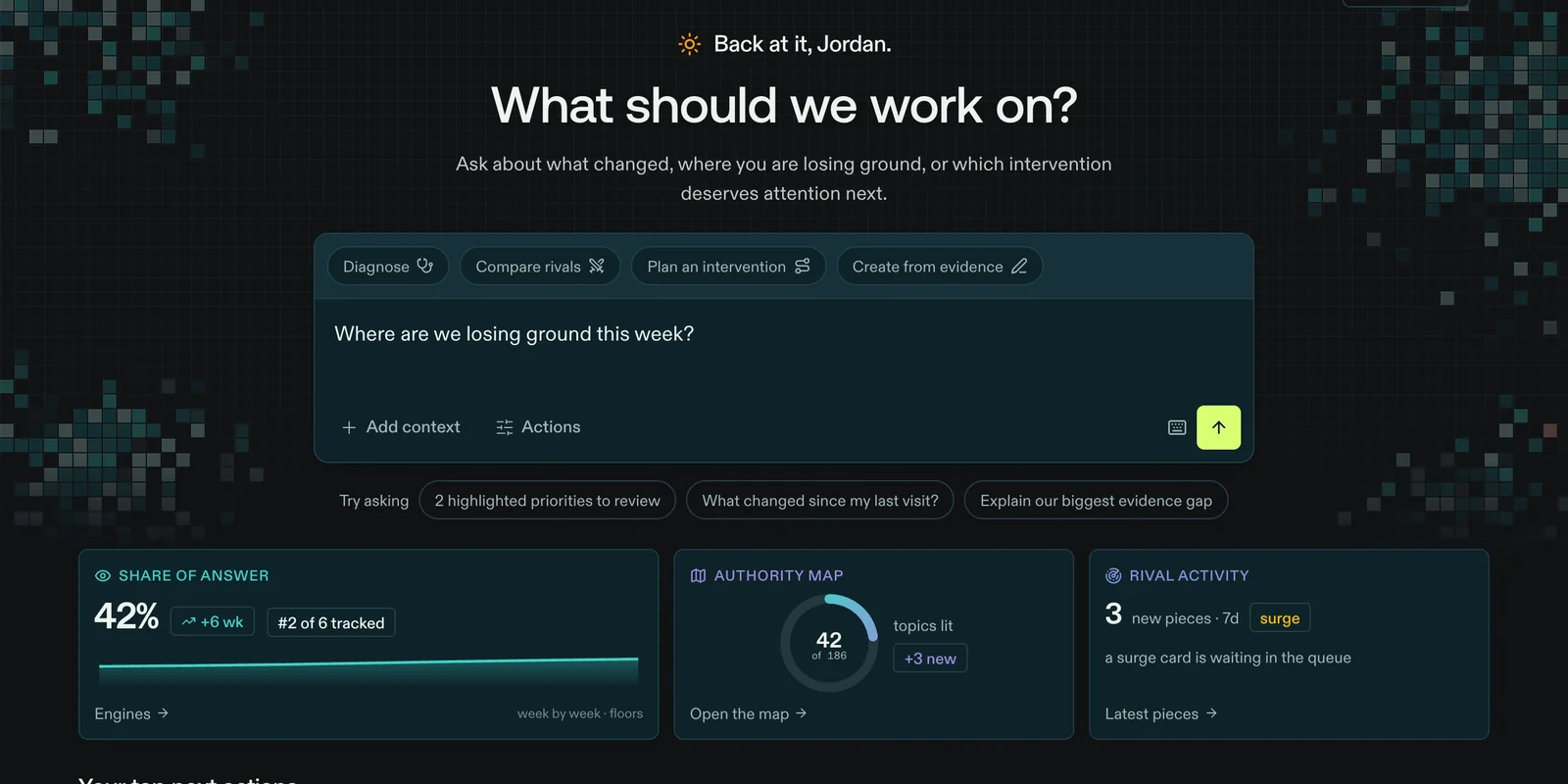
Trovance | AI referrals as they arrive, conversions from your server or Stripe, and weekly answer sweeps in one ledger | Visits with no referrer, which it leaves unattributed; crawler tracking is not available yet | Lean B2B teams that need the answer and the revenue in one place |
That last row is why we built Trovance the way we did. Its first-party pixel records visits without cookies or fingerprinting and identifies AI referrals where a referrer exists, leaving the rest unattributed rather than guessing. It merges Search Console, GA4 and Bing when you connect them, takes conversions from your server or Stripe, and traces leads and revenue to the AI-referred visits behind them. "Cookieless" is not the same as consent-free: the EU's data protection board treats pixel and URL tracking as covered by ePrivacy rules, so check consent requirements with your privacy counsel.
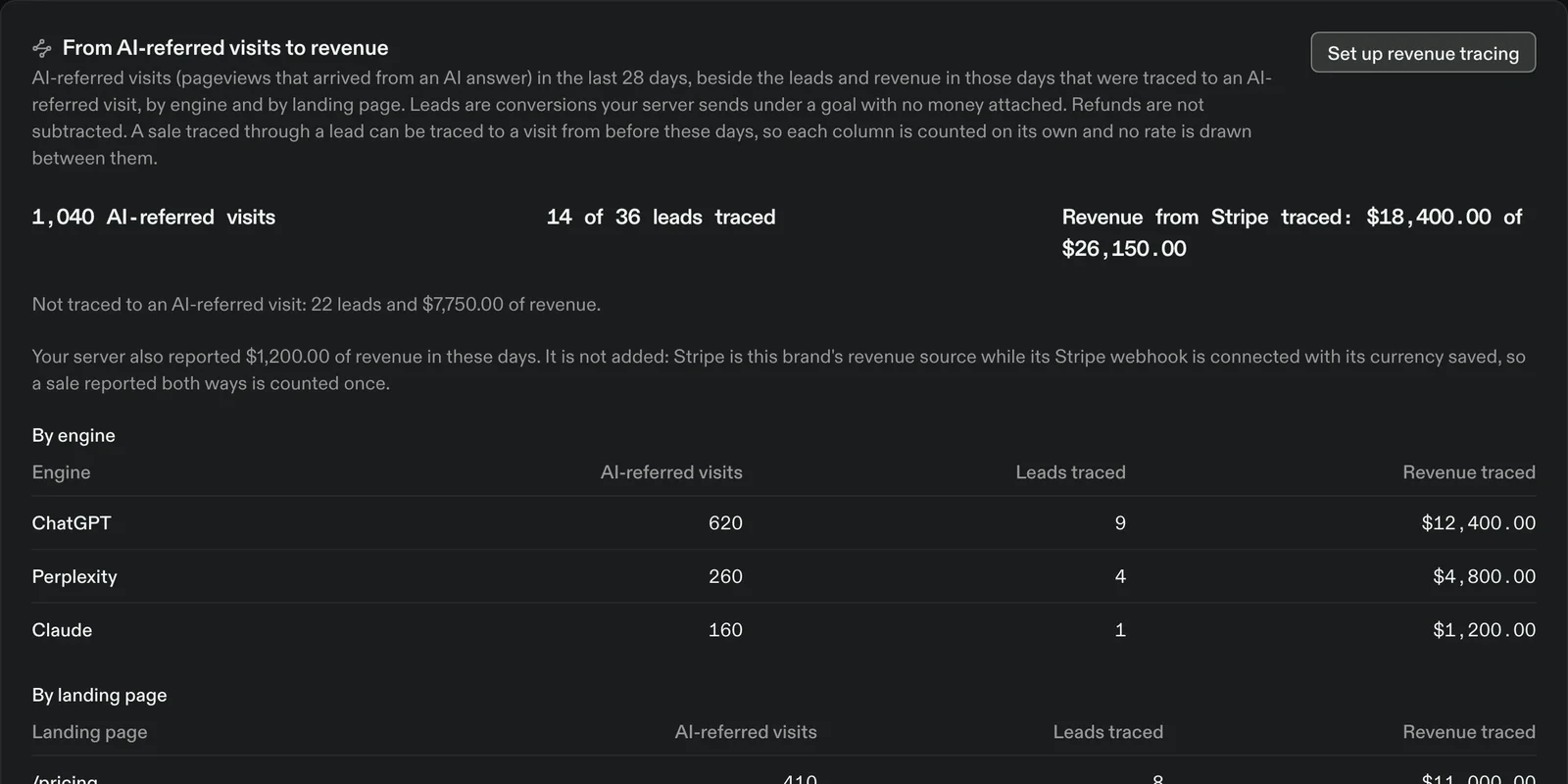
Traffic is only half the picture, because many answers name you without linking. Pair referral tracking with a measure of how often the answers include you at all; our pieces on AI search visibility and AI share of voice cover how to measure that, and Trovance's weekly sweeps report it by engine.
When your reporting needs something no product offers, such as AI-referral data joined to a sustainability or impact dashboard, Council Fire Labs builds it. Our guide to live data dashboards for ESG reporting shows the pattern, the sustainability data and technology guides cover the tooling, and how to choose sustainability software helps decide whether to buy or build. If you do build, start with a one-workflow build brief and a realistic view of what custom software costs. If AI will analyze the data, hold it to the same pilot acceptance discipline as any AI-assisted report.
Frequently asked questions
01How do I see ChatGPT traffic in GA4?
Since May 2026, GA4 groups visits from recognised AI assistants, including ChatGPT, into a default "AI Assistant" channel. For more control, Google documents a custom channel group using a regex on source, ordered above Referral. OpenAI has said ChatGPT adds utm_source=chatgpt.com to links, so also check your campaign source reports.
02Does GA4 track Google AI Overviews and AI Mode?
Not separately. GA4 counts clicks from Google's AI Overviews and AI Mode as Organic Search, and they are excluded from the AI Assistant channel. Search Console includes them in its normal Web totals, and its generative AI reports, available to all sites since August 2026, show impressions but not clicks.
03Why does AI traffic show up as direct?
Because some assistants do not pass a referrer. Cloudflare found Claude's native app sends no Referer header and believes other apps behave the same way, and GA4 files visits without a clear source as (direct) / (none). Buyers who later search your brand also appear as branded search, not AI.
04Does ChatGPT add UTM parameters to links?
OpenAI's publisher FAQ said ChatGPT automatically adds utm_source=chatgpt.com to referral URLs; that page was archived in October 2026, so confirm the tag in your own data. No equivalent tagging is documented by Perplexity, Anthropic or Google. Tag any ChatGPT ad campaigns with their own UTMs.
05How much traffic comes from AI assistants?
It depends on the sample, but it is small and growing. Ahrefs' September 2026 benchmark of 115,254 sites put AI assistants at 0.43% of visits, with ChatGPT at 0.34%. Adobe found AI-referred traffic to tech and software sites up 120% year over year over the 2025 holiday season.
06Should I block AI crawlers?
Decide bot by bot. AI companies run separate crawlers for training, search and user-requested fetches, and blocking a search crawler can remove you from that assistant's answers. Anthropic says its bots honor robots.txt, while OpenAI and Perplexity say their user-triggered fetchers may not. Count crawlers in server logs, separate from visitors.
07How do I connect AI traffic to revenue?
Capture the first-touch source on every lead, join conversions to visits, and report AI-referred leads beside your other channels. GA4 key events and your CRM cover the basics. Trovance records AI referrals as they arrive and traces leads and revenue from your server or Stripe to the AI-referred visits behind them.
Related Resources
AI search
- AI search visibility: why climate companies get left out: measuring how often answers include you.
- AI share of voice: the metric that replaces rank: the visibility metric to report beside traffic.
- How to substantiate environmental claims AI can cite: evidence answers can quote.
- AI x Sustainability: the marketing advantage nobody's talking about: where AI already changes sustainability marketing.
- The AI sustainability accelerator: practical uses for resource-constrained teams.
- Sustainability data and technology guides: the library's data and tooling guides.
Data and dashboards
- Why ESG reporting needs live data dashboards: the dashboard pattern behind joined-up reporting.
- ESG data management guide: keeping the underlying data clean.
- AI sustainability reporting: a pilot acceptance checklist: review discipline for AI-assisted work.
Tools and builds
- Trovance: the AI visibility platform described in this article.
- Council Fire Labs: the software and AI practice that built it.
- How to choose sustainability software: buy, configure or build?: decide before you shop.
- What drives the cost of custom sustainability software?: a budget brief for buyers.
Find the traffic you are already getting
Set up the AI Assistant channel and a custom group this week, check Search Console's generative AI report, and look at what share of your leads you can trace. Start a Trovance trial to see AI referrals and answers in one place, or talk to us on our contact page, choosing Software & AI (CF Labs), about a reporting build.
About the Author
George Chmael II is Council Fire's Founder & CEO. He has led the firm since its founding and through its B Corp certification in 2010. Council Fire's sustainable business practice helps companies build strategies and claims that hold up, and Council Fire Labs builds the software that puts them to work, including Trovance.
Cover photograph: Pexels — Blurred Subway Train behind Man, by Burak Argun. Illustrative stock photograph, not a Council Fire project.





FAQ