In This Article
AI assistants now shape B2B shortlists. Why climate and sustainability companies get left out of AI answers, and how to measure and fix it.
Last updated
AI search visibility: why climate companies get left out
Your next customer may meet your company inside an AI answer before they ever see your website. Forrester's survey of nearly 18,000 business buyers found that 94% use AI during their buying process, and in G2's March 2026 survey, 51% of B2B software buyers said they now start research in an AI chatbot more often than in Google. The stakes sit early: in 6sense's study of nearly 4,000 B2B buyers, the winning vendor was already on the Day One shortlist 95% of the time.
AI search visibility is how often, and how accurately, assistants such as ChatGPT, Perplexity, Gemini, Claude and Google's AI Overviews name your company when buyers ask for options. For sustainability and climate companies it turns on evidence more than keywords: specific, sourced, current claims on pages the engines can read and others can corroborate.
Council Fire has spent more than 15 years helping companies make sustainability claims that hold up, and we have been a certified B Corp since 2010. We built Trovance, our AI visibility platform, because the audience for those claims now includes the systems that summarize them for buyers.
Where do your buyers meet your company now?
Increasingly, inside an answer. OpenAI says more than 1.2 billion people use ChatGPT every week, and Google reported in June 2026 that AI Overviews reach over 2.5 billion users a month, and AI Mode more than 1 billion.
Fewer of those answers send a visitor on. In Pew Research Center's analysis of real browsing data, people clicked a traditional search result on 8% of Google visits that showed an AI summary, against 15% of visits without one, and clicked a link inside the summary on just 1%.
The answers also change minds. In the same G2 survey, 69% of buyers said they chose a different vendor than they had planned because it appeared in a chatbot's recommendation. Buyers do check: Gartner found that 45% of B2B buyers used generative AI in a recent purchase, mainly to research vendors, and 51% expect it to mislead them more often than a sales rep would.
So the shortlist forms before the visit, mostly where your analytics cannot see it. A buyer asks which scope 3 platforms suit a mid-size food manufacturer, or which firms design living shorelines, and reads three names. If yours is not one of them, there is no lost session to investigate, only a deal that never started. We made the broader case for AI as a marketing advantage for sustainability teams in 2024; the shortlist is where that advantage is now won or lost.
Why do AI assistants leave climate companies off the shortlist?
Because the answer can only repeat the evidence it can find. Sustainability companies often have strong evidence and weak exposure: the numbers sit in a 60-page PDF, the certifications live on a partner's site, and the homepage says "sustainable" where a figure should be.
The category makes it harder. In a review of how ChatGPT describes TIME's top greentech companies, Tigercomm and Rampiq report that more than 25 brands share near-identical taglines such as "Leader in sustainable X," which leaves an engine little to tell them apart.
In our sustainability communications work, the evidence usually goes missing in one of five ways:
- Locked evidence. Emissions data, life-cycle results and verification statements are published as PDFs or images rather than as readable pages with dates and methods.
- Adjectives instead of claims. "Eco-friendly" and "planet-positive" give an engine nothing to attribute. A sentence that states the reduction, the site, the year and the verifier does.
- Thin corroboration. Answers draw on what other sources say about you. Muck Rack's analysis of more than 25 million links cited by ChatGPT, Claude and Gemini found 84% came from earned media and 0.3% from paid content, and Ahrefs found that brand mentions across the web correlated far more strongly with AI Overview visibility than backlinks did (0.664 against 0.218).
- Rivals answer the question first. A competitor that publishes a clear comparison page can become the source the answer cites, including about you.
- Answers move. When volunteers ran the same prompts again and again, SparkToro and Gumshoe found less than a 1-in-100 chance that ChatGPT or Google's AI would return the same list of brands. One test in one engine tells you very little.
More content will not close the gap. Better evidence will. In a peer-reviewed study presented at KDD 2024, adding citations, quotations and statistics raised a source's visibility in generative-engine answers by 30 to 40% in the authors' benchmark, while keyword stuffing did not help.
Why do green-claims rules make vague claims a visibility problem?
Because the evidence that protects you from enforcement is the same evidence an AI answer can cite. Regulators are moving against unsupported environmental claims at the same moment AI assistants reward supported ones, and greenwashing now carries a cost on both fronts.
Jurisdiction | Rule | Status in October 2026 | What it asks of your claims |
|---|---|---|---|
European Union | Member States must apply it from 27 September 2026 | No generic claims without recognised excellent performance, no sustainability labels outside certification schemes or public authorities, no offset-based "neutral" claims | |
European Union | Green Claims Directive proposal | On hold; the Commission said in June 2025 it intended to withdraw it, but it has not been formally withdrawn | Nothing new yet; watch the Commission's next work programme |
United Kingdom | Consumer law enforced by the CMA | In force since 6 April 2025, with fines of up to 10% of global turnover | Substantiate every claim, including website copy |
United States | The 2012 text still applies; a review opened in 2022 has not produced revised guides | No unqualified general environmental benefit claims, business-to-business included | |
California | In force since 1 January 2024 | Publish how net-zero and carbon-neutral claims were determined and whether a third party verified them; penalties up to $500,000 |
The EU directive also requires claims about future performance, such as a net-zero target, to rest on a public implementation plan that an independent expert verifies regularly. It governs claims made to consumers, but a public website is visible to everyone, so B2B firms should not assume they are exempt.
The UK regulator is explicit about websites. Its January 2026 guidance counts what a business says on its website as a claim, and notes that an unwitting breach is still a breach.
A claim you cannot document is a liability in front of a regulator and invisible in front of an engine. Treat your claims file as publishable evidence. Our summary of anti-greenwashing regulations covers the rules in more depth, and greenwashing decline covers what transparent marketing looks like in practice.
How do you measure AI search visibility?
Ask the questions your buyers ask, in every engine they use, on a schedule, and keep the answers. Record whether you are named, with which claims, citing which sources and alongside which competitors. Then repeat the same questions weekly so you see movement rather than noise.
Measure share of answer across many runs, not a single position. The SparkToro researchers reached the same conclusion: visibility measured across dozens of prompts, run repeatedly, is a reasonable metric, and ranking position is not. Being in the answer is worth tracking because it pays: Seer Interactive's 2026 study found brands cited in a Google AI Overview earned 120% more organic clicks per impression than brands that were not, though Seer notes it cannot claim causation.
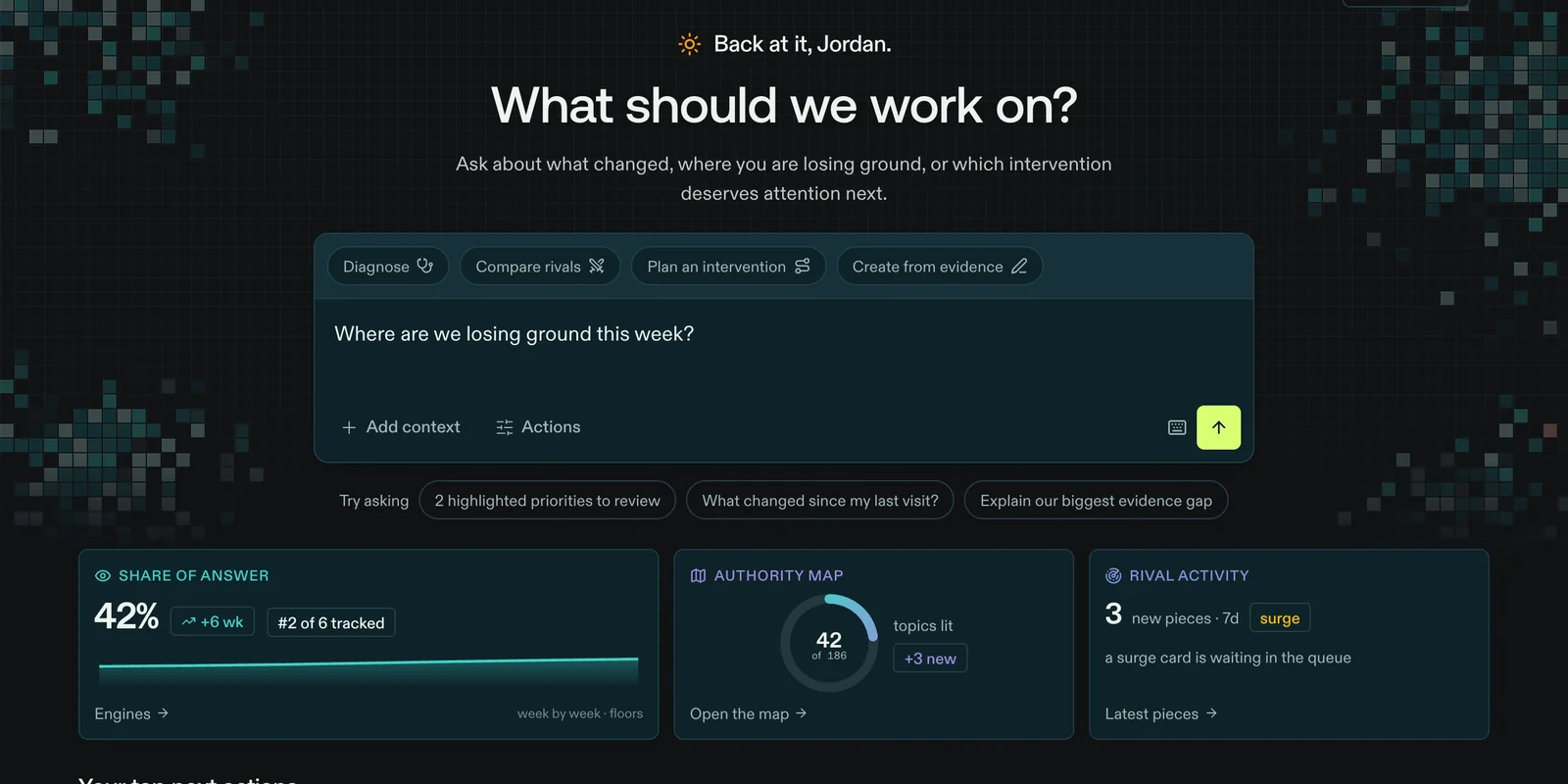
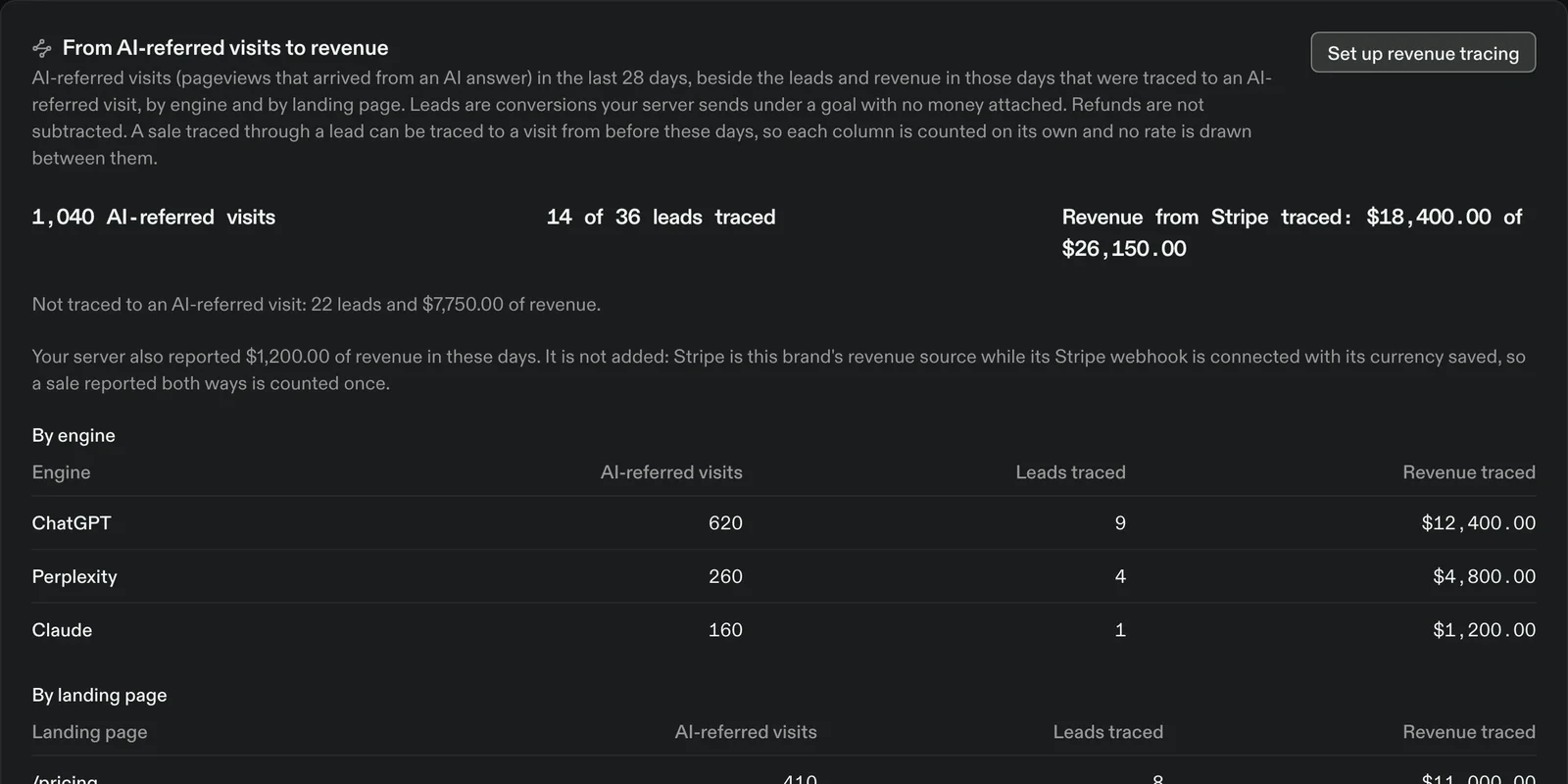
Start with 20 to 50 real buyer questions in three groups: category questions ("best supplier emissions software for food manufacturers"), comparison questions ("X versus Y") and problem questions ("how do I verify supplier emissions data"). Then follow AI-referred visits through to leads, so the work connects to pipeline. Adobe's analytics data showed AI-referred traffic to tech and software sites up 120% year over year over the 2025 holiday season.
Approach | What you learn | Who this is for | Risk |
|---|---|---|---|
Manual prompt spreadsheet | A snapshot of a few answers | Teams testing whether the problem is real | Answers vary run to run, so one snapshot misleads |
SEO suite add-on | Brand mentions beside keyword data | SEO-led teams already paying for a suite | Visibility without a diagnosis or a next action |
Agency audit | An expert read and a plan | Teams without staff time | A one-off report while answers change weekly |
An AI visibility platform such as Trovance | Weekly sweeps, share of answer, cited sources, ranked actions and traced revenue | Lean B2B teams that need to act, not only watch | Needs a person to approve and publish the fixes |
A custom build | Your own prompts, data and workflow | Organizations with unusual data or internal systems | Cost and upkeep; overkill if a product fits |
How do you fix what the answers get wrong?
Publish the evidence the answer is missing, in a form engines can read, and keep a person in charge of every claim. That takes a handful of habits rather than a content blitz.
- One claim, one page. Give each material claim its own readable page: the number, the method, the date, the boundary, the verifier and the level of assurance. Link the PDF from it rather than relying on the PDF.
- Answer the buyer's question directly. Comparison pages, use cases and certification explainers should answer in the first sentence and support it with figures.
- Earn corroboration. Forrester's analyst urges providers to make sure their claims can be validated through trusted external voices. Keep registries, certifications, partner pages and case studies current.
- Review before you publish. Every new claim should pass the same review as your sustainability reporting. Speed does not excuse greenwashing.
- Re-ask and measure. Rerun the same questions after publishing and track referrals, so you learn what moved the answer and what did not.
Your buyers' procurement teams are moving the same way. EcoVadis's 2026 barometer found 98% of the 1,000 multinationals it surveyed have started building ESG data into procurement, and 55% now use AI operationally, especially for ESG analytics and risk screening. Our guides to communicating ESG progress credibly and data storytelling cover how to turn a report into claims people, and now machines, can use.
Why did Council Fire build Trovance?
Because measuring the problem was not enough; teams needed a loop that ends in a verified fix. Trovance asks ChatGPT, Perplexity, Google AI Overviews, Gemini and Claude the questions your buyers ask every week (engines depend on the plan) and keeps every answer and source. It shows your share of the answer on each engine, your competitors, and a map of the questions you hold, they hold and nobody holds yet.
It then names why an answer leaves you out, whether evidence, positioning, retrieval, product or fit, and ranks the actions worth taking, including when the right move is to wait. Drafts are researched first and written in your voice, with every claim flagged for review. Nothing publishes until a person approves it.
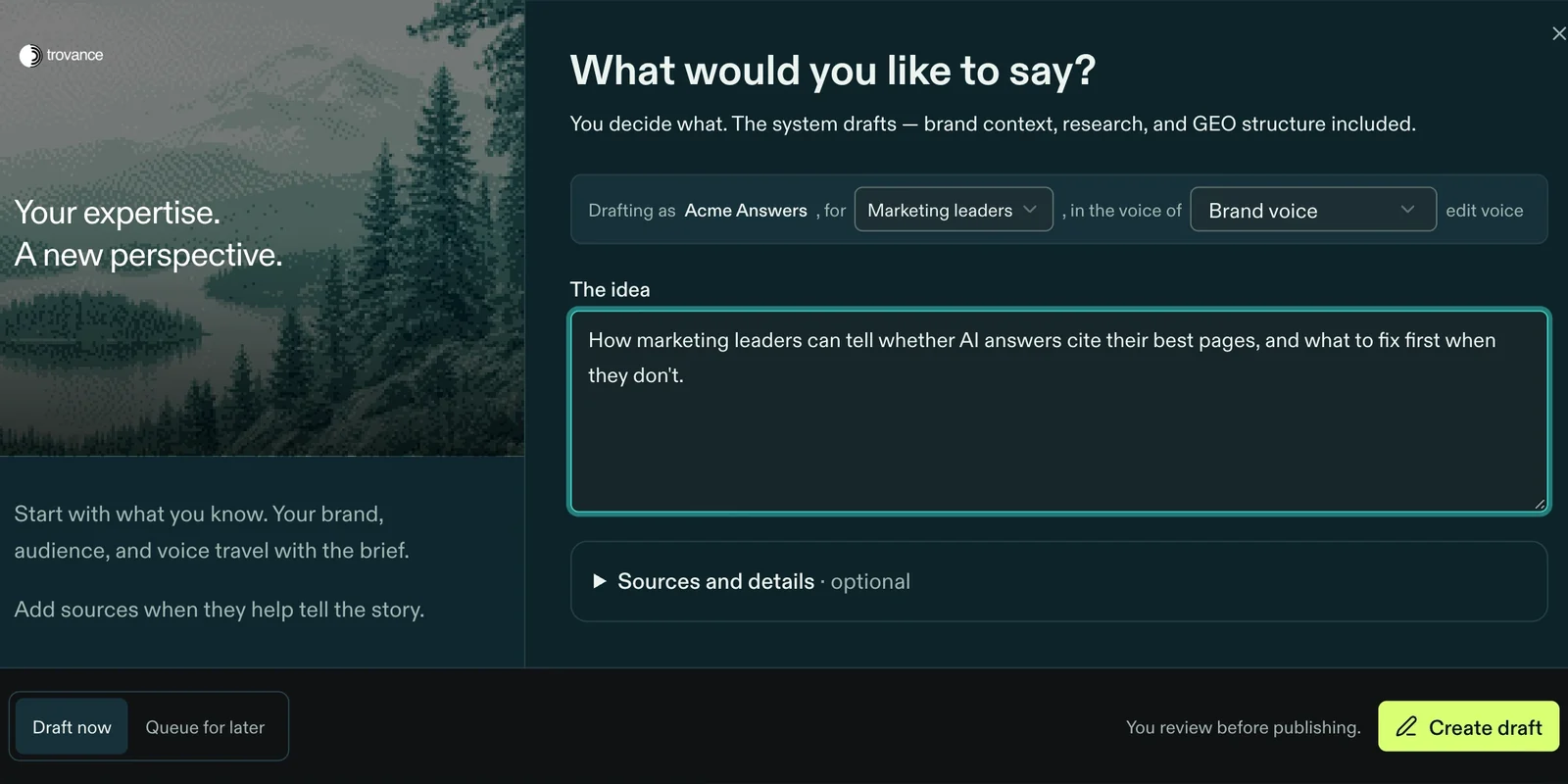
Once approved, Trovance publishes to WordPress, Framer or a signed webhook you connect, or hands over an agent-ready bundle for any CMS. It checks that the page is live, asks the question again in the next sweep and traces AI-referred visits to the leads and revenue that followed them. Plans start at $99 a month, and the Starter plan has a 14-day trial; you can also text Trovance from an iPhone, iPad or Mac to see how AI describes your company.
For sustainability companies the claim review matters most. An AI visibility tool that drafts faster than your team can verify is a greenwashing risk with a dashboard, which is why AI-drafted claims deserve the same pilot acceptance discipline as AI-assisted reporting.
When the workflow you need is not one any product offers, Council Fire Labs builds it. Start with how to choose sustainability software and what drives the cost of custom sustainability software.
Frequently asked questions
01What is AI search visibility?
AI search visibility is how often, and how accurately, AI assistants such as ChatGPT, Perplexity, Gemini, Claude and Google's AI Overviews mention your company when buyers ask for options. It is measured by asking real buyer questions across engines on a schedule and tracking mentions, cited sources and share of answer over time.
02How do AI assistants decide which companies to recommend?
Assistants combine what the model learned in training with pages retrieved when the question is asked, then summarize what those sources support. In a peer-reviewed KDD 2024 study, adding citations, quotations and statistics raised a source's visibility in generative-engine answers by 30 to 40%, while keyword stuffing did not help.
03Does SEO still matter for AI search?
Yes. Google states there are no additional technical requirements for AI Overviews or AI Mode: a page must be indexed and eligible to show in Search with a snippet. SEO gets a page found. AI search visibility then depends on what the answer can quote, so specific, current claims serve both.
04How can a sustainability company check what ChatGPT says about it?
Write 20 to 50 questions your buyers actually ask, run them in ChatGPT and the other engines your buyers use, and record whether you appear, which claims are made and which sources are cited. Repeat weekly, because answers vary between runs. A platform such as Trovance automates the sweep and keeps the history.
05Can greenwashing rules affect AI search visibility?
Indirectly, yes. Since 27 September 2026, EU Member States must apply rules banning generic environmental claims that a company cannot back with recognised excellent performance. Documented, specific claims are also the ones AI answers can cite, so a vague claim becomes a legal risk and stays invisible to engines at the same time.
06How long does it take to improve AI search visibility?
Expect weeks, not days. Engines refresh their sources on their own schedules and answers vary between runs, so judge a change across several weekly sweeps rather than one test. Trovance checks results at 7, 28 and 56 days and treats 28 days of evidence as the minimum before it records a lesson.
07What does Trovance do?
Trovance is the AI visibility platform for lean B2B teams, built by Council Fire Labs: it finds why AI assistants leave you off the shortlist, helps you publish the fix, and checks that it worked. Weekly sweeps cover up to five engines, depending on the plan, and nothing publishes without a person's approval.
Related Resources
AI and sustainability
- AI share of voice: the metric that replaces rank: how to report AI visibility to leadership.
- How to track AI referral traffic from ChatGPT & Perplexity: the visits and revenue AI sends.
- AI x Sustainability: the marketing advantage nobody's talking about: where AI already changes sustainability marketing.
- The AI sustainability accelerator: practical uses for resource-constrained teams.
- AI sustainability reporting: a pilot acceptance checklist: the review discipline AI-drafted claims need.
- Sustainability data and technology guides: the library's data and tooling guides.
Claims and communication
- How to substantiate environmental claims AI can cite: the claim file behind every answer.
- Greenwashing decline: building trust through transparent sustainability marketing: what credible claims look like now.
- What is greenwashing?: the definition regulators and buyers work from.
- What is the Green Claims Directive?: the EU proposal and its status.
- Sustainability communications and storytelling guides: turning evidence into a story people follow.
- Crafting compelling sustainability narratives: structure for the pages answers quote.
Tools and builds
- Trovance: the AI visibility platform described in this article.
- Council Fire Labs: the software and AI practice that built it.
- Before you commission sustainability software: write a one-workflow build brief: scope a custom build.
- How to choose sustainability software: buy, configure or build?: decide before you shop.
See what AI says about you
Find out what AI tells your buyers about you before your next pitch does. Start a Trovance trial and run the first sweep yourself, or talk to us on our contact page, choosing Software & AI (CF Labs), about AI search visibility, sustainability claims or a custom build.
About the Author
George Chmael II is Council Fire's Founder & CEO. He has led the firm since its founding and through its B Corp certification in 2010. Council Fire's sustainable business practice helps companies build strategies and claims that hold up, and Council Fire Labs builds the software that puts them to work, including Trovance.
Cover photograph: Pexels — Flock of Birds Flying over Man Standing on Lakeshore, by Sanjeev Kumar. Illustrative stock photograph, not a Council Fire project.




FAQ