In This Article
What AI share of voice is, why rank fails in AI answers, how to calculate share of answer across engines and runs, and what it can and cannot predict.
Last updated
AI share of voice: the metric that replaces rank
If you report your position in ChatGPT the way you report a Google ranking, you are reporting noise. When volunteers ran the same prompts again and again, SparkToro and Gumshoe found less than a 1-in-100 chance that ChatGPT or Google's AI would return the same list of brands. And Google rank does not transfer: only 12% of URLs cited by ChatGPT, Gemini and Copilot ranked in Google's top 10 for the same prompt. Gartner predicted in December 2023 that brands' organic search traffic will fall by 50% or more by 2028, so the old scoreboard is losing its game.
AI share of voice, often called share of answer, is the percentage of AI answers to your buyers' questions that mention your brand, measured across many prompts, every engine your buyers use, and repeated runs. It replaces rank because single answers change from run to run, while the share across many answers is stable enough to track.
Council Fire has spent more than 15 years helping companies build sustainability strategies that buyers believe, and we have been a certified B Corp since 2010. We built Trovance to measure that belief where buyers now form it: inside AI answers, engine by engine, week by week.
Why doesn't rank work in AI answers?
Because a single answer is a sample, not a standing. AI answers do list brands in an order, but the order changes from run to run, so a brand's position in any one answer is not a stable number to report. The SparkToro researchers concluded that visibility measured across dozens to hundreds of prompts, run repeatedly, is a reasonable metric, and ranking position is not.
The sources behind the answers move even faster than the brands. In BrightEdge's 12-week tracking of ecommerce prompts, share of brand mentions moved about 25% week over week, and share of citations 39 to 41%. On Gemini, 37% of the URLs cited each week had not been cited the week before, against 3% of the brands mentioned. Brands hold; evidence turns over.
That is the measurement case for a baseline and a schedule. Our guide to AI search visibility explains why sustainability companies in particular lose ground in these answers.
How do you calculate AI share of voice?
Count mentions across a fixed set of buyer questions, per engine, over repeated runs, and compare yourself with named competitors. Use questions where a recommendation is plausible: in Ahrefs' analysis of Google's AI surfaces, 59% of AI Overview answers and 35% of AI Mode answers named no brand at all, because many queries are informational.
Metric | How to calculate it | What it tells you | Watch out for |
|---|---|---|---|
Share of answer | Answers that mention you ÷ all answers to your prompt set, per engine | How often you are in the conversation | Prompt sets that favor you; run it repeatedly |
Competitive share | Your mentions ÷ all brand mentions across the prompt set | Your slice of the category's visibility | Big platform brands crowding every list |
Citation share | Answers that cite your pages ÷ all answers | Whether your own evidence is being used | Citations churn weekly; trend, do not snapshot |
Link rate | Mentions that include a link to you ÷ all mentions | Whether visibility can turn into visits | Varies widely by engine |
Average position | Mean order of your mention when present | Rough prominence | Unstable run to run; never report alone |
A mention is not a click. When Ahrefs studied more than 31,000 AI answers that named Ahrefs itself, the answers linked to it only about 28% of the time, from 10.7% in AI Overviews to 51.6% in Perplexity. Report share of answer beside AI referral traffic, never instead of it, and present the result the way our guide to data storytelling recommends: a few numbers that point to a decision.
Who this is for: B2B marketing leads who need a visibility number for leadership that will still mean the same thing next quarter.
Do AI engines agree on which brands to recommend?
On the biggest names, mostly; below them, much less. Studies differ on how much: BrightEdge found any two of five engines shared 36 to 55% of their top 100 named brands, while Semrush's 2026 AI Visibility Index, built on 25 million US prompts a month, found any two of four platforms shared 70 to 78 of their top 100 in the US and 63 to 70 in the UK.
The disagreement concentrates where B2B buyers do their research. Within categories, BrightEdge found agreement fell from 97% in retail to 71% in finance and 60% in healthcare, and in a head-to-head, ChatGPT and Gemini shared only about 2 of their top 5 brands per category. Across January to April 2026, only 36 brands held top-100 visibility on all four platforms every month, and they were giants such as YouTube, Amazon and Apple.
Even Google's two AI surfaces cite different sources. Ahrefs found AI Overviews and AI Mode shared only 13.7% of their citations for the same queries, though their answers were 86% similar in meaning. Measure every engine your buyers use, separately.
What does share of voice actually predict?
In advertising, a great deal; in AI answers, nobody knows yet. The idea that share of voice relative to market share signals growth goes back to John Philip Jones, who argued in Harvard Business Review in 1990 that a brand's market share should be compared with its share of voice. A peer-reviewed study in the International Journal of Advertising later confirmed the pattern that smaller brands run a relatively larger share of voice.
The best-known rule of thumb comes from Les Binet and Peter Field's analysis of advertising effectiveness, which, as Nielsen summarizes it, found a brand's share of market typically gained 0.5% for every 10% of excess share of voice. That evidence is mostly from consumer brands and paid media.
Share of answer borrows the same comparative logic for AI answers, and that is all we should claim for it. No study yet shows that AI share of answer predicts market share. It tells you whether you are in the conversation buyers now start with; tracing AI-referred visits to leads and revenue tells you whether that conversation pays.
How should B2B teams act on it?
Set a baseline, track it weekly against competitors, and spend effort on the evidence that moves it. A Forrester analyst reports that 90% of B2B marketing leaders treat AI visibility as at least an investment-level priority, and warns that falling engagement data will make marketing look as if it is failing. Share of answer is the metric that shows what engagement data cannot.
What moves the number is mostly evidence other people publish. In Ahrefs' study of 75,000 brands, brand mentions across the web correlated far more strongly with AI Overview visibility than backlinks did, and 84% of the links cited by ChatGPT, Claude and Gemini in Muck Rack's analysis came from earned media. That puts PR, partnerships and sustainability communications inside the AI visibility budget.
For sustainability companies, the evidence has to be specific and defensible; our guide on how to substantiate environmental claims AI can cite covers the claim file. Our guides to communicating ESG progress credibly and greenwashing decline cover what holds up, and we made the case for AI as a marketing advantage for resource-constrained teams back in 2024.
How does Trovance measure share of answer?
Every week, Trovance asks ChatGPT, Perplexity, Google AI Overviews, Gemini and Claude the questions your buyers ask (engines depend on the plan), keeps every answer and source, and reports your share of the answer on each engine beside your competitors. The Starter plan tracks 25 prompts and 3 competitors; Growth tracks 100 prompts and 10 competitors across all five engines.
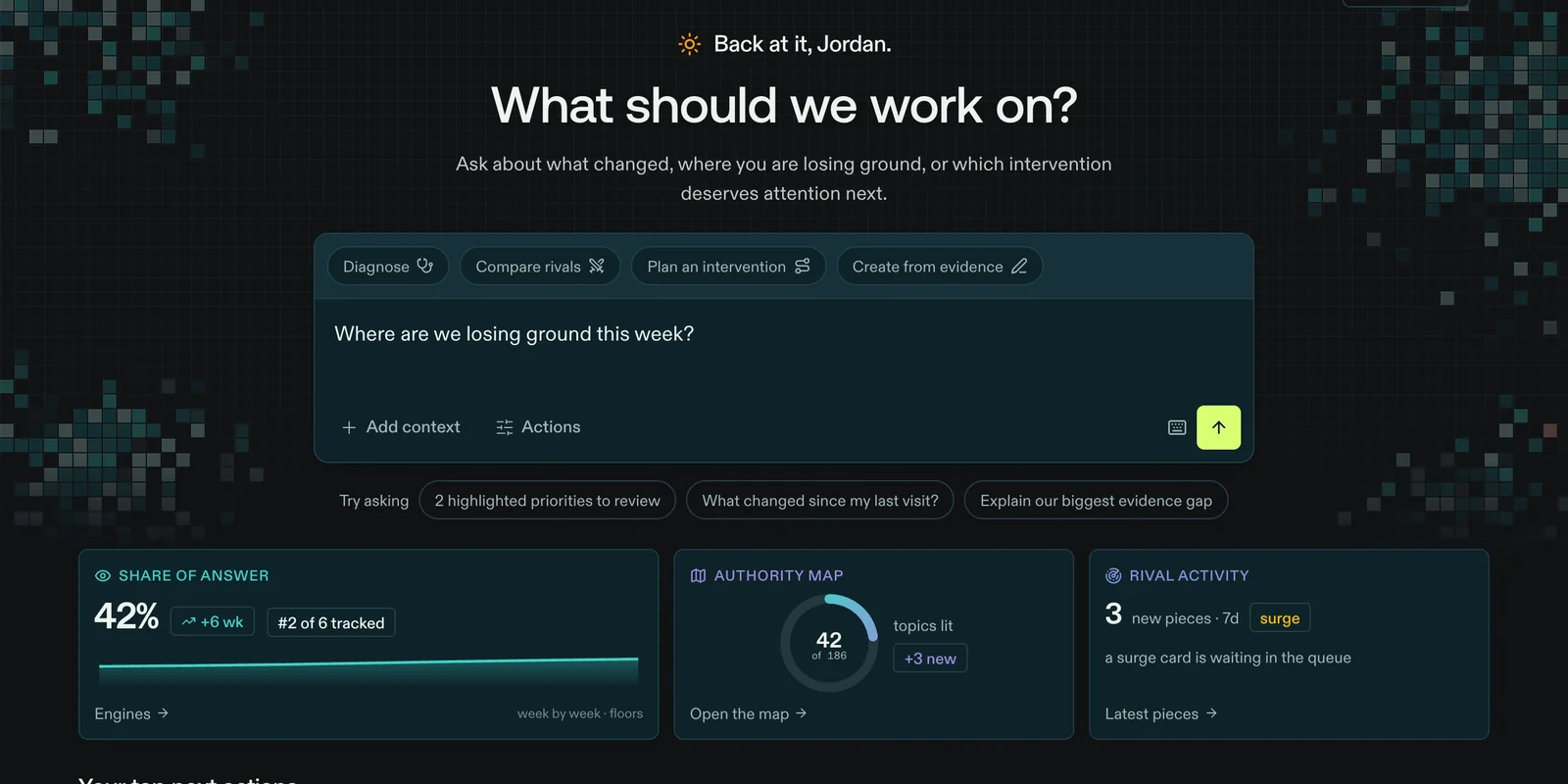
It then maps the questions you hold, the ones rivals hold and the ones nobody holds yet, names why an answer leaves you out, and ranks the actions worth taking. Because a mention is not a click, it also records AI-referred visits as they arrive and traces leads and revenue to them through your server or Stripe.
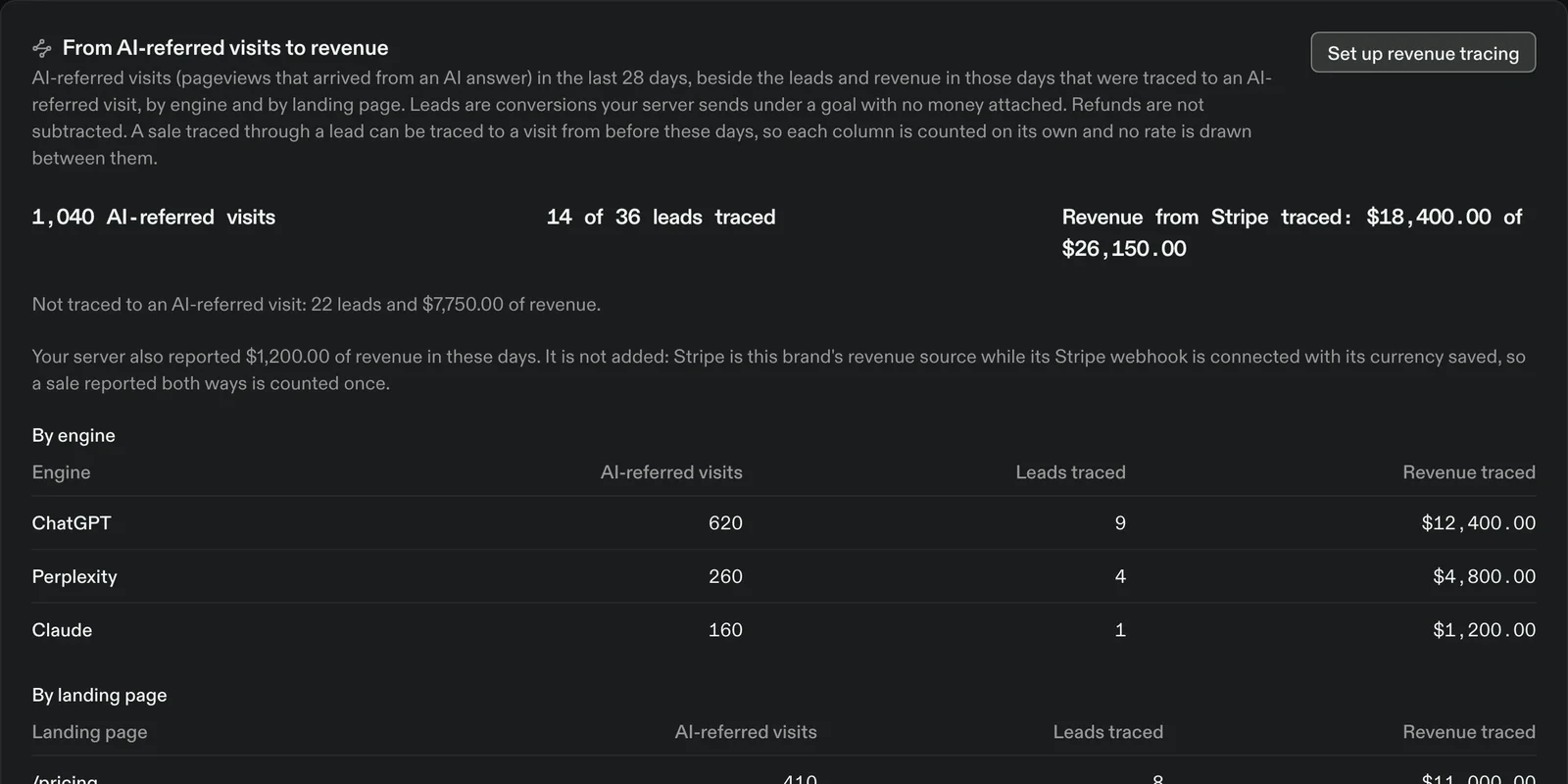
When you need a measurement no product offers, such as share of answer joined to your own sales data, Council Fire Labs builds it. The sustainability data and technology guides cover the tooling, how to choose sustainability software helps decide whether to buy or build, and what drives the cost of custom software sets the budget. Any AI analysis in the loop deserves the same pilot acceptance discipline as AI-assisted reporting.
Frequently asked questions
01What is AI share of voice?
AI share of voice, or share of answer, is the percentage of AI answers to your buyers' questions that mention your brand. It is measured across a fixed set of prompts, on each engine your buyers use, over repeated runs, and compared with competitors. It replaces rank because single AI answers change from run to run.
02How is AI share of voice different from SEO share of voice?
SEO share of voice estimates your share of clicks or impressions from search rankings. AI share of voice counts how often answers name you, whether or not anyone clicks. The two diverge: only 12% of URLs cited by ChatGPT, Gemini and Copilot ranked in Google's top 10 for the same prompt in Ahrefs' study.
03How many prompts do you need to measure AI share of voice?
Enough to average out run-to-run noise: dozens to hundreds, repeated over time. The SparkToro researchers called visibility across dozens to hundreds of prompts, run repeatedly, a reasonable metric. Start with 20 to 50 real buyer questions; Trovance's Starter plan tracks 25 prompts and Growth tracks 100.
04How often should you measure AI share of voice?
Weekly, against a fixed baseline. Brand mentions in AI answers moved about 25% week over week, and cited sources even more, in BrightEdge's 12-week tracking of ecommerce prompts, so monthly snapshots miss movement and single checks mislead. Compare each week's share with your baseline and with named competitors.
05Does position in an AI answer matter?
Somewhat, but it is too unstable to report alone. Answers do list brands in an order, yet that order changes between runs, so a single position says little. Track average position only alongside share of answer, across many prompts and runs, and treat a single answer as a sample, not a standing.
06Which AI engines should you track?
The ones your buyers use, measured separately. Engines disagree below the biggest brands: BrightEdge found ChatGPT and Gemini shared only about 2 of their top 5 brands per category, and Google's AI Overviews and AI Mode shared just 13.7% of citations. G2 found 51% of B2B software buyers now start research in a chatbot.
07Can AI share of voice predict revenue?
Not on its own, and no study yet links it to market share. In advertising, share of voice above market share has long signaled growth, but that evidence comes from paid media. Pair share of answer with AI-referred visits and the leads and revenue traced to them, which Trovance reports side by side.
Related Resources
AI search
- AI search visibility: why climate companies get left out: why answers leave sustainability companies out.
- How to track AI referral traffic from ChatGPT & Perplexity: the clicks share of answer cannot show.
- AI x Sustainability: the marketing advantage nobody's talking about: where AI already changes sustainability marketing.
- The AI sustainability accelerator: practical uses for resource-constrained teams.
Evidence and communication
- How to substantiate environmental claims AI can cite: the claim file behind the evidence.
- Sustainability communications and storytelling guides: the earned evidence that moves share.
- How to communicate ESG progress credibly: claims that hold up.
- Greenwashing decline: building trust through transparent sustainability marketing: what credible claims look like now.
- Data storytelling: using numbers to convey impact: presenting the metric to leadership.
Tools and builds
- Trovance: the AI visibility platform described in this article.
- Council Fire Labs: the software and AI practice that built it.
- How to choose sustainability software: buy, configure or build?: decide before you shop.
- What drives the cost of custom sustainability software?: a budget brief for buyers.
Set your baseline this week
Write down the 25 questions your buyers ask most, run them in the engines they use, and record who gets named. That is your baseline. Start a Trovance trial to run it every week automatically, or talk to us on our contact page, choosing Software & AI (CF Labs), about measuring AI visibility alongside your own sales data.
About the Author
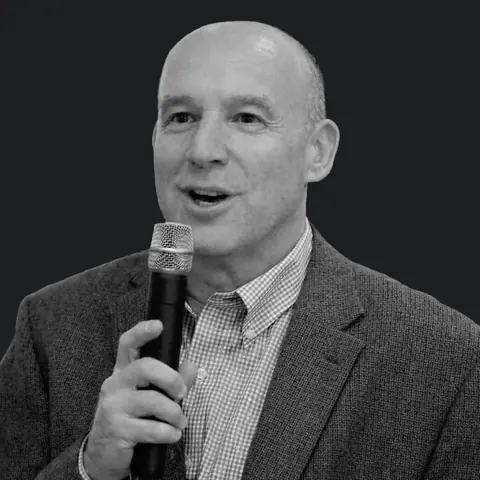
George Chmael II is Council Fire's Founder & CEO. He has led the firm since its founding and through its B Corp certification in 2010. Council Fire's sustainable business practice helps companies build strategies and claims that hold up, and Council Fire Labs builds the software that puts them to work, including Trovance.
Cover photograph: Pexels — Time Lapse Photography of People Walking on Pedestrian Lane, by Mike Chai. Illustrative stock photograph, not a Council Fire project.




FAQ