In This Article
How to substantiate environmental claims so they survive regulators and get cited by AI: the claim file, the standards, assurance and human review.
Last updated
How to substantiate environmental claims AI can cite
Most environmental claims do not fail because they are false. They fail because nobody can produce the evidence when asked. A 2020 European Commission study found 53.3% of the environmental claims it examined vague, misleading or unfounded, and 40% unsubstantiated. When regulators screened websites that year, the trader had no easily accessible evidence for 59% of 344 doubtful claims.
To substantiate an environmental claim, state it specifically, hold evidence that supports it as a reader would understand it, and document the method, boundary and date. Have material claims verified by a qualified third party, and publish the basis where the claim appears. The same file that satisfies a regulator gives AI assistants something to cite.
Council Fire has spent more than 15 years helping companies make sustainability claims that hold up, and we have been a certified B Corp since 2010. In our sustainability communications work, the claim is rarely the hard part; the file behind it is. We built Trovance because that file now has two audiences: the regulator who asks for it and the AI assistant that summarizes you for buyers.
Why do environmental claims fail?
Most fail in one of five ways: the words are vague, the claim is broader than the evidence, the evidence sits where nobody can see it, the target has no plan behind it, or no system checks any of it. Regulators on three continents have now found each of these failures.
Vague words come first. In the EU's website screening, 37% of the doubtful claims used terms such as "eco-friendly" or "sustainable", and Australia's competition regulator found 57% of the 247 businesses in its 2022 sweep making concerning environmental claims. Our piece on greenwashing decline covers why the vague era is ending.
Next comes the gap between the claim and the evidence. In June 2026 the UK's Advertising Standards Authority ruled against adidas, Uniqlo and Calvin Klein, finding no evidence to support "recycled" claims "as consumers were likely to understand it." Australia's Federal Court ordered Clorox to pay A$8.25 million for "50% Ocean Plastic Recycled" bin bags whose plastic was collected up to 50 kilometres from the shore, and noted that environmental claims "are useful for consumers only if they are accurate."
Targets fail when the plan does not exist yet. New York's Attorney General settled with JBS for $1.1 million, finding that when the company announced "Net Zero by 2040" it had not calculated its total emissions or built a plan to deliver the pledge.
And claims fail when no system checks them. Australian courts have ordered A$42 million in penalties across four ASIC greenwashing cases, and in the first, the judge traced the breaches to Mercer's "failures… to implement adequate systems" to keep its ESG claims accurate. A greenwashing finding is usually a process finding.
What do regulators expect in 2026?
They expect claims to be specific, evidenced as a reader would understand them, and, for targets, backed by a plan. The details differ by market.
Market | The rule | What it asks of your claims | A recent signal |
|---|---|---|---|
European Union | Directive (EU) 2024/825, applying from 27 September 2026 | No generic claims without recognised excellent performance, no labels outside certification schemes or public authorities, no offset-based "neutral" claims; future targets need a verified plan | Several Member States had not notified national measures by late October 2026 |
European Union | The Green Claims Directive proposal | Nothing yet: negotiations are on hold and the proposal has not been formally withdrawn | The Commission said in June 2025 it intended to withdraw it |
United Kingdom | Consumer law enforced by the CMA, the Green Claims Code and the ASA's CAP Code | Substantiate every claim, including website copy; claims about targets need a clear and verifiable strategy | The CMA can fine up to 10% of global turnover; its fines so far concern pricing, not green claims |
United States | FTC Green Guides (2012), state law | No unqualified general environmental benefit claims, business-to-business included | Kohl's and Walmart agreed to pay $5.5 million in civil penalties over "bamboo" claims |
Canada | Product claims need an adequate and proper test; business claims need adequate and proper substantiation | In March 2026 Parliament removed the added "internationally recognized methodology" requirement | |
Australia | Australian Consumer Law and financial-services law | Broad claims backed by scientific reports, supply-chain information or third-party certification | A$42 million in ASIC penalties across four cases |
Business buyers are moving the same way. UK central government requires bidders for contracts worth more than £5 million a year to publish a director-approved Carbon Reduction Plan on their website and update it at least annually. Our summary of anti-greenwashing regulations covers the rules market by market.
How do you build a claim file?
Keep one file per material claim, owned by a named person and reviewed on a schedule. The file should let anyone, a regulator, an auditor, a buyer or an AI assistant, see what you claim, how you know it, and how a reader is likely to understand it.
Field | What to record | Standard or source to lean on |
|---|---|---|
The claim | The exact words, every place they appear, and the plain reading a buyer would take from them | ISO 14021:2026 on self-declared claims |
Scope and boundary | Product, site, period, and what is excluded; whether scope 3 is in or out | Your inventory boundary |
Metric and method | How the number was calculated, with the baseline and any comparison | |
Evidence | Source data, dates and who produced them | Internal records, supplier data, test results |
Verification | Who checked it, to what level of assurance, and when | ISO 14064-3, ISSA 5000 |
Future claims | The plan, interim milestones, and who verifies progress | The EU's future-performance rule |
Publication | Where the basis is shown next to the claim | Regulator guidance |
Owner and review | Who answers for it and when it is next reviewed | Your governance calendar |
Two fields catch most teams out. The first is the reader's understanding: the ASA rulings turned on what "recycled" would mean to a shopper, not what the brand meant. The second is publication. In a 2023 ruling, the ASA upheld a complaint against a BrewDog "carbon negative" post that carried a certification badge and a link in bio, because the ad itself did not explain the basis of the claim.
Be careful with neutrality language in particular. In ASA-commissioned research, people read "carbon neutral" as an actual cut in emissions and some felt misled when they learned it relied on offsets, which is why the EU now bans offset-based neutrality claims to consumers. Our explainer on net zero versus carbon neutral sets out the difference.
Who this is for: sustainability, marketing and legal leads who publish environmental claims on a website, in sales material or in bids.
Which claims need third-party verification?
Any claim a buyer will rely on, any claim about a future target, and anything a regulator in your market expects to be verified. The level of assurance matters as much as the fact of it.
Under the IAASB's ISSA 5000, reasonable assurance reduces engagement risk "to an acceptably low level" and ends in an opinion, while limited assurance concludes only whether anything suggests the information is materially misstated. The standard applies to periods beginning on or after 15 December 2026, when ISAE 3410 on greenhouse gas statements is withdrawn. Our glossary entry on limited versus reasonable assurance explains the difference in plain terms.
Most companies stop at limited assurance on historical data. A July 2026 research snapshot for the IAASB, covering 120 of the world's largest listed companies, found limited assurance remained the norm and that forward-looking information was rarely covered. That is the gap regulators now press on: assurance of last year's inventory says nothing about your 2040 pledge.
How do you publish claims AI assistants can cite?
Put the evidence where both people and machines can read it: one claim per page, the basis beside the claim, figures with dates and methods, and verification statements as text rather than locked in a PDF. That is what the best-substantiated companies already do for regulators, and it is what answer engines can quote.
The research points the same way. In a peer-reviewed KDD 2024 study, adding citations, quotations and statistics raised a source's visibility in generative-engine answers by 30 to 40%. And because answers lean heavily on what others say about you, 84% of the links cited by ChatGPT, Claude and Gemini in Muck Rack's analysis came from earned media, which makes certifications, registries and third-party coverage part of the claim file too.
Trust is the prize. Only half of EU consumers agreed in 2024 that most environmental claims are reliable, six points fewer than in 2022. Our guides to communicating ESG progress credibly and data storytelling cover how to present the evidence, and our pieces on AI search visibility and AI share of voice cover how to measure whether the answers now cite it.
Where does AI belong in the claims workflow?
As a drafter and a checker, never as the signatory. UK regulators have been explicit: the ASA says that if an AI tool produces something problematic, the advertiser remains responsible for any output used in its ads, and the CMA's March 2026 guidance tells businesses to keep a human in the loop actively checking what AI agents produce.
The regulators use AI too. The ASA's monitoring system, which processed more than 60 million ads in 2025, is what surfaced the adidas, Uniqlo and Calvin Klein claims. Assume your claims will be read by machines on both sides.
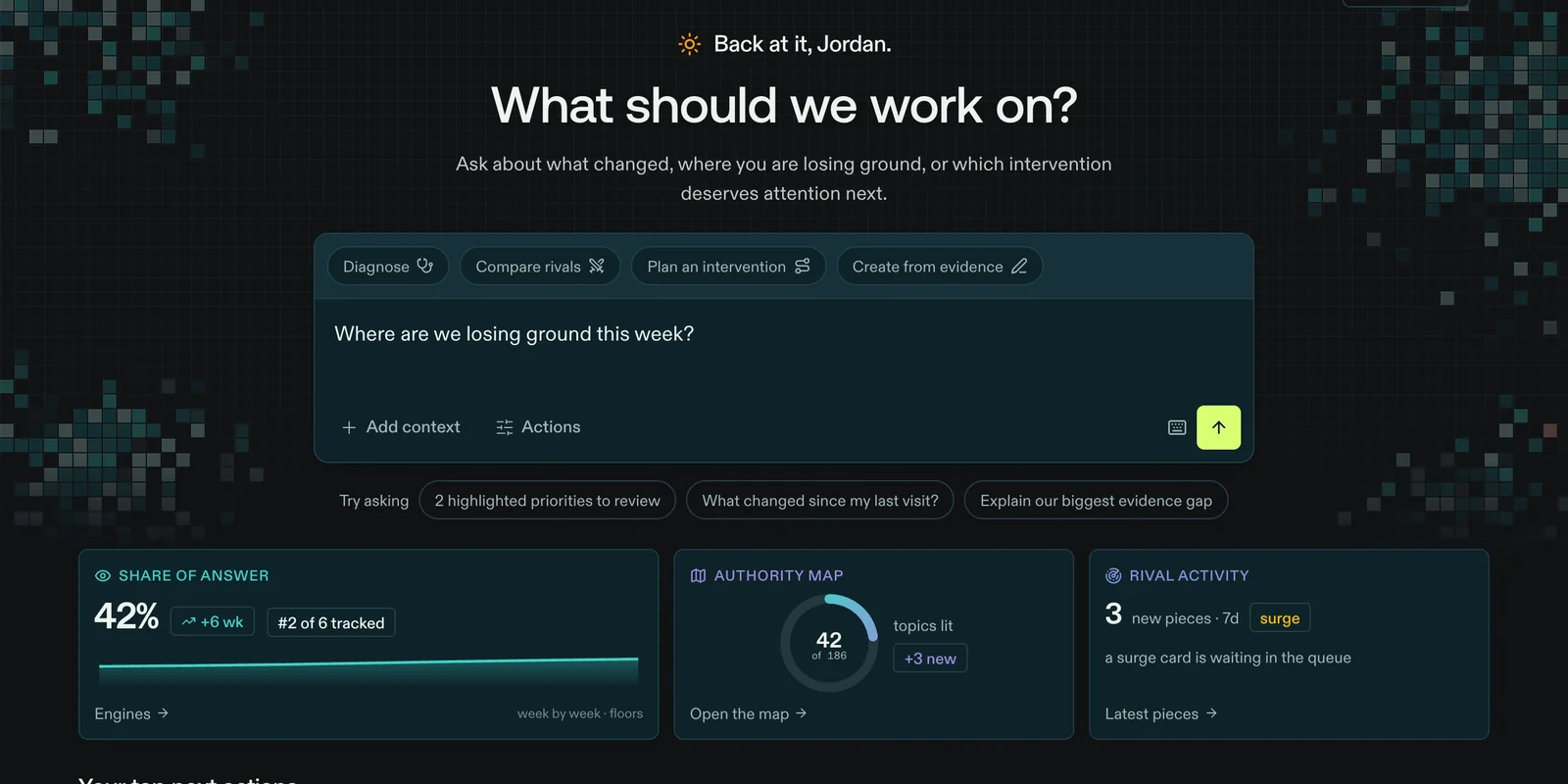
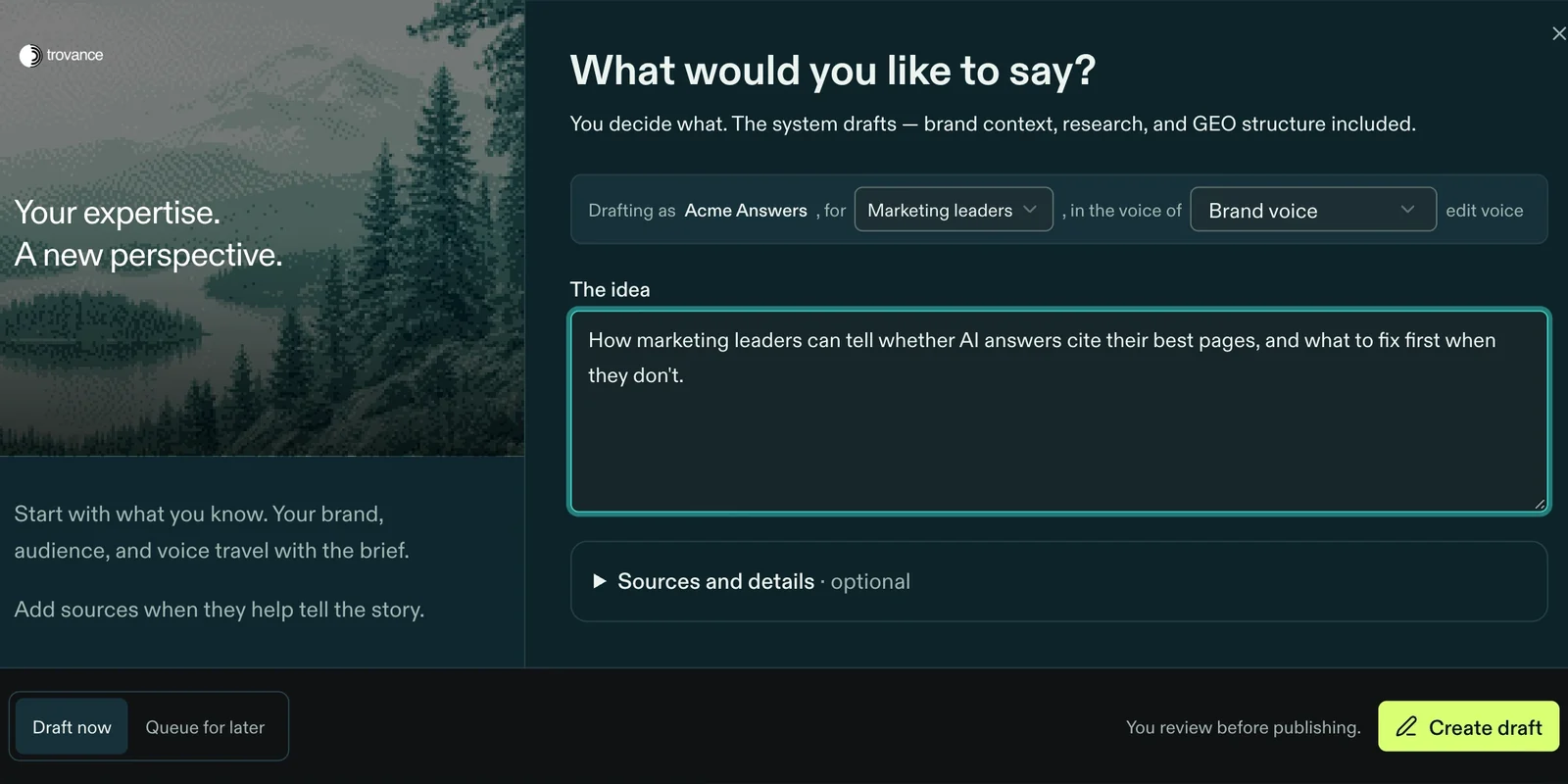
That is the design behind Trovance. It researches before it drafts, writes in your brand's voice, and flags every claim for review; nothing publishes until a person approves it, and every action leaves a receipt. For sustainability companies, that review step is the point: a tool that drafts faster than your team can verify is a greenwashing risk with a dashboard. We apply the same thinking to AI-assisted reporting in our pilot acceptance checklist.
When your claims workflow needs something no product offers, such as a claim register tied to your inventory system, Council Fire Labs builds it. Start with how to choose sustainability software to decide whether to buy, configure or build.
Frequently asked questions
01What does it mean to substantiate an environmental claim?
To substantiate an environmental claim is to hold evidence that supports it as a reader would understand it before you make it. In practice that means a specific claim, a documented method and boundary, dated source data, appropriate verification and a published basis. The UK's ASA requires a high level of substantiation for absolute claims such as "recycled."
02What evidence do you need for a carbon neutral claim?
In the EU, from 27 September 2026, consumer-facing claims that a product is neutral, reduced or positive in greenhouse gas terms because of offsetting are banned. Elsewhere, explain exactly what is counted and how much relies on offsets. UK research found people read "carbon neutral" as a real cut in emissions. See our net zero versus carbon neutral explainer.
03Do business-to-business companies have to follow green claims rules?
Yes, in most markets. The FTC's Green Guides state that they apply to business-to-business transactions, and the UK's Green Claims Code says its examples generally apply to business advertising. The EU's new directive governs consumer claims, but a public website is visible to everyone, so B2B firms should not assume they are exempt.
04What is the difference between limited and reasonable assurance?
Reasonable assurance reduces engagement risk to an acceptably low level and ends in a positive opinion; limited assurance only concludes whether anything suggests the information is materially misstated. ISSA 5000 sets both levels for periods beginning on or after 15 December 2026. Our glossary explains limited versus reasonable assurance.
05Can you use AI to write sustainability claims?
You can use AI to draft and check, but you remain responsible for what it produces. The UK's ASA says the advertiser stays responsible for any AI output used in its ads, and the CMA advises keeping a human in the loop. Treat every AI-drafted claim as unapproved until a named person has checked it against the claim file.
06Do net zero targets count as environmental claims?
Yes. A target is a claim about future performance, and regulators now treat it that way. EU law requires a public, detailed implementation plan verified by an independent expert, and the UK's CMA expects a clear and verifiable strategy. New York's Attorney General settled with JBS for $1.1 million over a target announced without a plan.
07How do substantiated claims help AI search visibility?
AI assistants can only repeat evidence they can find and corroborate. Specific, sourced claims published as readable pages give them something to cite; a peer-reviewed KDD 2024 study found citations, quotations and statistics raised visibility in generative-engine answers by 30 to 40%. Trovance measures whether the answers cite you and flags claims for human review.
Related Resources
Claims and compliance
- What is greenwashing?: the definition regulators and buyers work from.
- What are anti-greenwashing regulations?: the rules market by market.
- What is the Green Claims Directive?: the EU proposal and its status.
- What is limited vs. reasonable assurance?: the two levels of verification.
- Net zero vs. carbon neutral: two claims that are easy to confuse.
Communicating the evidence
- Greenwashing decline: building trust through transparent sustainability marketing: what credible claims look like now.
- How to communicate ESG progress credibly: presenting progress without overstating it.
- Sustainability communications and storytelling guides: the library's communications guides.
- Sustainability reporting: the reporting your claims should reconcile with.
AI and tools
- AI search visibility: why climate companies get left out: measuring what AI says about you.
- AI share of voice: the metric that replaces rank: how often the answers name you.
- How to track AI referral traffic from ChatGPT & Perplexity: the visits AI sends.
- AI sustainability reporting: a pilot acceptance checklist: review discipline for AI-assisted work.
- Trovance: the AI visibility platform described in this article.
- Council Fire Labs: the software and AI practice that built it.
Check your claims before someone else does
Pick the three claims your buyers see most, and build the claim file for each. If the evidence is thin, fix the claim before a regulator or an AI answer does it for you. Talk to us on our contact page, choosing Sustainable business or Software & AI (CF Labs), or start a Trovance trial to see what AI already says about you.
About the Author
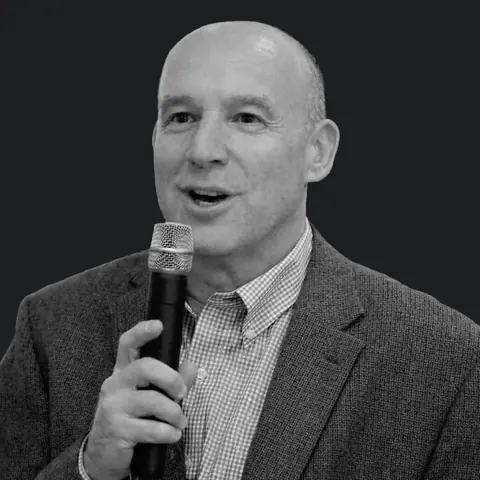
George Chmael II is Council Fire's Founder & CEO. He has led the firm since its founding and through its B Corp certification in 2010. Council Fire's sustainable business practice helps companies build strategies and claims that hold up, and Council Fire Labs builds the software that puts them to work, including Trovance.
Cover photograph: Pexels — Green Leaf Closeup Photography, by Gustavo Cruz. Illustrative stock photograph, not a Council Fire project.



FAQ