
Sep 16, 2026
Local Government Equity Accountability Checklist
Governance
In This Article
Equity accountability must be a management system with named owners, disaggregated data, budget links, and resident power.
Local Government Equity Accountability Checklist
Most local governments still do not have a full equity accountability system. In the 200 largest U.S. cities, 37.5% had equity offices, but only 19.5% had equity plans and just 9.5% had racial equity plans. To me, that gap says one thing: if goals, owners, data, budgets, resident input, and review dates are not written down, the work is easy to sideline.
If I were using this article as a quick self-check, I would focus on seven parts:
clear goals
named decision-makers
disaggregated data
public progress reports
budget ties
staff duties
resident input that changes decisions
set review dates with follow-up
At its core, the checklist asks four plain questions:
Who owns the work?
What result is supposed to change?
How will progress be tracked?
Can the public see the results?
The main point is simple: equity accountability is not a pledge. It is a management system. I see the article as a plain guide for cities, counties, and local agencies that want to connect policy, spending, staffing, community input, and review into one working process.
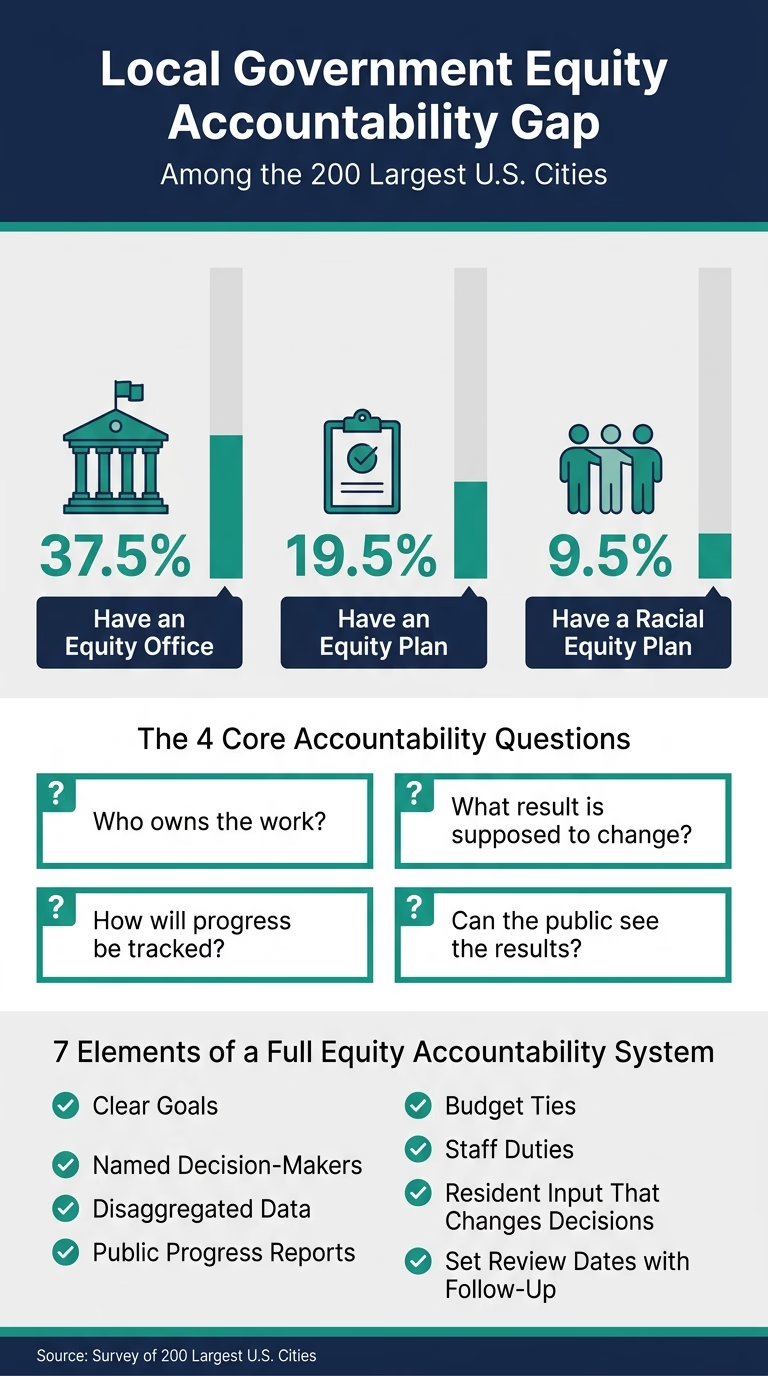
Local Government Equity Accountability Gap: Key Statistics
Results Based Accountability with Clear Impact | Equity Learning Series
1. Check Goals and Governance First
Equity work falls apart when no one defines it, owns it, or tracks it. That’s why it needs to be a formal governance commitment, with named owners and measurable targets.[2][10][11]
Adopt a Clear Equity Definition and Measurable Goals
Start by defining which inequities your jurisdiction plans to address - racial, economic, disability-related, or immigration-related - and connect them to local conditions like flood risk, transit access, or housing cost burden. That definition should also name the people and places at the center of the work, such as neighborhoods with higher flood risk or residents who have limited access to cooling centers during heat events.[4][8]
Once a council or board adopts that definition, it should shape measurable goals. In climate resilience, that could mean a set reduction in heat-related emergency visits in priority neighborhoods by 2030. In transportation, it might mean better transit frequency in low-income corridors. In housing, it could mean tracking eviction rates and the number of affordable units in high-need areas. Each goal needs three things: a baseline, a target, and a deadline. Use access, quality, procedural fairness, and outcomes as the main lens for setting those goals.[3][4][5][10]
Assign Authority Through Policy and Governance Structures
A goal with no owner is just a sentence on paper. Formal governance tools - ordinances, resolutions, executive directives, and designated offices - are what give equity commitments staying power. The Southern California Association of Governments (SCAG) Equity Resource Guide recommends that jurisdictions begin by officially declaring their commitment through an equity resolution. New York City has also used executive directives to require disaggregated data collection and equity metrics across departments.[11][6][8][9]
Policy gives the work staying power. Oversight is what turns it into day-to-day practice. Cross-department working groups with planning, public works, transportation, housing, public health, and emergency management help keep equity from getting stuck in one office. Resident seats on advisory or oversight bodies matter too, especially when those residents come from flood-prone areas, transit-dependent communities, or vulnerable housing situations. That outside voice adds a layer of accountability internal teams can’t provide on their own. Smaller jurisdictions may not be able to build a full equity office, and that’s fine. A part-time equity lead in an existing department can still work, but the role needs written reporting lines and clear oversight.[7][8]
Use a Plan-to-Accountability Table
The table below helps spot weak points fast. If any of the last three columns are blank, the plan does not have accountability built in.
Policy or Plan | Policy or Plan Exists | Equity Goals Defined | Indicators Identified | Accountable Entity Named |
|---|---|---|---|---|
Strategic Plan | Yes | Council-approved equity definition and target populations | Community-wide equity index scores | City Manager / Mayor's Office |
Operating Budget | Yes | Funding allocated to frontline community programs | % of budget spent in underserved tracts | Finance Department / Equity Office |
Capital Improvement Plan | Yes | Prioritization criteria for high-vulnerability zones | Number of projects in environmental justice neighborhoods | Public Works / General Services |
Climate Plan | Yes | Specific heat/flood reduction targets for at-risk groups | Reduction in heat-related illnesses | Sustainability / Adaptation Officer |
Housing Plan | Yes | Anti-displacement protections | Number of affordable units preserved | Housing & Community Development |
Transportation Plan | Yes | Access for underserved populations | Transit proximity metrics; crash rates by neighborhood | Department of Transportation |
Once goals and owners are in place, the next move is to connect them to data and reporting so progress can be checked, not guessed at. With goals, owners, and indicators set, the focus shifts to tracking and reporting progress.
2. Build Data, Reporting, and Budget Links
Data, reporting, and budget links turn equity commitments into something the public can check.
Collect Disaggregated Data and Maintain Usable Indicators
Citywide averages can blur what’s happening on the ground. Break data out by race, ethnicity, income, neighborhood, disability status, language, age, gender, and other local factors when it is legal and ethical to do so.
Each indicator should have a clear definition, source, update cycle, and owner. Fort Collins’ Equity Indicators dashboard breaks out data by race, ethnicity, and other factors, and it continues to add measures and clearer graphics.[14][16]
Administrative data tells part of the story. Resident feedback fills in the rest. Surveys, interviews, listening sessions, and open-ended responses can explain why a gap stays in place even when the numbers already show that it exists. Build data quality checks for completeness, consistency, accuracy, and timeliness. Set rules for withholding small cells to protect privacy, especially in sensitive categories or for small populations.
Once the data is usable, the next move is to make it public in a form people can read without a decoder ring.
Publish Public Reports in Plain Language
A report that only policy staff can read is not accountability. It’s paperwork.
Public equity reports should show the goal, the current status of each main indicator, the trend over time, and the corrective action. Put them out on a set schedule, quarterly or annually, and use plain status labels like on track, delayed, or off track. Then spell out what each label means. Chicago’s annual Budget Equity reporting process shows how this can work: departments report progress on racial equity commitments and use a structured tool to review goals and show how their budgets support them.[12][13]
Keep the format easy to use:
readable charts
short text summaries
links to deeper data for residents who want detail
Use MM/DD/YYYY date formatting and USD for all budget figures. Reports should be readable, searchable, translated, and available offline so residents can check progress for themselves. If inequities remain, say that plainly and name the corrective actions. Don’t post a highlight reel and call it a report. New York City’s Social Impact Dashboard, launched in 2024, tracks 25–30 metrics across five pillars to measure social and economic outcomes and better align investments with community disadvantage and need.[15]
Public reporting should shape budget choices, not sit next to them like an appendix nobody opens.
Tie Budget Decisions to Equity Commitments
Use the report to test whether spending lines up with the equity commitments.
If equity goals never show up in the budget, they’re wishes, not promises. Dallas requires departments to review how budget activities affect historically disadvantaged communities and equity priority areas before they submit annual budget requests. The city also links departmental measures to its Racial Equity Plan and public dashboard. In fiscal year 2022–2023, Dallas tracked $22.5 million in budget progress measures tied to that plan, which includes more than 200 specific equity goals.[1]
Equity impact review should happen early enough to shape major proposals, capital projects, grants, and policy changes, not after the big calls are already made. Ask who benefits, who pays, who is left out, and whether disparities shrink or grow. For capital projects, look at location, accessibility, service coverage, displacement risk, and long-term maintenance effects. Write down the review outcome and any changes made because of it. Tag equity-related spending so planned and actual allocations can be compared at year-end.
The table below gives a simple way to make that link visible:
Program or Line Item | Equity Impact Assessed | Target Population | Funding Level (USD) | Performance Measures Linked |
|---|---|---|---|---|
Urban Tree Canopy Expansion | Heat island reduction & air quality | Low-income census tracts | $500,000 | Number of trees planted; average temp reduction |
Multilingual Early Warning Systems | Emergency preparedness | Linguistically isolated residents | $150,000 | % of residents reached in preferred language during drills |
Stormwater Bioswale Installation | Flood resilience | Residents in high-flood-risk census tracts | $1,200,000 | Reduction in flood damage claims; gallons of runoff diverted |
Affordable Housing Weatherization | Energy burden reduction | Seniors & low-income renters | $850,000 | Average monthly utility savings per household |
If a line item can’t name the people it serves and the equity goal it supports, pause it. Assign a staff owner and a resident feedback channel before approval. That makes the commitment visible, traceable, and much harder to ignore.
3. Confirm Staff Ownership and Resident Input
Budget links and public reports mean little if no one inside government owns the work and no one outside government can shape it. The first check is simple: are responsibilities named clearly enough to survive staff turnover?
Name Responsible Staff and Embed Equity in Job Expectations
Every major equity commitment needs a home. That means a department owner, a named job title, and an executive sponsor who is answerable for results.
That accountability should live on paper, not just in hallway talk. Job descriptions need clear equity duties, such as using disaggregated data to spot service gaps, engaging historically underrepresented residents in program design, and making bias-aware decisions in hiring. Performance reviews should also track results, including narrowed service gaps and on-time equity reviews. Frontline roles - planners, inspectors, and outreach workers - can include day-to-day expectations for culturally responsive communication, language access, and use of standard equity procedures.
Portland's Racial Equity Strategy Guide makes this explicit in an ACTIONS FOR ALL STAFF section, including analyzing daily work through a racial equity lens and advocating for all-staff training.[19]
Training should not be occasional or vague. Require annual or semiannual sessions on implicit bias, civil rights, ADA, language access, and co-design. Track completion, and tie it to promotion eligibility. Monthly or quarterly cross-department equity review meetings help keep work on schedule and bring up decisions that need an equity lens before they are locked in.
Named staff and written performance rules carry more weight when residents can also see whether decisions match community priorities.
Create Resident Input Mechanisms That Influence Decisions
Resident input should lead to a change in a policy, project, funding choice, or timeline. That's the line between token participation and participation that shapes decisions.
Advisory boards with chartered authority - such as an Equity Advisory Commission or a Transit Equity Advisory Board - can have formal powers, like reviewing major policies before council votes or scoring proposals against equity criteria. Co-design sessions work best when they begin early and include the people most affected: residents in flood-prone neighborhoods for stormwater projects, transit-dependent riders for route redesigns, and tenants in high-eviction ZIP Codes for housing programs.
Taking down participation barriers is part of the job. In U.S. local government, that usually means:
language access
ADA-accessible venues
onsite childcare or childcare stipends
transit passes or rideshare vouchers
evening and weekend meetings for shift workers and caregivers
Pay residents who serve on advisory boards or co-design teams. Their community knowledge is work, and it should be treated like a professional-level contribution.
Madison's Racial Equity & Social Justice Initiative frames engagement as proactive outreach, not passive public comment.[20]
Just as important, document the process. Record who took part, what methods were used, what input came in, and what changed as a result. Then report back in plain language. If people give their time and hear nothing afterward, trust erodes fast.
Map Actions, Owners, and Feedback Channels
The table below works best as a live accountability tracker, not a document that sits in a folder. Update it at least once a year and bring it into review meetings so it stays part of active decision-making.
Equity Action | Responsible Staff or Unit | Community Partners | Resident Input Mechanism | Review Frequency |
|---|---|---|---|---|
Affordable Housing Protections | Housing & Community Development Dept. | Local Tenants Union, Housing Advocacy Groups | Co-design sessions; public hearings; advisory board review | Quarterly |
Stormwater Bioswale Installation | Public Works / Stormwater Engineering | Environmental Justice NGOs, Neighborhood Associations | Co-design charrettes; participatory mapping | Monthly (project phase) |
Transit Access Improvements | Transit Planning Division | Disability Advocacy Groups, Rider Associations | ADA-accessible town halls; rider surveys; advisory board review | Quarterly |
Public Health Outreach (Chronic Disease) | Public Health Outreach Team | Federally Qualified Health Centers, Faith Leaders | Community health worker panels; listening sessions | Semiannual |
Neighborhood Infrastructure (Sidewalks, Lighting) | Public Works / Capital Projects | Block Captains, Neighborhood Associations | Participatory budgeting; resident surveys | Annual |
Community liaisons can help bridge access gaps, but staff and elected officials still hold decision-making power and remain answerable for outcomes.[17][18] Community leaders should not carry the burden for government resource allocation decisions.
These roles and input channels set up the next step: routine review and course correction.
4. Set Review Cycles and Continuous Improvement Rules
Schedule Routine Reviews Tied to Plans and Budgets
Once budgets are linked to equity commitments, the next step is simple: check whether the work changed anything. That only happens when review dates are fixed, decision-makers are named, and each review can shape plans and budgets.
A steady review rhythm helps local governments catch problems before they harden into habits. Quarterly progress checks can spot implementation issues early enough to fix them. Mid-year budget reviews can show whether funding still lines up with equity commitments. Annual equity plan reviews can assess outcomes and reset priorities. Multi-year strategy refreshes can bring goals back into line with new data, leadership turnover, and changing community conditions.
One rule matters more than the rest: equity reviews must happen before budget decisions are final. Chicago's 2025 Equity Report shows what that looks like in practice. Since 2020, every year during the budget process, city departments have been required to account for progress on racial equity commitments, using the Budget Equity Tool to determine which commitments will be completed in the coming year.[22] If findings come in after departments have already submitted their budgets, the exercise turns into theater.
Each review also needs a clear decision-making body. Department directors and program managers should track implementation. The mayor's office, council, county commission, or an equity steering committee should approve course corrections and ask for more reporting when needed. Without that split, review meetings often drift into status updates instead of decision points.
Use Evaluation to Adjust Actions, Not Just Report Results
Reviews should do more than show progress on paper. They should point to what needs to change next. Evaluation has to lead to action, not just reporting.
That means looking past topline numbers and asking what is driving the gap. Is the problem tied to eligibility rules? Service hours? Geography? Language access? A hard-to-follow process? Washington State's PEAR framework takes this approach. It requires agencies to publish dashboards and annual performance review reports, and those reports must identify needed improvements and corrective actions.[21]
When a program is not closing gaps, the response should already be mapped out. Corrective action can include:
shifting funding
changing service hours
expanding multilingual outreach
revising eligibility criteria
retraining staff
Each action needs three things: a named owner, a deadline, and a follow-up date. Then it needs to stay on the record until the gap starts to narrow. Resident feedback matters here too. Numbers can show that a result changed; residents often explain why it did or did not.
Good documentation keeps the work from starting over every time staff changes. Keep a record of goals, baselines, findings, corrections, and results. Review note templates and decision memos help new staff see what was tried, what worked, and what still needs attention, instead of relying on memory that walks out the door with turnover.
Conclusion: A Practical Checklist Local Governments Can Use Now
When the review process is fixed, equity accountability becomes part of day-to-day management. It is an operating system, not a policy statement. It works when goals are clear, ownership is assigned by name, disaggregated data is collected and published, budgets are linked to commitments, residents have a real voice, and progress is reviewed on a set schedule with follow-up written down. These are management tools. They belong in budget planning, performance reviews, and leadership oversight - not in a binder that gets shelved after adoption.
The systems that last are the ones that treat a missed benchmark as a management signal, not something to bury. When data shows a gap, the process should trigger a response plan. When staff turns over or political priorities shift, the dashboard and the calendar keep the work in place.
FAQs
How can a small local government start with limited staff?
Start with a phased, high-impact approach. Go after the biggest emissions sources first - usually building energy and transportation - and use simple, no-cost tools like the EPA’s Local Greenhouse Gas Inventory Tool to build a solid baseline you can stand behind.
Then move to practical, low-cost projects that make a difference without stretching the budget. Good places to start include emergency communication plans, tree planting to cut urban heat islands, and cooling center networks for extreme heat events. Regional networks and university partnerships can also help expand capacity without adding full-time staff.
What data should be prioritized first?
Start with historical data and downscaled climate projections so you can track how risk shifts over time. That time view matters. It shows whether a problem is stable, getting worse, or starting to hit new places.
For environmental goals, focus first on your biggest emissions sources: building energy use, transportation, and waste. That’s usually where the biggest gains sit, and it keeps the work tied to the numbers instead of guesswork.
Then layer in baseline infrastructure metrics and social vulnerability indicators. Look at factors like income, racial demographics, and housing conditions to spot where physical risk and inequity land in the same communities. When those patterns overlap, the picture gets much clearer - and so does where action should start.
How can resident input actually change decisions?
Resident input changes decisions when municipalities stop treating public meetings like a box to check and start building steady, trust-based collaboration.
Make that input matter by using community perspectives to shape policy priorities and resource allocation. That also means giving frontline communities formal roles in the process, not just asking them to comment from the sidelines.
Just as important, close the feedback loop. Show people, in public, how their input changed decisions - or explain plainly why some ideas couldn’t move forward.
Related Blog Posts
Latest Articles
©2026

Narrative Change and Power Building: The Missing Half of Advocacy
Narrative change is the process of disrupting dominant narratives that normalize inequity and advancing new narratives from historically marginalized communities.

Funding Resilience Without Federal Grants
BRIC is unreliable and FEMA is shrinking. Here's how cities fund climate resilience with dedicated revenue, blended finance, and a coordinating authority.

The ESG Blind Spot: How AI Is Finding Risks in Companies Nobody Else Is Watching
Norway's sovereign wealth fund uses AI to screen 7,200 portfolio companies for forced labor and corruption within 24 hours. The real story is the emerging-market coverage gap that traditional ESG data vendors miss — and what it means for any company with a global supply chain.
Narrative Change and Power Building: The Missing Half of Advocacy
Narrative change is the process of disrupting dominant narratives that normalize inequity and advancing new narratives from historically marginalized communities.
Funding Resilience Without Federal Grants
BRIC is unreliable and FEMA is shrinking. Here's how cities fund climate resilience with dedicated revenue, blended finance, and a coordinating authority.
The ESG Blind Spot: How AI Is Finding Risks in Companies Nobody Else Is Watching
Norway's sovereign wealth fund uses AI to screen 7,200 portfolio companies for forced labor and corruption within 24 hours. The real story is the emerging-market coverage gap that traditional ESG data vendors miss — and what it means for any company with a global supply chain.
FAQ
01
What does it really mean to “redefine profit”?
02
What makes Council Fire different?
03
Who does Council Fire work with?
04
What does working with Council Fire actually look like?
05
How does Council Fire help organizations turn big goals into action?
06
How does Council Fire define and measure success?
07
How does technology fit into Council Fire’s work?
Sep 16, 2026
Local Government Equity Accountability Checklist
Governance
In This Article
Equity accountability must be a management system with named owners, disaggregated data, budget links, and resident power.
Local Government Equity Accountability Checklist
Most local governments still do not have a full equity accountability system. In the 200 largest U.S. cities, 37.5% had equity offices, but only 19.5% had equity plans and just 9.5% had racial equity plans. To me, that gap says one thing: if goals, owners, data, budgets, resident input, and review dates are not written down, the work is easy to sideline.
If I were using this article as a quick self-check, I would focus on seven parts:
clear goals
named decision-makers
disaggregated data
public progress reports
budget ties
staff duties
resident input that changes decisions
set review dates with follow-up
At its core, the checklist asks four plain questions:
Who owns the work?
What result is supposed to change?
How will progress be tracked?
Can the public see the results?
The main point is simple: equity accountability is not a pledge. It is a management system. I see the article as a plain guide for cities, counties, and local agencies that want to connect policy, spending, staffing, community input, and review into one working process.
Local Government Equity Accountability Gap: Key Statistics
Results Based Accountability with Clear Impact | Equity Learning Series
1. Check Goals and Governance First
Equity work falls apart when no one defines it, owns it, or tracks it. That’s why it needs to be a formal governance commitment, with named owners and measurable targets.[2][10][11]
Adopt a Clear Equity Definition and Measurable Goals
Start by defining which inequities your jurisdiction plans to address - racial, economic, disability-related, or immigration-related - and connect them to local conditions like flood risk, transit access, or housing cost burden. That definition should also name the people and places at the center of the work, such as neighborhoods with higher flood risk or residents who have limited access to cooling centers during heat events.[4][8]
Once a council or board adopts that definition, it should shape measurable goals. In climate resilience, that could mean a set reduction in heat-related emergency visits in priority neighborhoods by 2030. In transportation, it might mean better transit frequency in low-income corridors. In housing, it could mean tracking eviction rates and the number of affordable units in high-need areas. Each goal needs three things: a baseline, a target, and a deadline. Use access, quality, procedural fairness, and outcomes as the main lens for setting those goals.[3][4][5][10]
Assign Authority Through Policy and Governance Structures
A goal with no owner is just a sentence on paper. Formal governance tools - ordinances, resolutions, executive directives, and designated offices - are what give equity commitments staying power. The Southern California Association of Governments (SCAG) Equity Resource Guide recommends that jurisdictions begin by officially declaring their commitment through an equity resolution. New York City has also used executive directives to require disaggregated data collection and equity metrics across departments.[11][6][8][9]
Policy gives the work staying power. Oversight is what turns it into day-to-day practice. Cross-department working groups with planning, public works, transportation, housing, public health, and emergency management help keep equity from getting stuck in one office. Resident seats on advisory or oversight bodies matter too, especially when those residents come from flood-prone areas, transit-dependent communities, or vulnerable housing situations. That outside voice adds a layer of accountability internal teams can’t provide on their own. Smaller jurisdictions may not be able to build a full equity office, and that’s fine. A part-time equity lead in an existing department can still work, but the role needs written reporting lines and clear oversight.[7][8]
Use a Plan-to-Accountability Table
The table below helps spot weak points fast. If any of the last three columns are blank, the plan does not have accountability built in.
Policy or Plan | Policy or Plan Exists | Equity Goals Defined | Indicators Identified | Accountable Entity Named |
|---|---|---|---|---|
Strategic Plan | Yes | Council-approved equity definition and target populations | Community-wide equity index scores | City Manager / Mayor's Office |
Operating Budget | Yes | Funding allocated to frontline community programs | % of budget spent in underserved tracts | Finance Department / Equity Office |
Capital Improvement Plan | Yes | Prioritization criteria for high-vulnerability zones | Number of projects in environmental justice neighborhoods | Public Works / General Services |
Climate Plan | Yes | Specific heat/flood reduction targets for at-risk groups | Reduction in heat-related illnesses | Sustainability / Adaptation Officer |
Housing Plan | Yes | Anti-displacement protections | Number of affordable units preserved | Housing & Community Development |
Transportation Plan | Yes | Access for underserved populations | Transit proximity metrics; crash rates by neighborhood | Department of Transportation |
Once goals and owners are in place, the next move is to connect them to data and reporting so progress can be checked, not guessed at. With goals, owners, and indicators set, the focus shifts to tracking and reporting progress.
2. Build Data, Reporting, and Budget Links
Data, reporting, and budget links turn equity commitments into something the public can check.
Collect Disaggregated Data and Maintain Usable Indicators
Citywide averages can blur what’s happening on the ground. Break data out by race, ethnicity, income, neighborhood, disability status, language, age, gender, and other local factors when it is legal and ethical to do so.
Each indicator should have a clear definition, source, update cycle, and owner. Fort Collins’ Equity Indicators dashboard breaks out data by race, ethnicity, and other factors, and it continues to add measures and clearer graphics.[14][16]
Administrative data tells part of the story. Resident feedback fills in the rest. Surveys, interviews, listening sessions, and open-ended responses can explain why a gap stays in place even when the numbers already show that it exists. Build data quality checks for completeness, consistency, accuracy, and timeliness. Set rules for withholding small cells to protect privacy, especially in sensitive categories or for small populations.
Once the data is usable, the next move is to make it public in a form people can read without a decoder ring.
Publish Public Reports in Plain Language
A report that only policy staff can read is not accountability. It’s paperwork.
Public equity reports should show the goal, the current status of each main indicator, the trend over time, and the corrective action. Put them out on a set schedule, quarterly or annually, and use plain status labels like on track, delayed, or off track. Then spell out what each label means. Chicago’s annual Budget Equity reporting process shows how this can work: departments report progress on racial equity commitments and use a structured tool to review goals and show how their budgets support them.[12][13]
Keep the format easy to use:
readable charts
short text summaries
links to deeper data for residents who want detail
Use MM/DD/YYYY date formatting and USD for all budget figures. Reports should be readable, searchable, translated, and available offline so residents can check progress for themselves. If inequities remain, say that plainly and name the corrective actions. Don’t post a highlight reel and call it a report. New York City’s Social Impact Dashboard, launched in 2024, tracks 25–30 metrics across five pillars to measure social and economic outcomes and better align investments with community disadvantage and need.[15]
Public reporting should shape budget choices, not sit next to them like an appendix nobody opens.
Tie Budget Decisions to Equity Commitments
Use the report to test whether spending lines up with the equity commitments.
If equity goals never show up in the budget, they’re wishes, not promises. Dallas requires departments to review how budget activities affect historically disadvantaged communities and equity priority areas before they submit annual budget requests. The city also links departmental measures to its Racial Equity Plan and public dashboard. In fiscal year 2022–2023, Dallas tracked $22.5 million in budget progress measures tied to that plan, which includes more than 200 specific equity goals.[1]
Equity impact review should happen early enough to shape major proposals, capital projects, grants, and policy changes, not after the big calls are already made. Ask who benefits, who pays, who is left out, and whether disparities shrink or grow. For capital projects, look at location, accessibility, service coverage, displacement risk, and long-term maintenance effects. Write down the review outcome and any changes made because of it. Tag equity-related spending so planned and actual allocations can be compared at year-end.
The table below gives a simple way to make that link visible:
Program or Line Item | Equity Impact Assessed | Target Population | Funding Level (USD) | Performance Measures Linked |
|---|---|---|---|---|
Urban Tree Canopy Expansion | Heat island reduction & air quality | Low-income census tracts | $500,000 | Number of trees planted; average temp reduction |
Multilingual Early Warning Systems | Emergency preparedness | Linguistically isolated residents | $150,000 | % of residents reached in preferred language during drills |
Stormwater Bioswale Installation | Flood resilience | Residents in high-flood-risk census tracts | $1,200,000 | Reduction in flood damage claims; gallons of runoff diverted |
Affordable Housing Weatherization | Energy burden reduction | Seniors & low-income renters | $850,000 | Average monthly utility savings per household |
If a line item can’t name the people it serves and the equity goal it supports, pause it. Assign a staff owner and a resident feedback channel before approval. That makes the commitment visible, traceable, and much harder to ignore.
3. Confirm Staff Ownership and Resident Input
Budget links and public reports mean little if no one inside government owns the work and no one outside government can shape it. The first check is simple: are responsibilities named clearly enough to survive staff turnover?
Name Responsible Staff and Embed Equity in Job Expectations
Every major equity commitment needs a home. That means a department owner, a named job title, and an executive sponsor who is answerable for results.
That accountability should live on paper, not just in hallway talk. Job descriptions need clear equity duties, such as using disaggregated data to spot service gaps, engaging historically underrepresented residents in program design, and making bias-aware decisions in hiring. Performance reviews should also track results, including narrowed service gaps and on-time equity reviews. Frontline roles - planners, inspectors, and outreach workers - can include day-to-day expectations for culturally responsive communication, language access, and use of standard equity procedures.
Portland's Racial Equity Strategy Guide makes this explicit in an ACTIONS FOR ALL STAFF section, including analyzing daily work through a racial equity lens and advocating for all-staff training.[19]
Training should not be occasional or vague. Require annual or semiannual sessions on implicit bias, civil rights, ADA, language access, and co-design. Track completion, and tie it to promotion eligibility. Monthly or quarterly cross-department equity review meetings help keep work on schedule and bring up decisions that need an equity lens before they are locked in.
Named staff and written performance rules carry more weight when residents can also see whether decisions match community priorities.
Create Resident Input Mechanisms That Influence Decisions
Resident input should lead to a change in a policy, project, funding choice, or timeline. That's the line between token participation and participation that shapes decisions.
Advisory boards with chartered authority - such as an Equity Advisory Commission or a Transit Equity Advisory Board - can have formal powers, like reviewing major policies before council votes or scoring proposals against equity criteria. Co-design sessions work best when they begin early and include the people most affected: residents in flood-prone neighborhoods for stormwater projects, transit-dependent riders for route redesigns, and tenants in high-eviction ZIP Codes for housing programs.
Taking down participation barriers is part of the job. In U.S. local government, that usually means:
language access
ADA-accessible venues
onsite childcare or childcare stipends
transit passes or rideshare vouchers
evening and weekend meetings for shift workers and caregivers
Pay residents who serve on advisory boards or co-design teams. Their community knowledge is work, and it should be treated like a professional-level contribution.
Madison's Racial Equity & Social Justice Initiative frames engagement as proactive outreach, not passive public comment.[20]
Just as important, document the process. Record who took part, what methods were used, what input came in, and what changed as a result. Then report back in plain language. If people give their time and hear nothing afterward, trust erodes fast.
Map Actions, Owners, and Feedback Channels
The table below works best as a live accountability tracker, not a document that sits in a folder. Update it at least once a year and bring it into review meetings so it stays part of active decision-making.
Equity Action | Responsible Staff or Unit | Community Partners | Resident Input Mechanism | Review Frequency |
|---|---|---|---|---|
Affordable Housing Protections | Housing & Community Development Dept. | Local Tenants Union, Housing Advocacy Groups | Co-design sessions; public hearings; advisory board review | Quarterly |
Stormwater Bioswale Installation | Public Works / Stormwater Engineering | Environmental Justice NGOs, Neighborhood Associations | Co-design charrettes; participatory mapping | Monthly (project phase) |
Transit Access Improvements | Transit Planning Division | Disability Advocacy Groups, Rider Associations | ADA-accessible town halls; rider surveys; advisory board review | Quarterly |
Public Health Outreach (Chronic Disease) | Public Health Outreach Team | Federally Qualified Health Centers, Faith Leaders | Community health worker panels; listening sessions | Semiannual |
Neighborhood Infrastructure (Sidewalks, Lighting) | Public Works / Capital Projects | Block Captains, Neighborhood Associations | Participatory budgeting; resident surveys | Annual |
Community liaisons can help bridge access gaps, but staff and elected officials still hold decision-making power and remain answerable for outcomes.[17][18] Community leaders should not carry the burden for government resource allocation decisions.
These roles and input channels set up the next step: routine review and course correction.
4. Set Review Cycles and Continuous Improvement Rules
Schedule Routine Reviews Tied to Plans and Budgets
Once budgets are linked to equity commitments, the next step is simple: check whether the work changed anything. That only happens when review dates are fixed, decision-makers are named, and each review can shape plans and budgets.
A steady review rhythm helps local governments catch problems before they harden into habits. Quarterly progress checks can spot implementation issues early enough to fix them. Mid-year budget reviews can show whether funding still lines up with equity commitments. Annual equity plan reviews can assess outcomes and reset priorities. Multi-year strategy refreshes can bring goals back into line with new data, leadership turnover, and changing community conditions.
One rule matters more than the rest: equity reviews must happen before budget decisions are final. Chicago's 2025 Equity Report shows what that looks like in practice. Since 2020, every year during the budget process, city departments have been required to account for progress on racial equity commitments, using the Budget Equity Tool to determine which commitments will be completed in the coming year.[22] If findings come in after departments have already submitted their budgets, the exercise turns into theater.
Each review also needs a clear decision-making body. Department directors and program managers should track implementation. The mayor's office, council, county commission, or an equity steering committee should approve course corrections and ask for more reporting when needed. Without that split, review meetings often drift into status updates instead of decision points.
Use Evaluation to Adjust Actions, Not Just Report Results
Reviews should do more than show progress on paper. They should point to what needs to change next. Evaluation has to lead to action, not just reporting.
That means looking past topline numbers and asking what is driving the gap. Is the problem tied to eligibility rules? Service hours? Geography? Language access? A hard-to-follow process? Washington State's PEAR framework takes this approach. It requires agencies to publish dashboards and annual performance review reports, and those reports must identify needed improvements and corrective actions.[21]
When a program is not closing gaps, the response should already be mapped out. Corrective action can include:
shifting funding
changing service hours
expanding multilingual outreach
revising eligibility criteria
retraining staff
Each action needs three things: a named owner, a deadline, and a follow-up date. Then it needs to stay on the record until the gap starts to narrow. Resident feedback matters here too. Numbers can show that a result changed; residents often explain why it did or did not.
Good documentation keeps the work from starting over every time staff changes. Keep a record of goals, baselines, findings, corrections, and results. Review note templates and decision memos help new staff see what was tried, what worked, and what still needs attention, instead of relying on memory that walks out the door with turnover.
Conclusion: A Practical Checklist Local Governments Can Use Now
When the review process is fixed, equity accountability becomes part of day-to-day management. It is an operating system, not a policy statement. It works when goals are clear, ownership is assigned by name, disaggregated data is collected and published, budgets are linked to commitments, residents have a real voice, and progress is reviewed on a set schedule with follow-up written down. These are management tools. They belong in budget planning, performance reviews, and leadership oversight - not in a binder that gets shelved after adoption.
The systems that last are the ones that treat a missed benchmark as a management signal, not something to bury. When data shows a gap, the process should trigger a response plan. When staff turns over or political priorities shift, the dashboard and the calendar keep the work in place.
FAQs
How can a small local government start with limited staff?
Start with a phased, high-impact approach. Go after the biggest emissions sources first - usually building energy and transportation - and use simple, no-cost tools like the EPA’s Local Greenhouse Gas Inventory Tool to build a solid baseline you can stand behind.
Then move to practical, low-cost projects that make a difference without stretching the budget. Good places to start include emergency communication plans, tree planting to cut urban heat islands, and cooling center networks for extreme heat events. Regional networks and university partnerships can also help expand capacity without adding full-time staff.
What data should be prioritized first?
Start with historical data and downscaled climate projections so you can track how risk shifts over time. That time view matters. It shows whether a problem is stable, getting worse, or starting to hit new places.
For environmental goals, focus first on your biggest emissions sources: building energy use, transportation, and waste. That’s usually where the biggest gains sit, and it keeps the work tied to the numbers instead of guesswork.
Then layer in baseline infrastructure metrics and social vulnerability indicators. Look at factors like income, racial demographics, and housing conditions to spot where physical risk and inequity land in the same communities. When those patterns overlap, the picture gets much clearer - and so does where action should start.
How can resident input actually change decisions?
Resident input changes decisions when municipalities stop treating public meetings like a box to check and start building steady, trust-based collaboration.
Make that input matter by using community perspectives to shape policy priorities and resource allocation. That also means giving frontline communities formal roles in the process, not just asking them to comment from the sidelines.
Just as important, close the feedback loop. Show people, in public, how their input changed decisions - or explain plainly why some ideas couldn’t move forward.
Related Blog Posts
Latest Articles
©2026
Narrative Change and Power Building: The Missing Half of Advocacy
Narrative change is the process of disrupting dominant narratives that normalize inequity and advancing new narratives from historically marginalized communities.
Funding Resilience Without Federal Grants
BRIC is unreliable and FEMA is shrinking. Here's how cities fund climate resilience with dedicated revenue, blended finance, and a coordinating authority.
The ESG Blind Spot: How AI Is Finding Risks in Companies Nobody Else Is Watching
Norway's sovereign wealth fund uses AI to screen 7,200 portfolio companies for forced labor and corruption within 24 hours. The real story is the emerging-market coverage gap that traditional ESG data vendors miss — and what it means for any company with a global supply chain.
FAQ
What does it really mean to “redefine profit”?
What makes Council Fire different?
Who does Council Fire work with?
What does working with Council Fire actually look like?
How does Council Fire help organizations turn big goals into action?
How does Council Fire define and measure success?
How does technology fit into Council Fire’s work?