
Apr 5, 2026
How to Embed Equity in Local Resilience Planning for Foundations & Philanthropic Organizations
Capacity Building
In This Article
Foundations' guide to embedding equity in local resilience: partner with community groups, share decision-making, and measure outcomes.
How to Embed Equity in Local Resilience Planning for Foundations & Philanthropic Organizations
Resilience planning works best when it focuses on equity - helping communities most at risk from climate impacts. Foundations and philanthropic organizations have the power to lead this effort by prioritizing funding, partnerships, and decision-making that address systemic inequalities.
Key Takeaways:
Equity vs. Equality: Equity allocates resources to those facing the greatest challenges, like low-income or frontline communities.
Why It Matters: Marginalized groups, such as Black communities, face disproportionate climate risks (e.g., 40%-59% higher heat-related death rates).
Actionable Steps for Foundations:
Partner with local organizations rooted in vulnerable communities.
Engage residents as co-creators, compensating them for their expertise.
Design decision-making processes that give real authority to those most impacted.
Use tools like vulnerability mapping and equity frameworks to guide and measure outcomes.
By embedding equity into every stage of resilience planning, organizations can ensure their efforts protect and empower the communities that need it most.
Core Strategies for Embedding Equity in Local Resilience Planning
Partner with Community-Rooted Organizations
To build equity into local resilience planning, foundations must collaborate with organizations deeply connected to the communities they aim to support. These intermediary groups act as essential bridges, managing grants and offering the administrative backbone that grassroots coalitions often lack [3]. They help foundations connect with leaders in frontline communities - such as low-income neighborhoods, immigrant groups, communities of color, and elderly populations - who may not have the legal or financial capacity to oversee large-scale resilience projects on their own [1].
Identifying the right partners involves looking for those with a strong presence in these communities and the ability to provide fiscal sponsorship, helping grassroots leaders meet complex financial and legal requirements [3]. Local connectors, including faith leaders, block captains, and community health workers, are invaluable for their firsthand knowledge of community needs. When assessing potential partners, consider their impact across five key areas of community development: physical, financial, human, social, and environmental [4].
As Theethat Theerakulwanich aptly explains, "It is essential to see their point of view, their problem, resources, and stakeholders currently supporting the community... we need to see the problem from the side of experts and people in the community" [4]. This kind of partnership fosters collaboration, enabling community members to actively participate in co-creating resilience strategies.
Engage Communities as Co-Creators
True community engagement goes beyond gathering input - it requires shifting power dynamics to treat residents as experts in their own right [2]. This means moving away from transactional relationships and embracing approaches that prioritize local knowledge and values [5].
Practical steps to encourage participation include holding meetings in familiar, accessible locations like schools, churches, housing complexes, or community centers. Providing childcare, meals, and translation services ensures that logistical barriers don’t exclude anyone [1]. Additionally, compensating community members for their time and expertise recognizes their contributions as vital, treating them as valued consultants rather than passive participants [1].
Participatory methods such as community mapping, storytelling circles, and photovoice projects empower residents to identify local risks and resources themselves [1]. The Giving Practice suggests a phased approach: spend 2–6 months on establishing trust and co-creating decision-making frameworks, followed by 3–4 months of collaborative implementation [2]. As they note, "Equity-centered strategy is about more than deliverables. Because the process is intentional, deep relationships are often formed as a result, and closing out the work is an opportunity for celebration, gratitude and joy" [2]. These methods not only build trust but also lay the groundwork for inclusive decision-making processes that genuinely empower vulnerable communities.
Design Inclusive Decision-Making Processes
Equity must extend beyond planning into the governance of resilience projects. Inclusive decision-making demands more than an open invitation; it requires governance structures that give real authority to those most affected by climate impacts [1]. Tools like vulnerability mapping, which analyze exposure, sensitivity, and adaptive capacity, can help direct resources to areas in greatest need [1].
To ensure equity, apply criteria that prioritize projects delivering substantial benefits to low-income and frontline communities. Representatives from these groups should have formal roles in decision-making bodies, ensuring their voices shape outcomes [1]. Additionally, track the distribution of benefits using disaggregated demographic data to confirm that investments reach their intended targets [1].
One-time public meetings are insufficient. Instead, create ongoing feedback loops that allow for adjustments throughout planning, implementation, and monitoring phases [1]. While federal grants often cover a large portion of resilience project costs - ranging from 75% to 90% - local matching funds are usually required. Foundations can play a critical role in bridging this gap, ensuring that projects are both equitable and achievable [1].
Equitable Resilience Planning
Operationalizing Equity Through Organizational Commitments
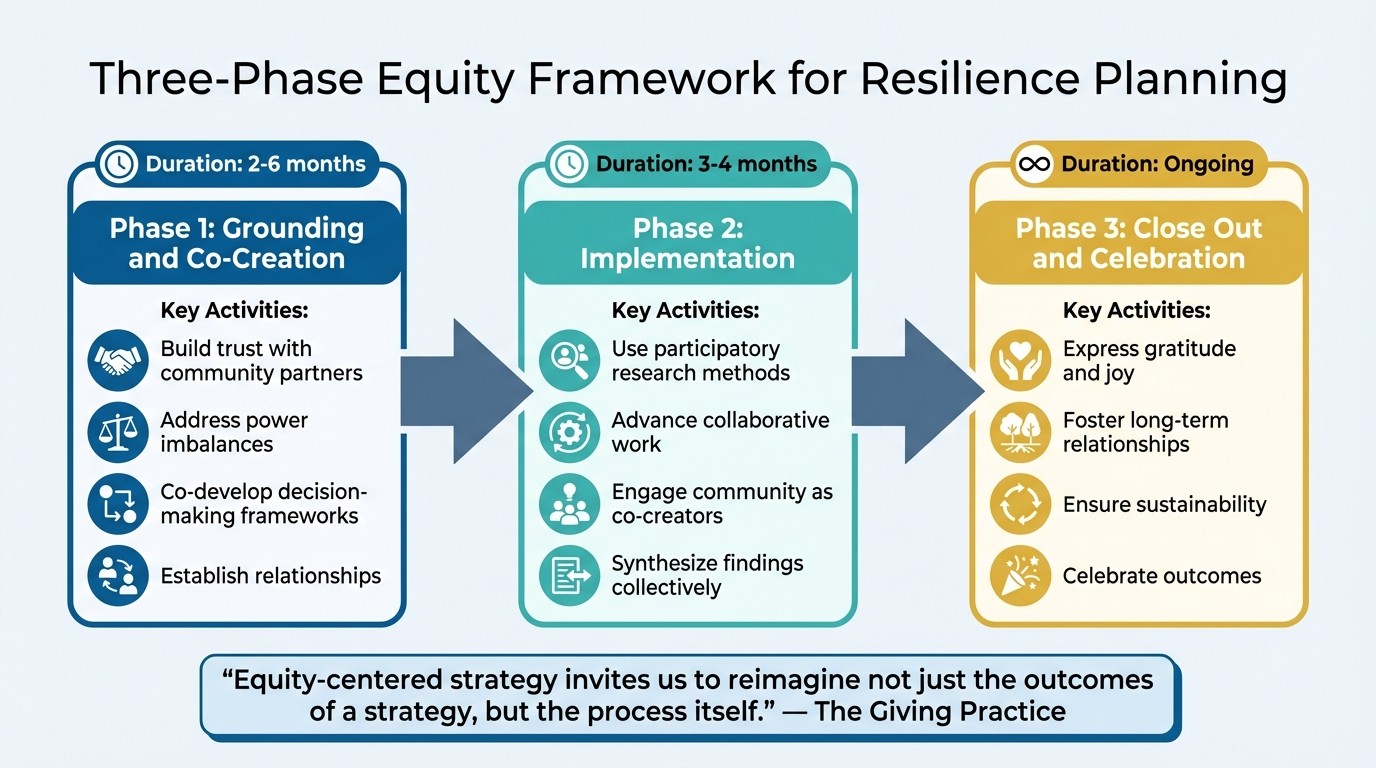
Three-Phase Equity Framework for Resilience Planning
Align Mission and Vision with Equity Goals
To truly embed equity into resilience planning, organizations must start with clear, high-level commitments. Foundations should craft investment belief statements at the board level that align with their mission and provide a solid foundation for decision-making [7]. However, this process goes beyond simply updating language - it requires confronting and addressing the inequities rooted in historical systems [8].
"Philanthropy is a product of the extractive systems of white supremacy, racial capitalism, colonialism, and hetero-patriarchy." - Justice Funders [8]
The composition of the board plays a key role here. Jennifer Bahus, Vice President at Fidelity Philanthropic Consulting, highlights the importance of including representatives from the communities the organization serves [6]. Before integrating equity into strategy, foundations must first engage in preparatory work at both individual and organizational levels to ensure they are ready to embrace the transformative changes equity-centered planning demands [2]. With a clear commitment to equity established, organizations can move toward actionable frameworks that translate these principles into measurable outcomes.
Apply Equity Frameworks to Resilience Work
Once equity commitments are firmly in place, organizations can use structured frameworks to ensure their resilience efforts remain both actionable and measurable. A three-phase model - grounding and co-creation, implementation, and celebration - provides a practical roadmap for turning intentions into results [2].
Phase 1 (Grounding and Co-Creation): This initial phase, lasting 2–6 months, focuses on building trust, addressing power imbalances, and co-developing decision-making frameworks.
Phase 2 (Implementation): Spanning 3–4 months, this phase employs participatory research methods to advance the work.
Phase 3 (Close Out and Celebration): This final phase emphasizes gratitude and joy, fostering long-term relationships and sustainability [2].
"Equity-centered strategy invites us to reimagine not just the outcomes of a strategy, but the process itself." - Emily Daman, Katie Hong, and Lalitha Vaidyanathan, The Giving Practice [2]
This framework places community expertise at the forefront, replacing traditional hierarchical approaches with collaborative, inclusive decision-making. Instead of relying solely on external consultants, findings are synthesized through collective meaning-making with input from the community [2]. Scenario planning also becomes a vital tool, helping organizations anticipate and navigate both internal and external risks, ensuring they remain adaptable in the face of uncertainty [6].
Develop Equity Playbooks and Toolkits
Building on equity frameworks, internal playbooks and toolkits help operationalize equity in daily operations. For instance, the Colorado Resiliency Office created a playbook featuring seven essential modules: Define, Build Team, Develop Policies, Build Projects, Engage, Overcome Barriers, and Track Performance. This includes a "Resiliency Prioritization Criteria Assessment Tool" designed to direct funding toward communities affected by the energy industry [9].
Another example comes from the W.K. Kellogg Foundation. In 2017, the foundation restructured its traditional hierarchy into a networked system of multidisciplinary pods to address low perception scores. By 2021, this shift enabled the foundation to process over 80% of grants within 60 business days, while also improving satisfaction scores among grantees and staff to the 75th percentile or higher [10]. As Alandra Washington, Vice President for Quality and Organizational Effectiveness at the W.K. Kellogg Foundation, explains:
"Our work toward racial equity isn't something that can be left to a single standing committee or executive leader but a lens we bring with us to every single aspect of our day-to-day work." [10]
Effective playbooks should include standardized tools like Memoranda of Understanding (MOUs), stakeholder engagement plans, and progress report templates to ensure consistency [9]. They should also integrate specific equity and resiliency metrics into every project, making it easier for organizations to track progress and report outcomes to stakeholders [9]. By making these tools accessible across all levels, organizations can streamline decision-making and enhance their overall agility [10].
Tools and Resources for Equitable Resilience Planning
Interactive Tools for Community Engagement
Integrating equity into local resilience planning requires tools that genuinely amplify community voices. Participatory mapping, for instance, allows residents to highlight local hazards and resources, while storytelling circles and photovoice projects provide a platform for capturing personal experiences and qualitative insights that go beyond technical data. When combined with trauma-informed approaches, these methods acknowledge and address historical inequities, fostering a more inclusive planning process.
One notable tool, the Equitable Resilience Builder (ERB 1.0) from the U.S. EPA, offers a structured way to assess hazards through an equity-focused lens. Activities like community connections diagramming and indicator card sorting help residents collaboratively prioritize resilience factors that matter most to them. According to the EPA, the ERB "promotes equitable resilience planning through relationships, recognition, information, and action" [11]. These interactive approaches provide a foundation for evaluating equity outcomes using frameworks driven by community input.
Frameworks for Assessing Equity Outcomes
Beyond engagement tools, comprehensive frameworks are essential for measuring and guiding equitable outcomes. The Equitable Resilience Framework (ERF), developed by MIT's Resilient Communities Lab, challenges traditional economic metrics by emphasizing community-defined capabilities such as health, mobility, and education over income or property values. The MIT team describes the ERF as "a toolkit for policymakers for community-led planning, decision-making, and communication" [12].
The ERF incorporates methods like Knowledge Convergence, which merges scientific data with Traditional Ecological Knowledge, community science, and artistic expressions. Another key feature is the Modified Trade-Off Analysis, which supports transparent and collaborative decision-making when communities must allocate limited resources [12][13]. This approach ensures that planning reflects diverse priorities and fosters consensus in challenging situations.
Low-Cost, High-Impact Resources
For communities with limited financial resources, certain strategies and tools can deliver meaningful results without significant expense. Neighborhood-level emergency communication plans, volunteer CERT training, and cooling center networks during extreme heat events are practical and impactful initiatives. Free resources like the NOAA Climate Explorer, FEMA flood maps, and state-level climate assessments offer valuable data for vulnerability mapping.
To enhance technical capacity, partnerships with universities and regional networks can provide additional support. Importantly, equitable participation requires thoughtful allocation of project funds to cover essentials like childcare, food, translation services, and direct compensation for community members' time and contributions [1]. These measures ensure that all voices are heard, enabling foundations to adopt funding and partnership models that truly reflect community needs and priorities.
Measuring and Sustaining Equitable Resilience Outcomes
Design Metrics to Track Equity Processes and Outcomes
Tracking equity in resilience planning goes beyond good intentions - it requires tangible metrics to assess both procedural equity (how inclusive the process is) and outcome equity (who benefits in the end). A study by the RAND Corporation revealed that during FEMA's initial BRIC program cycle, communities with lower incomes and higher numbers of older residents or children were less likely to participate [14]. This underscores the need to not only track which communities apply for resilience funding but also identify those that succeed in securing it.
An Equity Action-Logic Model (EALM) offers a structured way to follow the journey from funding decisions to stakeholder engagement and, ultimately, equity-focused outcomes [14]. Metrics should address common barriers to participation, such as the complexity of applications, time constraints, and resource limitations. RAND emphasizes that applying to BRIC is particularly challenging for communities with limited staff, expertise, or resources to navigate the process [14]. To address this, organizations should integrate natural hazard risk data with sociodemographic information to pinpoint underserved communities and adapt their strategies to bridge these gaps. These measurements are crucial for ensuring resilience investments are both equitable and sustainable over time.
Ensure Sustainability Through Long-Term Commitments
To make resilience efforts last, equity goals must be woven into existing capital improvement plans and departmental budgets, rather than being treated as temporary or isolated projects [1]. A layered funding approach can provide the financial stability needed to sustain these initiatives.
Building local capacity is equally important. By hiring directly from the community and compensating residents for their expertise, organizations can foster local leadership while contributing to economic stability [1]. Breaking resilience plans into actionable timeframes - short-term (under one year), mid-term (1–3 years), and long-term - helps maintain momentum and ensures steady progress. Additionally, pairing infrastructure upgrades with affordable housing protections is critical to preventing "climate gentrification", where resilience investments unintentionally displace the very populations they aim to protect [1]. With a solid financial and strategic foundation, ongoing community involvement can help refine and sustain these efforts.
Build Feedback Loops for Continuous Improvement
Resilience plans should be treated as dynamic, evolving documents, updated every 3–5 years to reflect new climate data, lessons from past events, and community input. Regular reviews are essential to uncover and address any equity gaps that may arise [1].
Using disaggregated demographic data allows organizations to monitor exactly who benefits from resilience investments. If vulnerable groups are being excluded, strategies can be adjusted to ensure inclusivity [1]. Participatory methods like storytelling circles, photovoice projects, and community mapping provide qualitative insights that traditional surveys might miss. As new knowledge and data emerge, organizations should refine their Equity Action-Logic Model and consistently share updates on their equity evaluation methods and outcomes to remain transparent and accountable [14]. Compensating residents for their time and contributions ensures that feedback is both diverse and sustainable, driving continuous improvement in resilience planning.
Conclusion
Equity plays a critical role in protecting vulnerable populations during climate adaptation efforts. Foundations and philanthropic organizations are uniquely positioned to lead this charge by channeling resources to frontline communities and compensating residents for their lived expertise [1].
Turning these principles into action requires bold steps. For example, offering matching funds can help under-resourced communities meet the 10–25% local contributions often required for federal grants [1]. Applying equity criteria to every funding decision ensures resources reach those who need them most, while tracking benefits through demographic data highlights the true impact. Additionally, pairing infrastructure investments with affordable housing protections can help combat climate gentrification, ensuring that the communities being supported aren’t displaced in the process [1]. These measures reflect a genuine commitment to equitable resilience.
"Building resilience requires more than infrastructure upgrades. It demands social cohesion, equitable resource distribution, and governance structures that center the people most vulnerable to climate impacts." – Council Fire Resources [1]
Investing in equitable resilience strengthens communities, making them more connected and better prepared for future challenges. This approach is not just sound philanthropy - it’s a moral responsibility.
To make a lasting difference, prioritize the voices of vulnerable populations in decision-making. Fund community engagement efforts by providing childcare and translation services, and commit to updating resilience plans every 3–5 years [1]. Start by listening, invest with intention, and maintain a steadfast commitment to the communities you aim to serve.
FAQs
How do we pick the right community partners?
Choosing community partners requires a commitment to engaging marginalized groups and fostering inclusive participation. It's about amplifying underrepresented voices, treating them as co-creators, and integrating their knowledge into every stage of planning. To make this collaboration meaningful, it's essential to allocate the necessary resources that enable their active involvement.
Focus on building partnerships with organizations and groups that authentically represent these communities. Emphasize shared decision-making and ensure resources are distributed fairly. This approach not only strengthens trust but also lays the groundwork for resilience strategies that are both effective and enduring.
How do we share decision-making power with residents?
Sharing decision-making power with residents requires actively involving them in the planning process and ensuring their voices influence resilience strategies. This can be achieved through efforts like conducting community vulnerability assessments, organizing participatory meetings, and ensuring marginalized groups have a meaningful seat at the table. Prioritizing social connections and fair resource distribution plays a crucial role in creating solutions that address local needs while promoting inclusive and effective outcomes.
What metrics prove our resilience funding is equitable?
Metrics that highlight progress in equitable resilience funding often focus on tangible improvements, such as enhanced access to essential services and measurable social benefits for underserved groups. Additionally, monitoring the involvement and achievements of marginalized communities within resilience initiatives sheds light on advancements in addressing equity challenges.
Related Blog Posts
Latest Articles
©2025

Narrative Change and Power Building: The Missing Half of Advocacy
Narrative change is the process of disrupting dominant narratives that normalize inequity and advancing new narratives from historically marginalized communities.

Funding Resilience Without Federal Grants
BRIC is unreliable and FEMA is shrinking. Here's how cities fund climate resilience with dedicated revenue, blended finance, and a coordinating authority.

The ESG Blind Spot: How AI Is Finding Risks in Companies Nobody Else Is Watching
Norway's sovereign wealth fund uses AI to screen 7,200 portfolio companies for forced labor and corruption within 24 hours. The real story is the emerging-market coverage gap that traditional ESG data vendors miss — and what it means for any company with a global supply chain.
Narrative Change and Power Building: The Missing Half of Advocacy
Narrative change is the process of disrupting dominant narratives that normalize inequity and advancing new narratives from historically marginalized communities.
Funding Resilience Without Federal Grants
BRIC is unreliable and FEMA is shrinking. Here's how cities fund climate resilience with dedicated revenue, blended finance, and a coordinating authority.
The ESG Blind Spot: How AI Is Finding Risks in Companies Nobody Else Is Watching
Norway's sovereign wealth fund uses AI to screen 7,200 portfolio companies for forced labor and corruption within 24 hours. The real story is the emerging-market coverage gap that traditional ESG data vendors miss — and what it means for any company with a global supply chain.
FAQ
01
What does it really mean to “redefine profit”?
02
What makes Council Fire different?
03
Who does Council Fire work with?
04
What does working with Council Fire actually look like?
05
How does Council Fire help organizations turn big goals into action?
06
How does Council Fire define and measure success?
Apr 5, 2026
How to Embed Equity in Local Resilience Planning for Foundations & Philanthropic Organizations
Capacity Building
In This Article
Foundations' guide to embedding equity in local resilience: partner with community groups, share decision-making, and measure outcomes.
How to Embed Equity in Local Resilience Planning for Foundations & Philanthropic Organizations
Resilience planning works best when it focuses on equity - helping communities most at risk from climate impacts. Foundations and philanthropic organizations have the power to lead this effort by prioritizing funding, partnerships, and decision-making that address systemic inequalities.
Key Takeaways:
Equity vs. Equality: Equity allocates resources to those facing the greatest challenges, like low-income or frontline communities.
Why It Matters: Marginalized groups, such as Black communities, face disproportionate climate risks (e.g., 40%-59% higher heat-related death rates).
Actionable Steps for Foundations:
Partner with local organizations rooted in vulnerable communities.
Engage residents as co-creators, compensating them for their expertise.
Design decision-making processes that give real authority to those most impacted.
Use tools like vulnerability mapping and equity frameworks to guide and measure outcomes.
By embedding equity into every stage of resilience planning, organizations can ensure their efforts protect and empower the communities that need it most.
Core Strategies for Embedding Equity in Local Resilience Planning
Partner with Community-Rooted Organizations
To build equity into local resilience planning, foundations must collaborate with organizations deeply connected to the communities they aim to support. These intermediary groups act as essential bridges, managing grants and offering the administrative backbone that grassroots coalitions often lack [3]. They help foundations connect with leaders in frontline communities - such as low-income neighborhoods, immigrant groups, communities of color, and elderly populations - who may not have the legal or financial capacity to oversee large-scale resilience projects on their own [1].
Identifying the right partners involves looking for those with a strong presence in these communities and the ability to provide fiscal sponsorship, helping grassroots leaders meet complex financial and legal requirements [3]. Local connectors, including faith leaders, block captains, and community health workers, are invaluable for their firsthand knowledge of community needs. When assessing potential partners, consider their impact across five key areas of community development: physical, financial, human, social, and environmental [4].
As Theethat Theerakulwanich aptly explains, "It is essential to see their point of view, their problem, resources, and stakeholders currently supporting the community... we need to see the problem from the side of experts and people in the community" [4]. This kind of partnership fosters collaboration, enabling community members to actively participate in co-creating resilience strategies.
Engage Communities as Co-Creators
True community engagement goes beyond gathering input - it requires shifting power dynamics to treat residents as experts in their own right [2]. This means moving away from transactional relationships and embracing approaches that prioritize local knowledge and values [5].
Practical steps to encourage participation include holding meetings in familiar, accessible locations like schools, churches, housing complexes, or community centers. Providing childcare, meals, and translation services ensures that logistical barriers don’t exclude anyone [1]. Additionally, compensating community members for their time and expertise recognizes their contributions as vital, treating them as valued consultants rather than passive participants [1].
Participatory methods such as community mapping, storytelling circles, and photovoice projects empower residents to identify local risks and resources themselves [1]. The Giving Practice suggests a phased approach: spend 2–6 months on establishing trust and co-creating decision-making frameworks, followed by 3–4 months of collaborative implementation [2]. As they note, "Equity-centered strategy is about more than deliverables. Because the process is intentional, deep relationships are often formed as a result, and closing out the work is an opportunity for celebration, gratitude and joy" [2]. These methods not only build trust but also lay the groundwork for inclusive decision-making processes that genuinely empower vulnerable communities.
Design Inclusive Decision-Making Processes
Equity must extend beyond planning into the governance of resilience projects. Inclusive decision-making demands more than an open invitation; it requires governance structures that give real authority to those most affected by climate impacts [1]. Tools like vulnerability mapping, which analyze exposure, sensitivity, and adaptive capacity, can help direct resources to areas in greatest need [1].
To ensure equity, apply criteria that prioritize projects delivering substantial benefits to low-income and frontline communities. Representatives from these groups should have formal roles in decision-making bodies, ensuring their voices shape outcomes [1]. Additionally, track the distribution of benefits using disaggregated demographic data to confirm that investments reach their intended targets [1].
One-time public meetings are insufficient. Instead, create ongoing feedback loops that allow for adjustments throughout planning, implementation, and monitoring phases [1]. While federal grants often cover a large portion of resilience project costs - ranging from 75% to 90% - local matching funds are usually required. Foundations can play a critical role in bridging this gap, ensuring that projects are both equitable and achievable [1].
Equitable Resilience Planning
Operationalizing Equity Through Organizational Commitments
Three-Phase Equity Framework for Resilience Planning
Align Mission and Vision with Equity Goals
To truly embed equity into resilience planning, organizations must start with clear, high-level commitments. Foundations should craft investment belief statements at the board level that align with their mission and provide a solid foundation for decision-making [7]. However, this process goes beyond simply updating language - it requires confronting and addressing the inequities rooted in historical systems [8].
"Philanthropy is a product of the extractive systems of white supremacy, racial capitalism, colonialism, and hetero-patriarchy." - Justice Funders [8]
The composition of the board plays a key role here. Jennifer Bahus, Vice President at Fidelity Philanthropic Consulting, highlights the importance of including representatives from the communities the organization serves [6]. Before integrating equity into strategy, foundations must first engage in preparatory work at both individual and organizational levels to ensure they are ready to embrace the transformative changes equity-centered planning demands [2]. With a clear commitment to equity established, organizations can move toward actionable frameworks that translate these principles into measurable outcomes.
Apply Equity Frameworks to Resilience Work
Once equity commitments are firmly in place, organizations can use structured frameworks to ensure their resilience efforts remain both actionable and measurable. A three-phase model - grounding and co-creation, implementation, and celebration - provides a practical roadmap for turning intentions into results [2].
Phase 1 (Grounding and Co-Creation): This initial phase, lasting 2–6 months, focuses on building trust, addressing power imbalances, and co-developing decision-making frameworks.
Phase 2 (Implementation): Spanning 3–4 months, this phase employs participatory research methods to advance the work.
Phase 3 (Close Out and Celebration): This final phase emphasizes gratitude and joy, fostering long-term relationships and sustainability [2].
"Equity-centered strategy invites us to reimagine not just the outcomes of a strategy, but the process itself." - Emily Daman, Katie Hong, and Lalitha Vaidyanathan, The Giving Practice [2]
This framework places community expertise at the forefront, replacing traditional hierarchical approaches with collaborative, inclusive decision-making. Instead of relying solely on external consultants, findings are synthesized through collective meaning-making with input from the community [2]. Scenario planning also becomes a vital tool, helping organizations anticipate and navigate both internal and external risks, ensuring they remain adaptable in the face of uncertainty [6].
Develop Equity Playbooks and Toolkits
Building on equity frameworks, internal playbooks and toolkits help operationalize equity in daily operations. For instance, the Colorado Resiliency Office created a playbook featuring seven essential modules: Define, Build Team, Develop Policies, Build Projects, Engage, Overcome Barriers, and Track Performance. This includes a "Resiliency Prioritization Criteria Assessment Tool" designed to direct funding toward communities affected by the energy industry [9].
Another example comes from the W.K. Kellogg Foundation. In 2017, the foundation restructured its traditional hierarchy into a networked system of multidisciplinary pods to address low perception scores. By 2021, this shift enabled the foundation to process over 80% of grants within 60 business days, while also improving satisfaction scores among grantees and staff to the 75th percentile or higher [10]. As Alandra Washington, Vice President for Quality and Organizational Effectiveness at the W.K. Kellogg Foundation, explains:
"Our work toward racial equity isn't something that can be left to a single standing committee or executive leader but a lens we bring with us to every single aspect of our day-to-day work." [10]
Effective playbooks should include standardized tools like Memoranda of Understanding (MOUs), stakeholder engagement plans, and progress report templates to ensure consistency [9]. They should also integrate specific equity and resiliency metrics into every project, making it easier for organizations to track progress and report outcomes to stakeholders [9]. By making these tools accessible across all levels, organizations can streamline decision-making and enhance their overall agility [10].
Tools and Resources for Equitable Resilience Planning
Interactive Tools for Community Engagement
Integrating equity into local resilience planning requires tools that genuinely amplify community voices. Participatory mapping, for instance, allows residents to highlight local hazards and resources, while storytelling circles and photovoice projects provide a platform for capturing personal experiences and qualitative insights that go beyond technical data. When combined with trauma-informed approaches, these methods acknowledge and address historical inequities, fostering a more inclusive planning process.
One notable tool, the Equitable Resilience Builder (ERB 1.0) from the U.S. EPA, offers a structured way to assess hazards through an equity-focused lens. Activities like community connections diagramming and indicator card sorting help residents collaboratively prioritize resilience factors that matter most to them. According to the EPA, the ERB "promotes equitable resilience planning through relationships, recognition, information, and action" [11]. These interactive approaches provide a foundation for evaluating equity outcomes using frameworks driven by community input.
Frameworks for Assessing Equity Outcomes
Beyond engagement tools, comprehensive frameworks are essential for measuring and guiding equitable outcomes. The Equitable Resilience Framework (ERF), developed by MIT's Resilient Communities Lab, challenges traditional economic metrics by emphasizing community-defined capabilities such as health, mobility, and education over income or property values. The MIT team describes the ERF as "a toolkit for policymakers for community-led planning, decision-making, and communication" [12].
The ERF incorporates methods like Knowledge Convergence, which merges scientific data with Traditional Ecological Knowledge, community science, and artistic expressions. Another key feature is the Modified Trade-Off Analysis, which supports transparent and collaborative decision-making when communities must allocate limited resources [12][13]. This approach ensures that planning reflects diverse priorities and fosters consensus in challenging situations.
Low-Cost, High-Impact Resources
For communities with limited financial resources, certain strategies and tools can deliver meaningful results without significant expense. Neighborhood-level emergency communication plans, volunteer CERT training, and cooling center networks during extreme heat events are practical and impactful initiatives. Free resources like the NOAA Climate Explorer, FEMA flood maps, and state-level climate assessments offer valuable data for vulnerability mapping.
To enhance technical capacity, partnerships with universities and regional networks can provide additional support. Importantly, equitable participation requires thoughtful allocation of project funds to cover essentials like childcare, food, translation services, and direct compensation for community members' time and contributions [1]. These measures ensure that all voices are heard, enabling foundations to adopt funding and partnership models that truly reflect community needs and priorities.
Measuring and Sustaining Equitable Resilience Outcomes
Design Metrics to Track Equity Processes and Outcomes
Tracking equity in resilience planning goes beyond good intentions - it requires tangible metrics to assess both procedural equity (how inclusive the process is) and outcome equity (who benefits in the end). A study by the RAND Corporation revealed that during FEMA's initial BRIC program cycle, communities with lower incomes and higher numbers of older residents or children were less likely to participate [14]. This underscores the need to not only track which communities apply for resilience funding but also identify those that succeed in securing it.
An Equity Action-Logic Model (EALM) offers a structured way to follow the journey from funding decisions to stakeholder engagement and, ultimately, equity-focused outcomes [14]. Metrics should address common barriers to participation, such as the complexity of applications, time constraints, and resource limitations. RAND emphasizes that applying to BRIC is particularly challenging for communities with limited staff, expertise, or resources to navigate the process [14]. To address this, organizations should integrate natural hazard risk data with sociodemographic information to pinpoint underserved communities and adapt their strategies to bridge these gaps. These measurements are crucial for ensuring resilience investments are both equitable and sustainable over time.
Ensure Sustainability Through Long-Term Commitments
To make resilience efforts last, equity goals must be woven into existing capital improvement plans and departmental budgets, rather than being treated as temporary or isolated projects [1]. A layered funding approach can provide the financial stability needed to sustain these initiatives.
Building local capacity is equally important. By hiring directly from the community and compensating residents for their expertise, organizations can foster local leadership while contributing to economic stability [1]. Breaking resilience plans into actionable timeframes - short-term (under one year), mid-term (1–3 years), and long-term - helps maintain momentum and ensures steady progress. Additionally, pairing infrastructure upgrades with affordable housing protections is critical to preventing "climate gentrification", where resilience investments unintentionally displace the very populations they aim to protect [1]. With a solid financial and strategic foundation, ongoing community involvement can help refine and sustain these efforts.
Build Feedback Loops for Continuous Improvement
Resilience plans should be treated as dynamic, evolving documents, updated every 3–5 years to reflect new climate data, lessons from past events, and community input. Regular reviews are essential to uncover and address any equity gaps that may arise [1].
Using disaggregated demographic data allows organizations to monitor exactly who benefits from resilience investments. If vulnerable groups are being excluded, strategies can be adjusted to ensure inclusivity [1]. Participatory methods like storytelling circles, photovoice projects, and community mapping provide qualitative insights that traditional surveys might miss. As new knowledge and data emerge, organizations should refine their Equity Action-Logic Model and consistently share updates on their equity evaluation methods and outcomes to remain transparent and accountable [14]. Compensating residents for their time and contributions ensures that feedback is both diverse and sustainable, driving continuous improvement in resilience planning.
Conclusion
Equity plays a critical role in protecting vulnerable populations during climate adaptation efforts. Foundations and philanthropic organizations are uniquely positioned to lead this charge by channeling resources to frontline communities and compensating residents for their lived expertise [1].
Turning these principles into action requires bold steps. For example, offering matching funds can help under-resourced communities meet the 10–25% local contributions often required for federal grants [1]. Applying equity criteria to every funding decision ensures resources reach those who need them most, while tracking benefits through demographic data highlights the true impact. Additionally, pairing infrastructure investments with affordable housing protections can help combat climate gentrification, ensuring that the communities being supported aren’t displaced in the process [1]. These measures reflect a genuine commitment to equitable resilience.
"Building resilience requires more than infrastructure upgrades. It demands social cohesion, equitable resource distribution, and governance structures that center the people most vulnerable to climate impacts." – Council Fire Resources [1]
Investing in equitable resilience strengthens communities, making them more connected and better prepared for future challenges. This approach is not just sound philanthropy - it’s a moral responsibility.
To make a lasting difference, prioritize the voices of vulnerable populations in decision-making. Fund community engagement efforts by providing childcare and translation services, and commit to updating resilience plans every 3–5 years [1]. Start by listening, invest with intention, and maintain a steadfast commitment to the communities you aim to serve.
FAQs
How do we pick the right community partners?
Choosing community partners requires a commitment to engaging marginalized groups and fostering inclusive participation. It's about amplifying underrepresented voices, treating them as co-creators, and integrating their knowledge into every stage of planning. To make this collaboration meaningful, it's essential to allocate the necessary resources that enable their active involvement.
Focus on building partnerships with organizations and groups that authentically represent these communities. Emphasize shared decision-making and ensure resources are distributed fairly. This approach not only strengthens trust but also lays the groundwork for resilience strategies that are both effective and enduring.
How do we share decision-making power with residents?
Sharing decision-making power with residents requires actively involving them in the planning process and ensuring their voices influence resilience strategies. This can be achieved through efforts like conducting community vulnerability assessments, organizing participatory meetings, and ensuring marginalized groups have a meaningful seat at the table. Prioritizing social connections and fair resource distribution plays a crucial role in creating solutions that address local needs while promoting inclusive and effective outcomes.
What metrics prove our resilience funding is equitable?
Metrics that highlight progress in equitable resilience funding often focus on tangible improvements, such as enhanced access to essential services and measurable social benefits for underserved groups. Additionally, monitoring the involvement and achievements of marginalized communities within resilience initiatives sheds light on advancements in addressing equity challenges.
Related Blog Posts
Latest Articles
©2025
Narrative Change and Power Building: The Missing Half of Advocacy
Narrative change is the process of disrupting dominant narratives that normalize inequity and advancing new narratives from historically marginalized communities.
Funding Resilience Without Federal Grants
BRIC is unreliable and FEMA is shrinking. Here's how cities fund climate resilience with dedicated revenue, blended finance, and a coordinating authority.
The ESG Blind Spot: How AI Is Finding Risks in Companies Nobody Else Is Watching
Norway's sovereign wealth fund uses AI to screen 7,200 portfolio companies for forced labor and corruption within 24 hours. The real story is the emerging-market coverage gap that traditional ESG data vendors miss — and what it means for any company with a global supply chain.
FAQ
01
What does it really mean to “redefine profit”?
02
What makes Council Fire different?
03
Who does Council Fire work with?
04
What does working with Council Fire actually look like?
05
How does Council Fire help organizations turn big goals into action?
06
How does Council Fire define and measure success?
Apr 5, 2026
How to Embed Equity in Local Resilience Planning for Foundations & Philanthropic Organizations
Capacity Building
In This Article
Foundations' guide to embedding equity in local resilience: partner with community groups, share decision-making, and measure outcomes.
How to Embed Equity in Local Resilience Planning for Foundations & Philanthropic Organizations
Resilience planning works best when it focuses on equity - helping communities most at risk from climate impacts. Foundations and philanthropic organizations have the power to lead this effort by prioritizing funding, partnerships, and decision-making that address systemic inequalities.
Key Takeaways:
Equity vs. Equality: Equity allocates resources to those facing the greatest challenges, like low-income or frontline communities.
Why It Matters: Marginalized groups, such as Black communities, face disproportionate climate risks (e.g., 40%-59% higher heat-related death rates).
Actionable Steps for Foundations:
Partner with local organizations rooted in vulnerable communities.
Engage residents as co-creators, compensating them for their expertise.
Design decision-making processes that give real authority to those most impacted.
Use tools like vulnerability mapping and equity frameworks to guide and measure outcomes.
By embedding equity into every stage of resilience planning, organizations can ensure their efforts protect and empower the communities that need it most.
Core Strategies for Embedding Equity in Local Resilience Planning
Partner with Community-Rooted Organizations
To build equity into local resilience planning, foundations must collaborate with organizations deeply connected to the communities they aim to support. These intermediary groups act as essential bridges, managing grants and offering the administrative backbone that grassroots coalitions often lack [3]. They help foundations connect with leaders in frontline communities - such as low-income neighborhoods, immigrant groups, communities of color, and elderly populations - who may not have the legal or financial capacity to oversee large-scale resilience projects on their own [1].
Identifying the right partners involves looking for those with a strong presence in these communities and the ability to provide fiscal sponsorship, helping grassroots leaders meet complex financial and legal requirements [3]. Local connectors, including faith leaders, block captains, and community health workers, are invaluable for their firsthand knowledge of community needs. When assessing potential partners, consider their impact across five key areas of community development: physical, financial, human, social, and environmental [4].
As Theethat Theerakulwanich aptly explains, "It is essential to see their point of view, their problem, resources, and stakeholders currently supporting the community... we need to see the problem from the side of experts and people in the community" [4]. This kind of partnership fosters collaboration, enabling community members to actively participate in co-creating resilience strategies.
Engage Communities as Co-Creators
True community engagement goes beyond gathering input - it requires shifting power dynamics to treat residents as experts in their own right [2]. This means moving away from transactional relationships and embracing approaches that prioritize local knowledge and values [5].
Practical steps to encourage participation include holding meetings in familiar, accessible locations like schools, churches, housing complexes, or community centers. Providing childcare, meals, and translation services ensures that logistical barriers don’t exclude anyone [1]. Additionally, compensating community members for their time and expertise recognizes their contributions as vital, treating them as valued consultants rather than passive participants [1].
Participatory methods such as community mapping, storytelling circles, and photovoice projects empower residents to identify local risks and resources themselves [1]. The Giving Practice suggests a phased approach: spend 2–6 months on establishing trust and co-creating decision-making frameworks, followed by 3–4 months of collaborative implementation [2]. As they note, "Equity-centered strategy is about more than deliverables. Because the process is intentional, deep relationships are often formed as a result, and closing out the work is an opportunity for celebration, gratitude and joy" [2]. These methods not only build trust but also lay the groundwork for inclusive decision-making processes that genuinely empower vulnerable communities.
Design Inclusive Decision-Making Processes
Equity must extend beyond planning into the governance of resilience projects. Inclusive decision-making demands more than an open invitation; it requires governance structures that give real authority to those most affected by climate impacts [1]. Tools like vulnerability mapping, which analyze exposure, sensitivity, and adaptive capacity, can help direct resources to areas in greatest need [1].
To ensure equity, apply criteria that prioritize projects delivering substantial benefits to low-income and frontline communities. Representatives from these groups should have formal roles in decision-making bodies, ensuring their voices shape outcomes [1]. Additionally, track the distribution of benefits using disaggregated demographic data to confirm that investments reach their intended targets [1].
One-time public meetings are insufficient. Instead, create ongoing feedback loops that allow for adjustments throughout planning, implementation, and monitoring phases [1]. While federal grants often cover a large portion of resilience project costs - ranging from 75% to 90% - local matching funds are usually required. Foundations can play a critical role in bridging this gap, ensuring that projects are both equitable and achievable [1].
Equitable Resilience Planning
Operationalizing Equity Through Organizational Commitments
Three-Phase Equity Framework for Resilience Planning
Align Mission and Vision with Equity Goals
To truly embed equity into resilience planning, organizations must start with clear, high-level commitments. Foundations should craft investment belief statements at the board level that align with their mission and provide a solid foundation for decision-making [7]. However, this process goes beyond simply updating language - it requires confronting and addressing the inequities rooted in historical systems [8].
"Philanthropy is a product of the extractive systems of white supremacy, racial capitalism, colonialism, and hetero-patriarchy." - Justice Funders [8]
The composition of the board plays a key role here. Jennifer Bahus, Vice President at Fidelity Philanthropic Consulting, highlights the importance of including representatives from the communities the organization serves [6]. Before integrating equity into strategy, foundations must first engage in preparatory work at both individual and organizational levels to ensure they are ready to embrace the transformative changes equity-centered planning demands [2]. With a clear commitment to equity established, organizations can move toward actionable frameworks that translate these principles into measurable outcomes.
Apply Equity Frameworks to Resilience Work
Once equity commitments are firmly in place, organizations can use structured frameworks to ensure their resilience efforts remain both actionable and measurable. A three-phase model - grounding and co-creation, implementation, and celebration - provides a practical roadmap for turning intentions into results [2].
Phase 1 (Grounding and Co-Creation): This initial phase, lasting 2–6 months, focuses on building trust, addressing power imbalances, and co-developing decision-making frameworks.
Phase 2 (Implementation): Spanning 3–4 months, this phase employs participatory research methods to advance the work.
Phase 3 (Close Out and Celebration): This final phase emphasizes gratitude and joy, fostering long-term relationships and sustainability [2].
"Equity-centered strategy invites us to reimagine not just the outcomes of a strategy, but the process itself." - Emily Daman, Katie Hong, and Lalitha Vaidyanathan, The Giving Practice [2]
This framework places community expertise at the forefront, replacing traditional hierarchical approaches with collaborative, inclusive decision-making. Instead of relying solely on external consultants, findings are synthesized through collective meaning-making with input from the community [2]. Scenario planning also becomes a vital tool, helping organizations anticipate and navigate both internal and external risks, ensuring they remain adaptable in the face of uncertainty [6].
Develop Equity Playbooks and Toolkits
Building on equity frameworks, internal playbooks and toolkits help operationalize equity in daily operations. For instance, the Colorado Resiliency Office created a playbook featuring seven essential modules: Define, Build Team, Develop Policies, Build Projects, Engage, Overcome Barriers, and Track Performance. This includes a "Resiliency Prioritization Criteria Assessment Tool" designed to direct funding toward communities affected by the energy industry [9].
Another example comes from the W.K. Kellogg Foundation. In 2017, the foundation restructured its traditional hierarchy into a networked system of multidisciplinary pods to address low perception scores. By 2021, this shift enabled the foundation to process over 80% of grants within 60 business days, while also improving satisfaction scores among grantees and staff to the 75th percentile or higher [10]. As Alandra Washington, Vice President for Quality and Organizational Effectiveness at the W.K. Kellogg Foundation, explains:
"Our work toward racial equity isn't something that can be left to a single standing committee or executive leader but a lens we bring with us to every single aspect of our day-to-day work." [10]
Effective playbooks should include standardized tools like Memoranda of Understanding (MOUs), stakeholder engagement plans, and progress report templates to ensure consistency [9]. They should also integrate specific equity and resiliency metrics into every project, making it easier for organizations to track progress and report outcomes to stakeholders [9]. By making these tools accessible across all levels, organizations can streamline decision-making and enhance their overall agility [10].
Tools and Resources for Equitable Resilience Planning
Interactive Tools for Community Engagement
Integrating equity into local resilience planning requires tools that genuinely amplify community voices. Participatory mapping, for instance, allows residents to highlight local hazards and resources, while storytelling circles and photovoice projects provide a platform for capturing personal experiences and qualitative insights that go beyond technical data. When combined with trauma-informed approaches, these methods acknowledge and address historical inequities, fostering a more inclusive planning process.
One notable tool, the Equitable Resilience Builder (ERB 1.0) from the U.S. EPA, offers a structured way to assess hazards through an equity-focused lens. Activities like community connections diagramming and indicator card sorting help residents collaboratively prioritize resilience factors that matter most to them. According to the EPA, the ERB "promotes equitable resilience planning through relationships, recognition, information, and action" [11]. These interactive approaches provide a foundation for evaluating equity outcomes using frameworks driven by community input.
Frameworks for Assessing Equity Outcomes
Beyond engagement tools, comprehensive frameworks are essential for measuring and guiding equitable outcomes. The Equitable Resilience Framework (ERF), developed by MIT's Resilient Communities Lab, challenges traditional economic metrics by emphasizing community-defined capabilities such as health, mobility, and education over income or property values. The MIT team describes the ERF as "a toolkit for policymakers for community-led planning, decision-making, and communication" [12].
The ERF incorporates methods like Knowledge Convergence, which merges scientific data with Traditional Ecological Knowledge, community science, and artistic expressions. Another key feature is the Modified Trade-Off Analysis, which supports transparent and collaborative decision-making when communities must allocate limited resources [12][13]. This approach ensures that planning reflects diverse priorities and fosters consensus in challenging situations.
Low-Cost, High-Impact Resources
For communities with limited financial resources, certain strategies and tools can deliver meaningful results without significant expense. Neighborhood-level emergency communication plans, volunteer CERT training, and cooling center networks during extreme heat events are practical and impactful initiatives. Free resources like the NOAA Climate Explorer, FEMA flood maps, and state-level climate assessments offer valuable data for vulnerability mapping.
To enhance technical capacity, partnerships with universities and regional networks can provide additional support. Importantly, equitable participation requires thoughtful allocation of project funds to cover essentials like childcare, food, translation services, and direct compensation for community members' time and contributions [1]. These measures ensure that all voices are heard, enabling foundations to adopt funding and partnership models that truly reflect community needs and priorities.
Measuring and Sustaining Equitable Resilience Outcomes
Design Metrics to Track Equity Processes and Outcomes
Tracking equity in resilience planning goes beyond good intentions - it requires tangible metrics to assess both procedural equity (how inclusive the process is) and outcome equity (who benefits in the end). A study by the RAND Corporation revealed that during FEMA's initial BRIC program cycle, communities with lower incomes and higher numbers of older residents or children were less likely to participate [14]. This underscores the need to not only track which communities apply for resilience funding but also identify those that succeed in securing it.
An Equity Action-Logic Model (EALM) offers a structured way to follow the journey from funding decisions to stakeholder engagement and, ultimately, equity-focused outcomes [14]. Metrics should address common barriers to participation, such as the complexity of applications, time constraints, and resource limitations. RAND emphasizes that applying to BRIC is particularly challenging for communities with limited staff, expertise, or resources to navigate the process [14]. To address this, organizations should integrate natural hazard risk data with sociodemographic information to pinpoint underserved communities and adapt their strategies to bridge these gaps. These measurements are crucial for ensuring resilience investments are both equitable and sustainable over time.
Ensure Sustainability Through Long-Term Commitments
To make resilience efforts last, equity goals must be woven into existing capital improvement plans and departmental budgets, rather than being treated as temporary or isolated projects [1]. A layered funding approach can provide the financial stability needed to sustain these initiatives.
Building local capacity is equally important. By hiring directly from the community and compensating residents for their expertise, organizations can foster local leadership while contributing to economic stability [1]. Breaking resilience plans into actionable timeframes - short-term (under one year), mid-term (1–3 years), and long-term - helps maintain momentum and ensures steady progress. Additionally, pairing infrastructure upgrades with affordable housing protections is critical to preventing "climate gentrification", where resilience investments unintentionally displace the very populations they aim to protect [1]. With a solid financial and strategic foundation, ongoing community involvement can help refine and sustain these efforts.
Build Feedback Loops for Continuous Improvement
Resilience plans should be treated as dynamic, evolving documents, updated every 3–5 years to reflect new climate data, lessons from past events, and community input. Regular reviews are essential to uncover and address any equity gaps that may arise [1].
Using disaggregated demographic data allows organizations to monitor exactly who benefits from resilience investments. If vulnerable groups are being excluded, strategies can be adjusted to ensure inclusivity [1]. Participatory methods like storytelling circles, photovoice projects, and community mapping provide qualitative insights that traditional surveys might miss. As new knowledge and data emerge, organizations should refine their Equity Action-Logic Model and consistently share updates on their equity evaluation methods and outcomes to remain transparent and accountable [14]. Compensating residents for their time and contributions ensures that feedback is both diverse and sustainable, driving continuous improvement in resilience planning.
Conclusion
Equity plays a critical role in protecting vulnerable populations during climate adaptation efforts. Foundations and philanthropic organizations are uniquely positioned to lead this charge by channeling resources to frontline communities and compensating residents for their lived expertise [1].
Turning these principles into action requires bold steps. For example, offering matching funds can help under-resourced communities meet the 10–25% local contributions often required for federal grants [1]. Applying equity criteria to every funding decision ensures resources reach those who need them most, while tracking benefits through demographic data highlights the true impact. Additionally, pairing infrastructure investments with affordable housing protections can help combat climate gentrification, ensuring that the communities being supported aren’t displaced in the process [1]. These measures reflect a genuine commitment to equitable resilience.
"Building resilience requires more than infrastructure upgrades. It demands social cohesion, equitable resource distribution, and governance structures that center the people most vulnerable to climate impacts." – Council Fire Resources [1]
Investing in equitable resilience strengthens communities, making them more connected and better prepared for future challenges. This approach is not just sound philanthropy - it’s a moral responsibility.
To make a lasting difference, prioritize the voices of vulnerable populations in decision-making. Fund community engagement efforts by providing childcare and translation services, and commit to updating resilience plans every 3–5 years [1]. Start by listening, invest with intention, and maintain a steadfast commitment to the communities you aim to serve.
FAQs
How do we pick the right community partners?
Choosing community partners requires a commitment to engaging marginalized groups and fostering inclusive participation. It's about amplifying underrepresented voices, treating them as co-creators, and integrating their knowledge into every stage of planning. To make this collaboration meaningful, it's essential to allocate the necessary resources that enable their active involvement.
Focus on building partnerships with organizations and groups that authentically represent these communities. Emphasize shared decision-making and ensure resources are distributed fairly. This approach not only strengthens trust but also lays the groundwork for resilience strategies that are both effective and enduring.
How do we share decision-making power with residents?
Sharing decision-making power with residents requires actively involving them in the planning process and ensuring their voices influence resilience strategies. This can be achieved through efforts like conducting community vulnerability assessments, organizing participatory meetings, and ensuring marginalized groups have a meaningful seat at the table. Prioritizing social connections and fair resource distribution plays a crucial role in creating solutions that address local needs while promoting inclusive and effective outcomes.
What metrics prove our resilience funding is equitable?
Metrics that highlight progress in equitable resilience funding often focus on tangible improvements, such as enhanced access to essential services and measurable social benefits for underserved groups. Additionally, monitoring the involvement and achievements of marginalized communities within resilience initiatives sheds light on advancements in addressing equity challenges.
Related Blog Posts
Latest Articles
©2025
Narrative Change and Power Building: The Missing Half of Advocacy
Narrative change is the process of disrupting dominant narratives that normalize inequity and advancing new narratives from historically marginalized communities.
Funding Resilience Without Federal Grants
BRIC is unreliable and FEMA is shrinking. Here's how cities fund climate resilience with dedicated revenue, blended finance, and a coordinating authority.
The ESG Blind Spot: How AI Is Finding Risks in Companies Nobody Else Is Watching
Norway's sovereign wealth fund uses AI to screen 7,200 portfolio companies for forced labor and corruption within 24 hours. The real story is the emerging-market coverage gap that traditional ESG data vendors miss — and what it means for any company with a global supply chain.
FAQ
What does it really mean to “redefine profit”?
What makes Council Fire different?
Who does Council Fire work with?
What does working with Council Fire actually look like?
How does Council Fire help organizations turn big goals into action?
How does Council Fire define and measure success?