
Apr 3, 2026
How to Embed Equity in Local Resilience Planning for Corporations
ESG Strategy
In This Article
How corporations can map vulnerabilities, co-create equitable resilience plans with communities, and track measurable outcomes.
How to Embed Equity in Local Resilience Planning for Corporations
Equity in resilience planning ensures that support is prioritized for communities facing the highest climate risks and limited resources, such as low-income neighborhoods and elderly populations. For corporations, this approach not only strengthens vulnerable communities but also protects business operations by reducing disruptions in supply chains, workforce stability, and customer bases.
Key Takeaways:
Why Equity Matters: Addressing inequities creates stronger communities that recover faster from disasters, reducing risks for businesses.
Economic Benefits: Every $1 invested in hazard mitigation saves $6 in disaster costs, with federal grants often covering up to 90% of project expenses.
Steps to Identify Gaps: Use tools like vulnerability mapping and demographic data to locate areas where climate risks and resource limitations intersect.
Community Engagement: Work directly with local stakeholders to co-create plans, ensuring solutions meet actual needs and avoid displacement.
Measuring Impact: Track procedural, distributional, and structural equity metrics to ensure investments benefit the most vulnerable populations.
By integrating equity into resilience initiatives, corporations can align business goals with community needs, ensuring long-term stability and growth while addressing climate challenges.
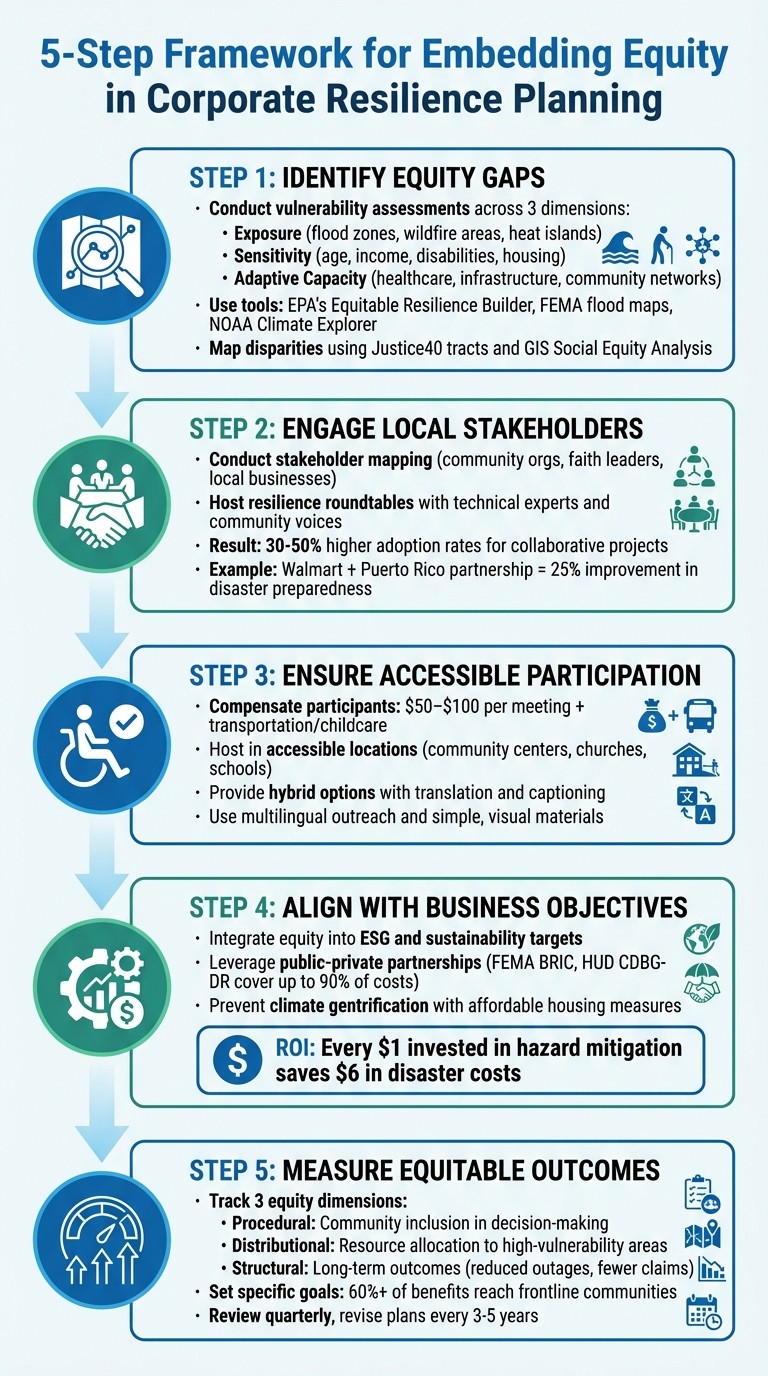
5-Step Framework for Embedding Equity in Corporate Resilience Planning
KEYNOTE Building Resilience, Equity and Community Before and After Disasters - Maria Evans
Identifying Equity Gaps in Your Communities
To address equity gaps effectively, corporations need to understand where vulnerabilities and risks intersect. This requires digging deeper than surface-level demographics by employing a structured approach to data collection and analysis. The goal is to pinpoint areas where climate hazards, population vulnerabilities, and limited local resources converge, creating heightened risks for both communities and business operations.
How to Conduct Community Vulnerability Assessments
A thorough vulnerability assessment should focus on three critical dimensions:
Exposure: Identify regions prone to hazards such as flood zones, wildfire-prone areas, or extreme heat islands.
Sensitivity: Assess population vulnerabilities, considering factors like age, income levels, disabilities, and housing conditions.
Adaptive Capacity: Evaluate the availability of resources for response and recovery, such as healthcare facilities, green infrastructure (e.g., tree coverage), and strong community networks [1].
The U.S. EPA’s Equitable Resilience Builder (ERB) provides a downloadable framework tailored for these assessments [3]. This tool combines technical data with local insights to evaluate risks across built, natural, and social systems. It employs participatory methods like community mapping and indicator card sorting to prioritize resilience initiatives [3].
To ensure accurate, experience-based data, compensate community members for their input. Hosting data-gathering sessions in accessible venues like community centers, churches, or schools - and offering supports such as childcare and translation services - can further encourage broad and inclusive participation.
Using Data to Map Disparities
Mapping disparities involves layering multiple data sources to visualize community vulnerabilities. Begin with exposure data from resources such as FEMA flood maps, NOAA storm records, and downscaled climate projections available through platforms like the NOAA Climate Explorer or state-specific tools like Cal-Adapt [1][2].
Next, overlay sensitivity metrics, including poverty rates, the prevalence of disabilities, populations of children and the elderly, and linguistic isolation. These factors can highlight areas where emergency communication may be less effective. Finally, examine adaptive capacity by mapping resources like healthcare infrastructure (e.g., hospital beds per capita), green space distribution, and the availability of cooling centers or emergency shelters.
Specialized tools such as Justice40 tracts and GIS-based Social Equity Analysis can help pinpoint disadvantaged communities and guide the allocation of federal funding [2]. In areas where official data are lacking, mobile survey tools like ArcGIS Survey123 can be used to gather on-the-ground insights [2].
Working with Communities to Build Resilience Plans
After identifying equity gaps, the next step is to create resilience plans with communities rather than for them. This collaborative approach shifts the process from mere consultation to true co-creation, leading to better outcomes. Research shows that projects developed collaboratively have 30–50% higher adoption rates, while FEMA reports that community-driven plans are 40% more effective in crisis response because they address specific local needs [5][9]. These findings highlight the importance of involving stakeholders directly in the planning process.
How to Engage Local Stakeholders
Begin with a stakeholder mapping exercise to identify groups affected by resilience challenges. These could include community organizations, faith-based leaders, advocacy groups, neighborhood associations, and local businesses. Use tools like public records, social media, and existing networks to pinpoint key players [5][6].
Engagement should start with introductory meetings or collaborative workshops. Hosting "resilience roundtables" can bring together technical experts and local voices. For instance, after Hurricane Maria, Walmart partnered with Puerto Rican community groups, forming advisory councils with local leaders and NGOs. This collaboration prioritized low-income areas, leading to faster recovery and a 25% improvement in disaster preparedness scores [7][10]. Such examples demonstrate the value of consistent, inclusive engagement.
Regular follow-ups are crucial. Personalized communications and advisory panels with ongoing membership foster continuous dialogue and show a genuine commitment to shared decision-making [4].
Once stakeholders are identified, focus on removing barriers to ensure everyone can participate meaningfully.
Making Participation Accessible to Everyone
To ensure full participation, it’s essential to address barriers that underserved communities face. Compensate participants for their time and expertise by offering stipends or honorariums - typically $50–$100 per meeting - and provide reimbursements for transportation and childcare. These measures promote equitable participation [4][6][8].
Host meetings in accessible locations like community centers, churches, schools, or housing complexes, and schedule them at convenient times, such as evenings or weekends. Providing food can also encourage attendance [1]. For broader accessibility, offer hybrid meeting options with features like real-time translation and captioning to accommodate non-native speakers, individuals with disabilities, or those with unreliable internet access [5][11].
Diverse representation is key. Use targeted recruitment through multilingual social media campaigns and collaborate with trusted local organizations to build credibility. Keep materials simple, avoiding corporate jargon, and include visuals like infographics to cater to different literacy levels [5][11]. Finally, close the loop by showing how community input shaped the final resilience strategy - this builds trust and encourages ongoing participation [4].
This collaborative and inclusive process strengthens trust and ensures that resilience plans align with the real needs of the communities they aim to support.
Adding Equity to Your Corporate Resilience Strategy
Incorporating equity into your resilience strategy requires aligning social impact efforts with your core business goals, rather than relegating them to standalone corporate social responsibility programs. When resilience initiatives are woven into capital improvement plans and departmental budgets, they transform into strategic investments that safeguard both your workforce and your customer base.
"Businesses also benefit from community resilience - a resilient community means a resilient workforce and customer base." - Council Fire Resources [1]
The financial benefits of resilience investments are clear. According to FEMA, every $1 spent on hazard mitigation generates $6 in savings, underscoring the value of resilience as a financial strategy [1]. This makes a compelling case for directing resources toward frontline communities, such as low-income neighborhoods and communities of color, which are often the most vulnerable to climate hazards. This approach builds on earlier community-focused assessments.
Connecting Equity Goals to Business Objectives
Integrating equity into resilience efforts can complement your existing ESG and sustainability targets. When selecting projects, apply equity-focused criteria, such as the proportion of benefits directed toward underserved or low-income communities. For example, in flood-prone areas, prioritize infrastructure upgrades in neighborhoods with high poverty rates and limited resources for adaptation. Use disaggregated data on factors like race, ethnicity, and income to ensure benefits are distributed fairly, and employ vulnerability assessments to align these efforts with broader business objectives.
To prevent climate gentrification, pair infrastructure upgrades with affordable housing measures to protect vulnerable residents from displacement. Large employers can also contribute to community stability by offering their facilities as emergency shelters, providing backup power, or assisting with logistics during crises.
Using Public-Private Partnerships for Scale
Public-private partnerships provide a way to expand equitable resilience initiatives by combining corporate funding with government resources. Programs like FEMA's Building Resilient Infrastructure and Communities (BRIC) and HUD's Community Development Block Grants for Disaster Recovery (CDBG-DR) can cover up to 90% of project costs, making it possible to tackle larger-scale challenges [1].
To maximize impact, align your corporate goals with local frameworks. For instance, the City of Boulder's Sustainability, Equity and Resilience (SER) framework [12] emphasizes equitable access to health and economic prosperity, while the Colorado Resiliency Framework [13] outlines 29 strategies across six priority areas where businesses can contribute meaningfully. Joining expert networks, such as the Urban Land Institute (ULI) Resilient Land Use Cohort [14], can also connect corporations with community partners to develop effective land use and climate resilience strategies. These collaborations not only amplify the scale of investments but also demonstrate a strong commitment to building community resilience.
How to Measure Equitable Outcomes
Once equity-focused initiatives are in place, it's essential to assess their impact. Ensuring that resilience investments reach the communities that need them most involves tracking two key types of metrics: process metrics and outcome metrics. Process metrics focus on the actions taken and participation levels, such as the amount of funding directed to specific zip codes or the number of residents from frontline communities involved in planning sessions. Outcome metrics, on the other hand, evaluate the actual results, such as reductions in heat-related illnesses or fewer flood insurance claims in vulnerable areas [1].
Designing Metrics for Equity
To effectively measure equity, your framework should address three critical dimensions:
Procedural equity: Assess how well vulnerable communities are included in decision-making. This can involve tracking the availability of childcare, translation services, and equitable representation in planning processes [1].
Distributional equity: Examine where resources are allocated. Compare funding directed to high-vulnerability versus low-vulnerability areas and monitor the percentage of completed critical infrastructure projects in underserved neighborhoods [1].
Structural equity: Focus on long-term outcomes, such as reduced power outage durations in marginalized communities or fewer flood insurance claims in low-income areas [1].
It's important to analyze data through the lens of race, ethnicity, income level, age, and disability status. This helps identify who truly benefits from the investments. Tools like the EPA's Equitable Resilience Builder (ERB) can support this process. For example, the ERB's "indicator card sorting" method allows communities to collaboratively choose and prioritize the most relevant metrics [3]. Establishing specific goals - such as ensuring that at least 60% of project benefits reach low-income or frontline communities - provides a clear benchmark for success [1].
These metrics create a foundation for ongoing evaluation and improvement.
Using Data to Improve Your Approach
With well-defined metrics in place, use the data collected to refine and enhance your strategy. Regularly update your resilience plan based on findings, conducting quarterly reviews and revising your approach every three to five years [1]. Incorporate participatory methods like community mapping, storytelling circles, and photovoice projects to capture personal experiences that numbers alone might overlook [1].
Stay vigilant for unintended consequences. For instance, if infrastructure improvements lead to rising property values, monitor for signs of climate gentrification and implement affordable housing measures as needed [1]. Collaborate with local social service agencies and economic development departments to tap into informal community networks, ensuring data collection includes populations that are often underrepresented in official records [15].
Conclusion: Building Resilience Through Equity
Integrating equity into local resilience planning isn't just a moral obligation - it's also a smart strategy that safeguards your workforce, strengthens customer loyalty, and boosts financial outcomes. Prioritizing frontline communities - such as low-income neighborhoods, communities of color, and elderly populations - ensures that resilience investments are directed where they can make the greatest impact.
To align equity with business goals, three key actions are essential: leverage vulnerability mapping and detailed data to allocate resources to areas with the greatest need and lowest adaptive capacity; engage in continuous dialogue with communities throughout the planning and implementation phases; and combine infrastructure upgrades with policies like affordable housing to prevent climate gentrification, ensuring that the very people you're aiming to protect aren't displaced.
Setting clear, measurable goals is critical. Instead of broad objectives like "improve stormwater management", commit to specific, actionable targets such as "install 50 bioswales in flood-prone neighborhoods by 2027" [1]. Monitor both process metrics (e.g., number of residents engaged, dollars allocated by region) and outcome metrics (e.g., reduced heat-related illnesses, quicker recovery from power outages). Regularly update plans - ideally every three to five years - based on evolving climate data and community input [1]. These measurable commitments underscore the broader message of resilience and sustainable planning.
Historically, vulnerable communities have had limited political influence, even though they face the highest risks. By prioritizing their voices in resilience strategies, you're not just strengthening neighborhoods - you’re laying the groundwork for a stable and thriving business in the face of an unpredictable climate future.
FAQs
Where should we start if we have limited data on local climate and social risks?
To begin addressing climate challenges effectively, start with a community-level vulnerability assessment. This involves identifying local climate risks such as floods, heatwaves, or other hazards and mapping out areas most susceptible to these threats. Collaborating with local residents and organizations is crucial - gathering their insights can provide a deeper understanding of social vulnerabilities that might not be immediately apparent through data alone. Even when resources or data are scarce, this method lays the groundwork for evaluating exposure and vulnerabilities, forming the first steps toward creating a more resilient community.
How do we engage underserved communities without causing harm or displacement?
Engaging underserved communities effectively means prioritizing equity every step of the way. Begin by evaluating the specific challenges and risks faced by these communities to pinpoint those most vulnerable. Programs should be structured to distribute resources fairly and eliminate obstacles that prevent participation. By actively listening to community members and working together to develop solutions, you can address concerns like displacement and ensure efforts align with their needs. Strengthening social bonds and encouraging community ownership are essential for creating resilience initiatives that truly benefit these populations while avoiding unintended negative consequences.
Which equity metrics should we track to prove real resilience outcomes?
Key equity metrics focus on areas like community vulnerability assessments, social cohesion, resource distribution, and equitable access to resilience resources and infrastructure. These measurements are vital for determining how effectively resilience strategies tackle disparities and provide support to underserved communities.
Related Blog Posts
Latest Articles
©2025

Narrative Change and Power Building: The Missing Half of Advocacy
Narrative change is the process of disrupting dominant narratives that normalize inequity and advancing new narratives from historically marginalized communities.

Funding Resilience Without Federal Grants
BRIC is unreliable and FEMA is shrinking. Here's how cities fund climate resilience with dedicated revenue, blended finance, and a coordinating authority.

The ESG Blind Spot: How AI Is Finding Risks in Companies Nobody Else Is Watching
Norway's sovereign wealth fund uses AI to screen 7,200 portfolio companies for forced labor and corruption within 24 hours. The real story is the emerging-market coverage gap that traditional ESG data vendors miss — and what it means for any company with a global supply chain.
Narrative Change and Power Building: The Missing Half of Advocacy
Narrative change is the process of disrupting dominant narratives that normalize inequity and advancing new narratives from historically marginalized communities.
Funding Resilience Without Federal Grants
BRIC is unreliable and FEMA is shrinking. Here's how cities fund climate resilience with dedicated revenue, blended finance, and a coordinating authority.
The ESG Blind Spot: How AI Is Finding Risks in Companies Nobody Else Is Watching
Norway's sovereign wealth fund uses AI to screen 7,200 portfolio companies for forced labor and corruption within 24 hours. The real story is the emerging-market coverage gap that traditional ESG data vendors miss — and what it means for any company with a global supply chain.
FAQ
01
What does it really mean to “redefine profit”?
02
What makes Council Fire different?
03
Who does Council Fire work with?
04
What does working with Council Fire actually look like?
05
How does Council Fire help organizations turn big goals into action?
06
How does Council Fire define and measure success?
Apr 3, 2026
How to Embed Equity in Local Resilience Planning for Corporations
ESG Strategy
In This Article
How corporations can map vulnerabilities, co-create equitable resilience plans with communities, and track measurable outcomes.
How to Embed Equity in Local Resilience Planning for Corporations
Equity in resilience planning ensures that support is prioritized for communities facing the highest climate risks and limited resources, such as low-income neighborhoods and elderly populations. For corporations, this approach not only strengthens vulnerable communities but also protects business operations by reducing disruptions in supply chains, workforce stability, and customer bases.
Key Takeaways:
Why Equity Matters: Addressing inequities creates stronger communities that recover faster from disasters, reducing risks for businesses.
Economic Benefits: Every $1 invested in hazard mitigation saves $6 in disaster costs, with federal grants often covering up to 90% of project expenses.
Steps to Identify Gaps: Use tools like vulnerability mapping and demographic data to locate areas where climate risks and resource limitations intersect.
Community Engagement: Work directly with local stakeholders to co-create plans, ensuring solutions meet actual needs and avoid displacement.
Measuring Impact: Track procedural, distributional, and structural equity metrics to ensure investments benefit the most vulnerable populations.
By integrating equity into resilience initiatives, corporations can align business goals with community needs, ensuring long-term stability and growth while addressing climate challenges.
5-Step Framework for Embedding Equity in Corporate Resilience Planning
KEYNOTE Building Resilience, Equity and Community Before and After Disasters - Maria Evans
Identifying Equity Gaps in Your Communities
To address equity gaps effectively, corporations need to understand where vulnerabilities and risks intersect. This requires digging deeper than surface-level demographics by employing a structured approach to data collection and analysis. The goal is to pinpoint areas where climate hazards, population vulnerabilities, and limited local resources converge, creating heightened risks for both communities and business operations.
How to Conduct Community Vulnerability Assessments
A thorough vulnerability assessment should focus on three critical dimensions:
Exposure: Identify regions prone to hazards such as flood zones, wildfire-prone areas, or extreme heat islands.
Sensitivity: Assess population vulnerabilities, considering factors like age, income levels, disabilities, and housing conditions.
Adaptive Capacity: Evaluate the availability of resources for response and recovery, such as healthcare facilities, green infrastructure (e.g., tree coverage), and strong community networks [1].
The U.S. EPA’s Equitable Resilience Builder (ERB) provides a downloadable framework tailored for these assessments [3]. This tool combines technical data with local insights to evaluate risks across built, natural, and social systems. It employs participatory methods like community mapping and indicator card sorting to prioritize resilience initiatives [3].
To ensure accurate, experience-based data, compensate community members for their input. Hosting data-gathering sessions in accessible venues like community centers, churches, or schools - and offering supports such as childcare and translation services - can further encourage broad and inclusive participation.
Using Data to Map Disparities
Mapping disparities involves layering multiple data sources to visualize community vulnerabilities. Begin with exposure data from resources such as FEMA flood maps, NOAA storm records, and downscaled climate projections available through platforms like the NOAA Climate Explorer or state-specific tools like Cal-Adapt [1][2].
Next, overlay sensitivity metrics, including poverty rates, the prevalence of disabilities, populations of children and the elderly, and linguistic isolation. These factors can highlight areas where emergency communication may be less effective. Finally, examine adaptive capacity by mapping resources like healthcare infrastructure (e.g., hospital beds per capita), green space distribution, and the availability of cooling centers or emergency shelters.
Specialized tools such as Justice40 tracts and GIS-based Social Equity Analysis can help pinpoint disadvantaged communities and guide the allocation of federal funding [2]. In areas where official data are lacking, mobile survey tools like ArcGIS Survey123 can be used to gather on-the-ground insights [2].
Working with Communities to Build Resilience Plans
After identifying equity gaps, the next step is to create resilience plans with communities rather than for them. This collaborative approach shifts the process from mere consultation to true co-creation, leading to better outcomes. Research shows that projects developed collaboratively have 30–50% higher adoption rates, while FEMA reports that community-driven plans are 40% more effective in crisis response because they address specific local needs [5][9]. These findings highlight the importance of involving stakeholders directly in the planning process.
How to Engage Local Stakeholders
Begin with a stakeholder mapping exercise to identify groups affected by resilience challenges. These could include community organizations, faith-based leaders, advocacy groups, neighborhood associations, and local businesses. Use tools like public records, social media, and existing networks to pinpoint key players [5][6].
Engagement should start with introductory meetings or collaborative workshops. Hosting "resilience roundtables" can bring together technical experts and local voices. For instance, after Hurricane Maria, Walmart partnered with Puerto Rican community groups, forming advisory councils with local leaders and NGOs. This collaboration prioritized low-income areas, leading to faster recovery and a 25% improvement in disaster preparedness scores [7][10]. Such examples demonstrate the value of consistent, inclusive engagement.
Regular follow-ups are crucial. Personalized communications and advisory panels with ongoing membership foster continuous dialogue and show a genuine commitment to shared decision-making [4].
Once stakeholders are identified, focus on removing barriers to ensure everyone can participate meaningfully.
Making Participation Accessible to Everyone
To ensure full participation, it’s essential to address barriers that underserved communities face. Compensate participants for their time and expertise by offering stipends or honorariums - typically $50–$100 per meeting - and provide reimbursements for transportation and childcare. These measures promote equitable participation [4][6][8].
Host meetings in accessible locations like community centers, churches, schools, or housing complexes, and schedule them at convenient times, such as evenings or weekends. Providing food can also encourage attendance [1]. For broader accessibility, offer hybrid meeting options with features like real-time translation and captioning to accommodate non-native speakers, individuals with disabilities, or those with unreliable internet access [5][11].
Diverse representation is key. Use targeted recruitment through multilingual social media campaigns and collaborate with trusted local organizations to build credibility. Keep materials simple, avoiding corporate jargon, and include visuals like infographics to cater to different literacy levels [5][11]. Finally, close the loop by showing how community input shaped the final resilience strategy - this builds trust and encourages ongoing participation [4].
This collaborative and inclusive process strengthens trust and ensures that resilience plans align with the real needs of the communities they aim to support.
Adding Equity to Your Corporate Resilience Strategy
Incorporating equity into your resilience strategy requires aligning social impact efforts with your core business goals, rather than relegating them to standalone corporate social responsibility programs. When resilience initiatives are woven into capital improvement plans and departmental budgets, they transform into strategic investments that safeguard both your workforce and your customer base.
"Businesses also benefit from community resilience - a resilient community means a resilient workforce and customer base." - Council Fire Resources [1]
The financial benefits of resilience investments are clear. According to FEMA, every $1 spent on hazard mitigation generates $6 in savings, underscoring the value of resilience as a financial strategy [1]. This makes a compelling case for directing resources toward frontline communities, such as low-income neighborhoods and communities of color, which are often the most vulnerable to climate hazards. This approach builds on earlier community-focused assessments.
Connecting Equity Goals to Business Objectives
Integrating equity into resilience efforts can complement your existing ESG and sustainability targets. When selecting projects, apply equity-focused criteria, such as the proportion of benefits directed toward underserved or low-income communities. For example, in flood-prone areas, prioritize infrastructure upgrades in neighborhoods with high poverty rates and limited resources for adaptation. Use disaggregated data on factors like race, ethnicity, and income to ensure benefits are distributed fairly, and employ vulnerability assessments to align these efforts with broader business objectives.
To prevent climate gentrification, pair infrastructure upgrades with affordable housing measures to protect vulnerable residents from displacement. Large employers can also contribute to community stability by offering their facilities as emergency shelters, providing backup power, or assisting with logistics during crises.
Using Public-Private Partnerships for Scale
Public-private partnerships provide a way to expand equitable resilience initiatives by combining corporate funding with government resources. Programs like FEMA's Building Resilient Infrastructure and Communities (BRIC) and HUD's Community Development Block Grants for Disaster Recovery (CDBG-DR) can cover up to 90% of project costs, making it possible to tackle larger-scale challenges [1].
To maximize impact, align your corporate goals with local frameworks. For instance, the City of Boulder's Sustainability, Equity and Resilience (SER) framework [12] emphasizes equitable access to health and economic prosperity, while the Colorado Resiliency Framework [13] outlines 29 strategies across six priority areas where businesses can contribute meaningfully. Joining expert networks, such as the Urban Land Institute (ULI) Resilient Land Use Cohort [14], can also connect corporations with community partners to develop effective land use and climate resilience strategies. These collaborations not only amplify the scale of investments but also demonstrate a strong commitment to building community resilience.
How to Measure Equitable Outcomes
Once equity-focused initiatives are in place, it's essential to assess their impact. Ensuring that resilience investments reach the communities that need them most involves tracking two key types of metrics: process metrics and outcome metrics. Process metrics focus on the actions taken and participation levels, such as the amount of funding directed to specific zip codes or the number of residents from frontline communities involved in planning sessions. Outcome metrics, on the other hand, evaluate the actual results, such as reductions in heat-related illnesses or fewer flood insurance claims in vulnerable areas [1].
Designing Metrics for Equity
To effectively measure equity, your framework should address three critical dimensions:
Procedural equity: Assess how well vulnerable communities are included in decision-making. This can involve tracking the availability of childcare, translation services, and equitable representation in planning processes [1].
Distributional equity: Examine where resources are allocated. Compare funding directed to high-vulnerability versus low-vulnerability areas and monitor the percentage of completed critical infrastructure projects in underserved neighborhoods [1].
Structural equity: Focus on long-term outcomes, such as reduced power outage durations in marginalized communities or fewer flood insurance claims in low-income areas [1].
It's important to analyze data through the lens of race, ethnicity, income level, age, and disability status. This helps identify who truly benefits from the investments. Tools like the EPA's Equitable Resilience Builder (ERB) can support this process. For example, the ERB's "indicator card sorting" method allows communities to collaboratively choose and prioritize the most relevant metrics [3]. Establishing specific goals - such as ensuring that at least 60% of project benefits reach low-income or frontline communities - provides a clear benchmark for success [1].
These metrics create a foundation for ongoing evaluation and improvement.
Using Data to Improve Your Approach
With well-defined metrics in place, use the data collected to refine and enhance your strategy. Regularly update your resilience plan based on findings, conducting quarterly reviews and revising your approach every three to five years [1]. Incorporate participatory methods like community mapping, storytelling circles, and photovoice projects to capture personal experiences that numbers alone might overlook [1].
Stay vigilant for unintended consequences. For instance, if infrastructure improvements lead to rising property values, monitor for signs of climate gentrification and implement affordable housing measures as needed [1]. Collaborate with local social service agencies and economic development departments to tap into informal community networks, ensuring data collection includes populations that are often underrepresented in official records [15].
Conclusion: Building Resilience Through Equity
Integrating equity into local resilience planning isn't just a moral obligation - it's also a smart strategy that safeguards your workforce, strengthens customer loyalty, and boosts financial outcomes. Prioritizing frontline communities - such as low-income neighborhoods, communities of color, and elderly populations - ensures that resilience investments are directed where they can make the greatest impact.
To align equity with business goals, three key actions are essential: leverage vulnerability mapping and detailed data to allocate resources to areas with the greatest need and lowest adaptive capacity; engage in continuous dialogue with communities throughout the planning and implementation phases; and combine infrastructure upgrades with policies like affordable housing to prevent climate gentrification, ensuring that the very people you're aiming to protect aren't displaced.
Setting clear, measurable goals is critical. Instead of broad objectives like "improve stormwater management", commit to specific, actionable targets such as "install 50 bioswales in flood-prone neighborhoods by 2027" [1]. Monitor both process metrics (e.g., number of residents engaged, dollars allocated by region) and outcome metrics (e.g., reduced heat-related illnesses, quicker recovery from power outages). Regularly update plans - ideally every three to five years - based on evolving climate data and community input [1]. These measurable commitments underscore the broader message of resilience and sustainable planning.
Historically, vulnerable communities have had limited political influence, even though they face the highest risks. By prioritizing their voices in resilience strategies, you're not just strengthening neighborhoods - you’re laying the groundwork for a stable and thriving business in the face of an unpredictable climate future.
FAQs
Where should we start if we have limited data on local climate and social risks?
To begin addressing climate challenges effectively, start with a community-level vulnerability assessment. This involves identifying local climate risks such as floods, heatwaves, or other hazards and mapping out areas most susceptible to these threats. Collaborating with local residents and organizations is crucial - gathering their insights can provide a deeper understanding of social vulnerabilities that might not be immediately apparent through data alone. Even when resources or data are scarce, this method lays the groundwork for evaluating exposure and vulnerabilities, forming the first steps toward creating a more resilient community.
How do we engage underserved communities without causing harm or displacement?
Engaging underserved communities effectively means prioritizing equity every step of the way. Begin by evaluating the specific challenges and risks faced by these communities to pinpoint those most vulnerable. Programs should be structured to distribute resources fairly and eliminate obstacles that prevent participation. By actively listening to community members and working together to develop solutions, you can address concerns like displacement and ensure efforts align with their needs. Strengthening social bonds and encouraging community ownership are essential for creating resilience initiatives that truly benefit these populations while avoiding unintended negative consequences.
Which equity metrics should we track to prove real resilience outcomes?
Key equity metrics focus on areas like community vulnerability assessments, social cohesion, resource distribution, and equitable access to resilience resources and infrastructure. These measurements are vital for determining how effectively resilience strategies tackle disparities and provide support to underserved communities.
Related Blog Posts
Latest Articles
©2025
Narrative Change and Power Building: The Missing Half of Advocacy
Narrative change is the process of disrupting dominant narratives that normalize inequity and advancing new narratives from historically marginalized communities.
Funding Resilience Without Federal Grants
BRIC is unreliable and FEMA is shrinking. Here's how cities fund climate resilience with dedicated revenue, blended finance, and a coordinating authority.
The ESG Blind Spot: How AI Is Finding Risks in Companies Nobody Else Is Watching
Norway's sovereign wealth fund uses AI to screen 7,200 portfolio companies for forced labor and corruption within 24 hours. The real story is the emerging-market coverage gap that traditional ESG data vendors miss — and what it means for any company with a global supply chain.
FAQ
01
What does it really mean to “redefine profit”?
02
What makes Council Fire different?
03
Who does Council Fire work with?
04
What does working with Council Fire actually look like?
05
How does Council Fire help organizations turn big goals into action?
06
How does Council Fire define and measure success?
Apr 3, 2026
How to Embed Equity in Local Resilience Planning for Corporations
ESG Strategy
In This Article
How corporations can map vulnerabilities, co-create equitable resilience plans with communities, and track measurable outcomes.
How to Embed Equity in Local Resilience Planning for Corporations
Equity in resilience planning ensures that support is prioritized for communities facing the highest climate risks and limited resources, such as low-income neighborhoods and elderly populations. For corporations, this approach not only strengthens vulnerable communities but also protects business operations by reducing disruptions in supply chains, workforce stability, and customer bases.
Key Takeaways:
Why Equity Matters: Addressing inequities creates stronger communities that recover faster from disasters, reducing risks for businesses.
Economic Benefits: Every $1 invested in hazard mitigation saves $6 in disaster costs, with federal grants often covering up to 90% of project expenses.
Steps to Identify Gaps: Use tools like vulnerability mapping and demographic data to locate areas where climate risks and resource limitations intersect.
Community Engagement: Work directly with local stakeholders to co-create plans, ensuring solutions meet actual needs and avoid displacement.
Measuring Impact: Track procedural, distributional, and structural equity metrics to ensure investments benefit the most vulnerable populations.
By integrating equity into resilience initiatives, corporations can align business goals with community needs, ensuring long-term stability and growth while addressing climate challenges.
5-Step Framework for Embedding Equity in Corporate Resilience Planning
KEYNOTE Building Resilience, Equity and Community Before and After Disasters - Maria Evans
Identifying Equity Gaps in Your Communities
To address equity gaps effectively, corporations need to understand where vulnerabilities and risks intersect. This requires digging deeper than surface-level demographics by employing a structured approach to data collection and analysis. The goal is to pinpoint areas where climate hazards, population vulnerabilities, and limited local resources converge, creating heightened risks for both communities and business operations.
How to Conduct Community Vulnerability Assessments
A thorough vulnerability assessment should focus on three critical dimensions:
Exposure: Identify regions prone to hazards such as flood zones, wildfire-prone areas, or extreme heat islands.
Sensitivity: Assess population vulnerabilities, considering factors like age, income levels, disabilities, and housing conditions.
Adaptive Capacity: Evaluate the availability of resources for response and recovery, such as healthcare facilities, green infrastructure (e.g., tree coverage), and strong community networks [1].
The U.S. EPA’s Equitable Resilience Builder (ERB) provides a downloadable framework tailored for these assessments [3]. This tool combines technical data with local insights to evaluate risks across built, natural, and social systems. It employs participatory methods like community mapping and indicator card sorting to prioritize resilience initiatives [3].
To ensure accurate, experience-based data, compensate community members for their input. Hosting data-gathering sessions in accessible venues like community centers, churches, or schools - and offering supports such as childcare and translation services - can further encourage broad and inclusive participation.
Using Data to Map Disparities
Mapping disparities involves layering multiple data sources to visualize community vulnerabilities. Begin with exposure data from resources such as FEMA flood maps, NOAA storm records, and downscaled climate projections available through platforms like the NOAA Climate Explorer or state-specific tools like Cal-Adapt [1][2].
Next, overlay sensitivity metrics, including poverty rates, the prevalence of disabilities, populations of children and the elderly, and linguistic isolation. These factors can highlight areas where emergency communication may be less effective. Finally, examine adaptive capacity by mapping resources like healthcare infrastructure (e.g., hospital beds per capita), green space distribution, and the availability of cooling centers or emergency shelters.
Specialized tools such as Justice40 tracts and GIS-based Social Equity Analysis can help pinpoint disadvantaged communities and guide the allocation of federal funding [2]. In areas where official data are lacking, mobile survey tools like ArcGIS Survey123 can be used to gather on-the-ground insights [2].
Working with Communities to Build Resilience Plans
After identifying equity gaps, the next step is to create resilience plans with communities rather than for them. This collaborative approach shifts the process from mere consultation to true co-creation, leading to better outcomes. Research shows that projects developed collaboratively have 30–50% higher adoption rates, while FEMA reports that community-driven plans are 40% more effective in crisis response because they address specific local needs [5][9]. These findings highlight the importance of involving stakeholders directly in the planning process.
How to Engage Local Stakeholders
Begin with a stakeholder mapping exercise to identify groups affected by resilience challenges. These could include community organizations, faith-based leaders, advocacy groups, neighborhood associations, and local businesses. Use tools like public records, social media, and existing networks to pinpoint key players [5][6].
Engagement should start with introductory meetings or collaborative workshops. Hosting "resilience roundtables" can bring together technical experts and local voices. For instance, after Hurricane Maria, Walmart partnered with Puerto Rican community groups, forming advisory councils with local leaders and NGOs. This collaboration prioritized low-income areas, leading to faster recovery and a 25% improvement in disaster preparedness scores [7][10]. Such examples demonstrate the value of consistent, inclusive engagement.
Regular follow-ups are crucial. Personalized communications and advisory panels with ongoing membership foster continuous dialogue and show a genuine commitment to shared decision-making [4].
Once stakeholders are identified, focus on removing barriers to ensure everyone can participate meaningfully.
Making Participation Accessible to Everyone
To ensure full participation, it’s essential to address barriers that underserved communities face. Compensate participants for their time and expertise by offering stipends or honorariums - typically $50–$100 per meeting - and provide reimbursements for transportation and childcare. These measures promote equitable participation [4][6][8].
Host meetings in accessible locations like community centers, churches, schools, or housing complexes, and schedule them at convenient times, such as evenings or weekends. Providing food can also encourage attendance [1]. For broader accessibility, offer hybrid meeting options with features like real-time translation and captioning to accommodate non-native speakers, individuals with disabilities, or those with unreliable internet access [5][11].
Diverse representation is key. Use targeted recruitment through multilingual social media campaigns and collaborate with trusted local organizations to build credibility. Keep materials simple, avoiding corporate jargon, and include visuals like infographics to cater to different literacy levels [5][11]. Finally, close the loop by showing how community input shaped the final resilience strategy - this builds trust and encourages ongoing participation [4].
This collaborative and inclusive process strengthens trust and ensures that resilience plans align with the real needs of the communities they aim to support.
Adding Equity to Your Corporate Resilience Strategy
Incorporating equity into your resilience strategy requires aligning social impact efforts with your core business goals, rather than relegating them to standalone corporate social responsibility programs. When resilience initiatives are woven into capital improvement plans and departmental budgets, they transform into strategic investments that safeguard both your workforce and your customer base.
"Businesses also benefit from community resilience - a resilient community means a resilient workforce and customer base." - Council Fire Resources [1]
The financial benefits of resilience investments are clear. According to FEMA, every $1 spent on hazard mitigation generates $6 in savings, underscoring the value of resilience as a financial strategy [1]. This makes a compelling case for directing resources toward frontline communities, such as low-income neighborhoods and communities of color, which are often the most vulnerable to climate hazards. This approach builds on earlier community-focused assessments.
Connecting Equity Goals to Business Objectives
Integrating equity into resilience efforts can complement your existing ESG and sustainability targets. When selecting projects, apply equity-focused criteria, such as the proportion of benefits directed toward underserved or low-income communities. For example, in flood-prone areas, prioritize infrastructure upgrades in neighborhoods with high poverty rates and limited resources for adaptation. Use disaggregated data on factors like race, ethnicity, and income to ensure benefits are distributed fairly, and employ vulnerability assessments to align these efforts with broader business objectives.
To prevent climate gentrification, pair infrastructure upgrades with affordable housing measures to protect vulnerable residents from displacement. Large employers can also contribute to community stability by offering their facilities as emergency shelters, providing backup power, or assisting with logistics during crises.
Using Public-Private Partnerships for Scale
Public-private partnerships provide a way to expand equitable resilience initiatives by combining corporate funding with government resources. Programs like FEMA's Building Resilient Infrastructure and Communities (BRIC) and HUD's Community Development Block Grants for Disaster Recovery (CDBG-DR) can cover up to 90% of project costs, making it possible to tackle larger-scale challenges [1].
To maximize impact, align your corporate goals with local frameworks. For instance, the City of Boulder's Sustainability, Equity and Resilience (SER) framework [12] emphasizes equitable access to health and economic prosperity, while the Colorado Resiliency Framework [13] outlines 29 strategies across six priority areas where businesses can contribute meaningfully. Joining expert networks, such as the Urban Land Institute (ULI) Resilient Land Use Cohort [14], can also connect corporations with community partners to develop effective land use and climate resilience strategies. These collaborations not only amplify the scale of investments but also demonstrate a strong commitment to building community resilience.
How to Measure Equitable Outcomes
Once equity-focused initiatives are in place, it's essential to assess their impact. Ensuring that resilience investments reach the communities that need them most involves tracking two key types of metrics: process metrics and outcome metrics. Process metrics focus on the actions taken and participation levels, such as the amount of funding directed to specific zip codes or the number of residents from frontline communities involved in planning sessions. Outcome metrics, on the other hand, evaluate the actual results, such as reductions in heat-related illnesses or fewer flood insurance claims in vulnerable areas [1].
Designing Metrics for Equity
To effectively measure equity, your framework should address three critical dimensions:
Procedural equity: Assess how well vulnerable communities are included in decision-making. This can involve tracking the availability of childcare, translation services, and equitable representation in planning processes [1].
Distributional equity: Examine where resources are allocated. Compare funding directed to high-vulnerability versus low-vulnerability areas and monitor the percentage of completed critical infrastructure projects in underserved neighborhoods [1].
Structural equity: Focus on long-term outcomes, such as reduced power outage durations in marginalized communities or fewer flood insurance claims in low-income areas [1].
It's important to analyze data through the lens of race, ethnicity, income level, age, and disability status. This helps identify who truly benefits from the investments. Tools like the EPA's Equitable Resilience Builder (ERB) can support this process. For example, the ERB's "indicator card sorting" method allows communities to collaboratively choose and prioritize the most relevant metrics [3]. Establishing specific goals - such as ensuring that at least 60% of project benefits reach low-income or frontline communities - provides a clear benchmark for success [1].
These metrics create a foundation for ongoing evaluation and improvement.
Using Data to Improve Your Approach
With well-defined metrics in place, use the data collected to refine and enhance your strategy. Regularly update your resilience plan based on findings, conducting quarterly reviews and revising your approach every three to five years [1]. Incorporate participatory methods like community mapping, storytelling circles, and photovoice projects to capture personal experiences that numbers alone might overlook [1].
Stay vigilant for unintended consequences. For instance, if infrastructure improvements lead to rising property values, monitor for signs of climate gentrification and implement affordable housing measures as needed [1]. Collaborate with local social service agencies and economic development departments to tap into informal community networks, ensuring data collection includes populations that are often underrepresented in official records [15].
Conclusion: Building Resilience Through Equity
Integrating equity into local resilience planning isn't just a moral obligation - it's also a smart strategy that safeguards your workforce, strengthens customer loyalty, and boosts financial outcomes. Prioritizing frontline communities - such as low-income neighborhoods, communities of color, and elderly populations - ensures that resilience investments are directed where they can make the greatest impact.
To align equity with business goals, three key actions are essential: leverage vulnerability mapping and detailed data to allocate resources to areas with the greatest need and lowest adaptive capacity; engage in continuous dialogue with communities throughout the planning and implementation phases; and combine infrastructure upgrades with policies like affordable housing to prevent climate gentrification, ensuring that the very people you're aiming to protect aren't displaced.
Setting clear, measurable goals is critical. Instead of broad objectives like "improve stormwater management", commit to specific, actionable targets such as "install 50 bioswales in flood-prone neighborhoods by 2027" [1]. Monitor both process metrics (e.g., number of residents engaged, dollars allocated by region) and outcome metrics (e.g., reduced heat-related illnesses, quicker recovery from power outages). Regularly update plans - ideally every three to five years - based on evolving climate data and community input [1]. These measurable commitments underscore the broader message of resilience and sustainable planning.
Historically, vulnerable communities have had limited political influence, even though they face the highest risks. By prioritizing their voices in resilience strategies, you're not just strengthening neighborhoods - you’re laying the groundwork for a stable and thriving business in the face of an unpredictable climate future.
FAQs
Where should we start if we have limited data on local climate and social risks?
To begin addressing climate challenges effectively, start with a community-level vulnerability assessment. This involves identifying local climate risks such as floods, heatwaves, or other hazards and mapping out areas most susceptible to these threats. Collaborating with local residents and organizations is crucial - gathering their insights can provide a deeper understanding of social vulnerabilities that might not be immediately apparent through data alone. Even when resources or data are scarce, this method lays the groundwork for evaluating exposure and vulnerabilities, forming the first steps toward creating a more resilient community.
How do we engage underserved communities without causing harm or displacement?
Engaging underserved communities effectively means prioritizing equity every step of the way. Begin by evaluating the specific challenges and risks faced by these communities to pinpoint those most vulnerable. Programs should be structured to distribute resources fairly and eliminate obstacles that prevent participation. By actively listening to community members and working together to develop solutions, you can address concerns like displacement and ensure efforts align with their needs. Strengthening social bonds and encouraging community ownership are essential for creating resilience initiatives that truly benefit these populations while avoiding unintended negative consequences.
Which equity metrics should we track to prove real resilience outcomes?
Key equity metrics focus on areas like community vulnerability assessments, social cohesion, resource distribution, and equitable access to resilience resources and infrastructure. These measurements are vital for determining how effectively resilience strategies tackle disparities and provide support to underserved communities.
Related Blog Posts
Latest Articles
©2025
Narrative Change and Power Building: The Missing Half of Advocacy
Narrative change is the process of disrupting dominant narratives that normalize inequity and advancing new narratives from historically marginalized communities.
Funding Resilience Without Federal Grants
BRIC is unreliable and FEMA is shrinking. Here's how cities fund climate resilience with dedicated revenue, blended finance, and a coordinating authority.
The ESG Blind Spot: How AI Is Finding Risks in Companies Nobody Else Is Watching
Norway's sovereign wealth fund uses AI to screen 7,200 portfolio companies for forced labor and corruption within 24 hours. The real story is the emerging-market coverage gap that traditional ESG data vendors miss — and what it means for any company with a global supply chain.
FAQ
What does it really mean to “redefine profit”?
What makes Council Fire different?
Who does Council Fire work with?
What does working with Council Fire actually look like?
How does Council Fire help organizations turn big goals into action?
How does Council Fire define and measure success?