Person
Person

Aug 23, 2026

Narrative Change and Power Building: The Missing Half of Advocacy

Narrative & Systems Change

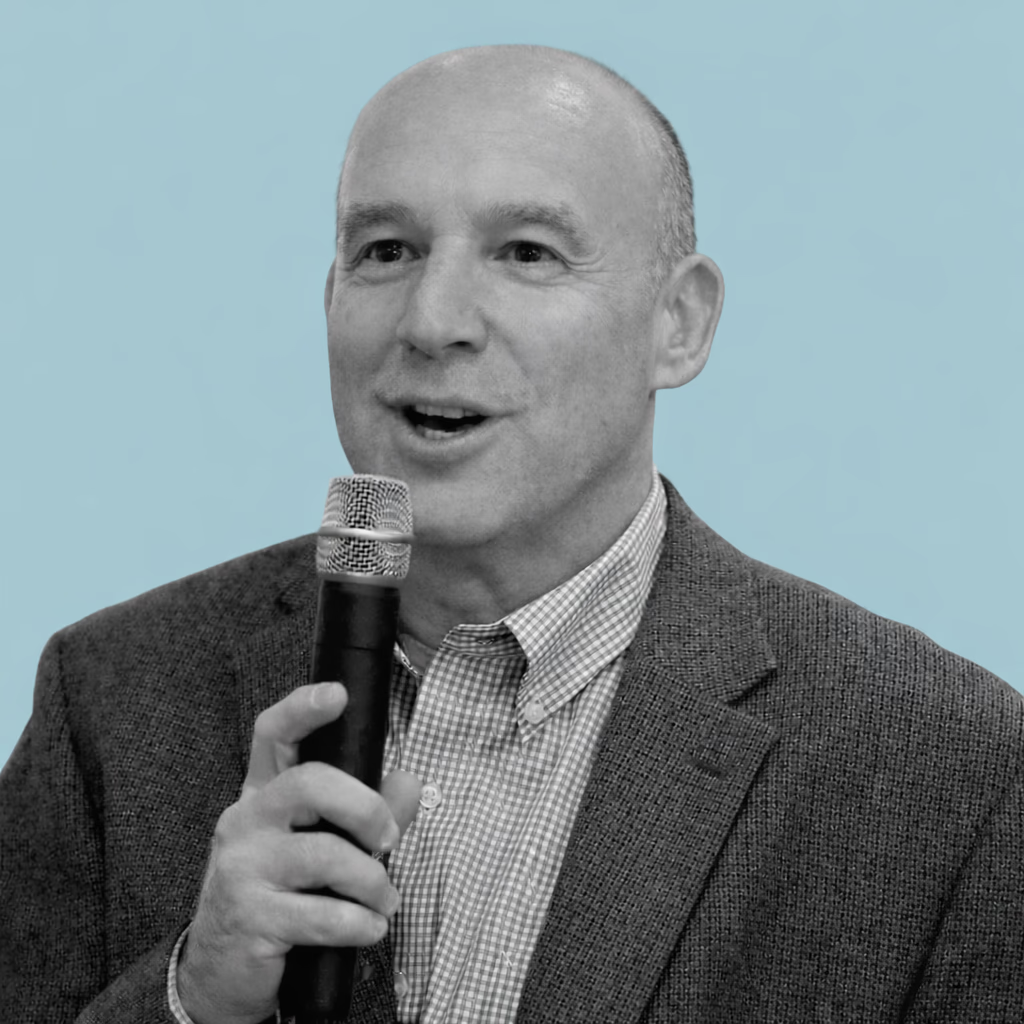
George Chmael II

Founder & CEO

In This Article

Narrative change is the process of disrupting dominant narratives that normalize inequity and advancing new narratives from historically marginalized communities.

Narrative Change and Power Building: The Missing Half of Advocacy

TL;DR

  • Narrative change disrupts dominant stories that normalize inequity and advances new ones — per The California Endowment, it is not the same as power but helps build it.

  • Convergence Partnership's 2025 framework says funding should target 3 forms of narrative power: mass culture, mass media, and mass movements.

  • The Pathways case study lays out a 5-stage approach: change, landscape, mindset, persuasion, and action.

  • A community power study found narrative work supports power-building by changing mindsets, strengthening relationships, and shaping organizational norms.

  • Narrative strategy is distinct from messaging because it targets narrative form, according to the Frameworks Institute.

Most advocacy campaigns lose before they launch. They win the argument and lose the story. They marshal the data, publish the report, secure the op-ed placement, and still watch the dominant story hold its ground because the story was never the target in the first place. Narrative change is the discipline that treats the story itself as the terrain. And power building is what turns a shifted story into a shifted outcome.

Here is the distinction that most organizations miss. Narrative change is the process of disrupting dominant narratives that normalize inequity and advancing new narratives from historically marginalized communities, as The California Endowment defines it. Power building is what makes those narratives stick, scale, and defend themselves. Narrative change is not the same as power — but as The California Endowment puts it plainly, it can help build power.

What is narrative change, and how is it different from messaging?

Narrative change is the practice of shifting the stories people use to make sense of the world, not the individual messages that ride on top of those stories. A 2025 article defines narrative power as the ability to shift the stories people use to interpret reality. Messaging is a single arrow. Narrative is the direction the whole quiver is aimed.

The Frameworks Institute draws the line sharply: narrative strategy is distinct from simple messaging because it focuses on narrative form — how stories are structured, not just what words they use. The Institute has built a model of narrative form specifically for social change efforts, because the shape of a story determines what it can carry.

This matters for anyone deciding where to put a budget. A messaging campaign asks whether people liked what you said. Narrative work asks whether people changed how they see. The 2024 Education Redesign Lab review traces the field's roots across social movements, narrative persuasion, and storytelling for social change — a body of research, not a copywriting trick.

Consider what the field says the goals actually are:

Goal

Source

What it means in practice

Disrupt dominant narratives that normalize inequity

The California Endowment

Break the "common sense" that makes harm feel natural

Disrupt underlying beliefs that perpetuate inequity

The California Endowment

Go beneath opinion to the assumptions underneath

Advance narratives of an inclusive society where everyone belongs

The California Endowment

Offer a replacement, not just a critique

Name and address cultural racism

Insight Center

Make the invisible mechanism visible

That fourth row deserves a pause. The Insight Center for Community Economic Development argues the work is fundamentally about naming, identifying, and addressing cultural racism. That is not a communications objective. It is a structural one, and it explains why narrative change belongs next to power, not next to public relations.

Why is narrative change the missing half of advocacy?

Because most advocacy stops at the argument. It disrupts a belief, then walks away before that shift becomes durable power. Narrative change and power building are two halves of the same machine — one shifts the story, the other builds the muscle to hold it. Skip either half and you get a good report nobody acts on, or a mobilized base with no coherent story to march behind.

The research is direct on this point. A community power study on public narratives found that narrative work supports power-building by changing mindsets, strengthening relationships, and shaping organizational norms and expectations. Note the mechanisms — relationships and norms, not just opinions. That study examined organizing initiatives in Detroit, Michigan, and Cincinnati, Ohio that intentionally used narrative change work, which is why its findings are grounded in practice rather than theory.

Power California frames the goal as narrative power building: a long-term effort to build the alignment, power, and collective infrastructure needed to advance, reinforce, and defend desired narratives at scale. Read that list again — advance, reinforce, and defend. Defense is the part advocacy budgets forget. A narrative you can't defend is a narrative you'll lose the moment the opposition organizes.

The 2025 article makes the same case in structural language: building narrative power requires strategic alignment across institutions and organizations to create, build, and sustain new narratives. It names the thing that alignment produces — narrative infrastructure. Infrastructure is not a campaign. It is what outlasts campaigns.

The field itself is converging on this vocabulary. A 2024 ORS Impact report notes that practitioners increasingly discuss narrative change in terms of building narrative power. The word is shifting from change to power for a reason. Change is an event. Power is a standing capacity.

How do you build narrative power? A five-stage model.

You build narrative power by mapping the story terrain before you speak, understanding the minds you're trying to move, and measuring whether you actually moved them. The Pathways case study lays out a five-stage approach — change, landscape, mindset, persuasion, and action — and the sequence is the discipline.

Start with the terrain. The Pathways model recommends mapping the narrative landscape to understand existing dominant narratives before intervening. You cannot displace a story you haven't named. Most campaigns skip this and end up arguing against a phantom while the real dominant narrative sits untouched.

Then understand the mind. The same case study recommends understanding target-audience mindsets before testing messages — the order matters, because a message tested against the wrong mindset reads as a false positive. This is where the Center for Economic and Social Rights did its work: researchers worked with community leaders and activists to challenge dominant perceptions of the economy and human rights, grounding the mindset in the people who hold it.

Here is the stage most funders never pay for. The Pathways model recommends measuring the impact of narrative interventions after implementation. Measurement is the difference between a narrative strategy and a hope. If you can't measure the shift, you can't defend the budget — and you can't tell whether the story moved or the news cycle did.

The stages, and what each one demands:

  • Change — name the specific shift you're pursuing, per Pathways.

  • Landscape — map the dominant narratives already in the field before you spend a dollar.

  • Mindsetunderstand target audiences before you test a single message.

  • Persuasion — build messages on research, not instinct; CESR provides research-based recommendations, cheat sheets, and messaging templates for exactly this.

  • Actionmeasure the impact and defend the ground you've taken.

Where should the money go? Three channels of narrative power.

Fund three channels or fund none well: mass culture, mass media, and mass movements. The Convergence Partnership's 2025 framework argues that funding narrative change should target these three forms of narrative power, and that philanthropic support should be distributed across all three channels rather than concentrated in one.

This is the allocation question every foundation and every corporate impact team eventually faces, and it is where most get it wrong. They fund media — a press strategy, a report launch — and call it narrative work. Media is one third. Culture is where beliefs live before they reach the news. Movements are where beliefs turn into durable power. Fund only media and you rent attention. Fund all three and you build the narrative infrastructure that a 2025 article identifies as the thing that sustains new narratives over time.

The tools are more concrete than the theory suggests. A 2025 Convergence Partnership report highlights community-led organizations using TikTok campaigns, community theater, documentary film, and local media engagement — and frames those methods as practical ways to advance narrative change and grow narrative power. The arts belong here too; The California Endowment names arts as part of narrative change strategy, not decoration around it.

Channel

What it reaches

Example methods

Mass culture

The assumptions beneath opinion

Community theater, documentary film, arts

Mass media

Public discourse in the news cycle

Local media engagement, TikTok campaigns

Mass movements

Durable organizing power

Base-building, organizing initiatives

Who this is for: if you're a corporate impact team spending under $250K a year on communications, do not try to fund all three channels shallowly. Pick the one where your credibility is real and go deep. If you're a foundation deploying seven figures across a multi-year program, the Convergence three-channel distribution is the discipline that keeps you from mistaking a press hit for a movement.

Who should lead this work — and why it can't be outsourced to a comms shop?

The people closest to the harm should lead it, with strategy and infrastructure built around them. Power California says its narrative power research is led by powerbuilding practitioners and movement leaders — not by an agency parachuting in with a message calendar. That is not a values statement. It is a design requirement, because the mindset work only holds when the people who live the story shape it.

We've watched this play out across sustainability and community development work for years, and the pattern is consistent. Narrative strategies designed at a distance from the affected community produce messages that test well in a focus group and fail in the field. The CESR toolkit got this right by building its research with community leaders and activists, which is why its cheat sheets and messaging templates actually match how people talk.

Here is where the two disciplines meet, and where most organizations have a gap. Narrative change without power building is a good story with no one behind it. Power building without narrative change is a base with no shared story to hold it together. The work Council Fire does sits precisely at that seam — pairing stakeholder engagement with communications strategy so the story and the power grow on the same timeline, not in separate silos handed to separate vendors.

That seam is the whole game. A 2024 ORS Impact report frames narrative change as changing the narratives circulating in public discourse — but public discourse doesn't shift because an agency published something clever. It shifts because aligned institutions, movement leaders, and the communities at the center push in the same direction long enough to make the new story feel like common sense. That alignment is the infrastructure. Building it is the work.

How Council Fire approaches narrative change and power building

We treat narrative as strategy, not garnish. In our sustainability and resilience work — across cities, ports, clean energy, water infrastructure, and corporate ESG — the technical case is rarely the thing that stalls a project. The story is. A resilience plan that reads as a cost to the public will lose to a status-quo narrative every time, no matter how sound the engineering.

So we start where the research says to start: mapping the narrative landscape and the mindsets of the people whose belief determines whether a project moves. Then we build the persuasion strategy on that evidence, run it through the channels that matter for the specific fight, and measure whether the story actually shifted — the action stage most programs skip.

The difference is that we don't hand the story to one vendor and the organizing to another. Strategy, creative, and implementation live under one roof, alongside the dashboards and stakeholder tools that let us track whether narrative power is actually building — the mindsets, relationships, and norms the community power study identified as the real mechanisms of change. Stop treating the story as the thing you do after the strategy is finished. The story is the strategy.


Related Resources


FAQs

What is the difference between narrative change and messaging?

Messaging is what you say in a single campaign; narrative change targets the underlying stories people use to interpret the world. The Frameworks Institute draws the line at narrative form — narrative strategy focuses on how stories are structured, not just the words used, which is why it outlasts any individual message.

Is narrative change the same as building power?

No. The California Endowment is explicit that narrative change is not the same as power, though it can help build power. Narrative work shifts mindsets and norms; power building turns those shifts into durable capacity. A community power study found narrative work supports power by changing mindsets, strengthening relationships, and shaping organizational norms.

What are the three channels for funding narrative change?

The Convergence Partnership's 2025 framework names three forms of narrative power to fund: mass culture, mass media, and mass movements. The framework argues philanthropic support should be distributed across all three rather than concentrated in one, so a story reaches beliefs, discourse, and organizing capacity at once.

What are the stages of a narrative change strategy?

The Pathways case study describes five stages: change, landscape, mindset, persuasion, and action. Map the dominant narratives first, understand audience mindsets before testing messages, build persuasion on that research, then measure the impact of interventions after implementation — the measurement step most programs skip.

Who should lead narrative power building?

People closest to the issue. Power California says its narrative power research is led by powerbuilding practitioners and movement leaders, not outside agencies. The CESR toolkit was built by researchers working directly with community leaders and activists, because narrative work only holds when the people who live the story shape it.

What tools do community organizations use for narrative change?

A 2025 Convergence Partnership report documents community-led groups using TikTok campaigns, community theater, documentary film, and local media engagement. The California Endowment also names arts as part of narrative strategy. The report frames these as practical methods to advance narrative change and grow narrative power over time.

Why does narrative change matter for sustainability and infrastructure projects?

Because the technical case rarely stalls a project — the story does. A resilience or clean-energy plan framed as a public cost loses to the status-quo narrative regardless of engineering. Narrative change disrupts the underlying beliefs that make inaction feel natural, then advances a story of shared benefit that lets the work move.

FAQ

01

What does it really mean to “redefine profit”?

02

What makes Council Fire different?

03

Who does Council Fire work with?

04

What does working with Council Fire actually look like?

05

How does Council Fire help organizations turn big goals into action?

06

How does Council Fire define and measure success?

Person
Person

Aug 23, 2026

Narrative Change and Power Building: The Missing Half of Advocacy

Narrative & Systems Change

George Chmael II

Founder & CEO

In This Article

Narrative change is the process of disrupting dominant narratives that normalize inequity and advancing new narratives from historically marginalized communities.

Narrative Change and Power Building: The Missing Half of Advocacy

TL;DR

  • Narrative change disrupts dominant stories that normalize inequity and advances new ones — per The California Endowment, it is not the same as power but helps build it.

  • Convergence Partnership's 2025 framework says funding should target 3 forms of narrative power: mass culture, mass media, and mass movements.

  • The Pathways case study lays out a 5-stage approach: change, landscape, mindset, persuasion, and action.

  • A community power study found narrative work supports power-building by changing mindsets, strengthening relationships, and shaping organizational norms.

  • Narrative strategy is distinct from messaging because it targets narrative form, according to the Frameworks Institute.

Most advocacy campaigns lose before they launch. They win the argument and lose the story. They marshal the data, publish the report, secure the op-ed placement, and still watch the dominant story hold its ground because the story was never the target in the first place. Narrative change is the discipline that treats the story itself as the terrain. And power building is what turns a shifted story into a shifted outcome.

Here is the distinction that most organizations miss. Narrative change is the process of disrupting dominant narratives that normalize inequity and advancing new narratives from historically marginalized communities, as The California Endowment defines it. Power building is what makes those narratives stick, scale, and defend themselves. Narrative change is not the same as power — but as The California Endowment puts it plainly, it can help build power.

What is narrative change, and how is it different from messaging?

Narrative change is the practice of shifting the stories people use to make sense of the world, not the individual messages that ride on top of those stories. A 2025 article defines narrative power as the ability to shift the stories people use to interpret reality. Messaging is a single arrow. Narrative is the direction the whole quiver is aimed.

The Frameworks Institute draws the line sharply: narrative strategy is distinct from simple messaging because it focuses on narrative form — how stories are structured, not just what words they use. The Institute has built a model of narrative form specifically for social change efforts, because the shape of a story determines what it can carry.

This matters for anyone deciding where to put a budget. A messaging campaign asks whether people liked what you said. Narrative work asks whether people changed how they see. The 2024 Education Redesign Lab review traces the field's roots across social movements, narrative persuasion, and storytelling for social change — a body of research, not a copywriting trick.

Consider what the field says the goals actually are:

Goal

Source

What it means in practice

Disrupt dominant narratives that normalize inequity

The California Endowment

Break the "common sense" that makes harm feel natural

Disrupt underlying beliefs that perpetuate inequity

The California Endowment

Go beneath opinion to the assumptions underneath

Advance narratives of an inclusive society where everyone belongs

The California Endowment

Offer a replacement, not just a critique

Name and address cultural racism

Insight Center

Make the invisible mechanism visible

That fourth row deserves a pause. The Insight Center for Community Economic Development argues the work is fundamentally about naming, identifying, and addressing cultural racism. That is not a communications objective. It is a structural one, and it explains why narrative change belongs next to power, not next to public relations.

Why is narrative change the missing half of advocacy?

Because most advocacy stops at the argument. It disrupts a belief, then walks away before that shift becomes durable power. Narrative change and power building are two halves of the same machine — one shifts the story, the other builds the muscle to hold it. Skip either half and you get a good report nobody acts on, or a mobilized base with no coherent story to march behind.

The research is direct on this point. A community power study on public narratives found that narrative work supports power-building by changing mindsets, strengthening relationships, and shaping organizational norms and expectations. Note the mechanisms — relationships and norms, not just opinions. That study examined organizing initiatives in Detroit, Michigan, and Cincinnati, Ohio that intentionally used narrative change work, which is why its findings are grounded in practice rather than theory.

Power California frames the goal as narrative power building: a long-term effort to build the alignment, power, and collective infrastructure needed to advance, reinforce, and defend desired narratives at scale. Read that list again — advance, reinforce, and defend. Defense is the part advocacy budgets forget. A narrative you can't defend is a narrative you'll lose the moment the opposition organizes.

The 2025 article makes the same case in structural language: building narrative power requires strategic alignment across institutions and organizations to create, build, and sustain new narratives. It names the thing that alignment produces — narrative infrastructure. Infrastructure is not a campaign. It is what outlasts campaigns.

The field itself is converging on this vocabulary. A 2024 ORS Impact report notes that practitioners increasingly discuss narrative change in terms of building narrative power. The word is shifting from change to power for a reason. Change is an event. Power is a standing capacity.

How do you build narrative power? A five-stage model.

You build narrative power by mapping the story terrain before you speak, understanding the minds you're trying to move, and measuring whether you actually moved them. The Pathways case study lays out a five-stage approach — change, landscape, mindset, persuasion, and action — and the sequence is the discipline.

Start with the terrain. The Pathways model recommends mapping the narrative landscape to understand existing dominant narratives before intervening. You cannot displace a story you haven't named. Most campaigns skip this and end up arguing against a phantom while the real dominant narrative sits untouched.

Then understand the mind. The same case study recommends understanding target-audience mindsets before testing messages — the order matters, because a message tested against the wrong mindset reads as a false positive. This is where the Center for Economic and Social Rights did its work: researchers worked with community leaders and activists to challenge dominant perceptions of the economy and human rights, grounding the mindset in the people who hold it.

Here is the stage most funders never pay for. The Pathways model recommends measuring the impact of narrative interventions after implementation. Measurement is the difference between a narrative strategy and a hope. If you can't measure the shift, you can't defend the budget — and you can't tell whether the story moved or the news cycle did.

The stages, and what each one demands:

  • Change — name the specific shift you're pursuing, per Pathways.

  • Landscape — map the dominant narratives already in the field before you spend a dollar.

  • Mindsetunderstand target audiences before you test a single message.

  • Persuasion — build messages on research, not instinct; CESR provides research-based recommendations, cheat sheets, and messaging templates for exactly this.

  • Actionmeasure the impact and defend the ground you've taken.

Where should the money go? Three channels of narrative power.

Fund three channels or fund none well: mass culture, mass media, and mass movements. The Convergence Partnership's 2025 framework argues that funding narrative change should target these three forms of narrative power, and that philanthropic support should be distributed across all three channels rather than concentrated in one.

This is the allocation question every foundation and every corporate impact team eventually faces, and it is where most get it wrong. They fund media — a press strategy, a report launch — and call it narrative work. Media is one third. Culture is where beliefs live before they reach the news. Movements are where beliefs turn into durable power. Fund only media and you rent attention. Fund all three and you build the narrative infrastructure that a 2025 article identifies as the thing that sustains new narratives over time.

The tools are more concrete than the theory suggests. A 2025 Convergence Partnership report highlights community-led organizations using TikTok campaigns, community theater, documentary film, and local media engagement — and frames those methods as practical ways to advance narrative change and grow narrative power. The arts belong here too; The California Endowment names arts as part of narrative change strategy, not decoration around it.

Channel

What it reaches

Example methods

Mass culture

The assumptions beneath opinion

Community theater, documentary film, arts

Mass media

Public discourse in the news cycle

Local media engagement, TikTok campaigns

Mass movements

Durable organizing power

Base-building, organizing initiatives

Who this is for: if you're a corporate impact team spending under $250K a year on communications, do not try to fund all three channels shallowly. Pick the one where your credibility is real and go deep. If you're a foundation deploying seven figures across a multi-year program, the Convergence three-channel distribution is the discipline that keeps you from mistaking a press hit for a movement.

Who should lead this work — and why it can't be outsourced to a comms shop?

The people closest to the harm should lead it, with strategy and infrastructure built around them. Power California says its narrative power research is led by powerbuilding practitioners and movement leaders — not by an agency parachuting in with a message calendar. That is not a values statement. It is a design requirement, because the mindset work only holds when the people who live the story shape it.

We've watched this play out across sustainability and community development work for years, and the pattern is consistent. Narrative strategies designed at a distance from the affected community produce messages that test well in a focus group and fail in the field. The CESR toolkit got this right by building its research with community leaders and activists, which is why its cheat sheets and messaging templates actually match how people talk.

Here is where the two disciplines meet, and where most organizations have a gap. Narrative change without power building is a good story with no one behind it. Power building without narrative change is a base with no shared story to hold it together. The work Council Fire does sits precisely at that seam — pairing stakeholder engagement with communications strategy so the story and the power grow on the same timeline, not in separate silos handed to separate vendors.

That seam is the whole game. A 2024 ORS Impact report frames narrative change as changing the narratives circulating in public discourse — but public discourse doesn't shift because an agency published something clever. It shifts because aligned institutions, movement leaders, and the communities at the center push in the same direction long enough to make the new story feel like common sense. That alignment is the infrastructure. Building it is the work.

How Council Fire approaches narrative change and power building

We treat narrative as strategy, not garnish. In our sustainability and resilience work — across cities, ports, clean energy, water infrastructure, and corporate ESG — the technical case is rarely the thing that stalls a project. The story is. A resilience plan that reads as a cost to the public will lose to a status-quo narrative every time, no matter how sound the engineering.

So we start where the research says to start: mapping the narrative landscape and the mindsets of the people whose belief determines whether a project moves. Then we build the persuasion strategy on that evidence, run it through the channels that matter for the specific fight, and measure whether the story actually shifted — the action stage most programs skip.

The difference is that we don't hand the story to one vendor and the organizing to another. Strategy, creative, and implementation live under one roof, alongside the dashboards and stakeholder tools that let us track whether narrative power is actually building — the mindsets, relationships, and norms the community power study identified as the real mechanisms of change. Stop treating the story as the thing you do after the strategy is finished. The story is the strategy.


Related Resources


FAQs

What is the difference between narrative change and messaging?

Messaging is what you say in a single campaign; narrative change targets the underlying stories people use to interpret the world. The Frameworks Institute draws the line at narrative form — narrative strategy focuses on how stories are structured, not just the words used, which is why it outlasts any individual message.

Is narrative change the same as building power?

No. The California Endowment is explicit that narrative change is not the same as power, though it can help build power. Narrative work shifts mindsets and norms; power building turns those shifts into durable capacity. A community power study found narrative work supports power by changing mindsets, strengthening relationships, and shaping organizational norms.

What are the three channels for funding narrative change?

The Convergence Partnership's 2025 framework names three forms of narrative power to fund: mass culture, mass media, and mass movements. The framework argues philanthropic support should be distributed across all three rather than concentrated in one, so a story reaches beliefs, discourse, and organizing capacity at once.

What are the stages of a narrative change strategy?

The Pathways case study describes five stages: change, landscape, mindset, persuasion, and action. Map the dominant narratives first, understand audience mindsets before testing messages, build persuasion on that research, then measure the impact of interventions after implementation — the measurement step most programs skip.

Who should lead narrative power building?

People closest to the issue. Power California says its narrative power research is led by powerbuilding practitioners and movement leaders, not outside agencies. The CESR toolkit was built by researchers working directly with community leaders and activists, because narrative work only holds when the people who live the story shape it.

What tools do community organizations use for narrative change?

A 2025 Convergence Partnership report documents community-led groups using TikTok campaigns, community theater, documentary film, and local media engagement. The California Endowment also names arts as part of narrative strategy. The report frames these as practical methods to advance narrative change and grow narrative power over time.

Why does narrative change matter for sustainability and infrastructure projects?

Because the technical case rarely stalls a project — the story does. A resilience or clean-energy plan framed as a public cost loses to the status-quo narrative regardless of engineering. Narrative change disrupts the underlying beliefs that make inaction feel natural, then advances a story of shared benefit that lets the work move.

FAQ

01

What does it really mean to “redefine profit”?

02

What makes Council Fire different?

03

Who does Council Fire work with?

04

What does working with Council Fire actually look like?

05

How does Council Fire help organizations turn big goals into action?

06

How does Council Fire define and measure success?

Person
Person

Aug 23, 2026

Narrative Change and Power Building: The Missing Half of Advocacy

Narrative & Systems Change

George Chmael II

Founder & CEO

In This Article

Narrative change is the process of disrupting dominant narratives that normalize inequity and advancing new narratives from historically marginalized communities.

Narrative Change and Power Building: The Missing Half of Advocacy

TL;DR

  • Narrative change disrupts dominant stories that normalize inequity and advances new ones — per The California Endowment, it is not the same as power but helps build it.

  • Convergence Partnership's 2025 framework says funding should target 3 forms of narrative power: mass culture, mass media, and mass movements.

  • The Pathways case study lays out a 5-stage approach: change, landscape, mindset, persuasion, and action.

  • A community power study found narrative work supports power-building by changing mindsets, strengthening relationships, and shaping organizational norms.

  • Narrative strategy is distinct from messaging because it targets narrative form, according to the Frameworks Institute.

Most advocacy campaigns lose before they launch. They win the argument and lose the story. They marshal the data, publish the report, secure the op-ed placement, and still watch the dominant story hold its ground because the story was never the target in the first place. Narrative change is the discipline that treats the story itself as the terrain. And power building is what turns a shifted story into a shifted outcome.

Here is the distinction that most organizations miss. Narrative change is the process of disrupting dominant narratives that normalize inequity and advancing new narratives from historically marginalized communities, as The California Endowment defines it. Power building is what makes those narratives stick, scale, and defend themselves. Narrative change is not the same as power — but as The California Endowment puts it plainly, it can help build power.

What is narrative change, and how is it different from messaging?

Narrative change is the practice of shifting the stories people use to make sense of the world, not the individual messages that ride on top of those stories. A 2025 article defines narrative power as the ability to shift the stories people use to interpret reality. Messaging is a single arrow. Narrative is the direction the whole quiver is aimed.

The Frameworks Institute draws the line sharply: narrative strategy is distinct from simple messaging because it focuses on narrative form — how stories are structured, not just what words they use. The Institute has built a model of narrative form specifically for social change efforts, because the shape of a story determines what it can carry.

This matters for anyone deciding where to put a budget. A messaging campaign asks whether people liked what you said. Narrative work asks whether people changed how they see. The 2024 Education Redesign Lab review traces the field's roots across social movements, narrative persuasion, and storytelling for social change — a body of research, not a copywriting trick.

Consider what the field says the goals actually are:

Goal

Source

What it means in practice

Disrupt dominant narratives that normalize inequity

The California Endowment

Break the "common sense" that makes harm feel natural

Disrupt underlying beliefs that perpetuate inequity

The California Endowment

Go beneath opinion to the assumptions underneath

Advance narratives of an inclusive society where everyone belongs

The California Endowment

Offer a replacement, not just a critique

Name and address cultural racism

Insight Center

Make the invisible mechanism visible

That fourth row deserves a pause. The Insight Center for Community Economic Development argues the work is fundamentally about naming, identifying, and addressing cultural racism. That is not a communications objective. It is a structural one, and it explains why narrative change belongs next to power, not next to public relations.

Why is narrative change the missing half of advocacy?

Because most advocacy stops at the argument. It disrupts a belief, then walks away before that shift becomes durable power. Narrative change and power building are two halves of the same machine — one shifts the story, the other builds the muscle to hold it. Skip either half and you get a good report nobody acts on, or a mobilized base with no coherent story to march behind.

The research is direct on this point. A community power study on public narratives found that narrative work supports power-building by changing mindsets, strengthening relationships, and shaping organizational norms and expectations. Note the mechanisms — relationships and norms, not just opinions. That study examined organizing initiatives in Detroit, Michigan, and Cincinnati, Ohio that intentionally used narrative change work, which is why its findings are grounded in practice rather than theory.

Power California frames the goal as narrative power building: a long-term effort to build the alignment, power, and collective infrastructure needed to advance, reinforce, and defend desired narratives at scale. Read that list again — advance, reinforce, and defend. Defense is the part advocacy budgets forget. A narrative you can't defend is a narrative you'll lose the moment the opposition organizes.

The 2025 article makes the same case in structural language: building narrative power requires strategic alignment across institutions and organizations to create, build, and sustain new narratives. It names the thing that alignment produces — narrative infrastructure. Infrastructure is not a campaign. It is what outlasts campaigns.

The field itself is converging on this vocabulary. A 2024 ORS Impact report notes that practitioners increasingly discuss narrative change in terms of building narrative power. The word is shifting from change to power for a reason. Change is an event. Power is a standing capacity.

How do you build narrative power? A five-stage model.

You build narrative power by mapping the story terrain before you speak, understanding the minds you're trying to move, and measuring whether you actually moved them. The Pathways case study lays out a five-stage approach — change, landscape, mindset, persuasion, and action — and the sequence is the discipline.

Start with the terrain. The Pathways model recommends mapping the narrative landscape to understand existing dominant narratives before intervening. You cannot displace a story you haven't named. Most campaigns skip this and end up arguing against a phantom while the real dominant narrative sits untouched.

Then understand the mind. The same case study recommends understanding target-audience mindsets before testing messages — the order matters, because a message tested against the wrong mindset reads as a false positive. This is where the Center for Economic and Social Rights did its work: researchers worked with community leaders and activists to challenge dominant perceptions of the economy and human rights, grounding the mindset in the people who hold it.

Here is the stage most funders never pay for. The Pathways model recommends measuring the impact of narrative interventions after implementation. Measurement is the difference between a narrative strategy and a hope. If you can't measure the shift, you can't defend the budget — and you can't tell whether the story moved or the news cycle did.

The stages, and what each one demands:

  • Change — name the specific shift you're pursuing, per Pathways.

  • Landscape — map the dominant narratives already in the field before you spend a dollar.

  • Mindsetunderstand target audiences before you test a single message.

  • Persuasion — build messages on research, not instinct; CESR provides research-based recommendations, cheat sheets, and messaging templates for exactly this.

  • Actionmeasure the impact and defend the ground you've taken.

Where should the money go? Three channels of narrative power.

Fund three channels or fund none well: mass culture, mass media, and mass movements. The Convergence Partnership's 2025 framework argues that funding narrative change should target these three forms of narrative power, and that philanthropic support should be distributed across all three channels rather than concentrated in one.

This is the allocation question every foundation and every corporate impact team eventually faces, and it is where most get it wrong. They fund media — a press strategy, a report launch — and call it narrative work. Media is one third. Culture is where beliefs live before they reach the news. Movements are where beliefs turn into durable power. Fund only media and you rent attention. Fund all three and you build the narrative infrastructure that a 2025 article identifies as the thing that sustains new narratives over time.

The tools are more concrete than the theory suggests. A 2025 Convergence Partnership report highlights community-led organizations using TikTok campaigns, community theater, documentary film, and local media engagement — and frames those methods as practical ways to advance narrative change and grow narrative power. The arts belong here too; The California Endowment names arts as part of narrative change strategy, not decoration around it.

Channel

What it reaches

Example methods

Mass culture

The assumptions beneath opinion

Community theater, documentary film, arts

Mass media

Public discourse in the news cycle

Local media engagement, TikTok campaigns

Mass movements

Durable organizing power

Base-building, organizing initiatives

Who this is for: if you're a corporate impact team spending under $250K a year on communications, do not try to fund all three channels shallowly. Pick the one where your credibility is real and go deep. If you're a foundation deploying seven figures across a multi-year program, the Convergence three-channel distribution is the discipline that keeps you from mistaking a press hit for a movement.

Who should lead this work — and why it can't be outsourced to a comms shop?

The people closest to the harm should lead it, with strategy and infrastructure built around them. Power California says its narrative power research is led by powerbuilding practitioners and movement leaders — not by an agency parachuting in with a message calendar. That is not a values statement. It is a design requirement, because the mindset work only holds when the people who live the story shape it.

We've watched this play out across sustainability and community development work for years, and the pattern is consistent. Narrative strategies designed at a distance from the affected community produce messages that test well in a focus group and fail in the field. The CESR toolkit got this right by building its research with community leaders and activists, which is why its cheat sheets and messaging templates actually match how people talk.

Here is where the two disciplines meet, and where most organizations have a gap. Narrative change without power building is a good story with no one behind it. Power building without narrative change is a base with no shared story to hold it together. The work Council Fire does sits precisely at that seam — pairing stakeholder engagement with communications strategy so the story and the power grow on the same timeline, not in separate silos handed to separate vendors.

That seam is the whole game. A 2024 ORS Impact report frames narrative change as changing the narratives circulating in public discourse — but public discourse doesn't shift because an agency published something clever. It shifts because aligned institutions, movement leaders, and the communities at the center push in the same direction long enough to make the new story feel like common sense. That alignment is the infrastructure. Building it is the work.

How Council Fire approaches narrative change and power building

We treat narrative as strategy, not garnish. In our sustainability and resilience work — across cities, ports, clean energy, water infrastructure, and corporate ESG — the technical case is rarely the thing that stalls a project. The story is. A resilience plan that reads as a cost to the public will lose to a status-quo narrative every time, no matter how sound the engineering.

So we start where the research says to start: mapping the narrative landscape and the mindsets of the people whose belief determines whether a project moves. Then we build the persuasion strategy on that evidence, run it through the channels that matter for the specific fight, and measure whether the story actually shifted — the action stage most programs skip.

The difference is that we don't hand the story to one vendor and the organizing to another. Strategy, creative, and implementation live under one roof, alongside the dashboards and stakeholder tools that let us track whether narrative power is actually building — the mindsets, relationships, and norms the community power study identified as the real mechanisms of change. Stop treating the story as the thing you do after the strategy is finished. The story is the strategy.


Related Resources


FAQs

What is the difference between narrative change and messaging?

Messaging is what you say in a single campaign; narrative change targets the underlying stories people use to interpret the world. The Frameworks Institute draws the line at narrative form — narrative strategy focuses on how stories are structured, not just the words used, which is why it outlasts any individual message.

Is narrative change the same as building power?

No. The California Endowment is explicit that narrative change is not the same as power, though it can help build power. Narrative work shifts mindsets and norms; power building turns those shifts into durable capacity. A community power study found narrative work supports power by changing mindsets, strengthening relationships, and shaping organizational norms.

What are the three channels for funding narrative change?

The Convergence Partnership's 2025 framework names three forms of narrative power to fund: mass culture, mass media, and mass movements. The framework argues philanthropic support should be distributed across all three rather than concentrated in one, so a story reaches beliefs, discourse, and organizing capacity at once.

What are the stages of a narrative change strategy?

The Pathways case study describes five stages: change, landscape, mindset, persuasion, and action. Map the dominant narratives first, understand audience mindsets before testing messages, build persuasion on that research, then measure the impact of interventions after implementation — the measurement step most programs skip.

Who should lead narrative power building?

People closest to the issue. Power California says its narrative power research is led by powerbuilding practitioners and movement leaders, not outside agencies. The CESR toolkit was built by researchers working directly with community leaders and activists, because narrative work only holds when the people who live the story shape it.

What tools do community organizations use for narrative change?

A 2025 Convergence Partnership report documents community-led groups using TikTok campaigns, community theater, documentary film, and local media engagement. The California Endowment also names arts as part of narrative strategy. The report frames these as practical methods to advance narrative change and grow narrative power over time.

Why does narrative change matter for sustainability and infrastructure projects?

Because the technical case rarely stalls a project — the story does. A resilience or clean-energy plan framed as a public cost loses to the status-quo narrative regardless of engineering. Narrative change disrupts the underlying beliefs that make inaction feel natural, then advances a story of shared benefit that lets the work move.

FAQ

What does it really mean to “redefine profit”?

What makes Council Fire different?

Who does Council Fire work with?

What does working with Council Fire actually look like?

How does Council Fire help organizations turn big goals into action?

How does Council Fire define and measure success?