
Sep 18, 2026
ESG Assurance vs Verification: Key Differences
ESG Strategy
In This Article
Compare ESG assurance vs verification: when to use full-report assurance or focused verification, plus standards and outputs.
ESG Assurance vs Verification: Key Differences
If you need a fast answer, here it is: assurance reviews broader ESG reporting, while verification checks one claim or dataset against set rules.
I’d break it down like this:
Assurance is for a full ESG report or a large set of disclosures
Verification is for one item, like a GHG inventory or an emissions claim
Assurance can be limited or reasonable
Verification ends with a statement that says whether the claim matches the chosen criteria
Assurance providers are often CPA firms or ESG review firms
Verification providers are often ISO-based verification bodies
If you choose the wrong path, you can waste time, miss what investors or funders asked for, or pay for a deeper review than you need. In most cases, the choice comes down to one question: Do you need confidence in a full disclosure, or proof that one number or claim is correct?
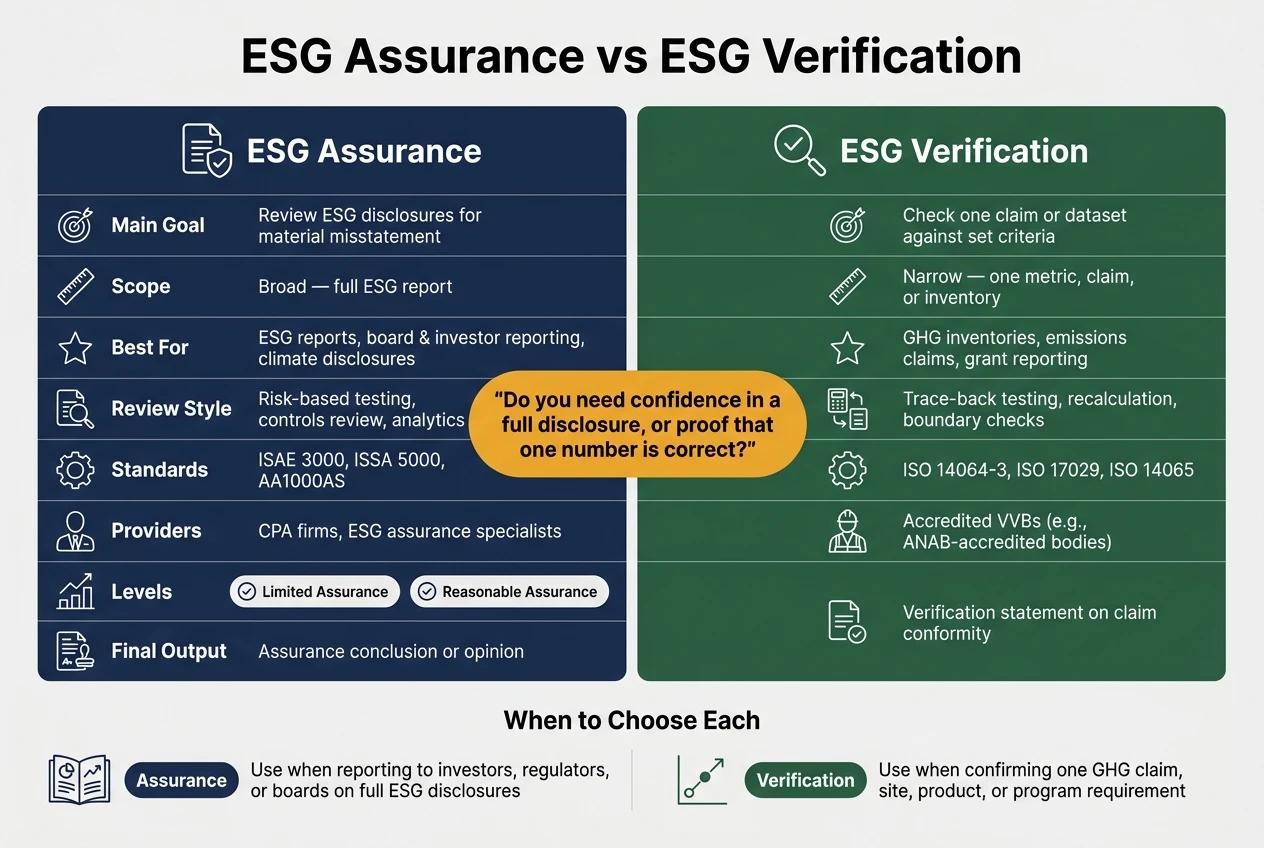
ESG Assurance vs Verification: Side-by-Side Comparison
GHG Verification vs. Assurance Explained | EcoVadis, CDP, SBTi & Regulations
Quick Comparison
Criteria | ESG Assurance | ESG Verification |
|---|---|---|
Main goal | Review ESG disclosures for material misstatement | Check one claim or dataset against set criteria |
Scope | Broad | Narrow |
Best for | ESG reports, board and investor reporting, climate disclosures | GHG inventories, emissions claims, grant reporting |
Review style | Risk-based testing, controls review, analytics | Trace-back testing, recalculation, boundary checks |
Common standards | ||
Final output | Assurance conclusion or opinion | Verification statement |
My short take: assurance tells readers they can rely on a broader ESG disclosure, while verification tells them one stated claim was tested against a named method. That’s the core difference, and it shapes scope, cost, effort, and the final report.
Purpose and Scope
Start with the exact question you need answered: do you want confidence in the entire ESG report, or do you need proof for one specific claim? That choice sets the scope of the review, how much of the reporting package gets tested, and who will rely on the result.
How Assurance Builds Stakeholder Confidence
Assurance looks at the full ESG report. An assurance engagement can cover quantitative metrics such as GHG emissions, water use, and safety incident rates, along with qualitative disclosures like governance structures, board oversight, climate transition narratives, and stakeholder engagement descriptions. The reviewer tests whether the metrics, narrative, and controls line up with each other.
In the U.S., assurance often supports reporting for investors, lenders, and boards. When the reporting boundary is broader, the reviewer spends more time checking consistency across the numbers, the written disclosures, and the control environment.
How Verification Tests a Specific Claim or Dataset
Verification is narrower by design. A company might ask for verification of its annual Scope 1 and 2 GHG inventory, reported in metric tons of CO₂e. The verifier checks traceability, data quality, and conformity to a named standard, such as the GHG Protocol Corporate Standard or ISO 14064-1, without stepping back to assess broader governance or narrative strategy.
Think of verification as proof for one specific claim. If a data center says it uses 100% renewable electricity, verification tests whether the utility data, renewable energy certificates (RECs), and contractual instruments back up that statement. The core question is straightforward: does the claim match the evidence?
Use assurance for multi-topic ESG reporting. Use verification for one metric, site, product, or program requirement. That gap in scope also shapes the methods, the type of reviewer, and the final output.
Methods Used
That split in scope shapes the review from the start.
How Assurance Uses Risk-Based Review Procedures
Assurance begins with scoping, materiality, and risk assessment. From there, the reviewer tests the data and controls most likely to affect the report. The focus stays on ESG topics and data points that matter most to stakeholders and that are most likely to contain errors or misstatements. Common trouble spots include manual data entry, complex estimates, and heavy reliance on third-party data.
The level of testing changes based on the assurance level. Limited assurance uses fewer procedures and leans more on management inquiry, document review, and analytical procedures. Reasonable assurance goes further. It uses more detailed control testing, data sampling, and recalculations, much like a financial audit.
Both levels may also use analytical procedures to flag unusual shifts that need a closer look. That can include period-over-period trend analysis and intensity ratios, such as emissions per dollar of revenue or water use per square foot. If a number suddenly jumps or drops, that’s usually a sign to dig deeper.
This is why assurance works well for reviewing an entire report, while verification is better suited to one metric or one specific assertion.
How Verification Focuses on Traceability and Conformity
Verification takes a different path. Instead of starting broad, it starts with one defined claim and the criteria that claim must meet. For example, the claim might be total Scope 1 and 2 emissions for calendar year 2025 measured against the GHG Protocol Corporate Standard or ISO 14064-1.
From there, the verifier works backward to the source. That means tracing reported data to records like fuel receipts, utility bills, and meter readings, checking the emissions factors used, and independently recalculating the reported totals. It’s less about the full story of the report and more about proving that one claim holds up under scrutiny.
Boundary review matters just as much. The verifier checks whether the facilities, subsidiaries, or leased assets that belong in scope are actually included, and whether any exclusions are properly justified and documented. Common issues include:
Missing sites
Outdated factors
Inconsistent electricity accounting
Spreadsheet errors
The tighter the claim, the more the review depends on traceability and conformity testing.
In practice, the two reviews differ like this:
Method element | Assurance | Verification |
|---|---|---|
Starting point | Risk and materiality assessment across the ESG report | Definition of the specific claim and applicable criteria |
Core evidence | Inquiries, analytics, control testing, document inspection | Source records, emissions factors, recalculation, boundary review |
Depth of testing | Limited assurance uses fewer procedures; reasonable assurance uses more extensive testing | Deep traceability around one assertion |
Output | Limited assurance conclusion; reasonable assurance opinion | Verification statement on whether the claim conforms to criteria |
Standards, Reviewers, and Outputs
The differences above come down to three things: the standard being used, the kind of group doing the work, and the document you receive at the end.
Common Standards and Frameworks
The standard should line up with the claim you want reviewed. ISAE 3000 (Revised), AA1000AS, and ISSA 5000 are the main ESG assurance standards. ISAE 3000 applies to nonfinancial assurance. AA1000AS puts more weight on stakeholder inclusivity and materiality. ISSA 5000 is the IAASB standard built for sustainability work.
For GHG claims, the main verification standards are ISO 14064-3, ISO/IEC 17029, and ISO 14065. These cover the criteria for verification, the rules for verification bodies, and the competence those bodies need to show. Put simply, assurance standards fit broad ESG disclosures, while verification standards fit defined GHG claims.
Who Performs Each Review
The standard also shapes who can do the review. ESG assurance is usually handled by CPA firms or specialist sustainability assurance providers. In the U.S., these firms work under PCAOB or AICPA requirements, and independence is governed by professional ethics codes.
GHG verification is usually done by accredited validation and verification bodies (VVBs) under ISO 14065. VVBs, including those accredited by ANAB in the U.S., are expected to be technically competent and impartial. That matters because a broad ESG review and a test of a single emissions claim are not the same job, even if they sound close on paper.
What the Final Output Looks Like
The final document should match the scope of the engagement. An assurance report states the conclusion on the ESG information and names the criteria used. With reasonable assurance, the wording is positive. With limited assurance, the wording is negative.
A verification statement confirms whether a specific GHG claim conforms to stated criteria. It tells readers what was reviewed and what sat outside the scope. For boards and investors, that distinction matters. The assurance report speaks to broad ESG disclosures, while the verification statement shows that one specific, high-stakes metric has been tested in a rigorous way.
When Each Option Fits Your Reporting Needs
Once scope, methods, and outputs are set, the last call is simple: pick the review that fits the report you need to publish.
Choose Assurance for Broad ESG Reporting
Use assurance when the main issue is whether the entire report can be trusted. It fits best when your ESG report covers many topics - emissions, governance, diversity, safety - and the main audience includes investors, regulators, or board members who want confidence in the full story.
If your organization publishes an annual sustainability report or must deal with SEC climate disclosure requirements, assurance sends a stronger message. It shows stakeholders that your reporting processes, controls, and governance have been tested by an independent party, not just one metric or claim.
That matters even more when leadership wants ESG disclosures handled with the same rigor as financial reporting.
Choose Verification for a Narrow Technical Need
Use verification when the issue is narrower: does one claim match a defined standard? Verification works best when the goal is to confirm a specific claim or inventory. The work is more focused, usually takes fewer resources, and centers on whether the data and calculations stand up against a set standard.
It’s also a smart starting point for organizations still building their ESG data systems. Verifying one inventory gives you a way to check data quality and methodology without taking on a full report-wide review. Many companies take a phased path: verify Scope 1 and 2 emissions in year one, standardize data collection across business units, then move toward limited assurance over broader ESG KPIs once data processes are repeatable and documented. [1][2]
Key Takeaways
Choose based on scope and purpose. Assurance is broader and more formal. It builds confidence in full ESG reporting, governance, and controls. Verification is narrower and criteria-based. It tests one claim or dataset against a defined methodology.
The standards are not the same, and the reviewer’s qualifications are not the same either. The right fit comes down to what you need most: broad confidence from stakeholders or a focused technical check.
FAQs
How do I choose between assurance and verification?
Choose your approach based on regulatory requirements, stakeholder expectations, and data maturity.
Limited assurance is often the starting point because it costs less, asks for less documentation, and gives a moderate level of confidence. It’s a practical first step for teams that are still getting their reporting process in shape.
Reasonable assurance offers a higher level of confidence because it relies on more rigorous testing. The tradeoff is time, effort, and cost. In many cases, it costs two to three times more than limited assurance.
That’s why many organizations take a phased path. They begin with limited assurance, build systems that are ready for assurance, and then apply reasonable assurance over time to their most material metrics.
Can a company start with verification and add assurance later?
Yes. Starting with verification and adding assurance later is a common, recommended path.
Many organizations begin with self-reporting and limited assurance on a small set of priority metrics, then widen the scope and tighten the process over time. That step-by-step approach gives teams room to build data systems, strengthen documentation, and create audit trails without trying to do everything at once.
In practice, it works like this:
Start with the metrics that matter most to the business and its stakeholders
Put basic controls in place for how data is collected, checked, and stored
Use limited assurance first, then move toward reasonable assurance as data quality improves
This phased approach makes the shift from limited to reasonable assurance much easier. It also helps teams spot weak points early, fix gaps, and build confidence in the numbers before adding more complexity.
What should I ask a provider before starting?
Ask about their qualifications, sector experience, and knowledge of standards such as ISSA 5000. You’ll also want to confirm their independence and make sure their technology can handle your data analytics needs.
Timing matters too. Check whether they can meet your reporting deadline and whether they offer a pre-assurance gap assessment. That early review can help spot and fix data quality issues before the formal engagement begins.
Related Blog Posts
Latest Articles
©2026

Narrative Change and Power Building: The Missing Half of Advocacy
Narrative change is the process of disrupting dominant narratives that normalize inequity and advancing new narratives from historically marginalized communities.

Funding Resilience Without Federal Grants
BRIC is unreliable and FEMA is shrinking. Here's how cities fund climate resilience with dedicated revenue, blended finance, and a coordinating authority.

The ESG Blind Spot: How AI Is Finding Risks in Companies Nobody Else Is Watching
Norway's sovereign wealth fund uses AI to screen 7,200 portfolio companies for forced labor and corruption within 24 hours. The real story is the emerging-market coverage gap that traditional ESG data vendors miss — and what it means for any company with a global supply chain.
Narrative Change and Power Building: The Missing Half of Advocacy
Narrative change is the process of disrupting dominant narratives that normalize inequity and advancing new narratives from historically marginalized communities.
Funding Resilience Without Federal Grants
BRIC is unreliable and FEMA is shrinking. Here's how cities fund climate resilience with dedicated revenue, blended finance, and a coordinating authority.
The ESG Blind Spot: How AI Is Finding Risks in Companies Nobody Else Is Watching
Norway's sovereign wealth fund uses AI to screen 7,200 portfolio companies for forced labor and corruption within 24 hours. The real story is the emerging-market coverage gap that traditional ESG data vendors miss — and what it means for any company with a global supply chain.
FAQ
01
What does it really mean to “redefine profit”?
02
What makes Council Fire different?
03
Who does Council Fire work with?
04
What does working with Council Fire actually look like?
05
How does Council Fire help organizations turn big goals into action?
06
How does Council Fire define and measure success?
07
How does technology fit into Council Fire’s work?
Sep 18, 2026
ESG Assurance vs Verification: Key Differences
ESG Strategy
In This Article
Compare ESG assurance vs verification: when to use full-report assurance or focused verification, plus standards and outputs.
ESG Assurance vs Verification: Key Differences
If you need a fast answer, here it is: assurance reviews broader ESG reporting, while verification checks one claim or dataset against set rules.
I’d break it down like this:
Assurance is for a full ESG report or a large set of disclosures
Verification is for one item, like a GHG inventory or an emissions claim
Assurance can be limited or reasonable
Verification ends with a statement that says whether the claim matches the chosen criteria
Assurance providers are often CPA firms or ESG review firms
Verification providers are often ISO-based verification bodies
If you choose the wrong path, you can waste time, miss what investors or funders asked for, or pay for a deeper review than you need. In most cases, the choice comes down to one question: Do you need confidence in a full disclosure, or proof that one number or claim is correct?
ESG Assurance vs Verification: Side-by-Side Comparison
GHG Verification vs. Assurance Explained | EcoVadis, CDP, SBTi & Regulations
Quick Comparison
Criteria | ESG Assurance | ESG Verification |
|---|---|---|
Main goal | Review ESG disclosures for material misstatement | Check one claim or dataset against set criteria |
Scope | Broad | Narrow |
Best for | ESG reports, board and investor reporting, climate disclosures | GHG inventories, emissions claims, grant reporting |
Review style | Risk-based testing, controls review, analytics | Trace-back testing, recalculation, boundary checks |
Common standards | ||
Final output | Assurance conclusion or opinion | Verification statement |
My short take: assurance tells readers they can rely on a broader ESG disclosure, while verification tells them one stated claim was tested against a named method. That’s the core difference, and it shapes scope, cost, effort, and the final report.
Purpose and Scope
Start with the exact question you need answered: do you want confidence in the entire ESG report, or do you need proof for one specific claim? That choice sets the scope of the review, how much of the reporting package gets tested, and who will rely on the result.
How Assurance Builds Stakeholder Confidence
Assurance looks at the full ESG report. An assurance engagement can cover quantitative metrics such as GHG emissions, water use, and safety incident rates, along with qualitative disclosures like governance structures, board oversight, climate transition narratives, and stakeholder engagement descriptions. The reviewer tests whether the metrics, narrative, and controls line up with each other.
In the U.S., assurance often supports reporting for investors, lenders, and boards. When the reporting boundary is broader, the reviewer spends more time checking consistency across the numbers, the written disclosures, and the control environment.
How Verification Tests a Specific Claim or Dataset
Verification is narrower by design. A company might ask for verification of its annual Scope 1 and 2 GHG inventory, reported in metric tons of CO₂e. The verifier checks traceability, data quality, and conformity to a named standard, such as the GHG Protocol Corporate Standard or ISO 14064-1, without stepping back to assess broader governance or narrative strategy.
Think of verification as proof for one specific claim. If a data center says it uses 100% renewable electricity, verification tests whether the utility data, renewable energy certificates (RECs), and contractual instruments back up that statement. The core question is straightforward: does the claim match the evidence?
Use assurance for multi-topic ESG reporting. Use verification for one metric, site, product, or program requirement. That gap in scope also shapes the methods, the type of reviewer, and the final output.
Methods Used
That split in scope shapes the review from the start.
How Assurance Uses Risk-Based Review Procedures
Assurance begins with scoping, materiality, and risk assessment. From there, the reviewer tests the data and controls most likely to affect the report. The focus stays on ESG topics and data points that matter most to stakeholders and that are most likely to contain errors or misstatements. Common trouble spots include manual data entry, complex estimates, and heavy reliance on third-party data.
The level of testing changes based on the assurance level. Limited assurance uses fewer procedures and leans more on management inquiry, document review, and analytical procedures. Reasonable assurance goes further. It uses more detailed control testing, data sampling, and recalculations, much like a financial audit.
Both levels may also use analytical procedures to flag unusual shifts that need a closer look. That can include period-over-period trend analysis and intensity ratios, such as emissions per dollar of revenue or water use per square foot. If a number suddenly jumps or drops, that’s usually a sign to dig deeper.
This is why assurance works well for reviewing an entire report, while verification is better suited to one metric or one specific assertion.
How Verification Focuses on Traceability and Conformity
Verification takes a different path. Instead of starting broad, it starts with one defined claim and the criteria that claim must meet. For example, the claim might be total Scope 1 and 2 emissions for calendar year 2025 measured against the GHG Protocol Corporate Standard or ISO 14064-1.
From there, the verifier works backward to the source. That means tracing reported data to records like fuel receipts, utility bills, and meter readings, checking the emissions factors used, and independently recalculating the reported totals. It’s less about the full story of the report and more about proving that one claim holds up under scrutiny.
Boundary review matters just as much. The verifier checks whether the facilities, subsidiaries, or leased assets that belong in scope are actually included, and whether any exclusions are properly justified and documented. Common issues include:
Missing sites
Outdated factors
Inconsistent electricity accounting
Spreadsheet errors
The tighter the claim, the more the review depends on traceability and conformity testing.
In practice, the two reviews differ like this:
Method element | Assurance | Verification |
|---|---|---|
Starting point | Risk and materiality assessment across the ESG report | Definition of the specific claim and applicable criteria |
Core evidence | Inquiries, analytics, control testing, document inspection | Source records, emissions factors, recalculation, boundary review |
Depth of testing | Limited assurance uses fewer procedures; reasonable assurance uses more extensive testing | Deep traceability around one assertion |
Output | Limited assurance conclusion; reasonable assurance opinion | Verification statement on whether the claim conforms to criteria |
Standards, Reviewers, and Outputs
The differences above come down to three things: the standard being used, the kind of group doing the work, and the document you receive at the end.
Common Standards and Frameworks
The standard should line up with the claim you want reviewed. ISAE 3000 (Revised), AA1000AS, and ISSA 5000 are the main ESG assurance standards. ISAE 3000 applies to nonfinancial assurance. AA1000AS puts more weight on stakeholder inclusivity and materiality. ISSA 5000 is the IAASB standard built for sustainability work.
For GHG claims, the main verification standards are ISO 14064-3, ISO/IEC 17029, and ISO 14065. These cover the criteria for verification, the rules for verification bodies, and the competence those bodies need to show. Put simply, assurance standards fit broad ESG disclosures, while verification standards fit defined GHG claims.
Who Performs Each Review
The standard also shapes who can do the review. ESG assurance is usually handled by CPA firms or specialist sustainability assurance providers. In the U.S., these firms work under PCAOB or AICPA requirements, and independence is governed by professional ethics codes.
GHG verification is usually done by accredited validation and verification bodies (VVBs) under ISO 14065. VVBs, including those accredited by ANAB in the U.S., are expected to be technically competent and impartial. That matters because a broad ESG review and a test of a single emissions claim are not the same job, even if they sound close on paper.
What the Final Output Looks Like
The final document should match the scope of the engagement. An assurance report states the conclusion on the ESG information and names the criteria used. With reasonable assurance, the wording is positive. With limited assurance, the wording is negative.
A verification statement confirms whether a specific GHG claim conforms to stated criteria. It tells readers what was reviewed and what sat outside the scope. For boards and investors, that distinction matters. The assurance report speaks to broad ESG disclosures, while the verification statement shows that one specific, high-stakes metric has been tested in a rigorous way.
When Each Option Fits Your Reporting Needs
Once scope, methods, and outputs are set, the last call is simple: pick the review that fits the report you need to publish.
Choose Assurance for Broad ESG Reporting
Use assurance when the main issue is whether the entire report can be trusted. It fits best when your ESG report covers many topics - emissions, governance, diversity, safety - and the main audience includes investors, regulators, or board members who want confidence in the full story.
If your organization publishes an annual sustainability report or must deal with SEC climate disclosure requirements, assurance sends a stronger message. It shows stakeholders that your reporting processes, controls, and governance have been tested by an independent party, not just one metric or claim.
That matters even more when leadership wants ESG disclosures handled with the same rigor as financial reporting.
Choose Verification for a Narrow Technical Need
Use verification when the issue is narrower: does one claim match a defined standard? Verification works best when the goal is to confirm a specific claim or inventory. The work is more focused, usually takes fewer resources, and centers on whether the data and calculations stand up against a set standard.
It’s also a smart starting point for organizations still building their ESG data systems. Verifying one inventory gives you a way to check data quality and methodology without taking on a full report-wide review. Many companies take a phased path: verify Scope 1 and 2 emissions in year one, standardize data collection across business units, then move toward limited assurance over broader ESG KPIs once data processes are repeatable and documented. [1][2]
Key Takeaways
Choose based on scope and purpose. Assurance is broader and more formal. It builds confidence in full ESG reporting, governance, and controls. Verification is narrower and criteria-based. It tests one claim or dataset against a defined methodology.
The standards are not the same, and the reviewer’s qualifications are not the same either. The right fit comes down to what you need most: broad confidence from stakeholders or a focused technical check.
FAQs
How do I choose between assurance and verification?
Choose your approach based on regulatory requirements, stakeholder expectations, and data maturity.
Limited assurance is often the starting point because it costs less, asks for less documentation, and gives a moderate level of confidence. It’s a practical first step for teams that are still getting their reporting process in shape.
Reasonable assurance offers a higher level of confidence because it relies on more rigorous testing. The tradeoff is time, effort, and cost. In many cases, it costs two to three times more than limited assurance.
That’s why many organizations take a phased path. They begin with limited assurance, build systems that are ready for assurance, and then apply reasonable assurance over time to their most material metrics.
Can a company start with verification and add assurance later?
Yes. Starting with verification and adding assurance later is a common, recommended path.
Many organizations begin with self-reporting and limited assurance on a small set of priority metrics, then widen the scope and tighten the process over time. That step-by-step approach gives teams room to build data systems, strengthen documentation, and create audit trails without trying to do everything at once.
In practice, it works like this:
Start with the metrics that matter most to the business and its stakeholders
Put basic controls in place for how data is collected, checked, and stored
Use limited assurance first, then move toward reasonable assurance as data quality improves
This phased approach makes the shift from limited to reasonable assurance much easier. It also helps teams spot weak points early, fix gaps, and build confidence in the numbers before adding more complexity.
What should I ask a provider before starting?
Ask about their qualifications, sector experience, and knowledge of standards such as ISSA 5000. You’ll also want to confirm their independence and make sure their technology can handle your data analytics needs.
Timing matters too. Check whether they can meet your reporting deadline and whether they offer a pre-assurance gap assessment. That early review can help spot and fix data quality issues before the formal engagement begins.
Related Blog Posts
Latest Articles
©2026
Narrative Change and Power Building: The Missing Half of Advocacy
Narrative change is the process of disrupting dominant narratives that normalize inequity and advancing new narratives from historically marginalized communities.
Funding Resilience Without Federal Grants
BRIC is unreliable and FEMA is shrinking. Here's how cities fund climate resilience with dedicated revenue, blended finance, and a coordinating authority.
The ESG Blind Spot: How AI Is Finding Risks in Companies Nobody Else Is Watching
Norway's sovereign wealth fund uses AI to screen 7,200 portfolio companies for forced labor and corruption within 24 hours. The real story is the emerging-market coverage gap that traditional ESG data vendors miss — and what it means for any company with a global supply chain.
FAQ
What does it really mean to “redefine profit”?
What makes Council Fire different?
Who does Council Fire work with?
What does working with Council Fire actually look like?
How does Council Fire help organizations turn big goals into action?
How does Council Fire define and measure success?
How does technology fit into Council Fire’s work?