
Aug 7, 2026
Meeting Stakeholder Expectations in ESG Reports
ESG Strategy
In This Article
Make ESG reports credible: prioritize material topics, use verifiable claims, tighten data controls, and track commitments.
Meeting Stakeholder Expectations in ESG Reports
Most ESG reports miss the mark for one simple reason: they list activity instead of proving results. If I want a report to meet stakeholder expectations, I need to do four things well: focus on the topics that matter most, make every claim specific, clean up the data behind the numbers, and show what happened after commitments were made.
A few facts make the problem clear. 94% of investors in PwC’s 2023 survey said sustainability reports include at least some unsupported claims. 80% of investors in an EY survey said materiality and comparability still need work. And among S&P 500 companies, 73% got outside assurance on at least part of their ESG data in 2023. The message is simple: people want proof, not broad statements.
If I were tightening an ESG report, I would focus on these points first:
Report the right topics: give more space to issues with the biggest business and stakeholder impact
Explain topic choices: show why an issue was included, limited, or left out
Write testable claims: include the initiative, metric, baseline, timeframe, and data source
Report misses too: mark goals as on track, at risk, or off track
Fix data problems: use clear KPI definitions, named owners, and review steps
Use assurance where it matters: back high-interest metrics with internal checks or outside review
Close the loop: connect each promise to an owner, deadline, status update, and next step
In short: stakeholders expect a report that shows priorities, numbers they can check, and proof of follow-through. That is the standard I would use for any ESG report today.
ESG Metrics and Stakeholder Engagement
Fix Weak Topic Coverage by Focusing on What Matters Most
Stakeholders don’t all read an ESG report the same way. Investors look for risk and financial exposure. Employees may care more about labor practices. Customers might zero in on sourcing or data privacy. That’s why depth should follow materiality, not volume. Too many ESG reports try to touch everything and end up saying almost nothing. When a small recycling effort gets the same space as a major climate risk, the signal gets lost. People can’t tell what matters most, and trust starts to slip.
That concern shows up in the data. An EY investor survey found that 80% of investors say the materiality and comparability of sustainability reporting need improvement, and three-quarters believe companies are highly selective in what they disclose - raising greenwashing concerns.[1][2]
Use materiality to decide what deserves deep coverage and what only needs a short mention.
Use Materiality and Stakeholder Input to Set Report Priorities
A materiality assessment should guide which topics get full treatment and which stay brief. In simple terms, the process maps possible ESG issues - climate risk, labor practices, data privacy, water use, supply chain integrity - against two core questions:
How much does this topic affect the business?
How much do stakeholders care about it?
Topics that rank high on both belong at the center of the report. Those are the issues that need solid data, trend analysis, and forward-looking discussion. Topics that rank low can be handled in a short summary or moved to an appendix.
Stakeholder input is part of that work, not a separate box to check. Meetings, surveys, and interviews help show which issues each group sees as material. Just as important, the report should show who was consulted, how they were engaged, and what changed because of that feedback. GRI’s guidance is clear here: disclose the stakeholder groups engaged, the frequency and type of engagement, and how that input connected to materiality decisions.[6] That record makes the process transparent and auditable.
Explain Why Topics Were Included or Left Out
Picking the right topics is only half the job. Stakeholders also need to see the reasoning behind those choices. A materiality matrix - showing topics by importance to stakeholders on one axis and business impact on the other - is one of the clearest ways to show that logic at a glance.[4][5] Still, the chart can’t do all the work.
Each material topic should come with a short explanation of why it made the cut: the risks tied to it, which stakeholder groups raised it, and how it links to the organization’s strategy. If a topic is missing or only covered lightly, say that plainly. Silence can look like concealment.
If detailed product end-of-life data isn't included because the data are unavailable, acknowledge that gap and provide a timeline for when it will be addressed.
That kind of plainspoken disclosure helps separate a report people can trust from one that looks like it’s dodging hard questions.[1][3][5]
Once topics are set, the next step is making every claim specific and verifiable.
Replace Vague Claims With Specific, Verifiable Statements
Once the right topics are in place, every claim tied to those topics needs to be written in a way stakeholders can test. This is where many ESG reports start to wobble. Broad phrases like "committed to sustainability," "on a net-zero path," or "reduced emissions" show up again and again, but they don’t give readers much to work with. There’s no scope, no metric, no baseline, and no timeframe. Investors want apples-to-apples comparison. Regulators want something they can audit. Employees want plain honesty. That’s why vague ESG language creates a trust issue, not just a writing issue.
Tie Claims to Named Initiatives, Outcomes, and Timeframes
The fix is simple: before any claim goes into the report, run it through a short check. Name the initiative. State the action. Quantify the result. Define the baseline. Set the timeframe. Cite the data source.
The difference shows up fast in practice. A vague claim says: We are reducing our carbon footprint. A verifiable claim says: Through our Fleet Electrification Initiative, we replaced 650 gasoline-powered delivery vans with electric vehicles, reducing our Scope 1 vehicle emissions by 5,200 metric tons of CO₂e per year compared with a 2022 baseline, based on telematics and fuel-purchase data verified by our internal audit team. The second version tells the reader what happened, where it happened, how much changed, and how the company knows. The first one can’t be tested.
Long-term targets need the same treatment. Don’t leave them floating out in the distance. Break them into interim milestones and report against those milestones each year. If a company plans to cut combined Scope 1 and 2 emissions by 50% by 2035 from a 2020 baseline, it might set a 15% interim target for 2026. The annual report could then say: As of August 7, 2026, we have achieved a 17% reduction versus our 2020 baseline, exceeding our 2026 interim target of 15%. That kind of year-by-year reporting gives stakeholders a clear view of progress. They can see whether the company is moving ahead, stalling out, or slipping backward across each reporting cycle.
Avoid Selective Disclosure and Acknowledge Gaps
Selective disclosure can wreck trust fast. This happens when a company highlights the good news and quietly leaves out the misses. Maybe it points to office-safety gains while saying nothing about higher-risk sites. Maybe it spotlights certified facilities but skips over violations elsewhere. Stakeholders check ESG claims against public records, and when they find a mismatch, the damage usually goes well beyond the missed target itself.
Balanced reporting means saying what’s working and what isn’t. Pair each major goal with a clear status such as on track, at risk, or off track, then explain why. If a waste-diversion target was missed, say it plainly and lay out the response:
We achieved 68% waste diversion against our 2025 target of 80%, due to slower-than-expected implementation at two U.S. distribution centers. We have allocated an additional $2 million in FY 2026 for infrastructure and training.
That kind of disclosure earns trust because it shows the company is watching the numbers and making corrections, not just polishing a highlight reel.[7][8][9]
Specific claims can still fall apart if the data underneath them is shaky, which is why data controls come next.
Improve Data Quality to Make ESG Reports More Reliable
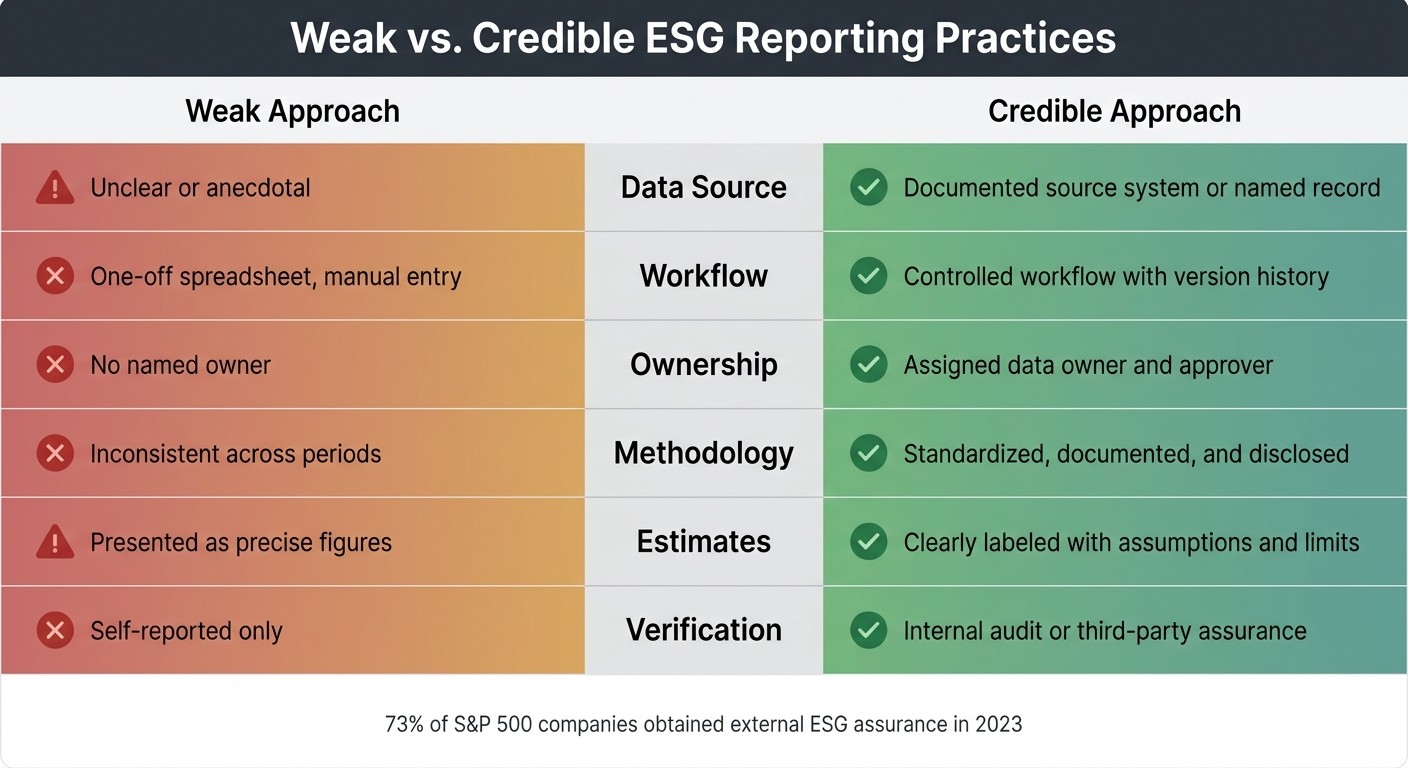
Weak vs. Credible ESG Reporting Practices: A Side-by-Side Comparison
Verifiable claims fall apart when the data system underneath them is shaky. Precise language helps, but it can't save weak inputs. The usual problems are familiar: inconsistent definitions, spreadsheet-heavy processes, and fuzzy ownership. The answer isn't better wording. It's better data governance.
Build Stronger Controls for Data Collection, Review, and Consistency
Start with a metrics dictionary that defines every ESG KPI. Each entry should spell out the formal definition, unit of measure, reporting boundary, data source, calculation method, and any assumptions built into the number. For example, that might mean metric tons of CO₂e or total recordable incident rate per 200,000 U.S. labor hours.
Each metric also needs a named data owner and approver, along with a review calendar and checks against source records. When responsibility is vague, mistakes tend to stick around. If an acquisition or divestiture shifts the reporting boundary in the middle of the year, say so plainly. Note which metric changed, when the change took effect, and whether prior-year figures were restated so readers can compare periods fairly.
Consistency matters just as much as control. Companies should stick with the same methodology from one reporting period to the next. Even a minor change in method can make results swing in ways that have nothing to do with actual performance. When a method change can't be avoided, disclose it clearly and separate the impact of the new method from the underlying performance change.
Use Assurance and Transparent Methods to Increase Confidence
Once definitions and ownership are in place, assurance gets faster and carries more weight. Among S&P 500 companies reporting sustainability information in 2023, 73% obtained some form of external assurance over at least part of their ESG data, up from 70% in 2022.[10][11]
Internal audit is a smart first move, especially for high-risk metrics that matter to the business or are likely to draw investor attention. It checks whether controls work before an outside reviewer ever sees the data. Third-party assurance carries more weight with outside audiences, but it only works if the company has the paperwork to back it up. An assurance provider can confirm only what the company can show. That means source records, calculation logs, version histories, and sign-off trails need to be in place before the engagement starts.
A short methodology note for each major metric can go a long way. Include the source, calculation method, estimates, and limits. That gives readers a clearer sense of what sits behind the number.
The table below shows the difference between practices that weaken trust and practices that support it:
Practice area | Weak approach | Credible approach |
|---|---|---|
Data source | Unclear or anecdotal | Documented source system or named record |
Workflow | One-off spreadsheet, manual entry | Controlled workflow with version history |
Ownership | No named owner | Assigned data owner and approver |
Methodology | Inconsistent across periods | Standardized, documented, and disclosed |
Estimates | Presented as precise figures | Clearly labeled with assumptions and limits |
Verification | Self-reported only | Internal audit or third-party assurance |
The goal is not to pile up more data. It's to produce data that stakeholders can trust and use. Strong data also makes it much easier to follow commitments in plain view. Once the numbers are under control, the next test is whether companies track those commitments all the way through.
Show Follow-Through by Closing the Reporting Loop
Reliable data matters, but stakeholders also want to see what happened after they spoke up. Too many ESG reports announce goals and then go silent. No owner. No deadline. No progress note. Investors are left guessing about execution risk, and communities have no clear way to see whether their input changed anything. That kind of silence chips away at trust.
Track Commitments With Owners, Deadlines, and Status Updates
Treat each major ESG commitment like a project, not a promise on paper. For every item, record the issue raised, the specific action promised, the responsible owner - at least by role title - the target date, the current status, and the next planned step. That gives you a clean way to track progress from one reporting cycle to the next.
A U.S. manufacturer, for example, might hear investor concerns about climate transition risk during its 2024 engagement round. In its 2025 ESG report, it could commit to cutting Scope 1 and 2 emissions by 40% by 2030 and name the COO and CSO as owners. Then, in 2026, it could report that emissions fell 12% from a 2023 baseline through LED retrofits, on-site solar, and renewable energy procurement. That is what a closed reporting loop looks like.
The table below shows the structure:
Element | What to include |
|---|---|
Issue raised | The stakeholder concern or material topic (e.g., water use at a specific facility) |
Action promised | A specific, measurable commitment with a defined scope |
Responsible owner | Named business unit and accountable executive |
Target date | Clear deadline (e.g., December 31, 2028) |
Current status | Numeric progress with baseline and reporting date (e.g., "down 8.3% from 2023 baseline as of March 31, 2026; on track") |
Next step | Upcoming milestone and when it will be reported |
Move From Compliance Reporting to Action
Closing the reporting loop is not just a matter of presentation. It shows whether ESG is part of day-to-day decision-making. When commitments are linked to capital decisions, executive pay, and quarterly management reviews, people track them. When they sit only in an annual report, they often drift.
At a larger company, that means commitments appear in budgets, governance processes, and public progress updates. Microsoft's public climate reporting shows what follow-through can look like at scale. In its FY2024 disclosures, Microsoft contracted nearly 22 million metric tons of carbon removals, diverted 88.1% of operational waste, and permanently protected 15,849 acres of land - more than 30% above target.[12][13][14][15] These are not broad statements. They are dated results tied to named programs and measurable outcomes.
Conclusion: What Stronger ESG Reporting Looks Like
A strong ESG report should leave investors, employees, and community members with clear answers to three basic questions: What matters most to this organization, and why? What is it doing about those priorities, and how is it performing? Is it doing what it said it would do over time? If the answer to any of those is "not really", the report is not serving stakeholders well.
The path to better reporting comes back to the same four fixes discussed above: material topics, specific claims, reliable data, and clear follow-through. Independent assurance is fast becoming a baseline expectation, not something that sets a report apart.
Just as important, organizations need to close the loop. Commitments without named owners, deadlines, and status updates are just intentions on paper. Once follow-through is built into governance, budgets, and management reviews - not only the annual report - ESG becomes part of how the organization runs day to day.
Transparency makes ESG reporting useful. It gives stakeholders something they can trust and act on. This does not call for perfection. It calls for discipline, honesty about gaps, and a real commitment to getting better over time. Organizations that use ESG reporting as a management tool, rather than a compliance task, produce reports that people can actually use. That is what meeting expectations looks like in practice.
FAQs
How do you decide what’s material in an ESG report?
Materiality is the process of figuring out which ESG topics matter most to your business and the people connected to it. A formal materiality assessment - ideally using double materiality - looks at two sides at once: your impact on the world, and the way sustainability issues affect enterprise value.
Start with a long list of topics. Then weigh their importance, bring stakeholders into the process, and document your reasoning so your reporting focus is transparent and defensible.
What makes an ESG claim credible?
An ESG claim carries weight when it rests on tight data management, plain transparency, and outside review. That means disclosures should line up with accepted frameworks, and the full data lifecycle should be documented with traceable audit trails from start to finish.
Vague language weakens trust fast. Be specific. Use clear metrics, report negative impacts along with wins, and show trends across three or more years so people can see what’s changing over time. Third-party assurance adds another layer of confidence by checking both the data and the processes behind it.
When should ESG data get external assurance?
For companies covered by the CSRD, external assurance is required in the first reporting year. For voluntary reporters, it isn't mandatory. Still, many investors and rating agencies now look for it because it can strengthen credibility and cut the risk of greenwashing.
Start 6 to 12 months early, and if possible, begin during data collection. That gives assurance providers time to review your processes and internal controls, not just the final numbers.
Related Blog Posts
Latest Articles
©2025

Narrative Change and Power Building: The Missing Half of Advocacy
Narrative change is the process of disrupting dominant narratives that normalize inequity and advancing new narratives from historically marginalized communities.

Funding Resilience Without Federal Grants
BRIC is unreliable and FEMA is shrinking. Here's how cities fund climate resilience with dedicated revenue, blended finance, and a coordinating authority.

The ESG Blind Spot: How AI Is Finding Risks in Companies Nobody Else Is Watching
Norway's sovereign wealth fund uses AI to screen 7,200 portfolio companies for forced labor and corruption within 24 hours. The real story is the emerging-market coverage gap that traditional ESG data vendors miss — and what it means for any company with a global supply chain.
Narrative Change and Power Building: The Missing Half of Advocacy
Narrative change is the process of disrupting dominant narratives that normalize inequity and advancing new narratives from historically marginalized communities.
Funding Resilience Without Federal Grants
BRIC is unreliable and FEMA is shrinking. Here's how cities fund climate resilience with dedicated revenue, blended finance, and a coordinating authority.
The ESG Blind Spot: How AI Is Finding Risks in Companies Nobody Else Is Watching
Norway's sovereign wealth fund uses AI to screen 7,200 portfolio companies for forced labor and corruption within 24 hours. The real story is the emerging-market coverage gap that traditional ESG data vendors miss — and what it means for any company with a global supply chain.
FAQ
01
What does it really mean to “redefine profit”?
02
What makes Council Fire different?
03
Who does Council Fire work with?
04
What does working with Council Fire actually look like?
05
How does Council Fire help organizations turn big goals into action?
06
How does Council Fire define and measure success?
Aug 7, 2026
Meeting Stakeholder Expectations in ESG Reports
ESG Strategy
In This Article
Make ESG reports credible: prioritize material topics, use verifiable claims, tighten data controls, and track commitments.
Meeting Stakeholder Expectations in ESG Reports
Most ESG reports miss the mark for one simple reason: they list activity instead of proving results. If I want a report to meet stakeholder expectations, I need to do four things well: focus on the topics that matter most, make every claim specific, clean up the data behind the numbers, and show what happened after commitments were made.
A few facts make the problem clear. 94% of investors in PwC’s 2023 survey said sustainability reports include at least some unsupported claims. 80% of investors in an EY survey said materiality and comparability still need work. And among S&P 500 companies, 73% got outside assurance on at least part of their ESG data in 2023. The message is simple: people want proof, not broad statements.
If I were tightening an ESG report, I would focus on these points first:
Report the right topics: give more space to issues with the biggest business and stakeholder impact
Explain topic choices: show why an issue was included, limited, or left out
Write testable claims: include the initiative, metric, baseline, timeframe, and data source
Report misses too: mark goals as on track, at risk, or off track
Fix data problems: use clear KPI definitions, named owners, and review steps
Use assurance where it matters: back high-interest metrics with internal checks or outside review
Close the loop: connect each promise to an owner, deadline, status update, and next step
In short: stakeholders expect a report that shows priorities, numbers they can check, and proof of follow-through. That is the standard I would use for any ESG report today.
ESG Metrics and Stakeholder Engagement
Fix Weak Topic Coverage by Focusing on What Matters Most
Stakeholders don’t all read an ESG report the same way. Investors look for risk and financial exposure. Employees may care more about labor practices. Customers might zero in on sourcing or data privacy. That’s why depth should follow materiality, not volume. Too many ESG reports try to touch everything and end up saying almost nothing. When a small recycling effort gets the same space as a major climate risk, the signal gets lost. People can’t tell what matters most, and trust starts to slip.
That concern shows up in the data. An EY investor survey found that 80% of investors say the materiality and comparability of sustainability reporting need improvement, and three-quarters believe companies are highly selective in what they disclose - raising greenwashing concerns.[1][2]
Use materiality to decide what deserves deep coverage and what only needs a short mention.
Use Materiality and Stakeholder Input to Set Report Priorities
A materiality assessment should guide which topics get full treatment and which stay brief. In simple terms, the process maps possible ESG issues - climate risk, labor practices, data privacy, water use, supply chain integrity - against two core questions:
How much does this topic affect the business?
How much do stakeholders care about it?
Topics that rank high on both belong at the center of the report. Those are the issues that need solid data, trend analysis, and forward-looking discussion. Topics that rank low can be handled in a short summary or moved to an appendix.
Stakeholder input is part of that work, not a separate box to check. Meetings, surveys, and interviews help show which issues each group sees as material. Just as important, the report should show who was consulted, how they were engaged, and what changed because of that feedback. GRI’s guidance is clear here: disclose the stakeholder groups engaged, the frequency and type of engagement, and how that input connected to materiality decisions.[6] That record makes the process transparent and auditable.
Explain Why Topics Were Included or Left Out
Picking the right topics is only half the job. Stakeholders also need to see the reasoning behind those choices. A materiality matrix - showing topics by importance to stakeholders on one axis and business impact on the other - is one of the clearest ways to show that logic at a glance.[4][5] Still, the chart can’t do all the work.
Each material topic should come with a short explanation of why it made the cut: the risks tied to it, which stakeholder groups raised it, and how it links to the organization’s strategy. If a topic is missing or only covered lightly, say that plainly. Silence can look like concealment.
If detailed product end-of-life data isn't included because the data are unavailable, acknowledge that gap and provide a timeline for when it will be addressed.
That kind of plainspoken disclosure helps separate a report people can trust from one that looks like it’s dodging hard questions.[1][3][5]
Once topics are set, the next step is making every claim specific and verifiable.
Replace Vague Claims With Specific, Verifiable Statements
Once the right topics are in place, every claim tied to those topics needs to be written in a way stakeholders can test. This is where many ESG reports start to wobble. Broad phrases like "committed to sustainability," "on a net-zero path," or "reduced emissions" show up again and again, but they don’t give readers much to work with. There’s no scope, no metric, no baseline, and no timeframe. Investors want apples-to-apples comparison. Regulators want something they can audit. Employees want plain honesty. That’s why vague ESG language creates a trust issue, not just a writing issue.
Tie Claims to Named Initiatives, Outcomes, and Timeframes
The fix is simple: before any claim goes into the report, run it through a short check. Name the initiative. State the action. Quantify the result. Define the baseline. Set the timeframe. Cite the data source.
The difference shows up fast in practice. A vague claim says: We are reducing our carbon footprint. A verifiable claim says: Through our Fleet Electrification Initiative, we replaced 650 gasoline-powered delivery vans with electric vehicles, reducing our Scope 1 vehicle emissions by 5,200 metric tons of CO₂e per year compared with a 2022 baseline, based on telematics and fuel-purchase data verified by our internal audit team. The second version tells the reader what happened, where it happened, how much changed, and how the company knows. The first one can’t be tested.
Long-term targets need the same treatment. Don’t leave them floating out in the distance. Break them into interim milestones and report against those milestones each year. If a company plans to cut combined Scope 1 and 2 emissions by 50% by 2035 from a 2020 baseline, it might set a 15% interim target for 2026. The annual report could then say: As of August 7, 2026, we have achieved a 17% reduction versus our 2020 baseline, exceeding our 2026 interim target of 15%. That kind of year-by-year reporting gives stakeholders a clear view of progress. They can see whether the company is moving ahead, stalling out, or slipping backward across each reporting cycle.
Avoid Selective Disclosure and Acknowledge Gaps
Selective disclosure can wreck trust fast. This happens when a company highlights the good news and quietly leaves out the misses. Maybe it points to office-safety gains while saying nothing about higher-risk sites. Maybe it spotlights certified facilities but skips over violations elsewhere. Stakeholders check ESG claims against public records, and when they find a mismatch, the damage usually goes well beyond the missed target itself.
Balanced reporting means saying what’s working and what isn’t. Pair each major goal with a clear status such as on track, at risk, or off track, then explain why. If a waste-diversion target was missed, say it plainly and lay out the response:
We achieved 68% waste diversion against our 2025 target of 80%, due to slower-than-expected implementation at two U.S. distribution centers. We have allocated an additional $2 million in FY 2026 for infrastructure and training.
That kind of disclosure earns trust because it shows the company is watching the numbers and making corrections, not just polishing a highlight reel.[7][8][9]
Specific claims can still fall apart if the data underneath them is shaky, which is why data controls come next.
Improve Data Quality to Make ESG Reports More Reliable
Weak vs. Credible ESG Reporting Practices: A Side-by-Side Comparison
Verifiable claims fall apart when the data system underneath them is shaky. Precise language helps, but it can't save weak inputs. The usual problems are familiar: inconsistent definitions, spreadsheet-heavy processes, and fuzzy ownership. The answer isn't better wording. It's better data governance.
Build Stronger Controls for Data Collection, Review, and Consistency
Start with a metrics dictionary that defines every ESG KPI. Each entry should spell out the formal definition, unit of measure, reporting boundary, data source, calculation method, and any assumptions built into the number. For example, that might mean metric tons of CO₂e or total recordable incident rate per 200,000 U.S. labor hours.
Each metric also needs a named data owner and approver, along with a review calendar and checks against source records. When responsibility is vague, mistakes tend to stick around. If an acquisition or divestiture shifts the reporting boundary in the middle of the year, say so plainly. Note which metric changed, when the change took effect, and whether prior-year figures were restated so readers can compare periods fairly.
Consistency matters just as much as control. Companies should stick with the same methodology from one reporting period to the next. Even a minor change in method can make results swing in ways that have nothing to do with actual performance. When a method change can't be avoided, disclose it clearly and separate the impact of the new method from the underlying performance change.
Use Assurance and Transparent Methods to Increase Confidence
Once definitions and ownership are in place, assurance gets faster and carries more weight. Among S&P 500 companies reporting sustainability information in 2023, 73% obtained some form of external assurance over at least part of their ESG data, up from 70% in 2022.[10][11]
Internal audit is a smart first move, especially for high-risk metrics that matter to the business or are likely to draw investor attention. It checks whether controls work before an outside reviewer ever sees the data. Third-party assurance carries more weight with outside audiences, but it only works if the company has the paperwork to back it up. An assurance provider can confirm only what the company can show. That means source records, calculation logs, version histories, and sign-off trails need to be in place before the engagement starts.
A short methodology note for each major metric can go a long way. Include the source, calculation method, estimates, and limits. That gives readers a clearer sense of what sits behind the number.
The table below shows the difference between practices that weaken trust and practices that support it:
Practice area | Weak approach | Credible approach |
|---|---|---|
Data source | Unclear or anecdotal | Documented source system or named record |
Workflow | One-off spreadsheet, manual entry | Controlled workflow with version history |
Ownership | No named owner | Assigned data owner and approver |
Methodology | Inconsistent across periods | Standardized, documented, and disclosed |
Estimates | Presented as precise figures | Clearly labeled with assumptions and limits |
Verification | Self-reported only | Internal audit or third-party assurance |
The goal is not to pile up more data. It's to produce data that stakeholders can trust and use. Strong data also makes it much easier to follow commitments in plain view. Once the numbers are under control, the next test is whether companies track those commitments all the way through.
Show Follow-Through by Closing the Reporting Loop
Reliable data matters, but stakeholders also want to see what happened after they spoke up. Too many ESG reports announce goals and then go silent. No owner. No deadline. No progress note. Investors are left guessing about execution risk, and communities have no clear way to see whether their input changed anything. That kind of silence chips away at trust.
Track Commitments With Owners, Deadlines, and Status Updates
Treat each major ESG commitment like a project, not a promise on paper. For every item, record the issue raised, the specific action promised, the responsible owner - at least by role title - the target date, the current status, and the next planned step. That gives you a clean way to track progress from one reporting cycle to the next.
A U.S. manufacturer, for example, might hear investor concerns about climate transition risk during its 2024 engagement round. In its 2025 ESG report, it could commit to cutting Scope 1 and 2 emissions by 40% by 2030 and name the COO and CSO as owners. Then, in 2026, it could report that emissions fell 12% from a 2023 baseline through LED retrofits, on-site solar, and renewable energy procurement. That is what a closed reporting loop looks like.
The table below shows the structure:
Element | What to include |
|---|---|
Issue raised | The stakeholder concern or material topic (e.g., water use at a specific facility) |
Action promised | A specific, measurable commitment with a defined scope |
Responsible owner | Named business unit and accountable executive |
Target date | Clear deadline (e.g., December 31, 2028) |
Current status | Numeric progress with baseline and reporting date (e.g., "down 8.3% from 2023 baseline as of March 31, 2026; on track") |
Next step | Upcoming milestone and when it will be reported |
Move From Compliance Reporting to Action
Closing the reporting loop is not just a matter of presentation. It shows whether ESG is part of day-to-day decision-making. When commitments are linked to capital decisions, executive pay, and quarterly management reviews, people track them. When they sit only in an annual report, they often drift.
At a larger company, that means commitments appear in budgets, governance processes, and public progress updates. Microsoft's public climate reporting shows what follow-through can look like at scale. In its FY2024 disclosures, Microsoft contracted nearly 22 million metric tons of carbon removals, diverted 88.1% of operational waste, and permanently protected 15,849 acres of land - more than 30% above target.[12][13][14][15] These are not broad statements. They are dated results tied to named programs and measurable outcomes.
Conclusion: What Stronger ESG Reporting Looks Like
A strong ESG report should leave investors, employees, and community members with clear answers to three basic questions: What matters most to this organization, and why? What is it doing about those priorities, and how is it performing? Is it doing what it said it would do over time? If the answer to any of those is "not really", the report is not serving stakeholders well.
The path to better reporting comes back to the same four fixes discussed above: material topics, specific claims, reliable data, and clear follow-through. Independent assurance is fast becoming a baseline expectation, not something that sets a report apart.
Just as important, organizations need to close the loop. Commitments without named owners, deadlines, and status updates are just intentions on paper. Once follow-through is built into governance, budgets, and management reviews - not only the annual report - ESG becomes part of how the organization runs day to day.
Transparency makes ESG reporting useful. It gives stakeholders something they can trust and act on. This does not call for perfection. It calls for discipline, honesty about gaps, and a real commitment to getting better over time. Organizations that use ESG reporting as a management tool, rather than a compliance task, produce reports that people can actually use. That is what meeting expectations looks like in practice.
FAQs
How do you decide what’s material in an ESG report?
Materiality is the process of figuring out which ESG topics matter most to your business and the people connected to it. A formal materiality assessment - ideally using double materiality - looks at two sides at once: your impact on the world, and the way sustainability issues affect enterprise value.
Start with a long list of topics. Then weigh their importance, bring stakeholders into the process, and document your reasoning so your reporting focus is transparent and defensible.
What makes an ESG claim credible?
An ESG claim carries weight when it rests on tight data management, plain transparency, and outside review. That means disclosures should line up with accepted frameworks, and the full data lifecycle should be documented with traceable audit trails from start to finish.
Vague language weakens trust fast. Be specific. Use clear metrics, report negative impacts along with wins, and show trends across three or more years so people can see what’s changing over time. Third-party assurance adds another layer of confidence by checking both the data and the processes behind it.
When should ESG data get external assurance?
For companies covered by the CSRD, external assurance is required in the first reporting year. For voluntary reporters, it isn't mandatory. Still, many investors and rating agencies now look for it because it can strengthen credibility and cut the risk of greenwashing.
Start 6 to 12 months early, and if possible, begin during data collection. That gives assurance providers time to review your processes and internal controls, not just the final numbers.
Related Blog Posts
Latest Articles
©2025
Narrative Change and Power Building: The Missing Half of Advocacy
Narrative change is the process of disrupting dominant narratives that normalize inequity and advancing new narratives from historically marginalized communities.
Funding Resilience Without Federal Grants
BRIC is unreliable and FEMA is shrinking. Here's how cities fund climate resilience with dedicated revenue, blended finance, and a coordinating authority.
The ESG Blind Spot: How AI Is Finding Risks in Companies Nobody Else Is Watching
Norway's sovereign wealth fund uses AI to screen 7,200 portfolio companies for forced labor and corruption within 24 hours. The real story is the emerging-market coverage gap that traditional ESG data vendors miss — and what it means for any company with a global supply chain.
FAQ
01
What does it really mean to “redefine profit”?
02
What makes Council Fire different?
03
Who does Council Fire work with?
04
What does working with Council Fire actually look like?
05
How does Council Fire help organizations turn big goals into action?
06
How does Council Fire define and measure success?
Aug 7, 2026
Meeting Stakeholder Expectations in ESG Reports
ESG Strategy
In This Article
Make ESG reports credible: prioritize material topics, use verifiable claims, tighten data controls, and track commitments.
Meeting Stakeholder Expectations in ESG Reports
Most ESG reports miss the mark for one simple reason: they list activity instead of proving results. If I want a report to meet stakeholder expectations, I need to do four things well: focus on the topics that matter most, make every claim specific, clean up the data behind the numbers, and show what happened after commitments were made.
A few facts make the problem clear. 94% of investors in PwC’s 2023 survey said sustainability reports include at least some unsupported claims. 80% of investors in an EY survey said materiality and comparability still need work. And among S&P 500 companies, 73% got outside assurance on at least part of their ESG data in 2023. The message is simple: people want proof, not broad statements.
If I were tightening an ESG report, I would focus on these points first:
Report the right topics: give more space to issues with the biggest business and stakeholder impact
Explain topic choices: show why an issue was included, limited, or left out
Write testable claims: include the initiative, metric, baseline, timeframe, and data source
Report misses too: mark goals as on track, at risk, or off track
Fix data problems: use clear KPI definitions, named owners, and review steps
Use assurance where it matters: back high-interest metrics with internal checks or outside review
Close the loop: connect each promise to an owner, deadline, status update, and next step
In short: stakeholders expect a report that shows priorities, numbers they can check, and proof of follow-through. That is the standard I would use for any ESG report today.
ESG Metrics and Stakeholder Engagement
Fix Weak Topic Coverage by Focusing on What Matters Most
Stakeholders don’t all read an ESG report the same way. Investors look for risk and financial exposure. Employees may care more about labor practices. Customers might zero in on sourcing or data privacy. That’s why depth should follow materiality, not volume. Too many ESG reports try to touch everything and end up saying almost nothing. When a small recycling effort gets the same space as a major climate risk, the signal gets lost. People can’t tell what matters most, and trust starts to slip.
That concern shows up in the data. An EY investor survey found that 80% of investors say the materiality and comparability of sustainability reporting need improvement, and three-quarters believe companies are highly selective in what they disclose - raising greenwashing concerns.[1][2]
Use materiality to decide what deserves deep coverage and what only needs a short mention.
Use Materiality and Stakeholder Input to Set Report Priorities
A materiality assessment should guide which topics get full treatment and which stay brief. In simple terms, the process maps possible ESG issues - climate risk, labor practices, data privacy, water use, supply chain integrity - against two core questions:
How much does this topic affect the business?
How much do stakeholders care about it?
Topics that rank high on both belong at the center of the report. Those are the issues that need solid data, trend analysis, and forward-looking discussion. Topics that rank low can be handled in a short summary or moved to an appendix.
Stakeholder input is part of that work, not a separate box to check. Meetings, surveys, and interviews help show which issues each group sees as material. Just as important, the report should show who was consulted, how they were engaged, and what changed because of that feedback. GRI’s guidance is clear here: disclose the stakeholder groups engaged, the frequency and type of engagement, and how that input connected to materiality decisions.[6] That record makes the process transparent and auditable.
Explain Why Topics Were Included or Left Out
Picking the right topics is only half the job. Stakeholders also need to see the reasoning behind those choices. A materiality matrix - showing topics by importance to stakeholders on one axis and business impact on the other - is one of the clearest ways to show that logic at a glance.[4][5] Still, the chart can’t do all the work.
Each material topic should come with a short explanation of why it made the cut: the risks tied to it, which stakeholder groups raised it, and how it links to the organization’s strategy. If a topic is missing or only covered lightly, say that plainly. Silence can look like concealment.
If detailed product end-of-life data isn't included because the data are unavailable, acknowledge that gap and provide a timeline for when it will be addressed.
That kind of plainspoken disclosure helps separate a report people can trust from one that looks like it’s dodging hard questions.[1][3][5]
Once topics are set, the next step is making every claim specific and verifiable.
Replace Vague Claims With Specific, Verifiable Statements
Once the right topics are in place, every claim tied to those topics needs to be written in a way stakeholders can test. This is where many ESG reports start to wobble. Broad phrases like "committed to sustainability," "on a net-zero path," or "reduced emissions" show up again and again, but they don’t give readers much to work with. There’s no scope, no metric, no baseline, and no timeframe. Investors want apples-to-apples comparison. Regulators want something they can audit. Employees want plain honesty. That’s why vague ESG language creates a trust issue, not just a writing issue.
Tie Claims to Named Initiatives, Outcomes, and Timeframes
The fix is simple: before any claim goes into the report, run it through a short check. Name the initiative. State the action. Quantify the result. Define the baseline. Set the timeframe. Cite the data source.
The difference shows up fast in practice. A vague claim says: We are reducing our carbon footprint. A verifiable claim says: Through our Fleet Electrification Initiative, we replaced 650 gasoline-powered delivery vans with electric vehicles, reducing our Scope 1 vehicle emissions by 5,200 metric tons of CO₂e per year compared with a 2022 baseline, based on telematics and fuel-purchase data verified by our internal audit team. The second version tells the reader what happened, where it happened, how much changed, and how the company knows. The first one can’t be tested.
Long-term targets need the same treatment. Don’t leave them floating out in the distance. Break them into interim milestones and report against those milestones each year. If a company plans to cut combined Scope 1 and 2 emissions by 50% by 2035 from a 2020 baseline, it might set a 15% interim target for 2026. The annual report could then say: As of August 7, 2026, we have achieved a 17% reduction versus our 2020 baseline, exceeding our 2026 interim target of 15%. That kind of year-by-year reporting gives stakeholders a clear view of progress. They can see whether the company is moving ahead, stalling out, or slipping backward across each reporting cycle.
Avoid Selective Disclosure and Acknowledge Gaps
Selective disclosure can wreck trust fast. This happens when a company highlights the good news and quietly leaves out the misses. Maybe it points to office-safety gains while saying nothing about higher-risk sites. Maybe it spotlights certified facilities but skips over violations elsewhere. Stakeholders check ESG claims against public records, and when they find a mismatch, the damage usually goes well beyond the missed target itself.
Balanced reporting means saying what’s working and what isn’t. Pair each major goal with a clear status such as on track, at risk, or off track, then explain why. If a waste-diversion target was missed, say it plainly and lay out the response:
We achieved 68% waste diversion against our 2025 target of 80%, due to slower-than-expected implementation at two U.S. distribution centers. We have allocated an additional $2 million in FY 2026 for infrastructure and training.
That kind of disclosure earns trust because it shows the company is watching the numbers and making corrections, not just polishing a highlight reel.[7][8][9]
Specific claims can still fall apart if the data underneath them is shaky, which is why data controls come next.
Improve Data Quality to Make ESG Reports More Reliable
Weak vs. Credible ESG Reporting Practices: A Side-by-Side Comparison
Verifiable claims fall apart when the data system underneath them is shaky. Precise language helps, but it can't save weak inputs. The usual problems are familiar: inconsistent definitions, spreadsheet-heavy processes, and fuzzy ownership. The answer isn't better wording. It's better data governance.
Build Stronger Controls for Data Collection, Review, and Consistency
Start with a metrics dictionary that defines every ESG KPI. Each entry should spell out the formal definition, unit of measure, reporting boundary, data source, calculation method, and any assumptions built into the number. For example, that might mean metric tons of CO₂e or total recordable incident rate per 200,000 U.S. labor hours.
Each metric also needs a named data owner and approver, along with a review calendar and checks against source records. When responsibility is vague, mistakes tend to stick around. If an acquisition or divestiture shifts the reporting boundary in the middle of the year, say so plainly. Note which metric changed, when the change took effect, and whether prior-year figures were restated so readers can compare periods fairly.
Consistency matters just as much as control. Companies should stick with the same methodology from one reporting period to the next. Even a minor change in method can make results swing in ways that have nothing to do with actual performance. When a method change can't be avoided, disclose it clearly and separate the impact of the new method from the underlying performance change.
Use Assurance and Transparent Methods to Increase Confidence
Once definitions and ownership are in place, assurance gets faster and carries more weight. Among S&P 500 companies reporting sustainability information in 2023, 73% obtained some form of external assurance over at least part of their ESG data, up from 70% in 2022.[10][11]
Internal audit is a smart first move, especially for high-risk metrics that matter to the business or are likely to draw investor attention. It checks whether controls work before an outside reviewer ever sees the data. Third-party assurance carries more weight with outside audiences, but it only works if the company has the paperwork to back it up. An assurance provider can confirm only what the company can show. That means source records, calculation logs, version histories, and sign-off trails need to be in place before the engagement starts.
A short methodology note for each major metric can go a long way. Include the source, calculation method, estimates, and limits. That gives readers a clearer sense of what sits behind the number.
The table below shows the difference between practices that weaken trust and practices that support it:
Practice area | Weak approach | Credible approach |
|---|---|---|
Data source | Unclear or anecdotal | Documented source system or named record |
Workflow | One-off spreadsheet, manual entry | Controlled workflow with version history |
Ownership | No named owner | Assigned data owner and approver |
Methodology | Inconsistent across periods | Standardized, documented, and disclosed |
Estimates | Presented as precise figures | Clearly labeled with assumptions and limits |
Verification | Self-reported only | Internal audit or third-party assurance |
The goal is not to pile up more data. It's to produce data that stakeholders can trust and use. Strong data also makes it much easier to follow commitments in plain view. Once the numbers are under control, the next test is whether companies track those commitments all the way through.
Show Follow-Through by Closing the Reporting Loop
Reliable data matters, but stakeholders also want to see what happened after they spoke up. Too many ESG reports announce goals and then go silent. No owner. No deadline. No progress note. Investors are left guessing about execution risk, and communities have no clear way to see whether their input changed anything. That kind of silence chips away at trust.
Track Commitments With Owners, Deadlines, and Status Updates
Treat each major ESG commitment like a project, not a promise on paper. For every item, record the issue raised, the specific action promised, the responsible owner - at least by role title - the target date, the current status, and the next planned step. That gives you a clean way to track progress from one reporting cycle to the next.
A U.S. manufacturer, for example, might hear investor concerns about climate transition risk during its 2024 engagement round. In its 2025 ESG report, it could commit to cutting Scope 1 and 2 emissions by 40% by 2030 and name the COO and CSO as owners. Then, in 2026, it could report that emissions fell 12% from a 2023 baseline through LED retrofits, on-site solar, and renewable energy procurement. That is what a closed reporting loop looks like.
The table below shows the structure:
Element | What to include |
|---|---|
Issue raised | The stakeholder concern or material topic (e.g., water use at a specific facility) |
Action promised | A specific, measurable commitment with a defined scope |
Responsible owner | Named business unit and accountable executive |
Target date | Clear deadline (e.g., December 31, 2028) |
Current status | Numeric progress with baseline and reporting date (e.g., "down 8.3% from 2023 baseline as of March 31, 2026; on track") |
Next step | Upcoming milestone and when it will be reported |
Move From Compliance Reporting to Action
Closing the reporting loop is not just a matter of presentation. It shows whether ESG is part of day-to-day decision-making. When commitments are linked to capital decisions, executive pay, and quarterly management reviews, people track them. When they sit only in an annual report, they often drift.
At a larger company, that means commitments appear in budgets, governance processes, and public progress updates. Microsoft's public climate reporting shows what follow-through can look like at scale. In its FY2024 disclosures, Microsoft contracted nearly 22 million metric tons of carbon removals, diverted 88.1% of operational waste, and permanently protected 15,849 acres of land - more than 30% above target.[12][13][14][15] These are not broad statements. They are dated results tied to named programs and measurable outcomes.
Conclusion: What Stronger ESG Reporting Looks Like
A strong ESG report should leave investors, employees, and community members with clear answers to three basic questions: What matters most to this organization, and why? What is it doing about those priorities, and how is it performing? Is it doing what it said it would do over time? If the answer to any of those is "not really", the report is not serving stakeholders well.
The path to better reporting comes back to the same four fixes discussed above: material topics, specific claims, reliable data, and clear follow-through. Independent assurance is fast becoming a baseline expectation, not something that sets a report apart.
Just as important, organizations need to close the loop. Commitments without named owners, deadlines, and status updates are just intentions on paper. Once follow-through is built into governance, budgets, and management reviews - not only the annual report - ESG becomes part of how the organization runs day to day.
Transparency makes ESG reporting useful. It gives stakeholders something they can trust and act on. This does not call for perfection. It calls for discipline, honesty about gaps, and a real commitment to getting better over time. Organizations that use ESG reporting as a management tool, rather than a compliance task, produce reports that people can actually use. That is what meeting expectations looks like in practice.
FAQs
How do you decide what’s material in an ESG report?
Materiality is the process of figuring out which ESG topics matter most to your business and the people connected to it. A formal materiality assessment - ideally using double materiality - looks at two sides at once: your impact on the world, and the way sustainability issues affect enterprise value.
Start with a long list of topics. Then weigh their importance, bring stakeholders into the process, and document your reasoning so your reporting focus is transparent and defensible.
What makes an ESG claim credible?
An ESG claim carries weight when it rests on tight data management, plain transparency, and outside review. That means disclosures should line up with accepted frameworks, and the full data lifecycle should be documented with traceable audit trails from start to finish.
Vague language weakens trust fast. Be specific. Use clear metrics, report negative impacts along with wins, and show trends across three or more years so people can see what’s changing over time. Third-party assurance adds another layer of confidence by checking both the data and the processes behind it.
When should ESG data get external assurance?
For companies covered by the CSRD, external assurance is required in the first reporting year. For voluntary reporters, it isn't mandatory. Still, many investors and rating agencies now look for it because it can strengthen credibility and cut the risk of greenwashing.
Start 6 to 12 months early, and if possible, begin during data collection. That gives assurance providers time to review your processes and internal controls, not just the final numbers.
Related Blog Posts
Latest Articles
©2025
Narrative Change and Power Building: The Missing Half of Advocacy
Narrative change is the process of disrupting dominant narratives that normalize inequity and advancing new narratives from historically marginalized communities.
Funding Resilience Without Federal Grants
BRIC is unreliable and FEMA is shrinking. Here's how cities fund climate resilience with dedicated revenue, blended finance, and a coordinating authority.
The ESG Blind Spot: How AI Is Finding Risks in Companies Nobody Else Is Watching
Norway's sovereign wealth fund uses AI to screen 7,200 portfolio companies for forced labor and corruption within 24 hours. The real story is the emerging-market coverage gap that traditional ESG data vendors miss — and what it means for any company with a global supply chain.
FAQ
What does it really mean to “redefine profit”?
What makes Council Fire different?
Who does Council Fire work with?
What does working with Council Fire actually look like?
How does Council Fire help organizations turn big goals into action?
How does Council Fire define and measure success?