
May 29, 2026
How to Develop Metrics, Monitoring, and Verification (MRV) for Impact for Foundations & Philanthropic Organizations
ESG Strategy
In This Article
Guide for foundations to build MRV: set a Theory of Change, choose outcome-focused metrics, monitor with tools, verify and learn.
How to Develop Metrics, Monitoring, and Verification (MRV) for Impact for Foundations & Philanthropic Organizations
Foundations and philanthropic organizations are under growing pressure to prove their efforts create real change. A Metrics, Monitoring, and Verification (MRV) system provides a structured way to measure, track, and validate impact. Here's how it works:
Define Impact Goals: Start with a clear Theory of Change to connect your activities to desired outcomes.
Design Metrics: Focus on measurable indicators that reflect actual change, not just activities.
Build a Monitoring System: Create a plan for consistent data collection and use tools like Amp Impact or satellite monitoring to streamline the process.
Verify Results: Ensure reported data aligns with real-world outcomes through validation and cross-checking.
Learn and Improve: Use the insights to refine strategies, reallocate resources, and enhance decision-making.
This guide outlines practical steps to build an effective MRV system that supports transparent reporting, informed decisions, and stronger community trust.
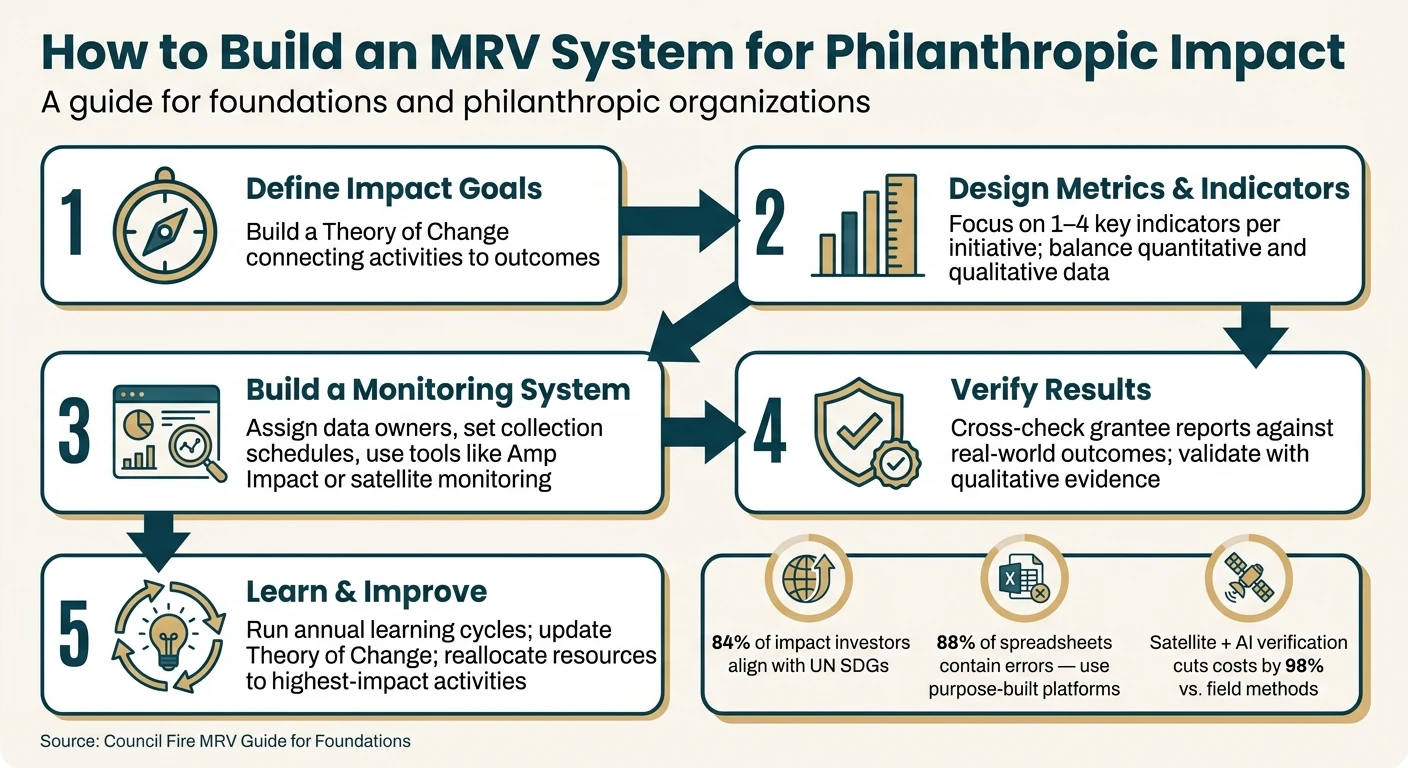
How to Build an MRV System for Philanthropic Impact
Guide to Impact Measurement: From Intent to Impact
Setting Impact Goals and Building a Theory of Change
Define the change you want to create and outline how your actions will lead to it. A Theory of Change (ToC) connects your grantmaking activities to the social or environmental outcomes you aim to achieve.
How to Define a Theory of Change
Unlike a logic model, which follows a straightforward path from inputs to outputs, a Theory of Change digs deeper. It explains the why and how behind change, highlighting the assumptions and causal relationships that underpin your work [7][8].
To build a ToC, use backward mapping. Start with the long-term condition you want to address, then work in reverse to identify the intermediate outcomes and preconditions that must be met along the way [7]. For example, if your foundation's ultimate goal is to combat food insecurity in rural areas, ask yourself: What needs to happen first? Does it require better access to affordable food? Strengthened local supply chains? Increased household income? Each of these becomes a critical layer in your ToC.
It’s essential to distinguish between outputs and outcomes. Outputs are tangible deliverables, like "120 people trained", while outcomes reflect meaningful changes, such as "70% of participants secured stable employment within six months" [8]. Build your ToC around outcomes, not activity counts, and revise it regularly as new evidence emerges or external conditions shift [7][8].
A well-crafted ToC not only sharpens your strategy but also helps align your goals with international standards, boosting credibility and fostering collaboration.
Aligning Goals with Global Standards
Tying your impact goals to recognized global frameworks enhances credibility and facilitates comparisons across the sector. The UN Sustainable Development Goals (SDGs) are now the leading shared framework, with 84% of impact investors reporting alignment with one or more of the 17 SDGs [6].
For those aiming to go deeper, the ISO/UNDP PAS 53002:2024 guidelines provide a comprehensive, 39-page framework to help organizations integrate SDG contributions into their core decision-making processes. This goes beyond simply mapping activities to goals [9]. Additionally, the UN’s Global Indicator Framework offers 234 specific indicators linked to SDG targets, serving as a valuable resource for developing measurable, globally recognized metrics [10].
Framework | Purpose |
|---|---|
UN SDGs | Establishing overarching impact goals |
ISO/UNDP PAS 53002 | Embedding SDG contributions into organizational processes |
Global Indicator Framework | Creating measurable, outcome-based metrics |
Managing and measuring environmental impact |
With these frameworks in mind, the next step is to translate your priorities into measurable outcomes.
Turning Priorities into Measurable Outcomes
Broad priorities like "improve climate resilience" or "enhance community well-being" need to be broken down into specific, measurable outcomes that your monitoring, reporting, and verification (MRV) systems can track.
For instance, a climate resilience goal could become: "By 2028, 75% of grantee communities in flood-prone regions adopt at least one locally-led adaptation practice." Similarly, a community well-being goal might translate to: "Within 18 months of program participation, 60% of households report reduced financial stress." These statements are concrete, time-bound, and tied to observable changes in behavior or conditions.
When drafting measurable outcomes, use contribution language rather than causation. For example, saying your program "contributes to reduced unemployment" is more accurate and defensible than claiming it "causes" the reduction [8]. This approach maintains credibility while still showcasing meaningful impact.
How to Design Impact Metrics and Indicators
With your Theory of Change established, the next step is to create metrics that determine whether your efforts are driving measurable change. These indicators are the backbone of the monitoring and verification processes that follow, ensuring your MRV system aligns with the impact goals outlined in your Theory of Change. The focus here is on measuring actual change, not just activity.
Key Metric Categories to Understand
Impact metrics for philanthropic initiatives generally fall into four main categories: environmental, social, governance, and financial.
Environmental indicators might include metrics like CO₂ emissions avoided or water conserved.
Social indicators could track outcomes such as increased lifetime earnings or reductions in emergency room visits.
Governance metrics often focus on areas like board diversity or transparency in decision-making.
Financial indicators assess aspects such as cost-per-outcome or fundraising efficiency.
Each of these categories serves a unique role within your MRV system. A balanced portfolio typically incorporates metrics from multiple categories. For example, 78% of donors now consider ESG performance when making philanthropic choices, and 62% specifically value transparency in impact reporting [1].
Characteristics of Strong Indicators
Not all metrics deserve your attention. A strong indicator meets five key criteria:
Validity: It measures what it claims to measure.
Reliability: It produces consistent results over time.
Sensitivity: It detects meaningful changes within your desired timeframe.
Feasibility: It's realistic to collect based on your resources.
Actionability: It provides insights that can guide decisions.
A practical guideline is to focus on 1–4 key indicators per initiative and no more than 2–3 for each specific outcome. As Laura Mills, Senior Director of Quality and Evaluation at A Place Called Home, aptly said:
"In practice, most nonprofits don't have time for side quests when it comes to measuring their impact. If everything is important, nothing is important." [4]
Establishing a baseline before starting your intervention is essential. Without it, you'll only be able to describe activities, not quantify progress.
Balancing Qualitative and Quantitative Indicators
Numbers can reveal the scale of your impact, but qualitative data adds depth and context. For instance, a quantitative metric like "15% reduction in emissions among grantees" highlights measurable outcomes, while a qualitative indicator - such as a community trust score rising from 67% to 89% after engaging in local town halls, as reported by The Rockefeller Foundation - captures the human side of the story.
One effective strategy is to group both types of data under shared themes, known as construct-based grouping. For example, "meals provided" (quantitative) and "community garden participation" (qualitative) both align under the theme "Access to nutritious food." This approach simplifies portfolio-level comparisons [11]. When integrating diverse metrics, document your aggregation methods clearly to ensure transparency and maintain audit-readiness [11].
"Change cannot be captured by numbers alone because metrics put the focus on what can be counted, not always what's most important." - Laudes Foundation
The aim isn't to track as many metrics as possible but to select indicators that together provide an honest, well-rounded view of your impact. With these strong metrics in place, the next step is building a monitoring system to effectively capture and leverage them. Stay tuned as we delve into the design of an effective monitoring system.
How to Build a Monitoring System That Works
Strong metrics can only deliver results when backed by a reliable system to collect and track them consistently. Without such a system, even the most well-designed indicators lose their effectiveness.
Building a Monitoring Plan
A monitoring plan serves as a blueprint, outlining who collects the data, how often, and where it goes. One common pitfall is treating data collection as a year-end task instead of integrating it into routine processes. To avoid this, assign specific individuals or teams to each data point and establish a regular collection schedule - monthly or quarterly intervals work much better than annual ones. This approach helps identify issues early, rather than at the last minute during reporting periods [5].
Your plan should also clarify how data moves from grantees to your team, the format in which it’s submitted, and who reviews it before it enters the system. Documenting these steps ensures accountability and minimizes confusion later. Once the plan is in place, focus on identifying precise data sources and selecting the right tools to support your efforts.
Data Sources and Tools to Use
Foundations typically rely on a combination of grantee progress reports, financial documents (like 990s), community surveys, and geospatial data.
Tool Category | Example Platform | Key Functionality |
|---|---|---|
Impact Management | Amp Impact | Tracks indicators, logframes, and aggregates portfolio data on Salesforce [12] |
Financial/Accounting | Automates payment tracking, budget reconciliation, and 990-PF tax preparation [13] | |
AI Financial Analysis | Uses AI to extract financial ratios from 990s and balance sheets [14] | |
Geospatial/MRV | Provides geo-anchored project boundaries and satellite forest cover alerts [16] | |
Capacity Building | CSP | Assesses institutional capacity across partner networks [15] |
Platforms like Amp Impact, which is used by over 17,000 people across 150+ countries to manage more than $12.5 billion in grants, replace scattered spreadsheets with centralized systems that consolidate results across an entire portfolio [12]. For environmental projects, satellite-based monitoring offers a powerful edge. For instance, in January 2026, the World Resources Institute demonstrated that combining high-resolution satellite imagery with the DINOv3 AI model to verify tree cover across 198 land restoration projects in Africa cut independent verification costs by 98% compared to traditional field methods [3].
"Amp Impact has helped us to get quite granular data back into the hands of field staff to help inform their daily work and it's also streamlined considerably our global reporting processes." - Aga Khan Foundation [12]
Once the data is collected using these tools, ensuring its accuracy becomes the next critical step.
Keeping Data Accurate and Reliable
Gathering data is only part of the equation; making sure it’s trustworthy is equally important. Studies reveal that 88% of spreadsheets contain errors, making them risky for any data subject to audits or external reviews [17]. Transitioning to purpose-built platforms can reduce these risks, but maintaining disciplined processes is just as essential.
Before sharing data externally, conduct internal validations. For example, year-over-year variance analysis can highlight anomalies, while cross-checking metrics - like energy use against production volume - can catch errors early [17]. Every figure must be traceable to its source, including estimates or allocations. As Unmesh Sheth, Founder of Sopact, explains:
"If the practice was clean, the report falls out of the data. If the practice was not, the team spends six weeks at year-end reconstructing it." [2]
Where possible, pair quantitative data with qualitative evidence from the same source. For instance, a participant's testimonial alongside a numeric outcome creates a richer, more credible finding. This dual approach lends depth and makes the data harder to dispute [2]. By following these practices, organizations can ensure their monitoring systems produce reliable insights that drive meaningful action.
Verification, Reporting, and Learning from Results
Once monitoring data is collected, the next step is to ensure its accuracy and use the insights to guide strategic decisions.
Verification Methods for Foundations
Verification ensures that grantees’ reports align with what’s actually happening on the ground. To achieve this, grantees should focus their reports on outcomes directly tied to their activities and their theory of change. Asking for data outside their operational scope can lead to "empty" metrics - data that looks comprehensive but lacks real meaning [18]. A common pitfall for foundations is confusing outputs, outcomes, and impact. Keeping these distinctions clear, as established during the metrics design phase, helps maintain the credibility and relevance of reported results [1][2].
After verifying individual project data, consolidating it across initiatives provides a broader perspective on the overall portfolio’s impact.
Portfolio-Level Reporting and Dashboards
Data from individual projects becomes more insightful when combined into a portfolio-wide view designed for leadership and board members. One effective method is the "Common Framework", which organizes diverse metrics under shared themes - such as "access to nutritious food" or "workforce readiness." By standardizing units (e.g., number of people served), results from different grantees can be compared and aggregated [11]. This approach helps answer the critical question: What has the portfolio achieved as a whole this year?
To make these reports actionable, pair quantitative data with qualitative insights. This combination not only strengthens the report’s credibility but also builds trust with donors, board members, and community partners.
Building Learning Cycles into Your MRV System
A well-designed MRV system goes beyond compliance. Annual assessments should serve as structured opportunities to reflect on key questions: What succeeded? What fell short? Where should resources be redirected? These regular checkpoints, often referred to as learning cycles, allow findings to directly inform updates to the theory of change and reallocate funding to the most effective activities [1][18].
In practice, this involves scheduling an annual review where program staff, grantees, and evaluators come together to analyze data, identify unexpected outcomes, and adjust assumptions. The aim isn’t just to celebrate successes but to uncover insights that lead to smarter resource allocation and greater impact.
Conclusion: Steps to MRV Success
A well-structured monitoring, reporting, and verification (MRV) framework doesn’t emerge overnight - it’s a process that grows stronger with time and experience. The final steps in this journey focus on refining systems and ensuring they align with your mission.
At the heart of an effective MRV system is a clear theory of change. By narrowing your focus to 3–5 key outcomes, you can ensure that each reporting cycle contributes to meaningful learning and improvement. But collecting data isn’t enough - how you manage and interpret that data is equally critical. Standardizing metrics, such as converting service data into a common unit like "number of people served", allows for clearer insights across your portfolio. Replace outdated static reports with dynamic dashboards to give leadership real-time access to actionable information.
One often overlooked yet essential element is developing a formal learning agenda. This is a set of targeted questions your MRV system should address over a 3–5 year period. Without it, data collection can veer toward what’s easy to measure rather than what’s truly impactful. A learning agenda keeps your theory of change alive and ensures that data collection remains purposeful and aligned with your mission [5].
Council Fire provides support at every stage of this process, from conducting materiality assessments to implementing multi-framework disclosures and third-party verifications. A key part of this assistance involves strengthening internal capacity, ensuring your team becomes more adept at monitoring and reporting over time rather than reliant on external expertise. For mid-size organizations, the first year of MRV and ESG implementation typically costs between $100,000 and $500,000, with annual costs ranging from $50,000 to $200,000 depending on scope and complexity [5].
The goal isn’t perfection - it’s progress. Build a system that improves year after year, where data tells a compelling story, grantees feel confident in the process, and your board can make informed, evidence-based decisions. These steps ensure your MRV framework not only supports but actively strengthens your mission.
FAQs
What’s the difference between outputs, outcomes, and impact?
In the context of impact measurement, these terms help define the progression of results. Outputs represent the immediate, quantifiable results of your actions - things like the number of meals served or trees planted. Outcomes go a step further, capturing the changes brought about by those outputs, such as better health or increased job opportunities. Impact, however, dives deeper, focusing on the lasting, meaningful change directly linked to your efforts, while also considering what might have happened without your intervention.
How can we choose a few indicators without overlooking key impact?
To create an effective measurement system, begin by aligning your efforts with a structured framework, such as a theory of change, to clearly define the outcomes you aim to achieve. Engage stakeholders early in the process to collaboratively identify 1–4 specific indicators for each initiative. This approach ensures that your metrics are relevant and tailored to the goals at hand.
For issues that are common across industries, incorporate standardized frameworks, but complement them with custom indicators that reflect the unique objectives of your mission. Prioritize tracking measurable outcomes over simply counting activities - this shift ensures that your data reflects real progress and impact. To maintain consistency and reliability, use rubrics to guide your evaluations. Ultimately, the goal is to ensure that your metrics serve as tools for meaningful improvement, not just as a means to meet reporting obligations.
When should we use third-party verification vs internal checks?
To maintain consistent oversight and ensure data accuracy, start with internal checks as a foundation. These checks help validate information, identify errors early, and establish a reliable baseline before sharing data externally. Incorporate audit trails and standardized procedures to streamline processes and enhance accountability.
For added trust and compliance, consider third-party verification. This step can strengthen credibility with investors, regulators, and rating agencies, especially when adhering to requirements like the Corporate Sustainability Reporting Directive (CSRD). Focus on external assurance for high-priority metrics, such as greenhouse gas emissions, while relying on internal checks for less-developed data. Adopting a phased approach allows for gradual improvements without overwhelming resources.
Related Blog Posts
How to Integrate ESG into Core Business Operations for Foundations & Philanthropic Organizations
How to Measure and Report ESG Impact Effectively for NGOs & Nonprofits
How to Develop Metrics, Monitoring, and Verification (MRV) for Impact for Corporations
How to Develop Metrics, Monitoring, and Verification (MRV) for Impact for NGOs & Nonprofits
Latest Articles
©2026

Narrative Change and Power Building: The Missing Half of Advocacy
Narrative change is the process of disrupting dominant narratives that normalize inequity and advancing new narratives from historically marginalized communities.

Funding Resilience Without Federal Grants
BRIC is unreliable and FEMA is shrinking. Here's how cities fund climate resilience with dedicated revenue, blended finance, and a coordinating authority.

The ESG Blind Spot: How AI Is Finding Risks in Companies Nobody Else Is Watching
Norway's sovereign wealth fund uses AI to screen 7,200 portfolio companies for forced labor and corruption within 24 hours. The real story is the emerging-market coverage gap that traditional ESG data vendors miss — and what it means for any company with a global supply chain.
Narrative Change and Power Building: The Missing Half of Advocacy
Narrative change is the process of disrupting dominant narratives that normalize inequity and advancing new narratives from historically marginalized communities.
Funding Resilience Without Federal Grants
BRIC is unreliable and FEMA is shrinking. Here's how cities fund climate resilience with dedicated revenue, blended finance, and a coordinating authority.
The ESG Blind Spot: How AI Is Finding Risks in Companies Nobody Else Is Watching
Norway's sovereign wealth fund uses AI to screen 7,200 portfolio companies for forced labor and corruption within 24 hours. The real story is the emerging-market coverage gap that traditional ESG data vendors miss — and what it means for any company with a global supply chain.
FAQ
01
What does it really mean to “redefine profit”?
02
What makes Council Fire different?
03
Who does Council Fire work with?
04
What does working with Council Fire actually look like?
05
How does Council Fire help organizations turn big goals into action?
06
How does Council Fire define and measure success?
07
How does technology fit into Council Fire’s work?
May 29, 2026
How to Develop Metrics, Monitoring, and Verification (MRV) for Impact for Foundations & Philanthropic Organizations
ESG Strategy
In This Article
Guide for foundations to build MRV: set a Theory of Change, choose outcome-focused metrics, monitor with tools, verify and learn.
How to Develop Metrics, Monitoring, and Verification (MRV) for Impact for Foundations & Philanthropic Organizations
Foundations and philanthropic organizations are under growing pressure to prove their efforts create real change. A Metrics, Monitoring, and Verification (MRV) system provides a structured way to measure, track, and validate impact. Here's how it works:
Define Impact Goals: Start with a clear Theory of Change to connect your activities to desired outcomes.
Design Metrics: Focus on measurable indicators that reflect actual change, not just activities.
Build a Monitoring System: Create a plan for consistent data collection and use tools like Amp Impact or satellite monitoring to streamline the process.
Verify Results: Ensure reported data aligns with real-world outcomes through validation and cross-checking.
Learn and Improve: Use the insights to refine strategies, reallocate resources, and enhance decision-making.
This guide outlines practical steps to build an effective MRV system that supports transparent reporting, informed decisions, and stronger community trust.
How to Build an MRV System for Philanthropic Impact
Guide to Impact Measurement: From Intent to Impact
Setting Impact Goals and Building a Theory of Change
Define the change you want to create and outline how your actions will lead to it. A Theory of Change (ToC) connects your grantmaking activities to the social or environmental outcomes you aim to achieve.
How to Define a Theory of Change
Unlike a logic model, which follows a straightforward path from inputs to outputs, a Theory of Change digs deeper. It explains the why and how behind change, highlighting the assumptions and causal relationships that underpin your work [7][8].
To build a ToC, use backward mapping. Start with the long-term condition you want to address, then work in reverse to identify the intermediate outcomes and preconditions that must be met along the way [7]. For example, if your foundation's ultimate goal is to combat food insecurity in rural areas, ask yourself: What needs to happen first? Does it require better access to affordable food? Strengthened local supply chains? Increased household income? Each of these becomes a critical layer in your ToC.
It’s essential to distinguish between outputs and outcomes. Outputs are tangible deliverables, like "120 people trained", while outcomes reflect meaningful changes, such as "70% of participants secured stable employment within six months" [8]. Build your ToC around outcomes, not activity counts, and revise it regularly as new evidence emerges or external conditions shift [7][8].
A well-crafted ToC not only sharpens your strategy but also helps align your goals with international standards, boosting credibility and fostering collaboration.
Aligning Goals with Global Standards
Tying your impact goals to recognized global frameworks enhances credibility and facilitates comparisons across the sector. The UN Sustainable Development Goals (SDGs) are now the leading shared framework, with 84% of impact investors reporting alignment with one or more of the 17 SDGs [6].
For those aiming to go deeper, the ISO/UNDP PAS 53002:2024 guidelines provide a comprehensive, 39-page framework to help organizations integrate SDG contributions into their core decision-making processes. This goes beyond simply mapping activities to goals [9]. Additionally, the UN’s Global Indicator Framework offers 234 specific indicators linked to SDG targets, serving as a valuable resource for developing measurable, globally recognized metrics [10].
Framework | Purpose |
|---|---|
UN SDGs | Establishing overarching impact goals |
ISO/UNDP PAS 53002 | Embedding SDG contributions into organizational processes |
Global Indicator Framework | Creating measurable, outcome-based metrics |
Managing and measuring environmental impact |
With these frameworks in mind, the next step is to translate your priorities into measurable outcomes.
Turning Priorities into Measurable Outcomes
Broad priorities like "improve climate resilience" or "enhance community well-being" need to be broken down into specific, measurable outcomes that your monitoring, reporting, and verification (MRV) systems can track.
For instance, a climate resilience goal could become: "By 2028, 75% of grantee communities in flood-prone regions adopt at least one locally-led adaptation practice." Similarly, a community well-being goal might translate to: "Within 18 months of program participation, 60% of households report reduced financial stress." These statements are concrete, time-bound, and tied to observable changes in behavior or conditions.
When drafting measurable outcomes, use contribution language rather than causation. For example, saying your program "contributes to reduced unemployment" is more accurate and defensible than claiming it "causes" the reduction [8]. This approach maintains credibility while still showcasing meaningful impact.
How to Design Impact Metrics and Indicators
With your Theory of Change established, the next step is to create metrics that determine whether your efforts are driving measurable change. These indicators are the backbone of the monitoring and verification processes that follow, ensuring your MRV system aligns with the impact goals outlined in your Theory of Change. The focus here is on measuring actual change, not just activity.
Key Metric Categories to Understand
Impact metrics for philanthropic initiatives generally fall into four main categories: environmental, social, governance, and financial.
Environmental indicators might include metrics like CO₂ emissions avoided or water conserved.
Social indicators could track outcomes such as increased lifetime earnings or reductions in emergency room visits.
Governance metrics often focus on areas like board diversity or transparency in decision-making.
Financial indicators assess aspects such as cost-per-outcome or fundraising efficiency.
Each of these categories serves a unique role within your MRV system. A balanced portfolio typically incorporates metrics from multiple categories. For example, 78% of donors now consider ESG performance when making philanthropic choices, and 62% specifically value transparency in impact reporting [1].
Characteristics of Strong Indicators
Not all metrics deserve your attention. A strong indicator meets five key criteria:
Validity: It measures what it claims to measure.
Reliability: It produces consistent results over time.
Sensitivity: It detects meaningful changes within your desired timeframe.
Feasibility: It's realistic to collect based on your resources.
Actionability: It provides insights that can guide decisions.
A practical guideline is to focus on 1–4 key indicators per initiative and no more than 2–3 for each specific outcome. As Laura Mills, Senior Director of Quality and Evaluation at A Place Called Home, aptly said:
"In practice, most nonprofits don't have time for side quests when it comes to measuring their impact. If everything is important, nothing is important." [4]
Establishing a baseline before starting your intervention is essential. Without it, you'll only be able to describe activities, not quantify progress.
Balancing Qualitative and Quantitative Indicators
Numbers can reveal the scale of your impact, but qualitative data adds depth and context. For instance, a quantitative metric like "15% reduction in emissions among grantees" highlights measurable outcomes, while a qualitative indicator - such as a community trust score rising from 67% to 89% after engaging in local town halls, as reported by The Rockefeller Foundation - captures the human side of the story.
One effective strategy is to group both types of data under shared themes, known as construct-based grouping. For example, "meals provided" (quantitative) and "community garden participation" (qualitative) both align under the theme "Access to nutritious food." This approach simplifies portfolio-level comparisons [11]. When integrating diverse metrics, document your aggregation methods clearly to ensure transparency and maintain audit-readiness [11].
"Change cannot be captured by numbers alone because metrics put the focus on what can be counted, not always what's most important." - Laudes Foundation
The aim isn't to track as many metrics as possible but to select indicators that together provide an honest, well-rounded view of your impact. With these strong metrics in place, the next step is building a monitoring system to effectively capture and leverage them. Stay tuned as we delve into the design of an effective monitoring system.
How to Build a Monitoring System That Works
Strong metrics can only deliver results when backed by a reliable system to collect and track them consistently. Without such a system, even the most well-designed indicators lose their effectiveness.
Building a Monitoring Plan
A monitoring plan serves as a blueprint, outlining who collects the data, how often, and where it goes. One common pitfall is treating data collection as a year-end task instead of integrating it into routine processes. To avoid this, assign specific individuals or teams to each data point and establish a regular collection schedule - monthly or quarterly intervals work much better than annual ones. This approach helps identify issues early, rather than at the last minute during reporting periods [5].
Your plan should also clarify how data moves from grantees to your team, the format in which it’s submitted, and who reviews it before it enters the system. Documenting these steps ensures accountability and minimizes confusion later. Once the plan is in place, focus on identifying precise data sources and selecting the right tools to support your efforts.
Data Sources and Tools to Use
Foundations typically rely on a combination of grantee progress reports, financial documents (like 990s), community surveys, and geospatial data.
Tool Category | Example Platform | Key Functionality |
|---|---|---|
Impact Management | Amp Impact | Tracks indicators, logframes, and aggregates portfolio data on Salesforce [12] |
Financial/Accounting | Automates payment tracking, budget reconciliation, and 990-PF tax preparation [13] | |
AI Financial Analysis | Uses AI to extract financial ratios from 990s and balance sheets [14] | |
Geospatial/MRV | Provides geo-anchored project boundaries and satellite forest cover alerts [16] | |
Capacity Building | CSP | Assesses institutional capacity across partner networks [15] |
Platforms like Amp Impact, which is used by over 17,000 people across 150+ countries to manage more than $12.5 billion in grants, replace scattered spreadsheets with centralized systems that consolidate results across an entire portfolio [12]. For environmental projects, satellite-based monitoring offers a powerful edge. For instance, in January 2026, the World Resources Institute demonstrated that combining high-resolution satellite imagery with the DINOv3 AI model to verify tree cover across 198 land restoration projects in Africa cut independent verification costs by 98% compared to traditional field methods [3].
"Amp Impact has helped us to get quite granular data back into the hands of field staff to help inform their daily work and it's also streamlined considerably our global reporting processes." - Aga Khan Foundation [12]
Once the data is collected using these tools, ensuring its accuracy becomes the next critical step.
Keeping Data Accurate and Reliable
Gathering data is only part of the equation; making sure it’s trustworthy is equally important. Studies reveal that 88% of spreadsheets contain errors, making them risky for any data subject to audits or external reviews [17]. Transitioning to purpose-built platforms can reduce these risks, but maintaining disciplined processes is just as essential.
Before sharing data externally, conduct internal validations. For example, year-over-year variance analysis can highlight anomalies, while cross-checking metrics - like energy use against production volume - can catch errors early [17]. Every figure must be traceable to its source, including estimates or allocations. As Unmesh Sheth, Founder of Sopact, explains:
"If the practice was clean, the report falls out of the data. If the practice was not, the team spends six weeks at year-end reconstructing it." [2]
Where possible, pair quantitative data with qualitative evidence from the same source. For instance, a participant's testimonial alongside a numeric outcome creates a richer, more credible finding. This dual approach lends depth and makes the data harder to dispute [2]. By following these practices, organizations can ensure their monitoring systems produce reliable insights that drive meaningful action.
Verification, Reporting, and Learning from Results
Once monitoring data is collected, the next step is to ensure its accuracy and use the insights to guide strategic decisions.
Verification Methods for Foundations
Verification ensures that grantees’ reports align with what’s actually happening on the ground. To achieve this, grantees should focus their reports on outcomes directly tied to their activities and their theory of change. Asking for data outside their operational scope can lead to "empty" metrics - data that looks comprehensive but lacks real meaning [18]. A common pitfall for foundations is confusing outputs, outcomes, and impact. Keeping these distinctions clear, as established during the metrics design phase, helps maintain the credibility and relevance of reported results [1][2].
After verifying individual project data, consolidating it across initiatives provides a broader perspective on the overall portfolio’s impact.
Portfolio-Level Reporting and Dashboards
Data from individual projects becomes more insightful when combined into a portfolio-wide view designed for leadership and board members. One effective method is the "Common Framework", which organizes diverse metrics under shared themes - such as "access to nutritious food" or "workforce readiness." By standardizing units (e.g., number of people served), results from different grantees can be compared and aggregated [11]. This approach helps answer the critical question: What has the portfolio achieved as a whole this year?
To make these reports actionable, pair quantitative data with qualitative insights. This combination not only strengthens the report’s credibility but also builds trust with donors, board members, and community partners.
Building Learning Cycles into Your MRV System
A well-designed MRV system goes beyond compliance. Annual assessments should serve as structured opportunities to reflect on key questions: What succeeded? What fell short? Where should resources be redirected? These regular checkpoints, often referred to as learning cycles, allow findings to directly inform updates to the theory of change and reallocate funding to the most effective activities [1][18].
In practice, this involves scheduling an annual review where program staff, grantees, and evaluators come together to analyze data, identify unexpected outcomes, and adjust assumptions. The aim isn’t just to celebrate successes but to uncover insights that lead to smarter resource allocation and greater impact.
Conclusion: Steps to MRV Success
A well-structured monitoring, reporting, and verification (MRV) framework doesn’t emerge overnight - it’s a process that grows stronger with time and experience. The final steps in this journey focus on refining systems and ensuring they align with your mission.
At the heart of an effective MRV system is a clear theory of change. By narrowing your focus to 3–5 key outcomes, you can ensure that each reporting cycle contributes to meaningful learning and improvement. But collecting data isn’t enough - how you manage and interpret that data is equally critical. Standardizing metrics, such as converting service data into a common unit like "number of people served", allows for clearer insights across your portfolio. Replace outdated static reports with dynamic dashboards to give leadership real-time access to actionable information.
One often overlooked yet essential element is developing a formal learning agenda. This is a set of targeted questions your MRV system should address over a 3–5 year period. Without it, data collection can veer toward what’s easy to measure rather than what’s truly impactful. A learning agenda keeps your theory of change alive and ensures that data collection remains purposeful and aligned with your mission [5].
Council Fire provides support at every stage of this process, from conducting materiality assessments to implementing multi-framework disclosures and third-party verifications. A key part of this assistance involves strengthening internal capacity, ensuring your team becomes more adept at monitoring and reporting over time rather than reliant on external expertise. For mid-size organizations, the first year of MRV and ESG implementation typically costs between $100,000 and $500,000, with annual costs ranging from $50,000 to $200,000 depending on scope and complexity [5].
The goal isn’t perfection - it’s progress. Build a system that improves year after year, where data tells a compelling story, grantees feel confident in the process, and your board can make informed, evidence-based decisions. These steps ensure your MRV framework not only supports but actively strengthens your mission.
FAQs
What’s the difference between outputs, outcomes, and impact?
In the context of impact measurement, these terms help define the progression of results. Outputs represent the immediate, quantifiable results of your actions - things like the number of meals served or trees planted. Outcomes go a step further, capturing the changes brought about by those outputs, such as better health or increased job opportunities. Impact, however, dives deeper, focusing on the lasting, meaningful change directly linked to your efforts, while also considering what might have happened without your intervention.
How can we choose a few indicators without overlooking key impact?
To create an effective measurement system, begin by aligning your efforts with a structured framework, such as a theory of change, to clearly define the outcomes you aim to achieve. Engage stakeholders early in the process to collaboratively identify 1–4 specific indicators for each initiative. This approach ensures that your metrics are relevant and tailored to the goals at hand.
For issues that are common across industries, incorporate standardized frameworks, but complement them with custom indicators that reflect the unique objectives of your mission. Prioritize tracking measurable outcomes over simply counting activities - this shift ensures that your data reflects real progress and impact. To maintain consistency and reliability, use rubrics to guide your evaluations. Ultimately, the goal is to ensure that your metrics serve as tools for meaningful improvement, not just as a means to meet reporting obligations.
When should we use third-party verification vs internal checks?
To maintain consistent oversight and ensure data accuracy, start with internal checks as a foundation. These checks help validate information, identify errors early, and establish a reliable baseline before sharing data externally. Incorporate audit trails and standardized procedures to streamline processes and enhance accountability.
For added trust and compliance, consider third-party verification. This step can strengthen credibility with investors, regulators, and rating agencies, especially when adhering to requirements like the Corporate Sustainability Reporting Directive (CSRD). Focus on external assurance for high-priority metrics, such as greenhouse gas emissions, while relying on internal checks for less-developed data. Adopting a phased approach allows for gradual improvements without overwhelming resources.
Related Blog Posts
How to Integrate ESG into Core Business Operations for Foundations & Philanthropic Organizations
How to Measure and Report ESG Impact Effectively for NGOs & Nonprofits
How to Develop Metrics, Monitoring, and Verification (MRV) for Impact for Corporations
How to Develop Metrics, Monitoring, and Verification (MRV) for Impact for NGOs & Nonprofits
Latest Articles
©2026
Narrative Change and Power Building: The Missing Half of Advocacy
Narrative change is the process of disrupting dominant narratives that normalize inequity and advancing new narratives from historically marginalized communities.
Funding Resilience Without Federal Grants
BRIC is unreliable and FEMA is shrinking. Here's how cities fund climate resilience with dedicated revenue, blended finance, and a coordinating authority.
The ESG Blind Spot: How AI Is Finding Risks in Companies Nobody Else Is Watching
Norway's sovereign wealth fund uses AI to screen 7,200 portfolio companies for forced labor and corruption within 24 hours. The real story is the emerging-market coverage gap that traditional ESG data vendors miss — and what it means for any company with a global supply chain.
FAQ
01
What does it really mean to “redefine profit”?
02
What makes Council Fire different?
03
Who does Council Fire work with?
04
What does working with Council Fire actually look like?
05
How does Council Fire help organizations turn big goals into action?
06
How does Council Fire define and measure success?
07
How does technology fit into Council Fire’s work?
May 29, 2026
How to Develop Metrics, Monitoring, and Verification (MRV) for Impact for Foundations & Philanthropic Organizations
ESG Strategy
In This Article
Guide for foundations to build MRV: set a Theory of Change, choose outcome-focused metrics, monitor with tools, verify and learn.
How to Develop Metrics, Monitoring, and Verification (MRV) for Impact for Foundations & Philanthropic Organizations
Foundations and philanthropic organizations are under growing pressure to prove their efforts create real change. A Metrics, Monitoring, and Verification (MRV) system provides a structured way to measure, track, and validate impact. Here's how it works:
Define Impact Goals: Start with a clear Theory of Change to connect your activities to desired outcomes.
Design Metrics: Focus on measurable indicators that reflect actual change, not just activities.
Build a Monitoring System: Create a plan for consistent data collection and use tools like Amp Impact or satellite monitoring to streamline the process.
Verify Results: Ensure reported data aligns with real-world outcomes through validation and cross-checking.
Learn and Improve: Use the insights to refine strategies, reallocate resources, and enhance decision-making.
This guide outlines practical steps to build an effective MRV system that supports transparent reporting, informed decisions, and stronger community trust.
How to Build an MRV System for Philanthropic Impact
Guide to Impact Measurement: From Intent to Impact
Setting Impact Goals and Building a Theory of Change
Define the change you want to create and outline how your actions will lead to it. A Theory of Change (ToC) connects your grantmaking activities to the social or environmental outcomes you aim to achieve.
How to Define a Theory of Change
Unlike a logic model, which follows a straightforward path from inputs to outputs, a Theory of Change digs deeper. It explains the why and how behind change, highlighting the assumptions and causal relationships that underpin your work [7][8].
To build a ToC, use backward mapping. Start with the long-term condition you want to address, then work in reverse to identify the intermediate outcomes and preconditions that must be met along the way [7]. For example, if your foundation's ultimate goal is to combat food insecurity in rural areas, ask yourself: What needs to happen first? Does it require better access to affordable food? Strengthened local supply chains? Increased household income? Each of these becomes a critical layer in your ToC.
It’s essential to distinguish between outputs and outcomes. Outputs are tangible deliverables, like "120 people trained", while outcomes reflect meaningful changes, such as "70% of participants secured stable employment within six months" [8]. Build your ToC around outcomes, not activity counts, and revise it regularly as new evidence emerges or external conditions shift [7][8].
A well-crafted ToC not only sharpens your strategy but also helps align your goals with international standards, boosting credibility and fostering collaboration.
Aligning Goals with Global Standards
Tying your impact goals to recognized global frameworks enhances credibility and facilitates comparisons across the sector. The UN Sustainable Development Goals (SDGs) are now the leading shared framework, with 84% of impact investors reporting alignment with one or more of the 17 SDGs [6].
For those aiming to go deeper, the ISO/UNDP PAS 53002:2024 guidelines provide a comprehensive, 39-page framework to help organizations integrate SDG contributions into their core decision-making processes. This goes beyond simply mapping activities to goals [9]. Additionally, the UN’s Global Indicator Framework offers 234 specific indicators linked to SDG targets, serving as a valuable resource for developing measurable, globally recognized metrics [10].
Framework | Purpose |
|---|---|
UN SDGs | Establishing overarching impact goals |
ISO/UNDP PAS 53002 | Embedding SDG contributions into organizational processes |
Global Indicator Framework | Creating measurable, outcome-based metrics |
Managing and measuring environmental impact |
With these frameworks in mind, the next step is to translate your priorities into measurable outcomes.
Turning Priorities into Measurable Outcomes
Broad priorities like "improve climate resilience" or "enhance community well-being" need to be broken down into specific, measurable outcomes that your monitoring, reporting, and verification (MRV) systems can track.
For instance, a climate resilience goal could become: "By 2028, 75% of grantee communities in flood-prone regions adopt at least one locally-led adaptation practice." Similarly, a community well-being goal might translate to: "Within 18 months of program participation, 60% of households report reduced financial stress." These statements are concrete, time-bound, and tied to observable changes in behavior or conditions.
When drafting measurable outcomes, use contribution language rather than causation. For example, saying your program "contributes to reduced unemployment" is more accurate and defensible than claiming it "causes" the reduction [8]. This approach maintains credibility while still showcasing meaningful impact.
How to Design Impact Metrics and Indicators
With your Theory of Change established, the next step is to create metrics that determine whether your efforts are driving measurable change. These indicators are the backbone of the monitoring and verification processes that follow, ensuring your MRV system aligns with the impact goals outlined in your Theory of Change. The focus here is on measuring actual change, not just activity.
Key Metric Categories to Understand
Impact metrics for philanthropic initiatives generally fall into four main categories: environmental, social, governance, and financial.
Environmental indicators might include metrics like CO₂ emissions avoided or water conserved.
Social indicators could track outcomes such as increased lifetime earnings or reductions in emergency room visits.
Governance metrics often focus on areas like board diversity or transparency in decision-making.
Financial indicators assess aspects such as cost-per-outcome or fundraising efficiency.
Each of these categories serves a unique role within your MRV system. A balanced portfolio typically incorporates metrics from multiple categories. For example, 78% of donors now consider ESG performance when making philanthropic choices, and 62% specifically value transparency in impact reporting [1].
Characteristics of Strong Indicators
Not all metrics deserve your attention. A strong indicator meets five key criteria:
Validity: It measures what it claims to measure.
Reliability: It produces consistent results over time.
Sensitivity: It detects meaningful changes within your desired timeframe.
Feasibility: It's realistic to collect based on your resources.
Actionability: It provides insights that can guide decisions.
A practical guideline is to focus on 1–4 key indicators per initiative and no more than 2–3 for each specific outcome. As Laura Mills, Senior Director of Quality and Evaluation at A Place Called Home, aptly said:
"In practice, most nonprofits don't have time for side quests when it comes to measuring their impact. If everything is important, nothing is important." [4]
Establishing a baseline before starting your intervention is essential. Without it, you'll only be able to describe activities, not quantify progress.
Balancing Qualitative and Quantitative Indicators
Numbers can reveal the scale of your impact, but qualitative data adds depth and context. For instance, a quantitative metric like "15% reduction in emissions among grantees" highlights measurable outcomes, while a qualitative indicator - such as a community trust score rising from 67% to 89% after engaging in local town halls, as reported by The Rockefeller Foundation - captures the human side of the story.
One effective strategy is to group both types of data under shared themes, known as construct-based grouping. For example, "meals provided" (quantitative) and "community garden participation" (qualitative) both align under the theme "Access to nutritious food." This approach simplifies portfolio-level comparisons [11]. When integrating diverse metrics, document your aggregation methods clearly to ensure transparency and maintain audit-readiness [11].
"Change cannot be captured by numbers alone because metrics put the focus on what can be counted, not always what's most important." - Laudes Foundation
The aim isn't to track as many metrics as possible but to select indicators that together provide an honest, well-rounded view of your impact. With these strong metrics in place, the next step is building a monitoring system to effectively capture and leverage them. Stay tuned as we delve into the design of an effective monitoring system.
How to Build a Monitoring System That Works
Strong metrics can only deliver results when backed by a reliable system to collect and track them consistently. Without such a system, even the most well-designed indicators lose their effectiveness.
Building a Monitoring Plan
A monitoring plan serves as a blueprint, outlining who collects the data, how often, and where it goes. One common pitfall is treating data collection as a year-end task instead of integrating it into routine processes. To avoid this, assign specific individuals or teams to each data point and establish a regular collection schedule - monthly or quarterly intervals work much better than annual ones. This approach helps identify issues early, rather than at the last minute during reporting periods [5].
Your plan should also clarify how data moves from grantees to your team, the format in which it’s submitted, and who reviews it before it enters the system. Documenting these steps ensures accountability and minimizes confusion later. Once the plan is in place, focus on identifying precise data sources and selecting the right tools to support your efforts.
Data Sources and Tools to Use
Foundations typically rely on a combination of grantee progress reports, financial documents (like 990s), community surveys, and geospatial data.
Tool Category | Example Platform | Key Functionality |
|---|---|---|
Impact Management | Amp Impact | Tracks indicators, logframes, and aggregates portfolio data on Salesforce [12] |
Financial/Accounting | Automates payment tracking, budget reconciliation, and 990-PF tax preparation [13] | |
AI Financial Analysis | Uses AI to extract financial ratios from 990s and balance sheets [14] | |
Geospatial/MRV | Provides geo-anchored project boundaries and satellite forest cover alerts [16] | |
Capacity Building | CSP | Assesses institutional capacity across partner networks [15] |
Platforms like Amp Impact, which is used by over 17,000 people across 150+ countries to manage more than $12.5 billion in grants, replace scattered spreadsheets with centralized systems that consolidate results across an entire portfolio [12]. For environmental projects, satellite-based monitoring offers a powerful edge. For instance, in January 2026, the World Resources Institute demonstrated that combining high-resolution satellite imagery with the DINOv3 AI model to verify tree cover across 198 land restoration projects in Africa cut independent verification costs by 98% compared to traditional field methods [3].
"Amp Impact has helped us to get quite granular data back into the hands of field staff to help inform their daily work and it's also streamlined considerably our global reporting processes." - Aga Khan Foundation [12]
Once the data is collected using these tools, ensuring its accuracy becomes the next critical step.
Keeping Data Accurate and Reliable
Gathering data is only part of the equation; making sure it’s trustworthy is equally important. Studies reveal that 88% of spreadsheets contain errors, making them risky for any data subject to audits or external reviews [17]. Transitioning to purpose-built platforms can reduce these risks, but maintaining disciplined processes is just as essential.
Before sharing data externally, conduct internal validations. For example, year-over-year variance analysis can highlight anomalies, while cross-checking metrics - like energy use against production volume - can catch errors early [17]. Every figure must be traceable to its source, including estimates or allocations. As Unmesh Sheth, Founder of Sopact, explains:
"If the practice was clean, the report falls out of the data. If the practice was not, the team spends six weeks at year-end reconstructing it." [2]
Where possible, pair quantitative data with qualitative evidence from the same source. For instance, a participant's testimonial alongside a numeric outcome creates a richer, more credible finding. This dual approach lends depth and makes the data harder to dispute [2]. By following these practices, organizations can ensure their monitoring systems produce reliable insights that drive meaningful action.
Verification, Reporting, and Learning from Results
Once monitoring data is collected, the next step is to ensure its accuracy and use the insights to guide strategic decisions.
Verification Methods for Foundations
Verification ensures that grantees’ reports align with what’s actually happening on the ground. To achieve this, grantees should focus their reports on outcomes directly tied to their activities and their theory of change. Asking for data outside their operational scope can lead to "empty" metrics - data that looks comprehensive but lacks real meaning [18]. A common pitfall for foundations is confusing outputs, outcomes, and impact. Keeping these distinctions clear, as established during the metrics design phase, helps maintain the credibility and relevance of reported results [1][2].
After verifying individual project data, consolidating it across initiatives provides a broader perspective on the overall portfolio’s impact.
Portfolio-Level Reporting and Dashboards
Data from individual projects becomes more insightful when combined into a portfolio-wide view designed for leadership and board members. One effective method is the "Common Framework", which organizes diverse metrics under shared themes - such as "access to nutritious food" or "workforce readiness." By standardizing units (e.g., number of people served), results from different grantees can be compared and aggregated [11]. This approach helps answer the critical question: What has the portfolio achieved as a whole this year?
To make these reports actionable, pair quantitative data with qualitative insights. This combination not only strengthens the report’s credibility but also builds trust with donors, board members, and community partners.
Building Learning Cycles into Your MRV System
A well-designed MRV system goes beyond compliance. Annual assessments should serve as structured opportunities to reflect on key questions: What succeeded? What fell short? Where should resources be redirected? These regular checkpoints, often referred to as learning cycles, allow findings to directly inform updates to the theory of change and reallocate funding to the most effective activities [1][18].
In practice, this involves scheduling an annual review where program staff, grantees, and evaluators come together to analyze data, identify unexpected outcomes, and adjust assumptions. The aim isn’t just to celebrate successes but to uncover insights that lead to smarter resource allocation and greater impact.
Conclusion: Steps to MRV Success
A well-structured monitoring, reporting, and verification (MRV) framework doesn’t emerge overnight - it’s a process that grows stronger with time and experience. The final steps in this journey focus on refining systems and ensuring they align with your mission.
At the heart of an effective MRV system is a clear theory of change. By narrowing your focus to 3–5 key outcomes, you can ensure that each reporting cycle contributes to meaningful learning and improvement. But collecting data isn’t enough - how you manage and interpret that data is equally critical. Standardizing metrics, such as converting service data into a common unit like "number of people served", allows for clearer insights across your portfolio. Replace outdated static reports with dynamic dashboards to give leadership real-time access to actionable information.
One often overlooked yet essential element is developing a formal learning agenda. This is a set of targeted questions your MRV system should address over a 3–5 year period. Without it, data collection can veer toward what’s easy to measure rather than what’s truly impactful. A learning agenda keeps your theory of change alive and ensures that data collection remains purposeful and aligned with your mission [5].
Council Fire provides support at every stage of this process, from conducting materiality assessments to implementing multi-framework disclosures and third-party verifications. A key part of this assistance involves strengthening internal capacity, ensuring your team becomes more adept at monitoring and reporting over time rather than reliant on external expertise. For mid-size organizations, the first year of MRV and ESG implementation typically costs between $100,000 and $500,000, with annual costs ranging from $50,000 to $200,000 depending on scope and complexity [5].
The goal isn’t perfection - it’s progress. Build a system that improves year after year, where data tells a compelling story, grantees feel confident in the process, and your board can make informed, evidence-based decisions. These steps ensure your MRV framework not only supports but actively strengthens your mission.
FAQs
What’s the difference between outputs, outcomes, and impact?
In the context of impact measurement, these terms help define the progression of results. Outputs represent the immediate, quantifiable results of your actions - things like the number of meals served or trees planted. Outcomes go a step further, capturing the changes brought about by those outputs, such as better health or increased job opportunities. Impact, however, dives deeper, focusing on the lasting, meaningful change directly linked to your efforts, while also considering what might have happened without your intervention.
How can we choose a few indicators without overlooking key impact?
To create an effective measurement system, begin by aligning your efforts with a structured framework, such as a theory of change, to clearly define the outcomes you aim to achieve. Engage stakeholders early in the process to collaboratively identify 1–4 specific indicators for each initiative. This approach ensures that your metrics are relevant and tailored to the goals at hand.
For issues that are common across industries, incorporate standardized frameworks, but complement them with custom indicators that reflect the unique objectives of your mission. Prioritize tracking measurable outcomes over simply counting activities - this shift ensures that your data reflects real progress and impact. To maintain consistency and reliability, use rubrics to guide your evaluations. Ultimately, the goal is to ensure that your metrics serve as tools for meaningful improvement, not just as a means to meet reporting obligations.
When should we use third-party verification vs internal checks?
To maintain consistent oversight and ensure data accuracy, start with internal checks as a foundation. These checks help validate information, identify errors early, and establish a reliable baseline before sharing data externally. Incorporate audit trails and standardized procedures to streamline processes and enhance accountability.
For added trust and compliance, consider third-party verification. This step can strengthen credibility with investors, regulators, and rating agencies, especially when adhering to requirements like the Corporate Sustainability Reporting Directive (CSRD). Focus on external assurance for high-priority metrics, such as greenhouse gas emissions, while relying on internal checks for less-developed data. Adopting a phased approach allows for gradual improvements without overwhelming resources.
Related Blog Posts
How to Integrate ESG into Core Business Operations for Foundations & Philanthropic Organizations
How to Measure and Report ESG Impact Effectively for NGOs & Nonprofits
How to Develop Metrics, Monitoring, and Verification (MRV) for Impact for Corporations
How to Develop Metrics, Monitoring, and Verification (MRV) for Impact for NGOs & Nonprofits
Latest Articles
©2026
Narrative Change and Power Building: The Missing Half of Advocacy
Narrative change is the process of disrupting dominant narratives that normalize inequity and advancing new narratives from historically marginalized communities.
Funding Resilience Without Federal Grants
BRIC is unreliable and FEMA is shrinking. Here's how cities fund climate resilience with dedicated revenue, blended finance, and a coordinating authority.
The ESG Blind Spot: How AI Is Finding Risks in Companies Nobody Else Is Watching
Norway's sovereign wealth fund uses AI to screen 7,200 portfolio companies for forced labor and corruption within 24 hours. The real story is the emerging-market coverage gap that traditional ESG data vendors miss — and what it means for any company with a global supply chain.
FAQ
What does it really mean to “redefine profit”?
What makes Council Fire different?
Who does Council Fire work with?
What does working with Council Fire actually look like?
How does Council Fire help organizations turn big goals into action?
How does Council Fire define and measure success?
How does technology fit into Council Fire’s work?