
Sep 2, 2026
Blended Finance for Sanitation: Guide 2026
Sustainability Strategy
In This Article
How to align grants, concessional loans, guarantees and private capital to make sanitation projects bankable.
Blended Finance for Sanitation: Guide 2026
Sanitation projects often fail to get funded for one simple reason: the money coming in does not match the risk, the payback period, or what users can afford to pay. In 2026, the fix is usually not one lender or one grant. It is a mix of public money, donor support, and private capital, each taking a different part of the risk.
I’d sum up the article this way: if you want a sanitation deal to close, you need three things lined up from the start - revenue that makes sense, public support that is legally in place, and a structure that puts risk with the party that can carry it. The article shows that this applies across sewer systems, wastewater plants, fecal sludge services, household sanitation, and decentralized models.
A few numbers make the point fast:
$114 billion per year is needed to reach universal access to safely managed water and sanitation by 2030.
Only 28 blended finance deals worth about $2.1 billion were recorded in the cited sample, and just around 11% focused on sanitation and wastewater.
Between 2012 and 2017, only about 1.4% of private finance mobilized went to water and sanitation.
UN-Water GLAAS data cited in the article show a 46% funding gap against national WASH targets in 20 countries.
In U.S. project finance, WIFIA can fund up to 49% of eligible project costs, while total federal support is capped at 80%.
If I strip the guide down to its core, here’s what matters most:
Blended finance works best when grants, concessional loans, guarantees, and private money each have a clear job.
Utilities and city wastewater systems tend to fit loan blends, guarantees, and public-backed structures.
Small-town, rural, and low-income sanitation usually need grants, output-based subsidies, or pooled finance.
Off-grid and fecal sludge businesses often need first-loss support, working capital, and payment models built around service fees.
Project preparation - permits, site control, cost modeling, tariff review, and demand testing - is often the main reason deals stall.
Policy rules matter as much as finance. If tariffs, subsidy rules, borrowing authority, and utility accounts are unclear, the deal gets weak fast.
The issue behind the issue: Closing the funding gap to solve the global water crisis
Quick comparison
Area | What the article says in plain English |
|---|---|
Main problem | Sanitation has high need, low cost recovery, and risk that private lenders do not want to take alone |
Main fix | Blend grants, public funds, concessional finance, guarantees, and private capital |
Best fit for private capital | Projects with steady cash flow, strong contracts, or public payment support |
Best fit for subsidies | Household access, low-income users, peri-urban systems, and weak-revenue service areas |
Common deal types | Loan blends, guarantees, pooled funds or bonds, RBF/OBA, revolving funds, availability-payment PPPs |
Main bankability tests | Demand, sponsor strength, permits, land, full lifecycle costs, affordability, and payment security |
Main policy tests | Tariff authority, subsidy rules, city borrowing power, utility governance, and data tracking |
Bottom line: I’d read this guide as a playbook for matching the right money to the right sanitation risk. The article’s message is simple: bankable sanitation is not just about building assets; it is about building a finance structure that fits public health goals, user affordability, and repayment reality from day one.
Market context and investor mix for sanitation projects
Sanitation finance has a plain problem: the need is far bigger than the money on the table. Blended finance helps, but it still reaches only a thin slice of the market. For a project to get funded, three things have to line up at the same time: risk, revenue, and investor appetite.
The scale gap is stark. Reaching universal access to safely managed water and sanitation by 2030 would require about $114 billion per year - roughly three times current global investment levels [2][7]. Yet Convergence's database recorded only 28 blended transactions worth about $2.1 billion, and just around 11% targeted sanitation and wastewater specifically, compared with 70% for water supply [6].
That pattern tells you a lot about where money feels safest. In 2026, blended capital tends to move first into projects with a clear path to repayment or firm public support. Urban utility upgrades and municipal wastewater systems draw multilateral and DFI lending when they are backed by tariff reform or long-term service contracts. Small-town and rural sanitation programs lean much more on grants and concessional loans because customer density is lower and affordability is tighter. Off-grid and decentralized models - including fecal sludge management and container-based sanitation - often depend on impact investors, philanthropic first-loss capital, and recurring service fees. Resource-recovery projects that produce biogas, compost, or reclaimed water can also reach climate finance and green infrastructure pools when positioned around circular economy or resilience outcomes.
The investor mix shifts with project type, the certainty of cash flow, and the level of public backing. In the U.S., federal tools such as WIFIA and State Revolving Funds (SRFs) offer long-term, lower-cost credit support that can sit alongside municipal bonds and grants to cut the total cost of capital [4][8]. WIFIA can cover up to 49% of eligible project costs, while total federal support is capped at 80%. The rest has to come from nonfederal sources, which is exactly where blended structures start to matter [4][5].
Who typically participates in sanitation deals
Investor mix follows risk and revenue. The table below shows what each group typically brings and what they expect in return.
Participant | What They Bring | What They Expect |
|---|---|---|
Governments & utilities | Public balance sheet, policy authority, service mandate | Improved service delivery, public health outcomes |
DFIs & multilateral banks | Senior loans, guarantees, anchor capital | Development impact, financial discipline, long tenors |
Philanthropic funders | Grants, first-loss capital, technical assistance funding | Measurable social outcomes, risk reduction for others |
Impact investors | Patient equity or mezzanine debt | Moderate returns, credible business model, measurable outcomes |
Local commercial banks | Debt financing for creditworthy borrowers | Contracted or guaranteed repayment, manageable risk |
Institutional investors | Large-scale capital at later stages | Investment-grade scale, stable cash flow, lower complexity |
Operators | Technical delivery, service management | Predictable payment terms, manageable performance risk |
Most capital in sanitation blended deals still comes from DFIs and MDBs rather than fully private investors [6]. That remains a key feature of the market. Private money may join, but public and development-backed institutions still do most of the heavy lifting.
MDB activity shows that attention to the sector is growing. Ten MDBs approved $19.6 billion in global water sector investments in 2024, with $14.4 billion directed to low- and middle-income countries [3]. Even so, private capital participation in sanitation remains limited.
How risk is shared to make sanitation deals investable
When repayment is shaky, the structure has to take some of the blow before private investors will step in. That is where first-loss capital, guarantees, subordinated debt, performance grants, and technical assistance come in. Each tool is meant to move a specific risk toward the party most able to carry it.
This is the heart of blended finance in sanitation. A lender may be open to the deal, but only if early losses are cushioned. An operator may be able to deliver, but only if performance risk is not loaded entirely onto the balance sheet. A municipality may support the project, but only if grant funding helps bridge the affordability gap. Put simply, the structure has to do the work that the market will not do on its own.
Blended leverage ratios in water and sanitation deals range from 1:1 up to 1:9. In other words, $1 of concessional capital can mobilize up to $9 of added investment, although the top end of that range is still not common in sanitation-specific projects [6]. Even a modest first-loss layer or guarantee can change the picture in a meaningful way for private lenders.
The role of implementation partners in sanitation programs
A lot of sanitation deals stall not because money is absent, but because the structure falls apart. Implementation partners help connect municipalities, utilities, regulators, operators, communities, and investors so policy goals can turn into bankable project documents.
That coordination work is easy to overlook, but it often decides whether a transaction closes. If the stakeholders are not aligned on payment terms, service standards, risk allocation, or public support, the capital stack will wobble. When they are aligned, the path to a workable financing structure becomes much clearer - and that leads straight into the deal structures in the next section.
Core blended finance structures used in sanitation
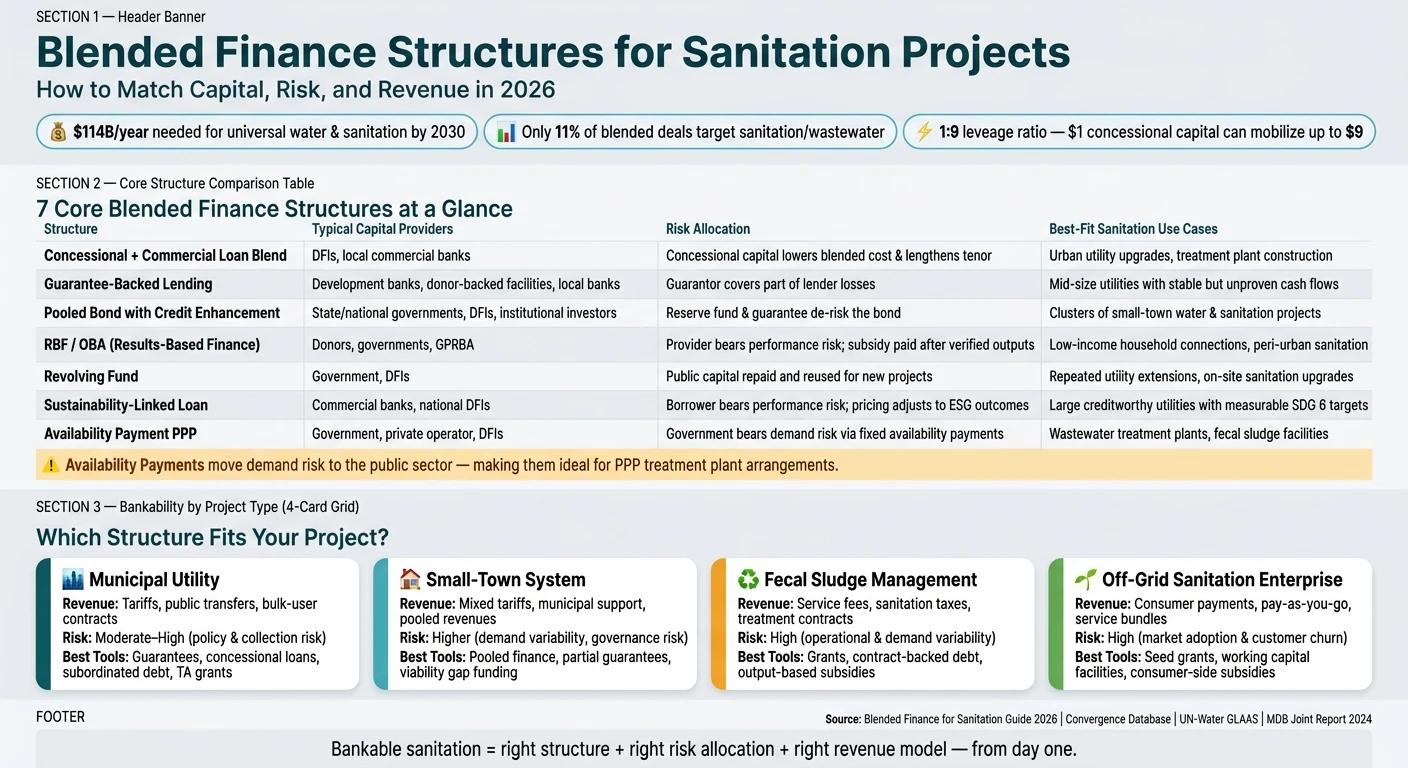
Blended Finance Structures for Sanitation Projects: A 2026 Guide
Sanitation deals tend to use a small set of core structures. The choice usually comes down to three things: revenue strength, risk, and sponsor capacity. Each structure moves risk around in a different way between governments, operators, lenders, and households. The practical task is to match the structure to the project's revenue model and its risk allocation.
Deal structures for utilities, cities, and off-grid operators
Concessional plus commercial loan blends are often the first place to start. In this setup, a development bank or donor offers a below-market loan alongside a commercial bank loan in the same capital stack. The concessional tranche brings down the blended interest rate and stretches the repayment period. That makes debt service easier for utilities whose tariffs can cover operating costs, but not the full cost of capital. A Cambodia package paired concessional lending, grants, and a guarantee to unlock commercial finance for domestic operators.
Guarantees are among the most common credit-support tools in the sector. A development bank or donor-backed facility agrees to cover part of a lender's losses if the borrower defaults. That partial backstop can lower perceived risk enough for local banks to step in. Guarantees tend to work best for medium to large projects with fairly steady cash flows, where a partial cushion is enough to make a commercial loan workable.
Pooled financing vehicles and bonds with credit enhancement address a different barrier: scale. Many sanitation projects in small and mid-sized towns are simply too small on their own to interest institutional investors. Bundling several investments into one fund or bond issuance creates more scale and spreads risk across assets. That mix is often what larger investors need. India's Tamil Nadu pooled fund bundled small water and sanitation projects with credit enhancement to reach bankable scale [15][16].
Results-based finance (RBF) and output-based aid (OBA) tie subsidy payments to independently verified outputs, such as new household connections, working latrines, or lower pollution loads. The mechanism is simple: service providers pre-finance the work, then receive grants or subsidies only after they hit agreed targets. In Bangladesh, subsidies of just $5–$16 per household paid to microfinance institutions after verification of installed sanitation facilities were enough to improve bankability for low-income household sanitation investments [13][14].
Sustainability-linked lending connects loan pricing to preset performance indicators, such as more connections or lower emissions from treatment plants. This structure fits larger, creditworthy utilities that already have access to capital markets but want financing terms linked to SDG 6 targets. It also relies on strong data systems for tracking performance, which limits use for now to more capable institutions [10][12].
Entity-level versus project-level financing: a comparison
A central choice in sanitation finance is whether to lend to the utility or municipality as a whole, or to isolate a single project inside a special-purpose vehicle (SPV). Strong utilities often borrow at the entity level. More fragmented or higher-risk projects often need project-level ring-fencing.
Attribute | Entity-Level Financing | Project-Level (SPV) Financing |
|---|---|---|
Use Case | Established utilities, municipal capital programs | New infrastructure, high-risk decentralized systems, PPPs |
Strengths | Lower transaction costs; flexible capital allocation across projects | Ring-fenced risk; clear impact measurement; tailored blended instruments |
Weaknesses | Risk not isolated; limited by sponsor's overall debt capacity | High setup costs; harder to attract investors for small tickets alone |
Revenue Dependence | Aggregate tariffs, transfers, and entity-wide income | Project-specific user fees, availability payments, or reuse revenues |
Investor Fit | Commercial banks, national development banks, institutional ESG investors | DFIs, impact funds, donor-backed facilities, pooled outcome vehicles |
Entity-level financing is simpler to run and usually works well when the sponsor has a solid track record, mixed revenue sources, and clear governance. Project-level structures take more legal and structuring work up front, but they make it easier to show impact and apply targeted tools such as OBA subsidies or guarantees to one asset. In plain terms, the structure has to fit the project's cash flow and the sponsor's balance sheet.
Choosing a structure based on revenue and risk
Revenue certainty is the biggest driver of structure choice. When tariffs reflect costs and collection rates are strong, commercial lenders are more willing to join in. In those cases, blended finance can focus on targeted risk reduction instead of heavy subsidy. When tariffs are low because of affordability limits or political choices, concessional finance and output-based subsidies do more of the work, and donors or governments take on more revenue risk.
Structure | Typical Capital Providers | Risk Allocation | Best-Fit Sanitation Use Cases |
|---|---|---|---|
Concessional + commercial loan blend | DFIs, local commercial banks | Concessional capital lowers blended financing costs and lengthens tenor; commercial lenders provide debt | Urban utility upgrades, treatment plant construction |
Guarantee-backed lending | Development banks, donor-backed facilities, local banks | Guarantor covers part of lender losses; lender still faces project and credit risk | Mid-size utilities with stable but unproven cash flows |
Pooled bond with credit enhancement | State/national governments, DFIs, institutional investors | Reserve fund and guarantee improve credit and help de-risk the bond | Clusters of small-town water and sanitation projects |
RBF / OBA | Donors, governments, GPRBA | Provider bears performance risk; subsidy is paid after verified outputs | Low-income household connections, peri-urban sanitation |
Revolving fund | Government, DFIs | Public capital is repaid and reused for new projects | Repeated utility extensions, on-site sanitation upgrades |
Sustainability-linked loan | Commercial banks, national DFIs | Borrower bears performance risk; pricing adjusts to ESG outcomes | Large creditworthy utilities with measurable SDG 6 targets |
Availability payment PPP | Government, private operator, DFIs | Government bears demand risk through fixed availability payments | Wastewater treatment plants, fecal sludge facilities |
Availability payments deserve a separate note. These are fixed government payments made only when the asset is available for service. They move demand risk to the public sector while giving private investors a more predictable income stream. That is why they show up so often in PPP arrangements for treatment plants and fecal sludge management facilities.
The next section tests these structures against bankability screening, affordability, and subsidy design.
Screening and preparing sanitation projects for bankability
Once the structure is set, the next job is simple to say and hard to do: check the sponsor, site, revenue base, and permits before going out to funders.
The chosen deal structure should shape the screen. Entity-level deals lean hard on sponsor strength. Project-level deals lean on site control, permits, and contract readiness.
A project screening checklist for 2026
Start with the service gap. Population figures alone won't carry a financing case. Funders want to see who will use the service, how often they’ll use it, and whether demand changes by season or location. If demand is still murky, phased rollout can help. So can anchor customers like schools, health clinics, or commercial users, since they make early cash flow less shaky.
Sponsor strength and regulatory readiness come next, and they come early for a reason. Check demand, sponsor capacity, permits, and site control first; if those pieces aren’t there, the deal isn’t ready. A weak sponsor doesn’t always kill a project, but it does change the path. In that case, lenders will usually want a stronger implementation partner, an escrow arrangement, or a performance-based contract before they step in. Permit readiness also needs to be treated as a hard requirement. Tariff-setting authority, environmental permits, discharge standards, and concession approvals must already exist or sit on a documented, believable timeline.
Land and site control can look like a routine legal item until it stops a project cold. Treatment plants, transfer stations, and fecal sludge facilities have been delayed for years because ownership or access rights were unclear. That’s why site control should be secured before approaching funders, or the sponsor should be able to show a clear legal path to get there.
Cost modeling has to go past the build phase. A bankable project needs full lifecycle costs, not just capex. That means construction, operations, maintenance, sludge transport, energy, staffing, and replacement. Every line should be stress-tested using conservative assumptions. If the numbers only work in a best-case scenario, lenders will spot it fast.
Climate and social risks now sit much closer to the center of project screening. Flooding, drought, sea-level rise, heat, and extreme rainfall can damage assets and drive up long-term costs. At the same time, public distrust around tariffs or siting can sink even a sound technical design. Funders now look for proof that the project can serve vulnerable groups safely, with attention to health, gender, labor, displacement, and environmental risk. They also want a monitoring plan that shows how service levels and impact indicators will be checked after launch.
Revenue models, affordability, and subsidy design
Revenue testing is where many sanitation deals either tighten up or start to wobble. Tariffs, connection fees, transfers, and subsidies need to be tested against opex and debt service. If tariffs sit below cost recovery, the funding gap has to be matched to a legal source of support. And if that support depends on public money, the next question is blunt: is that commitment legally in place?
Project appraisal should compare required and expected revenue and determine the level of subsidies or concessional resources needed to keep private participation affordable [18]. Willingness to pay is a better test than income alone because it reflects real use [17].
Subsidies should fill the gap between what users can afford and the full cost of service. They should not hide a business model that doesn’t work. Targeted subsidies and social protection tools usually perform better than blanket subsidies because they protect low-income users without weakening pressure for cost control. Collection risk can also be cut in practical ways. Prepaid systems, mobile payment platforms, master billing arrangements, and municipal payment guarantees can all make revenue more predictable from a lender’s point of view.
Bankability by project type
The best financing tool depends on two things: where revenue is strongest and where risk lands.
Project Type | Typical Revenue Model | Risk Profile | Data Needs | Suitable Blended Instruments |
|---|---|---|---|---|
Municipal utility | Tariffs, public transfers, bulk-user contracts | Moderate to high: policy and collection risk | Utility financials, tariff adequacy, non-revenue water, O&M recovery rates | Guarantees, subordinated debt, concessional loans, TA grants |
Small-town system | Mixed tariffs, municipal support, pooled revenues | Higher: demand variability and governance risk | Demand forecast, local affordability data, sponsor capacity assessment | Pooled finance, project prep grants, partial guarantees, viability gap funding |
Fecal sludge management | Service fees, sanitation taxes, treatment contracts | High: operational and demand variability | Desludging volumes, route logistics, treatment plant throughput | Grants, revenue-based loans, contract-backed debt, output-based subsidies |
Off-grid sanitation enterprise | Consumer payments, pay-as-you-go, service bundles | High: market adoption and customer churn risk | Customer behavior, willingness to pay, unit economics | Seed grants, working capital facilities, flexible debt, consumer-side subsidies |
For sponsors with thin data or little transaction experience, technical assistance grants are often the right first step. Project preparation - feasibility studies, financial modeling, safeguards assessments, and harmonized performance metrics - is consistently cited as the binding constraint that keeps otherwise viable sanitation projects from reaching investment-ready status [11][1].
The next filter is whether policy, institutions, and implementation roles can support the financing plan.
Policy support, implementation pathways, and conclusion
Policy and institutional conditions that improve deal flow
A sound capital stack isn't enough. Laws, tariffs, and utility governance have to support repayment too. After a project is screened and structured, policy and institutions decide whether capital can actually close.
Tariff rules need to be legally clear and steady enough for lenders to model cash flow. If tariff-setting authority is vague or open to political override, even well-built deals can stall. Subsidy frameworks also need to be transparent, timely, and legally committed. Lenders want to know whether public support is a legal commitment or a political promise. [14][22][23]
Municipal borrowing authority is a practical bottleneck that can stop a deal cold. Cities need defined instruments - pooled funds, green bonds, climate-resilient municipal bonds - and clear approval paths before they can legally reach long-term capital. They also need pipeline-ready plans that bundle networks, treatment, sludge management, and collection into a single borrowing case. PPP rules should cover non-traditional sanitation assets like fecal sludge management facilities and scheduled desludging services, not just standard treatment plants. [19][20]
Utility governance matters just as much as capital structure. Investors look for ring-fenced sanitation revenues, audited accounts, published service KPIs, and performance contracts that tie funding or bonuses to measurable results. A utility that shows steady billing, collection, maintenance, and reporting is a very different credit risk from one that leans only on stable policy support. [14][22]
Data systems sit underneath all of this. Outcomes-based finance works only when connections, treatment volumes, payment rates, and service quality are tracked with care. Digital monitoring, simple dashboards, and periodic third-party verification help cut disputes over whether outcomes were achieved. [9][21]
These conditions don't look the same everywhere. They show up one way in utility upgrades, another in PPP service zones, and another in decentralized enterprise models.
Implementation pathways in public and private settings
The same rules play out in different ways depending on the delivery model.
A mid-sized city utility restoring an aging treatment plant may pair concessional capital for construction with a results-based tranche released only after verified milestones, such as effluent compliance, connection rates, and collection ratios. That setup works when the utility has clear revenue authority and a billing record lenders can trust.
A public-private fecal sludge service model gives service standards, zone boundaries, and oversight to the public authority, while a private operator manages collection, transport, and treatment under a performance-based contract. In that case, financing depends on a predictable municipal payment stream, user fees, or a mix of both.
A decentralized household sanitation enterprise scaling a pay-as-you-go product may rely on working capital facilities and first-loss support to enter new markets. But scale doesn't come from finance alone. The unit economics have to hold, and customer acquisition has to be repeatable.
Key rules for blended sanitation finance in 2026
Blended finance can move capital into deals that pure public funding can't reach and that commercial lenders won't touch without risk mitigation - but only when the enabling environment is already in place. The deals that move are the ones where finance, resilience, and stakeholder planning are built together from day one, not added later as an afterthought.
A few rules stand out:
Investor roles need to line up clearly with risk tolerance.
Legal, tariff, and governance conditions need to be in place before the capital stack is assembled.
Project design has to reflect actual revenue capacity, not just funding ambition.
In 2026, the sanitation deals that win will be the ones that match legal authority, revenue reality, and risk sharing from the start.
FAQs
What is blended finance in sanitation?
Blended finance in sanitation brings together public, philanthropic, and concessional funding with private investment to help close funding gaps.
In practice, public or philanthropic funds take on early risk through tools like first-loss capital, loan guarantees, or concessional loans. That risk buffer can improve a project's creditworthiness and make sanitation projects more appealing to private investors.
Which sanitation projects best fit private capital?
Projects that fit private capital best are bankable. In plain terms, that means they have a clear path to revenue or cost recovery, plus measurable outcomes that help cut investor risk.
Good examples include modern water treatment plants, decentralized systems, and green infrastructure such as stormwater management. Regional collaboration and public-private partnerships can also strengthen the case. They help shift performance risk to private partners and support steadier, long-term returns.
What makes a sanitation project bankable?
A sanitation project is bankable when it shows a strong chance of delivery and a clear route to paying back the money in a way that can draw private capital. It also helps when investors already know the sector, want exposure to it, and trust that the municipality can handle the financing well.
Bankability gets stronger with solid work at the start. That includes feasibility studies, impact assessments, and blended finance that lowers risk for investors. Early engagement with stakeholders matters too. So do transparency and standardized processes, because they make the project easier to assess and easier to trust.
Related Blog Posts
Latest Articles
©2026

Narrative Change and Power Building: The Missing Half of Advocacy
Narrative change is the process of disrupting dominant narratives that normalize inequity and advancing new narratives from historically marginalized communities.

Funding Resilience Without Federal Grants
BRIC is unreliable and FEMA is shrinking. Here's how cities fund climate resilience with dedicated revenue, blended finance, and a coordinating authority.

The ESG Blind Spot: How AI Is Finding Risks in Companies Nobody Else Is Watching
Norway's sovereign wealth fund uses AI to screen 7,200 portfolio companies for forced labor and corruption within 24 hours. The real story is the emerging-market coverage gap that traditional ESG data vendors miss — and what it means for any company with a global supply chain.
Narrative Change and Power Building: The Missing Half of Advocacy
Narrative change is the process of disrupting dominant narratives that normalize inequity and advancing new narratives from historically marginalized communities.
Funding Resilience Without Federal Grants
BRIC is unreliable and FEMA is shrinking. Here's how cities fund climate resilience with dedicated revenue, blended finance, and a coordinating authority.
The ESG Blind Spot: How AI Is Finding Risks in Companies Nobody Else Is Watching
Norway's sovereign wealth fund uses AI to screen 7,200 portfolio companies for forced labor and corruption within 24 hours. The real story is the emerging-market coverage gap that traditional ESG data vendors miss — and what it means for any company with a global supply chain.
FAQ
01
What does it really mean to “redefine profit”?
02
What makes Council Fire different?
03
Who does Council Fire work with?
04
What does working with Council Fire actually look like?
05
How does Council Fire help organizations turn big goals into action?
06
How does Council Fire define and measure success?
07
How does technology fit into Council Fire’s work?
Sep 2, 2026
Blended Finance for Sanitation: Guide 2026
Sustainability Strategy
In This Article
How to align grants, concessional loans, guarantees and private capital to make sanitation projects bankable.
Blended Finance for Sanitation: Guide 2026
Sanitation projects often fail to get funded for one simple reason: the money coming in does not match the risk, the payback period, or what users can afford to pay. In 2026, the fix is usually not one lender or one grant. It is a mix of public money, donor support, and private capital, each taking a different part of the risk.
I’d sum up the article this way: if you want a sanitation deal to close, you need three things lined up from the start - revenue that makes sense, public support that is legally in place, and a structure that puts risk with the party that can carry it. The article shows that this applies across sewer systems, wastewater plants, fecal sludge services, household sanitation, and decentralized models.
A few numbers make the point fast:
$114 billion per year is needed to reach universal access to safely managed water and sanitation by 2030.
Only 28 blended finance deals worth about $2.1 billion were recorded in the cited sample, and just around 11% focused on sanitation and wastewater.
Between 2012 and 2017, only about 1.4% of private finance mobilized went to water and sanitation.
UN-Water GLAAS data cited in the article show a 46% funding gap against national WASH targets in 20 countries.
In U.S. project finance, WIFIA can fund up to 49% of eligible project costs, while total federal support is capped at 80%.
If I strip the guide down to its core, here’s what matters most:
Blended finance works best when grants, concessional loans, guarantees, and private money each have a clear job.
Utilities and city wastewater systems tend to fit loan blends, guarantees, and public-backed structures.
Small-town, rural, and low-income sanitation usually need grants, output-based subsidies, or pooled finance.
Off-grid and fecal sludge businesses often need first-loss support, working capital, and payment models built around service fees.
Project preparation - permits, site control, cost modeling, tariff review, and demand testing - is often the main reason deals stall.
Policy rules matter as much as finance. If tariffs, subsidy rules, borrowing authority, and utility accounts are unclear, the deal gets weak fast.
The issue behind the issue: Closing the funding gap to solve the global water crisis
Quick comparison
Area | What the article says in plain English |
|---|---|
Main problem | Sanitation has high need, low cost recovery, and risk that private lenders do not want to take alone |
Main fix | Blend grants, public funds, concessional finance, guarantees, and private capital |
Best fit for private capital | Projects with steady cash flow, strong contracts, or public payment support |
Best fit for subsidies | Household access, low-income users, peri-urban systems, and weak-revenue service areas |
Common deal types | Loan blends, guarantees, pooled funds or bonds, RBF/OBA, revolving funds, availability-payment PPPs |
Main bankability tests | Demand, sponsor strength, permits, land, full lifecycle costs, affordability, and payment security |
Main policy tests | Tariff authority, subsidy rules, city borrowing power, utility governance, and data tracking |
Bottom line: I’d read this guide as a playbook for matching the right money to the right sanitation risk. The article’s message is simple: bankable sanitation is not just about building assets; it is about building a finance structure that fits public health goals, user affordability, and repayment reality from day one.
Market context and investor mix for sanitation projects
Sanitation finance has a plain problem: the need is far bigger than the money on the table. Blended finance helps, but it still reaches only a thin slice of the market. For a project to get funded, three things have to line up at the same time: risk, revenue, and investor appetite.
The scale gap is stark. Reaching universal access to safely managed water and sanitation by 2030 would require about $114 billion per year - roughly three times current global investment levels [2][7]. Yet Convergence's database recorded only 28 blended transactions worth about $2.1 billion, and just around 11% targeted sanitation and wastewater specifically, compared with 70% for water supply [6].
That pattern tells you a lot about where money feels safest. In 2026, blended capital tends to move first into projects with a clear path to repayment or firm public support. Urban utility upgrades and municipal wastewater systems draw multilateral and DFI lending when they are backed by tariff reform or long-term service contracts. Small-town and rural sanitation programs lean much more on grants and concessional loans because customer density is lower and affordability is tighter. Off-grid and decentralized models - including fecal sludge management and container-based sanitation - often depend on impact investors, philanthropic first-loss capital, and recurring service fees. Resource-recovery projects that produce biogas, compost, or reclaimed water can also reach climate finance and green infrastructure pools when positioned around circular economy or resilience outcomes.
The investor mix shifts with project type, the certainty of cash flow, and the level of public backing. In the U.S., federal tools such as WIFIA and State Revolving Funds (SRFs) offer long-term, lower-cost credit support that can sit alongside municipal bonds and grants to cut the total cost of capital [4][8]. WIFIA can cover up to 49% of eligible project costs, while total federal support is capped at 80%. The rest has to come from nonfederal sources, which is exactly where blended structures start to matter [4][5].
Who typically participates in sanitation deals
Investor mix follows risk and revenue. The table below shows what each group typically brings and what they expect in return.
Participant | What They Bring | What They Expect |
|---|---|---|
Governments & utilities | Public balance sheet, policy authority, service mandate | Improved service delivery, public health outcomes |
DFIs & multilateral banks | Senior loans, guarantees, anchor capital | Development impact, financial discipline, long tenors |
Philanthropic funders | Grants, first-loss capital, technical assistance funding | Measurable social outcomes, risk reduction for others |
Impact investors | Patient equity or mezzanine debt | Moderate returns, credible business model, measurable outcomes |
Local commercial banks | Debt financing for creditworthy borrowers | Contracted or guaranteed repayment, manageable risk |
Institutional investors | Large-scale capital at later stages | Investment-grade scale, stable cash flow, lower complexity |
Operators | Technical delivery, service management | Predictable payment terms, manageable performance risk |
Most capital in sanitation blended deals still comes from DFIs and MDBs rather than fully private investors [6]. That remains a key feature of the market. Private money may join, but public and development-backed institutions still do most of the heavy lifting.
MDB activity shows that attention to the sector is growing. Ten MDBs approved $19.6 billion in global water sector investments in 2024, with $14.4 billion directed to low- and middle-income countries [3]. Even so, private capital participation in sanitation remains limited.
How risk is shared to make sanitation deals investable
When repayment is shaky, the structure has to take some of the blow before private investors will step in. That is where first-loss capital, guarantees, subordinated debt, performance grants, and technical assistance come in. Each tool is meant to move a specific risk toward the party most able to carry it.
This is the heart of blended finance in sanitation. A lender may be open to the deal, but only if early losses are cushioned. An operator may be able to deliver, but only if performance risk is not loaded entirely onto the balance sheet. A municipality may support the project, but only if grant funding helps bridge the affordability gap. Put simply, the structure has to do the work that the market will not do on its own.
Blended leverage ratios in water and sanitation deals range from 1:1 up to 1:9. In other words, $1 of concessional capital can mobilize up to $9 of added investment, although the top end of that range is still not common in sanitation-specific projects [6]. Even a modest first-loss layer or guarantee can change the picture in a meaningful way for private lenders.
The role of implementation partners in sanitation programs
A lot of sanitation deals stall not because money is absent, but because the structure falls apart. Implementation partners help connect municipalities, utilities, regulators, operators, communities, and investors so policy goals can turn into bankable project documents.
That coordination work is easy to overlook, but it often decides whether a transaction closes. If the stakeholders are not aligned on payment terms, service standards, risk allocation, or public support, the capital stack will wobble. When they are aligned, the path to a workable financing structure becomes much clearer - and that leads straight into the deal structures in the next section.
Core blended finance structures used in sanitation
Blended Finance Structures for Sanitation Projects: A 2026 Guide
Sanitation deals tend to use a small set of core structures. The choice usually comes down to three things: revenue strength, risk, and sponsor capacity. Each structure moves risk around in a different way between governments, operators, lenders, and households. The practical task is to match the structure to the project's revenue model and its risk allocation.
Deal structures for utilities, cities, and off-grid operators
Concessional plus commercial loan blends are often the first place to start. In this setup, a development bank or donor offers a below-market loan alongside a commercial bank loan in the same capital stack. The concessional tranche brings down the blended interest rate and stretches the repayment period. That makes debt service easier for utilities whose tariffs can cover operating costs, but not the full cost of capital. A Cambodia package paired concessional lending, grants, and a guarantee to unlock commercial finance for domestic operators.
Guarantees are among the most common credit-support tools in the sector. A development bank or donor-backed facility agrees to cover part of a lender's losses if the borrower defaults. That partial backstop can lower perceived risk enough for local banks to step in. Guarantees tend to work best for medium to large projects with fairly steady cash flows, where a partial cushion is enough to make a commercial loan workable.
Pooled financing vehicles and bonds with credit enhancement address a different barrier: scale. Many sanitation projects in small and mid-sized towns are simply too small on their own to interest institutional investors. Bundling several investments into one fund or bond issuance creates more scale and spreads risk across assets. That mix is often what larger investors need. India's Tamil Nadu pooled fund bundled small water and sanitation projects with credit enhancement to reach bankable scale [15][16].
Results-based finance (RBF) and output-based aid (OBA) tie subsidy payments to independently verified outputs, such as new household connections, working latrines, or lower pollution loads. The mechanism is simple: service providers pre-finance the work, then receive grants or subsidies only after they hit agreed targets. In Bangladesh, subsidies of just $5–$16 per household paid to microfinance institutions after verification of installed sanitation facilities were enough to improve bankability for low-income household sanitation investments [13][14].
Sustainability-linked lending connects loan pricing to preset performance indicators, such as more connections or lower emissions from treatment plants. This structure fits larger, creditworthy utilities that already have access to capital markets but want financing terms linked to SDG 6 targets. It also relies on strong data systems for tracking performance, which limits use for now to more capable institutions [10][12].
Entity-level versus project-level financing: a comparison
A central choice in sanitation finance is whether to lend to the utility or municipality as a whole, or to isolate a single project inside a special-purpose vehicle (SPV). Strong utilities often borrow at the entity level. More fragmented or higher-risk projects often need project-level ring-fencing.
Attribute | Entity-Level Financing | Project-Level (SPV) Financing |
|---|---|---|
Use Case | Established utilities, municipal capital programs | New infrastructure, high-risk decentralized systems, PPPs |
Strengths | Lower transaction costs; flexible capital allocation across projects | Ring-fenced risk; clear impact measurement; tailored blended instruments |
Weaknesses | Risk not isolated; limited by sponsor's overall debt capacity | High setup costs; harder to attract investors for small tickets alone |
Revenue Dependence | Aggregate tariffs, transfers, and entity-wide income | Project-specific user fees, availability payments, or reuse revenues |
Investor Fit | Commercial banks, national development banks, institutional ESG investors | DFIs, impact funds, donor-backed facilities, pooled outcome vehicles |
Entity-level financing is simpler to run and usually works well when the sponsor has a solid track record, mixed revenue sources, and clear governance. Project-level structures take more legal and structuring work up front, but they make it easier to show impact and apply targeted tools such as OBA subsidies or guarantees to one asset. In plain terms, the structure has to fit the project's cash flow and the sponsor's balance sheet.
Choosing a structure based on revenue and risk
Revenue certainty is the biggest driver of structure choice. When tariffs reflect costs and collection rates are strong, commercial lenders are more willing to join in. In those cases, blended finance can focus on targeted risk reduction instead of heavy subsidy. When tariffs are low because of affordability limits or political choices, concessional finance and output-based subsidies do more of the work, and donors or governments take on more revenue risk.
Structure | Typical Capital Providers | Risk Allocation | Best-Fit Sanitation Use Cases |
|---|---|---|---|
Concessional + commercial loan blend | DFIs, local commercial banks | Concessional capital lowers blended financing costs and lengthens tenor; commercial lenders provide debt | Urban utility upgrades, treatment plant construction |
Guarantee-backed lending | Development banks, donor-backed facilities, local banks | Guarantor covers part of lender losses; lender still faces project and credit risk | Mid-size utilities with stable but unproven cash flows |
Pooled bond with credit enhancement | State/national governments, DFIs, institutional investors | Reserve fund and guarantee improve credit and help de-risk the bond | Clusters of small-town water and sanitation projects |
RBF / OBA | Donors, governments, GPRBA | Provider bears performance risk; subsidy is paid after verified outputs | Low-income household connections, peri-urban sanitation |
Revolving fund | Government, DFIs | Public capital is repaid and reused for new projects | Repeated utility extensions, on-site sanitation upgrades |
Sustainability-linked loan | Commercial banks, national DFIs | Borrower bears performance risk; pricing adjusts to ESG outcomes | Large creditworthy utilities with measurable SDG 6 targets |
Availability payment PPP | Government, private operator, DFIs | Government bears demand risk through fixed availability payments | Wastewater treatment plants, fecal sludge facilities |
Availability payments deserve a separate note. These are fixed government payments made only when the asset is available for service. They move demand risk to the public sector while giving private investors a more predictable income stream. That is why they show up so often in PPP arrangements for treatment plants and fecal sludge management facilities.
The next section tests these structures against bankability screening, affordability, and subsidy design.
Screening and preparing sanitation projects for bankability
Once the structure is set, the next job is simple to say and hard to do: check the sponsor, site, revenue base, and permits before going out to funders.
The chosen deal structure should shape the screen. Entity-level deals lean hard on sponsor strength. Project-level deals lean on site control, permits, and contract readiness.
A project screening checklist for 2026
Start with the service gap. Population figures alone won't carry a financing case. Funders want to see who will use the service, how often they’ll use it, and whether demand changes by season or location. If demand is still murky, phased rollout can help. So can anchor customers like schools, health clinics, or commercial users, since they make early cash flow less shaky.
Sponsor strength and regulatory readiness come next, and they come early for a reason. Check demand, sponsor capacity, permits, and site control first; if those pieces aren’t there, the deal isn’t ready. A weak sponsor doesn’t always kill a project, but it does change the path. In that case, lenders will usually want a stronger implementation partner, an escrow arrangement, or a performance-based contract before they step in. Permit readiness also needs to be treated as a hard requirement. Tariff-setting authority, environmental permits, discharge standards, and concession approvals must already exist or sit on a documented, believable timeline.
Land and site control can look like a routine legal item until it stops a project cold. Treatment plants, transfer stations, and fecal sludge facilities have been delayed for years because ownership or access rights were unclear. That’s why site control should be secured before approaching funders, or the sponsor should be able to show a clear legal path to get there.
Cost modeling has to go past the build phase. A bankable project needs full lifecycle costs, not just capex. That means construction, operations, maintenance, sludge transport, energy, staffing, and replacement. Every line should be stress-tested using conservative assumptions. If the numbers only work in a best-case scenario, lenders will spot it fast.
Climate and social risks now sit much closer to the center of project screening. Flooding, drought, sea-level rise, heat, and extreme rainfall can damage assets and drive up long-term costs. At the same time, public distrust around tariffs or siting can sink even a sound technical design. Funders now look for proof that the project can serve vulnerable groups safely, with attention to health, gender, labor, displacement, and environmental risk. They also want a monitoring plan that shows how service levels and impact indicators will be checked after launch.
Revenue models, affordability, and subsidy design
Revenue testing is where many sanitation deals either tighten up or start to wobble. Tariffs, connection fees, transfers, and subsidies need to be tested against opex and debt service. If tariffs sit below cost recovery, the funding gap has to be matched to a legal source of support. And if that support depends on public money, the next question is blunt: is that commitment legally in place?
Project appraisal should compare required and expected revenue and determine the level of subsidies or concessional resources needed to keep private participation affordable [18]. Willingness to pay is a better test than income alone because it reflects real use [17].
Subsidies should fill the gap between what users can afford and the full cost of service. They should not hide a business model that doesn’t work. Targeted subsidies and social protection tools usually perform better than blanket subsidies because they protect low-income users without weakening pressure for cost control. Collection risk can also be cut in practical ways. Prepaid systems, mobile payment platforms, master billing arrangements, and municipal payment guarantees can all make revenue more predictable from a lender’s point of view.
Bankability by project type
The best financing tool depends on two things: where revenue is strongest and where risk lands.
Project Type | Typical Revenue Model | Risk Profile | Data Needs | Suitable Blended Instruments |
|---|---|---|---|---|
Municipal utility | Tariffs, public transfers, bulk-user contracts | Moderate to high: policy and collection risk | Utility financials, tariff adequacy, non-revenue water, O&M recovery rates | Guarantees, subordinated debt, concessional loans, TA grants |
Small-town system | Mixed tariffs, municipal support, pooled revenues | Higher: demand variability and governance risk | Demand forecast, local affordability data, sponsor capacity assessment | Pooled finance, project prep grants, partial guarantees, viability gap funding |
Fecal sludge management | Service fees, sanitation taxes, treatment contracts | High: operational and demand variability | Desludging volumes, route logistics, treatment plant throughput | Grants, revenue-based loans, contract-backed debt, output-based subsidies |
Off-grid sanitation enterprise | Consumer payments, pay-as-you-go, service bundles | High: market adoption and customer churn risk | Customer behavior, willingness to pay, unit economics | Seed grants, working capital facilities, flexible debt, consumer-side subsidies |
For sponsors with thin data or little transaction experience, technical assistance grants are often the right first step. Project preparation - feasibility studies, financial modeling, safeguards assessments, and harmonized performance metrics - is consistently cited as the binding constraint that keeps otherwise viable sanitation projects from reaching investment-ready status [11][1].
The next filter is whether policy, institutions, and implementation roles can support the financing plan.
Policy support, implementation pathways, and conclusion
Policy and institutional conditions that improve deal flow
A sound capital stack isn't enough. Laws, tariffs, and utility governance have to support repayment too. After a project is screened and structured, policy and institutions decide whether capital can actually close.
Tariff rules need to be legally clear and steady enough for lenders to model cash flow. If tariff-setting authority is vague or open to political override, even well-built deals can stall. Subsidy frameworks also need to be transparent, timely, and legally committed. Lenders want to know whether public support is a legal commitment or a political promise. [14][22][23]
Municipal borrowing authority is a practical bottleneck that can stop a deal cold. Cities need defined instruments - pooled funds, green bonds, climate-resilient municipal bonds - and clear approval paths before they can legally reach long-term capital. They also need pipeline-ready plans that bundle networks, treatment, sludge management, and collection into a single borrowing case. PPP rules should cover non-traditional sanitation assets like fecal sludge management facilities and scheduled desludging services, not just standard treatment plants. [19][20]
Utility governance matters just as much as capital structure. Investors look for ring-fenced sanitation revenues, audited accounts, published service KPIs, and performance contracts that tie funding or bonuses to measurable results. A utility that shows steady billing, collection, maintenance, and reporting is a very different credit risk from one that leans only on stable policy support. [14][22]
Data systems sit underneath all of this. Outcomes-based finance works only when connections, treatment volumes, payment rates, and service quality are tracked with care. Digital monitoring, simple dashboards, and periodic third-party verification help cut disputes over whether outcomes were achieved. [9][21]
These conditions don't look the same everywhere. They show up one way in utility upgrades, another in PPP service zones, and another in decentralized enterprise models.
Implementation pathways in public and private settings
The same rules play out in different ways depending on the delivery model.
A mid-sized city utility restoring an aging treatment plant may pair concessional capital for construction with a results-based tranche released only after verified milestones, such as effluent compliance, connection rates, and collection ratios. That setup works when the utility has clear revenue authority and a billing record lenders can trust.
A public-private fecal sludge service model gives service standards, zone boundaries, and oversight to the public authority, while a private operator manages collection, transport, and treatment under a performance-based contract. In that case, financing depends on a predictable municipal payment stream, user fees, or a mix of both.
A decentralized household sanitation enterprise scaling a pay-as-you-go product may rely on working capital facilities and first-loss support to enter new markets. But scale doesn't come from finance alone. The unit economics have to hold, and customer acquisition has to be repeatable.
Key rules for blended sanitation finance in 2026
Blended finance can move capital into deals that pure public funding can't reach and that commercial lenders won't touch without risk mitigation - but only when the enabling environment is already in place. The deals that move are the ones where finance, resilience, and stakeholder planning are built together from day one, not added later as an afterthought.
A few rules stand out:
Investor roles need to line up clearly with risk tolerance.
Legal, tariff, and governance conditions need to be in place before the capital stack is assembled.
Project design has to reflect actual revenue capacity, not just funding ambition.
In 2026, the sanitation deals that win will be the ones that match legal authority, revenue reality, and risk sharing from the start.
FAQs
What is blended finance in sanitation?
Blended finance in sanitation brings together public, philanthropic, and concessional funding with private investment to help close funding gaps.
In practice, public or philanthropic funds take on early risk through tools like first-loss capital, loan guarantees, or concessional loans. That risk buffer can improve a project's creditworthiness and make sanitation projects more appealing to private investors.
Which sanitation projects best fit private capital?
Projects that fit private capital best are bankable. In plain terms, that means they have a clear path to revenue or cost recovery, plus measurable outcomes that help cut investor risk.
Good examples include modern water treatment plants, decentralized systems, and green infrastructure such as stormwater management. Regional collaboration and public-private partnerships can also strengthen the case. They help shift performance risk to private partners and support steadier, long-term returns.
What makes a sanitation project bankable?
A sanitation project is bankable when it shows a strong chance of delivery and a clear route to paying back the money in a way that can draw private capital. It also helps when investors already know the sector, want exposure to it, and trust that the municipality can handle the financing well.
Bankability gets stronger with solid work at the start. That includes feasibility studies, impact assessments, and blended finance that lowers risk for investors. Early engagement with stakeholders matters too. So do transparency and standardized processes, because they make the project easier to assess and easier to trust.
Related Blog Posts
Latest Articles
©2026
Narrative Change and Power Building: The Missing Half of Advocacy
Narrative change is the process of disrupting dominant narratives that normalize inequity and advancing new narratives from historically marginalized communities.
Funding Resilience Without Federal Grants
BRIC is unreliable and FEMA is shrinking. Here's how cities fund climate resilience with dedicated revenue, blended finance, and a coordinating authority.
The ESG Blind Spot: How AI Is Finding Risks in Companies Nobody Else Is Watching
Norway's sovereign wealth fund uses AI to screen 7,200 portfolio companies for forced labor and corruption within 24 hours. The real story is the emerging-market coverage gap that traditional ESG data vendors miss — and what it means for any company with a global supply chain.
FAQ
01
What does it really mean to “redefine profit”?
02
What makes Council Fire different?
03
Who does Council Fire work with?
04
What does working with Council Fire actually look like?
05
How does Council Fire help organizations turn big goals into action?
06
How does Council Fire define and measure success?
07
How does technology fit into Council Fire’s work?
Sep 2, 2026
Blended Finance for Sanitation: Guide 2026
Sustainability Strategy
In This Article
How to align grants, concessional loans, guarantees and private capital to make sanitation projects bankable.
Blended Finance for Sanitation: Guide 2026
Sanitation projects often fail to get funded for one simple reason: the money coming in does not match the risk, the payback period, or what users can afford to pay. In 2026, the fix is usually not one lender or one grant. It is a mix of public money, donor support, and private capital, each taking a different part of the risk.
I’d sum up the article this way: if you want a sanitation deal to close, you need three things lined up from the start - revenue that makes sense, public support that is legally in place, and a structure that puts risk with the party that can carry it. The article shows that this applies across sewer systems, wastewater plants, fecal sludge services, household sanitation, and decentralized models.
A few numbers make the point fast:
$114 billion per year is needed to reach universal access to safely managed water and sanitation by 2030.
Only 28 blended finance deals worth about $2.1 billion were recorded in the cited sample, and just around 11% focused on sanitation and wastewater.
Between 2012 and 2017, only about 1.4% of private finance mobilized went to water and sanitation.
UN-Water GLAAS data cited in the article show a 46% funding gap against national WASH targets in 20 countries.
In U.S. project finance, WIFIA can fund up to 49% of eligible project costs, while total federal support is capped at 80%.
If I strip the guide down to its core, here’s what matters most:
Blended finance works best when grants, concessional loans, guarantees, and private money each have a clear job.
Utilities and city wastewater systems tend to fit loan blends, guarantees, and public-backed structures.
Small-town, rural, and low-income sanitation usually need grants, output-based subsidies, or pooled finance.
Off-grid and fecal sludge businesses often need first-loss support, working capital, and payment models built around service fees.
Project preparation - permits, site control, cost modeling, tariff review, and demand testing - is often the main reason deals stall.
Policy rules matter as much as finance. If tariffs, subsidy rules, borrowing authority, and utility accounts are unclear, the deal gets weak fast.
The issue behind the issue: Closing the funding gap to solve the global water crisis
Quick comparison
Area | What the article says in plain English |
|---|---|
Main problem | Sanitation has high need, low cost recovery, and risk that private lenders do not want to take alone |
Main fix | Blend grants, public funds, concessional finance, guarantees, and private capital |
Best fit for private capital | Projects with steady cash flow, strong contracts, or public payment support |
Best fit for subsidies | Household access, low-income users, peri-urban systems, and weak-revenue service areas |
Common deal types | Loan blends, guarantees, pooled funds or bonds, RBF/OBA, revolving funds, availability-payment PPPs |
Main bankability tests | Demand, sponsor strength, permits, land, full lifecycle costs, affordability, and payment security |
Main policy tests | Tariff authority, subsidy rules, city borrowing power, utility governance, and data tracking |
Bottom line: I’d read this guide as a playbook for matching the right money to the right sanitation risk. The article’s message is simple: bankable sanitation is not just about building assets; it is about building a finance structure that fits public health goals, user affordability, and repayment reality from day one.
Market context and investor mix for sanitation projects
Sanitation finance has a plain problem: the need is far bigger than the money on the table. Blended finance helps, but it still reaches only a thin slice of the market. For a project to get funded, three things have to line up at the same time: risk, revenue, and investor appetite.
The scale gap is stark. Reaching universal access to safely managed water and sanitation by 2030 would require about $114 billion per year - roughly three times current global investment levels [2][7]. Yet Convergence's database recorded only 28 blended transactions worth about $2.1 billion, and just around 11% targeted sanitation and wastewater specifically, compared with 70% for water supply [6].
That pattern tells you a lot about where money feels safest. In 2026, blended capital tends to move first into projects with a clear path to repayment or firm public support. Urban utility upgrades and municipal wastewater systems draw multilateral and DFI lending when they are backed by tariff reform or long-term service contracts. Small-town and rural sanitation programs lean much more on grants and concessional loans because customer density is lower and affordability is tighter. Off-grid and decentralized models - including fecal sludge management and container-based sanitation - often depend on impact investors, philanthropic first-loss capital, and recurring service fees. Resource-recovery projects that produce biogas, compost, or reclaimed water can also reach climate finance and green infrastructure pools when positioned around circular economy or resilience outcomes.
The investor mix shifts with project type, the certainty of cash flow, and the level of public backing. In the U.S., federal tools such as WIFIA and State Revolving Funds (SRFs) offer long-term, lower-cost credit support that can sit alongside municipal bonds and grants to cut the total cost of capital [4][8]. WIFIA can cover up to 49% of eligible project costs, while total federal support is capped at 80%. The rest has to come from nonfederal sources, which is exactly where blended structures start to matter [4][5].
Who typically participates in sanitation deals
Investor mix follows risk and revenue. The table below shows what each group typically brings and what they expect in return.
Participant | What They Bring | What They Expect |
|---|---|---|
Governments & utilities | Public balance sheet, policy authority, service mandate | Improved service delivery, public health outcomes |
DFIs & multilateral banks | Senior loans, guarantees, anchor capital | Development impact, financial discipline, long tenors |
Philanthropic funders | Grants, first-loss capital, technical assistance funding | Measurable social outcomes, risk reduction for others |
Impact investors | Patient equity or mezzanine debt | Moderate returns, credible business model, measurable outcomes |
Local commercial banks | Debt financing for creditworthy borrowers | Contracted or guaranteed repayment, manageable risk |
Institutional investors | Large-scale capital at later stages | Investment-grade scale, stable cash flow, lower complexity |
Operators | Technical delivery, service management | Predictable payment terms, manageable performance risk |
Most capital in sanitation blended deals still comes from DFIs and MDBs rather than fully private investors [6]. That remains a key feature of the market. Private money may join, but public and development-backed institutions still do most of the heavy lifting.
MDB activity shows that attention to the sector is growing. Ten MDBs approved $19.6 billion in global water sector investments in 2024, with $14.4 billion directed to low- and middle-income countries [3]. Even so, private capital participation in sanitation remains limited.
How risk is shared to make sanitation deals investable
When repayment is shaky, the structure has to take some of the blow before private investors will step in. That is where first-loss capital, guarantees, subordinated debt, performance grants, and technical assistance come in. Each tool is meant to move a specific risk toward the party most able to carry it.
This is the heart of blended finance in sanitation. A lender may be open to the deal, but only if early losses are cushioned. An operator may be able to deliver, but only if performance risk is not loaded entirely onto the balance sheet. A municipality may support the project, but only if grant funding helps bridge the affordability gap. Put simply, the structure has to do the work that the market will not do on its own.
Blended leverage ratios in water and sanitation deals range from 1:1 up to 1:9. In other words, $1 of concessional capital can mobilize up to $9 of added investment, although the top end of that range is still not common in sanitation-specific projects [6]. Even a modest first-loss layer or guarantee can change the picture in a meaningful way for private lenders.
The role of implementation partners in sanitation programs
A lot of sanitation deals stall not because money is absent, but because the structure falls apart. Implementation partners help connect municipalities, utilities, regulators, operators, communities, and investors so policy goals can turn into bankable project documents.
That coordination work is easy to overlook, but it often decides whether a transaction closes. If the stakeholders are not aligned on payment terms, service standards, risk allocation, or public support, the capital stack will wobble. When they are aligned, the path to a workable financing structure becomes much clearer - and that leads straight into the deal structures in the next section.
Core blended finance structures used in sanitation
Blended Finance Structures for Sanitation Projects: A 2026 Guide
Sanitation deals tend to use a small set of core structures. The choice usually comes down to three things: revenue strength, risk, and sponsor capacity. Each structure moves risk around in a different way between governments, operators, lenders, and households. The practical task is to match the structure to the project's revenue model and its risk allocation.
Deal structures for utilities, cities, and off-grid operators
Concessional plus commercial loan blends are often the first place to start. In this setup, a development bank or donor offers a below-market loan alongside a commercial bank loan in the same capital stack. The concessional tranche brings down the blended interest rate and stretches the repayment period. That makes debt service easier for utilities whose tariffs can cover operating costs, but not the full cost of capital. A Cambodia package paired concessional lending, grants, and a guarantee to unlock commercial finance for domestic operators.
Guarantees are among the most common credit-support tools in the sector. A development bank or donor-backed facility agrees to cover part of a lender's losses if the borrower defaults. That partial backstop can lower perceived risk enough for local banks to step in. Guarantees tend to work best for medium to large projects with fairly steady cash flows, where a partial cushion is enough to make a commercial loan workable.
Pooled financing vehicles and bonds with credit enhancement address a different barrier: scale. Many sanitation projects in small and mid-sized towns are simply too small on their own to interest institutional investors. Bundling several investments into one fund or bond issuance creates more scale and spreads risk across assets. That mix is often what larger investors need. India's Tamil Nadu pooled fund bundled small water and sanitation projects with credit enhancement to reach bankable scale [15][16].
Results-based finance (RBF) and output-based aid (OBA) tie subsidy payments to independently verified outputs, such as new household connections, working latrines, or lower pollution loads. The mechanism is simple: service providers pre-finance the work, then receive grants or subsidies only after they hit agreed targets. In Bangladesh, subsidies of just $5–$16 per household paid to microfinance institutions after verification of installed sanitation facilities were enough to improve bankability for low-income household sanitation investments [13][14].
Sustainability-linked lending connects loan pricing to preset performance indicators, such as more connections or lower emissions from treatment plants. This structure fits larger, creditworthy utilities that already have access to capital markets but want financing terms linked to SDG 6 targets. It also relies on strong data systems for tracking performance, which limits use for now to more capable institutions [10][12].
Entity-level versus project-level financing: a comparison
A central choice in sanitation finance is whether to lend to the utility or municipality as a whole, or to isolate a single project inside a special-purpose vehicle (SPV). Strong utilities often borrow at the entity level. More fragmented or higher-risk projects often need project-level ring-fencing.
Attribute | Entity-Level Financing | Project-Level (SPV) Financing |
|---|---|---|
Use Case | Established utilities, municipal capital programs | New infrastructure, high-risk decentralized systems, PPPs |
Strengths | Lower transaction costs; flexible capital allocation across projects | Ring-fenced risk; clear impact measurement; tailored blended instruments |
Weaknesses | Risk not isolated; limited by sponsor's overall debt capacity | High setup costs; harder to attract investors for small tickets alone |
Revenue Dependence | Aggregate tariffs, transfers, and entity-wide income | Project-specific user fees, availability payments, or reuse revenues |
Investor Fit | Commercial banks, national development banks, institutional ESG investors | DFIs, impact funds, donor-backed facilities, pooled outcome vehicles |
Entity-level financing is simpler to run and usually works well when the sponsor has a solid track record, mixed revenue sources, and clear governance. Project-level structures take more legal and structuring work up front, but they make it easier to show impact and apply targeted tools such as OBA subsidies or guarantees to one asset. In plain terms, the structure has to fit the project's cash flow and the sponsor's balance sheet.
Choosing a structure based on revenue and risk
Revenue certainty is the biggest driver of structure choice. When tariffs reflect costs and collection rates are strong, commercial lenders are more willing to join in. In those cases, blended finance can focus on targeted risk reduction instead of heavy subsidy. When tariffs are low because of affordability limits or political choices, concessional finance and output-based subsidies do more of the work, and donors or governments take on more revenue risk.
Structure | Typical Capital Providers | Risk Allocation | Best-Fit Sanitation Use Cases |
|---|---|---|---|
Concessional + commercial loan blend | DFIs, local commercial banks | Concessional capital lowers blended financing costs and lengthens tenor; commercial lenders provide debt | Urban utility upgrades, treatment plant construction |
Guarantee-backed lending | Development banks, donor-backed facilities, local banks | Guarantor covers part of lender losses; lender still faces project and credit risk | Mid-size utilities with stable but unproven cash flows |
Pooled bond with credit enhancement | State/national governments, DFIs, institutional investors | Reserve fund and guarantee improve credit and help de-risk the bond | Clusters of small-town water and sanitation projects |
RBF / OBA | Donors, governments, GPRBA | Provider bears performance risk; subsidy is paid after verified outputs | Low-income household connections, peri-urban sanitation |
Revolving fund | Government, DFIs | Public capital is repaid and reused for new projects | Repeated utility extensions, on-site sanitation upgrades |
Sustainability-linked loan | Commercial banks, national DFIs | Borrower bears performance risk; pricing adjusts to ESG outcomes | Large creditworthy utilities with measurable SDG 6 targets |
Availability payment PPP | Government, private operator, DFIs | Government bears demand risk through fixed availability payments | Wastewater treatment plants, fecal sludge facilities |
Availability payments deserve a separate note. These are fixed government payments made only when the asset is available for service. They move demand risk to the public sector while giving private investors a more predictable income stream. That is why they show up so often in PPP arrangements for treatment plants and fecal sludge management facilities.
The next section tests these structures against bankability screening, affordability, and subsidy design.
Screening and preparing sanitation projects for bankability
Once the structure is set, the next job is simple to say and hard to do: check the sponsor, site, revenue base, and permits before going out to funders.
The chosen deal structure should shape the screen. Entity-level deals lean hard on sponsor strength. Project-level deals lean on site control, permits, and contract readiness.
A project screening checklist for 2026
Start with the service gap. Population figures alone won't carry a financing case. Funders want to see who will use the service, how often they’ll use it, and whether demand changes by season or location. If demand is still murky, phased rollout can help. So can anchor customers like schools, health clinics, or commercial users, since they make early cash flow less shaky.
Sponsor strength and regulatory readiness come next, and they come early for a reason. Check demand, sponsor capacity, permits, and site control first; if those pieces aren’t there, the deal isn’t ready. A weak sponsor doesn’t always kill a project, but it does change the path. In that case, lenders will usually want a stronger implementation partner, an escrow arrangement, or a performance-based contract before they step in. Permit readiness also needs to be treated as a hard requirement. Tariff-setting authority, environmental permits, discharge standards, and concession approvals must already exist or sit on a documented, believable timeline.
Land and site control can look like a routine legal item until it stops a project cold. Treatment plants, transfer stations, and fecal sludge facilities have been delayed for years because ownership or access rights were unclear. That’s why site control should be secured before approaching funders, or the sponsor should be able to show a clear legal path to get there.
Cost modeling has to go past the build phase. A bankable project needs full lifecycle costs, not just capex. That means construction, operations, maintenance, sludge transport, energy, staffing, and replacement. Every line should be stress-tested using conservative assumptions. If the numbers only work in a best-case scenario, lenders will spot it fast.
Climate and social risks now sit much closer to the center of project screening. Flooding, drought, sea-level rise, heat, and extreme rainfall can damage assets and drive up long-term costs. At the same time, public distrust around tariffs or siting can sink even a sound technical design. Funders now look for proof that the project can serve vulnerable groups safely, with attention to health, gender, labor, displacement, and environmental risk. They also want a monitoring plan that shows how service levels and impact indicators will be checked after launch.
Revenue models, affordability, and subsidy design
Revenue testing is where many sanitation deals either tighten up or start to wobble. Tariffs, connection fees, transfers, and subsidies need to be tested against opex and debt service. If tariffs sit below cost recovery, the funding gap has to be matched to a legal source of support. And if that support depends on public money, the next question is blunt: is that commitment legally in place?
Project appraisal should compare required and expected revenue and determine the level of subsidies or concessional resources needed to keep private participation affordable [18]. Willingness to pay is a better test than income alone because it reflects real use [17].
Subsidies should fill the gap between what users can afford and the full cost of service. They should not hide a business model that doesn’t work. Targeted subsidies and social protection tools usually perform better than blanket subsidies because they protect low-income users without weakening pressure for cost control. Collection risk can also be cut in practical ways. Prepaid systems, mobile payment platforms, master billing arrangements, and municipal payment guarantees can all make revenue more predictable from a lender’s point of view.
Bankability by project type
The best financing tool depends on two things: where revenue is strongest and where risk lands.
Project Type | Typical Revenue Model | Risk Profile | Data Needs | Suitable Blended Instruments |
|---|---|---|---|---|
Municipal utility | Tariffs, public transfers, bulk-user contracts | Moderate to high: policy and collection risk | Utility financials, tariff adequacy, non-revenue water, O&M recovery rates | Guarantees, subordinated debt, concessional loans, TA grants |
Small-town system | Mixed tariffs, municipal support, pooled revenues | Higher: demand variability and governance risk | Demand forecast, local affordability data, sponsor capacity assessment | Pooled finance, project prep grants, partial guarantees, viability gap funding |
Fecal sludge management | Service fees, sanitation taxes, treatment contracts | High: operational and demand variability | Desludging volumes, route logistics, treatment plant throughput | Grants, revenue-based loans, contract-backed debt, output-based subsidies |
Off-grid sanitation enterprise | Consumer payments, pay-as-you-go, service bundles | High: market adoption and customer churn risk | Customer behavior, willingness to pay, unit economics | Seed grants, working capital facilities, flexible debt, consumer-side subsidies |
For sponsors with thin data or little transaction experience, technical assistance grants are often the right first step. Project preparation - feasibility studies, financial modeling, safeguards assessments, and harmonized performance metrics - is consistently cited as the binding constraint that keeps otherwise viable sanitation projects from reaching investment-ready status [11][1].
The next filter is whether policy, institutions, and implementation roles can support the financing plan.
Policy support, implementation pathways, and conclusion
Policy and institutional conditions that improve deal flow
A sound capital stack isn't enough. Laws, tariffs, and utility governance have to support repayment too. After a project is screened and structured, policy and institutions decide whether capital can actually close.
Tariff rules need to be legally clear and steady enough for lenders to model cash flow. If tariff-setting authority is vague or open to political override, even well-built deals can stall. Subsidy frameworks also need to be transparent, timely, and legally committed. Lenders want to know whether public support is a legal commitment or a political promise. [14][22][23]
Municipal borrowing authority is a practical bottleneck that can stop a deal cold. Cities need defined instruments - pooled funds, green bonds, climate-resilient municipal bonds - and clear approval paths before they can legally reach long-term capital. They also need pipeline-ready plans that bundle networks, treatment, sludge management, and collection into a single borrowing case. PPP rules should cover non-traditional sanitation assets like fecal sludge management facilities and scheduled desludging services, not just standard treatment plants. [19][20]
Utility governance matters just as much as capital structure. Investors look for ring-fenced sanitation revenues, audited accounts, published service KPIs, and performance contracts that tie funding or bonuses to measurable results. A utility that shows steady billing, collection, maintenance, and reporting is a very different credit risk from one that leans only on stable policy support. [14][22]
Data systems sit underneath all of this. Outcomes-based finance works only when connections, treatment volumes, payment rates, and service quality are tracked with care. Digital monitoring, simple dashboards, and periodic third-party verification help cut disputes over whether outcomes were achieved. [9][21]
These conditions don't look the same everywhere. They show up one way in utility upgrades, another in PPP service zones, and another in decentralized enterprise models.
Implementation pathways in public and private settings
The same rules play out in different ways depending on the delivery model.
A mid-sized city utility restoring an aging treatment plant may pair concessional capital for construction with a results-based tranche released only after verified milestones, such as effluent compliance, connection rates, and collection ratios. That setup works when the utility has clear revenue authority and a billing record lenders can trust.
A public-private fecal sludge service model gives service standards, zone boundaries, and oversight to the public authority, while a private operator manages collection, transport, and treatment under a performance-based contract. In that case, financing depends on a predictable municipal payment stream, user fees, or a mix of both.
A decentralized household sanitation enterprise scaling a pay-as-you-go product may rely on working capital facilities and first-loss support to enter new markets. But scale doesn't come from finance alone. The unit economics have to hold, and customer acquisition has to be repeatable.
Key rules for blended sanitation finance in 2026
Blended finance can move capital into deals that pure public funding can't reach and that commercial lenders won't touch without risk mitigation - but only when the enabling environment is already in place. The deals that move are the ones where finance, resilience, and stakeholder planning are built together from day one, not added later as an afterthought.
A few rules stand out:
Investor roles need to line up clearly with risk tolerance.
Legal, tariff, and governance conditions need to be in place before the capital stack is assembled.
Project design has to reflect actual revenue capacity, not just funding ambition.
In 2026, the sanitation deals that win will be the ones that match legal authority, revenue reality, and risk sharing from the start.
FAQs
What is blended finance in sanitation?
Blended finance in sanitation brings together public, philanthropic, and concessional funding with private investment to help close funding gaps.
In practice, public or philanthropic funds take on early risk through tools like first-loss capital, loan guarantees, or concessional loans. That risk buffer can improve a project's creditworthiness and make sanitation projects more appealing to private investors.
Which sanitation projects best fit private capital?
Projects that fit private capital best are bankable. In plain terms, that means they have a clear path to revenue or cost recovery, plus measurable outcomes that help cut investor risk.
Good examples include modern water treatment plants, decentralized systems, and green infrastructure such as stormwater management. Regional collaboration and public-private partnerships can also strengthen the case. They help shift performance risk to private partners and support steadier, long-term returns.
What makes a sanitation project bankable?
A sanitation project is bankable when it shows a strong chance of delivery and a clear route to paying back the money in a way that can draw private capital. It also helps when investors already know the sector, want exposure to it, and trust that the municipality can handle the financing well.
Bankability gets stronger with solid work at the start. That includes feasibility studies, impact assessments, and blended finance that lowers risk for investors. Early engagement with stakeholders matters too. So do transparency and standardized processes, because they make the project easier to assess and easier to trust.
Related Blog Posts
Latest Articles
©2026
Narrative Change and Power Building: The Missing Half of Advocacy
Narrative change is the process of disrupting dominant narratives that normalize inequity and advancing new narratives from historically marginalized communities.
Funding Resilience Without Federal Grants
BRIC is unreliable and FEMA is shrinking. Here's how cities fund climate resilience with dedicated revenue, blended finance, and a coordinating authority.
The ESG Blind Spot: How AI Is Finding Risks in Companies Nobody Else Is Watching
Norway's sovereign wealth fund uses AI to screen 7,200 portfolio companies for forced labor and corruption within 24 hours. The real story is the emerging-market coverage gap that traditional ESG data vendors miss — and what it means for any company with a global supply chain.
FAQ
What does it really mean to “redefine profit”?
What makes Council Fire different?
Who does Council Fire work with?
What does working with Council Fire actually look like?
How does Council Fire help organizations turn big goals into action?
How does Council Fire define and measure success?
How does technology fit into Council Fire’s work?