Aug 29, 2026
How Blended Finance De-Risks Off-Grid Energy
Sustainability Strategy
In This Article
Concessional capital, guarantees, and securitization reallocate risk to make off-grid energy bankable.
How Blended Finance De-Risks Off-Grid Energy
Off-grid energy deals often fail to get funded for one reason: the risk sits in the wrong place. I’d sum it up this way: blended finance makes these projects bankable by putting grants, first-loss capital, junior debt, and guarantees under private money so lenders face less downside.
If you want the short version, here it is:
Demand risk is hard to price because customer uptake and repayment can shift.
FX risk hits when revenue is in local currency but debt is in U.S. dollars.
Policy risk can change project economics through tariffs, subsidy shifts, or licensing rules.
Blended finance moves early losses away from commercial lenders.
Sponsors still need clear covenants, reporting, reserve accounts, and repayment waterfalls.
Exit paths matter, especially through aggregation and securitization.
Two 2026 data points make the case plain:
In July 2026, the Green Guarantee Company helped mobilize $70 million through a $20 million mini-grid guarantee in Nigeria and a $50 million securitized bond tied to d.light receivables.
GGC says $100 million in capital can support up to $1 billion in guarantees, or a 1:10 ratio.
What I take from the article is simple: private capital shows up when the structure makes losses, control rights, and repayment order clear. Blended finance does not remove risk. It reallocates it to the parties most willing to take it.
Risk / Need | Main tool used | What it does |
|---|---|---|
Slow customer uptake or missed payments | First-loss capital | Takes early losses before senior lenders are hit |
FX, political, or buyer default risk | Guarantees | Shields lenders from defined downside events |
Uneven cash flow | Subordinated debt | Sits below senior debt in repayment order |
Small projects needing large investors later | Securitization | Bundles receivables into investable assets |
So my bottom line is this: off-grid energy becomes financeable when concessional money has a clear job, private lenders have a buffer, and the deal documents show exactly how stress gets handled.
How Blended Finance Works in Off-Grid Energy
Blended finance puts lower-cost, risk-taking capital underneath commercial money so private investors can step into off-grid energy deals that might otherwise feel too risky.
The Basic Logic of Risk Transfer and Catalytic Capital
The basic move is simple: place concessional capital in the first-loss layer ahead of commercial capital. If a public institution or foundation takes the first hit when losses happen, commercial lenders and investors get protection from the risks that usually stop them - default, currency swings, policy shifts, or weak customer demand. Concessional capital becomes catalytic when it takes on the early losses that keep private money on the sidelines.
In July 2026, the Green Guarantee Company mobilized $70 million through a $20 million mini-grid guarantee in Nigeria and a $50 million securitized bond for d.light's off-grid solar receivables.[1] From there, those protections are built into a capital stack with clear risk tiers.
Who Does What in a Blended Deal
Each party in a blended deal has a clear job based on how much risk it can take and what kind of return it wants. Put plainly, each layer is there to match lender and investor risk appetite.
Public agencies and philanthropies sit in the most risk-tolerant layer. They provide grants, first-loss tranches, and technical assistance. Their goal is to make the deal financeable.
DFIs sit in the middle layer. They provide subordinated loans or junior equity, take on moderate risk, and may accept below-market to market-rate returns. They also serve as anchor investors, which helps signal creditworthiness to commercial lenders.
Commercial banks and private investors sit at the senior end of the stack. They want market-rate returns and usually need junior layers or guarantees to protect principal.
Project sponsors and developers hold the structure together. They line up the initial capital, build and run the assets, and take on performance risk - especially in results-based financing, where payments come only after customer connections are verified.
Pension funds and insurers can come in later, once deals are packaged as investment-grade securitizations with first-loss protection. That division of roles is exactly what the capital stack is built to formalize.
Building the Capital Stack to Match Risk
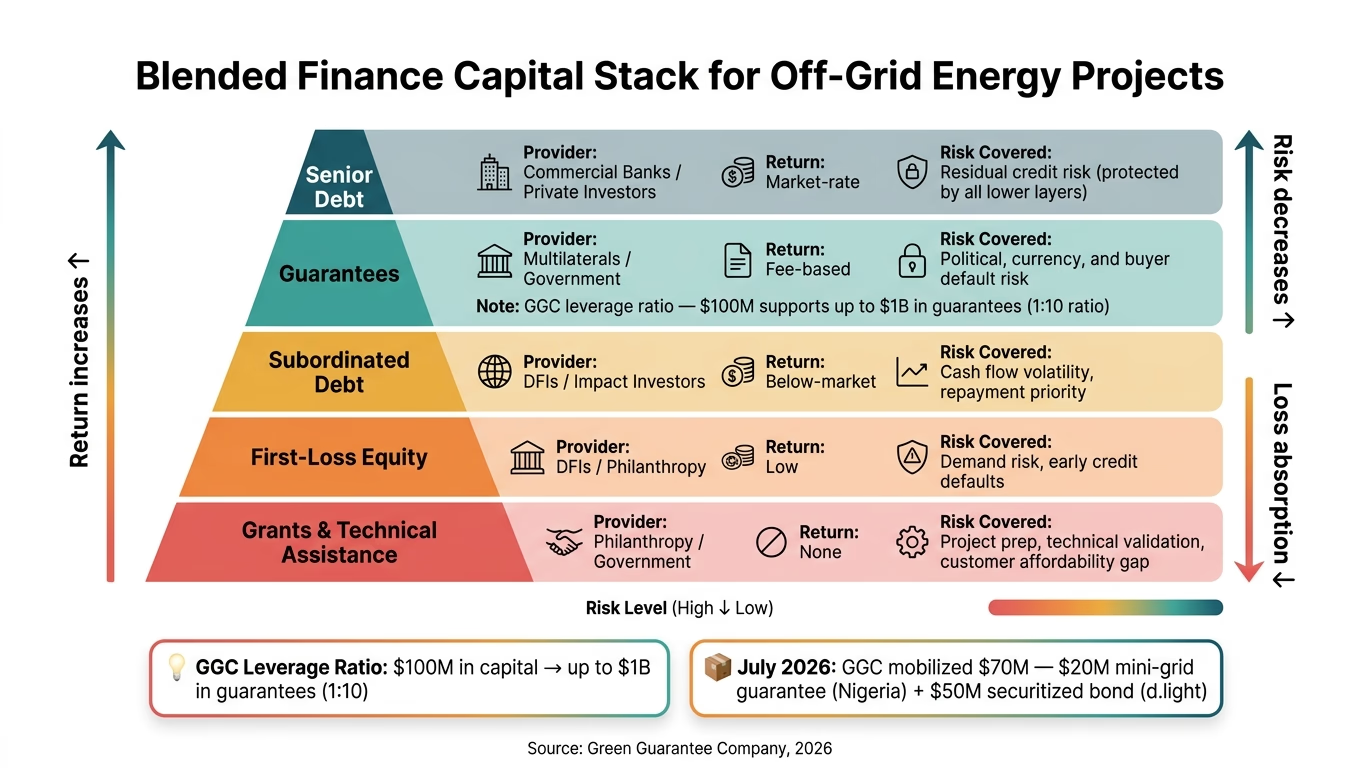
Blended Finance Capital Stack for Off-Grid Energy Projects
Once roles are clear, the deal needs to place each layer of capital where it can take the right kind of risk.
From Grants to Senior Debt: How the Stack Is Layered
The capital stack works like a loss-absorption system. Each layer is built to take losses before the layer above it gets hit. At the bottom are grants and technical assistance. These funds can pay for project prep, technical validation, and the customer affordability gap. Above that sits first-loss equity, often from DFIs or philanthropies. That layer absorbs early credit defaults and demand risk.
This setup matters. Off-grid deals often break down when demand risk, repayment issues, or policy shocks land in the wrong part of the stack.
In the middle is subordinated debt. It gets repaid only after senior lenders are paid in full, so it carries cash flow volatility and repayment priority risk. At the top is senior debt, the lowest-risk layer, because everything below it acts as a buffer. Commercial banks usually step in only when junior layers protect their principal.
Lower layers take more risk and accept lower returns.
Which Instruments Solve Which Risks
Not all instruments solve the same problem. First-loss tranches are meant for demand risk and early credit defaults - the moments when customers can’t pay or adoption comes in slower than expected. Guarantees deal with political risk, currency mismatch, and buyer default risk. The Green Guarantee Company (GGC) can support up to $1 billion in guarantees from $100 million in capital, a 1:10 leverage ratio [1].
Securitization tackles a different issue. It bundles customer payments into investment-grade securities that can draw in institutional capital. In July 2026, d.light listed a $50 million green bond on the London Stock Exchange, the first instrument of its kind to package off-grid solar customer payments into an investment-grade security [1].
The table below shows how each layer is tied to a different risk profile:
Capital Layer | Provider Type | Expected Return | Main Risk Covered |
|---|---|---|---|
Grants / Technical Assistance | Philanthropy / Government | None | Project prep, technical validation, customer affordability gap |
First-Loss Equity | DFIs / Philanthropy | Low | Demand risk, early credit defaults |
Subordinated Debt | DFIs / Impact Investors | Below-market | Cash flow volatility, repayment priority |
Senior Debt | Commercial Banks | Market-rate | Residual credit risk (protected by lower layers) |
Guarantees | Multilaterals / Government | Fee-based | Political, currency, and buyer default risk |
After the stack is set, the next move is to line it up with lender and investor terms. Sponsors then match covenants, reporting, and control rights so lenders can underwrite the structure.
How Sponsors Align Risk-Sharing With Lenders and Investors
A layered capital stack only works if lenders can actually underwrite it. That’s the turning point. Once the stack is in place, the documents have to hold it together under stress, not just look neat on paper. Sponsors do that by turning risk-sharing into hard deal terms: covenants, reserve accounts, repayment waterfalls, and loss-allocation rules. Those tools matter, but they don’t stand on their own. They work when the governance structure behind them is clear, disciplined, and built for scrutiny.
Structuring Terms That Lenders Can Underwrite
Sponsors make blended deals easier to underwrite by spelling out the rules in plain, bankable terms. Lenders want to know who takes losses first, how cash moves through the structure, and what kicks in if cash flow starts to slip. If those answers are fuzzy, underwriting gets shaky fast.
In practice, that means setting clear loss positions, defining the repayment waterfall, and laying out cash control mechanics before problems show up. The point isn’t just to divide risk on paper. It’s to show that the structure can handle pressure without turning into a negotiation every time performance changes.
Governance, Transparency, and Stakeholder Coordination
Lenders and investors need clear reporting and performance tracking before they commit capital. That’s what makes a blended structure something institutional capital can review with confidence. Without that discipline, even a smart capital stack can feel too hard to price.
Governance does more than keep everyone informed. It coordinates the people around the deal when priorities start to pull in different directions. Public, philanthropic, and private capital often come with different time horizons and risk limits. Good reporting, steady oversight, and direct stakeholder coordination help keep those interests aligned. That rigor is necessary, but it also creates a balance to manage.
Key Tradeoffs in Blended Structures
Blended finance should not leave projects stuck on public support. Concessional capital needs a clear job: stay in the deal long enough to prove performance, build a data trail, and bring in private capital on terms lenders can accept.
That creates the path sponsors are trying to build - from concessional backing to commercial bankability. If that handoff never comes, the structure may solve an early funding gap but still fall short of its bigger goal.
Conclusion: What Makes an Off-Grid Deal Bankable
Once risk-sharing, covenants, and reporting are in place, off-grid projects start to look bankable. Blended finance helps make these deals underwriteable by matching each risk layer to the right source of capital. In practice, that means pairing public and philanthropic backing with private investment in a stack that has clear governance, reporting investors can review, and defined exit routes through aggregation or securitization vehicles.
Recent GGC transactions show that guarantees and securitization can mobilize private capital at scale. [1]
Private capital goes where risk-adjusted returns are clear, so the core test is simple: does the structure make those returns plain and believable? That’s what moves off-grid energy from a promising idea to a financeable asset.
FAQs
What is blended finance in off-grid energy?
Blended finance in off-grid energy brings together public, philanthropic, and concessional capital with private investment to make higher-risk projects financially viable.
The basic idea is simple: public or donor funds take on some of the early risk or reduce project costs, which lowers private investors’ exposure. That can make deals work in places where the market might otherwise say no.
Common tools include:
First-loss capital
Results-based financing
Guarantees
Used well, these tools help push energy access into underserved last-mile markets.
Why do off-grid energy projects need a capital stack?
Off-grid energy projects need a capital stack to bridge the gap between what commercial lenders are willing to finance and what the project actually needs to get built.
These projects often come with high upfront costs, long payback periods, and more perceived risk. That mix can make lenders hesitant. Layered financing helps spread that risk across different investor groups instead of leaving one party to carry the whole load.
That’s where concessional capital comes in. A first-loss layer, for example, absorbs early losses before senior lenders take a hit. In plain terms, it gives private investors more protection, which can make an off-grid project far more attractive to fund.
How do sponsors make blended deals bankable?
Sponsors make off-grid energy deals bankable by reshaping the risk-return mix for commercial lenders and investors through blended finance.
In practice, that means building capital stacks with tools like concessional debt, first-loss capital, and results-based grants. It also means using guarantees or insurance to move currency, policy, and off-taker risk away from lenders that would otherwise sit on the sidelines.
Another piece of the puzzle is scale. Sponsors often bundle smaller projects into larger portfolios, which can improve liquidity and make the deals more appealing to institutional investors.
Related Blog Posts
Latest Articles
©2026

Narrative Change and Power Building: The Missing Half of Advocacy
Narrative change is the process of disrupting dominant narratives that normalize inequity and advancing new narratives from historically marginalized communities.

Funding Resilience Without Federal Grants
BRIC is unreliable and FEMA is shrinking. Here's how cities fund climate resilience with dedicated revenue, blended finance, and a coordinating authority.

The ESG Blind Spot: How AI Is Finding Risks in Companies Nobody Else Is Watching
Norway's sovereign wealth fund uses AI to screen 7,200 portfolio companies for forced labor and corruption within 24 hours. The real story is the emerging-market coverage gap that traditional ESG data vendors miss — and what it means for any company with a global supply chain.
Narrative Change and Power Building: The Missing Half of Advocacy
Narrative change is the process of disrupting dominant narratives that normalize inequity and advancing new narratives from historically marginalized communities.
Funding Resilience Without Federal Grants
BRIC is unreliable and FEMA is shrinking. Here's how cities fund climate resilience with dedicated revenue, blended finance, and a coordinating authority.
The ESG Blind Spot: How AI Is Finding Risks in Companies Nobody Else Is Watching
Norway's sovereign wealth fund uses AI to screen 7,200 portfolio companies for forced labor and corruption within 24 hours. The real story is the emerging-market coverage gap that traditional ESG data vendors miss — and what it means for any company with a global supply chain.
FAQ
01
What does it really mean to “redefine profit”?
02
What makes Council Fire different?
03
Who does Council Fire work with?
04
What does working with Council Fire actually look like?
05
How does Council Fire help organizations turn big goals into action?
06
How does Council Fire define and measure success?
07
How does technology fit into Council Fire’s work?
Aug 29, 2026
How Blended Finance De-Risks Off-Grid Energy
Sustainability Strategy
In This Article
Concessional capital, guarantees, and securitization reallocate risk to make off-grid energy bankable.
How Blended Finance De-Risks Off-Grid Energy
Off-grid energy deals often fail to get funded for one reason: the risk sits in the wrong place. I’d sum it up this way: blended finance makes these projects bankable by putting grants, first-loss capital, junior debt, and guarantees under private money so lenders face less downside.
If you want the short version, here it is:
Demand risk is hard to price because customer uptake and repayment can shift.
FX risk hits when revenue is in local currency but debt is in U.S. dollars.
Policy risk can change project economics through tariffs, subsidy shifts, or licensing rules.
Blended finance moves early losses away from commercial lenders.
Sponsors still need clear covenants, reporting, reserve accounts, and repayment waterfalls.
Exit paths matter, especially through aggregation and securitization.
Two 2026 data points make the case plain:
In July 2026, the Green Guarantee Company helped mobilize $70 million through a $20 million mini-grid guarantee in Nigeria and a $50 million securitized bond tied to d.light receivables.
GGC says $100 million in capital can support up to $1 billion in guarantees, or a 1:10 ratio.
What I take from the article is simple: private capital shows up when the structure makes losses, control rights, and repayment order clear. Blended finance does not remove risk. It reallocates it to the parties most willing to take it.
Risk / Need | Main tool used | What it does |
|---|---|---|
Slow customer uptake or missed payments | First-loss capital | Takes early losses before senior lenders are hit |
FX, political, or buyer default risk | Guarantees | Shields lenders from defined downside events |
Uneven cash flow | Subordinated debt | Sits below senior debt in repayment order |
Small projects needing large investors later | Securitization | Bundles receivables into investable assets |
So my bottom line is this: off-grid energy becomes financeable when concessional money has a clear job, private lenders have a buffer, and the deal documents show exactly how stress gets handled.
How Blended Finance Works in Off-Grid Energy
Blended finance puts lower-cost, risk-taking capital underneath commercial money so private investors can step into off-grid energy deals that might otherwise feel too risky.
The Basic Logic of Risk Transfer and Catalytic Capital
The basic move is simple: place concessional capital in the first-loss layer ahead of commercial capital. If a public institution or foundation takes the first hit when losses happen, commercial lenders and investors get protection from the risks that usually stop them - default, currency swings, policy shifts, or weak customer demand. Concessional capital becomes catalytic when it takes on the early losses that keep private money on the sidelines.
In July 2026, the Green Guarantee Company mobilized $70 million through a $20 million mini-grid guarantee in Nigeria and a $50 million securitized bond for d.light's off-grid solar receivables.[1] From there, those protections are built into a capital stack with clear risk tiers.
Who Does What in a Blended Deal
Each party in a blended deal has a clear job based on how much risk it can take and what kind of return it wants. Put plainly, each layer is there to match lender and investor risk appetite.
Public agencies and philanthropies sit in the most risk-tolerant layer. They provide grants, first-loss tranches, and technical assistance. Their goal is to make the deal financeable.
DFIs sit in the middle layer. They provide subordinated loans or junior equity, take on moderate risk, and may accept below-market to market-rate returns. They also serve as anchor investors, which helps signal creditworthiness to commercial lenders.
Commercial banks and private investors sit at the senior end of the stack. They want market-rate returns and usually need junior layers or guarantees to protect principal.
Project sponsors and developers hold the structure together. They line up the initial capital, build and run the assets, and take on performance risk - especially in results-based financing, where payments come only after customer connections are verified.
Pension funds and insurers can come in later, once deals are packaged as investment-grade securitizations with first-loss protection. That division of roles is exactly what the capital stack is built to formalize.
Building the Capital Stack to Match Risk
Blended Finance Capital Stack for Off-Grid Energy Projects
Once roles are clear, the deal needs to place each layer of capital where it can take the right kind of risk.
From Grants to Senior Debt: How the Stack Is Layered
The capital stack works like a loss-absorption system. Each layer is built to take losses before the layer above it gets hit. At the bottom are grants and technical assistance. These funds can pay for project prep, technical validation, and the customer affordability gap. Above that sits first-loss equity, often from DFIs or philanthropies. That layer absorbs early credit defaults and demand risk.
This setup matters. Off-grid deals often break down when demand risk, repayment issues, or policy shocks land in the wrong part of the stack.
In the middle is subordinated debt. It gets repaid only after senior lenders are paid in full, so it carries cash flow volatility and repayment priority risk. At the top is senior debt, the lowest-risk layer, because everything below it acts as a buffer. Commercial banks usually step in only when junior layers protect their principal.
Lower layers take more risk and accept lower returns.
Which Instruments Solve Which Risks
Not all instruments solve the same problem. First-loss tranches are meant for demand risk and early credit defaults - the moments when customers can’t pay or adoption comes in slower than expected. Guarantees deal with political risk, currency mismatch, and buyer default risk. The Green Guarantee Company (GGC) can support up to $1 billion in guarantees from $100 million in capital, a 1:10 leverage ratio [1].
Securitization tackles a different issue. It bundles customer payments into investment-grade securities that can draw in institutional capital. In July 2026, d.light listed a $50 million green bond on the London Stock Exchange, the first instrument of its kind to package off-grid solar customer payments into an investment-grade security [1].
The table below shows how each layer is tied to a different risk profile:
Capital Layer | Provider Type | Expected Return | Main Risk Covered |
|---|---|---|---|
Grants / Technical Assistance | Philanthropy / Government | None | Project prep, technical validation, customer affordability gap |
First-Loss Equity | DFIs / Philanthropy | Low | Demand risk, early credit defaults |
Subordinated Debt | DFIs / Impact Investors | Below-market | Cash flow volatility, repayment priority |
Senior Debt | Commercial Banks | Market-rate | Residual credit risk (protected by lower layers) |
Guarantees | Multilaterals / Government | Fee-based | Political, currency, and buyer default risk |
After the stack is set, the next move is to line it up with lender and investor terms. Sponsors then match covenants, reporting, and control rights so lenders can underwrite the structure.
How Sponsors Align Risk-Sharing With Lenders and Investors
A layered capital stack only works if lenders can actually underwrite it. That’s the turning point. Once the stack is in place, the documents have to hold it together under stress, not just look neat on paper. Sponsors do that by turning risk-sharing into hard deal terms: covenants, reserve accounts, repayment waterfalls, and loss-allocation rules. Those tools matter, but they don’t stand on their own. They work when the governance structure behind them is clear, disciplined, and built for scrutiny.
Structuring Terms That Lenders Can Underwrite
Sponsors make blended deals easier to underwrite by spelling out the rules in plain, bankable terms. Lenders want to know who takes losses first, how cash moves through the structure, and what kicks in if cash flow starts to slip. If those answers are fuzzy, underwriting gets shaky fast.
In practice, that means setting clear loss positions, defining the repayment waterfall, and laying out cash control mechanics before problems show up. The point isn’t just to divide risk on paper. It’s to show that the structure can handle pressure without turning into a negotiation every time performance changes.
Governance, Transparency, and Stakeholder Coordination
Lenders and investors need clear reporting and performance tracking before they commit capital. That’s what makes a blended structure something institutional capital can review with confidence. Without that discipline, even a smart capital stack can feel too hard to price.
Governance does more than keep everyone informed. It coordinates the people around the deal when priorities start to pull in different directions. Public, philanthropic, and private capital often come with different time horizons and risk limits. Good reporting, steady oversight, and direct stakeholder coordination help keep those interests aligned. That rigor is necessary, but it also creates a balance to manage.
Key Tradeoffs in Blended Structures
Blended finance should not leave projects stuck on public support. Concessional capital needs a clear job: stay in the deal long enough to prove performance, build a data trail, and bring in private capital on terms lenders can accept.
That creates the path sponsors are trying to build - from concessional backing to commercial bankability. If that handoff never comes, the structure may solve an early funding gap but still fall short of its bigger goal.
Conclusion: What Makes an Off-Grid Deal Bankable
Once risk-sharing, covenants, and reporting are in place, off-grid projects start to look bankable. Blended finance helps make these deals underwriteable by matching each risk layer to the right source of capital. In practice, that means pairing public and philanthropic backing with private investment in a stack that has clear governance, reporting investors can review, and defined exit routes through aggregation or securitization vehicles.
Recent GGC transactions show that guarantees and securitization can mobilize private capital at scale. [1]
Private capital goes where risk-adjusted returns are clear, so the core test is simple: does the structure make those returns plain and believable? That’s what moves off-grid energy from a promising idea to a financeable asset.
FAQs
What is blended finance in off-grid energy?
Blended finance in off-grid energy brings together public, philanthropic, and concessional capital with private investment to make higher-risk projects financially viable.
The basic idea is simple: public or donor funds take on some of the early risk or reduce project costs, which lowers private investors’ exposure. That can make deals work in places where the market might otherwise say no.
Common tools include:
First-loss capital
Results-based financing
Guarantees
Used well, these tools help push energy access into underserved last-mile markets.
Why do off-grid energy projects need a capital stack?
Off-grid energy projects need a capital stack to bridge the gap between what commercial lenders are willing to finance and what the project actually needs to get built.
These projects often come with high upfront costs, long payback periods, and more perceived risk. That mix can make lenders hesitant. Layered financing helps spread that risk across different investor groups instead of leaving one party to carry the whole load.
That’s where concessional capital comes in. A first-loss layer, for example, absorbs early losses before senior lenders take a hit. In plain terms, it gives private investors more protection, which can make an off-grid project far more attractive to fund.
How do sponsors make blended deals bankable?
Sponsors make off-grid energy deals bankable by reshaping the risk-return mix for commercial lenders and investors through blended finance.
In practice, that means building capital stacks with tools like concessional debt, first-loss capital, and results-based grants. It also means using guarantees or insurance to move currency, policy, and off-taker risk away from lenders that would otherwise sit on the sidelines.
Another piece of the puzzle is scale. Sponsors often bundle smaller projects into larger portfolios, which can improve liquidity and make the deals more appealing to institutional investors.
Related Blog Posts
Latest Articles
©2026
Narrative Change and Power Building: The Missing Half of Advocacy
Narrative change is the process of disrupting dominant narratives that normalize inequity and advancing new narratives from historically marginalized communities.
Funding Resilience Without Federal Grants
BRIC is unreliable and FEMA is shrinking. Here's how cities fund climate resilience with dedicated revenue, blended finance, and a coordinating authority.
The ESG Blind Spot: How AI Is Finding Risks in Companies Nobody Else Is Watching
Norway's sovereign wealth fund uses AI to screen 7,200 portfolio companies for forced labor and corruption within 24 hours. The real story is the emerging-market coverage gap that traditional ESG data vendors miss — and what it means for any company with a global supply chain.
FAQ
01
What does it really mean to “redefine profit”?
02
What makes Council Fire different?
03
Who does Council Fire work with?
04
What does working with Council Fire actually look like?
05
How does Council Fire help organizations turn big goals into action?
06
How does Council Fire define and measure success?
07
How does technology fit into Council Fire’s work?
Aug 29, 2026
How Blended Finance De-Risks Off-Grid Energy
Sustainability Strategy
In This Article
Concessional capital, guarantees, and securitization reallocate risk to make off-grid energy bankable.
How Blended Finance De-Risks Off-Grid Energy
Off-grid energy deals often fail to get funded for one reason: the risk sits in the wrong place. I’d sum it up this way: blended finance makes these projects bankable by putting grants, first-loss capital, junior debt, and guarantees under private money so lenders face less downside.
If you want the short version, here it is:
Demand risk is hard to price because customer uptake and repayment can shift.
FX risk hits when revenue is in local currency but debt is in U.S. dollars.
Policy risk can change project economics through tariffs, subsidy shifts, or licensing rules.
Blended finance moves early losses away from commercial lenders.
Sponsors still need clear covenants, reporting, reserve accounts, and repayment waterfalls.
Exit paths matter, especially through aggregation and securitization.
Two 2026 data points make the case plain:
In July 2026, the Green Guarantee Company helped mobilize $70 million through a $20 million mini-grid guarantee in Nigeria and a $50 million securitized bond tied to d.light receivables.
GGC says $100 million in capital can support up to $1 billion in guarantees, or a 1:10 ratio.
What I take from the article is simple: private capital shows up when the structure makes losses, control rights, and repayment order clear. Blended finance does not remove risk. It reallocates it to the parties most willing to take it.
Risk / Need | Main tool used | What it does |
|---|---|---|
Slow customer uptake or missed payments | First-loss capital | Takes early losses before senior lenders are hit |
FX, political, or buyer default risk | Guarantees | Shields lenders from defined downside events |
Uneven cash flow | Subordinated debt | Sits below senior debt in repayment order |
Small projects needing large investors later | Securitization | Bundles receivables into investable assets |
So my bottom line is this: off-grid energy becomes financeable when concessional money has a clear job, private lenders have a buffer, and the deal documents show exactly how stress gets handled.
How Blended Finance Works in Off-Grid Energy
Blended finance puts lower-cost, risk-taking capital underneath commercial money so private investors can step into off-grid energy deals that might otherwise feel too risky.
The Basic Logic of Risk Transfer and Catalytic Capital
The basic move is simple: place concessional capital in the first-loss layer ahead of commercial capital. If a public institution or foundation takes the first hit when losses happen, commercial lenders and investors get protection from the risks that usually stop them - default, currency swings, policy shifts, or weak customer demand. Concessional capital becomes catalytic when it takes on the early losses that keep private money on the sidelines.
In July 2026, the Green Guarantee Company mobilized $70 million through a $20 million mini-grid guarantee in Nigeria and a $50 million securitized bond for d.light's off-grid solar receivables.[1] From there, those protections are built into a capital stack with clear risk tiers.
Who Does What in a Blended Deal
Each party in a blended deal has a clear job based on how much risk it can take and what kind of return it wants. Put plainly, each layer is there to match lender and investor risk appetite.
Public agencies and philanthropies sit in the most risk-tolerant layer. They provide grants, first-loss tranches, and technical assistance. Their goal is to make the deal financeable.
DFIs sit in the middle layer. They provide subordinated loans or junior equity, take on moderate risk, and may accept below-market to market-rate returns. They also serve as anchor investors, which helps signal creditworthiness to commercial lenders.
Commercial banks and private investors sit at the senior end of the stack. They want market-rate returns and usually need junior layers or guarantees to protect principal.
Project sponsors and developers hold the structure together. They line up the initial capital, build and run the assets, and take on performance risk - especially in results-based financing, where payments come only after customer connections are verified.
Pension funds and insurers can come in later, once deals are packaged as investment-grade securitizations with first-loss protection. That division of roles is exactly what the capital stack is built to formalize.
Building the Capital Stack to Match Risk
Blended Finance Capital Stack for Off-Grid Energy Projects
Once roles are clear, the deal needs to place each layer of capital where it can take the right kind of risk.
From Grants to Senior Debt: How the Stack Is Layered
The capital stack works like a loss-absorption system. Each layer is built to take losses before the layer above it gets hit. At the bottom are grants and technical assistance. These funds can pay for project prep, technical validation, and the customer affordability gap. Above that sits first-loss equity, often from DFIs or philanthropies. That layer absorbs early credit defaults and demand risk.
This setup matters. Off-grid deals often break down when demand risk, repayment issues, or policy shocks land in the wrong part of the stack.
In the middle is subordinated debt. It gets repaid only after senior lenders are paid in full, so it carries cash flow volatility and repayment priority risk. At the top is senior debt, the lowest-risk layer, because everything below it acts as a buffer. Commercial banks usually step in only when junior layers protect their principal.
Lower layers take more risk and accept lower returns.
Which Instruments Solve Which Risks
Not all instruments solve the same problem. First-loss tranches are meant for demand risk and early credit defaults - the moments when customers can’t pay or adoption comes in slower than expected. Guarantees deal with political risk, currency mismatch, and buyer default risk. The Green Guarantee Company (GGC) can support up to $1 billion in guarantees from $100 million in capital, a 1:10 leverage ratio [1].
Securitization tackles a different issue. It bundles customer payments into investment-grade securities that can draw in institutional capital. In July 2026, d.light listed a $50 million green bond on the London Stock Exchange, the first instrument of its kind to package off-grid solar customer payments into an investment-grade security [1].
The table below shows how each layer is tied to a different risk profile:
Capital Layer | Provider Type | Expected Return | Main Risk Covered |
|---|---|---|---|
Grants / Technical Assistance | Philanthropy / Government | None | Project prep, technical validation, customer affordability gap |
First-Loss Equity | DFIs / Philanthropy | Low | Demand risk, early credit defaults |
Subordinated Debt | DFIs / Impact Investors | Below-market | Cash flow volatility, repayment priority |
Senior Debt | Commercial Banks | Market-rate | Residual credit risk (protected by lower layers) |
Guarantees | Multilaterals / Government | Fee-based | Political, currency, and buyer default risk |
After the stack is set, the next move is to line it up with lender and investor terms. Sponsors then match covenants, reporting, and control rights so lenders can underwrite the structure.
How Sponsors Align Risk-Sharing With Lenders and Investors
A layered capital stack only works if lenders can actually underwrite it. That’s the turning point. Once the stack is in place, the documents have to hold it together under stress, not just look neat on paper. Sponsors do that by turning risk-sharing into hard deal terms: covenants, reserve accounts, repayment waterfalls, and loss-allocation rules. Those tools matter, but they don’t stand on their own. They work when the governance structure behind them is clear, disciplined, and built for scrutiny.
Structuring Terms That Lenders Can Underwrite
Sponsors make blended deals easier to underwrite by spelling out the rules in plain, bankable terms. Lenders want to know who takes losses first, how cash moves through the structure, and what kicks in if cash flow starts to slip. If those answers are fuzzy, underwriting gets shaky fast.
In practice, that means setting clear loss positions, defining the repayment waterfall, and laying out cash control mechanics before problems show up. The point isn’t just to divide risk on paper. It’s to show that the structure can handle pressure without turning into a negotiation every time performance changes.
Governance, Transparency, and Stakeholder Coordination
Lenders and investors need clear reporting and performance tracking before they commit capital. That’s what makes a blended structure something institutional capital can review with confidence. Without that discipline, even a smart capital stack can feel too hard to price.
Governance does more than keep everyone informed. It coordinates the people around the deal when priorities start to pull in different directions. Public, philanthropic, and private capital often come with different time horizons and risk limits. Good reporting, steady oversight, and direct stakeholder coordination help keep those interests aligned. That rigor is necessary, but it also creates a balance to manage.
Key Tradeoffs in Blended Structures
Blended finance should not leave projects stuck on public support. Concessional capital needs a clear job: stay in the deal long enough to prove performance, build a data trail, and bring in private capital on terms lenders can accept.
That creates the path sponsors are trying to build - from concessional backing to commercial bankability. If that handoff never comes, the structure may solve an early funding gap but still fall short of its bigger goal.
Conclusion: What Makes an Off-Grid Deal Bankable
Once risk-sharing, covenants, and reporting are in place, off-grid projects start to look bankable. Blended finance helps make these deals underwriteable by matching each risk layer to the right source of capital. In practice, that means pairing public and philanthropic backing with private investment in a stack that has clear governance, reporting investors can review, and defined exit routes through aggregation or securitization vehicles.
Recent GGC transactions show that guarantees and securitization can mobilize private capital at scale. [1]
Private capital goes where risk-adjusted returns are clear, so the core test is simple: does the structure make those returns plain and believable? That’s what moves off-grid energy from a promising idea to a financeable asset.
FAQs
What is blended finance in off-grid energy?
Blended finance in off-grid energy brings together public, philanthropic, and concessional capital with private investment to make higher-risk projects financially viable.
The basic idea is simple: public or donor funds take on some of the early risk or reduce project costs, which lowers private investors’ exposure. That can make deals work in places where the market might otherwise say no.
Common tools include:
First-loss capital
Results-based financing
Guarantees
Used well, these tools help push energy access into underserved last-mile markets.
Why do off-grid energy projects need a capital stack?
Off-grid energy projects need a capital stack to bridge the gap between what commercial lenders are willing to finance and what the project actually needs to get built.
These projects often come with high upfront costs, long payback periods, and more perceived risk. That mix can make lenders hesitant. Layered financing helps spread that risk across different investor groups instead of leaving one party to carry the whole load.
That’s where concessional capital comes in. A first-loss layer, for example, absorbs early losses before senior lenders take a hit. In plain terms, it gives private investors more protection, which can make an off-grid project far more attractive to fund.
How do sponsors make blended deals bankable?
Sponsors make off-grid energy deals bankable by reshaping the risk-return mix for commercial lenders and investors through blended finance.
In practice, that means building capital stacks with tools like concessional debt, first-loss capital, and results-based grants. It also means using guarantees or insurance to move currency, policy, and off-taker risk away from lenders that would otherwise sit on the sidelines.
Another piece of the puzzle is scale. Sponsors often bundle smaller projects into larger portfolios, which can improve liquidity and make the deals more appealing to institutional investors.
Related Blog Posts
Latest Articles
©2026
Narrative Change and Power Building: The Missing Half of Advocacy
Narrative change is the process of disrupting dominant narratives that normalize inequity and advancing new narratives from historically marginalized communities.
Funding Resilience Without Federal Grants
BRIC is unreliable and FEMA is shrinking. Here's how cities fund climate resilience with dedicated revenue, blended finance, and a coordinating authority.
The ESG Blind Spot: How AI Is Finding Risks in Companies Nobody Else Is Watching
Norway's sovereign wealth fund uses AI to screen 7,200 portfolio companies for forced labor and corruption within 24 hours. The real story is the emerging-market coverage gap that traditional ESG data vendors miss — and what it means for any company with a global supply chain.
FAQ
What does it really mean to “redefine profit”?
What makes Council Fire different?
Who does Council Fire work with?
What does working with Council Fire actually look like?
How does Council Fire help organizations turn big goals into action?
How does Council Fire define and measure success?
How does technology fit into Council Fire’s work?