
Jul 12, 2026
How Blended Finance Aligns Private Capital
Sustainability Strategy
In This Article
Blended finance uses guarantees, concessional loans, first-loss capital and TA to shift risk and mobilize private climate investment.
How Blended Finance Aligns Private Capital
Blended finance works best when public or philanthropic money takes the risk that private investors will not. In the research I reviewed, the pattern is simple: private capital comes in when revenue is clear, losses are partly covered, and each funder has a set role. The average blended deal brings in about $4 of private money for every $1 of concessional capital, but that result depends on deal design.
If I had to boil the article down for you, it comes to this:
Blended finance is a risk-sharing setup, not just a funding mix.
It fits mitigation projects more easily than resilience and recovery projects.
The main tools are guarantees, concessional loans, first-loss capital, and technical assistance.
Private investors tend to back deals with steady cash flow first.
Poor design can turn a blended deal into a subsidy for investment that would have happened anyway.
Strong structures use only the subsidy needed and set KPIs, baselines, and payout rules up front.
A few numbers frame the issue fast:
$115 billion in U.S. disaster damage in 2025
23 separate billion-dollar disaster events
87% of climate-focused 4P models are in emerging markets
Less than 20% of total climate finance reaches low- and lower-middle-income countries
$1.86 returned per $1 spent on U.S. resilience investments
What I take from the research is clear: blended finance does not fix weak projects. It works when it matches the right risk tool to the right financing gap and moves private investors who otherwise would stay out.
Event: IMPACT= Inside the capital stack: blended finance fund design in practice
How Blended Finance Works in Climate Investment
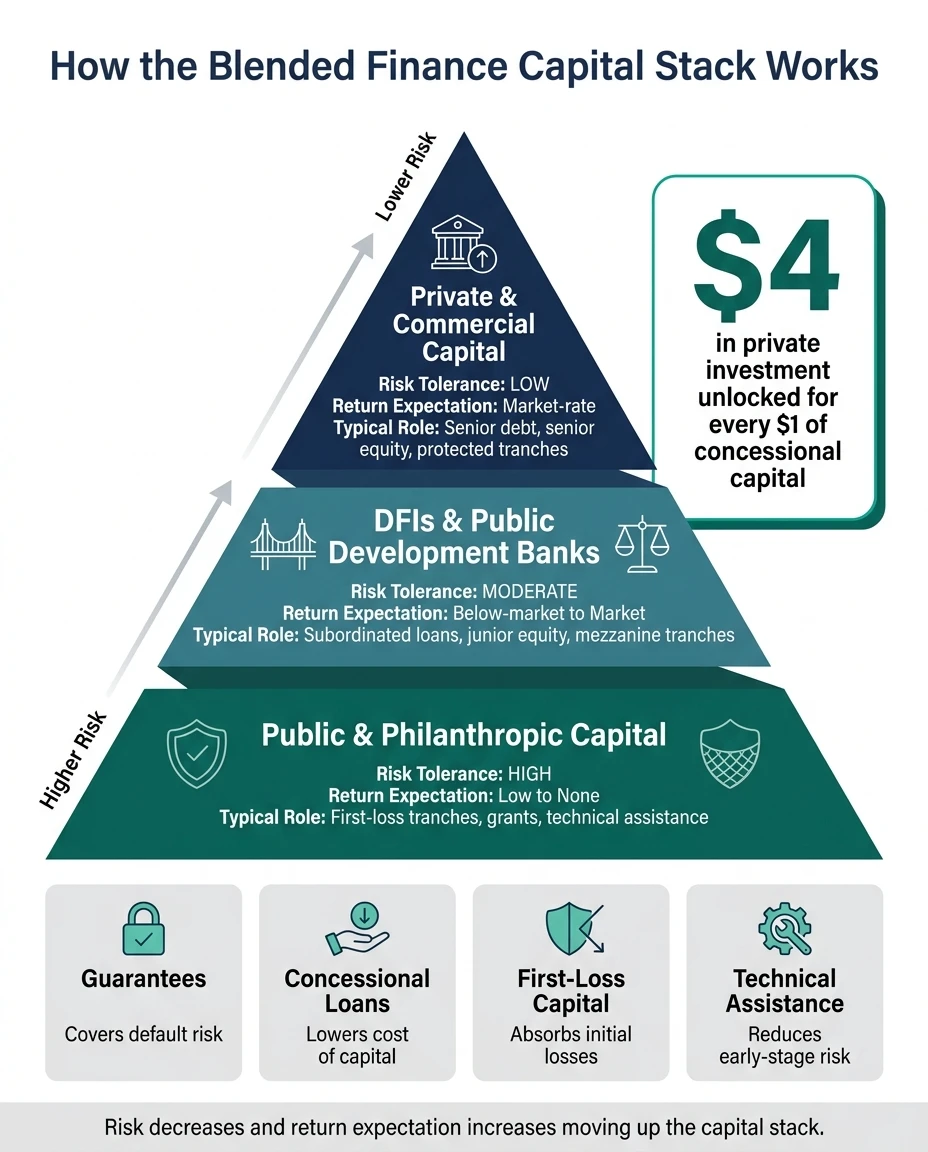
Blended Finance Capital Stack: How Risk & Return Align Private Climate Investment
For adaptation and resilience deals, the core problem usually isn’t climate intent. It’s risk. More specifically, it’s how to shift risk so private capital can come in without taking exposure it won’t accept.
The Main Instruments That Shift Investor Risk
Blended finance changes private risk in a few direct ways: it changes who takes losses first, who cuts the cost of capital, and who pays for early project preparation. That matters most in adaptation and resilience, where cash flows can be uneven and public value is hard to turn into a clear price.
A few tools do most of the heavy lifting:
Guarantees cover losses and reduce credit risk.
Concessional loans cut financing costs.
First-loss capital takes the initial hit if a project underperforms.
Technical assistance (TA) facilities pay for project preparation up front.
Green bonds and environmental impact bonds add more options to the mix. Green bonds tap debt markets for projects with steady revenue streams and can come with slightly lower yields. Environmental impact bonds tie repayment to results, which helps when performance risk is the main thing holding investors back.
How Layered Capital Aligns Different Return Expectations
Complex climate deals usually need more than one type of investor. That’s where the capital stack comes in. It sorts capital by risk-and-return profile so each investor sits where the deal fits them best.
At the bottom is the first-loss or junior layer, usually backed by public or philanthropic sources. In the middle sits mezzanine capital, often from Development Finance Institutions (DFIs) or state green banks, filling the gap between junior and senior layers. At the top are commercial banks, pension funds, and insurers, which take the least risk and earn market-rate returns.
Clear priority-of-payments rules are what keep this structure working. Put plainly, the stack only works when risk is matched to each investor’s return appetite.
Capital Source | Risk Tolerance | Return Expectation | Typical Role |
|---|---|---|---|
Public/Philanthropic | High | Low to none | First-loss tranches, grants, technical assistance |
DFIs/Public Dev. Banks | Moderate | Below-market to market | Subordinated loans, junior equity, mezzanine tranches |
Private/Commercial | Low | Market-rate | Senior debt, senior equity, protected tranches |
These structures work because each tool addresses a different kind of risk.
Climate Blended Finance Mechanisms Compared
The table below frames each instrument as a practical choice: what risk is blocking the deal, which tool fits that problem, and what private investors are likely to do in response.
Instrument | Investor Risk Reduction | Typical Climate Use Case | Effect on Private Participation |
|---|---|---|---|
Guarantees | Covers default risk | Green infrastructure, renewable energy | Often drives strong private participation |
Concessional Loans | Lowers cost of capital | Water, sanitation, affordable housing | Improves project bankability |
First-Loss Capital | Absorbs initial losses | Lower-rated projects | Enables higher credit ratings |
Technical Assistance | Reduces early-stage risk | Early-stage project preparation | Creates a pipeline of bankable projects |
The key is to match the tool to the binding constraint. If credit risk is the problem, a guarantee or first-loss tranche is usually the right lever. If the project pipeline isn’t bankable yet, technical assistance should come first.
The next question is whether these structures actually mobilize private capital at scale.
What Recent Studies Show About Mobilizing Private Capital
Recent research points to a pretty clear pattern: private money tends to flow first into climate projects with steady, easy-to-read revenue. That usually means utility-scale renewables and energy efficiency. The issue now isn’t whether private capital has a role. It’s which deal structures can move it in large amounts.
Where Blended Climate Deals Are Concentrated
About 87% of climate-focused public-private-philanthropic (4P) models are carried out in emerging economies [1]. Even so, less than 20% of total climate finance reaches low- and lower-middle-income countries [2].
That gap shows up early. The first phase of project development is still one of the hardest parts to fund. Feasibility work, local coordination, and stakeholder alignment often don’t fit neatly into strict funding mandates or near-term return targets. That’s why philanthropy is often a better match at this stage [1]. It can take on work that other funders tend to avoid, even when that work is what gets a project off the ground.
Mobilization Ratios and the Conditions That Improve Them
Across blended finance structures, the average result is roughly $4 in private investment for every $1 of concessional funding [3]. That’s the headline number. But the research also shows that ratios improve under a few plain conditions.
Deals tend to perform better when they are built for scale, when terms are standardized, and when cash-flow rules are clear from the start. In practice, that can mean bundling smaller projects so they meet the minimum check sizes large investors want. It can also mean using pre-set cash-flow rules, which can speed up deal closure by up to 40% [3].
One idea runs through all of this: the minimum concessionality principle. Put simply, use only the subsidy needed to make the deal work. No more than that.
Those same conditions keep showing up across the most common deal structures.
Case Archetypes From the Research
The documented deals fall into a handful of recurring patterns. Each one fits a different mix of risk, investor appetite, and climate goal. Taken together, they show the same basic truth: private capital moves when revenue is clear, risk is reduced, and public capital has a defined job.
Archetype | Instrument Mix | Primary Investor Type | Example Outcome |
|---|---|---|---|
Utility-Scale Renewables | Concessional loans, senior debt, risk guarantees | DFIs, commercial banks, institutional investors | 14,000 MW deployed (Power Africa) |
Distributed Energy and Efficiency | Technical assistance, PACE loans, private equity | Municipalities, private lenders, ESG investors | $1.8B deployed (NYC Accelerator) |
Resilience Infrastructure | Guarantees, first-loss capital, grants | Philanthropy, impact investors, local government | $2.5B for land restoration (Initiative 20x20) |
Conservation and Blue Finance | Blue bonds, debt-for-nature swaps, guarantees | Philanthropy, DFIs, institutional investors | Sovereign-level debt buybacks (Belize) |
Climate-Resilient Agriculture | Subordinated debt, equity, technical assistance | Impact investors, DFIs, philanthropy | Regional value chains; farmer income and drought resistance gains |
One weak spot remains hard to ignore. Adaptation and resilience deals still need better measurement because their outcomes are harder to price. That challenge matters because it marks one of the clearest points where blended finance starts to lose traction.
Limits, Critiques, and Governance Risks
Blended finance can bring private capital into the picture, but weak governance can turn it into a subsidy for deals that would have gone forward anyway. The core problem often isn't a shortage of money. It's poor deal design that does little to bring in new private finance.
When Blended Finance May Fail to Create Real Additionality
The key question in any blended deal is simple: does public or philanthropic capital unlock private investment that would not have happened without it? If the answer is no, the deal does not have additionality.
That test is not just about getting better terms. It's about whether the subsidy changes the risk profile in a meaningful way. If guarantees are too generous, they can dull investor scrutiny and let weak projects slide through. By contrast, subordinated public capital can create real additionality when it improves a project's credit profile - for example, moving it from BBB to A. That shift can cut borrowing costs and make the project eligible for institutional investors.
Once that line is crossed, attribution becomes the next big governance check.
Measurement, Reporting, and Accountability Concerns
Even well-built deals need solid measurement to show impact. Attribution remains a stubborn problem. If parties want impact claims to hold up, they need to agree on KPIs, baselines, and reporting schedules at the start of the deal.
Governance often breaks down when funding cycles, approvals, and reporting timelines do not line up with adaptation timelines [1].
Benefits and Drawbacks: A Research-Backed Overview
Feature | Potential Benefit | Risk |
|---|---|---|
Minimum concessionality | Supports bankability | Over-subsidizing wastes public resources |
Guarantees | Can help mobilize private capital | Too much protection creates moral hazard |
Credit enhancement | Lifts credit profile and unlocks institutional capital | Requires careful calibration |
Measurement and reporting | Early KPIs and baselines improve accountability | Weak attribution makes impact claims harder to verify |
Coordination | Aligns capital sources around a project | Siloed funding can miss adaptation timelines [1] |
Lessons for Strategy, Partnerships, and Next Steps
What Strong Climate-Aligned Structures Have in Common
Across the studies, one pattern shows up again and again: capital is sequenced to match risk as a project changes over time. The strongest structures do this with discipline. Philanthropy pays for feasibility. CDFIs help projects get through early uncertainty. Private capital steps in once cash flows are proven and the deal looks bankable.
That approach matters because it cuts friction for private investors without putting too much subsidy into the deal. In plain terms, each source of money does the job it is best built to do.
Why Systems Thinking and Stakeholder Design Matter
Structure helps, but structure by itself won't carry a project very far. Coordination is what makes the capital stack work in practice. The core lesson is simple: align capital, timing, and stakeholders around one project pipeline.
When that alignment is missing, even a smart financing model can stall. When it's in place, the path from concept to deal gets much clearer. U.S. resilience investments return $1.86 for every $1 spent [1]. That kind of payoff doesn't come from money alone. It comes from lining up the right partners, at the right moment, around the same path forward.
Conclusion: The Key Takeaway
Blended finance works when each capital source funds the stage it is best suited to cover.
FAQs
What is blended finance?
Blended finance brings together public, philanthropic, and private capital to pay for sustainable projects such as renewable energy and climate resilience infrastructure.
The idea is simple: stack different funding sources in a way that improves the project’s risk-return profile. Public or philanthropic backing can take on early risk through first-loss capital, guarantees, or concessional loans. That setup makes projects more appealing to private investors and helps bring in commercial capital at scale.
Why is private capital harder to attract for resilience projects?
Private capital is often a tough fit for resilience projects. The main problem is simple: many of these projects don’t produce steady, easy-to-model cash flows or clear near-term returns.
They’re also hard to assess in a way investors like. Financial risk and adaptation benefits can be tough to measure, costs often land across multiple stakeholders, and many projects don’t have much of a bankable track record. Without structures that lower political or performance risk, they often fall short of fiduciary or commercial requirements.
How do you know if a blended deal adds real value?
Assess its additionality: whether it delivers social or environmental outcomes that would not happen without your support.
A strong deal should also bring in private capital that would otherwise stay on the sidelines, using only the minimum subsidy needed to attract investors. Too much subsidy can waste public funds and erode long-term trust.
Related Blog Posts
Latest Articles
©2026

Narrative Change and Power Building: The Missing Half of Advocacy
Narrative change is the process of disrupting dominant narratives that normalize inequity and advancing new narratives from historically marginalized communities.

Funding Resilience Without Federal Grants
BRIC is unreliable and FEMA is shrinking. Here's how cities fund climate resilience with dedicated revenue, blended finance, and a coordinating authority.

The ESG Blind Spot: How AI Is Finding Risks in Companies Nobody Else Is Watching
Norway's sovereign wealth fund uses AI to screen 7,200 portfolio companies for forced labor and corruption within 24 hours. The real story is the emerging-market coverage gap that traditional ESG data vendors miss — and what it means for any company with a global supply chain.
Narrative Change and Power Building: The Missing Half of Advocacy
Narrative change is the process of disrupting dominant narratives that normalize inequity and advancing new narratives from historically marginalized communities.
Funding Resilience Without Federal Grants
BRIC is unreliable and FEMA is shrinking. Here's how cities fund climate resilience with dedicated revenue, blended finance, and a coordinating authority.
The ESG Blind Spot: How AI Is Finding Risks in Companies Nobody Else Is Watching
Norway's sovereign wealth fund uses AI to screen 7,200 portfolio companies for forced labor and corruption within 24 hours. The real story is the emerging-market coverage gap that traditional ESG data vendors miss — and what it means for any company with a global supply chain.
FAQ
01
What does it really mean to “redefine profit”?
02
What makes Council Fire different?
03
Who does Council Fire work with?
04
What does working with Council Fire actually look like?
05
How does Council Fire help organizations turn big goals into action?
06
How does Council Fire define and measure success?
07
How does technology fit into Council Fire’s work?
Jul 12, 2026
How Blended Finance Aligns Private Capital
Sustainability Strategy
In This Article
Blended finance uses guarantees, concessional loans, first-loss capital and TA to shift risk and mobilize private climate investment.
How Blended Finance Aligns Private Capital
Blended finance works best when public or philanthropic money takes the risk that private investors will not. In the research I reviewed, the pattern is simple: private capital comes in when revenue is clear, losses are partly covered, and each funder has a set role. The average blended deal brings in about $4 of private money for every $1 of concessional capital, but that result depends on deal design.
If I had to boil the article down for you, it comes to this:
Blended finance is a risk-sharing setup, not just a funding mix.
It fits mitigation projects more easily than resilience and recovery projects.
The main tools are guarantees, concessional loans, first-loss capital, and technical assistance.
Private investors tend to back deals with steady cash flow first.
Poor design can turn a blended deal into a subsidy for investment that would have happened anyway.
Strong structures use only the subsidy needed and set KPIs, baselines, and payout rules up front.
A few numbers frame the issue fast:
$115 billion in U.S. disaster damage in 2025
23 separate billion-dollar disaster events
87% of climate-focused 4P models are in emerging markets
Less than 20% of total climate finance reaches low- and lower-middle-income countries
$1.86 returned per $1 spent on U.S. resilience investments
What I take from the research is clear: blended finance does not fix weak projects. It works when it matches the right risk tool to the right financing gap and moves private investors who otherwise would stay out.
Event: IMPACT= Inside the capital stack: blended finance fund design in practice
How Blended Finance Works in Climate Investment
Blended Finance Capital Stack: How Risk & Return Align Private Climate Investment
For adaptation and resilience deals, the core problem usually isn’t climate intent. It’s risk. More specifically, it’s how to shift risk so private capital can come in without taking exposure it won’t accept.
The Main Instruments That Shift Investor Risk
Blended finance changes private risk in a few direct ways: it changes who takes losses first, who cuts the cost of capital, and who pays for early project preparation. That matters most in adaptation and resilience, where cash flows can be uneven and public value is hard to turn into a clear price.
A few tools do most of the heavy lifting:
Guarantees cover losses and reduce credit risk.
Concessional loans cut financing costs.
First-loss capital takes the initial hit if a project underperforms.
Technical assistance (TA) facilities pay for project preparation up front.
Green bonds and environmental impact bonds add more options to the mix. Green bonds tap debt markets for projects with steady revenue streams and can come with slightly lower yields. Environmental impact bonds tie repayment to results, which helps when performance risk is the main thing holding investors back.
How Layered Capital Aligns Different Return Expectations
Complex climate deals usually need more than one type of investor. That’s where the capital stack comes in. It sorts capital by risk-and-return profile so each investor sits where the deal fits them best.
At the bottom is the first-loss or junior layer, usually backed by public or philanthropic sources. In the middle sits mezzanine capital, often from Development Finance Institutions (DFIs) or state green banks, filling the gap between junior and senior layers. At the top are commercial banks, pension funds, and insurers, which take the least risk and earn market-rate returns.
Clear priority-of-payments rules are what keep this structure working. Put plainly, the stack only works when risk is matched to each investor’s return appetite.
Capital Source | Risk Tolerance | Return Expectation | Typical Role |
|---|---|---|---|
Public/Philanthropic | High | Low to none | First-loss tranches, grants, technical assistance |
DFIs/Public Dev. Banks | Moderate | Below-market to market | Subordinated loans, junior equity, mezzanine tranches |
Private/Commercial | Low | Market-rate | Senior debt, senior equity, protected tranches |
These structures work because each tool addresses a different kind of risk.
Climate Blended Finance Mechanisms Compared
The table below frames each instrument as a practical choice: what risk is blocking the deal, which tool fits that problem, and what private investors are likely to do in response.
Instrument | Investor Risk Reduction | Typical Climate Use Case | Effect on Private Participation |
|---|---|---|---|
Guarantees | Covers default risk | Green infrastructure, renewable energy | Often drives strong private participation |
Concessional Loans | Lowers cost of capital | Water, sanitation, affordable housing | Improves project bankability |
First-Loss Capital | Absorbs initial losses | Lower-rated projects | Enables higher credit ratings |
Technical Assistance | Reduces early-stage risk | Early-stage project preparation | Creates a pipeline of bankable projects |
The key is to match the tool to the binding constraint. If credit risk is the problem, a guarantee or first-loss tranche is usually the right lever. If the project pipeline isn’t bankable yet, technical assistance should come first.
The next question is whether these structures actually mobilize private capital at scale.
What Recent Studies Show About Mobilizing Private Capital
Recent research points to a pretty clear pattern: private money tends to flow first into climate projects with steady, easy-to-read revenue. That usually means utility-scale renewables and energy efficiency. The issue now isn’t whether private capital has a role. It’s which deal structures can move it in large amounts.
Where Blended Climate Deals Are Concentrated
About 87% of climate-focused public-private-philanthropic (4P) models are carried out in emerging economies [1]. Even so, less than 20% of total climate finance reaches low- and lower-middle-income countries [2].
That gap shows up early. The first phase of project development is still one of the hardest parts to fund. Feasibility work, local coordination, and stakeholder alignment often don’t fit neatly into strict funding mandates or near-term return targets. That’s why philanthropy is often a better match at this stage [1]. It can take on work that other funders tend to avoid, even when that work is what gets a project off the ground.
Mobilization Ratios and the Conditions That Improve Them
Across blended finance structures, the average result is roughly $4 in private investment for every $1 of concessional funding [3]. That’s the headline number. But the research also shows that ratios improve under a few plain conditions.
Deals tend to perform better when they are built for scale, when terms are standardized, and when cash-flow rules are clear from the start. In practice, that can mean bundling smaller projects so they meet the minimum check sizes large investors want. It can also mean using pre-set cash-flow rules, which can speed up deal closure by up to 40% [3].
One idea runs through all of this: the minimum concessionality principle. Put simply, use only the subsidy needed to make the deal work. No more than that.
Those same conditions keep showing up across the most common deal structures.
Case Archetypes From the Research
The documented deals fall into a handful of recurring patterns. Each one fits a different mix of risk, investor appetite, and climate goal. Taken together, they show the same basic truth: private capital moves when revenue is clear, risk is reduced, and public capital has a defined job.
Archetype | Instrument Mix | Primary Investor Type | Example Outcome |
|---|---|---|---|
Utility-Scale Renewables | Concessional loans, senior debt, risk guarantees | DFIs, commercial banks, institutional investors | 14,000 MW deployed (Power Africa) |
Distributed Energy and Efficiency | Technical assistance, PACE loans, private equity | Municipalities, private lenders, ESG investors | $1.8B deployed (NYC Accelerator) |
Resilience Infrastructure | Guarantees, first-loss capital, grants | Philanthropy, impact investors, local government | $2.5B for land restoration (Initiative 20x20) |
Conservation and Blue Finance | Blue bonds, debt-for-nature swaps, guarantees | Philanthropy, DFIs, institutional investors | Sovereign-level debt buybacks (Belize) |
Climate-Resilient Agriculture | Subordinated debt, equity, technical assistance | Impact investors, DFIs, philanthropy | Regional value chains; farmer income and drought resistance gains |
One weak spot remains hard to ignore. Adaptation and resilience deals still need better measurement because their outcomes are harder to price. That challenge matters because it marks one of the clearest points where blended finance starts to lose traction.
Limits, Critiques, and Governance Risks
Blended finance can bring private capital into the picture, but weak governance can turn it into a subsidy for deals that would have gone forward anyway. The core problem often isn't a shortage of money. It's poor deal design that does little to bring in new private finance.
When Blended Finance May Fail to Create Real Additionality
The key question in any blended deal is simple: does public or philanthropic capital unlock private investment that would not have happened without it? If the answer is no, the deal does not have additionality.
That test is not just about getting better terms. It's about whether the subsidy changes the risk profile in a meaningful way. If guarantees are too generous, they can dull investor scrutiny and let weak projects slide through. By contrast, subordinated public capital can create real additionality when it improves a project's credit profile - for example, moving it from BBB to A. That shift can cut borrowing costs and make the project eligible for institutional investors.
Once that line is crossed, attribution becomes the next big governance check.
Measurement, Reporting, and Accountability Concerns
Even well-built deals need solid measurement to show impact. Attribution remains a stubborn problem. If parties want impact claims to hold up, they need to agree on KPIs, baselines, and reporting schedules at the start of the deal.
Governance often breaks down when funding cycles, approvals, and reporting timelines do not line up with adaptation timelines [1].
Benefits and Drawbacks: A Research-Backed Overview
Feature | Potential Benefit | Risk |
|---|---|---|
Minimum concessionality | Supports bankability | Over-subsidizing wastes public resources |
Guarantees | Can help mobilize private capital | Too much protection creates moral hazard |
Credit enhancement | Lifts credit profile and unlocks institutional capital | Requires careful calibration |
Measurement and reporting | Early KPIs and baselines improve accountability | Weak attribution makes impact claims harder to verify |
Coordination | Aligns capital sources around a project | Siloed funding can miss adaptation timelines [1] |
Lessons for Strategy, Partnerships, and Next Steps
What Strong Climate-Aligned Structures Have in Common
Across the studies, one pattern shows up again and again: capital is sequenced to match risk as a project changes over time. The strongest structures do this with discipline. Philanthropy pays for feasibility. CDFIs help projects get through early uncertainty. Private capital steps in once cash flows are proven and the deal looks bankable.
That approach matters because it cuts friction for private investors without putting too much subsidy into the deal. In plain terms, each source of money does the job it is best built to do.
Why Systems Thinking and Stakeholder Design Matter
Structure helps, but structure by itself won't carry a project very far. Coordination is what makes the capital stack work in practice. The core lesson is simple: align capital, timing, and stakeholders around one project pipeline.
When that alignment is missing, even a smart financing model can stall. When it's in place, the path from concept to deal gets much clearer. U.S. resilience investments return $1.86 for every $1 spent [1]. That kind of payoff doesn't come from money alone. It comes from lining up the right partners, at the right moment, around the same path forward.
Conclusion: The Key Takeaway
Blended finance works when each capital source funds the stage it is best suited to cover.
FAQs
What is blended finance?
Blended finance brings together public, philanthropic, and private capital to pay for sustainable projects such as renewable energy and climate resilience infrastructure.
The idea is simple: stack different funding sources in a way that improves the project’s risk-return profile. Public or philanthropic backing can take on early risk through first-loss capital, guarantees, or concessional loans. That setup makes projects more appealing to private investors and helps bring in commercial capital at scale.
Why is private capital harder to attract for resilience projects?
Private capital is often a tough fit for resilience projects. The main problem is simple: many of these projects don’t produce steady, easy-to-model cash flows or clear near-term returns.
They’re also hard to assess in a way investors like. Financial risk and adaptation benefits can be tough to measure, costs often land across multiple stakeholders, and many projects don’t have much of a bankable track record. Without structures that lower political or performance risk, they often fall short of fiduciary or commercial requirements.
How do you know if a blended deal adds real value?
Assess its additionality: whether it delivers social or environmental outcomes that would not happen without your support.
A strong deal should also bring in private capital that would otherwise stay on the sidelines, using only the minimum subsidy needed to attract investors. Too much subsidy can waste public funds and erode long-term trust.
Related Blog Posts
Latest Articles
©2026
Narrative Change and Power Building: The Missing Half of Advocacy
Narrative change is the process of disrupting dominant narratives that normalize inequity and advancing new narratives from historically marginalized communities.
Funding Resilience Without Federal Grants
BRIC is unreliable and FEMA is shrinking. Here's how cities fund climate resilience with dedicated revenue, blended finance, and a coordinating authority.
The ESG Blind Spot: How AI Is Finding Risks in Companies Nobody Else Is Watching
Norway's sovereign wealth fund uses AI to screen 7,200 portfolio companies for forced labor and corruption within 24 hours. The real story is the emerging-market coverage gap that traditional ESG data vendors miss — and what it means for any company with a global supply chain.
FAQ
01
What does it really mean to “redefine profit”?
02
What makes Council Fire different?
03
Who does Council Fire work with?
04
What does working with Council Fire actually look like?
05
How does Council Fire help organizations turn big goals into action?
06
How does Council Fire define and measure success?
07
How does technology fit into Council Fire’s work?
Jul 12, 2026
How Blended Finance Aligns Private Capital
Sustainability Strategy
In This Article
Blended finance uses guarantees, concessional loans, first-loss capital and TA to shift risk and mobilize private climate investment.
How Blended Finance Aligns Private Capital
Blended finance works best when public or philanthropic money takes the risk that private investors will not. In the research I reviewed, the pattern is simple: private capital comes in when revenue is clear, losses are partly covered, and each funder has a set role. The average blended deal brings in about $4 of private money for every $1 of concessional capital, but that result depends on deal design.
If I had to boil the article down for you, it comes to this:
Blended finance is a risk-sharing setup, not just a funding mix.
It fits mitigation projects more easily than resilience and recovery projects.
The main tools are guarantees, concessional loans, first-loss capital, and technical assistance.
Private investors tend to back deals with steady cash flow first.
Poor design can turn a blended deal into a subsidy for investment that would have happened anyway.
Strong structures use only the subsidy needed and set KPIs, baselines, and payout rules up front.
A few numbers frame the issue fast:
$115 billion in U.S. disaster damage in 2025
23 separate billion-dollar disaster events
87% of climate-focused 4P models are in emerging markets
Less than 20% of total climate finance reaches low- and lower-middle-income countries
$1.86 returned per $1 spent on U.S. resilience investments
What I take from the research is clear: blended finance does not fix weak projects. It works when it matches the right risk tool to the right financing gap and moves private investors who otherwise would stay out.
Event: IMPACT= Inside the capital stack: blended finance fund design in practice
How Blended Finance Works in Climate Investment
Blended Finance Capital Stack: How Risk & Return Align Private Climate Investment
For adaptation and resilience deals, the core problem usually isn’t climate intent. It’s risk. More specifically, it’s how to shift risk so private capital can come in without taking exposure it won’t accept.
The Main Instruments That Shift Investor Risk
Blended finance changes private risk in a few direct ways: it changes who takes losses first, who cuts the cost of capital, and who pays for early project preparation. That matters most in adaptation and resilience, where cash flows can be uneven and public value is hard to turn into a clear price.
A few tools do most of the heavy lifting:
Guarantees cover losses and reduce credit risk.
Concessional loans cut financing costs.
First-loss capital takes the initial hit if a project underperforms.
Technical assistance (TA) facilities pay for project preparation up front.
Green bonds and environmental impact bonds add more options to the mix. Green bonds tap debt markets for projects with steady revenue streams and can come with slightly lower yields. Environmental impact bonds tie repayment to results, which helps when performance risk is the main thing holding investors back.
How Layered Capital Aligns Different Return Expectations
Complex climate deals usually need more than one type of investor. That’s where the capital stack comes in. It sorts capital by risk-and-return profile so each investor sits where the deal fits them best.
At the bottom is the first-loss or junior layer, usually backed by public or philanthropic sources. In the middle sits mezzanine capital, often from Development Finance Institutions (DFIs) or state green banks, filling the gap between junior and senior layers. At the top are commercial banks, pension funds, and insurers, which take the least risk and earn market-rate returns.
Clear priority-of-payments rules are what keep this structure working. Put plainly, the stack only works when risk is matched to each investor’s return appetite.
Capital Source | Risk Tolerance | Return Expectation | Typical Role |
|---|---|---|---|
Public/Philanthropic | High | Low to none | First-loss tranches, grants, technical assistance |
DFIs/Public Dev. Banks | Moderate | Below-market to market | Subordinated loans, junior equity, mezzanine tranches |
Private/Commercial | Low | Market-rate | Senior debt, senior equity, protected tranches |
These structures work because each tool addresses a different kind of risk.
Climate Blended Finance Mechanisms Compared
The table below frames each instrument as a practical choice: what risk is blocking the deal, which tool fits that problem, and what private investors are likely to do in response.
Instrument | Investor Risk Reduction | Typical Climate Use Case | Effect on Private Participation |
|---|---|---|---|
Guarantees | Covers default risk | Green infrastructure, renewable energy | Often drives strong private participation |
Concessional Loans | Lowers cost of capital | Water, sanitation, affordable housing | Improves project bankability |
First-Loss Capital | Absorbs initial losses | Lower-rated projects | Enables higher credit ratings |
Technical Assistance | Reduces early-stage risk | Early-stage project preparation | Creates a pipeline of bankable projects |
The key is to match the tool to the binding constraint. If credit risk is the problem, a guarantee or first-loss tranche is usually the right lever. If the project pipeline isn’t bankable yet, technical assistance should come first.
The next question is whether these structures actually mobilize private capital at scale.
What Recent Studies Show About Mobilizing Private Capital
Recent research points to a pretty clear pattern: private money tends to flow first into climate projects with steady, easy-to-read revenue. That usually means utility-scale renewables and energy efficiency. The issue now isn’t whether private capital has a role. It’s which deal structures can move it in large amounts.
Where Blended Climate Deals Are Concentrated
About 87% of climate-focused public-private-philanthropic (4P) models are carried out in emerging economies [1]. Even so, less than 20% of total climate finance reaches low- and lower-middle-income countries [2].
That gap shows up early. The first phase of project development is still one of the hardest parts to fund. Feasibility work, local coordination, and stakeholder alignment often don’t fit neatly into strict funding mandates or near-term return targets. That’s why philanthropy is often a better match at this stage [1]. It can take on work that other funders tend to avoid, even when that work is what gets a project off the ground.
Mobilization Ratios and the Conditions That Improve Them
Across blended finance structures, the average result is roughly $4 in private investment for every $1 of concessional funding [3]. That’s the headline number. But the research also shows that ratios improve under a few plain conditions.
Deals tend to perform better when they are built for scale, when terms are standardized, and when cash-flow rules are clear from the start. In practice, that can mean bundling smaller projects so they meet the minimum check sizes large investors want. It can also mean using pre-set cash-flow rules, which can speed up deal closure by up to 40% [3].
One idea runs through all of this: the minimum concessionality principle. Put simply, use only the subsidy needed to make the deal work. No more than that.
Those same conditions keep showing up across the most common deal structures.
Case Archetypes From the Research
The documented deals fall into a handful of recurring patterns. Each one fits a different mix of risk, investor appetite, and climate goal. Taken together, they show the same basic truth: private capital moves when revenue is clear, risk is reduced, and public capital has a defined job.
Archetype | Instrument Mix | Primary Investor Type | Example Outcome |
|---|---|---|---|
Utility-Scale Renewables | Concessional loans, senior debt, risk guarantees | DFIs, commercial banks, institutional investors | 14,000 MW deployed (Power Africa) |
Distributed Energy and Efficiency | Technical assistance, PACE loans, private equity | Municipalities, private lenders, ESG investors | $1.8B deployed (NYC Accelerator) |
Resilience Infrastructure | Guarantees, first-loss capital, grants | Philanthropy, impact investors, local government | $2.5B for land restoration (Initiative 20x20) |
Conservation and Blue Finance | Blue bonds, debt-for-nature swaps, guarantees | Philanthropy, DFIs, institutional investors | Sovereign-level debt buybacks (Belize) |
Climate-Resilient Agriculture | Subordinated debt, equity, technical assistance | Impact investors, DFIs, philanthropy | Regional value chains; farmer income and drought resistance gains |
One weak spot remains hard to ignore. Adaptation and resilience deals still need better measurement because their outcomes are harder to price. That challenge matters because it marks one of the clearest points where blended finance starts to lose traction.
Limits, Critiques, and Governance Risks
Blended finance can bring private capital into the picture, but weak governance can turn it into a subsidy for deals that would have gone forward anyway. The core problem often isn't a shortage of money. It's poor deal design that does little to bring in new private finance.
When Blended Finance May Fail to Create Real Additionality
The key question in any blended deal is simple: does public or philanthropic capital unlock private investment that would not have happened without it? If the answer is no, the deal does not have additionality.
That test is not just about getting better terms. It's about whether the subsidy changes the risk profile in a meaningful way. If guarantees are too generous, they can dull investor scrutiny and let weak projects slide through. By contrast, subordinated public capital can create real additionality when it improves a project's credit profile - for example, moving it from BBB to A. That shift can cut borrowing costs and make the project eligible for institutional investors.
Once that line is crossed, attribution becomes the next big governance check.
Measurement, Reporting, and Accountability Concerns
Even well-built deals need solid measurement to show impact. Attribution remains a stubborn problem. If parties want impact claims to hold up, they need to agree on KPIs, baselines, and reporting schedules at the start of the deal.
Governance often breaks down when funding cycles, approvals, and reporting timelines do not line up with adaptation timelines [1].
Benefits and Drawbacks: A Research-Backed Overview
Feature | Potential Benefit | Risk |
|---|---|---|
Minimum concessionality | Supports bankability | Over-subsidizing wastes public resources |
Guarantees | Can help mobilize private capital | Too much protection creates moral hazard |
Credit enhancement | Lifts credit profile and unlocks institutional capital | Requires careful calibration |
Measurement and reporting | Early KPIs and baselines improve accountability | Weak attribution makes impact claims harder to verify |
Coordination | Aligns capital sources around a project | Siloed funding can miss adaptation timelines [1] |
Lessons for Strategy, Partnerships, and Next Steps
What Strong Climate-Aligned Structures Have in Common
Across the studies, one pattern shows up again and again: capital is sequenced to match risk as a project changes over time. The strongest structures do this with discipline. Philanthropy pays for feasibility. CDFIs help projects get through early uncertainty. Private capital steps in once cash flows are proven and the deal looks bankable.
That approach matters because it cuts friction for private investors without putting too much subsidy into the deal. In plain terms, each source of money does the job it is best built to do.
Why Systems Thinking and Stakeholder Design Matter
Structure helps, but structure by itself won't carry a project very far. Coordination is what makes the capital stack work in practice. The core lesson is simple: align capital, timing, and stakeholders around one project pipeline.
When that alignment is missing, even a smart financing model can stall. When it's in place, the path from concept to deal gets much clearer. U.S. resilience investments return $1.86 for every $1 spent [1]. That kind of payoff doesn't come from money alone. It comes from lining up the right partners, at the right moment, around the same path forward.
Conclusion: The Key Takeaway
Blended finance works when each capital source funds the stage it is best suited to cover.
FAQs
What is blended finance?
Blended finance brings together public, philanthropic, and private capital to pay for sustainable projects such as renewable energy and climate resilience infrastructure.
The idea is simple: stack different funding sources in a way that improves the project’s risk-return profile. Public or philanthropic backing can take on early risk through first-loss capital, guarantees, or concessional loans. That setup makes projects more appealing to private investors and helps bring in commercial capital at scale.
Why is private capital harder to attract for resilience projects?
Private capital is often a tough fit for resilience projects. The main problem is simple: many of these projects don’t produce steady, easy-to-model cash flows or clear near-term returns.
They’re also hard to assess in a way investors like. Financial risk and adaptation benefits can be tough to measure, costs often land across multiple stakeholders, and many projects don’t have much of a bankable track record. Without structures that lower political or performance risk, they often fall short of fiduciary or commercial requirements.
How do you know if a blended deal adds real value?
Assess its additionality: whether it delivers social or environmental outcomes that would not happen without your support.
A strong deal should also bring in private capital that would otherwise stay on the sidelines, using only the minimum subsidy needed to attract investors. Too much subsidy can waste public funds and erode long-term trust.
Related Blog Posts
Latest Articles
©2026
Narrative Change and Power Building: The Missing Half of Advocacy
Narrative change is the process of disrupting dominant narratives that normalize inequity and advancing new narratives from historically marginalized communities.
Funding Resilience Without Federal Grants
BRIC is unreliable and FEMA is shrinking. Here's how cities fund climate resilience with dedicated revenue, blended finance, and a coordinating authority.
The ESG Blind Spot: How AI Is Finding Risks in Companies Nobody Else Is Watching
Norway's sovereign wealth fund uses AI to screen 7,200 portfolio companies for forced labor and corruption within 24 hours. The real story is the emerging-market coverage gap that traditional ESG data vendors miss — and what it means for any company with a global supply chain.
FAQ
What does it really mean to “redefine profit”?
What makes Council Fire different?
Who does Council Fire work with?
What does working with Council Fire actually look like?
How does Council Fire help organizations turn big goals into action?
How does Council Fire define and measure success?
How does technology fit into Council Fire’s work?