
Jul 9, 2026
How Blended Finance Aligns Public and Private Goals
Sustainability Strategy
In This Article
Public catalytic capital and risk tools bridge private returns and development goals—only with limited subsidy, strong governance, and disciplined execution.
How Blended Finance Aligns Public and Private Goals
Blended finance works when public money takes the first hit, lowers a key risk, or extends loan terms so private investors can back projects they would otherwise pass on. I’d boil the article down to this: the model is less about cheap capital and more about risk transfer, deal discipline, and long-term execution.
Right now, the funding gap is huge - about $3.5 trillion to $4.2 trillion per year through 2030. Public budgets cannot fill it alone. Private money can help, but only if deals meet basic investor tests like yield, credit strength, liquidity, and term length. Blended finance tries to bridge that gap by pairing public aims - climate resilience, Paris alignment, broad-based growth, and core infrastructure - with private needs - return, credit quality, diversification, and fiduciary duty.
Here’s the short version of what matters most:
Public capital changes the risk stack, often through first-loss tranches, guarantees, concessional loans, and currency support.
Private investors still underwrite the deal like any other investment. An impact label does not replace return or credit standards.
Governance matters as much as structure. SPVs, cash-flow waterfalls, and result-linked contracts help keep both sides aligned.
Three guardrails matter most: additionality, minimum concessionality, and time-bound support.
Execution is where deals pass or fail. Weak prep, bad timelines, and poor dispute rules can sink a project even if the capital stack looks sound.
Case data in the article points to $1.86 returned for every $1 spent in resilience-focused projects, but results depend on setup and follow-through.
A few numbers from the article stand out:
46% of IFC concessional finance portfolios: risk-sharing facilities or guarantees
24%: senior debt
12%: subordinated debt
10%: grants
8%: equity
That mix shows the core point: blended finance is mainly a risk-allocation tool.
What public actors want | What private investors want | What often bridges the gap |
|---|---|---|
Climate and development results | Risk-adjusted return | First-loss capital, guarantees |
Core infrastructure | Long tenors and steady cash flow | Concessional debt, payment support |
Paris-aligned investment | Lower policy and credit risk | Political risk cover, junior capital |
Broad-based growth | Diversification and market access | Pooled vehicles, local-currency structures |
If I were advising a reader, I’d say this: a blended deal only works when subsidy is limited, risks sit with the party best able to hold them, and monitoring stays in place for the full life of the contract - often 20 to 30 years.
That is the article’s main point in plain English.
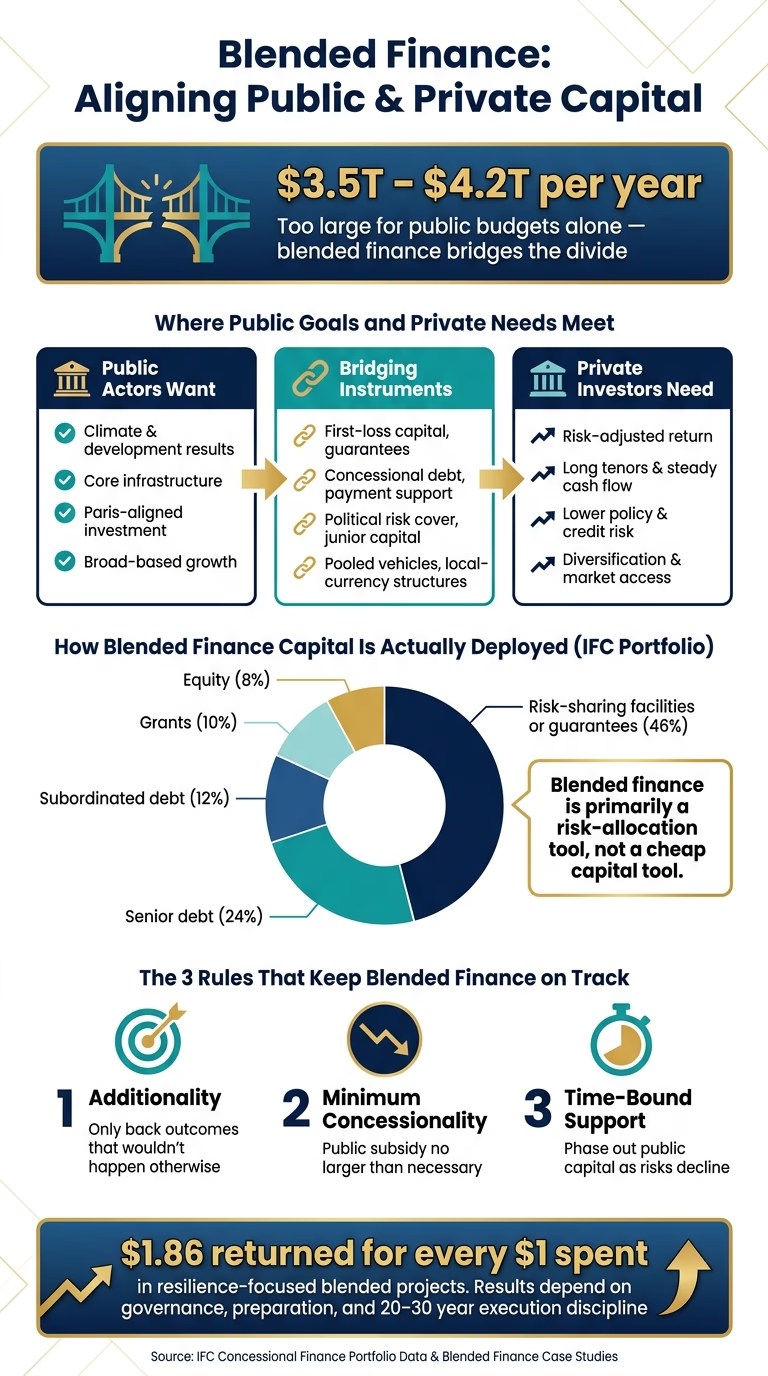
Blended Finance: How Public Goals Meet Private Returns
Blended Finance: Mobilizing Public and Private Capital
How blended finance aligns incentives
Blended finance lines up incentives by changing the risk-and-return picture so public and private money can join the same deal. Public actors want measurable development results. Private actors want returns that make sense for the risks they’re taking. The main levers are first-loss capital, guarantees, concessional debt, and governance setups that keep both sides aimed at the same goals.
Catalytic capital and risk-sharing tools
The basic logic is simple: public or philanthropic capital takes risks that commercial investors won’t take on their own, which opens the door for private money. In practice, that usually happens through a small set of proven instruments.
First-loss capital is one of the clearest examples. A public agency or foundation agrees to absorb early losses up to a set limit before senior private investors take a hit. In a $100 million solar project, a $15 million subordinated tranche can absorb early losses before senior lenders are affected.[5] That buffer can make a project far more bankable for institutional investors.
Guarantees do the job in another way. They move specific risks - like credit default or political instability - from private investors to a public guarantor. That can improve the project’s credit profile and support longer loan maturities at lower rates. Even so, guarantees are still used less than many expect, making up only an estimated 3–5% of total risk mitigation financing in blended portfolios.[13]
Concessional loans and subordinated debt help by cutting the overall cost of capital and extending tenor, which matters a lot for projects with long payback periods. Currency hedges solve another problem. When project revenue comes in one currency but financing sits in another, foreign exchange swings can wreck the economics of a long-term deal. Swaps and standby credit lines can steady cash flows enough to support 10- to 20-plus-year tenors for grid, water, and resilience projects.[7][10]
In IFC concessional finance portfolios, the mix looks roughly like this:[11]
46% risk-sharing facilities or guarantees
24% senior debt
12% subordinated debt
10% grants
8% equity
That breakdown makes the point pretty clearly: blended finance is often less about cheap money and more about changing who carries which risks.
Still, risk-sharing by itself won’t do the whole job. The structure of the deal has to protect public outcomes over time.
Governance structures that protect shared objectives
Without strong governance, public capital can end up padding private returns while missing the public purpose it was meant to serve. It can also skew markets in ways that push out later commercial investment.
Layered funds and SPVs (special purpose vehicles) are a common answer. An SPV ring-fences project cash flows and legal obligations. It pulls key contracts - such as power purchase agreements, availability payments, or resilience performance contracts - into one legal structure and distributes revenue through a pre-agreed waterfall based on the capital stack.[8][10] That setup keeps cash flows tied to the project’s stated purpose. In plain terms, the legal design gives shared goals some teeth.
Contracts add another layer of accountability by linking money to measured results. Deal terms can connect pricing, step-in rights, or outcome payments to targets such as renewable output, water quality, emissions cuts, or resilience gains.[9][12]
The DC Water Environmental Impact Bond issued in 2016 is a clear example: the $25 million bond carried a 3.43% coupon, and investors received additional payments based on the project's verified performance in reducing stormwater runoff over five years.[2]
Three guardrails keep blended finance on track: additionality, minimum concessionality, and time-bound support. Public capital should back outcomes that would not happen otherwise, remain no larger than needed, and phase out as risks fall.[6][1][3][14] The arrangement holds together only when public support is targeted, temporary, and tied to results.
These design rules matter only if they stand up in actual deals, which the case studies below test.
What public and private actors each need from a deal
Public and private actors come to the table with different priorities. That tension sits at the heart of blended finance. The job of the structure is simple to describe and hard to pull off: give each side what it must have without breaking the deal.
These tools only work when public purpose and private underwriting rules sit inside the same structure. In practice, that means both sides show up with terms they won’t bend on, and the deal has to meet them.
Public objectives, safeguards, and international guidance
Public actors such as DFIs, bilateral agencies, and multilateral development banks work from a development mandate, not a return target.[21] Their goals often center on climate mitigation, adaptation, clean energy access, water resilience, and inclusive growth.[17][4][19][16]
Those goals need to be set before the deal is built. That includes defining eligibility, outcome targets, and the minimum concessional support required.[15][18][19]
Public funders also apply environmental and social safeguards. These cover labor, communities, biodiversity, and human rights. Projects that fail those standards do not qualify.[15][18]
The OECD DAC principles add another layer of discipline. They call for a development rationale, targeted concessionality, and an eventual crowding in of private capital.[15][18][19][21]
Those public rules shape the field from the start. They narrow which private investors can join and under what terms.
Private investment criteria and fiduciary considerations
Institutional investors and commercial banks look at blended deals the same way they look at other investments: credit quality, expected loss, tenor, liquidity, and portfolio correlation. An impact label doesn’t change the underwriting test.[1][20]
Fiduciary duty is a hard limit. Public capital changes the risk-return profile so private investors can meet fiduciary duties while backing SDG-aligned projects.[1][19][20]
The sticking points are familiar: long tenors, illiquidity, and the need for investment-grade credit and better data.[23][20][22]
Blended structures are built to deal with those frictions head-on:
First-loss tranches and guarantees can cut expected loss for senior private investors.
Technical assistance facilities can improve project preparation and credit quality.
Performance-linked incentives, such as interest rate step-downs if specific climate outcomes are achieved, can tie impact and financial performance together over time without distorting the project’s core economics.[1][16][19]
The table below shows where those needs line up.
Table: Where public goals and private returns meet
Public Objective | Private Investor Need | Common Bridging Instruments |
|---|---|---|
SDG alignment and measurable impact | Acceptable risk-adjusted return | First-loss capital, guarantees, concessional debt |
Climate resilience and adaptation | Lower credit and policy risk | Political risk guarantees, subordinated tranches, blended project finance |
Clean energy access | Tenor matched to project cash flows | Senior debt with public junior capital, payment-security facilities |
Water security and sanitation | Predictable revenue and downside protection | Credit guarantees, concessional loans, technical assistance |
Inclusive development and local ownership | Liquidity and portfolio diversification | Portfolio guarantees, pooled vehicles, local-currency structures |
Each pairing connects a public goal to the private constraint that keeps capital on the sidelines. The next section tests those pairings against climate, energy, water, and infrastructure deals.
What research and case studies show
Findings from climate, energy, water, and infrastructure projects
The case studies back up the design rules discussed earlier. Across blended finance projects in climate, energy, water, and infrastructure, estimated resilience returns come to $1.86 for every $1 spent.[24]
That said, the same case studies also make clear where deals run off track. Weak preparation before close can leave basic issues unresolved. Investor exit timelines may not line up with how the project actually generates cash. And governance can fall apart when results miss the plan and no one has a clear way to settle disputes.
Those failure points matter because they show something simple but easy to miss: alignment does not come from structure alone. It comes from execution.
Putting blended finance strategies into practice
Why execution capacity matters as much as capital structure
The case studies land on a simple point: blended finance breaks down when execution capacity is weaker than the capital structure. The deal design matters, but it’s only half the work. Results come from execution. In plain terms, that means building a pipeline of bankable projects with believable revenue models and solid delivery plans.
Aggregation helps make projects financeable. When smaller projects are bundled into one investment vehicle, they can meet the minimum ticket sizes institutional investors need, while also cutting per-project due diligence costs. But getting to scale is only part of the job. Once projects are big enough to fund, the terms still need to hold up over decades.
A typical blended finance agreement runs for 20 to 30 years. Contracts should be built for certainty first, with limited room to adjust when conditions shift. That matters because a lot can change over a long project life. Pre-agreed cash-flow rules can speed closing and lower the odds of drawn-out renegotiation later.
Once the contract is in place, monitoring has to make those terms stick. Impact covenants written into legal agreements keep duties clear and enforceable. Digital MRV tools support near real-time tracking of carbon emissions or added energy capacity, and third-party verification through recognized standards adds an independent layer of trust.
Conclusion: Key takeaways for decision-makers
Blended finance works when the basics are right: public funds provide only the minimum subsidy needed to make a deal commercially viable, risks sit with the parties best able to carry them, and safeguards protect the public interest. Alignment comes from clear roles, believable incentives, and disciplined execution. That discipline is what keeps the deal on track across its full life.
FAQs
What is blended finance in simple terms?
Blended finance brings together public, philanthropic, and private capital to pay for sustainable development projects.
Public or charitable funds often take on early risk or offer better terms, which helps make these projects more appealing to private investors. Put simply, a small pool of catalytic capital can help draw in much larger private investment.
How does public money reduce risk for private investors?
Public money helps lower risk by taking the first hit when losses happen and by covering part of the uncertainty that tends to scare off investors early. That changes the risk-return picture in a way private investors can live with.
Tools like first-loss tranches and risk guarantees can protect private capital from early setbacks and non-commercial risks, including political instability and currency swings. Council Fire helps shape these structures with the smallest subsidy needed to bring private investment off the sidelines.
What makes a blended finance deal succeed or fail?
Blended finance deals work best when everyone starts from the same page: clear goals, strong governance, and risk shared in the right way. That sounds simple, but it’s where many deals are won or lost. If roles are fuzzy or incentives pull in different directions, the structure can wobble fast.
Project readiness matters just as much. Investors want credible financial data and planning that can stand up to scrutiny. In practice, that means investment-grade planning, realistic assumptions, and a clear path from early funding to long-term performance. Catalytic capital also plays a big part here. Tools like concessional loans or first-loss guarantees can help bring in private investors by easing some of the early downside.
When deals fall apart, the same trouble spots tend to show up again and again. Common issues include:
Regulatory uncertainty that makes future cash flows hard to trust
Weak institutional capacity that slows execution or oversight
Poor alignment between impact goals and investor return targets
Over-subsidization that distorts the deal structure
Long-term maintenance costs that were missed or pushed aside
A blended finance structure can look strong on paper and still struggle later if those weak points aren’t addressed early.
Related Blog Posts
Latest Articles
©2026

Narrative Change and Power Building: The Missing Half of Advocacy
Narrative change is the process of disrupting dominant narratives that normalize inequity and advancing new narratives from historically marginalized communities.

Funding Resilience Without Federal Grants
BRIC is unreliable and FEMA is shrinking. Here's how cities fund climate resilience with dedicated revenue, blended finance, and a coordinating authority.

The ESG Blind Spot: How AI Is Finding Risks in Companies Nobody Else Is Watching
Norway's sovereign wealth fund uses AI to screen 7,200 portfolio companies for forced labor and corruption within 24 hours. The real story is the emerging-market coverage gap that traditional ESG data vendors miss — and what it means for any company with a global supply chain.
Narrative Change and Power Building: The Missing Half of Advocacy
Narrative change is the process of disrupting dominant narratives that normalize inequity and advancing new narratives from historically marginalized communities.
Funding Resilience Without Federal Grants
BRIC is unreliable and FEMA is shrinking. Here's how cities fund climate resilience with dedicated revenue, blended finance, and a coordinating authority.
The ESG Blind Spot: How AI Is Finding Risks in Companies Nobody Else Is Watching
Norway's sovereign wealth fund uses AI to screen 7,200 portfolio companies for forced labor and corruption within 24 hours. The real story is the emerging-market coverage gap that traditional ESG data vendors miss — and what it means for any company with a global supply chain.
FAQ
01
What does it really mean to “redefine profit”?
02
What makes Council Fire different?
03
Who does Council Fire work with?
04
What does working with Council Fire actually look like?
05
How does Council Fire help organizations turn big goals into action?
06
How does Council Fire define and measure success?
07
How does technology fit into Council Fire’s work?
Jul 9, 2026
How Blended Finance Aligns Public and Private Goals
Sustainability Strategy
In This Article
Public catalytic capital and risk tools bridge private returns and development goals—only with limited subsidy, strong governance, and disciplined execution.
How Blended Finance Aligns Public and Private Goals
Blended finance works when public money takes the first hit, lowers a key risk, or extends loan terms so private investors can back projects they would otherwise pass on. I’d boil the article down to this: the model is less about cheap capital and more about risk transfer, deal discipline, and long-term execution.
Right now, the funding gap is huge - about $3.5 trillion to $4.2 trillion per year through 2030. Public budgets cannot fill it alone. Private money can help, but only if deals meet basic investor tests like yield, credit strength, liquidity, and term length. Blended finance tries to bridge that gap by pairing public aims - climate resilience, Paris alignment, broad-based growth, and core infrastructure - with private needs - return, credit quality, diversification, and fiduciary duty.
Here’s the short version of what matters most:
Public capital changes the risk stack, often through first-loss tranches, guarantees, concessional loans, and currency support.
Private investors still underwrite the deal like any other investment. An impact label does not replace return or credit standards.
Governance matters as much as structure. SPVs, cash-flow waterfalls, and result-linked contracts help keep both sides aligned.
Three guardrails matter most: additionality, minimum concessionality, and time-bound support.
Execution is where deals pass or fail. Weak prep, bad timelines, and poor dispute rules can sink a project even if the capital stack looks sound.
Case data in the article points to $1.86 returned for every $1 spent in resilience-focused projects, but results depend on setup and follow-through.
A few numbers from the article stand out:
46% of IFC concessional finance portfolios: risk-sharing facilities or guarantees
24%: senior debt
12%: subordinated debt
10%: grants
8%: equity
That mix shows the core point: blended finance is mainly a risk-allocation tool.
What public actors want | What private investors want | What often bridges the gap |
|---|---|---|
Climate and development results | Risk-adjusted return | First-loss capital, guarantees |
Core infrastructure | Long tenors and steady cash flow | Concessional debt, payment support |
Paris-aligned investment | Lower policy and credit risk | Political risk cover, junior capital |
Broad-based growth | Diversification and market access | Pooled vehicles, local-currency structures |
If I were advising a reader, I’d say this: a blended deal only works when subsidy is limited, risks sit with the party best able to hold them, and monitoring stays in place for the full life of the contract - often 20 to 30 years.
That is the article’s main point in plain English.
Blended Finance: How Public Goals Meet Private Returns
Blended Finance: Mobilizing Public and Private Capital
How blended finance aligns incentives
Blended finance lines up incentives by changing the risk-and-return picture so public and private money can join the same deal. Public actors want measurable development results. Private actors want returns that make sense for the risks they’re taking. The main levers are first-loss capital, guarantees, concessional debt, and governance setups that keep both sides aimed at the same goals.
Catalytic capital and risk-sharing tools
The basic logic is simple: public or philanthropic capital takes risks that commercial investors won’t take on their own, which opens the door for private money. In practice, that usually happens through a small set of proven instruments.
First-loss capital is one of the clearest examples. A public agency or foundation agrees to absorb early losses up to a set limit before senior private investors take a hit. In a $100 million solar project, a $15 million subordinated tranche can absorb early losses before senior lenders are affected.[5] That buffer can make a project far more bankable for institutional investors.
Guarantees do the job in another way. They move specific risks - like credit default or political instability - from private investors to a public guarantor. That can improve the project’s credit profile and support longer loan maturities at lower rates. Even so, guarantees are still used less than many expect, making up only an estimated 3–5% of total risk mitigation financing in blended portfolios.[13]
Concessional loans and subordinated debt help by cutting the overall cost of capital and extending tenor, which matters a lot for projects with long payback periods. Currency hedges solve another problem. When project revenue comes in one currency but financing sits in another, foreign exchange swings can wreck the economics of a long-term deal. Swaps and standby credit lines can steady cash flows enough to support 10- to 20-plus-year tenors for grid, water, and resilience projects.[7][10]
In IFC concessional finance portfolios, the mix looks roughly like this:[11]
46% risk-sharing facilities or guarantees
24% senior debt
12% subordinated debt
10% grants
8% equity
That breakdown makes the point pretty clearly: blended finance is often less about cheap money and more about changing who carries which risks.
Still, risk-sharing by itself won’t do the whole job. The structure of the deal has to protect public outcomes over time.
Governance structures that protect shared objectives
Without strong governance, public capital can end up padding private returns while missing the public purpose it was meant to serve. It can also skew markets in ways that push out later commercial investment.
Layered funds and SPVs (special purpose vehicles) are a common answer. An SPV ring-fences project cash flows and legal obligations. It pulls key contracts - such as power purchase agreements, availability payments, or resilience performance contracts - into one legal structure and distributes revenue through a pre-agreed waterfall based on the capital stack.[8][10] That setup keeps cash flows tied to the project’s stated purpose. In plain terms, the legal design gives shared goals some teeth.
Contracts add another layer of accountability by linking money to measured results. Deal terms can connect pricing, step-in rights, or outcome payments to targets such as renewable output, water quality, emissions cuts, or resilience gains.[9][12]
The DC Water Environmental Impact Bond issued in 2016 is a clear example: the $25 million bond carried a 3.43% coupon, and investors received additional payments based on the project's verified performance in reducing stormwater runoff over five years.[2]
Three guardrails keep blended finance on track: additionality, minimum concessionality, and time-bound support. Public capital should back outcomes that would not happen otherwise, remain no larger than needed, and phase out as risks fall.[6][1][3][14] The arrangement holds together only when public support is targeted, temporary, and tied to results.
These design rules matter only if they stand up in actual deals, which the case studies below test.
What public and private actors each need from a deal
Public and private actors come to the table with different priorities. That tension sits at the heart of blended finance. The job of the structure is simple to describe and hard to pull off: give each side what it must have without breaking the deal.
These tools only work when public purpose and private underwriting rules sit inside the same structure. In practice, that means both sides show up with terms they won’t bend on, and the deal has to meet them.
Public objectives, safeguards, and international guidance
Public actors such as DFIs, bilateral agencies, and multilateral development banks work from a development mandate, not a return target.[21] Their goals often center on climate mitigation, adaptation, clean energy access, water resilience, and inclusive growth.[17][4][19][16]
Those goals need to be set before the deal is built. That includes defining eligibility, outcome targets, and the minimum concessional support required.[15][18][19]
Public funders also apply environmental and social safeguards. These cover labor, communities, biodiversity, and human rights. Projects that fail those standards do not qualify.[15][18]
The OECD DAC principles add another layer of discipline. They call for a development rationale, targeted concessionality, and an eventual crowding in of private capital.[15][18][19][21]
Those public rules shape the field from the start. They narrow which private investors can join and under what terms.
Private investment criteria and fiduciary considerations
Institutional investors and commercial banks look at blended deals the same way they look at other investments: credit quality, expected loss, tenor, liquidity, and portfolio correlation. An impact label doesn’t change the underwriting test.[1][20]
Fiduciary duty is a hard limit. Public capital changes the risk-return profile so private investors can meet fiduciary duties while backing SDG-aligned projects.[1][19][20]
The sticking points are familiar: long tenors, illiquidity, and the need for investment-grade credit and better data.[23][20][22]
Blended structures are built to deal with those frictions head-on:
First-loss tranches and guarantees can cut expected loss for senior private investors.
Technical assistance facilities can improve project preparation and credit quality.
Performance-linked incentives, such as interest rate step-downs if specific climate outcomes are achieved, can tie impact and financial performance together over time without distorting the project’s core economics.[1][16][19]
The table below shows where those needs line up.
Table: Where public goals and private returns meet
Public Objective | Private Investor Need | Common Bridging Instruments |
|---|---|---|
SDG alignment and measurable impact | Acceptable risk-adjusted return | First-loss capital, guarantees, concessional debt |
Climate resilience and adaptation | Lower credit and policy risk | Political risk guarantees, subordinated tranches, blended project finance |
Clean energy access | Tenor matched to project cash flows | Senior debt with public junior capital, payment-security facilities |
Water security and sanitation | Predictable revenue and downside protection | Credit guarantees, concessional loans, technical assistance |
Inclusive development and local ownership | Liquidity and portfolio diversification | Portfolio guarantees, pooled vehicles, local-currency structures |
Each pairing connects a public goal to the private constraint that keeps capital on the sidelines. The next section tests those pairings against climate, energy, water, and infrastructure deals.
What research and case studies show
Findings from climate, energy, water, and infrastructure projects
The case studies back up the design rules discussed earlier. Across blended finance projects in climate, energy, water, and infrastructure, estimated resilience returns come to $1.86 for every $1 spent.[24]
That said, the same case studies also make clear where deals run off track. Weak preparation before close can leave basic issues unresolved. Investor exit timelines may not line up with how the project actually generates cash. And governance can fall apart when results miss the plan and no one has a clear way to settle disputes.
Those failure points matter because they show something simple but easy to miss: alignment does not come from structure alone. It comes from execution.
Putting blended finance strategies into practice
Why execution capacity matters as much as capital structure
The case studies land on a simple point: blended finance breaks down when execution capacity is weaker than the capital structure. The deal design matters, but it’s only half the work. Results come from execution. In plain terms, that means building a pipeline of bankable projects with believable revenue models and solid delivery plans.
Aggregation helps make projects financeable. When smaller projects are bundled into one investment vehicle, they can meet the minimum ticket sizes institutional investors need, while also cutting per-project due diligence costs. But getting to scale is only part of the job. Once projects are big enough to fund, the terms still need to hold up over decades.
A typical blended finance agreement runs for 20 to 30 years. Contracts should be built for certainty first, with limited room to adjust when conditions shift. That matters because a lot can change over a long project life. Pre-agreed cash-flow rules can speed closing and lower the odds of drawn-out renegotiation later.
Once the contract is in place, monitoring has to make those terms stick. Impact covenants written into legal agreements keep duties clear and enforceable. Digital MRV tools support near real-time tracking of carbon emissions or added energy capacity, and third-party verification through recognized standards adds an independent layer of trust.
Conclusion: Key takeaways for decision-makers
Blended finance works when the basics are right: public funds provide only the minimum subsidy needed to make a deal commercially viable, risks sit with the parties best able to carry them, and safeguards protect the public interest. Alignment comes from clear roles, believable incentives, and disciplined execution. That discipline is what keeps the deal on track across its full life.
FAQs
What is blended finance in simple terms?
Blended finance brings together public, philanthropic, and private capital to pay for sustainable development projects.
Public or charitable funds often take on early risk or offer better terms, which helps make these projects more appealing to private investors. Put simply, a small pool of catalytic capital can help draw in much larger private investment.
How does public money reduce risk for private investors?
Public money helps lower risk by taking the first hit when losses happen and by covering part of the uncertainty that tends to scare off investors early. That changes the risk-return picture in a way private investors can live with.
Tools like first-loss tranches and risk guarantees can protect private capital from early setbacks and non-commercial risks, including political instability and currency swings. Council Fire helps shape these structures with the smallest subsidy needed to bring private investment off the sidelines.
What makes a blended finance deal succeed or fail?
Blended finance deals work best when everyone starts from the same page: clear goals, strong governance, and risk shared in the right way. That sounds simple, but it’s where many deals are won or lost. If roles are fuzzy or incentives pull in different directions, the structure can wobble fast.
Project readiness matters just as much. Investors want credible financial data and planning that can stand up to scrutiny. In practice, that means investment-grade planning, realistic assumptions, and a clear path from early funding to long-term performance. Catalytic capital also plays a big part here. Tools like concessional loans or first-loss guarantees can help bring in private investors by easing some of the early downside.
When deals fall apart, the same trouble spots tend to show up again and again. Common issues include:
Regulatory uncertainty that makes future cash flows hard to trust
Weak institutional capacity that slows execution or oversight
Poor alignment between impact goals and investor return targets
Over-subsidization that distorts the deal structure
Long-term maintenance costs that were missed or pushed aside
A blended finance structure can look strong on paper and still struggle later if those weak points aren’t addressed early.
Related Blog Posts
Latest Articles
©2026
Narrative Change and Power Building: The Missing Half of Advocacy
Narrative change is the process of disrupting dominant narratives that normalize inequity and advancing new narratives from historically marginalized communities.
Funding Resilience Without Federal Grants
BRIC is unreliable and FEMA is shrinking. Here's how cities fund climate resilience with dedicated revenue, blended finance, and a coordinating authority.
The ESG Blind Spot: How AI Is Finding Risks in Companies Nobody Else Is Watching
Norway's sovereign wealth fund uses AI to screen 7,200 portfolio companies for forced labor and corruption within 24 hours. The real story is the emerging-market coverage gap that traditional ESG data vendors miss — and what it means for any company with a global supply chain.
FAQ
01
What does it really mean to “redefine profit”?
02
What makes Council Fire different?
03
Who does Council Fire work with?
04
What does working with Council Fire actually look like?
05
How does Council Fire help organizations turn big goals into action?
06
How does Council Fire define and measure success?
07
How does technology fit into Council Fire’s work?
Jul 9, 2026
How Blended Finance Aligns Public and Private Goals
Sustainability Strategy
In This Article
Public catalytic capital and risk tools bridge private returns and development goals—only with limited subsidy, strong governance, and disciplined execution.
How Blended Finance Aligns Public and Private Goals
Blended finance works when public money takes the first hit, lowers a key risk, or extends loan terms so private investors can back projects they would otherwise pass on. I’d boil the article down to this: the model is less about cheap capital and more about risk transfer, deal discipline, and long-term execution.
Right now, the funding gap is huge - about $3.5 trillion to $4.2 trillion per year through 2030. Public budgets cannot fill it alone. Private money can help, but only if deals meet basic investor tests like yield, credit strength, liquidity, and term length. Blended finance tries to bridge that gap by pairing public aims - climate resilience, Paris alignment, broad-based growth, and core infrastructure - with private needs - return, credit quality, diversification, and fiduciary duty.
Here’s the short version of what matters most:
Public capital changes the risk stack, often through first-loss tranches, guarantees, concessional loans, and currency support.
Private investors still underwrite the deal like any other investment. An impact label does not replace return or credit standards.
Governance matters as much as structure. SPVs, cash-flow waterfalls, and result-linked contracts help keep both sides aligned.
Three guardrails matter most: additionality, minimum concessionality, and time-bound support.
Execution is where deals pass or fail. Weak prep, bad timelines, and poor dispute rules can sink a project even if the capital stack looks sound.
Case data in the article points to $1.86 returned for every $1 spent in resilience-focused projects, but results depend on setup and follow-through.
A few numbers from the article stand out:
46% of IFC concessional finance portfolios: risk-sharing facilities or guarantees
24%: senior debt
12%: subordinated debt
10%: grants
8%: equity
That mix shows the core point: blended finance is mainly a risk-allocation tool.
What public actors want | What private investors want | What often bridges the gap |
|---|---|---|
Climate and development results | Risk-adjusted return | First-loss capital, guarantees |
Core infrastructure | Long tenors and steady cash flow | Concessional debt, payment support |
Paris-aligned investment | Lower policy and credit risk | Political risk cover, junior capital |
Broad-based growth | Diversification and market access | Pooled vehicles, local-currency structures |
If I were advising a reader, I’d say this: a blended deal only works when subsidy is limited, risks sit with the party best able to hold them, and monitoring stays in place for the full life of the contract - often 20 to 30 years.
That is the article’s main point in plain English.
Blended Finance: How Public Goals Meet Private Returns
Blended Finance: Mobilizing Public and Private Capital
How blended finance aligns incentives
Blended finance lines up incentives by changing the risk-and-return picture so public and private money can join the same deal. Public actors want measurable development results. Private actors want returns that make sense for the risks they’re taking. The main levers are first-loss capital, guarantees, concessional debt, and governance setups that keep both sides aimed at the same goals.
Catalytic capital and risk-sharing tools
The basic logic is simple: public or philanthropic capital takes risks that commercial investors won’t take on their own, which opens the door for private money. In practice, that usually happens through a small set of proven instruments.
First-loss capital is one of the clearest examples. A public agency or foundation agrees to absorb early losses up to a set limit before senior private investors take a hit. In a $100 million solar project, a $15 million subordinated tranche can absorb early losses before senior lenders are affected.[5] That buffer can make a project far more bankable for institutional investors.
Guarantees do the job in another way. They move specific risks - like credit default or political instability - from private investors to a public guarantor. That can improve the project’s credit profile and support longer loan maturities at lower rates. Even so, guarantees are still used less than many expect, making up only an estimated 3–5% of total risk mitigation financing in blended portfolios.[13]
Concessional loans and subordinated debt help by cutting the overall cost of capital and extending tenor, which matters a lot for projects with long payback periods. Currency hedges solve another problem. When project revenue comes in one currency but financing sits in another, foreign exchange swings can wreck the economics of a long-term deal. Swaps and standby credit lines can steady cash flows enough to support 10- to 20-plus-year tenors for grid, water, and resilience projects.[7][10]
In IFC concessional finance portfolios, the mix looks roughly like this:[11]
46% risk-sharing facilities or guarantees
24% senior debt
12% subordinated debt
10% grants
8% equity
That breakdown makes the point pretty clearly: blended finance is often less about cheap money and more about changing who carries which risks.
Still, risk-sharing by itself won’t do the whole job. The structure of the deal has to protect public outcomes over time.
Governance structures that protect shared objectives
Without strong governance, public capital can end up padding private returns while missing the public purpose it was meant to serve. It can also skew markets in ways that push out later commercial investment.
Layered funds and SPVs (special purpose vehicles) are a common answer. An SPV ring-fences project cash flows and legal obligations. It pulls key contracts - such as power purchase agreements, availability payments, or resilience performance contracts - into one legal structure and distributes revenue through a pre-agreed waterfall based on the capital stack.[8][10] That setup keeps cash flows tied to the project’s stated purpose. In plain terms, the legal design gives shared goals some teeth.
Contracts add another layer of accountability by linking money to measured results. Deal terms can connect pricing, step-in rights, or outcome payments to targets such as renewable output, water quality, emissions cuts, or resilience gains.[9][12]
The DC Water Environmental Impact Bond issued in 2016 is a clear example: the $25 million bond carried a 3.43% coupon, and investors received additional payments based on the project's verified performance in reducing stormwater runoff over five years.[2]
Three guardrails keep blended finance on track: additionality, minimum concessionality, and time-bound support. Public capital should back outcomes that would not happen otherwise, remain no larger than needed, and phase out as risks fall.[6][1][3][14] The arrangement holds together only when public support is targeted, temporary, and tied to results.
These design rules matter only if they stand up in actual deals, which the case studies below test.
What public and private actors each need from a deal
Public and private actors come to the table with different priorities. That tension sits at the heart of blended finance. The job of the structure is simple to describe and hard to pull off: give each side what it must have without breaking the deal.
These tools only work when public purpose and private underwriting rules sit inside the same structure. In practice, that means both sides show up with terms they won’t bend on, and the deal has to meet them.
Public objectives, safeguards, and international guidance
Public actors such as DFIs, bilateral agencies, and multilateral development banks work from a development mandate, not a return target.[21] Their goals often center on climate mitigation, adaptation, clean energy access, water resilience, and inclusive growth.[17][4][19][16]
Those goals need to be set before the deal is built. That includes defining eligibility, outcome targets, and the minimum concessional support required.[15][18][19]
Public funders also apply environmental and social safeguards. These cover labor, communities, biodiversity, and human rights. Projects that fail those standards do not qualify.[15][18]
The OECD DAC principles add another layer of discipline. They call for a development rationale, targeted concessionality, and an eventual crowding in of private capital.[15][18][19][21]
Those public rules shape the field from the start. They narrow which private investors can join and under what terms.
Private investment criteria and fiduciary considerations
Institutional investors and commercial banks look at blended deals the same way they look at other investments: credit quality, expected loss, tenor, liquidity, and portfolio correlation. An impact label doesn’t change the underwriting test.[1][20]
Fiduciary duty is a hard limit. Public capital changes the risk-return profile so private investors can meet fiduciary duties while backing SDG-aligned projects.[1][19][20]
The sticking points are familiar: long tenors, illiquidity, and the need for investment-grade credit and better data.[23][20][22]
Blended structures are built to deal with those frictions head-on:
First-loss tranches and guarantees can cut expected loss for senior private investors.
Technical assistance facilities can improve project preparation and credit quality.
Performance-linked incentives, such as interest rate step-downs if specific climate outcomes are achieved, can tie impact and financial performance together over time without distorting the project’s core economics.[1][16][19]
The table below shows where those needs line up.
Table: Where public goals and private returns meet
Public Objective | Private Investor Need | Common Bridging Instruments |
|---|---|---|
SDG alignment and measurable impact | Acceptable risk-adjusted return | First-loss capital, guarantees, concessional debt |
Climate resilience and adaptation | Lower credit and policy risk | Political risk guarantees, subordinated tranches, blended project finance |
Clean energy access | Tenor matched to project cash flows | Senior debt with public junior capital, payment-security facilities |
Water security and sanitation | Predictable revenue and downside protection | Credit guarantees, concessional loans, technical assistance |
Inclusive development and local ownership | Liquidity and portfolio diversification | Portfolio guarantees, pooled vehicles, local-currency structures |
Each pairing connects a public goal to the private constraint that keeps capital on the sidelines. The next section tests those pairings against climate, energy, water, and infrastructure deals.
What research and case studies show
Findings from climate, energy, water, and infrastructure projects
The case studies back up the design rules discussed earlier. Across blended finance projects in climate, energy, water, and infrastructure, estimated resilience returns come to $1.86 for every $1 spent.[24]
That said, the same case studies also make clear where deals run off track. Weak preparation before close can leave basic issues unresolved. Investor exit timelines may not line up with how the project actually generates cash. And governance can fall apart when results miss the plan and no one has a clear way to settle disputes.
Those failure points matter because they show something simple but easy to miss: alignment does not come from structure alone. It comes from execution.
Putting blended finance strategies into practice
Why execution capacity matters as much as capital structure
The case studies land on a simple point: blended finance breaks down when execution capacity is weaker than the capital structure. The deal design matters, but it’s only half the work. Results come from execution. In plain terms, that means building a pipeline of bankable projects with believable revenue models and solid delivery plans.
Aggregation helps make projects financeable. When smaller projects are bundled into one investment vehicle, they can meet the minimum ticket sizes institutional investors need, while also cutting per-project due diligence costs. But getting to scale is only part of the job. Once projects are big enough to fund, the terms still need to hold up over decades.
A typical blended finance agreement runs for 20 to 30 years. Contracts should be built for certainty first, with limited room to adjust when conditions shift. That matters because a lot can change over a long project life. Pre-agreed cash-flow rules can speed closing and lower the odds of drawn-out renegotiation later.
Once the contract is in place, monitoring has to make those terms stick. Impact covenants written into legal agreements keep duties clear and enforceable. Digital MRV tools support near real-time tracking of carbon emissions or added energy capacity, and third-party verification through recognized standards adds an independent layer of trust.
Conclusion: Key takeaways for decision-makers
Blended finance works when the basics are right: public funds provide only the minimum subsidy needed to make a deal commercially viable, risks sit with the parties best able to carry them, and safeguards protect the public interest. Alignment comes from clear roles, believable incentives, and disciplined execution. That discipline is what keeps the deal on track across its full life.
FAQs
What is blended finance in simple terms?
Blended finance brings together public, philanthropic, and private capital to pay for sustainable development projects.
Public or charitable funds often take on early risk or offer better terms, which helps make these projects more appealing to private investors. Put simply, a small pool of catalytic capital can help draw in much larger private investment.
How does public money reduce risk for private investors?
Public money helps lower risk by taking the first hit when losses happen and by covering part of the uncertainty that tends to scare off investors early. That changes the risk-return picture in a way private investors can live with.
Tools like first-loss tranches and risk guarantees can protect private capital from early setbacks and non-commercial risks, including political instability and currency swings. Council Fire helps shape these structures with the smallest subsidy needed to bring private investment off the sidelines.
What makes a blended finance deal succeed or fail?
Blended finance deals work best when everyone starts from the same page: clear goals, strong governance, and risk shared in the right way. That sounds simple, but it’s where many deals are won or lost. If roles are fuzzy or incentives pull in different directions, the structure can wobble fast.
Project readiness matters just as much. Investors want credible financial data and planning that can stand up to scrutiny. In practice, that means investment-grade planning, realistic assumptions, and a clear path from early funding to long-term performance. Catalytic capital also plays a big part here. Tools like concessional loans or first-loss guarantees can help bring in private investors by easing some of the early downside.
When deals fall apart, the same trouble spots tend to show up again and again. Common issues include:
Regulatory uncertainty that makes future cash flows hard to trust
Weak institutional capacity that slows execution or oversight
Poor alignment between impact goals and investor return targets
Over-subsidization that distorts the deal structure
Long-term maintenance costs that were missed or pushed aside
A blended finance structure can look strong on paper and still struggle later if those weak points aren’t addressed early.
Related Blog Posts
Latest Articles
©2026
Narrative Change and Power Building: The Missing Half of Advocacy
Narrative change is the process of disrupting dominant narratives that normalize inequity and advancing new narratives from historically marginalized communities.
Funding Resilience Without Federal Grants
BRIC is unreliable and FEMA is shrinking. Here's how cities fund climate resilience with dedicated revenue, blended finance, and a coordinating authority.
The ESG Blind Spot: How AI Is Finding Risks in Companies Nobody Else Is Watching
Norway's sovereign wealth fund uses AI to screen 7,200 portfolio companies for forced labor and corruption within 24 hours. The real story is the emerging-market coverage gap that traditional ESG data vendors miss — and what it means for any company with a global supply chain.
FAQ
What does it really mean to “redefine profit”?
What makes Council Fire different?
Who does Council Fire work with?
What does working with Council Fire actually look like?
How does Council Fire help organizations turn big goals into action?
How does Council Fire define and measure success?
How does technology fit into Council Fire’s work?