Apr 27, 2026
How to Transition to Renewable Energy Systems at the Local Level for Foundations & Philanthropic Organizations
Sustainability Strategy
In This Article
Foundations can use Direct Pay, grants, and local partnerships to bring affordable renewable energy to underserved communities.
How to Transition to Renewable Energy Systems at the Local Level for Foundations & Philanthropic Organizations
Foundations and philanthropic organizations have a unique opportunity to address energy inequality and climate challenges by supporting renewable energy initiatives for underserved communities. With tools like the Inflation Reduction Act’s Direct Pay, tax-exempt groups can now directly benefit from clean energy tax credits, enabling impactful projects. Key steps include:
Assessing Resources: Use tools like the EPA’s RE-Powering Mapper and NREL’s PVWatts to evaluate local renewable energy potential.
Funding Projects: Leverage federal tax credits, grants, and alternative financing models, such as Program-Related Investments (PRIs) and recoverable grants.
Collaborating Locally: Partner with community organizations and governments to build trust and ensure project success.
Choosing Technology: Match renewable systems - solar, wind, biogas, or geothermal - to community needs and site conditions.
Navigating Regulations: Simplify permitting and zoning processes with resources like SolSmart and SolarAPP+.
Tracking Impact: Measure outcomes such as energy savings, emissions reductions, and community benefits to refine and expand projects.
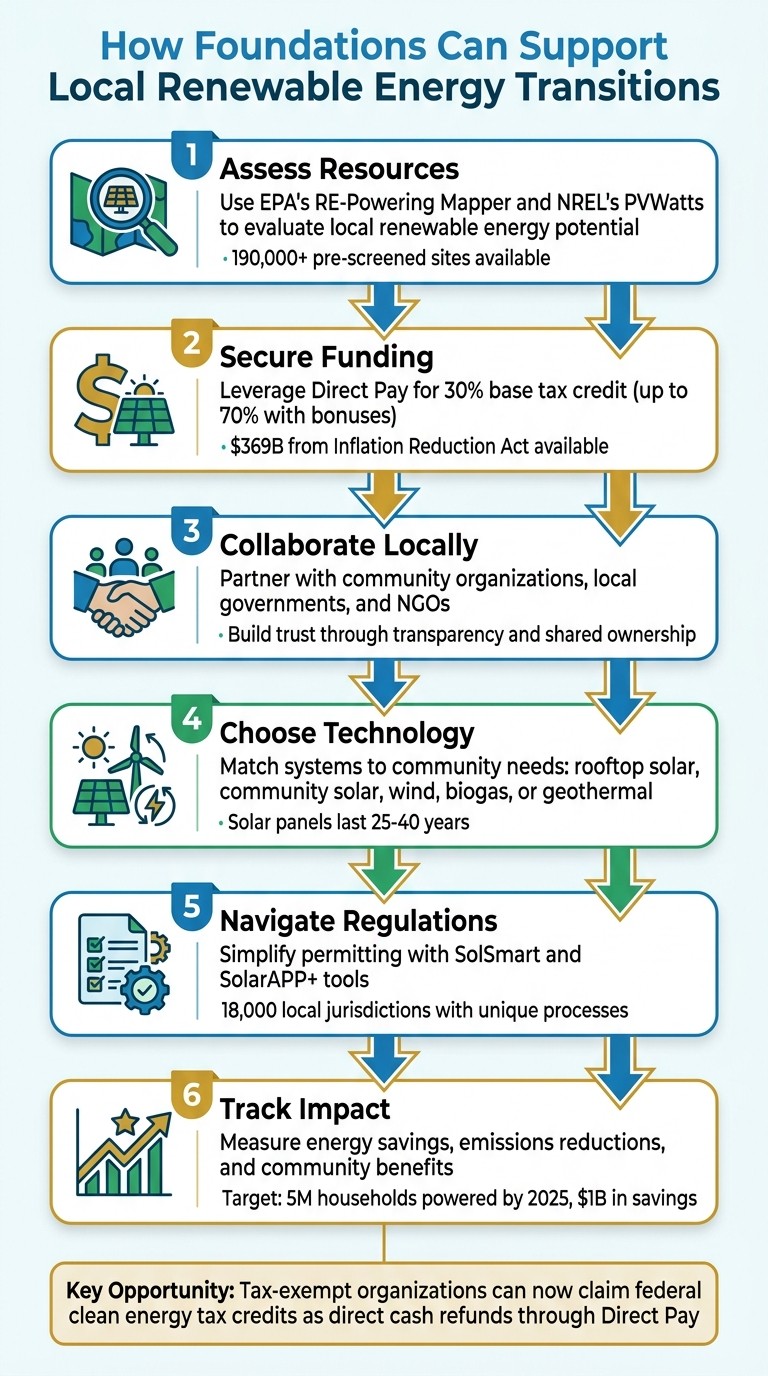
6 Steps for Foundations to Transition Communities to Renewable Energy
How Communities Are Taking Control of Clean Energy to Maximize Benefits for All
Evaluating Local Renewable Energy Resources
Assessing local renewable energy resources helps identify projects that deliver meaningful impact while staying financially feasible.
Conducting a Resource Assessment
Start by setting clear renewable energy objectives. According to the U.S. EPA, "Establishing a publicly available renewable energy project development and/or renewable energy usage goal helps bring clarity and focus to the process" [3]. These goals provide a foundation for tracking progress and guiding your evaluation.
Take advantage of free tools from the National Renewable Energy Laboratory (NREL). The PVWatts Calculator estimates solar photovoltaic (PV) production, while REopt Lite evaluates grid-connected solar and battery systems [3][5]. For wind energy, the Distributed Wind Energy Zoning and Permitting Toolkit helps navigate local regulations [5].
The EPA’s RE-Powering Mapper is another invaluable resource, offering data on over 190,000 pre-screened sites like contaminated lands, landfills, and former mines. These locations are filtered by factors such as acreage, proximity to substations, and capacity, making it easier to find options that are both practical and likely to gain regulatory approval compared to undeveloped green spaces [6].
Real-world examples showcase the value of thorough assessments. At Agnes Scott College in Georgia, Sustainability Director Susan Kidd led a 2015 project installing five solar PV arrays on campus rooftops. This system now generates 342,200 kWh annually [5]. Similarly, the City of Cincinnati conducted a detailed assessment in 2021, resulting in a 100 MW solar installation - the largest city-led project of its kind east of the Mississippi River [5].
Tools like the Levelized Cost of Electricity (LCOE) and databases such as DSIRE can help compare project costs and identify local incentives [3][5]. With a clear understanding of available resources and their economic potential, you can move forward with projects that align with your goals.
Identifying Viable Projects
Once resources are mapped, focus on projects that align with your mission and financial constraints. Evaluate site conditions by considering factors like available acreage, roof integrity, shading, and proximity to electrical infrastructure [6]. Sites closer to substations often have lower interconnection costs, which can significantly impact a project's financial outlook.
Prioritizing "brightfields" - sites like landfills, contaminated lands, and degraded properties - over undeveloped green spaces minimizes land-use conflicts while repurposing underutilized areas [6]. The EPA’s RE-Powering Electronic Decision Tree can screen sites for technical, financial, and regulatory challenges before significant investments are made [6].
Different renewable technologies suit different settings. Rooftop solar is ideal for schools, community centers, and affordable housing. Wind projects require careful analysis of wind speeds, zoning rules, and wildlife considerations. Biogas systems depend on the availability of landfill or wastewater digester gas, while geothermal systems call for subsurface temperature evaluations [2].
Collaborative efforts can amplify results. For instance, George Washington University, American University, and George Washington University Hospital joined forces to assess their energy needs. Together, they negotiated a 20-year Power Purchase Agreement to secure solar PV electricity, reducing risks and maximizing their purchasing power [5].
Engaging local stakeholders early is critical. This includes working with community members, officials, and nonprofits to address concerns and build support [2]. The Interstate Renewable Energy Council (IREC), which has guided over 500 cities and towns in expanding clean energy options, emphasizes the importance of collaboration:
"IREC is the bridge between clean energy possibilities and real-world implementation - the expert that states, cities, and communities call when they need to turn clean energy goals into action" [4].
This collaborative strategy not only improves project feasibility but also streamlines the path to implementation. Careful evaluation at this stage sets the stage for effective funding, stakeholder cooperation, and system installation, which are explored in upcoming sections.
Funding Local Renewable Energy Projects
Turning renewable energy projects from concept to reality requires effective funding strategies. For many foundations, securing the necessary capital remains a significant hurdle. However, recent federal legislation has created new pathways for tax-exempt organizations to access funding opportunities that were previously unavailable.
Using Grants and Incentives
The Inflation Reduction Act brought a historic commitment of $369 billion to clean energy, introducing a mechanism called Direct Pay (Elective Pay). This allows tax-exempt entities to claim federal tax credits as direct cash refunds [7].
The Investment Tax Credit (ITC) offers a 30% base credit for renewable energy installations under 1 megawatt. Additional bonus credits - 10% for U.S.-manufactured materials, 10% for projects in energy communities, and up to 20% for serving low-income areas - can bring the total credit to as much as 70% of project costs [8].
In 2023, Greenleaf Christian Church and the Rebuilding Broken Places Community Development Corporation in Goldsboro, North Carolina, utilized the Clean Electricity Investment Tax Credit with Direct Pay to install solar energy systems. This approach allowed them to recover a significant portion of their installation costs directly from the federal government [8].
To claim these benefits, foundations must pre-register with the IRS to obtain a registration number before filing for the installation year [8]. The low-income bonus credit, capped at 1.8 gigawatts of total capacity per year, must be applied for before the project becomes operational [8]. Furthermore, registration in SAM.gov is required to secure a Unique Entity Identifier (UEI), a process that can take 2–4 weeks [7].
The Greenhouse Gas Reduction Fund provides $27 billion through intermediaries to support clean energy projects in low-income and underserved communities [7]. Foundations can also explore resources like the Database of State Incentives for Renewables & Efficiency (dsireusa.org) to identify state-specific grants and utility incentives, which can complement federal credits [7]. These tools open the door to innovative financing options, leading to broader funding possibilities.
Alternative Financing Models
Beyond grants and incentives, alternative financing models can further increase access to capital. Foundations can use Program-Related Investments (PRIs) and recoverable grants to offer low-cost loans or bridge funding for renewable energy projects. These funds can be recycled as loans are repaid, maximizing impact [10].
For example, in early 2026, GRID Alternatives used its Energy Resilience Fund to provide 13 low-cost bridge loans for multifamily affordable housing projects. The fund raised $7 million from foundations like BQuest Foundation and The Schmidt Family Foundation and leveraged California's SOMAH rebate program to cover 100% of electricity costs for tenants [10]. Kara Ballester, President of BQuest Foundation, highlighted the importance of this approach:
"Foundations and other impact investors can make a difference on a large scale by providing the type of capital these projects need in order to get built and start creating a positive impact in marginalized communities." [10]
The RISE Model (Renewable Investment for Shared Equity) offers another pathway, enabling foundations to act as solar owners for low- and moderate-income households. By using Direct Pay to claim tax credits, foundations can provide solar systems with little to no upfront cost. In September 2023, the Capital Good Fund launched the Georgia BRIGHT program under this model, creating a subsidiary LLC to own residential solar systems, claim tax credits, and offer affordable solar leases to low-income households through an escrow structure [1].
Credit enhancements are also effective for reducing perceived risks. Philanthropic capital can provide guarantees, insurance, or loan loss reserves to make projects more attractive to traditional lenders [9]. For example, California Investor-Owned Utilities have issued $157 million in 0% interest On-Bill Financing loans since 2015, with an exceptionally low default rate of 0.06% [11].
Since IRS Direct Pay reimbursements can take 6–12 months after filing, foundations may need to use their internal resources to cover upfront construction costs or provide bridge funding to partners [8][13]. When assembling a "capital stack", it’s crucial to ensure that the combined value of grants and tax credits does not exceed 100% of project costs, as exceeding this limit can reduce the tax credit amount under the IRS "Excess Benefit" rule [8].
Collaborating with Stakeholders and Communities
Renewable energy initiatives succeed when foundations collaborate deeply with local organizations, fostering shared ownership of both challenges and achievements.
Partnering with Local Governments and NGOs
Tapping into existing networks is critical. The Department of Energy's Community Power Accelerator offers a centralized hub where foundations can connect with developers, lenders, and community organizations already active in renewable energy efforts [12]. This approach streamlines the process and ensures partnerships with experienced players.
Community-Based Organizations (CBOs) act as vital links between foundations and residents. A standout example is Georgia Interfaith Power & Light (GIPL), which has been running its Congregational Solar Program since 2018. By June 2025, this initiative will have installed 620 kilowatts of solar capacity across 25 projects, reducing 3,541 metric tons of carbon dioxide emissions annually. Hannah Shultz, the program’s director, highlighted the importance of external support:
"Establish relationships with the program administrator... and connect with pro-bono organizations... This external support and technical resources were key in establishing and expanding solar assistance" [14].
Effective partnerships require clearly defined roles from the outset. Successful projects typically designate a Program Manager, a Community Outreach Lead, and formalize compensation for CBOs to handle tasks like community enrollment and installer vetting [1][14]. Paying CBOs as official partners ensures their sustained, professional participation.
Building Community Support
Beyond partnerships, gaining trust within the community is essential. Trust grows through transparency and collaboration. Programs that are designed with communities, rather than for them, tend to achieve better outcomes. For example, Washington, D.C.’s Solar for All Program began working with CBOs in 2016 to recruit participants for community solar projects. These organizations, acting as trusted intermediaries, met directly with residents and even provided letters of support, helping to overcome skepticism about program benefits [14].
Simplifying enrollment processes is another key strategy. Offering checklists and hosting in-person Q&A events can help residents navigate income verification and utility bill requirements [14]. Addressing structural barriers, such as roof repairs, may also be necessary before solar installation can proceed.
Peer success stories often drive momentum. When residents see solar installations thriving in their neighborhoods, adoption tends to spread through a "ripple effect" [14]. In June 2025, the Climate Access Fund exemplified this with an 808-kilowatt community solar project on a Baltimore school rooftop. This initiative provided discounted electricity - 20%–25% lower costs - to 150 low- and moderate-income households [1]. Such visible successes can build trust and enthusiasm more effectively than traditional marketing efforts.
Collaboration should aim to deliver tangible benefits that go beyond clean energy itself. These include community ownership opportunities, workforce training, energy affordability for low-to-moderate income families, and improved grid resilience [12]. The DOE has set an ambitious target to deploy enough community solar to power five million households by 2025, generating $1 billion in energy bill savings [12]. Foundations that align their efforts with these measurable social benefits are more likely to build lasting coalitions that extend beyond individual projects.
Choosing and Installing Renewable Energy Systems
Selecting renewable energy systems involves balancing technology options with regulatory requirements to ensure they meet the needs of the community while delivering tangible benefits.
Selecting the Right Technology
Choosing the right renewable energy technology depends on the local housing landscape and the needs of those benefiting from the system. For instance:
Single-family rooftop solar is ideal for homeowners who can directly benefit from reduced utility bills.
Multifamily solar works well for affordable housing complexes, where savings can be distributed among tenants by the property owner.
Community solar provides a solution for renters or those with shaded roofs by offering access to shared, off-site systems [1].
Pairing solar panels with battery storage systems (BESS) can further enhance grid reliability and lower energy costs [17]. Solar panels, with a lifespan of 25–40 years [15], make durability a critical factor in technology selection.
A notable example is the September 2023 launch of Georgia BRIGHT Solar LLC by Capital Good Fund. This solar lease program was specifically designed for low- and moderate-income households. By utilizing the Investment Tax Credit (ITC) through the direct pay mechanism, the nonprofit CDFI made the project feasible without traditional tax equity investors [1].
When selecting technology, focus on achieving measurable outcomes like energy savings, job creation, and improved grid resilience [16][12]. Early appointment of a program manager to coordinate between financiers, community leaders, and installers can ensure smooth project execution [1].
After determining the appropriate technology, addressing permitting and zoning requirements becomes the next critical step.
Managing Permits and Zoning
Navigating permits and zoning regulations is crucial for turning plans into reality. Permitting is often cited as a significant barrier to solar expansion [18]. The U.S. has around 18,000 local jurisdictions, each with unique permitting processes [18]. Ensuring that your local zoning code allows solar as a "by-right" use can help avoid delays related to special hearings or variances [19][15]. Cities like Philadelphia and Brownsville, Texas, have taken proactive steps by designating solar as a permitted accessory use in their zoning ordinances, reducing deployment timelines [19][15].
Collaboration with local governments and the use of online permitting checklists can simplify the approval process [20]. Best practices recommend solar permit fees between $75 and $200, aligning with fees for similar installations like air conditioning systems [20]. After installation, a local inspector will verify that the system complies with approved plans before it goes live [20].
For larger-scale projects, it’s important to create a decommissioning plan that outlines removal procedures and financial guarantees. Additionally, utility-scale solar projects must comply with the National Electrical Code, which mandates fencing standards such as a 6-foot fence with three lines of barbed wire or a 7-foot fence without barbed wire [15]. Programs like SolSmart and SolarAPP+ provide standardized tools and frameworks to streamline regulatory processes and adopt national best practices [21][22].
Addressing Barriers Through Policy and Planning
Renewable energy projects often face hurdles even when the necessary technology and permits are in place. High initial costs, delays in grid interconnection, and pushback from utilities are among the most frequent challenges to local renewable energy adoption [23][24]. Tackling these issues requires targeted policy changes and region-specific planning strategies.
Solving Financial and Technical Problems
One of the biggest obstacles to local renewable energy projects is financial. Renewable systems typically come with higher upfront costs compared to fossil fuel alternatives, and the fossil fuel industry often works to maintain its dominance. Rising energy prices only add to the difficulty [23][24].
To address these financial challenges, focusing on state-level policy reforms can be more effective than national initiatives. States often act as testing grounds for new models that can later expand nationwide [23]. A prime example is the Regional Greenhouse Gas Initiative (RGGI), a cap-and-trade program involving 10 states. This initiative generates millions annually for energy-efficiency programs. In New England, it has contributed to a sharp decline in coal- and oil-fired electricity generation - from 16% and 11% in 2001 to just 0.5% and 0.2% by 2021 [23].
"State policies help build renewable energy markets that continue to grow when there is little federal support, and they provide important models for action when opportunities arise." - Karen Harris, Climate and Energy Consultant, The John Merck Fund [23]
Technical setbacks, such as prolonged grid interconnection waits, require collaboration with expert organizations. For instance, the Conservation Law Foundation (CLF) successfully blocked two major natural gas pipeline projects in Massachusetts during 2016-2017. This legal victory prevented utilities from locking communities into long-term fossil fuel dependence, preserving opportunities for renewable energy investments [23]. These examples underscore how targeted legal and policy actions can alleviate both technical and financial uncertainties.
Supporting policies like Renewable Portfolio Standards (RPS) and solar net metering can also compel utilities to integrate renewable energy into their systems [23]. As of 2024, 29 states and Washington, D.C. have adopted RPS policies, with 16 setting ambitious targets of 50% or more [26]. Additionally, "Solarize" campaigns - which use community outreach to pool demand and cut installation costs - have proven effective. Over three years, these campaigns facilitated over $100 million in residential solar installations across Connecticut, Rhode Island, and New Hampshire [23].
Using Location-Specific Planning
While broad policy reforms address systemic challenges, tailored regional strategies ensure solutions align with local needs. Generic approaches often fail in renewable energy transitions because local factors like housing types and economic structures demand customized plans [25]. Foundations can assist communities in embedding climate and justice considerations directly into municipal budgets, rather than relying solely on innovative financing solutions [25].
A compelling example comes from Holyoke, Massachusetts, where the community group Neighbor to Neighbor collaborated with local organizations to push for the replacement of the Mount Tom coal plant. The result was a 5.76-megawatt solar facility featuring 17,000 panels and a battery storage system. This project not only transitioned a fossil fuel site into a renewable energy hub but also included severance packages for displaced workers [23].
"As organizers, we know that when communities that are most impacted take the lead and develop their own vision of what should happen, that is when you get the groundbreaking victories." - Lena Entin, Lead Organizer, Neighbor to Neighbor [23]
Tailored planning also involves using health-impact data to mobilize grassroots support. Foundations can fund deep organizing efforts in areas near fossil fuel plants, addressing specific concerns like job losses and tax revenue [23]. In regions lacking strong state incentives, philanthropic organizations can step in to provide resources for securing external funding and technical expertise that state agencies might not offer [25].
Nonprofits can also act as technical advisors to shape local policies and lead regional collaborations [25]. By leveraging municipal policymaking autonomy and sustainability offices, local actors can bypass state-level regulatory barriers. The key is adapting technology choices and financing strategies to the unique conditions of each community [25].
Measuring Results and Expanding Projects
Building on the groundwork of resource evaluation and collaboration with stakeholders, tracking performance is essential to ensure that renewable energy projects meet both environmental and social goals.
Tracking Performance Metrics
Once a project is up and running, monitoring the right metrics distinguishes initiatives that make a tangible difference from those that merely generate electricity. To maintain stakeholder confidence and secure ongoing investment, it's crucial to measure outcomes across environmental, economic, and social dimensions.
Start by establishing baseline data before the project begins. For instance, document current conditions like average energy costs for low-to-moderate income (LMI) households or existing greenhouse gas emissions [28]. LMI households often spend 8–10% of their income on energy, compared to just 3% for median-income households, making cost savings a particularly important benchmark [29].
Environmental metrics should include reductions in annual greenhouse gas emissions (measured in tons of CO2 equivalent) and the total installed renewable energy capacity in kilowatts or megawatts [28][29]. For context, a typical residential solar system can save about 1 ton of carbon annually [27]. On the economic side, metrics like the Levelized Cost of Energy (LCOE), Return on Investment (ROI), and annual energy savings for households are key indicators [28][29][30].
Community solar projects bring additional considerations. Metrics like subscriber retention and participation rates help reveal whether these programs are effectively serving their target populations. For example, the Minnesota Community Solar Garden Program achieved a 94% subscriber retention rate and 29% verified LMI participation by 2024, across over 900 MW of operational capacity [29]. In contrast, poorly designed programs can face subscriber churn rates as high as 40% [29]. Other useful indicators include acquisition costs, Net Promoter Scores (with scores above 40 indicating strong performance), and the percentage of installations in disadvantaged areas [28][29][30].
To ensure the reliability of these metrics, install independent performance monitoring systems that comply with IEC 61724 standards rather than relying solely on self-reported data from inverters [29]. Use standardized frameworks from organizations like SolSmart or the Coalition for Community Solar Access to make your data comparable with industry norms [28][29]. Public-facing dashboards can also enhance transparency and accountability with community stakeholders [28].
By gathering robust, defensible data, organizations can identify what works and use these insights to expand successful projects.
Expanding Successful Projects
Scaling renewable energy initiatives requires proof of success at the pilot stage. Before expanding to new areas, ensure that pilot projects meet key benchmarks, such as energy generation within 5% of projections, subscriber retention rates above 92%, and positive unit economics [30].
Between 2020 and 2025, the French renewable energy cooperative Enercoop demonstrated how modular expansion can achieve both growth and social impact. They grew from 40,000 to over 115,000 members, operating more than 400 generation facilities tailored to local subscriber demand. Impressively, 22% of new subscriptions came from energy-vulnerable households [30]. Similarly, Belgium's Ecopower transitioned from small-scale rooftop solar installations to the nation's largest renewable energy cooperative, with over 65,000 members by 2025. Their success was driven by diversifying energy sources to include wind, biogas, and hydropower [30].
To identify potential new locations, evaluate grid capacity with local Distribution System Operators to find substations that can handle additional load without requiring lengthy upgrades [30]. Secure commitments from key subscribers - such as municipal buildings or large NGOs - to offtake 30–40% of projected energy generation before starting construction in new areas [30]. The U.S. Department of Energy's Community Power Accelerator offers an online platform to connect developers, foundations, and community organizations, helping to streamline the scaling process [16][12].
"Organizations that develop repeatable playbooks for scaling will be positioned to capture disproportionate value in this capital deployment wave." - Sustainability Atlas [31]
Documenting lessons from pilot projects is critical. Record variations in timelines, costs, and other factors to create a "replication playbook" that can guide future expansions [31]. Structuring financing to separate high-risk early-stage projects from de-risked operational portfolios can attract a broader range of investors and speed up scaling efforts [31]. Additionally, member referral programs in energy cooperatives are highly effective, with conversion rates three to four times higher than cold outreach [30].
Conclusion
Foundations and philanthropic organizations are stepping into a pivotal role in advancing the clean energy transition. The tools, financial mechanisms, and tested approaches already exist to bring renewable energy solutions to low- and moderate-income (LMI) communities across the nation [1]. By embracing direct pay systems, channeling investments into community-focused institutions, and adopting trust-based philanthropy, organizations can tackle long-standing energy inequities.
This shift requires moving beyond conventional grantmaking approaches. For example, in September 2023, the Capital Good Fund launched Georgia BRIGHT, a program leveraging federal tax credits through direct pay to remove upfront costs for LMI households. Similarly, Baltimore’s Climate Access Fund supported 150 LMI residents with electricity at a 20%–25% discount through an 808 kW community solar array [1]. These initiatives illustrate that renewable energy isn’t just about generating power - it’s about fostering economic justice, strengthening communities, and building resilience.
As industry leaders emphasize, solar energy represents a pathway to broader community development. Investments in capacity building, technical assistance, and revolving loan funds can empower local expertise, create sustainable jobs, and promote community-owned clean energy projects. Such efforts generate ripple effects that extend far beyond individual installations, amplifying their impact.
FAQs
What’s the fastest way to pick the right renewable project for our community?
To identify the most suitable renewable energy project for your community, start by evaluating its key priorities - whether that’s cost-effectiveness, resilience, or social advantages. Align these priorities with projects that have a track record of success, such as community solar initiatives. Engaging stakeholders is crucial, so use platforms that encourage collaboration and align with your community’s mission. Additionally, performing a feasibility assessment that considers local resources, funding options, and stakeholder feedback can simplify the decision-making process and uncover solutions that are both effective and scalable.
How does IRS Direct Pay work for nonprofits, and what paperwork is required?
Nonprofits can take advantage of IRS Direct Pay to receive payments equal to the full value of specific clean energy tax credits, such as those related to solar energy projects, even if they don’t owe taxes. To participate, organizations must register with the IRS, complete necessary forms like IRS Form 5884, and submit documentation confirming the eligibility of their projects. Always consult the most recent IRS guidance to stay updated on the required forms and criteria.
What are the biggest risks (interconnection, permitting, costs) and how can we reduce them?
Transitioning to local renewable energy systems comes with its own set of challenges - interconnection, permitting, and costs - but these can be addressed effectively with thoughtful planning.
Interconnection: Navigating regional electricity markets and understanding grid systems is crucial for smooth integration. A clear grasp of these dynamics can significantly reduce potential roadblocks.
Permitting: Early engagement with local communities and efforts to streamline permitting processes can help avoid unnecessary delays and build trust with stakeholders.
Costs: Leveraging federal funding opportunities, exploring creative financing options, and taking advantage of decreasing technology prices can make renewable systems more affordable.
By prioritizing collaboration and preparing in advance, these hurdles can be managed effectively, paving the way for a smoother transition to renewable energy.
Related Blog Posts
Latest Articles
©2025

Narrative Change and Power Building: The Missing Half of Advocacy
Narrative change is the process of disrupting dominant narratives that normalize inequity and advancing new narratives from historically marginalized communities.

Funding Resilience Without Federal Grants
BRIC is unreliable and FEMA is shrinking. Here's how cities fund climate resilience with dedicated revenue, blended finance, and a coordinating authority.

The ESG Blind Spot: How AI Is Finding Risks in Companies Nobody Else Is Watching
Norway's sovereign wealth fund uses AI to screen 7,200 portfolio companies for forced labor and corruption within 24 hours. The real story is the emerging-market coverage gap that traditional ESG data vendors miss — and what it means for any company with a global supply chain.
Narrative Change and Power Building: The Missing Half of Advocacy
Narrative change is the process of disrupting dominant narratives that normalize inequity and advancing new narratives from historically marginalized communities.
Funding Resilience Without Federal Grants
BRIC is unreliable and FEMA is shrinking. Here's how cities fund climate resilience with dedicated revenue, blended finance, and a coordinating authority.
The ESG Blind Spot: How AI Is Finding Risks in Companies Nobody Else Is Watching
Norway's sovereign wealth fund uses AI to screen 7,200 portfolio companies for forced labor and corruption within 24 hours. The real story is the emerging-market coverage gap that traditional ESG data vendors miss — and what it means for any company with a global supply chain.
FAQ
01
What does it really mean to “redefine profit”?
02
What makes Council Fire different?
03
Who does Council Fire work with?
04
What does working with Council Fire actually look like?
05
How does Council Fire help organizations turn big goals into action?
06
How does Council Fire define and measure success?
Apr 27, 2026
How to Transition to Renewable Energy Systems at the Local Level for Foundations & Philanthropic Organizations
Sustainability Strategy
In This Article
Foundations can use Direct Pay, grants, and local partnerships to bring affordable renewable energy to underserved communities.
How to Transition to Renewable Energy Systems at the Local Level for Foundations & Philanthropic Organizations
Foundations and philanthropic organizations have a unique opportunity to address energy inequality and climate challenges by supporting renewable energy initiatives for underserved communities. With tools like the Inflation Reduction Act’s Direct Pay, tax-exempt groups can now directly benefit from clean energy tax credits, enabling impactful projects. Key steps include:
Assessing Resources: Use tools like the EPA’s RE-Powering Mapper and NREL’s PVWatts to evaluate local renewable energy potential.
Funding Projects: Leverage federal tax credits, grants, and alternative financing models, such as Program-Related Investments (PRIs) and recoverable grants.
Collaborating Locally: Partner with community organizations and governments to build trust and ensure project success.
Choosing Technology: Match renewable systems - solar, wind, biogas, or geothermal - to community needs and site conditions.
Navigating Regulations: Simplify permitting and zoning processes with resources like SolSmart and SolarAPP+.
Tracking Impact: Measure outcomes such as energy savings, emissions reductions, and community benefits to refine and expand projects.
6 Steps for Foundations to Transition Communities to Renewable Energy
How Communities Are Taking Control of Clean Energy to Maximize Benefits for All
Evaluating Local Renewable Energy Resources
Assessing local renewable energy resources helps identify projects that deliver meaningful impact while staying financially feasible.
Conducting a Resource Assessment
Start by setting clear renewable energy objectives. According to the U.S. EPA, "Establishing a publicly available renewable energy project development and/or renewable energy usage goal helps bring clarity and focus to the process" [3]. These goals provide a foundation for tracking progress and guiding your evaluation.
Take advantage of free tools from the National Renewable Energy Laboratory (NREL). The PVWatts Calculator estimates solar photovoltaic (PV) production, while REopt Lite evaluates grid-connected solar and battery systems [3][5]. For wind energy, the Distributed Wind Energy Zoning and Permitting Toolkit helps navigate local regulations [5].
The EPA’s RE-Powering Mapper is another invaluable resource, offering data on over 190,000 pre-screened sites like contaminated lands, landfills, and former mines. These locations are filtered by factors such as acreage, proximity to substations, and capacity, making it easier to find options that are both practical and likely to gain regulatory approval compared to undeveloped green spaces [6].
Real-world examples showcase the value of thorough assessments. At Agnes Scott College in Georgia, Sustainability Director Susan Kidd led a 2015 project installing five solar PV arrays on campus rooftops. This system now generates 342,200 kWh annually [5]. Similarly, the City of Cincinnati conducted a detailed assessment in 2021, resulting in a 100 MW solar installation - the largest city-led project of its kind east of the Mississippi River [5].
Tools like the Levelized Cost of Electricity (LCOE) and databases such as DSIRE can help compare project costs and identify local incentives [3][5]. With a clear understanding of available resources and their economic potential, you can move forward with projects that align with your goals.
Identifying Viable Projects
Once resources are mapped, focus on projects that align with your mission and financial constraints. Evaluate site conditions by considering factors like available acreage, roof integrity, shading, and proximity to electrical infrastructure [6]. Sites closer to substations often have lower interconnection costs, which can significantly impact a project's financial outlook.
Prioritizing "brightfields" - sites like landfills, contaminated lands, and degraded properties - over undeveloped green spaces minimizes land-use conflicts while repurposing underutilized areas [6]. The EPA’s RE-Powering Electronic Decision Tree can screen sites for technical, financial, and regulatory challenges before significant investments are made [6].
Different renewable technologies suit different settings. Rooftop solar is ideal for schools, community centers, and affordable housing. Wind projects require careful analysis of wind speeds, zoning rules, and wildlife considerations. Biogas systems depend on the availability of landfill or wastewater digester gas, while geothermal systems call for subsurface temperature evaluations [2].
Collaborative efforts can amplify results. For instance, George Washington University, American University, and George Washington University Hospital joined forces to assess their energy needs. Together, they negotiated a 20-year Power Purchase Agreement to secure solar PV electricity, reducing risks and maximizing their purchasing power [5].
Engaging local stakeholders early is critical. This includes working with community members, officials, and nonprofits to address concerns and build support [2]. The Interstate Renewable Energy Council (IREC), which has guided over 500 cities and towns in expanding clean energy options, emphasizes the importance of collaboration:
"IREC is the bridge between clean energy possibilities and real-world implementation - the expert that states, cities, and communities call when they need to turn clean energy goals into action" [4].
This collaborative strategy not only improves project feasibility but also streamlines the path to implementation. Careful evaluation at this stage sets the stage for effective funding, stakeholder cooperation, and system installation, which are explored in upcoming sections.
Funding Local Renewable Energy Projects
Turning renewable energy projects from concept to reality requires effective funding strategies. For many foundations, securing the necessary capital remains a significant hurdle. However, recent federal legislation has created new pathways for tax-exempt organizations to access funding opportunities that were previously unavailable.
Using Grants and Incentives
The Inflation Reduction Act brought a historic commitment of $369 billion to clean energy, introducing a mechanism called Direct Pay (Elective Pay). This allows tax-exempt entities to claim federal tax credits as direct cash refunds [7].
The Investment Tax Credit (ITC) offers a 30% base credit for renewable energy installations under 1 megawatt. Additional bonus credits - 10% for U.S.-manufactured materials, 10% for projects in energy communities, and up to 20% for serving low-income areas - can bring the total credit to as much as 70% of project costs [8].
In 2023, Greenleaf Christian Church and the Rebuilding Broken Places Community Development Corporation in Goldsboro, North Carolina, utilized the Clean Electricity Investment Tax Credit with Direct Pay to install solar energy systems. This approach allowed them to recover a significant portion of their installation costs directly from the federal government [8].
To claim these benefits, foundations must pre-register with the IRS to obtain a registration number before filing for the installation year [8]. The low-income bonus credit, capped at 1.8 gigawatts of total capacity per year, must be applied for before the project becomes operational [8]. Furthermore, registration in SAM.gov is required to secure a Unique Entity Identifier (UEI), a process that can take 2–4 weeks [7].
The Greenhouse Gas Reduction Fund provides $27 billion through intermediaries to support clean energy projects in low-income and underserved communities [7]. Foundations can also explore resources like the Database of State Incentives for Renewables & Efficiency (dsireusa.org) to identify state-specific grants and utility incentives, which can complement federal credits [7]. These tools open the door to innovative financing options, leading to broader funding possibilities.
Alternative Financing Models
Beyond grants and incentives, alternative financing models can further increase access to capital. Foundations can use Program-Related Investments (PRIs) and recoverable grants to offer low-cost loans or bridge funding for renewable energy projects. These funds can be recycled as loans are repaid, maximizing impact [10].
For example, in early 2026, GRID Alternatives used its Energy Resilience Fund to provide 13 low-cost bridge loans for multifamily affordable housing projects. The fund raised $7 million from foundations like BQuest Foundation and The Schmidt Family Foundation and leveraged California's SOMAH rebate program to cover 100% of electricity costs for tenants [10]. Kara Ballester, President of BQuest Foundation, highlighted the importance of this approach:
"Foundations and other impact investors can make a difference on a large scale by providing the type of capital these projects need in order to get built and start creating a positive impact in marginalized communities." [10]
The RISE Model (Renewable Investment for Shared Equity) offers another pathway, enabling foundations to act as solar owners for low- and moderate-income households. By using Direct Pay to claim tax credits, foundations can provide solar systems with little to no upfront cost. In September 2023, the Capital Good Fund launched the Georgia BRIGHT program under this model, creating a subsidiary LLC to own residential solar systems, claim tax credits, and offer affordable solar leases to low-income households through an escrow structure [1].
Credit enhancements are also effective for reducing perceived risks. Philanthropic capital can provide guarantees, insurance, or loan loss reserves to make projects more attractive to traditional lenders [9]. For example, California Investor-Owned Utilities have issued $157 million in 0% interest On-Bill Financing loans since 2015, with an exceptionally low default rate of 0.06% [11].
Since IRS Direct Pay reimbursements can take 6–12 months after filing, foundations may need to use their internal resources to cover upfront construction costs or provide bridge funding to partners [8][13]. When assembling a "capital stack", it’s crucial to ensure that the combined value of grants and tax credits does not exceed 100% of project costs, as exceeding this limit can reduce the tax credit amount under the IRS "Excess Benefit" rule [8].
Collaborating with Stakeholders and Communities
Renewable energy initiatives succeed when foundations collaborate deeply with local organizations, fostering shared ownership of both challenges and achievements.
Partnering with Local Governments and NGOs
Tapping into existing networks is critical. The Department of Energy's Community Power Accelerator offers a centralized hub where foundations can connect with developers, lenders, and community organizations already active in renewable energy efforts [12]. This approach streamlines the process and ensures partnerships with experienced players.
Community-Based Organizations (CBOs) act as vital links between foundations and residents. A standout example is Georgia Interfaith Power & Light (GIPL), which has been running its Congregational Solar Program since 2018. By June 2025, this initiative will have installed 620 kilowatts of solar capacity across 25 projects, reducing 3,541 metric tons of carbon dioxide emissions annually. Hannah Shultz, the program’s director, highlighted the importance of external support:
"Establish relationships with the program administrator... and connect with pro-bono organizations... This external support and technical resources were key in establishing and expanding solar assistance" [14].
Effective partnerships require clearly defined roles from the outset. Successful projects typically designate a Program Manager, a Community Outreach Lead, and formalize compensation for CBOs to handle tasks like community enrollment and installer vetting [1][14]. Paying CBOs as official partners ensures their sustained, professional participation.
Building Community Support
Beyond partnerships, gaining trust within the community is essential. Trust grows through transparency and collaboration. Programs that are designed with communities, rather than for them, tend to achieve better outcomes. For example, Washington, D.C.’s Solar for All Program began working with CBOs in 2016 to recruit participants for community solar projects. These organizations, acting as trusted intermediaries, met directly with residents and even provided letters of support, helping to overcome skepticism about program benefits [14].
Simplifying enrollment processes is another key strategy. Offering checklists and hosting in-person Q&A events can help residents navigate income verification and utility bill requirements [14]. Addressing structural barriers, such as roof repairs, may also be necessary before solar installation can proceed.
Peer success stories often drive momentum. When residents see solar installations thriving in their neighborhoods, adoption tends to spread through a "ripple effect" [14]. In June 2025, the Climate Access Fund exemplified this with an 808-kilowatt community solar project on a Baltimore school rooftop. This initiative provided discounted electricity - 20%–25% lower costs - to 150 low- and moderate-income households [1]. Such visible successes can build trust and enthusiasm more effectively than traditional marketing efforts.
Collaboration should aim to deliver tangible benefits that go beyond clean energy itself. These include community ownership opportunities, workforce training, energy affordability for low-to-moderate income families, and improved grid resilience [12]. The DOE has set an ambitious target to deploy enough community solar to power five million households by 2025, generating $1 billion in energy bill savings [12]. Foundations that align their efforts with these measurable social benefits are more likely to build lasting coalitions that extend beyond individual projects.
Choosing and Installing Renewable Energy Systems
Selecting renewable energy systems involves balancing technology options with regulatory requirements to ensure they meet the needs of the community while delivering tangible benefits.
Selecting the Right Technology
Choosing the right renewable energy technology depends on the local housing landscape and the needs of those benefiting from the system. For instance:
Single-family rooftop solar is ideal for homeowners who can directly benefit from reduced utility bills.
Multifamily solar works well for affordable housing complexes, where savings can be distributed among tenants by the property owner.
Community solar provides a solution for renters or those with shaded roofs by offering access to shared, off-site systems [1].
Pairing solar panels with battery storage systems (BESS) can further enhance grid reliability and lower energy costs [17]. Solar panels, with a lifespan of 25–40 years [15], make durability a critical factor in technology selection.
A notable example is the September 2023 launch of Georgia BRIGHT Solar LLC by Capital Good Fund. This solar lease program was specifically designed for low- and moderate-income households. By utilizing the Investment Tax Credit (ITC) through the direct pay mechanism, the nonprofit CDFI made the project feasible without traditional tax equity investors [1].
When selecting technology, focus on achieving measurable outcomes like energy savings, job creation, and improved grid resilience [16][12]. Early appointment of a program manager to coordinate between financiers, community leaders, and installers can ensure smooth project execution [1].
After determining the appropriate technology, addressing permitting and zoning requirements becomes the next critical step.
Managing Permits and Zoning
Navigating permits and zoning regulations is crucial for turning plans into reality. Permitting is often cited as a significant barrier to solar expansion [18]. The U.S. has around 18,000 local jurisdictions, each with unique permitting processes [18]. Ensuring that your local zoning code allows solar as a "by-right" use can help avoid delays related to special hearings or variances [19][15]. Cities like Philadelphia and Brownsville, Texas, have taken proactive steps by designating solar as a permitted accessory use in their zoning ordinances, reducing deployment timelines [19][15].
Collaboration with local governments and the use of online permitting checklists can simplify the approval process [20]. Best practices recommend solar permit fees between $75 and $200, aligning with fees for similar installations like air conditioning systems [20]. After installation, a local inspector will verify that the system complies with approved plans before it goes live [20].
For larger-scale projects, it’s important to create a decommissioning plan that outlines removal procedures and financial guarantees. Additionally, utility-scale solar projects must comply with the National Electrical Code, which mandates fencing standards such as a 6-foot fence with three lines of barbed wire or a 7-foot fence without barbed wire [15]. Programs like SolSmart and SolarAPP+ provide standardized tools and frameworks to streamline regulatory processes and adopt national best practices [21][22].
Addressing Barriers Through Policy and Planning
Renewable energy projects often face hurdles even when the necessary technology and permits are in place. High initial costs, delays in grid interconnection, and pushback from utilities are among the most frequent challenges to local renewable energy adoption [23][24]. Tackling these issues requires targeted policy changes and region-specific planning strategies.
Solving Financial and Technical Problems
One of the biggest obstacles to local renewable energy projects is financial. Renewable systems typically come with higher upfront costs compared to fossil fuel alternatives, and the fossil fuel industry often works to maintain its dominance. Rising energy prices only add to the difficulty [23][24].
To address these financial challenges, focusing on state-level policy reforms can be more effective than national initiatives. States often act as testing grounds for new models that can later expand nationwide [23]. A prime example is the Regional Greenhouse Gas Initiative (RGGI), a cap-and-trade program involving 10 states. This initiative generates millions annually for energy-efficiency programs. In New England, it has contributed to a sharp decline in coal- and oil-fired electricity generation - from 16% and 11% in 2001 to just 0.5% and 0.2% by 2021 [23].
"State policies help build renewable energy markets that continue to grow when there is little federal support, and they provide important models for action when opportunities arise." - Karen Harris, Climate and Energy Consultant, The John Merck Fund [23]
Technical setbacks, such as prolonged grid interconnection waits, require collaboration with expert organizations. For instance, the Conservation Law Foundation (CLF) successfully blocked two major natural gas pipeline projects in Massachusetts during 2016-2017. This legal victory prevented utilities from locking communities into long-term fossil fuel dependence, preserving opportunities for renewable energy investments [23]. These examples underscore how targeted legal and policy actions can alleviate both technical and financial uncertainties.
Supporting policies like Renewable Portfolio Standards (RPS) and solar net metering can also compel utilities to integrate renewable energy into their systems [23]. As of 2024, 29 states and Washington, D.C. have adopted RPS policies, with 16 setting ambitious targets of 50% or more [26]. Additionally, "Solarize" campaigns - which use community outreach to pool demand and cut installation costs - have proven effective. Over three years, these campaigns facilitated over $100 million in residential solar installations across Connecticut, Rhode Island, and New Hampshire [23].
Using Location-Specific Planning
While broad policy reforms address systemic challenges, tailored regional strategies ensure solutions align with local needs. Generic approaches often fail in renewable energy transitions because local factors like housing types and economic structures demand customized plans [25]. Foundations can assist communities in embedding climate and justice considerations directly into municipal budgets, rather than relying solely on innovative financing solutions [25].
A compelling example comes from Holyoke, Massachusetts, where the community group Neighbor to Neighbor collaborated with local organizations to push for the replacement of the Mount Tom coal plant. The result was a 5.76-megawatt solar facility featuring 17,000 panels and a battery storage system. This project not only transitioned a fossil fuel site into a renewable energy hub but also included severance packages for displaced workers [23].
"As organizers, we know that when communities that are most impacted take the lead and develop their own vision of what should happen, that is when you get the groundbreaking victories." - Lena Entin, Lead Organizer, Neighbor to Neighbor [23]
Tailored planning also involves using health-impact data to mobilize grassroots support. Foundations can fund deep organizing efforts in areas near fossil fuel plants, addressing specific concerns like job losses and tax revenue [23]. In regions lacking strong state incentives, philanthropic organizations can step in to provide resources for securing external funding and technical expertise that state agencies might not offer [25].
Nonprofits can also act as technical advisors to shape local policies and lead regional collaborations [25]. By leveraging municipal policymaking autonomy and sustainability offices, local actors can bypass state-level regulatory barriers. The key is adapting technology choices and financing strategies to the unique conditions of each community [25].
Measuring Results and Expanding Projects
Building on the groundwork of resource evaluation and collaboration with stakeholders, tracking performance is essential to ensure that renewable energy projects meet both environmental and social goals.
Tracking Performance Metrics
Once a project is up and running, monitoring the right metrics distinguishes initiatives that make a tangible difference from those that merely generate electricity. To maintain stakeholder confidence and secure ongoing investment, it's crucial to measure outcomes across environmental, economic, and social dimensions.
Start by establishing baseline data before the project begins. For instance, document current conditions like average energy costs for low-to-moderate income (LMI) households or existing greenhouse gas emissions [28]. LMI households often spend 8–10% of their income on energy, compared to just 3% for median-income households, making cost savings a particularly important benchmark [29].
Environmental metrics should include reductions in annual greenhouse gas emissions (measured in tons of CO2 equivalent) and the total installed renewable energy capacity in kilowatts or megawatts [28][29]. For context, a typical residential solar system can save about 1 ton of carbon annually [27]. On the economic side, metrics like the Levelized Cost of Energy (LCOE), Return on Investment (ROI), and annual energy savings for households are key indicators [28][29][30].
Community solar projects bring additional considerations. Metrics like subscriber retention and participation rates help reveal whether these programs are effectively serving their target populations. For example, the Minnesota Community Solar Garden Program achieved a 94% subscriber retention rate and 29% verified LMI participation by 2024, across over 900 MW of operational capacity [29]. In contrast, poorly designed programs can face subscriber churn rates as high as 40% [29]. Other useful indicators include acquisition costs, Net Promoter Scores (with scores above 40 indicating strong performance), and the percentage of installations in disadvantaged areas [28][29][30].
To ensure the reliability of these metrics, install independent performance monitoring systems that comply with IEC 61724 standards rather than relying solely on self-reported data from inverters [29]. Use standardized frameworks from organizations like SolSmart or the Coalition for Community Solar Access to make your data comparable with industry norms [28][29]. Public-facing dashboards can also enhance transparency and accountability with community stakeholders [28].
By gathering robust, defensible data, organizations can identify what works and use these insights to expand successful projects.
Expanding Successful Projects
Scaling renewable energy initiatives requires proof of success at the pilot stage. Before expanding to new areas, ensure that pilot projects meet key benchmarks, such as energy generation within 5% of projections, subscriber retention rates above 92%, and positive unit economics [30].
Between 2020 and 2025, the French renewable energy cooperative Enercoop demonstrated how modular expansion can achieve both growth and social impact. They grew from 40,000 to over 115,000 members, operating more than 400 generation facilities tailored to local subscriber demand. Impressively, 22% of new subscriptions came from energy-vulnerable households [30]. Similarly, Belgium's Ecopower transitioned from small-scale rooftop solar installations to the nation's largest renewable energy cooperative, with over 65,000 members by 2025. Their success was driven by diversifying energy sources to include wind, biogas, and hydropower [30].
To identify potential new locations, evaluate grid capacity with local Distribution System Operators to find substations that can handle additional load without requiring lengthy upgrades [30]. Secure commitments from key subscribers - such as municipal buildings or large NGOs - to offtake 30–40% of projected energy generation before starting construction in new areas [30]. The U.S. Department of Energy's Community Power Accelerator offers an online platform to connect developers, foundations, and community organizations, helping to streamline the scaling process [16][12].
"Organizations that develop repeatable playbooks for scaling will be positioned to capture disproportionate value in this capital deployment wave." - Sustainability Atlas [31]
Documenting lessons from pilot projects is critical. Record variations in timelines, costs, and other factors to create a "replication playbook" that can guide future expansions [31]. Structuring financing to separate high-risk early-stage projects from de-risked operational portfolios can attract a broader range of investors and speed up scaling efforts [31]. Additionally, member referral programs in energy cooperatives are highly effective, with conversion rates three to four times higher than cold outreach [30].
Conclusion
Foundations and philanthropic organizations are stepping into a pivotal role in advancing the clean energy transition. The tools, financial mechanisms, and tested approaches already exist to bring renewable energy solutions to low- and moderate-income (LMI) communities across the nation [1]. By embracing direct pay systems, channeling investments into community-focused institutions, and adopting trust-based philanthropy, organizations can tackle long-standing energy inequities.
This shift requires moving beyond conventional grantmaking approaches. For example, in September 2023, the Capital Good Fund launched Georgia BRIGHT, a program leveraging federal tax credits through direct pay to remove upfront costs for LMI households. Similarly, Baltimore’s Climate Access Fund supported 150 LMI residents with electricity at a 20%–25% discount through an 808 kW community solar array [1]. These initiatives illustrate that renewable energy isn’t just about generating power - it’s about fostering economic justice, strengthening communities, and building resilience.
As industry leaders emphasize, solar energy represents a pathway to broader community development. Investments in capacity building, technical assistance, and revolving loan funds can empower local expertise, create sustainable jobs, and promote community-owned clean energy projects. Such efforts generate ripple effects that extend far beyond individual installations, amplifying their impact.
FAQs
What’s the fastest way to pick the right renewable project for our community?
To identify the most suitable renewable energy project for your community, start by evaluating its key priorities - whether that’s cost-effectiveness, resilience, or social advantages. Align these priorities with projects that have a track record of success, such as community solar initiatives. Engaging stakeholders is crucial, so use platforms that encourage collaboration and align with your community’s mission. Additionally, performing a feasibility assessment that considers local resources, funding options, and stakeholder feedback can simplify the decision-making process and uncover solutions that are both effective and scalable.
How does IRS Direct Pay work for nonprofits, and what paperwork is required?
Nonprofits can take advantage of IRS Direct Pay to receive payments equal to the full value of specific clean energy tax credits, such as those related to solar energy projects, even if they don’t owe taxes. To participate, organizations must register with the IRS, complete necessary forms like IRS Form 5884, and submit documentation confirming the eligibility of their projects. Always consult the most recent IRS guidance to stay updated on the required forms and criteria.
What are the biggest risks (interconnection, permitting, costs) and how can we reduce them?
Transitioning to local renewable energy systems comes with its own set of challenges - interconnection, permitting, and costs - but these can be addressed effectively with thoughtful planning.
Interconnection: Navigating regional electricity markets and understanding grid systems is crucial for smooth integration. A clear grasp of these dynamics can significantly reduce potential roadblocks.
Permitting: Early engagement with local communities and efforts to streamline permitting processes can help avoid unnecessary delays and build trust with stakeholders.
Costs: Leveraging federal funding opportunities, exploring creative financing options, and taking advantage of decreasing technology prices can make renewable systems more affordable.
By prioritizing collaboration and preparing in advance, these hurdles can be managed effectively, paving the way for a smoother transition to renewable energy.
Related Blog Posts
Latest Articles
©2025
Narrative Change and Power Building: The Missing Half of Advocacy
Narrative change is the process of disrupting dominant narratives that normalize inequity and advancing new narratives from historically marginalized communities.
Funding Resilience Without Federal Grants
BRIC is unreliable and FEMA is shrinking. Here's how cities fund climate resilience with dedicated revenue, blended finance, and a coordinating authority.
The ESG Blind Spot: How AI Is Finding Risks in Companies Nobody Else Is Watching
Norway's sovereign wealth fund uses AI to screen 7,200 portfolio companies for forced labor and corruption within 24 hours. The real story is the emerging-market coverage gap that traditional ESG data vendors miss — and what it means for any company with a global supply chain.
FAQ
01
What does it really mean to “redefine profit”?
02
What makes Council Fire different?
03
Who does Council Fire work with?
04
What does working with Council Fire actually look like?
05
How does Council Fire help organizations turn big goals into action?
06
How does Council Fire define and measure success?
Apr 27, 2026
How to Transition to Renewable Energy Systems at the Local Level for Foundations & Philanthropic Organizations
Sustainability Strategy
In This Article
Foundations can use Direct Pay, grants, and local partnerships to bring affordable renewable energy to underserved communities.
How to Transition to Renewable Energy Systems at the Local Level for Foundations & Philanthropic Organizations
Foundations and philanthropic organizations have a unique opportunity to address energy inequality and climate challenges by supporting renewable energy initiatives for underserved communities. With tools like the Inflation Reduction Act’s Direct Pay, tax-exempt groups can now directly benefit from clean energy tax credits, enabling impactful projects. Key steps include:
Assessing Resources: Use tools like the EPA’s RE-Powering Mapper and NREL’s PVWatts to evaluate local renewable energy potential.
Funding Projects: Leverage federal tax credits, grants, and alternative financing models, such as Program-Related Investments (PRIs) and recoverable grants.
Collaborating Locally: Partner with community organizations and governments to build trust and ensure project success.
Choosing Technology: Match renewable systems - solar, wind, biogas, or geothermal - to community needs and site conditions.
Navigating Regulations: Simplify permitting and zoning processes with resources like SolSmart and SolarAPP+.
Tracking Impact: Measure outcomes such as energy savings, emissions reductions, and community benefits to refine and expand projects.
6 Steps for Foundations to Transition Communities to Renewable Energy
How Communities Are Taking Control of Clean Energy to Maximize Benefits for All
Evaluating Local Renewable Energy Resources
Assessing local renewable energy resources helps identify projects that deliver meaningful impact while staying financially feasible.
Conducting a Resource Assessment
Start by setting clear renewable energy objectives. According to the U.S. EPA, "Establishing a publicly available renewable energy project development and/or renewable energy usage goal helps bring clarity and focus to the process" [3]. These goals provide a foundation for tracking progress and guiding your evaluation.
Take advantage of free tools from the National Renewable Energy Laboratory (NREL). The PVWatts Calculator estimates solar photovoltaic (PV) production, while REopt Lite evaluates grid-connected solar and battery systems [3][5]. For wind energy, the Distributed Wind Energy Zoning and Permitting Toolkit helps navigate local regulations [5].
The EPA’s RE-Powering Mapper is another invaluable resource, offering data on over 190,000 pre-screened sites like contaminated lands, landfills, and former mines. These locations are filtered by factors such as acreage, proximity to substations, and capacity, making it easier to find options that are both practical and likely to gain regulatory approval compared to undeveloped green spaces [6].
Real-world examples showcase the value of thorough assessments. At Agnes Scott College in Georgia, Sustainability Director Susan Kidd led a 2015 project installing five solar PV arrays on campus rooftops. This system now generates 342,200 kWh annually [5]. Similarly, the City of Cincinnati conducted a detailed assessment in 2021, resulting in a 100 MW solar installation - the largest city-led project of its kind east of the Mississippi River [5].
Tools like the Levelized Cost of Electricity (LCOE) and databases such as DSIRE can help compare project costs and identify local incentives [3][5]. With a clear understanding of available resources and their economic potential, you can move forward with projects that align with your goals.
Identifying Viable Projects
Once resources are mapped, focus on projects that align with your mission and financial constraints. Evaluate site conditions by considering factors like available acreage, roof integrity, shading, and proximity to electrical infrastructure [6]. Sites closer to substations often have lower interconnection costs, which can significantly impact a project's financial outlook.
Prioritizing "brightfields" - sites like landfills, contaminated lands, and degraded properties - over undeveloped green spaces minimizes land-use conflicts while repurposing underutilized areas [6]. The EPA’s RE-Powering Electronic Decision Tree can screen sites for technical, financial, and regulatory challenges before significant investments are made [6].
Different renewable technologies suit different settings. Rooftop solar is ideal for schools, community centers, and affordable housing. Wind projects require careful analysis of wind speeds, zoning rules, and wildlife considerations. Biogas systems depend on the availability of landfill or wastewater digester gas, while geothermal systems call for subsurface temperature evaluations [2].
Collaborative efforts can amplify results. For instance, George Washington University, American University, and George Washington University Hospital joined forces to assess their energy needs. Together, they negotiated a 20-year Power Purchase Agreement to secure solar PV electricity, reducing risks and maximizing their purchasing power [5].
Engaging local stakeholders early is critical. This includes working with community members, officials, and nonprofits to address concerns and build support [2]. The Interstate Renewable Energy Council (IREC), which has guided over 500 cities and towns in expanding clean energy options, emphasizes the importance of collaboration:
"IREC is the bridge between clean energy possibilities and real-world implementation - the expert that states, cities, and communities call when they need to turn clean energy goals into action" [4].
This collaborative strategy not only improves project feasibility but also streamlines the path to implementation. Careful evaluation at this stage sets the stage for effective funding, stakeholder cooperation, and system installation, which are explored in upcoming sections.
Funding Local Renewable Energy Projects
Turning renewable energy projects from concept to reality requires effective funding strategies. For many foundations, securing the necessary capital remains a significant hurdle. However, recent federal legislation has created new pathways for tax-exempt organizations to access funding opportunities that were previously unavailable.
Using Grants and Incentives
The Inflation Reduction Act brought a historic commitment of $369 billion to clean energy, introducing a mechanism called Direct Pay (Elective Pay). This allows tax-exempt entities to claim federal tax credits as direct cash refunds [7].
The Investment Tax Credit (ITC) offers a 30% base credit for renewable energy installations under 1 megawatt. Additional bonus credits - 10% for U.S.-manufactured materials, 10% for projects in energy communities, and up to 20% for serving low-income areas - can bring the total credit to as much as 70% of project costs [8].
In 2023, Greenleaf Christian Church and the Rebuilding Broken Places Community Development Corporation in Goldsboro, North Carolina, utilized the Clean Electricity Investment Tax Credit with Direct Pay to install solar energy systems. This approach allowed them to recover a significant portion of their installation costs directly from the federal government [8].
To claim these benefits, foundations must pre-register with the IRS to obtain a registration number before filing for the installation year [8]. The low-income bonus credit, capped at 1.8 gigawatts of total capacity per year, must be applied for before the project becomes operational [8]. Furthermore, registration in SAM.gov is required to secure a Unique Entity Identifier (UEI), a process that can take 2–4 weeks [7].
The Greenhouse Gas Reduction Fund provides $27 billion through intermediaries to support clean energy projects in low-income and underserved communities [7]. Foundations can also explore resources like the Database of State Incentives for Renewables & Efficiency (dsireusa.org) to identify state-specific grants and utility incentives, which can complement federal credits [7]. These tools open the door to innovative financing options, leading to broader funding possibilities.
Alternative Financing Models
Beyond grants and incentives, alternative financing models can further increase access to capital. Foundations can use Program-Related Investments (PRIs) and recoverable grants to offer low-cost loans or bridge funding for renewable energy projects. These funds can be recycled as loans are repaid, maximizing impact [10].
For example, in early 2026, GRID Alternatives used its Energy Resilience Fund to provide 13 low-cost bridge loans for multifamily affordable housing projects. The fund raised $7 million from foundations like BQuest Foundation and The Schmidt Family Foundation and leveraged California's SOMAH rebate program to cover 100% of electricity costs for tenants [10]. Kara Ballester, President of BQuest Foundation, highlighted the importance of this approach:
"Foundations and other impact investors can make a difference on a large scale by providing the type of capital these projects need in order to get built and start creating a positive impact in marginalized communities." [10]
The RISE Model (Renewable Investment for Shared Equity) offers another pathway, enabling foundations to act as solar owners for low- and moderate-income households. By using Direct Pay to claim tax credits, foundations can provide solar systems with little to no upfront cost. In September 2023, the Capital Good Fund launched the Georgia BRIGHT program under this model, creating a subsidiary LLC to own residential solar systems, claim tax credits, and offer affordable solar leases to low-income households through an escrow structure [1].
Credit enhancements are also effective for reducing perceived risks. Philanthropic capital can provide guarantees, insurance, or loan loss reserves to make projects more attractive to traditional lenders [9]. For example, California Investor-Owned Utilities have issued $157 million in 0% interest On-Bill Financing loans since 2015, with an exceptionally low default rate of 0.06% [11].
Since IRS Direct Pay reimbursements can take 6–12 months after filing, foundations may need to use their internal resources to cover upfront construction costs or provide bridge funding to partners [8][13]. When assembling a "capital stack", it’s crucial to ensure that the combined value of grants and tax credits does not exceed 100% of project costs, as exceeding this limit can reduce the tax credit amount under the IRS "Excess Benefit" rule [8].
Collaborating with Stakeholders and Communities
Renewable energy initiatives succeed when foundations collaborate deeply with local organizations, fostering shared ownership of both challenges and achievements.
Partnering with Local Governments and NGOs
Tapping into existing networks is critical. The Department of Energy's Community Power Accelerator offers a centralized hub where foundations can connect with developers, lenders, and community organizations already active in renewable energy efforts [12]. This approach streamlines the process and ensures partnerships with experienced players.
Community-Based Organizations (CBOs) act as vital links between foundations and residents. A standout example is Georgia Interfaith Power & Light (GIPL), which has been running its Congregational Solar Program since 2018. By June 2025, this initiative will have installed 620 kilowatts of solar capacity across 25 projects, reducing 3,541 metric tons of carbon dioxide emissions annually. Hannah Shultz, the program’s director, highlighted the importance of external support:
"Establish relationships with the program administrator... and connect with pro-bono organizations... This external support and technical resources were key in establishing and expanding solar assistance" [14].
Effective partnerships require clearly defined roles from the outset. Successful projects typically designate a Program Manager, a Community Outreach Lead, and formalize compensation for CBOs to handle tasks like community enrollment and installer vetting [1][14]. Paying CBOs as official partners ensures their sustained, professional participation.
Building Community Support
Beyond partnerships, gaining trust within the community is essential. Trust grows through transparency and collaboration. Programs that are designed with communities, rather than for them, tend to achieve better outcomes. For example, Washington, D.C.’s Solar for All Program began working with CBOs in 2016 to recruit participants for community solar projects. These organizations, acting as trusted intermediaries, met directly with residents and even provided letters of support, helping to overcome skepticism about program benefits [14].
Simplifying enrollment processes is another key strategy. Offering checklists and hosting in-person Q&A events can help residents navigate income verification and utility bill requirements [14]. Addressing structural barriers, such as roof repairs, may also be necessary before solar installation can proceed.
Peer success stories often drive momentum. When residents see solar installations thriving in their neighborhoods, adoption tends to spread through a "ripple effect" [14]. In June 2025, the Climate Access Fund exemplified this with an 808-kilowatt community solar project on a Baltimore school rooftop. This initiative provided discounted electricity - 20%–25% lower costs - to 150 low- and moderate-income households [1]. Such visible successes can build trust and enthusiasm more effectively than traditional marketing efforts.
Collaboration should aim to deliver tangible benefits that go beyond clean energy itself. These include community ownership opportunities, workforce training, energy affordability for low-to-moderate income families, and improved grid resilience [12]. The DOE has set an ambitious target to deploy enough community solar to power five million households by 2025, generating $1 billion in energy bill savings [12]. Foundations that align their efforts with these measurable social benefits are more likely to build lasting coalitions that extend beyond individual projects.
Choosing and Installing Renewable Energy Systems
Selecting renewable energy systems involves balancing technology options with regulatory requirements to ensure they meet the needs of the community while delivering tangible benefits.
Selecting the Right Technology
Choosing the right renewable energy technology depends on the local housing landscape and the needs of those benefiting from the system. For instance:
Single-family rooftop solar is ideal for homeowners who can directly benefit from reduced utility bills.
Multifamily solar works well for affordable housing complexes, where savings can be distributed among tenants by the property owner.
Community solar provides a solution for renters or those with shaded roofs by offering access to shared, off-site systems [1].
Pairing solar panels with battery storage systems (BESS) can further enhance grid reliability and lower energy costs [17]. Solar panels, with a lifespan of 25–40 years [15], make durability a critical factor in technology selection.
A notable example is the September 2023 launch of Georgia BRIGHT Solar LLC by Capital Good Fund. This solar lease program was specifically designed for low- and moderate-income households. By utilizing the Investment Tax Credit (ITC) through the direct pay mechanism, the nonprofit CDFI made the project feasible without traditional tax equity investors [1].
When selecting technology, focus on achieving measurable outcomes like energy savings, job creation, and improved grid resilience [16][12]. Early appointment of a program manager to coordinate between financiers, community leaders, and installers can ensure smooth project execution [1].
After determining the appropriate technology, addressing permitting and zoning requirements becomes the next critical step.
Managing Permits and Zoning
Navigating permits and zoning regulations is crucial for turning plans into reality. Permitting is often cited as a significant barrier to solar expansion [18]. The U.S. has around 18,000 local jurisdictions, each with unique permitting processes [18]. Ensuring that your local zoning code allows solar as a "by-right" use can help avoid delays related to special hearings or variances [19][15]. Cities like Philadelphia and Brownsville, Texas, have taken proactive steps by designating solar as a permitted accessory use in their zoning ordinances, reducing deployment timelines [19][15].
Collaboration with local governments and the use of online permitting checklists can simplify the approval process [20]. Best practices recommend solar permit fees between $75 and $200, aligning with fees for similar installations like air conditioning systems [20]. After installation, a local inspector will verify that the system complies with approved plans before it goes live [20].
For larger-scale projects, it’s important to create a decommissioning plan that outlines removal procedures and financial guarantees. Additionally, utility-scale solar projects must comply with the National Electrical Code, which mandates fencing standards such as a 6-foot fence with three lines of barbed wire or a 7-foot fence without barbed wire [15]. Programs like SolSmart and SolarAPP+ provide standardized tools and frameworks to streamline regulatory processes and adopt national best practices [21][22].
Addressing Barriers Through Policy and Planning
Renewable energy projects often face hurdles even when the necessary technology and permits are in place. High initial costs, delays in grid interconnection, and pushback from utilities are among the most frequent challenges to local renewable energy adoption [23][24]. Tackling these issues requires targeted policy changes and region-specific planning strategies.
Solving Financial and Technical Problems
One of the biggest obstacles to local renewable energy projects is financial. Renewable systems typically come with higher upfront costs compared to fossil fuel alternatives, and the fossil fuel industry often works to maintain its dominance. Rising energy prices only add to the difficulty [23][24].
To address these financial challenges, focusing on state-level policy reforms can be more effective than national initiatives. States often act as testing grounds for new models that can later expand nationwide [23]. A prime example is the Regional Greenhouse Gas Initiative (RGGI), a cap-and-trade program involving 10 states. This initiative generates millions annually for energy-efficiency programs. In New England, it has contributed to a sharp decline in coal- and oil-fired electricity generation - from 16% and 11% in 2001 to just 0.5% and 0.2% by 2021 [23].
"State policies help build renewable energy markets that continue to grow when there is little federal support, and they provide important models for action when opportunities arise." - Karen Harris, Climate and Energy Consultant, The John Merck Fund [23]
Technical setbacks, such as prolonged grid interconnection waits, require collaboration with expert organizations. For instance, the Conservation Law Foundation (CLF) successfully blocked two major natural gas pipeline projects in Massachusetts during 2016-2017. This legal victory prevented utilities from locking communities into long-term fossil fuel dependence, preserving opportunities for renewable energy investments [23]. These examples underscore how targeted legal and policy actions can alleviate both technical and financial uncertainties.
Supporting policies like Renewable Portfolio Standards (RPS) and solar net metering can also compel utilities to integrate renewable energy into their systems [23]. As of 2024, 29 states and Washington, D.C. have adopted RPS policies, with 16 setting ambitious targets of 50% or more [26]. Additionally, "Solarize" campaigns - which use community outreach to pool demand and cut installation costs - have proven effective. Over three years, these campaigns facilitated over $100 million in residential solar installations across Connecticut, Rhode Island, and New Hampshire [23].
Using Location-Specific Planning
While broad policy reforms address systemic challenges, tailored regional strategies ensure solutions align with local needs. Generic approaches often fail in renewable energy transitions because local factors like housing types and economic structures demand customized plans [25]. Foundations can assist communities in embedding climate and justice considerations directly into municipal budgets, rather than relying solely on innovative financing solutions [25].
A compelling example comes from Holyoke, Massachusetts, where the community group Neighbor to Neighbor collaborated with local organizations to push for the replacement of the Mount Tom coal plant. The result was a 5.76-megawatt solar facility featuring 17,000 panels and a battery storage system. This project not only transitioned a fossil fuel site into a renewable energy hub but also included severance packages for displaced workers [23].
"As organizers, we know that when communities that are most impacted take the lead and develop their own vision of what should happen, that is when you get the groundbreaking victories." - Lena Entin, Lead Organizer, Neighbor to Neighbor [23]
Tailored planning also involves using health-impact data to mobilize grassroots support. Foundations can fund deep organizing efforts in areas near fossil fuel plants, addressing specific concerns like job losses and tax revenue [23]. In regions lacking strong state incentives, philanthropic organizations can step in to provide resources for securing external funding and technical expertise that state agencies might not offer [25].
Nonprofits can also act as technical advisors to shape local policies and lead regional collaborations [25]. By leveraging municipal policymaking autonomy and sustainability offices, local actors can bypass state-level regulatory barriers. The key is adapting technology choices and financing strategies to the unique conditions of each community [25].
Measuring Results and Expanding Projects
Building on the groundwork of resource evaluation and collaboration with stakeholders, tracking performance is essential to ensure that renewable energy projects meet both environmental and social goals.
Tracking Performance Metrics
Once a project is up and running, monitoring the right metrics distinguishes initiatives that make a tangible difference from those that merely generate electricity. To maintain stakeholder confidence and secure ongoing investment, it's crucial to measure outcomes across environmental, economic, and social dimensions.
Start by establishing baseline data before the project begins. For instance, document current conditions like average energy costs for low-to-moderate income (LMI) households or existing greenhouse gas emissions [28]. LMI households often spend 8–10% of their income on energy, compared to just 3% for median-income households, making cost savings a particularly important benchmark [29].
Environmental metrics should include reductions in annual greenhouse gas emissions (measured in tons of CO2 equivalent) and the total installed renewable energy capacity in kilowatts or megawatts [28][29]. For context, a typical residential solar system can save about 1 ton of carbon annually [27]. On the economic side, metrics like the Levelized Cost of Energy (LCOE), Return on Investment (ROI), and annual energy savings for households are key indicators [28][29][30].
Community solar projects bring additional considerations. Metrics like subscriber retention and participation rates help reveal whether these programs are effectively serving their target populations. For example, the Minnesota Community Solar Garden Program achieved a 94% subscriber retention rate and 29% verified LMI participation by 2024, across over 900 MW of operational capacity [29]. In contrast, poorly designed programs can face subscriber churn rates as high as 40% [29]. Other useful indicators include acquisition costs, Net Promoter Scores (with scores above 40 indicating strong performance), and the percentage of installations in disadvantaged areas [28][29][30].
To ensure the reliability of these metrics, install independent performance monitoring systems that comply with IEC 61724 standards rather than relying solely on self-reported data from inverters [29]. Use standardized frameworks from organizations like SolSmart or the Coalition for Community Solar Access to make your data comparable with industry norms [28][29]. Public-facing dashboards can also enhance transparency and accountability with community stakeholders [28].
By gathering robust, defensible data, organizations can identify what works and use these insights to expand successful projects.
Expanding Successful Projects
Scaling renewable energy initiatives requires proof of success at the pilot stage. Before expanding to new areas, ensure that pilot projects meet key benchmarks, such as energy generation within 5% of projections, subscriber retention rates above 92%, and positive unit economics [30].
Between 2020 and 2025, the French renewable energy cooperative Enercoop demonstrated how modular expansion can achieve both growth and social impact. They grew from 40,000 to over 115,000 members, operating more than 400 generation facilities tailored to local subscriber demand. Impressively, 22% of new subscriptions came from energy-vulnerable households [30]. Similarly, Belgium's Ecopower transitioned from small-scale rooftop solar installations to the nation's largest renewable energy cooperative, with over 65,000 members by 2025. Their success was driven by diversifying energy sources to include wind, biogas, and hydropower [30].
To identify potential new locations, evaluate grid capacity with local Distribution System Operators to find substations that can handle additional load without requiring lengthy upgrades [30]. Secure commitments from key subscribers - such as municipal buildings or large NGOs - to offtake 30–40% of projected energy generation before starting construction in new areas [30]. The U.S. Department of Energy's Community Power Accelerator offers an online platform to connect developers, foundations, and community organizations, helping to streamline the scaling process [16][12].
"Organizations that develop repeatable playbooks for scaling will be positioned to capture disproportionate value in this capital deployment wave." - Sustainability Atlas [31]
Documenting lessons from pilot projects is critical. Record variations in timelines, costs, and other factors to create a "replication playbook" that can guide future expansions [31]. Structuring financing to separate high-risk early-stage projects from de-risked operational portfolios can attract a broader range of investors and speed up scaling efforts [31]. Additionally, member referral programs in energy cooperatives are highly effective, with conversion rates three to four times higher than cold outreach [30].
Conclusion
Foundations and philanthropic organizations are stepping into a pivotal role in advancing the clean energy transition. The tools, financial mechanisms, and tested approaches already exist to bring renewable energy solutions to low- and moderate-income (LMI) communities across the nation [1]. By embracing direct pay systems, channeling investments into community-focused institutions, and adopting trust-based philanthropy, organizations can tackle long-standing energy inequities.
This shift requires moving beyond conventional grantmaking approaches. For example, in September 2023, the Capital Good Fund launched Georgia BRIGHT, a program leveraging federal tax credits through direct pay to remove upfront costs for LMI households. Similarly, Baltimore’s Climate Access Fund supported 150 LMI residents with electricity at a 20%–25% discount through an 808 kW community solar array [1]. These initiatives illustrate that renewable energy isn’t just about generating power - it’s about fostering economic justice, strengthening communities, and building resilience.
As industry leaders emphasize, solar energy represents a pathway to broader community development. Investments in capacity building, technical assistance, and revolving loan funds can empower local expertise, create sustainable jobs, and promote community-owned clean energy projects. Such efforts generate ripple effects that extend far beyond individual installations, amplifying their impact.
FAQs
What’s the fastest way to pick the right renewable project for our community?
To identify the most suitable renewable energy project for your community, start by evaluating its key priorities - whether that’s cost-effectiveness, resilience, or social advantages. Align these priorities with projects that have a track record of success, such as community solar initiatives. Engaging stakeholders is crucial, so use platforms that encourage collaboration and align with your community’s mission. Additionally, performing a feasibility assessment that considers local resources, funding options, and stakeholder feedback can simplify the decision-making process and uncover solutions that are both effective and scalable.
How does IRS Direct Pay work for nonprofits, and what paperwork is required?
Nonprofits can take advantage of IRS Direct Pay to receive payments equal to the full value of specific clean energy tax credits, such as those related to solar energy projects, even if they don’t owe taxes. To participate, organizations must register with the IRS, complete necessary forms like IRS Form 5884, and submit documentation confirming the eligibility of their projects. Always consult the most recent IRS guidance to stay updated on the required forms and criteria.
What are the biggest risks (interconnection, permitting, costs) and how can we reduce them?
Transitioning to local renewable energy systems comes with its own set of challenges - interconnection, permitting, and costs - but these can be addressed effectively with thoughtful planning.
Interconnection: Navigating regional electricity markets and understanding grid systems is crucial for smooth integration. A clear grasp of these dynamics can significantly reduce potential roadblocks.
Permitting: Early engagement with local communities and efforts to streamline permitting processes can help avoid unnecessary delays and build trust with stakeholders.
Costs: Leveraging federal funding opportunities, exploring creative financing options, and taking advantage of decreasing technology prices can make renewable systems more affordable.
By prioritizing collaboration and preparing in advance, these hurdles can be managed effectively, paving the way for a smoother transition to renewable energy.
Related Blog Posts
Latest Articles
©2025
Narrative Change and Power Building: The Missing Half of Advocacy
Narrative change is the process of disrupting dominant narratives that normalize inequity and advancing new narratives from historically marginalized communities.
Funding Resilience Without Federal Grants
BRIC is unreliable and FEMA is shrinking. Here's how cities fund climate resilience with dedicated revenue, blended finance, and a coordinating authority.
The ESG Blind Spot: How AI Is Finding Risks in Companies Nobody Else Is Watching
Norway's sovereign wealth fund uses AI to screen 7,200 portfolio companies for forced labor and corruption within 24 hours. The real story is the emerging-market coverage gap that traditional ESG data vendors miss — and what it means for any company with a global supply chain.
FAQ
What does it really mean to “redefine profit”?
What makes Council Fire different?
Who does Council Fire work with?
What does working with Council Fire actually look like?
How does Council Fire help organizations turn big goals into action?
How does Council Fire define and measure success?