Apr 24, 2026
How to Build a Climate-Ready Energy & Water Infrastructure Plan for Foundations & Philanthropic Organizations
Sustainability Strategy
In This Article
Guide for foundations to assess climate risks, upgrade energy and water systems, secure funding, and prioritize equity in resilience plans.
How to Build a Climate-Ready Energy & Water Infrastructure Plan for Foundations & Philanthropic Organizations
Foundations face mounting risks from climate change, including disruptions to energy and water systems that threaten their ability to support communities. To address these challenges, organizations must develop resilient infrastructure plans that protect against extreme weather and long-term environmental shifts. Here's how to get started:
Identify Risks: Conduct climate vulnerability assessments to evaluate threats like heat, flooding, and drought.
Plan for the Future: Use tools like NOAA's Climate Explorer and FEMA's Risk Index to guide decisions for 2050 and beyond.
Upgrade Systems: Modernize energy and water infrastructure with solutions like solar power, rainwater collection, and green infrastructure.
Collaborate: Work with stakeholders, including community leaders, to align goals and pool resources.
Secure Funding: Leverage federal grants, philanthropic contributions, and municipal bonds to finance projects.
Track Progress: Set measurable goals, revisit plans every 3–5 years, and focus on equity to prioritize vulnerable communities.
Every $1 invested in climate resilience can save $6 in disaster costs, making proactive planning both cost-effective and impactful. Start with small, actionable steps like emergency communication upgrades and tree planting to build momentum toward long-term goals.
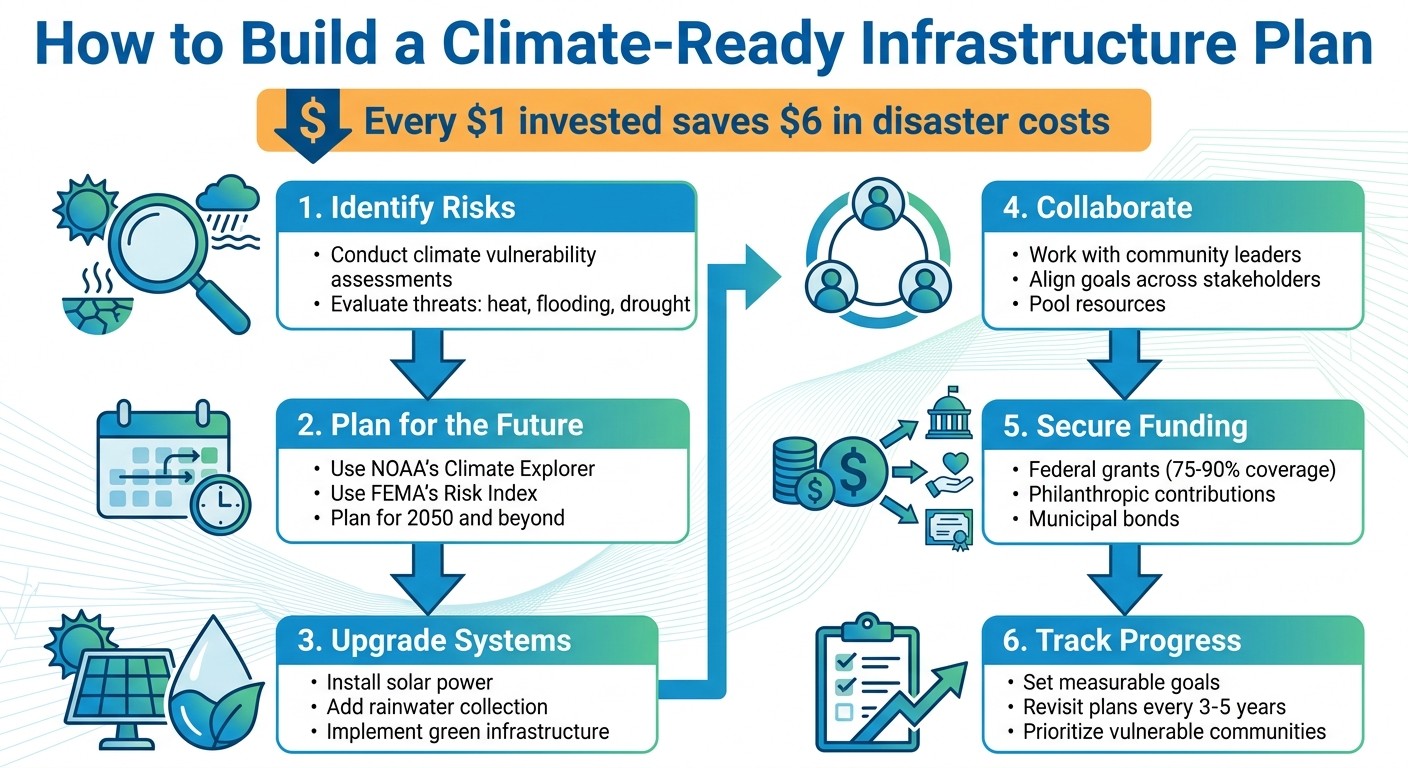
6-Step Climate-Ready Infrastructure Plan for Foundations
Building Resilient Infrastructure for Sustainable Development
Identifying Climate Risks to Your Infrastructure
Understanding and addressing climate risks begins with pinpointing the specific threats to your energy and water systems. A broad awareness of climate change isn’t enough - you need a detailed, systematic approach to uncover vulnerabilities that could disrupt your operations.
Running Climate Vulnerability Assessments
A Climate Vulnerability Assessment (CVA) is an essential tool for identifying risks tied to climate exposure, system sensitivity, and the ability to adapt. This process evaluates threats such as extreme heat, flooding, wildfires, and water scarcity to critical infrastructure like power grids and water treatment plants.
The statistics are eye-opening. By 2050, about 19% of drinking water systems, serving nearly 100 million people, are expected to face moderate or worse water supply stress [3]. Even more concerning, 91% of drinking water systems - a staggering 39,050 systems - are projected to experience at least a 3.6°F (2°C) rise in maximum 5-day temperatures by mid-century [3]. Researchers from Carnegie Mellon University highlight the urgency:
"Climate change will put increasing pressure on aging infrastructure, imposing a range of hazards for drinking water utilities" [3].
To ensure a thorough assessment, rely on diverse data sources rather than a single climate projection. Here are some tools to guide your CVA:
NOAA's Climate Explorer: Offers high-resolution climate models (1–10 km) [4].
FEMA's National Risk Index: Compares data on 18 natural hazards across the U.S. [6].
Climate Mapping for Resilience and Adaptation (CMRA): Provides projections for three future timeframes [5].
NOAA's Sea Level Rise Viewer: Visualizes coastal flooding risks [7].
U.S. Energy Mapping System: Evaluates energy infrastructure vulnerabilities to storm surges [8].
To prioritize risks, consider using a 3x3 matrix. This tool helps map infrastructure assets based on the likelihood of a hazard and the severity of its potential impacts - both financial and social [6]. This approach ensures you focus on the most urgent vulnerabilities.
Once risks are identified, the next step is shifting focus to long-term strategies.
Planning for 2100 and Beyond
Short-term fixes won’t address the challenges posed by climate change. Infrastructure decisions made today will influence resilience for decades, making it essential to plan with a view toward 2100. Changes in water systems, for example, have far-reaching implications for energy security, food supply, and economic stability, demanding adaptable and forward-thinking approaches [2].
By 2050, energy utilities are expected to face an average 6% increase in energy demands per unit of drinking water delivered [3]. These rising costs will strain budgets, reducing resources for other critical needs. Long-term planning helps utilities prepare for these challenges and design systems that evolve with changing conditions.
The International Water Management Institute (IWMI) underscores this:
"Water management provides these vital levers and tools for resilience. Enhanced water management can thus be an enabler of adaptation, mitigation and more sustainable, water-conscious development" [2].
Digital modeling can also play a crucial role. By simulating future scenarios of water availability and allocation, you can balance competing demands and ensure infrastructure remains operational under extreme circumstances [2].
Treat your climate resilience strategy as a living document. Revisit and revise it every 3–5 years to incorporate updated climate data, lessons from past events, and input from the community [4]. These assessments and long-term plans lay the groundwork for the adaptation strategies and collaborations discussed in the following sections.
Creating Your Climate Adaptation Plan
Once you've pinpointed your vulnerabilities, the next step is to design a practical, equity-centered adaptation plan. Using insights from your vulnerability assessments, this plan outlines clear, prioritized actions. The goal is to structure your strategies so they are achievable while ensuring resources are allocated to the communities most in need. By building on assessments, you can lay the groundwork for effective action.
Using an Effective Adaptation Framework
A solid framework for adaptation rests on three key pillars: awareness, adaptation, and collaboration. Awareness involves gaining a deep understanding of your unique climate risks through thorough vulnerability assessments. Adaptation focuses on modifying systems and processes to address these risks. Collaboration emphasizes working closely with community leaders, technical experts, and other stakeholders to enhance impact.
Jessica Brown, Senior Director of Adaptation and Resilience at ClimateWorks Foundation, highlights the value of this approach:
"Adaptation is where local innovation meets global momentum. With bold investments in climate adaptation, philanthropy can help connect the dots to strengthen collaboration, pilot scalable solutions, and build resources for community resilience" [10].
The economic case for adaptation is compelling: for every $1 invested in climate adaptation, the return can exceed $10 in long-term economic and social benefits [9]. Business investments in this area can yield returns ranging from $2 to $42 for every dollar spent [10]. In August 2025, ClimateWorks Foundation, alongside The Rockefeller Foundation, Howden Foundation, Laudes Foundation, and Quadrature Climate Foundation, launched the Adaptation and Resilience Fund (A&R Fund). With over $50 million in funding, this initiative supports locally led solutions tackling extreme heat, floods, and droughts in urban areas across South Asia, Southeast Asia, and sub-Saharan Africa [10]. This effort underscores how a well-crafted framework can drive systemic resilience through strategic partnerships.
Organizing Strategies by Type
Breaking your plan into clear categories simplifies execution and establishes accountability. Consider dividing your strategies into three main types: Planning, Operations, and Infrastructure [4].
Planning strategies: Regular vulnerability assessments, updating emergency protocols, and mapping high-risk zones.
Operations strategies: Implementing early warning systems, creating multilingual emergency networks, and training personnel in climate response.
Infrastructure strategies: Strengthening facilities to withstand extreme weather, installing green infrastructure like bioswales, and modernizing energy and water systems to handle increased demand [4].
Equity should guide your approach in each category. Focus resources on frontline communities - such as low-income areas and vulnerable populations like the elderly - that face the greatest climate risks. Use tools like vulnerability mapping to identify these areas and apply equity-focused criteria when selecting projects. Set measurable goals to track progress. For instance, aim for specific outcomes like "Install 50 bioswales by 2027" rather than vague targets like "improve stormwater management" [4].
Make it a priority to revisit and update your plan every 3–5 years, incorporating new data and lessons learned along the way [4].
Upgrading Infrastructure for Climate Resilience
Taking action to upgrade facilities and systems can directly address the vulnerabilities identified in previous assessments. These improvements not only enhance resilience but also save money in the long run. According to FEMA, for every $1 spent on hazard mitigation, $6 is saved in avoided disaster costs [4].
Modernizing Energy and Water Systems
Start by securing the reliability of water and energy systems. For water infrastructure, replacing or rehabilitating aging pipes can help them withstand flooding. Installing check valves in drainage systems prevents seawater from intruding during high tides, while sealing wastewater pipes below groundwater levels addresses rising water tables [12].
Diversifying water sources is another key step. Rainwater collection systems can support non-potable uses like irrigation and toilet flushing, while mutual aid agreements with nearby organizations can ensure emergency water supplies [12]. Energy systems, on the other hand, should be fortified to withstand extreme weather. In areas prone to wildfires or hurricanes, burying power lines is a critical strategy [4]. Backup power systems are essential for maintaining operations during outages, and a spatial database can help track resilience projects and monitor critical equipment like fire hydrants and drainage systems [12].
Federal grants can cover 75% to 90% of the costs for these projects, making them more accessible than many organizations realize [4]. Collaborating with water management authorities to use forward-looking climate data rather than historical trends ensures that infrastructure is prepared for future challenges [12].
Beyond technical upgrades, incorporating natural solutions can further enhance resilience.
Adding Nature-Based Solutions
Green infrastructure is a practical way to manage stormwater while offering additional benefits. Features like bioswales, rain gardens, and permeable pavement slow stormwater runoff, reduce erosion, and ease the burden on drainage systems [4]. These solutions can be integrated into existing infrastructure to create efficient systems.
Several projects across the U.S. showcase the potential of these approaches. For example, the George W. Shannon Wetlands in Texas treats water for reuse while providing recreational space, and LA Sanitation's Hollenbeck Park Lake Rehabilitation Project captures and treats stormwater for groundwater recharge [13].
Horizontal levees are another innovative approach. Palo Alto, California, is testing one along San Francisco Bay, using treated wastewater to irrigate wetlands that protect traditional levees from rising sea levels. This project is funded by the EPA’s San Francisco Bay Water Quality Improvement Fund [13]. Similarly, the Fairfield-Suisun Sewer District in California is implementing a wetland project to enhance resilience and shift public perceptions of the wastewater industry [13].
Expanding urban tree canopies, particularly in underserved areas, can provide cooling benefits while reducing heat islands [4]. Treated municipal wastewater can sustain these systems during dry periods [13]. Protecting natural buffers like wetlands and riparian corridors also offers cost-effective flood protection and water filtration [4].
Once these physical upgrades are in place, energy efficiency measures can further strengthen resilience.
Reducing Energy Use
Improving energy efficiency not only reduces costs but also bolsters resilience. A professional energy audit can help identify the top conservation opportunities. Upgrades like efficient HVAC systems, LED lighting, and better insulation can significantly cut costs and reduce environmental impact [16]. For instance, a $15,000 HVAC upgrade that saves $5,000 annually pays for itself in just three years [16].
Simple steps like thermostat scheduling, lighting controls, and managing plug loads can also make a big difference [16]. Natural lighting through skylights and advanced systems like air-source or geothermal heat pumps can further reduce energy use. Upgrading building envelopes with insulation and ENERGY STAR-certified windows and doors can yield long-term savings [14][15].
The Inflation Reduction Act’s "direct pay" provisions make clean energy investments such as solar panels and energy storage more accessible for tax-exempt entities [16]. Additionally, many utilities offer free or subsidized energy audits and rebates covering a significant portion of improvement costs [16]. Addressing plumbing inefficiencies, such as fixing leaks or upgrading fixtures, can save both water and the energy used to heat it [14].
Energy costs now account for 6% to 8% of nonprofit budgets, up from 4% to 5% just five years ago [16]. By reducing consumption, organizations can redirect funds toward their core missions instead of utility bills. With 62% of institutional funders now factoring sustainability practices into their grant decisions, these upgrades also enhance an organization's appeal to potential donors [16].
Working with Partners and Stakeholders
Collaborating with diverse partners is essential for making a lasting impact on climate resilience initiatives. These projects rarely thrive in isolation. By aligning efforts across governments, utilities, NGOs, and communities, organizations can pool resources and achieve outcomes that would be impossible individually. Joint efforts not only reduce redundancy and conflicting priorities but also attract substantial funding. For instance, a regional compact of 35 organizations secured $280 million in coordinated investments and $48 million in federal grants from FEMA and the DOE, showcasing the power of collaboration [17]. These partnerships lay a strong foundation for targeted initiatives and specialized support, as discussed in the sections below.
Creating Multi-Party Partnerships
The first step in forming effective partnerships is identifying who is involved and what they bring to the table. This begins with conducting one-on-one interviews with leaders from various sectors - government, utilities, NGOs, businesses, and academia. These conversations help clarify climate goals, understand organizational limits, and gauge willingness to collaborate [17]. Stakeholders can then be mapped based on their ambitions and practical approaches, allowing natural alliances to emerge while addressing potential conflicts.
Successful coalitions often rely on "pragmatic leaders" who balance ambitious goals with a focus on implementation. These leaders act as bridges between more aggressive advocates and cautious participants [17]. For example, in February 2026, a community foundation funded a coalition that conducted 65 stakeholder interviews and established four working groups. This partnership launched a clean energy procurement initiative that achieved pricing 18% below retail rates, saving $12 million annually for participants [17].
"Start with trust, not targets. The one-on-one interviews and small-group conversations that preceded the formal coalition were the most important phase." - Council Fire [17]
Engaging frontline communities - those most impacted by climate challenges, including low-income, elderly, and immigrant groups - should be a priority from the beginning. Instead of expecting these communities to attend formal meetings, bring the conversation to them. Host gatherings in accessible locations like community centers, churches, and schools. Provide essential support such as childcare, food, translation services, and fair compensation for community leaders and participants [4].
Building confidence early is key. Launch visible, short-term projects like joint procurement or shared assessments to show progress while working on longer-term infrastructure goals [17]. Use public progress updates and transparent tracking to maintain accountability, relying on peer pressure rather than legal mandates to keep commitments on track [17]. Once partnerships are established, expert consultants can help refine and implement these collaborative strategies.
Getting Help from Consulting Services
Specialized consultants play a crucial role in turning resilience plans into actionable projects. They help build trust, manage complex multi-party collaborations, and provide objective assessments [4][17]. Their expertise is particularly valuable when navigating federal grant applications, which often require coordinated submissions and matching local funds. For example, Council Fire assists in transforming ambitious sustainability goals into practical strategies that deliver lasting environmental, social, and economic benefits.
Foundations seeking technical expertise can use resources like the Registry of Adaptation Practitioners to find qualified service providers [11]. In August 2025, ClimateWorks Foundation joined forces with the Howden Foundation, Laudes Foundation, Quadrature Climate Foundation, and The Rockefeller Foundation to launch a $50 million fund supporting locally driven adaptation projects [10].
"By directing more than $50 million to locally led solutions, we are shifting power and resources directly to communities facing extreme heat and other climate shocks. This isn't just about survival, it's about catalyzing equitable, systems-level change where it's needed most." - Jess Ayers, CEO, Quadrature Climate Foundation [10]
Making Climate Resilience Part of Your Budget and Operations
Integrating climate resilience into financial and operational planning is no longer optional - it’s essential. By embedding resilience criteria into existing financial processes, such as capital improvement plans, grant evaluations, and departmental budgets, organizations can ensure that every investment strengthens infrastructure while securing long-term outcomes. This approach transforms resilience from an isolated concern into a core element of decision-making [4].
Currently, less than 10% of climate finance supports adaptation efforts, leaving developing countries with an estimated annual shortfall of $359 billion to meet their needs [1]. Foundations have a unique opportunity to address this gap by incorporating climate-focused considerations into asset renewal and infrastructure investment strategies. By weaving climate resilience into existing plans - whether related to health, food security, or infrastructure - organizations can ensure that resilience becomes a natural part of every operational decision [1].
"Resilience must be built into every investment and strategy to safeguard these gains." - Helen Mountford, President and CEO, ClimateWorks Foundation [1]
Adding Resilience Criteria to Grant Decisions
To make a meaningful impact, grant decisions should include specific, measurable criteria. Instead of broad objectives, set clear targets like "Harden 100% of critical water infrastructure against 100-year flood levels by 2030" [4]. Incorporate equity-focused metrics to track how much of the benefits reach low-income or frontline communities. Tools like vulnerability mapping can help direct resources to areas with the greatest need [4][18].
A great example of this approach is the California Adaptation Planning Grant Program (APGP), which wrapped up its first round in March 2026. This program allocated $8 million to 14 community-led projects, including the first-ever climate adaptation plans for the Hoopa Valley Tribe and the Ramona Municipal Water District. The initiative resulted in 14 new or updated resilience plans, engaged more than 18,800 community members, and compensated 396 participants for their expertise [18].
To evaluate the effectiveness of such grants, track both process metrics (e.g., dollars spent, projects completed) and outcome metrics (e.g., reduced flood damage, fewer heat-related illnesses, shorter power outages) [4]. Providing technical assistance and incremental funding can also help bridge the gap between standard projects and more resilient alternatives. For instance, in February 2025, the William Penn Foundation awarded $919,000 to Green Building United for the Climate Ready Capital Projects (CRCP) Program. This initiative helped grantees implement measures like electrifying building systems, installing solar panels with battery backups, and redesigning parking lots to minimize environmental impact. While these upgrades may require higher initial investments, they offer long-term savings through lower energy costs, reduced maintenance, and improved resilience to extreme weather [21].
Compensating local leaders for their time and expertise further ensures community-driven planning processes [4][18]. With clear funding targets and proven tools, organizations can make smarter, more impactful investment decisions.
Applying Assessment Tools for Better Decisions
To refine investments in resilience, practical tools can streamline decision-making. The "Steps to Resilience" framework from the U.S. Climate Resilience Toolkit provides a structured approach for community-level planning and investment [11]. For water utilities, the EPA’s Resilient Strategies Guide enables organizations to input location and asset data to develop tailored adaptation strategies and identify funding opportunities [20]. Another resource, the Ready-to-Fund Resilience Toolkit, helps organizations design fundable projects by outlining 10 essential characteristics and aligning resilience actions with existing plans and capital improvement projects [19].
A comprehensive vulnerability assessment - considering Exposure, Sensitivity, and Adaptive Capacity - can guide long-term planning [4]. Tools like NOAA’s Climate Explorer or state-specific models such as Cal-Adapt in California allow organizations to project future climate conditions effectively [4]. Additionally, the Registry of Adaptation Practitioners connects communities with vetted experts to support technical needs [11].
Council Fire works with organizations to turn ambitious sustainability goals into actionable strategies, delivering lasting benefits across environmental, social, and economic dimensions. To fund these efforts, organizations can layer multiple sources, including federal programs like FEMA BRIC and HUD CDBG-DR, state funds, municipal green bonds, and philanthropic grants. Federal grants often cover 75% to 90% of total expenses, making them a critical component of funding strategies [4].
"The business case for investing in adaptation and resilience efforts is clear. A recent report from WRI calculates that every dollar invested in adaptation pays off with a $10 return." - Claire Harbron, CEO, Howden Foundation [1]
Conclusion: Taking Action on Climate-Ready Infrastructure
Investing in climate-ready energy and water infrastructure safeguards both physical assets and the well-being of the communities you support. Research suggests that every $1 spent on hazard mitigation can save $6 in disaster-related costs[4]. The first step is conducting a detailed vulnerability assessment to evaluate hazard exposure, system sensitivity, and adaptive capacity[4].
Most initial climate resilience projects can be completed within 3 to 6 months, depending on how prepared your data is[4]. Focus on affordable, impactful actions such as mapping cooling centers, enhancing emergency communication systems, and planting trees in urban areas prone to extreme heat. Establish clear, measurable goals to track progress[4].
"Being a small Town, we rely heavily on external funding and supports like this program to achieve real results." - Torrie Santucci, Manager of Environment & Sustainability, Town of Devon[22]
These practical steps lay the foundation for broader funding collaborations. A structured approach includes conducting vulnerability assessments, engaging with frontline stakeholders, preparing technical options reports, prioritizing equitable project selection, and embedding resilience into capital planning[6,33]. To fund these efforts, combine resources from federal programs like FEMA BRIC - which can cover 75% to 90% of costs - with state grants, municipal bonds, and philanthropic contributions[4]. Revisit and revise your plan every 3 to 5 years to incorporate new climate insights and lessons learned[4].
FAQs
What’s the first step to start a climate-ready plan?
To begin, it's essential to perform a vulnerability assessment at the community level to pinpoint climate risks such as flooding, extreme heat, or severe storms. This involves mapping areas prone to hazards, reviewing historical data, and leveraging climate models to predict future scenarios. These findings provide a clearer picture of your community's exposure and sensitivities, laying the groundwork for developing a resilient plan for energy and water infrastructure.
Which tools should we use to assess local climate risks?
To evaluate local climate risks, leverage resources such as downscaled climate models like NOAA Climate Explorer and Cal-Adapt. These tools help project future climate conditions and outline hazard zones. Additionally, conduct community-level vulnerability assessments by examining factors such as exposure, sensitivity, and adaptive capacity, while integrating historical climate data for a more comprehensive analysis. The NOAA 'Implementing the Steps to Resilience' guide emphasizes the importance of pairing climate data with community assessments to pinpoint vulnerabilities with greater precision.
How do we pay for resilience upgrades without draining our budget?
To make resilience upgrades without overextending your budget, consider tapping into external funding options such as grants, federal programs, and collaborative partnerships. Numerous philanthropic organizations are also committed to supporting climate resilience projects. Begin by identifying specific vulnerabilities, involving key stakeholders, and crafting customized strategies to secure these funds. By utilizing these external resources, you can address necessary upgrades while safeguarding your internal financial resources.
Related Blog Posts
Latest Articles
©2025

Narrative Change and Power Building: The Missing Half of Advocacy
Narrative change is the process of disrupting dominant narratives that normalize inequity and advancing new narratives from historically marginalized communities.

Funding Resilience Without Federal Grants
BRIC is unreliable and FEMA is shrinking. Here's how cities fund climate resilience with dedicated revenue, blended finance, and a coordinating authority.

The ESG Blind Spot: How AI Is Finding Risks in Companies Nobody Else Is Watching
Norway's sovereign wealth fund uses AI to screen 7,200 portfolio companies for forced labor and corruption within 24 hours. The real story is the emerging-market coverage gap that traditional ESG data vendors miss — and what it means for any company with a global supply chain.
Narrative Change and Power Building: The Missing Half of Advocacy
Narrative change is the process of disrupting dominant narratives that normalize inequity and advancing new narratives from historically marginalized communities.
Funding Resilience Without Federal Grants
BRIC is unreliable and FEMA is shrinking. Here's how cities fund climate resilience with dedicated revenue, blended finance, and a coordinating authority.
The ESG Blind Spot: How AI Is Finding Risks in Companies Nobody Else Is Watching
Norway's sovereign wealth fund uses AI to screen 7,200 portfolio companies for forced labor and corruption within 24 hours. The real story is the emerging-market coverage gap that traditional ESG data vendors miss — and what it means for any company with a global supply chain.
FAQ
01
What does it really mean to “redefine profit”?
02
What makes Council Fire different?
03
Who does Council Fire work with?
04
What does working with Council Fire actually look like?
05
How does Council Fire help organizations turn big goals into action?
06
How does Council Fire define and measure success?
Apr 24, 2026
How to Build a Climate-Ready Energy & Water Infrastructure Plan for Foundations & Philanthropic Organizations
Sustainability Strategy
In This Article
Guide for foundations to assess climate risks, upgrade energy and water systems, secure funding, and prioritize equity in resilience plans.
How to Build a Climate-Ready Energy & Water Infrastructure Plan for Foundations & Philanthropic Organizations
Foundations face mounting risks from climate change, including disruptions to energy and water systems that threaten their ability to support communities. To address these challenges, organizations must develop resilient infrastructure plans that protect against extreme weather and long-term environmental shifts. Here's how to get started:
Identify Risks: Conduct climate vulnerability assessments to evaluate threats like heat, flooding, and drought.
Plan for the Future: Use tools like NOAA's Climate Explorer and FEMA's Risk Index to guide decisions for 2050 and beyond.
Upgrade Systems: Modernize energy and water infrastructure with solutions like solar power, rainwater collection, and green infrastructure.
Collaborate: Work with stakeholders, including community leaders, to align goals and pool resources.
Secure Funding: Leverage federal grants, philanthropic contributions, and municipal bonds to finance projects.
Track Progress: Set measurable goals, revisit plans every 3–5 years, and focus on equity to prioritize vulnerable communities.
Every $1 invested in climate resilience can save $6 in disaster costs, making proactive planning both cost-effective and impactful. Start with small, actionable steps like emergency communication upgrades and tree planting to build momentum toward long-term goals.
6-Step Climate-Ready Infrastructure Plan for Foundations
Building Resilient Infrastructure for Sustainable Development
Identifying Climate Risks to Your Infrastructure
Understanding and addressing climate risks begins with pinpointing the specific threats to your energy and water systems. A broad awareness of climate change isn’t enough - you need a detailed, systematic approach to uncover vulnerabilities that could disrupt your operations.
Running Climate Vulnerability Assessments
A Climate Vulnerability Assessment (CVA) is an essential tool for identifying risks tied to climate exposure, system sensitivity, and the ability to adapt. This process evaluates threats such as extreme heat, flooding, wildfires, and water scarcity to critical infrastructure like power grids and water treatment plants.
The statistics are eye-opening. By 2050, about 19% of drinking water systems, serving nearly 100 million people, are expected to face moderate or worse water supply stress [3]. Even more concerning, 91% of drinking water systems - a staggering 39,050 systems - are projected to experience at least a 3.6°F (2°C) rise in maximum 5-day temperatures by mid-century [3]. Researchers from Carnegie Mellon University highlight the urgency:
"Climate change will put increasing pressure on aging infrastructure, imposing a range of hazards for drinking water utilities" [3].
To ensure a thorough assessment, rely on diverse data sources rather than a single climate projection. Here are some tools to guide your CVA:
NOAA's Climate Explorer: Offers high-resolution climate models (1–10 km) [4].
FEMA's National Risk Index: Compares data on 18 natural hazards across the U.S. [6].
Climate Mapping for Resilience and Adaptation (CMRA): Provides projections for three future timeframes [5].
NOAA's Sea Level Rise Viewer: Visualizes coastal flooding risks [7].
U.S. Energy Mapping System: Evaluates energy infrastructure vulnerabilities to storm surges [8].
To prioritize risks, consider using a 3x3 matrix. This tool helps map infrastructure assets based on the likelihood of a hazard and the severity of its potential impacts - both financial and social [6]. This approach ensures you focus on the most urgent vulnerabilities.
Once risks are identified, the next step is shifting focus to long-term strategies.
Planning for 2100 and Beyond
Short-term fixes won’t address the challenges posed by climate change. Infrastructure decisions made today will influence resilience for decades, making it essential to plan with a view toward 2100. Changes in water systems, for example, have far-reaching implications for energy security, food supply, and economic stability, demanding adaptable and forward-thinking approaches [2].
By 2050, energy utilities are expected to face an average 6% increase in energy demands per unit of drinking water delivered [3]. These rising costs will strain budgets, reducing resources for other critical needs. Long-term planning helps utilities prepare for these challenges and design systems that evolve with changing conditions.
The International Water Management Institute (IWMI) underscores this:
"Water management provides these vital levers and tools for resilience. Enhanced water management can thus be an enabler of adaptation, mitigation and more sustainable, water-conscious development" [2].
Digital modeling can also play a crucial role. By simulating future scenarios of water availability and allocation, you can balance competing demands and ensure infrastructure remains operational under extreme circumstances [2].
Treat your climate resilience strategy as a living document. Revisit and revise it every 3–5 years to incorporate updated climate data, lessons from past events, and input from the community [4]. These assessments and long-term plans lay the groundwork for the adaptation strategies and collaborations discussed in the following sections.
Creating Your Climate Adaptation Plan
Once you've pinpointed your vulnerabilities, the next step is to design a practical, equity-centered adaptation plan. Using insights from your vulnerability assessments, this plan outlines clear, prioritized actions. The goal is to structure your strategies so they are achievable while ensuring resources are allocated to the communities most in need. By building on assessments, you can lay the groundwork for effective action.
Using an Effective Adaptation Framework
A solid framework for adaptation rests on three key pillars: awareness, adaptation, and collaboration. Awareness involves gaining a deep understanding of your unique climate risks through thorough vulnerability assessments. Adaptation focuses on modifying systems and processes to address these risks. Collaboration emphasizes working closely with community leaders, technical experts, and other stakeholders to enhance impact.
Jessica Brown, Senior Director of Adaptation and Resilience at ClimateWorks Foundation, highlights the value of this approach:
"Adaptation is where local innovation meets global momentum. With bold investments in climate adaptation, philanthropy can help connect the dots to strengthen collaboration, pilot scalable solutions, and build resources for community resilience" [10].
The economic case for adaptation is compelling: for every $1 invested in climate adaptation, the return can exceed $10 in long-term economic and social benefits [9]. Business investments in this area can yield returns ranging from $2 to $42 for every dollar spent [10]. In August 2025, ClimateWorks Foundation, alongside The Rockefeller Foundation, Howden Foundation, Laudes Foundation, and Quadrature Climate Foundation, launched the Adaptation and Resilience Fund (A&R Fund). With over $50 million in funding, this initiative supports locally led solutions tackling extreme heat, floods, and droughts in urban areas across South Asia, Southeast Asia, and sub-Saharan Africa [10]. This effort underscores how a well-crafted framework can drive systemic resilience through strategic partnerships.
Organizing Strategies by Type
Breaking your plan into clear categories simplifies execution and establishes accountability. Consider dividing your strategies into three main types: Planning, Operations, and Infrastructure [4].
Planning strategies: Regular vulnerability assessments, updating emergency protocols, and mapping high-risk zones.
Operations strategies: Implementing early warning systems, creating multilingual emergency networks, and training personnel in climate response.
Infrastructure strategies: Strengthening facilities to withstand extreme weather, installing green infrastructure like bioswales, and modernizing energy and water systems to handle increased demand [4].
Equity should guide your approach in each category. Focus resources on frontline communities - such as low-income areas and vulnerable populations like the elderly - that face the greatest climate risks. Use tools like vulnerability mapping to identify these areas and apply equity-focused criteria when selecting projects. Set measurable goals to track progress. For instance, aim for specific outcomes like "Install 50 bioswales by 2027" rather than vague targets like "improve stormwater management" [4].
Make it a priority to revisit and update your plan every 3–5 years, incorporating new data and lessons learned along the way [4].
Upgrading Infrastructure for Climate Resilience
Taking action to upgrade facilities and systems can directly address the vulnerabilities identified in previous assessments. These improvements not only enhance resilience but also save money in the long run. According to FEMA, for every $1 spent on hazard mitigation, $6 is saved in avoided disaster costs [4].
Modernizing Energy and Water Systems
Start by securing the reliability of water and energy systems. For water infrastructure, replacing or rehabilitating aging pipes can help them withstand flooding. Installing check valves in drainage systems prevents seawater from intruding during high tides, while sealing wastewater pipes below groundwater levels addresses rising water tables [12].
Diversifying water sources is another key step. Rainwater collection systems can support non-potable uses like irrigation and toilet flushing, while mutual aid agreements with nearby organizations can ensure emergency water supplies [12]. Energy systems, on the other hand, should be fortified to withstand extreme weather. In areas prone to wildfires or hurricanes, burying power lines is a critical strategy [4]. Backup power systems are essential for maintaining operations during outages, and a spatial database can help track resilience projects and monitor critical equipment like fire hydrants and drainage systems [12].
Federal grants can cover 75% to 90% of the costs for these projects, making them more accessible than many organizations realize [4]. Collaborating with water management authorities to use forward-looking climate data rather than historical trends ensures that infrastructure is prepared for future challenges [12].
Beyond technical upgrades, incorporating natural solutions can further enhance resilience.
Adding Nature-Based Solutions
Green infrastructure is a practical way to manage stormwater while offering additional benefits. Features like bioswales, rain gardens, and permeable pavement slow stormwater runoff, reduce erosion, and ease the burden on drainage systems [4]. These solutions can be integrated into existing infrastructure to create efficient systems.
Several projects across the U.S. showcase the potential of these approaches. For example, the George W. Shannon Wetlands in Texas treats water for reuse while providing recreational space, and LA Sanitation's Hollenbeck Park Lake Rehabilitation Project captures and treats stormwater for groundwater recharge [13].
Horizontal levees are another innovative approach. Palo Alto, California, is testing one along San Francisco Bay, using treated wastewater to irrigate wetlands that protect traditional levees from rising sea levels. This project is funded by the EPA’s San Francisco Bay Water Quality Improvement Fund [13]. Similarly, the Fairfield-Suisun Sewer District in California is implementing a wetland project to enhance resilience and shift public perceptions of the wastewater industry [13].
Expanding urban tree canopies, particularly in underserved areas, can provide cooling benefits while reducing heat islands [4]. Treated municipal wastewater can sustain these systems during dry periods [13]. Protecting natural buffers like wetlands and riparian corridors also offers cost-effective flood protection and water filtration [4].
Once these physical upgrades are in place, energy efficiency measures can further strengthen resilience.
Reducing Energy Use
Improving energy efficiency not only reduces costs but also bolsters resilience. A professional energy audit can help identify the top conservation opportunities. Upgrades like efficient HVAC systems, LED lighting, and better insulation can significantly cut costs and reduce environmental impact [16]. For instance, a $15,000 HVAC upgrade that saves $5,000 annually pays for itself in just three years [16].
Simple steps like thermostat scheduling, lighting controls, and managing plug loads can also make a big difference [16]. Natural lighting through skylights and advanced systems like air-source or geothermal heat pumps can further reduce energy use. Upgrading building envelopes with insulation and ENERGY STAR-certified windows and doors can yield long-term savings [14][15].
The Inflation Reduction Act’s "direct pay" provisions make clean energy investments such as solar panels and energy storage more accessible for tax-exempt entities [16]. Additionally, many utilities offer free or subsidized energy audits and rebates covering a significant portion of improvement costs [16]. Addressing plumbing inefficiencies, such as fixing leaks or upgrading fixtures, can save both water and the energy used to heat it [14].
Energy costs now account for 6% to 8% of nonprofit budgets, up from 4% to 5% just five years ago [16]. By reducing consumption, organizations can redirect funds toward their core missions instead of utility bills. With 62% of institutional funders now factoring sustainability practices into their grant decisions, these upgrades also enhance an organization's appeal to potential donors [16].
Working with Partners and Stakeholders
Collaborating with diverse partners is essential for making a lasting impact on climate resilience initiatives. These projects rarely thrive in isolation. By aligning efforts across governments, utilities, NGOs, and communities, organizations can pool resources and achieve outcomes that would be impossible individually. Joint efforts not only reduce redundancy and conflicting priorities but also attract substantial funding. For instance, a regional compact of 35 organizations secured $280 million in coordinated investments and $48 million in federal grants from FEMA and the DOE, showcasing the power of collaboration [17]. These partnerships lay a strong foundation for targeted initiatives and specialized support, as discussed in the sections below.
Creating Multi-Party Partnerships
The first step in forming effective partnerships is identifying who is involved and what they bring to the table. This begins with conducting one-on-one interviews with leaders from various sectors - government, utilities, NGOs, businesses, and academia. These conversations help clarify climate goals, understand organizational limits, and gauge willingness to collaborate [17]. Stakeholders can then be mapped based on their ambitions and practical approaches, allowing natural alliances to emerge while addressing potential conflicts.
Successful coalitions often rely on "pragmatic leaders" who balance ambitious goals with a focus on implementation. These leaders act as bridges between more aggressive advocates and cautious participants [17]. For example, in February 2026, a community foundation funded a coalition that conducted 65 stakeholder interviews and established four working groups. This partnership launched a clean energy procurement initiative that achieved pricing 18% below retail rates, saving $12 million annually for participants [17].
"Start with trust, not targets. The one-on-one interviews and small-group conversations that preceded the formal coalition were the most important phase." - Council Fire [17]
Engaging frontline communities - those most impacted by climate challenges, including low-income, elderly, and immigrant groups - should be a priority from the beginning. Instead of expecting these communities to attend formal meetings, bring the conversation to them. Host gatherings in accessible locations like community centers, churches, and schools. Provide essential support such as childcare, food, translation services, and fair compensation for community leaders and participants [4].
Building confidence early is key. Launch visible, short-term projects like joint procurement or shared assessments to show progress while working on longer-term infrastructure goals [17]. Use public progress updates and transparent tracking to maintain accountability, relying on peer pressure rather than legal mandates to keep commitments on track [17]. Once partnerships are established, expert consultants can help refine and implement these collaborative strategies.
Getting Help from Consulting Services
Specialized consultants play a crucial role in turning resilience plans into actionable projects. They help build trust, manage complex multi-party collaborations, and provide objective assessments [4][17]. Their expertise is particularly valuable when navigating federal grant applications, which often require coordinated submissions and matching local funds. For example, Council Fire assists in transforming ambitious sustainability goals into practical strategies that deliver lasting environmental, social, and economic benefits.
Foundations seeking technical expertise can use resources like the Registry of Adaptation Practitioners to find qualified service providers [11]. In August 2025, ClimateWorks Foundation joined forces with the Howden Foundation, Laudes Foundation, Quadrature Climate Foundation, and The Rockefeller Foundation to launch a $50 million fund supporting locally driven adaptation projects [10].
"By directing more than $50 million to locally led solutions, we are shifting power and resources directly to communities facing extreme heat and other climate shocks. This isn't just about survival, it's about catalyzing equitable, systems-level change where it's needed most." - Jess Ayers, CEO, Quadrature Climate Foundation [10]
Making Climate Resilience Part of Your Budget and Operations
Integrating climate resilience into financial and operational planning is no longer optional - it’s essential. By embedding resilience criteria into existing financial processes, such as capital improvement plans, grant evaluations, and departmental budgets, organizations can ensure that every investment strengthens infrastructure while securing long-term outcomes. This approach transforms resilience from an isolated concern into a core element of decision-making [4].
Currently, less than 10% of climate finance supports adaptation efforts, leaving developing countries with an estimated annual shortfall of $359 billion to meet their needs [1]. Foundations have a unique opportunity to address this gap by incorporating climate-focused considerations into asset renewal and infrastructure investment strategies. By weaving climate resilience into existing plans - whether related to health, food security, or infrastructure - organizations can ensure that resilience becomes a natural part of every operational decision [1].
"Resilience must be built into every investment and strategy to safeguard these gains." - Helen Mountford, President and CEO, ClimateWorks Foundation [1]
Adding Resilience Criteria to Grant Decisions
To make a meaningful impact, grant decisions should include specific, measurable criteria. Instead of broad objectives, set clear targets like "Harden 100% of critical water infrastructure against 100-year flood levels by 2030" [4]. Incorporate equity-focused metrics to track how much of the benefits reach low-income or frontline communities. Tools like vulnerability mapping can help direct resources to areas with the greatest need [4][18].
A great example of this approach is the California Adaptation Planning Grant Program (APGP), which wrapped up its first round in March 2026. This program allocated $8 million to 14 community-led projects, including the first-ever climate adaptation plans for the Hoopa Valley Tribe and the Ramona Municipal Water District. The initiative resulted in 14 new or updated resilience plans, engaged more than 18,800 community members, and compensated 396 participants for their expertise [18].
To evaluate the effectiveness of such grants, track both process metrics (e.g., dollars spent, projects completed) and outcome metrics (e.g., reduced flood damage, fewer heat-related illnesses, shorter power outages) [4]. Providing technical assistance and incremental funding can also help bridge the gap between standard projects and more resilient alternatives. For instance, in February 2025, the William Penn Foundation awarded $919,000 to Green Building United for the Climate Ready Capital Projects (CRCP) Program. This initiative helped grantees implement measures like electrifying building systems, installing solar panels with battery backups, and redesigning parking lots to minimize environmental impact. While these upgrades may require higher initial investments, they offer long-term savings through lower energy costs, reduced maintenance, and improved resilience to extreme weather [21].
Compensating local leaders for their time and expertise further ensures community-driven planning processes [4][18]. With clear funding targets and proven tools, organizations can make smarter, more impactful investment decisions.
Applying Assessment Tools for Better Decisions
To refine investments in resilience, practical tools can streamline decision-making. The "Steps to Resilience" framework from the U.S. Climate Resilience Toolkit provides a structured approach for community-level planning and investment [11]. For water utilities, the EPA’s Resilient Strategies Guide enables organizations to input location and asset data to develop tailored adaptation strategies and identify funding opportunities [20]. Another resource, the Ready-to-Fund Resilience Toolkit, helps organizations design fundable projects by outlining 10 essential characteristics and aligning resilience actions with existing plans and capital improvement projects [19].
A comprehensive vulnerability assessment - considering Exposure, Sensitivity, and Adaptive Capacity - can guide long-term planning [4]. Tools like NOAA’s Climate Explorer or state-specific models such as Cal-Adapt in California allow organizations to project future climate conditions effectively [4]. Additionally, the Registry of Adaptation Practitioners connects communities with vetted experts to support technical needs [11].
Council Fire works with organizations to turn ambitious sustainability goals into actionable strategies, delivering lasting benefits across environmental, social, and economic dimensions. To fund these efforts, organizations can layer multiple sources, including federal programs like FEMA BRIC and HUD CDBG-DR, state funds, municipal green bonds, and philanthropic grants. Federal grants often cover 75% to 90% of total expenses, making them a critical component of funding strategies [4].
"The business case for investing in adaptation and resilience efforts is clear. A recent report from WRI calculates that every dollar invested in adaptation pays off with a $10 return." - Claire Harbron, CEO, Howden Foundation [1]
Conclusion: Taking Action on Climate-Ready Infrastructure
Investing in climate-ready energy and water infrastructure safeguards both physical assets and the well-being of the communities you support. Research suggests that every $1 spent on hazard mitigation can save $6 in disaster-related costs[4]. The first step is conducting a detailed vulnerability assessment to evaluate hazard exposure, system sensitivity, and adaptive capacity[4].
Most initial climate resilience projects can be completed within 3 to 6 months, depending on how prepared your data is[4]. Focus on affordable, impactful actions such as mapping cooling centers, enhancing emergency communication systems, and planting trees in urban areas prone to extreme heat. Establish clear, measurable goals to track progress[4].
"Being a small Town, we rely heavily on external funding and supports like this program to achieve real results." - Torrie Santucci, Manager of Environment & Sustainability, Town of Devon[22]
These practical steps lay the foundation for broader funding collaborations. A structured approach includes conducting vulnerability assessments, engaging with frontline stakeholders, preparing technical options reports, prioritizing equitable project selection, and embedding resilience into capital planning[6,33]. To fund these efforts, combine resources from federal programs like FEMA BRIC - which can cover 75% to 90% of costs - with state grants, municipal bonds, and philanthropic contributions[4]. Revisit and revise your plan every 3 to 5 years to incorporate new climate insights and lessons learned[4].
FAQs
What’s the first step to start a climate-ready plan?
To begin, it's essential to perform a vulnerability assessment at the community level to pinpoint climate risks such as flooding, extreme heat, or severe storms. This involves mapping areas prone to hazards, reviewing historical data, and leveraging climate models to predict future scenarios. These findings provide a clearer picture of your community's exposure and sensitivities, laying the groundwork for developing a resilient plan for energy and water infrastructure.
Which tools should we use to assess local climate risks?
To evaluate local climate risks, leverage resources such as downscaled climate models like NOAA Climate Explorer and Cal-Adapt. These tools help project future climate conditions and outline hazard zones. Additionally, conduct community-level vulnerability assessments by examining factors such as exposure, sensitivity, and adaptive capacity, while integrating historical climate data for a more comprehensive analysis. The NOAA 'Implementing the Steps to Resilience' guide emphasizes the importance of pairing climate data with community assessments to pinpoint vulnerabilities with greater precision.
How do we pay for resilience upgrades without draining our budget?
To make resilience upgrades without overextending your budget, consider tapping into external funding options such as grants, federal programs, and collaborative partnerships. Numerous philanthropic organizations are also committed to supporting climate resilience projects. Begin by identifying specific vulnerabilities, involving key stakeholders, and crafting customized strategies to secure these funds. By utilizing these external resources, you can address necessary upgrades while safeguarding your internal financial resources.
Related Blog Posts
Latest Articles
©2025
Narrative Change and Power Building: The Missing Half of Advocacy
Narrative change is the process of disrupting dominant narratives that normalize inequity and advancing new narratives from historically marginalized communities.
Funding Resilience Without Federal Grants
BRIC is unreliable and FEMA is shrinking. Here's how cities fund climate resilience with dedicated revenue, blended finance, and a coordinating authority.
The ESG Blind Spot: How AI Is Finding Risks in Companies Nobody Else Is Watching
Norway's sovereign wealth fund uses AI to screen 7,200 portfolio companies for forced labor and corruption within 24 hours. The real story is the emerging-market coverage gap that traditional ESG data vendors miss — and what it means for any company with a global supply chain.
FAQ
01
What does it really mean to “redefine profit”?
02
What makes Council Fire different?
03
Who does Council Fire work with?
04
What does working with Council Fire actually look like?
05
How does Council Fire help organizations turn big goals into action?
06
How does Council Fire define and measure success?
Apr 24, 2026
How to Build a Climate-Ready Energy & Water Infrastructure Plan for Foundations & Philanthropic Organizations
Sustainability Strategy
In This Article
Guide for foundations to assess climate risks, upgrade energy and water systems, secure funding, and prioritize equity in resilience plans.
How to Build a Climate-Ready Energy & Water Infrastructure Plan for Foundations & Philanthropic Organizations
Foundations face mounting risks from climate change, including disruptions to energy and water systems that threaten their ability to support communities. To address these challenges, organizations must develop resilient infrastructure plans that protect against extreme weather and long-term environmental shifts. Here's how to get started:
Identify Risks: Conduct climate vulnerability assessments to evaluate threats like heat, flooding, and drought.
Plan for the Future: Use tools like NOAA's Climate Explorer and FEMA's Risk Index to guide decisions for 2050 and beyond.
Upgrade Systems: Modernize energy and water infrastructure with solutions like solar power, rainwater collection, and green infrastructure.
Collaborate: Work with stakeholders, including community leaders, to align goals and pool resources.
Secure Funding: Leverage federal grants, philanthropic contributions, and municipal bonds to finance projects.
Track Progress: Set measurable goals, revisit plans every 3–5 years, and focus on equity to prioritize vulnerable communities.
Every $1 invested in climate resilience can save $6 in disaster costs, making proactive planning both cost-effective and impactful. Start with small, actionable steps like emergency communication upgrades and tree planting to build momentum toward long-term goals.
6-Step Climate-Ready Infrastructure Plan for Foundations
Building Resilient Infrastructure for Sustainable Development
Identifying Climate Risks to Your Infrastructure
Understanding and addressing climate risks begins with pinpointing the specific threats to your energy and water systems. A broad awareness of climate change isn’t enough - you need a detailed, systematic approach to uncover vulnerabilities that could disrupt your operations.
Running Climate Vulnerability Assessments
A Climate Vulnerability Assessment (CVA) is an essential tool for identifying risks tied to climate exposure, system sensitivity, and the ability to adapt. This process evaluates threats such as extreme heat, flooding, wildfires, and water scarcity to critical infrastructure like power grids and water treatment plants.
The statistics are eye-opening. By 2050, about 19% of drinking water systems, serving nearly 100 million people, are expected to face moderate or worse water supply stress [3]. Even more concerning, 91% of drinking water systems - a staggering 39,050 systems - are projected to experience at least a 3.6°F (2°C) rise in maximum 5-day temperatures by mid-century [3]. Researchers from Carnegie Mellon University highlight the urgency:
"Climate change will put increasing pressure on aging infrastructure, imposing a range of hazards for drinking water utilities" [3].
To ensure a thorough assessment, rely on diverse data sources rather than a single climate projection. Here are some tools to guide your CVA:
NOAA's Climate Explorer: Offers high-resolution climate models (1–10 km) [4].
FEMA's National Risk Index: Compares data on 18 natural hazards across the U.S. [6].
Climate Mapping for Resilience and Adaptation (CMRA): Provides projections for three future timeframes [5].
NOAA's Sea Level Rise Viewer: Visualizes coastal flooding risks [7].
U.S. Energy Mapping System: Evaluates energy infrastructure vulnerabilities to storm surges [8].
To prioritize risks, consider using a 3x3 matrix. This tool helps map infrastructure assets based on the likelihood of a hazard and the severity of its potential impacts - both financial and social [6]. This approach ensures you focus on the most urgent vulnerabilities.
Once risks are identified, the next step is shifting focus to long-term strategies.
Planning for 2100 and Beyond
Short-term fixes won’t address the challenges posed by climate change. Infrastructure decisions made today will influence resilience for decades, making it essential to plan with a view toward 2100. Changes in water systems, for example, have far-reaching implications for energy security, food supply, and economic stability, demanding adaptable and forward-thinking approaches [2].
By 2050, energy utilities are expected to face an average 6% increase in energy demands per unit of drinking water delivered [3]. These rising costs will strain budgets, reducing resources for other critical needs. Long-term planning helps utilities prepare for these challenges and design systems that evolve with changing conditions.
The International Water Management Institute (IWMI) underscores this:
"Water management provides these vital levers and tools for resilience. Enhanced water management can thus be an enabler of adaptation, mitigation and more sustainable, water-conscious development" [2].
Digital modeling can also play a crucial role. By simulating future scenarios of water availability and allocation, you can balance competing demands and ensure infrastructure remains operational under extreme circumstances [2].
Treat your climate resilience strategy as a living document. Revisit and revise it every 3–5 years to incorporate updated climate data, lessons from past events, and input from the community [4]. These assessments and long-term plans lay the groundwork for the adaptation strategies and collaborations discussed in the following sections.
Creating Your Climate Adaptation Plan
Once you've pinpointed your vulnerabilities, the next step is to design a practical, equity-centered adaptation plan. Using insights from your vulnerability assessments, this plan outlines clear, prioritized actions. The goal is to structure your strategies so they are achievable while ensuring resources are allocated to the communities most in need. By building on assessments, you can lay the groundwork for effective action.
Using an Effective Adaptation Framework
A solid framework for adaptation rests on three key pillars: awareness, adaptation, and collaboration. Awareness involves gaining a deep understanding of your unique climate risks through thorough vulnerability assessments. Adaptation focuses on modifying systems and processes to address these risks. Collaboration emphasizes working closely with community leaders, technical experts, and other stakeholders to enhance impact.
Jessica Brown, Senior Director of Adaptation and Resilience at ClimateWorks Foundation, highlights the value of this approach:
"Adaptation is where local innovation meets global momentum. With bold investments in climate adaptation, philanthropy can help connect the dots to strengthen collaboration, pilot scalable solutions, and build resources for community resilience" [10].
The economic case for adaptation is compelling: for every $1 invested in climate adaptation, the return can exceed $10 in long-term economic and social benefits [9]. Business investments in this area can yield returns ranging from $2 to $42 for every dollar spent [10]. In August 2025, ClimateWorks Foundation, alongside The Rockefeller Foundation, Howden Foundation, Laudes Foundation, and Quadrature Climate Foundation, launched the Adaptation and Resilience Fund (A&R Fund). With over $50 million in funding, this initiative supports locally led solutions tackling extreme heat, floods, and droughts in urban areas across South Asia, Southeast Asia, and sub-Saharan Africa [10]. This effort underscores how a well-crafted framework can drive systemic resilience through strategic partnerships.
Organizing Strategies by Type
Breaking your plan into clear categories simplifies execution and establishes accountability. Consider dividing your strategies into three main types: Planning, Operations, and Infrastructure [4].
Planning strategies: Regular vulnerability assessments, updating emergency protocols, and mapping high-risk zones.
Operations strategies: Implementing early warning systems, creating multilingual emergency networks, and training personnel in climate response.
Infrastructure strategies: Strengthening facilities to withstand extreme weather, installing green infrastructure like bioswales, and modernizing energy and water systems to handle increased demand [4].
Equity should guide your approach in each category. Focus resources on frontline communities - such as low-income areas and vulnerable populations like the elderly - that face the greatest climate risks. Use tools like vulnerability mapping to identify these areas and apply equity-focused criteria when selecting projects. Set measurable goals to track progress. For instance, aim for specific outcomes like "Install 50 bioswales by 2027" rather than vague targets like "improve stormwater management" [4].
Make it a priority to revisit and update your plan every 3–5 years, incorporating new data and lessons learned along the way [4].
Upgrading Infrastructure for Climate Resilience
Taking action to upgrade facilities and systems can directly address the vulnerabilities identified in previous assessments. These improvements not only enhance resilience but also save money in the long run. According to FEMA, for every $1 spent on hazard mitigation, $6 is saved in avoided disaster costs [4].
Modernizing Energy and Water Systems
Start by securing the reliability of water and energy systems. For water infrastructure, replacing or rehabilitating aging pipes can help them withstand flooding. Installing check valves in drainage systems prevents seawater from intruding during high tides, while sealing wastewater pipes below groundwater levels addresses rising water tables [12].
Diversifying water sources is another key step. Rainwater collection systems can support non-potable uses like irrigation and toilet flushing, while mutual aid agreements with nearby organizations can ensure emergency water supplies [12]. Energy systems, on the other hand, should be fortified to withstand extreme weather. In areas prone to wildfires or hurricanes, burying power lines is a critical strategy [4]. Backup power systems are essential for maintaining operations during outages, and a spatial database can help track resilience projects and monitor critical equipment like fire hydrants and drainage systems [12].
Federal grants can cover 75% to 90% of the costs for these projects, making them more accessible than many organizations realize [4]. Collaborating with water management authorities to use forward-looking climate data rather than historical trends ensures that infrastructure is prepared for future challenges [12].
Beyond technical upgrades, incorporating natural solutions can further enhance resilience.
Adding Nature-Based Solutions
Green infrastructure is a practical way to manage stormwater while offering additional benefits. Features like bioswales, rain gardens, and permeable pavement slow stormwater runoff, reduce erosion, and ease the burden on drainage systems [4]. These solutions can be integrated into existing infrastructure to create efficient systems.
Several projects across the U.S. showcase the potential of these approaches. For example, the George W. Shannon Wetlands in Texas treats water for reuse while providing recreational space, and LA Sanitation's Hollenbeck Park Lake Rehabilitation Project captures and treats stormwater for groundwater recharge [13].
Horizontal levees are another innovative approach. Palo Alto, California, is testing one along San Francisco Bay, using treated wastewater to irrigate wetlands that protect traditional levees from rising sea levels. This project is funded by the EPA’s San Francisco Bay Water Quality Improvement Fund [13]. Similarly, the Fairfield-Suisun Sewer District in California is implementing a wetland project to enhance resilience and shift public perceptions of the wastewater industry [13].
Expanding urban tree canopies, particularly in underserved areas, can provide cooling benefits while reducing heat islands [4]. Treated municipal wastewater can sustain these systems during dry periods [13]. Protecting natural buffers like wetlands and riparian corridors also offers cost-effective flood protection and water filtration [4].
Once these physical upgrades are in place, energy efficiency measures can further strengthen resilience.
Reducing Energy Use
Improving energy efficiency not only reduces costs but also bolsters resilience. A professional energy audit can help identify the top conservation opportunities. Upgrades like efficient HVAC systems, LED lighting, and better insulation can significantly cut costs and reduce environmental impact [16]. For instance, a $15,000 HVAC upgrade that saves $5,000 annually pays for itself in just three years [16].
Simple steps like thermostat scheduling, lighting controls, and managing plug loads can also make a big difference [16]. Natural lighting through skylights and advanced systems like air-source or geothermal heat pumps can further reduce energy use. Upgrading building envelopes with insulation and ENERGY STAR-certified windows and doors can yield long-term savings [14][15].
The Inflation Reduction Act’s "direct pay" provisions make clean energy investments such as solar panels and energy storage more accessible for tax-exempt entities [16]. Additionally, many utilities offer free or subsidized energy audits and rebates covering a significant portion of improvement costs [16]. Addressing plumbing inefficiencies, such as fixing leaks or upgrading fixtures, can save both water and the energy used to heat it [14].
Energy costs now account for 6% to 8% of nonprofit budgets, up from 4% to 5% just five years ago [16]. By reducing consumption, organizations can redirect funds toward their core missions instead of utility bills. With 62% of institutional funders now factoring sustainability practices into their grant decisions, these upgrades also enhance an organization's appeal to potential donors [16].
Working with Partners and Stakeholders
Collaborating with diverse partners is essential for making a lasting impact on climate resilience initiatives. These projects rarely thrive in isolation. By aligning efforts across governments, utilities, NGOs, and communities, organizations can pool resources and achieve outcomes that would be impossible individually. Joint efforts not only reduce redundancy and conflicting priorities but also attract substantial funding. For instance, a regional compact of 35 organizations secured $280 million in coordinated investments and $48 million in federal grants from FEMA and the DOE, showcasing the power of collaboration [17]. These partnerships lay a strong foundation for targeted initiatives and specialized support, as discussed in the sections below.
Creating Multi-Party Partnerships
The first step in forming effective partnerships is identifying who is involved and what they bring to the table. This begins with conducting one-on-one interviews with leaders from various sectors - government, utilities, NGOs, businesses, and academia. These conversations help clarify climate goals, understand organizational limits, and gauge willingness to collaborate [17]. Stakeholders can then be mapped based on their ambitions and practical approaches, allowing natural alliances to emerge while addressing potential conflicts.
Successful coalitions often rely on "pragmatic leaders" who balance ambitious goals with a focus on implementation. These leaders act as bridges between more aggressive advocates and cautious participants [17]. For example, in February 2026, a community foundation funded a coalition that conducted 65 stakeholder interviews and established four working groups. This partnership launched a clean energy procurement initiative that achieved pricing 18% below retail rates, saving $12 million annually for participants [17].
"Start with trust, not targets. The one-on-one interviews and small-group conversations that preceded the formal coalition were the most important phase." - Council Fire [17]
Engaging frontline communities - those most impacted by climate challenges, including low-income, elderly, and immigrant groups - should be a priority from the beginning. Instead of expecting these communities to attend formal meetings, bring the conversation to them. Host gatherings in accessible locations like community centers, churches, and schools. Provide essential support such as childcare, food, translation services, and fair compensation for community leaders and participants [4].
Building confidence early is key. Launch visible, short-term projects like joint procurement or shared assessments to show progress while working on longer-term infrastructure goals [17]. Use public progress updates and transparent tracking to maintain accountability, relying on peer pressure rather than legal mandates to keep commitments on track [17]. Once partnerships are established, expert consultants can help refine and implement these collaborative strategies.
Getting Help from Consulting Services
Specialized consultants play a crucial role in turning resilience plans into actionable projects. They help build trust, manage complex multi-party collaborations, and provide objective assessments [4][17]. Their expertise is particularly valuable when navigating federal grant applications, which often require coordinated submissions and matching local funds. For example, Council Fire assists in transforming ambitious sustainability goals into practical strategies that deliver lasting environmental, social, and economic benefits.
Foundations seeking technical expertise can use resources like the Registry of Adaptation Practitioners to find qualified service providers [11]. In August 2025, ClimateWorks Foundation joined forces with the Howden Foundation, Laudes Foundation, Quadrature Climate Foundation, and The Rockefeller Foundation to launch a $50 million fund supporting locally driven adaptation projects [10].
"By directing more than $50 million to locally led solutions, we are shifting power and resources directly to communities facing extreme heat and other climate shocks. This isn't just about survival, it's about catalyzing equitable, systems-level change where it's needed most." - Jess Ayers, CEO, Quadrature Climate Foundation [10]
Making Climate Resilience Part of Your Budget and Operations
Integrating climate resilience into financial and operational planning is no longer optional - it’s essential. By embedding resilience criteria into existing financial processes, such as capital improvement plans, grant evaluations, and departmental budgets, organizations can ensure that every investment strengthens infrastructure while securing long-term outcomes. This approach transforms resilience from an isolated concern into a core element of decision-making [4].
Currently, less than 10% of climate finance supports adaptation efforts, leaving developing countries with an estimated annual shortfall of $359 billion to meet their needs [1]. Foundations have a unique opportunity to address this gap by incorporating climate-focused considerations into asset renewal and infrastructure investment strategies. By weaving climate resilience into existing plans - whether related to health, food security, or infrastructure - organizations can ensure that resilience becomes a natural part of every operational decision [1].
"Resilience must be built into every investment and strategy to safeguard these gains." - Helen Mountford, President and CEO, ClimateWorks Foundation [1]
Adding Resilience Criteria to Grant Decisions
To make a meaningful impact, grant decisions should include specific, measurable criteria. Instead of broad objectives, set clear targets like "Harden 100% of critical water infrastructure against 100-year flood levels by 2030" [4]. Incorporate equity-focused metrics to track how much of the benefits reach low-income or frontline communities. Tools like vulnerability mapping can help direct resources to areas with the greatest need [4][18].
A great example of this approach is the California Adaptation Planning Grant Program (APGP), which wrapped up its first round in March 2026. This program allocated $8 million to 14 community-led projects, including the first-ever climate adaptation plans for the Hoopa Valley Tribe and the Ramona Municipal Water District. The initiative resulted in 14 new or updated resilience plans, engaged more than 18,800 community members, and compensated 396 participants for their expertise [18].
To evaluate the effectiveness of such grants, track both process metrics (e.g., dollars spent, projects completed) and outcome metrics (e.g., reduced flood damage, fewer heat-related illnesses, shorter power outages) [4]. Providing technical assistance and incremental funding can also help bridge the gap between standard projects and more resilient alternatives. For instance, in February 2025, the William Penn Foundation awarded $919,000 to Green Building United for the Climate Ready Capital Projects (CRCP) Program. This initiative helped grantees implement measures like electrifying building systems, installing solar panels with battery backups, and redesigning parking lots to minimize environmental impact. While these upgrades may require higher initial investments, they offer long-term savings through lower energy costs, reduced maintenance, and improved resilience to extreme weather [21].
Compensating local leaders for their time and expertise further ensures community-driven planning processes [4][18]. With clear funding targets and proven tools, organizations can make smarter, more impactful investment decisions.
Applying Assessment Tools for Better Decisions
To refine investments in resilience, practical tools can streamline decision-making. The "Steps to Resilience" framework from the U.S. Climate Resilience Toolkit provides a structured approach for community-level planning and investment [11]. For water utilities, the EPA’s Resilient Strategies Guide enables organizations to input location and asset data to develop tailored adaptation strategies and identify funding opportunities [20]. Another resource, the Ready-to-Fund Resilience Toolkit, helps organizations design fundable projects by outlining 10 essential characteristics and aligning resilience actions with existing plans and capital improvement projects [19].
A comprehensive vulnerability assessment - considering Exposure, Sensitivity, and Adaptive Capacity - can guide long-term planning [4]. Tools like NOAA’s Climate Explorer or state-specific models such as Cal-Adapt in California allow organizations to project future climate conditions effectively [4]. Additionally, the Registry of Adaptation Practitioners connects communities with vetted experts to support technical needs [11].
Council Fire works with organizations to turn ambitious sustainability goals into actionable strategies, delivering lasting benefits across environmental, social, and economic dimensions. To fund these efforts, organizations can layer multiple sources, including federal programs like FEMA BRIC and HUD CDBG-DR, state funds, municipal green bonds, and philanthropic grants. Federal grants often cover 75% to 90% of total expenses, making them a critical component of funding strategies [4].
"The business case for investing in adaptation and resilience efforts is clear. A recent report from WRI calculates that every dollar invested in adaptation pays off with a $10 return." - Claire Harbron, CEO, Howden Foundation [1]
Conclusion: Taking Action on Climate-Ready Infrastructure
Investing in climate-ready energy and water infrastructure safeguards both physical assets and the well-being of the communities you support. Research suggests that every $1 spent on hazard mitigation can save $6 in disaster-related costs[4]. The first step is conducting a detailed vulnerability assessment to evaluate hazard exposure, system sensitivity, and adaptive capacity[4].
Most initial climate resilience projects can be completed within 3 to 6 months, depending on how prepared your data is[4]. Focus on affordable, impactful actions such as mapping cooling centers, enhancing emergency communication systems, and planting trees in urban areas prone to extreme heat. Establish clear, measurable goals to track progress[4].
"Being a small Town, we rely heavily on external funding and supports like this program to achieve real results." - Torrie Santucci, Manager of Environment & Sustainability, Town of Devon[22]
These practical steps lay the foundation for broader funding collaborations. A structured approach includes conducting vulnerability assessments, engaging with frontline stakeholders, preparing technical options reports, prioritizing equitable project selection, and embedding resilience into capital planning[6,33]. To fund these efforts, combine resources from federal programs like FEMA BRIC - which can cover 75% to 90% of costs - with state grants, municipal bonds, and philanthropic contributions[4]. Revisit and revise your plan every 3 to 5 years to incorporate new climate insights and lessons learned[4].
FAQs
What’s the first step to start a climate-ready plan?
To begin, it's essential to perform a vulnerability assessment at the community level to pinpoint climate risks such as flooding, extreme heat, or severe storms. This involves mapping areas prone to hazards, reviewing historical data, and leveraging climate models to predict future scenarios. These findings provide a clearer picture of your community's exposure and sensitivities, laying the groundwork for developing a resilient plan for energy and water infrastructure.
Which tools should we use to assess local climate risks?
To evaluate local climate risks, leverage resources such as downscaled climate models like NOAA Climate Explorer and Cal-Adapt. These tools help project future climate conditions and outline hazard zones. Additionally, conduct community-level vulnerability assessments by examining factors such as exposure, sensitivity, and adaptive capacity, while integrating historical climate data for a more comprehensive analysis. The NOAA 'Implementing the Steps to Resilience' guide emphasizes the importance of pairing climate data with community assessments to pinpoint vulnerabilities with greater precision.
How do we pay for resilience upgrades without draining our budget?
To make resilience upgrades without overextending your budget, consider tapping into external funding options such as grants, federal programs, and collaborative partnerships. Numerous philanthropic organizations are also committed to supporting climate resilience projects. Begin by identifying specific vulnerabilities, involving key stakeholders, and crafting customized strategies to secure these funds. By utilizing these external resources, you can address necessary upgrades while safeguarding your internal financial resources.
Related Blog Posts
Latest Articles
©2025
Narrative Change and Power Building: The Missing Half of Advocacy
Narrative change is the process of disrupting dominant narratives that normalize inequity and advancing new narratives from historically marginalized communities.
Funding Resilience Without Federal Grants
BRIC is unreliable and FEMA is shrinking. Here's how cities fund climate resilience with dedicated revenue, blended finance, and a coordinating authority.
The ESG Blind Spot: How AI Is Finding Risks in Companies Nobody Else Is Watching
Norway's sovereign wealth fund uses AI to screen 7,200 portfolio companies for forced labor and corruption within 24 hours. The real story is the emerging-market coverage gap that traditional ESG data vendors miss — and what it means for any company with a global supply chain.
FAQ
What does it really mean to “redefine profit”?
What makes Council Fire different?
Who does Council Fire work with?
What does working with Council Fire actually look like?
How does Council Fire help organizations turn big goals into action?
How does Council Fire define and measure success?