
May 21, 2026
How to Tell Impact Stories That Inspire Action for Foundations & Philanthropic Organizations
Capacity Building
In This Article
Guide for foundations on combining personal narratives with data, structuring impact stories, and using clear calls to action.
How to Tell Impact Stories That Inspire Action for Foundations & Philanthropic Organizations
Impact stories can increase donations by 35–50%, but crafting them requires more than just sharing data. Foundations and philanthropic organizations must combine personal narratives with measurable results to connect emotionally with stakeholders and inspire action. This guide outlines how to define your story’s purpose, tailor it to different audiences, and structure it effectively to drive engagement.
Key takeaways:
Purpose and Audience: Define why you’re telling the story, who needs to hear it, and what action you want them to take.
Story Structure: Use a beginning-middle-end framework to highlight challenges, solutions, and measurable outcomes.
Data and Emotion: Pair statistics with personal experiences to make the story relatable and impactful.
Call to Action: Always include a clear next step for your audience - donate, partner, or advocate.
How to Write an Impact Story for Your Nonprofit
Laying the Groundwork: Define Purpose, Audience, and Outcomes
To craft a meaningful impact story, begin by addressing three critical questions: Why share this story? Who needs to hear it? What action should follow? Skipping this foundational step often leads to stories that, while well-written, lack direction. Clearly defining your purpose, audience, and desired outcomes ensures your narrative connects and inspires action.
Define the Purpose of the Story
Every impactful story should serve a specific organizational goal. Whether it’s reporting results to funders, influencing policy, attracting new partnerships, or rebuilding public trust, clarity of purpose is essential. For instance, many people misunderstand how foundations operate, creating an information gap that can breed skepticism when left unaddressed [8].
Ask yourself what reaction you want from your audience - whether it’s bolstering trustee confidence or gaining policy support [1]. The answer guides every aspect of the story, from the characters you highlight to the tone you adopt.
Position your foundation as part of a larger movement rather than the sole driver of change. Emphasizing collaboration with community members, grantees, and local leaders adds credibility and accurately reflects the collective effort [4]. As Jacqueline Woodson wisely notes:
"The more specific we are, the more universal something can become. Life is in the details. If you generalize, it doesn't resonate." [4]
Identify and Segment Your Priority Audiences
Different stakeholders engage with stories for different reasons. To resonate, tailor your narrative to their unique motivations. For example:
Board members often seek data-driven evidence tied to strategic goals.
Donors respond to stories that clearly outline a problem, solution, and tangible results their support enabled [5].
Community members and grantees prefer stories that highlight their own agency, presenting them as active problem-solvers with your organization's support, rather than passive recipients of aid [5].
Understanding these distinctions ensures your story connects with each group in a meaningful way.
Set Clear Actions and Outcomes for Each Story
A story without a call to action feels incomplete. Strategist Andi Cross emphasizes the need for a "bridge" - a clear link between the narrative and the action you want the audience to take, whether that’s donating, partnering, or advocating [5].
Additionally, define measurable outcomes before releasing your story. The table below outlines key outcome categories and examples of indicators to track:
Outcome Category | Measurable Indicator Examples |
|---|---|
Financial | Increased donations, secured grants, or new funding commitments [7][5] |
Policy | Citations in government reports or influence in policy discussions [5] |
Engagement | New partner inquiries, collaborations, or media coverage [5] |
Programmatic | Improvements in participant outcomes, success rates, or behavior changes [7][1] |
Take New Leash on Life USA, a nonprofit in Philadelphia. They run a prison-based dog training program and track a 72% employment rate for formerly incarcerated participants, alongside a 100% adoption rate for at-risk dogs [1]. These are not just feel-good numbers - they’re concrete, traceable outcomes that resonate with funders and inspire donors.
"Data gets grants, and stories get donors. But combining both brings the strongest proposals." - Megan Hill, CEO and Founder, Professional Grant Writers [9]
Avoid relying solely on vanity metrics like social media likes or page views to measure success. Instead, focus on indicators of real impact: Did a funder renew their grant? Did a policymaker reference your work? Did a new partner reach out? Metrics like these provide clear evidence that your story inspired action, turning it into a powerful tool for change.
Crafting the Narrative: How to Structure an Impact Story
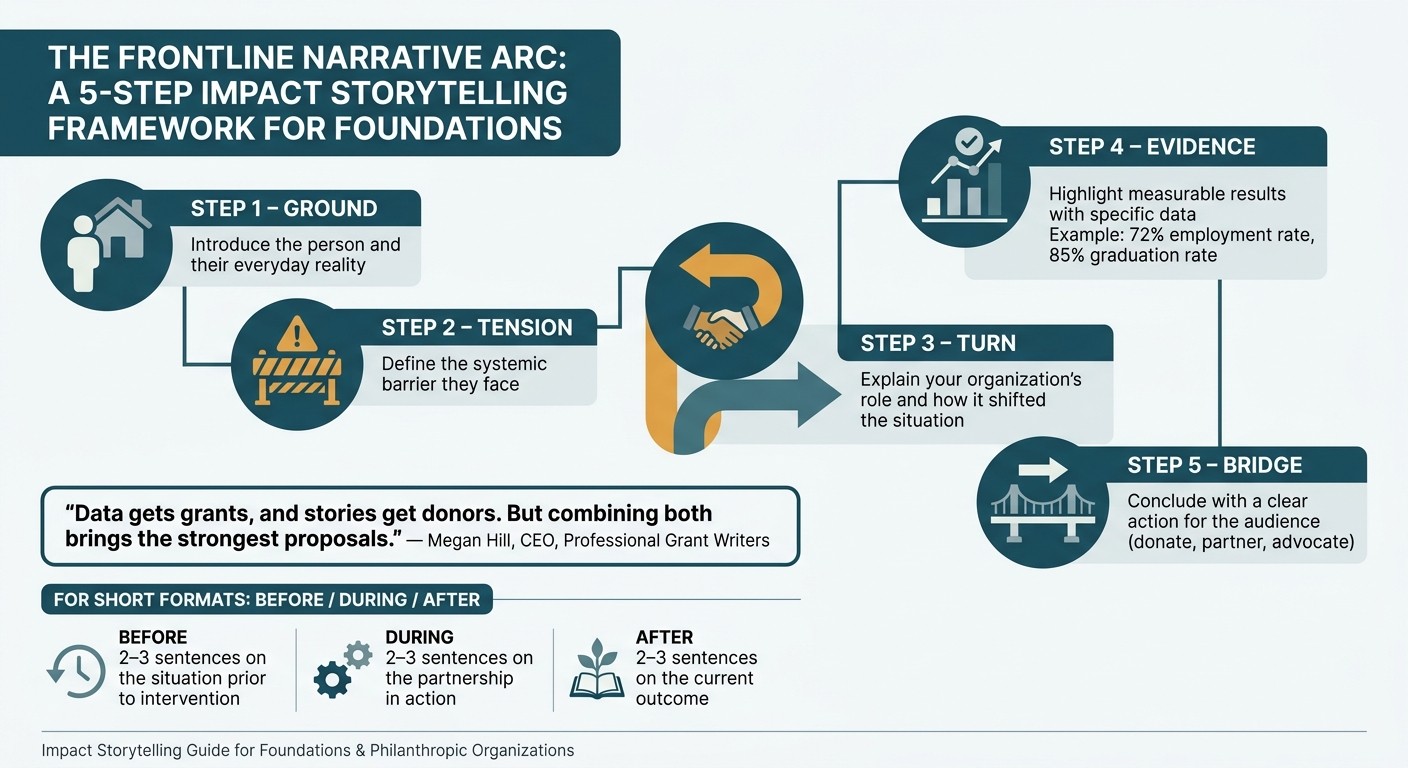
Impact Story Framework: 5-Step Frontline Narrative Arc for Foundations
When you have a clear purpose and audience in mind, the next step is structuring your story in a way that motivates action. A well-structured narrative doesn't just inform - it drives engagement and inspires change.
Use a Beginning–Middle–End Framework
The classic three-part storytelling arc is a powerful tool for crafting impact stories. It helps you guide the audience through the journey: defining the problem, showcasing the solution, and presenting the results.
Beginning: Start with a real person to ground the story in reality. Introduce the challenge they face and explain the broader systemic issue. For example, framing poverty or housing instability as societal problems - not personal failures - helps connect the audience to the larger stakes without losing the human element [4].
Middle: This is where transformation happens. Highlight the protagonist's journey, showing how your organization played a supportive role. As UpMetrics wisely advises, "Think Gandalf, not Frodo. You're equipping others to succeed" [3]. Focus on how obstacles were overcome and how collective efforts led to progress.
End: Conclude with measurable results and a clear call to action. Avoid vague statements like "lives were changed." Instead, use specific metrics to back up your claims. Close by telling your audience exactly what you want them to do next, whether it's donating, volunteering, or advocating [5].
The table below breaks down this storytelling framework:
Story Part | Core Purpose | What to Include |
|---|---|---|
Beginning | Establish context and stakes | A real protagonist, baseline conditions, systemic issue [1][7] |
Middle | Show the process of change | Obstacles, your organization’s role, collective effort [5][4] |
End | Demonstrate results |
This structure provides a solid foundation for crafting compelling narratives.
A Ready-to-Use Story Template for Foundations
To simplify storytelling, you can use a flexible template that ensures consistency and quality across your team. The Frontline Narrative Arc, originally developed for documenting fieldwork, works exceptionally well for foundations [5]:
Ground: Introduce the person and their everyday reality.
Tension: Define the systemic barrier they face.
Turn: Explain your organization’s role and how it shifted the situation.
Evidence: Highlight measurable results with specific data.
Bridge: Conclude with a clear action for the audience.
For shorter formats, like social media posts or email campaigns, the Before/During/After approach is effective. Spend two to three sentences on the situation before your intervention, two to three on the partnership in action, and two to three on the current outcome [6]. Both methods keep the focus on the individual while emphasizing your organization’s supporting role, making it easier to engage stakeholders and inspire action.
Show System-Level Impact Without Overcomplicating the Story
One common challenge is connecting personal stories to broader systemic change without overwhelming your audience. The solution? Treat the system as the antagonist, not a side note.
For instance, in 2023, Invisible People shared Jane Nguyen’s story alongside the efforts of the volunteer group Ktown for All in Los Angeles. The narrative shifted attention from homelessness as an individual issue to systemic failures like unjust property "sweeps" and lack of services. This approach highlighted the structural challenges without becoming a policy lecture [4].
"The more specific we are, the more universal something can become. Life is in the details. If you generalize, it doesn't resonate." - Jacqueline Woodson, Author [4]
To balance data and emotion, try the "Sandwich Method": start with a personal story, follow with a supporting statistic, and return to the human impact. For example, instead of saying, "We built 50 wells", emphasize community agency: "These 50 communities designed and built their own water systems with our support" [5]. This approach keeps the narrative relatable while providing the evidence funders and board members expect.
Building Stories That Are Credible and Relatable
To inspire meaningful action, your stories need to resonate on both a personal and factual level. Credibility is key - audiences are more likely to trust narratives that are grounded in evidence. These strategies work hand-in-hand with earlier advice on structure and audience focus, helping you craft stories that connect and persuade.
Combine Personal Stories with Impact Data
Numbers alone rarely change minds. But when you weave data into a compelling narrative, those numbers come to life.
"It's by embedding the facts into a narrative that gives the data a value." - Susan Nall Bales, Founder, FrameWorks Institute [11]
Pairing metrics with personal experiences makes your message more relatable. For example, instead of just stating statistics about homelessness, share the story of a family navigating that reality while incorporating key data points. This approach bridges the gap between abstract figures and the human experiences they represent.
Choose Story Subjects Who Reflect Your Community
The individuals you highlight in your stories signal how you perceive the community you serve. Always aim to feature people as active participants in their own journey, rather than portraying them as passive beneficiaries. Use empowering language, such as "children experiencing homelessness", to focus on their agency rather than their circumstances [2].
Equally important is ensuring ethical representation. Subjects should review the final story and give informed consent, with the process explained in their native language. Avoid burying consent details in complex legal jargon [5].
"The most ethical impact storytelling I've seen puts the camera in the community's hands and asks: what do you want the world to know?" - Andi Cross, Impact Strategist [5]
When these ethical practices are in place, you can shift your attention to simplifying complex topics for broader understanding.
Use Plain Language for Complex Topics
Making intricate ideas accessible doesn’t mean sacrificing depth. Instead, it’s about thoughtful choices in how you present information. As Andi Cross explains:
"Impact storytelling isn't marketing dressed up in a different vocabulary. It's honest documentation of what's happening on the ground, told in a way that connects with people who weren't there." [5]
Replace broad terms like "systemic inequality" with specific, tangible examples such as benefit cliffs, low wages, or hiring discrimination [4]. Start by writing with full technical clarity, then revise to simplify the language without losing accuracy [2]. Resist the urge to include every detail - too many disclaimers can dilute your message and distract your audience [5].
Building a Repeatable Impact Storytelling Process
Once you’ve crafted credible, data-driven narratives, the next step is to establish a process that consistently delivers meaningful stories. Effective storytelling isn’t a one-off effort - it’s a system. For foundations and philanthropic organizations, weaving impact storytelling into their broader strategy ensures a steady flow of compelling narratives. By combining structured techniques with ethical storytelling practices, the goal shifts toward creating a repeatable, reliable process.
Align Stories with Your Mission and Funding Priorities
Choose programs that reflect your organization’s core mission and strategic goals. Organizing your storytelling efforts around specific themes - whether by focus area, target demographics, or geographic regions - ensures that every story connects directly to your priorities [3].
Integrate storytelling into grant reporting by gathering visuals, testimonials, and other narrative elements alongside standard reports. This approach not only provides a consistent stream of content but also keeps it aligned with your mission [8]. Transparency is equally essential. Sharing insights into how funding decisions are made, including any strategic pivots or tough choices, builds trust and demonstrates how your mission translates into tangible outcomes [8].
Once internal alignment is in place, consider expanding your storytelling efforts by involving trusted voices from the communities you serve.
Co-Create Stories with Partners and Experts
The most compelling impact stories often emerge from collaborative efforts rather than a single organization’s perspective. By stepping back from the “hero” role and embracing the role of a facilitator, organizations can uncover richer, more relatable narratives [4].
Partnering with grantees, community members, and subject-matter experts enhances authenticity. Content generated by the community - such as photos, testimonials, and firsthand accounts - offers a level of credibility that polished internal messaging can’t always achieve [8]. When working collaboratively, it’s important to credit individuals by name, share the final story with them for approval, and ensure informed consent is obtained in their native language [5][4].
Track and Improve Story Performance Over Time
Publishing a story is just the beginning. To ensure lasting impact, it’s crucial to track its outcomes. Look at behavioral changes - such as increased donations, policy mentions, or new partnership inquiries - and pair these with qualitative evaluations to gauge long-term effects [5].
"The Proof Chain is the unbroken thread connecting first contact, intermediate evidence, and final outcome - the only thing that turns an impact claim into an impact story worth believing." - Unmesh Sheth, Founder, Sopact [13]
For instance, one organization discovered that 85% of students in their mentorship program graduated high school, compared to 60% of non-participants. By pairing this statistic with a personal story, they made the data far more engaging and persuasive [12]. Following up with story subjects at intervals like six months, one year, or even three years can reveal whether the reported changes were sustained or short-lived [13]. Additionally, asking supporters for feedback on how they perceive your organization’s impact can offer valuable insights for shaping future narratives [14].
"Behind any problem, there's a lot of context that is super important to share... We need to really start thinking about how we can responsibly report data, and talk about important things like root causes, and historical context." - Jennifer Marsack, Founder and CEO, Pivot Data Design [10]
Conclusion: Key Takeaways for Telling Stories That Drive Action
Telling impactful stories demands a blend of clarity, purpose, and solid evidence. When these elements align, a story becomes more than just information - it becomes a catalyst for action. Studies indicate that combining storytelling with data can increase donations by 35%–50% [6], as it brings the numbers to life by connecting them to real human experiences.
The most compelling narratives focus on individuals overcoming challenges. By highlighting systemic barriers - like hiring bias, policy shortcomings, or limited access to resources - these stories go beyond glorifying personal resilience. They shine a light on the broader issues and conclude with a clear, actionable takeaway.
"A good impact story is warm on the surface and airtight underneath. The reader sees a person. The skeptic, pulling the thread, finds evidence." - Unmesh Sheth, Sopact [7]
This insight underscores the importance of pairing emotional resonance with factual backing. Every story should be rooted in verifiable details, whether it’s a participant’s experience, a documented result, or qualitative insights tied to metrics. Without this foundation, even the most heartfelt narrative risks falling flat with critical audiences like funders or policymakers.
FAQs
How do I choose the right impact story to tell first?
To craft a compelling narrative, start with a specific moment, a powerful quote, or a measurable success that captures attention. Use data to underscore areas of meaningful impact, connecting those achievements to your strategic goals and what matters most to your audience. Be sure to highlight the human stories behind the numbers - these are what truly resonate. Always approach storytelling ethically, obtaining informed consent and preserving the dignity of those involved. Whether you're speaking to a board, engaging donors, or addressing stakeholders, choose stories that inspire action and create a lasting connection.
What data should I include to prove impact without bogging down the story?
To effectively demonstrate impact without overwhelming your audience, start with a relatable human story - perhaps a personal account of someone who benefited or a pivotal moment that highlights your initiative's success. Use the sandwich method: begin with this compelling story, follow it up with a key metric to anchor the narrative, and conclude with broader context to tie everything together. Striking a balance between qualitative testimonials and quantitative data is key; for example, you could mention the number of participants served or highlight specific growth milestones. To make your data more tangible, connect it to specific communities or locations, ensuring it feels both relevant and meaningful.
How can we get informed consent and still keep stories authentic?
To maintain authenticity while securing informed consent, emphasize community-led storytelling that centers on the lived experiences of participants. Clearly explain how their stories will be used and obtain written consent, ensuring participants understand their rights. Provide the option to withdraw or revise their contributions at any time. Safeguard authenticity by offering editorial review, using pseudonyms when necessary, and portraying individuals as active participants driving change, rather than as passive subjects.
Related Blog Posts
Latest Articles
©2025

Narrative Change and Power Building: The Missing Half of Advocacy
Narrative change is the process of disrupting dominant narratives that normalize inequity and advancing new narratives from historically marginalized communities.

Funding Resilience Without Federal Grants
BRIC is unreliable and FEMA is shrinking. Here's how cities fund climate resilience with dedicated revenue, blended finance, and a coordinating authority.

The ESG Blind Spot: How AI Is Finding Risks in Companies Nobody Else Is Watching
Norway's sovereign wealth fund uses AI to screen 7,200 portfolio companies for forced labor and corruption within 24 hours. The real story is the emerging-market coverage gap that traditional ESG data vendors miss — and what it means for any company with a global supply chain.
Narrative Change and Power Building: The Missing Half of Advocacy
Narrative change is the process of disrupting dominant narratives that normalize inequity and advancing new narratives from historically marginalized communities.
Funding Resilience Without Federal Grants
BRIC is unreliable and FEMA is shrinking. Here's how cities fund climate resilience with dedicated revenue, blended finance, and a coordinating authority.
The ESG Blind Spot: How AI Is Finding Risks in Companies Nobody Else Is Watching
Norway's sovereign wealth fund uses AI to screen 7,200 portfolio companies for forced labor and corruption within 24 hours. The real story is the emerging-market coverage gap that traditional ESG data vendors miss — and what it means for any company with a global supply chain.
FAQ
01
What does it really mean to “redefine profit”?
02
What makes Council Fire different?
03
Who does Council Fire work with?
04
What does working with Council Fire actually look like?
05
How does Council Fire help organizations turn big goals into action?
06
How does Council Fire define and measure success?
May 21, 2026
How to Tell Impact Stories That Inspire Action for Foundations & Philanthropic Organizations
Capacity Building
In This Article
Guide for foundations on combining personal narratives with data, structuring impact stories, and using clear calls to action.
How to Tell Impact Stories That Inspire Action for Foundations & Philanthropic Organizations
Impact stories can increase donations by 35–50%, but crafting them requires more than just sharing data. Foundations and philanthropic organizations must combine personal narratives with measurable results to connect emotionally with stakeholders and inspire action. This guide outlines how to define your story’s purpose, tailor it to different audiences, and structure it effectively to drive engagement.
Key takeaways:
Purpose and Audience: Define why you’re telling the story, who needs to hear it, and what action you want them to take.
Story Structure: Use a beginning-middle-end framework to highlight challenges, solutions, and measurable outcomes.
Data and Emotion: Pair statistics with personal experiences to make the story relatable and impactful.
Call to Action: Always include a clear next step for your audience - donate, partner, or advocate.
How to Write an Impact Story for Your Nonprofit
Laying the Groundwork: Define Purpose, Audience, and Outcomes
To craft a meaningful impact story, begin by addressing three critical questions: Why share this story? Who needs to hear it? What action should follow? Skipping this foundational step often leads to stories that, while well-written, lack direction. Clearly defining your purpose, audience, and desired outcomes ensures your narrative connects and inspires action.
Define the Purpose of the Story
Every impactful story should serve a specific organizational goal. Whether it’s reporting results to funders, influencing policy, attracting new partnerships, or rebuilding public trust, clarity of purpose is essential. For instance, many people misunderstand how foundations operate, creating an information gap that can breed skepticism when left unaddressed [8].
Ask yourself what reaction you want from your audience - whether it’s bolstering trustee confidence or gaining policy support [1]. The answer guides every aspect of the story, from the characters you highlight to the tone you adopt.
Position your foundation as part of a larger movement rather than the sole driver of change. Emphasizing collaboration with community members, grantees, and local leaders adds credibility and accurately reflects the collective effort [4]. As Jacqueline Woodson wisely notes:
"The more specific we are, the more universal something can become. Life is in the details. If you generalize, it doesn't resonate." [4]
Identify and Segment Your Priority Audiences
Different stakeholders engage with stories for different reasons. To resonate, tailor your narrative to their unique motivations. For example:
Board members often seek data-driven evidence tied to strategic goals.
Donors respond to stories that clearly outline a problem, solution, and tangible results their support enabled [5].
Community members and grantees prefer stories that highlight their own agency, presenting them as active problem-solvers with your organization's support, rather than passive recipients of aid [5].
Understanding these distinctions ensures your story connects with each group in a meaningful way.
Set Clear Actions and Outcomes for Each Story
A story without a call to action feels incomplete. Strategist Andi Cross emphasizes the need for a "bridge" - a clear link between the narrative and the action you want the audience to take, whether that’s donating, partnering, or advocating [5].
Additionally, define measurable outcomes before releasing your story. The table below outlines key outcome categories and examples of indicators to track:
Outcome Category | Measurable Indicator Examples |
|---|---|
Financial | Increased donations, secured grants, or new funding commitments [7][5] |
Policy | Citations in government reports or influence in policy discussions [5] |
Engagement | New partner inquiries, collaborations, or media coverage [5] |
Programmatic | Improvements in participant outcomes, success rates, or behavior changes [7][1] |
Take New Leash on Life USA, a nonprofit in Philadelphia. They run a prison-based dog training program and track a 72% employment rate for formerly incarcerated participants, alongside a 100% adoption rate for at-risk dogs [1]. These are not just feel-good numbers - they’re concrete, traceable outcomes that resonate with funders and inspire donors.
"Data gets grants, and stories get donors. But combining both brings the strongest proposals." - Megan Hill, CEO and Founder, Professional Grant Writers [9]
Avoid relying solely on vanity metrics like social media likes or page views to measure success. Instead, focus on indicators of real impact: Did a funder renew their grant? Did a policymaker reference your work? Did a new partner reach out? Metrics like these provide clear evidence that your story inspired action, turning it into a powerful tool for change.
Crafting the Narrative: How to Structure an Impact Story
Impact Story Framework: 5-Step Frontline Narrative Arc for Foundations
When you have a clear purpose and audience in mind, the next step is structuring your story in a way that motivates action. A well-structured narrative doesn't just inform - it drives engagement and inspires change.
Use a Beginning–Middle–End Framework
The classic three-part storytelling arc is a powerful tool for crafting impact stories. It helps you guide the audience through the journey: defining the problem, showcasing the solution, and presenting the results.
Beginning: Start with a real person to ground the story in reality. Introduce the challenge they face and explain the broader systemic issue. For example, framing poverty or housing instability as societal problems - not personal failures - helps connect the audience to the larger stakes without losing the human element [4].
Middle: This is where transformation happens. Highlight the protagonist's journey, showing how your organization played a supportive role. As UpMetrics wisely advises, "Think Gandalf, not Frodo. You're equipping others to succeed" [3]. Focus on how obstacles were overcome and how collective efforts led to progress.
End: Conclude with measurable results and a clear call to action. Avoid vague statements like "lives were changed." Instead, use specific metrics to back up your claims. Close by telling your audience exactly what you want them to do next, whether it's donating, volunteering, or advocating [5].
The table below breaks down this storytelling framework:
Story Part | Core Purpose | What to Include |
|---|---|---|
Beginning | Establish context and stakes | A real protagonist, baseline conditions, systemic issue [1][7] |
Middle | Show the process of change | Obstacles, your organization’s role, collective effort [5][4] |
End | Demonstrate results |
This structure provides a solid foundation for crafting compelling narratives.
A Ready-to-Use Story Template for Foundations
To simplify storytelling, you can use a flexible template that ensures consistency and quality across your team. The Frontline Narrative Arc, originally developed for documenting fieldwork, works exceptionally well for foundations [5]:
Ground: Introduce the person and their everyday reality.
Tension: Define the systemic barrier they face.
Turn: Explain your organization’s role and how it shifted the situation.
Evidence: Highlight measurable results with specific data.
Bridge: Conclude with a clear action for the audience.
For shorter formats, like social media posts or email campaigns, the Before/During/After approach is effective. Spend two to three sentences on the situation before your intervention, two to three on the partnership in action, and two to three on the current outcome [6]. Both methods keep the focus on the individual while emphasizing your organization’s supporting role, making it easier to engage stakeholders and inspire action.
Show System-Level Impact Without Overcomplicating the Story
One common challenge is connecting personal stories to broader systemic change without overwhelming your audience. The solution? Treat the system as the antagonist, not a side note.
For instance, in 2023, Invisible People shared Jane Nguyen’s story alongside the efforts of the volunteer group Ktown for All in Los Angeles. The narrative shifted attention from homelessness as an individual issue to systemic failures like unjust property "sweeps" and lack of services. This approach highlighted the structural challenges without becoming a policy lecture [4].
"The more specific we are, the more universal something can become. Life is in the details. If you generalize, it doesn't resonate." - Jacqueline Woodson, Author [4]
To balance data and emotion, try the "Sandwich Method": start with a personal story, follow with a supporting statistic, and return to the human impact. For example, instead of saying, "We built 50 wells", emphasize community agency: "These 50 communities designed and built their own water systems with our support" [5]. This approach keeps the narrative relatable while providing the evidence funders and board members expect.
Building Stories That Are Credible and Relatable
To inspire meaningful action, your stories need to resonate on both a personal and factual level. Credibility is key - audiences are more likely to trust narratives that are grounded in evidence. These strategies work hand-in-hand with earlier advice on structure and audience focus, helping you craft stories that connect and persuade.
Combine Personal Stories with Impact Data
Numbers alone rarely change minds. But when you weave data into a compelling narrative, those numbers come to life.
"It's by embedding the facts into a narrative that gives the data a value." - Susan Nall Bales, Founder, FrameWorks Institute [11]
Pairing metrics with personal experiences makes your message more relatable. For example, instead of just stating statistics about homelessness, share the story of a family navigating that reality while incorporating key data points. This approach bridges the gap between abstract figures and the human experiences they represent.
Choose Story Subjects Who Reflect Your Community
The individuals you highlight in your stories signal how you perceive the community you serve. Always aim to feature people as active participants in their own journey, rather than portraying them as passive beneficiaries. Use empowering language, such as "children experiencing homelessness", to focus on their agency rather than their circumstances [2].
Equally important is ensuring ethical representation. Subjects should review the final story and give informed consent, with the process explained in their native language. Avoid burying consent details in complex legal jargon [5].
"The most ethical impact storytelling I've seen puts the camera in the community's hands and asks: what do you want the world to know?" - Andi Cross, Impact Strategist [5]
When these ethical practices are in place, you can shift your attention to simplifying complex topics for broader understanding.
Use Plain Language for Complex Topics
Making intricate ideas accessible doesn’t mean sacrificing depth. Instead, it’s about thoughtful choices in how you present information. As Andi Cross explains:
"Impact storytelling isn't marketing dressed up in a different vocabulary. It's honest documentation of what's happening on the ground, told in a way that connects with people who weren't there." [5]
Replace broad terms like "systemic inequality" with specific, tangible examples such as benefit cliffs, low wages, or hiring discrimination [4]. Start by writing with full technical clarity, then revise to simplify the language without losing accuracy [2]. Resist the urge to include every detail - too many disclaimers can dilute your message and distract your audience [5].
Building a Repeatable Impact Storytelling Process
Once you’ve crafted credible, data-driven narratives, the next step is to establish a process that consistently delivers meaningful stories. Effective storytelling isn’t a one-off effort - it’s a system. For foundations and philanthropic organizations, weaving impact storytelling into their broader strategy ensures a steady flow of compelling narratives. By combining structured techniques with ethical storytelling practices, the goal shifts toward creating a repeatable, reliable process.
Align Stories with Your Mission and Funding Priorities
Choose programs that reflect your organization’s core mission and strategic goals. Organizing your storytelling efforts around specific themes - whether by focus area, target demographics, or geographic regions - ensures that every story connects directly to your priorities [3].
Integrate storytelling into grant reporting by gathering visuals, testimonials, and other narrative elements alongside standard reports. This approach not only provides a consistent stream of content but also keeps it aligned with your mission [8]. Transparency is equally essential. Sharing insights into how funding decisions are made, including any strategic pivots or tough choices, builds trust and demonstrates how your mission translates into tangible outcomes [8].
Once internal alignment is in place, consider expanding your storytelling efforts by involving trusted voices from the communities you serve.
Co-Create Stories with Partners and Experts
The most compelling impact stories often emerge from collaborative efforts rather than a single organization’s perspective. By stepping back from the “hero” role and embracing the role of a facilitator, organizations can uncover richer, more relatable narratives [4].
Partnering with grantees, community members, and subject-matter experts enhances authenticity. Content generated by the community - such as photos, testimonials, and firsthand accounts - offers a level of credibility that polished internal messaging can’t always achieve [8]. When working collaboratively, it’s important to credit individuals by name, share the final story with them for approval, and ensure informed consent is obtained in their native language [5][4].
Track and Improve Story Performance Over Time
Publishing a story is just the beginning. To ensure lasting impact, it’s crucial to track its outcomes. Look at behavioral changes - such as increased donations, policy mentions, or new partnership inquiries - and pair these with qualitative evaluations to gauge long-term effects [5].
"The Proof Chain is the unbroken thread connecting first contact, intermediate evidence, and final outcome - the only thing that turns an impact claim into an impact story worth believing." - Unmesh Sheth, Founder, Sopact [13]
For instance, one organization discovered that 85% of students in their mentorship program graduated high school, compared to 60% of non-participants. By pairing this statistic with a personal story, they made the data far more engaging and persuasive [12]. Following up with story subjects at intervals like six months, one year, or even three years can reveal whether the reported changes were sustained or short-lived [13]. Additionally, asking supporters for feedback on how they perceive your organization’s impact can offer valuable insights for shaping future narratives [14].
"Behind any problem, there's a lot of context that is super important to share... We need to really start thinking about how we can responsibly report data, and talk about important things like root causes, and historical context." - Jennifer Marsack, Founder and CEO, Pivot Data Design [10]
Conclusion: Key Takeaways for Telling Stories That Drive Action
Telling impactful stories demands a blend of clarity, purpose, and solid evidence. When these elements align, a story becomes more than just information - it becomes a catalyst for action. Studies indicate that combining storytelling with data can increase donations by 35%–50% [6], as it brings the numbers to life by connecting them to real human experiences.
The most compelling narratives focus on individuals overcoming challenges. By highlighting systemic barriers - like hiring bias, policy shortcomings, or limited access to resources - these stories go beyond glorifying personal resilience. They shine a light on the broader issues and conclude with a clear, actionable takeaway.
"A good impact story is warm on the surface and airtight underneath. The reader sees a person. The skeptic, pulling the thread, finds evidence." - Unmesh Sheth, Sopact [7]
This insight underscores the importance of pairing emotional resonance with factual backing. Every story should be rooted in verifiable details, whether it’s a participant’s experience, a documented result, or qualitative insights tied to metrics. Without this foundation, even the most heartfelt narrative risks falling flat with critical audiences like funders or policymakers.
FAQs
How do I choose the right impact story to tell first?
To craft a compelling narrative, start with a specific moment, a powerful quote, or a measurable success that captures attention. Use data to underscore areas of meaningful impact, connecting those achievements to your strategic goals and what matters most to your audience. Be sure to highlight the human stories behind the numbers - these are what truly resonate. Always approach storytelling ethically, obtaining informed consent and preserving the dignity of those involved. Whether you're speaking to a board, engaging donors, or addressing stakeholders, choose stories that inspire action and create a lasting connection.
What data should I include to prove impact without bogging down the story?
To effectively demonstrate impact without overwhelming your audience, start with a relatable human story - perhaps a personal account of someone who benefited or a pivotal moment that highlights your initiative's success. Use the sandwich method: begin with this compelling story, follow it up with a key metric to anchor the narrative, and conclude with broader context to tie everything together. Striking a balance between qualitative testimonials and quantitative data is key; for example, you could mention the number of participants served or highlight specific growth milestones. To make your data more tangible, connect it to specific communities or locations, ensuring it feels both relevant and meaningful.
How can we get informed consent and still keep stories authentic?
To maintain authenticity while securing informed consent, emphasize community-led storytelling that centers on the lived experiences of participants. Clearly explain how their stories will be used and obtain written consent, ensuring participants understand their rights. Provide the option to withdraw or revise their contributions at any time. Safeguard authenticity by offering editorial review, using pseudonyms when necessary, and portraying individuals as active participants driving change, rather than as passive subjects.
Related Blog Posts
Latest Articles
©2025
Narrative Change and Power Building: The Missing Half of Advocacy
Narrative change is the process of disrupting dominant narratives that normalize inequity and advancing new narratives from historically marginalized communities.
Funding Resilience Without Federal Grants
BRIC is unreliable and FEMA is shrinking. Here's how cities fund climate resilience with dedicated revenue, blended finance, and a coordinating authority.
The ESG Blind Spot: How AI Is Finding Risks in Companies Nobody Else Is Watching
Norway's sovereign wealth fund uses AI to screen 7,200 portfolio companies for forced labor and corruption within 24 hours. The real story is the emerging-market coverage gap that traditional ESG data vendors miss — and what it means for any company with a global supply chain.
FAQ
01
What does it really mean to “redefine profit”?
02
What makes Council Fire different?
03
Who does Council Fire work with?
04
What does working with Council Fire actually look like?
05
How does Council Fire help organizations turn big goals into action?
06
How does Council Fire define and measure success?
May 21, 2026
How to Tell Impact Stories That Inspire Action for Foundations & Philanthropic Organizations
Capacity Building
In This Article
Guide for foundations on combining personal narratives with data, structuring impact stories, and using clear calls to action.
How to Tell Impact Stories That Inspire Action for Foundations & Philanthropic Organizations
Impact stories can increase donations by 35–50%, but crafting them requires more than just sharing data. Foundations and philanthropic organizations must combine personal narratives with measurable results to connect emotionally with stakeholders and inspire action. This guide outlines how to define your story’s purpose, tailor it to different audiences, and structure it effectively to drive engagement.
Key takeaways:
Purpose and Audience: Define why you’re telling the story, who needs to hear it, and what action you want them to take.
Story Structure: Use a beginning-middle-end framework to highlight challenges, solutions, and measurable outcomes.
Data and Emotion: Pair statistics with personal experiences to make the story relatable and impactful.
Call to Action: Always include a clear next step for your audience - donate, partner, or advocate.
How to Write an Impact Story for Your Nonprofit
Laying the Groundwork: Define Purpose, Audience, and Outcomes
To craft a meaningful impact story, begin by addressing three critical questions: Why share this story? Who needs to hear it? What action should follow? Skipping this foundational step often leads to stories that, while well-written, lack direction. Clearly defining your purpose, audience, and desired outcomes ensures your narrative connects and inspires action.
Define the Purpose of the Story
Every impactful story should serve a specific organizational goal. Whether it’s reporting results to funders, influencing policy, attracting new partnerships, or rebuilding public trust, clarity of purpose is essential. For instance, many people misunderstand how foundations operate, creating an information gap that can breed skepticism when left unaddressed [8].
Ask yourself what reaction you want from your audience - whether it’s bolstering trustee confidence or gaining policy support [1]. The answer guides every aspect of the story, from the characters you highlight to the tone you adopt.
Position your foundation as part of a larger movement rather than the sole driver of change. Emphasizing collaboration with community members, grantees, and local leaders adds credibility and accurately reflects the collective effort [4]. As Jacqueline Woodson wisely notes:
"The more specific we are, the more universal something can become. Life is in the details. If you generalize, it doesn't resonate." [4]
Identify and Segment Your Priority Audiences
Different stakeholders engage with stories for different reasons. To resonate, tailor your narrative to their unique motivations. For example:
Board members often seek data-driven evidence tied to strategic goals.
Donors respond to stories that clearly outline a problem, solution, and tangible results their support enabled [5].
Community members and grantees prefer stories that highlight their own agency, presenting them as active problem-solvers with your organization's support, rather than passive recipients of aid [5].
Understanding these distinctions ensures your story connects with each group in a meaningful way.
Set Clear Actions and Outcomes for Each Story
A story without a call to action feels incomplete. Strategist Andi Cross emphasizes the need for a "bridge" - a clear link between the narrative and the action you want the audience to take, whether that’s donating, partnering, or advocating [5].
Additionally, define measurable outcomes before releasing your story. The table below outlines key outcome categories and examples of indicators to track:
Outcome Category | Measurable Indicator Examples |
|---|---|
Financial | Increased donations, secured grants, or new funding commitments [7][5] |
Policy | Citations in government reports or influence in policy discussions [5] |
Engagement | New partner inquiries, collaborations, or media coverage [5] |
Programmatic | Improvements in participant outcomes, success rates, or behavior changes [7][1] |
Take New Leash on Life USA, a nonprofit in Philadelphia. They run a prison-based dog training program and track a 72% employment rate for formerly incarcerated participants, alongside a 100% adoption rate for at-risk dogs [1]. These are not just feel-good numbers - they’re concrete, traceable outcomes that resonate with funders and inspire donors.
"Data gets grants, and stories get donors. But combining both brings the strongest proposals." - Megan Hill, CEO and Founder, Professional Grant Writers [9]
Avoid relying solely on vanity metrics like social media likes or page views to measure success. Instead, focus on indicators of real impact: Did a funder renew their grant? Did a policymaker reference your work? Did a new partner reach out? Metrics like these provide clear evidence that your story inspired action, turning it into a powerful tool for change.
Crafting the Narrative: How to Structure an Impact Story
Impact Story Framework: 5-Step Frontline Narrative Arc for Foundations
When you have a clear purpose and audience in mind, the next step is structuring your story in a way that motivates action. A well-structured narrative doesn't just inform - it drives engagement and inspires change.
Use a Beginning–Middle–End Framework
The classic three-part storytelling arc is a powerful tool for crafting impact stories. It helps you guide the audience through the journey: defining the problem, showcasing the solution, and presenting the results.
Beginning: Start with a real person to ground the story in reality. Introduce the challenge they face and explain the broader systemic issue. For example, framing poverty or housing instability as societal problems - not personal failures - helps connect the audience to the larger stakes without losing the human element [4].
Middle: This is where transformation happens. Highlight the protagonist's journey, showing how your organization played a supportive role. As UpMetrics wisely advises, "Think Gandalf, not Frodo. You're equipping others to succeed" [3]. Focus on how obstacles were overcome and how collective efforts led to progress.
End: Conclude with measurable results and a clear call to action. Avoid vague statements like "lives were changed." Instead, use specific metrics to back up your claims. Close by telling your audience exactly what you want them to do next, whether it's donating, volunteering, or advocating [5].
The table below breaks down this storytelling framework:
Story Part | Core Purpose | What to Include |
|---|---|---|
Beginning | Establish context and stakes | A real protagonist, baseline conditions, systemic issue [1][7] |
Middle | Show the process of change | Obstacles, your organization’s role, collective effort [5][4] |
End | Demonstrate results |
This structure provides a solid foundation for crafting compelling narratives.
A Ready-to-Use Story Template for Foundations
To simplify storytelling, you can use a flexible template that ensures consistency and quality across your team. The Frontline Narrative Arc, originally developed for documenting fieldwork, works exceptionally well for foundations [5]:
Ground: Introduce the person and their everyday reality.
Tension: Define the systemic barrier they face.
Turn: Explain your organization’s role and how it shifted the situation.
Evidence: Highlight measurable results with specific data.
Bridge: Conclude with a clear action for the audience.
For shorter formats, like social media posts or email campaigns, the Before/During/After approach is effective. Spend two to three sentences on the situation before your intervention, two to three on the partnership in action, and two to three on the current outcome [6]. Both methods keep the focus on the individual while emphasizing your organization’s supporting role, making it easier to engage stakeholders and inspire action.
Show System-Level Impact Without Overcomplicating the Story
One common challenge is connecting personal stories to broader systemic change without overwhelming your audience. The solution? Treat the system as the antagonist, not a side note.
For instance, in 2023, Invisible People shared Jane Nguyen’s story alongside the efforts of the volunteer group Ktown for All in Los Angeles. The narrative shifted attention from homelessness as an individual issue to systemic failures like unjust property "sweeps" and lack of services. This approach highlighted the structural challenges without becoming a policy lecture [4].
"The more specific we are, the more universal something can become. Life is in the details. If you generalize, it doesn't resonate." - Jacqueline Woodson, Author [4]
To balance data and emotion, try the "Sandwich Method": start with a personal story, follow with a supporting statistic, and return to the human impact. For example, instead of saying, "We built 50 wells", emphasize community agency: "These 50 communities designed and built their own water systems with our support" [5]. This approach keeps the narrative relatable while providing the evidence funders and board members expect.
Building Stories That Are Credible and Relatable
To inspire meaningful action, your stories need to resonate on both a personal and factual level. Credibility is key - audiences are more likely to trust narratives that are grounded in evidence. These strategies work hand-in-hand with earlier advice on structure and audience focus, helping you craft stories that connect and persuade.
Combine Personal Stories with Impact Data
Numbers alone rarely change minds. But when you weave data into a compelling narrative, those numbers come to life.
"It's by embedding the facts into a narrative that gives the data a value." - Susan Nall Bales, Founder, FrameWorks Institute [11]
Pairing metrics with personal experiences makes your message more relatable. For example, instead of just stating statistics about homelessness, share the story of a family navigating that reality while incorporating key data points. This approach bridges the gap between abstract figures and the human experiences they represent.
Choose Story Subjects Who Reflect Your Community
The individuals you highlight in your stories signal how you perceive the community you serve. Always aim to feature people as active participants in their own journey, rather than portraying them as passive beneficiaries. Use empowering language, such as "children experiencing homelessness", to focus on their agency rather than their circumstances [2].
Equally important is ensuring ethical representation. Subjects should review the final story and give informed consent, with the process explained in their native language. Avoid burying consent details in complex legal jargon [5].
"The most ethical impact storytelling I've seen puts the camera in the community's hands and asks: what do you want the world to know?" - Andi Cross, Impact Strategist [5]
When these ethical practices are in place, you can shift your attention to simplifying complex topics for broader understanding.
Use Plain Language for Complex Topics
Making intricate ideas accessible doesn’t mean sacrificing depth. Instead, it’s about thoughtful choices in how you present information. As Andi Cross explains:
"Impact storytelling isn't marketing dressed up in a different vocabulary. It's honest documentation of what's happening on the ground, told in a way that connects with people who weren't there." [5]
Replace broad terms like "systemic inequality" with specific, tangible examples such as benefit cliffs, low wages, or hiring discrimination [4]. Start by writing with full technical clarity, then revise to simplify the language without losing accuracy [2]. Resist the urge to include every detail - too many disclaimers can dilute your message and distract your audience [5].
Building a Repeatable Impact Storytelling Process
Once you’ve crafted credible, data-driven narratives, the next step is to establish a process that consistently delivers meaningful stories. Effective storytelling isn’t a one-off effort - it’s a system. For foundations and philanthropic organizations, weaving impact storytelling into their broader strategy ensures a steady flow of compelling narratives. By combining structured techniques with ethical storytelling practices, the goal shifts toward creating a repeatable, reliable process.
Align Stories with Your Mission and Funding Priorities
Choose programs that reflect your organization’s core mission and strategic goals. Organizing your storytelling efforts around specific themes - whether by focus area, target demographics, or geographic regions - ensures that every story connects directly to your priorities [3].
Integrate storytelling into grant reporting by gathering visuals, testimonials, and other narrative elements alongside standard reports. This approach not only provides a consistent stream of content but also keeps it aligned with your mission [8]. Transparency is equally essential. Sharing insights into how funding decisions are made, including any strategic pivots or tough choices, builds trust and demonstrates how your mission translates into tangible outcomes [8].
Once internal alignment is in place, consider expanding your storytelling efforts by involving trusted voices from the communities you serve.
Co-Create Stories with Partners and Experts
The most compelling impact stories often emerge from collaborative efforts rather than a single organization’s perspective. By stepping back from the “hero” role and embracing the role of a facilitator, organizations can uncover richer, more relatable narratives [4].
Partnering with grantees, community members, and subject-matter experts enhances authenticity. Content generated by the community - such as photos, testimonials, and firsthand accounts - offers a level of credibility that polished internal messaging can’t always achieve [8]. When working collaboratively, it’s important to credit individuals by name, share the final story with them for approval, and ensure informed consent is obtained in their native language [5][4].
Track and Improve Story Performance Over Time
Publishing a story is just the beginning. To ensure lasting impact, it’s crucial to track its outcomes. Look at behavioral changes - such as increased donations, policy mentions, or new partnership inquiries - and pair these with qualitative evaluations to gauge long-term effects [5].
"The Proof Chain is the unbroken thread connecting first contact, intermediate evidence, and final outcome - the only thing that turns an impact claim into an impact story worth believing." - Unmesh Sheth, Founder, Sopact [13]
For instance, one organization discovered that 85% of students in their mentorship program graduated high school, compared to 60% of non-participants. By pairing this statistic with a personal story, they made the data far more engaging and persuasive [12]. Following up with story subjects at intervals like six months, one year, or even three years can reveal whether the reported changes were sustained or short-lived [13]. Additionally, asking supporters for feedback on how they perceive your organization’s impact can offer valuable insights for shaping future narratives [14].
"Behind any problem, there's a lot of context that is super important to share... We need to really start thinking about how we can responsibly report data, and talk about important things like root causes, and historical context." - Jennifer Marsack, Founder and CEO, Pivot Data Design [10]
Conclusion: Key Takeaways for Telling Stories That Drive Action
Telling impactful stories demands a blend of clarity, purpose, and solid evidence. When these elements align, a story becomes more than just information - it becomes a catalyst for action. Studies indicate that combining storytelling with data can increase donations by 35%–50% [6], as it brings the numbers to life by connecting them to real human experiences.
The most compelling narratives focus on individuals overcoming challenges. By highlighting systemic barriers - like hiring bias, policy shortcomings, or limited access to resources - these stories go beyond glorifying personal resilience. They shine a light on the broader issues and conclude with a clear, actionable takeaway.
"A good impact story is warm on the surface and airtight underneath. The reader sees a person. The skeptic, pulling the thread, finds evidence." - Unmesh Sheth, Sopact [7]
This insight underscores the importance of pairing emotional resonance with factual backing. Every story should be rooted in verifiable details, whether it’s a participant’s experience, a documented result, or qualitative insights tied to metrics. Without this foundation, even the most heartfelt narrative risks falling flat with critical audiences like funders or policymakers.
FAQs
How do I choose the right impact story to tell first?
To craft a compelling narrative, start with a specific moment, a powerful quote, or a measurable success that captures attention. Use data to underscore areas of meaningful impact, connecting those achievements to your strategic goals and what matters most to your audience. Be sure to highlight the human stories behind the numbers - these are what truly resonate. Always approach storytelling ethically, obtaining informed consent and preserving the dignity of those involved. Whether you're speaking to a board, engaging donors, or addressing stakeholders, choose stories that inspire action and create a lasting connection.
What data should I include to prove impact without bogging down the story?
To effectively demonstrate impact without overwhelming your audience, start with a relatable human story - perhaps a personal account of someone who benefited or a pivotal moment that highlights your initiative's success. Use the sandwich method: begin with this compelling story, follow it up with a key metric to anchor the narrative, and conclude with broader context to tie everything together. Striking a balance between qualitative testimonials and quantitative data is key; for example, you could mention the number of participants served or highlight specific growth milestones. To make your data more tangible, connect it to specific communities or locations, ensuring it feels both relevant and meaningful.
How can we get informed consent and still keep stories authentic?
To maintain authenticity while securing informed consent, emphasize community-led storytelling that centers on the lived experiences of participants. Clearly explain how their stories will be used and obtain written consent, ensuring participants understand their rights. Provide the option to withdraw or revise their contributions at any time. Safeguard authenticity by offering editorial review, using pseudonyms when necessary, and portraying individuals as active participants driving change, rather than as passive subjects.
Related Blog Posts
Latest Articles
©2025
Narrative Change and Power Building: The Missing Half of Advocacy
Narrative change is the process of disrupting dominant narratives that normalize inequity and advancing new narratives from historically marginalized communities.
Funding Resilience Without Federal Grants
BRIC is unreliable and FEMA is shrinking. Here's how cities fund climate resilience with dedicated revenue, blended finance, and a coordinating authority.
The ESG Blind Spot: How AI Is Finding Risks in Companies Nobody Else Is Watching
Norway's sovereign wealth fund uses AI to screen 7,200 portfolio companies for forced labor and corruption within 24 hours. The real story is the emerging-market coverage gap that traditional ESG data vendors miss — and what it means for any company with a global supply chain.
FAQ
What does it really mean to “redefine profit”?
What makes Council Fire different?
Who does Council Fire work with?
What does working with Council Fire actually look like?
How does Council Fire help organizations turn big goals into action?
How does Council Fire define and measure success?