
May 20, 2026
How to Tell Impact Stories That Inspire Action for Universities & Research Institutions
Capacity Building
In This Article
How universities turn research into human-centered impact stories with clear metrics, audience-focused framing, and campus-wide workflows.
How to Tell Impact Stories That Inspire Action for Universities & Research Institutions
Universities and research institutions often struggle to communicate the real-world effects of their work. Impact storytelling bridges this gap by turning complex research into relatable narratives that inspire action.
Key Takeaways:
What is an Impact Story? It highlights the measurable difference research makes in people's lives, focusing on outcomes rather than internal achievements.
Why It Matters: Funders, policymakers, and collaborators increasingly demand clear evidence of research impact.
Core Elements of a Strong Story: Human-centered challenges, clear interventions, measurable results, and future potential.
Tailoring for Audiences: Different stakeholders (e.g., agencies, industry, public) require customized messaging to connect with their priorities.
Simplifying Complexity: Avoid jargon and use analogies to make technical concepts accessible.
Data + Human Context: Pair statistics with personal anecdotes to create emotional resonance.
Building a System: Create a repeatable campus-wide process to gather and refine stories.
Impact stories are tools for securing funding, building trust, and fostering collaboration. By focusing on outcomes and making research relatable, institutions can inspire action and extend their influence.
Research Communication and Storytelling Principles for Impact | Impact Skillbuilder
Define Purpose, Audience, and Desired Outcomes
To craft a compelling narrative, it’s essential to address three key questions: Why was this work done? What was done? What changed? This approach ensures the focus remains on tangible benefits rather than internal benchmarks. Without this clarity, stories can easily drift into highlighting internal achievements rather than meaningful progress in the real world[6].
Setting a Clear Story Purpose
Every impactful narrative starts with a clear purpose. Are you aiming to secure a federal grant, attract a corporate partner, or foster public trust? Your goal will shape the tone, key metrics, and call to action. Stories should align with one of four sustainability pillars: Economic, Environmental, Social, or Health and Well-being. For instance, a university’s water conservation initiative naturally ties to the Environmental pillar, while a workforce development program aligns with Economic priorities. For early-stage research, using if-then logic (e.g., "If this soil treatment scales to 10,000 acres, it could reduce agricultural runoff by 30%") transparently conveys the potential impact[6].
Identifying Key Audiences
Understanding your audience is crucial because different groups value different aspects of a story. Federal and state agencies prioritize measurable outcomes and policy alignment, industry partners focus on economic competitiveness and innovation, and the general public responds to straightforward, relatable language. Tailor your narrative to address what each audience needs to know, their concerns, and how they prefer to receive information[6].
Tailoring Stories for Different Stakeholders
Here are some examples of how to approach key university stakeholder groups effectively:
Stakeholder Group | Primary Interest | Recommended Approach |
|---|---|---|
Federal/State Agencies | Policy alignment and measurable outcomes | Provide quantifiable evidence and concise outcome-focused statements[6] |
Industry Partners | Economic benefits and innovation | Use infographics to highlight collaboration and economic potential[7] |
Policymakers | Legislation and public good | Share fact sheets and if-then projections to illustrate impact[6] |
Community Partners | Local benefits and ethical engagement | Include testimonials and personal stories to build trust[8] |
General Public | Relatability and societal benefit | Use plain language and human-interest stories for accessibility[3][9] |
A universal truth across all audiences: qualitative evidence can be as compelling as hard data. Consider this insight from the University of Minnesota:
"One personal anecdote or impactful example can be more powerful than several examples with the same outcome." [9]
To maximize efficiency, repackage your content for different formats. For example, a technical report can be transformed into a constituent letter or a media pitch, allowing you to engage multiple audiences without needing to start from scratch each time[6].
Build a Repeatable Structure for Impact Stories
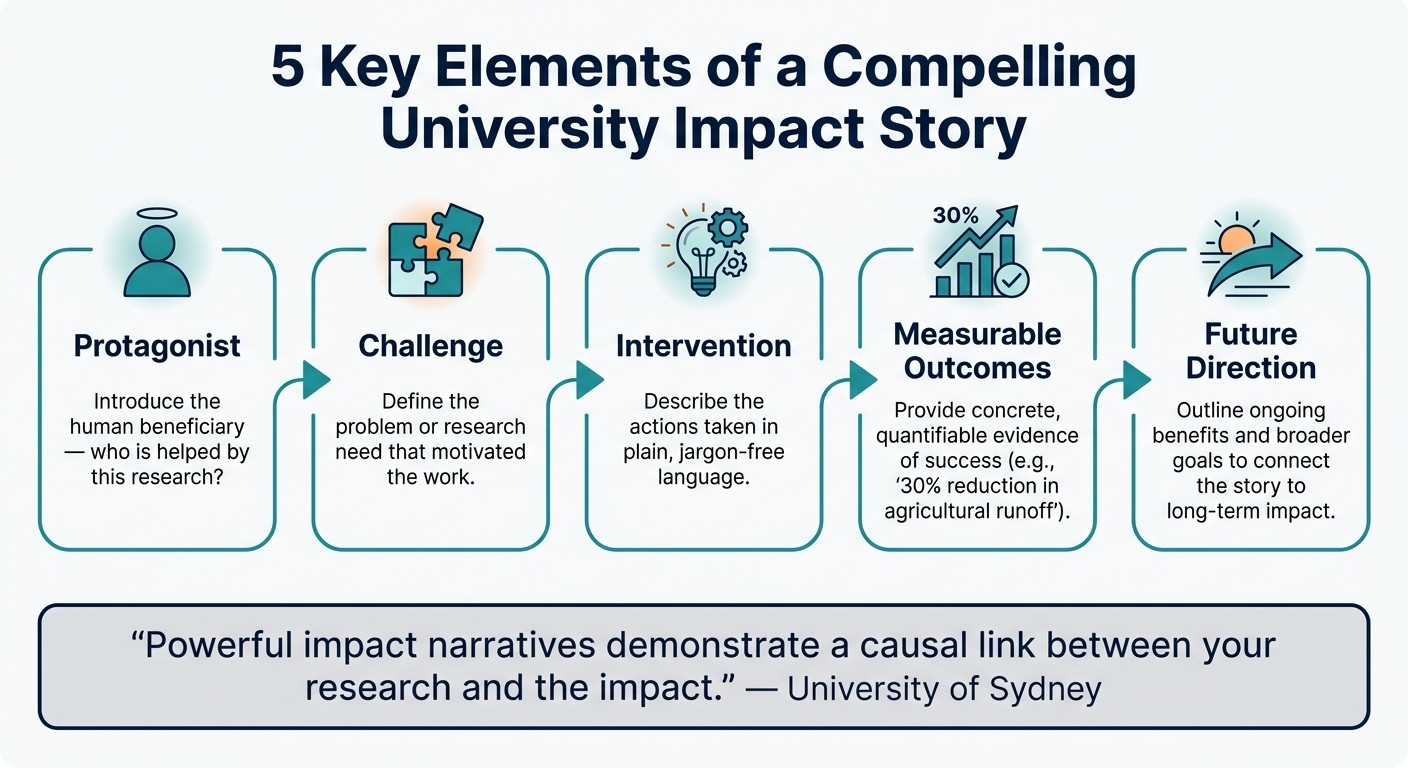
5-Step Impact Story Framework for Universities & Research Institutions
Crafting compelling impact stories involves more than just good storytelling - it requires a structured approach that ensures consistency and effectiveness. By following a repeatable framework, you can save time while maintaining high-quality narratives.
Key Elements of an Impact Story
Impact stories are built around five essential elements: protagonist, challenge, intervention, measurable outcomes, and future direction. These components bring the story to life while highlighting the significance of the research:
The protagonist and challenge humanize the story by introducing the beneficiaries and explaining the problem or research need.
The intervention focuses on the actions taken, avoiding overly technical language to keep the story accessible.
Measurable outcomes provide evidence of success, making the impact tangible.
Future direction outlines the ongoing benefits and future potential, connecting the story to broader goals.
Using clear and direct language like "resulted in" strengthens the narrative by establishing causality. This is especially important for funders and policymakers who need concrete evidence to justify their investments. As the University of Sydney explains:
"Powerful impact narratives demonstrate a causal link between your research and the impact. This is sometimes called 'attribution'." [4]
This structured approach naturally transitions to emphasizing the roles of stakeholders, which is explored in the next section.
Positioning Stakeholders as the Hero
One of the most effective ways to amplify an impact story is by framing stakeholders - such as donors, partners, and community members - as the heroes. By presenting their contributions as the driving force behind meaningful change, you can make the narrative even more compelling. This approach doesn’t diminish the importance of the research but rather highlights how their involvement made success possible.
Erin O'Dwyer, Director of Good Prose Studios, captures this idea perfectly:
"Framing your research in the context of pressing social issues – or a problem to be solved – makes it more powerful and more urgent." [10]
To do this effectively, align the story with what each stakeholder values most. For example, a corporate partner might care about economic relevance, while a community organization may prioritize local benefits. When the narrative reflects these priorities, stakeholders see their contributions as integral to the outcome, motivating further engagement. With stakeholders positioned as heroes, the next step is ensuring technical concepts are communicated clearly.
Simplifying Complex Concepts
Impact stories are often aimed at a broader audience, which means simplifying technical details is crucial. Academic writing may favor complexity, but as the University of Sydney points out, "Assessors of impact won't usually be experts in your particular niche research area." [4] Overloading the story with jargon, acronyms, or dense methodological details can alienate readers.
Instead, write with a curious, non-expert audience in mind. Analogies can be particularly helpful. For instance, if discussing a complex metric like a Field Weighted Citation Impact (FWCI) of 5.0, explain it in relatable terms: "This means the work is cited five times more than the average paper in its field." [4] The University of Minnesota emphasizes this point:
"Complexity doesn't always mean better - sometimes adding details can bog your story down, instead of adding meaningful context." [1]
Turn Data into Clear, Engaging Narratives
Data becomes far more impactful when transformed into stories that resonate with your audience. While numbers offer evidence, it’s the context and narrative that drive action and connection.
Selecting Key Metrics
Focus on metrics that align directly with your story’s purpose. Highlighting the most influential indicators ensures your message stays clear and compelling. To make these figures relatable, compare them to familiar benchmarks or everyday concepts.
For every metric, clarify its meaning and origin - whether it’s sourced from internal systems or external reports. This transparency strengthens trust and makes your narrative easier to validate [11]. Beyond that, bring these numbers to life by adding a human touch.
Adding Human Context to Data
While data provides the facts, personal stories reveal the “why” behind the numbers. Pairing a statistic with a testimonial, letter of support, or brief quote can make the data more relatable and emotionally engaging. As Virginia Commonwealth University aptly states:
"Quantitative metrics should be used to inform and complement, not replace, qualitative evidence." [5]
A single, well-told anecdote often has more impact than a collection of similar examples. For instance, a community partner sharing how a research project improved their daily work can leave a lasting impression, far more than a dense table of percentages. Research backs this up: while statistics lose 73% of their influence within a day, the power of a story diminishes by only 32% [2].
Once your data is enhanced with human context, it’s time to evaluate how well your narrative connects with its audience.
Measuring and Improving Story Effectiveness
Publishing your story is just the beginning. To refine it, monitor how it’s received. Look at news coverage, social media activity, mentions in policy discussions, or even its inclusion in academic syllabi [5].
Before releasing your story, share drafts with readers outside your field. Ask them direct questions like, What stands out most? What’s confusing? Their feedback can uncover blind spots that internal reviews might overlook. Use this cycle - publish, track, gather input, and revise - to continuously improve your storytelling.
Build a Campus-Wide Story Collection and Production Process
Once individual impact stories are refined, the next step is to scale the process across the entire campus. This involves embedding story collection into the rhythm of institutional activities like grant deadlines, semester evaluations, or annual reporting. Without a structured approach, impactful narratives often remain confined to specific departments, limiting their potential to resonate across broader audiences.
Setting Up a Storytelling Workflow
To make this process effective, provide researchers with specific prompts rather than leaving them with open-ended questions. Jocelyn Bosley, Research Impact Coordinator at the University of Nebraska-Lincoln, highlights the importance of this approach:
"Impact narratives that demonstrate the real-world impact of one's work can be a powerful strategy for communicating across a range of key audiences in a way that is relevant and meaningful." [11]
When preparing their narratives, researchers should consider: What metrics are you using? Who is your target audience? What outcomes are being tracked? What is the plan for implementation? [11] These targeted prompts simplify the process and encourage submissions that focus on meaningful impact rather than just listing activities.
Assigning Roles and Responsibilities
A successful storytelling process depends on clearly defined roles across the institution. It’s not just a task for the communications team - collaboration is key.
Role | Responsibility | Contribution |
|---|---|---|
Researcher / Faculty | Content Creation | Provides the personal element, core message, and qualitative evidence [3][5] |
Central Comms / RDS | Strategy & Distribution | Refines language for broader audiences and adapts stories for various platforms [3] |
Library / Impact Team | Framework & Evidence | Links data to societal outcomes using models like the Becker Model or RIF [5] |
Community Partners | Authentic Narrative | Contributes real-world perspectives and ensures systemic context is accurate [12] |
External Partners | Ethical Oversight | Treats storytellers as collaborators and provides production resources [12] |
Danielle DeCosta, Director at AcademyHealth, emphasizes the importance of sharing research effectively:
"For research to have real world impact, it's critical that it is shared with the people who can act on that evidence to improve policy and practice." [11]
By distributing responsibilities across these roles, institutions can establish a strong foundation for impactful storytelling.
Choosing the Right Storytelling Model
How stories are organized and produced is just as important as who is involved. For example, the University of Arizona's College of Agriculture, Life & Environmental Sciences (CALES) uses a hybrid model. Its central communications team reviews submissions from faculty and students, creating a variety of formats. These include concise 500–800-word news releases for major announcements and longer 1,000–2,000-word web features for deeper narratives. These stories are shared through CALES Insider, a monthly newsletter that reaches alumni, industry partners, and the wider community [13].
This hybrid model balances structure and flexibility, as shown in the comparison below:
Storytelling Model | Advantages | Limitations | Resource Needs |
|---|---|---|---|
Centralized | Ensures consistency and unified messaging | Can slow down processes; lacks nuance | Requires a dedicated central team and tools |
Decentralized | Promotes authenticity and faster output | Quality may vary; messaging can fragment | Relies on departmental champions and staff |
Hybrid | Balances consistency with authenticity | Needs clear roles and oversight | Requires shared templates and cloud-based tools |
For large institutions, the hybrid model often works best. It allows departments to act quickly while ensuring the central team maintains brand alignment and quality. Using cloud-based tracking tools instead of manual spreadsheets also helps streamline the process, making it easier for research teams and leadership to manage the entire pipeline [11].
Conclusion: Using Impact Stories to Drive Action
The best impact stories do more than just inform - they connect, persuade, and motivate. By identifying the audience, detailing the change, and explaining why it matters, universities and research institutions can turn dry reports into compelling narratives. These stories have the power to inspire action, whether it’s securing grant funding, influencing policy decisions, or strengthening community partnerships.
Precise language plays a crucial role in this process. Using terms like "resulted in" or "was cited as key evidence in" instead of vague phrases like "helped contribute to" adds weight and credibility to the narrative [4]. At the same time, keeping the human element front and center ensures that the story remains relatable and impactful, rather than being buried under a mountain of statistics [4].
"The average impact of statistics on beliefs fades by 73% over the course of a single day, but the impact of a story fades by only 32%." – Speaking Science 2025 Conference [2]
This insight highlights the enduring power of storytelling. While data may grab attention momentarily, a well-told story - structured with a clear progression from challenge to outcome, written in accessible language, and answering the all-important "so what?" - can leave a lasting impression and shift perspectives long after it’s been shared [3]. This kind of resonance can even help shape a campus's broader culture.
Institutions that understand this treat storytelling as an ongoing effort, not a one-off task. They establish systems to gather stories regularly, assign clear responsibilities, and refine their narratives based on feedback. When this discipline spreads across an entire campus, it transforms isolated research successes into a ripple effect of sustained, institution-wide impact.
FAQs
How do we prove impact without overstating attribution?
To effectively demonstrate impact without exaggerating your contribution, it's important to clearly outline how your research played a role in achieving the outcome while acknowledging other factors that may have influenced it. Use specific and precise language, such as "our research led to" or "was instrumental in," to highlight your involvement. Always back up your claims with solid evidence - this could include policy reports, testimonials, or measurable results. Avoid making vague statements, and ensure your narrative is rooted in objective, verifiable data.
What metrics should we use when results are still early-stage?
For initial outcomes, emphasize qualitative evidence and storytelling instead of depending entirely on numerical data. Gather insights from stakeholder feedback, testimonials, case studies, and media coverage to showcase progress. By building a compelling impact narrative that includes early indicators of change, detailed process explanations, and preliminary findings, you can effectively convey potential impact while adding depth and credibility to your message.
How can we build a campus-wide system to collect stories fast?
To gather impact stories across an entire campus efficiently, create a centralized platform that allows faculty, students, and staff to share their testimonials and evidence with ease. Utilize standardized templates to maintain uniformity in submissions, ensuring the information collected is clear and consistent. Encourage participation by sending reminders and offering quick, user-friendly submission options. Additionally, implement a review process to validate and organize the stories, ensuring they are reliable, actionable, and align with the institution’s objectives.
Related Blog Posts
Latest Articles
©2025

Narrative Change and Power Building: The Missing Half of Advocacy
Narrative change is the process of disrupting dominant narratives that normalize inequity and advancing new narratives from historically marginalized communities.

Funding Resilience Without Federal Grants
BRIC is unreliable and FEMA is shrinking. Here's how cities fund climate resilience with dedicated revenue, blended finance, and a coordinating authority.

The ESG Blind Spot: How AI Is Finding Risks in Companies Nobody Else Is Watching
Norway's sovereign wealth fund uses AI to screen 7,200 portfolio companies for forced labor and corruption within 24 hours. The real story is the emerging-market coverage gap that traditional ESG data vendors miss — and what it means for any company with a global supply chain.
Narrative Change and Power Building: The Missing Half of Advocacy
Narrative change is the process of disrupting dominant narratives that normalize inequity and advancing new narratives from historically marginalized communities.
Funding Resilience Without Federal Grants
BRIC is unreliable and FEMA is shrinking. Here's how cities fund climate resilience with dedicated revenue, blended finance, and a coordinating authority.
The ESG Blind Spot: How AI Is Finding Risks in Companies Nobody Else Is Watching
Norway's sovereign wealth fund uses AI to screen 7,200 portfolio companies for forced labor and corruption within 24 hours. The real story is the emerging-market coverage gap that traditional ESG data vendors miss — and what it means for any company with a global supply chain.
FAQ
01
What does it really mean to “redefine profit”?
02
What makes Council Fire different?
03
Who does Council Fire work with?
04
What does working with Council Fire actually look like?
05
How does Council Fire help organizations turn big goals into action?
06
How does Council Fire define and measure success?
May 20, 2026
How to Tell Impact Stories That Inspire Action for Universities & Research Institutions
Capacity Building
In This Article
How universities turn research into human-centered impact stories with clear metrics, audience-focused framing, and campus-wide workflows.
How to Tell Impact Stories That Inspire Action for Universities & Research Institutions
Universities and research institutions often struggle to communicate the real-world effects of their work. Impact storytelling bridges this gap by turning complex research into relatable narratives that inspire action.
Key Takeaways:
What is an Impact Story? It highlights the measurable difference research makes in people's lives, focusing on outcomes rather than internal achievements.
Why It Matters: Funders, policymakers, and collaborators increasingly demand clear evidence of research impact.
Core Elements of a Strong Story: Human-centered challenges, clear interventions, measurable results, and future potential.
Tailoring for Audiences: Different stakeholders (e.g., agencies, industry, public) require customized messaging to connect with their priorities.
Simplifying Complexity: Avoid jargon and use analogies to make technical concepts accessible.
Data + Human Context: Pair statistics with personal anecdotes to create emotional resonance.
Building a System: Create a repeatable campus-wide process to gather and refine stories.
Impact stories are tools for securing funding, building trust, and fostering collaboration. By focusing on outcomes and making research relatable, institutions can inspire action and extend their influence.
Research Communication and Storytelling Principles for Impact | Impact Skillbuilder
Define Purpose, Audience, and Desired Outcomes
To craft a compelling narrative, it’s essential to address three key questions: Why was this work done? What was done? What changed? This approach ensures the focus remains on tangible benefits rather than internal benchmarks. Without this clarity, stories can easily drift into highlighting internal achievements rather than meaningful progress in the real world[6].
Setting a Clear Story Purpose
Every impactful narrative starts with a clear purpose. Are you aiming to secure a federal grant, attract a corporate partner, or foster public trust? Your goal will shape the tone, key metrics, and call to action. Stories should align with one of four sustainability pillars: Economic, Environmental, Social, or Health and Well-being. For instance, a university’s water conservation initiative naturally ties to the Environmental pillar, while a workforce development program aligns with Economic priorities. For early-stage research, using if-then logic (e.g., "If this soil treatment scales to 10,000 acres, it could reduce agricultural runoff by 30%") transparently conveys the potential impact[6].
Identifying Key Audiences
Understanding your audience is crucial because different groups value different aspects of a story. Federal and state agencies prioritize measurable outcomes and policy alignment, industry partners focus on economic competitiveness and innovation, and the general public responds to straightforward, relatable language. Tailor your narrative to address what each audience needs to know, their concerns, and how they prefer to receive information[6].
Tailoring Stories for Different Stakeholders
Here are some examples of how to approach key university stakeholder groups effectively:
Stakeholder Group | Primary Interest | Recommended Approach |
|---|---|---|
Federal/State Agencies | Policy alignment and measurable outcomes | Provide quantifiable evidence and concise outcome-focused statements[6] |
Industry Partners | Economic benefits and innovation | Use infographics to highlight collaboration and economic potential[7] |
Policymakers | Legislation and public good | Share fact sheets and if-then projections to illustrate impact[6] |
Community Partners | Local benefits and ethical engagement | Include testimonials and personal stories to build trust[8] |
General Public | Relatability and societal benefit | Use plain language and human-interest stories for accessibility[3][9] |
A universal truth across all audiences: qualitative evidence can be as compelling as hard data. Consider this insight from the University of Minnesota:
"One personal anecdote or impactful example can be more powerful than several examples with the same outcome." [9]
To maximize efficiency, repackage your content for different formats. For example, a technical report can be transformed into a constituent letter or a media pitch, allowing you to engage multiple audiences without needing to start from scratch each time[6].
Build a Repeatable Structure for Impact Stories
5-Step Impact Story Framework for Universities & Research Institutions
Crafting compelling impact stories involves more than just good storytelling - it requires a structured approach that ensures consistency and effectiveness. By following a repeatable framework, you can save time while maintaining high-quality narratives.
Key Elements of an Impact Story
Impact stories are built around five essential elements: protagonist, challenge, intervention, measurable outcomes, and future direction. These components bring the story to life while highlighting the significance of the research:
The protagonist and challenge humanize the story by introducing the beneficiaries and explaining the problem or research need.
The intervention focuses on the actions taken, avoiding overly technical language to keep the story accessible.
Measurable outcomes provide evidence of success, making the impact tangible.
Future direction outlines the ongoing benefits and future potential, connecting the story to broader goals.
Using clear and direct language like "resulted in" strengthens the narrative by establishing causality. This is especially important for funders and policymakers who need concrete evidence to justify their investments. As the University of Sydney explains:
"Powerful impact narratives demonstrate a causal link between your research and the impact. This is sometimes called 'attribution'." [4]
This structured approach naturally transitions to emphasizing the roles of stakeholders, which is explored in the next section.
Positioning Stakeholders as the Hero
One of the most effective ways to amplify an impact story is by framing stakeholders - such as donors, partners, and community members - as the heroes. By presenting their contributions as the driving force behind meaningful change, you can make the narrative even more compelling. This approach doesn’t diminish the importance of the research but rather highlights how their involvement made success possible.
Erin O'Dwyer, Director of Good Prose Studios, captures this idea perfectly:
"Framing your research in the context of pressing social issues – or a problem to be solved – makes it more powerful and more urgent." [10]
To do this effectively, align the story with what each stakeholder values most. For example, a corporate partner might care about economic relevance, while a community organization may prioritize local benefits. When the narrative reflects these priorities, stakeholders see their contributions as integral to the outcome, motivating further engagement. With stakeholders positioned as heroes, the next step is ensuring technical concepts are communicated clearly.
Simplifying Complex Concepts
Impact stories are often aimed at a broader audience, which means simplifying technical details is crucial. Academic writing may favor complexity, but as the University of Sydney points out, "Assessors of impact won't usually be experts in your particular niche research area." [4] Overloading the story with jargon, acronyms, or dense methodological details can alienate readers.
Instead, write with a curious, non-expert audience in mind. Analogies can be particularly helpful. For instance, if discussing a complex metric like a Field Weighted Citation Impact (FWCI) of 5.0, explain it in relatable terms: "This means the work is cited five times more than the average paper in its field." [4] The University of Minnesota emphasizes this point:
"Complexity doesn't always mean better - sometimes adding details can bog your story down, instead of adding meaningful context." [1]
Turn Data into Clear, Engaging Narratives
Data becomes far more impactful when transformed into stories that resonate with your audience. While numbers offer evidence, it’s the context and narrative that drive action and connection.
Selecting Key Metrics
Focus on metrics that align directly with your story’s purpose. Highlighting the most influential indicators ensures your message stays clear and compelling. To make these figures relatable, compare them to familiar benchmarks or everyday concepts.
For every metric, clarify its meaning and origin - whether it’s sourced from internal systems or external reports. This transparency strengthens trust and makes your narrative easier to validate [11]. Beyond that, bring these numbers to life by adding a human touch.
Adding Human Context to Data
While data provides the facts, personal stories reveal the “why” behind the numbers. Pairing a statistic with a testimonial, letter of support, or brief quote can make the data more relatable and emotionally engaging. As Virginia Commonwealth University aptly states:
"Quantitative metrics should be used to inform and complement, not replace, qualitative evidence." [5]
A single, well-told anecdote often has more impact than a collection of similar examples. For instance, a community partner sharing how a research project improved their daily work can leave a lasting impression, far more than a dense table of percentages. Research backs this up: while statistics lose 73% of their influence within a day, the power of a story diminishes by only 32% [2].
Once your data is enhanced with human context, it’s time to evaluate how well your narrative connects with its audience.
Measuring and Improving Story Effectiveness
Publishing your story is just the beginning. To refine it, monitor how it’s received. Look at news coverage, social media activity, mentions in policy discussions, or even its inclusion in academic syllabi [5].
Before releasing your story, share drafts with readers outside your field. Ask them direct questions like, What stands out most? What’s confusing? Their feedback can uncover blind spots that internal reviews might overlook. Use this cycle - publish, track, gather input, and revise - to continuously improve your storytelling.
Build a Campus-Wide Story Collection and Production Process
Once individual impact stories are refined, the next step is to scale the process across the entire campus. This involves embedding story collection into the rhythm of institutional activities like grant deadlines, semester evaluations, or annual reporting. Without a structured approach, impactful narratives often remain confined to specific departments, limiting their potential to resonate across broader audiences.
Setting Up a Storytelling Workflow
To make this process effective, provide researchers with specific prompts rather than leaving them with open-ended questions. Jocelyn Bosley, Research Impact Coordinator at the University of Nebraska-Lincoln, highlights the importance of this approach:
"Impact narratives that demonstrate the real-world impact of one's work can be a powerful strategy for communicating across a range of key audiences in a way that is relevant and meaningful." [11]
When preparing their narratives, researchers should consider: What metrics are you using? Who is your target audience? What outcomes are being tracked? What is the plan for implementation? [11] These targeted prompts simplify the process and encourage submissions that focus on meaningful impact rather than just listing activities.
Assigning Roles and Responsibilities
A successful storytelling process depends on clearly defined roles across the institution. It’s not just a task for the communications team - collaboration is key.
Role | Responsibility | Contribution |
|---|---|---|
Researcher / Faculty | Content Creation | Provides the personal element, core message, and qualitative evidence [3][5] |
Central Comms / RDS | Strategy & Distribution | Refines language for broader audiences and adapts stories for various platforms [3] |
Library / Impact Team | Framework & Evidence | Links data to societal outcomes using models like the Becker Model or RIF [5] |
Community Partners | Authentic Narrative | Contributes real-world perspectives and ensures systemic context is accurate [12] |
External Partners | Ethical Oversight | Treats storytellers as collaborators and provides production resources [12] |
Danielle DeCosta, Director at AcademyHealth, emphasizes the importance of sharing research effectively:
"For research to have real world impact, it's critical that it is shared with the people who can act on that evidence to improve policy and practice." [11]
By distributing responsibilities across these roles, institutions can establish a strong foundation for impactful storytelling.
Choosing the Right Storytelling Model
How stories are organized and produced is just as important as who is involved. For example, the University of Arizona's College of Agriculture, Life & Environmental Sciences (CALES) uses a hybrid model. Its central communications team reviews submissions from faculty and students, creating a variety of formats. These include concise 500–800-word news releases for major announcements and longer 1,000–2,000-word web features for deeper narratives. These stories are shared through CALES Insider, a monthly newsletter that reaches alumni, industry partners, and the wider community [13].
This hybrid model balances structure and flexibility, as shown in the comparison below:
Storytelling Model | Advantages | Limitations | Resource Needs |
|---|---|---|---|
Centralized | Ensures consistency and unified messaging | Can slow down processes; lacks nuance | Requires a dedicated central team and tools |
Decentralized | Promotes authenticity and faster output | Quality may vary; messaging can fragment | Relies on departmental champions and staff |
Hybrid | Balances consistency with authenticity | Needs clear roles and oversight | Requires shared templates and cloud-based tools |
For large institutions, the hybrid model often works best. It allows departments to act quickly while ensuring the central team maintains brand alignment and quality. Using cloud-based tracking tools instead of manual spreadsheets also helps streamline the process, making it easier for research teams and leadership to manage the entire pipeline [11].
Conclusion: Using Impact Stories to Drive Action
The best impact stories do more than just inform - they connect, persuade, and motivate. By identifying the audience, detailing the change, and explaining why it matters, universities and research institutions can turn dry reports into compelling narratives. These stories have the power to inspire action, whether it’s securing grant funding, influencing policy decisions, or strengthening community partnerships.
Precise language plays a crucial role in this process. Using terms like "resulted in" or "was cited as key evidence in" instead of vague phrases like "helped contribute to" adds weight and credibility to the narrative [4]. At the same time, keeping the human element front and center ensures that the story remains relatable and impactful, rather than being buried under a mountain of statistics [4].
"The average impact of statistics on beliefs fades by 73% over the course of a single day, but the impact of a story fades by only 32%." – Speaking Science 2025 Conference [2]
This insight highlights the enduring power of storytelling. While data may grab attention momentarily, a well-told story - structured with a clear progression from challenge to outcome, written in accessible language, and answering the all-important "so what?" - can leave a lasting impression and shift perspectives long after it’s been shared [3]. This kind of resonance can even help shape a campus's broader culture.
Institutions that understand this treat storytelling as an ongoing effort, not a one-off task. They establish systems to gather stories regularly, assign clear responsibilities, and refine their narratives based on feedback. When this discipline spreads across an entire campus, it transforms isolated research successes into a ripple effect of sustained, institution-wide impact.
FAQs
How do we prove impact without overstating attribution?
To effectively demonstrate impact without exaggerating your contribution, it's important to clearly outline how your research played a role in achieving the outcome while acknowledging other factors that may have influenced it. Use specific and precise language, such as "our research led to" or "was instrumental in," to highlight your involvement. Always back up your claims with solid evidence - this could include policy reports, testimonials, or measurable results. Avoid making vague statements, and ensure your narrative is rooted in objective, verifiable data.
What metrics should we use when results are still early-stage?
For initial outcomes, emphasize qualitative evidence and storytelling instead of depending entirely on numerical data. Gather insights from stakeholder feedback, testimonials, case studies, and media coverage to showcase progress. By building a compelling impact narrative that includes early indicators of change, detailed process explanations, and preliminary findings, you can effectively convey potential impact while adding depth and credibility to your message.
How can we build a campus-wide system to collect stories fast?
To gather impact stories across an entire campus efficiently, create a centralized platform that allows faculty, students, and staff to share their testimonials and evidence with ease. Utilize standardized templates to maintain uniformity in submissions, ensuring the information collected is clear and consistent. Encourage participation by sending reminders and offering quick, user-friendly submission options. Additionally, implement a review process to validate and organize the stories, ensuring they are reliable, actionable, and align with the institution’s objectives.
Related Blog Posts
Latest Articles
©2025
Narrative Change and Power Building: The Missing Half of Advocacy
Narrative change is the process of disrupting dominant narratives that normalize inequity and advancing new narratives from historically marginalized communities.
Funding Resilience Without Federal Grants
BRIC is unreliable and FEMA is shrinking. Here's how cities fund climate resilience with dedicated revenue, blended finance, and a coordinating authority.
The ESG Blind Spot: How AI Is Finding Risks in Companies Nobody Else Is Watching
Norway's sovereign wealth fund uses AI to screen 7,200 portfolio companies for forced labor and corruption within 24 hours. The real story is the emerging-market coverage gap that traditional ESG data vendors miss — and what it means for any company with a global supply chain.
FAQ
01
What does it really mean to “redefine profit”?
02
What makes Council Fire different?
03
Who does Council Fire work with?
04
What does working with Council Fire actually look like?
05
How does Council Fire help organizations turn big goals into action?
06
How does Council Fire define and measure success?
May 20, 2026
How to Tell Impact Stories That Inspire Action for Universities & Research Institutions
Capacity Building
In This Article
How universities turn research into human-centered impact stories with clear metrics, audience-focused framing, and campus-wide workflows.
How to Tell Impact Stories That Inspire Action for Universities & Research Institutions
Universities and research institutions often struggle to communicate the real-world effects of their work. Impact storytelling bridges this gap by turning complex research into relatable narratives that inspire action.
Key Takeaways:
What is an Impact Story? It highlights the measurable difference research makes in people's lives, focusing on outcomes rather than internal achievements.
Why It Matters: Funders, policymakers, and collaborators increasingly demand clear evidence of research impact.
Core Elements of a Strong Story: Human-centered challenges, clear interventions, measurable results, and future potential.
Tailoring for Audiences: Different stakeholders (e.g., agencies, industry, public) require customized messaging to connect with their priorities.
Simplifying Complexity: Avoid jargon and use analogies to make technical concepts accessible.
Data + Human Context: Pair statistics with personal anecdotes to create emotional resonance.
Building a System: Create a repeatable campus-wide process to gather and refine stories.
Impact stories are tools for securing funding, building trust, and fostering collaboration. By focusing on outcomes and making research relatable, institutions can inspire action and extend their influence.
Research Communication and Storytelling Principles for Impact | Impact Skillbuilder
Define Purpose, Audience, and Desired Outcomes
To craft a compelling narrative, it’s essential to address three key questions: Why was this work done? What was done? What changed? This approach ensures the focus remains on tangible benefits rather than internal benchmarks. Without this clarity, stories can easily drift into highlighting internal achievements rather than meaningful progress in the real world[6].
Setting a Clear Story Purpose
Every impactful narrative starts with a clear purpose. Are you aiming to secure a federal grant, attract a corporate partner, or foster public trust? Your goal will shape the tone, key metrics, and call to action. Stories should align with one of four sustainability pillars: Economic, Environmental, Social, or Health and Well-being. For instance, a university’s water conservation initiative naturally ties to the Environmental pillar, while a workforce development program aligns with Economic priorities. For early-stage research, using if-then logic (e.g., "If this soil treatment scales to 10,000 acres, it could reduce agricultural runoff by 30%") transparently conveys the potential impact[6].
Identifying Key Audiences
Understanding your audience is crucial because different groups value different aspects of a story. Federal and state agencies prioritize measurable outcomes and policy alignment, industry partners focus on economic competitiveness and innovation, and the general public responds to straightforward, relatable language. Tailor your narrative to address what each audience needs to know, their concerns, and how they prefer to receive information[6].
Tailoring Stories for Different Stakeholders
Here are some examples of how to approach key university stakeholder groups effectively:
Stakeholder Group | Primary Interest | Recommended Approach |
|---|---|---|
Federal/State Agencies | Policy alignment and measurable outcomes | Provide quantifiable evidence and concise outcome-focused statements[6] |
Industry Partners | Economic benefits and innovation | Use infographics to highlight collaboration and economic potential[7] |
Policymakers | Legislation and public good | Share fact sheets and if-then projections to illustrate impact[6] |
Community Partners | Local benefits and ethical engagement | Include testimonials and personal stories to build trust[8] |
General Public | Relatability and societal benefit | Use plain language and human-interest stories for accessibility[3][9] |
A universal truth across all audiences: qualitative evidence can be as compelling as hard data. Consider this insight from the University of Minnesota:
"One personal anecdote or impactful example can be more powerful than several examples with the same outcome." [9]
To maximize efficiency, repackage your content for different formats. For example, a technical report can be transformed into a constituent letter or a media pitch, allowing you to engage multiple audiences without needing to start from scratch each time[6].
Build a Repeatable Structure for Impact Stories
5-Step Impact Story Framework for Universities & Research Institutions
Crafting compelling impact stories involves more than just good storytelling - it requires a structured approach that ensures consistency and effectiveness. By following a repeatable framework, you can save time while maintaining high-quality narratives.
Key Elements of an Impact Story
Impact stories are built around five essential elements: protagonist, challenge, intervention, measurable outcomes, and future direction. These components bring the story to life while highlighting the significance of the research:
The protagonist and challenge humanize the story by introducing the beneficiaries and explaining the problem or research need.
The intervention focuses on the actions taken, avoiding overly technical language to keep the story accessible.
Measurable outcomes provide evidence of success, making the impact tangible.
Future direction outlines the ongoing benefits and future potential, connecting the story to broader goals.
Using clear and direct language like "resulted in" strengthens the narrative by establishing causality. This is especially important for funders and policymakers who need concrete evidence to justify their investments. As the University of Sydney explains:
"Powerful impact narratives demonstrate a causal link between your research and the impact. This is sometimes called 'attribution'." [4]
This structured approach naturally transitions to emphasizing the roles of stakeholders, which is explored in the next section.
Positioning Stakeholders as the Hero
One of the most effective ways to amplify an impact story is by framing stakeholders - such as donors, partners, and community members - as the heroes. By presenting their contributions as the driving force behind meaningful change, you can make the narrative even more compelling. This approach doesn’t diminish the importance of the research but rather highlights how their involvement made success possible.
Erin O'Dwyer, Director of Good Prose Studios, captures this idea perfectly:
"Framing your research in the context of pressing social issues – or a problem to be solved – makes it more powerful and more urgent." [10]
To do this effectively, align the story with what each stakeholder values most. For example, a corporate partner might care about economic relevance, while a community organization may prioritize local benefits. When the narrative reflects these priorities, stakeholders see their contributions as integral to the outcome, motivating further engagement. With stakeholders positioned as heroes, the next step is ensuring technical concepts are communicated clearly.
Simplifying Complex Concepts
Impact stories are often aimed at a broader audience, which means simplifying technical details is crucial. Academic writing may favor complexity, but as the University of Sydney points out, "Assessors of impact won't usually be experts in your particular niche research area." [4] Overloading the story with jargon, acronyms, or dense methodological details can alienate readers.
Instead, write with a curious, non-expert audience in mind. Analogies can be particularly helpful. For instance, if discussing a complex metric like a Field Weighted Citation Impact (FWCI) of 5.0, explain it in relatable terms: "This means the work is cited five times more than the average paper in its field." [4] The University of Minnesota emphasizes this point:
"Complexity doesn't always mean better - sometimes adding details can bog your story down, instead of adding meaningful context." [1]
Turn Data into Clear, Engaging Narratives
Data becomes far more impactful when transformed into stories that resonate with your audience. While numbers offer evidence, it’s the context and narrative that drive action and connection.
Selecting Key Metrics
Focus on metrics that align directly with your story’s purpose. Highlighting the most influential indicators ensures your message stays clear and compelling. To make these figures relatable, compare them to familiar benchmarks or everyday concepts.
For every metric, clarify its meaning and origin - whether it’s sourced from internal systems or external reports. This transparency strengthens trust and makes your narrative easier to validate [11]. Beyond that, bring these numbers to life by adding a human touch.
Adding Human Context to Data
While data provides the facts, personal stories reveal the “why” behind the numbers. Pairing a statistic with a testimonial, letter of support, or brief quote can make the data more relatable and emotionally engaging. As Virginia Commonwealth University aptly states:
"Quantitative metrics should be used to inform and complement, not replace, qualitative evidence." [5]
A single, well-told anecdote often has more impact than a collection of similar examples. For instance, a community partner sharing how a research project improved their daily work can leave a lasting impression, far more than a dense table of percentages. Research backs this up: while statistics lose 73% of their influence within a day, the power of a story diminishes by only 32% [2].
Once your data is enhanced with human context, it’s time to evaluate how well your narrative connects with its audience.
Measuring and Improving Story Effectiveness
Publishing your story is just the beginning. To refine it, monitor how it’s received. Look at news coverage, social media activity, mentions in policy discussions, or even its inclusion in academic syllabi [5].
Before releasing your story, share drafts with readers outside your field. Ask them direct questions like, What stands out most? What’s confusing? Their feedback can uncover blind spots that internal reviews might overlook. Use this cycle - publish, track, gather input, and revise - to continuously improve your storytelling.
Build a Campus-Wide Story Collection and Production Process
Once individual impact stories are refined, the next step is to scale the process across the entire campus. This involves embedding story collection into the rhythm of institutional activities like grant deadlines, semester evaluations, or annual reporting. Without a structured approach, impactful narratives often remain confined to specific departments, limiting their potential to resonate across broader audiences.
Setting Up a Storytelling Workflow
To make this process effective, provide researchers with specific prompts rather than leaving them with open-ended questions. Jocelyn Bosley, Research Impact Coordinator at the University of Nebraska-Lincoln, highlights the importance of this approach:
"Impact narratives that demonstrate the real-world impact of one's work can be a powerful strategy for communicating across a range of key audiences in a way that is relevant and meaningful." [11]
When preparing their narratives, researchers should consider: What metrics are you using? Who is your target audience? What outcomes are being tracked? What is the plan for implementation? [11] These targeted prompts simplify the process and encourage submissions that focus on meaningful impact rather than just listing activities.
Assigning Roles and Responsibilities
A successful storytelling process depends on clearly defined roles across the institution. It’s not just a task for the communications team - collaboration is key.
Role | Responsibility | Contribution |
|---|---|---|
Researcher / Faculty | Content Creation | Provides the personal element, core message, and qualitative evidence [3][5] |
Central Comms / RDS | Strategy & Distribution | Refines language for broader audiences and adapts stories for various platforms [3] |
Library / Impact Team | Framework & Evidence | Links data to societal outcomes using models like the Becker Model or RIF [5] |
Community Partners | Authentic Narrative | Contributes real-world perspectives and ensures systemic context is accurate [12] |
External Partners | Ethical Oversight | Treats storytellers as collaborators and provides production resources [12] |
Danielle DeCosta, Director at AcademyHealth, emphasizes the importance of sharing research effectively:
"For research to have real world impact, it's critical that it is shared with the people who can act on that evidence to improve policy and practice." [11]
By distributing responsibilities across these roles, institutions can establish a strong foundation for impactful storytelling.
Choosing the Right Storytelling Model
How stories are organized and produced is just as important as who is involved. For example, the University of Arizona's College of Agriculture, Life & Environmental Sciences (CALES) uses a hybrid model. Its central communications team reviews submissions from faculty and students, creating a variety of formats. These include concise 500–800-word news releases for major announcements and longer 1,000–2,000-word web features for deeper narratives. These stories are shared through CALES Insider, a monthly newsletter that reaches alumni, industry partners, and the wider community [13].
This hybrid model balances structure and flexibility, as shown in the comparison below:
Storytelling Model | Advantages | Limitations | Resource Needs |
|---|---|---|---|
Centralized | Ensures consistency and unified messaging | Can slow down processes; lacks nuance | Requires a dedicated central team and tools |
Decentralized | Promotes authenticity and faster output | Quality may vary; messaging can fragment | Relies on departmental champions and staff |
Hybrid | Balances consistency with authenticity | Needs clear roles and oversight | Requires shared templates and cloud-based tools |
For large institutions, the hybrid model often works best. It allows departments to act quickly while ensuring the central team maintains brand alignment and quality. Using cloud-based tracking tools instead of manual spreadsheets also helps streamline the process, making it easier for research teams and leadership to manage the entire pipeline [11].
Conclusion: Using Impact Stories to Drive Action
The best impact stories do more than just inform - they connect, persuade, and motivate. By identifying the audience, detailing the change, and explaining why it matters, universities and research institutions can turn dry reports into compelling narratives. These stories have the power to inspire action, whether it’s securing grant funding, influencing policy decisions, or strengthening community partnerships.
Precise language plays a crucial role in this process. Using terms like "resulted in" or "was cited as key evidence in" instead of vague phrases like "helped contribute to" adds weight and credibility to the narrative [4]. At the same time, keeping the human element front and center ensures that the story remains relatable and impactful, rather than being buried under a mountain of statistics [4].
"The average impact of statistics on beliefs fades by 73% over the course of a single day, but the impact of a story fades by only 32%." – Speaking Science 2025 Conference [2]
This insight highlights the enduring power of storytelling. While data may grab attention momentarily, a well-told story - structured with a clear progression from challenge to outcome, written in accessible language, and answering the all-important "so what?" - can leave a lasting impression and shift perspectives long after it’s been shared [3]. This kind of resonance can even help shape a campus's broader culture.
Institutions that understand this treat storytelling as an ongoing effort, not a one-off task. They establish systems to gather stories regularly, assign clear responsibilities, and refine their narratives based on feedback. When this discipline spreads across an entire campus, it transforms isolated research successes into a ripple effect of sustained, institution-wide impact.
FAQs
How do we prove impact without overstating attribution?
To effectively demonstrate impact without exaggerating your contribution, it's important to clearly outline how your research played a role in achieving the outcome while acknowledging other factors that may have influenced it. Use specific and precise language, such as "our research led to" or "was instrumental in," to highlight your involvement. Always back up your claims with solid evidence - this could include policy reports, testimonials, or measurable results. Avoid making vague statements, and ensure your narrative is rooted in objective, verifiable data.
What metrics should we use when results are still early-stage?
For initial outcomes, emphasize qualitative evidence and storytelling instead of depending entirely on numerical data. Gather insights from stakeholder feedback, testimonials, case studies, and media coverage to showcase progress. By building a compelling impact narrative that includes early indicators of change, detailed process explanations, and preliminary findings, you can effectively convey potential impact while adding depth and credibility to your message.
How can we build a campus-wide system to collect stories fast?
To gather impact stories across an entire campus efficiently, create a centralized platform that allows faculty, students, and staff to share their testimonials and evidence with ease. Utilize standardized templates to maintain uniformity in submissions, ensuring the information collected is clear and consistent. Encourage participation by sending reminders and offering quick, user-friendly submission options. Additionally, implement a review process to validate and organize the stories, ensuring they are reliable, actionable, and align with the institution’s objectives.
Related Blog Posts
Latest Articles
©2025
Narrative Change and Power Building: The Missing Half of Advocacy
Narrative change is the process of disrupting dominant narratives that normalize inequity and advancing new narratives from historically marginalized communities.
Funding Resilience Without Federal Grants
BRIC is unreliable and FEMA is shrinking. Here's how cities fund climate resilience with dedicated revenue, blended finance, and a coordinating authority.
The ESG Blind Spot: How AI Is Finding Risks in Companies Nobody Else Is Watching
Norway's sovereign wealth fund uses AI to screen 7,200 portfolio companies for forced labor and corruption within 24 hours. The real story is the emerging-market coverage gap that traditional ESG data vendors miss — and what it means for any company with a global supply chain.
FAQ
What does it really mean to “redefine profit”?
What makes Council Fire different?
Who does Council Fire work with?
What does working with Council Fire actually look like?
How does Council Fire help organizations turn big goals into action?
How does Council Fire define and measure success?