
May 20, 2026
How to Tell Impact Stories That Inspire Action for NGOs & Nonprofits
Capacity Building
In This Article
How nonprofits combine data, ethics, and human stories to drive donations, policy support, and lasting community impact.
How to Tell Impact Stories That Inspire Action for NGOs & Nonprofits
The way you tell your organization’s story can be the difference between passive interest and active support. By focusing on real people, challenges, and measurable outcomes, nonprofits can connect emotionally with their audience and drive action. Here’s how to craft stories that resonate:
Set Goals and Know Your Audience: Tailor your story to specific objectives, whether it’s securing funding or building partnerships. Understand what motivates your audience - donors care about personal connections, while foundations value evidence of broad impact.
Use Data and Emotion Together: Combine personal stories with measurable outcomes. Highlight how your programs create real change, like a 25% drop in food insecurity or improved local employment rates.
Be Ethical and Specific: Represent individuals with dignity, focusing on their agency rather than portraying them as helpless. Use vivid, relatable details to make your story impactful.
Make It Local and Relevant: Show how your efforts connect to broader initiatives while staying relatable to your community.
Embed Storytelling in Operations: Collect stories regularly, link them to your strategic goals, and train staff to identify meaningful moments in the field.
How to Write an Impact Story for Your Nonprofit
Clarify Story Purpose and Audience
Before diving into storytelling, consider two essential questions: What do you want this story to achieve? and Who needs to hear it? Overlooking this step often leads to stories that fail to connect - attempting to speak to everyone but resonating with no one.
Define Story Goals
Every impactful story needs a clear objective. Are you aiming to secure a grant, engage a major donor, influence public policy, or invite new members into your mission? Each goal demands a tailored approach, from tone to structure and level of detail.
Drew Giddings, Founder & Principal Consultant at Giddings Consulting, highlights this perfectly:
"The organizations that raise the most money are not the ones with the most compelling problems - they are the ones that tell the most compelling stories about how change actually happens." [4]
A useful framework to guide storytelling is Problem-Person-Pathway-Outcome: identify a challenge, focus on an individual with agency, outline the actions taken, and showcase the resulting change. This approach ensures your stories go beyond dry program descriptions and bring to life the how of meaningful change [4].
Understand Your Target Audiences
Different audiences have different priorities, and your stories should reflect that. For instance, a foundation program officer might care about how your work aligns with a theory of change, while a corporate partner may prioritize shared values. A mid-level donor, on the other hand, seeks a personal connection that validates their contribution.
Here’s a breakdown of common audience groups and the types of stories that resonate with each:
Audience Group | Primary Motivation | Recommended Story Type | Key Narrative Element |
|---|---|---|---|
Major Donors | Personal connection & outcomes | Impact / Systems Change | Relationship-focused, one-on-one delivery |
Foundations | Evidence of systemic impact | Systems Change / Impact | Theory of Change connection & data |
City Officials | Actionable solutions | Systems Change | Geographic context & evidence-based plans |
Corporate Partners | Brand alignment & shared values | Partnership Stories | Corporate social responsibility alignment |
Mid-level Donors | Shared vision & human connection | Impact / Donor Stories | Individual stories tied to organizational vision |
Equally important is adapting your content to the right format. For example:
Website stories: 800–1,200 words
Email appeals: 300–500 words
Social media videos: 60–90 seconds [4]
Delivering the right story in the right format ensures you meet your audience where they already are.
Connect Stories to Sustainability Goals
Once you’ve clarified your goals and audience, align your stories with broader sustainability efforts. If your mission involves climate resilience, circular economies, or regenerative community initiatives, your storytelling should explicitly tie into these themes. Assumptions won’t suffice.
Annie Neimand, a researcher at the Stanford Social Innovation Review, offers valuable insight:
"Impact stories should show how organizations are part of a larger movement ecosystem working with other organizations and movement actors to transform systems and culture through their unique contributions." [2]
This means going beyond individual success stories to demonstrate how your work contributes to systemic change. When a funder or donor sees how one person’s experience connects to larger environmental or social goals, your story evolves from a simple anecdote into compelling evidence of impact.
Ground Stories in Data-Driven Impact
When you align your storytelling with solid data, you build trust and authenticity. Stories without evidence risk feeling hollow, while data without context can seem lifeless. The strongest narratives blend reliable data with human experiences, creating a connection that resonates.
Find Stories in the Field
Some of the most compelling stories are hidden within your program's data. Start by combing through monitoring reports, exit surveys, and case notes to identify trends or standout moments. Perhaps there’s a spike in demand, an unexpected result, or a personal experience that deviates from the norm. These insights can serve as the foundation for impactful storytelling.
Once you identify a key data point, follow up with the individual involved. Record an interview, ask open-ended questions, and document their exact words. Always ensure you have their informed consent before sharing their story. If an in-person interview isn’t feasible, written responses can work just as well [8].
Take the example of Read to Grow, a literacy nonprofit in Connecticut. By analyzing 20 years of program data and overlaying it with public indicators like poverty rates and local education metrics, they uncovered not only compelling stories but also service gaps. This analysis allowed them to refine their resource allocation and strengthen their impact [6].
Connect Narratives to Metrics
Not all data carries the same weight in storytelling. Outputs - such as the number of meals served or attendance rates - show the scale of your efforts. But outcomes - like a 25% drop in food insecurity or an 85% graduation rate among participants compared to 60% in the broader population - highlight meaningful change that inspires action [8].
Prioritize outcomes in your story and use outputs as supporting evidence. David Solo, CEO of Special Olympics Northern California, explains:
"We use quantitative data a lot in presentations, but ultimately, what does it mean? We need to go beyond the numbers. I think when you couple qualitative stories with your quantitative metrics you begin to see the whole picture." [7]
Author Jacqueline Woodson underscores the importance of details in storytelling:
"The more specific we are, the more universal something can become. Life is in the details. If you generalize, it doesn't resonate. The specificity of it is what resonates." [2]
Use Impact Frameworks
Clear metrics are only part of the equation. Structured frameworks like logic models and theories of change can help organize your narrative. A logic model outlines the relationship between resources, activities, outputs, and outcomes, while a theory of change explains why those outcomes occur. These tools make your data more accessible and compelling for funders, partners, and policymakers.
In early 2026, the Independent Drivers Guild (IDG) showcased the power of evidence-based frameworks. Representing 80,000 for-hire drivers in New York City, they combined survey data with the city’s street network, zoning rules, and traffic volumes. This analysis led to a shortlist of 16 proposed sites for new legal relief stands. Their structured, data-driven approach earned them a seat at the table with city agencies [6].
When your narrative is anchored in a clear framework, it doesn’t just engage emotionally - it builds a strong, credible case for action. This approach strengthens your mission and deepens connections with stakeholders.
Structure Stories for Clarity and Engagement
When data meets human experience, a clear narrative structure ensures your audience stays connected. Even the most compelling story can lose its impact if the flow is confusing or hard to follow.
Follow a Proven Story Format
A solid framework simplifies storytelling. Consider using the PPPO approach: start with a clear problem, introduce a relatable individual, outline their journey toward a solution, and finish with the lasting impact of their efforts [4].
For shorter formats like social media, a concise three-sentence story works well: one sentence for context, one for the challenge, and one for the resolution [4]. For longer pieces, you can expand this into a more detailed arc that includes obstacles, a pivotal moment, and the role of supporters in achieving the outcome [5].
"A story has characters, tension, transformation, and meaning. A program description has outputs, activities, and outcomes. Both have a place... but confusing one for the other is why most nonprofit storytelling fails." - Drew Giddings, Founder & Principal Consultant, Giddings Consulting [4]
Equally important is how you represent the people at the heart of your story.
Portray Characters Ethically
How you depict individuals matters just as much as the narrative itself. A frequent misstep is casting the organization as the hero while portraying the community as passive or helpless. Annie Neimand, Director of Research at the Center for Public Interest Communications, explains:
"We see a hero organization helping a homogenous group of helpless people, who we don't get to know beyond their struggle... We don't see organizations working toward change collectively with the people they serve." [2]
A great example comes from Reform Alliance's "Technically Illegal" video series. These short vignettes highlighted the struggles of people on probation missing key life moments - like picking up medicine for a sick child - due to technical violations. By focusing on a universal emotion, such as love for family, the series built genuine empathy for criminal-legal reform without exploiting anyone’s hardship [2].
In practical terms, this means treating consent as an ongoing process, not a one-time agreement. Always let individuals review and approve the final version of their story, and fairly compensate them for their participation and emotional effort [4][5].
Finally, make sure your story is accessible and relatable by simplifying complex ideas.
Translate Complex Concepts Into Plain Language
Sustainability and social impact work often involve technical jargon that can alienate readers. The key is to swap abstract terms for clear, tangible outcomes. For example, instead of saying "economic self-sufficiency", say "earning 40% more" or "promoted to shift supervisor" [4][5].
Concrete, sensory details also make a stronger impression. Instead of writing that someone was "struggling financially", describe them "choosing between buying groceries and paying the electricity bill" [5]. This kind of vivid imagery communicates the reality more effectively than vague phrasing. As Drew Giddings emphasizes:
"Asset-based storytelling is not about making the story less real. It is about making the story more real - by including the parts of the person's experience that deficit narratives systematically erase." [4]
To ensure the story maintains its integrity, have the individual review the plain-language version to confirm it captures their experience accurately and respectfully [4].
Make Impact Concrete and Local
Once you've laid the groundwork with solid data, the next step is making that information relatable and actionable for local audiences. While metrics like "reduced carbon emissions" or "improved food security" are significant, they can feel distant or abstract to a donor in Chicago or a community member in rural Texas. To inspire meaningful change, it's important to translate these figures into outcomes that resonate on a personal and local level.
Present Impact in Everyday Units
Raw data becomes far more powerful when it's framed in terms that people can visualize and connect with. For instance, instead of stating the number of meals served, explain how a 7% drop in food insecurity has improved lives in the community. Megan Lencoski, a nonprofit development expert, emphasizes this point:
"Outcomes are more compelling than outputs alone, helping you demonstrate impact in tangible, compelling ways." [8]
Think about using familiar benchmarks to make your data hit home. For example, "higher employment rates" could become "45% more program graduates found full-time work within six months." Similarly, a conservation endowment growing from $5 million to $12 million over two decades could be explained as "expanding protected land from 1,000 to 3,500 acres" [8]. These kinds of comparisons allow readers to clearly picture the progress being made.
Connect Local Actions to Broader Change
Once you've highlighted the local outcomes, take it a step further by showing how these actions contribute to larger, interconnected efforts. A single initiative - a neighborhood food drive, a volunteer's outreach calls, or a city council vote - gains more significance when it's framed as part of a broader movement.
Take, for example, the Bruce's Beach reparations case in Manhattan Beach, CA. Activists and local leaders worked together across racial lines to return beachfront property to the Bruce family, nearly a century after it was unjustly seized in 1924. Today, Manhattan Beach remains 90% white, a lingering impact of that historical act. By linking this local land return to the national reparations movement, storytellers turned a single municipal decision into a powerful symbol of racial justice on a larger scale [2].
As author Jacqueline Woodson notes:
"The more specific we are, the more universal something can become. Life is in the details. If you generalize, it doesn't resonate. The specificity of it is what resonates." [2]
Use this principle in your storytelling. For instance, show how a single community garden contributes to a city's overall food resilience goals or how a workforce training program supports regional employment growth. Specificity not only makes the story more engaging but also connects local efforts to a larger narrative.
Apply Council Fire's Systems Thinking Approach
To extend the impact of local results, consider adopting a systems thinking approach. This strategy involves mapping individual outcomes to broader changes at the policy or community level. Council Fire specializes in helping organizations identify how specific efforts - like addressing hiring discrimination or improving infrastructure - challenge systemic barriers and drive meaningful change [2].
Integrate Storytelling Into Your Organization's Work
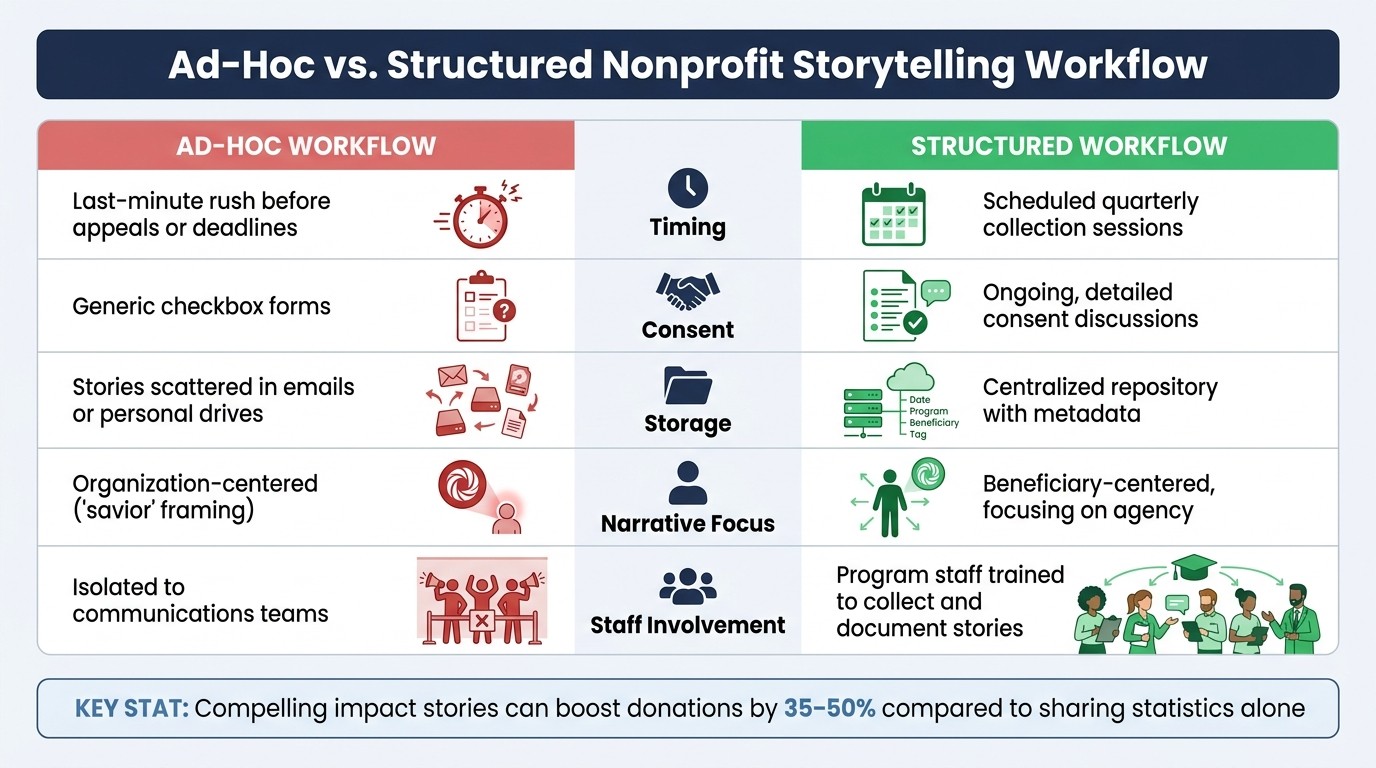
Ad-Hoc vs. Structured Nonprofit Storytelling Workflow
To make storytelling a consistent and impactful tool, it must become part of your organization's daily routines. Relying on last-minute efforts before deadlines often leads to rushed, less effective narratives. Instead, embed storytelling into your operations to sustain its value over time.
Align Stories With Strategic Plans
Storytelling should connect directly to your organization's strategic goals and theory of change. This means crafting narratives that resonate with specific audience segments and their unique interests. For instance, a major donor interested in systemic reform requires a different story than a local community member attending an event. By organizing your story library by themes, program areas, and audience types, your team can quickly access relevant stories when needed, avoiding the scramble to create new ones on short notice.
Work With Consulting Partners
Creating compelling, data-informed narratives can be time-intensive, but external consultants can simplify the process. Partners like Council Fire help refine evaluation frameworks and storytelling strategies, enabling organizations to highlight broader impacts, such as policy changes or community-level improvements, rather than focusing solely on individual success stories.
Consultants also provide guidance on maintaining a balance between emotional storytelling and respecting beneficiary dignity - an area where many organizations struggle. Once a narrative framework is established, ensure you have ongoing processes to collect and update stories regularly.
Build a Structured Story Collection Process
Storytelling efforts often falter when stories are gathered only during crises or right before deadlines. A structured system for story collection integrates this work into your regular program activities, ensuring consistency and quality.
The table below illustrates how a structured approach compares to an ad-hoc one:
Feature | Ad-Hoc Workflow | Structured Workflow |
|---|---|---|
Timing | Last-minute rush before appeals or deadlines [4] | Scheduled quarterly collection sessions [4] |
Consent | Generic checkbox forms [4] | |
Storage | Stories scattered in emails or personal drives [4] | Centralized repository with metadata [4] |
Narrative Focus | Organization-centered ("savior" framing) [4] | |
Staff Involvement | Isolated to communications teams [1] | Program staff trained to collect and document stories [1][5] |
An example of structured storytelling comes from Morning Light's "Meet Dewey" campaign, led by Advancement Director Madison Gonzalez. The organization created a three-part email series that shared a single hospice resident's story in acts - Introduction, Rising Action, and Resolution - delivered over consecutive days and coordinated with social media and direct mail. This approach earned them a "Storyteller of the Year" award and boosted donor engagement, underscoring the power of planning stories in advance [3].
This method ties storytelling directly to strategic goals and data-driven insights. When story collection is systematic and involves staff across the organization, the narratives naturally align with the outcomes your programs are already tracking.
Drew Giddings, Founder & Principal Consultant at Giddings Consulting, emphasizes the importance of storytelling discipline:
"The organizations that raise the most money are not the ones with the most compelling problems - they are the ones that tell the most compelling stories about how change actually happens." [4]
To build this discipline, assign a dedicated staff member to oversee storytelling, schedule quarterly collection sessions, and train program teams to identify and document stories as they occur in the field. This ensures your storytelling remains authentic, timely, and impactful.
Measure and Improve Your Storytelling
Measuring and refining your storytelling strengthens donor connections and ensures your narratives align with your broader sustainability goals. Without proper evaluation, you’re left to guess - and guessing wastes time and resources.
Track Key Metrics
Focus on tracking both outputs and outcomes. Outputs highlight the scale of your activities - like meals served, events hosted, or participants enrolled. Outcomes, on the other hand, reveal the deeper impact - such as improved employment rates, housing stability, or graduation rates.
Additionally, monitor digital engagement metrics like reach, shares, video completions, and click-through rates, alongside conversions like donation totals or volunteer sign-ups. Research shows that compelling impact stories can boost donations by 35–50% compared to simply sharing statistics [5]. By identifying which stories drive meaningful action, you can allocate resources more effectively. Combine these metrics with direct feedback from stakeholders to gain a fuller understanding of your storytelling’s impact.
Metric Category | What to Track | Why It Matters |
|---|---|---|
Outputs | Meals served, attendance rates, kits distributed | Reflects the scale of activity [8] |
Outcomes | Graduation rates, housing stability, employment rates | Shows the actual difference made [8] |
Engagement | Reach, shares, video views, click-through rates | Indicates how well your story captures attention [5] |
Conversions | Donation totals, volunteer sign-ups, grant approvals | Measures the story’s ability to inspire action [5] |
Collect Feedback From Stakeholders
While quantitative metrics are essential, qualitative feedback from donors, community members, and staff provides a deeper layer of understanding. Schedule short interviews or surveys with donors after campaigns to gauge their reactions. Ask program coordinators if the stories reflect the work accurately. Most importantly, check in with the individuals featured in your stories - not just to secure consent but to understand how they feel about their representation.
David Solo, CEO of Special Olympics Northern California, emphasizes the importance of combining both types of data:
"We use quantitative data a lot in presentations, but ultimately, what does it mean? We need to go beyond the numbers. I think when you couple qualitative stories with your quantitative metrics you begin to see the whole picture." [7]
Ethical storytelling also involves ensuring that those featured in your stories feel empowered by the process. Conduct annual check-ins with participants to confirm they are still comfortable with their story being shared. This practice not only respects individuals but also upholds your organization’s integrity [5].
Use Feedback to Inform Future Work
Insights from both data and feedback should guide your storytelling strategy. Story performance metrics shouldn’t just sit in a spreadsheet - they should influence decisions. For example, if video testimonials consistently outperform written narratives in driving donations, consider reallocating resources toward video production. If data shows a 25% rise in demand for a specific service, that trend could itself become a powerful story that highlights urgency for stakeholders [8].
Feedback can also uncover program gaps. For instance, Read to Grow, a Connecticut-based early literacy nonprofit, analyzed two decades of program data alongside public indicators like poverty and education levels. This approach revealed service gaps and helped the team prioritize outreach to areas with the greatest need [6]. Such insights don’t just refine storytelling - they enhance the programs behind the stories.
Testing different formats - video versus written, short versus long - provides concrete evidence to shape future strategies. Regularly review your impact materials, ideally every quarter, and refresh stories annually to ensure they reflect current results and maintain trust with your audience [5].
Conclusion: Inspiring Action Through Powerful Stories
The most impactful stories share a few key elements: they focus on real people with genuine agency, connect personal experiences to larger systemic changes, and blend emotional resonance with reliable data. Drew Giddings, Founder & Principal Consultant at Giddings Consulting, captures this perfectly:
"The organizations that raise the most money are not the ones with the most compelling problems - they are the ones that tell the most compelling stories about how change actually happens." [4]
To create lasting impact, storytelling needs a structured approach. This involves developing a process to collect stories, following ethical guidelines that respect and uplift the people involved, and converting program outputs into meaningful outcomes. Storytelling should not be treated as a one-time effort but as an ongoing, strategic priority.
Switching from raw statistics to engaging narratives can increase donations by 35–50% by linking data to tangible change [5]. However, the goal extends beyond financial contributions. It’s about fostering enduring trust with donors, communities, and partners who share your vision. This approach ties directly to broader sustainability goals, ensuring every story reflects measurable progress. Council Fire's systems thinking approach helps organizations turn ambitious goals into actionable, results-driven narratives [1][6].
Storytelling is a journey of constant improvement. Each step forward strengthens your mission and deepens the engagement of those who support your work. The power of a well-told story is its ability to inspire action and create meaningful connections, driving your initiatives further than data alone ever could.
FAQs
How do I pick the right story for each audience?
To craft an effective story, start by identifying what truly matters to your audience and shape your narrative to align with their priorities. Consider their values: donors often connect with emotional appeals, beneficiaries appreciate stories that uphold their dignity, and technical stakeholders may respond best to data-backed insights. Always practice ethical storytelling - respect the individuals featured in your story and ensure you have their consent to share their experiences. Adjust the tone and style to fit your audience, whether that means heartfelt anecdotes for donors or analytical narratives for policy professionals.
What outcomes should I measure for impact stories?
To demonstrate the real impact of your work, focus on outcomes that reflect genuine changes - whether it's enhancing lives, advancing community well-being, or addressing environmental challenges. Use data to track progress, such as the number of individuals served, the scope of your programs, or specific milestones achieved. When sharing these stories, prioritize ethical practices: obtain consent, safeguard privacy, and portray beneficiaries accurately and respectfully. By committing to measurable outcomes and honest storytelling, you can foster trust and encourage meaningful support.
How can we get consent and tell stories ethically?
To share stories responsibly, nonprofits must obtain informed, specific, revocable, and ongoing consent from those featured. This means clearly explaining how their stories will be used, offering them the chance to review the narratives, and honoring their right to withdraw consent at any time. It's also crucial to avoid narratives that focus on deficits or hardships. Instead, highlight dignity and empowerment, ensuring individuals are represented with respect and honesty. These steps not only protect privacy but also foster trust and uphold ethical standards.
Related Blog Posts
Latest Articles
©2025

Narrative Change and Power Building: The Missing Half of Advocacy
Narrative change is the process of disrupting dominant narratives that normalize inequity and advancing new narratives from historically marginalized communities.

Funding Resilience Without Federal Grants
BRIC is unreliable and FEMA is shrinking. Here's how cities fund climate resilience with dedicated revenue, blended finance, and a coordinating authority.

The ESG Blind Spot: How AI Is Finding Risks in Companies Nobody Else Is Watching
Norway's sovereign wealth fund uses AI to screen 7,200 portfolio companies for forced labor and corruption within 24 hours. The real story is the emerging-market coverage gap that traditional ESG data vendors miss — and what it means for any company with a global supply chain.
Narrative Change and Power Building: The Missing Half of Advocacy
Narrative change is the process of disrupting dominant narratives that normalize inequity and advancing new narratives from historically marginalized communities.
Funding Resilience Without Federal Grants
BRIC is unreliable and FEMA is shrinking. Here's how cities fund climate resilience with dedicated revenue, blended finance, and a coordinating authority.
The ESG Blind Spot: How AI Is Finding Risks in Companies Nobody Else Is Watching
Norway's sovereign wealth fund uses AI to screen 7,200 portfolio companies for forced labor and corruption within 24 hours. The real story is the emerging-market coverage gap that traditional ESG data vendors miss — and what it means for any company with a global supply chain.
FAQ
01
What does it really mean to “redefine profit”?
02
What makes Council Fire different?
03
Who does Council Fire work with?
04
What does working with Council Fire actually look like?
05
How does Council Fire help organizations turn big goals into action?
06
How does Council Fire define and measure success?
May 20, 2026
How to Tell Impact Stories That Inspire Action for NGOs & Nonprofits
Capacity Building
In This Article
How nonprofits combine data, ethics, and human stories to drive donations, policy support, and lasting community impact.
How to Tell Impact Stories That Inspire Action for NGOs & Nonprofits
The way you tell your organization’s story can be the difference between passive interest and active support. By focusing on real people, challenges, and measurable outcomes, nonprofits can connect emotionally with their audience and drive action. Here’s how to craft stories that resonate:
Set Goals and Know Your Audience: Tailor your story to specific objectives, whether it’s securing funding or building partnerships. Understand what motivates your audience - donors care about personal connections, while foundations value evidence of broad impact.
Use Data and Emotion Together: Combine personal stories with measurable outcomes. Highlight how your programs create real change, like a 25% drop in food insecurity or improved local employment rates.
Be Ethical and Specific: Represent individuals with dignity, focusing on their agency rather than portraying them as helpless. Use vivid, relatable details to make your story impactful.
Make It Local and Relevant: Show how your efforts connect to broader initiatives while staying relatable to your community.
Embed Storytelling in Operations: Collect stories regularly, link them to your strategic goals, and train staff to identify meaningful moments in the field.
How to Write an Impact Story for Your Nonprofit
Clarify Story Purpose and Audience
Before diving into storytelling, consider two essential questions: What do you want this story to achieve? and Who needs to hear it? Overlooking this step often leads to stories that fail to connect - attempting to speak to everyone but resonating with no one.
Define Story Goals
Every impactful story needs a clear objective. Are you aiming to secure a grant, engage a major donor, influence public policy, or invite new members into your mission? Each goal demands a tailored approach, from tone to structure and level of detail.
Drew Giddings, Founder & Principal Consultant at Giddings Consulting, highlights this perfectly:
"The organizations that raise the most money are not the ones with the most compelling problems - they are the ones that tell the most compelling stories about how change actually happens." [4]
A useful framework to guide storytelling is Problem-Person-Pathway-Outcome: identify a challenge, focus on an individual with agency, outline the actions taken, and showcase the resulting change. This approach ensures your stories go beyond dry program descriptions and bring to life the how of meaningful change [4].
Understand Your Target Audiences
Different audiences have different priorities, and your stories should reflect that. For instance, a foundation program officer might care about how your work aligns with a theory of change, while a corporate partner may prioritize shared values. A mid-level donor, on the other hand, seeks a personal connection that validates their contribution.
Here’s a breakdown of common audience groups and the types of stories that resonate with each:
Audience Group | Primary Motivation | Recommended Story Type | Key Narrative Element |
|---|---|---|---|
Major Donors | Personal connection & outcomes | Impact / Systems Change | Relationship-focused, one-on-one delivery |
Foundations | Evidence of systemic impact | Systems Change / Impact | Theory of Change connection & data |
City Officials | Actionable solutions | Systems Change | Geographic context & evidence-based plans |
Corporate Partners | Brand alignment & shared values | Partnership Stories | Corporate social responsibility alignment |
Mid-level Donors | Shared vision & human connection | Impact / Donor Stories | Individual stories tied to organizational vision |
Equally important is adapting your content to the right format. For example:
Website stories: 800–1,200 words
Email appeals: 300–500 words
Social media videos: 60–90 seconds [4]
Delivering the right story in the right format ensures you meet your audience where they already are.
Connect Stories to Sustainability Goals
Once you’ve clarified your goals and audience, align your stories with broader sustainability efforts. If your mission involves climate resilience, circular economies, or regenerative community initiatives, your storytelling should explicitly tie into these themes. Assumptions won’t suffice.
Annie Neimand, a researcher at the Stanford Social Innovation Review, offers valuable insight:
"Impact stories should show how organizations are part of a larger movement ecosystem working with other organizations and movement actors to transform systems and culture through their unique contributions." [2]
This means going beyond individual success stories to demonstrate how your work contributes to systemic change. When a funder or donor sees how one person’s experience connects to larger environmental or social goals, your story evolves from a simple anecdote into compelling evidence of impact.
Ground Stories in Data-Driven Impact
When you align your storytelling with solid data, you build trust and authenticity. Stories without evidence risk feeling hollow, while data without context can seem lifeless. The strongest narratives blend reliable data with human experiences, creating a connection that resonates.
Find Stories in the Field
Some of the most compelling stories are hidden within your program's data. Start by combing through monitoring reports, exit surveys, and case notes to identify trends or standout moments. Perhaps there’s a spike in demand, an unexpected result, or a personal experience that deviates from the norm. These insights can serve as the foundation for impactful storytelling.
Once you identify a key data point, follow up with the individual involved. Record an interview, ask open-ended questions, and document their exact words. Always ensure you have their informed consent before sharing their story. If an in-person interview isn’t feasible, written responses can work just as well [8].
Take the example of Read to Grow, a literacy nonprofit in Connecticut. By analyzing 20 years of program data and overlaying it with public indicators like poverty rates and local education metrics, they uncovered not only compelling stories but also service gaps. This analysis allowed them to refine their resource allocation and strengthen their impact [6].
Connect Narratives to Metrics
Not all data carries the same weight in storytelling. Outputs - such as the number of meals served or attendance rates - show the scale of your efforts. But outcomes - like a 25% drop in food insecurity or an 85% graduation rate among participants compared to 60% in the broader population - highlight meaningful change that inspires action [8].
Prioritize outcomes in your story and use outputs as supporting evidence. David Solo, CEO of Special Olympics Northern California, explains:
"We use quantitative data a lot in presentations, but ultimately, what does it mean? We need to go beyond the numbers. I think when you couple qualitative stories with your quantitative metrics you begin to see the whole picture." [7]
Author Jacqueline Woodson underscores the importance of details in storytelling:
"The more specific we are, the more universal something can become. Life is in the details. If you generalize, it doesn't resonate. The specificity of it is what resonates." [2]
Use Impact Frameworks
Clear metrics are only part of the equation. Structured frameworks like logic models and theories of change can help organize your narrative. A logic model outlines the relationship between resources, activities, outputs, and outcomes, while a theory of change explains why those outcomes occur. These tools make your data more accessible and compelling for funders, partners, and policymakers.
In early 2026, the Independent Drivers Guild (IDG) showcased the power of evidence-based frameworks. Representing 80,000 for-hire drivers in New York City, they combined survey data with the city’s street network, zoning rules, and traffic volumes. This analysis led to a shortlist of 16 proposed sites for new legal relief stands. Their structured, data-driven approach earned them a seat at the table with city agencies [6].
When your narrative is anchored in a clear framework, it doesn’t just engage emotionally - it builds a strong, credible case for action. This approach strengthens your mission and deepens connections with stakeholders.
Structure Stories for Clarity and Engagement
When data meets human experience, a clear narrative structure ensures your audience stays connected. Even the most compelling story can lose its impact if the flow is confusing or hard to follow.
Follow a Proven Story Format
A solid framework simplifies storytelling. Consider using the PPPO approach: start with a clear problem, introduce a relatable individual, outline their journey toward a solution, and finish with the lasting impact of their efforts [4].
For shorter formats like social media, a concise three-sentence story works well: one sentence for context, one for the challenge, and one for the resolution [4]. For longer pieces, you can expand this into a more detailed arc that includes obstacles, a pivotal moment, and the role of supporters in achieving the outcome [5].
"A story has characters, tension, transformation, and meaning. A program description has outputs, activities, and outcomes. Both have a place... but confusing one for the other is why most nonprofit storytelling fails." - Drew Giddings, Founder & Principal Consultant, Giddings Consulting [4]
Equally important is how you represent the people at the heart of your story.
Portray Characters Ethically
How you depict individuals matters just as much as the narrative itself. A frequent misstep is casting the organization as the hero while portraying the community as passive or helpless. Annie Neimand, Director of Research at the Center for Public Interest Communications, explains:
"We see a hero organization helping a homogenous group of helpless people, who we don't get to know beyond their struggle... We don't see organizations working toward change collectively with the people they serve." [2]
A great example comes from Reform Alliance's "Technically Illegal" video series. These short vignettes highlighted the struggles of people on probation missing key life moments - like picking up medicine for a sick child - due to technical violations. By focusing on a universal emotion, such as love for family, the series built genuine empathy for criminal-legal reform without exploiting anyone’s hardship [2].
In practical terms, this means treating consent as an ongoing process, not a one-time agreement. Always let individuals review and approve the final version of their story, and fairly compensate them for their participation and emotional effort [4][5].
Finally, make sure your story is accessible and relatable by simplifying complex ideas.
Translate Complex Concepts Into Plain Language
Sustainability and social impact work often involve technical jargon that can alienate readers. The key is to swap abstract terms for clear, tangible outcomes. For example, instead of saying "economic self-sufficiency", say "earning 40% more" or "promoted to shift supervisor" [4][5].
Concrete, sensory details also make a stronger impression. Instead of writing that someone was "struggling financially", describe them "choosing between buying groceries and paying the electricity bill" [5]. This kind of vivid imagery communicates the reality more effectively than vague phrasing. As Drew Giddings emphasizes:
"Asset-based storytelling is not about making the story less real. It is about making the story more real - by including the parts of the person's experience that deficit narratives systematically erase." [4]
To ensure the story maintains its integrity, have the individual review the plain-language version to confirm it captures their experience accurately and respectfully [4].
Make Impact Concrete and Local
Once you've laid the groundwork with solid data, the next step is making that information relatable and actionable for local audiences. While metrics like "reduced carbon emissions" or "improved food security" are significant, they can feel distant or abstract to a donor in Chicago or a community member in rural Texas. To inspire meaningful change, it's important to translate these figures into outcomes that resonate on a personal and local level.
Present Impact in Everyday Units
Raw data becomes far more powerful when it's framed in terms that people can visualize and connect with. For instance, instead of stating the number of meals served, explain how a 7% drop in food insecurity has improved lives in the community. Megan Lencoski, a nonprofit development expert, emphasizes this point:
"Outcomes are more compelling than outputs alone, helping you demonstrate impact in tangible, compelling ways." [8]
Think about using familiar benchmarks to make your data hit home. For example, "higher employment rates" could become "45% more program graduates found full-time work within six months." Similarly, a conservation endowment growing from $5 million to $12 million over two decades could be explained as "expanding protected land from 1,000 to 3,500 acres" [8]. These kinds of comparisons allow readers to clearly picture the progress being made.
Connect Local Actions to Broader Change
Once you've highlighted the local outcomes, take it a step further by showing how these actions contribute to larger, interconnected efforts. A single initiative - a neighborhood food drive, a volunteer's outreach calls, or a city council vote - gains more significance when it's framed as part of a broader movement.
Take, for example, the Bruce's Beach reparations case in Manhattan Beach, CA. Activists and local leaders worked together across racial lines to return beachfront property to the Bruce family, nearly a century after it was unjustly seized in 1924. Today, Manhattan Beach remains 90% white, a lingering impact of that historical act. By linking this local land return to the national reparations movement, storytellers turned a single municipal decision into a powerful symbol of racial justice on a larger scale [2].
As author Jacqueline Woodson notes:
"The more specific we are, the more universal something can become. Life is in the details. If you generalize, it doesn't resonate. The specificity of it is what resonates." [2]
Use this principle in your storytelling. For instance, show how a single community garden contributes to a city's overall food resilience goals or how a workforce training program supports regional employment growth. Specificity not only makes the story more engaging but also connects local efforts to a larger narrative.
Apply Council Fire's Systems Thinking Approach
To extend the impact of local results, consider adopting a systems thinking approach. This strategy involves mapping individual outcomes to broader changes at the policy or community level. Council Fire specializes in helping organizations identify how specific efforts - like addressing hiring discrimination or improving infrastructure - challenge systemic barriers and drive meaningful change [2].
Integrate Storytelling Into Your Organization's Work
Ad-Hoc vs. Structured Nonprofit Storytelling Workflow
To make storytelling a consistent and impactful tool, it must become part of your organization's daily routines. Relying on last-minute efforts before deadlines often leads to rushed, less effective narratives. Instead, embed storytelling into your operations to sustain its value over time.
Align Stories With Strategic Plans
Storytelling should connect directly to your organization's strategic goals and theory of change. This means crafting narratives that resonate with specific audience segments and their unique interests. For instance, a major donor interested in systemic reform requires a different story than a local community member attending an event. By organizing your story library by themes, program areas, and audience types, your team can quickly access relevant stories when needed, avoiding the scramble to create new ones on short notice.
Work With Consulting Partners
Creating compelling, data-informed narratives can be time-intensive, but external consultants can simplify the process. Partners like Council Fire help refine evaluation frameworks and storytelling strategies, enabling organizations to highlight broader impacts, such as policy changes or community-level improvements, rather than focusing solely on individual success stories.
Consultants also provide guidance on maintaining a balance between emotional storytelling and respecting beneficiary dignity - an area where many organizations struggle. Once a narrative framework is established, ensure you have ongoing processes to collect and update stories regularly.
Build a Structured Story Collection Process
Storytelling efforts often falter when stories are gathered only during crises or right before deadlines. A structured system for story collection integrates this work into your regular program activities, ensuring consistency and quality.
The table below illustrates how a structured approach compares to an ad-hoc one:
Feature | Ad-Hoc Workflow | Structured Workflow |
|---|---|---|
Timing | Last-minute rush before appeals or deadlines [4] | Scheduled quarterly collection sessions [4] |
Consent | Generic checkbox forms [4] | |
Storage | Stories scattered in emails or personal drives [4] | Centralized repository with metadata [4] |
Narrative Focus | Organization-centered ("savior" framing) [4] | |
Staff Involvement | Isolated to communications teams [1] | Program staff trained to collect and document stories [1][5] |
An example of structured storytelling comes from Morning Light's "Meet Dewey" campaign, led by Advancement Director Madison Gonzalez. The organization created a three-part email series that shared a single hospice resident's story in acts - Introduction, Rising Action, and Resolution - delivered over consecutive days and coordinated with social media and direct mail. This approach earned them a "Storyteller of the Year" award and boosted donor engagement, underscoring the power of planning stories in advance [3].
This method ties storytelling directly to strategic goals and data-driven insights. When story collection is systematic and involves staff across the organization, the narratives naturally align with the outcomes your programs are already tracking.
Drew Giddings, Founder & Principal Consultant at Giddings Consulting, emphasizes the importance of storytelling discipline:
"The organizations that raise the most money are not the ones with the most compelling problems - they are the ones that tell the most compelling stories about how change actually happens." [4]
To build this discipline, assign a dedicated staff member to oversee storytelling, schedule quarterly collection sessions, and train program teams to identify and document stories as they occur in the field. This ensures your storytelling remains authentic, timely, and impactful.
Measure and Improve Your Storytelling
Measuring and refining your storytelling strengthens donor connections and ensures your narratives align with your broader sustainability goals. Without proper evaluation, you’re left to guess - and guessing wastes time and resources.
Track Key Metrics
Focus on tracking both outputs and outcomes. Outputs highlight the scale of your activities - like meals served, events hosted, or participants enrolled. Outcomes, on the other hand, reveal the deeper impact - such as improved employment rates, housing stability, or graduation rates.
Additionally, monitor digital engagement metrics like reach, shares, video completions, and click-through rates, alongside conversions like donation totals or volunteer sign-ups. Research shows that compelling impact stories can boost donations by 35–50% compared to simply sharing statistics [5]. By identifying which stories drive meaningful action, you can allocate resources more effectively. Combine these metrics with direct feedback from stakeholders to gain a fuller understanding of your storytelling’s impact.
Metric Category | What to Track | Why It Matters |
|---|---|---|
Outputs | Meals served, attendance rates, kits distributed | Reflects the scale of activity [8] |
Outcomes | Graduation rates, housing stability, employment rates | Shows the actual difference made [8] |
Engagement | Reach, shares, video views, click-through rates | Indicates how well your story captures attention [5] |
Conversions | Donation totals, volunteer sign-ups, grant approvals | Measures the story’s ability to inspire action [5] |
Collect Feedback From Stakeholders
While quantitative metrics are essential, qualitative feedback from donors, community members, and staff provides a deeper layer of understanding. Schedule short interviews or surveys with donors after campaigns to gauge their reactions. Ask program coordinators if the stories reflect the work accurately. Most importantly, check in with the individuals featured in your stories - not just to secure consent but to understand how they feel about their representation.
David Solo, CEO of Special Olympics Northern California, emphasizes the importance of combining both types of data:
"We use quantitative data a lot in presentations, but ultimately, what does it mean? We need to go beyond the numbers. I think when you couple qualitative stories with your quantitative metrics you begin to see the whole picture." [7]
Ethical storytelling also involves ensuring that those featured in your stories feel empowered by the process. Conduct annual check-ins with participants to confirm they are still comfortable with their story being shared. This practice not only respects individuals but also upholds your organization’s integrity [5].
Use Feedback to Inform Future Work
Insights from both data and feedback should guide your storytelling strategy. Story performance metrics shouldn’t just sit in a spreadsheet - they should influence decisions. For example, if video testimonials consistently outperform written narratives in driving donations, consider reallocating resources toward video production. If data shows a 25% rise in demand for a specific service, that trend could itself become a powerful story that highlights urgency for stakeholders [8].
Feedback can also uncover program gaps. For instance, Read to Grow, a Connecticut-based early literacy nonprofit, analyzed two decades of program data alongside public indicators like poverty and education levels. This approach revealed service gaps and helped the team prioritize outreach to areas with the greatest need [6]. Such insights don’t just refine storytelling - they enhance the programs behind the stories.
Testing different formats - video versus written, short versus long - provides concrete evidence to shape future strategies. Regularly review your impact materials, ideally every quarter, and refresh stories annually to ensure they reflect current results and maintain trust with your audience [5].
Conclusion: Inspiring Action Through Powerful Stories
The most impactful stories share a few key elements: they focus on real people with genuine agency, connect personal experiences to larger systemic changes, and blend emotional resonance with reliable data. Drew Giddings, Founder & Principal Consultant at Giddings Consulting, captures this perfectly:
"The organizations that raise the most money are not the ones with the most compelling problems - they are the ones that tell the most compelling stories about how change actually happens." [4]
To create lasting impact, storytelling needs a structured approach. This involves developing a process to collect stories, following ethical guidelines that respect and uplift the people involved, and converting program outputs into meaningful outcomes. Storytelling should not be treated as a one-time effort but as an ongoing, strategic priority.
Switching from raw statistics to engaging narratives can increase donations by 35–50% by linking data to tangible change [5]. However, the goal extends beyond financial contributions. It’s about fostering enduring trust with donors, communities, and partners who share your vision. This approach ties directly to broader sustainability goals, ensuring every story reflects measurable progress. Council Fire's systems thinking approach helps organizations turn ambitious goals into actionable, results-driven narratives [1][6].
Storytelling is a journey of constant improvement. Each step forward strengthens your mission and deepens the engagement of those who support your work. The power of a well-told story is its ability to inspire action and create meaningful connections, driving your initiatives further than data alone ever could.
FAQs
How do I pick the right story for each audience?
To craft an effective story, start by identifying what truly matters to your audience and shape your narrative to align with their priorities. Consider their values: donors often connect with emotional appeals, beneficiaries appreciate stories that uphold their dignity, and technical stakeholders may respond best to data-backed insights. Always practice ethical storytelling - respect the individuals featured in your story and ensure you have their consent to share their experiences. Adjust the tone and style to fit your audience, whether that means heartfelt anecdotes for donors or analytical narratives for policy professionals.
What outcomes should I measure for impact stories?
To demonstrate the real impact of your work, focus on outcomes that reflect genuine changes - whether it's enhancing lives, advancing community well-being, or addressing environmental challenges. Use data to track progress, such as the number of individuals served, the scope of your programs, or specific milestones achieved. When sharing these stories, prioritize ethical practices: obtain consent, safeguard privacy, and portray beneficiaries accurately and respectfully. By committing to measurable outcomes and honest storytelling, you can foster trust and encourage meaningful support.
How can we get consent and tell stories ethically?
To share stories responsibly, nonprofits must obtain informed, specific, revocable, and ongoing consent from those featured. This means clearly explaining how their stories will be used, offering them the chance to review the narratives, and honoring their right to withdraw consent at any time. It's also crucial to avoid narratives that focus on deficits or hardships. Instead, highlight dignity and empowerment, ensuring individuals are represented with respect and honesty. These steps not only protect privacy but also foster trust and uphold ethical standards.
Related Blog Posts
Latest Articles
©2025
Narrative Change and Power Building: The Missing Half of Advocacy
Narrative change is the process of disrupting dominant narratives that normalize inequity and advancing new narratives from historically marginalized communities.
Funding Resilience Without Federal Grants
BRIC is unreliable and FEMA is shrinking. Here's how cities fund climate resilience with dedicated revenue, blended finance, and a coordinating authority.
The ESG Blind Spot: How AI Is Finding Risks in Companies Nobody Else Is Watching
Norway's sovereign wealth fund uses AI to screen 7,200 portfolio companies for forced labor and corruption within 24 hours. The real story is the emerging-market coverage gap that traditional ESG data vendors miss — and what it means for any company with a global supply chain.
FAQ
01
What does it really mean to “redefine profit”?
02
What makes Council Fire different?
03
Who does Council Fire work with?
04
What does working with Council Fire actually look like?
05
How does Council Fire help organizations turn big goals into action?
06
How does Council Fire define and measure success?
May 20, 2026
How to Tell Impact Stories That Inspire Action for NGOs & Nonprofits
Capacity Building
In This Article
How nonprofits combine data, ethics, and human stories to drive donations, policy support, and lasting community impact.
How to Tell Impact Stories That Inspire Action for NGOs & Nonprofits
The way you tell your organization’s story can be the difference between passive interest and active support. By focusing on real people, challenges, and measurable outcomes, nonprofits can connect emotionally with their audience and drive action. Here’s how to craft stories that resonate:
Set Goals and Know Your Audience: Tailor your story to specific objectives, whether it’s securing funding or building partnerships. Understand what motivates your audience - donors care about personal connections, while foundations value evidence of broad impact.
Use Data and Emotion Together: Combine personal stories with measurable outcomes. Highlight how your programs create real change, like a 25% drop in food insecurity or improved local employment rates.
Be Ethical and Specific: Represent individuals with dignity, focusing on their agency rather than portraying them as helpless. Use vivid, relatable details to make your story impactful.
Make It Local and Relevant: Show how your efforts connect to broader initiatives while staying relatable to your community.
Embed Storytelling in Operations: Collect stories regularly, link them to your strategic goals, and train staff to identify meaningful moments in the field.
How to Write an Impact Story for Your Nonprofit
Clarify Story Purpose and Audience
Before diving into storytelling, consider two essential questions: What do you want this story to achieve? and Who needs to hear it? Overlooking this step often leads to stories that fail to connect - attempting to speak to everyone but resonating with no one.
Define Story Goals
Every impactful story needs a clear objective. Are you aiming to secure a grant, engage a major donor, influence public policy, or invite new members into your mission? Each goal demands a tailored approach, from tone to structure and level of detail.
Drew Giddings, Founder & Principal Consultant at Giddings Consulting, highlights this perfectly:
"The organizations that raise the most money are not the ones with the most compelling problems - they are the ones that tell the most compelling stories about how change actually happens." [4]
A useful framework to guide storytelling is Problem-Person-Pathway-Outcome: identify a challenge, focus on an individual with agency, outline the actions taken, and showcase the resulting change. This approach ensures your stories go beyond dry program descriptions and bring to life the how of meaningful change [4].
Understand Your Target Audiences
Different audiences have different priorities, and your stories should reflect that. For instance, a foundation program officer might care about how your work aligns with a theory of change, while a corporate partner may prioritize shared values. A mid-level donor, on the other hand, seeks a personal connection that validates their contribution.
Here’s a breakdown of common audience groups and the types of stories that resonate with each:
Audience Group | Primary Motivation | Recommended Story Type | Key Narrative Element |
|---|---|---|---|
Major Donors | Personal connection & outcomes | Impact / Systems Change | Relationship-focused, one-on-one delivery |
Foundations | Evidence of systemic impact | Systems Change / Impact | Theory of Change connection & data |
City Officials | Actionable solutions | Systems Change | Geographic context & evidence-based plans |
Corporate Partners | Brand alignment & shared values | Partnership Stories | Corporate social responsibility alignment |
Mid-level Donors | Shared vision & human connection | Impact / Donor Stories | Individual stories tied to organizational vision |
Equally important is adapting your content to the right format. For example:
Website stories: 800–1,200 words
Email appeals: 300–500 words
Social media videos: 60–90 seconds [4]
Delivering the right story in the right format ensures you meet your audience where they already are.
Connect Stories to Sustainability Goals
Once you’ve clarified your goals and audience, align your stories with broader sustainability efforts. If your mission involves climate resilience, circular economies, or regenerative community initiatives, your storytelling should explicitly tie into these themes. Assumptions won’t suffice.
Annie Neimand, a researcher at the Stanford Social Innovation Review, offers valuable insight:
"Impact stories should show how organizations are part of a larger movement ecosystem working with other organizations and movement actors to transform systems and culture through their unique contributions." [2]
This means going beyond individual success stories to demonstrate how your work contributes to systemic change. When a funder or donor sees how one person’s experience connects to larger environmental or social goals, your story evolves from a simple anecdote into compelling evidence of impact.
Ground Stories in Data-Driven Impact
When you align your storytelling with solid data, you build trust and authenticity. Stories without evidence risk feeling hollow, while data without context can seem lifeless. The strongest narratives blend reliable data with human experiences, creating a connection that resonates.
Find Stories in the Field
Some of the most compelling stories are hidden within your program's data. Start by combing through monitoring reports, exit surveys, and case notes to identify trends or standout moments. Perhaps there’s a spike in demand, an unexpected result, or a personal experience that deviates from the norm. These insights can serve as the foundation for impactful storytelling.
Once you identify a key data point, follow up with the individual involved. Record an interview, ask open-ended questions, and document their exact words. Always ensure you have their informed consent before sharing their story. If an in-person interview isn’t feasible, written responses can work just as well [8].
Take the example of Read to Grow, a literacy nonprofit in Connecticut. By analyzing 20 years of program data and overlaying it with public indicators like poverty rates and local education metrics, they uncovered not only compelling stories but also service gaps. This analysis allowed them to refine their resource allocation and strengthen their impact [6].
Connect Narratives to Metrics
Not all data carries the same weight in storytelling. Outputs - such as the number of meals served or attendance rates - show the scale of your efforts. But outcomes - like a 25% drop in food insecurity or an 85% graduation rate among participants compared to 60% in the broader population - highlight meaningful change that inspires action [8].
Prioritize outcomes in your story and use outputs as supporting evidence. David Solo, CEO of Special Olympics Northern California, explains:
"We use quantitative data a lot in presentations, but ultimately, what does it mean? We need to go beyond the numbers. I think when you couple qualitative stories with your quantitative metrics you begin to see the whole picture." [7]
Author Jacqueline Woodson underscores the importance of details in storytelling:
"The more specific we are, the more universal something can become. Life is in the details. If you generalize, it doesn't resonate. The specificity of it is what resonates." [2]
Use Impact Frameworks
Clear metrics are only part of the equation. Structured frameworks like logic models and theories of change can help organize your narrative. A logic model outlines the relationship between resources, activities, outputs, and outcomes, while a theory of change explains why those outcomes occur. These tools make your data more accessible and compelling for funders, partners, and policymakers.
In early 2026, the Independent Drivers Guild (IDG) showcased the power of evidence-based frameworks. Representing 80,000 for-hire drivers in New York City, they combined survey data with the city’s street network, zoning rules, and traffic volumes. This analysis led to a shortlist of 16 proposed sites for new legal relief stands. Their structured, data-driven approach earned them a seat at the table with city agencies [6].
When your narrative is anchored in a clear framework, it doesn’t just engage emotionally - it builds a strong, credible case for action. This approach strengthens your mission and deepens connections with stakeholders.
Structure Stories for Clarity and Engagement
When data meets human experience, a clear narrative structure ensures your audience stays connected. Even the most compelling story can lose its impact if the flow is confusing or hard to follow.
Follow a Proven Story Format
A solid framework simplifies storytelling. Consider using the PPPO approach: start with a clear problem, introduce a relatable individual, outline their journey toward a solution, and finish with the lasting impact of their efforts [4].
For shorter formats like social media, a concise three-sentence story works well: one sentence for context, one for the challenge, and one for the resolution [4]. For longer pieces, you can expand this into a more detailed arc that includes obstacles, a pivotal moment, and the role of supporters in achieving the outcome [5].
"A story has characters, tension, transformation, and meaning. A program description has outputs, activities, and outcomes. Both have a place... but confusing one for the other is why most nonprofit storytelling fails." - Drew Giddings, Founder & Principal Consultant, Giddings Consulting [4]
Equally important is how you represent the people at the heart of your story.
Portray Characters Ethically
How you depict individuals matters just as much as the narrative itself. A frequent misstep is casting the organization as the hero while portraying the community as passive or helpless. Annie Neimand, Director of Research at the Center for Public Interest Communications, explains:
"We see a hero organization helping a homogenous group of helpless people, who we don't get to know beyond their struggle... We don't see organizations working toward change collectively with the people they serve." [2]
A great example comes from Reform Alliance's "Technically Illegal" video series. These short vignettes highlighted the struggles of people on probation missing key life moments - like picking up medicine for a sick child - due to technical violations. By focusing on a universal emotion, such as love for family, the series built genuine empathy for criminal-legal reform without exploiting anyone’s hardship [2].
In practical terms, this means treating consent as an ongoing process, not a one-time agreement. Always let individuals review and approve the final version of their story, and fairly compensate them for their participation and emotional effort [4][5].
Finally, make sure your story is accessible and relatable by simplifying complex ideas.
Translate Complex Concepts Into Plain Language
Sustainability and social impact work often involve technical jargon that can alienate readers. The key is to swap abstract terms for clear, tangible outcomes. For example, instead of saying "economic self-sufficiency", say "earning 40% more" or "promoted to shift supervisor" [4][5].
Concrete, sensory details also make a stronger impression. Instead of writing that someone was "struggling financially", describe them "choosing between buying groceries and paying the electricity bill" [5]. This kind of vivid imagery communicates the reality more effectively than vague phrasing. As Drew Giddings emphasizes:
"Asset-based storytelling is not about making the story less real. It is about making the story more real - by including the parts of the person's experience that deficit narratives systematically erase." [4]
To ensure the story maintains its integrity, have the individual review the plain-language version to confirm it captures their experience accurately and respectfully [4].
Make Impact Concrete and Local
Once you've laid the groundwork with solid data, the next step is making that information relatable and actionable for local audiences. While metrics like "reduced carbon emissions" or "improved food security" are significant, they can feel distant or abstract to a donor in Chicago or a community member in rural Texas. To inspire meaningful change, it's important to translate these figures into outcomes that resonate on a personal and local level.
Present Impact in Everyday Units
Raw data becomes far more powerful when it's framed in terms that people can visualize and connect with. For instance, instead of stating the number of meals served, explain how a 7% drop in food insecurity has improved lives in the community. Megan Lencoski, a nonprofit development expert, emphasizes this point:
"Outcomes are more compelling than outputs alone, helping you demonstrate impact in tangible, compelling ways." [8]
Think about using familiar benchmarks to make your data hit home. For example, "higher employment rates" could become "45% more program graduates found full-time work within six months." Similarly, a conservation endowment growing from $5 million to $12 million over two decades could be explained as "expanding protected land from 1,000 to 3,500 acres" [8]. These kinds of comparisons allow readers to clearly picture the progress being made.
Connect Local Actions to Broader Change
Once you've highlighted the local outcomes, take it a step further by showing how these actions contribute to larger, interconnected efforts. A single initiative - a neighborhood food drive, a volunteer's outreach calls, or a city council vote - gains more significance when it's framed as part of a broader movement.
Take, for example, the Bruce's Beach reparations case in Manhattan Beach, CA. Activists and local leaders worked together across racial lines to return beachfront property to the Bruce family, nearly a century after it was unjustly seized in 1924. Today, Manhattan Beach remains 90% white, a lingering impact of that historical act. By linking this local land return to the national reparations movement, storytellers turned a single municipal decision into a powerful symbol of racial justice on a larger scale [2].
As author Jacqueline Woodson notes:
"The more specific we are, the more universal something can become. Life is in the details. If you generalize, it doesn't resonate. The specificity of it is what resonates." [2]
Use this principle in your storytelling. For instance, show how a single community garden contributes to a city's overall food resilience goals or how a workforce training program supports regional employment growth. Specificity not only makes the story more engaging but also connects local efforts to a larger narrative.
Apply Council Fire's Systems Thinking Approach
To extend the impact of local results, consider adopting a systems thinking approach. This strategy involves mapping individual outcomes to broader changes at the policy or community level. Council Fire specializes in helping organizations identify how specific efforts - like addressing hiring discrimination or improving infrastructure - challenge systemic barriers and drive meaningful change [2].
Integrate Storytelling Into Your Organization's Work
Ad-Hoc vs. Structured Nonprofit Storytelling Workflow
To make storytelling a consistent and impactful tool, it must become part of your organization's daily routines. Relying on last-minute efforts before deadlines often leads to rushed, less effective narratives. Instead, embed storytelling into your operations to sustain its value over time.
Align Stories With Strategic Plans
Storytelling should connect directly to your organization's strategic goals and theory of change. This means crafting narratives that resonate with specific audience segments and their unique interests. For instance, a major donor interested in systemic reform requires a different story than a local community member attending an event. By organizing your story library by themes, program areas, and audience types, your team can quickly access relevant stories when needed, avoiding the scramble to create new ones on short notice.
Work With Consulting Partners
Creating compelling, data-informed narratives can be time-intensive, but external consultants can simplify the process. Partners like Council Fire help refine evaluation frameworks and storytelling strategies, enabling organizations to highlight broader impacts, such as policy changes or community-level improvements, rather than focusing solely on individual success stories.
Consultants also provide guidance on maintaining a balance between emotional storytelling and respecting beneficiary dignity - an area where many organizations struggle. Once a narrative framework is established, ensure you have ongoing processes to collect and update stories regularly.
Build a Structured Story Collection Process
Storytelling efforts often falter when stories are gathered only during crises or right before deadlines. A structured system for story collection integrates this work into your regular program activities, ensuring consistency and quality.
The table below illustrates how a structured approach compares to an ad-hoc one:
Feature | Ad-Hoc Workflow | Structured Workflow |
|---|---|---|
Timing | Last-minute rush before appeals or deadlines [4] | Scheduled quarterly collection sessions [4] |
Consent | Generic checkbox forms [4] | |
Storage | Stories scattered in emails or personal drives [4] | Centralized repository with metadata [4] |
Narrative Focus | Organization-centered ("savior" framing) [4] | |
Staff Involvement | Isolated to communications teams [1] | Program staff trained to collect and document stories [1][5] |
An example of structured storytelling comes from Morning Light's "Meet Dewey" campaign, led by Advancement Director Madison Gonzalez. The organization created a three-part email series that shared a single hospice resident's story in acts - Introduction, Rising Action, and Resolution - delivered over consecutive days and coordinated with social media and direct mail. This approach earned them a "Storyteller of the Year" award and boosted donor engagement, underscoring the power of planning stories in advance [3].
This method ties storytelling directly to strategic goals and data-driven insights. When story collection is systematic and involves staff across the organization, the narratives naturally align with the outcomes your programs are already tracking.
Drew Giddings, Founder & Principal Consultant at Giddings Consulting, emphasizes the importance of storytelling discipline:
"The organizations that raise the most money are not the ones with the most compelling problems - they are the ones that tell the most compelling stories about how change actually happens." [4]
To build this discipline, assign a dedicated staff member to oversee storytelling, schedule quarterly collection sessions, and train program teams to identify and document stories as they occur in the field. This ensures your storytelling remains authentic, timely, and impactful.
Measure and Improve Your Storytelling
Measuring and refining your storytelling strengthens donor connections and ensures your narratives align with your broader sustainability goals. Without proper evaluation, you’re left to guess - and guessing wastes time and resources.
Track Key Metrics
Focus on tracking both outputs and outcomes. Outputs highlight the scale of your activities - like meals served, events hosted, or participants enrolled. Outcomes, on the other hand, reveal the deeper impact - such as improved employment rates, housing stability, or graduation rates.
Additionally, monitor digital engagement metrics like reach, shares, video completions, and click-through rates, alongside conversions like donation totals or volunteer sign-ups. Research shows that compelling impact stories can boost donations by 35–50% compared to simply sharing statistics [5]. By identifying which stories drive meaningful action, you can allocate resources more effectively. Combine these metrics with direct feedback from stakeholders to gain a fuller understanding of your storytelling’s impact.
Metric Category | What to Track | Why It Matters |
|---|---|---|
Outputs | Meals served, attendance rates, kits distributed | Reflects the scale of activity [8] |
Outcomes | Graduation rates, housing stability, employment rates | Shows the actual difference made [8] |
Engagement | Reach, shares, video views, click-through rates | Indicates how well your story captures attention [5] |
Conversions | Donation totals, volunteer sign-ups, grant approvals | Measures the story’s ability to inspire action [5] |
Collect Feedback From Stakeholders
While quantitative metrics are essential, qualitative feedback from donors, community members, and staff provides a deeper layer of understanding. Schedule short interviews or surveys with donors after campaigns to gauge their reactions. Ask program coordinators if the stories reflect the work accurately. Most importantly, check in with the individuals featured in your stories - not just to secure consent but to understand how they feel about their representation.
David Solo, CEO of Special Olympics Northern California, emphasizes the importance of combining both types of data:
"We use quantitative data a lot in presentations, but ultimately, what does it mean? We need to go beyond the numbers. I think when you couple qualitative stories with your quantitative metrics you begin to see the whole picture." [7]
Ethical storytelling also involves ensuring that those featured in your stories feel empowered by the process. Conduct annual check-ins with participants to confirm they are still comfortable with their story being shared. This practice not only respects individuals but also upholds your organization’s integrity [5].
Use Feedback to Inform Future Work
Insights from both data and feedback should guide your storytelling strategy. Story performance metrics shouldn’t just sit in a spreadsheet - they should influence decisions. For example, if video testimonials consistently outperform written narratives in driving donations, consider reallocating resources toward video production. If data shows a 25% rise in demand for a specific service, that trend could itself become a powerful story that highlights urgency for stakeholders [8].
Feedback can also uncover program gaps. For instance, Read to Grow, a Connecticut-based early literacy nonprofit, analyzed two decades of program data alongside public indicators like poverty and education levels. This approach revealed service gaps and helped the team prioritize outreach to areas with the greatest need [6]. Such insights don’t just refine storytelling - they enhance the programs behind the stories.
Testing different formats - video versus written, short versus long - provides concrete evidence to shape future strategies. Regularly review your impact materials, ideally every quarter, and refresh stories annually to ensure they reflect current results and maintain trust with your audience [5].
Conclusion: Inspiring Action Through Powerful Stories
The most impactful stories share a few key elements: they focus on real people with genuine agency, connect personal experiences to larger systemic changes, and blend emotional resonance with reliable data. Drew Giddings, Founder & Principal Consultant at Giddings Consulting, captures this perfectly:
"The organizations that raise the most money are not the ones with the most compelling problems - they are the ones that tell the most compelling stories about how change actually happens." [4]
To create lasting impact, storytelling needs a structured approach. This involves developing a process to collect stories, following ethical guidelines that respect and uplift the people involved, and converting program outputs into meaningful outcomes. Storytelling should not be treated as a one-time effort but as an ongoing, strategic priority.
Switching from raw statistics to engaging narratives can increase donations by 35–50% by linking data to tangible change [5]. However, the goal extends beyond financial contributions. It’s about fostering enduring trust with donors, communities, and partners who share your vision. This approach ties directly to broader sustainability goals, ensuring every story reflects measurable progress. Council Fire's systems thinking approach helps organizations turn ambitious goals into actionable, results-driven narratives [1][6].
Storytelling is a journey of constant improvement. Each step forward strengthens your mission and deepens the engagement of those who support your work. The power of a well-told story is its ability to inspire action and create meaningful connections, driving your initiatives further than data alone ever could.
FAQs
How do I pick the right story for each audience?
To craft an effective story, start by identifying what truly matters to your audience and shape your narrative to align with their priorities. Consider their values: donors often connect with emotional appeals, beneficiaries appreciate stories that uphold their dignity, and technical stakeholders may respond best to data-backed insights. Always practice ethical storytelling - respect the individuals featured in your story and ensure you have their consent to share their experiences. Adjust the tone and style to fit your audience, whether that means heartfelt anecdotes for donors or analytical narratives for policy professionals.
What outcomes should I measure for impact stories?
To demonstrate the real impact of your work, focus on outcomes that reflect genuine changes - whether it's enhancing lives, advancing community well-being, or addressing environmental challenges. Use data to track progress, such as the number of individuals served, the scope of your programs, or specific milestones achieved. When sharing these stories, prioritize ethical practices: obtain consent, safeguard privacy, and portray beneficiaries accurately and respectfully. By committing to measurable outcomes and honest storytelling, you can foster trust and encourage meaningful support.
How can we get consent and tell stories ethically?
To share stories responsibly, nonprofits must obtain informed, specific, revocable, and ongoing consent from those featured. This means clearly explaining how their stories will be used, offering them the chance to review the narratives, and honoring their right to withdraw consent at any time. It's also crucial to avoid narratives that focus on deficits or hardships. Instead, highlight dignity and empowerment, ensuring individuals are represented with respect and honesty. These steps not only protect privacy but also foster trust and uphold ethical standards.
Related Blog Posts
Latest Articles
©2025
Narrative Change and Power Building: The Missing Half of Advocacy
Narrative change is the process of disrupting dominant narratives that normalize inequity and advancing new narratives from historically marginalized communities.
Funding Resilience Without Federal Grants
BRIC is unreliable and FEMA is shrinking. Here's how cities fund climate resilience with dedicated revenue, blended finance, and a coordinating authority.
The ESG Blind Spot: How AI Is Finding Risks in Companies Nobody Else Is Watching
Norway's sovereign wealth fund uses AI to screen 7,200 portfolio companies for forced labor and corruption within 24 hours. The real story is the emerging-market coverage gap that traditional ESG data vendors miss — and what it means for any company with a global supply chain.
FAQ
What does it really mean to “redefine profit”?
What makes Council Fire different?
Who does Council Fire work with?
What does working with Council Fire actually look like?
How does Council Fire help organizations turn big goals into action?
How does Council Fire define and measure success?