
May 19, 2026
How to Tell Impact Stories That Inspire Action for Municipalities & Government Agencies
Capacity Building
In This Article
Turn municipal data into human stories that build trust, secure funding, and drive community action with repeatable workflows.
How to Tell Impact Stories That Inspire Action for Municipalities & Government Agencies
Municipalities and government agencies often struggle to communicate the value of their work effectively. Impact storytelling bridges this gap by turning complex data and programs into relatable narratives that build trust, justify funding, and engage communities. By blending data with personal experiences, municipalities can make their achievements visible and relevant. Here’s how:
Define Clear Goals: Tailor stories to specific objectives, such as gaining public trust or securing funding.
Know Your Audience: Use simple, relatable language and focus on what matters most to residents and policymakers.
Choose Measurable Projects: Highlight initiatives with clear outcomes that address community needs.
Combine Data with Human Stories: Pair statistics with personal accounts to create a balanced narrative.
Make Storytelling a Routine: Regular updates tied to broader plans keep communities informed and engaged.
Impact storytelling isn’t just about sharing results - it’s about fostering long-term connection and accountability. By connecting stories to broader goals, municipalities can inspire action and strengthen public confidence.
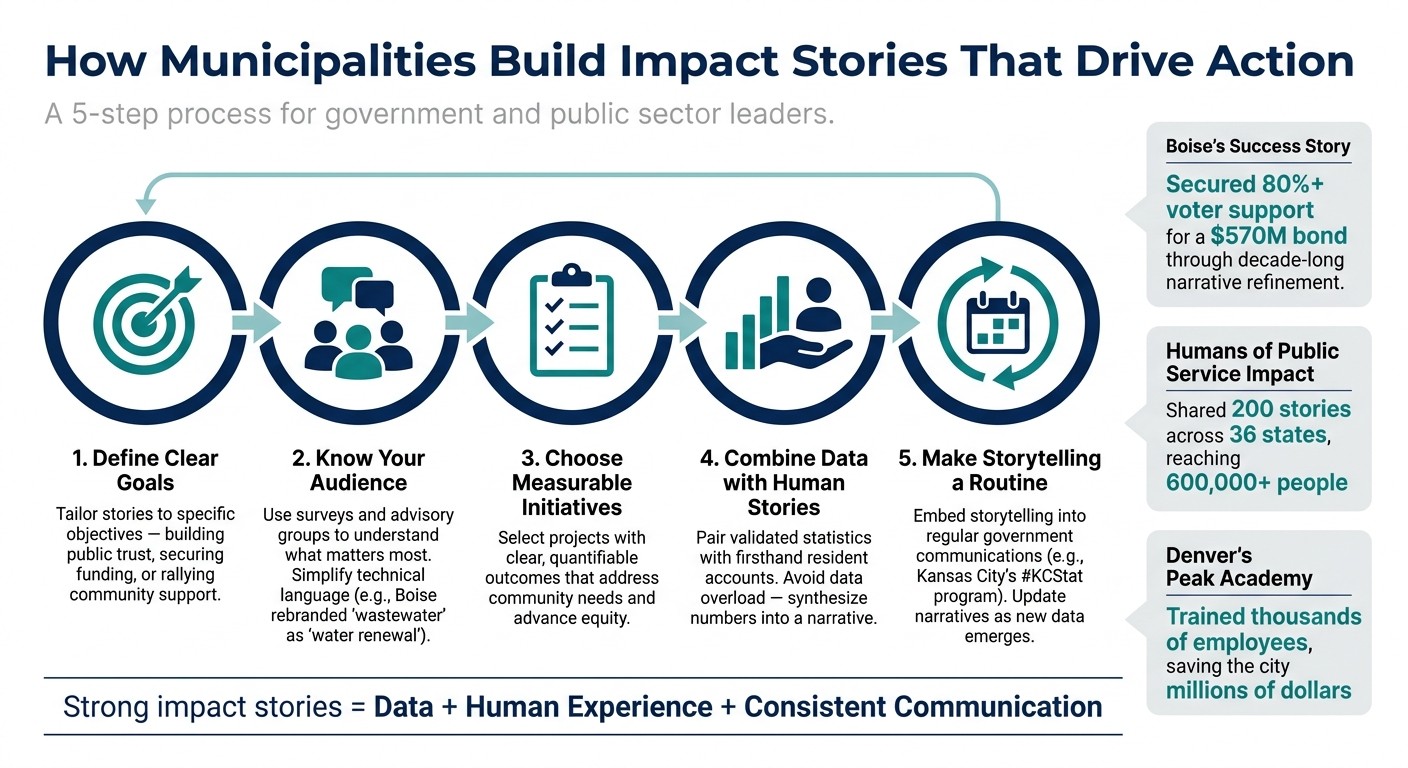
How Municipalities Build Impact Stories That Drive Action
Storytelling in Local Government: Humanizing Public Services
Building the Foundation for Strong Impact Stories
Before diving into crafting an impact story, it's crucial to lay a solid groundwork. Skipping this step often leads to messaging that fails to connect with its intended audience.
Setting Clear Goals and Knowing Your Audience
Start by defining what you want your story to achieve. Are you aiming to build trust with the public, justify funding, or rally support for a community initiative? The purpose of your story dictates its tone, the data you emphasize, and the personal experiences you highlight.
Equally important is understanding your audience. Tailor your message to their priorities. For example, policymakers might focus on cost-efficiency and alignment with regulations, while residents are more likely to care about how an initiative impacts their daily lives. Using tools like surveys and advisory groups that reflect your community's diversity can help uncover what matters most to them and what they already know [5].
Language plays a pivotal role in effective communication. Simplifying technical terms into everyday language can make even complex topics relatable. The City of Boise, Idaho, provides an excellent example: by rebranding "wastewater" as "water renewal" and "aquifer recharge" as "groundwater recharge", they turned a technical issue into something residents could easily understand and support [5].
"By keeping the values and experiences that matter most to our residents top of mind, we've transformed a challenging issue into a collective mission that supports sustainable water renewal." - Lauren McLean, Mayor, City of Boise [5]
With clear goals and a defined audience, the next step is to focus on initiatives that offer measurable and relatable outcomes.
Choosing Initiatives with Clear, Measurable Results
Not every program is suited for an impact story. The strongest examples address specific community needs, deliver measurable environmental, social, or economic benefits, and align with broader community goals or plans. Highlight initiatives that show visible progress, such as through before-and-after photos or short videos [2].
Equity should also be a priority. Choose projects that tackle structural inequities or benefit historically underserved populations. This approach not only adds moral weight to your story but also ensures it resonates with a wider audience [1].
"Whenever possible, stories about your program should not only cover the activities of the TA but should explain why they are needed." - California Strategic Growth Council [1]
While it's essential to acknowledge challenges, avoid creating narratives that focus solely on hardship. Instead, emphasize community strengths and assets. As the California Strategic Growth Council suggests, framing stories around what a community already has can inspire confidence and encourage action, rather than reinforcing a sense of deficit [1].
Once you've identified a compelling initiative, back it up with reliable and accessible data.
Gathering and Using Data as Evidence
Data adds credibility to your story, but the key is presenting it in a way that’s easy to understand. Jennifer Perkins, Senior Government Industry Specialist at Brightly, advises:
"It is more effective to synthesize the data into a story to communicate both need and solution. Too many charts, graphs, or data elements can make the issue more difficult to understand." [4]
Municipal agencies have access to a variety of data sources, such as administrative records, sensor data, community surveys, social media insights, and digitized documents [3]. However, it's essential to validate every piece of data before including it in your story. Use these checks:
Validation Step | What to Check |
|---|---|
Source Verification | Ensure the data originates from a credible source. |
Methodology Review | Confirm the data collection method is transparent. |
Contextual Analysis | Verify the data’s relevance to your local community. |
Cross-Validation | Check if independent sources support the findings. |
Outlier Investigation | Investigate unusual results for possible external factors. |
Pairing data with firsthand accounts from residents - gathered through focus groups or advisory panels - adds a human element to your narrative. This combination of numbers and lived experiences is what transforms a dry report into a story that resonates and inspires action [5].
How to Craft a Strong Public Sector Impact Story
To create a compelling public sector impact story, combine your goals, audience insights, and validated data into a narrative designed to inspire action. Such a story thrives on three essential elements: a well-defined problem, a focus on human experiences, and results conveyed through a mix of data and personal stories.
Framing the Problem in Human and Systemic Terms
Simply presenting statistics won't spark urgency - context is key. To make an issue resonate, it’s important to showcase both its human impact and the systemic challenges behind it.
Take San Diego County’s approach to water supply vulnerability as an example. Instead of just presenting numbers, water managers emphasized the region’s near-total dependence on external water sources as a threat to economic stability. In the early 1990s, the Metropolitan Water District’s warning of a potential 50% cut in water deliveries for municipal and industrial users provided a clear crisis to rally around. Framing the issue around “Independence” helped the region shift from 95% reliance on a single supplier to a diversified water strategy over two decades [6].
"Problem frames combine mental models of cause and effect with value laden and politically driven positions about how problems should be solved." - Evan M. Dennis and Eduardo Brondizio [6]
Connecting issues to broader systems is equally powerful. For instance, linking water supply challenges to public health, conservation, and economic resilience encourages support for cross-sector solutions. Using accessible language, free of technical jargon, ensures the message reaches a wider audience.
Centering People, Place, and Community in Your Story
While data builds credibility, it’s the human element that brings a story to life. Rooting a narrative in specific communities, familiar landmarks, or individual experiences transforms abstract concepts into relatable, meaningful accounts.
Research from the Gallup/Knight Foundation highlights that factors like community engagement, openness, and aesthetic appeal drive residents' attachment to their local area - and that this attachment positively correlates with local GDP growth [8]. This underscores the importance of weaving stories around recognizable places and people.
The Humans of Public Service initiative exemplifies this approach. By sharing 200 personal stories of public servants across 36 states, the project reached over 600,000 people, building trust and reshaping perceptions of government work [10].
"We exist to change the narrative around government work by putting the heart and soul of public servants on full display." - Brian Whittaker, Founder, Humans of Public Service [10]
Another layer of engagement comes from participatory storytelling, where those most affected by an issue contribute to shaping the narrative. For example, Richmond, California’s Community Power and Policy Partnerships (CP3) program, led by the Othering & Belonging Institute, empowers residents to co-author stories. This approach ensures authenticity and fosters a sense of ownership [9].
Once the human elements are established, connect them to measurable outcomes that underscore the story’s impact.
Presenting Results with Data and Personal Accounts
The most effective impact stories seamlessly combine data with personal experiences. A "summary-to-detail" approach works well: start with a powerful, headline-grabbing result, then offer pathways for deeper exploration.
Singapore’s Ministry of Finance illustrates this effectively. They produced a two-page budget summary highlighting key policy objectives, with QR codes linking to comprehensive data sets for those seeking more details [7]. Similarly, Toronto’s 2020 annual report used a visual representation of a single dollar bill, segmented to show how taxpayer money was allocated. This made the city’s budget feel concrete and relatable [7].
Pairing key metrics with personal stories further enhances the narrative. For example, alongside data showcasing improved public services, share firsthand accounts of how these changes have impacted individuals or communities. This combination makes the outcomes both credible and emotionally resonant.
Creating a Repeatable Storytelling Process
Temporary impact stories can only go so far - they often fail to build the trust needed for long-term engagement. A structured, ongoing approach ensures that your storytelling aligns consistently with your strategic goals. By combining data with human experiences and following a repeatable process, your impact stories can maintain both relevance and resonance.
Setting Up a Storytelling Workflow
The best municipal storytelling systems rely on regular data collection that feeds directly into public narratives, rather than sporadic reporting. Kansas City, Missouri, is an excellent example of this. Through its KCStat performance management program, the city transforms internal data reviews into regular public updates shared via Twitter (@KCMO) and the hashtag #KCStat [2].
To streamline this process, it’s crucial to formalize your workflow early. Collaborate with communications teams from the start of a project to establish clear guidelines for data collection and storytelling use [1]. Automating updates from existing systems not only ensures accuracy but also reduces the manual workload [11].
Ben Williamson, Assistant City Manager of Farmers Branch, Texas, described the benefits of this approach after adopting Spider Impact software:
"Spider Impact removes emotion and assumptions from our discussions about community concerns, and lets us just look at the facts to tell an accurate story." - Ben Williamson, Assistant City Manager, Farmers Branch, TX [11]
Involving Communities in the Storytelling Process
Numbers alone don’t inspire action - stories shaped by community voices do. Moving beyond traditional surveys and town halls, municipalities can actively involve residents in framing and sharing narratives. This approach builds trust and fosters a sense of shared ownership.
Including a variety of voices - elected officials, frontline workers, data specialists, and local partners like chambers of commerce or universities - can enrich these stories. For instance, in October 2023, a small Iowa city partnered with its local Chamber of Commerce to hire a dedicated community storyteller. This role focused on promoting tourism and welcoming new residents [3].
Engaging communities in two-way conversations is equally important. Using initiative-specific hashtags, creating social media accounts for projects, or aligning storytelling with events like "Open Data Day" can provide clear opportunities for public participation [2]. By anchoring these narratives to community input and trust, municipalities can amplify their impact.
Connecting Stories to Policy and Planning Frameworks
Stories about individual projects can feel disconnected unless tied to a larger vision. By linking narratives to a municipality’s master plan, climate action goals, or equity initiatives, you can transform updates into evidence of meaningful, long-term progress [4]. This approach not only strengthens the narrative but also supports better decision-making across all levels of government.
"A community's master plan is its 'big picture,' as it lays out the objectives the community agreed upon... Without the larger context, these efforts appear random and unrelated." - Jennifer Perkins, Senior Government Industry Specialist, Brightly [4]
For example, Boise successfully anchored its storytelling to its climate risk assessment. By connecting project updates to broader policy goals, the city secured over 80% voter support for a $570 million bond to build a new water recycling plant [5].
When stories consistently align with strategic goals, they become more than updates - they inspire action and foster collaboration among residents, policymakers, and planners.
Sharing and Refining Impact Stories Over Time
Strong storytelling is just the beginning - keeping narratives relevant and engaging over time is what sustains community interest and trust.
Tailoring Stories for Different Formats and Channels
A well-crafted story should be flexible enough to resonate with different audiences and platforms. Boise, Idaho, provides an excellent example of this adaptability. From 2016 to 2021, city leaders like Mayor Lauren McLean and Haley Falconer from the Department of Public Works employed multi-layered storytelling to gain support for a water recycling initiative. They used the catchy phrase, "We give new life to used water", on social media to spark curiosity. Public events featured water tasting experiences, including beer brewed with recycled water, alongside mobile trailers adorned with narrative-driven graphics. Meanwhile, technical audiences were engaged with detailed insights through asset investment planning tools. Importantly, they tested their messaging with community groups before rolling it out, ensuring it resonated with diverse audiences [5]. These strategies demonstrate how storytelling can be effectively integrated into routine communications.
Making Storytelling Part of Regular Government Communications
Storytelling works best when it becomes a regular feature of government communication rather than a one-off effort. For instance, Kansas City, Missouri, incorporates storytelling into its routine updates through the #KCStat program. This approach transforms internal performance reviews into live updates shared on Twitter (@KCMO), offering transparency and keeping the public informed. Similarly, San Jose, California, uses blog posts to share insights from randomized control trials, such as which postcard designs were most effective in reducing illegal dumping [2]. These consistent, evidence-backed updates foster trust and engagement over time.
"Open data opens doors for all of us, our citizens to be empowered to not just find, but to also use publishable data that is freely provided by the City." - Mark Stodola, Mayor, City of Little Rock [2]
By regularly sharing updates, governments can build a foundation of trust while keeping their stories dynamic and relevant.
Revisiting and Updating Stories as New Data Emerges
As circumstances evolve, so should the stories you tell. Keeping narratives fresh by incorporating new data ensures they remain credible and engaging. This process involves a continuous feedback loop: engaging with the community, gathering their input, and revising the narrative to reflect updated results. Boise’s decade-long effort to refine its messaging is a case in point. By adapting their story as new insights became available, they secured more than 80% voter approval for a $570 million bond in 2021 [5].
Transparency is key - acknowledging setbacks and having a plan to address unexpected challenges helps maintain credibility [12]. Regular updates grounded in validated data reinforce trust and keep communities invested in the story.
Conclusion: Using Storytelling to Drive Real Action
Storytelling that combines solid data with the human experience can build trust and inspire meaningful action. By highlighting community strengths and maintaining clear, consistent messaging, this approach transforms challenges into opportunities for progress.
Take, for example, Hartford Mayor Luke Bronin, who used broadcast TV interviews and data to showcase the success of the Youth Service Corps in preparing at-risk teens for the workforce [2]. Similarly, former Syracuse Mayor Stephanie Miner utilized open data in public speeches to explain how the city prioritized water system upgrades and identified homes without smoke detectors [2]. These aren’t flashy PR stunts; they’re authentic, data-backed stories that resonate with both residents and decision-makers.
"Pairing robust data with the human resources necessary to tell a story will improve communities far into the future." - Erin Mullenix, Author, The Business of Government [3]
Building storytelling capacity is equally important. Denver’s Peak Academy exemplifies this by training thousands of municipal employees in data-driven improvement techniques, resulting in millions of dollars in savings for the city [2]. Such investments in narrative skills and data literacy create long-term benefits for communities.
FAQs
How do we pick the right project to turn into an impact story?
When selecting projects, prioritize those that deliver clear results, meet community needs, and align with your agency's objectives. Emphasize initiatives that produce measurable impacts and tell relatable stories. Share the purpose behind the work, the obstacles encountered, and the positive transformations achieved. Projects that highlight new approaches or tangible community benefits can be particularly effective in motivating action and fostering trust with stakeholders.
How can we use data without overwhelming or losing the public?
When presenting data to the public, it’s crucial to pair it with clear, relatable storytelling. Break down complex topics into narratives that tie directly to community goals and tangible outcomes. For instance, describing technical projects like water-renewal efforts in terms of shared benefits - such as cleaner water for families or long-term resource sustainability - helps build trust and foster engagement. This method not only makes the data more accessible but also ensures residents grasp its importance and feel connected to the larger mission.
How do we build a repeatable storytelling workflow across departments?
To create a reliable storytelling workflow, it's crucial to establish a structured process that bridges departments and encourages teamwork. Automation tools can help simplify repetitive tasks such as gathering data, managing approvals, and sharing content, ensuring a consistent approach across the board. Providing teams with access to no-code or low-code platforms allows them to adapt more easily to changing needs, while regular training keeps everyone aligned and skilled. Incorporating data into storytelling ensures that narratives are not only engaging but also resonate with audiences and align with your organization's objectives, helping to build trust and strengthen connections with stakeholders.
Related Blog Posts
Latest Articles
©2025

Narrative Change and Power Building: The Missing Half of Advocacy
Narrative change is the process of disrupting dominant narratives that normalize inequity and advancing new narratives from historically marginalized communities.

Funding Resilience Without Federal Grants
BRIC is unreliable and FEMA is shrinking. Here's how cities fund climate resilience with dedicated revenue, blended finance, and a coordinating authority.

The ESG Blind Spot: How AI Is Finding Risks in Companies Nobody Else Is Watching
Norway's sovereign wealth fund uses AI to screen 7,200 portfolio companies for forced labor and corruption within 24 hours. The real story is the emerging-market coverage gap that traditional ESG data vendors miss — and what it means for any company with a global supply chain.
Narrative Change and Power Building: The Missing Half of Advocacy
Narrative change is the process of disrupting dominant narratives that normalize inequity and advancing new narratives from historically marginalized communities.
Funding Resilience Without Federal Grants
BRIC is unreliable and FEMA is shrinking. Here's how cities fund climate resilience with dedicated revenue, blended finance, and a coordinating authority.
The ESG Blind Spot: How AI Is Finding Risks in Companies Nobody Else Is Watching
Norway's sovereign wealth fund uses AI to screen 7,200 portfolio companies for forced labor and corruption within 24 hours. The real story is the emerging-market coverage gap that traditional ESG data vendors miss — and what it means for any company with a global supply chain.
FAQ
01
What does it really mean to “redefine profit”?
02
What makes Council Fire different?
03
Who does Council Fire work with?
04
What does working with Council Fire actually look like?
05
How does Council Fire help organizations turn big goals into action?
06
How does Council Fire define and measure success?
May 19, 2026
How to Tell Impact Stories That Inspire Action for Municipalities & Government Agencies
Capacity Building
In This Article
Turn municipal data into human stories that build trust, secure funding, and drive community action with repeatable workflows.
How to Tell Impact Stories That Inspire Action for Municipalities & Government Agencies
Municipalities and government agencies often struggle to communicate the value of their work effectively. Impact storytelling bridges this gap by turning complex data and programs into relatable narratives that build trust, justify funding, and engage communities. By blending data with personal experiences, municipalities can make their achievements visible and relevant. Here’s how:
Define Clear Goals: Tailor stories to specific objectives, such as gaining public trust or securing funding.
Know Your Audience: Use simple, relatable language and focus on what matters most to residents and policymakers.
Choose Measurable Projects: Highlight initiatives with clear outcomes that address community needs.
Combine Data with Human Stories: Pair statistics with personal accounts to create a balanced narrative.
Make Storytelling a Routine: Regular updates tied to broader plans keep communities informed and engaged.
Impact storytelling isn’t just about sharing results - it’s about fostering long-term connection and accountability. By connecting stories to broader goals, municipalities can inspire action and strengthen public confidence.
How Municipalities Build Impact Stories That Drive Action
Storytelling in Local Government: Humanizing Public Services
Building the Foundation for Strong Impact Stories
Before diving into crafting an impact story, it's crucial to lay a solid groundwork. Skipping this step often leads to messaging that fails to connect with its intended audience.
Setting Clear Goals and Knowing Your Audience
Start by defining what you want your story to achieve. Are you aiming to build trust with the public, justify funding, or rally support for a community initiative? The purpose of your story dictates its tone, the data you emphasize, and the personal experiences you highlight.
Equally important is understanding your audience. Tailor your message to their priorities. For example, policymakers might focus on cost-efficiency and alignment with regulations, while residents are more likely to care about how an initiative impacts their daily lives. Using tools like surveys and advisory groups that reflect your community's diversity can help uncover what matters most to them and what they already know [5].
Language plays a pivotal role in effective communication. Simplifying technical terms into everyday language can make even complex topics relatable. The City of Boise, Idaho, provides an excellent example: by rebranding "wastewater" as "water renewal" and "aquifer recharge" as "groundwater recharge", they turned a technical issue into something residents could easily understand and support [5].
"By keeping the values and experiences that matter most to our residents top of mind, we've transformed a challenging issue into a collective mission that supports sustainable water renewal." - Lauren McLean, Mayor, City of Boise [5]
With clear goals and a defined audience, the next step is to focus on initiatives that offer measurable and relatable outcomes.
Choosing Initiatives with Clear, Measurable Results
Not every program is suited for an impact story. The strongest examples address specific community needs, deliver measurable environmental, social, or economic benefits, and align with broader community goals or plans. Highlight initiatives that show visible progress, such as through before-and-after photos or short videos [2].
Equity should also be a priority. Choose projects that tackle structural inequities or benefit historically underserved populations. This approach not only adds moral weight to your story but also ensures it resonates with a wider audience [1].
"Whenever possible, stories about your program should not only cover the activities of the TA but should explain why they are needed." - California Strategic Growth Council [1]
While it's essential to acknowledge challenges, avoid creating narratives that focus solely on hardship. Instead, emphasize community strengths and assets. As the California Strategic Growth Council suggests, framing stories around what a community already has can inspire confidence and encourage action, rather than reinforcing a sense of deficit [1].
Once you've identified a compelling initiative, back it up with reliable and accessible data.
Gathering and Using Data as Evidence
Data adds credibility to your story, but the key is presenting it in a way that’s easy to understand. Jennifer Perkins, Senior Government Industry Specialist at Brightly, advises:
"It is more effective to synthesize the data into a story to communicate both need and solution. Too many charts, graphs, or data elements can make the issue more difficult to understand." [4]
Municipal agencies have access to a variety of data sources, such as administrative records, sensor data, community surveys, social media insights, and digitized documents [3]. However, it's essential to validate every piece of data before including it in your story. Use these checks:
Validation Step | What to Check |
|---|---|
Source Verification | Ensure the data originates from a credible source. |
Methodology Review | Confirm the data collection method is transparent. |
Contextual Analysis | Verify the data’s relevance to your local community. |
Cross-Validation | Check if independent sources support the findings. |
Outlier Investigation | Investigate unusual results for possible external factors. |
Pairing data with firsthand accounts from residents - gathered through focus groups or advisory panels - adds a human element to your narrative. This combination of numbers and lived experiences is what transforms a dry report into a story that resonates and inspires action [5].
How to Craft a Strong Public Sector Impact Story
To create a compelling public sector impact story, combine your goals, audience insights, and validated data into a narrative designed to inspire action. Such a story thrives on three essential elements: a well-defined problem, a focus on human experiences, and results conveyed through a mix of data and personal stories.
Framing the Problem in Human and Systemic Terms
Simply presenting statistics won't spark urgency - context is key. To make an issue resonate, it’s important to showcase both its human impact and the systemic challenges behind it.
Take San Diego County’s approach to water supply vulnerability as an example. Instead of just presenting numbers, water managers emphasized the region’s near-total dependence on external water sources as a threat to economic stability. In the early 1990s, the Metropolitan Water District’s warning of a potential 50% cut in water deliveries for municipal and industrial users provided a clear crisis to rally around. Framing the issue around “Independence” helped the region shift from 95% reliance on a single supplier to a diversified water strategy over two decades [6].
"Problem frames combine mental models of cause and effect with value laden and politically driven positions about how problems should be solved." - Evan M. Dennis and Eduardo Brondizio [6]
Connecting issues to broader systems is equally powerful. For instance, linking water supply challenges to public health, conservation, and economic resilience encourages support for cross-sector solutions. Using accessible language, free of technical jargon, ensures the message reaches a wider audience.
Centering People, Place, and Community in Your Story
While data builds credibility, it’s the human element that brings a story to life. Rooting a narrative in specific communities, familiar landmarks, or individual experiences transforms abstract concepts into relatable, meaningful accounts.
Research from the Gallup/Knight Foundation highlights that factors like community engagement, openness, and aesthetic appeal drive residents' attachment to their local area - and that this attachment positively correlates with local GDP growth [8]. This underscores the importance of weaving stories around recognizable places and people.
The Humans of Public Service initiative exemplifies this approach. By sharing 200 personal stories of public servants across 36 states, the project reached over 600,000 people, building trust and reshaping perceptions of government work [10].
"We exist to change the narrative around government work by putting the heart and soul of public servants on full display." - Brian Whittaker, Founder, Humans of Public Service [10]
Another layer of engagement comes from participatory storytelling, where those most affected by an issue contribute to shaping the narrative. For example, Richmond, California’s Community Power and Policy Partnerships (CP3) program, led by the Othering & Belonging Institute, empowers residents to co-author stories. This approach ensures authenticity and fosters a sense of ownership [9].
Once the human elements are established, connect them to measurable outcomes that underscore the story’s impact.
Presenting Results with Data and Personal Accounts
The most effective impact stories seamlessly combine data with personal experiences. A "summary-to-detail" approach works well: start with a powerful, headline-grabbing result, then offer pathways for deeper exploration.
Singapore’s Ministry of Finance illustrates this effectively. They produced a two-page budget summary highlighting key policy objectives, with QR codes linking to comprehensive data sets for those seeking more details [7]. Similarly, Toronto’s 2020 annual report used a visual representation of a single dollar bill, segmented to show how taxpayer money was allocated. This made the city’s budget feel concrete and relatable [7].
Pairing key metrics with personal stories further enhances the narrative. For example, alongside data showcasing improved public services, share firsthand accounts of how these changes have impacted individuals or communities. This combination makes the outcomes both credible and emotionally resonant.
Creating a Repeatable Storytelling Process
Temporary impact stories can only go so far - they often fail to build the trust needed for long-term engagement. A structured, ongoing approach ensures that your storytelling aligns consistently with your strategic goals. By combining data with human experiences and following a repeatable process, your impact stories can maintain both relevance and resonance.
Setting Up a Storytelling Workflow
The best municipal storytelling systems rely on regular data collection that feeds directly into public narratives, rather than sporadic reporting. Kansas City, Missouri, is an excellent example of this. Through its KCStat performance management program, the city transforms internal data reviews into regular public updates shared via Twitter (@KCMO) and the hashtag #KCStat [2].
To streamline this process, it’s crucial to formalize your workflow early. Collaborate with communications teams from the start of a project to establish clear guidelines for data collection and storytelling use [1]. Automating updates from existing systems not only ensures accuracy but also reduces the manual workload [11].
Ben Williamson, Assistant City Manager of Farmers Branch, Texas, described the benefits of this approach after adopting Spider Impact software:
"Spider Impact removes emotion and assumptions from our discussions about community concerns, and lets us just look at the facts to tell an accurate story." - Ben Williamson, Assistant City Manager, Farmers Branch, TX [11]
Involving Communities in the Storytelling Process
Numbers alone don’t inspire action - stories shaped by community voices do. Moving beyond traditional surveys and town halls, municipalities can actively involve residents in framing and sharing narratives. This approach builds trust and fosters a sense of shared ownership.
Including a variety of voices - elected officials, frontline workers, data specialists, and local partners like chambers of commerce or universities - can enrich these stories. For instance, in October 2023, a small Iowa city partnered with its local Chamber of Commerce to hire a dedicated community storyteller. This role focused on promoting tourism and welcoming new residents [3].
Engaging communities in two-way conversations is equally important. Using initiative-specific hashtags, creating social media accounts for projects, or aligning storytelling with events like "Open Data Day" can provide clear opportunities for public participation [2]. By anchoring these narratives to community input and trust, municipalities can amplify their impact.
Connecting Stories to Policy and Planning Frameworks
Stories about individual projects can feel disconnected unless tied to a larger vision. By linking narratives to a municipality’s master plan, climate action goals, or equity initiatives, you can transform updates into evidence of meaningful, long-term progress [4]. This approach not only strengthens the narrative but also supports better decision-making across all levels of government.
"A community's master plan is its 'big picture,' as it lays out the objectives the community agreed upon... Without the larger context, these efforts appear random and unrelated." - Jennifer Perkins, Senior Government Industry Specialist, Brightly [4]
For example, Boise successfully anchored its storytelling to its climate risk assessment. By connecting project updates to broader policy goals, the city secured over 80% voter support for a $570 million bond to build a new water recycling plant [5].
When stories consistently align with strategic goals, they become more than updates - they inspire action and foster collaboration among residents, policymakers, and planners.
Sharing and Refining Impact Stories Over Time
Strong storytelling is just the beginning - keeping narratives relevant and engaging over time is what sustains community interest and trust.
Tailoring Stories for Different Formats and Channels
A well-crafted story should be flexible enough to resonate with different audiences and platforms. Boise, Idaho, provides an excellent example of this adaptability. From 2016 to 2021, city leaders like Mayor Lauren McLean and Haley Falconer from the Department of Public Works employed multi-layered storytelling to gain support for a water recycling initiative. They used the catchy phrase, "We give new life to used water", on social media to spark curiosity. Public events featured water tasting experiences, including beer brewed with recycled water, alongside mobile trailers adorned with narrative-driven graphics. Meanwhile, technical audiences were engaged with detailed insights through asset investment planning tools. Importantly, they tested their messaging with community groups before rolling it out, ensuring it resonated with diverse audiences [5]. These strategies demonstrate how storytelling can be effectively integrated into routine communications.
Making Storytelling Part of Regular Government Communications
Storytelling works best when it becomes a regular feature of government communication rather than a one-off effort. For instance, Kansas City, Missouri, incorporates storytelling into its routine updates through the #KCStat program. This approach transforms internal performance reviews into live updates shared on Twitter (@KCMO), offering transparency and keeping the public informed. Similarly, San Jose, California, uses blog posts to share insights from randomized control trials, such as which postcard designs were most effective in reducing illegal dumping [2]. These consistent, evidence-backed updates foster trust and engagement over time.
"Open data opens doors for all of us, our citizens to be empowered to not just find, but to also use publishable data that is freely provided by the City." - Mark Stodola, Mayor, City of Little Rock [2]
By regularly sharing updates, governments can build a foundation of trust while keeping their stories dynamic and relevant.
Revisiting and Updating Stories as New Data Emerges
As circumstances evolve, so should the stories you tell. Keeping narratives fresh by incorporating new data ensures they remain credible and engaging. This process involves a continuous feedback loop: engaging with the community, gathering their input, and revising the narrative to reflect updated results. Boise’s decade-long effort to refine its messaging is a case in point. By adapting their story as new insights became available, they secured more than 80% voter approval for a $570 million bond in 2021 [5].
Transparency is key - acknowledging setbacks and having a plan to address unexpected challenges helps maintain credibility [12]. Regular updates grounded in validated data reinforce trust and keep communities invested in the story.
Conclusion: Using Storytelling to Drive Real Action
Storytelling that combines solid data with the human experience can build trust and inspire meaningful action. By highlighting community strengths and maintaining clear, consistent messaging, this approach transforms challenges into opportunities for progress.
Take, for example, Hartford Mayor Luke Bronin, who used broadcast TV interviews and data to showcase the success of the Youth Service Corps in preparing at-risk teens for the workforce [2]. Similarly, former Syracuse Mayor Stephanie Miner utilized open data in public speeches to explain how the city prioritized water system upgrades and identified homes without smoke detectors [2]. These aren’t flashy PR stunts; they’re authentic, data-backed stories that resonate with both residents and decision-makers.
"Pairing robust data with the human resources necessary to tell a story will improve communities far into the future." - Erin Mullenix, Author, The Business of Government [3]
Building storytelling capacity is equally important. Denver’s Peak Academy exemplifies this by training thousands of municipal employees in data-driven improvement techniques, resulting in millions of dollars in savings for the city [2]. Such investments in narrative skills and data literacy create long-term benefits for communities.
FAQs
How do we pick the right project to turn into an impact story?
When selecting projects, prioritize those that deliver clear results, meet community needs, and align with your agency's objectives. Emphasize initiatives that produce measurable impacts and tell relatable stories. Share the purpose behind the work, the obstacles encountered, and the positive transformations achieved. Projects that highlight new approaches or tangible community benefits can be particularly effective in motivating action and fostering trust with stakeholders.
How can we use data without overwhelming or losing the public?
When presenting data to the public, it’s crucial to pair it with clear, relatable storytelling. Break down complex topics into narratives that tie directly to community goals and tangible outcomes. For instance, describing technical projects like water-renewal efforts in terms of shared benefits - such as cleaner water for families or long-term resource sustainability - helps build trust and foster engagement. This method not only makes the data more accessible but also ensures residents grasp its importance and feel connected to the larger mission.
How do we build a repeatable storytelling workflow across departments?
To create a reliable storytelling workflow, it's crucial to establish a structured process that bridges departments and encourages teamwork. Automation tools can help simplify repetitive tasks such as gathering data, managing approvals, and sharing content, ensuring a consistent approach across the board. Providing teams with access to no-code or low-code platforms allows them to adapt more easily to changing needs, while regular training keeps everyone aligned and skilled. Incorporating data into storytelling ensures that narratives are not only engaging but also resonate with audiences and align with your organization's objectives, helping to build trust and strengthen connections with stakeholders.
Related Blog Posts
Latest Articles
©2025
Narrative Change and Power Building: The Missing Half of Advocacy
Narrative change is the process of disrupting dominant narratives that normalize inequity and advancing new narratives from historically marginalized communities.
Funding Resilience Without Federal Grants
BRIC is unreliable and FEMA is shrinking. Here's how cities fund climate resilience with dedicated revenue, blended finance, and a coordinating authority.
The ESG Blind Spot: How AI Is Finding Risks in Companies Nobody Else Is Watching
Norway's sovereign wealth fund uses AI to screen 7,200 portfolio companies for forced labor and corruption within 24 hours. The real story is the emerging-market coverage gap that traditional ESG data vendors miss — and what it means for any company with a global supply chain.
FAQ
01
What does it really mean to “redefine profit”?
02
What makes Council Fire different?
03
Who does Council Fire work with?
04
What does working with Council Fire actually look like?
05
How does Council Fire help organizations turn big goals into action?
06
How does Council Fire define and measure success?
May 19, 2026
How to Tell Impact Stories That Inspire Action for Municipalities & Government Agencies
Capacity Building
In This Article
Turn municipal data into human stories that build trust, secure funding, and drive community action with repeatable workflows.
How to Tell Impact Stories That Inspire Action for Municipalities & Government Agencies
Municipalities and government agencies often struggle to communicate the value of their work effectively. Impact storytelling bridges this gap by turning complex data and programs into relatable narratives that build trust, justify funding, and engage communities. By blending data with personal experiences, municipalities can make their achievements visible and relevant. Here’s how:
Define Clear Goals: Tailor stories to specific objectives, such as gaining public trust or securing funding.
Know Your Audience: Use simple, relatable language and focus on what matters most to residents and policymakers.
Choose Measurable Projects: Highlight initiatives with clear outcomes that address community needs.
Combine Data with Human Stories: Pair statistics with personal accounts to create a balanced narrative.
Make Storytelling a Routine: Regular updates tied to broader plans keep communities informed and engaged.
Impact storytelling isn’t just about sharing results - it’s about fostering long-term connection and accountability. By connecting stories to broader goals, municipalities can inspire action and strengthen public confidence.
How Municipalities Build Impact Stories That Drive Action
Storytelling in Local Government: Humanizing Public Services
Building the Foundation for Strong Impact Stories
Before diving into crafting an impact story, it's crucial to lay a solid groundwork. Skipping this step often leads to messaging that fails to connect with its intended audience.
Setting Clear Goals and Knowing Your Audience
Start by defining what you want your story to achieve. Are you aiming to build trust with the public, justify funding, or rally support for a community initiative? The purpose of your story dictates its tone, the data you emphasize, and the personal experiences you highlight.
Equally important is understanding your audience. Tailor your message to their priorities. For example, policymakers might focus on cost-efficiency and alignment with regulations, while residents are more likely to care about how an initiative impacts their daily lives. Using tools like surveys and advisory groups that reflect your community's diversity can help uncover what matters most to them and what they already know [5].
Language plays a pivotal role in effective communication. Simplifying technical terms into everyday language can make even complex topics relatable. The City of Boise, Idaho, provides an excellent example: by rebranding "wastewater" as "water renewal" and "aquifer recharge" as "groundwater recharge", they turned a technical issue into something residents could easily understand and support [5].
"By keeping the values and experiences that matter most to our residents top of mind, we've transformed a challenging issue into a collective mission that supports sustainable water renewal." - Lauren McLean, Mayor, City of Boise [5]
With clear goals and a defined audience, the next step is to focus on initiatives that offer measurable and relatable outcomes.
Choosing Initiatives with Clear, Measurable Results
Not every program is suited for an impact story. The strongest examples address specific community needs, deliver measurable environmental, social, or economic benefits, and align with broader community goals or plans. Highlight initiatives that show visible progress, such as through before-and-after photos or short videos [2].
Equity should also be a priority. Choose projects that tackle structural inequities or benefit historically underserved populations. This approach not only adds moral weight to your story but also ensures it resonates with a wider audience [1].
"Whenever possible, stories about your program should not only cover the activities of the TA but should explain why they are needed." - California Strategic Growth Council [1]
While it's essential to acknowledge challenges, avoid creating narratives that focus solely on hardship. Instead, emphasize community strengths and assets. As the California Strategic Growth Council suggests, framing stories around what a community already has can inspire confidence and encourage action, rather than reinforcing a sense of deficit [1].
Once you've identified a compelling initiative, back it up with reliable and accessible data.
Gathering and Using Data as Evidence
Data adds credibility to your story, but the key is presenting it in a way that’s easy to understand. Jennifer Perkins, Senior Government Industry Specialist at Brightly, advises:
"It is more effective to synthesize the data into a story to communicate both need and solution. Too many charts, graphs, or data elements can make the issue more difficult to understand." [4]
Municipal agencies have access to a variety of data sources, such as administrative records, sensor data, community surveys, social media insights, and digitized documents [3]. However, it's essential to validate every piece of data before including it in your story. Use these checks:
Validation Step | What to Check |
|---|---|
Source Verification | Ensure the data originates from a credible source. |
Methodology Review | Confirm the data collection method is transparent. |
Contextual Analysis | Verify the data’s relevance to your local community. |
Cross-Validation | Check if independent sources support the findings. |
Outlier Investigation | Investigate unusual results for possible external factors. |
Pairing data with firsthand accounts from residents - gathered through focus groups or advisory panels - adds a human element to your narrative. This combination of numbers and lived experiences is what transforms a dry report into a story that resonates and inspires action [5].
How to Craft a Strong Public Sector Impact Story
To create a compelling public sector impact story, combine your goals, audience insights, and validated data into a narrative designed to inspire action. Such a story thrives on three essential elements: a well-defined problem, a focus on human experiences, and results conveyed through a mix of data and personal stories.
Framing the Problem in Human and Systemic Terms
Simply presenting statistics won't spark urgency - context is key. To make an issue resonate, it’s important to showcase both its human impact and the systemic challenges behind it.
Take San Diego County’s approach to water supply vulnerability as an example. Instead of just presenting numbers, water managers emphasized the region’s near-total dependence on external water sources as a threat to economic stability. In the early 1990s, the Metropolitan Water District’s warning of a potential 50% cut in water deliveries for municipal and industrial users provided a clear crisis to rally around. Framing the issue around “Independence” helped the region shift from 95% reliance on a single supplier to a diversified water strategy over two decades [6].
"Problem frames combine mental models of cause and effect with value laden and politically driven positions about how problems should be solved." - Evan M. Dennis and Eduardo Brondizio [6]
Connecting issues to broader systems is equally powerful. For instance, linking water supply challenges to public health, conservation, and economic resilience encourages support for cross-sector solutions. Using accessible language, free of technical jargon, ensures the message reaches a wider audience.
Centering People, Place, and Community in Your Story
While data builds credibility, it’s the human element that brings a story to life. Rooting a narrative in specific communities, familiar landmarks, or individual experiences transforms abstract concepts into relatable, meaningful accounts.
Research from the Gallup/Knight Foundation highlights that factors like community engagement, openness, and aesthetic appeal drive residents' attachment to their local area - and that this attachment positively correlates with local GDP growth [8]. This underscores the importance of weaving stories around recognizable places and people.
The Humans of Public Service initiative exemplifies this approach. By sharing 200 personal stories of public servants across 36 states, the project reached over 600,000 people, building trust and reshaping perceptions of government work [10].
"We exist to change the narrative around government work by putting the heart and soul of public servants on full display." - Brian Whittaker, Founder, Humans of Public Service [10]
Another layer of engagement comes from participatory storytelling, where those most affected by an issue contribute to shaping the narrative. For example, Richmond, California’s Community Power and Policy Partnerships (CP3) program, led by the Othering & Belonging Institute, empowers residents to co-author stories. This approach ensures authenticity and fosters a sense of ownership [9].
Once the human elements are established, connect them to measurable outcomes that underscore the story’s impact.
Presenting Results with Data and Personal Accounts
The most effective impact stories seamlessly combine data with personal experiences. A "summary-to-detail" approach works well: start with a powerful, headline-grabbing result, then offer pathways for deeper exploration.
Singapore’s Ministry of Finance illustrates this effectively. They produced a two-page budget summary highlighting key policy objectives, with QR codes linking to comprehensive data sets for those seeking more details [7]. Similarly, Toronto’s 2020 annual report used a visual representation of a single dollar bill, segmented to show how taxpayer money was allocated. This made the city’s budget feel concrete and relatable [7].
Pairing key metrics with personal stories further enhances the narrative. For example, alongside data showcasing improved public services, share firsthand accounts of how these changes have impacted individuals or communities. This combination makes the outcomes both credible and emotionally resonant.
Creating a Repeatable Storytelling Process
Temporary impact stories can only go so far - they often fail to build the trust needed for long-term engagement. A structured, ongoing approach ensures that your storytelling aligns consistently with your strategic goals. By combining data with human experiences and following a repeatable process, your impact stories can maintain both relevance and resonance.
Setting Up a Storytelling Workflow
The best municipal storytelling systems rely on regular data collection that feeds directly into public narratives, rather than sporadic reporting. Kansas City, Missouri, is an excellent example of this. Through its KCStat performance management program, the city transforms internal data reviews into regular public updates shared via Twitter (@KCMO) and the hashtag #KCStat [2].
To streamline this process, it’s crucial to formalize your workflow early. Collaborate with communications teams from the start of a project to establish clear guidelines for data collection and storytelling use [1]. Automating updates from existing systems not only ensures accuracy but also reduces the manual workload [11].
Ben Williamson, Assistant City Manager of Farmers Branch, Texas, described the benefits of this approach after adopting Spider Impact software:
"Spider Impact removes emotion and assumptions from our discussions about community concerns, and lets us just look at the facts to tell an accurate story." - Ben Williamson, Assistant City Manager, Farmers Branch, TX [11]
Involving Communities in the Storytelling Process
Numbers alone don’t inspire action - stories shaped by community voices do. Moving beyond traditional surveys and town halls, municipalities can actively involve residents in framing and sharing narratives. This approach builds trust and fosters a sense of shared ownership.
Including a variety of voices - elected officials, frontline workers, data specialists, and local partners like chambers of commerce or universities - can enrich these stories. For instance, in October 2023, a small Iowa city partnered with its local Chamber of Commerce to hire a dedicated community storyteller. This role focused on promoting tourism and welcoming new residents [3].
Engaging communities in two-way conversations is equally important. Using initiative-specific hashtags, creating social media accounts for projects, or aligning storytelling with events like "Open Data Day" can provide clear opportunities for public participation [2]. By anchoring these narratives to community input and trust, municipalities can amplify their impact.
Connecting Stories to Policy and Planning Frameworks
Stories about individual projects can feel disconnected unless tied to a larger vision. By linking narratives to a municipality’s master plan, climate action goals, or equity initiatives, you can transform updates into evidence of meaningful, long-term progress [4]. This approach not only strengthens the narrative but also supports better decision-making across all levels of government.
"A community's master plan is its 'big picture,' as it lays out the objectives the community agreed upon... Without the larger context, these efforts appear random and unrelated." - Jennifer Perkins, Senior Government Industry Specialist, Brightly [4]
For example, Boise successfully anchored its storytelling to its climate risk assessment. By connecting project updates to broader policy goals, the city secured over 80% voter support for a $570 million bond to build a new water recycling plant [5].
When stories consistently align with strategic goals, they become more than updates - they inspire action and foster collaboration among residents, policymakers, and planners.
Sharing and Refining Impact Stories Over Time
Strong storytelling is just the beginning - keeping narratives relevant and engaging over time is what sustains community interest and trust.
Tailoring Stories for Different Formats and Channels
A well-crafted story should be flexible enough to resonate with different audiences and platforms. Boise, Idaho, provides an excellent example of this adaptability. From 2016 to 2021, city leaders like Mayor Lauren McLean and Haley Falconer from the Department of Public Works employed multi-layered storytelling to gain support for a water recycling initiative. They used the catchy phrase, "We give new life to used water", on social media to spark curiosity. Public events featured water tasting experiences, including beer brewed with recycled water, alongside mobile trailers adorned with narrative-driven graphics. Meanwhile, technical audiences were engaged with detailed insights through asset investment planning tools. Importantly, they tested their messaging with community groups before rolling it out, ensuring it resonated with diverse audiences [5]. These strategies demonstrate how storytelling can be effectively integrated into routine communications.
Making Storytelling Part of Regular Government Communications
Storytelling works best when it becomes a regular feature of government communication rather than a one-off effort. For instance, Kansas City, Missouri, incorporates storytelling into its routine updates through the #KCStat program. This approach transforms internal performance reviews into live updates shared on Twitter (@KCMO), offering transparency and keeping the public informed. Similarly, San Jose, California, uses blog posts to share insights from randomized control trials, such as which postcard designs were most effective in reducing illegal dumping [2]. These consistent, evidence-backed updates foster trust and engagement over time.
"Open data opens doors for all of us, our citizens to be empowered to not just find, but to also use publishable data that is freely provided by the City." - Mark Stodola, Mayor, City of Little Rock [2]
By regularly sharing updates, governments can build a foundation of trust while keeping their stories dynamic and relevant.
Revisiting and Updating Stories as New Data Emerges
As circumstances evolve, so should the stories you tell. Keeping narratives fresh by incorporating new data ensures they remain credible and engaging. This process involves a continuous feedback loop: engaging with the community, gathering their input, and revising the narrative to reflect updated results. Boise’s decade-long effort to refine its messaging is a case in point. By adapting their story as new insights became available, they secured more than 80% voter approval for a $570 million bond in 2021 [5].
Transparency is key - acknowledging setbacks and having a plan to address unexpected challenges helps maintain credibility [12]. Regular updates grounded in validated data reinforce trust and keep communities invested in the story.
Conclusion: Using Storytelling to Drive Real Action
Storytelling that combines solid data with the human experience can build trust and inspire meaningful action. By highlighting community strengths and maintaining clear, consistent messaging, this approach transforms challenges into opportunities for progress.
Take, for example, Hartford Mayor Luke Bronin, who used broadcast TV interviews and data to showcase the success of the Youth Service Corps in preparing at-risk teens for the workforce [2]. Similarly, former Syracuse Mayor Stephanie Miner utilized open data in public speeches to explain how the city prioritized water system upgrades and identified homes without smoke detectors [2]. These aren’t flashy PR stunts; they’re authentic, data-backed stories that resonate with both residents and decision-makers.
"Pairing robust data with the human resources necessary to tell a story will improve communities far into the future." - Erin Mullenix, Author, The Business of Government [3]
Building storytelling capacity is equally important. Denver’s Peak Academy exemplifies this by training thousands of municipal employees in data-driven improvement techniques, resulting in millions of dollars in savings for the city [2]. Such investments in narrative skills and data literacy create long-term benefits for communities.
FAQs
How do we pick the right project to turn into an impact story?
When selecting projects, prioritize those that deliver clear results, meet community needs, and align with your agency's objectives. Emphasize initiatives that produce measurable impacts and tell relatable stories. Share the purpose behind the work, the obstacles encountered, and the positive transformations achieved. Projects that highlight new approaches or tangible community benefits can be particularly effective in motivating action and fostering trust with stakeholders.
How can we use data without overwhelming or losing the public?
When presenting data to the public, it’s crucial to pair it with clear, relatable storytelling. Break down complex topics into narratives that tie directly to community goals and tangible outcomes. For instance, describing technical projects like water-renewal efforts in terms of shared benefits - such as cleaner water for families or long-term resource sustainability - helps build trust and foster engagement. This method not only makes the data more accessible but also ensures residents grasp its importance and feel connected to the larger mission.
How do we build a repeatable storytelling workflow across departments?
To create a reliable storytelling workflow, it's crucial to establish a structured process that bridges departments and encourages teamwork. Automation tools can help simplify repetitive tasks such as gathering data, managing approvals, and sharing content, ensuring a consistent approach across the board. Providing teams with access to no-code or low-code platforms allows them to adapt more easily to changing needs, while regular training keeps everyone aligned and skilled. Incorporating data into storytelling ensures that narratives are not only engaging but also resonate with audiences and align with your organization's objectives, helping to build trust and strengthen connections with stakeholders.
Related Blog Posts
Latest Articles
©2025
Narrative Change and Power Building: The Missing Half of Advocacy
Narrative change is the process of disrupting dominant narratives that normalize inequity and advancing new narratives from historically marginalized communities.
Funding Resilience Without Federal Grants
BRIC is unreliable and FEMA is shrinking. Here's how cities fund climate resilience with dedicated revenue, blended finance, and a coordinating authority.
The ESG Blind Spot: How AI Is Finding Risks in Companies Nobody Else Is Watching
Norway's sovereign wealth fund uses AI to screen 7,200 portfolio companies for forced labor and corruption within 24 hours. The real story is the emerging-market coverage gap that traditional ESG data vendors miss — and what it means for any company with a global supply chain.
FAQ
What does it really mean to “redefine profit”?
What makes Council Fire different?
Who does Council Fire work with?
What does working with Council Fire actually look like?
How does Council Fire help organizations turn big goals into action?
How does Council Fire define and measure success?