Aug 18, 2026
Public Transit Electrification: Study Summary
Sustainability Strategy
In This Article
Electric buses cut street-level pollution fast, but success hinges on route fit, charger uptime, winter range, and utility lead times.
Public Transit Electrification: Study Summary
If I had to boil this down to one point, it’s this: electric buses can cut street-level pollution fast, but fleet success depends on route fit, charger uptime, winter range, and utility lead times.
I see four clear takeaways from the research:
Buses don’t deliver the same range in daily service as they do on paper. Many urban battery-electric buses use about 1.5 to 3.0 kWh per mile, and cold weather can push that 20% to 40% higher.
Charging is a service issue, not just a facility issue. Depot charging often supports about 100 to 150 miles per charge, while on-route charging can push service past 200 miles a day.
Health gains show up first on the street. Electric buses remove tailpipe PM2.5, NOx, and black carbon, and studies tie that to lower asthma and heart risk near busy corridors.
Grid delays can slow everything down. Some utility upgrades can take years, which means agencies need power planning well before bus orders go out.
If I’m reading these studies as a decision-maker, I’d focus on three questions right away: Which routes fit current bus range? Where will health gains be highest? And how soon can the depot get enough power? That frame matters more than headline claims about electrification alone.
What stands out most is the split between urban and rural service. Urban systems often have shorter routes and more charging choices. Rural and regional systems face longer distances, hills, thinner grid access, and sharper winter limits. That means phased rollout is often the safer path.
Decision area | What the research says | What I’d watch first |
|---|---|---|
Fleet performance | Range drops in cold weather; charger failures can disrupt service | Daily mileage, hills, HVAC load, spare ratio |
Health | Street-level pollution drops at once | High-exposure corridors, schools, dense neighborhoods |
Grid readiness | Depot loads can reach megawatt scale | Utility timeline, feeder/substation work, site power |
Equity | Some communities may get cleaner buses later than others | Route priority, rural service fit, grant access |
My short read: electrification works best when agencies start with the routes that can finish service, cut the most local harm, and match the power the depot can actually get.
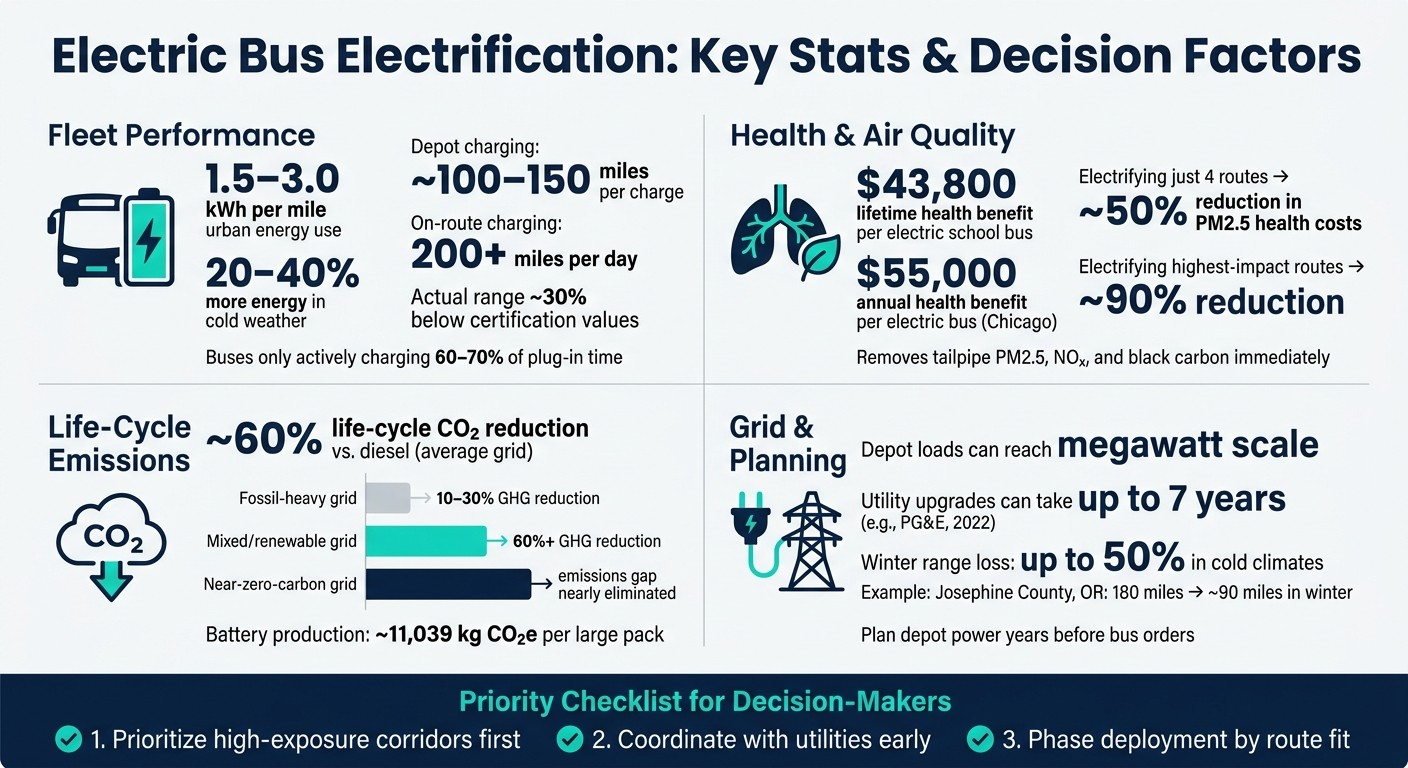
Electric Bus Electrification: Key Stats & Decision Factors at a Glance
Electric Buses Have a Winter Problem: Cold Weather, Charging and the Grid
Fleet Performance: Range, Reliability, and Operating Fit
BEB performance is shaped by the route it has to run, not just the spec sheet. Route length, hills, weather, and charger access all affect how well a bus fits into daily service. That’s why fleet fit matters just as much as the vehicle itself.
Range and Energy Use in Service
Studies of BEBs on urban routes usually place energy use between 1.5 and 3.0 kWh per mile.[1][6] The low end tends to show up in mild weather on flatter routes. The high end is more common in cold conditions, on steep grades, or when HVAC demand is heavy.[1][6]
Cold weather, in particular, can push energy use 20–40% above mild-weather baselines, which cuts into usable range.[1][5] In colder parts of the country, agencies often deal with that by choosing larger battery packs, adding auxiliary heaters, or shortening winter service blocks.[6][7]
For daily operations, depot charging often supports about 100–150 miles per charge, while on-route charging can stretch service to more than 200 miles in a day.[6][7][9] One Milwaukee-area facilities analysis found that a 450-kWh battery pack could deliver a reliable range of 130 miles per charge, or about 10 hours in service.[10] At the same time, one ICCT review found that actual range averages about 30% below certification values.[11][12] In plain terms, that gap puts charger access and scheduling right at the center of service planning.
Reliability and Charging Strategy Effects
Charger uptime has a direct effect on BEB reliability. If depot and on-route chargers stay online, BEBs assigned to the right routes can hit schedule adherence comparable to diesel fleets.[7][9] But when charging fails, problems stack up fast. One resilience study found that if all chargers at a single on-route hub were down for a full day, roughly 30% of electrified blocks could miss scheduled blocks.[8]
Depot charging, usually with chargers below 200 kW, keeps operations simpler and can help agencies use off-peak power rates.[6][7] The downside is that it calls for tight overnight scheduling and can push agencies toward higher spare ratios for routes that cannot be finished on one charge.[6][7]
Real depot data add another wrinkle: buses are only actively charging 60–70% of the time they are plugged in.[2][6] So charger count alone doesn’t tell the whole story. Infrastructure sizing and charge management matter just as much.
Planning studies point to a practical takeaway: depot charging and on-route charging work best as complementary rather than competing strategies.[4][6][7][8] The right mix depends on route design, layover windows, and how much backup an agency wants built into the system. That operating fit shapes whether electrification can deliver the air-quality gains agencies are aiming for.
Maintenance and Deployment Readiness
BEBs usually need less drivetrain and brake maintenance, but they also bring new service demands tied to battery degradation and high-voltage systems.[1][3] Agencies need technician training, updated parts inventories, and a cautious approach to spare ratios during early rollout, while maintenance teams get used to the equipment.[6][7]
These operating limits shape the emissions and health outcomes reviewed next.
Health and Air Quality Outcomes: What Changes and What Depends on the Grid
Electric buses remove tailpipe PM2.5, NOx, and black carbon entirely - the pollutants most closely linked to asthma, heart disease, and early death.[13][14] That matters most in places where buses pass people again and again: busy corridors, school zones, and neighborhood streets. In those places, the public health upside is not abstract. It shows up in fewer asthma cases, lower medical costs, and fewer premature deaths.
The dollar impact is large, too. Studies estimate about $43,800 in lifetime health benefits per electric school bus and about $55,000 in annual health benefits per electric bus in Chicago.[17][22][24] Those gains are strongest on the most concentrated routes, which also shapes how fast transit agencies can expand electrification in practice.
Air Quality and Public Health Benefits
Route-level modeling in Greater Boston and Milan shows how much route selection matters. Electrifying only 4 bus routes cut PM2.5-related health costs by about 50%, while electrifying most of the highest-impact routes pushed that reduction to about 90%.[23] In plain terms, agencies do not need to electrify every route at once to get a large share of the health payoff. If they start with the routes that create the most exposure, they can remove a big chunk of the harm early.
That said, full urban conversion still delivers the biggest local air-quality gains. Partial electrification gets much of the benefit up front on the worst routes, but systemwide conversion spreads those gains across the whole city.
Life-Cycle Emissions and Upstream Tradeoffs
The health upside starts right away. Climate gains are more tied to the power grid.
Battery production adds upstream emissions, and that part should not be brushed aside. Manufacturing a large lithium-ion bus battery generates an estimated 11,038.8 kg CO2e during production alone.[19][20] Even with that added burden, most life-cycle assessments still find that electric buses cut life-cycle CO2 emissions by about 60% compared with diesel buses over a typical service life.[18]
How much they cut depends a lot on what powers them:
On a fossil-heavy grid, net GHG cuts may land in the 10–30% range.[21][15][16]
On a grid with a strong share of renewable generation, reductions can reach 60% or more.[21][15][16]
With near-zero-carbon electricity, the emissions gap with diesel can almost disappear.[21][15][16]
So the picture is pretty clear. Near-road pollution falls first, because the bus itself stops emitting on the street. Climate gains build over time as the grid gets cleaner. That split matters for policy: local health gains come early, while the full emissions case depends more on power-sector change.
The next constraint is whether the depot, utility, and route network can support that scale of electrification.
Grid Readiness, Route Limits, and System Planning
Electrification depends on three plain factors: depot power, utility timing, and whether routes fit what the buses can actually do. After range and reliability, the next hard limit is grid capacity. If the local system can't support the fleet, the rollout slows down fast.
Depot Loads, Smart Charging, and Utility Coordination
A battery-electric fleet can demand megawatts of power, not kilowatts. That's a big jump, and it turns utility coordination into a core planning issue rather than a side task.
In 2022, Pacific Gas and Electric (PG&E) told the Humboldt County Board of Supervisors that building the electrical capacity needed for high-load customers, including transit fleets shifting to electric service, would take seven years.[25] That kind of timeline changes the whole playbook. Agencies can't wait until buses are on order to think about charging. They have to plan depot power years in advance.
This is where system planning gets very real. A fleet might look good on paper, but if substation work, feeder upgrades, or site power delays drag on, electrification can only start in places where the grid is ready. That bottleneck shapes both the first phase and the pace of later expansion.
Route Limits in Urban and Rural Service
Urban systems usually have fewer distance and siting problems than rural ones. Shorter routes, denser service areas, and easier access to charging make deployment more feasible. Rural and regional systems face a tougher set of limits.
Cold weather alone can cut electric bus range by 50%, because energy is diverted to heating systems.[25] Josephine County Transit in Oregon found that winter conditions dropped its battery-electric buses from roughly 180 miles of range down to about 90 miles, and older models in the fleet couldn't handle hills outside the Grants Pass valley at all, limiting them to city-center service only.[25]
Those numbers show the issue clearly. Electrification works when route length, grid capacity, terrain, weather, and charging access line up. When they don't, some routes are ready early and others are not. That gap also affects service equity, since communities with harder routes or weaker grid access may stay on diesel longer.
Equity and Key Priorities for Decision-Makers
Equity Risks and Community Benefits
When range limits and utility delays hit some places harder than others, electrification stops being just a tech shift. It becomes an access issue too. Agencies that move first on routes in areas with high particulate and carbon pollution can deliver the fastest public health gains[25]. But that’s only part of the story. The harder equity question is who gets service first, who waits, and how those choices shape daily life for riders.
That puts route selection and rollout timing at the center of the equity debate. They are not side issues.
There’s a tension here. The same routes that can produce the biggest health gains may also leave rural riders with fewer options if buses can’t handle long distances, steep grades, or winter conditions. Rural agencies already start from a tougher spot. They receive a small share of Low-No funding, yet they face higher replacement costs and lower grant success rates[25].
Key Takeaways for Policy, Funding, and Phased Deployment
The research points in the same direction: electrification can cut emissions and improve public health, but it works best when agencies line up route fit, grid capacity, and community needs from day one. If that planning doesn’t happen, the risk is plain enough - buses that can’t complete service and depots stuck waiting years for utility upgrades[25].
For decision-makers, the main questions are straightforward: where will electrification reduce harm fastest, where is it most likely to fall short, and which systems need a phased rollout?
Prioritize high-exposure routes first. Corridor-based pilots on routes through high-pollution areas can deliver the biggest early health return. They also give agencies room to build operating experience before moving into tougher service settings[25].
Coordinate with utilities early. Megawatt-level depot loads often require substation and feeder work, and that can take years. If agencies wait until buses are already on order, they’ve waited too long[25].
Phase deployment by route fit. Track range in cold weather and on steep grades. Rural and regional routes with long distances, hilly terrain, or limited charging access need their own planning timeline and may need different vehicle specs to keep service levels steady[25].
FAQs
Which routes should transit agencies electrify first?
Agencies should begin with routes that match the current range of battery-electric buses. In practice, that often means shorter routes, lighter-duty service, or lines with frequent layovers. Route and energy modeling should guide those choices, with close attention to speed, elevation, idling time, and heating or cooling demand.
They can also rotate electric buses across the network so the gains are shared more evenly, while giving added focus to areas with poor air quality or environmental justice concerns. Depot charging, paired with well-placed on-route charging, can help keep service levels steady.
How much does cold weather reduce electric bus range?
Cold weather can take a real bite out of battery-electric bus (BEB) range. When temperatures drop, battery resistance goes up. That means less range on the road and, in many cases, slower charging at the depot.
Then there’s the heating load. Electric heaters have to keep the cabin comfortable and protect bus parts from the cold, and that power has to come from somewhere. In practice, it comes out of the battery, which cuts range even more.
One often-cited case comes from Minneapolis, where, on very cold days, some electric buses could not always complete their usual routes.
How early should agencies start utility planning?
Agencies should start utility planning as early as possible in the electrification process and meet with electric utilities early and often.
Some utilities plan as far as 2 years ahead, and the utility application, design, and construction process can take up to 36 months. Getting started early helps agencies avoid delays by spotting dependencies, lining up permits, and making sure infrastructure is in place before new vehicles arrive.
Related Blog Posts
Decarbonizing transportation: EVs, logistics and low‑carbon fuels
How to Transition to Renewable Energy Systems at the Local Level for Maritime & Logistics Companies
How to Decarbonize Maritime Operations and Supply Chains for Municipalities & Government Agencies
How to Design Green Port Infrastructure for the Future for Corporations
Latest Articles
©2025

Narrative Change and Power Building: The Missing Half of Advocacy
Narrative change is the process of disrupting dominant narratives that normalize inequity and advancing new narratives from historically marginalized communities.

Funding Resilience Without Federal Grants
BRIC is unreliable and FEMA is shrinking. Here's how cities fund climate resilience with dedicated revenue, blended finance, and a coordinating authority.

The ESG Blind Spot: How AI Is Finding Risks in Companies Nobody Else Is Watching
Norway's sovereign wealth fund uses AI to screen 7,200 portfolio companies for forced labor and corruption within 24 hours. The real story is the emerging-market coverage gap that traditional ESG data vendors miss — and what it means for any company with a global supply chain.
Narrative Change and Power Building: The Missing Half of Advocacy
Narrative change is the process of disrupting dominant narratives that normalize inequity and advancing new narratives from historically marginalized communities.
Funding Resilience Without Federal Grants
BRIC is unreliable and FEMA is shrinking. Here's how cities fund climate resilience with dedicated revenue, blended finance, and a coordinating authority.
The ESG Blind Spot: How AI Is Finding Risks in Companies Nobody Else Is Watching
Norway's sovereign wealth fund uses AI to screen 7,200 portfolio companies for forced labor and corruption within 24 hours. The real story is the emerging-market coverage gap that traditional ESG data vendors miss — and what it means for any company with a global supply chain.
FAQ
01
What does it really mean to “redefine profit”?
02
What makes Council Fire different?
03
Who does Council Fire work with?
04
What does working with Council Fire actually look like?
05
How does Council Fire help organizations turn big goals into action?
06
How does Council Fire define and measure success?
Aug 18, 2026
Public Transit Electrification: Study Summary
Sustainability Strategy
In This Article
Electric buses cut street-level pollution fast, but success hinges on route fit, charger uptime, winter range, and utility lead times.
Public Transit Electrification: Study Summary
If I had to boil this down to one point, it’s this: electric buses can cut street-level pollution fast, but fleet success depends on route fit, charger uptime, winter range, and utility lead times.
I see four clear takeaways from the research:
Buses don’t deliver the same range in daily service as they do on paper. Many urban battery-electric buses use about 1.5 to 3.0 kWh per mile, and cold weather can push that 20% to 40% higher.
Charging is a service issue, not just a facility issue. Depot charging often supports about 100 to 150 miles per charge, while on-route charging can push service past 200 miles a day.
Health gains show up first on the street. Electric buses remove tailpipe PM2.5, NOx, and black carbon, and studies tie that to lower asthma and heart risk near busy corridors.
Grid delays can slow everything down. Some utility upgrades can take years, which means agencies need power planning well before bus orders go out.
If I’m reading these studies as a decision-maker, I’d focus on three questions right away: Which routes fit current bus range? Where will health gains be highest? And how soon can the depot get enough power? That frame matters more than headline claims about electrification alone.
What stands out most is the split between urban and rural service. Urban systems often have shorter routes and more charging choices. Rural and regional systems face longer distances, hills, thinner grid access, and sharper winter limits. That means phased rollout is often the safer path.
Decision area | What the research says | What I’d watch first |
|---|---|---|
Fleet performance | Range drops in cold weather; charger failures can disrupt service | Daily mileage, hills, HVAC load, spare ratio |
Health | Street-level pollution drops at once | High-exposure corridors, schools, dense neighborhoods |
Grid readiness | Depot loads can reach megawatt scale | Utility timeline, feeder/substation work, site power |
Equity | Some communities may get cleaner buses later than others | Route priority, rural service fit, grant access |
My short read: electrification works best when agencies start with the routes that can finish service, cut the most local harm, and match the power the depot can actually get.
Electric Bus Electrification: Key Stats & Decision Factors at a Glance
Electric Buses Have a Winter Problem: Cold Weather, Charging and the Grid
Fleet Performance: Range, Reliability, and Operating Fit
BEB performance is shaped by the route it has to run, not just the spec sheet. Route length, hills, weather, and charger access all affect how well a bus fits into daily service. That’s why fleet fit matters just as much as the vehicle itself.
Range and Energy Use in Service
Studies of BEBs on urban routes usually place energy use between 1.5 and 3.0 kWh per mile.[1][6] The low end tends to show up in mild weather on flatter routes. The high end is more common in cold conditions, on steep grades, or when HVAC demand is heavy.[1][6]
Cold weather, in particular, can push energy use 20–40% above mild-weather baselines, which cuts into usable range.[1][5] In colder parts of the country, agencies often deal with that by choosing larger battery packs, adding auxiliary heaters, or shortening winter service blocks.[6][7]
For daily operations, depot charging often supports about 100–150 miles per charge, while on-route charging can stretch service to more than 200 miles in a day.[6][7][9] One Milwaukee-area facilities analysis found that a 450-kWh battery pack could deliver a reliable range of 130 miles per charge, or about 10 hours in service.[10] At the same time, one ICCT review found that actual range averages about 30% below certification values.[11][12] In plain terms, that gap puts charger access and scheduling right at the center of service planning.
Reliability and Charging Strategy Effects
Charger uptime has a direct effect on BEB reliability. If depot and on-route chargers stay online, BEBs assigned to the right routes can hit schedule adherence comparable to diesel fleets.[7][9] But when charging fails, problems stack up fast. One resilience study found that if all chargers at a single on-route hub were down for a full day, roughly 30% of electrified blocks could miss scheduled blocks.[8]
Depot charging, usually with chargers below 200 kW, keeps operations simpler and can help agencies use off-peak power rates.[6][7] The downside is that it calls for tight overnight scheduling and can push agencies toward higher spare ratios for routes that cannot be finished on one charge.[6][7]
Real depot data add another wrinkle: buses are only actively charging 60–70% of the time they are plugged in.[2][6] So charger count alone doesn’t tell the whole story. Infrastructure sizing and charge management matter just as much.
Planning studies point to a practical takeaway: depot charging and on-route charging work best as complementary rather than competing strategies.[4][6][7][8] The right mix depends on route design, layover windows, and how much backup an agency wants built into the system. That operating fit shapes whether electrification can deliver the air-quality gains agencies are aiming for.
Maintenance and Deployment Readiness
BEBs usually need less drivetrain and brake maintenance, but they also bring new service demands tied to battery degradation and high-voltage systems.[1][3] Agencies need technician training, updated parts inventories, and a cautious approach to spare ratios during early rollout, while maintenance teams get used to the equipment.[6][7]
These operating limits shape the emissions and health outcomes reviewed next.
Health and Air Quality Outcomes: What Changes and What Depends on the Grid
Electric buses remove tailpipe PM2.5, NOx, and black carbon entirely - the pollutants most closely linked to asthma, heart disease, and early death.[13][14] That matters most in places where buses pass people again and again: busy corridors, school zones, and neighborhood streets. In those places, the public health upside is not abstract. It shows up in fewer asthma cases, lower medical costs, and fewer premature deaths.
The dollar impact is large, too. Studies estimate about $43,800 in lifetime health benefits per electric school bus and about $55,000 in annual health benefits per electric bus in Chicago.[17][22][24] Those gains are strongest on the most concentrated routes, which also shapes how fast transit agencies can expand electrification in practice.
Air Quality and Public Health Benefits
Route-level modeling in Greater Boston and Milan shows how much route selection matters. Electrifying only 4 bus routes cut PM2.5-related health costs by about 50%, while electrifying most of the highest-impact routes pushed that reduction to about 90%.[23] In plain terms, agencies do not need to electrify every route at once to get a large share of the health payoff. If they start with the routes that create the most exposure, they can remove a big chunk of the harm early.
That said, full urban conversion still delivers the biggest local air-quality gains. Partial electrification gets much of the benefit up front on the worst routes, but systemwide conversion spreads those gains across the whole city.
Life-Cycle Emissions and Upstream Tradeoffs
The health upside starts right away. Climate gains are more tied to the power grid.
Battery production adds upstream emissions, and that part should not be brushed aside. Manufacturing a large lithium-ion bus battery generates an estimated 11,038.8 kg CO2e during production alone.[19][20] Even with that added burden, most life-cycle assessments still find that electric buses cut life-cycle CO2 emissions by about 60% compared with diesel buses over a typical service life.[18]
How much they cut depends a lot on what powers them:
On a fossil-heavy grid, net GHG cuts may land in the 10–30% range.[21][15][16]
On a grid with a strong share of renewable generation, reductions can reach 60% or more.[21][15][16]
With near-zero-carbon electricity, the emissions gap with diesel can almost disappear.[21][15][16]
So the picture is pretty clear. Near-road pollution falls first, because the bus itself stops emitting on the street. Climate gains build over time as the grid gets cleaner. That split matters for policy: local health gains come early, while the full emissions case depends more on power-sector change.
The next constraint is whether the depot, utility, and route network can support that scale of electrification.
Grid Readiness, Route Limits, and System Planning
Electrification depends on three plain factors: depot power, utility timing, and whether routes fit what the buses can actually do. After range and reliability, the next hard limit is grid capacity. If the local system can't support the fleet, the rollout slows down fast.
Depot Loads, Smart Charging, and Utility Coordination
A battery-electric fleet can demand megawatts of power, not kilowatts. That's a big jump, and it turns utility coordination into a core planning issue rather than a side task.
In 2022, Pacific Gas and Electric (PG&E) told the Humboldt County Board of Supervisors that building the electrical capacity needed for high-load customers, including transit fleets shifting to electric service, would take seven years.[25] That kind of timeline changes the whole playbook. Agencies can't wait until buses are on order to think about charging. They have to plan depot power years in advance.
This is where system planning gets very real. A fleet might look good on paper, but if substation work, feeder upgrades, or site power delays drag on, electrification can only start in places where the grid is ready. That bottleneck shapes both the first phase and the pace of later expansion.
Route Limits in Urban and Rural Service
Urban systems usually have fewer distance and siting problems than rural ones. Shorter routes, denser service areas, and easier access to charging make deployment more feasible. Rural and regional systems face a tougher set of limits.
Cold weather alone can cut electric bus range by 50%, because energy is diverted to heating systems.[25] Josephine County Transit in Oregon found that winter conditions dropped its battery-electric buses from roughly 180 miles of range down to about 90 miles, and older models in the fleet couldn't handle hills outside the Grants Pass valley at all, limiting them to city-center service only.[25]
Those numbers show the issue clearly. Electrification works when route length, grid capacity, terrain, weather, and charging access line up. When they don't, some routes are ready early and others are not. That gap also affects service equity, since communities with harder routes or weaker grid access may stay on diesel longer.
Equity and Key Priorities for Decision-Makers
Equity Risks and Community Benefits
When range limits and utility delays hit some places harder than others, electrification stops being just a tech shift. It becomes an access issue too. Agencies that move first on routes in areas with high particulate and carbon pollution can deliver the fastest public health gains[25]. But that’s only part of the story. The harder equity question is who gets service first, who waits, and how those choices shape daily life for riders.
That puts route selection and rollout timing at the center of the equity debate. They are not side issues.
There’s a tension here. The same routes that can produce the biggest health gains may also leave rural riders with fewer options if buses can’t handle long distances, steep grades, or winter conditions. Rural agencies already start from a tougher spot. They receive a small share of Low-No funding, yet they face higher replacement costs and lower grant success rates[25].
Key Takeaways for Policy, Funding, and Phased Deployment
The research points in the same direction: electrification can cut emissions and improve public health, but it works best when agencies line up route fit, grid capacity, and community needs from day one. If that planning doesn’t happen, the risk is plain enough - buses that can’t complete service and depots stuck waiting years for utility upgrades[25].
For decision-makers, the main questions are straightforward: where will electrification reduce harm fastest, where is it most likely to fall short, and which systems need a phased rollout?
Prioritize high-exposure routes first. Corridor-based pilots on routes through high-pollution areas can deliver the biggest early health return. They also give agencies room to build operating experience before moving into tougher service settings[25].
Coordinate with utilities early. Megawatt-level depot loads often require substation and feeder work, and that can take years. If agencies wait until buses are already on order, they’ve waited too long[25].
Phase deployment by route fit. Track range in cold weather and on steep grades. Rural and regional routes with long distances, hilly terrain, or limited charging access need their own planning timeline and may need different vehicle specs to keep service levels steady[25].
FAQs
Which routes should transit agencies electrify first?
Agencies should begin with routes that match the current range of battery-electric buses. In practice, that often means shorter routes, lighter-duty service, or lines with frequent layovers. Route and energy modeling should guide those choices, with close attention to speed, elevation, idling time, and heating or cooling demand.
They can also rotate electric buses across the network so the gains are shared more evenly, while giving added focus to areas with poor air quality or environmental justice concerns. Depot charging, paired with well-placed on-route charging, can help keep service levels steady.
How much does cold weather reduce electric bus range?
Cold weather can take a real bite out of battery-electric bus (BEB) range. When temperatures drop, battery resistance goes up. That means less range on the road and, in many cases, slower charging at the depot.
Then there’s the heating load. Electric heaters have to keep the cabin comfortable and protect bus parts from the cold, and that power has to come from somewhere. In practice, it comes out of the battery, which cuts range even more.
One often-cited case comes from Minneapolis, where, on very cold days, some electric buses could not always complete their usual routes.
How early should agencies start utility planning?
Agencies should start utility planning as early as possible in the electrification process and meet with electric utilities early and often.
Some utilities plan as far as 2 years ahead, and the utility application, design, and construction process can take up to 36 months. Getting started early helps agencies avoid delays by spotting dependencies, lining up permits, and making sure infrastructure is in place before new vehicles arrive.
Related Blog Posts
Decarbonizing transportation: EVs, logistics and low‑carbon fuels
How to Transition to Renewable Energy Systems at the Local Level for Maritime & Logistics Companies
How to Decarbonize Maritime Operations and Supply Chains for Municipalities & Government Agencies
How to Design Green Port Infrastructure for the Future for Corporations
Latest Articles
©2025
Narrative Change and Power Building: The Missing Half of Advocacy
Narrative change is the process of disrupting dominant narratives that normalize inequity and advancing new narratives from historically marginalized communities.
Funding Resilience Without Federal Grants
BRIC is unreliable and FEMA is shrinking. Here's how cities fund climate resilience with dedicated revenue, blended finance, and a coordinating authority.
The ESG Blind Spot: How AI Is Finding Risks in Companies Nobody Else Is Watching
Norway's sovereign wealth fund uses AI to screen 7,200 portfolio companies for forced labor and corruption within 24 hours. The real story is the emerging-market coverage gap that traditional ESG data vendors miss — and what it means for any company with a global supply chain.
FAQ
01
What does it really mean to “redefine profit”?
02
What makes Council Fire different?
03
Who does Council Fire work with?
04
What does working with Council Fire actually look like?
05
How does Council Fire help organizations turn big goals into action?
06
How does Council Fire define and measure success?
Aug 18, 2026
Public Transit Electrification: Study Summary
Sustainability Strategy
In This Article
Electric buses cut street-level pollution fast, but success hinges on route fit, charger uptime, winter range, and utility lead times.
Public Transit Electrification: Study Summary
If I had to boil this down to one point, it’s this: electric buses can cut street-level pollution fast, but fleet success depends on route fit, charger uptime, winter range, and utility lead times.
I see four clear takeaways from the research:
Buses don’t deliver the same range in daily service as they do on paper. Many urban battery-electric buses use about 1.5 to 3.0 kWh per mile, and cold weather can push that 20% to 40% higher.
Charging is a service issue, not just a facility issue. Depot charging often supports about 100 to 150 miles per charge, while on-route charging can push service past 200 miles a day.
Health gains show up first on the street. Electric buses remove tailpipe PM2.5, NOx, and black carbon, and studies tie that to lower asthma and heart risk near busy corridors.
Grid delays can slow everything down. Some utility upgrades can take years, which means agencies need power planning well before bus orders go out.
If I’m reading these studies as a decision-maker, I’d focus on three questions right away: Which routes fit current bus range? Where will health gains be highest? And how soon can the depot get enough power? That frame matters more than headline claims about electrification alone.
What stands out most is the split between urban and rural service. Urban systems often have shorter routes and more charging choices. Rural and regional systems face longer distances, hills, thinner grid access, and sharper winter limits. That means phased rollout is often the safer path.
Decision area | What the research says | What I’d watch first |
|---|---|---|
Fleet performance | Range drops in cold weather; charger failures can disrupt service | Daily mileage, hills, HVAC load, spare ratio |
Health | Street-level pollution drops at once | High-exposure corridors, schools, dense neighborhoods |
Grid readiness | Depot loads can reach megawatt scale | Utility timeline, feeder/substation work, site power |
Equity | Some communities may get cleaner buses later than others | Route priority, rural service fit, grant access |
My short read: electrification works best when agencies start with the routes that can finish service, cut the most local harm, and match the power the depot can actually get.
Electric Bus Electrification: Key Stats & Decision Factors at a Glance
Electric Buses Have a Winter Problem: Cold Weather, Charging and the Grid
Fleet Performance: Range, Reliability, and Operating Fit
BEB performance is shaped by the route it has to run, not just the spec sheet. Route length, hills, weather, and charger access all affect how well a bus fits into daily service. That’s why fleet fit matters just as much as the vehicle itself.
Range and Energy Use in Service
Studies of BEBs on urban routes usually place energy use between 1.5 and 3.0 kWh per mile.[1][6] The low end tends to show up in mild weather on flatter routes. The high end is more common in cold conditions, on steep grades, or when HVAC demand is heavy.[1][6]
Cold weather, in particular, can push energy use 20–40% above mild-weather baselines, which cuts into usable range.[1][5] In colder parts of the country, agencies often deal with that by choosing larger battery packs, adding auxiliary heaters, or shortening winter service blocks.[6][7]
For daily operations, depot charging often supports about 100–150 miles per charge, while on-route charging can stretch service to more than 200 miles in a day.[6][7][9] One Milwaukee-area facilities analysis found that a 450-kWh battery pack could deliver a reliable range of 130 miles per charge, or about 10 hours in service.[10] At the same time, one ICCT review found that actual range averages about 30% below certification values.[11][12] In plain terms, that gap puts charger access and scheduling right at the center of service planning.
Reliability and Charging Strategy Effects
Charger uptime has a direct effect on BEB reliability. If depot and on-route chargers stay online, BEBs assigned to the right routes can hit schedule adherence comparable to diesel fleets.[7][9] But when charging fails, problems stack up fast. One resilience study found that if all chargers at a single on-route hub were down for a full day, roughly 30% of electrified blocks could miss scheduled blocks.[8]
Depot charging, usually with chargers below 200 kW, keeps operations simpler and can help agencies use off-peak power rates.[6][7] The downside is that it calls for tight overnight scheduling and can push agencies toward higher spare ratios for routes that cannot be finished on one charge.[6][7]
Real depot data add another wrinkle: buses are only actively charging 60–70% of the time they are plugged in.[2][6] So charger count alone doesn’t tell the whole story. Infrastructure sizing and charge management matter just as much.
Planning studies point to a practical takeaway: depot charging and on-route charging work best as complementary rather than competing strategies.[4][6][7][8] The right mix depends on route design, layover windows, and how much backup an agency wants built into the system. That operating fit shapes whether electrification can deliver the air-quality gains agencies are aiming for.
Maintenance and Deployment Readiness
BEBs usually need less drivetrain and brake maintenance, but they also bring new service demands tied to battery degradation and high-voltage systems.[1][3] Agencies need technician training, updated parts inventories, and a cautious approach to spare ratios during early rollout, while maintenance teams get used to the equipment.[6][7]
These operating limits shape the emissions and health outcomes reviewed next.
Health and Air Quality Outcomes: What Changes and What Depends on the Grid
Electric buses remove tailpipe PM2.5, NOx, and black carbon entirely - the pollutants most closely linked to asthma, heart disease, and early death.[13][14] That matters most in places where buses pass people again and again: busy corridors, school zones, and neighborhood streets. In those places, the public health upside is not abstract. It shows up in fewer asthma cases, lower medical costs, and fewer premature deaths.
The dollar impact is large, too. Studies estimate about $43,800 in lifetime health benefits per electric school bus and about $55,000 in annual health benefits per electric bus in Chicago.[17][22][24] Those gains are strongest on the most concentrated routes, which also shapes how fast transit agencies can expand electrification in practice.
Air Quality and Public Health Benefits
Route-level modeling in Greater Boston and Milan shows how much route selection matters. Electrifying only 4 bus routes cut PM2.5-related health costs by about 50%, while electrifying most of the highest-impact routes pushed that reduction to about 90%.[23] In plain terms, agencies do not need to electrify every route at once to get a large share of the health payoff. If they start with the routes that create the most exposure, they can remove a big chunk of the harm early.
That said, full urban conversion still delivers the biggest local air-quality gains. Partial electrification gets much of the benefit up front on the worst routes, but systemwide conversion spreads those gains across the whole city.
Life-Cycle Emissions and Upstream Tradeoffs
The health upside starts right away. Climate gains are more tied to the power grid.
Battery production adds upstream emissions, and that part should not be brushed aside. Manufacturing a large lithium-ion bus battery generates an estimated 11,038.8 kg CO2e during production alone.[19][20] Even with that added burden, most life-cycle assessments still find that electric buses cut life-cycle CO2 emissions by about 60% compared with diesel buses over a typical service life.[18]
How much they cut depends a lot on what powers them:
On a fossil-heavy grid, net GHG cuts may land in the 10–30% range.[21][15][16]
On a grid with a strong share of renewable generation, reductions can reach 60% or more.[21][15][16]
With near-zero-carbon electricity, the emissions gap with diesel can almost disappear.[21][15][16]
So the picture is pretty clear. Near-road pollution falls first, because the bus itself stops emitting on the street. Climate gains build over time as the grid gets cleaner. That split matters for policy: local health gains come early, while the full emissions case depends more on power-sector change.
The next constraint is whether the depot, utility, and route network can support that scale of electrification.
Grid Readiness, Route Limits, and System Planning
Electrification depends on three plain factors: depot power, utility timing, and whether routes fit what the buses can actually do. After range and reliability, the next hard limit is grid capacity. If the local system can't support the fleet, the rollout slows down fast.
Depot Loads, Smart Charging, and Utility Coordination
A battery-electric fleet can demand megawatts of power, not kilowatts. That's a big jump, and it turns utility coordination into a core planning issue rather than a side task.
In 2022, Pacific Gas and Electric (PG&E) told the Humboldt County Board of Supervisors that building the electrical capacity needed for high-load customers, including transit fleets shifting to electric service, would take seven years.[25] That kind of timeline changes the whole playbook. Agencies can't wait until buses are on order to think about charging. They have to plan depot power years in advance.
This is where system planning gets very real. A fleet might look good on paper, but if substation work, feeder upgrades, or site power delays drag on, electrification can only start in places where the grid is ready. That bottleneck shapes both the first phase and the pace of later expansion.
Route Limits in Urban and Rural Service
Urban systems usually have fewer distance and siting problems than rural ones. Shorter routes, denser service areas, and easier access to charging make deployment more feasible. Rural and regional systems face a tougher set of limits.
Cold weather alone can cut electric bus range by 50%, because energy is diverted to heating systems.[25] Josephine County Transit in Oregon found that winter conditions dropped its battery-electric buses from roughly 180 miles of range down to about 90 miles, and older models in the fleet couldn't handle hills outside the Grants Pass valley at all, limiting them to city-center service only.[25]
Those numbers show the issue clearly. Electrification works when route length, grid capacity, terrain, weather, and charging access line up. When they don't, some routes are ready early and others are not. That gap also affects service equity, since communities with harder routes or weaker grid access may stay on diesel longer.
Equity and Key Priorities for Decision-Makers
Equity Risks and Community Benefits
When range limits and utility delays hit some places harder than others, electrification stops being just a tech shift. It becomes an access issue too. Agencies that move first on routes in areas with high particulate and carbon pollution can deliver the fastest public health gains[25]. But that’s only part of the story. The harder equity question is who gets service first, who waits, and how those choices shape daily life for riders.
That puts route selection and rollout timing at the center of the equity debate. They are not side issues.
There’s a tension here. The same routes that can produce the biggest health gains may also leave rural riders with fewer options if buses can’t handle long distances, steep grades, or winter conditions. Rural agencies already start from a tougher spot. They receive a small share of Low-No funding, yet they face higher replacement costs and lower grant success rates[25].
Key Takeaways for Policy, Funding, and Phased Deployment
The research points in the same direction: electrification can cut emissions and improve public health, but it works best when agencies line up route fit, grid capacity, and community needs from day one. If that planning doesn’t happen, the risk is plain enough - buses that can’t complete service and depots stuck waiting years for utility upgrades[25].
For decision-makers, the main questions are straightforward: where will electrification reduce harm fastest, where is it most likely to fall short, and which systems need a phased rollout?
Prioritize high-exposure routes first. Corridor-based pilots on routes through high-pollution areas can deliver the biggest early health return. They also give agencies room to build operating experience before moving into tougher service settings[25].
Coordinate with utilities early. Megawatt-level depot loads often require substation and feeder work, and that can take years. If agencies wait until buses are already on order, they’ve waited too long[25].
Phase deployment by route fit. Track range in cold weather and on steep grades. Rural and regional routes with long distances, hilly terrain, or limited charging access need their own planning timeline and may need different vehicle specs to keep service levels steady[25].
FAQs
Which routes should transit agencies electrify first?
Agencies should begin with routes that match the current range of battery-electric buses. In practice, that often means shorter routes, lighter-duty service, or lines with frequent layovers. Route and energy modeling should guide those choices, with close attention to speed, elevation, idling time, and heating or cooling demand.
They can also rotate electric buses across the network so the gains are shared more evenly, while giving added focus to areas with poor air quality or environmental justice concerns. Depot charging, paired with well-placed on-route charging, can help keep service levels steady.
How much does cold weather reduce electric bus range?
Cold weather can take a real bite out of battery-electric bus (BEB) range. When temperatures drop, battery resistance goes up. That means less range on the road and, in many cases, slower charging at the depot.
Then there’s the heating load. Electric heaters have to keep the cabin comfortable and protect bus parts from the cold, and that power has to come from somewhere. In practice, it comes out of the battery, which cuts range even more.
One often-cited case comes from Minneapolis, where, on very cold days, some electric buses could not always complete their usual routes.
How early should agencies start utility planning?
Agencies should start utility planning as early as possible in the electrification process and meet with electric utilities early and often.
Some utilities plan as far as 2 years ahead, and the utility application, design, and construction process can take up to 36 months. Getting started early helps agencies avoid delays by spotting dependencies, lining up permits, and making sure infrastructure is in place before new vehicles arrive.
Related Blog Posts
Decarbonizing transportation: EVs, logistics and low‑carbon fuels
How to Transition to Renewable Energy Systems at the Local Level for Maritime & Logistics Companies
How to Decarbonize Maritime Operations and Supply Chains for Municipalities & Government Agencies
How to Design Green Port Infrastructure for the Future for Corporations
Latest Articles
©2025
Narrative Change and Power Building: The Missing Half of Advocacy
Narrative change is the process of disrupting dominant narratives that normalize inequity and advancing new narratives from historically marginalized communities.
Funding Resilience Without Federal Grants
BRIC is unreliable and FEMA is shrinking. Here's how cities fund climate resilience with dedicated revenue, blended finance, and a coordinating authority.
The ESG Blind Spot: How AI Is Finding Risks in Companies Nobody Else Is Watching
Norway's sovereign wealth fund uses AI to screen 7,200 portfolio companies for forced labor and corruption within 24 hours. The real story is the emerging-market coverage gap that traditional ESG data vendors miss — and what it means for any company with a global supply chain.
FAQ
What does it really mean to “redefine profit”?
What makes Council Fire different?
Who does Council Fire work with?
What does working with Council Fire actually look like?
How does Council Fire help organizations turn big goals into action?
How does Council Fire define and measure success?