Sep 10, 2026
Peatland Preservation vs Restoration: Cost Tradeoffs
Sustainability Strategy
In This Article
Compare costs, carbon timing, and risks of protecting intact peatlands versus restoring degraded sites for practical capital planning.
Peatland Preservation vs Restoration: Cost Tradeoffs
If a peatland is still intact, I’d protect it first. If it has already been drained or burned, I’d plan for restoration. That is the short answer because preservation usually costs less up front, starts cutting emissions at once, and comes with fewer project risks. Restoration costs more, takes longer, and often needs years of follow-up work, but it is the only option once damage is already in place.
I read this as a capital planning choice with a clear order:
Protect intact peatlands first to avoid new emissions now
Restore damaged peatlands next to cut emissions that are already happening
Use a mixed plan when a landscape has both intact and degraded areas
Split one-time spend from annual spend before comparing options
Check carbon timing, since preservation delivers now while restoration may take 5–30 years to settle into expected results
A few numbers frame the decision fast:
Peatlands cover only 3%–4% of land but store about 450–650 gigatons of soil carbon
Degraded peatlands drive about 4%–5% of annual human-caused greenhouse gas emissions
Preservation can avoid about 0.37–5.45 tCO₂-eq per acre per year
Restoration work can run from about $1,200–$3,000 per acre for base site work, plus $2,000–$5,000 in equipment and more for ditch plugs, access limits, and follow-up care
Post-project restoration costs can add $1,000–$5,000 per year
My takeaway: preservation is usually the lower-cost, lower-risk first move; restoration is the higher-cost repair job you take on when the site is already losing carbon, water control, or fire safety.
Quick Comparison
Factor | Preservation | Restoration |
|---|---|---|
Best fit | Intact or lightly disturbed sites | Drained, burned, or degraded sites |
Main goal | Stop future loss | Repair current damage |
Up-front cost | Lower | Higher |
Annual cost | Lower and more predictable | Higher follow-up needs |
Carbon timing | Immediate | Slower, often years to decades |
Project risk | Lower | Higher |
Main cost drivers | Land price, easements, lost use value | Hydrology, site condition, access, permits |
Best use in a portfolio | First move | Second move after damage occurs |
If I were screening projects, I’d start with site condition, then map cost, carbon timing, wildfire exposure, land control, and policy fit before choosing preservation, restoration, or both.
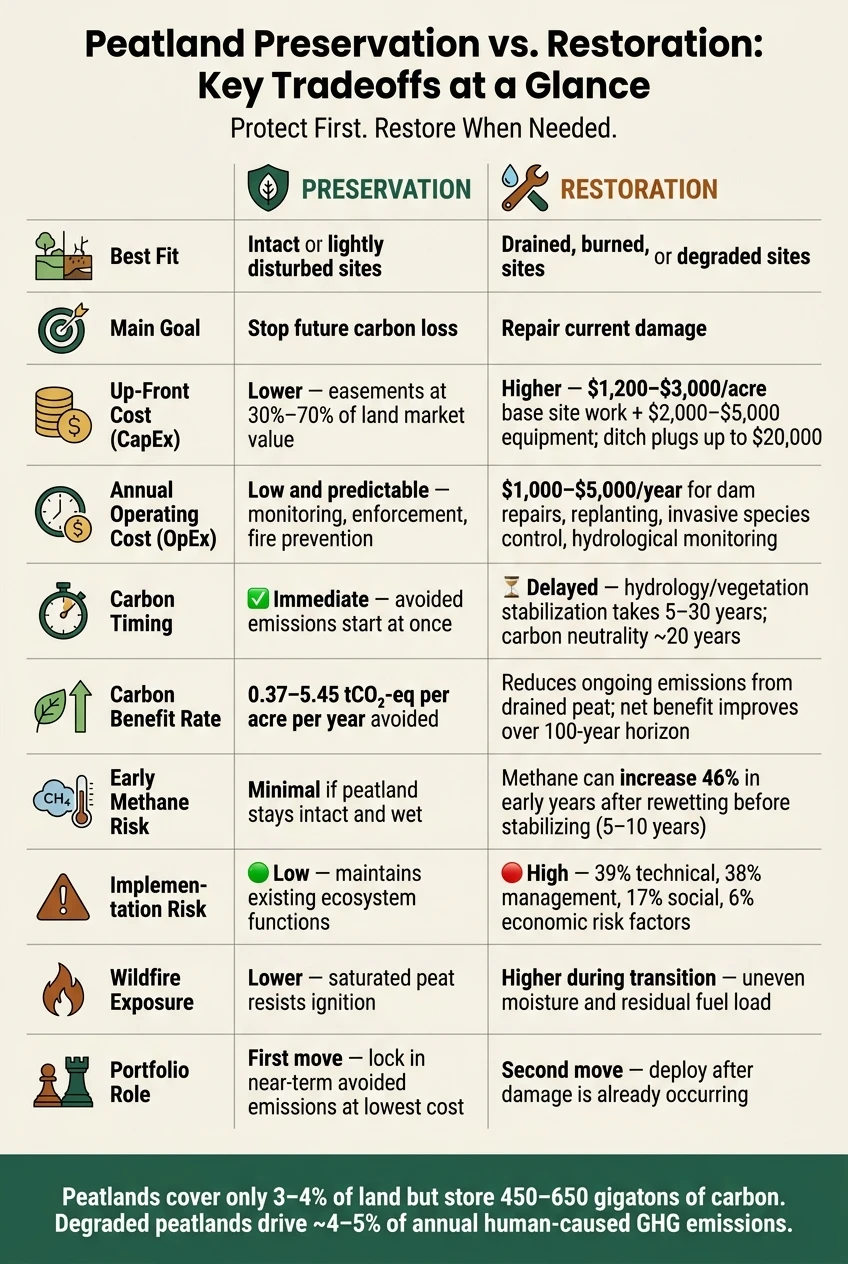
Peatland Preservation vs Restoration: Cost, Carbon & Risk Comparison
Peatland ACTION case study - Ben Wyvis
Direct Cost Comparison: Lower Up-Front Protection vs. Higher Up-Front Recovery
In capital planning, preservation usually comes with lower CapEx and low OpEx. Restoration is different. It tends to need more money up front, then years of follow-up work. The core issue is simple: is it cheaper to prevent damage now, or pay later to fix it after the fact?
Preservation Cost Structure
Preservation costs usually start with land acquisition or an easement. Easements often cost 30%–70% of market value, depending on the limits attached to the agreement and local land prices. Once the deal closes, yearly costs are often limited to monitoring, enforcement, outreach, and fire prevention.
One thing that gets missed in many preservation budgets is opportunity cost. If the land has strong development or farm value, the income or use given up can be larger than the cash price of the easement itself.
Restoration Cost Structure
Preservation is often shaped like a transaction. Restoration looks more like a project build. Most of the spending lands in the first 1–3 years, covering design, permitting, mobilization, drain blocking, rewetting, revegetation, and site cleanup. A U.S. state agency technical guide for peatland restoration estimates site preparation, donor material harvest, installation, and maintenance at roughly $1,200–$3,000 per acre, with equipment costs adding another $2,000–$5,000, and individual ditch plugs ranging from a few thousand dollars up to $20,000 for complex sites.[1] If a site sits near roads, homes, or other structures, that can add $5,000–$20,000 or more to total project costs.[1]
After construction, the meter keeps running. Restoration projects often need dam repairs, follow-up planting, invasive species control, and hydrological monitoring. Those post-build costs are estimated at $1,000–$5,000 per year depending on site conditions.[1] In other words, this is recurring OpEx that can stick around for years.
Preservation | Restoration | |
|---|---|---|
Main cost components | Easements or acquisition, legal fees, monitoring, fire prevention | Rewetting works, drain blocking, site engineering, revegetation, contractor costs |
Timing of spend | One-time legal spend, then low annual stewardship | Heavy upfront buildout, then ongoing maintenance |
Indicative U.S. cost pattern | Lower up-front; low, predictable annual operating costs | Higher one-time capital; variable multi-year follow-up costs |
Primary cost drivers | Land value, opportunity cost of competing uses | Site degradation level, hydrological complexity, remoteness, permitting |
How to Read Cost Ranges Without Overgeneralizing
Per-acre numbers can be useful, but they can also flatten big differences between sites. On the restoration side, simple drain blocking on a lightly degraded area is nothing like bare peat stabilization with geotextiles, which can run $9,000–$12,000 per hectare - about $3,600–$4,900 per acre - in complex cases.[2][3] Remoteness, permitting demands, and the level of hydrological disruption can all move costs up or down by a lot.
For capital planning, the smartest move is to separate one-time CapEx from recurring OpEx before putting preservation and restoration side by side in a budget cycle. That view shows when cash actually goes out the door. It also gives a better read on funding fit, near-term budget pressure, and long-range value.
Cost is only one piece of the choice; the next issue is how fast each path starts producing carbon value.
Carbon Results and Timelines: Immediate Avoided Loss vs. Slower Recovery
Cost is only part of the story. Timing shapes capital value too. For capital planners, one question sits right at the center: when does the carbon benefit appear? Preservation and restoration do not move on the same clock, and that matters when a site is tied to near-term decarbonization goals. It also shapes the next call: which path matches the site's risk profile and policy limits?
Why Preservation Often Delivers Faster Climate Value
Protecting an intact peatland prevents new emissions right away and keeps stored carbon in place. Project Drawdown estimates that protecting one hectare of peatland avoids about 0.92–13.47 metric tons of CO₂-equivalent per hectare per year, or around 0.37–5.45 tCO₂-eq per acre per year for U.S. planning use.[5] The exact rate shifts by climate, but the main point is simple: avoided emissions start immediately and continue as long as protection stays in force. That speed lines up well with 2030 targets.
Why Restoration Can Still Be Necessary
Once land has already been drained, preservation is no longer enough. Drained peatlands keep emitting, releasing an estimated 1.9 gigatons of CO₂-equivalent per year - about 5% of global anthropogenic greenhouse gas emissions - while covering only about 0.3% of Earth's landmass.[8] In cases like that, restoration is the path left to cut those losses.
After rewetting, CO₂ and N₂O tend to drop, but methane often moves in the other direction at first. A meta-analysis of northern peatlands found that rewetting increased methane emissions by 46%, even though drainage had earlier reduced it by 84%.[9] That can make early-year results look rougher than expected. Over a 100-year period, though, the net warming effect is usually lower.
Recovery also takes time. Methane patterns often settle once peatland vegetation returns, and that can take 5–10 years.[6] Some forested peat systems may need 15–30 years before they show functions typical of pristine peatlands.[7] Restored peat extraction sites have been shown to move toward carbon neutrality in about 20 years, and after that they can shift into steady sequestration.[4] For teams working toward 2050 goals, that can still fit the plan - if they begin with the right expectations about delayed payback.
Carbon timing matters, but it is not the only thing on the table. In practice, land tenure, wildfire risk, and permitting often decide what can actually move forward.
Dimension | Preservation | Restoration |
|---|---|---|
Carbon mechanism | Avoids future oxidation and protects existing carbon stocks | Reduces ongoing emissions from drained peat and rebuilds sequestration over time |
Time to benefit | Immediate once drainage or conversion is prevented | Delayed; hydrology and vegetation often take years to stabilize |
Early methane issue | Usually minimal if the peatland stays intact and wet | Often higher in early years after rewetting |
Durability | High if land-use protection is durable | Improves over time, but lost carbon stock is not quickly recovered |
Modeling issue | Estimating counterfactual avoided emissions | Choosing the right time horizon and methane weighting |
Run both 20-year and 100-year GWP analyses to capture short-term methane effects and long-run net warming.[10] A restoration project can look weaker than it is when methane gets heavy weight over a short window, even if the long-term warming cut is large. That framing leads straight into the next choice: protection, rewetting, or some mix of the two.
Risk and Policy Fit: When Each Option Makes More Sense
Once cost and carbon timing are clear, the next screen is risk. That’s usually where the choice gets sharper. A site isn’t picked on price alone; its risk profile, governance setting, and policy fit matter just as much.
Lower-Risk Cases for Preservation
Preservation makes the most sense for intact or lightly disturbed peatlands with high water tables and a clear threat of drainage or conversion. In those cases, avoided-loss accounting is easier to verify. The logic is straightforward: keep the system wet and intact, and you prevent damage before it starts.
Wet peatlands also tend to face less wildfire exposure. Saturated peat can act as a natural firebreak under normal conditions, although extreme drought can still increase ignition risk.
If those conditions aren’t in place, protection starts to lose ground. At that point, the case usually shifts toward repair.
Higher-Need Cases for Restoration
When a peatland has already been drained, burned over and over, or is subsiding, restoration becomes the only route that can cut fire, flood, and liability exposure. As peat dries out, wildfire risk climbs. Subsidence can also weaken nearby roads, buildings, and other infrastructure while making flood exposure worse over time. For landowners and operators, that can turn into regulatory and reputational liability.
Restoration is harder to carry out than preservation. A study of peat restoration actors in Indonesia found that 39% of risks were technical, 38% management, 17% social, and 6% economic; 15% were extreme and 22% high.[11] MRV is also more demanding because emissions fluxes shift as hydrology recovers.
Still, on sites already carrying material climate, safety, and compliance risk, restoration can be the better risk-adjusted choice. It deals with liabilities that protection alone can’t fix after the damage is already done.
Risk Category | Preservation Profile | Restoration Profile | Policy Alignment |
|---|---|---|---|
Implementation Risk | Low; maintains existing ecosystem functions | High; requires active engineering and rewetting | Preservation is typically the first-line option |
Carbon Accounting | Moderate; avoided-loss baselines are simpler to verify | High; complex flux modeling and permanence risk | Avoided-emissions accounting is clearer for preservation |
Wildfire & Drought Exposure | Lower; wet peat resists ignition under normal conditions | Higher; transition periods can leave uneven moisture and residual fuel | Rewetting helps reduce fire risk but needs drought contingencies |
Stakeholder & Governance | Simpler; often preserves existing land use | Complex; may require livelihood transitions and more coordination | Both require consent; restoration usually needs deeper engagement |
Policy Fit | Conservation and nature-based-solution mandates | Resilience and disaster-risk-reduction mandates | Global guidance generally favors protect first, restore second |
Where Council Fire Can Support Decision-Making
For portfolio decisions, this kind of risk map is more than a planning exercise. It helps teams decide where to preserve, where to restore, and how to line up the work with stakeholder expectations. Council Fire supports that process by mapping peatland risk, sorting preservation versus restoration priorities, and turning that mix into action.
Conclusion: How to Choose Preservation, Restoration, or Both
Start with intact peatlands. Protect those first. Then move to drained or degraded sites that need repair. Use both approaches only when a landscape includes a mix of conditions. Preservation is cheaper and faster. Restoration takes more money, more time, and more technical work, so it makes sense when damage is already there.
Once you apply that rule, the cost decision becomes pretty clear. Preservation cuts avoided emissions right away and usually does so at a lower cost per ton. Restoration asks for more capital and patience, but when a site is already leaking carbon into the atmosphere, it’s the only path that fits the problem. And timing isn’t a side issue here. Waiting to restore means waiting for climate gains too.
That shapes the order of action. Put money into intact sites first, then target the degraded sites with the highest emissions. In practice, that means locking in preservation on high-integrity areas to secure near-term avoided emissions at the lowest cost, then sending capital to the most emission-intensive degraded sites, where continued losses make doing nothing the riskier call. In mixed landscapes, a blended portfolio can work well: protect intact core areas while phasing restoration across drained edges within one financing framework.
Council Fire helps map peatland integrity, set priorities for preservation and restoration, and sequence projects around capital and climate goals.
FAQs
How do I know if a peatland needs preservation or restoration?
Preservation is the right move for peatlands that are still intact and working as they should. In most cases, stopping damage before it starts costs less than trying to repair it later.
Restoration comes into play when a site has already been harmed by drainage, land-use change, or pollution. But before jumping in, it helps to look at the signs on the ground. Check land cover, land productivity, and soil organic carbon stocks. If those are slipping, the site is degrading.
Restoration has a shot only when the root causes of that decline are clear and dealt with. If drainage, pollution, or damaging land use continues, repair efforts can stall fast.
Which option usually has a better cost per ton of emissions reduced?
Preservation usually costs less than restoration. Restoration matters when you need to bring an ecosystem back to health, but it often takes hands-on work like earthmoving and planting. That work adds time, labor, and expense.
Preservation, by contrast, protects systems that are already working. Those systems are already storing carbon and helping communities adapt to climate stress. In many cases, it’s cheaper to keep those benefits in place than to fix damage later. That’s why preservation often delivers a lower cost per ton of emissions reduced.
How should I prioritize projects in a mixed peatland landscape?
Follow the mitigation hierarchy: avoid, then reduce, then reverse. Start by protecting intact, working peatlands. In most cases, avoidance costs less than restoration, and it stops stored carbon from oxidizing in the first place.
For damaged areas, fix the source of the problem before you restore the site. That may mean dealing with upstream drainage or other drivers of damage. When possible, use passive restoration and let natural processes do more of the work. Save active restoration for sites that are badly degraded. Site selection should also fit the bigger picture, including landscape context, carbon outcomes, and biodiversity goals.
Related Blog Posts
How to Develop a Nature-Based Solutions Strategy for Corporations
How to Finance Green and Nature-Based Infrastructure for Corporations
How to Finance Green and Nature-Based Infrastructure for NGOs & Nonprofits
How to Finance Green and Nature-Based Infrastructure for Foundations & Philanthropic Organizations
Latest Articles
©2026

Narrative Change and Power Building: The Missing Half of Advocacy
Narrative change is the process of disrupting dominant narratives that normalize inequity and advancing new narratives from historically marginalized communities.
Funding Resilience Without Federal Grants
BRIC is unreliable and FEMA is shrinking. Here's how cities fund climate resilience with dedicated revenue, blended finance, and a coordinating authority.

The ESG Blind Spot: How AI Is Finding Risks in Companies Nobody Else Is Watching
Norway's sovereign wealth fund uses AI to screen 7,200 portfolio companies for forced labor and corruption within 24 hours. The real story is the emerging-market coverage gap that traditional ESG data vendors miss — and what it means for any company with a global supply chain.
Narrative Change and Power Building: The Missing Half of Advocacy
Narrative change is the process of disrupting dominant narratives that normalize inequity and advancing new narratives from historically marginalized communities.
Funding Resilience Without Federal Grants
BRIC is unreliable and FEMA is shrinking. Here's how cities fund climate resilience with dedicated revenue, blended finance, and a coordinating authority.
The ESG Blind Spot: How AI Is Finding Risks in Companies Nobody Else Is Watching
Norway's sovereign wealth fund uses AI to screen 7,200 portfolio companies for forced labor and corruption within 24 hours. The real story is the emerging-market coverage gap that traditional ESG data vendors miss — and what it means for any company with a global supply chain.
FAQ
01
What does it really mean to “redefine profit”?
02
What makes Council Fire different?
03
Who does Council Fire work with?
04
What does working with Council Fire actually look like?
05
How does Council Fire help organizations turn big goals into action?
06
How does Council Fire define and measure success?
07
How does technology fit into Council Fire’s work?
Sep 10, 2026
Peatland Preservation vs Restoration: Cost Tradeoffs
Sustainability Strategy
In This Article
Compare costs, carbon timing, and risks of protecting intact peatlands versus restoring degraded sites for practical capital planning.
Peatland Preservation vs Restoration: Cost Tradeoffs
If a peatland is still intact, I’d protect it first. If it has already been drained or burned, I’d plan for restoration. That is the short answer because preservation usually costs less up front, starts cutting emissions at once, and comes with fewer project risks. Restoration costs more, takes longer, and often needs years of follow-up work, but it is the only option once damage is already in place.
I read this as a capital planning choice with a clear order:
Protect intact peatlands first to avoid new emissions now
Restore damaged peatlands next to cut emissions that are already happening
Use a mixed plan when a landscape has both intact and degraded areas
Split one-time spend from annual spend before comparing options
Check carbon timing, since preservation delivers now while restoration may take 5–30 years to settle into expected results
A few numbers frame the decision fast:
Peatlands cover only 3%–4% of land but store about 450–650 gigatons of soil carbon
Degraded peatlands drive about 4%–5% of annual human-caused greenhouse gas emissions
Preservation can avoid about 0.37–5.45 tCO₂-eq per acre per year
Restoration work can run from about $1,200–$3,000 per acre for base site work, plus $2,000–$5,000 in equipment and more for ditch plugs, access limits, and follow-up care
Post-project restoration costs can add $1,000–$5,000 per year
My takeaway: preservation is usually the lower-cost, lower-risk first move; restoration is the higher-cost repair job you take on when the site is already losing carbon, water control, or fire safety.
Quick Comparison
Factor | Preservation | Restoration |
|---|---|---|
Best fit | Intact or lightly disturbed sites | Drained, burned, or degraded sites |
Main goal | Stop future loss | Repair current damage |
Up-front cost | Lower | Higher |
Annual cost | Lower and more predictable | Higher follow-up needs |
Carbon timing | Immediate | Slower, often years to decades |
Project risk | Lower | Higher |
Main cost drivers | Land price, easements, lost use value | Hydrology, site condition, access, permits |
Best use in a portfolio | First move | Second move after damage occurs |
If I were screening projects, I’d start with site condition, then map cost, carbon timing, wildfire exposure, land control, and policy fit before choosing preservation, restoration, or both.
Peatland Preservation vs Restoration: Cost, Carbon & Risk Comparison
Peatland ACTION case study - Ben Wyvis
Direct Cost Comparison: Lower Up-Front Protection vs. Higher Up-Front Recovery
In capital planning, preservation usually comes with lower CapEx and low OpEx. Restoration is different. It tends to need more money up front, then years of follow-up work. The core issue is simple: is it cheaper to prevent damage now, or pay later to fix it after the fact?
Preservation Cost Structure
Preservation costs usually start with land acquisition or an easement. Easements often cost 30%–70% of market value, depending on the limits attached to the agreement and local land prices. Once the deal closes, yearly costs are often limited to monitoring, enforcement, outreach, and fire prevention.
One thing that gets missed in many preservation budgets is opportunity cost. If the land has strong development or farm value, the income or use given up can be larger than the cash price of the easement itself.
Restoration Cost Structure
Preservation is often shaped like a transaction. Restoration looks more like a project build. Most of the spending lands in the first 1–3 years, covering design, permitting, mobilization, drain blocking, rewetting, revegetation, and site cleanup. A U.S. state agency technical guide for peatland restoration estimates site preparation, donor material harvest, installation, and maintenance at roughly $1,200–$3,000 per acre, with equipment costs adding another $2,000–$5,000, and individual ditch plugs ranging from a few thousand dollars up to $20,000 for complex sites.[1] If a site sits near roads, homes, or other structures, that can add $5,000–$20,000 or more to total project costs.[1]
After construction, the meter keeps running. Restoration projects often need dam repairs, follow-up planting, invasive species control, and hydrological monitoring. Those post-build costs are estimated at $1,000–$5,000 per year depending on site conditions.[1] In other words, this is recurring OpEx that can stick around for years.
Preservation | Restoration | |
|---|---|---|
Main cost components | Easements or acquisition, legal fees, monitoring, fire prevention | Rewetting works, drain blocking, site engineering, revegetation, contractor costs |
Timing of spend | One-time legal spend, then low annual stewardship | Heavy upfront buildout, then ongoing maintenance |
Indicative U.S. cost pattern | Lower up-front; low, predictable annual operating costs | Higher one-time capital; variable multi-year follow-up costs |
Primary cost drivers | Land value, opportunity cost of competing uses | Site degradation level, hydrological complexity, remoteness, permitting |
How to Read Cost Ranges Without Overgeneralizing
Per-acre numbers can be useful, but they can also flatten big differences between sites. On the restoration side, simple drain blocking on a lightly degraded area is nothing like bare peat stabilization with geotextiles, which can run $9,000–$12,000 per hectare - about $3,600–$4,900 per acre - in complex cases.[2][3] Remoteness, permitting demands, and the level of hydrological disruption can all move costs up or down by a lot.
For capital planning, the smartest move is to separate one-time CapEx from recurring OpEx before putting preservation and restoration side by side in a budget cycle. That view shows when cash actually goes out the door. It also gives a better read on funding fit, near-term budget pressure, and long-range value.
Cost is only one piece of the choice; the next issue is how fast each path starts producing carbon value.
Carbon Results and Timelines: Immediate Avoided Loss vs. Slower Recovery
Cost is only part of the story. Timing shapes capital value too. For capital planners, one question sits right at the center: when does the carbon benefit appear? Preservation and restoration do not move on the same clock, and that matters when a site is tied to near-term decarbonization goals. It also shapes the next call: which path matches the site's risk profile and policy limits?
Why Preservation Often Delivers Faster Climate Value
Protecting an intact peatland prevents new emissions right away and keeps stored carbon in place. Project Drawdown estimates that protecting one hectare of peatland avoids about 0.92–13.47 metric tons of CO₂-equivalent per hectare per year, or around 0.37–5.45 tCO₂-eq per acre per year for U.S. planning use.[5] The exact rate shifts by climate, but the main point is simple: avoided emissions start immediately and continue as long as protection stays in force. That speed lines up well with 2030 targets.
Why Restoration Can Still Be Necessary
Once land has already been drained, preservation is no longer enough. Drained peatlands keep emitting, releasing an estimated 1.9 gigatons of CO₂-equivalent per year - about 5% of global anthropogenic greenhouse gas emissions - while covering only about 0.3% of Earth's landmass.[8] In cases like that, restoration is the path left to cut those losses.
After rewetting, CO₂ and N₂O tend to drop, but methane often moves in the other direction at first. A meta-analysis of northern peatlands found that rewetting increased methane emissions by 46%, even though drainage had earlier reduced it by 84%.[9] That can make early-year results look rougher than expected. Over a 100-year period, though, the net warming effect is usually lower.
Recovery also takes time. Methane patterns often settle once peatland vegetation returns, and that can take 5–10 years.[6] Some forested peat systems may need 15–30 years before they show functions typical of pristine peatlands.[7] Restored peat extraction sites have been shown to move toward carbon neutrality in about 20 years, and after that they can shift into steady sequestration.[4] For teams working toward 2050 goals, that can still fit the plan - if they begin with the right expectations about delayed payback.
Carbon timing matters, but it is not the only thing on the table. In practice, land tenure, wildfire risk, and permitting often decide what can actually move forward.
Dimension | Preservation | Restoration |
|---|---|---|
Carbon mechanism | Avoids future oxidation and protects existing carbon stocks | Reduces ongoing emissions from drained peat and rebuilds sequestration over time |
Time to benefit | Immediate once drainage or conversion is prevented | Delayed; hydrology and vegetation often take years to stabilize |
Early methane issue | Usually minimal if the peatland stays intact and wet | Often higher in early years after rewetting |
Durability | High if land-use protection is durable | Improves over time, but lost carbon stock is not quickly recovered |
Modeling issue | Estimating counterfactual avoided emissions | Choosing the right time horizon and methane weighting |
Run both 20-year and 100-year GWP analyses to capture short-term methane effects and long-run net warming.[10] A restoration project can look weaker than it is when methane gets heavy weight over a short window, even if the long-term warming cut is large. That framing leads straight into the next choice: protection, rewetting, or some mix of the two.
Risk and Policy Fit: When Each Option Makes More Sense
Once cost and carbon timing are clear, the next screen is risk. That’s usually where the choice gets sharper. A site isn’t picked on price alone; its risk profile, governance setting, and policy fit matter just as much.
Lower-Risk Cases for Preservation
Preservation makes the most sense for intact or lightly disturbed peatlands with high water tables and a clear threat of drainage or conversion. In those cases, avoided-loss accounting is easier to verify. The logic is straightforward: keep the system wet and intact, and you prevent damage before it starts.
Wet peatlands also tend to face less wildfire exposure. Saturated peat can act as a natural firebreak under normal conditions, although extreme drought can still increase ignition risk.
If those conditions aren’t in place, protection starts to lose ground. At that point, the case usually shifts toward repair.
Higher-Need Cases for Restoration
When a peatland has already been drained, burned over and over, or is subsiding, restoration becomes the only route that can cut fire, flood, and liability exposure. As peat dries out, wildfire risk climbs. Subsidence can also weaken nearby roads, buildings, and other infrastructure while making flood exposure worse over time. For landowners and operators, that can turn into regulatory and reputational liability.
Restoration is harder to carry out than preservation. A study of peat restoration actors in Indonesia found that 39% of risks were technical, 38% management, 17% social, and 6% economic; 15% were extreme and 22% high.[11] MRV is also more demanding because emissions fluxes shift as hydrology recovers.
Still, on sites already carrying material climate, safety, and compliance risk, restoration can be the better risk-adjusted choice. It deals with liabilities that protection alone can’t fix after the damage is already done.
Risk Category | Preservation Profile | Restoration Profile | Policy Alignment |
|---|---|---|---|
Implementation Risk | Low; maintains existing ecosystem functions | High; requires active engineering and rewetting | Preservation is typically the first-line option |
Carbon Accounting | Moderate; avoided-loss baselines are simpler to verify | High; complex flux modeling and permanence risk | Avoided-emissions accounting is clearer for preservation |
Wildfire & Drought Exposure | Lower; wet peat resists ignition under normal conditions | Higher; transition periods can leave uneven moisture and residual fuel | Rewetting helps reduce fire risk but needs drought contingencies |
Stakeholder & Governance | Simpler; often preserves existing land use | Complex; may require livelihood transitions and more coordination | Both require consent; restoration usually needs deeper engagement |
Policy Fit | Conservation and nature-based-solution mandates | Resilience and disaster-risk-reduction mandates | Global guidance generally favors protect first, restore second |
Where Council Fire Can Support Decision-Making
For portfolio decisions, this kind of risk map is more than a planning exercise. It helps teams decide where to preserve, where to restore, and how to line up the work with stakeholder expectations. Council Fire supports that process by mapping peatland risk, sorting preservation versus restoration priorities, and turning that mix into action.
Conclusion: How to Choose Preservation, Restoration, or Both
Start with intact peatlands. Protect those first. Then move to drained or degraded sites that need repair. Use both approaches only when a landscape includes a mix of conditions. Preservation is cheaper and faster. Restoration takes more money, more time, and more technical work, so it makes sense when damage is already there.
Once you apply that rule, the cost decision becomes pretty clear. Preservation cuts avoided emissions right away and usually does so at a lower cost per ton. Restoration asks for more capital and patience, but when a site is already leaking carbon into the atmosphere, it’s the only path that fits the problem. And timing isn’t a side issue here. Waiting to restore means waiting for climate gains too.
That shapes the order of action. Put money into intact sites first, then target the degraded sites with the highest emissions. In practice, that means locking in preservation on high-integrity areas to secure near-term avoided emissions at the lowest cost, then sending capital to the most emission-intensive degraded sites, where continued losses make doing nothing the riskier call. In mixed landscapes, a blended portfolio can work well: protect intact core areas while phasing restoration across drained edges within one financing framework.
Council Fire helps map peatland integrity, set priorities for preservation and restoration, and sequence projects around capital and climate goals.
FAQs
How do I know if a peatland needs preservation or restoration?
Preservation is the right move for peatlands that are still intact and working as they should. In most cases, stopping damage before it starts costs less than trying to repair it later.
Restoration comes into play when a site has already been harmed by drainage, land-use change, or pollution. But before jumping in, it helps to look at the signs on the ground. Check land cover, land productivity, and soil organic carbon stocks. If those are slipping, the site is degrading.
Restoration has a shot only when the root causes of that decline are clear and dealt with. If drainage, pollution, or damaging land use continues, repair efforts can stall fast.
Which option usually has a better cost per ton of emissions reduced?
Preservation usually costs less than restoration. Restoration matters when you need to bring an ecosystem back to health, but it often takes hands-on work like earthmoving and planting. That work adds time, labor, and expense.
Preservation, by contrast, protects systems that are already working. Those systems are already storing carbon and helping communities adapt to climate stress. In many cases, it’s cheaper to keep those benefits in place than to fix damage later. That’s why preservation often delivers a lower cost per ton of emissions reduced.
How should I prioritize projects in a mixed peatland landscape?
Follow the mitigation hierarchy: avoid, then reduce, then reverse. Start by protecting intact, working peatlands. In most cases, avoidance costs less than restoration, and it stops stored carbon from oxidizing in the first place.
For damaged areas, fix the source of the problem before you restore the site. That may mean dealing with upstream drainage or other drivers of damage. When possible, use passive restoration and let natural processes do more of the work. Save active restoration for sites that are badly degraded. Site selection should also fit the bigger picture, including landscape context, carbon outcomes, and biodiversity goals.
Related Blog Posts
How to Develop a Nature-Based Solutions Strategy for Corporations
How to Finance Green and Nature-Based Infrastructure for Corporations
How to Finance Green and Nature-Based Infrastructure for NGOs & Nonprofits
How to Finance Green and Nature-Based Infrastructure for Foundations & Philanthropic Organizations
Latest Articles
©2026
Narrative Change and Power Building: The Missing Half of Advocacy
Narrative change is the process of disrupting dominant narratives that normalize inequity and advancing new narratives from historically marginalized communities.
Funding Resilience Without Federal Grants
BRIC is unreliable and FEMA is shrinking. Here's how cities fund climate resilience with dedicated revenue, blended finance, and a coordinating authority.
The ESG Blind Spot: How AI Is Finding Risks in Companies Nobody Else Is Watching
Norway's sovereign wealth fund uses AI to screen 7,200 portfolio companies for forced labor and corruption within 24 hours. The real story is the emerging-market coverage gap that traditional ESG data vendors miss — and what it means for any company with a global supply chain.
FAQ
What does it really mean to “redefine profit”?
What makes Council Fire different?
Who does Council Fire work with?
What does working with Council Fire actually look like?
How does Council Fire help organizations turn big goals into action?
How does Council Fire define and measure success?
How does technology fit into Council Fire’s work?