
May 3, 2026
How to Finance Green and Nature-Based Infrastructure for Foundations & Philanthropic Organizations
Sustainability Strategy
In This Article
How foundations can finance green and nature-based infrastructure using grants, impact investments, bonds, and blended finance tools.
How to Finance Green and Nature-Based Infrastructure for Foundations & Philanthropic Organizations
Philanthropy can close funding gaps for green infrastructure projects. Foundations play a critical role in financing initiatives like urban green spaces and ecosystem restoration, which provide long-term social and environmental benefits. However, challenges such as small project sizes, lack of consistent revenue streams, and limited private investment often hinder progress. This article explores practical funding strategies to overcome these barriers.
Key Takeaways:
Lifecycle Costs: Budget for all expenses, including long-term maintenance, not just upfront costs.
Pay-for-Success Models: Tie payments to measurable results, reducing financial risk.
Grants & Impact Investments: Combine federal/state grants (e.g., Clean Water State Revolving Fund) with philanthropic funds for greater impact.
Alternative Financing: Use green bonds, stormwater fees, and public-private partnerships to scale funding.
Risk Mitigation: Tools like first-loss capital and bridge loans can attract private investors by reducing perceived risks.
By leveraging these methods, foundations can drive impactful green infrastructure projects while addressing financial challenges.
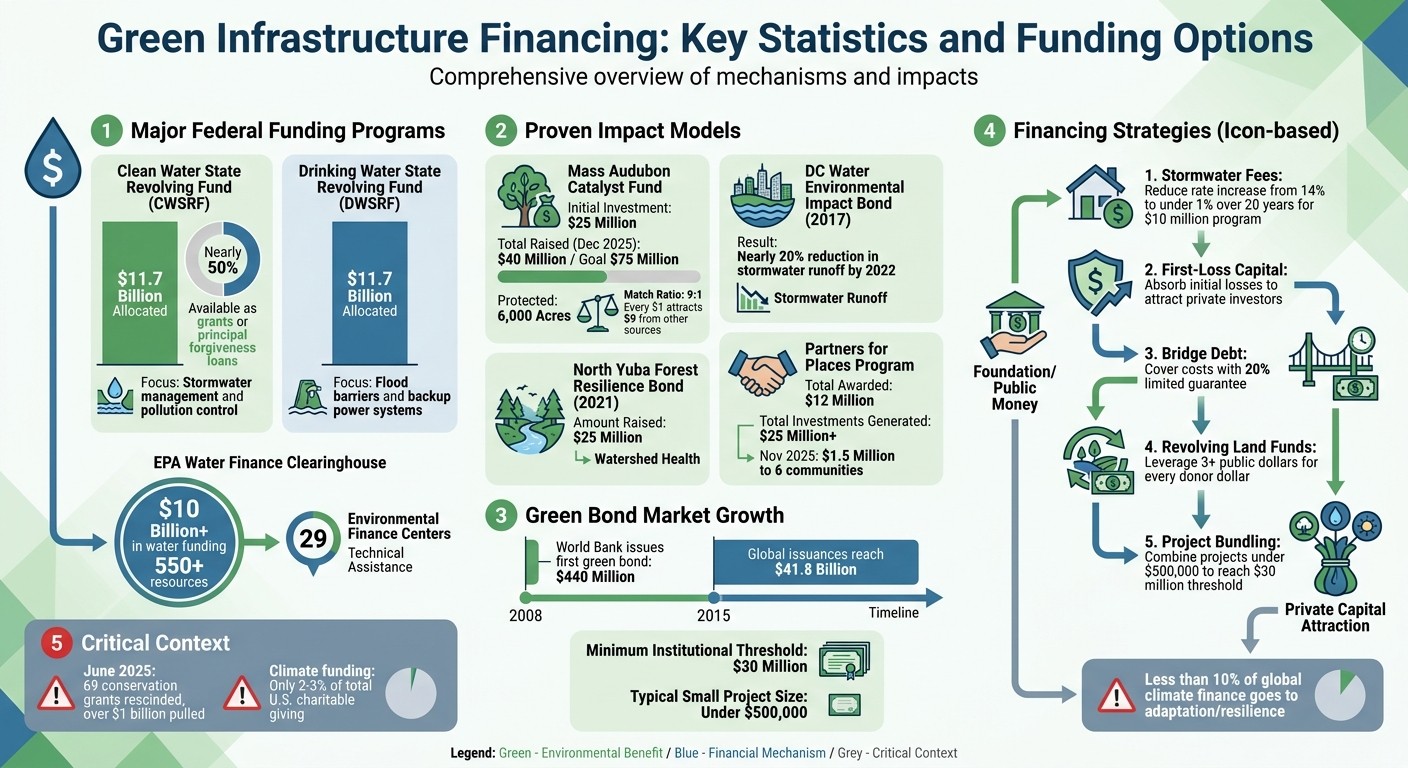
Green Infrastructure Financing Options and Impact Statistics for Foundations
Challenges to Financing Greener Solutions in Cities | Bloomberg Philanthropies

Assessing Funding Requirements and Project Fit
Foundations must carefully evaluate both the full costs of a project and its alignment with their mission. This thorough assessment lays the groundwork for exploring grants, impact investments, and alternative financing options, which are discussed in later sections.
Calculating Lifecycle Costs
Green infrastructure projects often come with costs that extend far beyond initial construction. A complete financial plan should account for land acquisition, installation, ongoing maintenance, and monitoring over time. Focusing solely on upfront expenses can lead to underestimating the true financial commitment required.
Timing of costs can also complicate matters. Grace Edinger and Phoebe Higgins highlight this challenge:
The project costs come well before the revenue, creating a financing gap. A bridge debt facility could help solve this problem... by offering a loan to cover the time between the project cost and the final payment [2].
For instance, a riparian forest buffer project, which typically costs under $500,000 [2], might need significant investment in land acquisition and planting long before funding from grants or environmental outcome payments becomes available.
Pay-for-success (PFS) models offer a solution by tying payments to verified outcomes, which transforms uncertain revenue into predictable cash flows. Bridge debt can then cover upfront expenses until grants or outcome payments are received. With a limited guarantee - 20% of the project value [2] - this approach reduces overall risk. As Edinger and Higgins explain:
The PFS model encourages greater private sector participation in restoration projects by guaranteeing payment for verified outcomes so project developers can anticipate revenues and plan project costs and financing accordingly [2].
Matching Projects to Your Mission
Even the most financially sound project is not worthwhile if it doesn’t align with your core mission. The primary question is whether your investment achieves additionality - delivering outcomes that would not happen without your support. For example, by taking a first-loss position in a blended finance structure, a foundation can both fund a project and attract private capital that might otherwise remain untapped. Edinger and Higgins emphasize:
Concessional first loss capital can be used effectively... to improve additionality by helping coerce market-rate participants to participate in a transaction they otherwise would not have [1].
Foundations must also decide whether their mission is better served by fostering early-stage innovation or by scaling proven solutions. Many companies focused on nature-based solutions have effective technologies but lack the capital to grow. A $50 million investment [2] could seed a growth equity fund to help these businesses enter mainstream markets. Alternatively, smaller investments - less than $5 million [2] - in policy advocacy could create the regulatory conditions needed to sustain green infrastructure over the long term.
Lastly, projects should align with policy initiatives that drive demand for environmental outcomes. It’s important to assess whether a project operates in a region that actively supports innovative regulatory frameworks, ensuring its long-term success. The upcoming section delves into how blending grants with impact investments can further enhance funding strategies.
Using Grants and Impact Investments
Foundations have the opportunity to extend their financial reach by combining grants with impact investments. The EPA’s Water Finance Clearinghouse simplifies the process, centralizing access to over $10 billion in water funding and more than 550 green infrastructure resources [3]. Federal and state grant programs, in particular, offer a pathway to low-cost capital and can support strategic environmental projects.
Accessing Federal and State Grants
The Clean Water State Revolving Fund (CWSRF) offers low-interest loans designed for stormwater management and nonpoint source pollution control. It also includes a "Green Project Reserve" that focuses on environmentally forward-thinking activities [4][5]. Thanks to the 2021 Bipartisan Infrastructure Law, the CWSRF received $11.7 billion, with nearly half allocated as grants or principal forgiveness loans specifically for underserved communities [4]. Similarly, the Drinking Water State Revolving Fund (DWSRF) was allocated an identical $11.7 billion to fund public health-focused infrastructure, such as flood barriers and backup power systems [4].
For those interested, contacting state CWSRF or DWSRF offices is a vital first step to understanding eligibility and application deadlines. To aid applicants, the EPA’s 29 Environmental Finance Centers (EFCs) offer tailored technical assistance [3]. For wetland restoration projects, programs like the Five Star Wetland and Urban Waters Restoration Program provide financial support for habitat restoration and stormwater management [5]. Combining these grants with impact investments can amplify the effects of funding, creating broader outcomes.
Combining Grants with Impact Investments
Merging grants with impact investments can establish funding models that recycle capital, allowing resources to support multiple projects over time. A notable example is Mass Audubon’s Catalyst Fund, which launched in June 2024 with a $25 million gift from MathWorks. This seed funding enabled the organization to secure matching grants and provide bridge financing for partners. By December 2025, the fund had raised over $40 million of its $75 million goal and protected 6,000 acres, achieving a 9:1 match ratio - each dollar from the fund attracted nine dollars from other sources [7].
The Arc of Appalachia in Ohio offers another compelling model with its "Revolving Land Fund." This fund is used to quickly purchase ecologically important land as soon as it becomes available on the market. The organization explains:
When properties come up on the real estate market, there is usually only a small window of time to buy them... Negotiating a fair sale price in a competitive market requires that we move quickly and have cash in hand [6].
Once grants from programs like Clean Ohio or the Water Resources Restoration Sponsor Program are secured, the land is formally purchased, and the funds are returned to the revolving pool for future acquisitions.
Private philanthropic funds also play a critical role in these efforts, often serving as the "match" required by federal grants. This approach can leverage three or more public dollars for every donor dollar [6]. By doing so, limited foundation resources can be transformed into significantly larger budgets, all while staying aligned with mission-driven goals.
Alternative Financing Methods for Green Infrastructure
Foundations looking to expand their funding options for green infrastructure projects have several alternative financing tools at their disposal. These approaches go beyond traditional grants, offering sustainable, long-term funding solutions. By exploring green bonds, stormwater fees, and public-private partnerships, organizations can tap into larger financial resources while distributing costs over time.
Issuing Green Bonds and Climate Bonds
Green bonds provide immediate funding for environmental projects, with repayment scheduled over the project’s lifespan. The World Bank pioneered this concept in 2008 with a green bond issuance of $440 million, and by 2015, global issuances had climbed to $41.8 billion [8]. Foundations can play a crucial role in making these bonds more attractive to private investors.
They can act as guarantors, offering credit guarantees or absorbing initial losses if the project underperforms. This approach reduces risk for market-rate investors [2][8]. Foundations can also serve as aggregators, combining smaller projects - those under $500,000 - into larger bond issuances that meet the $30 million threshold required by institutional investors [2].
Environmental Impact Bonds (EIBs) are another option, where repayment hinges on achieving specific outcomes. For instance, DC Water launched the first U.S. EIB in 2017 to address sewage overflow using green infrastructure. By 2022, third-party evaluations confirmed a nearly 20% reduction in stormwater runoff, meeting the bond’s performance goals [9]. Another example is the 2021 North Yuba Forest Resilience Bond, which raised $25 million for watershed health projects in California’s Northern Sierra. Investors included AAA Insurance and Calvert Impact Capital [9].
Charlotte Kaiser, Deputy Managing Director at NatureVest, highlights the growing demand for such opportunities:
There's a ton of interest among institutional clients for conservation or environmental investment opportunities, and limited product that's appropriate [8].
Green bonds are particularly effective for water and stormwater projects, as these often have clear regulatory requirements and existing user-fee structures to support repayment [8].
Implementing Stormwater Fees and Tax Increment Financing
Stormwater utility fees offer a consistent revenue stream by charging property owners based on the amount of impervious surface on their land - areas like pavement or roofing that prevent water absorption. These fees help fund both the maintenance of green infrastructure and new projects, removing the need for annual budget negotiations. For instance, financing a $10 million program over 20 years could reduce an immediate 14% rate increase to under 1% [9].
Tax increment financing (TIF) is another tool that captures the rise in property tax revenue resulting from infrastructure improvements in a specific area. As green infrastructure projects boost property values and attract development, the additional tax revenue can be used to repay the initial investment. This method is particularly effective in urban settings, where solutions like green roofs and bioswales visibly enhance neighborhood appeal.
Building Public-Private Partnerships
Public-private partnerships (PPPs) combine community engagement, technical expertise, and financial resources to drive larger-scale investments. For example, the Partners for Places program has awarded over $12 million, which has spurred more than $25 million in total investments [10]. In November 2025, six communities received $1.5 million in matching grants through the Jobs and Inclusive Infrastructure Initiative [10].
In 2025, the Gates Family Foundation provided a $1.25 million loan guarantee to the Colorado West Land Trust, enabling the acquisition of three irrigated farms in Montrose County. This initiative safeguarded senior water rights and restored riparian habitats [11]. Similarly, Palmer Land Conservancy used a $500,000 program-related investment from the same foundation to purchase a 620-acre farm, ensuring its water resources would not be depleted by 2039 [11].
Most partnerships require a 50% match from local foundations, fostering shared financial responsibility and strong community involvement [10]. Matching awards typically range from $45,000 to $100,000 for one-year projects and $75,000 to $150,000 for two-year initiatives [10].
Addressing Funding Challenges with Expert Support
Green infrastructure funding often faces hurdles tied to policy changes and the intricacies of long-term financial models. A striking example occurred in June 2025, when the federal government rescinded 69 conservation grants, pulling over $1 billion in funding. This abrupt shift forced organizations to rethink their strategies and seek more dependable funding sources [7]. Peter Howell, Director of the Conservation Finance Network, highlighted the gravity of the situation:
We're at a really critical inflection point right now, where the loss of that federal funding is going to affect the scale of conservation. It's created uncertainty; it's also putting a premium on innovation, on how to do more with less. [7]
This pressing need for adaptability underscores the importance of implementing a solid risk management framework, which we’ll delve into next.
Managing Risks with Financial Tools
Foundations can mitigate the risks tied to green infrastructure funding by employing a range of financial tools. One effective method is the use of first-loss capital structures. This approach allows philanthropic organizations to absorb initial losses, thereby making projects less risky and more attractive to investors seeking market-rate returns [1]. It’s a targeted way to address the current funding uncertainty while encouraging private investment.
Catalyst funds are another useful tool. These funds offer gap financing or low-interest loans, stepping in when government grants are delayed or withdrawn. Such mechanisms ensure projects can move forward without significant delays.
A third strategy involves bundling environmental credits - such as carbon offsets, water quality improvements, and biodiversity credits - into a single revenue stream. This reduces financial risks for both landowners and project developers. For example, the Sebago Clean Waters coalition in Maine partnered with a regional water utility to fund conservation easements upstream. This collaboration allowed the utility to avoid the massive expense of constructing a new water filtration plant, demonstrating how innovative financing can deliver cost-effective solutions [7].
Working with Council Fire for Custom Solutions
Navigating the complexities of blended financing and environmental policies requires expert guidance. Council Fire offers tailored solutions that align with the unique demands of regenerative infrastructure projects. By combining philanthropic funding with market-driven mechanisms, they craft financing models designed to close funding gaps effectively.
Council Fire specializes in leveraging blended finance tools like Pay for Success contracts, which guarantee payment only after environmental outcomes are verified. They also help bundle smaller projects into portfolios that meet the scale and standards required by institutional investors [1]. This approach ensures that even modest initiatives can attract significant funding.
Their expertise extends to stakeholder engagement, identifying downstream beneficiaries - such as water utilities or insurance companies - who can contribute to project costs. For instance, models like the Forest Resilience Bond allow multiple stakeholders to share financial responsibilities, creating a more sustainable funding structure. This type of collaboration is increasingly critical, given that climate-related funding accounts for just 2–3% of total U.S. charitable giving, with less than 10% of global climate finance directed toward adaptation and resilience efforts [12].
Conclusion
Combining grants with inventive financial tools is key to successful funding strategies. As previously mentioned, smaller policy investments paired with larger seed funds can open the door to significant market capital. By aligning diverse funding mechanisms with thoughtful risk management, foundations can bridge financing gaps and create lasting change.
Blended finance models are particularly effective in reducing risk for investors while drawing in private capital. Tools like first-loss capital and guarantee structures not only cushion risks but also encourage private sector participation. When debt investments are repaid, the recovered funds can be reinvested into new initiatives, fostering a self-sustaining cycle of progress [2].
Grace Edinger and Phoebe Higgins from the Environmental Policy Innovation Center emphasize this point:
Philanthropy plays a critical role in scaling these efforts by bridging gaps in financing, policy, and market coordination [2].
Organizations that excel in this space treat their capital as a strategic asset. They use concessional investments to build credibility, combine smaller projects into larger, institutional-scale portfolios, and work with experts who understand both environmental goals and financial structuring.
These approaches lay the foundation for a robust and adaptable financing model. Whether through bridge debt, advocating for policy reforms, or forming partnerships for customized funding solutions, success lies in going beyond traditional philanthropy and leveraging the full array of financial tools available.
FAQs
How do I know if a project fits our mission?
To assess if a project fits your mission, consider whether it delivers environmental advantages and tackles community or ecological priorities that align with your organization's values. Initiatives such as green infrastructure developments or efforts led by Indigenous communities that emphasize waterways, cultural preservation, or environmental justice often resonate with these goals. Make sure the project's aims and expected outcomes align with your sustainability priorities, and explore funding options that emphasize both environmental and social impact.
What costs should we budget beyond construction?
When planning a project, it’s vital to account for more than just the initial construction costs. Allocate funds for ongoing needs such as maintenance, monitoring, and evaluation to ensure the infrastructure remains effective in the long run. Additionally, set aside resources for technical assistance, community involvement, and capacity building, which are essential for maintaining the project's success and longevity. These efforts help ensure the initiative continues to deliver value over time.
How can we attract private investors to small projects?
To draw private investors to smaller-scale projects, it’s essential to use creative financial tools and present enticing opportunities. Some effective strategies include setting up regional resilience trust funds and tapping into grants, public funding, green bonds, or Tax Increment Financing (TIF) to mitigate risks and enhance potential returns. Collaborating with philanthropic organizations can also help close funding gaps. Highlighting environmental and social benefits, paired with clear and measurable impact metrics, further increases the appeal of these projects to private capital.
Related Blog Posts
Latest Articles
©2025

Narrative Change and Power Building: The Missing Half of Advocacy
Narrative change is the process of disrupting dominant narratives that normalize inequity and advancing new narratives from historically marginalized communities.

Funding Resilience Without Federal Grants
BRIC is unreliable and FEMA is shrinking. Here's how cities fund climate resilience with dedicated revenue, blended finance, and a coordinating authority.

The ESG Blind Spot: How AI Is Finding Risks in Companies Nobody Else Is Watching
Norway's sovereign wealth fund uses AI to screen 7,200 portfolio companies for forced labor and corruption within 24 hours. The real story is the emerging-market coverage gap that traditional ESG data vendors miss — and what it means for any company with a global supply chain.
Narrative Change and Power Building: The Missing Half of Advocacy
Narrative change is the process of disrupting dominant narratives that normalize inequity and advancing new narratives from historically marginalized communities.
Funding Resilience Without Federal Grants
BRIC is unreliable and FEMA is shrinking. Here's how cities fund climate resilience with dedicated revenue, blended finance, and a coordinating authority.
The ESG Blind Spot: How AI Is Finding Risks in Companies Nobody Else Is Watching
Norway's sovereign wealth fund uses AI to screen 7,200 portfolio companies for forced labor and corruption within 24 hours. The real story is the emerging-market coverage gap that traditional ESG data vendors miss — and what it means for any company with a global supply chain.
FAQ
01
What does it really mean to “redefine profit”?
02
What makes Council Fire different?
03
Who does Council Fire work with?
04
What does working with Council Fire actually look like?
05
How does Council Fire help organizations turn big goals into action?
06
How does Council Fire define and measure success?
May 3, 2026
How to Finance Green and Nature-Based Infrastructure for Foundations & Philanthropic Organizations
Sustainability Strategy
In This Article
How foundations can finance green and nature-based infrastructure using grants, impact investments, bonds, and blended finance tools.
How to Finance Green and Nature-Based Infrastructure for Foundations & Philanthropic Organizations
Philanthropy can close funding gaps for green infrastructure projects. Foundations play a critical role in financing initiatives like urban green spaces and ecosystem restoration, which provide long-term social and environmental benefits. However, challenges such as small project sizes, lack of consistent revenue streams, and limited private investment often hinder progress. This article explores practical funding strategies to overcome these barriers.
Key Takeaways:
Lifecycle Costs: Budget for all expenses, including long-term maintenance, not just upfront costs.
Pay-for-Success Models: Tie payments to measurable results, reducing financial risk.
Grants & Impact Investments: Combine federal/state grants (e.g., Clean Water State Revolving Fund) with philanthropic funds for greater impact.
Alternative Financing: Use green bonds, stormwater fees, and public-private partnerships to scale funding.
Risk Mitigation: Tools like first-loss capital and bridge loans can attract private investors by reducing perceived risks.
By leveraging these methods, foundations can drive impactful green infrastructure projects while addressing financial challenges.
Green Infrastructure Financing Options and Impact Statistics for Foundations
Challenges to Financing Greener Solutions in Cities | Bloomberg Philanthropies
Assessing Funding Requirements and Project Fit
Foundations must carefully evaluate both the full costs of a project and its alignment with their mission. This thorough assessment lays the groundwork for exploring grants, impact investments, and alternative financing options, which are discussed in later sections.
Calculating Lifecycle Costs
Green infrastructure projects often come with costs that extend far beyond initial construction. A complete financial plan should account for land acquisition, installation, ongoing maintenance, and monitoring over time. Focusing solely on upfront expenses can lead to underestimating the true financial commitment required.
Timing of costs can also complicate matters. Grace Edinger and Phoebe Higgins highlight this challenge:
The project costs come well before the revenue, creating a financing gap. A bridge debt facility could help solve this problem... by offering a loan to cover the time between the project cost and the final payment [2].
For instance, a riparian forest buffer project, which typically costs under $500,000 [2], might need significant investment in land acquisition and planting long before funding from grants or environmental outcome payments becomes available.
Pay-for-success (PFS) models offer a solution by tying payments to verified outcomes, which transforms uncertain revenue into predictable cash flows. Bridge debt can then cover upfront expenses until grants or outcome payments are received. With a limited guarantee - 20% of the project value [2] - this approach reduces overall risk. As Edinger and Higgins explain:
The PFS model encourages greater private sector participation in restoration projects by guaranteeing payment for verified outcomes so project developers can anticipate revenues and plan project costs and financing accordingly [2].
Matching Projects to Your Mission
Even the most financially sound project is not worthwhile if it doesn’t align with your core mission. The primary question is whether your investment achieves additionality - delivering outcomes that would not happen without your support. For example, by taking a first-loss position in a blended finance structure, a foundation can both fund a project and attract private capital that might otherwise remain untapped. Edinger and Higgins emphasize:
Concessional first loss capital can be used effectively... to improve additionality by helping coerce market-rate participants to participate in a transaction they otherwise would not have [1].
Foundations must also decide whether their mission is better served by fostering early-stage innovation or by scaling proven solutions. Many companies focused on nature-based solutions have effective technologies but lack the capital to grow. A $50 million investment [2] could seed a growth equity fund to help these businesses enter mainstream markets. Alternatively, smaller investments - less than $5 million [2] - in policy advocacy could create the regulatory conditions needed to sustain green infrastructure over the long term.
Lastly, projects should align with policy initiatives that drive demand for environmental outcomes. It’s important to assess whether a project operates in a region that actively supports innovative regulatory frameworks, ensuring its long-term success. The upcoming section delves into how blending grants with impact investments can further enhance funding strategies.
Using Grants and Impact Investments
Foundations have the opportunity to extend their financial reach by combining grants with impact investments. The EPA’s Water Finance Clearinghouse simplifies the process, centralizing access to over $10 billion in water funding and more than 550 green infrastructure resources [3]. Federal and state grant programs, in particular, offer a pathway to low-cost capital and can support strategic environmental projects.
Accessing Federal and State Grants
The Clean Water State Revolving Fund (CWSRF) offers low-interest loans designed for stormwater management and nonpoint source pollution control. It also includes a "Green Project Reserve" that focuses on environmentally forward-thinking activities [4][5]. Thanks to the 2021 Bipartisan Infrastructure Law, the CWSRF received $11.7 billion, with nearly half allocated as grants or principal forgiveness loans specifically for underserved communities [4]. Similarly, the Drinking Water State Revolving Fund (DWSRF) was allocated an identical $11.7 billion to fund public health-focused infrastructure, such as flood barriers and backup power systems [4].
For those interested, contacting state CWSRF or DWSRF offices is a vital first step to understanding eligibility and application deadlines. To aid applicants, the EPA’s 29 Environmental Finance Centers (EFCs) offer tailored technical assistance [3]. For wetland restoration projects, programs like the Five Star Wetland and Urban Waters Restoration Program provide financial support for habitat restoration and stormwater management [5]. Combining these grants with impact investments can amplify the effects of funding, creating broader outcomes.
Combining Grants with Impact Investments
Merging grants with impact investments can establish funding models that recycle capital, allowing resources to support multiple projects over time. A notable example is Mass Audubon’s Catalyst Fund, which launched in June 2024 with a $25 million gift from MathWorks. This seed funding enabled the organization to secure matching grants and provide bridge financing for partners. By December 2025, the fund had raised over $40 million of its $75 million goal and protected 6,000 acres, achieving a 9:1 match ratio - each dollar from the fund attracted nine dollars from other sources [7].
The Arc of Appalachia in Ohio offers another compelling model with its "Revolving Land Fund." This fund is used to quickly purchase ecologically important land as soon as it becomes available on the market. The organization explains:
When properties come up on the real estate market, there is usually only a small window of time to buy them... Negotiating a fair sale price in a competitive market requires that we move quickly and have cash in hand [6].
Once grants from programs like Clean Ohio or the Water Resources Restoration Sponsor Program are secured, the land is formally purchased, and the funds are returned to the revolving pool for future acquisitions.
Private philanthropic funds also play a critical role in these efforts, often serving as the "match" required by federal grants. This approach can leverage three or more public dollars for every donor dollar [6]. By doing so, limited foundation resources can be transformed into significantly larger budgets, all while staying aligned with mission-driven goals.
Alternative Financing Methods for Green Infrastructure
Foundations looking to expand their funding options for green infrastructure projects have several alternative financing tools at their disposal. These approaches go beyond traditional grants, offering sustainable, long-term funding solutions. By exploring green bonds, stormwater fees, and public-private partnerships, organizations can tap into larger financial resources while distributing costs over time.
Issuing Green Bonds and Climate Bonds
Green bonds provide immediate funding for environmental projects, with repayment scheduled over the project’s lifespan. The World Bank pioneered this concept in 2008 with a green bond issuance of $440 million, and by 2015, global issuances had climbed to $41.8 billion [8]. Foundations can play a crucial role in making these bonds more attractive to private investors.
They can act as guarantors, offering credit guarantees or absorbing initial losses if the project underperforms. This approach reduces risk for market-rate investors [2][8]. Foundations can also serve as aggregators, combining smaller projects - those under $500,000 - into larger bond issuances that meet the $30 million threshold required by institutional investors [2].
Environmental Impact Bonds (EIBs) are another option, where repayment hinges on achieving specific outcomes. For instance, DC Water launched the first U.S. EIB in 2017 to address sewage overflow using green infrastructure. By 2022, third-party evaluations confirmed a nearly 20% reduction in stormwater runoff, meeting the bond’s performance goals [9]. Another example is the 2021 North Yuba Forest Resilience Bond, which raised $25 million for watershed health projects in California’s Northern Sierra. Investors included AAA Insurance and Calvert Impact Capital [9].
Charlotte Kaiser, Deputy Managing Director at NatureVest, highlights the growing demand for such opportunities:
There's a ton of interest among institutional clients for conservation or environmental investment opportunities, and limited product that's appropriate [8].
Green bonds are particularly effective for water and stormwater projects, as these often have clear regulatory requirements and existing user-fee structures to support repayment [8].
Implementing Stormwater Fees and Tax Increment Financing
Stormwater utility fees offer a consistent revenue stream by charging property owners based on the amount of impervious surface on their land - areas like pavement or roofing that prevent water absorption. These fees help fund both the maintenance of green infrastructure and new projects, removing the need for annual budget negotiations. For instance, financing a $10 million program over 20 years could reduce an immediate 14% rate increase to under 1% [9].
Tax increment financing (TIF) is another tool that captures the rise in property tax revenue resulting from infrastructure improvements in a specific area. As green infrastructure projects boost property values and attract development, the additional tax revenue can be used to repay the initial investment. This method is particularly effective in urban settings, where solutions like green roofs and bioswales visibly enhance neighborhood appeal.
Building Public-Private Partnerships
Public-private partnerships (PPPs) combine community engagement, technical expertise, and financial resources to drive larger-scale investments. For example, the Partners for Places program has awarded over $12 million, which has spurred more than $25 million in total investments [10]. In November 2025, six communities received $1.5 million in matching grants through the Jobs and Inclusive Infrastructure Initiative [10].
In 2025, the Gates Family Foundation provided a $1.25 million loan guarantee to the Colorado West Land Trust, enabling the acquisition of three irrigated farms in Montrose County. This initiative safeguarded senior water rights and restored riparian habitats [11]. Similarly, Palmer Land Conservancy used a $500,000 program-related investment from the same foundation to purchase a 620-acre farm, ensuring its water resources would not be depleted by 2039 [11].
Most partnerships require a 50% match from local foundations, fostering shared financial responsibility and strong community involvement [10]. Matching awards typically range from $45,000 to $100,000 for one-year projects and $75,000 to $150,000 for two-year initiatives [10].
Addressing Funding Challenges with Expert Support
Green infrastructure funding often faces hurdles tied to policy changes and the intricacies of long-term financial models. A striking example occurred in June 2025, when the federal government rescinded 69 conservation grants, pulling over $1 billion in funding. This abrupt shift forced organizations to rethink their strategies and seek more dependable funding sources [7]. Peter Howell, Director of the Conservation Finance Network, highlighted the gravity of the situation:
We're at a really critical inflection point right now, where the loss of that federal funding is going to affect the scale of conservation. It's created uncertainty; it's also putting a premium on innovation, on how to do more with less. [7]
This pressing need for adaptability underscores the importance of implementing a solid risk management framework, which we’ll delve into next.
Managing Risks with Financial Tools
Foundations can mitigate the risks tied to green infrastructure funding by employing a range of financial tools. One effective method is the use of first-loss capital structures. This approach allows philanthropic organizations to absorb initial losses, thereby making projects less risky and more attractive to investors seeking market-rate returns [1]. It’s a targeted way to address the current funding uncertainty while encouraging private investment.
Catalyst funds are another useful tool. These funds offer gap financing or low-interest loans, stepping in when government grants are delayed or withdrawn. Such mechanisms ensure projects can move forward without significant delays.
A third strategy involves bundling environmental credits - such as carbon offsets, water quality improvements, and biodiversity credits - into a single revenue stream. This reduces financial risks for both landowners and project developers. For example, the Sebago Clean Waters coalition in Maine partnered with a regional water utility to fund conservation easements upstream. This collaboration allowed the utility to avoid the massive expense of constructing a new water filtration plant, demonstrating how innovative financing can deliver cost-effective solutions [7].
Working with Council Fire for Custom Solutions
Navigating the complexities of blended financing and environmental policies requires expert guidance. Council Fire offers tailored solutions that align with the unique demands of regenerative infrastructure projects. By combining philanthropic funding with market-driven mechanisms, they craft financing models designed to close funding gaps effectively.
Council Fire specializes in leveraging blended finance tools like Pay for Success contracts, which guarantee payment only after environmental outcomes are verified. They also help bundle smaller projects into portfolios that meet the scale and standards required by institutional investors [1]. This approach ensures that even modest initiatives can attract significant funding.
Their expertise extends to stakeholder engagement, identifying downstream beneficiaries - such as water utilities or insurance companies - who can contribute to project costs. For instance, models like the Forest Resilience Bond allow multiple stakeholders to share financial responsibilities, creating a more sustainable funding structure. This type of collaboration is increasingly critical, given that climate-related funding accounts for just 2–3% of total U.S. charitable giving, with less than 10% of global climate finance directed toward adaptation and resilience efforts [12].
Conclusion
Combining grants with inventive financial tools is key to successful funding strategies. As previously mentioned, smaller policy investments paired with larger seed funds can open the door to significant market capital. By aligning diverse funding mechanisms with thoughtful risk management, foundations can bridge financing gaps and create lasting change.
Blended finance models are particularly effective in reducing risk for investors while drawing in private capital. Tools like first-loss capital and guarantee structures not only cushion risks but also encourage private sector participation. When debt investments are repaid, the recovered funds can be reinvested into new initiatives, fostering a self-sustaining cycle of progress [2].
Grace Edinger and Phoebe Higgins from the Environmental Policy Innovation Center emphasize this point:
Philanthropy plays a critical role in scaling these efforts by bridging gaps in financing, policy, and market coordination [2].
Organizations that excel in this space treat their capital as a strategic asset. They use concessional investments to build credibility, combine smaller projects into larger, institutional-scale portfolios, and work with experts who understand both environmental goals and financial structuring.
These approaches lay the foundation for a robust and adaptable financing model. Whether through bridge debt, advocating for policy reforms, or forming partnerships for customized funding solutions, success lies in going beyond traditional philanthropy and leveraging the full array of financial tools available.
FAQs
How do I know if a project fits our mission?
To assess if a project fits your mission, consider whether it delivers environmental advantages and tackles community or ecological priorities that align with your organization's values. Initiatives such as green infrastructure developments or efforts led by Indigenous communities that emphasize waterways, cultural preservation, or environmental justice often resonate with these goals. Make sure the project's aims and expected outcomes align with your sustainability priorities, and explore funding options that emphasize both environmental and social impact.
What costs should we budget beyond construction?
When planning a project, it’s vital to account for more than just the initial construction costs. Allocate funds for ongoing needs such as maintenance, monitoring, and evaluation to ensure the infrastructure remains effective in the long run. Additionally, set aside resources for technical assistance, community involvement, and capacity building, which are essential for maintaining the project's success and longevity. These efforts help ensure the initiative continues to deliver value over time.
How can we attract private investors to small projects?
To draw private investors to smaller-scale projects, it’s essential to use creative financial tools and present enticing opportunities. Some effective strategies include setting up regional resilience trust funds and tapping into grants, public funding, green bonds, or Tax Increment Financing (TIF) to mitigate risks and enhance potential returns. Collaborating with philanthropic organizations can also help close funding gaps. Highlighting environmental and social benefits, paired with clear and measurable impact metrics, further increases the appeal of these projects to private capital.
Related Blog Posts
Latest Articles
©2025
Narrative Change and Power Building: The Missing Half of Advocacy
Narrative change is the process of disrupting dominant narratives that normalize inequity and advancing new narratives from historically marginalized communities.
Funding Resilience Without Federal Grants
BRIC is unreliable and FEMA is shrinking. Here's how cities fund climate resilience with dedicated revenue, blended finance, and a coordinating authority.
The ESG Blind Spot: How AI Is Finding Risks in Companies Nobody Else Is Watching
Norway's sovereign wealth fund uses AI to screen 7,200 portfolio companies for forced labor and corruption within 24 hours. The real story is the emerging-market coverage gap that traditional ESG data vendors miss — and what it means for any company with a global supply chain.
FAQ
01
What does it really mean to “redefine profit”?
02
What makes Council Fire different?
03
Who does Council Fire work with?
04
What does working with Council Fire actually look like?
05
How does Council Fire help organizations turn big goals into action?
06
How does Council Fire define and measure success?
May 3, 2026
How to Finance Green and Nature-Based Infrastructure for Foundations & Philanthropic Organizations
Sustainability Strategy
In This Article
How foundations can finance green and nature-based infrastructure using grants, impact investments, bonds, and blended finance tools.
How to Finance Green and Nature-Based Infrastructure for Foundations & Philanthropic Organizations
Philanthropy can close funding gaps for green infrastructure projects. Foundations play a critical role in financing initiatives like urban green spaces and ecosystem restoration, which provide long-term social and environmental benefits. However, challenges such as small project sizes, lack of consistent revenue streams, and limited private investment often hinder progress. This article explores practical funding strategies to overcome these barriers.
Key Takeaways:
Lifecycle Costs: Budget for all expenses, including long-term maintenance, not just upfront costs.
Pay-for-Success Models: Tie payments to measurable results, reducing financial risk.
Grants & Impact Investments: Combine federal/state grants (e.g., Clean Water State Revolving Fund) with philanthropic funds for greater impact.
Alternative Financing: Use green bonds, stormwater fees, and public-private partnerships to scale funding.
Risk Mitigation: Tools like first-loss capital and bridge loans can attract private investors by reducing perceived risks.
By leveraging these methods, foundations can drive impactful green infrastructure projects while addressing financial challenges.
Green Infrastructure Financing Options and Impact Statistics for Foundations
Challenges to Financing Greener Solutions in Cities | Bloomberg Philanthropies
Assessing Funding Requirements and Project Fit
Foundations must carefully evaluate both the full costs of a project and its alignment with their mission. This thorough assessment lays the groundwork for exploring grants, impact investments, and alternative financing options, which are discussed in later sections.
Calculating Lifecycle Costs
Green infrastructure projects often come with costs that extend far beyond initial construction. A complete financial plan should account for land acquisition, installation, ongoing maintenance, and monitoring over time. Focusing solely on upfront expenses can lead to underestimating the true financial commitment required.
Timing of costs can also complicate matters. Grace Edinger and Phoebe Higgins highlight this challenge:
The project costs come well before the revenue, creating a financing gap. A bridge debt facility could help solve this problem... by offering a loan to cover the time between the project cost and the final payment [2].
For instance, a riparian forest buffer project, which typically costs under $500,000 [2], might need significant investment in land acquisition and planting long before funding from grants or environmental outcome payments becomes available.
Pay-for-success (PFS) models offer a solution by tying payments to verified outcomes, which transforms uncertain revenue into predictable cash flows. Bridge debt can then cover upfront expenses until grants or outcome payments are received. With a limited guarantee - 20% of the project value [2] - this approach reduces overall risk. As Edinger and Higgins explain:
The PFS model encourages greater private sector participation in restoration projects by guaranteeing payment for verified outcomes so project developers can anticipate revenues and plan project costs and financing accordingly [2].
Matching Projects to Your Mission
Even the most financially sound project is not worthwhile if it doesn’t align with your core mission. The primary question is whether your investment achieves additionality - delivering outcomes that would not happen without your support. For example, by taking a first-loss position in a blended finance structure, a foundation can both fund a project and attract private capital that might otherwise remain untapped. Edinger and Higgins emphasize:
Concessional first loss capital can be used effectively... to improve additionality by helping coerce market-rate participants to participate in a transaction they otherwise would not have [1].
Foundations must also decide whether their mission is better served by fostering early-stage innovation or by scaling proven solutions. Many companies focused on nature-based solutions have effective technologies but lack the capital to grow. A $50 million investment [2] could seed a growth equity fund to help these businesses enter mainstream markets. Alternatively, smaller investments - less than $5 million [2] - in policy advocacy could create the regulatory conditions needed to sustain green infrastructure over the long term.
Lastly, projects should align with policy initiatives that drive demand for environmental outcomes. It’s important to assess whether a project operates in a region that actively supports innovative regulatory frameworks, ensuring its long-term success. The upcoming section delves into how blending grants with impact investments can further enhance funding strategies.
Using Grants and Impact Investments
Foundations have the opportunity to extend their financial reach by combining grants with impact investments. The EPA’s Water Finance Clearinghouse simplifies the process, centralizing access to over $10 billion in water funding and more than 550 green infrastructure resources [3]. Federal and state grant programs, in particular, offer a pathway to low-cost capital and can support strategic environmental projects.
Accessing Federal and State Grants
The Clean Water State Revolving Fund (CWSRF) offers low-interest loans designed for stormwater management and nonpoint source pollution control. It also includes a "Green Project Reserve" that focuses on environmentally forward-thinking activities [4][5]. Thanks to the 2021 Bipartisan Infrastructure Law, the CWSRF received $11.7 billion, with nearly half allocated as grants or principal forgiveness loans specifically for underserved communities [4]. Similarly, the Drinking Water State Revolving Fund (DWSRF) was allocated an identical $11.7 billion to fund public health-focused infrastructure, such as flood barriers and backup power systems [4].
For those interested, contacting state CWSRF or DWSRF offices is a vital first step to understanding eligibility and application deadlines. To aid applicants, the EPA’s 29 Environmental Finance Centers (EFCs) offer tailored technical assistance [3]. For wetland restoration projects, programs like the Five Star Wetland and Urban Waters Restoration Program provide financial support for habitat restoration and stormwater management [5]. Combining these grants with impact investments can amplify the effects of funding, creating broader outcomes.
Combining Grants with Impact Investments
Merging grants with impact investments can establish funding models that recycle capital, allowing resources to support multiple projects over time. A notable example is Mass Audubon’s Catalyst Fund, which launched in June 2024 with a $25 million gift from MathWorks. This seed funding enabled the organization to secure matching grants and provide bridge financing for partners. By December 2025, the fund had raised over $40 million of its $75 million goal and protected 6,000 acres, achieving a 9:1 match ratio - each dollar from the fund attracted nine dollars from other sources [7].
The Arc of Appalachia in Ohio offers another compelling model with its "Revolving Land Fund." This fund is used to quickly purchase ecologically important land as soon as it becomes available on the market. The organization explains:
When properties come up on the real estate market, there is usually only a small window of time to buy them... Negotiating a fair sale price in a competitive market requires that we move quickly and have cash in hand [6].
Once grants from programs like Clean Ohio or the Water Resources Restoration Sponsor Program are secured, the land is formally purchased, and the funds are returned to the revolving pool for future acquisitions.
Private philanthropic funds also play a critical role in these efforts, often serving as the "match" required by federal grants. This approach can leverage three or more public dollars for every donor dollar [6]. By doing so, limited foundation resources can be transformed into significantly larger budgets, all while staying aligned with mission-driven goals.
Alternative Financing Methods for Green Infrastructure
Foundations looking to expand their funding options for green infrastructure projects have several alternative financing tools at their disposal. These approaches go beyond traditional grants, offering sustainable, long-term funding solutions. By exploring green bonds, stormwater fees, and public-private partnerships, organizations can tap into larger financial resources while distributing costs over time.
Issuing Green Bonds and Climate Bonds
Green bonds provide immediate funding for environmental projects, with repayment scheduled over the project’s lifespan. The World Bank pioneered this concept in 2008 with a green bond issuance of $440 million, and by 2015, global issuances had climbed to $41.8 billion [8]. Foundations can play a crucial role in making these bonds more attractive to private investors.
They can act as guarantors, offering credit guarantees or absorbing initial losses if the project underperforms. This approach reduces risk for market-rate investors [2][8]. Foundations can also serve as aggregators, combining smaller projects - those under $500,000 - into larger bond issuances that meet the $30 million threshold required by institutional investors [2].
Environmental Impact Bonds (EIBs) are another option, where repayment hinges on achieving specific outcomes. For instance, DC Water launched the first U.S. EIB in 2017 to address sewage overflow using green infrastructure. By 2022, third-party evaluations confirmed a nearly 20% reduction in stormwater runoff, meeting the bond’s performance goals [9]. Another example is the 2021 North Yuba Forest Resilience Bond, which raised $25 million for watershed health projects in California’s Northern Sierra. Investors included AAA Insurance and Calvert Impact Capital [9].
Charlotte Kaiser, Deputy Managing Director at NatureVest, highlights the growing demand for such opportunities:
There's a ton of interest among institutional clients for conservation or environmental investment opportunities, and limited product that's appropriate [8].
Green bonds are particularly effective for water and stormwater projects, as these often have clear regulatory requirements and existing user-fee structures to support repayment [8].
Implementing Stormwater Fees and Tax Increment Financing
Stormwater utility fees offer a consistent revenue stream by charging property owners based on the amount of impervious surface on their land - areas like pavement or roofing that prevent water absorption. These fees help fund both the maintenance of green infrastructure and new projects, removing the need for annual budget negotiations. For instance, financing a $10 million program over 20 years could reduce an immediate 14% rate increase to under 1% [9].
Tax increment financing (TIF) is another tool that captures the rise in property tax revenue resulting from infrastructure improvements in a specific area. As green infrastructure projects boost property values and attract development, the additional tax revenue can be used to repay the initial investment. This method is particularly effective in urban settings, where solutions like green roofs and bioswales visibly enhance neighborhood appeal.
Building Public-Private Partnerships
Public-private partnerships (PPPs) combine community engagement, technical expertise, and financial resources to drive larger-scale investments. For example, the Partners for Places program has awarded over $12 million, which has spurred more than $25 million in total investments [10]. In November 2025, six communities received $1.5 million in matching grants through the Jobs and Inclusive Infrastructure Initiative [10].
In 2025, the Gates Family Foundation provided a $1.25 million loan guarantee to the Colorado West Land Trust, enabling the acquisition of three irrigated farms in Montrose County. This initiative safeguarded senior water rights and restored riparian habitats [11]. Similarly, Palmer Land Conservancy used a $500,000 program-related investment from the same foundation to purchase a 620-acre farm, ensuring its water resources would not be depleted by 2039 [11].
Most partnerships require a 50% match from local foundations, fostering shared financial responsibility and strong community involvement [10]. Matching awards typically range from $45,000 to $100,000 for one-year projects and $75,000 to $150,000 for two-year initiatives [10].
Addressing Funding Challenges with Expert Support
Green infrastructure funding often faces hurdles tied to policy changes and the intricacies of long-term financial models. A striking example occurred in June 2025, when the federal government rescinded 69 conservation grants, pulling over $1 billion in funding. This abrupt shift forced organizations to rethink their strategies and seek more dependable funding sources [7]. Peter Howell, Director of the Conservation Finance Network, highlighted the gravity of the situation:
We're at a really critical inflection point right now, where the loss of that federal funding is going to affect the scale of conservation. It's created uncertainty; it's also putting a premium on innovation, on how to do more with less. [7]
This pressing need for adaptability underscores the importance of implementing a solid risk management framework, which we’ll delve into next.
Managing Risks with Financial Tools
Foundations can mitigate the risks tied to green infrastructure funding by employing a range of financial tools. One effective method is the use of first-loss capital structures. This approach allows philanthropic organizations to absorb initial losses, thereby making projects less risky and more attractive to investors seeking market-rate returns [1]. It’s a targeted way to address the current funding uncertainty while encouraging private investment.
Catalyst funds are another useful tool. These funds offer gap financing or low-interest loans, stepping in when government grants are delayed or withdrawn. Such mechanisms ensure projects can move forward without significant delays.
A third strategy involves bundling environmental credits - such as carbon offsets, water quality improvements, and biodiversity credits - into a single revenue stream. This reduces financial risks for both landowners and project developers. For example, the Sebago Clean Waters coalition in Maine partnered with a regional water utility to fund conservation easements upstream. This collaboration allowed the utility to avoid the massive expense of constructing a new water filtration plant, demonstrating how innovative financing can deliver cost-effective solutions [7].
Working with Council Fire for Custom Solutions
Navigating the complexities of blended financing and environmental policies requires expert guidance. Council Fire offers tailored solutions that align with the unique demands of regenerative infrastructure projects. By combining philanthropic funding with market-driven mechanisms, they craft financing models designed to close funding gaps effectively.
Council Fire specializes in leveraging blended finance tools like Pay for Success contracts, which guarantee payment only after environmental outcomes are verified. They also help bundle smaller projects into portfolios that meet the scale and standards required by institutional investors [1]. This approach ensures that even modest initiatives can attract significant funding.
Their expertise extends to stakeholder engagement, identifying downstream beneficiaries - such as water utilities or insurance companies - who can contribute to project costs. For instance, models like the Forest Resilience Bond allow multiple stakeholders to share financial responsibilities, creating a more sustainable funding structure. This type of collaboration is increasingly critical, given that climate-related funding accounts for just 2–3% of total U.S. charitable giving, with less than 10% of global climate finance directed toward adaptation and resilience efforts [12].
Conclusion
Combining grants with inventive financial tools is key to successful funding strategies. As previously mentioned, smaller policy investments paired with larger seed funds can open the door to significant market capital. By aligning diverse funding mechanisms with thoughtful risk management, foundations can bridge financing gaps and create lasting change.
Blended finance models are particularly effective in reducing risk for investors while drawing in private capital. Tools like first-loss capital and guarantee structures not only cushion risks but also encourage private sector participation. When debt investments are repaid, the recovered funds can be reinvested into new initiatives, fostering a self-sustaining cycle of progress [2].
Grace Edinger and Phoebe Higgins from the Environmental Policy Innovation Center emphasize this point:
Philanthropy plays a critical role in scaling these efforts by bridging gaps in financing, policy, and market coordination [2].
Organizations that excel in this space treat their capital as a strategic asset. They use concessional investments to build credibility, combine smaller projects into larger, institutional-scale portfolios, and work with experts who understand both environmental goals and financial structuring.
These approaches lay the foundation for a robust and adaptable financing model. Whether through bridge debt, advocating for policy reforms, or forming partnerships for customized funding solutions, success lies in going beyond traditional philanthropy and leveraging the full array of financial tools available.
FAQs
How do I know if a project fits our mission?
To assess if a project fits your mission, consider whether it delivers environmental advantages and tackles community or ecological priorities that align with your organization's values. Initiatives such as green infrastructure developments or efforts led by Indigenous communities that emphasize waterways, cultural preservation, or environmental justice often resonate with these goals. Make sure the project's aims and expected outcomes align with your sustainability priorities, and explore funding options that emphasize both environmental and social impact.
What costs should we budget beyond construction?
When planning a project, it’s vital to account for more than just the initial construction costs. Allocate funds for ongoing needs such as maintenance, monitoring, and evaluation to ensure the infrastructure remains effective in the long run. Additionally, set aside resources for technical assistance, community involvement, and capacity building, which are essential for maintaining the project's success and longevity. These efforts help ensure the initiative continues to deliver value over time.
How can we attract private investors to small projects?
To draw private investors to smaller-scale projects, it’s essential to use creative financial tools and present enticing opportunities. Some effective strategies include setting up regional resilience trust funds and tapping into grants, public funding, green bonds, or Tax Increment Financing (TIF) to mitigate risks and enhance potential returns. Collaborating with philanthropic organizations can also help close funding gaps. Highlighting environmental and social benefits, paired with clear and measurable impact metrics, further increases the appeal of these projects to private capital.
Related Blog Posts
Latest Articles
©2025
Narrative Change and Power Building: The Missing Half of Advocacy
Narrative change is the process of disrupting dominant narratives that normalize inequity and advancing new narratives from historically marginalized communities.
Funding Resilience Without Federal Grants
BRIC is unreliable and FEMA is shrinking. Here's how cities fund climate resilience with dedicated revenue, blended finance, and a coordinating authority.
The ESG Blind Spot: How AI Is Finding Risks in Companies Nobody Else Is Watching
Norway's sovereign wealth fund uses AI to screen 7,200 portfolio companies for forced labor and corruption within 24 hours. The real story is the emerging-market coverage gap that traditional ESG data vendors miss — and what it means for any company with a global supply chain.
FAQ
What does it really mean to “redefine profit”?
What makes Council Fire different?
Who does Council Fire work with?
What does working with Council Fire actually look like?
How does Council Fire help organizations turn big goals into action?
How does Council Fire define and measure success?