
Sep 21, 2026
Hydrogen Incentive Compliance: Guide 2026
ESG Strategy
In This Article
Step-by-step checklist to screen, structure, measure, and file Section 45V hydrogen tax credits while maintaining MRV and labor compliance.
Hydrogen Incentive Compliance: Guide 2026
If you wait to set up compliance, you can lose credit value fast. In 2026, a hydrogen project can qualify for up to $3.185 per kilogram under Section 45V when wage and apprenticeship rules are met, but one weak link - emissions, labor records, ownership, or filing errors - can cut that amount or wipe it out.
I’d boil the article down to this: screen early, lock the project structure, build the emissions file before first production, and keep one clean record set for tax and DOE review. The article shows that the work falls into five connected areas: incentive screening, deal structure, emissions and MRV, filings, and risk control. It also makes one point very clear: small early choices can change project value by hundreds of millions of dollars in a large facility.
Here’s the plain-English version of what matters most:
Check eligibility first. If the project cannot stay at or below 4 kg CO2e per kg of hydrogen, 45V is out.
Choose the tax path early.45V and Section 48 do not work the same way, and that choice affects recapture and project setup.
Treat labor records like money records. Missing wage or apprenticeship support can push the credit from top-tier levels down to much lower amounts.
For electrolysis, power data is everything. The article stresses EAC tracking, 1:1 matching, and the shift from annual matching through 2029 to hourly matching in 2030.
Keep one source of truth. Ownership records, commissioning dates, GREET inputs, verifier reports, IRS registration data, and DOE reports all need to match.
Plan for review before filing. Most problems start with mismatched facts, not math.
A short credit snapshot helps frame the stakes:
Item | What the article says |
|---|---|
Top 45V value | $3.185/kg with wage and apprenticeship compliance |
45V emissions limit | ≤ 4 kg CO2e/kg H₂ |
Credit term | 10 years from placed-in-service date |
Electrolyzer power matching | Annual through 2029; hourly starts in 2030 |
Core tax forms/process | IRS pre-filing registration, Form 3800, credit form, transfer paperwork if used |
Record retention | At least 6 years after the filing due date in the cases described |
What I like about the piece is that it does not treat compliance as a year-end tax exercise. It frames it as a day-one build issue. That is the right lens. If you set the wrong facility boundary, use weak metering, leave labor duties vague in EPC contracts, or file with dates that do not line up, the project can end up fighting over credit value later.
The takeaway is simple: the article is a guide to building the project so the claim can survive review, not just look good in a model.
If you read the rest, expect a step-by-step path that moves from screening to structure, then to MRV, filings, and long-term controls.
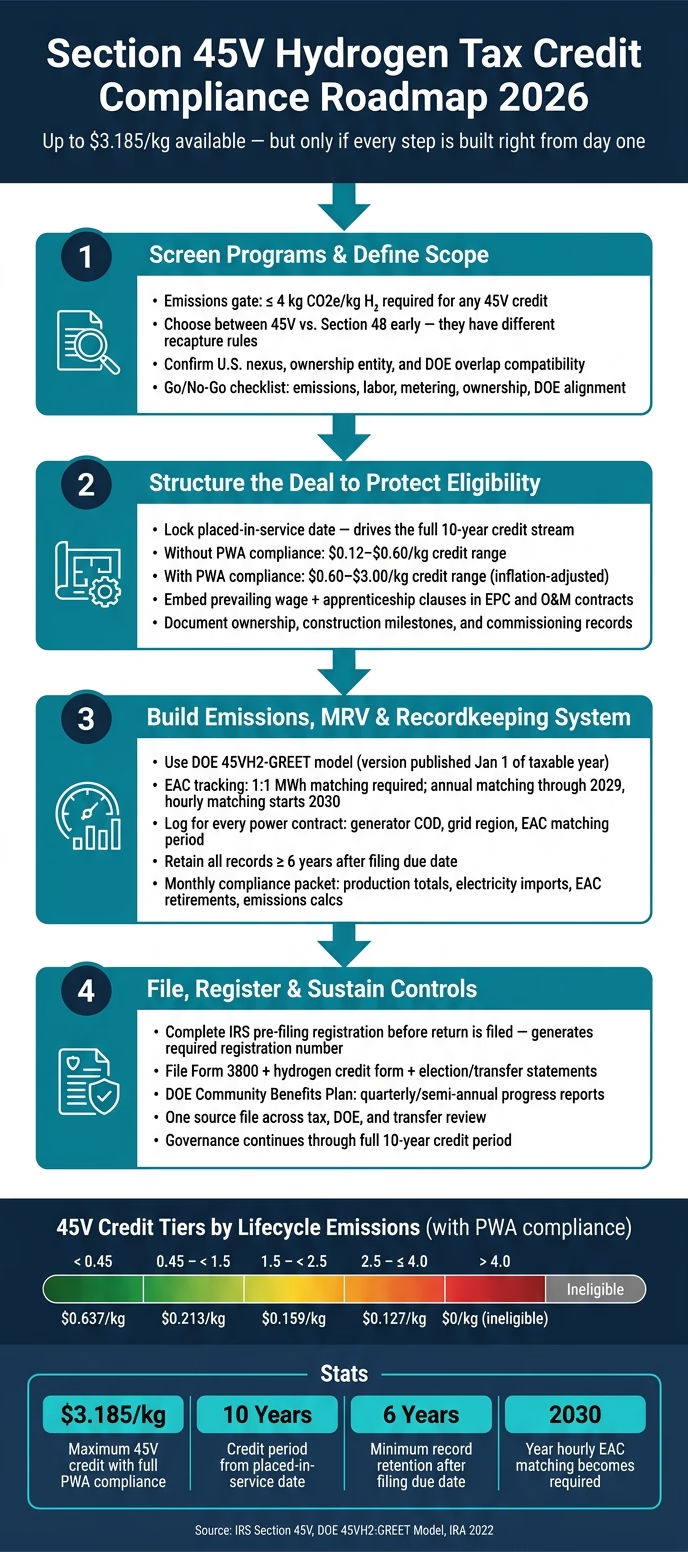
Section 45V Hydrogen Tax Credit Compliance Roadmap 2026
Final regulations under Section 45V expand options for determining greenhouse gas emissions
Step 1: Screen Programs and Define Your Compliance Scope
Screening decides a basic but high-stakes point: can the project claim the credits at all?
Match Your Project to the Right Incentive Path
Review 45V and DOE funding at the same time. They test eligibility in different ways, and those differences can clash early, especially during design.
Under 45V, the main gate is a lifecycle greenhouse gas emissions rate of no more than 4 kg CO2e per kg of hydrogen at the point of production.[5][19][15] Within that limit, the credit changes based on how low the hydrogen’s emissions are.[1][7][20]
Lifecycle Emissions (kg CO2e/kg H₂) | Credit (with PWA) |
|---|---|
< 0.45 | $0.637/kg |
0.45–< 1.5 | $0.213/kg |
1.5–< 2.5 | $0.159/kg |
2.5–≤ 4.0 | $0.127/kg |
> 4.0 | $0/kg |
DOE funding works differently. It is scored on project impact and readiness, not on a single emissions cutoff.[14][1] That sounds simple on paper, but in practice it can get messy. If a project goes after both paths, design moves made to fit 45V, such as electricity sourcing tied to hourly matching, can shape the broader DOE plan too, including later reporting and community-benefits duties.
Define Facility Boundaries, Technology, and U.S. Nexus
Once the incentive path is set, lock the system boundary. This is where many teams either get sharp or get sloppy.
Facility boundaries decide which assets, energy inputs, and process emissions go into the lifecycle calculation.[14][15][8] The details shift by technology. Grid-connected electrolysis turns on electricity sourcing and records. SMR with carbon capture puts the focus on gas supply, capture rate, and storage integrity. Biomass and waste feedstocks can bring heavier upstream data demands.[15][1][14]
U.S. nexus means the production facility and the qualifying activity must be located and operated in the United States or its territories, and the entity claiming the credit must be subject to U.S. tax jurisdiction.[8][5][10] If the project has cross-border supply chains or overseas financing partners, get that legal point checked early and in writing.
Build a Go/No-Go Screening Checklist
Before design or financing gets locked in, the memo should answer five questions. Think of this as the project’s first hard filter, not a box-checking exercise.
Emissions eligibility: Can a preliminary lifecycle estimate get below 4 kg CO2e/kg H₂ under realistic design assumptions? If not, 45V is off the table.[5][13][12][15]
Labor compliance: Is the project willing and able to meet prevailing wage and registered apprenticeship rules? Without both, the credit drops sharply.[4][11]
Metering and data readiness: Does the team have access to the metering, process data, and feedstock records needed to populate the 45VH2-GREET model and support annual verification?[15][18]
Ownership alignment: Is it clear which entity owns the facility, claims the credit, and carries recapture risk?[14][18]
DOE overlap: If DOE funding is also in scope, are community benefits commitments, technology readiness, and reporting duties compatible with the 45V compliance setup?[14][1]
Use this screen to lock scope before drafting ownership, labor, and financing terms. If the project clears it, move at once to project structure, labor terms, and financing documents.
Step 2: Structure the Project to Protect Credit Eligibility
Once screening is done, the next job is to lock in the legal, financial, and construction terms that keep the project eligible across the full 10-year credit period. This is where the screening memo stops being a planning document and becomes contracts, records, and financing terms.
Document Ownership, Placed-in-Service Dates, and Construction Milestones
Section 45V credits run for 10 years from the facility's placed-in-service date.[17][16] That one date drives the entire credit stream. If the tax return shows one date and the commissioning report shows another, the result can be a shift worth tens of millions of dollars in incentive value. It can also slow monetization if the IRS questions the filing.
Ownership sits with the entity that bears the facility's economic benefits and burdens. Placed-in-service means the project is ready for its intended use, not just mechanically complete. Those dates need to line up across tax files, engineering records, and permit documents. Put simply, ownership, commissioning, and filing records all need to tell the same story.
A single compliance data room helps keep that story straight. Organize it around three record sets:
Ownership records: operating agreements, joint venture contracts, equity transfer documents, and board resolutions that show who holds the facility at each stage
Construction and commissioning records: EPC contracts, progress certificates, mechanical completion reports, and initial hydrogen production logs
Permits and regulatory records: air permits, grid interconnection agreements, and operating permits with their effective dates
Run a pre-filing review before each annual claim to confirm that ownership records, key dates, and permit files match.
Meet Prevailing Wage and Apprenticeship Rules
Without PWA compliance, the credit range is $0.12-$0.60 per kilogram of qualified clean hydrogen. With it, that range increases to $0.60-$3.00/kg, adjusted each year for inflation.[16][3][4][23][24]
That spread is too large to treat labor compliance as back-office paperwork. PWA rules apply to construction, repairs, and alteration work during the credit period, so those duties need to be built into EPC, O&M, and outage contracts from the start.
Embed prevailing wage clauses directly into EPC agreements and subcontracts, with the applicable Department of Labor wage determinations spelled out. Add audit and data-access rights so the project owner can review payroll records and apprenticeship documents from contractors on a set schedule. IRS recordkeeping guidance calls for payroll records that show hours worked in each classification, wage rates, fringe benefits, and correction payments for all covered workers.[21][22]
For apprenticeship compliance, keep written requests for apprentices, agreements with registered apprenticeship programs, and daily plus program-set apprentice-to-journeyworker ratios. Payroll records for apprentices need to be kept as well.[22]
Align Financing Structure With Compliance Duties
The financing structure decides who claims the credit, how it gets allocated, and how much document work follows the project into an audit. Three structures show up most often in U.S. hydrogen projects, and each comes with a different compliance profile:
Structure | Ownership Evidence | Labor Compliance Administration | Credit Allocation Complexity | Audit Risk |
|---|---|---|---|---|
Direct ownership | Straightforward; single entity holds all records | Simpler oversight; one claimant manages contractor compliance | None; single claimant | Lower |
Joint venture | Requires clear operating agreements, capital accounts, and equity transfer records | Responsibility must be assigned directly in the JV agreement | Moderate; credits allocated by partner interest | Moderate |
Tax partnership | Complex; must show which entity bears economic burdens and benefits over time | Often delegated to sponsor; requires contract clarity with investors | High; special allocations, investor representations, and modeling required | Higher |
Whatever structure you use, document who owns the facility, who bears the risk, and how credits move. Once the structure and labor duties are set, emissions accounting and MRV become the next control point.
Step 3: Build the Emissions, MRV, and Recordkeeping System
With the project structure and labor controls set, the work shifts from deal terms to proof. The compliance file has to tie each kilogram of hydrogen to its emissions rate, power source, and annual claim. That's the layer of evidence that turns a project on paper into a claim that can stand up under review.
Calculate Lifecycle Emissions Using the Required Method
Section 45V credit claims rest on the pathway lifecycle emissions rate, measured in kilograms of CO2e per kilogram of hydrogen.[28][10][5] For most pathways, taxpayers generally use the DOE's 45VH2-GREET model. The required version is the one published on the first day of the taxable year.[10] So each year, you need a clear record of the model version, the inputs, and the assumptions used.[10]
If your production pathway does not appear in the current GREET model, you can ask the IRS for a provisional emissions rate (PER), backed by a DOE emissions value request.[5][29][30] That package needs to spell out the production pathway, feedstocks, process details, and the DOE emissions value used as the technical basis.[5][30] Don't leave this for later. Start the PER process before first production, and make sure the filing is already moving before the first taxable year closes.[5][29]
In 2026, the credit equals $0.656 × the applicable percentage, so a small emissions mistake can push the project into a lower credit tier.[8][31]
Control Electricity Sourcing and Energy Attribute Certificate Data
For electrolytic hydrogen, electricity use drives the emissions rate. In plain terms, power data is the backbone of compliance. Electricity can count as coming from a specific clean generator only if the facility acquires and retires qualifying energy attribute certificates (EACs) on a 1:1 MWh basis.[36] The main tests are incrementality, temporal matching, and deliverability.[2][25][27]
For 2026, annual matching is still allowed through 2029, and hourly matching starts in 2030.[35][1] That may sound far off, but it isn't. Build the tracking system now so it can handle today's annual true-up and tomorrow's hour-by-hour audit trail.
A simple three-part log for every power contract goes a long way. Record:
The generator's commercial operation date
Its location or grid region
That gives you a file where incrementality, deliverability, and temporal matching can be tested from records, not just stated in a memo.
Create an MRV and Record Retention Protocol
Treat MRV as an operating control, not a year-end scramble.[5][8][6] That means naming the people responsible for data capture, review, approval, and retention, and keeping version control on every emissions-related file.[10][6]
At a minimum, the compliance file should include source data logs, meter calibration records, EAC generation and retirement records, lifecycle emissions model outputs, and the related assumptions and input sheets.[6] Annual verification reports must be signed and dated by the verifier by the return due date, including extensions, and kept for at least six years after the relevant filing due date.[33][32] Raw data used for a DOE emissions value request tied to a PER must also be kept for at least six years after the relevant return due date, including extensions.[33][12]
Set up a monthly compliance packet with production totals, electricity imports, EAC retirements, emissions calculations, and anomaly notes.[10][6] Before each annual filing, run an internal audit to check that GREET inputs, EAC retirements, metering records, and retention logs all line up with the tax year's hydrogen output.[10][6]
An auditor should be able to answer four questions from the file alone: what was produced, how it was measured, what electricity supported it, and who verified it.[34][12][36]
Use the file to support IRS filings, DOE reporting, and audit review.
Step 4: Complete Registrations, Filings, and Agency Review
Once the MRV system is live and your records are in order, the next job is simple to describe but easy to get wrong: file the right forms with the right agencies on time. Miss a registration or blow past a filing date, and the credit can be delayed or denied. This is the point where MRV data and project records stop being internal paperwork and become enforceable claims. Treat the MRV file as the single source of truth for registrations, credit claims, and DOE reporting.
Prepare IRS Pre-Filing Registration and Annual Credit Filings
IRS pre-filing registration is required before electing elective payment under §6417 or transferring credits under §6418. The registration must be completed electronically before the tax return is filed, and it generates a registration number for each applicable credit property. That number must appear on the relevant return.[9][37][47] If the number is missing, or if the facility facts do not match the filed return, the credit claim can be delayed, cut back, or denied.
Before starting registration, gather the core project facts in one place: taxpayer ID data, facility location and ownership, placed-in-service proof, capacity, emissions method, and supporting permits.[9][47] After the registration is done, use it as the reference file for that facility. Ownership, capacity, location, and emissions method in the registration should match the DOE filings and financial statements.[9][37][47]
File Form 3800 with the hydrogen credit form and any needed election or transfer statement.[47] If the credit is transferred, the election must be made separately for each facility and for each taxable year in the 10-year credit period. The transfer also needs a written election statement and the minimum documentation delivered to the transferee.[44][47][46] Payment for transferred credits must be made in cash. That payment is not deductible by the transferee, and it is excluded from the transferor's gross income.[45][46][43]
A good way to stay out of trouble is to work backward from the return due date. Build milestones for:
registration
data validation
draft filing
legal review
tax review
management sign-off
Put one person in charge of each step so tax, engineering, legal, operations, and finance stay lined up. Also set up a post-filing response process. If the IRS comes back with questions, you want answers ready from the source file, not a scramble across inboxes and shared drives.
Manage DOE Reporting and Community Benefits Obligations
For projects that receive DOE hydrogen hub or demonstration funding, DOE reporting runs on a parallel track with tax filings. It has its own deadlines and its own risks. DOE's Office of Clean Energy Demonstrations requires Community Benefits Plans (CBPs) that cover community and labor engagement, workforce investments, diversity, equity, inclusion, accessibility, and Justice40 commitments.[39][40][42][38] Projects must report progress against milestones, community benefits metrics, and environmental impacts over the award term.[39][38]
Treat these duties the way a lender would treat loan covenants. Late or missing DOE reports can put funding at risk even if the tax credit filing is otherwise clean. The practical move is to turn each CBP promise into an internal control: name the owner, define the metric, record the proof, and set the reporting date. Justice40 guidance goes further. It requires projects to identify which disadvantaged communities will receive benefits, spell out outcomes that can be measured and tracked, and address possible negative impacts.[41][38][39] Keep the backup close at hand: hiring metrics, training records, meeting minutes, and engagement logs should sit with the report, not somewhere else.
Prepare for Review, Audit, and Credit Transfer Review
Reviewers usually spot mismatches before they spot math errors. That's where many claims start to wobble. A project narrative may say one thing while the backup says another - for example, a different hydrogen production pathway, a different electricity sourcing claim, or dates that don't match across engineering, tax, and funding files.[47] The fix is not fancy. Use contemporaneous records and make sure everyone is pulling from the same file set.
Use one source file across tax, DOE, and transfer review. The table below shows the main filings and reports, who owns them, when they are due, what needs to be attached, and where review risk tends to show up first.
Filing / Report | Responsible Team | Timing | Required Attachments | Primary Review Risk |
|---|---|---|---|---|
IRS pre-filing registration | Tax + Engineering | Before return is filed | Facility records, placed-in-service docs, ownership data | Registration number missing or facility facts inconsistent with return |
Annual credit claim (Form 3800 + credit form) | Tax + Finance | Return due date (with extensions) | Registration number, credit computation, election statements | Emissions tier mismatch, labor compliance gaps |
Credit transfer election statement | Tax + Legal | With the filed return | Written transfer statement, transferee documentation, cash payment records | Transfer amount inconsistent with filed return or buyer's tax position |
Annual verification / MRV package | Sustainability + Operations | By return due date, including extensions | Verifier report and source-data cross-references | Late or unsigned report; assumptions not traceable to source data |
DOE performance / progress report | Engineering + ESG | Per award terms (typically quarterly or semi-annually) | Milestone updates, budget execution, risk log | Late submission; deviations from approved scope unreported |
Community Benefits Plan progress update | ESG + HR + Legal | Per award terms | Hiring metrics, training records, community engagement logs, Justice40 data | Commitments not tracked with measurable evidence |
When a credit is transferred or monetized, the review gets tighter because the filing, the transfer agreement, and the buyer's tax position all need to match.[44][47][46] Before closing the deal, run an internal reconciliation of the transferred amount against the filed return. Keep copies of all transfer-related attestations. Assign one owner to each filing, report, and transfer item, then reconcile the full document set before anything goes out. One filing calendar and one reconciliation file for tax, DOE, and transfer actions can save a lot of pain later.
Conclusion: Build Long-Term Controls Around Hydrogen Incentives
Hydrogen incentive compliance in 2026 isn't a one-time filing task. It's an operating discipline that starts with the first screening call and stays in place through the last year of a 10-year credit period. Once filings go in, compliance works less like a checklist and more like an operating system. Each kilogram of qualified clean hydrogen produced under Section 45V can create credit value across that full decade, so early calls on documentation and operations carry a lot of weight.[48][49]
The path in this guide is straightforward: screen first, structure the deal with care, measure before first production, file on time, and keep controls in place for the life of the credit period.
The biggest risk is weak recordkeeping. Missing support, mismatched filings, and claims that can't be verified can cut down credits or knock them out altogether.
For teams trying to connect incentive compliance with a broader sustainability plan, Council Fire helps turn MRV, community benefits, and filing controls into day-to-day practice. That work helps line up MRV, community-benefits tracking, and public reporting with what the project files.
Key Takeaways for 2026 Project Teams
Five principles run through every stage of this guide:
Eligibility starts with screening. No capital commitment should come before legal and tax sign-off on the core eligibility assumptions: credit type, emissions thresholds, labor rules, ownership structure, and placed-in-service timing.
Structure creates or destroys credit value. Clear ownership records, direct compliance terms in EPC and O&M contracts, and coordinated credit transfer agreements are the base of a defensible claim.
MRV is the single source of truth. MRV needs to tie emissions, electricity, and EAC data to the filed claim.
Cross-functional coordination is required. Tax, engineering, legal, ESG, and operations need one calendar and one owner for each filing.
Governance does not stop at filing. Governance has to continue through the full 10-year credit period.
Build these controls into the project from day one, and the compliance path stays manageable. Bolt them on later, and the risk grows with each year of production.
FAQs
How do I know if my project should claim 45V or 48?
First, confirm that your project produces clean hydrogen and that it may qualify for the Section 45V Clean Hydrogen Production Tax Credit. The credit ranges from $0.60 to $3.00 per kilogram, based on your project’s lifecycle greenhouse gas emissions.
That sounds simple on paper. In practice, it can get messy fast. Eligibility rules, prevailing wage requirements, bonus adders, and project structuring all shape what your project may claim and how you should plan for it.
Council Fire works with organizations to sort through those moving parts, model costs, assess credit options, and line up reporting with the Greenhouse Gas Protocol.
What records matter most before first hydrogen production?
Before first hydrogen production, put data governance in place. Keep contemporaneous records that show how data was collected, how calculations were done, which assumptions were used, and where estimates or judgment calls came into play.
You’ll also want audit trails that show data lineage and each transformation from source to disclosure. On top of that, document internal controls such as review and approval workflows, along with clear segregation of duties.
What happens if my power and EAC data don't match?
If your power consumption data and Energy Attribute Certificate (EAC) records don’t line up, you’ve got a serious data quality and compliance problem. That gap can undercut the accuracy and completeness required for regulatory reporting and incentive qualification.
The fix is pretty direct: formally reconcile operational energy data with EAC records, use validation checks and exception handling to spot issues early, and maintain a clear audit trail for agency review and continued eligibility.
Related Blog Posts
Latest Articles
©2026

Narrative Change and Power Building: The Missing Half of Advocacy
Narrative change is the process of disrupting dominant narratives that normalize inequity and advancing new narratives from historically marginalized communities.

Funding Resilience Without Federal Grants
BRIC is unreliable and FEMA is shrinking. Here's how cities fund climate resilience with dedicated revenue, blended finance, and a coordinating authority.

The ESG Blind Spot: How AI Is Finding Risks in Companies Nobody Else Is Watching
Norway's sovereign wealth fund uses AI to screen 7,200 portfolio companies for forced labor and corruption within 24 hours. The real story is the emerging-market coverage gap that traditional ESG data vendors miss — and what it means for any company with a global supply chain.
Narrative Change and Power Building: The Missing Half of Advocacy
Narrative change is the process of disrupting dominant narratives that normalize inequity and advancing new narratives from historically marginalized communities.
Funding Resilience Without Federal Grants
BRIC is unreliable and FEMA is shrinking. Here's how cities fund climate resilience with dedicated revenue, blended finance, and a coordinating authority.
The ESG Blind Spot: How AI Is Finding Risks in Companies Nobody Else Is Watching
Norway's sovereign wealth fund uses AI to screen 7,200 portfolio companies for forced labor and corruption within 24 hours. The real story is the emerging-market coverage gap that traditional ESG data vendors miss — and what it means for any company with a global supply chain.
FAQ
01
What does it really mean to “redefine profit”?
02
What makes Council Fire different?
03
Who does Council Fire work with?
04
What does working with Council Fire actually look like?
05
How does Council Fire help organizations turn big goals into action?
06
How does Council Fire define and measure success?
07
How does technology fit into Council Fire’s work?
Sep 21, 2026
Hydrogen Incentive Compliance: Guide 2026
ESG Strategy
In This Article
Step-by-step checklist to screen, structure, measure, and file Section 45V hydrogen tax credits while maintaining MRV and labor compliance.
Hydrogen Incentive Compliance: Guide 2026
If you wait to set up compliance, you can lose credit value fast. In 2026, a hydrogen project can qualify for up to $3.185 per kilogram under Section 45V when wage and apprenticeship rules are met, but one weak link - emissions, labor records, ownership, or filing errors - can cut that amount or wipe it out.
I’d boil the article down to this: screen early, lock the project structure, build the emissions file before first production, and keep one clean record set for tax and DOE review. The article shows that the work falls into five connected areas: incentive screening, deal structure, emissions and MRV, filings, and risk control. It also makes one point very clear: small early choices can change project value by hundreds of millions of dollars in a large facility.
Here’s the plain-English version of what matters most:
Check eligibility first. If the project cannot stay at or below 4 kg CO2e per kg of hydrogen, 45V is out.
Choose the tax path early.45V and Section 48 do not work the same way, and that choice affects recapture and project setup.
Treat labor records like money records. Missing wage or apprenticeship support can push the credit from top-tier levels down to much lower amounts.
For electrolysis, power data is everything. The article stresses EAC tracking, 1:1 matching, and the shift from annual matching through 2029 to hourly matching in 2030.
Keep one source of truth. Ownership records, commissioning dates, GREET inputs, verifier reports, IRS registration data, and DOE reports all need to match.
Plan for review before filing. Most problems start with mismatched facts, not math.
A short credit snapshot helps frame the stakes:
Item | What the article says |
|---|---|
Top 45V value | $3.185/kg with wage and apprenticeship compliance |
45V emissions limit | ≤ 4 kg CO2e/kg H₂ |
Credit term | 10 years from placed-in-service date |
Electrolyzer power matching | Annual through 2029; hourly starts in 2030 |
Core tax forms/process | IRS pre-filing registration, Form 3800, credit form, transfer paperwork if used |
Record retention | At least 6 years after the filing due date in the cases described |
What I like about the piece is that it does not treat compliance as a year-end tax exercise. It frames it as a day-one build issue. That is the right lens. If you set the wrong facility boundary, use weak metering, leave labor duties vague in EPC contracts, or file with dates that do not line up, the project can end up fighting over credit value later.
The takeaway is simple: the article is a guide to building the project so the claim can survive review, not just look good in a model.
If you read the rest, expect a step-by-step path that moves from screening to structure, then to MRV, filings, and long-term controls.
Section 45V Hydrogen Tax Credit Compliance Roadmap 2026
Final regulations under Section 45V expand options for determining greenhouse gas emissions
Step 1: Screen Programs and Define Your Compliance Scope
Screening decides a basic but high-stakes point: can the project claim the credits at all?
Match Your Project to the Right Incentive Path
Review 45V and DOE funding at the same time. They test eligibility in different ways, and those differences can clash early, especially during design.
Under 45V, the main gate is a lifecycle greenhouse gas emissions rate of no more than 4 kg CO2e per kg of hydrogen at the point of production.[5][19][15] Within that limit, the credit changes based on how low the hydrogen’s emissions are.[1][7][20]
Lifecycle Emissions (kg CO2e/kg H₂) | Credit (with PWA) |
|---|---|
< 0.45 | $0.637/kg |
0.45–< 1.5 | $0.213/kg |
1.5–< 2.5 | $0.159/kg |
2.5–≤ 4.0 | $0.127/kg |
> 4.0 | $0/kg |
DOE funding works differently. It is scored on project impact and readiness, not on a single emissions cutoff.[14][1] That sounds simple on paper, but in practice it can get messy. If a project goes after both paths, design moves made to fit 45V, such as electricity sourcing tied to hourly matching, can shape the broader DOE plan too, including later reporting and community-benefits duties.
Define Facility Boundaries, Technology, and U.S. Nexus
Once the incentive path is set, lock the system boundary. This is where many teams either get sharp or get sloppy.
Facility boundaries decide which assets, energy inputs, and process emissions go into the lifecycle calculation.[14][15][8] The details shift by technology. Grid-connected electrolysis turns on electricity sourcing and records. SMR with carbon capture puts the focus on gas supply, capture rate, and storage integrity. Biomass and waste feedstocks can bring heavier upstream data demands.[15][1][14]
U.S. nexus means the production facility and the qualifying activity must be located and operated in the United States or its territories, and the entity claiming the credit must be subject to U.S. tax jurisdiction.[8][5][10] If the project has cross-border supply chains or overseas financing partners, get that legal point checked early and in writing.
Build a Go/No-Go Screening Checklist
Before design or financing gets locked in, the memo should answer five questions. Think of this as the project’s first hard filter, not a box-checking exercise.
Emissions eligibility: Can a preliminary lifecycle estimate get below 4 kg CO2e/kg H₂ under realistic design assumptions? If not, 45V is off the table.[5][13][12][15]
Labor compliance: Is the project willing and able to meet prevailing wage and registered apprenticeship rules? Without both, the credit drops sharply.[4][11]
Metering and data readiness: Does the team have access to the metering, process data, and feedstock records needed to populate the 45VH2-GREET model and support annual verification?[15][18]
Ownership alignment: Is it clear which entity owns the facility, claims the credit, and carries recapture risk?[14][18]
DOE overlap: If DOE funding is also in scope, are community benefits commitments, technology readiness, and reporting duties compatible with the 45V compliance setup?[14][1]
Use this screen to lock scope before drafting ownership, labor, and financing terms. If the project clears it, move at once to project structure, labor terms, and financing documents.
Step 2: Structure the Project to Protect Credit Eligibility
Once screening is done, the next job is to lock in the legal, financial, and construction terms that keep the project eligible across the full 10-year credit period. This is where the screening memo stops being a planning document and becomes contracts, records, and financing terms.
Document Ownership, Placed-in-Service Dates, and Construction Milestones
Section 45V credits run for 10 years from the facility's placed-in-service date.[17][16] That one date drives the entire credit stream. If the tax return shows one date and the commissioning report shows another, the result can be a shift worth tens of millions of dollars in incentive value. It can also slow monetization if the IRS questions the filing.
Ownership sits with the entity that bears the facility's economic benefits and burdens. Placed-in-service means the project is ready for its intended use, not just mechanically complete. Those dates need to line up across tax files, engineering records, and permit documents. Put simply, ownership, commissioning, and filing records all need to tell the same story.
A single compliance data room helps keep that story straight. Organize it around three record sets:
Ownership records: operating agreements, joint venture contracts, equity transfer documents, and board resolutions that show who holds the facility at each stage
Construction and commissioning records: EPC contracts, progress certificates, mechanical completion reports, and initial hydrogen production logs
Permits and regulatory records: air permits, grid interconnection agreements, and operating permits with their effective dates
Run a pre-filing review before each annual claim to confirm that ownership records, key dates, and permit files match.
Meet Prevailing Wage and Apprenticeship Rules
Without PWA compliance, the credit range is $0.12-$0.60 per kilogram of qualified clean hydrogen. With it, that range increases to $0.60-$3.00/kg, adjusted each year for inflation.[16][3][4][23][24]
That spread is too large to treat labor compliance as back-office paperwork. PWA rules apply to construction, repairs, and alteration work during the credit period, so those duties need to be built into EPC, O&M, and outage contracts from the start.
Embed prevailing wage clauses directly into EPC agreements and subcontracts, with the applicable Department of Labor wage determinations spelled out. Add audit and data-access rights so the project owner can review payroll records and apprenticeship documents from contractors on a set schedule. IRS recordkeeping guidance calls for payroll records that show hours worked in each classification, wage rates, fringe benefits, and correction payments for all covered workers.[21][22]
For apprenticeship compliance, keep written requests for apprentices, agreements with registered apprenticeship programs, and daily plus program-set apprentice-to-journeyworker ratios. Payroll records for apprentices need to be kept as well.[22]
Align Financing Structure With Compliance Duties
The financing structure decides who claims the credit, how it gets allocated, and how much document work follows the project into an audit. Three structures show up most often in U.S. hydrogen projects, and each comes with a different compliance profile:
Structure | Ownership Evidence | Labor Compliance Administration | Credit Allocation Complexity | Audit Risk |
|---|---|---|---|---|
Direct ownership | Straightforward; single entity holds all records | Simpler oversight; one claimant manages contractor compliance | None; single claimant | Lower |
Joint venture | Requires clear operating agreements, capital accounts, and equity transfer records | Responsibility must be assigned directly in the JV agreement | Moderate; credits allocated by partner interest | Moderate |
Tax partnership | Complex; must show which entity bears economic burdens and benefits over time | Often delegated to sponsor; requires contract clarity with investors | High; special allocations, investor representations, and modeling required | Higher |
Whatever structure you use, document who owns the facility, who bears the risk, and how credits move. Once the structure and labor duties are set, emissions accounting and MRV become the next control point.
Step 3: Build the Emissions, MRV, and Recordkeeping System
With the project structure and labor controls set, the work shifts from deal terms to proof. The compliance file has to tie each kilogram of hydrogen to its emissions rate, power source, and annual claim. That's the layer of evidence that turns a project on paper into a claim that can stand up under review.
Calculate Lifecycle Emissions Using the Required Method
Section 45V credit claims rest on the pathway lifecycle emissions rate, measured in kilograms of CO2e per kilogram of hydrogen.[28][10][5] For most pathways, taxpayers generally use the DOE's 45VH2-GREET model. The required version is the one published on the first day of the taxable year.[10] So each year, you need a clear record of the model version, the inputs, and the assumptions used.[10]
If your production pathway does not appear in the current GREET model, you can ask the IRS for a provisional emissions rate (PER), backed by a DOE emissions value request.[5][29][30] That package needs to spell out the production pathway, feedstocks, process details, and the DOE emissions value used as the technical basis.[5][30] Don't leave this for later. Start the PER process before first production, and make sure the filing is already moving before the first taxable year closes.[5][29]
In 2026, the credit equals $0.656 × the applicable percentage, so a small emissions mistake can push the project into a lower credit tier.[8][31]
Control Electricity Sourcing and Energy Attribute Certificate Data
For electrolytic hydrogen, electricity use drives the emissions rate. In plain terms, power data is the backbone of compliance. Electricity can count as coming from a specific clean generator only if the facility acquires and retires qualifying energy attribute certificates (EACs) on a 1:1 MWh basis.[36] The main tests are incrementality, temporal matching, and deliverability.[2][25][27]
For 2026, annual matching is still allowed through 2029, and hourly matching starts in 2030.[35][1] That may sound far off, but it isn't. Build the tracking system now so it can handle today's annual true-up and tomorrow's hour-by-hour audit trail.
A simple three-part log for every power contract goes a long way. Record:
The generator's commercial operation date
Its location or grid region
That gives you a file where incrementality, deliverability, and temporal matching can be tested from records, not just stated in a memo.
Create an MRV and Record Retention Protocol
Treat MRV as an operating control, not a year-end scramble.[5][8][6] That means naming the people responsible for data capture, review, approval, and retention, and keeping version control on every emissions-related file.[10][6]
At a minimum, the compliance file should include source data logs, meter calibration records, EAC generation and retirement records, lifecycle emissions model outputs, and the related assumptions and input sheets.[6] Annual verification reports must be signed and dated by the verifier by the return due date, including extensions, and kept for at least six years after the relevant filing due date.[33][32] Raw data used for a DOE emissions value request tied to a PER must also be kept for at least six years after the relevant return due date, including extensions.[33][12]
Set up a monthly compliance packet with production totals, electricity imports, EAC retirements, emissions calculations, and anomaly notes.[10][6] Before each annual filing, run an internal audit to check that GREET inputs, EAC retirements, metering records, and retention logs all line up with the tax year's hydrogen output.[10][6]
An auditor should be able to answer four questions from the file alone: what was produced, how it was measured, what electricity supported it, and who verified it.[34][12][36]
Use the file to support IRS filings, DOE reporting, and audit review.
Step 4: Complete Registrations, Filings, and Agency Review
Once the MRV system is live and your records are in order, the next job is simple to describe but easy to get wrong: file the right forms with the right agencies on time. Miss a registration or blow past a filing date, and the credit can be delayed or denied. This is the point where MRV data and project records stop being internal paperwork and become enforceable claims. Treat the MRV file as the single source of truth for registrations, credit claims, and DOE reporting.
Prepare IRS Pre-Filing Registration and Annual Credit Filings
IRS pre-filing registration is required before electing elective payment under §6417 or transferring credits under §6418. The registration must be completed electronically before the tax return is filed, and it generates a registration number for each applicable credit property. That number must appear on the relevant return.[9][37][47] If the number is missing, or if the facility facts do not match the filed return, the credit claim can be delayed, cut back, or denied.
Before starting registration, gather the core project facts in one place: taxpayer ID data, facility location and ownership, placed-in-service proof, capacity, emissions method, and supporting permits.[9][47] After the registration is done, use it as the reference file for that facility. Ownership, capacity, location, and emissions method in the registration should match the DOE filings and financial statements.[9][37][47]
File Form 3800 with the hydrogen credit form and any needed election or transfer statement.[47] If the credit is transferred, the election must be made separately for each facility and for each taxable year in the 10-year credit period. The transfer also needs a written election statement and the minimum documentation delivered to the transferee.[44][47][46] Payment for transferred credits must be made in cash. That payment is not deductible by the transferee, and it is excluded from the transferor's gross income.[45][46][43]
A good way to stay out of trouble is to work backward from the return due date. Build milestones for:
registration
data validation
draft filing
legal review
tax review
management sign-off
Put one person in charge of each step so tax, engineering, legal, operations, and finance stay lined up. Also set up a post-filing response process. If the IRS comes back with questions, you want answers ready from the source file, not a scramble across inboxes and shared drives.
Manage DOE Reporting and Community Benefits Obligations
For projects that receive DOE hydrogen hub or demonstration funding, DOE reporting runs on a parallel track with tax filings. It has its own deadlines and its own risks. DOE's Office of Clean Energy Demonstrations requires Community Benefits Plans (CBPs) that cover community and labor engagement, workforce investments, diversity, equity, inclusion, accessibility, and Justice40 commitments.[39][40][42][38] Projects must report progress against milestones, community benefits metrics, and environmental impacts over the award term.[39][38]
Treat these duties the way a lender would treat loan covenants. Late or missing DOE reports can put funding at risk even if the tax credit filing is otherwise clean. The practical move is to turn each CBP promise into an internal control: name the owner, define the metric, record the proof, and set the reporting date. Justice40 guidance goes further. It requires projects to identify which disadvantaged communities will receive benefits, spell out outcomes that can be measured and tracked, and address possible negative impacts.[41][38][39] Keep the backup close at hand: hiring metrics, training records, meeting minutes, and engagement logs should sit with the report, not somewhere else.
Prepare for Review, Audit, and Credit Transfer Review
Reviewers usually spot mismatches before they spot math errors. That's where many claims start to wobble. A project narrative may say one thing while the backup says another - for example, a different hydrogen production pathway, a different electricity sourcing claim, or dates that don't match across engineering, tax, and funding files.[47] The fix is not fancy. Use contemporaneous records and make sure everyone is pulling from the same file set.
Use one source file across tax, DOE, and transfer review. The table below shows the main filings and reports, who owns them, when they are due, what needs to be attached, and where review risk tends to show up first.
Filing / Report | Responsible Team | Timing | Required Attachments | Primary Review Risk |
|---|---|---|---|---|
IRS pre-filing registration | Tax + Engineering | Before return is filed | Facility records, placed-in-service docs, ownership data | Registration number missing or facility facts inconsistent with return |
Annual credit claim (Form 3800 + credit form) | Tax + Finance | Return due date (with extensions) | Registration number, credit computation, election statements | Emissions tier mismatch, labor compliance gaps |
Credit transfer election statement | Tax + Legal | With the filed return | Written transfer statement, transferee documentation, cash payment records | Transfer amount inconsistent with filed return or buyer's tax position |
Annual verification / MRV package | Sustainability + Operations | By return due date, including extensions | Verifier report and source-data cross-references | Late or unsigned report; assumptions not traceable to source data |
DOE performance / progress report | Engineering + ESG | Per award terms (typically quarterly or semi-annually) | Milestone updates, budget execution, risk log | Late submission; deviations from approved scope unreported |
Community Benefits Plan progress update | ESG + HR + Legal | Per award terms | Hiring metrics, training records, community engagement logs, Justice40 data | Commitments not tracked with measurable evidence |
When a credit is transferred or monetized, the review gets tighter because the filing, the transfer agreement, and the buyer's tax position all need to match.[44][47][46] Before closing the deal, run an internal reconciliation of the transferred amount against the filed return. Keep copies of all transfer-related attestations. Assign one owner to each filing, report, and transfer item, then reconcile the full document set before anything goes out. One filing calendar and one reconciliation file for tax, DOE, and transfer actions can save a lot of pain later.
Conclusion: Build Long-Term Controls Around Hydrogen Incentives
Hydrogen incentive compliance in 2026 isn't a one-time filing task. It's an operating discipline that starts with the first screening call and stays in place through the last year of a 10-year credit period. Once filings go in, compliance works less like a checklist and more like an operating system. Each kilogram of qualified clean hydrogen produced under Section 45V can create credit value across that full decade, so early calls on documentation and operations carry a lot of weight.[48][49]
The path in this guide is straightforward: screen first, structure the deal with care, measure before first production, file on time, and keep controls in place for the life of the credit period.
The biggest risk is weak recordkeeping. Missing support, mismatched filings, and claims that can't be verified can cut down credits or knock them out altogether.
For teams trying to connect incentive compliance with a broader sustainability plan, Council Fire helps turn MRV, community benefits, and filing controls into day-to-day practice. That work helps line up MRV, community-benefits tracking, and public reporting with what the project files.
Key Takeaways for 2026 Project Teams
Five principles run through every stage of this guide:
Eligibility starts with screening. No capital commitment should come before legal and tax sign-off on the core eligibility assumptions: credit type, emissions thresholds, labor rules, ownership structure, and placed-in-service timing.
Structure creates or destroys credit value. Clear ownership records, direct compliance terms in EPC and O&M contracts, and coordinated credit transfer agreements are the base of a defensible claim.
MRV is the single source of truth. MRV needs to tie emissions, electricity, and EAC data to the filed claim.
Cross-functional coordination is required. Tax, engineering, legal, ESG, and operations need one calendar and one owner for each filing.
Governance does not stop at filing. Governance has to continue through the full 10-year credit period.
Build these controls into the project from day one, and the compliance path stays manageable. Bolt them on later, and the risk grows with each year of production.
FAQs
How do I know if my project should claim 45V or 48?
First, confirm that your project produces clean hydrogen and that it may qualify for the Section 45V Clean Hydrogen Production Tax Credit. The credit ranges from $0.60 to $3.00 per kilogram, based on your project’s lifecycle greenhouse gas emissions.
That sounds simple on paper. In practice, it can get messy fast. Eligibility rules, prevailing wage requirements, bonus adders, and project structuring all shape what your project may claim and how you should plan for it.
Council Fire works with organizations to sort through those moving parts, model costs, assess credit options, and line up reporting with the Greenhouse Gas Protocol.
What records matter most before first hydrogen production?
Before first hydrogen production, put data governance in place. Keep contemporaneous records that show how data was collected, how calculations were done, which assumptions were used, and where estimates or judgment calls came into play.
You’ll also want audit trails that show data lineage and each transformation from source to disclosure. On top of that, document internal controls such as review and approval workflows, along with clear segregation of duties.
What happens if my power and EAC data don't match?
If your power consumption data and Energy Attribute Certificate (EAC) records don’t line up, you’ve got a serious data quality and compliance problem. That gap can undercut the accuracy and completeness required for regulatory reporting and incentive qualification.
The fix is pretty direct: formally reconcile operational energy data with EAC records, use validation checks and exception handling to spot issues early, and maintain a clear audit trail for agency review and continued eligibility.
Related Blog Posts
Latest Articles
©2026
Narrative Change and Power Building: The Missing Half of Advocacy
Narrative change is the process of disrupting dominant narratives that normalize inequity and advancing new narratives from historically marginalized communities.
Funding Resilience Without Federal Grants
BRIC is unreliable and FEMA is shrinking. Here's how cities fund climate resilience with dedicated revenue, blended finance, and a coordinating authority.
The ESG Blind Spot: How AI Is Finding Risks in Companies Nobody Else Is Watching
Norway's sovereign wealth fund uses AI to screen 7,200 portfolio companies for forced labor and corruption within 24 hours. The real story is the emerging-market coverage gap that traditional ESG data vendors miss — and what it means for any company with a global supply chain.
FAQ
What does it really mean to “redefine profit”?
What makes Council Fire different?
Who does Council Fire work with?
What does working with Council Fire actually look like?
How does Council Fire help organizations turn big goals into action?
How does Council Fire define and measure success?
How does technology fit into Council Fire’s work?