
Aug 1, 2026
How Cities Use Tax Credits in PPP Projects
Sustainability Strategy
In This Article
Cities can lower PPP costs by matching eligible tax credits, structuring ownership, ensuring long-term compliance, and sequencing financing.
How Cities Use Tax Credits in PPP Projects
If a city wants tax credits to help fund a PPP, it has to get four things right from the start: pick the right credit, set up ownership the right way, keep records from day one, and line up financing in the right order. Miss one of those steps, and the deal can lose credit value or stall before close.
I’d boil the article down to this:
Tax credits cut project cost by letting a taxable private party use federal tax benefits that a city usually cannot use on its own.
The main credits in city PPPs are the ITC/PTC for clean energy, LIHTC for affordable rental housing, and NMTC for projects in low-income areas.
Structure matters. In most cases, a private SPV, developer, or tax-equity investor must own or hold the right interest to claim the credit.
Timing matters. Credit checks should happen before RFQs and RFPs, not after partner selection.
Compliance lasts for years. For example, ITC recapture can run for 5 years, while LIHTC compliance can stretch past 15 years, with record retention often lasting 20+ years in practice.
Financing has to be sequenced. Cities often line up grants and soft funds first, then tax equity, then debt at close.
Here’s the simple takeaway for you: if the project is solar, storage, EV charging, microgrids, affordable housing, or station-area redevelopment, tax credits may help fill the gap - but only if the PPP is built around credit rules early.
Quick comparison
Credit | Common city use | Who usually claims it | Key watchpoint |
|---|---|---|---|
ITC | Solar, batteries, EV charging, microgrids | Private owner or tax-equity party | Placed-in-service date, 5-year recapture |
PTC | Renewable power output | Private owner or tax-equity party | Annual production records |
LIHTC | Affordable rental housing | Developer/investor partnership | Rent, income, and long compliance term |
NMTC | Low-income area redevelopment | CDE-based structure | CDE must be in the deal |
I see the article’s core message as plain and practical: match the credit to the project first, then build the PPP and financing around that match.
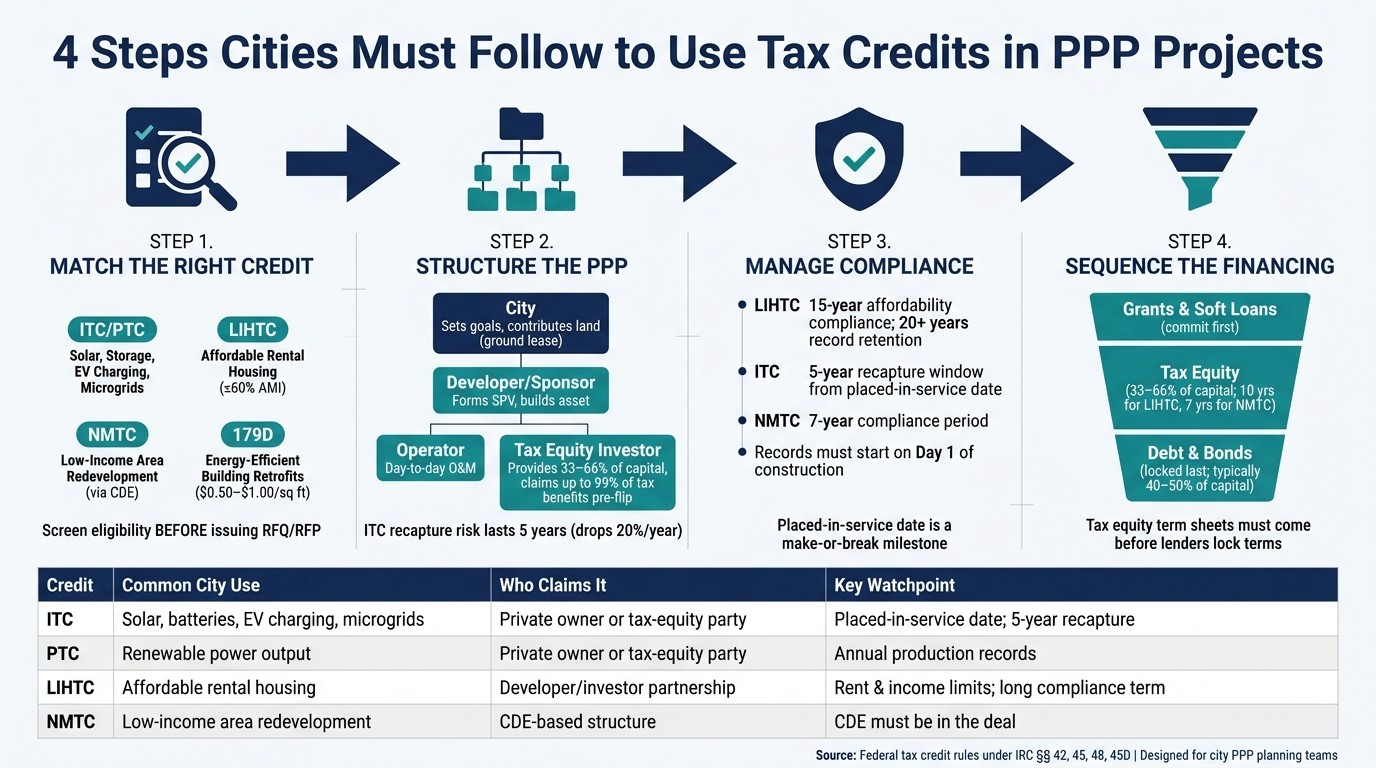
4 Steps Cities Must Follow to Use Tax Credits in PPP Projects
Financing Capital Projects with the Use of New Markets Tax Credits
Step 1: Match the right tax credit to the right project
One of the most common mistakes is building a PPP around a tax credit before checking whether the project can use that credit at all. That order can back a city into a corner. If the credit turns out to be a poor fit, the deal may need costly restructuring after a preferred partner is already on board. The smarter move is simple: screen for credit eligibility before procurement begins. Once the credit fit is clear, the city can shape the PPP so the private side can use it.
Transit, building, and energy projects that commonly qualify
In most city PPP deals, tax-credit decisions cluster around three project types.
Transit-oriented development (TOD) projects often combine more than one funding source. LIHTC applies to units serving households at or below 60% of Area Median Income. NMTC can support ground-floor community facilities when the site sits in a low-income census tract and the financing runs through a certified Community Development Entity (CDE). In practice, many TOD deals pair LIHTC with NMTC when housing and community uses share the same site.
Public and mixed-use buildings often look to the Section 48/48E ITC for solar, storage, and integrated energy systems, or to the Section 179D deduction for energy-efficient commercial building retrofits. The 179D deduction starts at $0.50 per square foot at 25% energy savings and scales up to $1.00 per square foot at 50% savings.[2]
Microgrids, district energy, solar canopies, storage, and EV charging are the main ITC/PTC uses in city deals. Projects in designated energy communities can add another 10 percentage points to the base credit.[1][5] Transit-adjacent charging and refueling projects can also qualify for the 30C credit, up to 30% or $100,000 per item.
Eligibility checks cities should complete before procurement
Before issuing an RFQ or RFP, cities should run a basic credit screen. It’s a plain but important step. No city wants to shape a deal around a credit the project can’t claim.
Eligibility Check | What to Confirm |
|---|---|
Ownership and tax structure | Does the city or private partner need to hold the asset, or can the project use direct pay or transferability? |
Placed-in-service timing | Do project schedules clear credit deadlines and construction-start rules? |
Qualified costs | Which project costs count as eligible under the target credit? |
Performance thresholds | Does the design meet applicable energy, affordability, or building-standard requirements? |
Affordability restrictions | Are income limits, rent caps, and compliance periods aligned with the program? |
Site control | Does the city or partner have ownership, a ground lease, or other documented rights? |
Zoning and land use | Are the intended uses permitted, or are variances needed before financing can close? |
Environmental review | Is NEPA or state review complete, and are any conditions tied to credit eligibility? |
For NMTC deals, there’s one more checkpoint that cities can’t skip: a certified CDE must be in the financing chain before the PPP is built around that capital source. The CDFI Fund certifies CDEs, so cities need to bring one into the deal structure.[3][4]
How sustainability goals shape project selection
Sustainability goals do more than set direction. They help decide which projects rise to the top of the pipeline.
A city with a decarbonization target will often move solar, storage, and microgrid projects forward first because those assets can draw the largest clean energy credits. A city focused on resilience will lean toward microgrids and district energy systems that keep critical facilities running during outages, especially when those projects may qualify for low-income or energy-community bonus adders. If affordability is the main goal, LIHTC-backed TOD housing tends to move up fast.
The hard part is turning those policy goals into project designs that a private partner can finance. Advisory support such as Council Fire can help cities connect sustainability plans to workable infrastructure and PPP portfolios. Projects that clear this screen move to Step 2: structuring the PPP so the credit can flow into the capital stack.
Step 2: Structure the PPP so the credits can be used
After eligibility is confirmed, the next job is simple in theory but tricky in practice: the PPP has to route the credit to a taxable private party that can use it.
Roles of the city, developer, operator, and tax equity investors
Each party has a clear lane.
The city sets the public goals - service standards, affordability, and emissions targets. It also often brings land or rights-of-way into the deal through a long-term ground lease. The developer forms the special-purpose vehicle (SPV), or project company, manages design and construction, and helps line up capital.
The operator may be the same company as the developer, or it may be a separate O&M firm. Either way, it runs the asset day to day under a long-term contract. That contract usually includes service-level standards the city can enforce through penalties, step-in rights, and termination terms.
Tax equity investors put in capital mainly to use the tax benefits and receive a negotiated share of project cash flow. In many energy deals, they supply about 33% to 66% of total capital.[15][12] In a standard partnership-flip structure, they may get up to 99% of the tax benefits and depreciation during the pre-flip period, plus a share of cash flow, until they reach a target after-tax IRR. After that, the allocations usually flip back to the sponsor, often to about 95% or more.[15][18][8][19]
Party | Core Role | Financial Interest |
|---|---|---|
City | Defines objectives, secures approvals, oversees compliance | Public benefit and cost savings |
Developer/Sponsor | Forms SPV, builds, raises capital | Development fees and residual equity |
Operator | Day-to-day O&M, KPI reporting | O&M contract fees |
Tax Equity Investor | Provides a large share of capital, monetizes tax benefits | Tax offsets and negotiated cash flow |
Once those roles are in place, the deal has to make sure the tax benefits sit with the party that can actually use them.
Ownership, lease, and concession models that support tax credit use
The structure has to give the tax benefits to the private side while letting the city keep policy control. That balance is the heart of the deal.
Ground leases show up often in civic and mixed-use projects. The city keeps fee title to the land, while the private SPV leases it for 30 to 99 years, builds the improvements, and claims the credit. Lease covenants and transfer-approval rights let the city keep a firm hand on the project.[7][9]
Concession agreements, including DBFOM or DBFM models, are common in transit and toll projects. If the drafting is done well, the concessionaire's SPV can hold the tax attributes tied to the improvements even while the public authority keeps title. The contract then carries the fare, service, and equity terms the city cares about.[13][6][7]
For energy projects, tax equity partnership structures are common. The city often serves as the offtaker under a power purchase agreement or energy-as-a-service contract, while a private SPV owns and runs the generation asset and claims the relevant credits.[8][11] Some clean energy credits can now be transferred for cash, which may make the capital stack easier to put together.[16][17]
Risk allocation before contracts are finalized
A deal can look fine on an org chart and still fall apart if risk is fuzzy. The term sheet needs to assign each major risk with care, or credit value can leak away before the project even opens.
Construction risk - delays, cost overruns, and defects - usually sits with the private design-build contractor or the developer SPV under a fixed-price, date-certain contract backed by performance bonds. If the placed-in-service date slips, credit claims can be delayed or reduced.[6][7]
Tax credit recapture risk for §48 ITC projects lasts five years from the placed-in-service date, and the possible recapture drops by 20% per year.[14] That risk usually lands with the party that controls operations and compliance, which is often the project company.
Tax-law change risk is usually a negotiated point. Tax equity investors often want change-in-law protection, while cities try not to take on open-ended exposure.[8][10] Demand and operating performance risk is often split. In concession models, the private party usually carries most of it. In availability-payment structures, the city keeps demand risk but uses payment deductions to enforce performance.[6][7]
A good rule here is plain: each major risk should have one owner, one mitigation plan, and one cure path before step-in or termination rights kick in. Those assignments need to hold through construction, commissioning, and operations, where compliance gets tested in the real world.
Step 3: Manage Compliance from Construction Through Operations
Once the PPP is signed, the work changes. It moves from deal design to proof. Every tax credit claim has to hold up under reporting and audit, and closing is only the beginning of that job.
That matters because LIHTC and many energy credits come with multi-year monitoring. Miss one certification or lose one file, and the project can face recapture or disallowance. In a PPP, compliance sits right inside the capital stack. If the credit is at risk, the financing is at risk too. Cities and private partners should run compliance as a parallel track alongside asset management, not treat it like paperwork to finish after financial close.
Documentation and Reporting During Development and Commissioning
The record trail for a credit claim should start on day one of construction. If teams wait until the end to pull it together, gaps almost always show up.
Each project needs a central compliance file with detailed cost ledgers that separate qualified and non-qualified costs. Those ledgers should be backed by invoices, pay applications, and proof of payment. For energy projects, the file should also include stamped engineering plans, equipment submittals, and commissioning test results. For housing projects, it should include IRS Form 8609, the regulatory agreement, and the certificate of occupancy.
The placed-in-service date is a make-or-break item. Under Treasury Regulation 26 CFR § 1.42-5, cities need records that establish the placed-in-service date and support credit eligibility [21]. In practice, that may mean a final commissioning report, a utility interconnection date for energy assets, or a certificate of occupancy for a building. Whatever the source, the record should be stored in a format an auditor can confirm years later.
One smart move is to require a placed-in-service package under the PPP contract. The city can make that package a condition for final payment release or for turning on revenue-sharing provisions. That gives everyone a clear deadline and removes the usual end-of-project scramble.
After placed-in-service, the paper trail shifts. The focus moves from construction support to operating evidence.
Ongoing Compliance for Housing, Energy, and Mixed-Use Assets
For LIHTC housing, compliance is hands-on and constant. Owners must verify tenant income at move-in, keep rents within limits, maintain utility allowances, and file annual certifications under penalty of perjury [20][21]. State agencies also inspect units and review files on a set schedule.
Energy assets work a bit differently. Here, compliance depends on output. Operators should report monthly or quarterly generation or savings data and flag any ownership change, major outage, or decommissioning during the recapture period.
Mixed-use projects add another layer. Deals that combine LIHTC, energy credits, and sometimes New Markets Tax Credits can get messy fast. A cost-allocation matrix helps sort that out by assigning each building area and system to the right credit. That way, a change in one part of the project doesn't accidentally set off recapture under another credit stream.
How Cities Build Oversight Systems That Last
The long game is where many PPP compliance systems break down. Staff leaves, folders get scattered, and the logic behind old decisions disappears. If the system lives in one person's head, it's already in trouble.
Cities should put procedures into written manuals, keep training in place for new staff, and require private partners to do the same. Federal rules require LIHTC records for the first year of the credit period to be kept for at least 6 years beyond the last year of the compliance period, which means more than 20 years of record retention in practice [21].
A lasting oversight setup usually depends on three tools working together:
A compliance dashboard that tracks affordability metrics, energy performance, inspection status, and tax credit deadlines in one place
Annual certifications from the developer or operator confirming continued compliance with income limits, rent restrictions, and operating standards
Third-party checks, such as energy audits, engineering inspections, or compliance reviews, that spot problems internal teams may miss
When those pieces are built into the PPP from the start, cities have a much better shot at keeping records clean, catching issues early, and protecting the credits tied to the deal.
Step 4: Sequence the Financing and Close the Deal
Compliance systems protect the credits. But before a city gets there, it has to line up the financing in the right order. If procurement, tax equity, and debt come together at the wrong time, closing can stall or fall apart. At this stage, timing is the whole game: who signs on first, and when does each funding source become binding?
When Tax Credits Enter the Capital Stack
Tax credits are turned into cash through tax-equity investors. These investors put in upfront capital and claim the tax benefits over time. That capital usually enters the stack at or just before financial close. The benefits then flow over time - 10 years for LIHTC and seven years for NMTC.[28][29][26][27]
Cities should map the deal across six stages: early feasibility, capital stack modeling, investor and lender engagement, procurement and financial close, construction draws, and post-completion credit claiming.
Each stage depends on the one before it. Lenders, for instance, often will not lock terms until tax-equity investors have issued term sheets, because tax equity changes how much debt a project can carry. If tax equity covers 45% of project capital, lenders may limit debt to 40% to 50% so debt-service coverage ratios stay in range.[22][24][12]
That sequencing matters. Cities should commit grants and soft loans first, then tax equity, then debt and bonds at close. In plain terms, that order is what makes the deal financeable.
Tax Credit and PPP Structure Options Compared
Use structure only after the capital stack is clear. The legal form should follow the financing plan, not the other way around.
Tax Credit | Typical Project Use | Who Claims It | Main Compliance Requirement | Common PPP Structure |
|---|---|---|---|---|
LIHTC | Affordable housing near transit | Developer with LIHTC syndicator or investor | 15-year affordability compliance | Ground lease or joint venture with city land contribution |
NMTC | Community facilities, TOD in low-income tracts | Community Development Entity (CDE) structures the deal | 7-year compliance | Leveraged loan + NMTC equity layered into PPP concession |
ITC | Solar, storage, geothermal on city assets | Tax-equity investor | Placed-in-service and ownership tests | Tax-equity SPV with city as offtaker |
PTC | Wind and other qualifying renewables | Tax-equity investor claims per-kWh credit annually | Annual production reporting | Tax-equity structure with a PPA to the city or utility |
For energy projects, tax equity is the setup used most often. The tax-equity investor usually holds a large share of the tax attributes - often 99% - and a smaller share of cash flows until it reaches its target return. After that, the deal flips and the investor moves to a smaller interest. The city or its private partner keeps operating control the whole time.[23][25]
Conclusion: The Core Steps Cities Should Follow
Once the stack is set, the city's job is to keep the structure lined up with the credit all the way through close. The sequence is straightforward: match the credit, structure the PPP, control compliance, then close the financing.
These steps do not stand alone. An ownership model can be well designed and still fail if compliance records are weak. A strong compliance system will not save a deal if the capital stack came together out of order and closing never happened. Cities that treat financing, structure, and compliance as one connected process are the ones that get projects built, credits realized, and long-term public goals met.
FAQs
Can a city claim these tax credits directly?
Usually, no. Municipalities are tax-exempt, which means they don’t owe federal income tax and, in most cases, can’t claim federal tax credits on their own.
There’s one big exception. The Inflation Reduction Act lets some tax-exempt government entities use direct pay for certain clean energy credits. In plain English, that means a city may be able to receive the value of a credit even without a federal tax bill.
Outside of direct pay, cities often partner with private developers through PPAs. In that setup, the developer claims the credits, then passes some of that value back to the city through lower energy rates.
Which tax credit fits my PPP project?
Match the tax credit to the kind of project you’re building. Under the Inflation Reduction Act, some of the most common paths include Section 45Y for clean electricity production, Section 48E for clean electricity investment, and Section 179D for commercial building energy efficiency. Other credits may come into play as well, especially for clean hydrogen, carbon capture, or advanced manufacturing.
In many PPPs, private partners monetize these credits and pass part of the savings back to the city. That can make the deal work better on both sides. Direct pay may also allow government entities to receive cash payments for certain clean energy credits, which changes the math in a big way. It’s also smart to check for bonus adders and make sure you understand the compliance rules tied to each credit.
When should tax credit planning start?
Tax credit planning should begin during the initial project feasibility study. An early look at federal, state, and local incentives can help confirm financial and operational viability, cut risk, and close funding gaps before agreements are finalized.
Starting early also gives stakeholders more room to use Safe Harbor provisions if rules change. For tax-exempt entities, it also helps teams set up direct-pay provisions the right way from the start.
Related Blog Posts
Latest Articles
©2025

Narrative Change and Power Building: The Missing Half of Advocacy
Narrative change is the process of disrupting dominant narratives that normalize inequity and advancing new narratives from historically marginalized communities.

Funding Resilience Without Federal Grants
BRIC is unreliable and FEMA is shrinking. Here's how cities fund climate resilience with dedicated revenue, blended finance, and a coordinating authority.

The ESG Blind Spot: How AI Is Finding Risks in Companies Nobody Else Is Watching
Norway's sovereign wealth fund uses AI to screen 7,200 portfolio companies for forced labor and corruption within 24 hours. The real story is the emerging-market coverage gap that traditional ESG data vendors miss — and what it means for any company with a global supply chain.
Narrative Change and Power Building: The Missing Half of Advocacy
Narrative change is the process of disrupting dominant narratives that normalize inequity and advancing new narratives from historically marginalized communities.
Funding Resilience Without Federal Grants
BRIC is unreliable and FEMA is shrinking. Here's how cities fund climate resilience with dedicated revenue, blended finance, and a coordinating authority.
The ESG Blind Spot: How AI Is Finding Risks in Companies Nobody Else Is Watching
Norway's sovereign wealth fund uses AI to screen 7,200 portfolio companies for forced labor and corruption within 24 hours. The real story is the emerging-market coverage gap that traditional ESG data vendors miss — and what it means for any company with a global supply chain.
FAQ
01
What does it really mean to “redefine profit”?
02
What makes Council Fire different?
03
Who does Council Fire work with?
04
What does working with Council Fire actually look like?
05
How does Council Fire help organizations turn big goals into action?
06
How does Council Fire define and measure success?
Aug 1, 2026
How Cities Use Tax Credits in PPP Projects
Sustainability Strategy
In This Article
Cities can lower PPP costs by matching eligible tax credits, structuring ownership, ensuring long-term compliance, and sequencing financing.
How Cities Use Tax Credits in PPP Projects
If a city wants tax credits to help fund a PPP, it has to get four things right from the start: pick the right credit, set up ownership the right way, keep records from day one, and line up financing in the right order. Miss one of those steps, and the deal can lose credit value or stall before close.
I’d boil the article down to this:
Tax credits cut project cost by letting a taxable private party use federal tax benefits that a city usually cannot use on its own.
The main credits in city PPPs are the ITC/PTC for clean energy, LIHTC for affordable rental housing, and NMTC for projects in low-income areas.
Structure matters. In most cases, a private SPV, developer, or tax-equity investor must own or hold the right interest to claim the credit.
Timing matters. Credit checks should happen before RFQs and RFPs, not after partner selection.
Compliance lasts for years. For example, ITC recapture can run for 5 years, while LIHTC compliance can stretch past 15 years, with record retention often lasting 20+ years in practice.
Financing has to be sequenced. Cities often line up grants and soft funds first, then tax equity, then debt at close.
Here’s the simple takeaway for you: if the project is solar, storage, EV charging, microgrids, affordable housing, or station-area redevelopment, tax credits may help fill the gap - but only if the PPP is built around credit rules early.
Quick comparison
Credit | Common city use | Who usually claims it | Key watchpoint |
|---|---|---|---|
ITC | Solar, batteries, EV charging, microgrids | Private owner or tax-equity party | Placed-in-service date, 5-year recapture |
PTC | Renewable power output | Private owner or tax-equity party | Annual production records |
LIHTC | Affordable rental housing | Developer/investor partnership | Rent, income, and long compliance term |
NMTC | Low-income area redevelopment | CDE-based structure | CDE must be in the deal |
I see the article’s core message as plain and practical: match the credit to the project first, then build the PPP and financing around that match.
4 Steps Cities Must Follow to Use Tax Credits in PPP Projects
Financing Capital Projects with the Use of New Markets Tax Credits
Step 1: Match the right tax credit to the right project
One of the most common mistakes is building a PPP around a tax credit before checking whether the project can use that credit at all. That order can back a city into a corner. If the credit turns out to be a poor fit, the deal may need costly restructuring after a preferred partner is already on board. The smarter move is simple: screen for credit eligibility before procurement begins. Once the credit fit is clear, the city can shape the PPP so the private side can use it.
Transit, building, and energy projects that commonly qualify
In most city PPP deals, tax-credit decisions cluster around three project types.
Transit-oriented development (TOD) projects often combine more than one funding source. LIHTC applies to units serving households at or below 60% of Area Median Income. NMTC can support ground-floor community facilities when the site sits in a low-income census tract and the financing runs through a certified Community Development Entity (CDE). In practice, many TOD deals pair LIHTC with NMTC when housing and community uses share the same site.
Public and mixed-use buildings often look to the Section 48/48E ITC for solar, storage, and integrated energy systems, or to the Section 179D deduction for energy-efficient commercial building retrofits. The 179D deduction starts at $0.50 per square foot at 25% energy savings and scales up to $1.00 per square foot at 50% savings.[2]
Microgrids, district energy, solar canopies, storage, and EV charging are the main ITC/PTC uses in city deals. Projects in designated energy communities can add another 10 percentage points to the base credit.[1][5] Transit-adjacent charging and refueling projects can also qualify for the 30C credit, up to 30% or $100,000 per item.
Eligibility checks cities should complete before procurement
Before issuing an RFQ or RFP, cities should run a basic credit screen. It’s a plain but important step. No city wants to shape a deal around a credit the project can’t claim.
Eligibility Check | What to Confirm |
|---|---|
Ownership and tax structure | Does the city or private partner need to hold the asset, or can the project use direct pay or transferability? |
Placed-in-service timing | Do project schedules clear credit deadlines and construction-start rules? |
Qualified costs | Which project costs count as eligible under the target credit? |
Performance thresholds | Does the design meet applicable energy, affordability, or building-standard requirements? |
Affordability restrictions | Are income limits, rent caps, and compliance periods aligned with the program? |
Site control | Does the city or partner have ownership, a ground lease, or other documented rights? |
Zoning and land use | Are the intended uses permitted, or are variances needed before financing can close? |
Environmental review | Is NEPA or state review complete, and are any conditions tied to credit eligibility? |
For NMTC deals, there’s one more checkpoint that cities can’t skip: a certified CDE must be in the financing chain before the PPP is built around that capital source. The CDFI Fund certifies CDEs, so cities need to bring one into the deal structure.[3][4]
How sustainability goals shape project selection
Sustainability goals do more than set direction. They help decide which projects rise to the top of the pipeline.
A city with a decarbonization target will often move solar, storage, and microgrid projects forward first because those assets can draw the largest clean energy credits. A city focused on resilience will lean toward microgrids and district energy systems that keep critical facilities running during outages, especially when those projects may qualify for low-income or energy-community bonus adders. If affordability is the main goal, LIHTC-backed TOD housing tends to move up fast.
The hard part is turning those policy goals into project designs that a private partner can finance. Advisory support such as Council Fire can help cities connect sustainability plans to workable infrastructure and PPP portfolios. Projects that clear this screen move to Step 2: structuring the PPP so the credit can flow into the capital stack.
Step 2: Structure the PPP so the credits can be used
After eligibility is confirmed, the next job is simple in theory but tricky in practice: the PPP has to route the credit to a taxable private party that can use it.
Roles of the city, developer, operator, and tax equity investors
Each party has a clear lane.
The city sets the public goals - service standards, affordability, and emissions targets. It also often brings land or rights-of-way into the deal through a long-term ground lease. The developer forms the special-purpose vehicle (SPV), or project company, manages design and construction, and helps line up capital.
The operator may be the same company as the developer, or it may be a separate O&M firm. Either way, it runs the asset day to day under a long-term contract. That contract usually includes service-level standards the city can enforce through penalties, step-in rights, and termination terms.
Tax equity investors put in capital mainly to use the tax benefits and receive a negotiated share of project cash flow. In many energy deals, they supply about 33% to 66% of total capital.[15][12] In a standard partnership-flip structure, they may get up to 99% of the tax benefits and depreciation during the pre-flip period, plus a share of cash flow, until they reach a target after-tax IRR. After that, the allocations usually flip back to the sponsor, often to about 95% or more.[15][18][8][19]
Party | Core Role | Financial Interest |
|---|---|---|
City | Defines objectives, secures approvals, oversees compliance | Public benefit and cost savings |
Developer/Sponsor | Forms SPV, builds, raises capital | Development fees and residual equity |
Operator | Day-to-day O&M, KPI reporting | O&M contract fees |
Tax Equity Investor | Provides a large share of capital, monetizes tax benefits | Tax offsets and negotiated cash flow |
Once those roles are in place, the deal has to make sure the tax benefits sit with the party that can actually use them.
Ownership, lease, and concession models that support tax credit use
The structure has to give the tax benefits to the private side while letting the city keep policy control. That balance is the heart of the deal.
Ground leases show up often in civic and mixed-use projects. The city keeps fee title to the land, while the private SPV leases it for 30 to 99 years, builds the improvements, and claims the credit. Lease covenants and transfer-approval rights let the city keep a firm hand on the project.[7][9]
Concession agreements, including DBFOM or DBFM models, are common in transit and toll projects. If the drafting is done well, the concessionaire's SPV can hold the tax attributes tied to the improvements even while the public authority keeps title. The contract then carries the fare, service, and equity terms the city cares about.[13][6][7]
For energy projects, tax equity partnership structures are common. The city often serves as the offtaker under a power purchase agreement or energy-as-a-service contract, while a private SPV owns and runs the generation asset and claims the relevant credits.[8][11] Some clean energy credits can now be transferred for cash, which may make the capital stack easier to put together.[16][17]
Risk allocation before contracts are finalized
A deal can look fine on an org chart and still fall apart if risk is fuzzy. The term sheet needs to assign each major risk with care, or credit value can leak away before the project even opens.
Construction risk - delays, cost overruns, and defects - usually sits with the private design-build contractor or the developer SPV under a fixed-price, date-certain contract backed by performance bonds. If the placed-in-service date slips, credit claims can be delayed or reduced.[6][7]
Tax credit recapture risk for §48 ITC projects lasts five years from the placed-in-service date, and the possible recapture drops by 20% per year.[14] That risk usually lands with the party that controls operations and compliance, which is often the project company.
Tax-law change risk is usually a negotiated point. Tax equity investors often want change-in-law protection, while cities try not to take on open-ended exposure.[8][10] Demand and operating performance risk is often split. In concession models, the private party usually carries most of it. In availability-payment structures, the city keeps demand risk but uses payment deductions to enforce performance.[6][7]
A good rule here is plain: each major risk should have one owner, one mitigation plan, and one cure path before step-in or termination rights kick in. Those assignments need to hold through construction, commissioning, and operations, where compliance gets tested in the real world.
Step 3: Manage Compliance from Construction Through Operations
Once the PPP is signed, the work changes. It moves from deal design to proof. Every tax credit claim has to hold up under reporting and audit, and closing is only the beginning of that job.
That matters because LIHTC and many energy credits come with multi-year monitoring. Miss one certification or lose one file, and the project can face recapture or disallowance. In a PPP, compliance sits right inside the capital stack. If the credit is at risk, the financing is at risk too. Cities and private partners should run compliance as a parallel track alongside asset management, not treat it like paperwork to finish after financial close.
Documentation and Reporting During Development and Commissioning
The record trail for a credit claim should start on day one of construction. If teams wait until the end to pull it together, gaps almost always show up.
Each project needs a central compliance file with detailed cost ledgers that separate qualified and non-qualified costs. Those ledgers should be backed by invoices, pay applications, and proof of payment. For energy projects, the file should also include stamped engineering plans, equipment submittals, and commissioning test results. For housing projects, it should include IRS Form 8609, the regulatory agreement, and the certificate of occupancy.
The placed-in-service date is a make-or-break item. Under Treasury Regulation 26 CFR § 1.42-5, cities need records that establish the placed-in-service date and support credit eligibility [21]. In practice, that may mean a final commissioning report, a utility interconnection date for energy assets, or a certificate of occupancy for a building. Whatever the source, the record should be stored in a format an auditor can confirm years later.
One smart move is to require a placed-in-service package under the PPP contract. The city can make that package a condition for final payment release or for turning on revenue-sharing provisions. That gives everyone a clear deadline and removes the usual end-of-project scramble.
After placed-in-service, the paper trail shifts. The focus moves from construction support to operating evidence.
Ongoing Compliance for Housing, Energy, and Mixed-Use Assets
For LIHTC housing, compliance is hands-on and constant. Owners must verify tenant income at move-in, keep rents within limits, maintain utility allowances, and file annual certifications under penalty of perjury [20][21]. State agencies also inspect units and review files on a set schedule.
Energy assets work a bit differently. Here, compliance depends on output. Operators should report monthly or quarterly generation or savings data and flag any ownership change, major outage, or decommissioning during the recapture period.
Mixed-use projects add another layer. Deals that combine LIHTC, energy credits, and sometimes New Markets Tax Credits can get messy fast. A cost-allocation matrix helps sort that out by assigning each building area and system to the right credit. That way, a change in one part of the project doesn't accidentally set off recapture under another credit stream.
How Cities Build Oversight Systems That Last
The long game is where many PPP compliance systems break down. Staff leaves, folders get scattered, and the logic behind old decisions disappears. If the system lives in one person's head, it's already in trouble.
Cities should put procedures into written manuals, keep training in place for new staff, and require private partners to do the same. Federal rules require LIHTC records for the first year of the credit period to be kept for at least 6 years beyond the last year of the compliance period, which means more than 20 years of record retention in practice [21].
A lasting oversight setup usually depends on three tools working together:
A compliance dashboard that tracks affordability metrics, energy performance, inspection status, and tax credit deadlines in one place
Annual certifications from the developer or operator confirming continued compliance with income limits, rent restrictions, and operating standards
Third-party checks, such as energy audits, engineering inspections, or compliance reviews, that spot problems internal teams may miss
When those pieces are built into the PPP from the start, cities have a much better shot at keeping records clean, catching issues early, and protecting the credits tied to the deal.
Step 4: Sequence the Financing and Close the Deal
Compliance systems protect the credits. But before a city gets there, it has to line up the financing in the right order. If procurement, tax equity, and debt come together at the wrong time, closing can stall or fall apart. At this stage, timing is the whole game: who signs on first, and when does each funding source become binding?
When Tax Credits Enter the Capital Stack
Tax credits are turned into cash through tax-equity investors. These investors put in upfront capital and claim the tax benefits over time. That capital usually enters the stack at or just before financial close. The benefits then flow over time - 10 years for LIHTC and seven years for NMTC.[28][29][26][27]
Cities should map the deal across six stages: early feasibility, capital stack modeling, investor and lender engagement, procurement and financial close, construction draws, and post-completion credit claiming.
Each stage depends on the one before it. Lenders, for instance, often will not lock terms until tax-equity investors have issued term sheets, because tax equity changes how much debt a project can carry. If tax equity covers 45% of project capital, lenders may limit debt to 40% to 50% so debt-service coverage ratios stay in range.[22][24][12]
That sequencing matters. Cities should commit grants and soft loans first, then tax equity, then debt and bonds at close. In plain terms, that order is what makes the deal financeable.
Tax Credit and PPP Structure Options Compared
Use structure only after the capital stack is clear. The legal form should follow the financing plan, not the other way around.
Tax Credit | Typical Project Use | Who Claims It | Main Compliance Requirement | Common PPP Structure |
|---|---|---|---|---|
LIHTC | Affordable housing near transit | Developer with LIHTC syndicator or investor | 15-year affordability compliance | Ground lease or joint venture with city land contribution |
NMTC | Community facilities, TOD in low-income tracts | Community Development Entity (CDE) structures the deal | 7-year compliance | Leveraged loan + NMTC equity layered into PPP concession |
ITC | Solar, storage, geothermal on city assets | Tax-equity investor | Placed-in-service and ownership tests | Tax-equity SPV with city as offtaker |
PTC | Wind and other qualifying renewables | Tax-equity investor claims per-kWh credit annually | Annual production reporting | Tax-equity structure with a PPA to the city or utility |
For energy projects, tax equity is the setup used most often. The tax-equity investor usually holds a large share of the tax attributes - often 99% - and a smaller share of cash flows until it reaches its target return. After that, the deal flips and the investor moves to a smaller interest. The city or its private partner keeps operating control the whole time.[23][25]
Conclusion: The Core Steps Cities Should Follow
Once the stack is set, the city's job is to keep the structure lined up with the credit all the way through close. The sequence is straightforward: match the credit, structure the PPP, control compliance, then close the financing.
These steps do not stand alone. An ownership model can be well designed and still fail if compliance records are weak. A strong compliance system will not save a deal if the capital stack came together out of order and closing never happened. Cities that treat financing, structure, and compliance as one connected process are the ones that get projects built, credits realized, and long-term public goals met.
FAQs
Can a city claim these tax credits directly?
Usually, no. Municipalities are tax-exempt, which means they don’t owe federal income tax and, in most cases, can’t claim federal tax credits on their own.
There’s one big exception. The Inflation Reduction Act lets some tax-exempt government entities use direct pay for certain clean energy credits. In plain English, that means a city may be able to receive the value of a credit even without a federal tax bill.
Outside of direct pay, cities often partner with private developers through PPAs. In that setup, the developer claims the credits, then passes some of that value back to the city through lower energy rates.
Which tax credit fits my PPP project?
Match the tax credit to the kind of project you’re building. Under the Inflation Reduction Act, some of the most common paths include Section 45Y for clean electricity production, Section 48E for clean electricity investment, and Section 179D for commercial building energy efficiency. Other credits may come into play as well, especially for clean hydrogen, carbon capture, or advanced manufacturing.
In many PPPs, private partners monetize these credits and pass part of the savings back to the city. That can make the deal work better on both sides. Direct pay may also allow government entities to receive cash payments for certain clean energy credits, which changes the math in a big way. It’s also smart to check for bonus adders and make sure you understand the compliance rules tied to each credit.
When should tax credit planning start?
Tax credit planning should begin during the initial project feasibility study. An early look at federal, state, and local incentives can help confirm financial and operational viability, cut risk, and close funding gaps before agreements are finalized.
Starting early also gives stakeholders more room to use Safe Harbor provisions if rules change. For tax-exempt entities, it also helps teams set up direct-pay provisions the right way from the start.
Related Blog Posts
Latest Articles
©2025
Narrative Change and Power Building: The Missing Half of Advocacy
Narrative change is the process of disrupting dominant narratives that normalize inequity and advancing new narratives from historically marginalized communities.
Funding Resilience Without Federal Grants
BRIC is unreliable and FEMA is shrinking. Here's how cities fund climate resilience with dedicated revenue, blended finance, and a coordinating authority.
The ESG Blind Spot: How AI Is Finding Risks in Companies Nobody Else Is Watching
Norway's sovereign wealth fund uses AI to screen 7,200 portfolio companies for forced labor and corruption within 24 hours. The real story is the emerging-market coverage gap that traditional ESG data vendors miss — and what it means for any company with a global supply chain.
FAQ
01
What does it really mean to “redefine profit”?
02
What makes Council Fire different?
03
Who does Council Fire work with?
04
What does working with Council Fire actually look like?
05
How does Council Fire help organizations turn big goals into action?
06
How does Council Fire define and measure success?
Aug 1, 2026
How Cities Use Tax Credits in PPP Projects
Sustainability Strategy
In This Article
Cities can lower PPP costs by matching eligible tax credits, structuring ownership, ensuring long-term compliance, and sequencing financing.
How Cities Use Tax Credits in PPP Projects
If a city wants tax credits to help fund a PPP, it has to get four things right from the start: pick the right credit, set up ownership the right way, keep records from day one, and line up financing in the right order. Miss one of those steps, and the deal can lose credit value or stall before close.
I’d boil the article down to this:
Tax credits cut project cost by letting a taxable private party use federal tax benefits that a city usually cannot use on its own.
The main credits in city PPPs are the ITC/PTC for clean energy, LIHTC for affordable rental housing, and NMTC for projects in low-income areas.
Structure matters. In most cases, a private SPV, developer, or tax-equity investor must own or hold the right interest to claim the credit.
Timing matters. Credit checks should happen before RFQs and RFPs, not after partner selection.
Compliance lasts for years. For example, ITC recapture can run for 5 years, while LIHTC compliance can stretch past 15 years, with record retention often lasting 20+ years in practice.
Financing has to be sequenced. Cities often line up grants and soft funds first, then tax equity, then debt at close.
Here’s the simple takeaway for you: if the project is solar, storage, EV charging, microgrids, affordable housing, or station-area redevelopment, tax credits may help fill the gap - but only if the PPP is built around credit rules early.
Quick comparison
Credit | Common city use | Who usually claims it | Key watchpoint |
|---|---|---|---|
ITC | Solar, batteries, EV charging, microgrids | Private owner or tax-equity party | Placed-in-service date, 5-year recapture |
PTC | Renewable power output | Private owner or tax-equity party | Annual production records |
LIHTC | Affordable rental housing | Developer/investor partnership | Rent, income, and long compliance term |
NMTC | Low-income area redevelopment | CDE-based structure | CDE must be in the deal |
I see the article’s core message as plain and practical: match the credit to the project first, then build the PPP and financing around that match.
4 Steps Cities Must Follow to Use Tax Credits in PPP Projects
Financing Capital Projects with the Use of New Markets Tax Credits
Step 1: Match the right tax credit to the right project
One of the most common mistakes is building a PPP around a tax credit before checking whether the project can use that credit at all. That order can back a city into a corner. If the credit turns out to be a poor fit, the deal may need costly restructuring after a preferred partner is already on board. The smarter move is simple: screen for credit eligibility before procurement begins. Once the credit fit is clear, the city can shape the PPP so the private side can use it.
Transit, building, and energy projects that commonly qualify
In most city PPP deals, tax-credit decisions cluster around three project types.
Transit-oriented development (TOD) projects often combine more than one funding source. LIHTC applies to units serving households at or below 60% of Area Median Income. NMTC can support ground-floor community facilities when the site sits in a low-income census tract and the financing runs through a certified Community Development Entity (CDE). In practice, many TOD deals pair LIHTC with NMTC when housing and community uses share the same site.
Public and mixed-use buildings often look to the Section 48/48E ITC for solar, storage, and integrated energy systems, or to the Section 179D deduction for energy-efficient commercial building retrofits. The 179D deduction starts at $0.50 per square foot at 25% energy savings and scales up to $1.00 per square foot at 50% savings.[2]
Microgrids, district energy, solar canopies, storage, and EV charging are the main ITC/PTC uses in city deals. Projects in designated energy communities can add another 10 percentage points to the base credit.[1][5] Transit-adjacent charging and refueling projects can also qualify for the 30C credit, up to 30% or $100,000 per item.
Eligibility checks cities should complete before procurement
Before issuing an RFQ or RFP, cities should run a basic credit screen. It’s a plain but important step. No city wants to shape a deal around a credit the project can’t claim.
Eligibility Check | What to Confirm |
|---|---|
Ownership and tax structure | Does the city or private partner need to hold the asset, or can the project use direct pay or transferability? |
Placed-in-service timing | Do project schedules clear credit deadlines and construction-start rules? |
Qualified costs | Which project costs count as eligible under the target credit? |
Performance thresholds | Does the design meet applicable energy, affordability, or building-standard requirements? |
Affordability restrictions | Are income limits, rent caps, and compliance periods aligned with the program? |
Site control | Does the city or partner have ownership, a ground lease, or other documented rights? |
Zoning and land use | Are the intended uses permitted, or are variances needed before financing can close? |
Environmental review | Is NEPA or state review complete, and are any conditions tied to credit eligibility? |
For NMTC deals, there’s one more checkpoint that cities can’t skip: a certified CDE must be in the financing chain before the PPP is built around that capital source. The CDFI Fund certifies CDEs, so cities need to bring one into the deal structure.[3][4]
How sustainability goals shape project selection
Sustainability goals do more than set direction. They help decide which projects rise to the top of the pipeline.
A city with a decarbonization target will often move solar, storage, and microgrid projects forward first because those assets can draw the largest clean energy credits. A city focused on resilience will lean toward microgrids and district energy systems that keep critical facilities running during outages, especially when those projects may qualify for low-income or energy-community bonus adders. If affordability is the main goal, LIHTC-backed TOD housing tends to move up fast.
The hard part is turning those policy goals into project designs that a private partner can finance. Advisory support such as Council Fire can help cities connect sustainability plans to workable infrastructure and PPP portfolios. Projects that clear this screen move to Step 2: structuring the PPP so the credit can flow into the capital stack.
Step 2: Structure the PPP so the credits can be used
After eligibility is confirmed, the next job is simple in theory but tricky in practice: the PPP has to route the credit to a taxable private party that can use it.
Roles of the city, developer, operator, and tax equity investors
Each party has a clear lane.
The city sets the public goals - service standards, affordability, and emissions targets. It also often brings land or rights-of-way into the deal through a long-term ground lease. The developer forms the special-purpose vehicle (SPV), or project company, manages design and construction, and helps line up capital.
The operator may be the same company as the developer, or it may be a separate O&M firm. Either way, it runs the asset day to day under a long-term contract. That contract usually includes service-level standards the city can enforce through penalties, step-in rights, and termination terms.
Tax equity investors put in capital mainly to use the tax benefits and receive a negotiated share of project cash flow. In many energy deals, they supply about 33% to 66% of total capital.[15][12] In a standard partnership-flip structure, they may get up to 99% of the tax benefits and depreciation during the pre-flip period, plus a share of cash flow, until they reach a target after-tax IRR. After that, the allocations usually flip back to the sponsor, often to about 95% or more.[15][18][8][19]
Party | Core Role | Financial Interest |
|---|---|---|
City | Defines objectives, secures approvals, oversees compliance | Public benefit and cost savings |
Developer/Sponsor | Forms SPV, builds, raises capital | Development fees and residual equity |
Operator | Day-to-day O&M, KPI reporting | O&M contract fees |
Tax Equity Investor | Provides a large share of capital, monetizes tax benefits | Tax offsets and negotiated cash flow |
Once those roles are in place, the deal has to make sure the tax benefits sit with the party that can actually use them.
Ownership, lease, and concession models that support tax credit use
The structure has to give the tax benefits to the private side while letting the city keep policy control. That balance is the heart of the deal.
Ground leases show up often in civic and mixed-use projects. The city keeps fee title to the land, while the private SPV leases it for 30 to 99 years, builds the improvements, and claims the credit. Lease covenants and transfer-approval rights let the city keep a firm hand on the project.[7][9]
Concession agreements, including DBFOM or DBFM models, are common in transit and toll projects. If the drafting is done well, the concessionaire's SPV can hold the tax attributes tied to the improvements even while the public authority keeps title. The contract then carries the fare, service, and equity terms the city cares about.[13][6][7]
For energy projects, tax equity partnership structures are common. The city often serves as the offtaker under a power purchase agreement or energy-as-a-service contract, while a private SPV owns and runs the generation asset and claims the relevant credits.[8][11] Some clean energy credits can now be transferred for cash, which may make the capital stack easier to put together.[16][17]
Risk allocation before contracts are finalized
A deal can look fine on an org chart and still fall apart if risk is fuzzy. The term sheet needs to assign each major risk with care, or credit value can leak away before the project even opens.
Construction risk - delays, cost overruns, and defects - usually sits with the private design-build contractor or the developer SPV under a fixed-price, date-certain contract backed by performance bonds. If the placed-in-service date slips, credit claims can be delayed or reduced.[6][7]
Tax credit recapture risk for §48 ITC projects lasts five years from the placed-in-service date, and the possible recapture drops by 20% per year.[14] That risk usually lands with the party that controls operations and compliance, which is often the project company.
Tax-law change risk is usually a negotiated point. Tax equity investors often want change-in-law protection, while cities try not to take on open-ended exposure.[8][10] Demand and operating performance risk is often split. In concession models, the private party usually carries most of it. In availability-payment structures, the city keeps demand risk but uses payment deductions to enforce performance.[6][7]
A good rule here is plain: each major risk should have one owner, one mitigation plan, and one cure path before step-in or termination rights kick in. Those assignments need to hold through construction, commissioning, and operations, where compliance gets tested in the real world.
Step 3: Manage Compliance from Construction Through Operations
Once the PPP is signed, the work changes. It moves from deal design to proof. Every tax credit claim has to hold up under reporting and audit, and closing is only the beginning of that job.
That matters because LIHTC and many energy credits come with multi-year monitoring. Miss one certification or lose one file, and the project can face recapture or disallowance. In a PPP, compliance sits right inside the capital stack. If the credit is at risk, the financing is at risk too. Cities and private partners should run compliance as a parallel track alongside asset management, not treat it like paperwork to finish after financial close.
Documentation and Reporting During Development and Commissioning
The record trail for a credit claim should start on day one of construction. If teams wait until the end to pull it together, gaps almost always show up.
Each project needs a central compliance file with detailed cost ledgers that separate qualified and non-qualified costs. Those ledgers should be backed by invoices, pay applications, and proof of payment. For energy projects, the file should also include stamped engineering plans, equipment submittals, and commissioning test results. For housing projects, it should include IRS Form 8609, the regulatory agreement, and the certificate of occupancy.
The placed-in-service date is a make-or-break item. Under Treasury Regulation 26 CFR § 1.42-5, cities need records that establish the placed-in-service date and support credit eligibility [21]. In practice, that may mean a final commissioning report, a utility interconnection date for energy assets, or a certificate of occupancy for a building. Whatever the source, the record should be stored in a format an auditor can confirm years later.
One smart move is to require a placed-in-service package under the PPP contract. The city can make that package a condition for final payment release or for turning on revenue-sharing provisions. That gives everyone a clear deadline and removes the usual end-of-project scramble.
After placed-in-service, the paper trail shifts. The focus moves from construction support to operating evidence.
Ongoing Compliance for Housing, Energy, and Mixed-Use Assets
For LIHTC housing, compliance is hands-on and constant. Owners must verify tenant income at move-in, keep rents within limits, maintain utility allowances, and file annual certifications under penalty of perjury [20][21]. State agencies also inspect units and review files on a set schedule.
Energy assets work a bit differently. Here, compliance depends on output. Operators should report monthly or quarterly generation or savings data and flag any ownership change, major outage, or decommissioning during the recapture period.
Mixed-use projects add another layer. Deals that combine LIHTC, energy credits, and sometimes New Markets Tax Credits can get messy fast. A cost-allocation matrix helps sort that out by assigning each building area and system to the right credit. That way, a change in one part of the project doesn't accidentally set off recapture under another credit stream.
How Cities Build Oversight Systems That Last
The long game is where many PPP compliance systems break down. Staff leaves, folders get scattered, and the logic behind old decisions disappears. If the system lives in one person's head, it's already in trouble.
Cities should put procedures into written manuals, keep training in place for new staff, and require private partners to do the same. Federal rules require LIHTC records for the first year of the credit period to be kept for at least 6 years beyond the last year of the compliance period, which means more than 20 years of record retention in practice [21].
A lasting oversight setup usually depends on three tools working together:
A compliance dashboard that tracks affordability metrics, energy performance, inspection status, and tax credit deadlines in one place
Annual certifications from the developer or operator confirming continued compliance with income limits, rent restrictions, and operating standards
Third-party checks, such as energy audits, engineering inspections, or compliance reviews, that spot problems internal teams may miss
When those pieces are built into the PPP from the start, cities have a much better shot at keeping records clean, catching issues early, and protecting the credits tied to the deal.
Step 4: Sequence the Financing and Close the Deal
Compliance systems protect the credits. But before a city gets there, it has to line up the financing in the right order. If procurement, tax equity, and debt come together at the wrong time, closing can stall or fall apart. At this stage, timing is the whole game: who signs on first, and when does each funding source become binding?
When Tax Credits Enter the Capital Stack
Tax credits are turned into cash through tax-equity investors. These investors put in upfront capital and claim the tax benefits over time. That capital usually enters the stack at or just before financial close. The benefits then flow over time - 10 years for LIHTC and seven years for NMTC.[28][29][26][27]
Cities should map the deal across six stages: early feasibility, capital stack modeling, investor and lender engagement, procurement and financial close, construction draws, and post-completion credit claiming.
Each stage depends on the one before it. Lenders, for instance, often will not lock terms until tax-equity investors have issued term sheets, because tax equity changes how much debt a project can carry. If tax equity covers 45% of project capital, lenders may limit debt to 40% to 50% so debt-service coverage ratios stay in range.[22][24][12]
That sequencing matters. Cities should commit grants and soft loans first, then tax equity, then debt and bonds at close. In plain terms, that order is what makes the deal financeable.
Tax Credit and PPP Structure Options Compared
Use structure only after the capital stack is clear. The legal form should follow the financing plan, not the other way around.
Tax Credit | Typical Project Use | Who Claims It | Main Compliance Requirement | Common PPP Structure |
|---|---|---|---|---|
LIHTC | Affordable housing near transit | Developer with LIHTC syndicator or investor | 15-year affordability compliance | Ground lease or joint venture with city land contribution |
NMTC | Community facilities, TOD in low-income tracts | Community Development Entity (CDE) structures the deal | 7-year compliance | Leveraged loan + NMTC equity layered into PPP concession |
ITC | Solar, storage, geothermal on city assets | Tax-equity investor | Placed-in-service and ownership tests | Tax-equity SPV with city as offtaker |
PTC | Wind and other qualifying renewables | Tax-equity investor claims per-kWh credit annually | Annual production reporting | Tax-equity structure with a PPA to the city or utility |
For energy projects, tax equity is the setup used most often. The tax-equity investor usually holds a large share of the tax attributes - often 99% - and a smaller share of cash flows until it reaches its target return. After that, the deal flips and the investor moves to a smaller interest. The city or its private partner keeps operating control the whole time.[23][25]
Conclusion: The Core Steps Cities Should Follow
Once the stack is set, the city's job is to keep the structure lined up with the credit all the way through close. The sequence is straightforward: match the credit, structure the PPP, control compliance, then close the financing.
These steps do not stand alone. An ownership model can be well designed and still fail if compliance records are weak. A strong compliance system will not save a deal if the capital stack came together out of order and closing never happened. Cities that treat financing, structure, and compliance as one connected process are the ones that get projects built, credits realized, and long-term public goals met.
FAQs
Can a city claim these tax credits directly?
Usually, no. Municipalities are tax-exempt, which means they don’t owe federal income tax and, in most cases, can’t claim federal tax credits on their own.
There’s one big exception. The Inflation Reduction Act lets some tax-exempt government entities use direct pay for certain clean energy credits. In plain English, that means a city may be able to receive the value of a credit even without a federal tax bill.
Outside of direct pay, cities often partner with private developers through PPAs. In that setup, the developer claims the credits, then passes some of that value back to the city through lower energy rates.
Which tax credit fits my PPP project?
Match the tax credit to the kind of project you’re building. Under the Inflation Reduction Act, some of the most common paths include Section 45Y for clean electricity production, Section 48E for clean electricity investment, and Section 179D for commercial building energy efficiency. Other credits may come into play as well, especially for clean hydrogen, carbon capture, or advanced manufacturing.
In many PPPs, private partners monetize these credits and pass part of the savings back to the city. That can make the deal work better on both sides. Direct pay may also allow government entities to receive cash payments for certain clean energy credits, which changes the math in a big way. It’s also smart to check for bonus adders and make sure you understand the compliance rules tied to each credit.
When should tax credit planning start?
Tax credit planning should begin during the initial project feasibility study. An early look at federal, state, and local incentives can help confirm financial and operational viability, cut risk, and close funding gaps before agreements are finalized.
Starting early also gives stakeholders more room to use Safe Harbor provisions if rules change. For tax-exempt entities, it also helps teams set up direct-pay provisions the right way from the start.
Related Blog Posts
Latest Articles
©2025
Narrative Change and Power Building: The Missing Half of Advocacy
Narrative change is the process of disrupting dominant narratives that normalize inequity and advancing new narratives from historically marginalized communities.
Funding Resilience Without Federal Grants
BRIC is unreliable and FEMA is shrinking. Here's how cities fund climate resilience with dedicated revenue, blended finance, and a coordinating authority.
The ESG Blind Spot: How AI Is Finding Risks in Companies Nobody Else Is Watching
Norway's sovereign wealth fund uses AI to screen 7,200 portfolio companies for forced labor and corruption within 24 hours. The real story is the emerging-market coverage gap that traditional ESG data vendors miss — and what it means for any company with a global supply chain.
FAQ
What does it really mean to “redefine profit”?
What makes Council Fire different?
Who does Council Fire work with?
What does working with Council Fire actually look like?
How does Council Fire help organizations turn big goals into action?
How does Council Fire define and measure success?