
Jun 2, 2026
How to Align Local Policy with State and Federal Climate Goals for Corporations
ESG Strategy
In This Article
Corporations that ignore local, state and federal climate rules risk fines, lost incentives, and competitive decline — alignment is now a business imperative.
How to Align Local Policy with State and Federal Climate Goals for Corporations
Navigating the complex layers of U.S. climate policy is crucial for businesses to remain compliant, avoid penalties, and seize financial opportunities. Misalignment can lead to regulatory fines, reputational harm, and missed incentives like the $370 billion in clean energy funds under the Inflation Reduction Act (IRA). Companies must integrate federal, state, and local climate policies into their operations to meet evolving regulations, improve efficiency, and maintain market relevance.
Key Takeaways:
Financial Risks and Opportunities: Missteps, like JBS's $1.1 million fine for unsubstantiated claims, highlight the cost of non-compliance. Meanwhile, the IRA offers lucrative incentives for clean energy projects.
Policy Layers: Federal goals focus on economy-wide initiatives like the Greenhouse Gas Reduction Fund, while states emphasize emissions reporting and renewable standards. Local governments enforce zoning and building codes but face state preemption challenges.
Action Plan: Build cross-functional governance, track regulations, set emissions targets, and implement facility-specific upgrades like energy retrofits or renewable energy procurement.
Start by reviewing policies in key regions, creating a compliance inventory, and prioritizing high-impact projects. Proactive alignment with climate goals not only ensures compliance but also positions businesses for growth in a changing regulatory landscape.
Corporate Climate Resilience in Practice: Insights from the 2025 Foresight Series
Mapping the Climate Policy Landscape
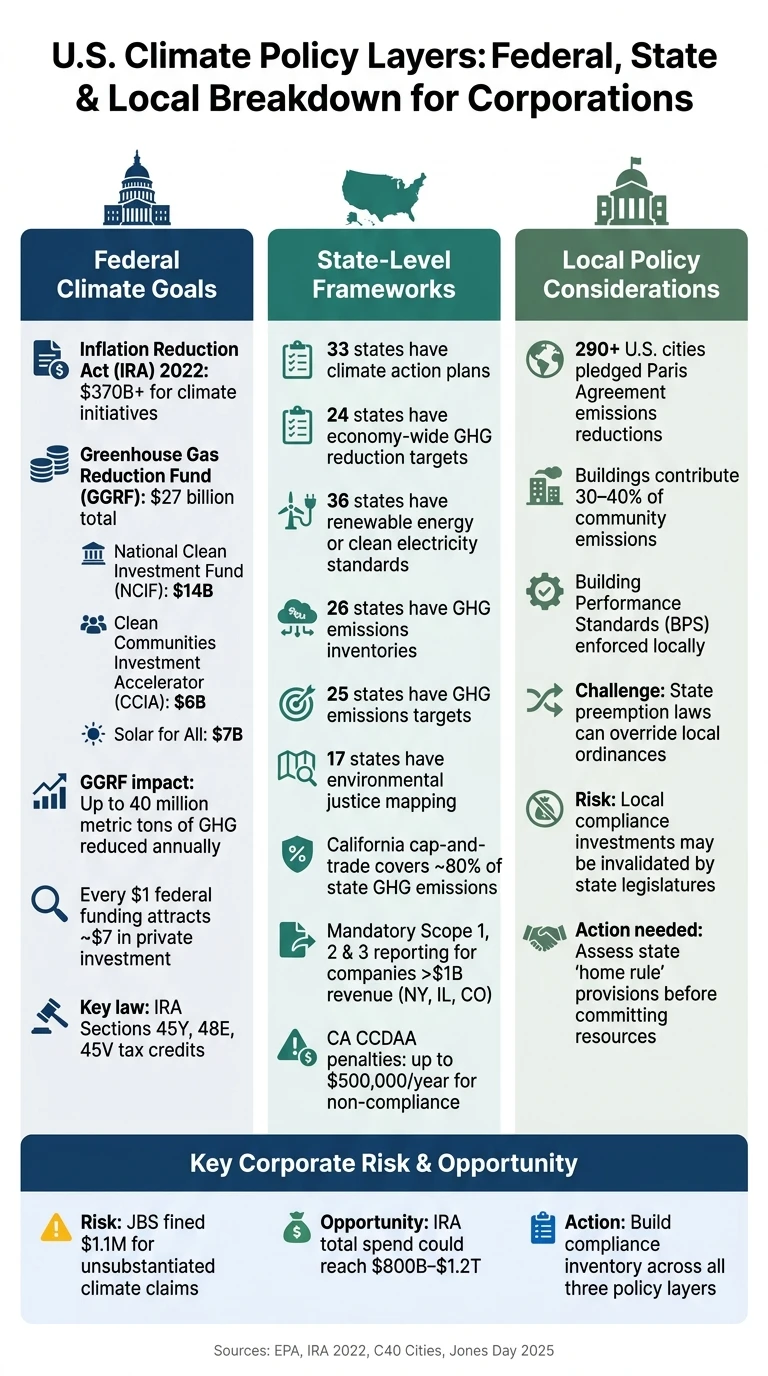
U.S. Climate Policy Layers: Federal, State & Local Breakdown for Corporations
Understanding how federal, state, and local policies interact is essential for ensuring compliance and identifying funding opportunities. Each level of government brings its own strategies and enforcement mechanisms, and knowing these distinctions can help businesses navigate potential challenges and opportunities effectively. Below, we break down the key elements at each level.
Federal Climate Goals and Key Policy Instruments
The Inflation Reduction Act (IRA) of 2022 stands out as a cornerstone of federal climate action. Central to this legislation is the Greenhouse Gas Reduction Fund (GGRF), a $27 billion program aimed at promoting low- and zero-emission technologies. According to the EPA, projects funded through the GGRF could cut or prevent up to 40 million metric tons of greenhouse gas emissions annually [8].
Three primary funding streams under the GGRF deserve close attention:
GGRF Program | Funding | Focus Area |
|---|---|---|
National Clean Investment Fund (NCIF) | $14 billion | National clean tech financing via nonprofit partners |
Clean Communities Investment Accelerator (CCIA) | $6 billion | Strengthening clean financing in low-income areas |
Solar for All | $7 billion | Expanding residential solar access for disadvantaged households |
In April 2024, the EPA designated three nonprofits to oversee the NCIF program: Climate United Fund ($6.97 billion), Coalition for Green Capital ($5 billion), and Power Forward Communities ($2 billion). Notably, for every $1 in federal funding, these programs are projected to attract nearly $7 in private investment [8]. This high level of private-sector leverage makes these initiatives particularly appealing for corporations planning facility-level decarbonization projects.
State-Level Climate Policy Frameworks
While federal policy has leaned toward deregulation since early 2026, many states have taken the opposite approach. Currently, 33 states have climate action plans, 24 have economy-wide greenhouse gas reduction targets, and 36 have renewable energy or clean electricity standards [4]. For example, California operates the world’s fourth-largest carbon market, with its cap-and-trade program covering about 80% of the state’s greenhouse gas emissions [1].
For companies operating in multiple states, the patchwork of regulations can be challenging. States such as New York, Illinois, and Colorado are advancing mandatory reporting for Scope 1, 2, and 3 emissions for companies generating over $1 billion in annual revenue [3]. Jones Day highlighted this complexity in 2025:
"The next few years will see heightened volatility in the climate regulatory landscape... Businesses should be mindful of the increased contrast and inconsistency between federal and state regulations." [9]
To stay ahead, corporations should conduct emissions accounting reviews now, ensuring their systems can adapt to new mandates. This proactive approach minimizes the risk of scrambling to meet compliance under tight deadlines. While state policies are setting increasingly rigorous standards, local governments add another layer of complexity.
Local Policy Considerations and Challenges
Local governments often enforce the most direct regulations on businesses through land use, zoning, and building codes. Over 290 U.S. cities have pledged emissions reductions aligned with the Paris Agreement [10], and many are implementing Building Performance Standards (BPS) to enforce these commitments. Commercial and multifamily buildings, which typically contribute 30–40% of a community’s emissions, are a key focus for these policies [10].
However, state preemption laws often complicate local efforts. These laws can limit what cities are allowed to mandate on energy and climate issues. For instance, local ordinances on natural gas bans or net-zero targets are increasingly being overridden by state legislatures. Miami-Dade County Commissioner Raquel Regalado expressed the frustration this creates:
"Every time they preempt us, they take tools away, right? Lawmakers in Tallahassee don't necessarily understand the unintended consequences." [11]
For businesses, this means that compliance with a local ordinance could become irrelevant if the state invalidates it. Before committing resources to local compliance, it’s crucial to assess the durability of these rules by analyzing your state’s "home rule" provisions. This layered understanding allows corporations to align their strategies with broader climate goals while minimizing risks.
Building an Internal Framework for Policy Alignment
To effectively navigate evolving climate regulations, corporations need robust internal systems that turn policy requirements into actionable strategies. As climate policies shift and new mandates emerge, having a clear framework helps avoid wasted resources and ensures compliance.
Setting Up Cross-Functional Climate Governance
Strong governance starts at the top. Board-level oversight should include a clear climate policy agenda, with responsibility for climate disclosure assigned to a dedicated committee or executive [12][13]. This is more than just a best practice - in California, for instance, the Climate Corporate Data Accountability Act (CCDAA) mandates that companies with over $1 billion in annual revenue disclose Scope 1 and Scope 2 emissions starting in 2026. Non-compliance could result in penalties of up to $500,000 per reporting year [13][18].
To ensure alignment across all areas of the business, companies should involve teams from Government Relations, Legal, Sustainability, External Relations, and Communications. This collaboration ensures consistent advocacy and compliance across subsidiaries and regions [12].
"Board directors should ensure that their companies, whether large or small, adopt a proactive, transparent and constructive voice in public policy-making and broader societal engagement." - Chapter Zero Alliance [12]
One risk that often flies under the radar is the misalignment between corporate goals and trade association lobbying. Research into roughly 200 influential industry associations revealed that their lobbying efforts sometimes conflict with the climate goals of their members [12]. For example, in January 2025, Unilever updated its Climate Policy Engagement Review to address these discrepancies [14].
Building a Policy and Compliance Inventory
Accurate, up-to-date data is the backbone of effective governance. Companies operating in multiple states need a detailed inventory of climate regulations, categorized by jurisdiction, sector, and compliance status (e.g., enacted, in progress, or pending). This allows businesses to anticipate and prepare for future requirements [16].
For instance, the EPA's Quantified Climate Action Measures Directory tracks 276 greenhouse gas reduction measures across 24 state climate action plans [17]. Integrating such data into compliance platforms provides a baseline for action. Organizing these regulations by sector - such as electricity, transportation, and waste management - ensures the right teams take responsibility [16][17]. Additionally, third-party tools can track over 100 key climate and ESG regulations across 33 global jurisdictions, reducing the need for manual updates [15].
Policy Category | Current U.S. State Adoption |
|---|---|
GHG Emissions Targets | 25 states |
Climate Action Plans | 23 states |
GHG Emissions Inventory | 26 states |
Environmental Justice Mapping | 17 states |
Documenting methodologies is just as important as tracking regulations. Under both the GHG Protocol and emerging ISSB standards, companies must record uncertainties and verification processes in their inventories [13]. With jurisdictions representing over 50% of global GDP moving toward ISSB disclosure standards, preparing now minimizes future challenges [6].
By maintaining a comprehensive regulatory inventory, companies position themselves to set meaningful, compliance-aligned climate targets.
Setting Corporate Targets That Match Public Climate Goals
Once governance structures and regulatory inventories are in place, companies can align their targets with public climate objectives. Start by completing a full GHG inventory, covering Scopes 1, 2, and 3, as outlined in the GHG Protocol Corporate Standard. This helps identify major emission sources and establish a baseline [5][18].
Targets should align with 1.5°C pathways using the Science Based Targets initiative (SBTi) framework. Additionally, consider federal National Determined Contributions and local C40 Cities pathways for alignment [5]. The SBTi's Corporate Net-Zero Standard allows for neutralizing only 10% or less of baseline emissions, achievable through permanent carbon removal rather than offsets [5].
Focus on absolute emissions reduction rather than intensity-based targets, as the latter can obscure total emissions growth during business expansion. Set phased goals, such as a 50% reduction by 2030, coupled with a long-term net-zero goal by 2050 [5]. To fund these efforts, introduce internal carbon pricing, which can generate capital for climate initiatives while influencing procurement and investment decisions [5]. For Scope 3 emissions, prioritize the 15 most material categories and collaborate with key suppliers to obtain primary data, moving away from less reliable spend-based estimates [18].
Putting Policy Alignment Into Practice
After establishing governance and compliance inventories, the next challenge is implementing operational changes that reflect policy alignment. This involves moving beyond plans and spreadsheets to tangible actions across facilities, procurement processes, and supply chains.
Translating Mandates Into Actionable Facility Plans
Each facility must align with its specific mandates. For example, California's SB 253 requires companies earning over $1 billion to report Scope 1 and 2 emissions by 2026, with Scope 3 emissions reporting starting in 2027 [18]. To meet these requirements, prioritize impactful actions like energy efficiency upgrades, on-site renewable energy installations, and fleet electrification, based on deadlines and potential impact.
When considering solar installations, rooftop systems often provide the most cost-effective option, costing $1.50–$2.80 per watt before incentives. Ground-mounted systems, while 10–20% more expensive, offer benefits such as easier maintenance and optimal orientation for solar panels [2].
To ensure these plans progress beyond the planning stage, tie facility-level milestones directly to executive accountability. For instance, link emissions reduction targets to compensation structures, creating a clear incentive for action [5]. These facility-specific initiatives lay the groundwork for broader operational and supply chain improvements.
Aligning Energy Procurement and Supply Chains
Operational alignment doesn't stop at facility upgrades - it extends to energy procurement and supply chain management. With Scope 3 emissions often 5–20 times higher than direct emissions [2][20], addressing supplier practices is essential.
Incorporate sustainability criteria into procurement decisions, typically weighting them at 10–20% alongside traditional factors like price and quality [20]. Require Tier 1 suppliers to report greenhouse gas emissions, adopt no-deforestation policies, and demonstrate effective energy management through a formal Supplier Code of Conduct [20]. Instead of relying solely on audits, focus on collaborative efforts to help smaller suppliers measure and reduce their emissions, fostering resilience across the value chain [20].
On the energy procurement side, green tariff programs provide a straightforward way to secure renewable energy. For instance, one utility leveraged $1.8 billion in Inflation Reduction Act tax credits to accelerate its coal retirement timeline from 2032 to 2029. It also introduced a green tariff program benefiting 14 large industrial customers, representing 1,100 GWh of annual energy demand [19]. Such programs allow companies to transition to clean energy without directly managing generation assets.
"Treat the gas business honestly. Integrated utilities that present net-zero plans without addressing their gas distribution business lose credibility with investors and regulators." - Council Fire Case Study [19]
Enhancing Operational Resilience
To strengthen resilience, align climate strategies with operational planning by modeling scenarios for both a 1.5°C pathway and a higher-warming scenario (>3°C). This helps quantify financial risks over short (1–3 years), medium (3–10 years), and long-term (10–30+ years) horizons [7].
Develop a climate risk register to document the likelihood, financial impact, and response strategies for various risks. Responses may include avoiding, mitigating, transferring through insurance, or accepting the risk [7]. Acute risks like hurricanes and wildfires demand different strategies compared to chronic risks such as rising sea levels or water scarcity. For facilities in coastal or flood-prone areas, consider green infrastructure, elevated structures, and backup power systems [21]. These measures not only enhance resilience but also support compliance with disclosure frameworks like TCFD and ISSB/IFRS S2 [7].
Stakeholder Engagement and Keeping Alignment on Track
Operational changes and facility upgrades demand consistent engagement with stakeholders. While internal governance ensures alignment within the organization, external engagement ensures these efforts remain effective, especially as climate policies evolve.
Working with Government and Community Stakeholders
Successful corporate climate programs view government agencies and community groups as partners, not just audiences. This means moving beyond one-way announcements or public comment periods. Different approaches - like workshops, community meetings, or one-on-one consultations - can serve specific purposes depending on the stakeholders involved.
A key principle in building trust is closing the loop. When stakeholders provide input, it’s vital to communicate how their feedback influenced decisions. Aligning this input with internal compliance strategies ensures operational targets stay relevant and adaptable.
When forming coalitions with municipalities or NGOs, focus on "pragmatic leaders" - groups that balance ambition with practicality. These organizations act as bridges between advocates pushing for bold goals and more cautious participants, helping coalitions remain cohesive. For instance, in February 2026, Council Fire facilitated a coalition of 35 organizations - including 14 municipalities and 12 businesses - that signed a regional climate compact. This initiative unlocked $280 million in coordinated investment and set an emissions reduction target of 50% by 2030. Remarkably, individual commitments from participants totaled 52%, surpassing the coalition’s headline goal [22].
It’s equally important to align external advocacy with internal climate strategies. Discrepancies between lobbying positions and public commitments can raise red flags with regulators and investors. Adopting Responsible Policy Engagement (RPE) ensures your public advocacy aligns with your internal actions, reducing reputational risks and strengthening credibility with government partners [14].
Tracking Progress and Reporting Results
Clear metrics are essential to maintaining alignment. Begin with a comprehensive GHG inventory covering Scopes 1, 2, and 3, following the GHG Protocol Corporate Standard, before setting reduction targets [5]. Incorporate climate KPIs - such as total emissions in metric tons of CO₂ equivalent (tCO₂e), renewable energy usage, and energy intensity per unit of output - into financial reports. This not only meets investor expectations and regulatory requirements like California’s SB 253 but also provides actionable insights for refining facility-level strategies [5][18].
Countries representing over 50% of global GDP are already aligning with ISSB sustainability disclosure standards, signaling a clear global trend [6].
For accountability, engage third-party assurance providers early. Starting with limited assurance and gradually moving to reasonable assurance positions your organization ahead of regulatory tightening, avoiding last-minute compliance scrambles [6][18].
Using Strategic Consulting to Support Alignment
Managing overlapping regulations and stakeholder relationships can be overwhelming. Strategic consulting firms offer expertise in systems thinking and facilitation, helping organizations navigate these complexities.
For example, in February 2026, Council Fire assisted a mid-size utility serving 1.2 million customers in developing a Paris-aligned transition plan. Within 10 months, the utility achieved SBTi-validated targets, reduced methane leaks by 28% in the first year, and withdrew a major shareholder resolution. Additionally, the company secured $1.8 billion in IRA tax credits, enabling it to retire coal operations three years ahead of schedule, from 2032 to 2029 [19].
Consultants also play a crucial role in identifying and leveraging federal incentives. The Inflation Reduction Act allocates approximately $369 billion for climate-related initiatives, with total spending potentially reaching $800 billion to $1.2 trillion due to uncapped tax credits [23]. Navigating credits like Sections 45Y, 48E, or 45V - and meeting bonus criteria such as domestic content or prevailing wage requirements - requires specialized knowledge. This expertise can unlock significant financial benefits, seamlessly connecting internal sustainability efforts with external opportunities [23].
Conclusion: Key Takeaways and Next Steps
This guide has walked through essential strategies, from understanding the policy landscape to establishing strong governance practices. Now, the focus shifts to taking decisive actions that will cement your progress. Aligning corporate operations with climate goals across multiple jurisdictions requires a structured approach: mapping relevant policies, setting up governance frameworks, implementing targeted actions, and engaging stakeholders effectively. Skipping any of these steps risks creating compliance gaps that could undermine your efforts.
Three core principles should guide your actions. First, your corporate targets must align with the climate goals of the regions where you operate. For example, if a state mandates a 50% emissions reduction by 2030, your internal milestones should meet or even exceed that benchmark. Second, fragmented data and siloed teams often derail alignment efforts. A cross-functional governance structure - bringing together legal, finance, operations, and procurement - ensures that local actions stay connected to your broader corporate goals. Third, transparent and consistent reporting isn't just about meeting compliance requirements. Investors and regulators now expect verifiable climate data as a baseline, making it a critical component of your strategy.
The next 90 days are crucial for putting these strategies into motion. Start by appointing an executive sponsor to lead the effort. Conduct a high-level review of climate policies in your key operating regions and compile a basic greenhouse gas (GHG) and energy usage baseline using existing utility and fuel data. From there, create a detailed compliance inventory, establish corporate targets, and identify three high-impact projects. These could include energy efficiency upgrades or entering renewable power purchase agreements - initiatives that both reduce emissions and lower costs.
Leveraging external expertise can significantly speed up this process. Council Fire, for instance, excels at converting complex, multi-jurisdictional policies into actionable roadmaps. They also help identify federal incentives and facilitate stakeholder engagement across diverse regions. Their efforts have led to renewable energy pricing 18% below retail rates and annual savings of $12 million for participants [22].
Aligning with climate policies isn't just about compliance; it's a strategic advantage. Companies that build strong systems and foster cross-functional collaboration gain better access to procurement opportunities, attract capital, and earn community trust. Those that fail to adapt risk being left behind, stuck in a reactive mode while competitors move ahead.
FAQs
Where should we start if we operate in multiple states and cities?
To begin, pinpoint the specific regulations that apply in the states and cities where your business operates, has subsidiaries, or generates revenue. Establish a cross-functional ESG (Environmental, Social, and Governance) committee to monitor regulatory updates and oversee compliance efforts. Develop a Climate Action Plan (CAP), which includes a comprehensive greenhouse gas inventory covering Scopes 1, 2, and 3 emissions. Collaborate with local sustainability offices to align your objectives with theirs, advocate for regulatory improvements, and maintain uniformity in your approach across all jurisdictions.
How do we keep local compliance plans from being derailed by state preemption?
To protect local compliance plans from being overridden by state-level authority, begin with a detailed legal analysis of state-specific regulations. Focus on critical elements such as home rule statutes, climate-related preemption laws, and relevant judicial decisions. This groundwork helps identify potential obstacles and ensures policies are crafted to stay within legal boundaries. A clear grasp of the legal framework not only uncovers opportunities for local innovation but also fortifies existing programs against potential challenges.
What’s the fastest way to qualify for IRA incentives while meeting new reporting rules?
To streamline the process of qualifying for Inflation Reduction Act (IRA) incentives while adhering to reporting requirements, it’s essential to adopt a unified and scientifically grounded sustainability data system. This system should be capable of addressing a variety of regulatory demands, including alignment with frameworks like California SB 253 or ISSB.
When pursuing IRA credits, focus on a few key steps: verify eligibility for elective pay or credit transferability, structure your projects with the help of industry experts, and ensure your reporting and verification processes align with the Greenhouse Gas (GHG) Protocol. A well-built and adaptable system will not only simplify compliance but also position you to maximize the benefits of these incentives.
Related Blog Posts
Latest Articles
©2026

Narrative Change and Power Building: The Missing Half of Advocacy
Narrative change is the process of disrupting dominant narratives that normalize inequity and advancing new narratives from historically marginalized communities.

Funding Resilience Without Federal Grants
BRIC is unreliable and FEMA is shrinking. Here's how cities fund climate resilience with dedicated revenue, blended finance, and a coordinating authority.

The ESG Blind Spot: How AI Is Finding Risks in Companies Nobody Else Is Watching
Norway's sovereign wealth fund uses AI to screen 7,200 portfolio companies for forced labor and corruption within 24 hours. The real story is the emerging-market coverage gap that traditional ESG data vendors miss — and what it means for any company with a global supply chain.
Narrative Change and Power Building: The Missing Half of Advocacy
Narrative change is the process of disrupting dominant narratives that normalize inequity and advancing new narratives from historically marginalized communities.
Funding Resilience Without Federal Grants
BRIC is unreliable and FEMA is shrinking. Here's how cities fund climate resilience with dedicated revenue, blended finance, and a coordinating authority.
The ESG Blind Spot: How AI Is Finding Risks in Companies Nobody Else Is Watching
Norway's sovereign wealth fund uses AI to screen 7,200 portfolio companies for forced labor and corruption within 24 hours. The real story is the emerging-market coverage gap that traditional ESG data vendors miss — and what it means for any company with a global supply chain.
FAQ
01
What does it really mean to “redefine profit”?
02
What makes Council Fire different?
03
Who does Council Fire work with?
04
What does working with Council Fire actually look like?
05
How does Council Fire help organizations turn big goals into action?
06
How does Council Fire define and measure success?
07
How does technology fit into Council Fire’s work?
Jun 2, 2026
How to Align Local Policy with State and Federal Climate Goals for Corporations
ESG Strategy
In This Article
Corporations that ignore local, state and federal climate rules risk fines, lost incentives, and competitive decline — alignment is now a business imperative.
How to Align Local Policy with State and Federal Climate Goals for Corporations
Navigating the complex layers of U.S. climate policy is crucial for businesses to remain compliant, avoid penalties, and seize financial opportunities. Misalignment can lead to regulatory fines, reputational harm, and missed incentives like the $370 billion in clean energy funds under the Inflation Reduction Act (IRA). Companies must integrate federal, state, and local climate policies into their operations to meet evolving regulations, improve efficiency, and maintain market relevance.
Key Takeaways:
Financial Risks and Opportunities: Missteps, like JBS's $1.1 million fine for unsubstantiated claims, highlight the cost of non-compliance. Meanwhile, the IRA offers lucrative incentives for clean energy projects.
Policy Layers: Federal goals focus on economy-wide initiatives like the Greenhouse Gas Reduction Fund, while states emphasize emissions reporting and renewable standards. Local governments enforce zoning and building codes but face state preemption challenges.
Action Plan: Build cross-functional governance, track regulations, set emissions targets, and implement facility-specific upgrades like energy retrofits or renewable energy procurement.
Start by reviewing policies in key regions, creating a compliance inventory, and prioritizing high-impact projects. Proactive alignment with climate goals not only ensures compliance but also positions businesses for growth in a changing regulatory landscape.
Corporate Climate Resilience in Practice: Insights from the 2025 Foresight Series
Mapping the Climate Policy Landscape
U.S. Climate Policy Layers: Federal, State & Local Breakdown for Corporations
Understanding how federal, state, and local policies interact is essential for ensuring compliance and identifying funding opportunities. Each level of government brings its own strategies and enforcement mechanisms, and knowing these distinctions can help businesses navigate potential challenges and opportunities effectively. Below, we break down the key elements at each level.
Federal Climate Goals and Key Policy Instruments
The Inflation Reduction Act (IRA) of 2022 stands out as a cornerstone of federal climate action. Central to this legislation is the Greenhouse Gas Reduction Fund (GGRF), a $27 billion program aimed at promoting low- and zero-emission technologies. According to the EPA, projects funded through the GGRF could cut or prevent up to 40 million metric tons of greenhouse gas emissions annually [8].
Three primary funding streams under the GGRF deserve close attention:
GGRF Program | Funding | Focus Area |
|---|---|---|
National Clean Investment Fund (NCIF) | $14 billion | National clean tech financing via nonprofit partners |
Clean Communities Investment Accelerator (CCIA) | $6 billion | Strengthening clean financing in low-income areas |
Solar for All | $7 billion | Expanding residential solar access for disadvantaged households |
In April 2024, the EPA designated three nonprofits to oversee the NCIF program: Climate United Fund ($6.97 billion), Coalition for Green Capital ($5 billion), and Power Forward Communities ($2 billion). Notably, for every $1 in federal funding, these programs are projected to attract nearly $7 in private investment [8]. This high level of private-sector leverage makes these initiatives particularly appealing for corporations planning facility-level decarbonization projects.
State-Level Climate Policy Frameworks
While federal policy has leaned toward deregulation since early 2026, many states have taken the opposite approach. Currently, 33 states have climate action plans, 24 have economy-wide greenhouse gas reduction targets, and 36 have renewable energy or clean electricity standards [4]. For example, California operates the world’s fourth-largest carbon market, with its cap-and-trade program covering about 80% of the state’s greenhouse gas emissions [1].
For companies operating in multiple states, the patchwork of regulations can be challenging. States such as New York, Illinois, and Colorado are advancing mandatory reporting for Scope 1, 2, and 3 emissions for companies generating over $1 billion in annual revenue [3]. Jones Day highlighted this complexity in 2025:
"The next few years will see heightened volatility in the climate regulatory landscape... Businesses should be mindful of the increased contrast and inconsistency between federal and state regulations." [9]
To stay ahead, corporations should conduct emissions accounting reviews now, ensuring their systems can adapt to new mandates. This proactive approach minimizes the risk of scrambling to meet compliance under tight deadlines. While state policies are setting increasingly rigorous standards, local governments add another layer of complexity.
Local Policy Considerations and Challenges
Local governments often enforce the most direct regulations on businesses through land use, zoning, and building codes. Over 290 U.S. cities have pledged emissions reductions aligned with the Paris Agreement [10], and many are implementing Building Performance Standards (BPS) to enforce these commitments. Commercial and multifamily buildings, which typically contribute 30–40% of a community’s emissions, are a key focus for these policies [10].
However, state preemption laws often complicate local efforts. These laws can limit what cities are allowed to mandate on energy and climate issues. For instance, local ordinances on natural gas bans or net-zero targets are increasingly being overridden by state legislatures. Miami-Dade County Commissioner Raquel Regalado expressed the frustration this creates:
"Every time they preempt us, they take tools away, right? Lawmakers in Tallahassee don't necessarily understand the unintended consequences." [11]
For businesses, this means that compliance with a local ordinance could become irrelevant if the state invalidates it. Before committing resources to local compliance, it’s crucial to assess the durability of these rules by analyzing your state’s "home rule" provisions. This layered understanding allows corporations to align their strategies with broader climate goals while minimizing risks.
Building an Internal Framework for Policy Alignment
To effectively navigate evolving climate regulations, corporations need robust internal systems that turn policy requirements into actionable strategies. As climate policies shift and new mandates emerge, having a clear framework helps avoid wasted resources and ensures compliance.
Setting Up Cross-Functional Climate Governance
Strong governance starts at the top. Board-level oversight should include a clear climate policy agenda, with responsibility for climate disclosure assigned to a dedicated committee or executive [12][13]. This is more than just a best practice - in California, for instance, the Climate Corporate Data Accountability Act (CCDAA) mandates that companies with over $1 billion in annual revenue disclose Scope 1 and Scope 2 emissions starting in 2026. Non-compliance could result in penalties of up to $500,000 per reporting year [13][18].
To ensure alignment across all areas of the business, companies should involve teams from Government Relations, Legal, Sustainability, External Relations, and Communications. This collaboration ensures consistent advocacy and compliance across subsidiaries and regions [12].
"Board directors should ensure that their companies, whether large or small, adopt a proactive, transparent and constructive voice in public policy-making and broader societal engagement." - Chapter Zero Alliance [12]
One risk that often flies under the radar is the misalignment between corporate goals and trade association lobbying. Research into roughly 200 influential industry associations revealed that their lobbying efforts sometimes conflict with the climate goals of their members [12]. For example, in January 2025, Unilever updated its Climate Policy Engagement Review to address these discrepancies [14].
Building a Policy and Compliance Inventory
Accurate, up-to-date data is the backbone of effective governance. Companies operating in multiple states need a detailed inventory of climate regulations, categorized by jurisdiction, sector, and compliance status (e.g., enacted, in progress, or pending). This allows businesses to anticipate and prepare for future requirements [16].
For instance, the EPA's Quantified Climate Action Measures Directory tracks 276 greenhouse gas reduction measures across 24 state climate action plans [17]. Integrating such data into compliance platforms provides a baseline for action. Organizing these regulations by sector - such as electricity, transportation, and waste management - ensures the right teams take responsibility [16][17]. Additionally, third-party tools can track over 100 key climate and ESG regulations across 33 global jurisdictions, reducing the need for manual updates [15].
Policy Category | Current U.S. State Adoption |
|---|---|
GHG Emissions Targets | 25 states |
Climate Action Plans | 23 states |
GHG Emissions Inventory | 26 states |
Environmental Justice Mapping | 17 states |
Documenting methodologies is just as important as tracking regulations. Under both the GHG Protocol and emerging ISSB standards, companies must record uncertainties and verification processes in their inventories [13]. With jurisdictions representing over 50% of global GDP moving toward ISSB disclosure standards, preparing now minimizes future challenges [6].
By maintaining a comprehensive regulatory inventory, companies position themselves to set meaningful, compliance-aligned climate targets.
Setting Corporate Targets That Match Public Climate Goals
Once governance structures and regulatory inventories are in place, companies can align their targets with public climate objectives. Start by completing a full GHG inventory, covering Scopes 1, 2, and 3, as outlined in the GHG Protocol Corporate Standard. This helps identify major emission sources and establish a baseline [5][18].
Targets should align with 1.5°C pathways using the Science Based Targets initiative (SBTi) framework. Additionally, consider federal National Determined Contributions and local C40 Cities pathways for alignment [5]. The SBTi's Corporate Net-Zero Standard allows for neutralizing only 10% or less of baseline emissions, achievable through permanent carbon removal rather than offsets [5].
Focus on absolute emissions reduction rather than intensity-based targets, as the latter can obscure total emissions growth during business expansion. Set phased goals, such as a 50% reduction by 2030, coupled with a long-term net-zero goal by 2050 [5]. To fund these efforts, introduce internal carbon pricing, which can generate capital for climate initiatives while influencing procurement and investment decisions [5]. For Scope 3 emissions, prioritize the 15 most material categories and collaborate with key suppliers to obtain primary data, moving away from less reliable spend-based estimates [18].
Putting Policy Alignment Into Practice
After establishing governance and compliance inventories, the next challenge is implementing operational changes that reflect policy alignment. This involves moving beyond plans and spreadsheets to tangible actions across facilities, procurement processes, and supply chains.
Translating Mandates Into Actionable Facility Plans
Each facility must align with its specific mandates. For example, California's SB 253 requires companies earning over $1 billion to report Scope 1 and 2 emissions by 2026, with Scope 3 emissions reporting starting in 2027 [18]. To meet these requirements, prioritize impactful actions like energy efficiency upgrades, on-site renewable energy installations, and fleet electrification, based on deadlines and potential impact.
When considering solar installations, rooftop systems often provide the most cost-effective option, costing $1.50–$2.80 per watt before incentives. Ground-mounted systems, while 10–20% more expensive, offer benefits such as easier maintenance and optimal orientation for solar panels [2].
To ensure these plans progress beyond the planning stage, tie facility-level milestones directly to executive accountability. For instance, link emissions reduction targets to compensation structures, creating a clear incentive for action [5]. These facility-specific initiatives lay the groundwork for broader operational and supply chain improvements.
Aligning Energy Procurement and Supply Chains
Operational alignment doesn't stop at facility upgrades - it extends to energy procurement and supply chain management. With Scope 3 emissions often 5–20 times higher than direct emissions [2][20], addressing supplier practices is essential.
Incorporate sustainability criteria into procurement decisions, typically weighting them at 10–20% alongside traditional factors like price and quality [20]. Require Tier 1 suppliers to report greenhouse gas emissions, adopt no-deforestation policies, and demonstrate effective energy management through a formal Supplier Code of Conduct [20]. Instead of relying solely on audits, focus on collaborative efforts to help smaller suppliers measure and reduce their emissions, fostering resilience across the value chain [20].
On the energy procurement side, green tariff programs provide a straightforward way to secure renewable energy. For instance, one utility leveraged $1.8 billion in Inflation Reduction Act tax credits to accelerate its coal retirement timeline from 2032 to 2029. It also introduced a green tariff program benefiting 14 large industrial customers, representing 1,100 GWh of annual energy demand [19]. Such programs allow companies to transition to clean energy without directly managing generation assets.
"Treat the gas business honestly. Integrated utilities that present net-zero plans without addressing their gas distribution business lose credibility with investors and regulators." - Council Fire Case Study [19]
Enhancing Operational Resilience
To strengthen resilience, align climate strategies with operational planning by modeling scenarios for both a 1.5°C pathway and a higher-warming scenario (>3°C). This helps quantify financial risks over short (1–3 years), medium (3–10 years), and long-term (10–30+ years) horizons [7].
Develop a climate risk register to document the likelihood, financial impact, and response strategies for various risks. Responses may include avoiding, mitigating, transferring through insurance, or accepting the risk [7]. Acute risks like hurricanes and wildfires demand different strategies compared to chronic risks such as rising sea levels or water scarcity. For facilities in coastal or flood-prone areas, consider green infrastructure, elevated structures, and backup power systems [21]. These measures not only enhance resilience but also support compliance with disclosure frameworks like TCFD and ISSB/IFRS S2 [7].
Stakeholder Engagement and Keeping Alignment on Track
Operational changes and facility upgrades demand consistent engagement with stakeholders. While internal governance ensures alignment within the organization, external engagement ensures these efforts remain effective, especially as climate policies evolve.
Working with Government and Community Stakeholders
Successful corporate climate programs view government agencies and community groups as partners, not just audiences. This means moving beyond one-way announcements or public comment periods. Different approaches - like workshops, community meetings, or one-on-one consultations - can serve specific purposes depending on the stakeholders involved.
A key principle in building trust is closing the loop. When stakeholders provide input, it’s vital to communicate how their feedback influenced decisions. Aligning this input with internal compliance strategies ensures operational targets stay relevant and adaptable.
When forming coalitions with municipalities or NGOs, focus on "pragmatic leaders" - groups that balance ambition with practicality. These organizations act as bridges between advocates pushing for bold goals and more cautious participants, helping coalitions remain cohesive. For instance, in February 2026, Council Fire facilitated a coalition of 35 organizations - including 14 municipalities and 12 businesses - that signed a regional climate compact. This initiative unlocked $280 million in coordinated investment and set an emissions reduction target of 50% by 2030. Remarkably, individual commitments from participants totaled 52%, surpassing the coalition’s headline goal [22].
It’s equally important to align external advocacy with internal climate strategies. Discrepancies between lobbying positions and public commitments can raise red flags with regulators and investors. Adopting Responsible Policy Engagement (RPE) ensures your public advocacy aligns with your internal actions, reducing reputational risks and strengthening credibility with government partners [14].
Tracking Progress and Reporting Results
Clear metrics are essential to maintaining alignment. Begin with a comprehensive GHG inventory covering Scopes 1, 2, and 3, following the GHG Protocol Corporate Standard, before setting reduction targets [5]. Incorporate climate KPIs - such as total emissions in metric tons of CO₂ equivalent (tCO₂e), renewable energy usage, and energy intensity per unit of output - into financial reports. This not only meets investor expectations and regulatory requirements like California’s SB 253 but also provides actionable insights for refining facility-level strategies [5][18].
Countries representing over 50% of global GDP are already aligning with ISSB sustainability disclosure standards, signaling a clear global trend [6].
For accountability, engage third-party assurance providers early. Starting with limited assurance and gradually moving to reasonable assurance positions your organization ahead of regulatory tightening, avoiding last-minute compliance scrambles [6][18].
Using Strategic Consulting to Support Alignment
Managing overlapping regulations and stakeholder relationships can be overwhelming. Strategic consulting firms offer expertise in systems thinking and facilitation, helping organizations navigate these complexities.
For example, in February 2026, Council Fire assisted a mid-size utility serving 1.2 million customers in developing a Paris-aligned transition plan. Within 10 months, the utility achieved SBTi-validated targets, reduced methane leaks by 28% in the first year, and withdrew a major shareholder resolution. Additionally, the company secured $1.8 billion in IRA tax credits, enabling it to retire coal operations three years ahead of schedule, from 2032 to 2029 [19].
Consultants also play a crucial role in identifying and leveraging federal incentives. The Inflation Reduction Act allocates approximately $369 billion for climate-related initiatives, with total spending potentially reaching $800 billion to $1.2 trillion due to uncapped tax credits [23]. Navigating credits like Sections 45Y, 48E, or 45V - and meeting bonus criteria such as domestic content or prevailing wage requirements - requires specialized knowledge. This expertise can unlock significant financial benefits, seamlessly connecting internal sustainability efforts with external opportunities [23].
Conclusion: Key Takeaways and Next Steps
This guide has walked through essential strategies, from understanding the policy landscape to establishing strong governance practices. Now, the focus shifts to taking decisive actions that will cement your progress. Aligning corporate operations with climate goals across multiple jurisdictions requires a structured approach: mapping relevant policies, setting up governance frameworks, implementing targeted actions, and engaging stakeholders effectively. Skipping any of these steps risks creating compliance gaps that could undermine your efforts.
Three core principles should guide your actions. First, your corporate targets must align with the climate goals of the regions where you operate. For example, if a state mandates a 50% emissions reduction by 2030, your internal milestones should meet or even exceed that benchmark. Second, fragmented data and siloed teams often derail alignment efforts. A cross-functional governance structure - bringing together legal, finance, operations, and procurement - ensures that local actions stay connected to your broader corporate goals. Third, transparent and consistent reporting isn't just about meeting compliance requirements. Investors and regulators now expect verifiable climate data as a baseline, making it a critical component of your strategy.
The next 90 days are crucial for putting these strategies into motion. Start by appointing an executive sponsor to lead the effort. Conduct a high-level review of climate policies in your key operating regions and compile a basic greenhouse gas (GHG) and energy usage baseline using existing utility and fuel data. From there, create a detailed compliance inventory, establish corporate targets, and identify three high-impact projects. These could include energy efficiency upgrades or entering renewable power purchase agreements - initiatives that both reduce emissions and lower costs.
Leveraging external expertise can significantly speed up this process. Council Fire, for instance, excels at converting complex, multi-jurisdictional policies into actionable roadmaps. They also help identify federal incentives and facilitate stakeholder engagement across diverse regions. Their efforts have led to renewable energy pricing 18% below retail rates and annual savings of $12 million for participants [22].
Aligning with climate policies isn't just about compliance; it's a strategic advantage. Companies that build strong systems and foster cross-functional collaboration gain better access to procurement opportunities, attract capital, and earn community trust. Those that fail to adapt risk being left behind, stuck in a reactive mode while competitors move ahead.
FAQs
Where should we start if we operate in multiple states and cities?
To begin, pinpoint the specific regulations that apply in the states and cities where your business operates, has subsidiaries, or generates revenue. Establish a cross-functional ESG (Environmental, Social, and Governance) committee to monitor regulatory updates and oversee compliance efforts. Develop a Climate Action Plan (CAP), which includes a comprehensive greenhouse gas inventory covering Scopes 1, 2, and 3 emissions. Collaborate with local sustainability offices to align your objectives with theirs, advocate for regulatory improvements, and maintain uniformity in your approach across all jurisdictions.
How do we keep local compliance plans from being derailed by state preemption?
To protect local compliance plans from being overridden by state-level authority, begin with a detailed legal analysis of state-specific regulations. Focus on critical elements such as home rule statutes, climate-related preemption laws, and relevant judicial decisions. This groundwork helps identify potential obstacles and ensures policies are crafted to stay within legal boundaries. A clear grasp of the legal framework not only uncovers opportunities for local innovation but also fortifies existing programs against potential challenges.
What’s the fastest way to qualify for IRA incentives while meeting new reporting rules?
To streamline the process of qualifying for Inflation Reduction Act (IRA) incentives while adhering to reporting requirements, it’s essential to adopt a unified and scientifically grounded sustainability data system. This system should be capable of addressing a variety of regulatory demands, including alignment with frameworks like California SB 253 or ISSB.
When pursuing IRA credits, focus on a few key steps: verify eligibility for elective pay or credit transferability, structure your projects with the help of industry experts, and ensure your reporting and verification processes align with the Greenhouse Gas (GHG) Protocol. A well-built and adaptable system will not only simplify compliance but also position you to maximize the benefits of these incentives.
Related Blog Posts
Latest Articles
©2026
Narrative Change and Power Building: The Missing Half of Advocacy
Narrative change is the process of disrupting dominant narratives that normalize inequity and advancing new narratives from historically marginalized communities.
Funding Resilience Without Federal Grants
BRIC is unreliable and FEMA is shrinking. Here's how cities fund climate resilience with dedicated revenue, blended finance, and a coordinating authority.
The ESG Blind Spot: How AI Is Finding Risks in Companies Nobody Else Is Watching
Norway's sovereign wealth fund uses AI to screen 7,200 portfolio companies for forced labor and corruption within 24 hours. The real story is the emerging-market coverage gap that traditional ESG data vendors miss — and what it means for any company with a global supply chain.
FAQ
01
What does it really mean to “redefine profit”?
02
What makes Council Fire different?
03
Who does Council Fire work with?
04
What does working with Council Fire actually look like?
05
How does Council Fire help organizations turn big goals into action?
06
How does Council Fire define and measure success?
07
How does technology fit into Council Fire’s work?
Jun 2, 2026
How to Align Local Policy with State and Federal Climate Goals for Corporations
ESG Strategy
In This Article
Corporations that ignore local, state and federal climate rules risk fines, lost incentives, and competitive decline — alignment is now a business imperative.
How to Align Local Policy with State and Federal Climate Goals for Corporations
Navigating the complex layers of U.S. climate policy is crucial for businesses to remain compliant, avoid penalties, and seize financial opportunities. Misalignment can lead to regulatory fines, reputational harm, and missed incentives like the $370 billion in clean energy funds under the Inflation Reduction Act (IRA). Companies must integrate federal, state, and local climate policies into their operations to meet evolving regulations, improve efficiency, and maintain market relevance.
Key Takeaways:
Financial Risks and Opportunities: Missteps, like JBS's $1.1 million fine for unsubstantiated claims, highlight the cost of non-compliance. Meanwhile, the IRA offers lucrative incentives for clean energy projects.
Policy Layers: Federal goals focus on economy-wide initiatives like the Greenhouse Gas Reduction Fund, while states emphasize emissions reporting and renewable standards. Local governments enforce zoning and building codes but face state preemption challenges.
Action Plan: Build cross-functional governance, track regulations, set emissions targets, and implement facility-specific upgrades like energy retrofits or renewable energy procurement.
Start by reviewing policies in key regions, creating a compliance inventory, and prioritizing high-impact projects. Proactive alignment with climate goals not only ensures compliance but also positions businesses for growth in a changing regulatory landscape.
Corporate Climate Resilience in Practice: Insights from the 2025 Foresight Series
Mapping the Climate Policy Landscape
U.S. Climate Policy Layers: Federal, State & Local Breakdown for Corporations
Understanding how federal, state, and local policies interact is essential for ensuring compliance and identifying funding opportunities. Each level of government brings its own strategies and enforcement mechanisms, and knowing these distinctions can help businesses navigate potential challenges and opportunities effectively. Below, we break down the key elements at each level.
Federal Climate Goals and Key Policy Instruments
The Inflation Reduction Act (IRA) of 2022 stands out as a cornerstone of federal climate action. Central to this legislation is the Greenhouse Gas Reduction Fund (GGRF), a $27 billion program aimed at promoting low- and zero-emission technologies. According to the EPA, projects funded through the GGRF could cut or prevent up to 40 million metric tons of greenhouse gas emissions annually [8].
Three primary funding streams under the GGRF deserve close attention:
GGRF Program | Funding | Focus Area |
|---|---|---|
National Clean Investment Fund (NCIF) | $14 billion | National clean tech financing via nonprofit partners |
Clean Communities Investment Accelerator (CCIA) | $6 billion | Strengthening clean financing in low-income areas |
Solar for All | $7 billion | Expanding residential solar access for disadvantaged households |
In April 2024, the EPA designated three nonprofits to oversee the NCIF program: Climate United Fund ($6.97 billion), Coalition for Green Capital ($5 billion), and Power Forward Communities ($2 billion). Notably, for every $1 in federal funding, these programs are projected to attract nearly $7 in private investment [8]. This high level of private-sector leverage makes these initiatives particularly appealing for corporations planning facility-level decarbonization projects.
State-Level Climate Policy Frameworks
While federal policy has leaned toward deregulation since early 2026, many states have taken the opposite approach. Currently, 33 states have climate action plans, 24 have economy-wide greenhouse gas reduction targets, and 36 have renewable energy or clean electricity standards [4]. For example, California operates the world’s fourth-largest carbon market, with its cap-and-trade program covering about 80% of the state’s greenhouse gas emissions [1].
For companies operating in multiple states, the patchwork of regulations can be challenging. States such as New York, Illinois, and Colorado are advancing mandatory reporting for Scope 1, 2, and 3 emissions for companies generating over $1 billion in annual revenue [3]. Jones Day highlighted this complexity in 2025:
"The next few years will see heightened volatility in the climate regulatory landscape... Businesses should be mindful of the increased contrast and inconsistency between federal and state regulations." [9]
To stay ahead, corporations should conduct emissions accounting reviews now, ensuring their systems can adapt to new mandates. This proactive approach minimizes the risk of scrambling to meet compliance under tight deadlines. While state policies are setting increasingly rigorous standards, local governments add another layer of complexity.
Local Policy Considerations and Challenges
Local governments often enforce the most direct regulations on businesses through land use, zoning, and building codes. Over 290 U.S. cities have pledged emissions reductions aligned with the Paris Agreement [10], and many are implementing Building Performance Standards (BPS) to enforce these commitments. Commercial and multifamily buildings, which typically contribute 30–40% of a community’s emissions, are a key focus for these policies [10].
However, state preemption laws often complicate local efforts. These laws can limit what cities are allowed to mandate on energy and climate issues. For instance, local ordinances on natural gas bans or net-zero targets are increasingly being overridden by state legislatures. Miami-Dade County Commissioner Raquel Regalado expressed the frustration this creates:
"Every time they preempt us, they take tools away, right? Lawmakers in Tallahassee don't necessarily understand the unintended consequences." [11]
For businesses, this means that compliance with a local ordinance could become irrelevant if the state invalidates it. Before committing resources to local compliance, it’s crucial to assess the durability of these rules by analyzing your state’s "home rule" provisions. This layered understanding allows corporations to align their strategies with broader climate goals while minimizing risks.
Building an Internal Framework for Policy Alignment
To effectively navigate evolving climate regulations, corporations need robust internal systems that turn policy requirements into actionable strategies. As climate policies shift and new mandates emerge, having a clear framework helps avoid wasted resources and ensures compliance.
Setting Up Cross-Functional Climate Governance
Strong governance starts at the top. Board-level oversight should include a clear climate policy agenda, with responsibility for climate disclosure assigned to a dedicated committee or executive [12][13]. This is more than just a best practice - in California, for instance, the Climate Corporate Data Accountability Act (CCDAA) mandates that companies with over $1 billion in annual revenue disclose Scope 1 and Scope 2 emissions starting in 2026. Non-compliance could result in penalties of up to $500,000 per reporting year [13][18].
To ensure alignment across all areas of the business, companies should involve teams from Government Relations, Legal, Sustainability, External Relations, and Communications. This collaboration ensures consistent advocacy and compliance across subsidiaries and regions [12].
"Board directors should ensure that their companies, whether large or small, adopt a proactive, transparent and constructive voice in public policy-making and broader societal engagement." - Chapter Zero Alliance [12]
One risk that often flies under the radar is the misalignment between corporate goals and trade association lobbying. Research into roughly 200 influential industry associations revealed that their lobbying efforts sometimes conflict with the climate goals of their members [12]. For example, in January 2025, Unilever updated its Climate Policy Engagement Review to address these discrepancies [14].
Building a Policy and Compliance Inventory
Accurate, up-to-date data is the backbone of effective governance. Companies operating in multiple states need a detailed inventory of climate regulations, categorized by jurisdiction, sector, and compliance status (e.g., enacted, in progress, or pending). This allows businesses to anticipate and prepare for future requirements [16].
For instance, the EPA's Quantified Climate Action Measures Directory tracks 276 greenhouse gas reduction measures across 24 state climate action plans [17]. Integrating such data into compliance platforms provides a baseline for action. Organizing these regulations by sector - such as electricity, transportation, and waste management - ensures the right teams take responsibility [16][17]. Additionally, third-party tools can track over 100 key climate and ESG regulations across 33 global jurisdictions, reducing the need for manual updates [15].
Policy Category | Current U.S. State Adoption |
|---|---|
GHG Emissions Targets | 25 states |
Climate Action Plans | 23 states |
GHG Emissions Inventory | 26 states |
Environmental Justice Mapping | 17 states |
Documenting methodologies is just as important as tracking regulations. Under both the GHG Protocol and emerging ISSB standards, companies must record uncertainties and verification processes in their inventories [13]. With jurisdictions representing over 50% of global GDP moving toward ISSB disclosure standards, preparing now minimizes future challenges [6].
By maintaining a comprehensive regulatory inventory, companies position themselves to set meaningful, compliance-aligned climate targets.
Setting Corporate Targets That Match Public Climate Goals
Once governance structures and regulatory inventories are in place, companies can align their targets with public climate objectives. Start by completing a full GHG inventory, covering Scopes 1, 2, and 3, as outlined in the GHG Protocol Corporate Standard. This helps identify major emission sources and establish a baseline [5][18].
Targets should align with 1.5°C pathways using the Science Based Targets initiative (SBTi) framework. Additionally, consider federal National Determined Contributions and local C40 Cities pathways for alignment [5]. The SBTi's Corporate Net-Zero Standard allows for neutralizing only 10% or less of baseline emissions, achievable through permanent carbon removal rather than offsets [5].
Focus on absolute emissions reduction rather than intensity-based targets, as the latter can obscure total emissions growth during business expansion. Set phased goals, such as a 50% reduction by 2030, coupled with a long-term net-zero goal by 2050 [5]. To fund these efforts, introduce internal carbon pricing, which can generate capital for climate initiatives while influencing procurement and investment decisions [5]. For Scope 3 emissions, prioritize the 15 most material categories and collaborate with key suppliers to obtain primary data, moving away from less reliable spend-based estimates [18].
Putting Policy Alignment Into Practice
After establishing governance and compliance inventories, the next challenge is implementing operational changes that reflect policy alignment. This involves moving beyond plans and spreadsheets to tangible actions across facilities, procurement processes, and supply chains.
Translating Mandates Into Actionable Facility Plans
Each facility must align with its specific mandates. For example, California's SB 253 requires companies earning over $1 billion to report Scope 1 and 2 emissions by 2026, with Scope 3 emissions reporting starting in 2027 [18]. To meet these requirements, prioritize impactful actions like energy efficiency upgrades, on-site renewable energy installations, and fleet electrification, based on deadlines and potential impact.
When considering solar installations, rooftop systems often provide the most cost-effective option, costing $1.50–$2.80 per watt before incentives. Ground-mounted systems, while 10–20% more expensive, offer benefits such as easier maintenance and optimal orientation for solar panels [2].
To ensure these plans progress beyond the planning stage, tie facility-level milestones directly to executive accountability. For instance, link emissions reduction targets to compensation structures, creating a clear incentive for action [5]. These facility-specific initiatives lay the groundwork for broader operational and supply chain improvements.
Aligning Energy Procurement and Supply Chains
Operational alignment doesn't stop at facility upgrades - it extends to energy procurement and supply chain management. With Scope 3 emissions often 5–20 times higher than direct emissions [2][20], addressing supplier practices is essential.
Incorporate sustainability criteria into procurement decisions, typically weighting them at 10–20% alongside traditional factors like price and quality [20]. Require Tier 1 suppliers to report greenhouse gas emissions, adopt no-deforestation policies, and demonstrate effective energy management through a formal Supplier Code of Conduct [20]. Instead of relying solely on audits, focus on collaborative efforts to help smaller suppliers measure and reduce their emissions, fostering resilience across the value chain [20].
On the energy procurement side, green tariff programs provide a straightforward way to secure renewable energy. For instance, one utility leveraged $1.8 billion in Inflation Reduction Act tax credits to accelerate its coal retirement timeline from 2032 to 2029. It also introduced a green tariff program benefiting 14 large industrial customers, representing 1,100 GWh of annual energy demand [19]. Such programs allow companies to transition to clean energy without directly managing generation assets.
"Treat the gas business honestly. Integrated utilities that present net-zero plans without addressing their gas distribution business lose credibility with investors and regulators." - Council Fire Case Study [19]
Enhancing Operational Resilience
To strengthen resilience, align climate strategies with operational planning by modeling scenarios for both a 1.5°C pathway and a higher-warming scenario (>3°C). This helps quantify financial risks over short (1–3 years), medium (3–10 years), and long-term (10–30+ years) horizons [7].
Develop a climate risk register to document the likelihood, financial impact, and response strategies for various risks. Responses may include avoiding, mitigating, transferring through insurance, or accepting the risk [7]. Acute risks like hurricanes and wildfires demand different strategies compared to chronic risks such as rising sea levels or water scarcity. For facilities in coastal or flood-prone areas, consider green infrastructure, elevated structures, and backup power systems [21]. These measures not only enhance resilience but also support compliance with disclosure frameworks like TCFD and ISSB/IFRS S2 [7].
Stakeholder Engagement and Keeping Alignment on Track
Operational changes and facility upgrades demand consistent engagement with stakeholders. While internal governance ensures alignment within the organization, external engagement ensures these efforts remain effective, especially as climate policies evolve.
Working with Government and Community Stakeholders
Successful corporate climate programs view government agencies and community groups as partners, not just audiences. This means moving beyond one-way announcements or public comment periods. Different approaches - like workshops, community meetings, or one-on-one consultations - can serve specific purposes depending on the stakeholders involved.
A key principle in building trust is closing the loop. When stakeholders provide input, it’s vital to communicate how their feedback influenced decisions. Aligning this input with internal compliance strategies ensures operational targets stay relevant and adaptable.
When forming coalitions with municipalities or NGOs, focus on "pragmatic leaders" - groups that balance ambition with practicality. These organizations act as bridges between advocates pushing for bold goals and more cautious participants, helping coalitions remain cohesive. For instance, in February 2026, Council Fire facilitated a coalition of 35 organizations - including 14 municipalities and 12 businesses - that signed a regional climate compact. This initiative unlocked $280 million in coordinated investment and set an emissions reduction target of 50% by 2030. Remarkably, individual commitments from participants totaled 52%, surpassing the coalition’s headline goal [22].
It’s equally important to align external advocacy with internal climate strategies. Discrepancies between lobbying positions and public commitments can raise red flags with regulators and investors. Adopting Responsible Policy Engagement (RPE) ensures your public advocacy aligns with your internal actions, reducing reputational risks and strengthening credibility with government partners [14].
Tracking Progress and Reporting Results
Clear metrics are essential to maintaining alignment. Begin with a comprehensive GHG inventory covering Scopes 1, 2, and 3, following the GHG Protocol Corporate Standard, before setting reduction targets [5]. Incorporate climate KPIs - such as total emissions in metric tons of CO₂ equivalent (tCO₂e), renewable energy usage, and energy intensity per unit of output - into financial reports. This not only meets investor expectations and regulatory requirements like California’s SB 253 but also provides actionable insights for refining facility-level strategies [5][18].
Countries representing over 50% of global GDP are already aligning with ISSB sustainability disclosure standards, signaling a clear global trend [6].
For accountability, engage third-party assurance providers early. Starting with limited assurance and gradually moving to reasonable assurance positions your organization ahead of regulatory tightening, avoiding last-minute compliance scrambles [6][18].
Using Strategic Consulting to Support Alignment
Managing overlapping regulations and stakeholder relationships can be overwhelming. Strategic consulting firms offer expertise in systems thinking and facilitation, helping organizations navigate these complexities.
For example, in February 2026, Council Fire assisted a mid-size utility serving 1.2 million customers in developing a Paris-aligned transition plan. Within 10 months, the utility achieved SBTi-validated targets, reduced methane leaks by 28% in the first year, and withdrew a major shareholder resolution. Additionally, the company secured $1.8 billion in IRA tax credits, enabling it to retire coal operations three years ahead of schedule, from 2032 to 2029 [19].
Consultants also play a crucial role in identifying and leveraging federal incentives. The Inflation Reduction Act allocates approximately $369 billion for climate-related initiatives, with total spending potentially reaching $800 billion to $1.2 trillion due to uncapped tax credits [23]. Navigating credits like Sections 45Y, 48E, or 45V - and meeting bonus criteria such as domestic content or prevailing wage requirements - requires specialized knowledge. This expertise can unlock significant financial benefits, seamlessly connecting internal sustainability efforts with external opportunities [23].
Conclusion: Key Takeaways and Next Steps
This guide has walked through essential strategies, from understanding the policy landscape to establishing strong governance practices. Now, the focus shifts to taking decisive actions that will cement your progress. Aligning corporate operations with climate goals across multiple jurisdictions requires a structured approach: mapping relevant policies, setting up governance frameworks, implementing targeted actions, and engaging stakeholders effectively. Skipping any of these steps risks creating compliance gaps that could undermine your efforts.
Three core principles should guide your actions. First, your corporate targets must align with the climate goals of the regions where you operate. For example, if a state mandates a 50% emissions reduction by 2030, your internal milestones should meet or even exceed that benchmark. Second, fragmented data and siloed teams often derail alignment efforts. A cross-functional governance structure - bringing together legal, finance, operations, and procurement - ensures that local actions stay connected to your broader corporate goals. Third, transparent and consistent reporting isn't just about meeting compliance requirements. Investors and regulators now expect verifiable climate data as a baseline, making it a critical component of your strategy.
The next 90 days are crucial for putting these strategies into motion. Start by appointing an executive sponsor to lead the effort. Conduct a high-level review of climate policies in your key operating regions and compile a basic greenhouse gas (GHG) and energy usage baseline using existing utility and fuel data. From there, create a detailed compliance inventory, establish corporate targets, and identify three high-impact projects. These could include energy efficiency upgrades or entering renewable power purchase agreements - initiatives that both reduce emissions and lower costs.
Leveraging external expertise can significantly speed up this process. Council Fire, for instance, excels at converting complex, multi-jurisdictional policies into actionable roadmaps. They also help identify federal incentives and facilitate stakeholder engagement across diverse regions. Their efforts have led to renewable energy pricing 18% below retail rates and annual savings of $12 million for participants [22].
Aligning with climate policies isn't just about compliance; it's a strategic advantage. Companies that build strong systems and foster cross-functional collaboration gain better access to procurement opportunities, attract capital, and earn community trust. Those that fail to adapt risk being left behind, stuck in a reactive mode while competitors move ahead.
FAQs
Where should we start if we operate in multiple states and cities?
To begin, pinpoint the specific regulations that apply in the states and cities where your business operates, has subsidiaries, or generates revenue. Establish a cross-functional ESG (Environmental, Social, and Governance) committee to monitor regulatory updates and oversee compliance efforts. Develop a Climate Action Plan (CAP), which includes a comprehensive greenhouse gas inventory covering Scopes 1, 2, and 3 emissions. Collaborate with local sustainability offices to align your objectives with theirs, advocate for regulatory improvements, and maintain uniformity in your approach across all jurisdictions.
How do we keep local compliance plans from being derailed by state preemption?
To protect local compliance plans from being overridden by state-level authority, begin with a detailed legal analysis of state-specific regulations. Focus on critical elements such as home rule statutes, climate-related preemption laws, and relevant judicial decisions. This groundwork helps identify potential obstacles and ensures policies are crafted to stay within legal boundaries. A clear grasp of the legal framework not only uncovers opportunities for local innovation but also fortifies existing programs against potential challenges.
What’s the fastest way to qualify for IRA incentives while meeting new reporting rules?
To streamline the process of qualifying for Inflation Reduction Act (IRA) incentives while adhering to reporting requirements, it’s essential to adopt a unified and scientifically grounded sustainability data system. This system should be capable of addressing a variety of regulatory demands, including alignment with frameworks like California SB 253 or ISSB.
When pursuing IRA credits, focus on a few key steps: verify eligibility for elective pay or credit transferability, structure your projects with the help of industry experts, and ensure your reporting and verification processes align with the Greenhouse Gas (GHG) Protocol. A well-built and adaptable system will not only simplify compliance but also position you to maximize the benefits of these incentives.
Related Blog Posts
Latest Articles
©2026
Narrative Change and Power Building: The Missing Half of Advocacy
Narrative change is the process of disrupting dominant narratives that normalize inequity and advancing new narratives from historically marginalized communities.
Funding Resilience Without Federal Grants
BRIC is unreliable and FEMA is shrinking. Here's how cities fund climate resilience with dedicated revenue, blended finance, and a coordinating authority.
The ESG Blind Spot: How AI Is Finding Risks in Companies Nobody Else Is Watching
Norway's sovereign wealth fund uses AI to screen 7,200 portfolio companies for forced labor and corruption within 24 hours. The real story is the emerging-market coverage gap that traditional ESG data vendors miss — and what it means for any company with a global supply chain.
FAQ
What does it really mean to “redefine profit”?
What makes Council Fire different?
Who does Council Fire work with?
What does working with Council Fire actually look like?
How does Council Fire help organizations turn big goals into action?
How does Council Fire define and measure success?
How does technology fit into Council Fire’s work?