
Jun 20, 2026
How to Engage Port Stakeholders in Resilience Planning for Municipalities & Government Agencies
Capacity Building
In This Article
Municipalities must align agencies, map port stakeholders, rank shared risks, and build durable governance for resilient ports.
How to Engage Port Stakeholders in Resilience Planning for Municipalities & Government Agencies
If a port goes down, the shock does not stay at the waterfront. Freight stalls, fuel and food shipments slip, traffic backs up, and nearby neighborhoods can face worse air and water problems.
If I were leading this work, I would keep the plan simple:
Align government teams first so agencies speak with one voice
Map all port stakeholders by influence and risk exposure
Run phased sessions instead of one large public meeting
Use shared risk tools to rank hazards, assets, and impacts
Set 3–5 clear goals tied to cargo flow, community health, and port conditions
Assign roles in writing with a RACI, MOU, or hazard plan update
Keep the plan active through a standing working group and review cycle
A few facts shape the case. The U.S. maritime transportation system is classified by CISA as a core national system. Research cited in the article shows many port leaders still plan on short timeframes, often less than 10 years for climate risk. Another study noted that traffic congestion ranked above high operating costs as a top disruption concern across stakeholder groups.
What matters most is not more meetings. It is getting the right people in the room, using plain language, naming trade-offs early, and turning discussion into assigned actions.
I see this as a four-step job: align internally, map stakeholders, rank risks together, and build a standing structure that keeps the work current.
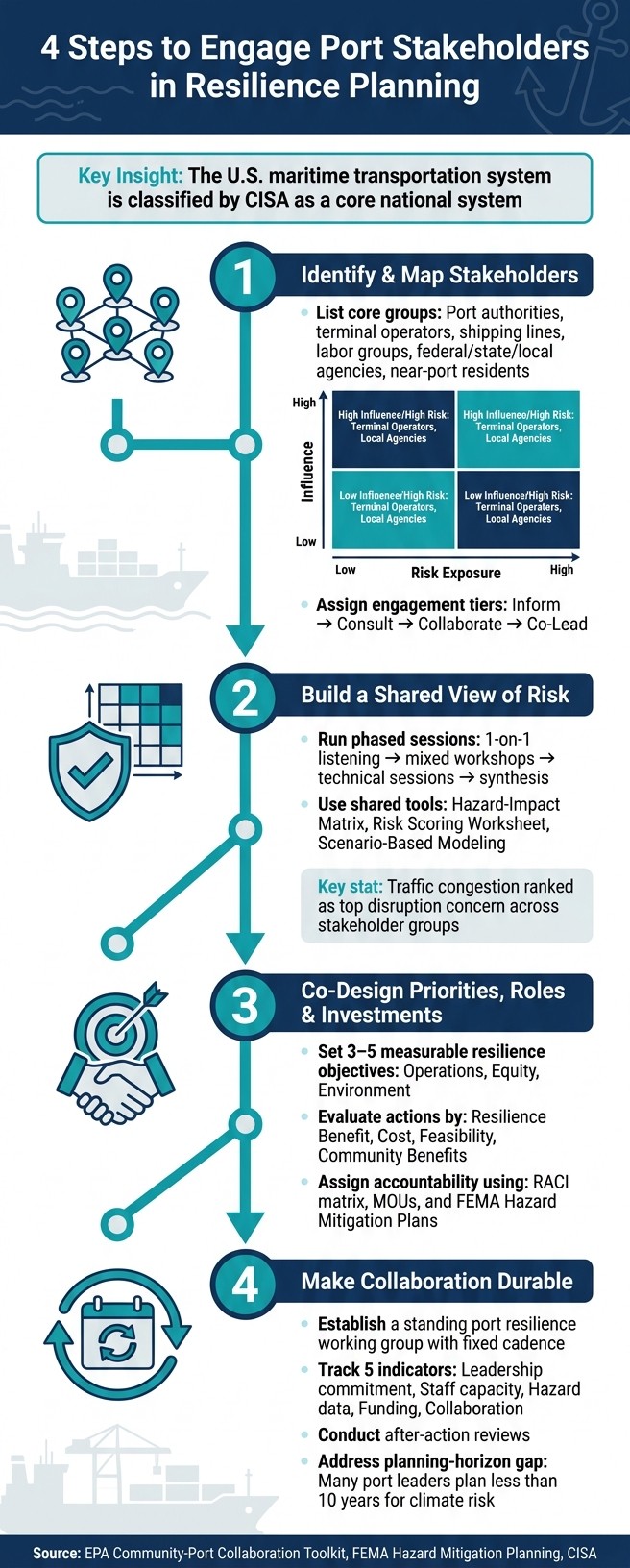
4-Step Port Stakeholder Resilience Planning Process for Municipalities
Step 1: Identify and Map the Port Stakeholders That Matter
List the Core Stakeholder Groups Across the Port System
Port resilience breaks down when only port leadership shows up.
Your stakeholder list should cover the full port system: port authorities, terminal operators, shipping lines, exporters, importers, labor groups, emergency managers, federal, state, and local agencies, environmental regulators, and near-port residents. Don’t miss the landside connectors - the roads, pipelines, and railroads that move freight from the port to its final destination [4]. Knowing who owns and runs those assets matters just as much as knowing who runs the terminal.
"Understanding the scope of port and port-related business activities, along with identifying and engaging with near-port stakeholders most impacted by port operations are key for developing shared solutions." - EPA Community-Port Collaboration Toolkit [3]
Near-port communities often deal with noise, air and water pollution, and traffic congestion. That makes their inclusion a core part of fair planning, not an optional add-on.
Build a Stakeholder Map Using Influence and Impact
Once you’ve listed the players, sort them by power and exposure. A simple 2x2 matrix works well here. One axis tracks decision-making influence - who can approve investments, change operations, or set policy. The other tracks risk exposure - who is most at risk when disruption hits [2].
Groups that rank high on both axes, such as the port authority or a major terminal operator, should help lead resilience work. Groups with high exposure but less institutional power, such as near-port residents or labor groups, need a seat at the table by design, not by vague invitation.
This exercise also brings friction into the open early. Port operations and community concerns don’t always line up. Seeing those gaps up front helps your team build a planning process that can hold up under pressure.
Match Engagement Methods to Each Stakeholder Type
Not every stakeholder needs the same kind of involvement. A useful way to assign engagement is to work with four tiers: inform, consult, collaborate, and co-lead [3].
Stakeholder Group | Engagement Tier | Practical Approach |
|---|---|---|
Port authority, terminal operators | Co-lead | Shared planning and resilience scoring |
Federal, state, and local agencies | Collaborate | Multi-agency coordination and risk assessment guidance |
Labor groups and port workers | Consult | Small-group listening sessions |
Near-port residents and community organizations | Consult / Collaborate | Plain-language community briefings |
Vulnerable populations | Consult / Collaborate | Multilingual outreach, deliberative guidance, and online participation options |
For operational partners, keep the focus on functional resilience - the capacity to keep throughput moving during and after a disruption [1]. For community organizations and vulnerable populations, the EPA's Ports Primer for Communities can help non-technical participants get a clear picture of port operations before weighing in on resilience planning [3].
Engagement should also reflect local histories, cultures, land use legacies, and languages, along with the deliberative guidance and resources needed to support meaningful participation [3][1]. Online or virtual settings can also help people speak more freely, especially when they might hold back in person [1]. Use this map to decide who should take part in the Step 2 risk-prioritization workshop.
Step 2: Bring Stakeholders Together and Build a Shared View of Risk
Run a Phased Engagement Process Instead of a Single Meeting
Once you've mapped stakeholders, the next job is to get them into a shared risk review process. The biggest mistake here is trying to do everything in one big meeting. That usually leads to guarded comments, uneven participation, and a lot of talking past each other.
A phased process works better. Start with one-on-one listening sessions before the full group meets. Those early conversations give people room to speak plainly, flag concerns, and say things they might not bring up in a public setting. Then move into mixed stakeholder workshops, where participants work through specific disruption scenarios together. After that, hold technical sessions with infrastructure and operations teams to pressure-test the details. End with a synthesis session that brings findings back to the full group for review and validation.
After each phase, write down where people agree, where they don't, and what still needs work. Share that summary before the next session starts. It keeps the process grounded and gives everyone the same reference point.
Use Risk-Prioritization Tools That Stakeholders Can Apply Together
Talk about "resilience" can get fuzzy fast. Shared tools make the conversation concrete and help the group sort concern from priority. The table below shows the most practical options for comparing and ranking risk in Step 2.
Tool | Purpose | Best Used For |
|---|---|---|
Hazard-Impact Matrix | Link specific hazards to exposed assets and affected groups | Surfacing dependencies across the port system |
Risk Scoring Worksheet | Rank risks by likelihood, consequence, and recovery capacity | Setting shared priorities across stakeholder groups |
Scenario-Based Modeling | Test how different disruptions shift initiative priorities | Comparing resilience investments under different scenarios |
Use these tools to move from broad concerns to ranked risks. For the risk scoring worksheet, set up rows for hazard, exposed assets, affected stakeholders, likelihood, consequence, recovery capacity, and priority rank. Then walk the group through a few sample hazards, such as severe weather, traffic disruption, or economic shifts. That simple exercise tends to show, pretty fast, which risks different groups weigh differently and why.
Research on container port resilience found that traffic congestion was often identified as the most disruptive scenario across stakeholder groups, while high operating costs ranked lower [2].
Conflicting stakeholder interests can materially shape port operations and planning [2].
Design for Trust, Equity, and Plain-Language Participation
Power gaps can distort port planning if you don't deal with them head-on. Neutral facilitation helps by balancing speaking time and translating technical language into plain English [1][3]. Small breakout groups of 3 to 4 people help too. People are often more willing to share concerns, local knowledge, or field experience in a smaller setting than in front of a packed room [1].
It also helps to name the biggest trade-offs early. Throughput vs. air quality. Capital upgrades vs. neighborhood disruption. Say them out loud from the start so the discussion doesn't drift into vague agreement that falls apart later.
Fair participation is not just about process. It improves the legitimacy of the final risk ranking and the resilience plan. The EPA's Ports Primer for Communities, available in both English and Spanish, gives non-technical participants the background they need to take part in these discussions [3]. Those trade-offs then carry forward into Step 3, where the group starts setting shared priorities, roles, and investment choices.
Step 3: Co-Design Priorities, Roles, and Resilience Investments
Set Shared Resilience Objectives Tied to Operations, Equity, and the Environment
Once the group agrees on the top risks, the next move is simple: turn that risk list into a short set of measurable goals. Aim for 3–5 objectives tied to operations, equity, and environmental performance. Each one should connect straight back to what stakeholders said mattered most during the workshop phases.
This matters because resilience at a port is not just about keeping cargo moving. It is also about how the port affects the people living nearby. The EPA's Environmental Justice Primer for Ports emphasizes that social equity is built when ports act as good neighbors, so resilience goals should reflect community health and quality-of-life aspirations alongside throughput and infrastructure targets [3].
Prioritize Actions by Impact, Cost, Feasibility, and Co-Benefits
After setting the objectives, compare proposed actions using four criteria:
Resilience benefit
Cost
Implementation feasibility
Community benefits
Run those options through more than one disruption scenario so stakeholders can see which actions still hold up under traffic congestion, high operating costs, or extreme weather. The point is not to reopen the risk debate. It is to compare investment choices side by side [2].
The table below shows common port resilience actions and what each is mainly meant to do.
Action | Category | Primary Benefit |
|---|---|---|
Build protective breakwaters or seawalls | Construction & Design | Technical resilience / physical protection |
Incorporate hazard mitigation into regional transportation plans | Long-Range Planning | Institutional alignment |
Create joint evacuation procedures with municipalities | Emergency Response | Safety and recovery speed |
Establish climate change working groups with residents | Networks & Thinking | Social capital and equity |
Prohibit erosive fill in high-risk zones | Building Codes & Land Use | Long-term risk reduction |
Conduct site-specific vulnerability assessments | Research | Data-driven decision-making |
Research on 10 U.S. seaport resilience planning cases found that seaports increasingly pursue infrastructure-related strategies, such as seawalls and breakwaters, immediately after completing formal resilience planning [1]. The Port of Long Beach's vulnerability assessment, for example, identified specific construction and design strategies for landlord-managed assets across hazards including sea-level rise, storm surge, extreme heat, precipitation, riverine flooding, extreme wind, and ocean acidification [1].
Define Governance and Accountability With Formal Tools
Once priorities are ranked, assign responsibility before implementation starts. Shared data systems, formal agreements, and clear decision rules help each agency understand its part in planning, evaluation, and delivery.
Three tools fit well together here. A RACI matrix - Responsible, Accountable, Consulted, Informed - assigns each action to a specific entity and cuts down on confusion about who decides and who carries out the work. Memorandums of Understanding (MOUs) or interagency agreements can lock in those assignments and support shared learning and evaluation. It also helps to fold resilience actions into existing Hazard Mitigation Plans under FEMA, or document them through the Ports Resilience Index (PRI), so there is a clear record of who committed to what [1].
Roles should match the port's operating model. A landlord port and an operating port do not control the same assets or day-to-day functions, so the RACI should reflect that. Those assignments should then carry straight into the implementation plan in the next step.
Step 4: Make Collaboration Durable and Keep the Plan Current
Create Standing Structures for Port-Community Coordination
Once priorities and roles are clear, the next task is simple to say and harder to do: build a governance setup that keeps the work moving. A resilience plan that sits on a shelf stops being a plan.
Set up a standing port resilience working group that meets on a fixed cadence and includes the stakeholders already identified - port authority, terminal operators, agencies, labor groups, and community representatives. This group should have a clear charter, defined membership, decision rules, a set meeting schedule, and plan-update triggers. It should also own the risk register, action tracker, and update calendar.
Research on U.S. seaport resilience planning points to a polycentric governance model - that is, decision-making is shared across multiple agencies and authorities instead of sitting in one office [1]. That distributed approach helps ports coordinate, adjust, and keep going even when staff changes or leadership turns over [1].
Track Progress With Indicators, After-Action Reviews, and Plan Updates
A standing coordination group also needs a short scorecard. Without one, it’s hard to tell whether collaboration is working or just taking up calendar space. A practical set of five indicators covers the basics [1]:
Leadership commitment
Staff capacity
Usable hazard data
Funding availability
Internal and external collaboration
After major disruptions, use after-action reviews to update the stakeholder map, revisit risk assumptions, and reshuffle action priorities. When major conditions change, rerun scenario analysis [2].
There’s also a planning-horizon problem worth calling out. Seaport leaders often lean toward short timeframes, and many seldom look beyond 10 years when judging climate impacts [1]. A standing governance structure, paired with a recurring review cycle, is one of the best ways to keep long-range risks in view.
Conclusion: What Public-Sector Leaders Should Do Next
With the governance cycle in place, name the next review point before the process loses momentum. Align internally, map stakeholders, run phased risk sessions, and keep the work active through a standing governance body and a recurring review cycle.
Webinar "Disaster Risk Management in Ports: Strategies for Coordinated Preparedness,..."
FAQs
Who should lead port resilience planning?
Port operators have often taken the lead on resilience planning. That makes sense - they're on the front lines when storms, supply chain shocks, or infrastructure failures hit. But if the goal is lasting progress, one group can't carry the whole load.
Resilience works best as a shared effort. It needs coordination across the public, private, and nonprofit sectors, with each group bringing a different piece of the puzzle.
A dedicated official should guide that work. This could be a Chief Resilience Officer, an emergency management professional, or a city planner. The point is simple: someone needs clear ownership of the process to keep it moving, hold continuity from one phase to the next, keep resilience high on the agenda, and bring the right stakeholders to the table.
How do we get community buy-in early?
Start with outreach that brings people in and relationship-building from day one of resilience planning. Identify stakeholders early, get them to the table, and use those first conversations to set shared goals and build trust.
Bring together leaders who can make decisions, along with a broad mix of community voices. That mix helps remove engagement barriers and makes it more likely the final plan reflects local needs, local priorities, and support that lasts.
How often should a port resilience plan be updated?
Set a regular review cycle for the port resilience plan and link it directly to implementation monitoring. As measures roll out, track what’s working, what’s lagging, and where conditions on the ground have changed. Then use those findings to update the plan as needed.
Once the priority resilience and response measures are in place, review how well they perform. If the results show gaps, delays, or weak spots, make the needed changes so the plan stays useful in practice.
Related Blog Posts
Latest Articles
©2025

Narrative Change and Power Building: The Missing Half of Advocacy
Narrative change is the process of disrupting dominant narratives that normalize inequity and advancing new narratives from historically marginalized communities.

Funding Resilience Without Federal Grants
BRIC is unreliable and FEMA is shrinking. Here's how cities fund climate resilience with dedicated revenue, blended finance, and a coordinating authority.

The ESG Blind Spot: How AI Is Finding Risks in Companies Nobody Else Is Watching
Norway's sovereign wealth fund uses AI to screen 7,200 portfolio companies for forced labor and corruption within 24 hours. The real story is the emerging-market coverage gap that traditional ESG data vendors miss — and what it means for any company with a global supply chain.
Narrative Change and Power Building: The Missing Half of Advocacy
Narrative change is the process of disrupting dominant narratives that normalize inequity and advancing new narratives from historically marginalized communities.
Funding Resilience Without Federal Grants
BRIC is unreliable and FEMA is shrinking. Here's how cities fund climate resilience with dedicated revenue, blended finance, and a coordinating authority.
The ESG Blind Spot: How AI Is Finding Risks in Companies Nobody Else Is Watching
Norway's sovereign wealth fund uses AI to screen 7,200 portfolio companies for forced labor and corruption within 24 hours. The real story is the emerging-market coverage gap that traditional ESG data vendors miss — and what it means for any company with a global supply chain.
FAQ
01
What does it really mean to “redefine profit”?
02
What makes Council Fire different?
03
Who does Council Fire work with?
04
What does working with Council Fire actually look like?
05
How does Council Fire help organizations turn big goals into action?
06
How does Council Fire define and measure success?
Jun 20, 2026
How to Engage Port Stakeholders in Resilience Planning for Municipalities & Government Agencies
Capacity Building
In This Article
Municipalities must align agencies, map port stakeholders, rank shared risks, and build durable governance for resilient ports.
How to Engage Port Stakeholders in Resilience Planning for Municipalities & Government Agencies
If a port goes down, the shock does not stay at the waterfront. Freight stalls, fuel and food shipments slip, traffic backs up, and nearby neighborhoods can face worse air and water problems.
If I were leading this work, I would keep the plan simple:
Align government teams first so agencies speak with one voice
Map all port stakeholders by influence and risk exposure
Run phased sessions instead of one large public meeting
Use shared risk tools to rank hazards, assets, and impacts
Set 3–5 clear goals tied to cargo flow, community health, and port conditions
Assign roles in writing with a RACI, MOU, or hazard plan update
Keep the plan active through a standing working group and review cycle
A few facts shape the case. The U.S. maritime transportation system is classified by CISA as a core national system. Research cited in the article shows many port leaders still plan on short timeframes, often less than 10 years for climate risk. Another study noted that traffic congestion ranked above high operating costs as a top disruption concern across stakeholder groups.
What matters most is not more meetings. It is getting the right people in the room, using plain language, naming trade-offs early, and turning discussion into assigned actions.
I see this as a four-step job: align internally, map stakeholders, rank risks together, and build a standing structure that keeps the work current.
4-Step Port Stakeholder Resilience Planning Process for Municipalities
Step 1: Identify and Map the Port Stakeholders That Matter
List the Core Stakeholder Groups Across the Port System
Port resilience breaks down when only port leadership shows up.
Your stakeholder list should cover the full port system: port authorities, terminal operators, shipping lines, exporters, importers, labor groups, emergency managers, federal, state, and local agencies, environmental regulators, and near-port residents. Don’t miss the landside connectors - the roads, pipelines, and railroads that move freight from the port to its final destination [4]. Knowing who owns and runs those assets matters just as much as knowing who runs the terminal.
"Understanding the scope of port and port-related business activities, along with identifying and engaging with near-port stakeholders most impacted by port operations are key for developing shared solutions." - EPA Community-Port Collaboration Toolkit [3]
Near-port communities often deal with noise, air and water pollution, and traffic congestion. That makes their inclusion a core part of fair planning, not an optional add-on.
Build a Stakeholder Map Using Influence and Impact
Once you’ve listed the players, sort them by power and exposure. A simple 2x2 matrix works well here. One axis tracks decision-making influence - who can approve investments, change operations, or set policy. The other tracks risk exposure - who is most at risk when disruption hits [2].
Groups that rank high on both axes, such as the port authority or a major terminal operator, should help lead resilience work. Groups with high exposure but less institutional power, such as near-port residents or labor groups, need a seat at the table by design, not by vague invitation.
This exercise also brings friction into the open early. Port operations and community concerns don’t always line up. Seeing those gaps up front helps your team build a planning process that can hold up under pressure.
Match Engagement Methods to Each Stakeholder Type
Not every stakeholder needs the same kind of involvement. A useful way to assign engagement is to work with four tiers: inform, consult, collaborate, and co-lead [3].
Stakeholder Group | Engagement Tier | Practical Approach |
|---|---|---|
Port authority, terminal operators | Co-lead | Shared planning and resilience scoring |
Federal, state, and local agencies | Collaborate | Multi-agency coordination and risk assessment guidance |
Labor groups and port workers | Consult | Small-group listening sessions |
Near-port residents and community organizations | Consult / Collaborate | Plain-language community briefings |
Vulnerable populations | Consult / Collaborate | Multilingual outreach, deliberative guidance, and online participation options |
For operational partners, keep the focus on functional resilience - the capacity to keep throughput moving during and after a disruption [1]. For community organizations and vulnerable populations, the EPA's Ports Primer for Communities can help non-technical participants get a clear picture of port operations before weighing in on resilience planning [3].
Engagement should also reflect local histories, cultures, land use legacies, and languages, along with the deliberative guidance and resources needed to support meaningful participation [3][1]. Online or virtual settings can also help people speak more freely, especially when they might hold back in person [1]. Use this map to decide who should take part in the Step 2 risk-prioritization workshop.
Step 2: Bring Stakeholders Together and Build a Shared View of Risk
Run a Phased Engagement Process Instead of a Single Meeting
Once you've mapped stakeholders, the next job is to get them into a shared risk review process. The biggest mistake here is trying to do everything in one big meeting. That usually leads to guarded comments, uneven participation, and a lot of talking past each other.
A phased process works better. Start with one-on-one listening sessions before the full group meets. Those early conversations give people room to speak plainly, flag concerns, and say things they might not bring up in a public setting. Then move into mixed stakeholder workshops, where participants work through specific disruption scenarios together. After that, hold technical sessions with infrastructure and operations teams to pressure-test the details. End with a synthesis session that brings findings back to the full group for review and validation.
After each phase, write down where people agree, where they don't, and what still needs work. Share that summary before the next session starts. It keeps the process grounded and gives everyone the same reference point.
Use Risk-Prioritization Tools That Stakeholders Can Apply Together
Talk about "resilience" can get fuzzy fast. Shared tools make the conversation concrete and help the group sort concern from priority. The table below shows the most practical options for comparing and ranking risk in Step 2.
Tool | Purpose | Best Used For |
|---|---|---|
Hazard-Impact Matrix | Link specific hazards to exposed assets and affected groups | Surfacing dependencies across the port system |
Risk Scoring Worksheet | Rank risks by likelihood, consequence, and recovery capacity | Setting shared priorities across stakeholder groups |
Scenario-Based Modeling | Test how different disruptions shift initiative priorities | Comparing resilience investments under different scenarios |
Use these tools to move from broad concerns to ranked risks. For the risk scoring worksheet, set up rows for hazard, exposed assets, affected stakeholders, likelihood, consequence, recovery capacity, and priority rank. Then walk the group through a few sample hazards, such as severe weather, traffic disruption, or economic shifts. That simple exercise tends to show, pretty fast, which risks different groups weigh differently and why.
Research on container port resilience found that traffic congestion was often identified as the most disruptive scenario across stakeholder groups, while high operating costs ranked lower [2].
Conflicting stakeholder interests can materially shape port operations and planning [2].
Design for Trust, Equity, and Plain-Language Participation
Power gaps can distort port planning if you don't deal with them head-on. Neutral facilitation helps by balancing speaking time and translating technical language into plain English [1][3]. Small breakout groups of 3 to 4 people help too. People are often more willing to share concerns, local knowledge, or field experience in a smaller setting than in front of a packed room [1].
It also helps to name the biggest trade-offs early. Throughput vs. air quality. Capital upgrades vs. neighborhood disruption. Say them out loud from the start so the discussion doesn't drift into vague agreement that falls apart later.
Fair participation is not just about process. It improves the legitimacy of the final risk ranking and the resilience plan. The EPA's Ports Primer for Communities, available in both English and Spanish, gives non-technical participants the background they need to take part in these discussions [3]. Those trade-offs then carry forward into Step 3, where the group starts setting shared priorities, roles, and investment choices.
Step 3: Co-Design Priorities, Roles, and Resilience Investments
Set Shared Resilience Objectives Tied to Operations, Equity, and the Environment
Once the group agrees on the top risks, the next move is simple: turn that risk list into a short set of measurable goals. Aim for 3–5 objectives tied to operations, equity, and environmental performance. Each one should connect straight back to what stakeholders said mattered most during the workshop phases.
This matters because resilience at a port is not just about keeping cargo moving. It is also about how the port affects the people living nearby. The EPA's Environmental Justice Primer for Ports emphasizes that social equity is built when ports act as good neighbors, so resilience goals should reflect community health and quality-of-life aspirations alongside throughput and infrastructure targets [3].
Prioritize Actions by Impact, Cost, Feasibility, and Co-Benefits
After setting the objectives, compare proposed actions using four criteria:
Resilience benefit
Cost
Implementation feasibility
Community benefits
Run those options through more than one disruption scenario so stakeholders can see which actions still hold up under traffic congestion, high operating costs, or extreme weather. The point is not to reopen the risk debate. It is to compare investment choices side by side [2].
The table below shows common port resilience actions and what each is mainly meant to do.
Action | Category | Primary Benefit |
|---|---|---|
Build protective breakwaters or seawalls | Construction & Design | Technical resilience / physical protection |
Incorporate hazard mitigation into regional transportation plans | Long-Range Planning | Institutional alignment |
Create joint evacuation procedures with municipalities | Emergency Response | Safety and recovery speed |
Establish climate change working groups with residents | Networks & Thinking | Social capital and equity |
Prohibit erosive fill in high-risk zones | Building Codes & Land Use | Long-term risk reduction |
Conduct site-specific vulnerability assessments | Research | Data-driven decision-making |
Research on 10 U.S. seaport resilience planning cases found that seaports increasingly pursue infrastructure-related strategies, such as seawalls and breakwaters, immediately after completing formal resilience planning [1]. The Port of Long Beach's vulnerability assessment, for example, identified specific construction and design strategies for landlord-managed assets across hazards including sea-level rise, storm surge, extreme heat, precipitation, riverine flooding, extreme wind, and ocean acidification [1].
Define Governance and Accountability With Formal Tools
Once priorities are ranked, assign responsibility before implementation starts. Shared data systems, formal agreements, and clear decision rules help each agency understand its part in planning, evaluation, and delivery.
Three tools fit well together here. A RACI matrix - Responsible, Accountable, Consulted, Informed - assigns each action to a specific entity and cuts down on confusion about who decides and who carries out the work. Memorandums of Understanding (MOUs) or interagency agreements can lock in those assignments and support shared learning and evaluation. It also helps to fold resilience actions into existing Hazard Mitigation Plans under FEMA, or document them through the Ports Resilience Index (PRI), so there is a clear record of who committed to what [1].
Roles should match the port's operating model. A landlord port and an operating port do not control the same assets or day-to-day functions, so the RACI should reflect that. Those assignments should then carry straight into the implementation plan in the next step.
Step 4: Make Collaboration Durable and Keep the Plan Current
Create Standing Structures for Port-Community Coordination
Once priorities and roles are clear, the next task is simple to say and harder to do: build a governance setup that keeps the work moving. A resilience plan that sits on a shelf stops being a plan.
Set up a standing port resilience working group that meets on a fixed cadence and includes the stakeholders already identified - port authority, terminal operators, agencies, labor groups, and community representatives. This group should have a clear charter, defined membership, decision rules, a set meeting schedule, and plan-update triggers. It should also own the risk register, action tracker, and update calendar.
Research on U.S. seaport resilience planning points to a polycentric governance model - that is, decision-making is shared across multiple agencies and authorities instead of sitting in one office [1]. That distributed approach helps ports coordinate, adjust, and keep going even when staff changes or leadership turns over [1].
Track Progress With Indicators, After-Action Reviews, and Plan Updates
A standing coordination group also needs a short scorecard. Without one, it’s hard to tell whether collaboration is working or just taking up calendar space. A practical set of five indicators covers the basics [1]:
Leadership commitment
Staff capacity
Usable hazard data
Funding availability
Internal and external collaboration
After major disruptions, use after-action reviews to update the stakeholder map, revisit risk assumptions, and reshuffle action priorities. When major conditions change, rerun scenario analysis [2].
There’s also a planning-horizon problem worth calling out. Seaport leaders often lean toward short timeframes, and many seldom look beyond 10 years when judging climate impacts [1]. A standing governance structure, paired with a recurring review cycle, is one of the best ways to keep long-range risks in view.
Conclusion: What Public-Sector Leaders Should Do Next
With the governance cycle in place, name the next review point before the process loses momentum. Align internally, map stakeholders, run phased risk sessions, and keep the work active through a standing governance body and a recurring review cycle.
Webinar "Disaster Risk Management in Ports: Strategies for Coordinated Preparedness,..."
FAQs
Who should lead port resilience planning?
Port operators have often taken the lead on resilience planning. That makes sense - they're on the front lines when storms, supply chain shocks, or infrastructure failures hit. But if the goal is lasting progress, one group can't carry the whole load.
Resilience works best as a shared effort. It needs coordination across the public, private, and nonprofit sectors, with each group bringing a different piece of the puzzle.
A dedicated official should guide that work. This could be a Chief Resilience Officer, an emergency management professional, or a city planner. The point is simple: someone needs clear ownership of the process to keep it moving, hold continuity from one phase to the next, keep resilience high on the agenda, and bring the right stakeholders to the table.
How do we get community buy-in early?
Start with outreach that brings people in and relationship-building from day one of resilience planning. Identify stakeholders early, get them to the table, and use those first conversations to set shared goals and build trust.
Bring together leaders who can make decisions, along with a broad mix of community voices. That mix helps remove engagement barriers and makes it more likely the final plan reflects local needs, local priorities, and support that lasts.
How often should a port resilience plan be updated?
Set a regular review cycle for the port resilience plan and link it directly to implementation monitoring. As measures roll out, track what’s working, what’s lagging, and where conditions on the ground have changed. Then use those findings to update the plan as needed.
Once the priority resilience and response measures are in place, review how well they perform. If the results show gaps, delays, or weak spots, make the needed changes so the plan stays useful in practice.
Related Blog Posts
Latest Articles
©2025
Narrative Change and Power Building: The Missing Half of Advocacy
Narrative change is the process of disrupting dominant narratives that normalize inequity and advancing new narratives from historically marginalized communities.
Funding Resilience Without Federal Grants
BRIC is unreliable and FEMA is shrinking. Here's how cities fund climate resilience with dedicated revenue, blended finance, and a coordinating authority.
The ESG Blind Spot: How AI Is Finding Risks in Companies Nobody Else Is Watching
Norway's sovereign wealth fund uses AI to screen 7,200 portfolio companies for forced labor and corruption within 24 hours. The real story is the emerging-market coverage gap that traditional ESG data vendors miss — and what it means for any company with a global supply chain.
FAQ
01
What does it really mean to “redefine profit”?
02
What makes Council Fire different?
03
Who does Council Fire work with?
04
What does working with Council Fire actually look like?
05
How does Council Fire help organizations turn big goals into action?
06
How does Council Fire define and measure success?
Jun 20, 2026
How to Engage Port Stakeholders in Resilience Planning for Municipalities & Government Agencies
Capacity Building
In This Article
Municipalities must align agencies, map port stakeholders, rank shared risks, and build durable governance for resilient ports.
How to Engage Port Stakeholders in Resilience Planning for Municipalities & Government Agencies
If a port goes down, the shock does not stay at the waterfront. Freight stalls, fuel and food shipments slip, traffic backs up, and nearby neighborhoods can face worse air and water problems.
If I were leading this work, I would keep the plan simple:
Align government teams first so agencies speak with one voice
Map all port stakeholders by influence and risk exposure
Run phased sessions instead of one large public meeting
Use shared risk tools to rank hazards, assets, and impacts
Set 3–5 clear goals tied to cargo flow, community health, and port conditions
Assign roles in writing with a RACI, MOU, or hazard plan update
Keep the plan active through a standing working group and review cycle
A few facts shape the case. The U.S. maritime transportation system is classified by CISA as a core national system. Research cited in the article shows many port leaders still plan on short timeframes, often less than 10 years for climate risk. Another study noted that traffic congestion ranked above high operating costs as a top disruption concern across stakeholder groups.
What matters most is not more meetings. It is getting the right people in the room, using plain language, naming trade-offs early, and turning discussion into assigned actions.
I see this as a four-step job: align internally, map stakeholders, rank risks together, and build a standing structure that keeps the work current.
4-Step Port Stakeholder Resilience Planning Process for Municipalities
Step 1: Identify and Map the Port Stakeholders That Matter
List the Core Stakeholder Groups Across the Port System
Port resilience breaks down when only port leadership shows up.
Your stakeholder list should cover the full port system: port authorities, terminal operators, shipping lines, exporters, importers, labor groups, emergency managers, federal, state, and local agencies, environmental regulators, and near-port residents. Don’t miss the landside connectors - the roads, pipelines, and railroads that move freight from the port to its final destination [4]. Knowing who owns and runs those assets matters just as much as knowing who runs the terminal.
"Understanding the scope of port and port-related business activities, along with identifying and engaging with near-port stakeholders most impacted by port operations are key for developing shared solutions." - EPA Community-Port Collaboration Toolkit [3]
Near-port communities often deal with noise, air and water pollution, and traffic congestion. That makes their inclusion a core part of fair planning, not an optional add-on.
Build a Stakeholder Map Using Influence and Impact
Once you’ve listed the players, sort them by power and exposure. A simple 2x2 matrix works well here. One axis tracks decision-making influence - who can approve investments, change operations, or set policy. The other tracks risk exposure - who is most at risk when disruption hits [2].
Groups that rank high on both axes, such as the port authority or a major terminal operator, should help lead resilience work. Groups with high exposure but less institutional power, such as near-port residents or labor groups, need a seat at the table by design, not by vague invitation.
This exercise also brings friction into the open early. Port operations and community concerns don’t always line up. Seeing those gaps up front helps your team build a planning process that can hold up under pressure.
Match Engagement Methods to Each Stakeholder Type
Not every stakeholder needs the same kind of involvement. A useful way to assign engagement is to work with four tiers: inform, consult, collaborate, and co-lead [3].
Stakeholder Group | Engagement Tier | Practical Approach |
|---|---|---|
Port authority, terminal operators | Co-lead | Shared planning and resilience scoring |
Federal, state, and local agencies | Collaborate | Multi-agency coordination and risk assessment guidance |
Labor groups and port workers | Consult | Small-group listening sessions |
Near-port residents and community organizations | Consult / Collaborate | Plain-language community briefings |
Vulnerable populations | Consult / Collaborate | Multilingual outreach, deliberative guidance, and online participation options |
For operational partners, keep the focus on functional resilience - the capacity to keep throughput moving during and after a disruption [1]. For community organizations and vulnerable populations, the EPA's Ports Primer for Communities can help non-technical participants get a clear picture of port operations before weighing in on resilience planning [3].
Engagement should also reflect local histories, cultures, land use legacies, and languages, along with the deliberative guidance and resources needed to support meaningful participation [3][1]. Online or virtual settings can also help people speak more freely, especially when they might hold back in person [1]. Use this map to decide who should take part in the Step 2 risk-prioritization workshop.
Step 2: Bring Stakeholders Together and Build a Shared View of Risk
Run a Phased Engagement Process Instead of a Single Meeting
Once you've mapped stakeholders, the next job is to get them into a shared risk review process. The biggest mistake here is trying to do everything in one big meeting. That usually leads to guarded comments, uneven participation, and a lot of talking past each other.
A phased process works better. Start with one-on-one listening sessions before the full group meets. Those early conversations give people room to speak plainly, flag concerns, and say things they might not bring up in a public setting. Then move into mixed stakeholder workshops, where participants work through specific disruption scenarios together. After that, hold technical sessions with infrastructure and operations teams to pressure-test the details. End with a synthesis session that brings findings back to the full group for review and validation.
After each phase, write down where people agree, where they don't, and what still needs work. Share that summary before the next session starts. It keeps the process grounded and gives everyone the same reference point.
Use Risk-Prioritization Tools That Stakeholders Can Apply Together
Talk about "resilience" can get fuzzy fast. Shared tools make the conversation concrete and help the group sort concern from priority. The table below shows the most practical options for comparing and ranking risk in Step 2.
Tool | Purpose | Best Used For |
|---|---|---|
Hazard-Impact Matrix | Link specific hazards to exposed assets and affected groups | Surfacing dependencies across the port system |
Risk Scoring Worksheet | Rank risks by likelihood, consequence, and recovery capacity | Setting shared priorities across stakeholder groups |
Scenario-Based Modeling | Test how different disruptions shift initiative priorities | Comparing resilience investments under different scenarios |
Use these tools to move from broad concerns to ranked risks. For the risk scoring worksheet, set up rows for hazard, exposed assets, affected stakeholders, likelihood, consequence, recovery capacity, and priority rank. Then walk the group through a few sample hazards, such as severe weather, traffic disruption, or economic shifts. That simple exercise tends to show, pretty fast, which risks different groups weigh differently and why.
Research on container port resilience found that traffic congestion was often identified as the most disruptive scenario across stakeholder groups, while high operating costs ranked lower [2].
Conflicting stakeholder interests can materially shape port operations and planning [2].
Design for Trust, Equity, and Plain-Language Participation
Power gaps can distort port planning if you don't deal with them head-on. Neutral facilitation helps by balancing speaking time and translating technical language into plain English [1][3]. Small breakout groups of 3 to 4 people help too. People are often more willing to share concerns, local knowledge, or field experience in a smaller setting than in front of a packed room [1].
It also helps to name the biggest trade-offs early. Throughput vs. air quality. Capital upgrades vs. neighborhood disruption. Say them out loud from the start so the discussion doesn't drift into vague agreement that falls apart later.
Fair participation is not just about process. It improves the legitimacy of the final risk ranking and the resilience plan. The EPA's Ports Primer for Communities, available in both English and Spanish, gives non-technical participants the background they need to take part in these discussions [3]. Those trade-offs then carry forward into Step 3, where the group starts setting shared priorities, roles, and investment choices.
Step 3: Co-Design Priorities, Roles, and Resilience Investments
Set Shared Resilience Objectives Tied to Operations, Equity, and the Environment
Once the group agrees on the top risks, the next move is simple: turn that risk list into a short set of measurable goals. Aim for 3–5 objectives tied to operations, equity, and environmental performance. Each one should connect straight back to what stakeholders said mattered most during the workshop phases.
This matters because resilience at a port is not just about keeping cargo moving. It is also about how the port affects the people living nearby. The EPA's Environmental Justice Primer for Ports emphasizes that social equity is built when ports act as good neighbors, so resilience goals should reflect community health and quality-of-life aspirations alongside throughput and infrastructure targets [3].
Prioritize Actions by Impact, Cost, Feasibility, and Co-Benefits
After setting the objectives, compare proposed actions using four criteria:
Resilience benefit
Cost
Implementation feasibility
Community benefits
Run those options through more than one disruption scenario so stakeholders can see which actions still hold up under traffic congestion, high operating costs, or extreme weather. The point is not to reopen the risk debate. It is to compare investment choices side by side [2].
The table below shows common port resilience actions and what each is mainly meant to do.
Action | Category | Primary Benefit |
|---|---|---|
Build protective breakwaters or seawalls | Construction & Design | Technical resilience / physical protection |
Incorporate hazard mitigation into regional transportation plans | Long-Range Planning | Institutional alignment |
Create joint evacuation procedures with municipalities | Emergency Response | Safety and recovery speed |
Establish climate change working groups with residents | Networks & Thinking | Social capital and equity |
Prohibit erosive fill in high-risk zones | Building Codes & Land Use | Long-term risk reduction |
Conduct site-specific vulnerability assessments | Research | Data-driven decision-making |
Research on 10 U.S. seaport resilience planning cases found that seaports increasingly pursue infrastructure-related strategies, such as seawalls and breakwaters, immediately after completing formal resilience planning [1]. The Port of Long Beach's vulnerability assessment, for example, identified specific construction and design strategies for landlord-managed assets across hazards including sea-level rise, storm surge, extreme heat, precipitation, riverine flooding, extreme wind, and ocean acidification [1].
Define Governance and Accountability With Formal Tools
Once priorities are ranked, assign responsibility before implementation starts. Shared data systems, formal agreements, and clear decision rules help each agency understand its part in planning, evaluation, and delivery.
Three tools fit well together here. A RACI matrix - Responsible, Accountable, Consulted, Informed - assigns each action to a specific entity and cuts down on confusion about who decides and who carries out the work. Memorandums of Understanding (MOUs) or interagency agreements can lock in those assignments and support shared learning and evaluation. It also helps to fold resilience actions into existing Hazard Mitigation Plans under FEMA, or document them through the Ports Resilience Index (PRI), so there is a clear record of who committed to what [1].
Roles should match the port's operating model. A landlord port and an operating port do not control the same assets or day-to-day functions, so the RACI should reflect that. Those assignments should then carry straight into the implementation plan in the next step.
Step 4: Make Collaboration Durable and Keep the Plan Current
Create Standing Structures for Port-Community Coordination
Once priorities and roles are clear, the next task is simple to say and harder to do: build a governance setup that keeps the work moving. A resilience plan that sits on a shelf stops being a plan.
Set up a standing port resilience working group that meets on a fixed cadence and includes the stakeholders already identified - port authority, terminal operators, agencies, labor groups, and community representatives. This group should have a clear charter, defined membership, decision rules, a set meeting schedule, and plan-update triggers. It should also own the risk register, action tracker, and update calendar.
Research on U.S. seaport resilience planning points to a polycentric governance model - that is, decision-making is shared across multiple agencies and authorities instead of sitting in one office [1]. That distributed approach helps ports coordinate, adjust, and keep going even when staff changes or leadership turns over [1].
Track Progress With Indicators, After-Action Reviews, and Plan Updates
A standing coordination group also needs a short scorecard. Without one, it’s hard to tell whether collaboration is working or just taking up calendar space. A practical set of five indicators covers the basics [1]:
Leadership commitment
Staff capacity
Usable hazard data
Funding availability
Internal and external collaboration
After major disruptions, use after-action reviews to update the stakeholder map, revisit risk assumptions, and reshuffle action priorities. When major conditions change, rerun scenario analysis [2].
There’s also a planning-horizon problem worth calling out. Seaport leaders often lean toward short timeframes, and many seldom look beyond 10 years when judging climate impacts [1]. A standing governance structure, paired with a recurring review cycle, is one of the best ways to keep long-range risks in view.
Conclusion: What Public-Sector Leaders Should Do Next
With the governance cycle in place, name the next review point before the process loses momentum. Align internally, map stakeholders, run phased risk sessions, and keep the work active through a standing governance body and a recurring review cycle.
Webinar "Disaster Risk Management in Ports: Strategies for Coordinated Preparedness,..."
FAQs
Who should lead port resilience planning?
Port operators have often taken the lead on resilience planning. That makes sense - they're on the front lines when storms, supply chain shocks, or infrastructure failures hit. But if the goal is lasting progress, one group can't carry the whole load.
Resilience works best as a shared effort. It needs coordination across the public, private, and nonprofit sectors, with each group bringing a different piece of the puzzle.
A dedicated official should guide that work. This could be a Chief Resilience Officer, an emergency management professional, or a city planner. The point is simple: someone needs clear ownership of the process to keep it moving, hold continuity from one phase to the next, keep resilience high on the agenda, and bring the right stakeholders to the table.
How do we get community buy-in early?
Start with outreach that brings people in and relationship-building from day one of resilience planning. Identify stakeholders early, get them to the table, and use those first conversations to set shared goals and build trust.
Bring together leaders who can make decisions, along with a broad mix of community voices. That mix helps remove engagement barriers and makes it more likely the final plan reflects local needs, local priorities, and support that lasts.
How often should a port resilience plan be updated?
Set a regular review cycle for the port resilience plan and link it directly to implementation monitoring. As measures roll out, track what’s working, what’s lagging, and where conditions on the ground have changed. Then use those findings to update the plan as needed.
Once the priority resilience and response measures are in place, review how well they perform. If the results show gaps, delays, or weak spots, make the needed changes so the plan stays useful in practice.
Related Blog Posts
Latest Articles
©2025
Narrative Change and Power Building: The Missing Half of Advocacy
Narrative change is the process of disrupting dominant narratives that normalize inequity and advancing new narratives from historically marginalized communities.
Funding Resilience Without Federal Grants
BRIC is unreliable and FEMA is shrinking. Here's how cities fund climate resilience with dedicated revenue, blended finance, and a coordinating authority.
The ESG Blind Spot: How AI Is Finding Risks in Companies Nobody Else Is Watching
Norway's sovereign wealth fund uses AI to screen 7,200 portfolio companies for forced labor and corruption within 24 hours. The real story is the emerging-market coverage gap that traditional ESG data vendors miss — and what it means for any company with a global supply chain.
FAQ
What does it really mean to “redefine profit”?
What makes Council Fire different?
Who does Council Fire work with?
What does working with Council Fire actually look like?
How does Council Fire help organizations turn big goals into action?
How does Council Fire define and measure success?