
Jun 22, 2026
How to Engage Port Stakeholders in Resilience Planning for Maritime & Logistics Companies
Capacity Building
In This Article
Map port systems, assign stakeholder owners, set recovery targets, run joint drills, and track throughput to improve resilience.
How to Engage Port Stakeholders in Resilience Planning for Maritime & Logistics Companies
If you wait until a storm, cyber event, or labor stoppage hits, you’ve waited too long. In U.S. ports, one weak link can slow cargo, trucking, rail, customs, and local services at the same time. I’d treat resilience planning as a shared job: map the port system, name the people tied to each risk, agree on roles, test plans, and track results.
Here’s the short version:
Start with the system, not the asset. I’d map terminals, roads, rail links, utilities, IT, customs points, and inland hubs.
Focus on the functions that cannot stop. That usually means cargo handling, vessel scheduling, customs processing, intermodal handoffs, and data flow.
Set hard recovery targets. Use MTPD, RTO, and RPO so everyone knows the limits for downtime and data loss.
Group stakeholders by role. Core players, freight partners, nearby groups, and finance teams do not need the same level of input.
Match each stakeholder to a risk. Storm surge, sea-level rise, heat, cyber events, congestion, labor actions, and rule changes each need named owners.
Build shared tools. I’d use joint risk maps, asset lists, contingency plans, communication rules, and a RACI matrix.
Run drills and reviews. Tabletop exercises and after-action reviews show where plans fail before a live event does.
Measure what matters. Track throughput, dwell time, recovery time, exercise turnout, and cross-party data or staff sharing.
One fact sets the tone: many U.S. ports sit within 10 miles of the coast, which puts them in the path of storm surge, sea-level rise, and heat stress. Add cyber risk and inland bottlenecks, and the case for early stakeholder work becomes plain.
I’d keep the process simple: who matters, what can fail, who owns the response, and how fast can the port recover?
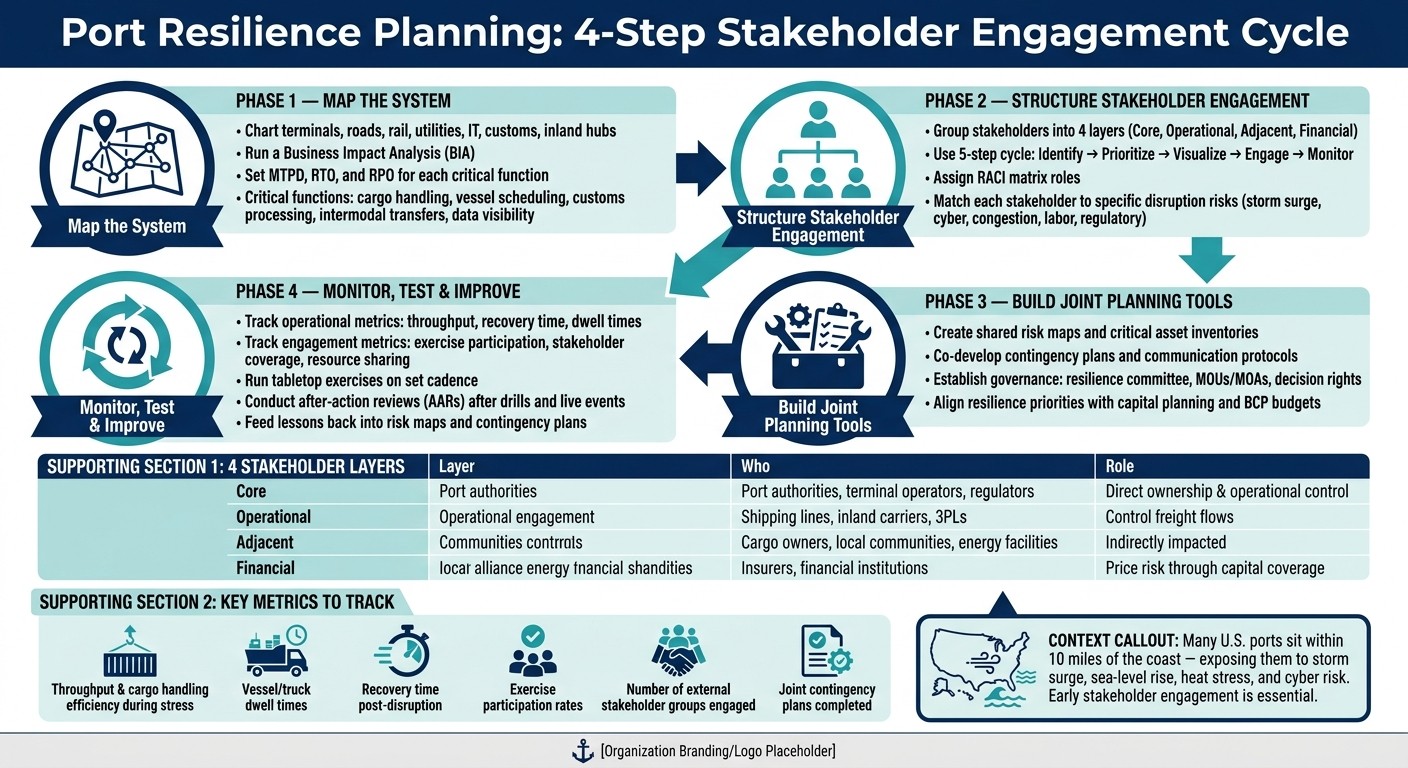
Port Resilience Planning: 4-Step Stakeholder Engagement Cycle
1. Map the Port Stakeholder Landscape and Risk Profile
Define Port System Boundaries and Critical Functions
Start by mapping the full port system and the functions that simply cannot go down.
That means charting infrastructure, access corridors, utilities, IT, customs points, inland hubs, and key third-party sites.[2] Think of it as drawing the operating picture before you try to fix weak spots. If a road link fails, a data feed drops, or a utility outage hits at the wrong moment, the effect can spread fast.
For each part of that system, identify the functions that matter most to your business. That usually includes cargo handling, vessel scheduling, customs processing, intermodal transfers, and data visibility. A Business Impact Analysis (BIA) helps pinpoint the assets and processes whose failure would hit revenue or core services the hardest.[2]
For each critical function, set:
Maximum Tolerable Period of Disruption (MTPD)
Recovery Time Objective (RTO)
Recovery Point Objective (RPO)
These metrics make your limits clear. How long can a function be down? How fast must it come back? How much data loss can you live with before the damage becomes too great?
Use this function map to decide which stakeholders need to be part of each resilience discussion. The goal is simple: the map should show who needs to be in the room for every critical function.
Identify and Prioritize Stakeholders with a Simple Engagement Model
Once the system map is done, group stakeholders into four layers based on how directly they affect port operations.[4]
Layer | Who They Are | Resilience Role |
|---|---|---|
Core | Port authorities, terminal operators, regulators | Direct ownership, oversight, and operational control |
Operational | Shipping lines, inland carriers, 3PLs | Control freight flows; directly depend on port assets |
Adjacent | Cargo owners, local communities, co-located energy facilities | Indirectly impacted; influence long-term facility use |
Financial stakeholders | Insurers, financial institutions | Price risk through valuation and capital coverage |
This kind of grouping keeps planning from turning into a crowded room with no clear purpose. You can use it to sort who co-owns plans, who reviews them, and who simply needs updates.
From there, use the five-step engagement cycle - identify, prioritize, visualize, engage, and monitor - to turn a contact list into something you can work from day to day. Pair that with a RACI matrix so each resilience function has clear ownership.[3]
Once stakeholders are grouped, assign each one to the disruptions they are best placed to influence.
Link Each Stakeholder to Specific Disruption Risks
The next move is to connect each stakeholder to the risks they can help prevent, respond to, or recover from.
"Risks can have an impact on a port's corporate objectives as well as on key dependencies, core processes, and stakeholder expectations. This is called 'attachment of risk'." - UNCTAD [2]
That line gets to the point. Risk does not sit in one neat box. It attaches itself to operations, systems, people, and outside partners.
Climate risks, cyber incidents, congestion, labor actions, and regulatory changes each need a named stakeholder owner. Climate risks such as storm surge, sea-level rise, and extreme heat link to port authorities, regulators, terminal operators, and critical infrastructure dependencies. Cyber incidents draw in terminal operators and other critical digital dependencies. Congestion and labor actions involve shipping lines, inland carriers, and 3PLs. Regulatory changes call for coordination between port authorities and regulators.
Use a severity-probability matrix to set planning priorities.[2] High-probability, high-severity risks need detailed business continuity and crisis management plans. Lower-severity, more frequent disruptions may be handled through routine coordination.
With the stakeholder map in place, the next step is to turn it into a repeatable engagement process.
2. Design a Structured Stakeholder Engagement Process
Set Shared Resilience Objectives and Engagement Principles
Once the stakeholder map is in place, the next step is getting people aligned around the same resilience goals. That means co-creating clear, measurable targets for recovery time, minimum service levels, and worker safety during disruptions. Those targets should cover a range of risks, including climate threats, congestion, cyber incidents, and regulatory shocks.
This works best when everyone is operating from the same ground rules. Keep data sharing open, make room for labor and community voices, and spell out who owns what across public and private groups. A simple role map can help assign owners, approvers, and participants without turning the process into a paperwork exercise.
"Resilience planning necessitates system-wide engagement of all relevant stakeholders to develop a shared mental model of vulnerability." - Cybersecurity and Infrastructure Security Agency (CISA) [1]
Strong resilience planning has to do two things at once. It has to protect operational continuity, so throughput and port activity stay at workable levels, and it has to support coordination and learning once a disruption lands. That shared view of what is happening should feed directly into joint risk maps and contingency plans.
Choose Formats and Cadence That Fit Port Operations
Not every stakeholder needs the same meeting, and forcing everyone into one format usually wastes time. The format should fit the job.
A steering group is useful for high-level coordination. It helps set priorities, review progress, and keep port authorities, terminal operators, and key agencies pointed in the same direction. Hazard-specific working groups are better for detailed scenario planning, where technical teams can dig into different types of disruptions. A rapid self-assessment can spot gaps fast, while a full vulnerability study takes more time but produces deeper operational data [1].
Regular coordination meetings help operational stakeholders stay current on risks and response plans. Shorter cycles make sense for fast-moving operational threats. Longer cycles fit capital planning or policy issues better. Tabletop exercises and drills are where plans get stress-tested, not just discussed. And after-action reviews, whether after drills or actual disruptions, often produce the most useful lessons. It helps to organize engagement across three phases: before, during, and after disruption [5].
Tailor Engagement for Agencies, Labor, and Nearby Communities
Each stakeholder group needs a different level of engagement, with the right mix of format, focus, and trust-building. A customs agency does not need the same conversation as a labor group, and nearby residents will care about different impacts than terminal operators.
Stakeholder Group | Primary Focus | Recommended Format |
|---|---|---|
Port Authorities & Terminal Operators | Business continuity & cargo throughput | Steering Groups / Regular Coordination Meetings |
Customs & Federal Agencies | Regulatory alignment & infrastructure dependencies | FEMA Planning Sessions / CISA Assessments |
Unions & Labor Groups | Worker safety & operational recovery protocols | Technical Workshops / Tabletop Exercises |
Local Governments & Communities | Environmental justice, air quality, & noise | Advisory Boards / Community Forums |
These meetings should lead to concrete outputs: shared risk maps, contingency actions, and communication protocols.
3. Build Joint Planning Tools, Contingency Plans, and Governance
Create Shared Risk Maps and Critical Asset Inventories
Once stakeholders are aligned, the next step is simple: stop talking in the abstract and start building shared planning tools. This is where stakeholder work turns into day-to-day resilience.
Use joint workshops to map critical assets, chokepoints, utility links, digital systems, and nearby sensitive areas on one shared map. Bring in IT systems, operating processes, and navigation systems alongside physical assets. That map should be a live working tool for the whole group, not just a one-time assessment file. When pressure hits, it cuts down on guesswork and helps people make decisions with the same picture in front of them. Adding data on community-sensitive areas and social capital gives the map context that engineering reviews alone can miss [1].
Co-Develop Contingency Plans and Communication Protocols
Once the risk picture is visible, turn it into clear response roles, triggers, and communication steps.
A solid contingency plan covers both slow-moving and fast-moving disruptions, from sea-level rise to storms or cyber incidents [6]. Each stakeholder group should know its part. Port authorities and terminal operators handle operational triggers. Agencies manage regulatory reporting lines. Labor groups confirm worker safety protocols before recovery actions start.
This only works if roles are settled before something goes wrong. A RACI matrix - defining who is Responsible, Accountable, Consulted, and Informed for each response task - helps keep accountability from slipping during a crisis [3]. Pre-agreed decision triggers, reporting lines, and communication protocols make it clear who needs to know what and when [3]. Shared data standards and common terminology across agencies cut confusion during an event [1][7].
The Port of Virginia's MIRT is a good example. It shows how multi-agency coordination, shared agreements, and preplanned response roles can speed reopening after disruptions [7].
"Resilience is not measured by an agency's or partner's capabilities, but rather by the collective, bound by common operating standards, a shared commitment to the port, and bonds of trust." - Captain Samson C. Stevens, U.S. Coast Guard [7]
Set Up Governance for Ongoing Collaboration and Funding Alignment
Once the response plan is in place, decide who runs it, updates it, and pays for it.
A resilience committee or steering group with a formal charter helps keep the work moving between disruptions [3]. Memoranda of Understanding (MOUs) or Memoranda of Agreement (MOAs) put partnerships in writing and link first responders with private stakeholders [7]. Paperwork matters, but decision rights matter just as much. Governance should clearly cover updates, approvals, funding choices, and plan ownership.
Shared governance across agencies and operators can help both sides move fast when central coordination slows [1]. It also helps to tie resilience priorities to capital planning, maintenance, and continuity budgets, so plans do not fade after a single exercise. Put resilience actions into ERM and BCP so owners, deadlines, and budgets stay active [3].
Those same governance structures should also be used to review drills, incidents, and performance trends.
Webinar on Building Port Resilience: Strategies for Risk Management and Emergency Response
4. Monitor results, learn from disruptions, and improve over time
Once plans and governance are set, the next job is simple to say and harder to do: check if they work. The point is not to measure everything. It’s to watch a small group of signals that show whether engagement is helping recovery, coordination, and community impact.
Track resilience, cargo, and community metrics
Focus on a short list of metrics that show whether stakeholder engagement is making operations run better and helping people coordinate under stress. Look at both day-to-day performance and the port’s ability to work across groups when disruption hits. That means watching throughput, recovery time, dwell times, and cargo-handling efficiency during disruption. It also means tracking exercise participation, stakeholder coverage, and resource sharing. Community and collaboration measures matter too, because resilience is not just about continuity. It’s also about trust.
Metric Category | What to Track |
|---|---|
Operational Resilience | Throughput, recovery time, vessel/truck dwell times, cargo handling efficiency during stress |
Stakeholder Engagement | Participation rates in exercises, number of external stakeholder groups engaged, frequency of resource sharing (staff/data); joint contingency plans completed; RACI assignments implemented |
Adaptive Capacity | Leadership commitment, staff/data availability, resource sharing, and external collaboration |
"Resilience planning interventions enhanced, inter alia, seaports' social capital with their internal and external stakeholders." - Ellis Kalaidjian, Austin Becker, and Sandra Pinel [1]
Use drills, after-action reviews, and real events as feedback loops
These metrics should guide where drills, reviews, and plan updates need the most attention. Numbers can show that something changed. Drills and after-action reviews, or AARs, help explain why it changed and what needs to be fixed.
Run joint tabletop exercises on a set cadence and build them around plausible scenarios: traffic congestion, spikes in demand, adverse weather events, or other disruptions that put strain on port operations. After each drill or live disruption, bring the main stakeholders together for a structured AAR. Use that review to spot communication gaps, unclear roles, weak backup plans, and coordination failures before the next event puts those problems under pressure.
Treat each cycle as a working loop:
Identify hazards
Test responses
Put fixes in place
Update plans
"Once these measures have been implemented, a review process should follow to assess their effectiveness and make any requisite adjustments that may be required." - UNCTAD [6]
Bring in the same stakeholder groups used in your risk maps and contingency plans to review results and assign fixes. Live disruptions often teach lessons that no exercise can fully match. When a real event happens, document how far the effects spread. A disruption at one terminal can spill into nearby sectors and inland logistics networks [1]. Feed those lessons back into shared risk maps and contingency plans so teams are working from a current picture, not last year’s assumptions.
Conclusion: Keep resilience planning collaborative, measurable, and adaptive
Strong port resilience comes from a repeatable cycle: map the port system and its stakeholders, connect each stakeholder to specific disruption risks, run a structured engagement process, build shared tools and governance, and then measure results and improve over time. Resilience works best as an ongoing management practice, not a one-off project. Keep measuring, testing, and updating plans with the stakeholders who share the risk.
FAQs
Who should lead port resilience planning?
Port management should lead port resilience planning. That means port authorities and senior executives need to make a clear commitment up front, then spell out who owns what, who is accountable, and who is responsible for each part of the work.
A steering group should coordinate efforts across the full port ecosystem, bringing together terminal operators, government agencies, and logistics providers. Ports don’t run as single, isolated operations; they work more like connected networks with a lot of moving parts. Because of that, leadership should be shared and collaborative, with both internal teams and external partners at the table.
How often should port stakeholders run drills?
There is no single rule for how often drills must happen. Still, industry guidance treats drills and exercises as a core part of checking whether business continuity and port resilience plans will hold up under pressure.
A steady governance and review process helps keep those plans usable, current, and ready for action. It also gives stakeholders a clear way to fold in lessons learned instead of letting them sit in a report and gather dust.
Regular exercises give the port ecosystem a chance to practice coordination, test communication protocols, and make roles clearer during disruptions. In plain terms, they help people work through the mess before the mess shows up.
What should a port resilience plan include?
A port resilience plan should set a clear governance framework from the start. That means spelling out roles and responsibilities in plain terms, often through a RACI matrix, so everyone knows who is responsible, accountable, consulted, and informed. The plan should also define its scope clearly and establish a collaborative steering group that includes hinterland, regional, and national government representatives.
The core building blocks are practical and connected. They include horizon scanning to spot shifts early, business impact analysis to understand what disruption would hit hardest, and scenario planning to test how the port would respond under different conditions. The plan should also cover risk registry management, set out defined activity phases, and support continuous monitoring for response, recovery, and adaptation.
Put simply, the plan needs to do two things at once: clarify who does what, and create a working system for tracking risk and acting on it over time.
Related Blog Posts
Latest Articles
©2025

Narrative Change and Power Building: The Missing Half of Advocacy
Narrative change is the process of disrupting dominant narratives that normalize inequity and advancing new narratives from historically marginalized communities.

Funding Resilience Without Federal Grants
BRIC is unreliable and FEMA is shrinking. Here's how cities fund climate resilience with dedicated revenue, blended finance, and a coordinating authority.

The ESG Blind Spot: How AI Is Finding Risks in Companies Nobody Else Is Watching
Norway's sovereign wealth fund uses AI to screen 7,200 portfolio companies for forced labor and corruption within 24 hours. The real story is the emerging-market coverage gap that traditional ESG data vendors miss — and what it means for any company with a global supply chain.
Narrative Change and Power Building: The Missing Half of Advocacy
Narrative change is the process of disrupting dominant narratives that normalize inequity and advancing new narratives from historically marginalized communities.
Funding Resilience Without Federal Grants
BRIC is unreliable and FEMA is shrinking. Here's how cities fund climate resilience with dedicated revenue, blended finance, and a coordinating authority.
The ESG Blind Spot: How AI Is Finding Risks in Companies Nobody Else Is Watching
Norway's sovereign wealth fund uses AI to screen 7,200 portfolio companies for forced labor and corruption within 24 hours. The real story is the emerging-market coverage gap that traditional ESG data vendors miss — and what it means for any company with a global supply chain.
FAQ
01
What does it really mean to “redefine profit”?
02
What makes Council Fire different?
03
Who does Council Fire work with?
04
What does working with Council Fire actually look like?
05
How does Council Fire help organizations turn big goals into action?
06
How does Council Fire define and measure success?
Jun 22, 2026
How to Engage Port Stakeholders in Resilience Planning for Maritime & Logistics Companies
Capacity Building
In This Article
Map port systems, assign stakeholder owners, set recovery targets, run joint drills, and track throughput to improve resilience.
How to Engage Port Stakeholders in Resilience Planning for Maritime & Logistics Companies
If you wait until a storm, cyber event, or labor stoppage hits, you’ve waited too long. In U.S. ports, one weak link can slow cargo, trucking, rail, customs, and local services at the same time. I’d treat resilience planning as a shared job: map the port system, name the people tied to each risk, agree on roles, test plans, and track results.
Here’s the short version:
Start with the system, not the asset. I’d map terminals, roads, rail links, utilities, IT, customs points, and inland hubs.
Focus on the functions that cannot stop. That usually means cargo handling, vessel scheduling, customs processing, intermodal handoffs, and data flow.
Set hard recovery targets. Use MTPD, RTO, and RPO so everyone knows the limits for downtime and data loss.
Group stakeholders by role. Core players, freight partners, nearby groups, and finance teams do not need the same level of input.
Match each stakeholder to a risk. Storm surge, sea-level rise, heat, cyber events, congestion, labor actions, and rule changes each need named owners.
Build shared tools. I’d use joint risk maps, asset lists, contingency plans, communication rules, and a RACI matrix.
Run drills and reviews. Tabletop exercises and after-action reviews show where plans fail before a live event does.
Measure what matters. Track throughput, dwell time, recovery time, exercise turnout, and cross-party data or staff sharing.
One fact sets the tone: many U.S. ports sit within 10 miles of the coast, which puts them in the path of storm surge, sea-level rise, and heat stress. Add cyber risk and inland bottlenecks, and the case for early stakeholder work becomes plain.
I’d keep the process simple: who matters, what can fail, who owns the response, and how fast can the port recover?
Port Resilience Planning: 4-Step Stakeholder Engagement Cycle
1. Map the Port Stakeholder Landscape and Risk Profile
Define Port System Boundaries and Critical Functions
Start by mapping the full port system and the functions that simply cannot go down.
That means charting infrastructure, access corridors, utilities, IT, customs points, inland hubs, and key third-party sites.[2] Think of it as drawing the operating picture before you try to fix weak spots. If a road link fails, a data feed drops, or a utility outage hits at the wrong moment, the effect can spread fast.
For each part of that system, identify the functions that matter most to your business. That usually includes cargo handling, vessel scheduling, customs processing, intermodal transfers, and data visibility. A Business Impact Analysis (BIA) helps pinpoint the assets and processes whose failure would hit revenue or core services the hardest.[2]
For each critical function, set:
Maximum Tolerable Period of Disruption (MTPD)
Recovery Time Objective (RTO)
Recovery Point Objective (RPO)
These metrics make your limits clear. How long can a function be down? How fast must it come back? How much data loss can you live with before the damage becomes too great?
Use this function map to decide which stakeholders need to be part of each resilience discussion. The goal is simple: the map should show who needs to be in the room for every critical function.
Identify and Prioritize Stakeholders with a Simple Engagement Model
Once the system map is done, group stakeholders into four layers based on how directly they affect port operations.[4]
Layer | Who They Are | Resilience Role |
|---|---|---|
Core | Port authorities, terminal operators, regulators | Direct ownership, oversight, and operational control |
Operational | Shipping lines, inland carriers, 3PLs | Control freight flows; directly depend on port assets |
Adjacent | Cargo owners, local communities, co-located energy facilities | Indirectly impacted; influence long-term facility use |
Financial stakeholders | Insurers, financial institutions | Price risk through valuation and capital coverage |
This kind of grouping keeps planning from turning into a crowded room with no clear purpose. You can use it to sort who co-owns plans, who reviews them, and who simply needs updates.
From there, use the five-step engagement cycle - identify, prioritize, visualize, engage, and monitor - to turn a contact list into something you can work from day to day. Pair that with a RACI matrix so each resilience function has clear ownership.[3]
Once stakeholders are grouped, assign each one to the disruptions they are best placed to influence.
Link Each Stakeholder to Specific Disruption Risks
The next move is to connect each stakeholder to the risks they can help prevent, respond to, or recover from.
"Risks can have an impact on a port's corporate objectives as well as on key dependencies, core processes, and stakeholder expectations. This is called 'attachment of risk'." - UNCTAD [2]
That line gets to the point. Risk does not sit in one neat box. It attaches itself to operations, systems, people, and outside partners.
Climate risks, cyber incidents, congestion, labor actions, and regulatory changes each need a named stakeholder owner. Climate risks such as storm surge, sea-level rise, and extreme heat link to port authorities, regulators, terminal operators, and critical infrastructure dependencies. Cyber incidents draw in terminal operators and other critical digital dependencies. Congestion and labor actions involve shipping lines, inland carriers, and 3PLs. Regulatory changes call for coordination between port authorities and regulators.
Use a severity-probability matrix to set planning priorities.[2] High-probability, high-severity risks need detailed business continuity and crisis management plans. Lower-severity, more frequent disruptions may be handled through routine coordination.
With the stakeholder map in place, the next step is to turn it into a repeatable engagement process.
2. Design a Structured Stakeholder Engagement Process
Set Shared Resilience Objectives and Engagement Principles
Once the stakeholder map is in place, the next step is getting people aligned around the same resilience goals. That means co-creating clear, measurable targets for recovery time, minimum service levels, and worker safety during disruptions. Those targets should cover a range of risks, including climate threats, congestion, cyber incidents, and regulatory shocks.
This works best when everyone is operating from the same ground rules. Keep data sharing open, make room for labor and community voices, and spell out who owns what across public and private groups. A simple role map can help assign owners, approvers, and participants without turning the process into a paperwork exercise.
"Resilience planning necessitates system-wide engagement of all relevant stakeholders to develop a shared mental model of vulnerability." - Cybersecurity and Infrastructure Security Agency (CISA) [1]
Strong resilience planning has to do two things at once. It has to protect operational continuity, so throughput and port activity stay at workable levels, and it has to support coordination and learning once a disruption lands. That shared view of what is happening should feed directly into joint risk maps and contingency plans.
Choose Formats and Cadence That Fit Port Operations
Not every stakeholder needs the same meeting, and forcing everyone into one format usually wastes time. The format should fit the job.
A steering group is useful for high-level coordination. It helps set priorities, review progress, and keep port authorities, terminal operators, and key agencies pointed in the same direction. Hazard-specific working groups are better for detailed scenario planning, where technical teams can dig into different types of disruptions. A rapid self-assessment can spot gaps fast, while a full vulnerability study takes more time but produces deeper operational data [1].
Regular coordination meetings help operational stakeholders stay current on risks and response plans. Shorter cycles make sense for fast-moving operational threats. Longer cycles fit capital planning or policy issues better. Tabletop exercises and drills are where plans get stress-tested, not just discussed. And after-action reviews, whether after drills or actual disruptions, often produce the most useful lessons. It helps to organize engagement across three phases: before, during, and after disruption [5].
Tailor Engagement for Agencies, Labor, and Nearby Communities
Each stakeholder group needs a different level of engagement, with the right mix of format, focus, and trust-building. A customs agency does not need the same conversation as a labor group, and nearby residents will care about different impacts than terminal operators.
Stakeholder Group | Primary Focus | Recommended Format |
|---|---|---|
Port Authorities & Terminal Operators | Business continuity & cargo throughput | Steering Groups / Regular Coordination Meetings |
Customs & Federal Agencies | Regulatory alignment & infrastructure dependencies | FEMA Planning Sessions / CISA Assessments |
Unions & Labor Groups | Worker safety & operational recovery protocols | Technical Workshops / Tabletop Exercises |
Local Governments & Communities | Environmental justice, air quality, & noise | Advisory Boards / Community Forums |
These meetings should lead to concrete outputs: shared risk maps, contingency actions, and communication protocols.
3. Build Joint Planning Tools, Contingency Plans, and Governance
Create Shared Risk Maps and Critical Asset Inventories
Once stakeholders are aligned, the next step is simple: stop talking in the abstract and start building shared planning tools. This is where stakeholder work turns into day-to-day resilience.
Use joint workshops to map critical assets, chokepoints, utility links, digital systems, and nearby sensitive areas on one shared map. Bring in IT systems, operating processes, and navigation systems alongside physical assets. That map should be a live working tool for the whole group, not just a one-time assessment file. When pressure hits, it cuts down on guesswork and helps people make decisions with the same picture in front of them. Adding data on community-sensitive areas and social capital gives the map context that engineering reviews alone can miss [1].
Co-Develop Contingency Plans and Communication Protocols
Once the risk picture is visible, turn it into clear response roles, triggers, and communication steps.
A solid contingency plan covers both slow-moving and fast-moving disruptions, from sea-level rise to storms or cyber incidents [6]. Each stakeholder group should know its part. Port authorities and terminal operators handle operational triggers. Agencies manage regulatory reporting lines. Labor groups confirm worker safety protocols before recovery actions start.
This only works if roles are settled before something goes wrong. A RACI matrix - defining who is Responsible, Accountable, Consulted, and Informed for each response task - helps keep accountability from slipping during a crisis [3]. Pre-agreed decision triggers, reporting lines, and communication protocols make it clear who needs to know what and when [3]. Shared data standards and common terminology across agencies cut confusion during an event [1][7].
The Port of Virginia's MIRT is a good example. It shows how multi-agency coordination, shared agreements, and preplanned response roles can speed reopening after disruptions [7].
"Resilience is not measured by an agency's or partner's capabilities, but rather by the collective, bound by common operating standards, a shared commitment to the port, and bonds of trust." - Captain Samson C. Stevens, U.S. Coast Guard [7]
Set Up Governance for Ongoing Collaboration and Funding Alignment
Once the response plan is in place, decide who runs it, updates it, and pays for it.
A resilience committee or steering group with a formal charter helps keep the work moving between disruptions [3]. Memoranda of Understanding (MOUs) or Memoranda of Agreement (MOAs) put partnerships in writing and link first responders with private stakeholders [7]. Paperwork matters, but decision rights matter just as much. Governance should clearly cover updates, approvals, funding choices, and plan ownership.
Shared governance across agencies and operators can help both sides move fast when central coordination slows [1]. It also helps to tie resilience priorities to capital planning, maintenance, and continuity budgets, so plans do not fade after a single exercise. Put resilience actions into ERM and BCP so owners, deadlines, and budgets stay active [3].
Those same governance structures should also be used to review drills, incidents, and performance trends.
Webinar on Building Port Resilience: Strategies for Risk Management and Emergency Response
4. Monitor results, learn from disruptions, and improve over time
Once plans and governance are set, the next job is simple to say and harder to do: check if they work. The point is not to measure everything. It’s to watch a small group of signals that show whether engagement is helping recovery, coordination, and community impact.
Track resilience, cargo, and community metrics
Focus on a short list of metrics that show whether stakeholder engagement is making operations run better and helping people coordinate under stress. Look at both day-to-day performance and the port’s ability to work across groups when disruption hits. That means watching throughput, recovery time, dwell times, and cargo-handling efficiency during disruption. It also means tracking exercise participation, stakeholder coverage, and resource sharing. Community and collaboration measures matter too, because resilience is not just about continuity. It’s also about trust.
Metric Category | What to Track |
|---|---|
Operational Resilience | Throughput, recovery time, vessel/truck dwell times, cargo handling efficiency during stress |
Stakeholder Engagement | Participation rates in exercises, number of external stakeholder groups engaged, frequency of resource sharing (staff/data); joint contingency plans completed; RACI assignments implemented |
Adaptive Capacity | Leadership commitment, staff/data availability, resource sharing, and external collaboration |
"Resilience planning interventions enhanced, inter alia, seaports' social capital with their internal and external stakeholders." - Ellis Kalaidjian, Austin Becker, and Sandra Pinel [1]
Use drills, after-action reviews, and real events as feedback loops
These metrics should guide where drills, reviews, and plan updates need the most attention. Numbers can show that something changed. Drills and after-action reviews, or AARs, help explain why it changed and what needs to be fixed.
Run joint tabletop exercises on a set cadence and build them around plausible scenarios: traffic congestion, spikes in demand, adverse weather events, or other disruptions that put strain on port operations. After each drill or live disruption, bring the main stakeholders together for a structured AAR. Use that review to spot communication gaps, unclear roles, weak backup plans, and coordination failures before the next event puts those problems under pressure.
Treat each cycle as a working loop:
Identify hazards
Test responses
Put fixes in place
Update plans
"Once these measures have been implemented, a review process should follow to assess their effectiveness and make any requisite adjustments that may be required." - UNCTAD [6]
Bring in the same stakeholder groups used in your risk maps and contingency plans to review results and assign fixes. Live disruptions often teach lessons that no exercise can fully match. When a real event happens, document how far the effects spread. A disruption at one terminal can spill into nearby sectors and inland logistics networks [1]. Feed those lessons back into shared risk maps and contingency plans so teams are working from a current picture, not last year’s assumptions.
Conclusion: Keep resilience planning collaborative, measurable, and adaptive
Strong port resilience comes from a repeatable cycle: map the port system and its stakeholders, connect each stakeholder to specific disruption risks, run a structured engagement process, build shared tools and governance, and then measure results and improve over time. Resilience works best as an ongoing management practice, not a one-off project. Keep measuring, testing, and updating plans with the stakeholders who share the risk.
FAQs
Who should lead port resilience planning?
Port management should lead port resilience planning. That means port authorities and senior executives need to make a clear commitment up front, then spell out who owns what, who is accountable, and who is responsible for each part of the work.
A steering group should coordinate efforts across the full port ecosystem, bringing together terminal operators, government agencies, and logistics providers. Ports don’t run as single, isolated operations; they work more like connected networks with a lot of moving parts. Because of that, leadership should be shared and collaborative, with both internal teams and external partners at the table.
How often should port stakeholders run drills?
There is no single rule for how often drills must happen. Still, industry guidance treats drills and exercises as a core part of checking whether business continuity and port resilience plans will hold up under pressure.
A steady governance and review process helps keep those plans usable, current, and ready for action. It also gives stakeholders a clear way to fold in lessons learned instead of letting them sit in a report and gather dust.
Regular exercises give the port ecosystem a chance to practice coordination, test communication protocols, and make roles clearer during disruptions. In plain terms, they help people work through the mess before the mess shows up.
What should a port resilience plan include?
A port resilience plan should set a clear governance framework from the start. That means spelling out roles and responsibilities in plain terms, often through a RACI matrix, so everyone knows who is responsible, accountable, consulted, and informed. The plan should also define its scope clearly and establish a collaborative steering group that includes hinterland, regional, and national government representatives.
The core building blocks are practical and connected. They include horizon scanning to spot shifts early, business impact analysis to understand what disruption would hit hardest, and scenario planning to test how the port would respond under different conditions. The plan should also cover risk registry management, set out defined activity phases, and support continuous monitoring for response, recovery, and adaptation.
Put simply, the plan needs to do two things at once: clarify who does what, and create a working system for tracking risk and acting on it over time.
Related Blog Posts
Latest Articles
©2025
Narrative Change and Power Building: The Missing Half of Advocacy
Narrative change is the process of disrupting dominant narratives that normalize inequity and advancing new narratives from historically marginalized communities.
Funding Resilience Without Federal Grants
BRIC is unreliable and FEMA is shrinking. Here's how cities fund climate resilience with dedicated revenue, blended finance, and a coordinating authority.
The ESG Blind Spot: How AI Is Finding Risks in Companies Nobody Else Is Watching
Norway's sovereign wealth fund uses AI to screen 7,200 portfolio companies for forced labor and corruption within 24 hours. The real story is the emerging-market coverage gap that traditional ESG data vendors miss — and what it means for any company with a global supply chain.
FAQ
01
What does it really mean to “redefine profit”?
02
What makes Council Fire different?
03
Who does Council Fire work with?
04
What does working with Council Fire actually look like?
05
How does Council Fire help organizations turn big goals into action?
06
How does Council Fire define and measure success?
Jun 22, 2026
How to Engage Port Stakeholders in Resilience Planning for Maritime & Logistics Companies
Capacity Building
In This Article
Map port systems, assign stakeholder owners, set recovery targets, run joint drills, and track throughput to improve resilience.
How to Engage Port Stakeholders in Resilience Planning for Maritime & Logistics Companies
If you wait until a storm, cyber event, or labor stoppage hits, you’ve waited too long. In U.S. ports, one weak link can slow cargo, trucking, rail, customs, and local services at the same time. I’d treat resilience planning as a shared job: map the port system, name the people tied to each risk, agree on roles, test plans, and track results.
Here’s the short version:
Start with the system, not the asset. I’d map terminals, roads, rail links, utilities, IT, customs points, and inland hubs.
Focus on the functions that cannot stop. That usually means cargo handling, vessel scheduling, customs processing, intermodal handoffs, and data flow.
Set hard recovery targets. Use MTPD, RTO, and RPO so everyone knows the limits for downtime and data loss.
Group stakeholders by role. Core players, freight partners, nearby groups, and finance teams do not need the same level of input.
Match each stakeholder to a risk. Storm surge, sea-level rise, heat, cyber events, congestion, labor actions, and rule changes each need named owners.
Build shared tools. I’d use joint risk maps, asset lists, contingency plans, communication rules, and a RACI matrix.
Run drills and reviews. Tabletop exercises and after-action reviews show where plans fail before a live event does.
Measure what matters. Track throughput, dwell time, recovery time, exercise turnout, and cross-party data or staff sharing.
One fact sets the tone: many U.S. ports sit within 10 miles of the coast, which puts them in the path of storm surge, sea-level rise, and heat stress. Add cyber risk and inland bottlenecks, and the case for early stakeholder work becomes plain.
I’d keep the process simple: who matters, what can fail, who owns the response, and how fast can the port recover?
Port Resilience Planning: 4-Step Stakeholder Engagement Cycle
1. Map the Port Stakeholder Landscape and Risk Profile
Define Port System Boundaries and Critical Functions
Start by mapping the full port system and the functions that simply cannot go down.
That means charting infrastructure, access corridors, utilities, IT, customs points, inland hubs, and key third-party sites.[2] Think of it as drawing the operating picture before you try to fix weak spots. If a road link fails, a data feed drops, or a utility outage hits at the wrong moment, the effect can spread fast.
For each part of that system, identify the functions that matter most to your business. That usually includes cargo handling, vessel scheduling, customs processing, intermodal transfers, and data visibility. A Business Impact Analysis (BIA) helps pinpoint the assets and processes whose failure would hit revenue or core services the hardest.[2]
For each critical function, set:
Maximum Tolerable Period of Disruption (MTPD)
Recovery Time Objective (RTO)
Recovery Point Objective (RPO)
These metrics make your limits clear. How long can a function be down? How fast must it come back? How much data loss can you live with before the damage becomes too great?
Use this function map to decide which stakeholders need to be part of each resilience discussion. The goal is simple: the map should show who needs to be in the room for every critical function.
Identify and Prioritize Stakeholders with a Simple Engagement Model
Once the system map is done, group stakeholders into four layers based on how directly they affect port operations.[4]
Layer | Who They Are | Resilience Role |
|---|---|---|
Core | Port authorities, terminal operators, regulators | Direct ownership, oversight, and operational control |
Operational | Shipping lines, inland carriers, 3PLs | Control freight flows; directly depend on port assets |
Adjacent | Cargo owners, local communities, co-located energy facilities | Indirectly impacted; influence long-term facility use |
Financial stakeholders | Insurers, financial institutions | Price risk through valuation and capital coverage |
This kind of grouping keeps planning from turning into a crowded room with no clear purpose. You can use it to sort who co-owns plans, who reviews them, and who simply needs updates.
From there, use the five-step engagement cycle - identify, prioritize, visualize, engage, and monitor - to turn a contact list into something you can work from day to day. Pair that with a RACI matrix so each resilience function has clear ownership.[3]
Once stakeholders are grouped, assign each one to the disruptions they are best placed to influence.
Link Each Stakeholder to Specific Disruption Risks
The next move is to connect each stakeholder to the risks they can help prevent, respond to, or recover from.
"Risks can have an impact on a port's corporate objectives as well as on key dependencies, core processes, and stakeholder expectations. This is called 'attachment of risk'." - UNCTAD [2]
That line gets to the point. Risk does not sit in one neat box. It attaches itself to operations, systems, people, and outside partners.
Climate risks, cyber incidents, congestion, labor actions, and regulatory changes each need a named stakeholder owner. Climate risks such as storm surge, sea-level rise, and extreme heat link to port authorities, regulators, terminal operators, and critical infrastructure dependencies. Cyber incidents draw in terminal operators and other critical digital dependencies. Congestion and labor actions involve shipping lines, inland carriers, and 3PLs. Regulatory changes call for coordination between port authorities and regulators.
Use a severity-probability matrix to set planning priorities.[2] High-probability, high-severity risks need detailed business continuity and crisis management plans. Lower-severity, more frequent disruptions may be handled through routine coordination.
With the stakeholder map in place, the next step is to turn it into a repeatable engagement process.
2. Design a Structured Stakeholder Engagement Process
Set Shared Resilience Objectives and Engagement Principles
Once the stakeholder map is in place, the next step is getting people aligned around the same resilience goals. That means co-creating clear, measurable targets for recovery time, minimum service levels, and worker safety during disruptions. Those targets should cover a range of risks, including climate threats, congestion, cyber incidents, and regulatory shocks.
This works best when everyone is operating from the same ground rules. Keep data sharing open, make room for labor and community voices, and spell out who owns what across public and private groups. A simple role map can help assign owners, approvers, and participants without turning the process into a paperwork exercise.
"Resilience planning necessitates system-wide engagement of all relevant stakeholders to develop a shared mental model of vulnerability." - Cybersecurity and Infrastructure Security Agency (CISA) [1]
Strong resilience planning has to do two things at once. It has to protect operational continuity, so throughput and port activity stay at workable levels, and it has to support coordination and learning once a disruption lands. That shared view of what is happening should feed directly into joint risk maps and contingency plans.
Choose Formats and Cadence That Fit Port Operations
Not every stakeholder needs the same meeting, and forcing everyone into one format usually wastes time. The format should fit the job.
A steering group is useful for high-level coordination. It helps set priorities, review progress, and keep port authorities, terminal operators, and key agencies pointed in the same direction. Hazard-specific working groups are better for detailed scenario planning, where technical teams can dig into different types of disruptions. A rapid self-assessment can spot gaps fast, while a full vulnerability study takes more time but produces deeper operational data [1].
Regular coordination meetings help operational stakeholders stay current on risks and response plans. Shorter cycles make sense for fast-moving operational threats. Longer cycles fit capital planning or policy issues better. Tabletop exercises and drills are where plans get stress-tested, not just discussed. And after-action reviews, whether after drills or actual disruptions, often produce the most useful lessons. It helps to organize engagement across three phases: before, during, and after disruption [5].
Tailor Engagement for Agencies, Labor, and Nearby Communities
Each stakeholder group needs a different level of engagement, with the right mix of format, focus, and trust-building. A customs agency does not need the same conversation as a labor group, and nearby residents will care about different impacts than terminal operators.
Stakeholder Group | Primary Focus | Recommended Format |
|---|---|---|
Port Authorities & Terminal Operators | Business continuity & cargo throughput | Steering Groups / Regular Coordination Meetings |
Customs & Federal Agencies | Regulatory alignment & infrastructure dependencies | FEMA Planning Sessions / CISA Assessments |
Unions & Labor Groups | Worker safety & operational recovery protocols | Technical Workshops / Tabletop Exercises |
Local Governments & Communities | Environmental justice, air quality, & noise | Advisory Boards / Community Forums |
These meetings should lead to concrete outputs: shared risk maps, contingency actions, and communication protocols.
3. Build Joint Planning Tools, Contingency Plans, and Governance
Create Shared Risk Maps and Critical Asset Inventories
Once stakeholders are aligned, the next step is simple: stop talking in the abstract and start building shared planning tools. This is where stakeholder work turns into day-to-day resilience.
Use joint workshops to map critical assets, chokepoints, utility links, digital systems, and nearby sensitive areas on one shared map. Bring in IT systems, operating processes, and navigation systems alongside physical assets. That map should be a live working tool for the whole group, not just a one-time assessment file. When pressure hits, it cuts down on guesswork and helps people make decisions with the same picture in front of them. Adding data on community-sensitive areas and social capital gives the map context that engineering reviews alone can miss [1].
Co-Develop Contingency Plans and Communication Protocols
Once the risk picture is visible, turn it into clear response roles, triggers, and communication steps.
A solid contingency plan covers both slow-moving and fast-moving disruptions, from sea-level rise to storms or cyber incidents [6]. Each stakeholder group should know its part. Port authorities and terminal operators handle operational triggers. Agencies manage regulatory reporting lines. Labor groups confirm worker safety protocols before recovery actions start.
This only works if roles are settled before something goes wrong. A RACI matrix - defining who is Responsible, Accountable, Consulted, and Informed for each response task - helps keep accountability from slipping during a crisis [3]. Pre-agreed decision triggers, reporting lines, and communication protocols make it clear who needs to know what and when [3]. Shared data standards and common terminology across agencies cut confusion during an event [1][7].
The Port of Virginia's MIRT is a good example. It shows how multi-agency coordination, shared agreements, and preplanned response roles can speed reopening after disruptions [7].
"Resilience is not measured by an agency's or partner's capabilities, but rather by the collective, bound by common operating standards, a shared commitment to the port, and bonds of trust." - Captain Samson C. Stevens, U.S. Coast Guard [7]
Set Up Governance for Ongoing Collaboration and Funding Alignment
Once the response plan is in place, decide who runs it, updates it, and pays for it.
A resilience committee or steering group with a formal charter helps keep the work moving between disruptions [3]. Memoranda of Understanding (MOUs) or Memoranda of Agreement (MOAs) put partnerships in writing and link first responders with private stakeholders [7]. Paperwork matters, but decision rights matter just as much. Governance should clearly cover updates, approvals, funding choices, and plan ownership.
Shared governance across agencies and operators can help both sides move fast when central coordination slows [1]. It also helps to tie resilience priorities to capital planning, maintenance, and continuity budgets, so plans do not fade after a single exercise. Put resilience actions into ERM and BCP so owners, deadlines, and budgets stay active [3].
Those same governance structures should also be used to review drills, incidents, and performance trends.
Webinar on Building Port Resilience: Strategies for Risk Management and Emergency Response
4. Monitor results, learn from disruptions, and improve over time
Once plans and governance are set, the next job is simple to say and harder to do: check if they work. The point is not to measure everything. It’s to watch a small group of signals that show whether engagement is helping recovery, coordination, and community impact.
Track resilience, cargo, and community metrics
Focus on a short list of metrics that show whether stakeholder engagement is making operations run better and helping people coordinate under stress. Look at both day-to-day performance and the port’s ability to work across groups when disruption hits. That means watching throughput, recovery time, dwell times, and cargo-handling efficiency during disruption. It also means tracking exercise participation, stakeholder coverage, and resource sharing. Community and collaboration measures matter too, because resilience is not just about continuity. It’s also about trust.
Metric Category | What to Track |
|---|---|
Operational Resilience | Throughput, recovery time, vessel/truck dwell times, cargo handling efficiency during stress |
Stakeholder Engagement | Participation rates in exercises, number of external stakeholder groups engaged, frequency of resource sharing (staff/data); joint contingency plans completed; RACI assignments implemented |
Adaptive Capacity | Leadership commitment, staff/data availability, resource sharing, and external collaboration |
"Resilience planning interventions enhanced, inter alia, seaports' social capital with their internal and external stakeholders." - Ellis Kalaidjian, Austin Becker, and Sandra Pinel [1]
Use drills, after-action reviews, and real events as feedback loops
These metrics should guide where drills, reviews, and plan updates need the most attention. Numbers can show that something changed. Drills and after-action reviews, or AARs, help explain why it changed and what needs to be fixed.
Run joint tabletop exercises on a set cadence and build them around plausible scenarios: traffic congestion, spikes in demand, adverse weather events, or other disruptions that put strain on port operations. After each drill or live disruption, bring the main stakeholders together for a structured AAR. Use that review to spot communication gaps, unclear roles, weak backup plans, and coordination failures before the next event puts those problems under pressure.
Treat each cycle as a working loop:
Identify hazards
Test responses
Put fixes in place
Update plans
"Once these measures have been implemented, a review process should follow to assess their effectiveness and make any requisite adjustments that may be required." - UNCTAD [6]
Bring in the same stakeholder groups used in your risk maps and contingency plans to review results and assign fixes. Live disruptions often teach lessons that no exercise can fully match. When a real event happens, document how far the effects spread. A disruption at one terminal can spill into nearby sectors and inland logistics networks [1]. Feed those lessons back into shared risk maps and contingency plans so teams are working from a current picture, not last year’s assumptions.
Conclusion: Keep resilience planning collaborative, measurable, and adaptive
Strong port resilience comes from a repeatable cycle: map the port system and its stakeholders, connect each stakeholder to specific disruption risks, run a structured engagement process, build shared tools and governance, and then measure results and improve over time. Resilience works best as an ongoing management practice, not a one-off project. Keep measuring, testing, and updating plans with the stakeholders who share the risk.
FAQs
Who should lead port resilience planning?
Port management should lead port resilience planning. That means port authorities and senior executives need to make a clear commitment up front, then spell out who owns what, who is accountable, and who is responsible for each part of the work.
A steering group should coordinate efforts across the full port ecosystem, bringing together terminal operators, government agencies, and logistics providers. Ports don’t run as single, isolated operations; they work more like connected networks with a lot of moving parts. Because of that, leadership should be shared and collaborative, with both internal teams and external partners at the table.
How often should port stakeholders run drills?
There is no single rule for how often drills must happen. Still, industry guidance treats drills and exercises as a core part of checking whether business continuity and port resilience plans will hold up under pressure.
A steady governance and review process helps keep those plans usable, current, and ready for action. It also gives stakeholders a clear way to fold in lessons learned instead of letting them sit in a report and gather dust.
Regular exercises give the port ecosystem a chance to practice coordination, test communication protocols, and make roles clearer during disruptions. In plain terms, they help people work through the mess before the mess shows up.
What should a port resilience plan include?
A port resilience plan should set a clear governance framework from the start. That means spelling out roles and responsibilities in plain terms, often through a RACI matrix, so everyone knows who is responsible, accountable, consulted, and informed. The plan should also define its scope clearly and establish a collaborative steering group that includes hinterland, regional, and national government representatives.
The core building blocks are practical and connected. They include horizon scanning to spot shifts early, business impact analysis to understand what disruption would hit hardest, and scenario planning to test how the port would respond under different conditions. The plan should also cover risk registry management, set out defined activity phases, and support continuous monitoring for response, recovery, and adaptation.
Put simply, the plan needs to do two things at once: clarify who does what, and create a working system for tracking risk and acting on it over time.
Related Blog Posts
Latest Articles
©2025
Narrative Change and Power Building: The Missing Half of Advocacy
Narrative change is the process of disrupting dominant narratives that normalize inequity and advancing new narratives from historically marginalized communities.
Funding Resilience Without Federal Grants
BRIC is unreliable and FEMA is shrinking. Here's how cities fund climate resilience with dedicated revenue, blended finance, and a coordinating authority.
The ESG Blind Spot: How AI Is Finding Risks in Companies Nobody Else Is Watching
Norway's sovereign wealth fund uses AI to screen 7,200 portfolio companies for forced labor and corruption within 24 hours. The real story is the emerging-market coverage gap that traditional ESG data vendors miss — and what it means for any company with a global supply chain.
FAQ
What does it really mean to “redefine profit”?
What makes Council Fire different?
Who does Council Fire work with?
What does working with Council Fire actually look like?
How does Council Fire help organizations turn big goals into action?
How does Council Fire define and measure success?