
Jun 20, 2026
How to Engage Port Stakeholders in Resilience Planning for Corporations
Sustainability Strategy
In This Article
Map and prioritize port stakeholders, set data-sharing and governance, and link resilience to business continuity and capital planning.
How to Engage Port Stakeholders in Resilience Planning for Corporations
If one port fails, your supply chain can stall within hours. I’d treat port resilience as a company issue, not just a shipping issue: map the port players that affect my cargo, rank them by business impact, set up a few clear ways to work with them, assign owners, and track whether recovery gets faster after drills and disruptions.
In plain terms, I’d focus on five things:
Map who matters most across port authorities, terminal operators, carriers, rail and drayage providers, utilities, regulators, insurers, and local groups.
Rank them by business risk such as cargo dependence, delay risk, and how much they can slow or speed recovery.
Use simple engagement tools like joint risk workshops, data-sharing rules, and public-private partnerships.
Turn meetings into decisions with named owners, decision rights, escalation paths, and links to business continuity and capital plans.
Measure results by tracking data flow, executive ownership, funding, cross-team coordination, and post-incident follow-through.
A few facts make the case. The article notes that traffic congestion is often one of the most disruptive port scenarios in U.S. seaport planning. It also points out that disruptions can trigger higher procurement costs, missed production schedules, and customer service failures. UNCTAD states that there is a return on resilience spending at ports, which means this is not just about risk control - it is also about avoiding avoidable cost.
What I take from the article is simple: don’t wait for a port crisis to start building relationships. If I depend on a port, I need a short list of people who can share alerts, make decisions, and help move freight when normal flow breaks down.
Quick take:
Step | What I’d do | Why it matters |
|---|---|---|
1 | Map stakeholders | Shows who can stop or restore cargo flow |
2 | Rank by business impact | Keeps attention on the biggest weak points |
3 | Set engagement methods | Turns concern into shared actions and trigger points |
4 | Build governance | Makes ownership and escalation clear |
5 | Review and measure | Shows if the plan works after drills or live events |
The core message: port resilience planning works best when I connect external port partners with internal risk, procurement, logistics, and finance teams - then turn that network into a clear action plan.
Map and prioritize the port stakeholders that affect your operations
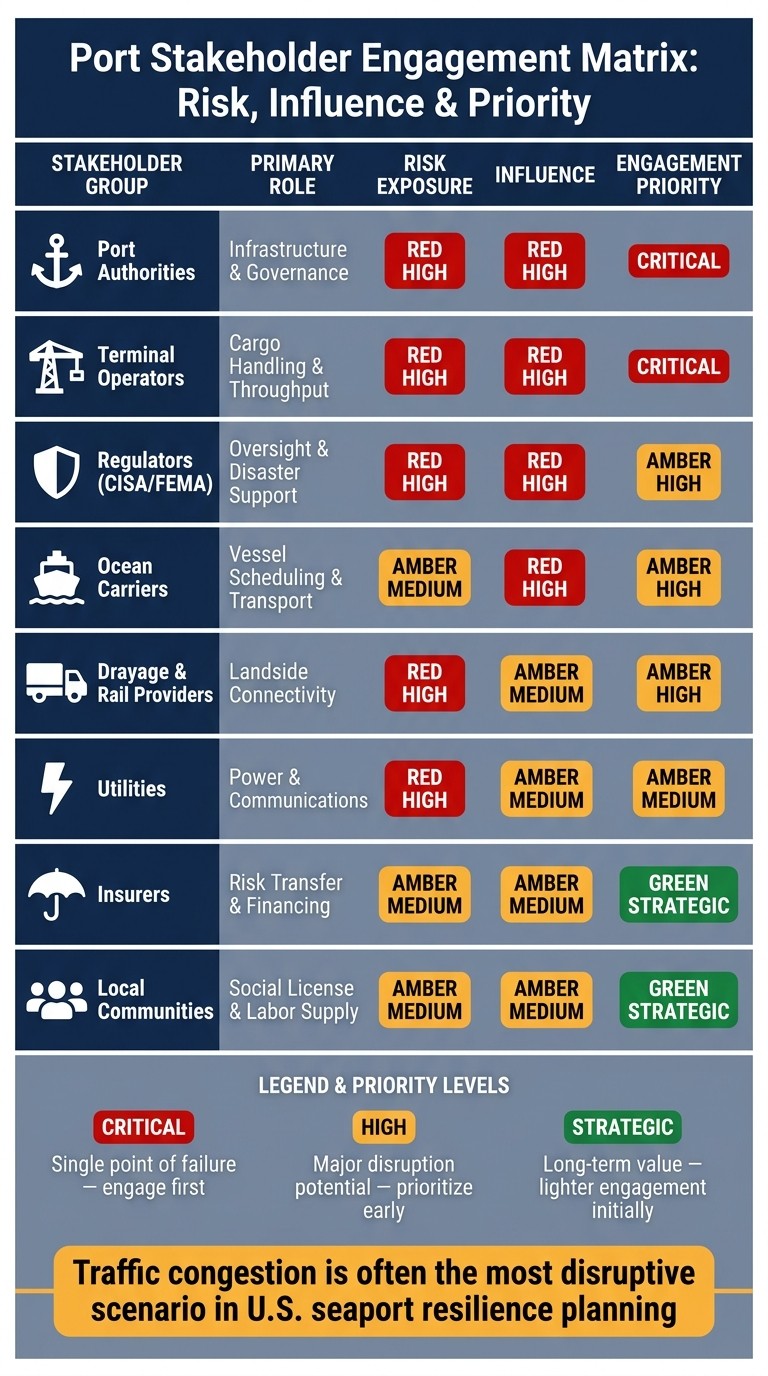
Port Stakeholder Engagement Matrix: Risk, Influence & Priority
Map every stakeholder that can stop your cargo flow - or help get it moving again - then focus on the ones tied to your biggest port risks. From there, turn that list into a matrix that shows who controls risk, who takes the hit during disruption, and who can speed up recovery.
Build a stakeholder mapping matrix
Build the matrix around the points where freight can stall, reroute, or recover slowly. For each group - port authorities, terminal operators, ocean carriers, drayage and rail providers, regulators such as CISA and FEMA, utilities, insurers, and local community organizations - map four things:
How much influence they have over port operations
How dependent your freight flow is on them
Their climate or disruption exposure
Their response speed during disruption
Separate landlord ports from operational ports because decision-making power sits in different places. That changes who actually controls recovery decisions during a disruption, which means it also changes who belongs in your engagement plan.
Once the matrix is done, rank each stakeholder by business impact, not by organization size.
Rank stakeholders by risk, influence, and business criticality
Score each stakeholder group on criteria that tie straight to your business exposure: cargo volume dependence, disruption likelihood, shared climate risk, regulatory relevance, and recovery impact. Research on U.S. seaport resilience planning found that traffic congestion is often the most disruptive scenario in port planning [2].
Use the table below as a starting point. Adjust the engagement priority column based on your freight volumes, port concentration, and supply chain geography.
Stakeholder Group | Primary Role | Risk Exposure | Influence | Engagement Priority |
|---|---|---|---|---|
Port Authorities | Infrastructure & Governance | High (climate, regulatory) | High (controls access and permits) | Critical |
Terminal Operators | Cargo handling and throughput | High (labor, equipment) | High (direct operational control) | Critical |
Regulators (CISA/FEMA) | Oversight and disaster support | High (funding and standards) | High (permitting and legal access) | High |
Ocean Carriers | Vessel scheduling and transport | Medium (route flexibility) | High (market power) | High |
Drayage & Rail Providers | Landside connectivity | High (congestion, infrastructure) | Medium (bottleneck potential) | High |
Utilities | Power and communications | High (interdependency) | Medium (determines recovery speed) | Medium |
Insurers | Risk transfer and financing | Medium (financial loss) | Medium (standards-setting) | Strategic |
Local Communities | Social license and labor supply | Medium (environmental) | Medium (political influence) | Strategic |
Don’t engage every stakeholder at the same depth. Rank them by the scale of disruption they can prevent or cause. Put early effort into those marked Critical or High, especially where a single point of failure could shut down freight flow altogether. Insurers and community groups should still be part of the plan, but lighter engagement makes sense until the core relationships are in place.
Use this ranking to decide who joins risk workshops, data-sharing agreements, and resilience governance first. That priority list becomes the base for joint assessments, data-sharing, and public-private partnerships.
Choose the right engagement mechanisms for resilience planning
Use priority rankings to pick the small number of engagement mechanisms that will shape decisions and shorten recovery time. The goal is simple: choose mechanisms that move risk awareness into clear decisions, shared data, and response triggers.
Run joint risk assessments and scenario planning workshops
Joint risk assessments work best when the right people are in the room. That usually means port authority engineers, terminal operations managers, carrier representatives, and, when needed, outside specialists such as climate scientists.
Scenario planning workshops are especially useful for long-term risks like sea-level rise and extreme storms [5]. Keep the scenarios grounded in what people may actually face: storm surges, channel closures, or labor actions. Then push the discussion past general concern and into operations. Ask participants to spell out their operational constraints, recovery dependencies, and trigger points for escalation.
Start with landside connectivity, especially drayage, rail, and gate operations. That’s often where disruption spreads fast. Each scenario should tie straight to rerouting options, recovery timelines, and the escalation decisions your business would need to make.
Set up data-sharing agreements and operating protocols
Workshops build alignment. Data-sharing agreements turn that alignment into day-to-day action.
Before teams can act on shared risk intelligence, they need a formal protocol that answers four plain questions: Who owns the data? Who can access it? How often is it updated? Who gets the call when something changes?
At a minimum, the agreement should cover:
incident alerts
berth and gate disruption updates
shipment status updates
estimated recovery timelines [4]
The details matter. Saying, “we’ll share updates during disruptions,” sounds fine until a disruption hits. A real protocol names the system, the contact person, the format, and the update cadence. Treat it as an operating protocol, not just a communications plan.
Cyber risk also needs attention. As ports add digital tools like IoT sensors and vessel scheduling platforms, the attack surface gets bigger. Any data-sharing agreement should include confidentiality terms and a clear process for handling a breach.
Form public-private resilience partnerships
Some resilience problems are simply too big for one company to handle through one-off agreements. If the issue involves regional freight continuity or major infrastructure investment, a public-private resilience partnership is often the better structure. It gives partners a way to pool data, coordinate funding, and set decision rights across port authorities, policymakers, and private sector groups.
Insurers, banks, and infrastructure investors are more willing to factor climate risk into pricing and lending terms, but they need shared data and clear governance to do it [3].
"Climate resilience in ports is fundamentally a shared responsibility between port authorities, policymakers and the private sector." - Dr. Darshana Godaliyadde, Director of Resilience4Ports, ICSI [3]
Once these mechanisms are in place, define the governance model that turns them into action. Use them to assign owners, set escalation paths, and link each trigger to a recovery action.
Turn stakeholder engagement into a governance model and action plan
Engagement work has to lead somewhere concrete. The next step is to turn what you learned into a governance structure with named owners, clear decision rights, and set review points.
Choose a governance structure with clear roles
Pick the model that fits your port network and the speed at which disruptions can spiral. In most cases, one of these three structures will do the job:
Governance Model | Primary Function | Strengths | Limitations |
|---|---|---|---|
Steering Committee | Coordination, prioritization, and senior management reporting [4] | High-level buy-in; keeps resilience aligned with corporate strategy [4] | Can be too removed from day-to-day technical realities |
Technical Working Groups | Expert analysis on specific services or terminal operations [4] | In-depth analysis [4] | Can become siloed without strong central coordination [5] |
Joint Operating Council | Cross-stakeholder collaboration [4] | Builds trust and speeds coordination [5] | Requires high levels of trust and shared data [5] |
After you choose the structure, assign each resilience task to a specific owner. A RACI matrix - Responsible, Accountable, Consulted, Informed - helps spell out who owns what for each task [4]. Be explicit about escalation paths too: who makes the call during a terminal closure or major disruption, and who must be notified right away [4]. Add milestones so teams can track implementation over time [4][1].
This model should guide both internal teams and external port partners. It also needs a regular review cadence, so decisions don’t sit on a shelf while conditions change.
Connect port actions to business continuity and capital planning
Governance has little value if it doesn’t change how the company plans and spends money. The findings from engagement and risk work should feed directly into business decisions, especially supplier continuity plans, route diversification strategies, inventory positioning, and capital budgets [1][5].
Say a joint risk assessment flags a single point of failure. That shouldn’t stay buried in a workshop summary. It should trigger a formal review of alternate routing options and show up in the next capital planning cycle - whether that means funding backup power, hardening a facility, or building alternate transport links [1][5]. Joint findings should translate into funding choices for port operators, carriers, and inland providers.
"Enterprise Risk Management (ERM) plays a vital function in bringing together the various resilience-building approaches and tools, including business continuity planning (BCP), horizon scanning (HS)." - UNCTAD [4]
Climate adaptation priorities should also shape harbor protocols, building codes, and capital allocation, so finance teams can weigh them against other capital needs. Those same priorities should guide the indicators you track next.
Measure progress, review after disruptions, and keep the plan current
Track a focused set of resilience indicators
Once governance is in place, the next step is simple: check whether it’s helping your team recover faster and work together better.
Track a small set of indicators that show whether stakeholder engagement is cutting disruption exposure, not just producing paperwork. The goal is to see if port partners are sharing data, coordinating faster, and getting operations back on track sooner.
Indicator | What to Measure |
|---|---|
Executive commitment and accountability | Is resilience a standing executive-level priority with named owners? |
Data access and quality | Is shared hazard and operational data current, complete, and accessible? |
Financial resources | Are resilience investments budgeted and available when needed? |
Cross-functional coordination | Is information flowing across departments and port partners without silos? |
External stakeholder engagement | Are port authorities, carriers, and regulators completing joint actions on schedule? |
Ports deal with slow-building threats and sudden disruptions that can force decisions within hours. [1] That makes speed of communication a practical signal. Track how fast your stakeholder network shares critical updates during drills and live events. If updates move slowly, that’s a warning sign.
Review the plan after drills, incidents, and infrastructure changes
Use these indicators to trigger formal reviews after drills, incidents, or port changes.
Treat climate risk assessments as living documents. Update them after major events or when new hazard data becomes available. [3] Set a formal review after every tabletop exercise, real disruption, or major infrastructure change at a port you rely on. Each review should end with clear answers to three questions: What broke down? Who owns the fix? What is the updated timeline? Assign fixes and deadlines through the RACI matrix. [4]
These reviews often bring out infrastructure issues that workshops alone can miss. [5] Refresh climate risk assessments whenever new hazard data is available or after a major weather event affects your port network. [3]
Done consistently, stakeholder engagement shifts port resilience planning from a paper exercise into an operational capability.
FAQs
How do I choose which port stakeholders matter most?
Use stakeholder mapping to rank port stakeholders by influence, stakes, and the disruption scenarios you’re planning for.
Then line up that view with your Business Impact Analysis to pinpoint the port services, assets, and dependencies that matter most for continuity. From there, focus on the stakeholders with the responsibility, authority, and resources to carry out response measures within your governance framework.
What should a port data-sharing agreement include?
A port data-sharing agreement needs a clear legal framework for cybersecurity, privacy, and ethics. That gives everyone a firm baseline and helps prevent confusion later. It should also let data owners spell out exactly which data elements they will share, so teams can work together without giving away more than they intend.
The agreement should also define governance in plain terms: who gets access, under what conditions, and who is accountable. Just as important, it needs to align data-sharing practices with regulatory and security requirements while supporting clear day-to-day operating processes across agencies and private entities.
How often should I review a port resilience plan?
Treat a port resilience plan as an ongoing process once mitigation and response measures are in place. The job isn’t done at implementation. A plan needs regular review so teams can see what’s working, spot gaps, and make changes based on lessons learned.
There’s no set timeline for these reviews, but the process should not be loose or informal. The plan needs clear governance, defined reporting, and a formal review process so updates happen with purpose, not by chance. That structure helps keep accountability in place across teams and decision-makers.
At the same time, the plan should stay flexible. Ports deal with shifting risks, changing operations, and new pressure points, so a rigid document can go stale fast. It should also line up with the organization’s broader business continuity management approach, which supports steady improvement over time rather than a one-and-done exercise.
Related Blog Posts
Latest Articles
©2025

Narrative Change and Power Building: The Missing Half of Advocacy
Narrative change is the process of disrupting dominant narratives that normalize inequity and advancing new narratives from historically marginalized communities.

Funding Resilience Without Federal Grants
BRIC is unreliable and FEMA is shrinking. Here's how cities fund climate resilience with dedicated revenue, blended finance, and a coordinating authority.

The ESG Blind Spot: How AI Is Finding Risks in Companies Nobody Else Is Watching
Norway's sovereign wealth fund uses AI to screen 7,200 portfolio companies for forced labor and corruption within 24 hours. The real story is the emerging-market coverage gap that traditional ESG data vendors miss — and what it means for any company with a global supply chain.
Narrative Change and Power Building: The Missing Half of Advocacy
Narrative change is the process of disrupting dominant narratives that normalize inequity and advancing new narratives from historically marginalized communities.
Funding Resilience Without Federal Grants
BRIC is unreliable and FEMA is shrinking. Here's how cities fund climate resilience with dedicated revenue, blended finance, and a coordinating authority.
The ESG Blind Spot: How AI Is Finding Risks in Companies Nobody Else Is Watching
Norway's sovereign wealth fund uses AI to screen 7,200 portfolio companies for forced labor and corruption within 24 hours. The real story is the emerging-market coverage gap that traditional ESG data vendors miss — and what it means for any company with a global supply chain.
FAQ
01
What does it really mean to “redefine profit”?
02
What makes Council Fire different?
03
Who does Council Fire work with?
04
What does working with Council Fire actually look like?
05
How does Council Fire help organizations turn big goals into action?
06
How does Council Fire define and measure success?
Jun 20, 2026
How to Engage Port Stakeholders in Resilience Planning for Corporations
Sustainability Strategy
In This Article
Map and prioritize port stakeholders, set data-sharing and governance, and link resilience to business continuity and capital planning.
How to Engage Port Stakeholders in Resilience Planning for Corporations
If one port fails, your supply chain can stall within hours. I’d treat port resilience as a company issue, not just a shipping issue: map the port players that affect my cargo, rank them by business impact, set up a few clear ways to work with them, assign owners, and track whether recovery gets faster after drills and disruptions.
In plain terms, I’d focus on five things:
Map who matters most across port authorities, terminal operators, carriers, rail and drayage providers, utilities, regulators, insurers, and local groups.
Rank them by business risk such as cargo dependence, delay risk, and how much they can slow or speed recovery.
Use simple engagement tools like joint risk workshops, data-sharing rules, and public-private partnerships.
Turn meetings into decisions with named owners, decision rights, escalation paths, and links to business continuity and capital plans.
Measure results by tracking data flow, executive ownership, funding, cross-team coordination, and post-incident follow-through.
A few facts make the case. The article notes that traffic congestion is often one of the most disruptive port scenarios in U.S. seaport planning. It also points out that disruptions can trigger higher procurement costs, missed production schedules, and customer service failures. UNCTAD states that there is a return on resilience spending at ports, which means this is not just about risk control - it is also about avoiding avoidable cost.
What I take from the article is simple: don’t wait for a port crisis to start building relationships. If I depend on a port, I need a short list of people who can share alerts, make decisions, and help move freight when normal flow breaks down.
Quick take:
Step | What I’d do | Why it matters |
|---|---|---|
1 | Map stakeholders | Shows who can stop or restore cargo flow |
2 | Rank by business impact | Keeps attention on the biggest weak points |
3 | Set engagement methods | Turns concern into shared actions and trigger points |
4 | Build governance | Makes ownership and escalation clear |
5 | Review and measure | Shows if the plan works after drills or live events |
The core message: port resilience planning works best when I connect external port partners with internal risk, procurement, logistics, and finance teams - then turn that network into a clear action plan.
Map and prioritize the port stakeholders that affect your operations
Port Stakeholder Engagement Matrix: Risk, Influence & Priority
Map every stakeholder that can stop your cargo flow - or help get it moving again - then focus on the ones tied to your biggest port risks. From there, turn that list into a matrix that shows who controls risk, who takes the hit during disruption, and who can speed up recovery.
Build a stakeholder mapping matrix
Build the matrix around the points where freight can stall, reroute, or recover slowly. For each group - port authorities, terminal operators, ocean carriers, drayage and rail providers, regulators such as CISA and FEMA, utilities, insurers, and local community organizations - map four things:
How much influence they have over port operations
How dependent your freight flow is on them
Their climate or disruption exposure
Their response speed during disruption
Separate landlord ports from operational ports because decision-making power sits in different places. That changes who actually controls recovery decisions during a disruption, which means it also changes who belongs in your engagement plan.
Once the matrix is done, rank each stakeholder by business impact, not by organization size.
Rank stakeholders by risk, influence, and business criticality
Score each stakeholder group on criteria that tie straight to your business exposure: cargo volume dependence, disruption likelihood, shared climate risk, regulatory relevance, and recovery impact. Research on U.S. seaport resilience planning found that traffic congestion is often the most disruptive scenario in port planning [2].
Use the table below as a starting point. Adjust the engagement priority column based on your freight volumes, port concentration, and supply chain geography.
Stakeholder Group | Primary Role | Risk Exposure | Influence | Engagement Priority |
|---|---|---|---|---|
Port Authorities | Infrastructure & Governance | High (climate, regulatory) | High (controls access and permits) | Critical |
Terminal Operators | Cargo handling and throughput | High (labor, equipment) | High (direct operational control) | Critical |
Regulators (CISA/FEMA) | Oversight and disaster support | High (funding and standards) | High (permitting and legal access) | High |
Ocean Carriers | Vessel scheduling and transport | Medium (route flexibility) | High (market power) | High |
Drayage & Rail Providers | Landside connectivity | High (congestion, infrastructure) | Medium (bottleneck potential) | High |
Utilities | Power and communications | High (interdependency) | Medium (determines recovery speed) | Medium |
Insurers | Risk transfer and financing | Medium (financial loss) | Medium (standards-setting) | Strategic |
Local Communities | Social license and labor supply | Medium (environmental) | Medium (political influence) | Strategic |
Don’t engage every stakeholder at the same depth. Rank them by the scale of disruption they can prevent or cause. Put early effort into those marked Critical or High, especially where a single point of failure could shut down freight flow altogether. Insurers and community groups should still be part of the plan, but lighter engagement makes sense until the core relationships are in place.
Use this ranking to decide who joins risk workshops, data-sharing agreements, and resilience governance first. That priority list becomes the base for joint assessments, data-sharing, and public-private partnerships.
Choose the right engagement mechanisms for resilience planning
Use priority rankings to pick the small number of engagement mechanisms that will shape decisions and shorten recovery time. The goal is simple: choose mechanisms that move risk awareness into clear decisions, shared data, and response triggers.
Run joint risk assessments and scenario planning workshops
Joint risk assessments work best when the right people are in the room. That usually means port authority engineers, terminal operations managers, carrier representatives, and, when needed, outside specialists such as climate scientists.
Scenario planning workshops are especially useful for long-term risks like sea-level rise and extreme storms [5]. Keep the scenarios grounded in what people may actually face: storm surges, channel closures, or labor actions. Then push the discussion past general concern and into operations. Ask participants to spell out their operational constraints, recovery dependencies, and trigger points for escalation.
Start with landside connectivity, especially drayage, rail, and gate operations. That’s often where disruption spreads fast. Each scenario should tie straight to rerouting options, recovery timelines, and the escalation decisions your business would need to make.
Set up data-sharing agreements and operating protocols
Workshops build alignment. Data-sharing agreements turn that alignment into day-to-day action.
Before teams can act on shared risk intelligence, they need a formal protocol that answers four plain questions: Who owns the data? Who can access it? How often is it updated? Who gets the call when something changes?
At a minimum, the agreement should cover:
incident alerts
berth and gate disruption updates
shipment status updates
estimated recovery timelines [4]
The details matter. Saying, “we’ll share updates during disruptions,” sounds fine until a disruption hits. A real protocol names the system, the contact person, the format, and the update cadence. Treat it as an operating protocol, not just a communications plan.
Cyber risk also needs attention. As ports add digital tools like IoT sensors and vessel scheduling platforms, the attack surface gets bigger. Any data-sharing agreement should include confidentiality terms and a clear process for handling a breach.
Form public-private resilience partnerships
Some resilience problems are simply too big for one company to handle through one-off agreements. If the issue involves regional freight continuity or major infrastructure investment, a public-private resilience partnership is often the better structure. It gives partners a way to pool data, coordinate funding, and set decision rights across port authorities, policymakers, and private sector groups.
Insurers, banks, and infrastructure investors are more willing to factor climate risk into pricing and lending terms, but they need shared data and clear governance to do it [3].
"Climate resilience in ports is fundamentally a shared responsibility between port authorities, policymakers and the private sector." - Dr. Darshana Godaliyadde, Director of Resilience4Ports, ICSI [3]
Once these mechanisms are in place, define the governance model that turns them into action. Use them to assign owners, set escalation paths, and link each trigger to a recovery action.
Turn stakeholder engagement into a governance model and action plan
Engagement work has to lead somewhere concrete. The next step is to turn what you learned into a governance structure with named owners, clear decision rights, and set review points.
Choose a governance structure with clear roles
Pick the model that fits your port network and the speed at which disruptions can spiral. In most cases, one of these three structures will do the job:
Governance Model | Primary Function | Strengths | Limitations |
|---|---|---|---|
Steering Committee | Coordination, prioritization, and senior management reporting [4] | High-level buy-in; keeps resilience aligned with corporate strategy [4] | Can be too removed from day-to-day technical realities |
Technical Working Groups | Expert analysis on specific services or terminal operations [4] | In-depth analysis [4] | Can become siloed without strong central coordination [5] |
Joint Operating Council | Cross-stakeholder collaboration [4] | Builds trust and speeds coordination [5] | Requires high levels of trust and shared data [5] |
After you choose the structure, assign each resilience task to a specific owner. A RACI matrix - Responsible, Accountable, Consulted, Informed - helps spell out who owns what for each task [4]. Be explicit about escalation paths too: who makes the call during a terminal closure or major disruption, and who must be notified right away [4]. Add milestones so teams can track implementation over time [4][1].
This model should guide both internal teams and external port partners. It also needs a regular review cadence, so decisions don’t sit on a shelf while conditions change.
Connect port actions to business continuity and capital planning
Governance has little value if it doesn’t change how the company plans and spends money. The findings from engagement and risk work should feed directly into business decisions, especially supplier continuity plans, route diversification strategies, inventory positioning, and capital budgets [1][5].
Say a joint risk assessment flags a single point of failure. That shouldn’t stay buried in a workshop summary. It should trigger a formal review of alternate routing options and show up in the next capital planning cycle - whether that means funding backup power, hardening a facility, or building alternate transport links [1][5]. Joint findings should translate into funding choices for port operators, carriers, and inland providers.
"Enterprise Risk Management (ERM) plays a vital function in bringing together the various resilience-building approaches and tools, including business continuity planning (BCP), horizon scanning (HS)." - UNCTAD [4]
Climate adaptation priorities should also shape harbor protocols, building codes, and capital allocation, so finance teams can weigh them against other capital needs. Those same priorities should guide the indicators you track next.
Measure progress, review after disruptions, and keep the plan current
Track a focused set of resilience indicators
Once governance is in place, the next step is simple: check whether it’s helping your team recover faster and work together better.
Track a small set of indicators that show whether stakeholder engagement is cutting disruption exposure, not just producing paperwork. The goal is to see if port partners are sharing data, coordinating faster, and getting operations back on track sooner.
Indicator | What to Measure |
|---|---|
Executive commitment and accountability | Is resilience a standing executive-level priority with named owners? |
Data access and quality | Is shared hazard and operational data current, complete, and accessible? |
Financial resources | Are resilience investments budgeted and available when needed? |
Cross-functional coordination | Is information flowing across departments and port partners without silos? |
External stakeholder engagement | Are port authorities, carriers, and regulators completing joint actions on schedule? |
Ports deal with slow-building threats and sudden disruptions that can force decisions within hours. [1] That makes speed of communication a practical signal. Track how fast your stakeholder network shares critical updates during drills and live events. If updates move slowly, that’s a warning sign.
Review the plan after drills, incidents, and infrastructure changes
Use these indicators to trigger formal reviews after drills, incidents, or port changes.
Treat climate risk assessments as living documents. Update them after major events or when new hazard data becomes available. [3] Set a formal review after every tabletop exercise, real disruption, or major infrastructure change at a port you rely on. Each review should end with clear answers to three questions: What broke down? Who owns the fix? What is the updated timeline? Assign fixes and deadlines through the RACI matrix. [4]
These reviews often bring out infrastructure issues that workshops alone can miss. [5] Refresh climate risk assessments whenever new hazard data is available or after a major weather event affects your port network. [3]
Done consistently, stakeholder engagement shifts port resilience planning from a paper exercise into an operational capability.
FAQs
How do I choose which port stakeholders matter most?
Use stakeholder mapping to rank port stakeholders by influence, stakes, and the disruption scenarios you’re planning for.
Then line up that view with your Business Impact Analysis to pinpoint the port services, assets, and dependencies that matter most for continuity. From there, focus on the stakeholders with the responsibility, authority, and resources to carry out response measures within your governance framework.
What should a port data-sharing agreement include?
A port data-sharing agreement needs a clear legal framework for cybersecurity, privacy, and ethics. That gives everyone a firm baseline and helps prevent confusion later. It should also let data owners spell out exactly which data elements they will share, so teams can work together without giving away more than they intend.
The agreement should also define governance in plain terms: who gets access, under what conditions, and who is accountable. Just as important, it needs to align data-sharing practices with regulatory and security requirements while supporting clear day-to-day operating processes across agencies and private entities.
How often should I review a port resilience plan?
Treat a port resilience plan as an ongoing process once mitigation and response measures are in place. The job isn’t done at implementation. A plan needs regular review so teams can see what’s working, spot gaps, and make changes based on lessons learned.
There’s no set timeline for these reviews, but the process should not be loose or informal. The plan needs clear governance, defined reporting, and a formal review process so updates happen with purpose, not by chance. That structure helps keep accountability in place across teams and decision-makers.
At the same time, the plan should stay flexible. Ports deal with shifting risks, changing operations, and new pressure points, so a rigid document can go stale fast. It should also line up with the organization’s broader business continuity management approach, which supports steady improvement over time rather than a one-and-done exercise.
Related Blog Posts
Latest Articles
©2025
Narrative Change and Power Building: The Missing Half of Advocacy
Narrative change is the process of disrupting dominant narratives that normalize inequity and advancing new narratives from historically marginalized communities.
Funding Resilience Without Federal Grants
BRIC is unreliable and FEMA is shrinking. Here's how cities fund climate resilience with dedicated revenue, blended finance, and a coordinating authority.
The ESG Blind Spot: How AI Is Finding Risks in Companies Nobody Else Is Watching
Norway's sovereign wealth fund uses AI to screen 7,200 portfolio companies for forced labor and corruption within 24 hours. The real story is the emerging-market coverage gap that traditional ESG data vendors miss — and what it means for any company with a global supply chain.
FAQ
01
What does it really mean to “redefine profit”?
02
What makes Council Fire different?
03
Who does Council Fire work with?
04
What does working with Council Fire actually look like?
05
How does Council Fire help organizations turn big goals into action?
06
How does Council Fire define and measure success?
Jun 20, 2026
How to Engage Port Stakeholders in Resilience Planning for Corporations
Sustainability Strategy
In This Article
Map and prioritize port stakeholders, set data-sharing and governance, and link resilience to business continuity and capital planning.
How to Engage Port Stakeholders in Resilience Planning for Corporations
If one port fails, your supply chain can stall within hours. I’d treat port resilience as a company issue, not just a shipping issue: map the port players that affect my cargo, rank them by business impact, set up a few clear ways to work with them, assign owners, and track whether recovery gets faster after drills and disruptions.
In plain terms, I’d focus on five things:
Map who matters most across port authorities, terminal operators, carriers, rail and drayage providers, utilities, regulators, insurers, and local groups.
Rank them by business risk such as cargo dependence, delay risk, and how much they can slow or speed recovery.
Use simple engagement tools like joint risk workshops, data-sharing rules, and public-private partnerships.
Turn meetings into decisions with named owners, decision rights, escalation paths, and links to business continuity and capital plans.
Measure results by tracking data flow, executive ownership, funding, cross-team coordination, and post-incident follow-through.
A few facts make the case. The article notes that traffic congestion is often one of the most disruptive port scenarios in U.S. seaport planning. It also points out that disruptions can trigger higher procurement costs, missed production schedules, and customer service failures. UNCTAD states that there is a return on resilience spending at ports, which means this is not just about risk control - it is also about avoiding avoidable cost.
What I take from the article is simple: don’t wait for a port crisis to start building relationships. If I depend on a port, I need a short list of people who can share alerts, make decisions, and help move freight when normal flow breaks down.
Quick take:
Step | What I’d do | Why it matters |
|---|---|---|
1 | Map stakeholders | Shows who can stop or restore cargo flow |
2 | Rank by business impact | Keeps attention on the biggest weak points |
3 | Set engagement methods | Turns concern into shared actions and trigger points |
4 | Build governance | Makes ownership and escalation clear |
5 | Review and measure | Shows if the plan works after drills or live events |
The core message: port resilience planning works best when I connect external port partners with internal risk, procurement, logistics, and finance teams - then turn that network into a clear action plan.
Map and prioritize the port stakeholders that affect your operations
Port Stakeholder Engagement Matrix: Risk, Influence & Priority
Map every stakeholder that can stop your cargo flow - or help get it moving again - then focus on the ones tied to your biggest port risks. From there, turn that list into a matrix that shows who controls risk, who takes the hit during disruption, and who can speed up recovery.
Build a stakeholder mapping matrix
Build the matrix around the points where freight can stall, reroute, or recover slowly. For each group - port authorities, terminal operators, ocean carriers, drayage and rail providers, regulators such as CISA and FEMA, utilities, insurers, and local community organizations - map four things:
How much influence they have over port operations
How dependent your freight flow is on them
Their climate or disruption exposure
Their response speed during disruption
Separate landlord ports from operational ports because decision-making power sits in different places. That changes who actually controls recovery decisions during a disruption, which means it also changes who belongs in your engagement plan.
Once the matrix is done, rank each stakeholder by business impact, not by organization size.
Rank stakeholders by risk, influence, and business criticality
Score each stakeholder group on criteria that tie straight to your business exposure: cargo volume dependence, disruption likelihood, shared climate risk, regulatory relevance, and recovery impact. Research on U.S. seaport resilience planning found that traffic congestion is often the most disruptive scenario in port planning [2].
Use the table below as a starting point. Adjust the engagement priority column based on your freight volumes, port concentration, and supply chain geography.
Stakeholder Group | Primary Role | Risk Exposure | Influence | Engagement Priority |
|---|---|---|---|---|
Port Authorities | Infrastructure & Governance | High (climate, regulatory) | High (controls access and permits) | Critical |
Terminal Operators | Cargo handling and throughput | High (labor, equipment) | High (direct operational control) | Critical |
Regulators (CISA/FEMA) | Oversight and disaster support | High (funding and standards) | High (permitting and legal access) | High |
Ocean Carriers | Vessel scheduling and transport | Medium (route flexibility) | High (market power) | High |
Drayage & Rail Providers | Landside connectivity | High (congestion, infrastructure) | Medium (bottleneck potential) | High |
Utilities | Power and communications | High (interdependency) | Medium (determines recovery speed) | Medium |
Insurers | Risk transfer and financing | Medium (financial loss) | Medium (standards-setting) | Strategic |
Local Communities | Social license and labor supply | Medium (environmental) | Medium (political influence) | Strategic |
Don’t engage every stakeholder at the same depth. Rank them by the scale of disruption they can prevent or cause. Put early effort into those marked Critical or High, especially where a single point of failure could shut down freight flow altogether. Insurers and community groups should still be part of the plan, but lighter engagement makes sense until the core relationships are in place.
Use this ranking to decide who joins risk workshops, data-sharing agreements, and resilience governance first. That priority list becomes the base for joint assessments, data-sharing, and public-private partnerships.
Choose the right engagement mechanisms for resilience planning
Use priority rankings to pick the small number of engagement mechanisms that will shape decisions and shorten recovery time. The goal is simple: choose mechanisms that move risk awareness into clear decisions, shared data, and response triggers.
Run joint risk assessments and scenario planning workshops
Joint risk assessments work best when the right people are in the room. That usually means port authority engineers, terminal operations managers, carrier representatives, and, when needed, outside specialists such as climate scientists.
Scenario planning workshops are especially useful for long-term risks like sea-level rise and extreme storms [5]. Keep the scenarios grounded in what people may actually face: storm surges, channel closures, or labor actions. Then push the discussion past general concern and into operations. Ask participants to spell out their operational constraints, recovery dependencies, and trigger points for escalation.
Start with landside connectivity, especially drayage, rail, and gate operations. That’s often where disruption spreads fast. Each scenario should tie straight to rerouting options, recovery timelines, and the escalation decisions your business would need to make.
Set up data-sharing agreements and operating protocols
Workshops build alignment. Data-sharing agreements turn that alignment into day-to-day action.
Before teams can act on shared risk intelligence, they need a formal protocol that answers four plain questions: Who owns the data? Who can access it? How often is it updated? Who gets the call when something changes?
At a minimum, the agreement should cover:
incident alerts
berth and gate disruption updates
shipment status updates
estimated recovery timelines [4]
The details matter. Saying, “we’ll share updates during disruptions,” sounds fine until a disruption hits. A real protocol names the system, the contact person, the format, and the update cadence. Treat it as an operating protocol, not just a communications plan.
Cyber risk also needs attention. As ports add digital tools like IoT sensors and vessel scheduling platforms, the attack surface gets bigger. Any data-sharing agreement should include confidentiality terms and a clear process for handling a breach.
Form public-private resilience partnerships
Some resilience problems are simply too big for one company to handle through one-off agreements. If the issue involves regional freight continuity or major infrastructure investment, a public-private resilience partnership is often the better structure. It gives partners a way to pool data, coordinate funding, and set decision rights across port authorities, policymakers, and private sector groups.
Insurers, banks, and infrastructure investors are more willing to factor climate risk into pricing and lending terms, but they need shared data and clear governance to do it [3].
"Climate resilience in ports is fundamentally a shared responsibility between port authorities, policymakers and the private sector." - Dr. Darshana Godaliyadde, Director of Resilience4Ports, ICSI [3]
Once these mechanisms are in place, define the governance model that turns them into action. Use them to assign owners, set escalation paths, and link each trigger to a recovery action.
Turn stakeholder engagement into a governance model and action plan
Engagement work has to lead somewhere concrete. The next step is to turn what you learned into a governance structure with named owners, clear decision rights, and set review points.
Choose a governance structure with clear roles
Pick the model that fits your port network and the speed at which disruptions can spiral. In most cases, one of these three structures will do the job:
Governance Model | Primary Function | Strengths | Limitations |
|---|---|---|---|
Steering Committee | Coordination, prioritization, and senior management reporting [4] | High-level buy-in; keeps resilience aligned with corporate strategy [4] | Can be too removed from day-to-day technical realities |
Technical Working Groups | Expert analysis on specific services or terminal operations [4] | In-depth analysis [4] | Can become siloed without strong central coordination [5] |
Joint Operating Council | Cross-stakeholder collaboration [4] | Builds trust and speeds coordination [5] | Requires high levels of trust and shared data [5] |
After you choose the structure, assign each resilience task to a specific owner. A RACI matrix - Responsible, Accountable, Consulted, Informed - helps spell out who owns what for each task [4]. Be explicit about escalation paths too: who makes the call during a terminal closure or major disruption, and who must be notified right away [4]. Add milestones so teams can track implementation over time [4][1].
This model should guide both internal teams and external port partners. It also needs a regular review cadence, so decisions don’t sit on a shelf while conditions change.
Connect port actions to business continuity and capital planning
Governance has little value if it doesn’t change how the company plans and spends money. The findings from engagement and risk work should feed directly into business decisions, especially supplier continuity plans, route diversification strategies, inventory positioning, and capital budgets [1][5].
Say a joint risk assessment flags a single point of failure. That shouldn’t stay buried in a workshop summary. It should trigger a formal review of alternate routing options and show up in the next capital planning cycle - whether that means funding backup power, hardening a facility, or building alternate transport links [1][5]. Joint findings should translate into funding choices for port operators, carriers, and inland providers.
"Enterprise Risk Management (ERM) plays a vital function in bringing together the various resilience-building approaches and tools, including business continuity planning (BCP), horizon scanning (HS)." - UNCTAD [4]
Climate adaptation priorities should also shape harbor protocols, building codes, and capital allocation, so finance teams can weigh them against other capital needs. Those same priorities should guide the indicators you track next.
Measure progress, review after disruptions, and keep the plan current
Track a focused set of resilience indicators
Once governance is in place, the next step is simple: check whether it’s helping your team recover faster and work together better.
Track a small set of indicators that show whether stakeholder engagement is cutting disruption exposure, not just producing paperwork. The goal is to see if port partners are sharing data, coordinating faster, and getting operations back on track sooner.
Indicator | What to Measure |
|---|---|
Executive commitment and accountability | Is resilience a standing executive-level priority with named owners? |
Data access and quality | Is shared hazard and operational data current, complete, and accessible? |
Financial resources | Are resilience investments budgeted and available when needed? |
Cross-functional coordination | Is information flowing across departments and port partners without silos? |
External stakeholder engagement | Are port authorities, carriers, and regulators completing joint actions on schedule? |
Ports deal with slow-building threats and sudden disruptions that can force decisions within hours. [1] That makes speed of communication a practical signal. Track how fast your stakeholder network shares critical updates during drills and live events. If updates move slowly, that’s a warning sign.
Review the plan after drills, incidents, and infrastructure changes
Use these indicators to trigger formal reviews after drills, incidents, or port changes.
Treat climate risk assessments as living documents. Update them after major events or when new hazard data becomes available. [3] Set a formal review after every tabletop exercise, real disruption, or major infrastructure change at a port you rely on. Each review should end with clear answers to three questions: What broke down? Who owns the fix? What is the updated timeline? Assign fixes and deadlines through the RACI matrix. [4]
These reviews often bring out infrastructure issues that workshops alone can miss. [5] Refresh climate risk assessments whenever new hazard data is available or after a major weather event affects your port network. [3]
Done consistently, stakeholder engagement shifts port resilience planning from a paper exercise into an operational capability.
FAQs
How do I choose which port stakeholders matter most?
Use stakeholder mapping to rank port stakeholders by influence, stakes, and the disruption scenarios you’re planning for.
Then line up that view with your Business Impact Analysis to pinpoint the port services, assets, and dependencies that matter most for continuity. From there, focus on the stakeholders with the responsibility, authority, and resources to carry out response measures within your governance framework.
What should a port data-sharing agreement include?
A port data-sharing agreement needs a clear legal framework for cybersecurity, privacy, and ethics. That gives everyone a firm baseline and helps prevent confusion later. It should also let data owners spell out exactly which data elements they will share, so teams can work together without giving away more than they intend.
The agreement should also define governance in plain terms: who gets access, under what conditions, and who is accountable. Just as important, it needs to align data-sharing practices with regulatory and security requirements while supporting clear day-to-day operating processes across agencies and private entities.
How often should I review a port resilience plan?
Treat a port resilience plan as an ongoing process once mitigation and response measures are in place. The job isn’t done at implementation. A plan needs regular review so teams can see what’s working, spot gaps, and make changes based on lessons learned.
There’s no set timeline for these reviews, but the process should not be loose or informal. The plan needs clear governance, defined reporting, and a formal review process so updates happen with purpose, not by chance. That structure helps keep accountability in place across teams and decision-makers.
At the same time, the plan should stay flexible. Ports deal with shifting risks, changing operations, and new pressure points, so a rigid document can go stale fast. It should also line up with the organization’s broader business continuity management approach, which supports steady improvement over time rather than a one-and-done exercise.
Related Blog Posts
Latest Articles
©2025
Narrative Change and Power Building: The Missing Half of Advocacy
Narrative change is the process of disrupting dominant narratives that normalize inequity and advancing new narratives from historically marginalized communities.
Funding Resilience Without Federal Grants
BRIC is unreliable and FEMA is shrinking. Here's how cities fund climate resilience with dedicated revenue, blended finance, and a coordinating authority.
The ESG Blind Spot: How AI Is Finding Risks in Companies Nobody Else Is Watching
Norway's sovereign wealth fund uses AI to screen 7,200 portfolio companies for forced labor and corruption within 24 hours. The real story is the emerging-market coverage gap that traditional ESG data vendors miss — and what it means for any company with a global supply chain.
FAQ
What does it really mean to “redefine profit”?
What makes Council Fire different?
Who does Council Fire work with?
What does working with Council Fire actually look like?
How does Council Fire help organizations turn big goals into action?
How does Council Fire define and measure success?