
Jun 21, 2026
How to Engage Port Stakeholders in Resilience Planning for NGOs & Nonprofits
Capacity Building
In This Article
Practical steps for NGOs to map, prioritize, and engage port stakeholders—meetings, tools, action tracking, and trust-building.
How to Engage Port Stakeholders in Resilience Planning for NGOs & Nonprofits
If you want port resilience planning to work, start with people, not projects. When a port is hit by a storm, heat wave, flood, or cyber event, the damage can spread fast across jobs, freight, roads, public services, and nearby neighborhoods. In the U.S., 115 ports sit within 10 miles of the coast, which puts many at risk from surge and sea level change.
I’d boil the article down to this:
Map who matters inside and outside the port
Rank who to involve first based on influence, exposure, and community risk
Run meetings with a clear job and written follow-up
Build trust with plain language, shared actions, and visible progress
Track results by looking at data sharing, follow-through, and who stays engaged
What you should walk away with is simple and usable: a stakeholder map, a priority matrix, a meeting plan, a set of working tools, an action tracker, and a trust check.
Here’s the short version: ports work as connected systems, so planning has to do the same. If you want better decisions, fewer silos, and stronger follow-through, you need the right groups in the room early - and you need a process they can keep using after the first round of meetings.
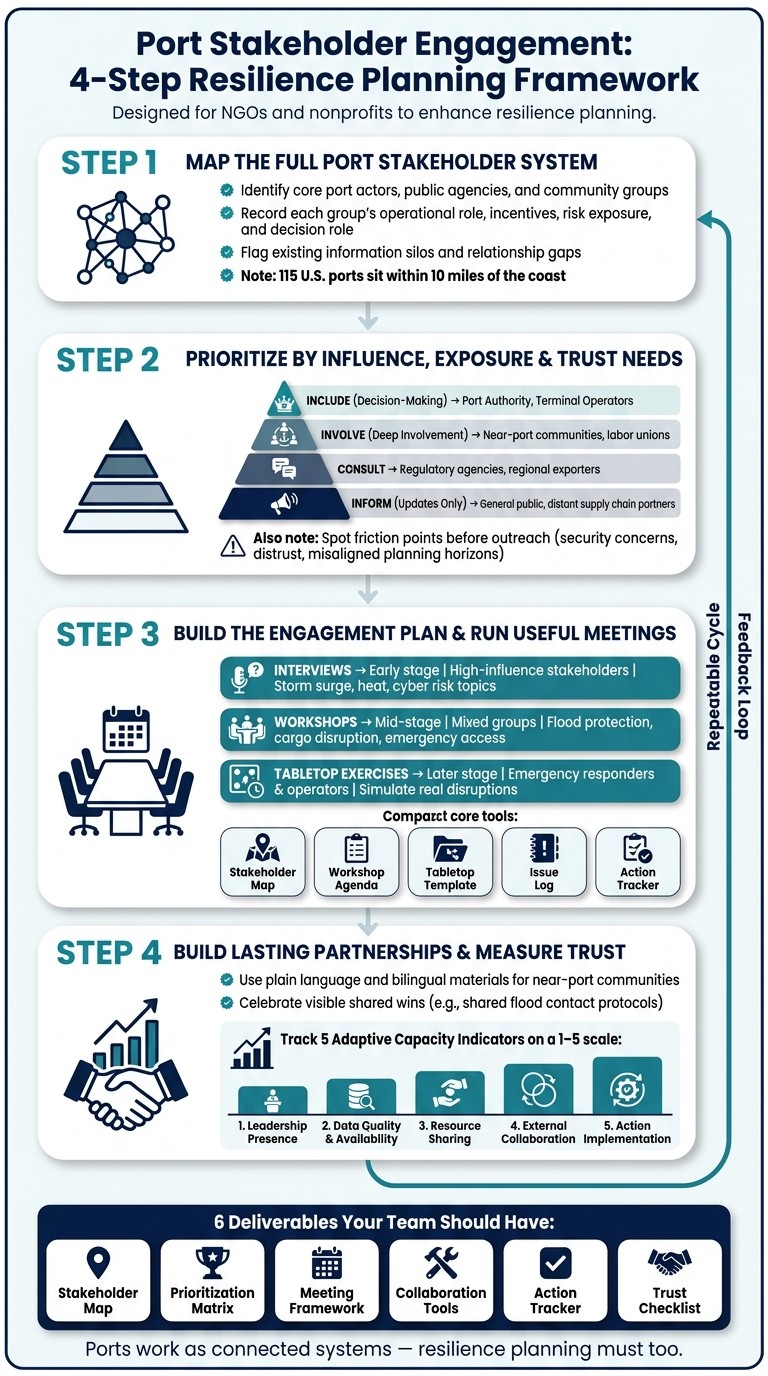
Port Stakeholder Engagement Process for Resilience Planning
Port Resilience Crisis: Can Ports Keep Up with Extreme Weather?
Step 1: Map the full port stakeholder system
Start with a stakeholder map that shows three things: who runs work inside the port, who makes decisions, and who takes the hit when operations break down. Then sort those groups by influence, exposure, and trust needs.
List the core port, public, and community stakeholders
Group stakeholders into core port actors, public agencies and regulators, and community stakeholders. Include infrastructure providers too, since power and communications failures can ripple across port operations. These systems don’t stop at the port boundary, so map those dependencies early.
Use the EPA's Community-Port Collaboration Toolkit to identify near-port community groups, especially those left out of past planning. Near-port communities don’t all look the same. They have different histories, languages, and planning priorities, so outreach needs to fit local conditions.
For NGOs, this map helps show where community representation is missing and where outreach may run into resistance. Different groups also need different entry points:
Technical briefings for operators
Compliance framing for agencies
Plain-language risk discussions for communities
Once the groups are clear, document what each one needs, fears, and controls.
Record each stakeholder's interests, risks, and decision role
Use a simple stakeholder map table here. Treat it as a working document, not a full database.
Stakeholder | Operational Role | Primary Incentive | Key Risk Exposure | Decision Role |
|---|---|---|---|---|
Port Authority | Landlord or operational port authority | Revenue protection, safety | Storm surge, sea-level rise | Infrastructure investment, leasing terms |
Terminal Operators | Cargo handling, facility management | Continuity of operations, throughput | Flooding, extreme heat, bottlenecks | Equipment upgrades, operational protocols |
Shipping Lines, Trucking, and Rail Partners | Cargo movement and routing | Supply chain continuity, efficiency | Traffic congestion, bottlenecks, high operational costs | Service schedules and operational coordination |
Labor Unions | Workforce representation | Worker safety, job security | Extreme heat, safety risks | Operational leverage |
Security and navigation oversight | National security, infrastructure protection | Storm events, infrastructure disruptions | Federal security and oversight authority | |
Near-Port Communities | Residents and community groups | Air quality, traffic, neighborhood health | Flooding, pollution, emergency access | Local political influence |
Record influence, not just formal authority. In ports, informal leverage often matters just as much as what shows up on an org chart. As Ellis Kalaidjian notes:
"The conflicting objectives and interests between seaports' key stakeholders... may also lead to interorganizational information siloes that impede coordinated resilience decision-making." - Ellis Kalaidjian, University of Rhode Island [1]
Also flag relationship gaps where information silos already exist. Note whether each stakeholder is focused on infrastructure performance or on decision-making and recovery. That split matters because it changes how you frame the conversation.
With the map in place, you can now prioritize who to engage first.
Step 2: Prioritize stakeholders by influence, exposure, and trust needs
Use a simple matrix to decide who to engage first
Start by scoring each stakeholder on three factors: their influence over resilience decisions, their exposure to port disruption, and their level of community vulnerability. From there, place each group into one of four engagement levels so you know who needs a seat at the table first and who mainly needs updates.
Engagement Level | Examples | How to Engage |
|---|---|---|
Include (Decision-Making) | Port Authority, Terminal Operators | Joint steering committees; shared accountability for outcomes |
Involve (Deep Involvement) | Near-port community groups, labor unions | Workshops; scenario planning sessions; direct participation |
Consult | Regional exporters, regulatory agencies | Surveys; focus groups; public comment periods |
Inform (Simple Updates) | General public, distant supply chain partners | Newsletters; fact sheets; project milestone updates |
The basic rule is simple: higher-priority stakeholders need deeper engagement. The friction map then helps you figure out how to approach them without getting stuck early.
Give extra weight to stakeholders who control critical chokepoints in the supply chain. If one of those nodes goes down, the effects can move upstream through shipping networks and downstream into inland distribution [4]. That puts those actors near the top of the list, even if they’re harder to reach or less eager to join.
If time, staff, or budget are tight, the Port Resilience Index (PRI) can help. It’s a one-week qualitative self-assessment that helped the Port of Tampa Bay spot institutional weak points and strengthen relationships [1].
Spot likely friction points before outreach begins
Ranking stakeholders is only part of the job. You also need a clear read on where outreach may slow down before the first meeting invite goes out.
Common trouble spots include security concerns, business-confidentiality concerns, labor impacts, community distrust, and planning horizons that don’t line up [1] [2] [3]. One group may be thinking about next quarter, while another is thinking about the next 20 years. That gap can derail a discussion fast if you don’t plan for it.
Power imbalances matter too. Private sector entities often have more day-to-day leverage over port operations than community groups do [1] [3]. If that goes unchecked, the meeting itself can mirror the same imbalance you’re trying to manage. Set up the process so quieter groups aren’t pushed to the margins.
Use these rankings and friction points to shape the meeting plan in Step 3.
Step 3: Build the engagement plan and run useful meetings
Create a meeting framework with clear purpose, roles, and outputs
Use the priority tiers and friction points from Step 2 to match each group with the meeting format that makes sense. The goal is simple: each session should move the plan forward, not just fill time on the calendar.
Stick to three meeting types: interviews, workshops, and tabletop exercises.
Start with bilateral interviews. They work best early, when you need port-specific input on storm surge, heat, congestion, cyber risk, and recovery priorities. Put your attention on high-influence, high-exposure stakeholders like port authorities, terminal operators, and federal, state, or local agency contacts. These conversations help you learn how each stakeholder defines normal operations and which concerns shape their priorities [1].
Workshops make more sense once you've built enough trust to bring groups into the same room. If the topic is technical, such as flood protection, cargo disruption, or emergency access, begin with small expert breakouts and then bring everyone back together to compare views [1]. Each workshop should have a clear objective, a defined attendee list, pre-reads, discussion prompts, facilitator roles, and a note-taker. End the session with concrete outputs, such as prioritized goals, actionable changes, or specific resilience strategies [3][1].
Tabletop exercises fit later in the process. Here, you simulate a specific disruption - like a storm surge or a major traffic congestion event - and test response and recovery decisions in real time [2][1]. This is where plans meet pressure.
Capture the outputs from every session in the issue log and action tracker.
Choose collaboration tools that fit the stage of planning
Use the same core tools across sessions so each meeting builds on the last one instead of starting from scratch.
Tool | Purpose | Best Timing | Stakeholder Groups Supported |
|---|---|---|---|
Completed stakeholder map and priority matrix | Reference outputs from Steps 1 and 2 to guide engagement decisions | Before outreach begins | NGO leaders, Port Authority [2] |
Workshop Agenda | Facilitate collaborative dialogue on shared risks | Mid-planning | Operators, Agencies, Community [3] |
Tabletop Exercise Template | Simulate disruptions (e.g., storms, congestion) | Later in the process | Emergency responders, Operators [1] |
Issue Log | Track friction points and conflicting interests | Ongoing | All participants [2] |
Shared Action Tracker | Assign ownership, deadlines, and track dependencies | Ongoing through close | Project owners, Agency partners [4] |
The issue log is one of those plain, practical tools that does a lot of heavy lifting. It records unresolved conflicts, data gaps, and competing priorities that come up across sessions [2]. More importantly, it keeps those issues visible between meetings, so they don't drift out of sight.
Assign next steps, deadlines, and ownership after every session
Meetings lose value fast when they end without a clear record of who is doing what, and by when. Before closing any session, document the action items, name the owner for each one, and set a specific due date [1][4].
"An appropriate governance structure and relevant support is key to developing commitment and assigning ownership and accountability for port risk management." - UNCTAD [4]
If more than one agency or operator shares a task, name one lead owner and list the others as dependencies. Then send a written summary after the session so the action items, owners, and deadlines are on record.
Step 4: Build lasting partnerships and trust across the port system
Use clear communication and plain-language risk framing
After the first round of meetings, the job shifts. At that point, it’s less about planning on paper and more about keeping the partnership alive.
Use plain language so every group is working from the same risk picture. If people don’t understand the terms, they can’t make sound choices. For near-port communities, provide bilingual materials. Spanish-language modules and roadmaps help ensure residents are not excluded from decisions that affect their neighborhoods [3]. For operators and agency contacts, be direct about tradeoffs instead of softening them. That’s often how NGOs keep technical planning usable for communities, operators, and agencies at the same time.
One simple tool can help here: a redacted Resilience Enhancement Opportunity (REO) summary. Use a redacted Resilience Enhancement Opportunity summary to share shared risks without exposing sensitive asset data.
Design partnerships that balance power and deliver visible wins
Once stakeholders are using the same language, shift to visible shared wins. Trust tends to grow when people can point to something concrete and say, that changed because we worked together.
Low-cost actions, such as a shared flood contact protocol or stormwater upgrades, can build momentum for tougher choices later. These small wins matter. They show the partnership can do more than talk; it can act.
As Austin Becker notes, resilience planning builds social capital that helps systems adapt.
Measure engagement quality, not just attendance
If trust stays vague, it usually slips. Measure it directly.
Attendance alone doesn’t tell you much. A full room can still mean weak engagement. Instead, track whether the process is changing decisions, prompting data sharing, and leading to action. For grant reporting, express resilience results in U.S. dollar terms when possible, such as avoided losses or prioritized investments. That makes it easier to show that engagement is creating concrete value, not just more meetings.
The table below outlines five adaptive capacity indicators that give you a structured way to track engagement quality over time [1]:
Adaptive Capacity Indicator | What It Measures |
|---|---|
Leadership Presence | Whether "champions" are sustaining momentum between meetings |
Data Quality & Availability | Whether stakeholders are sharing credible, useful risk information |
Resource Sharing | Flow of staff, data, and information across organizational silos |
External Collaboration | Depth of partnership with community groups and private operators |
Action Implementation | Percentage of agreed strategies actually initiated after planning |
Use a pre- and post-assessment to rate these indicators on a 1–5 scale and measure trust growth [1]. That information helps internal teams see what’s changing, and it also gives funders a clear case that the engagement led to real, lasting change. If the scores don’t improve, revise the engagement process before the next planning cycle.
Conclusion: Make stakeholder engagement a repeatable part of resilience planning
Port resilience works best as a repeatable cycle: map stakeholders, set priorities, run structured engagement, and carry those lessons into the next planning round.
By the end of this process, your team should have six concrete deliverables: a stakeholder map, a prioritization matrix, a meeting framework, collaboration tools, an action tracker, and a trust checklist. The point is simple. Turn engagement into shared routines, shared information, and shared decisions.
Those outputs matter only if someone keeps them active between planning cycles. A permanent resilience working group helps internal staff and external stakeholders stay aligned between major planning milestones.
Ports sit at the meeting point of infrastructure, operations, agencies, and communities. That means resilience depends on keeping all of those groups moving in the same direction. Resilience investments reduce disruption costs, and steady coordination across the full port system is what makes that possible [4]. That's where NGOs and nonprofits do some of their best work: they keep the port system talking, coordinating, and acting.
FAQs
How do we start if no stakeholder relationships exist yet?
Start with existing frameworks that support community capacity-building and outreach. Tools like the EPA’s Community Action Roadmap give teams a clear, step-by-step way to define the scope of local operations and identify the stakeholders most affected.
Stakeholder mapping can also help. It lets you sort relevant groups and understand what they may need or prefer during disruption scenarios. Early engagement builds trust and makes collaborative dialogue for resilience much easier.
Which port stakeholders should we engage first with limited resources?
With limited resources, begin with the first layer of the port ecosystem: port authorities, government and regulatory agencies, and terminal operators.
These groups shape ownership, planning, day-to-day operations, and governance. If they’re on board, they set the base for resilience work before it spreads to secondary and tertiary actors.
How can we measure whether stakeholder engagement is working?
Measure stakeholder engagement through a triple-bottom-line lens: social, economic, and environmental results, along with day-to-day operational metrics.
Look beyond participation counts. Track whether engagement is building social capital and trust among stakeholders, use a clear cycle to monitor progress over time, and verify concrete outcomes such as resilience projects moving into action or stronger community awareness of climate risks.
Related Blog Posts
How to Build a Climate Resilience Plan for NGOs & Nonprofits
How to Integrate Climate Risk into Infrastructure Planning for NGOs & Nonprofits
How to Engage Port Stakeholders in Resilience Planning for Municipalities & Government Agencies
How to Engage Port Stakeholders in Resilience Planning for Corporations
Latest Articles
©2025

Narrative Change and Power Building: The Missing Half of Advocacy
Narrative change is the process of disrupting dominant narratives that normalize inequity and advancing new narratives from historically marginalized communities.

Funding Resilience Without Federal Grants
BRIC is unreliable and FEMA is shrinking. Here's how cities fund climate resilience with dedicated revenue, blended finance, and a coordinating authority.

The ESG Blind Spot: How AI Is Finding Risks in Companies Nobody Else Is Watching
Norway's sovereign wealth fund uses AI to screen 7,200 portfolio companies for forced labor and corruption within 24 hours. The real story is the emerging-market coverage gap that traditional ESG data vendors miss — and what it means for any company with a global supply chain.
Narrative Change and Power Building: The Missing Half of Advocacy
Narrative change is the process of disrupting dominant narratives that normalize inequity and advancing new narratives from historically marginalized communities.
Funding Resilience Without Federal Grants
BRIC is unreliable and FEMA is shrinking. Here's how cities fund climate resilience with dedicated revenue, blended finance, and a coordinating authority.
The ESG Blind Spot: How AI Is Finding Risks in Companies Nobody Else Is Watching
Norway's sovereign wealth fund uses AI to screen 7,200 portfolio companies for forced labor and corruption within 24 hours. The real story is the emerging-market coverage gap that traditional ESG data vendors miss — and what it means for any company with a global supply chain.
FAQ
01
What does it really mean to “redefine profit”?
02
What makes Council Fire different?
03
Who does Council Fire work with?
04
What does working with Council Fire actually look like?
05
How does Council Fire help organizations turn big goals into action?
06
How does Council Fire define and measure success?
Jun 21, 2026
How to Engage Port Stakeholders in Resilience Planning for NGOs & Nonprofits
Capacity Building
In This Article
Practical steps for NGOs to map, prioritize, and engage port stakeholders—meetings, tools, action tracking, and trust-building.
How to Engage Port Stakeholders in Resilience Planning for NGOs & Nonprofits
If you want port resilience planning to work, start with people, not projects. When a port is hit by a storm, heat wave, flood, or cyber event, the damage can spread fast across jobs, freight, roads, public services, and nearby neighborhoods. In the U.S., 115 ports sit within 10 miles of the coast, which puts many at risk from surge and sea level change.
I’d boil the article down to this:
Map who matters inside and outside the port
Rank who to involve first based on influence, exposure, and community risk
Run meetings with a clear job and written follow-up
Build trust with plain language, shared actions, and visible progress
Track results by looking at data sharing, follow-through, and who stays engaged
What you should walk away with is simple and usable: a stakeholder map, a priority matrix, a meeting plan, a set of working tools, an action tracker, and a trust check.
Here’s the short version: ports work as connected systems, so planning has to do the same. If you want better decisions, fewer silos, and stronger follow-through, you need the right groups in the room early - and you need a process they can keep using after the first round of meetings.
Port Stakeholder Engagement Process for Resilience Planning
Port Resilience Crisis: Can Ports Keep Up with Extreme Weather?
Step 1: Map the full port stakeholder system
Start with a stakeholder map that shows three things: who runs work inside the port, who makes decisions, and who takes the hit when operations break down. Then sort those groups by influence, exposure, and trust needs.
List the core port, public, and community stakeholders
Group stakeholders into core port actors, public agencies and regulators, and community stakeholders. Include infrastructure providers too, since power and communications failures can ripple across port operations. These systems don’t stop at the port boundary, so map those dependencies early.
Use the EPA's Community-Port Collaboration Toolkit to identify near-port community groups, especially those left out of past planning. Near-port communities don’t all look the same. They have different histories, languages, and planning priorities, so outreach needs to fit local conditions.
For NGOs, this map helps show where community representation is missing and where outreach may run into resistance. Different groups also need different entry points:
Technical briefings for operators
Compliance framing for agencies
Plain-language risk discussions for communities
Once the groups are clear, document what each one needs, fears, and controls.
Record each stakeholder's interests, risks, and decision role
Use a simple stakeholder map table here. Treat it as a working document, not a full database.
Stakeholder | Operational Role | Primary Incentive | Key Risk Exposure | Decision Role |
|---|---|---|---|---|
Port Authority | Landlord or operational port authority | Revenue protection, safety | Storm surge, sea-level rise | Infrastructure investment, leasing terms |
Terminal Operators | Cargo handling, facility management | Continuity of operations, throughput | Flooding, extreme heat, bottlenecks | Equipment upgrades, operational protocols |
Shipping Lines, Trucking, and Rail Partners | Cargo movement and routing | Supply chain continuity, efficiency | Traffic congestion, bottlenecks, high operational costs | Service schedules and operational coordination |
Labor Unions | Workforce representation | Worker safety, job security | Extreme heat, safety risks | Operational leverage |
Security and navigation oversight | National security, infrastructure protection | Storm events, infrastructure disruptions | Federal security and oversight authority | |
Near-Port Communities | Residents and community groups | Air quality, traffic, neighborhood health | Flooding, pollution, emergency access | Local political influence |
Record influence, not just formal authority. In ports, informal leverage often matters just as much as what shows up on an org chart. As Ellis Kalaidjian notes:
"The conflicting objectives and interests between seaports' key stakeholders... may also lead to interorganizational information siloes that impede coordinated resilience decision-making." - Ellis Kalaidjian, University of Rhode Island [1]
Also flag relationship gaps where information silos already exist. Note whether each stakeholder is focused on infrastructure performance or on decision-making and recovery. That split matters because it changes how you frame the conversation.
With the map in place, you can now prioritize who to engage first.
Step 2: Prioritize stakeholders by influence, exposure, and trust needs
Use a simple matrix to decide who to engage first
Start by scoring each stakeholder on three factors: their influence over resilience decisions, their exposure to port disruption, and their level of community vulnerability. From there, place each group into one of four engagement levels so you know who needs a seat at the table first and who mainly needs updates.
Engagement Level | Examples | How to Engage |
|---|---|---|
Include (Decision-Making) | Port Authority, Terminal Operators | Joint steering committees; shared accountability for outcomes |
Involve (Deep Involvement) | Near-port community groups, labor unions | Workshops; scenario planning sessions; direct participation |
Consult | Regional exporters, regulatory agencies | Surveys; focus groups; public comment periods |
Inform (Simple Updates) | General public, distant supply chain partners | Newsletters; fact sheets; project milestone updates |
The basic rule is simple: higher-priority stakeholders need deeper engagement. The friction map then helps you figure out how to approach them without getting stuck early.
Give extra weight to stakeholders who control critical chokepoints in the supply chain. If one of those nodes goes down, the effects can move upstream through shipping networks and downstream into inland distribution [4]. That puts those actors near the top of the list, even if they’re harder to reach or less eager to join.
If time, staff, or budget are tight, the Port Resilience Index (PRI) can help. It’s a one-week qualitative self-assessment that helped the Port of Tampa Bay spot institutional weak points and strengthen relationships [1].
Spot likely friction points before outreach begins
Ranking stakeholders is only part of the job. You also need a clear read on where outreach may slow down before the first meeting invite goes out.
Common trouble spots include security concerns, business-confidentiality concerns, labor impacts, community distrust, and planning horizons that don’t line up [1] [2] [3]. One group may be thinking about next quarter, while another is thinking about the next 20 years. That gap can derail a discussion fast if you don’t plan for it.
Power imbalances matter too. Private sector entities often have more day-to-day leverage over port operations than community groups do [1] [3]. If that goes unchecked, the meeting itself can mirror the same imbalance you’re trying to manage. Set up the process so quieter groups aren’t pushed to the margins.
Use these rankings and friction points to shape the meeting plan in Step 3.
Step 3: Build the engagement plan and run useful meetings
Create a meeting framework with clear purpose, roles, and outputs
Use the priority tiers and friction points from Step 2 to match each group with the meeting format that makes sense. The goal is simple: each session should move the plan forward, not just fill time on the calendar.
Stick to three meeting types: interviews, workshops, and tabletop exercises.
Start with bilateral interviews. They work best early, when you need port-specific input on storm surge, heat, congestion, cyber risk, and recovery priorities. Put your attention on high-influence, high-exposure stakeholders like port authorities, terminal operators, and federal, state, or local agency contacts. These conversations help you learn how each stakeholder defines normal operations and which concerns shape their priorities [1].
Workshops make more sense once you've built enough trust to bring groups into the same room. If the topic is technical, such as flood protection, cargo disruption, or emergency access, begin with small expert breakouts and then bring everyone back together to compare views [1]. Each workshop should have a clear objective, a defined attendee list, pre-reads, discussion prompts, facilitator roles, and a note-taker. End the session with concrete outputs, such as prioritized goals, actionable changes, or specific resilience strategies [3][1].
Tabletop exercises fit later in the process. Here, you simulate a specific disruption - like a storm surge or a major traffic congestion event - and test response and recovery decisions in real time [2][1]. This is where plans meet pressure.
Capture the outputs from every session in the issue log and action tracker.
Choose collaboration tools that fit the stage of planning
Use the same core tools across sessions so each meeting builds on the last one instead of starting from scratch.
Tool | Purpose | Best Timing | Stakeholder Groups Supported |
|---|---|---|---|
Completed stakeholder map and priority matrix | Reference outputs from Steps 1 and 2 to guide engagement decisions | Before outreach begins | NGO leaders, Port Authority [2] |
Workshop Agenda | Facilitate collaborative dialogue on shared risks | Mid-planning | Operators, Agencies, Community [3] |
Tabletop Exercise Template | Simulate disruptions (e.g., storms, congestion) | Later in the process | Emergency responders, Operators [1] |
Issue Log | Track friction points and conflicting interests | Ongoing | All participants [2] |
Shared Action Tracker | Assign ownership, deadlines, and track dependencies | Ongoing through close | Project owners, Agency partners [4] |
The issue log is one of those plain, practical tools that does a lot of heavy lifting. It records unresolved conflicts, data gaps, and competing priorities that come up across sessions [2]. More importantly, it keeps those issues visible between meetings, so they don't drift out of sight.
Assign next steps, deadlines, and ownership after every session
Meetings lose value fast when they end without a clear record of who is doing what, and by when. Before closing any session, document the action items, name the owner for each one, and set a specific due date [1][4].
"An appropriate governance structure and relevant support is key to developing commitment and assigning ownership and accountability for port risk management." - UNCTAD [4]
If more than one agency or operator shares a task, name one lead owner and list the others as dependencies. Then send a written summary after the session so the action items, owners, and deadlines are on record.
Step 4: Build lasting partnerships and trust across the port system
Use clear communication and plain-language risk framing
After the first round of meetings, the job shifts. At that point, it’s less about planning on paper and more about keeping the partnership alive.
Use plain language so every group is working from the same risk picture. If people don’t understand the terms, they can’t make sound choices. For near-port communities, provide bilingual materials. Spanish-language modules and roadmaps help ensure residents are not excluded from decisions that affect their neighborhoods [3]. For operators and agency contacts, be direct about tradeoffs instead of softening them. That’s often how NGOs keep technical planning usable for communities, operators, and agencies at the same time.
One simple tool can help here: a redacted Resilience Enhancement Opportunity (REO) summary. Use a redacted Resilience Enhancement Opportunity summary to share shared risks without exposing sensitive asset data.
Design partnerships that balance power and deliver visible wins
Once stakeholders are using the same language, shift to visible shared wins. Trust tends to grow when people can point to something concrete and say, that changed because we worked together.
Low-cost actions, such as a shared flood contact protocol or stormwater upgrades, can build momentum for tougher choices later. These small wins matter. They show the partnership can do more than talk; it can act.
As Austin Becker notes, resilience planning builds social capital that helps systems adapt.
Measure engagement quality, not just attendance
If trust stays vague, it usually slips. Measure it directly.
Attendance alone doesn’t tell you much. A full room can still mean weak engagement. Instead, track whether the process is changing decisions, prompting data sharing, and leading to action. For grant reporting, express resilience results in U.S. dollar terms when possible, such as avoided losses or prioritized investments. That makes it easier to show that engagement is creating concrete value, not just more meetings.
The table below outlines five adaptive capacity indicators that give you a structured way to track engagement quality over time [1]:
Adaptive Capacity Indicator | What It Measures |
|---|---|
Leadership Presence | Whether "champions" are sustaining momentum between meetings |
Data Quality & Availability | Whether stakeholders are sharing credible, useful risk information |
Resource Sharing | Flow of staff, data, and information across organizational silos |
External Collaboration | Depth of partnership with community groups and private operators |
Action Implementation | Percentage of agreed strategies actually initiated after planning |
Use a pre- and post-assessment to rate these indicators on a 1–5 scale and measure trust growth [1]. That information helps internal teams see what’s changing, and it also gives funders a clear case that the engagement led to real, lasting change. If the scores don’t improve, revise the engagement process before the next planning cycle.
Conclusion: Make stakeholder engagement a repeatable part of resilience planning
Port resilience works best as a repeatable cycle: map stakeholders, set priorities, run structured engagement, and carry those lessons into the next planning round.
By the end of this process, your team should have six concrete deliverables: a stakeholder map, a prioritization matrix, a meeting framework, collaboration tools, an action tracker, and a trust checklist. The point is simple. Turn engagement into shared routines, shared information, and shared decisions.
Those outputs matter only if someone keeps them active between planning cycles. A permanent resilience working group helps internal staff and external stakeholders stay aligned between major planning milestones.
Ports sit at the meeting point of infrastructure, operations, agencies, and communities. That means resilience depends on keeping all of those groups moving in the same direction. Resilience investments reduce disruption costs, and steady coordination across the full port system is what makes that possible [4]. That's where NGOs and nonprofits do some of their best work: they keep the port system talking, coordinating, and acting.
FAQs
How do we start if no stakeholder relationships exist yet?
Start with existing frameworks that support community capacity-building and outreach. Tools like the EPA’s Community Action Roadmap give teams a clear, step-by-step way to define the scope of local operations and identify the stakeholders most affected.
Stakeholder mapping can also help. It lets you sort relevant groups and understand what they may need or prefer during disruption scenarios. Early engagement builds trust and makes collaborative dialogue for resilience much easier.
Which port stakeholders should we engage first with limited resources?
With limited resources, begin with the first layer of the port ecosystem: port authorities, government and regulatory agencies, and terminal operators.
These groups shape ownership, planning, day-to-day operations, and governance. If they’re on board, they set the base for resilience work before it spreads to secondary and tertiary actors.
How can we measure whether stakeholder engagement is working?
Measure stakeholder engagement through a triple-bottom-line lens: social, economic, and environmental results, along with day-to-day operational metrics.
Look beyond participation counts. Track whether engagement is building social capital and trust among stakeholders, use a clear cycle to monitor progress over time, and verify concrete outcomes such as resilience projects moving into action or stronger community awareness of climate risks.
Related Blog Posts
How to Build a Climate Resilience Plan for NGOs & Nonprofits
How to Integrate Climate Risk into Infrastructure Planning for NGOs & Nonprofits
How to Engage Port Stakeholders in Resilience Planning for Municipalities & Government Agencies
How to Engage Port Stakeholders in Resilience Planning for Corporations
Latest Articles
©2025
Narrative Change and Power Building: The Missing Half of Advocacy
Narrative change is the process of disrupting dominant narratives that normalize inequity and advancing new narratives from historically marginalized communities.
Funding Resilience Without Federal Grants
BRIC is unreliable and FEMA is shrinking. Here's how cities fund climate resilience with dedicated revenue, blended finance, and a coordinating authority.
The ESG Blind Spot: How AI Is Finding Risks in Companies Nobody Else Is Watching
Norway's sovereign wealth fund uses AI to screen 7,200 portfolio companies for forced labor and corruption within 24 hours. The real story is the emerging-market coverage gap that traditional ESG data vendors miss — and what it means for any company with a global supply chain.
FAQ
01
What does it really mean to “redefine profit”?
02
What makes Council Fire different?
03
Who does Council Fire work with?
04
What does working with Council Fire actually look like?
05
How does Council Fire help organizations turn big goals into action?
06
How does Council Fire define and measure success?
Jun 21, 2026
How to Engage Port Stakeholders in Resilience Planning for NGOs & Nonprofits
Capacity Building
In This Article
Practical steps for NGOs to map, prioritize, and engage port stakeholders—meetings, tools, action tracking, and trust-building.
How to Engage Port Stakeholders in Resilience Planning for NGOs & Nonprofits
If you want port resilience planning to work, start with people, not projects. When a port is hit by a storm, heat wave, flood, or cyber event, the damage can spread fast across jobs, freight, roads, public services, and nearby neighborhoods. In the U.S., 115 ports sit within 10 miles of the coast, which puts many at risk from surge and sea level change.
I’d boil the article down to this:
Map who matters inside and outside the port
Rank who to involve first based on influence, exposure, and community risk
Run meetings with a clear job and written follow-up
Build trust with plain language, shared actions, and visible progress
Track results by looking at data sharing, follow-through, and who stays engaged
What you should walk away with is simple and usable: a stakeholder map, a priority matrix, a meeting plan, a set of working tools, an action tracker, and a trust check.
Here’s the short version: ports work as connected systems, so planning has to do the same. If you want better decisions, fewer silos, and stronger follow-through, you need the right groups in the room early - and you need a process they can keep using after the first round of meetings.
Port Stakeholder Engagement Process for Resilience Planning
Port Resilience Crisis: Can Ports Keep Up with Extreme Weather?
Step 1: Map the full port stakeholder system
Start with a stakeholder map that shows three things: who runs work inside the port, who makes decisions, and who takes the hit when operations break down. Then sort those groups by influence, exposure, and trust needs.
List the core port, public, and community stakeholders
Group stakeholders into core port actors, public agencies and regulators, and community stakeholders. Include infrastructure providers too, since power and communications failures can ripple across port operations. These systems don’t stop at the port boundary, so map those dependencies early.
Use the EPA's Community-Port Collaboration Toolkit to identify near-port community groups, especially those left out of past planning. Near-port communities don’t all look the same. They have different histories, languages, and planning priorities, so outreach needs to fit local conditions.
For NGOs, this map helps show where community representation is missing and where outreach may run into resistance. Different groups also need different entry points:
Technical briefings for operators
Compliance framing for agencies
Plain-language risk discussions for communities
Once the groups are clear, document what each one needs, fears, and controls.
Record each stakeholder's interests, risks, and decision role
Use a simple stakeholder map table here. Treat it as a working document, not a full database.
Stakeholder | Operational Role | Primary Incentive | Key Risk Exposure | Decision Role |
|---|---|---|---|---|
Port Authority | Landlord or operational port authority | Revenue protection, safety | Storm surge, sea-level rise | Infrastructure investment, leasing terms |
Terminal Operators | Cargo handling, facility management | Continuity of operations, throughput | Flooding, extreme heat, bottlenecks | Equipment upgrades, operational protocols |
Shipping Lines, Trucking, and Rail Partners | Cargo movement and routing | Supply chain continuity, efficiency | Traffic congestion, bottlenecks, high operational costs | Service schedules and operational coordination |
Labor Unions | Workforce representation | Worker safety, job security | Extreme heat, safety risks | Operational leverage |
Security and navigation oversight | National security, infrastructure protection | Storm events, infrastructure disruptions | Federal security and oversight authority | |
Near-Port Communities | Residents and community groups | Air quality, traffic, neighborhood health | Flooding, pollution, emergency access | Local political influence |
Record influence, not just formal authority. In ports, informal leverage often matters just as much as what shows up on an org chart. As Ellis Kalaidjian notes:
"The conflicting objectives and interests between seaports' key stakeholders... may also lead to interorganizational information siloes that impede coordinated resilience decision-making." - Ellis Kalaidjian, University of Rhode Island [1]
Also flag relationship gaps where information silos already exist. Note whether each stakeholder is focused on infrastructure performance or on decision-making and recovery. That split matters because it changes how you frame the conversation.
With the map in place, you can now prioritize who to engage first.
Step 2: Prioritize stakeholders by influence, exposure, and trust needs
Use a simple matrix to decide who to engage first
Start by scoring each stakeholder on three factors: their influence over resilience decisions, their exposure to port disruption, and their level of community vulnerability. From there, place each group into one of four engagement levels so you know who needs a seat at the table first and who mainly needs updates.
Engagement Level | Examples | How to Engage |
|---|---|---|
Include (Decision-Making) | Port Authority, Terminal Operators | Joint steering committees; shared accountability for outcomes |
Involve (Deep Involvement) | Near-port community groups, labor unions | Workshops; scenario planning sessions; direct participation |
Consult | Regional exporters, regulatory agencies | Surveys; focus groups; public comment periods |
Inform (Simple Updates) | General public, distant supply chain partners | Newsletters; fact sheets; project milestone updates |
The basic rule is simple: higher-priority stakeholders need deeper engagement. The friction map then helps you figure out how to approach them without getting stuck early.
Give extra weight to stakeholders who control critical chokepoints in the supply chain. If one of those nodes goes down, the effects can move upstream through shipping networks and downstream into inland distribution [4]. That puts those actors near the top of the list, even if they’re harder to reach or less eager to join.
If time, staff, or budget are tight, the Port Resilience Index (PRI) can help. It’s a one-week qualitative self-assessment that helped the Port of Tampa Bay spot institutional weak points and strengthen relationships [1].
Spot likely friction points before outreach begins
Ranking stakeholders is only part of the job. You also need a clear read on where outreach may slow down before the first meeting invite goes out.
Common trouble spots include security concerns, business-confidentiality concerns, labor impacts, community distrust, and planning horizons that don’t line up [1] [2] [3]. One group may be thinking about next quarter, while another is thinking about the next 20 years. That gap can derail a discussion fast if you don’t plan for it.
Power imbalances matter too. Private sector entities often have more day-to-day leverage over port operations than community groups do [1] [3]. If that goes unchecked, the meeting itself can mirror the same imbalance you’re trying to manage. Set up the process so quieter groups aren’t pushed to the margins.
Use these rankings and friction points to shape the meeting plan in Step 3.
Step 3: Build the engagement plan and run useful meetings
Create a meeting framework with clear purpose, roles, and outputs
Use the priority tiers and friction points from Step 2 to match each group with the meeting format that makes sense. The goal is simple: each session should move the plan forward, not just fill time on the calendar.
Stick to three meeting types: interviews, workshops, and tabletop exercises.
Start with bilateral interviews. They work best early, when you need port-specific input on storm surge, heat, congestion, cyber risk, and recovery priorities. Put your attention on high-influence, high-exposure stakeholders like port authorities, terminal operators, and federal, state, or local agency contacts. These conversations help you learn how each stakeholder defines normal operations and which concerns shape their priorities [1].
Workshops make more sense once you've built enough trust to bring groups into the same room. If the topic is technical, such as flood protection, cargo disruption, or emergency access, begin with small expert breakouts and then bring everyone back together to compare views [1]. Each workshop should have a clear objective, a defined attendee list, pre-reads, discussion prompts, facilitator roles, and a note-taker. End the session with concrete outputs, such as prioritized goals, actionable changes, or specific resilience strategies [3][1].
Tabletop exercises fit later in the process. Here, you simulate a specific disruption - like a storm surge or a major traffic congestion event - and test response and recovery decisions in real time [2][1]. This is where plans meet pressure.
Capture the outputs from every session in the issue log and action tracker.
Choose collaboration tools that fit the stage of planning
Use the same core tools across sessions so each meeting builds on the last one instead of starting from scratch.
Tool | Purpose | Best Timing | Stakeholder Groups Supported |
|---|---|---|---|
Completed stakeholder map and priority matrix | Reference outputs from Steps 1 and 2 to guide engagement decisions | Before outreach begins | NGO leaders, Port Authority [2] |
Workshop Agenda | Facilitate collaborative dialogue on shared risks | Mid-planning | Operators, Agencies, Community [3] |
Tabletop Exercise Template | Simulate disruptions (e.g., storms, congestion) | Later in the process | Emergency responders, Operators [1] |
Issue Log | Track friction points and conflicting interests | Ongoing | All participants [2] |
Shared Action Tracker | Assign ownership, deadlines, and track dependencies | Ongoing through close | Project owners, Agency partners [4] |
The issue log is one of those plain, practical tools that does a lot of heavy lifting. It records unresolved conflicts, data gaps, and competing priorities that come up across sessions [2]. More importantly, it keeps those issues visible between meetings, so they don't drift out of sight.
Assign next steps, deadlines, and ownership after every session
Meetings lose value fast when they end without a clear record of who is doing what, and by when. Before closing any session, document the action items, name the owner for each one, and set a specific due date [1][4].
"An appropriate governance structure and relevant support is key to developing commitment and assigning ownership and accountability for port risk management." - UNCTAD [4]
If more than one agency or operator shares a task, name one lead owner and list the others as dependencies. Then send a written summary after the session so the action items, owners, and deadlines are on record.
Step 4: Build lasting partnerships and trust across the port system
Use clear communication and plain-language risk framing
After the first round of meetings, the job shifts. At that point, it’s less about planning on paper and more about keeping the partnership alive.
Use plain language so every group is working from the same risk picture. If people don’t understand the terms, they can’t make sound choices. For near-port communities, provide bilingual materials. Spanish-language modules and roadmaps help ensure residents are not excluded from decisions that affect their neighborhoods [3]. For operators and agency contacts, be direct about tradeoffs instead of softening them. That’s often how NGOs keep technical planning usable for communities, operators, and agencies at the same time.
One simple tool can help here: a redacted Resilience Enhancement Opportunity (REO) summary. Use a redacted Resilience Enhancement Opportunity summary to share shared risks without exposing sensitive asset data.
Design partnerships that balance power and deliver visible wins
Once stakeholders are using the same language, shift to visible shared wins. Trust tends to grow when people can point to something concrete and say, that changed because we worked together.
Low-cost actions, such as a shared flood contact protocol or stormwater upgrades, can build momentum for tougher choices later. These small wins matter. They show the partnership can do more than talk; it can act.
As Austin Becker notes, resilience planning builds social capital that helps systems adapt.
Measure engagement quality, not just attendance
If trust stays vague, it usually slips. Measure it directly.
Attendance alone doesn’t tell you much. A full room can still mean weak engagement. Instead, track whether the process is changing decisions, prompting data sharing, and leading to action. For grant reporting, express resilience results in U.S. dollar terms when possible, such as avoided losses or prioritized investments. That makes it easier to show that engagement is creating concrete value, not just more meetings.
The table below outlines five adaptive capacity indicators that give you a structured way to track engagement quality over time [1]:
Adaptive Capacity Indicator | What It Measures |
|---|---|
Leadership Presence | Whether "champions" are sustaining momentum between meetings |
Data Quality & Availability | Whether stakeholders are sharing credible, useful risk information |
Resource Sharing | Flow of staff, data, and information across organizational silos |
External Collaboration | Depth of partnership with community groups and private operators |
Action Implementation | Percentage of agreed strategies actually initiated after planning |
Use a pre- and post-assessment to rate these indicators on a 1–5 scale and measure trust growth [1]. That information helps internal teams see what’s changing, and it also gives funders a clear case that the engagement led to real, lasting change. If the scores don’t improve, revise the engagement process before the next planning cycle.
Conclusion: Make stakeholder engagement a repeatable part of resilience planning
Port resilience works best as a repeatable cycle: map stakeholders, set priorities, run structured engagement, and carry those lessons into the next planning round.
By the end of this process, your team should have six concrete deliverables: a stakeholder map, a prioritization matrix, a meeting framework, collaboration tools, an action tracker, and a trust checklist. The point is simple. Turn engagement into shared routines, shared information, and shared decisions.
Those outputs matter only if someone keeps them active between planning cycles. A permanent resilience working group helps internal staff and external stakeholders stay aligned between major planning milestones.
Ports sit at the meeting point of infrastructure, operations, agencies, and communities. That means resilience depends on keeping all of those groups moving in the same direction. Resilience investments reduce disruption costs, and steady coordination across the full port system is what makes that possible [4]. That's where NGOs and nonprofits do some of their best work: they keep the port system talking, coordinating, and acting.
FAQs
How do we start if no stakeholder relationships exist yet?
Start with existing frameworks that support community capacity-building and outreach. Tools like the EPA’s Community Action Roadmap give teams a clear, step-by-step way to define the scope of local operations and identify the stakeholders most affected.
Stakeholder mapping can also help. It lets you sort relevant groups and understand what they may need or prefer during disruption scenarios. Early engagement builds trust and makes collaborative dialogue for resilience much easier.
Which port stakeholders should we engage first with limited resources?
With limited resources, begin with the first layer of the port ecosystem: port authorities, government and regulatory agencies, and terminal operators.
These groups shape ownership, planning, day-to-day operations, and governance. If they’re on board, they set the base for resilience work before it spreads to secondary and tertiary actors.
How can we measure whether stakeholder engagement is working?
Measure stakeholder engagement through a triple-bottom-line lens: social, economic, and environmental results, along with day-to-day operational metrics.
Look beyond participation counts. Track whether engagement is building social capital and trust among stakeholders, use a clear cycle to monitor progress over time, and verify concrete outcomes such as resilience projects moving into action or stronger community awareness of climate risks.
Related Blog Posts
How to Build a Climate Resilience Plan for NGOs & Nonprofits
How to Integrate Climate Risk into Infrastructure Planning for NGOs & Nonprofits
How to Engage Port Stakeholders in Resilience Planning for Municipalities & Government Agencies
How to Engage Port Stakeholders in Resilience Planning for Corporations
Latest Articles
©2025
Narrative Change and Power Building: The Missing Half of Advocacy
Narrative change is the process of disrupting dominant narratives that normalize inequity and advancing new narratives from historically marginalized communities.
Funding Resilience Without Federal Grants
BRIC is unreliable and FEMA is shrinking. Here's how cities fund climate resilience with dedicated revenue, blended finance, and a coordinating authority.
The ESG Blind Spot: How AI Is Finding Risks in Companies Nobody Else Is Watching
Norway's sovereign wealth fund uses AI to screen 7,200 portfolio companies for forced labor and corruption within 24 hours. The real story is the emerging-market coverage gap that traditional ESG data vendors miss — and what it means for any company with a global supply chain.
FAQ
What does it really mean to “redefine profit”?
What makes Council Fire different?
Who does Council Fire work with?
What does working with Council Fire actually look like?
How does Council Fire help organizations turn big goals into action?
How does Council Fire define and measure success?