
Jun 22, 2026
How to Engage Port Stakeholders in Resilience Planning for Foundations & Philanthropic Organizations
Capacity Building
In This Article
Foundations must fund early coordination: mapping, outreach, and neutral facilitation to make port resilience planning effective.
How to Engage Port Stakeholders in Resilience Planning for Foundations & Philanthropic Organizations
Port resilience planning fails when the wrong people are left out. If I want grants to move projects forward instead of stalling them, I need to fund the early work: system mapping, stakeholder outreach, neutral facilitation, shared data review, and follow-through.
In plain terms, this article shows me how to help ports, operators, workers, public agencies, and near-port residents plan together before floods, heat, power loss, traffic backups, or supply chain problems turn into bigger failures. It also makes one point clear: a port is not just a dock. It is a linked system of assets, roads, rail, power, data, jobs, and neighborhoods.
What I need to do first:
Map the port system so I can see assets, weak links, and outside dependencies
List the stakeholders by role, influence, risk, and decision power
Pick the right meeting format for each group instead of using one format for all
Pay for participation support so workers and community groups can take part
Use shared data and tradeoff reviews to line up priorities across jobs, health, habitat, and port uptime
Match grants to the project phase from scoping to pilot work to scale-up
Track progress with simple measures for participation, coordination, and results
A few facts from the article stand out. One port assessment ran 120 pages to map flood and wind risk. After Hurricane Maria, port-related failures in power and communications helped disrupt pharmaceutical supply for several months. And the article suggests using 1–5 scoring to track leadership, data sharing, and who is taking part.
If I am a funder, the message is simple: do not wait for a shovel-ready project. The early coordination work is where money can remove delays, reduce conflict, and help better plans take shape.
Webinar "Disaster Risk Management in Ports: Strategies for Coordinated Preparedness,..."
Map the port system and the stakeholder landscape
Before you bring anyone into a room, get clear on the system itself. A port is far more than a dock. It is a layered network of physical assets, business activity, public agencies, workforce movement, and nearby neighborhoods. Mapping that system first cuts down on blind spots. For foundations, this kind of map shows where grants can support convening, analysis, and data sharing. For funders, it also points to where small grants can clear early roadblocks.
Build a port resilience system map
Map the assets, the functions they support, the links between them, and the points where failure can spread.
Start with the physical side: cargo-handling equipment, storage facilities, navigation systems, and channel infrastructure. Then add digital systems such as software, procurement tools, and logistics platforms. From there, trace the dependencies. A port depends on outside power grids, communications networks, road and rail links, and waterway access. If one of those goes down, the effects can move fast across the whole system.
Puerto Rico after Hurricane Maria shows why this matters. When energy and communications systems at port facilities failed, critical pharmaceutical supplies to North America were disrupted for several months - not because the port itself was destroyed, but because the surrounding infrastructure it depended on collapsed [1]. Hazard exposure finishes the picture. The Port of Baltimore’s 120-page resilience assessment mapped the combined effects of sea level rise, storm surge, extreme wind, and riverine flooding on port operations [1].
Use one shared map so agencies and operators are weighing the same risks and the same tradeoffs.
Once the system is mapped, the next job is to identify who controls each dependency and who carries the most risk.
Create a stakeholder register with roles, influence, and priorities
Once the system map is in place, the next step is sorting out who shapes each part of it. Not every stakeholder has the same pull, and not every group faces the same exposure. A power-interest analysis gives funders a fast way to read the field. It helps separate the groups that make decisions, the groups that carry the heaviest burden, and the groups that need to help put any plan into action.
Each port sits inside a stack of overlapping jurisdictions and interests. Port authorities may own the wharves but lease operations to private terminal operators. Local governments control land use and transportation corridors. Labor groups bring concerns about worker safety and access. Near-port communities live with the environmental and economic effects. Environmental NGOs track ecosystem health. Each group comes in with its own information, leverage, and limits. A funder who understands those differences can build engagement that leads somewhere, instead of just filling a calendar.
The table below lays out the core stakeholder groups by interests, influence, resilience concerns, and the engagement formats most likely to support useful participation.
Stakeholder Group | Primary Interests | Level of Influence | Resilience Concerns | Preferred Engagement Format |
|---|---|---|---|---|
Port Authorities | Revenue, business continuity, safety, infrastructure longevity | High - regulatory and ownership power | Asset damage, operational downtime, liability | 1-on-1 briefings, board meetings |
Terminal Operators | Throughput, equipment protection, labor availability | High (Operational) | Supply chain bottlenecks, power outages | Technical workshops, operational committees |
Labor & Workforce | Safety, job security, commute reliability | Medium | Extreme heat, flooded access roads, facility safety | Town halls, union meetings, mobile apps |
Near-Port Communities | Air quality, health, emergency access, economic opportunity | Medium to High (Political) | Displacement, health impacts, cascading utility failures | Co-creation workshops, community advisory boards |
Local Governments/MPOs | Regional economy, public safety, infrastructure integration | High - planning and funding power | Transportation network failure, loss of tax base | Inter-agency task forces, public hearings |
Environmental NGOs | Ecosystem health, nature-based solutions, environmental justice | Medium | Habitat loss, pollution during disasters, inequitable protection | Collaborative planning sessions, focus groups |
Data sharing between port authorities and terminal operators is a strong early grant target. The stakeholder register should guide who needs to be in the room, how often they should be there, and which decisions they need to shape.
Design convening and engagement methods that work for all groups
Once you have the system map and stakeholder register, the next step is simple in theory and hard in practice: match each engagement method to the decision each group can shape. That keeps the process grounded. It also helps people spend time where their input can matter.
Foundations can play a useful role here. They can fund neutral facilitation and shared decision-making across agencies, operators, labor, and communities. Just as important, they can help turn technical analysis into decisions people outside a technical meeting can actually use.
Choose the right format for each stakeholder group
The matrix below helps match each group to the right level of effort.
Engagement Format | Depth of Input | Relative Cost | Time Commitment | Best-Fit Stakeholder Type |
|---|---|---|---|---|
One-on-One Interviews | High | Moderate | High | Technical experts, Port executives |
Listening Sessions | Moderate | Low | Low | General community, Residents |
Scenario Workshops | High | Moderate | Moderate | Operators, Logistics managers, Labor leaders |
Resilience Charrettes | Very High | High | High | Multi-disciplinary teams, Planners |
Advisory Committees | High | Moderate | Ongoing | Community leaders, Environmental groups |
Technical Working Groups | Very High | Moderate | Ongoing | Engineers, Regulatory agencies, IT/Data staff |
A one-size-fits-all approach usually falls flat. Port leadership may respond best to the Port Resilience Index (PRI). Operators and engineers often need vulnerability assessments that speak their language. Labor and frontline workers, by contrast, tend to offer their strongest input in focus groups, where day-to-day knowledge can come out more naturally [1].
Lower participation barriers and support a fair process
Choosing the format is only half the job. You also have to remove the barriers that keep lower-power groups from showing up or being heard.
These groups often have less time, fewer resources, and less access to technical meetings. If the process ignores that, the loudest voices win by default. A fair process takes planning. Use the EPA's Training Facilitators Resource for sample agendas and the Community Action Roadmap for participation support. Publish agendas in advance, and send follow-up notes that show how input changed decisions [2]. That last step matters more than people think. It tells participants their time was not wasted, and it builds trust for the next round.
Build trust, align interests, and fund collaborative action
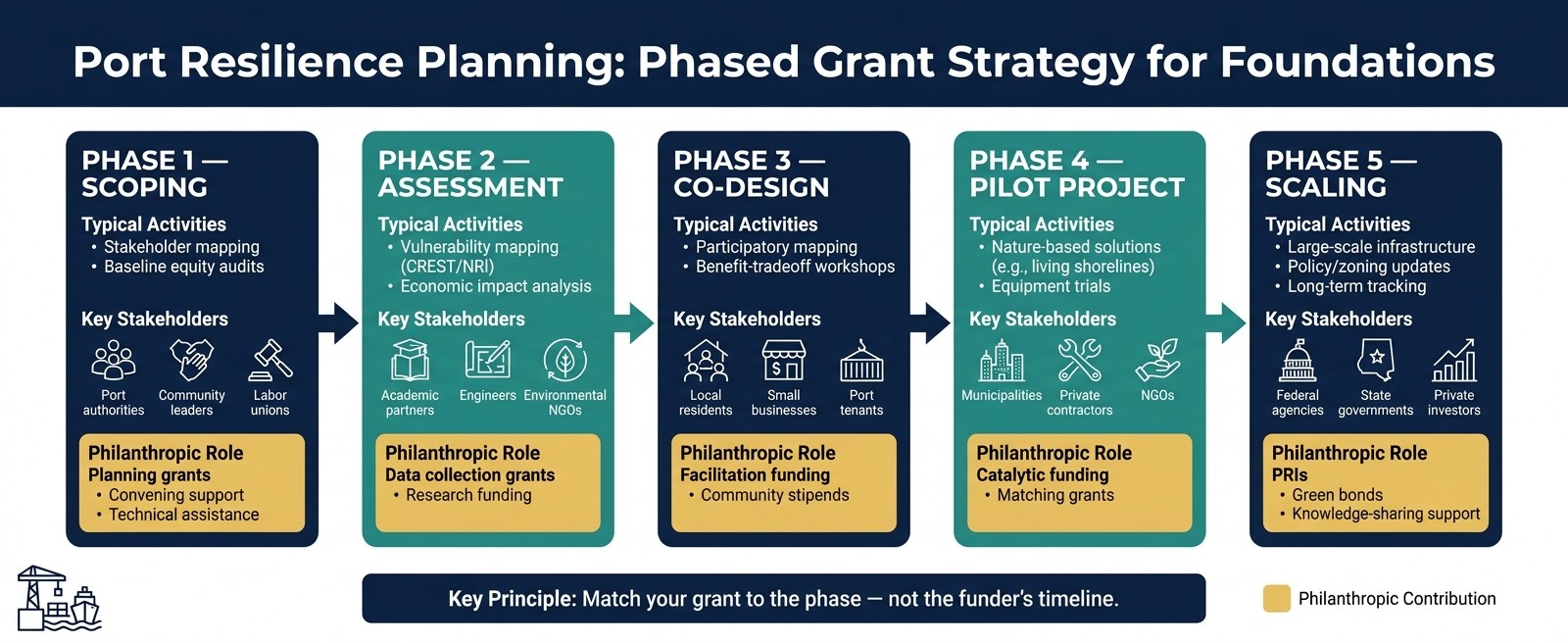
Port Resilience Planning: A Phased Framework for Funders
Once people are at the table, trust decides whether the process leads to shared action.
Use equity and trust-building tools to shape priorities
Trust-building starts before the meeting begins. Co-created norms and participatory mapping give each group a real stake in the process.
Participatory mapping allows community members and labor representatives to mark flood-prone areas and local concerns on shared maps. That way, technical plans reflect what people on the ground already know.
Shared data only goes so far if people read it in isolation. It matters most when groups review it together and agree on what the data is saying. When stakeholders look at the same flood, air quality, and asset data, it becomes easier to line up priorities.
Resilience planning builds stakeholder trust, but only with sustained support. [1] That is why grantmaking should back relationship-building work, not only technical studies.
Before funding a direction, weigh tradeoffs across jobs, air quality, habitat, and community well-being. In co-design sessions with ports, labor, communities, and environmental groups, this kind of screen helps people compare options before money is committed:
Option | Jobs & Economy | Air Quality | Habitat Protection | Community Well-being |
|---|---|---|---|---|
Flood Barriers | High short-term construction jobs; protects high-value assets | Neutral | Can disrupt local ecosystems and sediment flow | Provides high perceived safety but may block waterfront access |
Green Infrastructure | Lower-cost maintenance and restoration jobs | Improves local air quality through vegetation | Restores coastal habitats and supports biodiversity | Provides recreational space and reduces urban heat |
Equipment Electrification | Requires workforce retraining; reduces long-term fuel costs | Significant reduction in particulate matter and NOx | Neutral | Directly improves health outcomes for near-port residents |
Once priorities are shared, the next move is to match funding and tools to the stage of work.
Match grants, partnerships, and planning tools to each phase
Funding should match the phase of the project, not the timeline a funder wants to see. Early-stage work needs planning grants and support for convening. Mid-stage co-design needs money for facilitation and community stipends. Pilot projects need catalytic funding that lowers risk for public and private partners. Scaling calls for long-term tools like PRIs and interagency agreements for work that stretches across years.
Partnership structure matters just as much as funding type. The Olympia Sea Level Rise Response Collaborative, a formal partnership between the Port of Olympia, the City of Olympia, and LOTT Clean Water Alliance, used an Interlocal Agreement (ILA) to coordinate long-term adaptation and funding across agencies. [3]
These structures tend to work best when paired with the right planning tools and data systems. Three tool types stand out:
U.S. risk and exposure resources, such as NOAA's National Risk Index and FEMA's CREST tool
Infrastructure resilience frameworks, such as RAFT (Resilience Adaptation Feasibility Tool), which guides teams through a social/economic scorecard, a resilience action checklist, and a one-year implementation phase
Port emissions inventory tools for tracking air quality co-benefits from electrification pilots
The table below links each phase to the activities, stakeholders, and philanthropic support that often fit best:
Phase | Typical Activities | Key Stakeholders | Philanthropic Contribution |
|---|---|---|---|
Scoping | Stakeholder mapping; baseline equity audits | Port authorities, community leaders, labor unions | Planning grants; convening support; technical assistance |
Assessment | Vulnerability mapping (CREST/NRI); economic impact analysis | Academic partners, engineers, environmental NGOs | Data collection grants; research funding |
Co-Design | Participatory mapping; benefit-tradeoff workshops | Local residents, small businesses, port tenants | Facilitation funding; community stipends |
Pilot Project | Small-scale nature-based solutions (e.g., living shorelines); equipment trials | Municipalities, private contractors, NGOs | Catalytic funding; matching grants |
Scaling | Large-scale infrastructure; policy and zoning updates; long-term tracking | Federal agencies, state governments, private investors | Program-Related Investments (PRIs); green bonds; knowledge-sharing support |
The next step is tracking whether these commitments turn into measurable action.
Measure progress and keep the process moving
Track participation, resilience outcomes, and learning loops
Once partnerships are set, measurement is what keeps everyone honest. Without a clear feedback loop, planning slows down and can drift. The fix is simple: agree on shared metrics that show whether engagement is becoming more inclusive and more effective.
A useful way to organize tracking is through three buckets: leadership and resources; data and collaboration; and diversity of external stakeholders. In the first bucket, look at organizational commitment, leadership champions, staff availability, financial resources, and cross-team resource sharing. In the second, track data availability, data quality, internal collaboration, and external collaboration. The third focuses on who is at the table and whether participation reflects the people affected. Rate each area on a 1–5 scale to spot where capacity is getting stronger and where it is starting to slip [1].
It also helps to track both the process itself and the outcomes the process is supposed to improve. That means watching whether people keep showing up, whether new groups join, and whether information is shared openly. It also means tracking on-the-ground results. Air quality, water quality, and health outcomes link port operations to community well-being [2]. Reduced disruption days and workforce safety outcomes add the day-to-day port and frontline view. Social capital can be tracked through repeat participation, new voices entering the process, and open data sharing [1].
Set regular review sessions so partners can study the data together, not in separate silos. Those meetings should do more than report numbers. They should help the group reset priorities, adjust next steps, and deal with weak spots before they turn into bigger problems.
Key takeaways for foundations and philanthropic organizations
A few ground rules can help keep this work on track.
Map the system before acting. When you understand how port infrastructure, supply chains, and communities connect, you can see where a disruption is likely to hit - and where a funder has the most leverage.
Keep major stakeholders involved through permanent working groups or advisory boards. Continuity across multiple cycles is itself a sign that the process is working [1].
Fund facilitation, relationship-building, and ongoing engagement - not just the plan.
Treat near-port air quality and health burdens as core resilience issues[2].
Use phased partnerships and ongoing governance. Move from assessment to implementation with review cycles in place, so priorities can shift as conditions change.
FAQs
Who should lead port resilience planning?
In the United States, port operators usually take the lead on long-term disaster and resilience planning.
Still, ports don’t run as single, self-contained systems. They’re busy networks with public agencies, private firms, nearby neighborhoods, and many moving parts. That’s why planning tends to work better when it’s shared. A polycentric approach - bringing in port authorities, government entities, community groups, and private partners - can build stronger adaptive capacity and better reflect the needs of the surrounding community.
How can funders support participation early on?
Funders can support early participation by mapping stakeholders to spot who faces the most risk and who has the most at stake. Just as important, they should clear out common roadblocks to engagement, like language gaps, weak internet access, or meeting times that don’t work for working families. That’s how procedural equity moves from a nice idea to something people can actually feel.
Support also matters in practical ways. Funding technical assistance, capacity building, co-creation workshops, and third-party facilitation can help community groups take part on more equal footing. It also helps build trust, consensus, and shared ownership from the very beginning.
What metrics show stakeholder engagement is working?
Stakeholder engagement is doing its job when it deepens relationships and leads to better resilience planning. To see if that’s happening, track indicators like asset vulnerability, resource use, and compliance with updated building codes.
It also helps to look beyond operations. Has engagement increased trust? Has it supported decision-making that brings more voices into the room? Has it built a shared understanding of risk among port stakeholders, including local communities and labor representatives?
Related Blog Posts
How to Design Coastal Resilience & Flood Mitigation for Foundations & Philanthropic Organizations
How to Co-Design Climate-Ready Communities with Residents for Maritime & Logistics Companies
How to Engage Port Stakeholders in Resilience Planning for Municipalities & Government Agencies
How to Engage Port Stakeholders in Resilience Planning for NGOs & Nonprofits
Latest Articles
©2025

Narrative Change and Power Building: The Missing Half of Advocacy
Narrative change is the process of disrupting dominant narratives that normalize inequity and advancing new narratives from historically marginalized communities.

Funding Resilience Without Federal Grants
BRIC is unreliable and FEMA is shrinking. Here's how cities fund climate resilience with dedicated revenue, blended finance, and a coordinating authority.

The ESG Blind Spot: How AI Is Finding Risks in Companies Nobody Else Is Watching
Norway's sovereign wealth fund uses AI to screen 7,200 portfolio companies for forced labor and corruption within 24 hours. The real story is the emerging-market coverage gap that traditional ESG data vendors miss — and what it means for any company with a global supply chain.
Narrative Change and Power Building: The Missing Half of Advocacy
Narrative change is the process of disrupting dominant narratives that normalize inequity and advancing new narratives from historically marginalized communities.
Funding Resilience Without Federal Grants
BRIC is unreliable and FEMA is shrinking. Here's how cities fund climate resilience with dedicated revenue, blended finance, and a coordinating authority.
The ESG Blind Spot: How AI Is Finding Risks in Companies Nobody Else Is Watching
Norway's sovereign wealth fund uses AI to screen 7,200 portfolio companies for forced labor and corruption within 24 hours. The real story is the emerging-market coverage gap that traditional ESG data vendors miss — and what it means for any company with a global supply chain.
FAQ
01
What does it really mean to “redefine profit”?
02
What makes Council Fire different?
03
Who does Council Fire work with?
04
What does working with Council Fire actually look like?
05
How does Council Fire help organizations turn big goals into action?
06
How does Council Fire define and measure success?
Jun 22, 2026
How to Engage Port Stakeholders in Resilience Planning for Foundations & Philanthropic Organizations
Capacity Building
In This Article
Foundations must fund early coordination: mapping, outreach, and neutral facilitation to make port resilience planning effective.
How to Engage Port Stakeholders in Resilience Planning for Foundations & Philanthropic Organizations
Port resilience planning fails when the wrong people are left out. If I want grants to move projects forward instead of stalling them, I need to fund the early work: system mapping, stakeholder outreach, neutral facilitation, shared data review, and follow-through.
In plain terms, this article shows me how to help ports, operators, workers, public agencies, and near-port residents plan together before floods, heat, power loss, traffic backups, or supply chain problems turn into bigger failures. It also makes one point clear: a port is not just a dock. It is a linked system of assets, roads, rail, power, data, jobs, and neighborhoods.
What I need to do first:
Map the port system so I can see assets, weak links, and outside dependencies
List the stakeholders by role, influence, risk, and decision power
Pick the right meeting format for each group instead of using one format for all
Pay for participation support so workers and community groups can take part
Use shared data and tradeoff reviews to line up priorities across jobs, health, habitat, and port uptime
Match grants to the project phase from scoping to pilot work to scale-up
Track progress with simple measures for participation, coordination, and results
A few facts from the article stand out. One port assessment ran 120 pages to map flood and wind risk. After Hurricane Maria, port-related failures in power and communications helped disrupt pharmaceutical supply for several months. And the article suggests using 1–5 scoring to track leadership, data sharing, and who is taking part.
If I am a funder, the message is simple: do not wait for a shovel-ready project. The early coordination work is where money can remove delays, reduce conflict, and help better plans take shape.
Webinar "Disaster Risk Management in Ports: Strategies for Coordinated Preparedness,..."
Map the port system and the stakeholder landscape
Before you bring anyone into a room, get clear on the system itself. A port is far more than a dock. It is a layered network of physical assets, business activity, public agencies, workforce movement, and nearby neighborhoods. Mapping that system first cuts down on blind spots. For foundations, this kind of map shows where grants can support convening, analysis, and data sharing. For funders, it also points to where small grants can clear early roadblocks.
Build a port resilience system map
Map the assets, the functions they support, the links between them, and the points where failure can spread.
Start with the physical side: cargo-handling equipment, storage facilities, navigation systems, and channel infrastructure. Then add digital systems such as software, procurement tools, and logistics platforms. From there, trace the dependencies. A port depends on outside power grids, communications networks, road and rail links, and waterway access. If one of those goes down, the effects can move fast across the whole system.
Puerto Rico after Hurricane Maria shows why this matters. When energy and communications systems at port facilities failed, critical pharmaceutical supplies to North America were disrupted for several months - not because the port itself was destroyed, but because the surrounding infrastructure it depended on collapsed [1]. Hazard exposure finishes the picture. The Port of Baltimore’s 120-page resilience assessment mapped the combined effects of sea level rise, storm surge, extreme wind, and riverine flooding on port operations [1].
Use one shared map so agencies and operators are weighing the same risks and the same tradeoffs.
Once the system is mapped, the next job is to identify who controls each dependency and who carries the most risk.
Create a stakeholder register with roles, influence, and priorities
Once the system map is in place, the next step is sorting out who shapes each part of it. Not every stakeholder has the same pull, and not every group faces the same exposure. A power-interest analysis gives funders a fast way to read the field. It helps separate the groups that make decisions, the groups that carry the heaviest burden, and the groups that need to help put any plan into action.
Each port sits inside a stack of overlapping jurisdictions and interests. Port authorities may own the wharves but lease operations to private terminal operators. Local governments control land use and transportation corridors. Labor groups bring concerns about worker safety and access. Near-port communities live with the environmental and economic effects. Environmental NGOs track ecosystem health. Each group comes in with its own information, leverage, and limits. A funder who understands those differences can build engagement that leads somewhere, instead of just filling a calendar.
The table below lays out the core stakeholder groups by interests, influence, resilience concerns, and the engagement formats most likely to support useful participation.
Stakeholder Group | Primary Interests | Level of Influence | Resilience Concerns | Preferred Engagement Format |
|---|---|---|---|---|
Port Authorities | Revenue, business continuity, safety, infrastructure longevity | High - regulatory and ownership power | Asset damage, operational downtime, liability | 1-on-1 briefings, board meetings |
Terminal Operators | Throughput, equipment protection, labor availability | High (Operational) | Supply chain bottlenecks, power outages | Technical workshops, operational committees |
Labor & Workforce | Safety, job security, commute reliability | Medium | Extreme heat, flooded access roads, facility safety | Town halls, union meetings, mobile apps |
Near-Port Communities | Air quality, health, emergency access, economic opportunity | Medium to High (Political) | Displacement, health impacts, cascading utility failures | Co-creation workshops, community advisory boards |
Local Governments/MPOs | Regional economy, public safety, infrastructure integration | High - planning and funding power | Transportation network failure, loss of tax base | Inter-agency task forces, public hearings |
Environmental NGOs | Ecosystem health, nature-based solutions, environmental justice | Medium | Habitat loss, pollution during disasters, inequitable protection | Collaborative planning sessions, focus groups |
Data sharing between port authorities and terminal operators is a strong early grant target. The stakeholder register should guide who needs to be in the room, how often they should be there, and which decisions they need to shape.
Design convening and engagement methods that work for all groups
Once you have the system map and stakeholder register, the next step is simple in theory and hard in practice: match each engagement method to the decision each group can shape. That keeps the process grounded. It also helps people spend time where their input can matter.
Foundations can play a useful role here. They can fund neutral facilitation and shared decision-making across agencies, operators, labor, and communities. Just as important, they can help turn technical analysis into decisions people outside a technical meeting can actually use.
Choose the right format for each stakeholder group
The matrix below helps match each group to the right level of effort.
Engagement Format | Depth of Input | Relative Cost | Time Commitment | Best-Fit Stakeholder Type |
|---|---|---|---|---|
One-on-One Interviews | High | Moderate | High | Technical experts, Port executives |
Listening Sessions | Moderate | Low | Low | General community, Residents |
Scenario Workshops | High | Moderate | Moderate | Operators, Logistics managers, Labor leaders |
Resilience Charrettes | Very High | High | High | Multi-disciplinary teams, Planners |
Advisory Committees | High | Moderate | Ongoing | Community leaders, Environmental groups |
Technical Working Groups | Very High | Moderate | Ongoing | Engineers, Regulatory agencies, IT/Data staff |
A one-size-fits-all approach usually falls flat. Port leadership may respond best to the Port Resilience Index (PRI). Operators and engineers often need vulnerability assessments that speak their language. Labor and frontline workers, by contrast, tend to offer their strongest input in focus groups, where day-to-day knowledge can come out more naturally [1].
Lower participation barriers and support a fair process
Choosing the format is only half the job. You also have to remove the barriers that keep lower-power groups from showing up or being heard.
These groups often have less time, fewer resources, and less access to technical meetings. If the process ignores that, the loudest voices win by default. A fair process takes planning. Use the EPA's Training Facilitators Resource for sample agendas and the Community Action Roadmap for participation support. Publish agendas in advance, and send follow-up notes that show how input changed decisions [2]. That last step matters more than people think. It tells participants their time was not wasted, and it builds trust for the next round.
Build trust, align interests, and fund collaborative action
Port Resilience Planning: A Phased Framework for Funders
Once people are at the table, trust decides whether the process leads to shared action.
Use equity and trust-building tools to shape priorities
Trust-building starts before the meeting begins. Co-created norms and participatory mapping give each group a real stake in the process.
Participatory mapping allows community members and labor representatives to mark flood-prone areas and local concerns on shared maps. That way, technical plans reflect what people on the ground already know.
Shared data only goes so far if people read it in isolation. It matters most when groups review it together and agree on what the data is saying. When stakeholders look at the same flood, air quality, and asset data, it becomes easier to line up priorities.
Resilience planning builds stakeholder trust, but only with sustained support. [1] That is why grantmaking should back relationship-building work, not only technical studies.
Before funding a direction, weigh tradeoffs across jobs, air quality, habitat, and community well-being. In co-design sessions with ports, labor, communities, and environmental groups, this kind of screen helps people compare options before money is committed:
Option | Jobs & Economy | Air Quality | Habitat Protection | Community Well-being |
|---|---|---|---|---|
Flood Barriers | High short-term construction jobs; protects high-value assets | Neutral | Can disrupt local ecosystems and sediment flow | Provides high perceived safety but may block waterfront access |
Green Infrastructure | Lower-cost maintenance and restoration jobs | Improves local air quality through vegetation | Restores coastal habitats and supports biodiversity | Provides recreational space and reduces urban heat |
Equipment Electrification | Requires workforce retraining; reduces long-term fuel costs | Significant reduction in particulate matter and NOx | Neutral | Directly improves health outcomes for near-port residents |
Once priorities are shared, the next move is to match funding and tools to the stage of work.
Match grants, partnerships, and planning tools to each phase
Funding should match the phase of the project, not the timeline a funder wants to see. Early-stage work needs planning grants and support for convening. Mid-stage co-design needs money for facilitation and community stipends. Pilot projects need catalytic funding that lowers risk for public and private partners. Scaling calls for long-term tools like PRIs and interagency agreements for work that stretches across years.
Partnership structure matters just as much as funding type. The Olympia Sea Level Rise Response Collaborative, a formal partnership between the Port of Olympia, the City of Olympia, and LOTT Clean Water Alliance, used an Interlocal Agreement (ILA) to coordinate long-term adaptation and funding across agencies. [3]
These structures tend to work best when paired with the right planning tools and data systems. Three tool types stand out:
U.S. risk and exposure resources, such as NOAA's National Risk Index and FEMA's CREST tool
Infrastructure resilience frameworks, such as RAFT (Resilience Adaptation Feasibility Tool), which guides teams through a social/economic scorecard, a resilience action checklist, and a one-year implementation phase
Port emissions inventory tools for tracking air quality co-benefits from electrification pilots
The table below links each phase to the activities, stakeholders, and philanthropic support that often fit best:
Phase | Typical Activities | Key Stakeholders | Philanthropic Contribution |
|---|---|---|---|
Scoping | Stakeholder mapping; baseline equity audits | Port authorities, community leaders, labor unions | Planning grants; convening support; technical assistance |
Assessment | Vulnerability mapping (CREST/NRI); economic impact analysis | Academic partners, engineers, environmental NGOs | Data collection grants; research funding |
Co-Design | Participatory mapping; benefit-tradeoff workshops | Local residents, small businesses, port tenants | Facilitation funding; community stipends |
Pilot Project | Small-scale nature-based solutions (e.g., living shorelines); equipment trials | Municipalities, private contractors, NGOs | Catalytic funding; matching grants |
Scaling | Large-scale infrastructure; policy and zoning updates; long-term tracking | Federal agencies, state governments, private investors | Program-Related Investments (PRIs); green bonds; knowledge-sharing support |
The next step is tracking whether these commitments turn into measurable action.
Measure progress and keep the process moving
Track participation, resilience outcomes, and learning loops
Once partnerships are set, measurement is what keeps everyone honest. Without a clear feedback loop, planning slows down and can drift. The fix is simple: agree on shared metrics that show whether engagement is becoming more inclusive and more effective.
A useful way to organize tracking is through three buckets: leadership and resources; data and collaboration; and diversity of external stakeholders. In the first bucket, look at organizational commitment, leadership champions, staff availability, financial resources, and cross-team resource sharing. In the second, track data availability, data quality, internal collaboration, and external collaboration. The third focuses on who is at the table and whether participation reflects the people affected. Rate each area on a 1–5 scale to spot where capacity is getting stronger and where it is starting to slip [1].
It also helps to track both the process itself and the outcomes the process is supposed to improve. That means watching whether people keep showing up, whether new groups join, and whether information is shared openly. It also means tracking on-the-ground results. Air quality, water quality, and health outcomes link port operations to community well-being [2]. Reduced disruption days and workforce safety outcomes add the day-to-day port and frontline view. Social capital can be tracked through repeat participation, new voices entering the process, and open data sharing [1].
Set regular review sessions so partners can study the data together, not in separate silos. Those meetings should do more than report numbers. They should help the group reset priorities, adjust next steps, and deal with weak spots before they turn into bigger problems.
Key takeaways for foundations and philanthropic organizations
A few ground rules can help keep this work on track.
Map the system before acting. When you understand how port infrastructure, supply chains, and communities connect, you can see where a disruption is likely to hit - and where a funder has the most leverage.
Keep major stakeholders involved through permanent working groups or advisory boards. Continuity across multiple cycles is itself a sign that the process is working [1].
Fund facilitation, relationship-building, and ongoing engagement - not just the plan.
Treat near-port air quality and health burdens as core resilience issues[2].
Use phased partnerships and ongoing governance. Move from assessment to implementation with review cycles in place, so priorities can shift as conditions change.
FAQs
Who should lead port resilience planning?
In the United States, port operators usually take the lead on long-term disaster and resilience planning.
Still, ports don’t run as single, self-contained systems. They’re busy networks with public agencies, private firms, nearby neighborhoods, and many moving parts. That’s why planning tends to work better when it’s shared. A polycentric approach - bringing in port authorities, government entities, community groups, and private partners - can build stronger adaptive capacity and better reflect the needs of the surrounding community.
How can funders support participation early on?
Funders can support early participation by mapping stakeholders to spot who faces the most risk and who has the most at stake. Just as important, they should clear out common roadblocks to engagement, like language gaps, weak internet access, or meeting times that don’t work for working families. That’s how procedural equity moves from a nice idea to something people can actually feel.
Support also matters in practical ways. Funding technical assistance, capacity building, co-creation workshops, and third-party facilitation can help community groups take part on more equal footing. It also helps build trust, consensus, and shared ownership from the very beginning.
What metrics show stakeholder engagement is working?
Stakeholder engagement is doing its job when it deepens relationships and leads to better resilience planning. To see if that’s happening, track indicators like asset vulnerability, resource use, and compliance with updated building codes.
It also helps to look beyond operations. Has engagement increased trust? Has it supported decision-making that brings more voices into the room? Has it built a shared understanding of risk among port stakeholders, including local communities and labor representatives?
Related Blog Posts
How to Design Coastal Resilience & Flood Mitigation for Foundations & Philanthropic Organizations
How to Co-Design Climate-Ready Communities with Residents for Maritime & Logistics Companies
How to Engage Port Stakeholders in Resilience Planning for Municipalities & Government Agencies
How to Engage Port Stakeholders in Resilience Planning for NGOs & Nonprofits
Latest Articles
©2025
Narrative Change and Power Building: The Missing Half of Advocacy
Narrative change is the process of disrupting dominant narratives that normalize inequity and advancing new narratives from historically marginalized communities.
Funding Resilience Without Federal Grants
BRIC is unreliable and FEMA is shrinking. Here's how cities fund climate resilience with dedicated revenue, blended finance, and a coordinating authority.
The ESG Blind Spot: How AI Is Finding Risks in Companies Nobody Else Is Watching
Norway's sovereign wealth fund uses AI to screen 7,200 portfolio companies for forced labor and corruption within 24 hours. The real story is the emerging-market coverage gap that traditional ESG data vendors miss — and what it means for any company with a global supply chain.
FAQ
01
What does it really mean to “redefine profit”?
02
What makes Council Fire different?
03
Who does Council Fire work with?
04
What does working with Council Fire actually look like?
05
How does Council Fire help organizations turn big goals into action?
06
How does Council Fire define and measure success?
Jun 22, 2026
How to Engage Port Stakeholders in Resilience Planning for Foundations & Philanthropic Organizations
Capacity Building
In This Article
Foundations must fund early coordination: mapping, outreach, and neutral facilitation to make port resilience planning effective.
How to Engage Port Stakeholders in Resilience Planning for Foundations & Philanthropic Organizations
Port resilience planning fails when the wrong people are left out. If I want grants to move projects forward instead of stalling them, I need to fund the early work: system mapping, stakeholder outreach, neutral facilitation, shared data review, and follow-through.
In plain terms, this article shows me how to help ports, operators, workers, public agencies, and near-port residents plan together before floods, heat, power loss, traffic backups, or supply chain problems turn into bigger failures. It also makes one point clear: a port is not just a dock. It is a linked system of assets, roads, rail, power, data, jobs, and neighborhoods.
What I need to do first:
Map the port system so I can see assets, weak links, and outside dependencies
List the stakeholders by role, influence, risk, and decision power
Pick the right meeting format for each group instead of using one format for all
Pay for participation support so workers and community groups can take part
Use shared data and tradeoff reviews to line up priorities across jobs, health, habitat, and port uptime
Match grants to the project phase from scoping to pilot work to scale-up
Track progress with simple measures for participation, coordination, and results
A few facts from the article stand out. One port assessment ran 120 pages to map flood and wind risk. After Hurricane Maria, port-related failures in power and communications helped disrupt pharmaceutical supply for several months. And the article suggests using 1–5 scoring to track leadership, data sharing, and who is taking part.
If I am a funder, the message is simple: do not wait for a shovel-ready project. The early coordination work is where money can remove delays, reduce conflict, and help better plans take shape.
Webinar "Disaster Risk Management in Ports: Strategies for Coordinated Preparedness,..."
Map the port system and the stakeholder landscape
Before you bring anyone into a room, get clear on the system itself. A port is far more than a dock. It is a layered network of physical assets, business activity, public agencies, workforce movement, and nearby neighborhoods. Mapping that system first cuts down on blind spots. For foundations, this kind of map shows where grants can support convening, analysis, and data sharing. For funders, it also points to where small grants can clear early roadblocks.
Build a port resilience system map
Map the assets, the functions they support, the links between them, and the points where failure can spread.
Start with the physical side: cargo-handling equipment, storage facilities, navigation systems, and channel infrastructure. Then add digital systems such as software, procurement tools, and logistics platforms. From there, trace the dependencies. A port depends on outside power grids, communications networks, road and rail links, and waterway access. If one of those goes down, the effects can move fast across the whole system.
Puerto Rico after Hurricane Maria shows why this matters. When energy and communications systems at port facilities failed, critical pharmaceutical supplies to North America were disrupted for several months - not because the port itself was destroyed, but because the surrounding infrastructure it depended on collapsed [1]. Hazard exposure finishes the picture. The Port of Baltimore’s 120-page resilience assessment mapped the combined effects of sea level rise, storm surge, extreme wind, and riverine flooding on port operations [1].
Use one shared map so agencies and operators are weighing the same risks and the same tradeoffs.
Once the system is mapped, the next job is to identify who controls each dependency and who carries the most risk.
Create a stakeholder register with roles, influence, and priorities
Once the system map is in place, the next step is sorting out who shapes each part of it. Not every stakeholder has the same pull, and not every group faces the same exposure. A power-interest analysis gives funders a fast way to read the field. It helps separate the groups that make decisions, the groups that carry the heaviest burden, and the groups that need to help put any plan into action.
Each port sits inside a stack of overlapping jurisdictions and interests. Port authorities may own the wharves but lease operations to private terminal operators. Local governments control land use and transportation corridors. Labor groups bring concerns about worker safety and access. Near-port communities live with the environmental and economic effects. Environmental NGOs track ecosystem health. Each group comes in with its own information, leverage, and limits. A funder who understands those differences can build engagement that leads somewhere, instead of just filling a calendar.
The table below lays out the core stakeholder groups by interests, influence, resilience concerns, and the engagement formats most likely to support useful participation.
Stakeholder Group | Primary Interests | Level of Influence | Resilience Concerns | Preferred Engagement Format |
|---|---|---|---|---|
Port Authorities | Revenue, business continuity, safety, infrastructure longevity | High - regulatory and ownership power | Asset damage, operational downtime, liability | 1-on-1 briefings, board meetings |
Terminal Operators | Throughput, equipment protection, labor availability | High (Operational) | Supply chain bottlenecks, power outages | Technical workshops, operational committees |
Labor & Workforce | Safety, job security, commute reliability | Medium | Extreme heat, flooded access roads, facility safety | Town halls, union meetings, mobile apps |
Near-Port Communities | Air quality, health, emergency access, economic opportunity | Medium to High (Political) | Displacement, health impacts, cascading utility failures | Co-creation workshops, community advisory boards |
Local Governments/MPOs | Regional economy, public safety, infrastructure integration | High - planning and funding power | Transportation network failure, loss of tax base | Inter-agency task forces, public hearings |
Environmental NGOs | Ecosystem health, nature-based solutions, environmental justice | Medium | Habitat loss, pollution during disasters, inequitable protection | Collaborative planning sessions, focus groups |
Data sharing between port authorities and terminal operators is a strong early grant target. The stakeholder register should guide who needs to be in the room, how often they should be there, and which decisions they need to shape.
Design convening and engagement methods that work for all groups
Once you have the system map and stakeholder register, the next step is simple in theory and hard in practice: match each engagement method to the decision each group can shape. That keeps the process grounded. It also helps people spend time where their input can matter.
Foundations can play a useful role here. They can fund neutral facilitation and shared decision-making across agencies, operators, labor, and communities. Just as important, they can help turn technical analysis into decisions people outside a technical meeting can actually use.
Choose the right format for each stakeholder group
The matrix below helps match each group to the right level of effort.
Engagement Format | Depth of Input | Relative Cost | Time Commitment | Best-Fit Stakeholder Type |
|---|---|---|---|---|
One-on-One Interviews | High | Moderate | High | Technical experts, Port executives |
Listening Sessions | Moderate | Low | Low | General community, Residents |
Scenario Workshops | High | Moderate | Moderate | Operators, Logistics managers, Labor leaders |
Resilience Charrettes | Very High | High | High | Multi-disciplinary teams, Planners |
Advisory Committees | High | Moderate | Ongoing | Community leaders, Environmental groups |
Technical Working Groups | Very High | Moderate | Ongoing | Engineers, Regulatory agencies, IT/Data staff |
A one-size-fits-all approach usually falls flat. Port leadership may respond best to the Port Resilience Index (PRI). Operators and engineers often need vulnerability assessments that speak their language. Labor and frontline workers, by contrast, tend to offer their strongest input in focus groups, where day-to-day knowledge can come out more naturally [1].
Lower participation barriers and support a fair process
Choosing the format is only half the job. You also have to remove the barriers that keep lower-power groups from showing up or being heard.
These groups often have less time, fewer resources, and less access to technical meetings. If the process ignores that, the loudest voices win by default. A fair process takes planning. Use the EPA's Training Facilitators Resource for sample agendas and the Community Action Roadmap for participation support. Publish agendas in advance, and send follow-up notes that show how input changed decisions [2]. That last step matters more than people think. It tells participants their time was not wasted, and it builds trust for the next round.
Build trust, align interests, and fund collaborative action
Port Resilience Planning: A Phased Framework for Funders
Once people are at the table, trust decides whether the process leads to shared action.
Use equity and trust-building tools to shape priorities
Trust-building starts before the meeting begins. Co-created norms and participatory mapping give each group a real stake in the process.
Participatory mapping allows community members and labor representatives to mark flood-prone areas and local concerns on shared maps. That way, technical plans reflect what people on the ground already know.
Shared data only goes so far if people read it in isolation. It matters most when groups review it together and agree on what the data is saying. When stakeholders look at the same flood, air quality, and asset data, it becomes easier to line up priorities.
Resilience planning builds stakeholder trust, but only with sustained support. [1] That is why grantmaking should back relationship-building work, not only technical studies.
Before funding a direction, weigh tradeoffs across jobs, air quality, habitat, and community well-being. In co-design sessions with ports, labor, communities, and environmental groups, this kind of screen helps people compare options before money is committed:
Option | Jobs & Economy | Air Quality | Habitat Protection | Community Well-being |
|---|---|---|---|---|
Flood Barriers | High short-term construction jobs; protects high-value assets | Neutral | Can disrupt local ecosystems and sediment flow | Provides high perceived safety but may block waterfront access |
Green Infrastructure | Lower-cost maintenance and restoration jobs | Improves local air quality through vegetation | Restores coastal habitats and supports biodiversity | Provides recreational space and reduces urban heat |
Equipment Electrification | Requires workforce retraining; reduces long-term fuel costs | Significant reduction in particulate matter and NOx | Neutral | Directly improves health outcomes for near-port residents |
Once priorities are shared, the next move is to match funding and tools to the stage of work.
Match grants, partnerships, and planning tools to each phase
Funding should match the phase of the project, not the timeline a funder wants to see. Early-stage work needs planning grants and support for convening. Mid-stage co-design needs money for facilitation and community stipends. Pilot projects need catalytic funding that lowers risk for public and private partners. Scaling calls for long-term tools like PRIs and interagency agreements for work that stretches across years.
Partnership structure matters just as much as funding type. The Olympia Sea Level Rise Response Collaborative, a formal partnership between the Port of Olympia, the City of Olympia, and LOTT Clean Water Alliance, used an Interlocal Agreement (ILA) to coordinate long-term adaptation and funding across agencies. [3]
These structures tend to work best when paired with the right planning tools and data systems. Three tool types stand out:
U.S. risk and exposure resources, such as NOAA's National Risk Index and FEMA's CREST tool
Infrastructure resilience frameworks, such as RAFT (Resilience Adaptation Feasibility Tool), which guides teams through a social/economic scorecard, a resilience action checklist, and a one-year implementation phase
Port emissions inventory tools for tracking air quality co-benefits from electrification pilots
The table below links each phase to the activities, stakeholders, and philanthropic support that often fit best:
Phase | Typical Activities | Key Stakeholders | Philanthropic Contribution |
|---|---|---|---|
Scoping | Stakeholder mapping; baseline equity audits | Port authorities, community leaders, labor unions | Planning grants; convening support; technical assistance |
Assessment | Vulnerability mapping (CREST/NRI); economic impact analysis | Academic partners, engineers, environmental NGOs | Data collection grants; research funding |
Co-Design | Participatory mapping; benefit-tradeoff workshops | Local residents, small businesses, port tenants | Facilitation funding; community stipends |
Pilot Project | Small-scale nature-based solutions (e.g., living shorelines); equipment trials | Municipalities, private contractors, NGOs | Catalytic funding; matching grants |
Scaling | Large-scale infrastructure; policy and zoning updates; long-term tracking | Federal agencies, state governments, private investors | Program-Related Investments (PRIs); green bonds; knowledge-sharing support |
The next step is tracking whether these commitments turn into measurable action.
Measure progress and keep the process moving
Track participation, resilience outcomes, and learning loops
Once partnerships are set, measurement is what keeps everyone honest. Without a clear feedback loop, planning slows down and can drift. The fix is simple: agree on shared metrics that show whether engagement is becoming more inclusive and more effective.
A useful way to organize tracking is through three buckets: leadership and resources; data and collaboration; and diversity of external stakeholders. In the first bucket, look at organizational commitment, leadership champions, staff availability, financial resources, and cross-team resource sharing. In the second, track data availability, data quality, internal collaboration, and external collaboration. The third focuses on who is at the table and whether participation reflects the people affected. Rate each area on a 1–5 scale to spot where capacity is getting stronger and where it is starting to slip [1].
It also helps to track both the process itself and the outcomes the process is supposed to improve. That means watching whether people keep showing up, whether new groups join, and whether information is shared openly. It also means tracking on-the-ground results. Air quality, water quality, and health outcomes link port operations to community well-being [2]. Reduced disruption days and workforce safety outcomes add the day-to-day port and frontline view. Social capital can be tracked through repeat participation, new voices entering the process, and open data sharing [1].
Set regular review sessions so partners can study the data together, not in separate silos. Those meetings should do more than report numbers. They should help the group reset priorities, adjust next steps, and deal with weak spots before they turn into bigger problems.
Key takeaways for foundations and philanthropic organizations
A few ground rules can help keep this work on track.
Map the system before acting. When you understand how port infrastructure, supply chains, and communities connect, you can see where a disruption is likely to hit - and where a funder has the most leverage.
Keep major stakeholders involved through permanent working groups or advisory boards. Continuity across multiple cycles is itself a sign that the process is working [1].
Fund facilitation, relationship-building, and ongoing engagement - not just the plan.
Treat near-port air quality and health burdens as core resilience issues[2].
Use phased partnerships and ongoing governance. Move from assessment to implementation with review cycles in place, so priorities can shift as conditions change.
FAQs
Who should lead port resilience planning?
In the United States, port operators usually take the lead on long-term disaster and resilience planning.
Still, ports don’t run as single, self-contained systems. They’re busy networks with public agencies, private firms, nearby neighborhoods, and many moving parts. That’s why planning tends to work better when it’s shared. A polycentric approach - bringing in port authorities, government entities, community groups, and private partners - can build stronger adaptive capacity and better reflect the needs of the surrounding community.
How can funders support participation early on?
Funders can support early participation by mapping stakeholders to spot who faces the most risk and who has the most at stake. Just as important, they should clear out common roadblocks to engagement, like language gaps, weak internet access, or meeting times that don’t work for working families. That’s how procedural equity moves from a nice idea to something people can actually feel.
Support also matters in practical ways. Funding technical assistance, capacity building, co-creation workshops, and third-party facilitation can help community groups take part on more equal footing. It also helps build trust, consensus, and shared ownership from the very beginning.
What metrics show stakeholder engagement is working?
Stakeholder engagement is doing its job when it deepens relationships and leads to better resilience planning. To see if that’s happening, track indicators like asset vulnerability, resource use, and compliance with updated building codes.
It also helps to look beyond operations. Has engagement increased trust? Has it supported decision-making that brings more voices into the room? Has it built a shared understanding of risk among port stakeholders, including local communities and labor representatives?
Related Blog Posts
How to Design Coastal Resilience & Flood Mitigation for Foundations & Philanthropic Organizations
How to Co-Design Climate-Ready Communities with Residents for Maritime & Logistics Companies
How to Engage Port Stakeholders in Resilience Planning for Municipalities & Government Agencies
How to Engage Port Stakeholders in Resilience Planning for NGOs & Nonprofits
Latest Articles
©2025
Narrative Change and Power Building: The Missing Half of Advocacy
Narrative change is the process of disrupting dominant narratives that normalize inequity and advancing new narratives from historically marginalized communities.
Funding Resilience Without Federal Grants
BRIC is unreliable and FEMA is shrinking. Here's how cities fund climate resilience with dedicated revenue, blended finance, and a coordinating authority.
The ESG Blind Spot: How AI Is Finding Risks in Companies Nobody Else Is Watching
Norway's sovereign wealth fund uses AI to screen 7,200 portfolio companies for forced labor and corruption within 24 hours. The real story is the emerging-market coverage gap that traditional ESG data vendors miss — and what it means for any company with a global supply chain.
FAQ
What does it really mean to “redefine profit”?
What makes Council Fire different?
Who does Council Fire work with?
What does working with Council Fire actually look like?
How does Council Fire help organizations turn big goals into action?
How does Council Fire define and measure success?