
Jun 19, 2026
How to Design Green Port Infrastructure for the Future for Maritime & Logistics Companies
Sustainability Strategy
In This Article
Ports need a single phased roadmap tying power, electrification, water, resilience, and capital to cut emissions and stay operational.
How to Design Green Port Infrastructure for the Future for Maritime & Logistics Companies
If I had to sum it up in one line: ports need one phased plan that ties power, equipment, water, flood protection, digital systems, and capital spending together.
I’d focus on five things first: clear KPIs, grid and permit limits, electrification, site resilience, and phased spending. The pressure is already here. The IMO has a 2040 emissions target, CARB requires 100% shore power for some vessel visits and zero-emission cargo handling by 2030, and the Port of Seattle expects waterfront power demand to grow 4x by 2050. On top of that, 76% of top-25 U.S. container volume already comes from ports with net-zero-by-2050 commitments.
If you run a port or logistics hub, the short version is simple:
Set targets that connect emissions, uptime, cost, and community impact
Check utility capacity early before ordering major equipment
Electrify in phases with shore power, cranes, yard equipment, storage, and clean power supply
Plan for water reuse, waste cuts, and lower-carbon materials
Design for flooding, heat, storm surge, and outages
Use digital tools to track loads, emissions, asset health, and throughput
Rank projects by impact, grid readiness, permit risk, and total cost
A few numbers make the case clear:
Georgia Ports Authority saves $2.2 million per year after electrifying RTG cranes
Port electrification reviews and approvals often take 12 to 18 months
Seattle’s clean energy roadmap shows $208 million to $457 million in port and utility investment through 2050
Near-port air pollution remains a major issue; Los Angeles and Long Beach together produce about 100 tons of smog per day
Here’s the simplest way I’d frame the article:
Focus area | What matters most | Why it matters |
|---|---|---|
Strategy | KPIs, emissions baseline, TCO | Keeps spending tied to results |
Power | Shore power, storage, microgrids, utility upgrades | Cuts emissions and helps uptime |
Equipment | Electric cranes, yard tractors, charging plans | Lowers fuel and service costs |
Fuels | Space and capacity for methanol, ammonia, hydrogen | Keeps future options open |
Water & materials | Reuse, stormwater treatment, low-carbon inputs | Lowers water use and project footprint |
Resilience | Flood, heat, outage, and surge planning | Helps ports keep running |
Digital | EMS, SCADA, sensors, digital twins | Improves control and project timing |
Capital | Phased roadmap in U.S. dollars | Makes projects easier to fund and stage |
The main takeaway: don’t treat port decarbonization as a set of separate projects. I’d build one connected roadmap that starts with power and permits, then moves into equipment, resilience, water, and future fuel readiness.
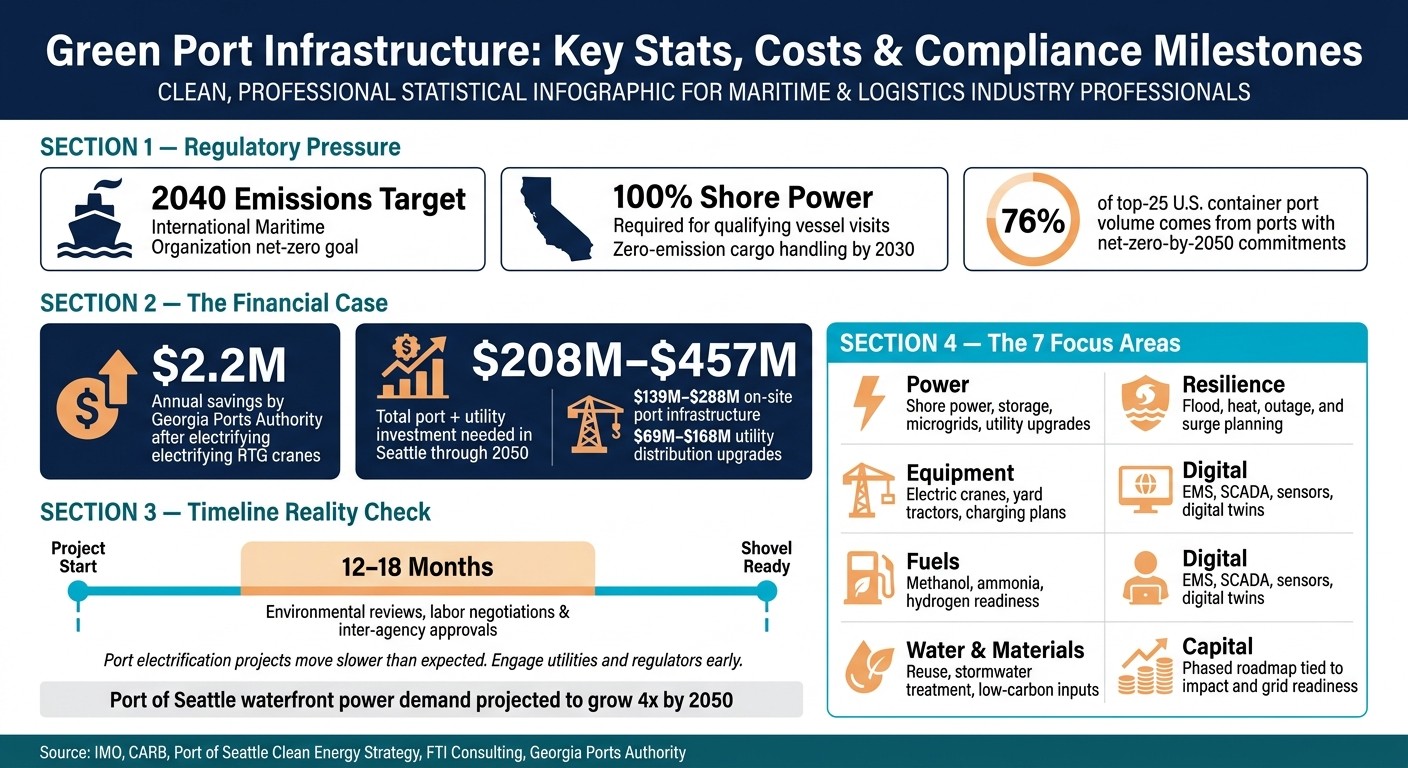
Green Port Infrastructure: Key Stats, Costs & Compliance Milestones
Green Port Progress Report: Operations
1. Set Strategy, Compliance Priorities, and Stakeholder Requirements
Before a port picks equipment or signs utility agreements, it needs a clear plan. Sustainability goals have to turn into measurable targets tied to operations, cost, and community impact. Skip that step, and capital plans, utility work, and day-to-day operations start pulling in different directions.
Define Measurable Port Objectives and KPIs
The right KPIs do more than track progress. They show where money is being saved, where bottlenecks remain, and which infrastructure choices make sense.
Metrics such as CO2e per TEU, energy use per container move, and vessel-at-berth emissions help ports track emissions while also pointing to efficiency gains. Truck turn times and outage resilience show whether upgrades are improving throughput and uptime. In practice, these numbers should shape decisions on shore power, electrification, storage, and terminal automation.
The table below shows how each KPI category links to infrastructure choices:
KPI Category | Measurable Metric | Infrastructure Impact |
|---|---|---|
Emissions | CO2e per TEU; vessel-at-berth emissions | Guides shore power and zero-emission equipment selection |
Energy | Levelized Cost of Energy (LCOE); energy autonomy % | Influences on-site renewable and storage sizing |
Reliability | Hours of uninterrupted operation during grid outages | Determines backup power and microgrid requirements |
Community | Near-port diesel emissions reduction | Affects terminal layout and drayage electrification |
Efficiency | Energy use per container move; truck turn times | Drives automation and digital tool implementation |
A good starting point is a baseline emissions model and greenhouse gas inventory covering Scope 1, 2, and 3 emissions across vessel activity, cargo-handling equipment, trucking, rail, and on-site facilities. That baseline becomes the reference point for each infrastructure move that follows [3][1].
Those same KPIs also make it clear which permits, utility upgrades, and community commitments matter most.
Map Regulations, Utility Constraints, and Community Expectations
Once targets are set, the next job is to map the limits around the project. That includes municipal permitting, state transportation and energy policy, stormwater and water quality rules, and grid interconnection timelines. The goal is simple: keep projects permit-ready, grid-ready, and aligned with nearby communities. It also means understanding labor requirements and environmental justice commitments for people living near the port.
One of the biggest choke points is utility capacity, and ports often underestimate it. The Port of Seattle projects that peak power demand across its waterfront operations will increase fourfold by 2050, requiring between $208 million and $457 million in combined port and utility infrastructure investment [5]. In April 2025, the port released its Seattle Waterfront Clean Energy Strategy in partnership with The Northwest Seaport Alliance (NWSA) and Seattle City Light (SCL). The plan identified $139 million to $288 million in on-site port infrastructure needs, including transformers, switchgear, and substation equipment, along with $69 million to $168 million in utility distribution upgrades [5].
"By taking a holistic and innovative approach, we are able to work in tandem to ensure a clean energy future for the region." - Dawn Lindell, General Manager and CEO, Seattle City Light [5]
Port electrification projects also move slower than many teams expect. Environmental reviews, labor negotiations, and inter-agency approvals typically take 12 to 18 months [1]. That’s why utilities, regulators, carriers, and neighboring communities need to be brought in early. Doing that upfront can prevent delays, redesigns, and budget creep later.
Use Scenario Planning and Total Cost of Ownership Analysis
With the main constraints on the table, ports need to test whether the plan still holds up under pressure. Scenario planning helps teams stress-test designs against cargo growth, energy prices, extreme weather, and fuel shifts, including hydrogen and ammonia [2][6].
Cost comparisons should also go beyond sticker price. Total cost of ownership gives a better view of long-term performance, and electrified assets often come out ahead on fuel, maintenance, and uptime. As FTI Consulting put it: "Electrification has moved from a climate goal to a competitive necessity for U.S. ports." [1] That kind of framing can help during capital approval and investor review.
With strategy and constraints in place, the next step is to test how shore power, electrification, and on-site energy systems should be sized to meet those targets.
2. Design Low-Carbon Energy, Equipment, and Fuel Systems
Once strategy and utility limits are clear, the next move is sizing the energy systems that will help the port cut emissions without hurting uptime. This is where many of the near-term gains come from: shore power, electrified equipment, on-site renewables, storage, and fuel-ready infrastructure. Get these choices right, and they affect emissions, operating cost, and berth reliability all at once.
Plan Shore Power and Electrified Cargo-Handling Equipment
Shore power allows vessels to turn off auxiliary engines while at berth and connect to grid electricity instead. In practice, that means high-voltage systems, dedicated electrical infrastructure, early coordination with the utility, and careful transformer sizing and load sequencing so interconnection delays don't slow the project [1].
The Port of Seattle put $44 million into shore power at its Bell Street Pier Cruise Terminal (Pier 66). As of April 2025, all three of its cruise berths are shore-power enabled [5].
One step often gets missed: buying clean electricity. Shore power only lowers Scope 2 emissions when the electricity supply itself is low-carbon. Power Purchase Agreements (PPAs) or on-site renewables are the most dependable ways to close that gap [1].
A smart way to start is to pilot one equipment class, check the load profile and operating impact, and then expand. That same load analysis should shape electrification plans for cranes, yard tractors, and other vehicles.
Add On-Site Renewables, Storage, and Smart Energy Controls
On-site renewables and battery storage help lower emissions and keep operations running during grid stress. Solar over parking canopies, maintenance buildings, and warehouse roofs is a practical place to begin. Those sites are already built out, the power is produced close to where it's used, and transmission losses are lower [6].
Battery Energy Storage Systems (BESS) can store extra solar output during the day, discharge during peak demand, and supply backup power during an outage. When paired with a smart Energy Management System (EMS), storage can react in real time to shifting demand from vessel hookups, crane cycles, and charging equipment [1][6]. If those assets are managed together as a microgrid, they can also keep critical loads online when the grid is down.
A microgrid coordinates generation, storage, and loads to improve resilience and reduce disruption [1][6].
Prepare for Low-Carbon Bunkering With a Phased Design Approach
Alternative fuel bunkering is more of a long-range investment, but the choices made now can either leave the door open or shut it.
"Decarbonizing ports involves multiple initiatives: creating baseline emissions models, retrofitting for equipment electrification, testing and deploying zero-emission technologies and adapting infrastructure for offshore renewables and alternative liquid-bulk fuels." - Laurence Banyard, Global Principal for Maritime Energy, Jacobs [3]
A phased bunkering roadmap works best when it tracks local vessel demand and fuel supply. That means planning for methanol, ammonia, and hydrogen as regional partnerships develop [6]. Hydrogen and ammonia need setback planning and specialized training because of toxicity and flammability risks [4][6].
Two design moves matter early:
Reserve physical space for future bunkering assets.
Hold enough utility capacity so later build-outs don't hit avoidable limits.
Scenario planning also helps ports judge which fuels are most likely to gain demand at each location, so capital follows market signals instead of guesswork [6].
Next, align water, waste, and materials systems with the same low-carbon design logic.
3. Build Circular Water, Waste, and Material Systems
After energy and fuel systems, the next gains come from closing water, waste, and material loops. When ports set these systems up as closed loops, they can cut freshwater use, trim operating costs, and make permit compliance easier [4].
Design Water Reuse, Stormwater Treatment, and Marine Protection Systems
Water should be treated like a working asset, not just a utility bill. Ports can capture, treat, and reuse water on-site instead of leaning so hard on freshwater supplies. On-site treatment facilities can process captured stormwater or treated wastewater for nonpotable uses such as dust suppression and equipment washing, which cuts freshwater demand and lowers operating cost at the same time [4].
Permeable pavements in terminal yards help in a few ways at once. They slow runoff, support natural filtration, and help ports meet water quality standards tied to permit compliance [4]. That means less freshwater use and less runoff risk from the same design move.
Retention and detention systems add a buffer during heavy rain events. When ports pair those systems with connected water-quality sensors, they can track sediment and pollutant levels in real time and respond faster to storm surge and spill events [4][6]. Shoreline habitat buffers also help slow storm surge while building community trust [4].
Reduce Waste and Choose Lower-Impact Materials
Waste reduction starts earlier than many teams think. It begins with procurement and segregation, not just disposal. In April 2025, the Port of Seattle mandated that all airport and terminal food service tenants use only reusable or approved compostable food service ware and packaging across all Port-owned properties [5]. Lease terms can bake in source reduction and improve diversion over time.
Construction choices matter just as much. The materials selected during a project can lock in decades of embodied carbon. Low-carbon concrete and recycled steel can cut that upfront carbon load in a major way [4]. Predictive maintenance and modular construction also help assets last longer and reduce waste tied to early replacement.
Dimension | Standard Approach | Circular Approach |
|---|---|---|
Water sourcing | High reliance on municipal freshwater | Stormwater capture and wastewater reuse [4] |
Material choice | Standard concrete and virgin steel | Low-carbon concrete and recycled steel [4] |
Asset life-cycle | Reactive maintenance and replacement | Predictive maintenance and modular construction [4] |
Closed-loop systems can also lower permitting risk and give ports a cleaner starting point for resilience work and digital upgrades.
4. Make the Port Resilient, Digital, and Investable
Once circular systems are in place, the next move is clear: make port operations harder to knock offline, put better digital control in place, and line up capital in a sensible sequence.
Design for Flooding, Heat, Storm Surge, and Power Disruption
Coastal and inland ports are dealing with a tough mix of risks: flooding, storm surge, extreme heat, heavy rain, and long power outages. Good port design starts by treating those risks as core engineering conditions, not as side issues to fix later.
That means hardening transformers, switchgear, and substations against flood, heat, and outage risk [5]. Inside humid or heat-stressed port buildings, even ventilation changes can make a big dent in load, delivering 30%–40% HVAC cooling demand flexibility [7].
BESS, paired with on-site microgrids, play a central role in energy resilience. They can keep power flowing during outages and help steady supply when the grid is under strain [6].
"A resilient system has the ability to resist, adapt, and recover from disruptions." - Tyler Phillips et al., IEEE [7]
These resilience needs should feed into the same control layer that manages energy use and cargo throughput.
Use Digital Tools to Cut Emissions and Improve Throughput
Digital infrastructure gives ports the visibility they need to run cleaner and faster. EMS, IoT sensors, and SCADA platforms form the data backbone for real-time asset management, while digital twins let teams test climate-stress scenarios before they commit capital [6].
That kind of planning matters. The Port of Los Angeles has used emissions modeling and electrification planning to meet regulatory requirements without sacrificing throughput [2].
Rank Projects With a Phased U.S. Dollar Investment Roadmap
Model outputs should help ports stage capital by readiness, not just by price tag. A phased roadmap can rank projects based on emissions impact, resilience value, permitting risk, utility readiness, and return.
The Port of Seattle's Seattle Waterfront Clean Energy Strategy offers a clear example. It identified a $208 million to $457 million investment roadmap through 2050, showing how a port can stage major infrastructure commitments over time [5].
"By taking a holistic and innovative approach, we are able to work in tandem to ensure a clean energy future for the region." - Dawn Lindell, General Manager and CEO, Seattle City Light [5]
One practical step matters early: secure grid impact assessments and interconnection dates before ordering equipment [1].
Conclusion: Turn Sustainability Goals Into Port Infrastructure Programs
Green port infrastructure works best when strategy, design, operations, and capital planning move together as one program. Once the design choices are set, the next job is execution. That kind of alignment helps ports keep moving instead of losing steam after a few early pilots.
The clearest way forward starts with a unified project roadmap that connects regulatory milestones, labor planning, procurement schedules, utility coordination, and funding windows in one sequence [1]. About 76% of the cargo volume handled by the top 25 U.S. container ports comes from facilities committed to reaching net-zero emissions by 2050 [1]. That makes today’s infrastructure choices hard to ignore. They will either move that goal ahead or get in its way.
Electrification, alternative fuel readiness, digital controls, and circular systems do more when they are planned as one connected system. BESS can help shore power stay stable and strengthen grid resilience. Stormwater treatment and water reuse can be built into daily port operations instead of treated as side projects. Emissions modeling can guide both capital sequencing and regulatory compliance. The Port of Los Angeles shows what this looks like in practice: over a 20-year period, it used advanced greenhouse gas inventories and emissions modeling to plan for zero-emission cargo handling equipment and climate-resilient terminal operations while maintaining high throughput and meeting strict regional air-quality regulations [2].
Council Fire helps port operators turn sustainability goals into phased, investable infrastructure programs. The firm works with organizations to turn goals into projects, including climate resilience planning, circular economy strategy, stakeholder engagement, impact analysis, and strategic communication, with measurable emissions, resilience, and cost results. The result is a port program that is easier to fund, permit, and deliver.
FAQs
Where should a port start with green infrastructure?
Start by setting a baseline for current emissions, cargo-handling equipment, and energy use. That snapshot shows your port’s current operating footprint and gives you a firm starting point for every next step.
From there, set priorities with a structured plan. Focus on long-range operations planning, bring utilities into the process early to check grid capacity, and set decarbonization goals that fit your port’s strategy and local limits.
How do ports balance electrification with grid limits?
Ports have to thread a pretty fine needle here. They want to electrify fast, but the local grid may not be ready for a big jump in demand. That’s why the smartest move is to work with utilities early - well before new equipment comes online - to gauge grid impacts and lock in the interconnections they’ll need.
That early coordination helps ports avoid delays, surprise costs, and last-minute redesigns. It also gives utilities time to plan for added load instead of scrambling after the fact.
Ports can also take pressure off the grid with smart charging and load management. In plain terms, that means charging equipment at the right times, smoothing out demand, and steering clear of costly peak spikes that can trigger grid upgrades.
Beyond that, on-site renewables, battery energy storage, and microgrids give ports more room to maneuver. These tools can cut strain on the grid while improving resilience and giving ports more control over their own power supply.
What makes a green port investment worth the cost?
Green port infrastructure is worth the cost because it’s a long-term business move, not just a box to check for compliance. Ports that invest now put themselves in a better spot to stay competitive, match changing expectations from vessel operators, and hold their place in key trade lanes.
The payoff isn’t only about emissions. These upgrades can improve efficiency, throughput, safety, and resilience at the same time. They can also cut the risk - and cost - of having to retrofit aging systems later, when the work is often more disruptive and more expensive.
Upfront capital costs can be a hurdle, no doubt. But federal funding and grant programs can help cover part of that burden, making the path more workable while supporting long-term profitability.
Related Blog Posts
How to Build a Climate-Ready Energy & Water Infrastructure Plan for Maritime & Logistics Companies
How to Transition to Renewable Energy Systems at the Local Level for Maritime & Logistics Companies
How to Design Green Port Infrastructure for the Future for Corporations
How to Design Green Port Infrastructure for the Future for Universities & Research Institutions
Latest Articles
©2025

Narrative Change and Power Building: The Missing Half of Advocacy
Narrative change is the process of disrupting dominant narratives that normalize inequity and advancing new narratives from historically marginalized communities.

Funding Resilience Without Federal Grants
BRIC is unreliable and FEMA is shrinking. Here's how cities fund climate resilience with dedicated revenue, blended finance, and a coordinating authority.

The ESG Blind Spot: How AI Is Finding Risks in Companies Nobody Else Is Watching
Norway's sovereign wealth fund uses AI to screen 7,200 portfolio companies for forced labor and corruption within 24 hours. The real story is the emerging-market coverage gap that traditional ESG data vendors miss — and what it means for any company with a global supply chain.
Narrative Change and Power Building: The Missing Half of Advocacy
Narrative change is the process of disrupting dominant narratives that normalize inequity and advancing new narratives from historically marginalized communities.
Funding Resilience Without Federal Grants
BRIC is unreliable and FEMA is shrinking. Here's how cities fund climate resilience with dedicated revenue, blended finance, and a coordinating authority.
The ESG Blind Spot: How AI Is Finding Risks in Companies Nobody Else Is Watching
Norway's sovereign wealth fund uses AI to screen 7,200 portfolio companies for forced labor and corruption within 24 hours. The real story is the emerging-market coverage gap that traditional ESG data vendors miss — and what it means for any company with a global supply chain.
FAQ
01
What does it really mean to “redefine profit”?
02
What makes Council Fire different?
03
Who does Council Fire work with?
04
What does working with Council Fire actually look like?
05
How does Council Fire help organizations turn big goals into action?
06
How does Council Fire define and measure success?
Jun 19, 2026
How to Design Green Port Infrastructure for the Future for Maritime & Logistics Companies
Sustainability Strategy
In This Article
Ports need a single phased roadmap tying power, electrification, water, resilience, and capital to cut emissions and stay operational.
How to Design Green Port Infrastructure for the Future for Maritime & Logistics Companies
If I had to sum it up in one line: ports need one phased plan that ties power, equipment, water, flood protection, digital systems, and capital spending together.
I’d focus on five things first: clear KPIs, grid and permit limits, electrification, site resilience, and phased spending. The pressure is already here. The IMO has a 2040 emissions target, CARB requires 100% shore power for some vessel visits and zero-emission cargo handling by 2030, and the Port of Seattle expects waterfront power demand to grow 4x by 2050. On top of that, 76% of top-25 U.S. container volume already comes from ports with net-zero-by-2050 commitments.
If you run a port or logistics hub, the short version is simple:
Set targets that connect emissions, uptime, cost, and community impact
Check utility capacity early before ordering major equipment
Electrify in phases with shore power, cranes, yard equipment, storage, and clean power supply
Plan for water reuse, waste cuts, and lower-carbon materials
Design for flooding, heat, storm surge, and outages
Use digital tools to track loads, emissions, asset health, and throughput
Rank projects by impact, grid readiness, permit risk, and total cost
A few numbers make the case clear:
Georgia Ports Authority saves $2.2 million per year after electrifying RTG cranes
Port electrification reviews and approvals often take 12 to 18 months
Seattle’s clean energy roadmap shows $208 million to $457 million in port and utility investment through 2050
Near-port air pollution remains a major issue; Los Angeles and Long Beach together produce about 100 tons of smog per day
Here’s the simplest way I’d frame the article:
Focus area | What matters most | Why it matters |
|---|---|---|
Strategy | KPIs, emissions baseline, TCO | Keeps spending tied to results |
Power | Shore power, storage, microgrids, utility upgrades | Cuts emissions and helps uptime |
Equipment | Electric cranes, yard tractors, charging plans | Lowers fuel and service costs |
Fuels | Space and capacity for methanol, ammonia, hydrogen | Keeps future options open |
Water & materials | Reuse, stormwater treatment, low-carbon inputs | Lowers water use and project footprint |
Resilience | Flood, heat, outage, and surge planning | Helps ports keep running |
Digital | EMS, SCADA, sensors, digital twins | Improves control and project timing |
Capital | Phased roadmap in U.S. dollars | Makes projects easier to fund and stage |
The main takeaway: don’t treat port decarbonization as a set of separate projects. I’d build one connected roadmap that starts with power and permits, then moves into equipment, resilience, water, and future fuel readiness.
Green Port Infrastructure: Key Stats, Costs & Compliance Milestones
Green Port Progress Report: Operations
1. Set Strategy, Compliance Priorities, and Stakeholder Requirements
Before a port picks equipment or signs utility agreements, it needs a clear plan. Sustainability goals have to turn into measurable targets tied to operations, cost, and community impact. Skip that step, and capital plans, utility work, and day-to-day operations start pulling in different directions.
Define Measurable Port Objectives and KPIs
The right KPIs do more than track progress. They show where money is being saved, where bottlenecks remain, and which infrastructure choices make sense.
Metrics such as CO2e per TEU, energy use per container move, and vessel-at-berth emissions help ports track emissions while also pointing to efficiency gains. Truck turn times and outage resilience show whether upgrades are improving throughput and uptime. In practice, these numbers should shape decisions on shore power, electrification, storage, and terminal automation.
The table below shows how each KPI category links to infrastructure choices:
KPI Category | Measurable Metric | Infrastructure Impact |
|---|---|---|
Emissions | CO2e per TEU; vessel-at-berth emissions | Guides shore power and zero-emission equipment selection |
Energy | Levelized Cost of Energy (LCOE); energy autonomy % | Influences on-site renewable and storage sizing |
Reliability | Hours of uninterrupted operation during grid outages | Determines backup power and microgrid requirements |
Community | Near-port diesel emissions reduction | Affects terminal layout and drayage electrification |
Efficiency | Energy use per container move; truck turn times | Drives automation and digital tool implementation |
A good starting point is a baseline emissions model and greenhouse gas inventory covering Scope 1, 2, and 3 emissions across vessel activity, cargo-handling equipment, trucking, rail, and on-site facilities. That baseline becomes the reference point for each infrastructure move that follows [3][1].
Those same KPIs also make it clear which permits, utility upgrades, and community commitments matter most.
Map Regulations, Utility Constraints, and Community Expectations
Once targets are set, the next job is to map the limits around the project. That includes municipal permitting, state transportation and energy policy, stormwater and water quality rules, and grid interconnection timelines. The goal is simple: keep projects permit-ready, grid-ready, and aligned with nearby communities. It also means understanding labor requirements and environmental justice commitments for people living near the port.
One of the biggest choke points is utility capacity, and ports often underestimate it. The Port of Seattle projects that peak power demand across its waterfront operations will increase fourfold by 2050, requiring between $208 million and $457 million in combined port and utility infrastructure investment [5]. In April 2025, the port released its Seattle Waterfront Clean Energy Strategy in partnership with The Northwest Seaport Alliance (NWSA) and Seattle City Light (SCL). The plan identified $139 million to $288 million in on-site port infrastructure needs, including transformers, switchgear, and substation equipment, along with $69 million to $168 million in utility distribution upgrades [5].
"By taking a holistic and innovative approach, we are able to work in tandem to ensure a clean energy future for the region." - Dawn Lindell, General Manager and CEO, Seattle City Light [5]
Port electrification projects also move slower than many teams expect. Environmental reviews, labor negotiations, and inter-agency approvals typically take 12 to 18 months [1]. That’s why utilities, regulators, carriers, and neighboring communities need to be brought in early. Doing that upfront can prevent delays, redesigns, and budget creep later.
Use Scenario Planning and Total Cost of Ownership Analysis
With the main constraints on the table, ports need to test whether the plan still holds up under pressure. Scenario planning helps teams stress-test designs against cargo growth, energy prices, extreme weather, and fuel shifts, including hydrogen and ammonia [2][6].
Cost comparisons should also go beyond sticker price. Total cost of ownership gives a better view of long-term performance, and electrified assets often come out ahead on fuel, maintenance, and uptime. As FTI Consulting put it: "Electrification has moved from a climate goal to a competitive necessity for U.S. ports." [1] That kind of framing can help during capital approval and investor review.
With strategy and constraints in place, the next step is to test how shore power, electrification, and on-site energy systems should be sized to meet those targets.
2. Design Low-Carbon Energy, Equipment, and Fuel Systems
Once strategy and utility limits are clear, the next move is sizing the energy systems that will help the port cut emissions without hurting uptime. This is where many of the near-term gains come from: shore power, electrified equipment, on-site renewables, storage, and fuel-ready infrastructure. Get these choices right, and they affect emissions, operating cost, and berth reliability all at once.
Plan Shore Power and Electrified Cargo-Handling Equipment
Shore power allows vessels to turn off auxiliary engines while at berth and connect to grid electricity instead. In practice, that means high-voltage systems, dedicated electrical infrastructure, early coordination with the utility, and careful transformer sizing and load sequencing so interconnection delays don't slow the project [1].
The Port of Seattle put $44 million into shore power at its Bell Street Pier Cruise Terminal (Pier 66). As of April 2025, all three of its cruise berths are shore-power enabled [5].
One step often gets missed: buying clean electricity. Shore power only lowers Scope 2 emissions when the electricity supply itself is low-carbon. Power Purchase Agreements (PPAs) or on-site renewables are the most dependable ways to close that gap [1].
A smart way to start is to pilot one equipment class, check the load profile and operating impact, and then expand. That same load analysis should shape electrification plans for cranes, yard tractors, and other vehicles.
Add On-Site Renewables, Storage, and Smart Energy Controls
On-site renewables and battery storage help lower emissions and keep operations running during grid stress. Solar over parking canopies, maintenance buildings, and warehouse roofs is a practical place to begin. Those sites are already built out, the power is produced close to where it's used, and transmission losses are lower [6].
Battery Energy Storage Systems (BESS) can store extra solar output during the day, discharge during peak demand, and supply backup power during an outage. When paired with a smart Energy Management System (EMS), storage can react in real time to shifting demand from vessel hookups, crane cycles, and charging equipment [1][6]. If those assets are managed together as a microgrid, they can also keep critical loads online when the grid is down.
A microgrid coordinates generation, storage, and loads to improve resilience and reduce disruption [1][6].
Prepare for Low-Carbon Bunkering With a Phased Design Approach
Alternative fuel bunkering is more of a long-range investment, but the choices made now can either leave the door open or shut it.
"Decarbonizing ports involves multiple initiatives: creating baseline emissions models, retrofitting for equipment electrification, testing and deploying zero-emission technologies and adapting infrastructure for offshore renewables and alternative liquid-bulk fuels." - Laurence Banyard, Global Principal for Maritime Energy, Jacobs [3]
A phased bunkering roadmap works best when it tracks local vessel demand and fuel supply. That means planning for methanol, ammonia, and hydrogen as regional partnerships develop [6]. Hydrogen and ammonia need setback planning and specialized training because of toxicity and flammability risks [4][6].
Two design moves matter early:
Reserve physical space for future bunkering assets.
Hold enough utility capacity so later build-outs don't hit avoidable limits.
Scenario planning also helps ports judge which fuels are most likely to gain demand at each location, so capital follows market signals instead of guesswork [6].
Next, align water, waste, and materials systems with the same low-carbon design logic.
3. Build Circular Water, Waste, and Material Systems
After energy and fuel systems, the next gains come from closing water, waste, and material loops. When ports set these systems up as closed loops, they can cut freshwater use, trim operating costs, and make permit compliance easier [4].
Design Water Reuse, Stormwater Treatment, and Marine Protection Systems
Water should be treated like a working asset, not just a utility bill. Ports can capture, treat, and reuse water on-site instead of leaning so hard on freshwater supplies. On-site treatment facilities can process captured stormwater or treated wastewater for nonpotable uses such as dust suppression and equipment washing, which cuts freshwater demand and lowers operating cost at the same time [4].
Permeable pavements in terminal yards help in a few ways at once. They slow runoff, support natural filtration, and help ports meet water quality standards tied to permit compliance [4]. That means less freshwater use and less runoff risk from the same design move.
Retention and detention systems add a buffer during heavy rain events. When ports pair those systems with connected water-quality sensors, they can track sediment and pollutant levels in real time and respond faster to storm surge and spill events [4][6]. Shoreline habitat buffers also help slow storm surge while building community trust [4].
Reduce Waste and Choose Lower-Impact Materials
Waste reduction starts earlier than many teams think. It begins with procurement and segregation, not just disposal. In April 2025, the Port of Seattle mandated that all airport and terminal food service tenants use only reusable or approved compostable food service ware and packaging across all Port-owned properties [5]. Lease terms can bake in source reduction and improve diversion over time.
Construction choices matter just as much. The materials selected during a project can lock in decades of embodied carbon. Low-carbon concrete and recycled steel can cut that upfront carbon load in a major way [4]. Predictive maintenance and modular construction also help assets last longer and reduce waste tied to early replacement.
Dimension | Standard Approach | Circular Approach |
|---|---|---|
Water sourcing | High reliance on municipal freshwater | Stormwater capture and wastewater reuse [4] |
Material choice | Standard concrete and virgin steel | Low-carbon concrete and recycled steel [4] |
Asset life-cycle | Reactive maintenance and replacement | Predictive maintenance and modular construction [4] |
Closed-loop systems can also lower permitting risk and give ports a cleaner starting point for resilience work and digital upgrades.
4. Make the Port Resilient, Digital, and Investable
Once circular systems are in place, the next move is clear: make port operations harder to knock offline, put better digital control in place, and line up capital in a sensible sequence.
Design for Flooding, Heat, Storm Surge, and Power Disruption
Coastal and inland ports are dealing with a tough mix of risks: flooding, storm surge, extreme heat, heavy rain, and long power outages. Good port design starts by treating those risks as core engineering conditions, not as side issues to fix later.
That means hardening transformers, switchgear, and substations against flood, heat, and outage risk [5]. Inside humid or heat-stressed port buildings, even ventilation changes can make a big dent in load, delivering 30%–40% HVAC cooling demand flexibility [7].
BESS, paired with on-site microgrids, play a central role in energy resilience. They can keep power flowing during outages and help steady supply when the grid is under strain [6].
"A resilient system has the ability to resist, adapt, and recover from disruptions." - Tyler Phillips et al., IEEE [7]
These resilience needs should feed into the same control layer that manages energy use and cargo throughput.
Use Digital Tools to Cut Emissions and Improve Throughput
Digital infrastructure gives ports the visibility they need to run cleaner and faster. EMS, IoT sensors, and SCADA platforms form the data backbone for real-time asset management, while digital twins let teams test climate-stress scenarios before they commit capital [6].
That kind of planning matters. The Port of Los Angeles has used emissions modeling and electrification planning to meet regulatory requirements without sacrificing throughput [2].
Rank Projects With a Phased U.S. Dollar Investment Roadmap
Model outputs should help ports stage capital by readiness, not just by price tag. A phased roadmap can rank projects based on emissions impact, resilience value, permitting risk, utility readiness, and return.
The Port of Seattle's Seattle Waterfront Clean Energy Strategy offers a clear example. It identified a $208 million to $457 million investment roadmap through 2050, showing how a port can stage major infrastructure commitments over time [5].
"By taking a holistic and innovative approach, we are able to work in tandem to ensure a clean energy future for the region." - Dawn Lindell, General Manager and CEO, Seattle City Light [5]
One practical step matters early: secure grid impact assessments and interconnection dates before ordering equipment [1].
Conclusion: Turn Sustainability Goals Into Port Infrastructure Programs
Green port infrastructure works best when strategy, design, operations, and capital planning move together as one program. Once the design choices are set, the next job is execution. That kind of alignment helps ports keep moving instead of losing steam after a few early pilots.
The clearest way forward starts with a unified project roadmap that connects regulatory milestones, labor planning, procurement schedules, utility coordination, and funding windows in one sequence [1]. About 76% of the cargo volume handled by the top 25 U.S. container ports comes from facilities committed to reaching net-zero emissions by 2050 [1]. That makes today’s infrastructure choices hard to ignore. They will either move that goal ahead or get in its way.
Electrification, alternative fuel readiness, digital controls, and circular systems do more when they are planned as one connected system. BESS can help shore power stay stable and strengthen grid resilience. Stormwater treatment and water reuse can be built into daily port operations instead of treated as side projects. Emissions modeling can guide both capital sequencing and regulatory compliance. The Port of Los Angeles shows what this looks like in practice: over a 20-year period, it used advanced greenhouse gas inventories and emissions modeling to plan for zero-emission cargo handling equipment and climate-resilient terminal operations while maintaining high throughput and meeting strict regional air-quality regulations [2].
Council Fire helps port operators turn sustainability goals into phased, investable infrastructure programs. The firm works with organizations to turn goals into projects, including climate resilience planning, circular economy strategy, stakeholder engagement, impact analysis, and strategic communication, with measurable emissions, resilience, and cost results. The result is a port program that is easier to fund, permit, and deliver.
FAQs
Where should a port start with green infrastructure?
Start by setting a baseline for current emissions, cargo-handling equipment, and energy use. That snapshot shows your port’s current operating footprint and gives you a firm starting point for every next step.
From there, set priorities with a structured plan. Focus on long-range operations planning, bring utilities into the process early to check grid capacity, and set decarbonization goals that fit your port’s strategy and local limits.
How do ports balance electrification with grid limits?
Ports have to thread a pretty fine needle here. They want to electrify fast, but the local grid may not be ready for a big jump in demand. That’s why the smartest move is to work with utilities early - well before new equipment comes online - to gauge grid impacts and lock in the interconnections they’ll need.
That early coordination helps ports avoid delays, surprise costs, and last-minute redesigns. It also gives utilities time to plan for added load instead of scrambling after the fact.
Ports can also take pressure off the grid with smart charging and load management. In plain terms, that means charging equipment at the right times, smoothing out demand, and steering clear of costly peak spikes that can trigger grid upgrades.
Beyond that, on-site renewables, battery energy storage, and microgrids give ports more room to maneuver. These tools can cut strain on the grid while improving resilience and giving ports more control over their own power supply.
What makes a green port investment worth the cost?
Green port infrastructure is worth the cost because it’s a long-term business move, not just a box to check for compliance. Ports that invest now put themselves in a better spot to stay competitive, match changing expectations from vessel operators, and hold their place in key trade lanes.
The payoff isn’t only about emissions. These upgrades can improve efficiency, throughput, safety, and resilience at the same time. They can also cut the risk - and cost - of having to retrofit aging systems later, when the work is often more disruptive and more expensive.
Upfront capital costs can be a hurdle, no doubt. But federal funding and grant programs can help cover part of that burden, making the path more workable while supporting long-term profitability.
Related Blog Posts
How to Build a Climate-Ready Energy & Water Infrastructure Plan for Maritime & Logistics Companies
How to Transition to Renewable Energy Systems at the Local Level for Maritime & Logistics Companies
How to Design Green Port Infrastructure for the Future for Corporations
How to Design Green Port Infrastructure for the Future for Universities & Research Institutions
Latest Articles
©2025
Narrative Change and Power Building: The Missing Half of Advocacy
Narrative change is the process of disrupting dominant narratives that normalize inequity and advancing new narratives from historically marginalized communities.
Funding Resilience Without Federal Grants
BRIC is unreliable and FEMA is shrinking. Here's how cities fund climate resilience with dedicated revenue, blended finance, and a coordinating authority.
The ESG Blind Spot: How AI Is Finding Risks in Companies Nobody Else Is Watching
Norway's sovereign wealth fund uses AI to screen 7,200 portfolio companies for forced labor and corruption within 24 hours. The real story is the emerging-market coverage gap that traditional ESG data vendors miss — and what it means for any company with a global supply chain.
FAQ
01
What does it really mean to “redefine profit”?
02
What makes Council Fire different?
03
Who does Council Fire work with?
04
What does working with Council Fire actually look like?
05
How does Council Fire help organizations turn big goals into action?
06
How does Council Fire define and measure success?
Jun 19, 2026
How to Design Green Port Infrastructure for the Future for Maritime & Logistics Companies
Sustainability Strategy
In This Article
Ports need a single phased roadmap tying power, electrification, water, resilience, and capital to cut emissions and stay operational.
How to Design Green Port Infrastructure for the Future for Maritime & Logistics Companies
If I had to sum it up in one line: ports need one phased plan that ties power, equipment, water, flood protection, digital systems, and capital spending together.
I’d focus on five things first: clear KPIs, grid and permit limits, electrification, site resilience, and phased spending. The pressure is already here. The IMO has a 2040 emissions target, CARB requires 100% shore power for some vessel visits and zero-emission cargo handling by 2030, and the Port of Seattle expects waterfront power demand to grow 4x by 2050. On top of that, 76% of top-25 U.S. container volume already comes from ports with net-zero-by-2050 commitments.
If you run a port or logistics hub, the short version is simple:
Set targets that connect emissions, uptime, cost, and community impact
Check utility capacity early before ordering major equipment
Electrify in phases with shore power, cranes, yard equipment, storage, and clean power supply
Plan for water reuse, waste cuts, and lower-carbon materials
Design for flooding, heat, storm surge, and outages
Use digital tools to track loads, emissions, asset health, and throughput
Rank projects by impact, grid readiness, permit risk, and total cost
A few numbers make the case clear:
Georgia Ports Authority saves $2.2 million per year after electrifying RTG cranes
Port electrification reviews and approvals often take 12 to 18 months
Seattle’s clean energy roadmap shows $208 million to $457 million in port and utility investment through 2050
Near-port air pollution remains a major issue; Los Angeles and Long Beach together produce about 100 tons of smog per day
Here’s the simplest way I’d frame the article:
Focus area | What matters most | Why it matters |
|---|---|---|
Strategy | KPIs, emissions baseline, TCO | Keeps spending tied to results |
Power | Shore power, storage, microgrids, utility upgrades | Cuts emissions and helps uptime |
Equipment | Electric cranes, yard tractors, charging plans | Lowers fuel and service costs |
Fuels | Space and capacity for methanol, ammonia, hydrogen | Keeps future options open |
Water & materials | Reuse, stormwater treatment, low-carbon inputs | Lowers water use and project footprint |
Resilience | Flood, heat, outage, and surge planning | Helps ports keep running |
Digital | EMS, SCADA, sensors, digital twins | Improves control and project timing |
Capital | Phased roadmap in U.S. dollars | Makes projects easier to fund and stage |
The main takeaway: don’t treat port decarbonization as a set of separate projects. I’d build one connected roadmap that starts with power and permits, then moves into equipment, resilience, water, and future fuel readiness.
Green Port Infrastructure: Key Stats, Costs & Compliance Milestones
Green Port Progress Report: Operations
1. Set Strategy, Compliance Priorities, and Stakeholder Requirements
Before a port picks equipment or signs utility agreements, it needs a clear plan. Sustainability goals have to turn into measurable targets tied to operations, cost, and community impact. Skip that step, and capital plans, utility work, and day-to-day operations start pulling in different directions.
Define Measurable Port Objectives and KPIs
The right KPIs do more than track progress. They show where money is being saved, where bottlenecks remain, and which infrastructure choices make sense.
Metrics such as CO2e per TEU, energy use per container move, and vessel-at-berth emissions help ports track emissions while also pointing to efficiency gains. Truck turn times and outage resilience show whether upgrades are improving throughput and uptime. In practice, these numbers should shape decisions on shore power, electrification, storage, and terminal automation.
The table below shows how each KPI category links to infrastructure choices:
KPI Category | Measurable Metric | Infrastructure Impact |
|---|---|---|
Emissions | CO2e per TEU; vessel-at-berth emissions | Guides shore power and zero-emission equipment selection |
Energy | Levelized Cost of Energy (LCOE); energy autonomy % | Influences on-site renewable and storage sizing |
Reliability | Hours of uninterrupted operation during grid outages | Determines backup power and microgrid requirements |
Community | Near-port diesel emissions reduction | Affects terminal layout and drayage electrification |
Efficiency | Energy use per container move; truck turn times | Drives automation and digital tool implementation |
A good starting point is a baseline emissions model and greenhouse gas inventory covering Scope 1, 2, and 3 emissions across vessel activity, cargo-handling equipment, trucking, rail, and on-site facilities. That baseline becomes the reference point for each infrastructure move that follows [3][1].
Those same KPIs also make it clear which permits, utility upgrades, and community commitments matter most.
Map Regulations, Utility Constraints, and Community Expectations
Once targets are set, the next job is to map the limits around the project. That includes municipal permitting, state transportation and energy policy, stormwater and water quality rules, and grid interconnection timelines. The goal is simple: keep projects permit-ready, grid-ready, and aligned with nearby communities. It also means understanding labor requirements and environmental justice commitments for people living near the port.
One of the biggest choke points is utility capacity, and ports often underestimate it. The Port of Seattle projects that peak power demand across its waterfront operations will increase fourfold by 2050, requiring between $208 million and $457 million in combined port and utility infrastructure investment [5]. In April 2025, the port released its Seattle Waterfront Clean Energy Strategy in partnership with The Northwest Seaport Alliance (NWSA) and Seattle City Light (SCL). The plan identified $139 million to $288 million in on-site port infrastructure needs, including transformers, switchgear, and substation equipment, along with $69 million to $168 million in utility distribution upgrades [5].
"By taking a holistic and innovative approach, we are able to work in tandem to ensure a clean energy future for the region." - Dawn Lindell, General Manager and CEO, Seattle City Light [5]
Port electrification projects also move slower than many teams expect. Environmental reviews, labor negotiations, and inter-agency approvals typically take 12 to 18 months [1]. That’s why utilities, regulators, carriers, and neighboring communities need to be brought in early. Doing that upfront can prevent delays, redesigns, and budget creep later.
Use Scenario Planning and Total Cost of Ownership Analysis
With the main constraints on the table, ports need to test whether the plan still holds up under pressure. Scenario planning helps teams stress-test designs against cargo growth, energy prices, extreme weather, and fuel shifts, including hydrogen and ammonia [2][6].
Cost comparisons should also go beyond sticker price. Total cost of ownership gives a better view of long-term performance, and electrified assets often come out ahead on fuel, maintenance, and uptime. As FTI Consulting put it: "Electrification has moved from a climate goal to a competitive necessity for U.S. ports." [1] That kind of framing can help during capital approval and investor review.
With strategy and constraints in place, the next step is to test how shore power, electrification, and on-site energy systems should be sized to meet those targets.
2. Design Low-Carbon Energy, Equipment, and Fuel Systems
Once strategy and utility limits are clear, the next move is sizing the energy systems that will help the port cut emissions without hurting uptime. This is where many of the near-term gains come from: shore power, electrified equipment, on-site renewables, storage, and fuel-ready infrastructure. Get these choices right, and they affect emissions, operating cost, and berth reliability all at once.
Plan Shore Power and Electrified Cargo-Handling Equipment
Shore power allows vessels to turn off auxiliary engines while at berth and connect to grid electricity instead. In practice, that means high-voltage systems, dedicated electrical infrastructure, early coordination with the utility, and careful transformer sizing and load sequencing so interconnection delays don't slow the project [1].
The Port of Seattle put $44 million into shore power at its Bell Street Pier Cruise Terminal (Pier 66). As of April 2025, all three of its cruise berths are shore-power enabled [5].
One step often gets missed: buying clean electricity. Shore power only lowers Scope 2 emissions when the electricity supply itself is low-carbon. Power Purchase Agreements (PPAs) or on-site renewables are the most dependable ways to close that gap [1].
A smart way to start is to pilot one equipment class, check the load profile and operating impact, and then expand. That same load analysis should shape electrification plans for cranes, yard tractors, and other vehicles.
Add On-Site Renewables, Storage, and Smart Energy Controls
On-site renewables and battery storage help lower emissions and keep operations running during grid stress. Solar over parking canopies, maintenance buildings, and warehouse roofs is a practical place to begin. Those sites are already built out, the power is produced close to where it's used, and transmission losses are lower [6].
Battery Energy Storage Systems (BESS) can store extra solar output during the day, discharge during peak demand, and supply backup power during an outage. When paired with a smart Energy Management System (EMS), storage can react in real time to shifting demand from vessel hookups, crane cycles, and charging equipment [1][6]. If those assets are managed together as a microgrid, they can also keep critical loads online when the grid is down.
A microgrid coordinates generation, storage, and loads to improve resilience and reduce disruption [1][6].
Prepare for Low-Carbon Bunkering With a Phased Design Approach
Alternative fuel bunkering is more of a long-range investment, but the choices made now can either leave the door open or shut it.
"Decarbonizing ports involves multiple initiatives: creating baseline emissions models, retrofitting for equipment electrification, testing and deploying zero-emission technologies and adapting infrastructure for offshore renewables and alternative liquid-bulk fuels." - Laurence Banyard, Global Principal for Maritime Energy, Jacobs [3]
A phased bunkering roadmap works best when it tracks local vessel demand and fuel supply. That means planning for methanol, ammonia, and hydrogen as regional partnerships develop [6]. Hydrogen and ammonia need setback planning and specialized training because of toxicity and flammability risks [4][6].
Two design moves matter early:
Reserve physical space for future bunkering assets.
Hold enough utility capacity so later build-outs don't hit avoidable limits.
Scenario planning also helps ports judge which fuels are most likely to gain demand at each location, so capital follows market signals instead of guesswork [6].
Next, align water, waste, and materials systems with the same low-carbon design logic.
3. Build Circular Water, Waste, and Material Systems
After energy and fuel systems, the next gains come from closing water, waste, and material loops. When ports set these systems up as closed loops, they can cut freshwater use, trim operating costs, and make permit compliance easier [4].
Design Water Reuse, Stormwater Treatment, and Marine Protection Systems
Water should be treated like a working asset, not just a utility bill. Ports can capture, treat, and reuse water on-site instead of leaning so hard on freshwater supplies. On-site treatment facilities can process captured stormwater or treated wastewater for nonpotable uses such as dust suppression and equipment washing, which cuts freshwater demand and lowers operating cost at the same time [4].
Permeable pavements in terminal yards help in a few ways at once. They slow runoff, support natural filtration, and help ports meet water quality standards tied to permit compliance [4]. That means less freshwater use and less runoff risk from the same design move.
Retention and detention systems add a buffer during heavy rain events. When ports pair those systems with connected water-quality sensors, they can track sediment and pollutant levels in real time and respond faster to storm surge and spill events [4][6]. Shoreline habitat buffers also help slow storm surge while building community trust [4].
Reduce Waste and Choose Lower-Impact Materials
Waste reduction starts earlier than many teams think. It begins with procurement and segregation, not just disposal. In April 2025, the Port of Seattle mandated that all airport and terminal food service tenants use only reusable or approved compostable food service ware and packaging across all Port-owned properties [5]. Lease terms can bake in source reduction and improve diversion over time.
Construction choices matter just as much. The materials selected during a project can lock in decades of embodied carbon. Low-carbon concrete and recycled steel can cut that upfront carbon load in a major way [4]. Predictive maintenance and modular construction also help assets last longer and reduce waste tied to early replacement.
Dimension | Standard Approach | Circular Approach |
|---|---|---|
Water sourcing | High reliance on municipal freshwater | Stormwater capture and wastewater reuse [4] |
Material choice | Standard concrete and virgin steel | Low-carbon concrete and recycled steel [4] |
Asset life-cycle | Reactive maintenance and replacement | Predictive maintenance and modular construction [4] |
Closed-loop systems can also lower permitting risk and give ports a cleaner starting point for resilience work and digital upgrades.
4. Make the Port Resilient, Digital, and Investable
Once circular systems are in place, the next move is clear: make port operations harder to knock offline, put better digital control in place, and line up capital in a sensible sequence.
Design for Flooding, Heat, Storm Surge, and Power Disruption
Coastal and inland ports are dealing with a tough mix of risks: flooding, storm surge, extreme heat, heavy rain, and long power outages. Good port design starts by treating those risks as core engineering conditions, not as side issues to fix later.
That means hardening transformers, switchgear, and substations against flood, heat, and outage risk [5]. Inside humid or heat-stressed port buildings, even ventilation changes can make a big dent in load, delivering 30%–40% HVAC cooling demand flexibility [7].
BESS, paired with on-site microgrids, play a central role in energy resilience. They can keep power flowing during outages and help steady supply when the grid is under strain [6].
"A resilient system has the ability to resist, adapt, and recover from disruptions." - Tyler Phillips et al., IEEE [7]
These resilience needs should feed into the same control layer that manages energy use and cargo throughput.
Use Digital Tools to Cut Emissions and Improve Throughput
Digital infrastructure gives ports the visibility they need to run cleaner and faster. EMS, IoT sensors, and SCADA platforms form the data backbone for real-time asset management, while digital twins let teams test climate-stress scenarios before they commit capital [6].
That kind of planning matters. The Port of Los Angeles has used emissions modeling and electrification planning to meet regulatory requirements without sacrificing throughput [2].
Rank Projects With a Phased U.S. Dollar Investment Roadmap
Model outputs should help ports stage capital by readiness, not just by price tag. A phased roadmap can rank projects based on emissions impact, resilience value, permitting risk, utility readiness, and return.
The Port of Seattle's Seattle Waterfront Clean Energy Strategy offers a clear example. It identified a $208 million to $457 million investment roadmap through 2050, showing how a port can stage major infrastructure commitments over time [5].
"By taking a holistic and innovative approach, we are able to work in tandem to ensure a clean energy future for the region." - Dawn Lindell, General Manager and CEO, Seattle City Light [5]
One practical step matters early: secure grid impact assessments and interconnection dates before ordering equipment [1].
Conclusion: Turn Sustainability Goals Into Port Infrastructure Programs
Green port infrastructure works best when strategy, design, operations, and capital planning move together as one program. Once the design choices are set, the next job is execution. That kind of alignment helps ports keep moving instead of losing steam after a few early pilots.
The clearest way forward starts with a unified project roadmap that connects regulatory milestones, labor planning, procurement schedules, utility coordination, and funding windows in one sequence [1]. About 76% of the cargo volume handled by the top 25 U.S. container ports comes from facilities committed to reaching net-zero emissions by 2050 [1]. That makes today’s infrastructure choices hard to ignore. They will either move that goal ahead or get in its way.
Electrification, alternative fuel readiness, digital controls, and circular systems do more when they are planned as one connected system. BESS can help shore power stay stable and strengthen grid resilience. Stormwater treatment and water reuse can be built into daily port operations instead of treated as side projects. Emissions modeling can guide both capital sequencing and regulatory compliance. The Port of Los Angeles shows what this looks like in practice: over a 20-year period, it used advanced greenhouse gas inventories and emissions modeling to plan for zero-emission cargo handling equipment and climate-resilient terminal operations while maintaining high throughput and meeting strict regional air-quality regulations [2].
Council Fire helps port operators turn sustainability goals into phased, investable infrastructure programs. The firm works with organizations to turn goals into projects, including climate resilience planning, circular economy strategy, stakeholder engagement, impact analysis, and strategic communication, with measurable emissions, resilience, and cost results. The result is a port program that is easier to fund, permit, and deliver.
FAQs
Where should a port start with green infrastructure?
Start by setting a baseline for current emissions, cargo-handling equipment, and energy use. That snapshot shows your port’s current operating footprint and gives you a firm starting point for every next step.
From there, set priorities with a structured plan. Focus on long-range operations planning, bring utilities into the process early to check grid capacity, and set decarbonization goals that fit your port’s strategy and local limits.
How do ports balance electrification with grid limits?
Ports have to thread a pretty fine needle here. They want to electrify fast, but the local grid may not be ready for a big jump in demand. That’s why the smartest move is to work with utilities early - well before new equipment comes online - to gauge grid impacts and lock in the interconnections they’ll need.
That early coordination helps ports avoid delays, surprise costs, and last-minute redesigns. It also gives utilities time to plan for added load instead of scrambling after the fact.
Ports can also take pressure off the grid with smart charging and load management. In plain terms, that means charging equipment at the right times, smoothing out demand, and steering clear of costly peak spikes that can trigger grid upgrades.
Beyond that, on-site renewables, battery energy storage, and microgrids give ports more room to maneuver. These tools can cut strain on the grid while improving resilience and giving ports more control over their own power supply.
What makes a green port investment worth the cost?
Green port infrastructure is worth the cost because it’s a long-term business move, not just a box to check for compliance. Ports that invest now put themselves in a better spot to stay competitive, match changing expectations from vessel operators, and hold their place in key trade lanes.
The payoff isn’t only about emissions. These upgrades can improve efficiency, throughput, safety, and resilience at the same time. They can also cut the risk - and cost - of having to retrofit aging systems later, when the work is often more disruptive and more expensive.
Upfront capital costs can be a hurdle, no doubt. But federal funding and grant programs can help cover part of that burden, making the path more workable while supporting long-term profitability.
Related Blog Posts
How to Build a Climate-Ready Energy & Water Infrastructure Plan for Maritime & Logistics Companies
How to Transition to Renewable Energy Systems at the Local Level for Maritime & Logistics Companies
How to Design Green Port Infrastructure for the Future for Corporations
How to Design Green Port Infrastructure for the Future for Universities & Research Institutions
Latest Articles
©2025
Narrative Change and Power Building: The Missing Half of Advocacy
Narrative change is the process of disrupting dominant narratives that normalize inequity and advancing new narratives from historically marginalized communities.
Funding Resilience Without Federal Grants
BRIC is unreliable and FEMA is shrinking. Here's how cities fund climate resilience with dedicated revenue, blended finance, and a coordinating authority.
The ESG Blind Spot: How AI Is Finding Risks in Companies Nobody Else Is Watching
Norway's sovereign wealth fund uses AI to screen 7,200 portfolio companies for forced labor and corruption within 24 hours. The real story is the emerging-market coverage gap that traditional ESG data vendors miss — and what it means for any company with a global supply chain.
FAQ
What does it really mean to “redefine profit”?
What makes Council Fire different?
Who does Council Fire work with?
What does working with Council Fire actually look like?
How does Council Fire help organizations turn big goals into action?
How does Council Fire define and measure success?