
Jun 19, 2026
How to Design Green Port Infrastructure for the Future for Foundations & Philanthropic Organizations
Sustainability Strategy
In This Article
Practical funding steps for foundations to back planning, pilots, and partnerships that unlock public grants and cut port pollution.
How to Design Green Port Infrastructure for the Future for Foundations & Philanthropic Organizations
U.S. ports need early-stage funding now. In 2019, the ports of Los Angeles, Long Beach, and New York/New Jersey produced more than 2.5 million tons of CO2e, while Los Angeles and Long Beach together create about 100 tons of air pollution per day. For foundations and philanthropic groups, the clearest role is to fund the work that happens before big public or private money shows up.
If I were shaping a green port funding plan, I would keep it simple:
Start with planning gaps like emissions inventories, grid studies, and flood risk work
Back near-term projects such as shore power, electric cargo equipment, and truck idling cuts
Support port-community coalitions so local health, jobs, and accountability stay part of the deal
Use grants to bring in larger funds, including federal programs like the $3 billion EPA Clean Ports Program
Track results in public using data on emissions, air quality, flood risk, jobs, and contracting
The article makes one point clear: the best use of philanthropic money is not to pay for everything. It is to cover the early work that helps ports win larger grants, shape better projects, and avoid locking in years of extra pollution and flood risk.
A few numbers stand out:
Global shipping needs about €2 trillion over the next decade for decarbonization
Current climate funding for shipping is only about $6 billion per year
Foundations give just $16 million to $33 million per year to cut shipping emissions
Only 13 U.S. ports currently produce emissions inventories
Electric cranes can cut CO2 emissions by 60% to 80%
Shore power can cut at-berth air pollution by up to 98%
For me, the smartest path is a short list: fund baseline data, pick a few high-impact pilots, tie them to community terms, and measure outcomes in plain view. That is how a small grant can help move a much larger port project from idea to buildout.
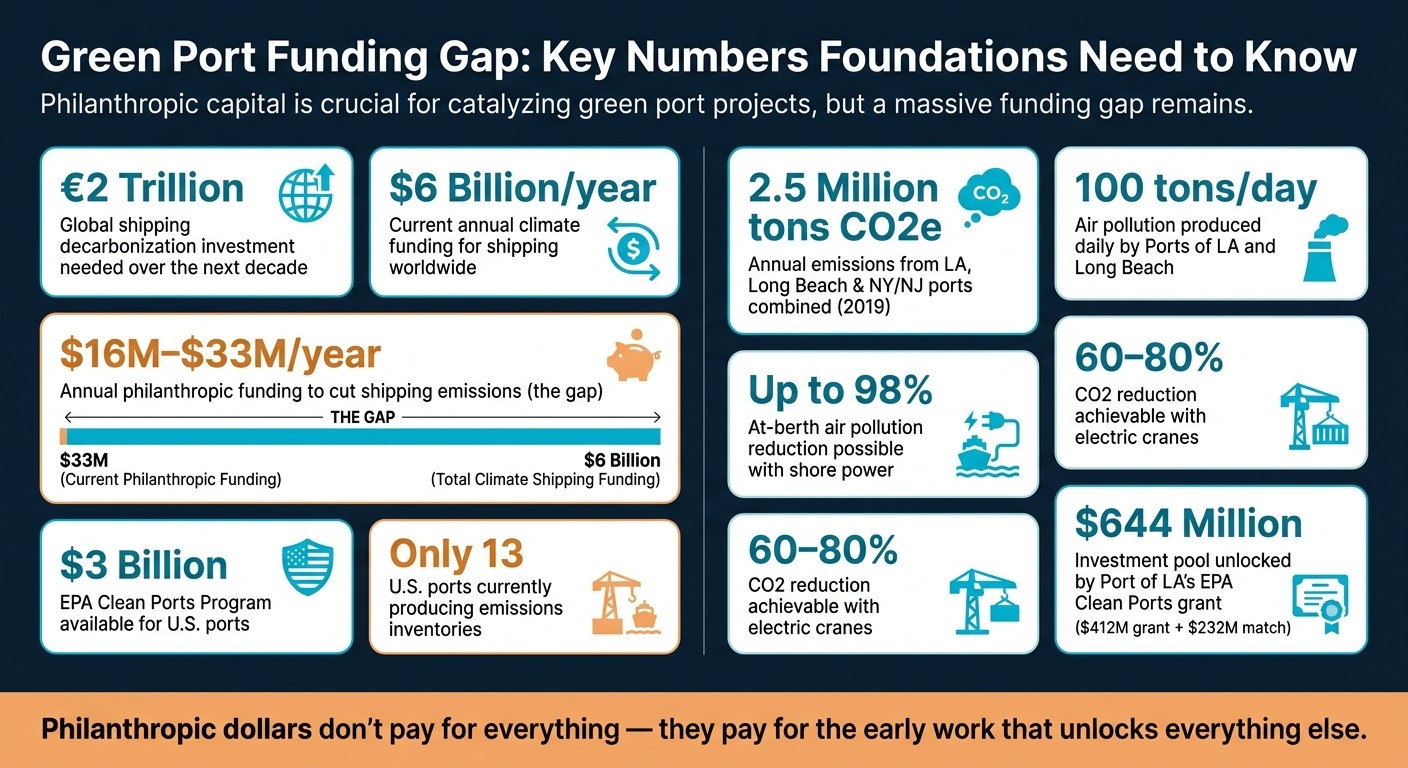
Green Port Funding Gap: Key Numbers Foundations Need to Know
Green Port Progress Report: Operations
Step 1: Identify Where Philanthropy Can Have the Most Influence
Foundations need a clear view of how a port actually works: who controls which assets, where the friction sits, and which gaps have little business upside but clear public value. That kind of map is what separates high-leverage grants from money that gets spent with good intentions and little staying power. From there, the goal is simple: identify who can approve, block, fund, or carry out change.
Map Port Actors, Risks, and Community Priorities
A port is not one entity. It is a web of stakeholders, each with its own incentives and exposure to risk. Map the groups that control land, terminals, cargo equipment, vessels, freight movement, grid access, labor, regulation, and nearby neighborhoods. That includes the low-income communities of color that bear the health burden of diesel pollution every day.
Look for overlap in priorities. The best projects cut emissions, improve public health, create jobs, and help restore ecosystems [2]. Diesel pollution is one of the clearest examples. The Ports of Los Angeles and Long Beach together produce about 100 tons of smog each day, more than the emissions from six million cars in the region [3]. That shared damage gives port authorities, health groups, and residents a common reason to push for action.
Governance shapes what can happen. A landlord port leases terminals to private operators, while an operator port runs terminals itself [1]. That setup, along with utility access and community priorities, affects whether shore power, electrification, or resilience projects can move ahead and who needs a seat at the table.
Match Philanthropic Tools to Project Needs
Once the decision-makers are clear, line up each funding tool with the project stage. Grants work well for early research and advocacy. Technical assistance can support data work and applications. Convening helps build coalitions. Pilot funding can de-risk new ideas. PRIs or blended finance fit projects that are close to commercial use.
Philanthropic Tool | Best Project Match | Risk Level | Primary Outcome |
|---|---|---|---|
Grants | Community health studies, air monitoring, policy advocacy | High | Environmental justice, regulatory shifts |
Technical Assistance | Federal grant applications, emissions modeling | Low | Unlocking public capital |
Convening Power | Green shipping corridors, stakeholder coalitions | Medium | Industry alignment, shared demand signals |
Pilot Funding | Green hydrogen or ammonia fueling infrastructure, electric harbor craft | High | Proof of concept, tech de-risking |
PRIs / Blended Finance | Shore power infrastructure, electric fleets | Medium | Commercial viability, scaled deployment |
Technical assistance is often overlooked, even though it can open the door to much larger funding. Only 13 U.S. ports now produce emissions inventories [3]. Without that baseline, many ports are at a disadvantage when applying for federal programs such as the EPA's $3 billion Clean Ports Program [4]. A grant that pays for this groundwork can help unlock far larger public dollars.
Use an Impact-vs.-Feasibility Screen to Prioritize
After matching tools to needs, sort projects by what they can deliver and how fast they can move. Score each one on impact - emissions reduction potential, community health benefit, and resilience value - and feasibility - project readiness, permitting support, and the chance of drawing public or private co-funding. The strongest near-term picks are the ones that rank high on both. Those are the green infrastructure pilots that move into Step 2.
Cargo handling equipment stands out as a top target. Terminal tractors, cranes, and forklifts use only 15% of total port energy but account for as much as 30% of particulate emissions [2]. That makes them a practical place to start. Electrifying this equipment can happen now, and electric cranes can cut CO2 emissions by 60% to 80% while lowering repair costs by 30% compared with diesel models [3]. By contrast, projects with high upside but low readiness, such as green hydrogen or ammonia fueling infrastructure, make more sense for pilot funding at this stage, with larger commitments held back until the technology is further along.
Step 2: Choose the Right Green Port Infrastructure Investments
After screening for impact and feasibility, foundations should focus on the few infrastructure bets that cut emissions now, strengthen resilience, and have room to grow.
Fund Shore Power and Clean Vessel Connections
Shore power lets ships plug into the grid while they’re at berth instead of running diesel auxiliary engines. That matters because berthed ships are often the single largest source of greenhouse gas emissions at a port [3]. Shore power can also cut local air pollution by up to 98% [3]. Put plainly, shore powering one container ship for one day can reduce pollution as much as taking 33,000 cars off the road for that same day [3].
A smart place to start is with grid-capacity studies and berth-priority analysis, then move into pilot installations that lower risk before a full buildout. The main numbers to watch are kilowatt-hours (kWh) delivered to vessels at berth and tons of CO2 equivalent (CO2e) avoided each year. The public health upside is hard to ignore: California's at-berth regulations are estimated to save $2.3 billion in healthcare costs by preventing premature deaths and hospital visits [3].
Once berth emissions are under control, the next strong move is to electrify cargo equipment and cut truck idling.
Support Zero-Emission Cargo Handling and Low-Carbon Logistics
Battery-electric yard tractors and rubber-tired gantry (RTG) cranes are already cost-competitive with diesel over a 12-year life cycle, especially with federal incentives in the mix [5]. The Georgia Ports Authority saves about $2.2 million per year in fuel costs with electric RTG cranes [3]. That kind of return gives operators something concrete to work with.
Foundations can help by paying for the cost analyses and data systems that let terminal operators and labor groups make clear decisions about where charging infrastructure should go and how daily operations should change. Workforce training matters just as much. Moving port workers from diesel engine maintenance to electric and hydrogen system management takes planning, and vendors rarely cover that gap.
Outside the terminal fence, there’s room to back cleaner drayage corridors through gate optimization systems that reduce truck idling time, along with on-dock rail upgrades that shift more cargo off trucks. Rail moves one ton of freight 477 miles per gallon of fuel, compared with 145 miles by truck [3] - close to a 3.3x efficiency gain spread across thousands of daily port trips.
After terminal operations, attention turns to shoreline defense and district-scale systems that help ports hold up under flood and surge.
Back Coastal Resilience, Nature-Based Protection, and Circular Port Districts
Ports face sea-level rise, storm surge, and flooding. Circular port districts reuse waste heat, materials, and power across nearby facilities to cut emissions and costs. Nature-based infrastructure - living shorelines, restored wetlands, oyster reefs - can outperform concrete seawalls in protecting port assets while also sequestering carbon, improving water quality, and creating habitat [3]. Some ports are even testing low-cost ideas like using oyster shells in stormwater catchment basins to filter heavy metals such as copper from runoff [3].
This is an area where foundations can play a direct role by funding risk assessments and community-led planning. Demonstration projects matter here because nature-based designs usually need site-specific planning and local support before anyone is ready to expand them.
The table below compares the main infrastructure strategies across the factors philanthropic decision-makers tend to weigh most heavily.
Infrastructure Strategy | Climate Benefit | Resilience Benefit | Community Health Value | Capital Intensity | Philanthropic Fit |
|---|---|---|---|---|---|
Shore Power | Very High (up to 98% at-berth reduction) [3] | Low | Very High (reduces smog and cancer risk) | High | Grid studies, berth prioritization, pilot co-funding |
Electric CHE | High | Low | High (reduces noise and particulate matter) | Moderate to High | TCO analysis, workforce training, data systems |
On-Dock Rail & Gate Optimization | High | Low | Moderate (cuts drayage corridor pollution) | High | Idling data systems, logistics planning |
Living Shorelines & Wetlands | Moderate (carbon sequestration) | High (flood and erosion protection) | Moderate (water quality and green space) | Moderate | Risk assessments, demonstration projects, community planning |
A practical mix is one investment with strong health gains, one resilience project, and the data systems needed to measure both. These investments hold up only when governance, agreements, and funding paths keep performance in place over time.
Step 3: Build Partnerships, Governance, and Funding Pathways That Last
After a port picks the right projects, the next job is simpler to say than to do: get the right people, rules, and money lined up so those projects keep working. Infrastructure doesn't last on equipment alone. It lasts when governance, agreements, and funding all point in the same direction. That's how a pilot becomes a program that sticks.
Create a Multi-Stakeholder Port Coalition With Clear Roles
The port projects that hold up over time usually sit inside a coalition. That means port authority leaders, local government, utilities, labor unions, community-based organizations (CBOs), and technical partners all have a seat at the table. Just as important, each group needs clear decision rights and clear accountability. If no one knows who decides what, things drift fast.
The Port of Oakland is a strong example. In December 2024, the port secured $322 million from the EPA Clean Ports Program for a coalition-led project. The coalition includes community partners and aims to make the seaport nearly zero-emissions. [6]
Use the port's governance model to assign decision rights before the coalition launches.
Coalitions create alignment. Formal agreements are what turn that alignment into commitments that last.
Use Agreements That Lock In Community and Environmental Outcomes
Foundations should press for formal structures that keep community and environmental commitments in place for the full life of a project. Good intentions fade. Written terms don't.
Agreement Structure | Enforceability | Community Influence | Speed to Deploy | Common Use Case |
|---|---|---|---|---|
MOU | Low/Medium | Moderate | Fast | Initial alignment between port and utilities or local government |
Community Benefit Agreement (CBA) | High | High | Slow | Large-scale terminal expansions; locking in local hiring and air quality monitoring |
Terminal Lease Agreement | Very High | Low to Moderate | Medium | Mandating shore power and zero-emission equipment for tenants |
Performance-Based Funding | High | Moderate | Medium | Grants tied to specific emission reduction targets |
Green bond covenants | High (investor-driven) | Low | Medium | Financing large-scale electrification with mandatory annual impact reporting |
One shift is already clear: shore power is moving from a voluntary add-on to a contract term in long-term terminal leases. Shipping lines with decarbonization goals are giving preference to terminals that already have the equipment in place. [7] That creates an opening for foundations to push ports to make zero-emission equipment capability a standard term in new leases, not an optional extra.
Community accountability matters just as much as tenant compliance. Foundations can fund air quality monitoring systems that are community-verified and backed by local air districts, so residents have their own way to confirm that promises are being met. [6]
Once those commitments are on paper, the next step is getting enough money behind them.
Connect Philanthropic Dollars to Public Grants and Blended Finance
Philanthropic grants work best when they pay for the early work that opens the door to much larger public funding. The EPA Clean Ports Program provides $3 billion in grants for emissions reduction and climate resilience. [4] But ports usually can't compete for that money without doing the prep work first: emissions inventories, engineering studies, environmental reviews, and resilience assessments. That's often the part with no line item and no easy funding source.
The Port of Los Angeles shows what this can look like in practice. Long-term funding for emissions inventories and modeling helped the port win a $412 million EPA Clean Ports grant in October 2024. With $232 million in matching funds, that produced a $644 million investment pool for zero-emission equipment and trucks. [7]
A practical blended-finance model can split the job across funding sources:
Philanthropic grants cover predevelopment and community-centered pilots
Public grants pay for infrastructure buildout
Private capital supports terminal upgrades that can produce revenue [1]
Some federal programs under the Infrastructure Investment and Jobs Act (IIJA) require 20% to 30% matching funds. Philanthropic dollars can help fill that gap. [8] And that match doesn't just make a project eligible. It also gives foundations a voice in project design and in the community benefit terms set at the start.
Step 4: Measure Results and Align Capital With Long-Term Impact
Once partnerships and funding are in place, measurement is what turns a pilot into a program. When projects move from plan to action, foundations can support the inventories, sensors, and reporting systems that show whether green port investments are doing what they promised.
Set a Scorecard for Climate, Resilience, Health, and Economic Outcomes
Set the scorecard around five outcomes: climate, health, resilience, local economic benefit, and equity.
That means tracking Scope 1–3 greenhouse gas reductions, PM2.5 and NOx, flood protection and restored habitat, local jobs and training, and contracts awarded to minority- and Indigenous-owned businesses.
Build Justice40 into the scorecard from day one. It directs 40% of certain federal benefits to disadvantaged communities [4]. When metrics line up with Justice40, it can be easier to go after the next round of public funding.
Keep the scorecard tight. Focus on metrics that can be measured the same way over time and checked in public.
Fund Baseline Data, Monitoring, and Public Reporting
Data is not overhead - it is how philanthropy de-risks scale and creates the accountability infrastructure that attracts follow-on capital. Many ports still do not have the baseline data needed for accountability. Paying for that baseline work is one of the highest-leverage moves a foundation can make.
Use this monitoring framework across port projects:
Metric Category | Example Metrics | Data Source | Reporting Frequency | Data Ownership |
|---|---|---|---|---|
Climate | CO2e reductions (short tons), Scope 1–3 | Emissions inventories, vessel fuel logs | Annual | Port Authority |
Air Quality | PM2.5, NOx, SOx levels | On-site air quality sensors | Real-time / Monthly | Community / Port |
Resilience | Flood protection level, acres of restored habitat | GIS mapping, resilience diagnostics | Every 2–3 years | Conservation NGO |
Health | Local respiratory ER visits | Public health records | Annual | Municipal Health Dept. |
Economic | Local jobs created, workforce training hours | Payroll data, economic impact studies | Semi-Annual | Terminal Operator |
Equity | % contracts to minority/Indigenous businesses, CBA compliance | Procurement records, legal agreements | Annual | Port Authority / CBOs |
Set data ownership before the grant closes. Public-reporting rights should also be written into the grant terms, not left for later.
Conclusion: Start With High-Leverage Pilots and Build a Measurable Portfolio
The strongest philanthropic portfolios bring together three things: emissions reduction through shore power and zero-emission equipment, resilience through nature-based coastal protection and flood-ready logistics, and community benefit through local hiring, air quality monitoring, and equity in contracting.
Early results matter. They help foundations build a portfolio of bankable, community-backed port investments. That proof is what helps open the door to the next round of public and private capital. Start with one measurable pilot, report results publicly, and scale from evidence.
FAQs
How can a small grant unlock larger port funding?
Small grants can give ports the runway they need to go after much larger funding. They can cover early-stage work like planning, feasibility studies, and community engagement - the kind of prep work that often decides whether a project moves forward or stalls out.
That early support can make a big difference. It helps ports build stronger applications, sharpen measurement frameworks, and work more closely with key stakeholders. In practice, that puts them in a better position to compete for federal programs like the Clean Ports Program and the Port Infrastructure Development Program.
Which green port projects should foundations fund first?
Foundations should put their money behind green port projects that deliver broad public gains, even when the short-term business payoff is limited. That includes zero-emission terminal equipment, shore power, and renewable energy systems like solar arrays and battery storage.
Philanthropic funding can also help open the door to larger public investment. It can support feasibility studies, policy advocacy, stakeholder collaboration, and community-focused projects that improve air quality and advance environmental justice.
How can ports prove community and climate benefits?
Ports can show community and climate gains in ways that stand up to scrutiny. The first step is to set baseline emissions models, track progress over time, and use standard reporting frameworks that include environmental justice metrics. That gives ports a clear before-and-after picture instead of vague claims.
They can also point to results through action on the ground: deploying zero-emission technologies, lining up projects with community-led action plans, pursuing programs like Justice40, and formalizing stakeholder engagement. Done well, this helps document measurable environmental, economic, and social benefits in a way communities, funders, and public agencies can all follow.
Related Blog Posts
Latest Articles
©2025

Narrative Change and Power Building: The Missing Half of Advocacy
Narrative change is the process of disrupting dominant narratives that normalize inequity and advancing new narratives from historically marginalized communities.

Funding Resilience Without Federal Grants
BRIC is unreliable and FEMA is shrinking. Here's how cities fund climate resilience with dedicated revenue, blended finance, and a coordinating authority.

The ESG Blind Spot: How AI Is Finding Risks in Companies Nobody Else Is Watching
Norway's sovereign wealth fund uses AI to screen 7,200 portfolio companies for forced labor and corruption within 24 hours. The real story is the emerging-market coverage gap that traditional ESG data vendors miss — and what it means for any company with a global supply chain.
Narrative Change and Power Building: The Missing Half of Advocacy
Narrative change is the process of disrupting dominant narratives that normalize inequity and advancing new narratives from historically marginalized communities.
Funding Resilience Without Federal Grants
BRIC is unreliable and FEMA is shrinking. Here's how cities fund climate resilience with dedicated revenue, blended finance, and a coordinating authority.
The ESG Blind Spot: How AI Is Finding Risks in Companies Nobody Else Is Watching
Norway's sovereign wealth fund uses AI to screen 7,200 portfolio companies for forced labor and corruption within 24 hours. The real story is the emerging-market coverage gap that traditional ESG data vendors miss — and what it means for any company with a global supply chain.
FAQ
01
What does it really mean to “redefine profit”?
02
What makes Council Fire different?
03
Who does Council Fire work with?
04
What does working with Council Fire actually look like?
05
How does Council Fire help organizations turn big goals into action?
06
How does Council Fire define and measure success?
Jun 19, 2026
How to Design Green Port Infrastructure for the Future for Foundations & Philanthropic Organizations
Sustainability Strategy
In This Article
Practical funding steps for foundations to back planning, pilots, and partnerships that unlock public grants and cut port pollution.
How to Design Green Port Infrastructure for the Future for Foundations & Philanthropic Organizations
U.S. ports need early-stage funding now. In 2019, the ports of Los Angeles, Long Beach, and New York/New Jersey produced more than 2.5 million tons of CO2e, while Los Angeles and Long Beach together create about 100 tons of air pollution per day. For foundations and philanthropic groups, the clearest role is to fund the work that happens before big public or private money shows up.
If I were shaping a green port funding plan, I would keep it simple:
Start with planning gaps like emissions inventories, grid studies, and flood risk work
Back near-term projects such as shore power, electric cargo equipment, and truck idling cuts
Support port-community coalitions so local health, jobs, and accountability stay part of the deal
Use grants to bring in larger funds, including federal programs like the $3 billion EPA Clean Ports Program
Track results in public using data on emissions, air quality, flood risk, jobs, and contracting
The article makes one point clear: the best use of philanthropic money is not to pay for everything. It is to cover the early work that helps ports win larger grants, shape better projects, and avoid locking in years of extra pollution and flood risk.
A few numbers stand out:
Global shipping needs about €2 trillion over the next decade for decarbonization
Current climate funding for shipping is only about $6 billion per year
Foundations give just $16 million to $33 million per year to cut shipping emissions
Only 13 U.S. ports currently produce emissions inventories
Electric cranes can cut CO2 emissions by 60% to 80%
Shore power can cut at-berth air pollution by up to 98%
For me, the smartest path is a short list: fund baseline data, pick a few high-impact pilots, tie them to community terms, and measure outcomes in plain view. That is how a small grant can help move a much larger port project from idea to buildout.
Green Port Funding Gap: Key Numbers Foundations Need to Know
Green Port Progress Report: Operations
Step 1: Identify Where Philanthropy Can Have the Most Influence
Foundations need a clear view of how a port actually works: who controls which assets, where the friction sits, and which gaps have little business upside but clear public value. That kind of map is what separates high-leverage grants from money that gets spent with good intentions and little staying power. From there, the goal is simple: identify who can approve, block, fund, or carry out change.
Map Port Actors, Risks, and Community Priorities
A port is not one entity. It is a web of stakeholders, each with its own incentives and exposure to risk. Map the groups that control land, terminals, cargo equipment, vessels, freight movement, grid access, labor, regulation, and nearby neighborhoods. That includes the low-income communities of color that bear the health burden of diesel pollution every day.
Look for overlap in priorities. The best projects cut emissions, improve public health, create jobs, and help restore ecosystems [2]. Diesel pollution is one of the clearest examples. The Ports of Los Angeles and Long Beach together produce about 100 tons of smog each day, more than the emissions from six million cars in the region [3]. That shared damage gives port authorities, health groups, and residents a common reason to push for action.
Governance shapes what can happen. A landlord port leases terminals to private operators, while an operator port runs terminals itself [1]. That setup, along with utility access and community priorities, affects whether shore power, electrification, or resilience projects can move ahead and who needs a seat at the table.
Match Philanthropic Tools to Project Needs
Once the decision-makers are clear, line up each funding tool with the project stage. Grants work well for early research and advocacy. Technical assistance can support data work and applications. Convening helps build coalitions. Pilot funding can de-risk new ideas. PRIs or blended finance fit projects that are close to commercial use.
Philanthropic Tool | Best Project Match | Risk Level | Primary Outcome |
|---|---|---|---|
Grants | Community health studies, air monitoring, policy advocacy | High | Environmental justice, regulatory shifts |
Technical Assistance | Federal grant applications, emissions modeling | Low | Unlocking public capital |
Convening Power | Green shipping corridors, stakeholder coalitions | Medium | Industry alignment, shared demand signals |
Pilot Funding | Green hydrogen or ammonia fueling infrastructure, electric harbor craft | High | Proof of concept, tech de-risking |
PRIs / Blended Finance | Shore power infrastructure, electric fleets | Medium | Commercial viability, scaled deployment |
Technical assistance is often overlooked, even though it can open the door to much larger funding. Only 13 U.S. ports now produce emissions inventories [3]. Without that baseline, many ports are at a disadvantage when applying for federal programs such as the EPA's $3 billion Clean Ports Program [4]. A grant that pays for this groundwork can help unlock far larger public dollars.
Use an Impact-vs.-Feasibility Screen to Prioritize
After matching tools to needs, sort projects by what they can deliver and how fast they can move. Score each one on impact - emissions reduction potential, community health benefit, and resilience value - and feasibility - project readiness, permitting support, and the chance of drawing public or private co-funding. The strongest near-term picks are the ones that rank high on both. Those are the green infrastructure pilots that move into Step 2.
Cargo handling equipment stands out as a top target. Terminal tractors, cranes, and forklifts use only 15% of total port energy but account for as much as 30% of particulate emissions [2]. That makes them a practical place to start. Electrifying this equipment can happen now, and electric cranes can cut CO2 emissions by 60% to 80% while lowering repair costs by 30% compared with diesel models [3]. By contrast, projects with high upside but low readiness, such as green hydrogen or ammonia fueling infrastructure, make more sense for pilot funding at this stage, with larger commitments held back until the technology is further along.
Step 2: Choose the Right Green Port Infrastructure Investments
After screening for impact and feasibility, foundations should focus on the few infrastructure bets that cut emissions now, strengthen resilience, and have room to grow.
Fund Shore Power and Clean Vessel Connections
Shore power lets ships plug into the grid while they’re at berth instead of running diesel auxiliary engines. That matters because berthed ships are often the single largest source of greenhouse gas emissions at a port [3]. Shore power can also cut local air pollution by up to 98% [3]. Put plainly, shore powering one container ship for one day can reduce pollution as much as taking 33,000 cars off the road for that same day [3].
A smart place to start is with grid-capacity studies and berth-priority analysis, then move into pilot installations that lower risk before a full buildout. The main numbers to watch are kilowatt-hours (kWh) delivered to vessels at berth and tons of CO2 equivalent (CO2e) avoided each year. The public health upside is hard to ignore: California's at-berth regulations are estimated to save $2.3 billion in healthcare costs by preventing premature deaths and hospital visits [3].
Once berth emissions are under control, the next strong move is to electrify cargo equipment and cut truck idling.
Support Zero-Emission Cargo Handling and Low-Carbon Logistics
Battery-electric yard tractors and rubber-tired gantry (RTG) cranes are already cost-competitive with diesel over a 12-year life cycle, especially with federal incentives in the mix [5]. The Georgia Ports Authority saves about $2.2 million per year in fuel costs with electric RTG cranes [3]. That kind of return gives operators something concrete to work with.
Foundations can help by paying for the cost analyses and data systems that let terminal operators and labor groups make clear decisions about where charging infrastructure should go and how daily operations should change. Workforce training matters just as much. Moving port workers from diesel engine maintenance to electric and hydrogen system management takes planning, and vendors rarely cover that gap.
Outside the terminal fence, there’s room to back cleaner drayage corridors through gate optimization systems that reduce truck idling time, along with on-dock rail upgrades that shift more cargo off trucks. Rail moves one ton of freight 477 miles per gallon of fuel, compared with 145 miles by truck [3] - close to a 3.3x efficiency gain spread across thousands of daily port trips.
After terminal operations, attention turns to shoreline defense and district-scale systems that help ports hold up under flood and surge.
Back Coastal Resilience, Nature-Based Protection, and Circular Port Districts
Ports face sea-level rise, storm surge, and flooding. Circular port districts reuse waste heat, materials, and power across nearby facilities to cut emissions and costs. Nature-based infrastructure - living shorelines, restored wetlands, oyster reefs - can outperform concrete seawalls in protecting port assets while also sequestering carbon, improving water quality, and creating habitat [3]. Some ports are even testing low-cost ideas like using oyster shells in stormwater catchment basins to filter heavy metals such as copper from runoff [3].
This is an area where foundations can play a direct role by funding risk assessments and community-led planning. Demonstration projects matter here because nature-based designs usually need site-specific planning and local support before anyone is ready to expand them.
The table below compares the main infrastructure strategies across the factors philanthropic decision-makers tend to weigh most heavily.
Infrastructure Strategy | Climate Benefit | Resilience Benefit | Community Health Value | Capital Intensity | Philanthropic Fit |
|---|---|---|---|---|---|
Shore Power | Very High (up to 98% at-berth reduction) [3] | Low | Very High (reduces smog and cancer risk) | High | Grid studies, berth prioritization, pilot co-funding |
Electric CHE | High | Low | High (reduces noise and particulate matter) | Moderate to High | TCO analysis, workforce training, data systems |
On-Dock Rail & Gate Optimization | High | Low | Moderate (cuts drayage corridor pollution) | High | Idling data systems, logistics planning |
Living Shorelines & Wetlands | Moderate (carbon sequestration) | High (flood and erosion protection) | Moderate (water quality and green space) | Moderate | Risk assessments, demonstration projects, community planning |
A practical mix is one investment with strong health gains, one resilience project, and the data systems needed to measure both. These investments hold up only when governance, agreements, and funding paths keep performance in place over time.
Step 3: Build Partnerships, Governance, and Funding Pathways That Last
After a port picks the right projects, the next job is simpler to say than to do: get the right people, rules, and money lined up so those projects keep working. Infrastructure doesn't last on equipment alone. It lasts when governance, agreements, and funding all point in the same direction. That's how a pilot becomes a program that sticks.
Create a Multi-Stakeholder Port Coalition With Clear Roles
The port projects that hold up over time usually sit inside a coalition. That means port authority leaders, local government, utilities, labor unions, community-based organizations (CBOs), and technical partners all have a seat at the table. Just as important, each group needs clear decision rights and clear accountability. If no one knows who decides what, things drift fast.
The Port of Oakland is a strong example. In December 2024, the port secured $322 million from the EPA Clean Ports Program for a coalition-led project. The coalition includes community partners and aims to make the seaport nearly zero-emissions. [6]
Use the port's governance model to assign decision rights before the coalition launches.
Coalitions create alignment. Formal agreements are what turn that alignment into commitments that last.
Use Agreements That Lock In Community and Environmental Outcomes
Foundations should press for formal structures that keep community and environmental commitments in place for the full life of a project. Good intentions fade. Written terms don't.
Agreement Structure | Enforceability | Community Influence | Speed to Deploy | Common Use Case |
|---|---|---|---|---|
MOU | Low/Medium | Moderate | Fast | Initial alignment between port and utilities or local government |
Community Benefit Agreement (CBA) | High | High | Slow | Large-scale terminal expansions; locking in local hiring and air quality monitoring |
Terminal Lease Agreement | Very High | Low to Moderate | Medium | Mandating shore power and zero-emission equipment for tenants |
Performance-Based Funding | High | Moderate | Medium | Grants tied to specific emission reduction targets |
Green bond covenants | High (investor-driven) | Low | Medium | Financing large-scale electrification with mandatory annual impact reporting |
One shift is already clear: shore power is moving from a voluntary add-on to a contract term in long-term terminal leases. Shipping lines with decarbonization goals are giving preference to terminals that already have the equipment in place. [7] That creates an opening for foundations to push ports to make zero-emission equipment capability a standard term in new leases, not an optional extra.
Community accountability matters just as much as tenant compliance. Foundations can fund air quality monitoring systems that are community-verified and backed by local air districts, so residents have their own way to confirm that promises are being met. [6]
Once those commitments are on paper, the next step is getting enough money behind them.
Connect Philanthropic Dollars to Public Grants and Blended Finance
Philanthropic grants work best when they pay for the early work that opens the door to much larger public funding. The EPA Clean Ports Program provides $3 billion in grants for emissions reduction and climate resilience. [4] But ports usually can't compete for that money without doing the prep work first: emissions inventories, engineering studies, environmental reviews, and resilience assessments. That's often the part with no line item and no easy funding source.
The Port of Los Angeles shows what this can look like in practice. Long-term funding for emissions inventories and modeling helped the port win a $412 million EPA Clean Ports grant in October 2024. With $232 million in matching funds, that produced a $644 million investment pool for zero-emission equipment and trucks. [7]
A practical blended-finance model can split the job across funding sources:
Philanthropic grants cover predevelopment and community-centered pilots
Public grants pay for infrastructure buildout
Private capital supports terminal upgrades that can produce revenue [1]
Some federal programs under the Infrastructure Investment and Jobs Act (IIJA) require 20% to 30% matching funds. Philanthropic dollars can help fill that gap. [8] And that match doesn't just make a project eligible. It also gives foundations a voice in project design and in the community benefit terms set at the start.
Step 4: Measure Results and Align Capital With Long-Term Impact
Once partnerships and funding are in place, measurement is what turns a pilot into a program. When projects move from plan to action, foundations can support the inventories, sensors, and reporting systems that show whether green port investments are doing what they promised.
Set a Scorecard for Climate, Resilience, Health, and Economic Outcomes
Set the scorecard around five outcomes: climate, health, resilience, local economic benefit, and equity.
That means tracking Scope 1–3 greenhouse gas reductions, PM2.5 and NOx, flood protection and restored habitat, local jobs and training, and contracts awarded to minority- and Indigenous-owned businesses.
Build Justice40 into the scorecard from day one. It directs 40% of certain federal benefits to disadvantaged communities [4]. When metrics line up with Justice40, it can be easier to go after the next round of public funding.
Keep the scorecard tight. Focus on metrics that can be measured the same way over time and checked in public.
Fund Baseline Data, Monitoring, and Public Reporting
Data is not overhead - it is how philanthropy de-risks scale and creates the accountability infrastructure that attracts follow-on capital. Many ports still do not have the baseline data needed for accountability. Paying for that baseline work is one of the highest-leverage moves a foundation can make.
Use this monitoring framework across port projects:
Metric Category | Example Metrics | Data Source | Reporting Frequency | Data Ownership |
|---|---|---|---|---|
Climate | CO2e reductions (short tons), Scope 1–3 | Emissions inventories, vessel fuel logs | Annual | Port Authority |
Air Quality | PM2.5, NOx, SOx levels | On-site air quality sensors | Real-time / Monthly | Community / Port |
Resilience | Flood protection level, acres of restored habitat | GIS mapping, resilience diagnostics | Every 2–3 years | Conservation NGO |
Health | Local respiratory ER visits | Public health records | Annual | Municipal Health Dept. |
Economic | Local jobs created, workforce training hours | Payroll data, economic impact studies | Semi-Annual | Terminal Operator |
Equity | % contracts to minority/Indigenous businesses, CBA compliance | Procurement records, legal agreements | Annual | Port Authority / CBOs |
Set data ownership before the grant closes. Public-reporting rights should also be written into the grant terms, not left for later.
Conclusion: Start With High-Leverage Pilots and Build a Measurable Portfolio
The strongest philanthropic portfolios bring together three things: emissions reduction through shore power and zero-emission equipment, resilience through nature-based coastal protection and flood-ready logistics, and community benefit through local hiring, air quality monitoring, and equity in contracting.
Early results matter. They help foundations build a portfolio of bankable, community-backed port investments. That proof is what helps open the door to the next round of public and private capital. Start with one measurable pilot, report results publicly, and scale from evidence.
FAQs
How can a small grant unlock larger port funding?
Small grants can give ports the runway they need to go after much larger funding. They can cover early-stage work like planning, feasibility studies, and community engagement - the kind of prep work that often decides whether a project moves forward or stalls out.
That early support can make a big difference. It helps ports build stronger applications, sharpen measurement frameworks, and work more closely with key stakeholders. In practice, that puts them in a better position to compete for federal programs like the Clean Ports Program and the Port Infrastructure Development Program.
Which green port projects should foundations fund first?
Foundations should put their money behind green port projects that deliver broad public gains, even when the short-term business payoff is limited. That includes zero-emission terminal equipment, shore power, and renewable energy systems like solar arrays and battery storage.
Philanthropic funding can also help open the door to larger public investment. It can support feasibility studies, policy advocacy, stakeholder collaboration, and community-focused projects that improve air quality and advance environmental justice.
How can ports prove community and climate benefits?
Ports can show community and climate gains in ways that stand up to scrutiny. The first step is to set baseline emissions models, track progress over time, and use standard reporting frameworks that include environmental justice metrics. That gives ports a clear before-and-after picture instead of vague claims.
They can also point to results through action on the ground: deploying zero-emission technologies, lining up projects with community-led action plans, pursuing programs like Justice40, and formalizing stakeholder engagement. Done well, this helps document measurable environmental, economic, and social benefits in a way communities, funders, and public agencies can all follow.
Related Blog Posts
Latest Articles
©2025
Narrative Change and Power Building: The Missing Half of Advocacy
Narrative change is the process of disrupting dominant narratives that normalize inequity and advancing new narratives from historically marginalized communities.
Funding Resilience Without Federal Grants
BRIC is unreliable and FEMA is shrinking. Here's how cities fund climate resilience with dedicated revenue, blended finance, and a coordinating authority.
The ESG Blind Spot: How AI Is Finding Risks in Companies Nobody Else Is Watching
Norway's sovereign wealth fund uses AI to screen 7,200 portfolio companies for forced labor and corruption within 24 hours. The real story is the emerging-market coverage gap that traditional ESG data vendors miss — and what it means for any company with a global supply chain.
FAQ
01
What does it really mean to “redefine profit”?
02
What makes Council Fire different?
03
Who does Council Fire work with?
04
What does working with Council Fire actually look like?
05
How does Council Fire help organizations turn big goals into action?
06
How does Council Fire define and measure success?
Jun 19, 2026
How to Design Green Port Infrastructure for the Future for Foundations & Philanthropic Organizations
Sustainability Strategy
In This Article
Practical funding steps for foundations to back planning, pilots, and partnerships that unlock public grants and cut port pollution.
How to Design Green Port Infrastructure for the Future for Foundations & Philanthropic Organizations
U.S. ports need early-stage funding now. In 2019, the ports of Los Angeles, Long Beach, and New York/New Jersey produced more than 2.5 million tons of CO2e, while Los Angeles and Long Beach together create about 100 tons of air pollution per day. For foundations and philanthropic groups, the clearest role is to fund the work that happens before big public or private money shows up.
If I were shaping a green port funding plan, I would keep it simple:
Start with planning gaps like emissions inventories, grid studies, and flood risk work
Back near-term projects such as shore power, electric cargo equipment, and truck idling cuts
Support port-community coalitions so local health, jobs, and accountability stay part of the deal
Use grants to bring in larger funds, including federal programs like the $3 billion EPA Clean Ports Program
Track results in public using data on emissions, air quality, flood risk, jobs, and contracting
The article makes one point clear: the best use of philanthropic money is not to pay for everything. It is to cover the early work that helps ports win larger grants, shape better projects, and avoid locking in years of extra pollution and flood risk.
A few numbers stand out:
Global shipping needs about €2 trillion over the next decade for decarbonization
Current climate funding for shipping is only about $6 billion per year
Foundations give just $16 million to $33 million per year to cut shipping emissions
Only 13 U.S. ports currently produce emissions inventories
Electric cranes can cut CO2 emissions by 60% to 80%
Shore power can cut at-berth air pollution by up to 98%
For me, the smartest path is a short list: fund baseline data, pick a few high-impact pilots, tie them to community terms, and measure outcomes in plain view. That is how a small grant can help move a much larger port project from idea to buildout.
Green Port Funding Gap: Key Numbers Foundations Need to Know
Green Port Progress Report: Operations
Step 1: Identify Where Philanthropy Can Have the Most Influence
Foundations need a clear view of how a port actually works: who controls which assets, where the friction sits, and which gaps have little business upside but clear public value. That kind of map is what separates high-leverage grants from money that gets spent with good intentions and little staying power. From there, the goal is simple: identify who can approve, block, fund, or carry out change.
Map Port Actors, Risks, and Community Priorities
A port is not one entity. It is a web of stakeholders, each with its own incentives and exposure to risk. Map the groups that control land, terminals, cargo equipment, vessels, freight movement, grid access, labor, regulation, and nearby neighborhoods. That includes the low-income communities of color that bear the health burden of diesel pollution every day.
Look for overlap in priorities. The best projects cut emissions, improve public health, create jobs, and help restore ecosystems [2]. Diesel pollution is one of the clearest examples. The Ports of Los Angeles and Long Beach together produce about 100 tons of smog each day, more than the emissions from six million cars in the region [3]. That shared damage gives port authorities, health groups, and residents a common reason to push for action.
Governance shapes what can happen. A landlord port leases terminals to private operators, while an operator port runs terminals itself [1]. That setup, along with utility access and community priorities, affects whether shore power, electrification, or resilience projects can move ahead and who needs a seat at the table.
Match Philanthropic Tools to Project Needs
Once the decision-makers are clear, line up each funding tool with the project stage. Grants work well for early research and advocacy. Technical assistance can support data work and applications. Convening helps build coalitions. Pilot funding can de-risk new ideas. PRIs or blended finance fit projects that are close to commercial use.
Philanthropic Tool | Best Project Match | Risk Level | Primary Outcome |
|---|---|---|---|
Grants | Community health studies, air monitoring, policy advocacy | High | Environmental justice, regulatory shifts |
Technical Assistance | Federal grant applications, emissions modeling | Low | Unlocking public capital |
Convening Power | Green shipping corridors, stakeholder coalitions | Medium | Industry alignment, shared demand signals |
Pilot Funding | Green hydrogen or ammonia fueling infrastructure, electric harbor craft | High | Proof of concept, tech de-risking |
PRIs / Blended Finance | Shore power infrastructure, electric fleets | Medium | Commercial viability, scaled deployment |
Technical assistance is often overlooked, even though it can open the door to much larger funding. Only 13 U.S. ports now produce emissions inventories [3]. Without that baseline, many ports are at a disadvantage when applying for federal programs such as the EPA's $3 billion Clean Ports Program [4]. A grant that pays for this groundwork can help unlock far larger public dollars.
Use an Impact-vs.-Feasibility Screen to Prioritize
After matching tools to needs, sort projects by what they can deliver and how fast they can move. Score each one on impact - emissions reduction potential, community health benefit, and resilience value - and feasibility - project readiness, permitting support, and the chance of drawing public or private co-funding. The strongest near-term picks are the ones that rank high on both. Those are the green infrastructure pilots that move into Step 2.
Cargo handling equipment stands out as a top target. Terminal tractors, cranes, and forklifts use only 15% of total port energy but account for as much as 30% of particulate emissions [2]. That makes them a practical place to start. Electrifying this equipment can happen now, and electric cranes can cut CO2 emissions by 60% to 80% while lowering repair costs by 30% compared with diesel models [3]. By contrast, projects with high upside but low readiness, such as green hydrogen or ammonia fueling infrastructure, make more sense for pilot funding at this stage, with larger commitments held back until the technology is further along.
Step 2: Choose the Right Green Port Infrastructure Investments
After screening for impact and feasibility, foundations should focus on the few infrastructure bets that cut emissions now, strengthen resilience, and have room to grow.
Fund Shore Power and Clean Vessel Connections
Shore power lets ships plug into the grid while they’re at berth instead of running diesel auxiliary engines. That matters because berthed ships are often the single largest source of greenhouse gas emissions at a port [3]. Shore power can also cut local air pollution by up to 98% [3]. Put plainly, shore powering one container ship for one day can reduce pollution as much as taking 33,000 cars off the road for that same day [3].
A smart place to start is with grid-capacity studies and berth-priority analysis, then move into pilot installations that lower risk before a full buildout. The main numbers to watch are kilowatt-hours (kWh) delivered to vessels at berth and tons of CO2 equivalent (CO2e) avoided each year. The public health upside is hard to ignore: California's at-berth regulations are estimated to save $2.3 billion in healthcare costs by preventing premature deaths and hospital visits [3].
Once berth emissions are under control, the next strong move is to electrify cargo equipment and cut truck idling.
Support Zero-Emission Cargo Handling and Low-Carbon Logistics
Battery-electric yard tractors and rubber-tired gantry (RTG) cranes are already cost-competitive with diesel over a 12-year life cycle, especially with federal incentives in the mix [5]. The Georgia Ports Authority saves about $2.2 million per year in fuel costs with electric RTG cranes [3]. That kind of return gives operators something concrete to work with.
Foundations can help by paying for the cost analyses and data systems that let terminal operators and labor groups make clear decisions about where charging infrastructure should go and how daily operations should change. Workforce training matters just as much. Moving port workers from diesel engine maintenance to electric and hydrogen system management takes planning, and vendors rarely cover that gap.
Outside the terminal fence, there’s room to back cleaner drayage corridors through gate optimization systems that reduce truck idling time, along with on-dock rail upgrades that shift more cargo off trucks. Rail moves one ton of freight 477 miles per gallon of fuel, compared with 145 miles by truck [3] - close to a 3.3x efficiency gain spread across thousands of daily port trips.
After terminal operations, attention turns to shoreline defense and district-scale systems that help ports hold up under flood and surge.
Back Coastal Resilience, Nature-Based Protection, and Circular Port Districts
Ports face sea-level rise, storm surge, and flooding. Circular port districts reuse waste heat, materials, and power across nearby facilities to cut emissions and costs. Nature-based infrastructure - living shorelines, restored wetlands, oyster reefs - can outperform concrete seawalls in protecting port assets while also sequestering carbon, improving water quality, and creating habitat [3]. Some ports are even testing low-cost ideas like using oyster shells in stormwater catchment basins to filter heavy metals such as copper from runoff [3].
This is an area where foundations can play a direct role by funding risk assessments and community-led planning. Demonstration projects matter here because nature-based designs usually need site-specific planning and local support before anyone is ready to expand them.
The table below compares the main infrastructure strategies across the factors philanthropic decision-makers tend to weigh most heavily.
Infrastructure Strategy | Climate Benefit | Resilience Benefit | Community Health Value | Capital Intensity | Philanthropic Fit |
|---|---|---|---|---|---|
Shore Power | Very High (up to 98% at-berth reduction) [3] | Low | Very High (reduces smog and cancer risk) | High | Grid studies, berth prioritization, pilot co-funding |
Electric CHE | High | Low | High (reduces noise and particulate matter) | Moderate to High | TCO analysis, workforce training, data systems |
On-Dock Rail & Gate Optimization | High | Low | Moderate (cuts drayage corridor pollution) | High | Idling data systems, logistics planning |
Living Shorelines & Wetlands | Moderate (carbon sequestration) | High (flood and erosion protection) | Moderate (water quality and green space) | Moderate | Risk assessments, demonstration projects, community planning |
A practical mix is one investment with strong health gains, one resilience project, and the data systems needed to measure both. These investments hold up only when governance, agreements, and funding paths keep performance in place over time.
Step 3: Build Partnerships, Governance, and Funding Pathways That Last
After a port picks the right projects, the next job is simpler to say than to do: get the right people, rules, and money lined up so those projects keep working. Infrastructure doesn't last on equipment alone. It lasts when governance, agreements, and funding all point in the same direction. That's how a pilot becomes a program that sticks.
Create a Multi-Stakeholder Port Coalition With Clear Roles
The port projects that hold up over time usually sit inside a coalition. That means port authority leaders, local government, utilities, labor unions, community-based organizations (CBOs), and technical partners all have a seat at the table. Just as important, each group needs clear decision rights and clear accountability. If no one knows who decides what, things drift fast.
The Port of Oakland is a strong example. In December 2024, the port secured $322 million from the EPA Clean Ports Program for a coalition-led project. The coalition includes community partners and aims to make the seaport nearly zero-emissions. [6]
Use the port's governance model to assign decision rights before the coalition launches.
Coalitions create alignment. Formal agreements are what turn that alignment into commitments that last.
Use Agreements That Lock In Community and Environmental Outcomes
Foundations should press for formal structures that keep community and environmental commitments in place for the full life of a project. Good intentions fade. Written terms don't.
Agreement Structure | Enforceability | Community Influence | Speed to Deploy | Common Use Case |
|---|---|---|---|---|
MOU | Low/Medium | Moderate | Fast | Initial alignment between port and utilities or local government |
Community Benefit Agreement (CBA) | High | High | Slow | Large-scale terminal expansions; locking in local hiring and air quality monitoring |
Terminal Lease Agreement | Very High | Low to Moderate | Medium | Mandating shore power and zero-emission equipment for tenants |
Performance-Based Funding | High | Moderate | Medium | Grants tied to specific emission reduction targets |
Green bond covenants | High (investor-driven) | Low | Medium | Financing large-scale electrification with mandatory annual impact reporting |
One shift is already clear: shore power is moving from a voluntary add-on to a contract term in long-term terminal leases. Shipping lines with decarbonization goals are giving preference to terminals that already have the equipment in place. [7] That creates an opening for foundations to push ports to make zero-emission equipment capability a standard term in new leases, not an optional extra.
Community accountability matters just as much as tenant compliance. Foundations can fund air quality monitoring systems that are community-verified and backed by local air districts, so residents have their own way to confirm that promises are being met. [6]
Once those commitments are on paper, the next step is getting enough money behind them.
Connect Philanthropic Dollars to Public Grants and Blended Finance
Philanthropic grants work best when they pay for the early work that opens the door to much larger public funding. The EPA Clean Ports Program provides $3 billion in grants for emissions reduction and climate resilience. [4] But ports usually can't compete for that money without doing the prep work first: emissions inventories, engineering studies, environmental reviews, and resilience assessments. That's often the part with no line item and no easy funding source.
The Port of Los Angeles shows what this can look like in practice. Long-term funding for emissions inventories and modeling helped the port win a $412 million EPA Clean Ports grant in October 2024. With $232 million in matching funds, that produced a $644 million investment pool for zero-emission equipment and trucks. [7]
A practical blended-finance model can split the job across funding sources:
Philanthropic grants cover predevelopment and community-centered pilots
Public grants pay for infrastructure buildout
Private capital supports terminal upgrades that can produce revenue [1]
Some federal programs under the Infrastructure Investment and Jobs Act (IIJA) require 20% to 30% matching funds. Philanthropic dollars can help fill that gap. [8] And that match doesn't just make a project eligible. It also gives foundations a voice in project design and in the community benefit terms set at the start.
Step 4: Measure Results and Align Capital With Long-Term Impact
Once partnerships and funding are in place, measurement is what turns a pilot into a program. When projects move from plan to action, foundations can support the inventories, sensors, and reporting systems that show whether green port investments are doing what they promised.
Set a Scorecard for Climate, Resilience, Health, and Economic Outcomes
Set the scorecard around five outcomes: climate, health, resilience, local economic benefit, and equity.
That means tracking Scope 1–3 greenhouse gas reductions, PM2.5 and NOx, flood protection and restored habitat, local jobs and training, and contracts awarded to minority- and Indigenous-owned businesses.
Build Justice40 into the scorecard from day one. It directs 40% of certain federal benefits to disadvantaged communities [4]. When metrics line up with Justice40, it can be easier to go after the next round of public funding.
Keep the scorecard tight. Focus on metrics that can be measured the same way over time and checked in public.
Fund Baseline Data, Monitoring, and Public Reporting
Data is not overhead - it is how philanthropy de-risks scale and creates the accountability infrastructure that attracts follow-on capital. Many ports still do not have the baseline data needed for accountability. Paying for that baseline work is one of the highest-leverage moves a foundation can make.
Use this monitoring framework across port projects:
Metric Category | Example Metrics | Data Source | Reporting Frequency | Data Ownership |
|---|---|---|---|---|
Climate | CO2e reductions (short tons), Scope 1–3 | Emissions inventories, vessel fuel logs | Annual | Port Authority |
Air Quality | PM2.5, NOx, SOx levels | On-site air quality sensors | Real-time / Monthly | Community / Port |
Resilience | Flood protection level, acres of restored habitat | GIS mapping, resilience diagnostics | Every 2–3 years | Conservation NGO |
Health | Local respiratory ER visits | Public health records | Annual | Municipal Health Dept. |
Economic | Local jobs created, workforce training hours | Payroll data, economic impact studies | Semi-Annual | Terminal Operator |
Equity | % contracts to minority/Indigenous businesses, CBA compliance | Procurement records, legal agreements | Annual | Port Authority / CBOs |
Set data ownership before the grant closes. Public-reporting rights should also be written into the grant terms, not left for later.
Conclusion: Start With High-Leverage Pilots and Build a Measurable Portfolio
The strongest philanthropic portfolios bring together three things: emissions reduction through shore power and zero-emission equipment, resilience through nature-based coastal protection and flood-ready logistics, and community benefit through local hiring, air quality monitoring, and equity in contracting.
Early results matter. They help foundations build a portfolio of bankable, community-backed port investments. That proof is what helps open the door to the next round of public and private capital. Start with one measurable pilot, report results publicly, and scale from evidence.
FAQs
How can a small grant unlock larger port funding?
Small grants can give ports the runway they need to go after much larger funding. They can cover early-stage work like planning, feasibility studies, and community engagement - the kind of prep work that often decides whether a project moves forward or stalls out.
That early support can make a big difference. It helps ports build stronger applications, sharpen measurement frameworks, and work more closely with key stakeholders. In practice, that puts them in a better position to compete for federal programs like the Clean Ports Program and the Port Infrastructure Development Program.
Which green port projects should foundations fund first?
Foundations should put their money behind green port projects that deliver broad public gains, even when the short-term business payoff is limited. That includes zero-emission terminal equipment, shore power, and renewable energy systems like solar arrays and battery storage.
Philanthropic funding can also help open the door to larger public investment. It can support feasibility studies, policy advocacy, stakeholder collaboration, and community-focused projects that improve air quality and advance environmental justice.
How can ports prove community and climate benefits?
Ports can show community and climate gains in ways that stand up to scrutiny. The first step is to set baseline emissions models, track progress over time, and use standard reporting frameworks that include environmental justice metrics. That gives ports a clear before-and-after picture instead of vague claims.
They can also point to results through action on the ground: deploying zero-emission technologies, lining up projects with community-led action plans, pursuing programs like Justice40, and formalizing stakeholder engagement. Done well, this helps document measurable environmental, economic, and social benefits in a way communities, funders, and public agencies can all follow.
Related Blog Posts
Latest Articles
©2025
Narrative Change and Power Building: The Missing Half of Advocacy
Narrative change is the process of disrupting dominant narratives that normalize inequity and advancing new narratives from historically marginalized communities.
Funding Resilience Without Federal Grants
BRIC is unreliable and FEMA is shrinking. Here's how cities fund climate resilience with dedicated revenue, blended finance, and a coordinating authority.
The ESG Blind Spot: How AI Is Finding Risks in Companies Nobody Else Is Watching
Norway's sovereign wealth fund uses AI to screen 7,200 portfolio companies for forced labor and corruption within 24 hours. The real story is the emerging-market coverage gap that traditional ESG data vendors miss — and what it means for any company with a global supply chain.
FAQ
What does it really mean to “redefine profit”?
What makes Council Fire different?
Who does Council Fire work with?
What does working with Council Fire actually look like?
How does Council Fire help organizations turn big goals into action?
How does Council Fire define and measure success?