
Aug 10, 2026
Community Energy Engagement Guide for Project Teams
Sustainability Strategy
In This Article
Framework for project teams to plan early stakeholder mapping, consent, benefit-sharing, accessible outreach, and long-term governance.
Community Energy Engagement Guide for Project Teams
Poor public engagement can stall or stop an energy project fast: one study found 34% of opposed projects saw major delays, 49% were canceled, and 26% had to restart, with nearly 4,600 MW affected. If I’m running a community energy project, I need a clear plan for who to involve, when to involve them, what decisions they can shape, and how I will track promises over time.
Here’s the core of it in plain terms:
Start early. Engagement begins before design choices are locked.
Know the stakeholders. Residents, landowners, Tribes, utilities, local officials, schools, and community groups all want different things.
Match the method to the decision. A site choice, rate issue, or land-use change needs more than a generic public meeting.
Be clear about consent. Say what is fixed, what can change, and where approval is needed.
Put benefits in writing. If the project promises bill credits, local jobs, or a $50,000 per year community fund, document it before construction starts.
Remove access barriers. Translation, childcare, transit help, ADA access, and plain-language materials matter.
Show what changed. After each meeting, publish a short summary and a response log within 10 business days.
Keep review in place for the life of the project. Track complaints, attendance, and whether commitments are delivered on time.
I’d sum up the article this way: community energy engagement works best when it is treated like project delivery, not public relations. That means clear roles, a set budget, written commitments, and regular review from planning through decommissioning.
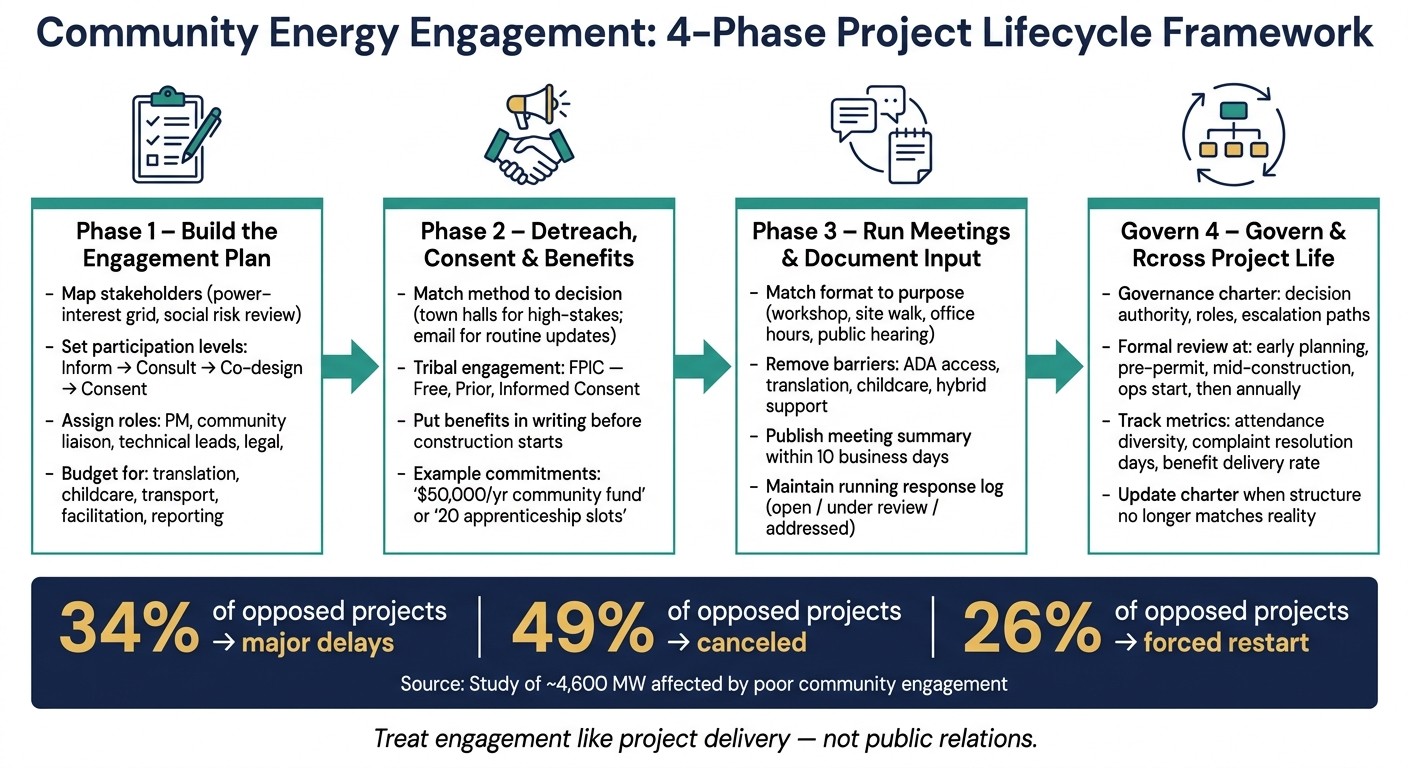
Community Energy Engagement: 4-Phase Project Lifecycle Framework
Community Engagement - An overview for Community Energy Ambassadors
1. Build the engagement plan before outreach starts
An engagement plan is a project management document, not just a communications calendar. It should link each engagement activity to a project decision across scoping, siting and design, permitting, construction, operations, and decommissioning. When outreach starts only after key decisions are already locked in, people notice - and trust slips fast.
Map stakeholders by influence, impact, and trust needs
Start the stakeholder register with zoning records, demographic data, EJ screening tools, community organizations, and Tribal contacts. Then pressure-test it through key informant interviews before holding any public meeting. That early check can save a lot of pain later.
Once the register is in place, use a mapping method to decide where attention should go first:
Method | Best use |
|---|---|
Power–interest grid | Early prioritization |
Influence–impact matrix | Balancing power and vulnerability |
Social risk review | Anticipating conflict and EJ concerns |
Ecosystem mapping | Understanding networks and trust channels |
In sensitive or mixed-context settings, use at least two methods. In most cases, that means a power–interest grid paired with a social risk review. The register should shape who gets contacted, when they hear from the team, and which decision they are being asked to weigh in on.
Set engagement goals and decision rules for each project phase
Be plain about the level of participation in each phase: inform, consult, co-design, or consent. Say what is fixed. Say what can still change. Mark the phases where consent is required.
That clarity matters. People can handle limits better than vagueness. Once the plan shows who is involved, what they can shape, and what is already set, outreach can begin on solid ground.
Assign internal roles and budget for follow-through
Set clear ownership across the team: project manager, community liaison, technical leads, legal/permitting lead, and communications support. Tie each role to project milestones so engagement stays part of delivery rather than getting pushed off to the side as a messaging task.
The budget needs to cover the basics that often get skipped until it's too late:
Venue access
Translation and interpretation
Childcare
Transportation
Facilitation
Note-taking and reporting
Printing
Web updates
Also name a documentation lead, set standard templates, and put a clear escalation path in place before outreach begins. When the team knows how issues get logged, routed, and answered, the outreach and response process runs with far less friction.
The next step is to match outreach methods, consent practices, and benefit-sharing to the decisions at hand.
2. Design outreach, consent, and benefit-sharing processes
The next step is simple in concept but easy to get wrong: match outreach, consent, and benefits to the decision in front of you.
Choose outreach methods that fit the decision at hand
Not every decision calls for a town hall, and not every update needs a mailed notice. The format should match the stakes, the people affected, and the level of back-and-forth the moment calls for.
For high-stakes decisions - site selection, land use changes, and rate impacts - use formats that give people room to ask direct questions and challenge what’s on the table. Public meetings, focus groups, and small-group workshops work well here. For routine updates, like construction schedules or maintenance windows, email and social media are usually enough. One-on-one conversations are often the best fit for people with specific concerns or strong influence, such as adjacent landowners, local elected officials, and Tribal leaders.
In rural areas or environmental justice communities, digital outreach often misses people for plain, practical reasons. Internet access may be limited. Trust in outside developers may be low. In those places, local radio, faith-based bulletins, and outreach led by community-based organizations can go much farther than a polished email campaign.
Outreach Method | Typical Use Case | Strengths | Access Considerations | Limitations |
|---|---|---|---|---|
Public meetings | Permitting hearings, formal presentations | Visible transparency, official record | ADA-accessible venues, translation, childcare, avoid work hours | Can be dominated by a few voices; intimidating for some residents |
One-on-one conversations | Adjacent neighbors, Tribal leaders, local officials | Builds trust, surfaces sensitive concerns | Offer in-person, phone, or video at stakeholder's convenience | Time-intensive; can appear exclusionary if not explained openly |
Focus groups | Renters, small businesses, low-income households | Richer qualitative insight, structured feedback | Provide stipends, transportation, food; recruit through trusted intermediaries | Not statistically representative; requires skilled facilitation |
Partner-led outreach | Marginalized or low-trust communities | Leverages existing networks and credibility | Compensate partners fairly; involve them early in planning | Requires time to build agreements; risk of overburdening local organizations |
Social media and email | Broad updates, meeting reminders, quick polls | Low cost, fast, scalable | Must be mobile-friendly and available in key local languages | Shallow engagement; misses residents without internet access |
Local radio and mailed notices | Rural or low-broadband areas, legally required notices | Reaches people offline; satisfies statutory requirements | Use plain language; put key details on the first page | Limited space for detail; no guaranteed comprehension or response |
Drop-in hours | Early scoping and permitting phases | Informal, low-pressure, accessible | Hold at libraries or community centers at convenient times | Lower attendance than structured events; harder to document systematically |
Across all channels, keep the message plain and consistent. A flyer, FAQ, short video, or infographic should all explain the project’s purpose in one or two sentences and show a simple timeline with key dates, such as “03/15/2027 – Draft permit submitted.” Spell out expected benefits and likely impacts in everyday language. If construction will create noise, say what hours it will happen and give a rough decibel range. If utility bills may change, give a realistic range people can picture. And if parts of the project are still uncertain, say so directly instead of hiding it in the fine print.
These channels should also make one thing crystal clear: what is open for input, what is already fixed, and when consent is required.
Handle consent correctly, especially in Tribal and high-impact contexts
Community consent is not a one-time checkbox. It changes as a project moves forward.
Early on, the question is broad: does the community agree, in principle, that a project of this type, size, and location is acceptable? Later, consent shifts to more specific choices - technology, site layout, mitigation measures, and how benefits will be shared. During construction and operations, keeping consent alive means honoring commitments and fixing problems as they come up. It does not mean pointing to an approval signed years ago and calling the matter settled.
For Tribal nations, use formal government-to-government consultation and FPIC: free from coercion, prior to final decisions, and informed by full information on scope, impacts, alternatives, and rights. [1][4] In practice, that means identifying all potentially affected federally recognized and state-recognized Tribes early, following each Tribe’s own consultation protocols and points of contact, and allowing time for internal Tribal decision-making. That process may involve councils, elders, or cultural committees. Teams should also be ready for outcomes that include conditions, redesign requests, or refusal. [2][3]
Culturally appropriate engagement also has a practical side. Schedule meetings around Tribal events and seasons. Respect rules on photography and recording near cultural or sacred sites. Make interpreters available for elders who prefer Indigenous languages.
Once consent terms are clear, move them into the project’s benefit-sharing package.
Link engagement to local value creation
Benefit-sharing works best when it is treated as a negotiated package, not a vague promise. Early in the process, present a clear menu of possible benefits - bill savings, local hiring commitments, apprenticeship slots, community benefit funds, resilience upgrades for critical facilities, ownership shares, and site improvements - and ask the community which ones matter most and who should qualify.
Then put every commitment in writing through a public agreement: a community benefit agreement (CBA), memorandum of understanding (MOU), or a side agreement tied to permits or power purchase contracts. That document should say exactly what is being offered - for example, “$50,000 per year into a community fund for 25 years” or “20 apprenticeship slots over three years” - who is eligible, how decisions on fund use will be made, and how benefits will be tracked and reported over time. [6][7] Unwritten promises have a way of falling apart fast.
Get those commitments on paper before construction starts, so later meetings can focus on delivery rather than arguing over what was promised.
3. Run meetings that are useful, open to all, and well documented
Once outreach starts, meetings need to do more than collect comments. They need to turn public input into actual decisions. In community energy work, the format has to fit the job. A bad meeting format burns time and chips away at trust. A good one helps move input into design, permitting, and benefit-sharing choices.
Match the meeting format to its purpose
Don’t default to a town hall every time. Town halls work for broad updates and open comment, but they’re a weak choice when you need detailed feedback on a site layout or a community benefit package. For that kind of discussion, small-group workshops and one-on-one conversations usually get much better input. [20][21]
Site walks can be especially helpful when a project has a physical footprint. Walking a proposed 40-acre solar site with nearby residents - seeing the distance to homes in feet, the sight lines, and the access road routing - makes abstract worries much easier to discuss in plain terms. [21]
Meeting Format | Level of Involvement | Depth of Input | Resource Needs | Best-Fit Project Stage |
|---|---|---|---|---|
Informational briefing | Presentation plus Q&A | Low | Light (basic AV, 1–2 staff) | Scoping, early announcement |
Co-design workshop | Co-design | High | High (facilitation, materials) | Concept, pre-design |
Town hall | Q&A, open comment | Broad | Medium (venue, facilitation) | Feasibility, mid-project check-in |
Public hearing | Formal comment | Structured | High (legal notice, transcript) | Permitting, environmental review |
Small-group session | Deliberative | Deep | Medium (facilitator) | Benefit-sharing, design tradeoffs |
Office hours | One-on-one | Specific | Low (1 staff, flexible venue) | Any stage, ongoing |
Site walk | Moderate | Contextual | Medium (logistics, safety gear) | Siting, design refinement |
Use office hours, virtual Q&A, or direct updates for routine construction issues. Save larger meetings for decisions the public can still influence. If people can’t shape the outcome, a big meeting often feels like theater. [20][21][22]
Remove barriers to participation
The right format won’t help much if the people most affected can’t take part. Access has to be built into the plan from day one, not tacked on later.
Choose neutral, familiar places such as local libraries, schools, community centers, or Tribal community facilities. Make sure they are ADA-compliant and have accessible parking or nearby transit. Timing matters too. Sessions outside normal work hours - say, a weekday evening and a Saturday morning - will reach more people than a single Tuesday afternoon meeting. Use clear U.S. date and time formatting. [8][14][21]
Language access also needs planning up front. Look at which non-English languages are most common in the project area - Spanish, Vietnamese, Navajo, or others - and provide interpreters, translated handouts, and bilingual signage at every meeting. For ADA accommodations, include microphones and sound systems, live captioning for virtual sessions, and a plain request line on every notice: To request ASL interpretation, large-print materials, or other accommodations, contact us at…. [8][14][17][19]
On-site childcare and food can make a big difference. So can small participation stipends or gift cards when the budget allows. These steps reduce the cost and caregiving burdens that often keep lower-income residents away. [14]
Hybrid meetings need extra care. Assign one person to handle the online side: track chat, manage raised hands, and read remote questions into the room. Pause every 15 minutes or so for online participants, and test the tech at least 30 minutes before the meeting starts. [17][18][19]
Access is not a courtesy; it decides who gets to shape the project.
Plain-language materials matter just as much. Skip jargon like "local solar and storage system." Say something people can picture: This 10 MW project can power roughly X homes in our county. When technical units appear - kilowatts (kW), megawatts (MW), miles, acres, degrees Fahrenheit - explain them the first time in plain context. [14][5]
Document input and show how it changed the project
Few things damage trust faster than asking for input and then leaving people in the dark. People need proof that their time counted.
After each meeting, prepare a short summary - two to four pages - within 10 business days. It should cover the purpose of the meeting, attendance count, main themes, sample concerns, and a clear table that pairs each question or request with the project team’s response. Add a section that plainly states what changed and what did not. [10][12] If a concern led to a direct change - such as added vegetative screening along a project boundary - say so clearly. [10][12]
Post these summaries on the project website, send them by email, and place printed copies at local libraries for residents without steady internet access. Alongside them, keep a running response log that tracks each separate issue, its status - open, under review, or addressed - and links to the meeting notes and technical studies tied to it. [11][13][15]
Inside each meeting, document the basics well. Use sign-in sheets or virtual registration records for attendance. Code comments by topic and sentiment - support, concern, or neutral. Record every promise the project team makes in the room, such as Project team will share a draft traffic plan by October 15, 2026. Each follow-up item should have a named owner and a deadline. [11][13][16]
Use neutral, non-attributed summaries to protect privacy - for example, several residents raised concerns about… - unless a participant clearly agrees to be quoted. If a session will be recorded, tell people before it starts. Explain how the recording will be used, how long it will be kept, and who can access it. [9][19]
The response log should also help assign local responsibility and track review over the life of the project. These records should feed local governance and ongoing review.
4. Define local roles, governance, and review across the project life cycle
Use the response log to assign owners, escalation paths, and review dates. Without clear governance - who decides what, who is accountable, and who communities call when something goes wrong - even well-run engagement processes can wear down over time.
Clarify who does what in local governance
Project teams should start with a governance charter that spells out the decision-making structure, roles, and accountability tools for each project phase. A one-page governance map helps make this plain: who makes decisions, who owns problems, and where concerns go. Post it on municipal, Tribal, and project websites, and walk through it in public meetings.
Put these roles into MOUs, interconnection agreements, and CBAs, then adopt them through council resolutions, Tribal ordinances, or board votes. Each CBA should state how delivery, monitoring, enforcement, and remedies will work.
Stakeholder Group | Decision Authority | Engagement Role | Project Phase Involvement |
|---|---|---|---|
Municipalities | Approves zoning and land use | Convener, sponsor | All phases |
Tribal Governments | Sets consultation terms, sovereign consent | Partner, rights holder | Planning, permitting, operations |
Utilities | Controls interconnection | System partner | Planning, implementation, operations |
Cooperatives | Governs member assets and operations | Member-based owner | Implementation, operations |
CBOs/Nonprofits | Shapes outreach priorities | Community navigator | Planning, outreach, evaluation |
Project Sponsors | Directs financing, design, implementation | Lead proponent | All phases |
For Tribes, use government-to-government consultation and protect data sovereignty. Any agreement should define data control, protections for cultural knowledge, and when terms can be reopened. [28][31][32]
For cooperatives, the existing democratic structure - board elections, member meetings, and advisory committees - can plug straight into project governance. That gives members a real voice in pricing, benefit-sharing, and siting decisions. [29][30]
Review engagement performance and adjust the approach
Governance can go stale if nobody checks whether it still works. Project teams should build formal review points into the project schedule and tie them to major milestones, not random calendar dates.
Review engagement in early planning, before permitting, mid-construction, at operations start, and annually or biannually after that. Each review should look at participation trends, unresolved concerns, complaint response times, whether the stakeholder map and governance roles still match conditions on the ground, and whether promised community benefits are being delivered. [23][24][26]
The metrics that matter most are pretty straightforward:
Attendance diversity across meetings
Average number of days to resolve a complaint
Share of benefit commitments delivered on schedule
Recurring themes in community feedback
DOE Community Benefits Plan guidance expects funded projects to define specific metrics and report benefits data across the life of the project. [25][27]
When trust gaps show up - for example, if renters or non-English-speaking residents keep missing from meetings - treat that as a governance signal, not just a communications issue. In plain terms, the process may be leaving people out. Good responses can include adding CBO partners to the outreach team, setting formal seats on advisory committees for underrepresented groups, changing decision rules when needed, or pausing a decision until major concerns are addressed. Clear communication about why the process is changing builds more trust than acting like nothing is wrong. [23][24]
When the structure no longer matches reality, update the charter before the next decision.
Conclusion: Core principles for project teams to carry forward
Engagement lasts when authority, accountability, and review stay visible through the full project life cycle.
Clear authority, visible accountability, and scheduled review keep engagement effective from planning through decommissioning.
FAQs
When should project teams start engagement?
Project teams need to start engagement early - before key decisions are locked in - so stakeholder input has a real chance to shape the outcome.
That means starting in the initial planning stage, right alongside stakeholder mapping, and then carrying that work through the main engagement period. When teams do this well, feedback can influence design choices, strategy decisions, and later communications. If input is collected only after plans are already set, it turns into a box-checking exercise instead of something that helps steer the project.
How do we know which stakeholders to involve first?
Start with stakeholder mapping. Then sort people and groups with a simple influence × impact 2×2 matrix, adding urgency as a practical filter. It’s a plain way to see who can shape the work, who feels the effects most, and who needs your attention first.
Tier 1 stakeholders sit in the high-influence, high-impact corner. They need deeper engagement, not just updates. That can mean co-design workshops, advisory panels, or one-on-one interviews.
Tier 2 stakeholders can often be engaged through surveys or town halls. Tier 3 stakeholders should still stay in the loop through regular communications or public reporting.
When you rank stakeholders, don’t just focus on the loudest voices or the people with formal power. Include critics, affected communities, and proximity to the issue. Someone may have little institutional power but still face the strongest effects. That matters.
What should a community benefit agreement include?
A community benefit agreement should spell out, from the start, how stakeholders will give input and how the project team will use that input. That includes informed consent and, when it applies, free, prior, and informed consent for Indigenous communities.
It should also lay out clear terms for sharing benefits, keep a record of participation, methods, dates, and outcomes, and make governance roles clear for local partners. Where needed, it should include confidentiality terms and a grievance process. Just as important, it should close the feedback loop: explain what was heard, what changed because of that input, and why some ideas were not used.
Related Blog Posts
Latest Articles
©2025

Narrative Change and Power Building: The Missing Half of Advocacy
Narrative change is the process of disrupting dominant narratives that normalize inequity and advancing new narratives from historically marginalized communities.

Funding Resilience Without Federal Grants
BRIC is unreliable and FEMA is shrinking. Here's how cities fund climate resilience with dedicated revenue, blended finance, and a coordinating authority.

The ESG Blind Spot: How AI Is Finding Risks in Companies Nobody Else Is Watching
Norway's sovereign wealth fund uses AI to screen 7,200 portfolio companies for forced labor and corruption within 24 hours. The real story is the emerging-market coverage gap that traditional ESG data vendors miss — and what it means for any company with a global supply chain.
Narrative Change and Power Building: The Missing Half of Advocacy
Narrative change is the process of disrupting dominant narratives that normalize inequity and advancing new narratives from historically marginalized communities.
Funding Resilience Without Federal Grants
BRIC is unreliable and FEMA is shrinking. Here's how cities fund climate resilience with dedicated revenue, blended finance, and a coordinating authority.
The ESG Blind Spot: How AI Is Finding Risks in Companies Nobody Else Is Watching
Norway's sovereign wealth fund uses AI to screen 7,200 portfolio companies for forced labor and corruption within 24 hours. The real story is the emerging-market coverage gap that traditional ESG data vendors miss — and what it means for any company with a global supply chain.
FAQ
01
What does it really mean to “redefine profit”?
02
What makes Council Fire different?
03
Who does Council Fire work with?
04
What does working with Council Fire actually look like?
05
How does Council Fire help organizations turn big goals into action?
06
How does Council Fire define and measure success?
Aug 10, 2026
Community Energy Engagement Guide for Project Teams
Sustainability Strategy
In This Article
Framework for project teams to plan early stakeholder mapping, consent, benefit-sharing, accessible outreach, and long-term governance.
Community Energy Engagement Guide for Project Teams
Poor public engagement can stall or stop an energy project fast: one study found 34% of opposed projects saw major delays, 49% were canceled, and 26% had to restart, with nearly 4,600 MW affected. If I’m running a community energy project, I need a clear plan for who to involve, when to involve them, what decisions they can shape, and how I will track promises over time.
Here’s the core of it in plain terms:
Start early. Engagement begins before design choices are locked.
Know the stakeholders. Residents, landowners, Tribes, utilities, local officials, schools, and community groups all want different things.
Match the method to the decision. A site choice, rate issue, or land-use change needs more than a generic public meeting.
Be clear about consent. Say what is fixed, what can change, and where approval is needed.
Put benefits in writing. If the project promises bill credits, local jobs, or a $50,000 per year community fund, document it before construction starts.
Remove access barriers. Translation, childcare, transit help, ADA access, and plain-language materials matter.
Show what changed. After each meeting, publish a short summary and a response log within 10 business days.
Keep review in place for the life of the project. Track complaints, attendance, and whether commitments are delivered on time.
I’d sum up the article this way: community energy engagement works best when it is treated like project delivery, not public relations. That means clear roles, a set budget, written commitments, and regular review from planning through decommissioning.
Community Energy Engagement: 4-Phase Project Lifecycle Framework
Community Engagement - An overview for Community Energy Ambassadors
1. Build the engagement plan before outreach starts
An engagement plan is a project management document, not just a communications calendar. It should link each engagement activity to a project decision across scoping, siting and design, permitting, construction, operations, and decommissioning. When outreach starts only after key decisions are already locked in, people notice - and trust slips fast.
Map stakeholders by influence, impact, and trust needs
Start the stakeholder register with zoning records, demographic data, EJ screening tools, community organizations, and Tribal contacts. Then pressure-test it through key informant interviews before holding any public meeting. That early check can save a lot of pain later.
Once the register is in place, use a mapping method to decide where attention should go first:
Method | Best use |
|---|---|
Power–interest grid | Early prioritization |
Influence–impact matrix | Balancing power and vulnerability |
Social risk review | Anticipating conflict and EJ concerns |
Ecosystem mapping | Understanding networks and trust channels |
In sensitive or mixed-context settings, use at least two methods. In most cases, that means a power–interest grid paired with a social risk review. The register should shape who gets contacted, when they hear from the team, and which decision they are being asked to weigh in on.
Set engagement goals and decision rules for each project phase
Be plain about the level of participation in each phase: inform, consult, co-design, or consent. Say what is fixed. Say what can still change. Mark the phases where consent is required.
That clarity matters. People can handle limits better than vagueness. Once the plan shows who is involved, what they can shape, and what is already set, outreach can begin on solid ground.
Assign internal roles and budget for follow-through
Set clear ownership across the team: project manager, community liaison, technical leads, legal/permitting lead, and communications support. Tie each role to project milestones so engagement stays part of delivery rather than getting pushed off to the side as a messaging task.
The budget needs to cover the basics that often get skipped until it's too late:
Venue access
Translation and interpretation
Childcare
Transportation
Facilitation
Note-taking and reporting
Printing
Web updates
Also name a documentation lead, set standard templates, and put a clear escalation path in place before outreach begins. When the team knows how issues get logged, routed, and answered, the outreach and response process runs with far less friction.
The next step is to match outreach methods, consent practices, and benefit-sharing to the decisions at hand.
2. Design outreach, consent, and benefit-sharing processes
The next step is simple in concept but easy to get wrong: match outreach, consent, and benefits to the decision in front of you.
Choose outreach methods that fit the decision at hand
Not every decision calls for a town hall, and not every update needs a mailed notice. The format should match the stakes, the people affected, and the level of back-and-forth the moment calls for.
For high-stakes decisions - site selection, land use changes, and rate impacts - use formats that give people room to ask direct questions and challenge what’s on the table. Public meetings, focus groups, and small-group workshops work well here. For routine updates, like construction schedules or maintenance windows, email and social media are usually enough. One-on-one conversations are often the best fit for people with specific concerns or strong influence, such as adjacent landowners, local elected officials, and Tribal leaders.
In rural areas or environmental justice communities, digital outreach often misses people for plain, practical reasons. Internet access may be limited. Trust in outside developers may be low. In those places, local radio, faith-based bulletins, and outreach led by community-based organizations can go much farther than a polished email campaign.
Outreach Method | Typical Use Case | Strengths | Access Considerations | Limitations |
|---|---|---|---|---|
Public meetings | Permitting hearings, formal presentations | Visible transparency, official record | ADA-accessible venues, translation, childcare, avoid work hours | Can be dominated by a few voices; intimidating for some residents |
One-on-one conversations | Adjacent neighbors, Tribal leaders, local officials | Builds trust, surfaces sensitive concerns | Offer in-person, phone, or video at stakeholder's convenience | Time-intensive; can appear exclusionary if not explained openly |
Focus groups | Renters, small businesses, low-income households | Richer qualitative insight, structured feedback | Provide stipends, transportation, food; recruit through trusted intermediaries | Not statistically representative; requires skilled facilitation |
Partner-led outreach | Marginalized or low-trust communities | Leverages existing networks and credibility | Compensate partners fairly; involve them early in planning | Requires time to build agreements; risk of overburdening local organizations |
Social media and email | Broad updates, meeting reminders, quick polls | Low cost, fast, scalable | Must be mobile-friendly and available in key local languages | Shallow engagement; misses residents without internet access |
Local radio and mailed notices | Rural or low-broadband areas, legally required notices | Reaches people offline; satisfies statutory requirements | Use plain language; put key details on the first page | Limited space for detail; no guaranteed comprehension or response |
Drop-in hours | Early scoping and permitting phases | Informal, low-pressure, accessible | Hold at libraries or community centers at convenient times | Lower attendance than structured events; harder to document systematically |
Across all channels, keep the message plain and consistent. A flyer, FAQ, short video, or infographic should all explain the project’s purpose in one or two sentences and show a simple timeline with key dates, such as “03/15/2027 – Draft permit submitted.” Spell out expected benefits and likely impacts in everyday language. If construction will create noise, say what hours it will happen and give a rough decibel range. If utility bills may change, give a realistic range people can picture. And if parts of the project are still uncertain, say so directly instead of hiding it in the fine print.
These channels should also make one thing crystal clear: what is open for input, what is already fixed, and when consent is required.
Handle consent correctly, especially in Tribal and high-impact contexts
Community consent is not a one-time checkbox. It changes as a project moves forward.
Early on, the question is broad: does the community agree, in principle, that a project of this type, size, and location is acceptable? Later, consent shifts to more specific choices - technology, site layout, mitigation measures, and how benefits will be shared. During construction and operations, keeping consent alive means honoring commitments and fixing problems as they come up. It does not mean pointing to an approval signed years ago and calling the matter settled.
For Tribal nations, use formal government-to-government consultation and FPIC: free from coercion, prior to final decisions, and informed by full information on scope, impacts, alternatives, and rights. [1][4] In practice, that means identifying all potentially affected federally recognized and state-recognized Tribes early, following each Tribe’s own consultation protocols and points of contact, and allowing time for internal Tribal decision-making. That process may involve councils, elders, or cultural committees. Teams should also be ready for outcomes that include conditions, redesign requests, or refusal. [2][3]
Culturally appropriate engagement also has a practical side. Schedule meetings around Tribal events and seasons. Respect rules on photography and recording near cultural or sacred sites. Make interpreters available for elders who prefer Indigenous languages.
Once consent terms are clear, move them into the project’s benefit-sharing package.
Link engagement to local value creation
Benefit-sharing works best when it is treated as a negotiated package, not a vague promise. Early in the process, present a clear menu of possible benefits - bill savings, local hiring commitments, apprenticeship slots, community benefit funds, resilience upgrades for critical facilities, ownership shares, and site improvements - and ask the community which ones matter most and who should qualify.
Then put every commitment in writing through a public agreement: a community benefit agreement (CBA), memorandum of understanding (MOU), or a side agreement tied to permits or power purchase contracts. That document should say exactly what is being offered - for example, “$50,000 per year into a community fund for 25 years” or “20 apprenticeship slots over three years” - who is eligible, how decisions on fund use will be made, and how benefits will be tracked and reported over time. [6][7] Unwritten promises have a way of falling apart fast.
Get those commitments on paper before construction starts, so later meetings can focus on delivery rather than arguing over what was promised.
3. Run meetings that are useful, open to all, and well documented
Once outreach starts, meetings need to do more than collect comments. They need to turn public input into actual decisions. In community energy work, the format has to fit the job. A bad meeting format burns time and chips away at trust. A good one helps move input into design, permitting, and benefit-sharing choices.
Match the meeting format to its purpose
Don’t default to a town hall every time. Town halls work for broad updates and open comment, but they’re a weak choice when you need detailed feedback on a site layout or a community benefit package. For that kind of discussion, small-group workshops and one-on-one conversations usually get much better input. [20][21]
Site walks can be especially helpful when a project has a physical footprint. Walking a proposed 40-acre solar site with nearby residents - seeing the distance to homes in feet, the sight lines, and the access road routing - makes abstract worries much easier to discuss in plain terms. [21]
Meeting Format | Level of Involvement | Depth of Input | Resource Needs | Best-Fit Project Stage |
|---|---|---|---|---|
Informational briefing | Presentation plus Q&A | Low | Light (basic AV, 1–2 staff) | Scoping, early announcement |
Co-design workshop | Co-design | High | High (facilitation, materials) | Concept, pre-design |
Town hall | Q&A, open comment | Broad | Medium (venue, facilitation) | Feasibility, mid-project check-in |
Public hearing | Formal comment | Structured | High (legal notice, transcript) | Permitting, environmental review |
Small-group session | Deliberative | Deep | Medium (facilitator) | Benefit-sharing, design tradeoffs |
Office hours | One-on-one | Specific | Low (1 staff, flexible venue) | Any stage, ongoing |
Site walk | Moderate | Contextual | Medium (logistics, safety gear) | Siting, design refinement |
Use office hours, virtual Q&A, or direct updates for routine construction issues. Save larger meetings for decisions the public can still influence. If people can’t shape the outcome, a big meeting often feels like theater. [20][21][22]
Remove barriers to participation
The right format won’t help much if the people most affected can’t take part. Access has to be built into the plan from day one, not tacked on later.
Choose neutral, familiar places such as local libraries, schools, community centers, or Tribal community facilities. Make sure they are ADA-compliant and have accessible parking or nearby transit. Timing matters too. Sessions outside normal work hours - say, a weekday evening and a Saturday morning - will reach more people than a single Tuesday afternoon meeting. Use clear U.S. date and time formatting. [8][14][21]
Language access also needs planning up front. Look at which non-English languages are most common in the project area - Spanish, Vietnamese, Navajo, or others - and provide interpreters, translated handouts, and bilingual signage at every meeting. For ADA accommodations, include microphones and sound systems, live captioning for virtual sessions, and a plain request line on every notice: To request ASL interpretation, large-print materials, or other accommodations, contact us at…. [8][14][17][19]
On-site childcare and food can make a big difference. So can small participation stipends or gift cards when the budget allows. These steps reduce the cost and caregiving burdens that often keep lower-income residents away. [14]
Hybrid meetings need extra care. Assign one person to handle the online side: track chat, manage raised hands, and read remote questions into the room. Pause every 15 minutes or so for online participants, and test the tech at least 30 minutes before the meeting starts. [17][18][19]
Access is not a courtesy; it decides who gets to shape the project.
Plain-language materials matter just as much. Skip jargon like "local solar and storage system." Say something people can picture: This 10 MW project can power roughly X homes in our county. When technical units appear - kilowatts (kW), megawatts (MW), miles, acres, degrees Fahrenheit - explain them the first time in plain context. [14][5]
Document input and show how it changed the project
Few things damage trust faster than asking for input and then leaving people in the dark. People need proof that their time counted.
After each meeting, prepare a short summary - two to four pages - within 10 business days. It should cover the purpose of the meeting, attendance count, main themes, sample concerns, and a clear table that pairs each question or request with the project team’s response. Add a section that plainly states what changed and what did not. [10][12] If a concern led to a direct change - such as added vegetative screening along a project boundary - say so clearly. [10][12]
Post these summaries on the project website, send them by email, and place printed copies at local libraries for residents without steady internet access. Alongside them, keep a running response log that tracks each separate issue, its status - open, under review, or addressed - and links to the meeting notes and technical studies tied to it. [11][13][15]
Inside each meeting, document the basics well. Use sign-in sheets or virtual registration records for attendance. Code comments by topic and sentiment - support, concern, or neutral. Record every promise the project team makes in the room, such as Project team will share a draft traffic plan by October 15, 2026. Each follow-up item should have a named owner and a deadline. [11][13][16]
Use neutral, non-attributed summaries to protect privacy - for example, several residents raised concerns about… - unless a participant clearly agrees to be quoted. If a session will be recorded, tell people before it starts. Explain how the recording will be used, how long it will be kept, and who can access it. [9][19]
The response log should also help assign local responsibility and track review over the life of the project. These records should feed local governance and ongoing review.
4. Define local roles, governance, and review across the project life cycle
Use the response log to assign owners, escalation paths, and review dates. Without clear governance - who decides what, who is accountable, and who communities call when something goes wrong - even well-run engagement processes can wear down over time.
Clarify who does what in local governance
Project teams should start with a governance charter that spells out the decision-making structure, roles, and accountability tools for each project phase. A one-page governance map helps make this plain: who makes decisions, who owns problems, and where concerns go. Post it on municipal, Tribal, and project websites, and walk through it in public meetings.
Put these roles into MOUs, interconnection agreements, and CBAs, then adopt them through council resolutions, Tribal ordinances, or board votes. Each CBA should state how delivery, monitoring, enforcement, and remedies will work.
Stakeholder Group | Decision Authority | Engagement Role | Project Phase Involvement |
|---|---|---|---|
Municipalities | Approves zoning and land use | Convener, sponsor | All phases |
Tribal Governments | Sets consultation terms, sovereign consent | Partner, rights holder | Planning, permitting, operations |
Utilities | Controls interconnection | System partner | Planning, implementation, operations |
Cooperatives | Governs member assets and operations | Member-based owner | Implementation, operations |
CBOs/Nonprofits | Shapes outreach priorities | Community navigator | Planning, outreach, evaluation |
Project Sponsors | Directs financing, design, implementation | Lead proponent | All phases |
For Tribes, use government-to-government consultation and protect data sovereignty. Any agreement should define data control, protections for cultural knowledge, and when terms can be reopened. [28][31][32]
For cooperatives, the existing democratic structure - board elections, member meetings, and advisory committees - can plug straight into project governance. That gives members a real voice in pricing, benefit-sharing, and siting decisions. [29][30]
Review engagement performance and adjust the approach
Governance can go stale if nobody checks whether it still works. Project teams should build formal review points into the project schedule and tie them to major milestones, not random calendar dates.
Review engagement in early planning, before permitting, mid-construction, at operations start, and annually or biannually after that. Each review should look at participation trends, unresolved concerns, complaint response times, whether the stakeholder map and governance roles still match conditions on the ground, and whether promised community benefits are being delivered. [23][24][26]
The metrics that matter most are pretty straightforward:
Attendance diversity across meetings
Average number of days to resolve a complaint
Share of benefit commitments delivered on schedule
Recurring themes in community feedback
DOE Community Benefits Plan guidance expects funded projects to define specific metrics and report benefits data across the life of the project. [25][27]
When trust gaps show up - for example, if renters or non-English-speaking residents keep missing from meetings - treat that as a governance signal, not just a communications issue. In plain terms, the process may be leaving people out. Good responses can include adding CBO partners to the outreach team, setting formal seats on advisory committees for underrepresented groups, changing decision rules when needed, or pausing a decision until major concerns are addressed. Clear communication about why the process is changing builds more trust than acting like nothing is wrong. [23][24]
When the structure no longer matches reality, update the charter before the next decision.
Conclusion: Core principles for project teams to carry forward
Engagement lasts when authority, accountability, and review stay visible through the full project life cycle.
Clear authority, visible accountability, and scheduled review keep engagement effective from planning through decommissioning.
FAQs
When should project teams start engagement?
Project teams need to start engagement early - before key decisions are locked in - so stakeholder input has a real chance to shape the outcome.
That means starting in the initial planning stage, right alongside stakeholder mapping, and then carrying that work through the main engagement period. When teams do this well, feedback can influence design choices, strategy decisions, and later communications. If input is collected only after plans are already set, it turns into a box-checking exercise instead of something that helps steer the project.
How do we know which stakeholders to involve first?
Start with stakeholder mapping. Then sort people and groups with a simple influence × impact 2×2 matrix, adding urgency as a practical filter. It’s a plain way to see who can shape the work, who feels the effects most, and who needs your attention first.
Tier 1 stakeholders sit in the high-influence, high-impact corner. They need deeper engagement, not just updates. That can mean co-design workshops, advisory panels, or one-on-one interviews.
Tier 2 stakeholders can often be engaged through surveys or town halls. Tier 3 stakeholders should still stay in the loop through regular communications or public reporting.
When you rank stakeholders, don’t just focus on the loudest voices or the people with formal power. Include critics, affected communities, and proximity to the issue. Someone may have little institutional power but still face the strongest effects. That matters.
What should a community benefit agreement include?
A community benefit agreement should spell out, from the start, how stakeholders will give input and how the project team will use that input. That includes informed consent and, when it applies, free, prior, and informed consent for Indigenous communities.
It should also lay out clear terms for sharing benefits, keep a record of participation, methods, dates, and outcomes, and make governance roles clear for local partners. Where needed, it should include confidentiality terms and a grievance process. Just as important, it should close the feedback loop: explain what was heard, what changed because of that input, and why some ideas were not used.
Related Blog Posts
Latest Articles
©2025
Narrative Change and Power Building: The Missing Half of Advocacy
Narrative change is the process of disrupting dominant narratives that normalize inequity and advancing new narratives from historically marginalized communities.
Funding Resilience Without Federal Grants
BRIC is unreliable and FEMA is shrinking. Here's how cities fund climate resilience with dedicated revenue, blended finance, and a coordinating authority.
The ESG Blind Spot: How AI Is Finding Risks in Companies Nobody Else Is Watching
Norway's sovereign wealth fund uses AI to screen 7,200 portfolio companies for forced labor and corruption within 24 hours. The real story is the emerging-market coverage gap that traditional ESG data vendors miss — and what it means for any company with a global supply chain.
FAQ
01
What does it really mean to “redefine profit”?
02
What makes Council Fire different?
03
Who does Council Fire work with?
04
What does working with Council Fire actually look like?
05
How does Council Fire help organizations turn big goals into action?
06
How does Council Fire define and measure success?
Aug 10, 2026
Community Energy Engagement Guide for Project Teams
Sustainability Strategy
In This Article
Framework for project teams to plan early stakeholder mapping, consent, benefit-sharing, accessible outreach, and long-term governance.
Community Energy Engagement Guide for Project Teams
Poor public engagement can stall or stop an energy project fast: one study found 34% of opposed projects saw major delays, 49% were canceled, and 26% had to restart, with nearly 4,600 MW affected. If I’m running a community energy project, I need a clear plan for who to involve, when to involve them, what decisions they can shape, and how I will track promises over time.
Here’s the core of it in plain terms:
Start early. Engagement begins before design choices are locked.
Know the stakeholders. Residents, landowners, Tribes, utilities, local officials, schools, and community groups all want different things.
Match the method to the decision. A site choice, rate issue, or land-use change needs more than a generic public meeting.
Be clear about consent. Say what is fixed, what can change, and where approval is needed.
Put benefits in writing. If the project promises bill credits, local jobs, or a $50,000 per year community fund, document it before construction starts.
Remove access barriers. Translation, childcare, transit help, ADA access, and plain-language materials matter.
Show what changed. After each meeting, publish a short summary and a response log within 10 business days.
Keep review in place for the life of the project. Track complaints, attendance, and whether commitments are delivered on time.
I’d sum up the article this way: community energy engagement works best when it is treated like project delivery, not public relations. That means clear roles, a set budget, written commitments, and regular review from planning through decommissioning.
Community Energy Engagement: 4-Phase Project Lifecycle Framework
Community Engagement - An overview for Community Energy Ambassadors
1. Build the engagement plan before outreach starts
An engagement plan is a project management document, not just a communications calendar. It should link each engagement activity to a project decision across scoping, siting and design, permitting, construction, operations, and decommissioning. When outreach starts only after key decisions are already locked in, people notice - and trust slips fast.
Map stakeholders by influence, impact, and trust needs
Start the stakeholder register with zoning records, demographic data, EJ screening tools, community organizations, and Tribal contacts. Then pressure-test it through key informant interviews before holding any public meeting. That early check can save a lot of pain later.
Once the register is in place, use a mapping method to decide where attention should go first:
Method | Best use |
|---|---|
Power–interest grid | Early prioritization |
Influence–impact matrix | Balancing power and vulnerability |
Social risk review | Anticipating conflict and EJ concerns |
Ecosystem mapping | Understanding networks and trust channels |
In sensitive or mixed-context settings, use at least two methods. In most cases, that means a power–interest grid paired with a social risk review. The register should shape who gets contacted, when they hear from the team, and which decision they are being asked to weigh in on.
Set engagement goals and decision rules for each project phase
Be plain about the level of participation in each phase: inform, consult, co-design, or consent. Say what is fixed. Say what can still change. Mark the phases where consent is required.
That clarity matters. People can handle limits better than vagueness. Once the plan shows who is involved, what they can shape, and what is already set, outreach can begin on solid ground.
Assign internal roles and budget for follow-through
Set clear ownership across the team: project manager, community liaison, technical leads, legal/permitting lead, and communications support. Tie each role to project milestones so engagement stays part of delivery rather than getting pushed off to the side as a messaging task.
The budget needs to cover the basics that often get skipped until it's too late:
Venue access
Translation and interpretation
Childcare
Transportation
Facilitation
Note-taking and reporting
Printing
Web updates
Also name a documentation lead, set standard templates, and put a clear escalation path in place before outreach begins. When the team knows how issues get logged, routed, and answered, the outreach and response process runs with far less friction.
The next step is to match outreach methods, consent practices, and benefit-sharing to the decisions at hand.
2. Design outreach, consent, and benefit-sharing processes
The next step is simple in concept but easy to get wrong: match outreach, consent, and benefits to the decision in front of you.
Choose outreach methods that fit the decision at hand
Not every decision calls for a town hall, and not every update needs a mailed notice. The format should match the stakes, the people affected, and the level of back-and-forth the moment calls for.
For high-stakes decisions - site selection, land use changes, and rate impacts - use formats that give people room to ask direct questions and challenge what’s on the table. Public meetings, focus groups, and small-group workshops work well here. For routine updates, like construction schedules or maintenance windows, email and social media are usually enough. One-on-one conversations are often the best fit for people with specific concerns or strong influence, such as adjacent landowners, local elected officials, and Tribal leaders.
In rural areas or environmental justice communities, digital outreach often misses people for plain, practical reasons. Internet access may be limited. Trust in outside developers may be low. In those places, local radio, faith-based bulletins, and outreach led by community-based organizations can go much farther than a polished email campaign.
Outreach Method | Typical Use Case | Strengths | Access Considerations | Limitations |
|---|---|---|---|---|
Public meetings | Permitting hearings, formal presentations | Visible transparency, official record | ADA-accessible venues, translation, childcare, avoid work hours | Can be dominated by a few voices; intimidating for some residents |
One-on-one conversations | Adjacent neighbors, Tribal leaders, local officials | Builds trust, surfaces sensitive concerns | Offer in-person, phone, or video at stakeholder's convenience | Time-intensive; can appear exclusionary if not explained openly |
Focus groups | Renters, small businesses, low-income households | Richer qualitative insight, structured feedback | Provide stipends, transportation, food; recruit through trusted intermediaries | Not statistically representative; requires skilled facilitation |
Partner-led outreach | Marginalized or low-trust communities | Leverages existing networks and credibility | Compensate partners fairly; involve them early in planning | Requires time to build agreements; risk of overburdening local organizations |
Social media and email | Broad updates, meeting reminders, quick polls | Low cost, fast, scalable | Must be mobile-friendly and available in key local languages | Shallow engagement; misses residents without internet access |
Local radio and mailed notices | Rural or low-broadband areas, legally required notices | Reaches people offline; satisfies statutory requirements | Use plain language; put key details on the first page | Limited space for detail; no guaranteed comprehension or response |
Drop-in hours | Early scoping and permitting phases | Informal, low-pressure, accessible | Hold at libraries or community centers at convenient times | Lower attendance than structured events; harder to document systematically |
Across all channels, keep the message plain and consistent. A flyer, FAQ, short video, or infographic should all explain the project’s purpose in one or two sentences and show a simple timeline with key dates, such as “03/15/2027 – Draft permit submitted.” Spell out expected benefits and likely impacts in everyday language. If construction will create noise, say what hours it will happen and give a rough decibel range. If utility bills may change, give a realistic range people can picture. And if parts of the project are still uncertain, say so directly instead of hiding it in the fine print.
These channels should also make one thing crystal clear: what is open for input, what is already fixed, and when consent is required.
Handle consent correctly, especially in Tribal and high-impact contexts
Community consent is not a one-time checkbox. It changes as a project moves forward.
Early on, the question is broad: does the community agree, in principle, that a project of this type, size, and location is acceptable? Later, consent shifts to more specific choices - technology, site layout, mitigation measures, and how benefits will be shared. During construction and operations, keeping consent alive means honoring commitments and fixing problems as they come up. It does not mean pointing to an approval signed years ago and calling the matter settled.
For Tribal nations, use formal government-to-government consultation and FPIC: free from coercion, prior to final decisions, and informed by full information on scope, impacts, alternatives, and rights. [1][4] In practice, that means identifying all potentially affected federally recognized and state-recognized Tribes early, following each Tribe’s own consultation protocols and points of contact, and allowing time for internal Tribal decision-making. That process may involve councils, elders, or cultural committees. Teams should also be ready for outcomes that include conditions, redesign requests, or refusal. [2][3]
Culturally appropriate engagement also has a practical side. Schedule meetings around Tribal events and seasons. Respect rules on photography and recording near cultural or sacred sites. Make interpreters available for elders who prefer Indigenous languages.
Once consent terms are clear, move them into the project’s benefit-sharing package.
Link engagement to local value creation
Benefit-sharing works best when it is treated as a negotiated package, not a vague promise. Early in the process, present a clear menu of possible benefits - bill savings, local hiring commitments, apprenticeship slots, community benefit funds, resilience upgrades for critical facilities, ownership shares, and site improvements - and ask the community which ones matter most and who should qualify.
Then put every commitment in writing through a public agreement: a community benefit agreement (CBA), memorandum of understanding (MOU), or a side agreement tied to permits or power purchase contracts. That document should say exactly what is being offered - for example, “$50,000 per year into a community fund for 25 years” or “20 apprenticeship slots over three years” - who is eligible, how decisions on fund use will be made, and how benefits will be tracked and reported over time. [6][7] Unwritten promises have a way of falling apart fast.
Get those commitments on paper before construction starts, so later meetings can focus on delivery rather than arguing over what was promised.
3. Run meetings that are useful, open to all, and well documented
Once outreach starts, meetings need to do more than collect comments. They need to turn public input into actual decisions. In community energy work, the format has to fit the job. A bad meeting format burns time and chips away at trust. A good one helps move input into design, permitting, and benefit-sharing choices.
Match the meeting format to its purpose
Don’t default to a town hall every time. Town halls work for broad updates and open comment, but they’re a weak choice when you need detailed feedback on a site layout or a community benefit package. For that kind of discussion, small-group workshops and one-on-one conversations usually get much better input. [20][21]
Site walks can be especially helpful when a project has a physical footprint. Walking a proposed 40-acre solar site with nearby residents - seeing the distance to homes in feet, the sight lines, and the access road routing - makes abstract worries much easier to discuss in plain terms. [21]
Meeting Format | Level of Involvement | Depth of Input | Resource Needs | Best-Fit Project Stage |
|---|---|---|---|---|
Informational briefing | Presentation plus Q&A | Low | Light (basic AV, 1–2 staff) | Scoping, early announcement |
Co-design workshop | Co-design | High | High (facilitation, materials) | Concept, pre-design |
Town hall | Q&A, open comment | Broad | Medium (venue, facilitation) | Feasibility, mid-project check-in |
Public hearing | Formal comment | Structured | High (legal notice, transcript) | Permitting, environmental review |
Small-group session | Deliberative | Deep | Medium (facilitator) | Benefit-sharing, design tradeoffs |
Office hours | One-on-one | Specific | Low (1 staff, flexible venue) | Any stage, ongoing |
Site walk | Moderate | Contextual | Medium (logistics, safety gear) | Siting, design refinement |
Use office hours, virtual Q&A, or direct updates for routine construction issues. Save larger meetings for decisions the public can still influence. If people can’t shape the outcome, a big meeting often feels like theater. [20][21][22]
Remove barriers to participation
The right format won’t help much if the people most affected can’t take part. Access has to be built into the plan from day one, not tacked on later.
Choose neutral, familiar places such as local libraries, schools, community centers, or Tribal community facilities. Make sure they are ADA-compliant and have accessible parking or nearby transit. Timing matters too. Sessions outside normal work hours - say, a weekday evening and a Saturday morning - will reach more people than a single Tuesday afternoon meeting. Use clear U.S. date and time formatting. [8][14][21]
Language access also needs planning up front. Look at which non-English languages are most common in the project area - Spanish, Vietnamese, Navajo, or others - and provide interpreters, translated handouts, and bilingual signage at every meeting. For ADA accommodations, include microphones and sound systems, live captioning for virtual sessions, and a plain request line on every notice: To request ASL interpretation, large-print materials, or other accommodations, contact us at…. [8][14][17][19]
On-site childcare and food can make a big difference. So can small participation stipends or gift cards when the budget allows. These steps reduce the cost and caregiving burdens that often keep lower-income residents away. [14]
Hybrid meetings need extra care. Assign one person to handle the online side: track chat, manage raised hands, and read remote questions into the room. Pause every 15 minutes or so for online participants, and test the tech at least 30 minutes before the meeting starts. [17][18][19]
Access is not a courtesy; it decides who gets to shape the project.
Plain-language materials matter just as much. Skip jargon like "local solar and storage system." Say something people can picture: This 10 MW project can power roughly X homes in our county. When technical units appear - kilowatts (kW), megawatts (MW), miles, acres, degrees Fahrenheit - explain them the first time in plain context. [14][5]
Document input and show how it changed the project
Few things damage trust faster than asking for input and then leaving people in the dark. People need proof that their time counted.
After each meeting, prepare a short summary - two to four pages - within 10 business days. It should cover the purpose of the meeting, attendance count, main themes, sample concerns, and a clear table that pairs each question or request with the project team’s response. Add a section that plainly states what changed and what did not. [10][12] If a concern led to a direct change - such as added vegetative screening along a project boundary - say so clearly. [10][12]
Post these summaries on the project website, send them by email, and place printed copies at local libraries for residents without steady internet access. Alongside them, keep a running response log that tracks each separate issue, its status - open, under review, or addressed - and links to the meeting notes and technical studies tied to it. [11][13][15]
Inside each meeting, document the basics well. Use sign-in sheets or virtual registration records for attendance. Code comments by topic and sentiment - support, concern, or neutral. Record every promise the project team makes in the room, such as Project team will share a draft traffic plan by October 15, 2026. Each follow-up item should have a named owner and a deadline. [11][13][16]
Use neutral, non-attributed summaries to protect privacy - for example, several residents raised concerns about… - unless a participant clearly agrees to be quoted. If a session will be recorded, tell people before it starts. Explain how the recording will be used, how long it will be kept, and who can access it. [9][19]
The response log should also help assign local responsibility and track review over the life of the project. These records should feed local governance and ongoing review.
4. Define local roles, governance, and review across the project life cycle
Use the response log to assign owners, escalation paths, and review dates. Without clear governance - who decides what, who is accountable, and who communities call when something goes wrong - even well-run engagement processes can wear down over time.
Clarify who does what in local governance
Project teams should start with a governance charter that spells out the decision-making structure, roles, and accountability tools for each project phase. A one-page governance map helps make this plain: who makes decisions, who owns problems, and where concerns go. Post it on municipal, Tribal, and project websites, and walk through it in public meetings.
Put these roles into MOUs, interconnection agreements, and CBAs, then adopt them through council resolutions, Tribal ordinances, or board votes. Each CBA should state how delivery, monitoring, enforcement, and remedies will work.
Stakeholder Group | Decision Authority | Engagement Role | Project Phase Involvement |
|---|---|---|---|
Municipalities | Approves zoning and land use | Convener, sponsor | All phases |
Tribal Governments | Sets consultation terms, sovereign consent | Partner, rights holder | Planning, permitting, operations |
Utilities | Controls interconnection | System partner | Planning, implementation, operations |
Cooperatives | Governs member assets and operations | Member-based owner | Implementation, operations |
CBOs/Nonprofits | Shapes outreach priorities | Community navigator | Planning, outreach, evaluation |
Project Sponsors | Directs financing, design, implementation | Lead proponent | All phases |
For Tribes, use government-to-government consultation and protect data sovereignty. Any agreement should define data control, protections for cultural knowledge, and when terms can be reopened. [28][31][32]
For cooperatives, the existing democratic structure - board elections, member meetings, and advisory committees - can plug straight into project governance. That gives members a real voice in pricing, benefit-sharing, and siting decisions. [29][30]
Review engagement performance and adjust the approach
Governance can go stale if nobody checks whether it still works. Project teams should build formal review points into the project schedule and tie them to major milestones, not random calendar dates.
Review engagement in early planning, before permitting, mid-construction, at operations start, and annually or biannually after that. Each review should look at participation trends, unresolved concerns, complaint response times, whether the stakeholder map and governance roles still match conditions on the ground, and whether promised community benefits are being delivered. [23][24][26]
The metrics that matter most are pretty straightforward:
Attendance diversity across meetings
Average number of days to resolve a complaint
Share of benefit commitments delivered on schedule
Recurring themes in community feedback
DOE Community Benefits Plan guidance expects funded projects to define specific metrics and report benefits data across the life of the project. [25][27]
When trust gaps show up - for example, if renters or non-English-speaking residents keep missing from meetings - treat that as a governance signal, not just a communications issue. In plain terms, the process may be leaving people out. Good responses can include adding CBO partners to the outreach team, setting formal seats on advisory committees for underrepresented groups, changing decision rules when needed, or pausing a decision until major concerns are addressed. Clear communication about why the process is changing builds more trust than acting like nothing is wrong. [23][24]
When the structure no longer matches reality, update the charter before the next decision.
Conclusion: Core principles for project teams to carry forward
Engagement lasts when authority, accountability, and review stay visible through the full project life cycle.
Clear authority, visible accountability, and scheduled review keep engagement effective from planning through decommissioning.
FAQs
When should project teams start engagement?
Project teams need to start engagement early - before key decisions are locked in - so stakeholder input has a real chance to shape the outcome.
That means starting in the initial planning stage, right alongside stakeholder mapping, and then carrying that work through the main engagement period. When teams do this well, feedback can influence design choices, strategy decisions, and later communications. If input is collected only after plans are already set, it turns into a box-checking exercise instead of something that helps steer the project.
How do we know which stakeholders to involve first?
Start with stakeholder mapping. Then sort people and groups with a simple influence × impact 2×2 matrix, adding urgency as a practical filter. It’s a plain way to see who can shape the work, who feels the effects most, and who needs your attention first.
Tier 1 stakeholders sit in the high-influence, high-impact corner. They need deeper engagement, not just updates. That can mean co-design workshops, advisory panels, or one-on-one interviews.
Tier 2 stakeholders can often be engaged through surveys or town halls. Tier 3 stakeholders should still stay in the loop through regular communications or public reporting.
When you rank stakeholders, don’t just focus on the loudest voices or the people with formal power. Include critics, affected communities, and proximity to the issue. Someone may have little institutional power but still face the strongest effects. That matters.
What should a community benefit agreement include?
A community benefit agreement should spell out, from the start, how stakeholders will give input and how the project team will use that input. That includes informed consent and, when it applies, free, prior, and informed consent for Indigenous communities.
It should also lay out clear terms for sharing benefits, keep a record of participation, methods, dates, and outcomes, and make governance roles clear for local partners. Where needed, it should include confidentiality terms and a grievance process. Just as important, it should close the feedback loop: explain what was heard, what changed because of that input, and why some ideas were not used.
Related Blog Posts
Latest Articles
©2025
Narrative Change and Power Building: The Missing Half of Advocacy
Narrative change is the process of disrupting dominant narratives that normalize inequity and advancing new narratives from historically marginalized communities.
Funding Resilience Without Federal Grants
BRIC is unreliable and FEMA is shrinking. Here's how cities fund climate resilience with dedicated revenue, blended finance, and a coordinating authority.
The ESG Blind Spot: How AI Is Finding Risks in Companies Nobody Else Is Watching
Norway's sovereign wealth fund uses AI to screen 7,200 portfolio companies for forced labor and corruption within 24 hours. The real story is the emerging-market coverage gap that traditional ESG data vendors miss — and what it means for any company with a global supply chain.
FAQ
What does it really mean to “redefine profit”?
What makes Council Fire different?
Who does Council Fire work with?
What does working with Council Fire actually look like?
How does Council Fire help organizations turn big goals into action?
How does Council Fire define and measure success?