
Aug 29, 2026
Public Capacity Building for Circular Buying
Capacity Building
In This Article
Public circular buying succeeds by building staff skills, contract rules, and pilots, not by a single memo.
Public Capacity Building for Circular Buying
If public buyers keep choosing the lowest upfront price, they often lock in higher costs later. I’d sum up the fix this way: train staff first, target a few spend categories, write bid language around product life and take-back, test with suppliers, and scale only after pilots show cost, waste, and service-life results.
Here’s the article in plain terms:
Start inside the agency. Buyers, legal, finance, facilities, and program teams need the same rules for life-cycle cost, repair, refurbishment, remanufacturing, reuse, and recycling.
Pick a few categories first. Furniture and IT often make sense because replacement cycles are easy to track and spend can be high.
Set decision rules before bids go out. Define when life-cycle cost analysis is required, who approves exceptions, and how price is weighed against product life, maintenance, and end-of-use handling.
Write bids for outcomes, not just items. Ask for durability, repairability, recycled content, take-back, and proof for supplier claims.
Use pilots to learn with data. Track reuse rate, service life, maintenance frequency, diversion rate, and total cost of ownership from day one.
Review and standardize what works. Update templates, staff training, and policy so the process can be used again across departments.
A few facts from the piece stand out: pilot correction plans often use 6- to 12-month milestones, and the circular hierarchy puts use extension first and recycling last. That order matters because keeping products in use longer usually saves more money and materials than dealing with them after disposal is already in play.
In short, I’d say the article’s main point is simple: public circular buying is less about one policy change and more about building staff skill, contract rules, supplier checks, and post-award review into one repeatable system.
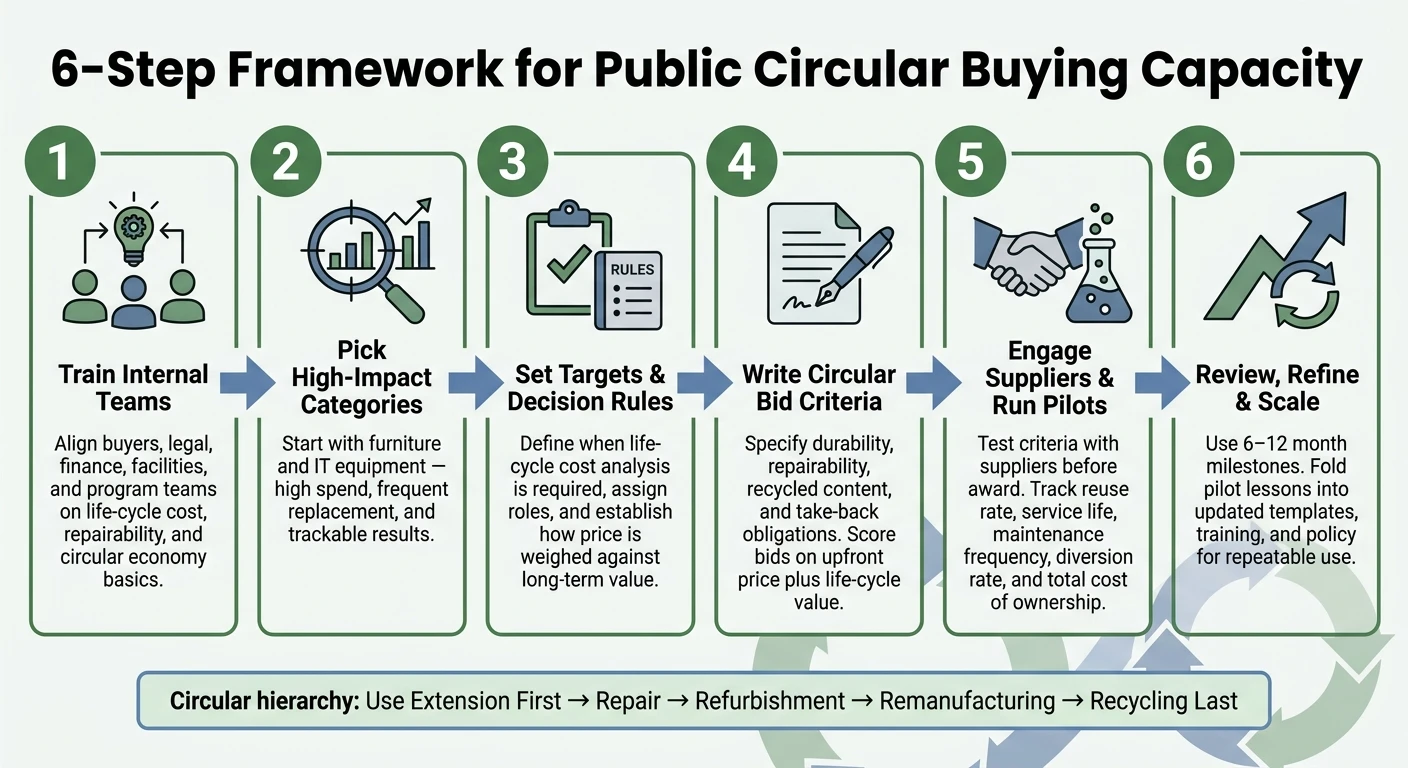
6-Step Framework for Public Circular Buying Capacity
Build internal capacity before changing contracts
Train buyers on circular principles and life-cycle cost
Before a team rewrites contracts, it needs a shared grasp of how circular purchasing works in day-to-day decisions. That means buyers, legal staff, finance staff, program managers, and facilities teams all need a working knowledge of circular economy basics, Total Cost of Ownership (TCO), repairability, modularity, product-as-a-service models, and end-of-life handling. They also need basic tools for life-cycle costing and material-flow analysis.
The skill gaps are different across teams. Legal and procurement staff need to know how to write and manage performance-based contracts, and they need a clear process for checking certifications such as FSC, SFI, and ISO 14001. Finance teams need to look past the sticker price and assess NPV across a longer asset life. Facilities teams need to be at ease with take-back and return flows, along with circular strategies such as repair, refurbishment, remanufacturing, and reuse.
Cross-functional workshops can help turn these ideas into something people can use. When teams work through the same purchasing scenarios together, they build a shared vocabulary and make fewer assumptions across departments.
Once people are speaking the same language, the next step is to look at spend data and find the categories where change will matter most.
Review spend and pick high-impact categories
Before changing specifications, run a baseline spend review using procurement financial data. The goal is simple: spot the categories with the most leverage. Focus first on areas with high spend, frequent replacement, visible waste, and supplier markets that are ready for circular criteria.
Furniture and IT equipment are often strong starting points because replacements happen often and the effects are easier to track. Electronics need extra attention. Their manufacturing emissions can outweigh what their physical weight might suggest. Picking the right categories can also cut operating costs [2].
This early filter keeps teams from trying to change everything at once. It points effort toward the parts of the budget where better specifications are most likely to pay off.
Set targets, assign roles, and define decision rules
With priority categories in place, set clear targets before drafting bid language. Those targets might cover the share of spend covered by circular criteria, waste avoided, or the number of years of product life extended. Just as important, assign roles so procurement, legal, finance, facilities, and program managers each know what they own.
Decision rules should spell out when life-cycle cost analysis is required, what triggers circular criteria, and how to weigh price against long-term value. Some agencies also use internal carbon pricing to make high-emission purchases more visible during budget decisions. Without clear rules, buyers tend to fall back on familiar habits. With targets and decision rules in place, circular buying becomes repeatable instead of ad hoc.
Those internal rules then set up the specifications and scoring criteria used in the next stage.
Write bid criteria that support circular outcomes
Write specifications that favor durability, repair, and take-back
The next step is simple in theory and often messy in practice: turn policy into bid language people can use. Training only pays off when it leads to clear, repeatable wording in solicitations.
Write performance-based specifications for durability, repairability, reuse, recycled content, and take-back. That gives suppliers a clear target without boxing buyers into product descriptions that age badly. Use third-party certifications and ecolabels only when they directly confirm the requirement being claimed [1]. If a label doesn’t prove the point, it shouldn’t carry the weight.
Timing matters too. Suppliers tend to respond better when they see these criteria before the solicitation closes. That sounds obvious, but it can make the difference between a strong field of bids and a stack of confused responses.
Score bids on price and life-cycle value
Don’t score bids on sticker price alone. Score them on upfront price plus life-cycle value: maintenance, repair, residual value, and end-of-life handling. That approach gives buyers a better read on what something will cost over its full service life, not just on day one.
The table below lays out common circular criteria, what each one measures, where it helps, and where buyers may hit friction.
Circular Criteria Type | What It Measures | Advantage | Tradeoff |
|---|---|---|---|
Durability standard | Product performance over time | Reduces replacement frequency and total spend | May limit supplier choice |
Repairability requirement | Parts availability and service access | Extends asset life and reduces downtime | Requires staff capacity to manage repairs |
Recycled content threshold | Share of recycled material in the product | Reduces demand for virgin materials | Availability varies by product type |
Take-back obligation | Supplier responsibility at end of life | Shifts disposal responsibility away from the agency | Needs clear contract language and logistics planning |
Refurbished product option | Buying refurbished products or selling to refurbishers | Extends asset value and reduces new spend | May involve shorter secondary warranties |
Cooperative purchasing can help agencies get better terms on circular products. It can also make pilot contracts easier to handle, since the same evaluation framework gives teams a more consistent way to compare bids.
Engage suppliers and run pilot contracts
Run early market engagement to expand supplier readiness
Once bid criteria are drafted, test them with suppliers before award. This is the point where circular criteria stop being theory and start facing day-to-day market conditions. Trained buyers can use market sounding to see whether the criteria are realistic, where suppliers may struggle, and what needs to be clarified before bids come in.
These conversations do more than check feasibility. They help agencies learn what suppliers can meet today, what information suppliers need to respond with confidence, and where execution risks may show up. In plain terms, it’s a stress test before the contract is on the line.
Design pilot contracts for learning and measurable performance
A pilot should work like a controlled test, not just a smaller purchase. Start with one clear learning goal before scaling. Pick a category where the agency can measure results against a clear baseline, then write contract clauses around measurable outcomes instead of broad promises.
Track metrics such as:
reuse rate
maintenance frequency
service life
diversion rate
total cost of ownership
When agencies track these measures from day one, they can compare results against the baseline and make a stronger case for scaling - or for changing course. Existing cooperative contracts can also help launch pilots faster. Just make sure those checks are built into post-award management so the pilot produces data the agency can actually use.
Use contract management to keep circular commitments on track
Signing the contract is the start, not the finish. Without follow-through, take-back terms, reporting, and data collection tend to slip. Define reporting and verification requirements in the contract before award so expectations are clear from the start.
Don’t rely only on supplier self-reporting. Use third-party certifications and chain-of-custody records as evidence. If suppliers fall below target, set a 6- to 12-month milestone plan and pair it with technical assistance.
Regular supplier reviews keep both sides accountable. They also create a feedback loop that helps improve future solicitations. Agencies that track metrics across procurement, operations, material flows, financial, and social categories are more likely to produce pilot results that leaders can act on. Those results should be documented for the post-pilot review.
Review results, refine methods, and scale what works
Track metrics that decision-relevant
Once a pilot is live, the job shifts from testing ideas to making choices. The data should help agencies decide whether to expand a circular purchasing approach, adjust it, or shut it down.
That means tracking a small set of metrics that tie straight to action: the share of certified products, spend under circular criteria, cost differences, and carbon or waste reduction. Put these metrics into contract reporting before award so suppliers know what they’ll need to show.
Just as important, agencies need a review method that makes the next move clear: what to scale, what to revise, and what to stop.
Review pilots and update training, templates, and policy
A pilot only matters if its lessons feed into day-to-day practice. Run a post-pilot review that records costs, performance, and lessons learned, then use that record to sharpen the next solicitation.
The table below shows a few practical ways agencies can review pilot results:
Review Method | What It Measures | Best Used For |
|---|---|---|
Supplier reporting | Costs, performance data, and certification documentation | Verifying contract commitments as a post-pilot review tool |
Spend analysis | Share of budget under circular criteria | Tracking policy adoption over time |
Life-cycle cost analysis | Cost differences and total life-cycle cost | Comparing pilot options and justifying scale-up decisions |
Once the results are on paper, fold the requirements into policy and bid templates. Then update staff training so teams know the rules around certification, documentation, and life-cycle costing. That’s how a one-off test starts to become standard operating practice.
Conclusion: A step-by-step path to circular buying capacity
Circular buying grows when agencies turn pilot lessons into repeatable practice. Start by defining what circular buying means for your agency. Build staff capability before rewriting contracts. Write bid criteria tied to measurable outcomes. Talk with suppliers early so the market has time to prepare. Begin with pilots in one or two categories, track results against a clear baseline, and review them before scaling.
What moves this work isn’t a policy memo on its own. It’s a system people can use again and again: trained staff, clear templates, contract follow-through, and scheduled reviews. Policy sets the direction. Capacity does the heavy lifting.
Organizations like Council Fire work with public agencies to translate that kind of sustainability ambition into operating systems - turning circular economy goals from strategy documents into procurement practices that produce measurable results.
FAQs
How do we start circular buying with a limited budget?
Start with categories that drive the most waste and spending, such as office furniture, IT equipment, and packaging. That’s usually where better purchasing choices have the biggest payoff. It also helps to pause and ask a simple question: Do we need to buy this at all? In many cases, buying less is the best move for both the planet and the budget.
A total cost of ownership view gives a clearer picture than sticker price alone. It brings in costs like maintenance, energy use, and disposal, which often shows that the greener option ends up costing less over time.
You don’t have to build the process from scratch, either. Existing cooperative purchasing contracts can save time, and free guidance from relevant organizations can help teams make better choices without adding much extra work.
Which product categories are best for a first pilot?
Start with categories where you buy a lot or throw away a lot - office furniture, IT equipment, and packaging are common places to begin. These areas make it easier to put circular specifications into practice, such as minimum recycled content, product-as-a-service models, and take-back requirements.
There’s also a smart internal case for starting here. When teams focus on top-spend categories - or on areas with known environmental, social, and governance risks - they can show results sooner. That tends to build support across the organization and makes broader adoption a much easier sell.
How can we prove circular buying saves money over time?
Focus on total cost of ownership, not just the sticker price. That’s where long-term savings come into view. When you factor in maintenance, energy use, disposal, and risk, you get a much clearer picture of what a purchase will actually cost over time - costs that standard procurement often overlooks.
Use life cycle costing to compare options on more than upfront spend. Then track KPIs like dollars saved, waste reduced, and financial results over 3–5 years. When these metrics are built into procurement, teams can check whether products perform as expected and make a stronger case for circular buying.
Related Blog Posts
How to Design a Circular Supply Chain Roadmap for Municipalities & Government Agencies
How to Design a Circular Supply Chain Roadmap for Corporations
How to Design a Circular Supply Chain Roadmap for NGOs & Nonprofits
How to Design a Circular Supply Chain Roadmap for Universities & Research Institutions
Latest Articles
©2026

Narrative Change and Power Building: The Missing Half of Advocacy
Narrative change is the process of disrupting dominant narratives that normalize inequity and advancing new narratives from historically marginalized communities.

Funding Resilience Without Federal Grants
BRIC is unreliable and FEMA is shrinking. Here's how cities fund climate resilience with dedicated revenue, blended finance, and a coordinating authority.

The ESG Blind Spot: How AI Is Finding Risks in Companies Nobody Else Is Watching
Norway's sovereign wealth fund uses AI to screen 7,200 portfolio companies for forced labor and corruption within 24 hours. The real story is the emerging-market coverage gap that traditional ESG data vendors miss — and what it means for any company with a global supply chain.
Narrative Change and Power Building: The Missing Half of Advocacy
Narrative change is the process of disrupting dominant narratives that normalize inequity and advancing new narratives from historically marginalized communities.
Funding Resilience Without Federal Grants
BRIC is unreliable and FEMA is shrinking. Here's how cities fund climate resilience with dedicated revenue, blended finance, and a coordinating authority.
The ESG Blind Spot: How AI Is Finding Risks in Companies Nobody Else Is Watching
Norway's sovereign wealth fund uses AI to screen 7,200 portfolio companies for forced labor and corruption within 24 hours. The real story is the emerging-market coverage gap that traditional ESG data vendors miss — and what it means for any company with a global supply chain.
FAQ
01
What does it really mean to “redefine profit”?
02
What makes Council Fire different?
03
Who does Council Fire work with?
04
What does working with Council Fire actually look like?
05
How does Council Fire help organizations turn big goals into action?
06
How does Council Fire define and measure success?
07
How does technology fit into Council Fire’s work?
Aug 29, 2026
Public Capacity Building for Circular Buying
Capacity Building
In This Article
Public circular buying succeeds by building staff skills, contract rules, and pilots, not by a single memo.
Public Capacity Building for Circular Buying
If public buyers keep choosing the lowest upfront price, they often lock in higher costs later. I’d sum up the fix this way: train staff first, target a few spend categories, write bid language around product life and take-back, test with suppliers, and scale only after pilots show cost, waste, and service-life results.
Here’s the article in plain terms:
Start inside the agency. Buyers, legal, finance, facilities, and program teams need the same rules for life-cycle cost, repair, refurbishment, remanufacturing, reuse, and recycling.
Pick a few categories first. Furniture and IT often make sense because replacement cycles are easy to track and spend can be high.
Set decision rules before bids go out. Define when life-cycle cost analysis is required, who approves exceptions, and how price is weighed against product life, maintenance, and end-of-use handling.
Write bids for outcomes, not just items. Ask for durability, repairability, recycled content, take-back, and proof for supplier claims.
Use pilots to learn with data. Track reuse rate, service life, maintenance frequency, diversion rate, and total cost of ownership from day one.
Review and standardize what works. Update templates, staff training, and policy so the process can be used again across departments.
A few facts from the piece stand out: pilot correction plans often use 6- to 12-month milestones, and the circular hierarchy puts use extension first and recycling last. That order matters because keeping products in use longer usually saves more money and materials than dealing with them after disposal is already in play.
In short, I’d say the article’s main point is simple: public circular buying is less about one policy change and more about building staff skill, contract rules, supplier checks, and post-award review into one repeatable system.
6-Step Framework for Public Circular Buying Capacity
Build internal capacity before changing contracts
Train buyers on circular principles and life-cycle cost
Before a team rewrites contracts, it needs a shared grasp of how circular purchasing works in day-to-day decisions. That means buyers, legal staff, finance staff, program managers, and facilities teams all need a working knowledge of circular economy basics, Total Cost of Ownership (TCO), repairability, modularity, product-as-a-service models, and end-of-life handling. They also need basic tools for life-cycle costing and material-flow analysis.
The skill gaps are different across teams. Legal and procurement staff need to know how to write and manage performance-based contracts, and they need a clear process for checking certifications such as FSC, SFI, and ISO 14001. Finance teams need to look past the sticker price and assess NPV across a longer asset life. Facilities teams need to be at ease with take-back and return flows, along with circular strategies such as repair, refurbishment, remanufacturing, and reuse.
Cross-functional workshops can help turn these ideas into something people can use. When teams work through the same purchasing scenarios together, they build a shared vocabulary and make fewer assumptions across departments.
Once people are speaking the same language, the next step is to look at spend data and find the categories where change will matter most.
Review spend and pick high-impact categories
Before changing specifications, run a baseline spend review using procurement financial data. The goal is simple: spot the categories with the most leverage. Focus first on areas with high spend, frequent replacement, visible waste, and supplier markets that are ready for circular criteria.
Furniture and IT equipment are often strong starting points because replacements happen often and the effects are easier to track. Electronics need extra attention. Their manufacturing emissions can outweigh what their physical weight might suggest. Picking the right categories can also cut operating costs [2].
This early filter keeps teams from trying to change everything at once. It points effort toward the parts of the budget where better specifications are most likely to pay off.
Set targets, assign roles, and define decision rules
With priority categories in place, set clear targets before drafting bid language. Those targets might cover the share of spend covered by circular criteria, waste avoided, or the number of years of product life extended. Just as important, assign roles so procurement, legal, finance, facilities, and program managers each know what they own.
Decision rules should spell out when life-cycle cost analysis is required, what triggers circular criteria, and how to weigh price against long-term value. Some agencies also use internal carbon pricing to make high-emission purchases more visible during budget decisions. Without clear rules, buyers tend to fall back on familiar habits. With targets and decision rules in place, circular buying becomes repeatable instead of ad hoc.
Those internal rules then set up the specifications and scoring criteria used in the next stage.
Write bid criteria that support circular outcomes
Write specifications that favor durability, repair, and take-back
The next step is simple in theory and often messy in practice: turn policy into bid language people can use. Training only pays off when it leads to clear, repeatable wording in solicitations.
Write performance-based specifications for durability, repairability, reuse, recycled content, and take-back. That gives suppliers a clear target without boxing buyers into product descriptions that age badly. Use third-party certifications and ecolabels only when they directly confirm the requirement being claimed [1]. If a label doesn’t prove the point, it shouldn’t carry the weight.
Timing matters too. Suppliers tend to respond better when they see these criteria before the solicitation closes. That sounds obvious, but it can make the difference between a strong field of bids and a stack of confused responses.
Score bids on price and life-cycle value
Don’t score bids on sticker price alone. Score them on upfront price plus life-cycle value: maintenance, repair, residual value, and end-of-life handling. That approach gives buyers a better read on what something will cost over its full service life, not just on day one.
The table below lays out common circular criteria, what each one measures, where it helps, and where buyers may hit friction.
Circular Criteria Type | What It Measures | Advantage | Tradeoff |
|---|---|---|---|
Durability standard | Product performance over time | Reduces replacement frequency and total spend | May limit supplier choice |
Repairability requirement | Parts availability and service access | Extends asset life and reduces downtime | Requires staff capacity to manage repairs |
Recycled content threshold | Share of recycled material in the product | Reduces demand for virgin materials | Availability varies by product type |
Take-back obligation | Supplier responsibility at end of life | Shifts disposal responsibility away from the agency | Needs clear contract language and logistics planning |
Refurbished product option | Buying refurbished products or selling to refurbishers | Extends asset value and reduces new spend | May involve shorter secondary warranties |
Cooperative purchasing can help agencies get better terms on circular products. It can also make pilot contracts easier to handle, since the same evaluation framework gives teams a more consistent way to compare bids.
Engage suppliers and run pilot contracts
Run early market engagement to expand supplier readiness
Once bid criteria are drafted, test them with suppliers before award. This is the point where circular criteria stop being theory and start facing day-to-day market conditions. Trained buyers can use market sounding to see whether the criteria are realistic, where suppliers may struggle, and what needs to be clarified before bids come in.
These conversations do more than check feasibility. They help agencies learn what suppliers can meet today, what information suppliers need to respond with confidence, and where execution risks may show up. In plain terms, it’s a stress test before the contract is on the line.
Design pilot contracts for learning and measurable performance
A pilot should work like a controlled test, not just a smaller purchase. Start with one clear learning goal before scaling. Pick a category where the agency can measure results against a clear baseline, then write contract clauses around measurable outcomes instead of broad promises.
Track metrics such as:
reuse rate
maintenance frequency
service life
diversion rate
total cost of ownership
When agencies track these measures from day one, they can compare results against the baseline and make a stronger case for scaling - or for changing course. Existing cooperative contracts can also help launch pilots faster. Just make sure those checks are built into post-award management so the pilot produces data the agency can actually use.
Use contract management to keep circular commitments on track
Signing the contract is the start, not the finish. Without follow-through, take-back terms, reporting, and data collection tend to slip. Define reporting and verification requirements in the contract before award so expectations are clear from the start.
Don’t rely only on supplier self-reporting. Use third-party certifications and chain-of-custody records as evidence. If suppliers fall below target, set a 6- to 12-month milestone plan and pair it with technical assistance.
Regular supplier reviews keep both sides accountable. They also create a feedback loop that helps improve future solicitations. Agencies that track metrics across procurement, operations, material flows, financial, and social categories are more likely to produce pilot results that leaders can act on. Those results should be documented for the post-pilot review.
Review results, refine methods, and scale what works
Track metrics that decision-relevant
Once a pilot is live, the job shifts from testing ideas to making choices. The data should help agencies decide whether to expand a circular purchasing approach, adjust it, or shut it down.
That means tracking a small set of metrics that tie straight to action: the share of certified products, spend under circular criteria, cost differences, and carbon or waste reduction. Put these metrics into contract reporting before award so suppliers know what they’ll need to show.
Just as important, agencies need a review method that makes the next move clear: what to scale, what to revise, and what to stop.
Review pilots and update training, templates, and policy
A pilot only matters if its lessons feed into day-to-day practice. Run a post-pilot review that records costs, performance, and lessons learned, then use that record to sharpen the next solicitation.
The table below shows a few practical ways agencies can review pilot results:
Review Method | What It Measures | Best Used For |
|---|---|---|
Supplier reporting | Costs, performance data, and certification documentation | Verifying contract commitments as a post-pilot review tool |
Spend analysis | Share of budget under circular criteria | Tracking policy adoption over time |
Life-cycle cost analysis | Cost differences and total life-cycle cost | Comparing pilot options and justifying scale-up decisions |
Once the results are on paper, fold the requirements into policy and bid templates. Then update staff training so teams know the rules around certification, documentation, and life-cycle costing. That’s how a one-off test starts to become standard operating practice.
Conclusion: A step-by-step path to circular buying capacity
Circular buying grows when agencies turn pilot lessons into repeatable practice. Start by defining what circular buying means for your agency. Build staff capability before rewriting contracts. Write bid criteria tied to measurable outcomes. Talk with suppliers early so the market has time to prepare. Begin with pilots in one or two categories, track results against a clear baseline, and review them before scaling.
What moves this work isn’t a policy memo on its own. It’s a system people can use again and again: trained staff, clear templates, contract follow-through, and scheduled reviews. Policy sets the direction. Capacity does the heavy lifting.
Organizations like Council Fire work with public agencies to translate that kind of sustainability ambition into operating systems - turning circular economy goals from strategy documents into procurement practices that produce measurable results.
FAQs
How do we start circular buying with a limited budget?
Start with categories that drive the most waste and spending, such as office furniture, IT equipment, and packaging. That’s usually where better purchasing choices have the biggest payoff. It also helps to pause and ask a simple question: Do we need to buy this at all? In many cases, buying less is the best move for both the planet and the budget.
A total cost of ownership view gives a clearer picture than sticker price alone. It brings in costs like maintenance, energy use, and disposal, which often shows that the greener option ends up costing less over time.
You don’t have to build the process from scratch, either. Existing cooperative purchasing contracts can save time, and free guidance from relevant organizations can help teams make better choices without adding much extra work.
Which product categories are best for a first pilot?
Start with categories where you buy a lot or throw away a lot - office furniture, IT equipment, and packaging are common places to begin. These areas make it easier to put circular specifications into practice, such as minimum recycled content, product-as-a-service models, and take-back requirements.
There’s also a smart internal case for starting here. When teams focus on top-spend categories - or on areas with known environmental, social, and governance risks - they can show results sooner. That tends to build support across the organization and makes broader adoption a much easier sell.
How can we prove circular buying saves money over time?
Focus on total cost of ownership, not just the sticker price. That’s where long-term savings come into view. When you factor in maintenance, energy use, disposal, and risk, you get a much clearer picture of what a purchase will actually cost over time - costs that standard procurement often overlooks.
Use life cycle costing to compare options on more than upfront spend. Then track KPIs like dollars saved, waste reduced, and financial results over 3–5 years. When these metrics are built into procurement, teams can check whether products perform as expected and make a stronger case for circular buying.
Related Blog Posts
How to Design a Circular Supply Chain Roadmap for Municipalities & Government Agencies
How to Design a Circular Supply Chain Roadmap for Corporations
How to Design a Circular Supply Chain Roadmap for NGOs & Nonprofits
How to Design a Circular Supply Chain Roadmap for Universities & Research Institutions
Latest Articles
©2026
Narrative Change and Power Building: The Missing Half of Advocacy
Narrative change is the process of disrupting dominant narratives that normalize inequity and advancing new narratives from historically marginalized communities.
Funding Resilience Without Federal Grants
BRIC is unreliable and FEMA is shrinking. Here's how cities fund climate resilience with dedicated revenue, blended finance, and a coordinating authority.
The ESG Blind Spot: How AI Is Finding Risks in Companies Nobody Else Is Watching
Norway's sovereign wealth fund uses AI to screen 7,200 portfolio companies for forced labor and corruption within 24 hours. The real story is the emerging-market coverage gap that traditional ESG data vendors miss — and what it means for any company with a global supply chain.
FAQ
01
What does it really mean to “redefine profit”?
02
What makes Council Fire different?
03
Who does Council Fire work with?
04
What does working with Council Fire actually look like?
05
How does Council Fire help organizations turn big goals into action?
06
How does Council Fire define and measure success?
07
How does technology fit into Council Fire’s work?
Aug 29, 2026
Public Capacity Building for Circular Buying
Capacity Building
In This Article
Public circular buying succeeds by building staff skills, contract rules, and pilots, not by a single memo.
Public Capacity Building for Circular Buying
If public buyers keep choosing the lowest upfront price, they often lock in higher costs later. I’d sum up the fix this way: train staff first, target a few spend categories, write bid language around product life and take-back, test with suppliers, and scale only after pilots show cost, waste, and service-life results.
Here’s the article in plain terms:
Start inside the agency. Buyers, legal, finance, facilities, and program teams need the same rules for life-cycle cost, repair, refurbishment, remanufacturing, reuse, and recycling.
Pick a few categories first. Furniture and IT often make sense because replacement cycles are easy to track and spend can be high.
Set decision rules before bids go out. Define when life-cycle cost analysis is required, who approves exceptions, and how price is weighed against product life, maintenance, and end-of-use handling.
Write bids for outcomes, not just items. Ask for durability, repairability, recycled content, take-back, and proof for supplier claims.
Use pilots to learn with data. Track reuse rate, service life, maintenance frequency, diversion rate, and total cost of ownership from day one.
Review and standardize what works. Update templates, staff training, and policy so the process can be used again across departments.
A few facts from the piece stand out: pilot correction plans often use 6- to 12-month milestones, and the circular hierarchy puts use extension first and recycling last. That order matters because keeping products in use longer usually saves more money and materials than dealing with them after disposal is already in play.
In short, I’d say the article’s main point is simple: public circular buying is less about one policy change and more about building staff skill, contract rules, supplier checks, and post-award review into one repeatable system.
6-Step Framework for Public Circular Buying Capacity
Build internal capacity before changing contracts
Train buyers on circular principles and life-cycle cost
Before a team rewrites contracts, it needs a shared grasp of how circular purchasing works in day-to-day decisions. That means buyers, legal staff, finance staff, program managers, and facilities teams all need a working knowledge of circular economy basics, Total Cost of Ownership (TCO), repairability, modularity, product-as-a-service models, and end-of-life handling. They also need basic tools for life-cycle costing and material-flow analysis.
The skill gaps are different across teams. Legal and procurement staff need to know how to write and manage performance-based contracts, and they need a clear process for checking certifications such as FSC, SFI, and ISO 14001. Finance teams need to look past the sticker price and assess NPV across a longer asset life. Facilities teams need to be at ease with take-back and return flows, along with circular strategies such as repair, refurbishment, remanufacturing, and reuse.
Cross-functional workshops can help turn these ideas into something people can use. When teams work through the same purchasing scenarios together, they build a shared vocabulary and make fewer assumptions across departments.
Once people are speaking the same language, the next step is to look at spend data and find the categories where change will matter most.
Review spend and pick high-impact categories
Before changing specifications, run a baseline spend review using procurement financial data. The goal is simple: spot the categories with the most leverage. Focus first on areas with high spend, frequent replacement, visible waste, and supplier markets that are ready for circular criteria.
Furniture and IT equipment are often strong starting points because replacements happen often and the effects are easier to track. Electronics need extra attention. Their manufacturing emissions can outweigh what their physical weight might suggest. Picking the right categories can also cut operating costs [2].
This early filter keeps teams from trying to change everything at once. It points effort toward the parts of the budget where better specifications are most likely to pay off.
Set targets, assign roles, and define decision rules
With priority categories in place, set clear targets before drafting bid language. Those targets might cover the share of spend covered by circular criteria, waste avoided, or the number of years of product life extended. Just as important, assign roles so procurement, legal, finance, facilities, and program managers each know what they own.
Decision rules should spell out when life-cycle cost analysis is required, what triggers circular criteria, and how to weigh price against long-term value. Some agencies also use internal carbon pricing to make high-emission purchases more visible during budget decisions. Without clear rules, buyers tend to fall back on familiar habits. With targets and decision rules in place, circular buying becomes repeatable instead of ad hoc.
Those internal rules then set up the specifications and scoring criteria used in the next stage.
Write bid criteria that support circular outcomes
Write specifications that favor durability, repair, and take-back
The next step is simple in theory and often messy in practice: turn policy into bid language people can use. Training only pays off when it leads to clear, repeatable wording in solicitations.
Write performance-based specifications for durability, repairability, reuse, recycled content, and take-back. That gives suppliers a clear target without boxing buyers into product descriptions that age badly. Use third-party certifications and ecolabels only when they directly confirm the requirement being claimed [1]. If a label doesn’t prove the point, it shouldn’t carry the weight.
Timing matters too. Suppliers tend to respond better when they see these criteria before the solicitation closes. That sounds obvious, but it can make the difference between a strong field of bids and a stack of confused responses.
Score bids on price and life-cycle value
Don’t score bids on sticker price alone. Score them on upfront price plus life-cycle value: maintenance, repair, residual value, and end-of-life handling. That approach gives buyers a better read on what something will cost over its full service life, not just on day one.
The table below lays out common circular criteria, what each one measures, where it helps, and where buyers may hit friction.
Circular Criteria Type | What It Measures | Advantage | Tradeoff |
|---|---|---|---|
Durability standard | Product performance over time | Reduces replacement frequency and total spend | May limit supplier choice |
Repairability requirement | Parts availability and service access | Extends asset life and reduces downtime | Requires staff capacity to manage repairs |
Recycled content threshold | Share of recycled material in the product | Reduces demand for virgin materials | Availability varies by product type |
Take-back obligation | Supplier responsibility at end of life | Shifts disposal responsibility away from the agency | Needs clear contract language and logistics planning |
Refurbished product option | Buying refurbished products or selling to refurbishers | Extends asset value and reduces new spend | May involve shorter secondary warranties |
Cooperative purchasing can help agencies get better terms on circular products. It can also make pilot contracts easier to handle, since the same evaluation framework gives teams a more consistent way to compare bids.
Engage suppliers and run pilot contracts
Run early market engagement to expand supplier readiness
Once bid criteria are drafted, test them with suppliers before award. This is the point where circular criteria stop being theory and start facing day-to-day market conditions. Trained buyers can use market sounding to see whether the criteria are realistic, where suppliers may struggle, and what needs to be clarified before bids come in.
These conversations do more than check feasibility. They help agencies learn what suppliers can meet today, what information suppliers need to respond with confidence, and where execution risks may show up. In plain terms, it’s a stress test before the contract is on the line.
Design pilot contracts for learning and measurable performance
A pilot should work like a controlled test, not just a smaller purchase. Start with one clear learning goal before scaling. Pick a category where the agency can measure results against a clear baseline, then write contract clauses around measurable outcomes instead of broad promises.
Track metrics such as:
reuse rate
maintenance frequency
service life
diversion rate
total cost of ownership
When agencies track these measures from day one, they can compare results against the baseline and make a stronger case for scaling - or for changing course. Existing cooperative contracts can also help launch pilots faster. Just make sure those checks are built into post-award management so the pilot produces data the agency can actually use.
Use contract management to keep circular commitments on track
Signing the contract is the start, not the finish. Without follow-through, take-back terms, reporting, and data collection tend to slip. Define reporting and verification requirements in the contract before award so expectations are clear from the start.
Don’t rely only on supplier self-reporting. Use third-party certifications and chain-of-custody records as evidence. If suppliers fall below target, set a 6- to 12-month milestone plan and pair it with technical assistance.
Regular supplier reviews keep both sides accountable. They also create a feedback loop that helps improve future solicitations. Agencies that track metrics across procurement, operations, material flows, financial, and social categories are more likely to produce pilot results that leaders can act on. Those results should be documented for the post-pilot review.
Review results, refine methods, and scale what works
Track metrics that decision-relevant
Once a pilot is live, the job shifts from testing ideas to making choices. The data should help agencies decide whether to expand a circular purchasing approach, adjust it, or shut it down.
That means tracking a small set of metrics that tie straight to action: the share of certified products, spend under circular criteria, cost differences, and carbon or waste reduction. Put these metrics into contract reporting before award so suppliers know what they’ll need to show.
Just as important, agencies need a review method that makes the next move clear: what to scale, what to revise, and what to stop.
Review pilots and update training, templates, and policy
A pilot only matters if its lessons feed into day-to-day practice. Run a post-pilot review that records costs, performance, and lessons learned, then use that record to sharpen the next solicitation.
The table below shows a few practical ways agencies can review pilot results:
Review Method | What It Measures | Best Used For |
|---|---|---|
Supplier reporting | Costs, performance data, and certification documentation | Verifying contract commitments as a post-pilot review tool |
Spend analysis | Share of budget under circular criteria | Tracking policy adoption over time |
Life-cycle cost analysis | Cost differences and total life-cycle cost | Comparing pilot options and justifying scale-up decisions |
Once the results are on paper, fold the requirements into policy and bid templates. Then update staff training so teams know the rules around certification, documentation, and life-cycle costing. That’s how a one-off test starts to become standard operating practice.
Conclusion: A step-by-step path to circular buying capacity
Circular buying grows when agencies turn pilot lessons into repeatable practice. Start by defining what circular buying means for your agency. Build staff capability before rewriting contracts. Write bid criteria tied to measurable outcomes. Talk with suppliers early so the market has time to prepare. Begin with pilots in one or two categories, track results against a clear baseline, and review them before scaling.
What moves this work isn’t a policy memo on its own. It’s a system people can use again and again: trained staff, clear templates, contract follow-through, and scheduled reviews. Policy sets the direction. Capacity does the heavy lifting.
Organizations like Council Fire work with public agencies to translate that kind of sustainability ambition into operating systems - turning circular economy goals from strategy documents into procurement practices that produce measurable results.
FAQs
How do we start circular buying with a limited budget?
Start with categories that drive the most waste and spending, such as office furniture, IT equipment, and packaging. That’s usually where better purchasing choices have the biggest payoff. It also helps to pause and ask a simple question: Do we need to buy this at all? In many cases, buying less is the best move for both the planet and the budget.
A total cost of ownership view gives a clearer picture than sticker price alone. It brings in costs like maintenance, energy use, and disposal, which often shows that the greener option ends up costing less over time.
You don’t have to build the process from scratch, either. Existing cooperative purchasing contracts can save time, and free guidance from relevant organizations can help teams make better choices without adding much extra work.
Which product categories are best for a first pilot?
Start with categories where you buy a lot or throw away a lot - office furniture, IT equipment, and packaging are common places to begin. These areas make it easier to put circular specifications into practice, such as minimum recycled content, product-as-a-service models, and take-back requirements.
There’s also a smart internal case for starting here. When teams focus on top-spend categories - or on areas with known environmental, social, and governance risks - they can show results sooner. That tends to build support across the organization and makes broader adoption a much easier sell.
How can we prove circular buying saves money over time?
Focus on total cost of ownership, not just the sticker price. That’s where long-term savings come into view. When you factor in maintenance, energy use, disposal, and risk, you get a much clearer picture of what a purchase will actually cost over time - costs that standard procurement often overlooks.
Use life cycle costing to compare options on more than upfront spend. Then track KPIs like dollars saved, waste reduced, and financial results over 3–5 years. When these metrics are built into procurement, teams can check whether products perform as expected and make a stronger case for circular buying.
Related Blog Posts
How to Design a Circular Supply Chain Roadmap for Municipalities & Government Agencies
How to Design a Circular Supply Chain Roadmap for Corporations
How to Design a Circular Supply Chain Roadmap for NGOs & Nonprofits
How to Design a Circular Supply Chain Roadmap for Universities & Research Institutions
Latest Articles
©2026
Narrative Change and Power Building: The Missing Half of Advocacy
Narrative change is the process of disrupting dominant narratives that normalize inequity and advancing new narratives from historically marginalized communities.
Funding Resilience Without Federal Grants
BRIC is unreliable and FEMA is shrinking. Here's how cities fund climate resilience with dedicated revenue, blended finance, and a coordinating authority.
The ESG Blind Spot: How AI Is Finding Risks in Companies Nobody Else Is Watching
Norway's sovereign wealth fund uses AI to screen 7,200 portfolio companies for forced labor and corruption within 24 hours. The real story is the emerging-market coverage gap that traditional ESG data vendors miss — and what it means for any company with a global supply chain.
FAQ
What does it really mean to “redefine profit”?
What makes Council Fire different?
Who does Council Fire work with?
What does working with Council Fire actually look like?
How does Council Fire help organizations turn big goals into action?
How does Council Fire define and measure success?
How does technology fit into Council Fire’s work?