Feb 27, 2026
How to Design a Circular Supply Chain Roadmap for Universities & Research Institutions
Sustainability Strategy
In This Article
Universities must redesign procurement and logistics to close material loops, cut emissions, and turn campuses into circular supply-chain testbeds.
How to Design a Circular Supply Chain Roadmap for Universities & Research Institutions
Universities and research institutions have immense purchasing power but often rely on outdated, wasteful supply chain models. Transitioning to a circular supply chain - one that focuses on reusing, recycling, and regenerating materials - can drastically reduce waste and emissions while improving operational efficiency. Here's how institutions can start:
Assess the Current Supply Chain: Conduct a baseline audit to map material flows, identify inefficiencies, and prioritize high-impact areas like electronics and furniture.
Set Clear Metrics: Track procurement, waste diversion rates, and product lifespans to measure progress toward circularity.
Adopt Circular Procurement Policies: Focus on durable, repairable products and establish internal reuse platforms to reduce new purchases.
Develop Reverse Logistics Systems: Implement systems to recover and reuse materials, extending product lifespans and cutting costs.
Collaborate with Suppliers: Work with vendors on modular product designs and take-back programs.
Launch Pilot Programs: Test strategies in specific departments or for high-impact materials, then expand successful initiatives across the institution.
Institutions like MIT and the University of British Columbia have already made strides by redesigning waste management systems and introducing zero-waste action plans. With the right data, tools, and stakeholder engagement, universities can turn their campuses into models for sustainable operations.
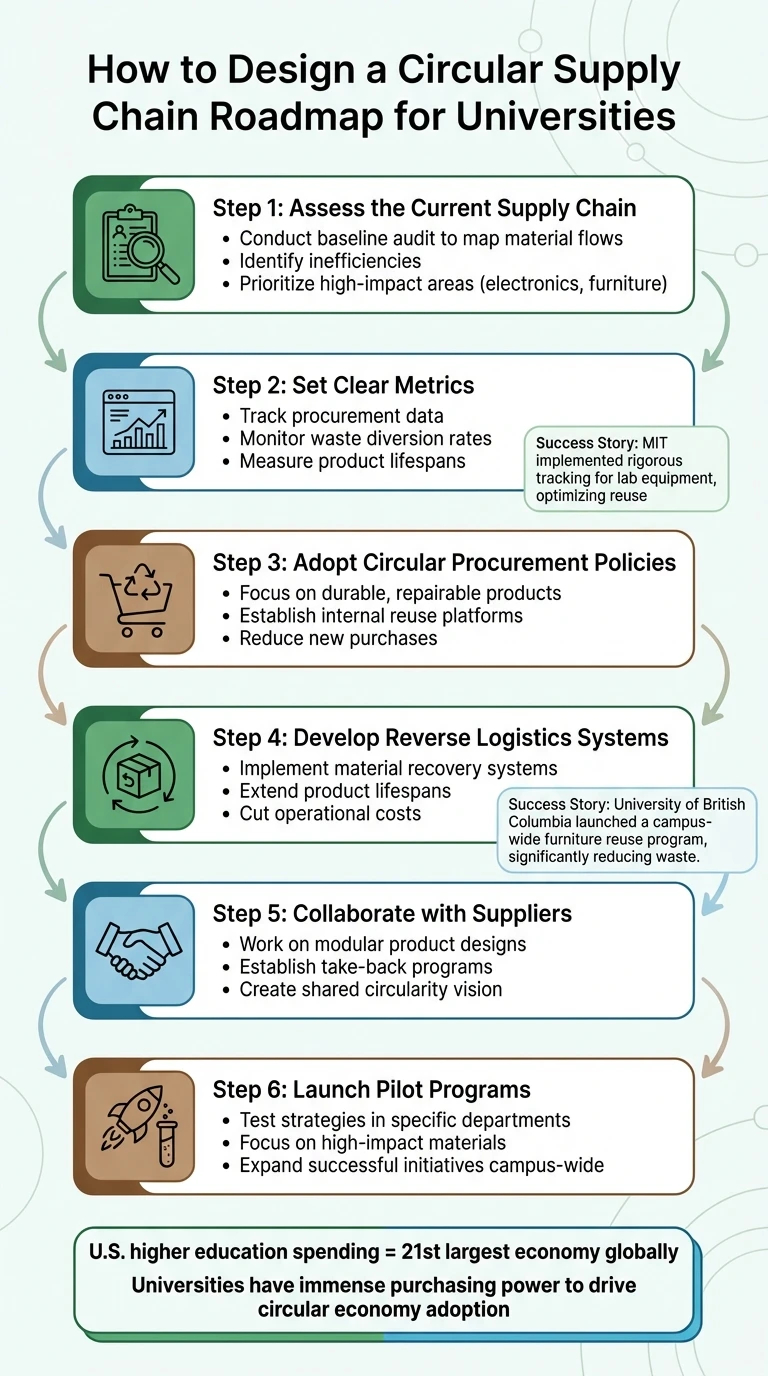
6-Step Circular Supply Chain Roadmap for Universities
Insights from our new white paper: Building a circular supply chain
Assessing Your Current Supply Chain
Before making any changes, it's crucial to evaluate your current supply chain setup. Many universities rely on decentralized purchasing, where departments make independent buying decisions. This fragmented approach makes it challenging to track materials from procurement to disposal [7]. Without visibility, inefficiencies remain hidden, and identifying opportunities for circular improvements becomes difficult. Recognizing these decentralized systems is the first step toward transitioning from linear to more circular and sustainable operations. A thorough understanding of your current practices lays the groundwork for a detailed baseline audit.
Conduct a Baseline Audit
A baseline audit involves mapping out all material flows within your institution - tracking what enters, stays, and exits. Start with a Material Flow Analysis (MFA), which uses procurement financial data to assess inflows and stocks, paired with mass data to quantify outflows [7][6]. Combine this with an Economic Input-Output Life Cycle Assessment (EIO-LCA) to estimate the embedded greenhouse gas emissions, energy consumption, and water usage in the goods you purchase [7][6]. Together, these methods reveal the economic and environmental footprint of your institution's operations.
Take the University of Melbourne as an example. In 2017, they analyzed 11,555 purchases across 189 material types on their Parkville campus. Although procurement accounted for just 4% of the total material mass (92.8 tons of 2,280 tons), it was responsible for 22,587 GJ of energy use and 1,477 metric tons of CO2-equivalent emissions [6]. This analysis shifted their strategy, highlighting that targeting high-impact categories like electronics and furniture would yield greater environmental benefits than simply addressing waste streams.
Similarly, an analysis at MIT revealed that the embodied greenhouse gas emissions from purchased goods in fiscal year 2016 were approximately 78,800 metric tons of CO2-equivalent, nearly matching the institution's direct operational emissions [7]. Their top spending categories included laboratory supplies, hardware, lab equipment, chemicals, and office furniture [7]. These findings helped MIT focus on areas with the most potential for sustainability improvements, underscoring how baseline audits can guide strategic planning for circular supply chains.
Don’t forget to examine your waste streams. Conducting regular physical audits can help identify waste generation patterns, contamination in recycling streams, and whether your disposal contracts align with sustainability goals. Waste hauler data, often designed for billing purposes, may need rethinking to support decision-making aligned with your environmental objectives [1].
Engaging stakeholders is equally important. Host interviews and workshops with faculty, staff, and procurement officers to understand their purchasing habits. At MIT, researchers discovered that while purchasers had significant autonomy, they often lacked the information and guidelines needed for sustainable choices [7]. Addressing these behavioral barriers is as critical as analyzing material flows.
Define Key Metrics
Once your baseline audit is complete, establish clear metrics to track progress toward circularity. These indicators should cover procurement, operations, waste management, and financial performance.
Metric Category | Key Data Points & Indicators |
|---|---|
Procurement | Spend by category, embodied GHG (CO2-eq), embodied energy (GJ), embodied water (gallons), percentage of recycled or bio-based products [7][6][9] |
Operations/Stock | Product lifespan (years), maintenance frequency, reuse rates through internal platforms [7][4] |
Waste/Outflow | Mass by stream (hazardous, medical, municipal solid waste), contamination rates, diversion rates (landfill vs. recycling), waste-to-resource conversion [7][1][8] |
Financial | Total Cost of Ownership (TCO), Net Present Value (NPV) of assets, supplier sustainability scores [9] |
Pay close attention to diversion rates, which measure the percentage of materials diverted from landfills through recycling, composting, or reuse. For instance, at MIT, only 40-50% of material waste is clean enough to be reprocessed, leaving 60% destined for landfills or incineration [1]. Monitoring contamination rates at the building level can help pinpoint problem areas and craft targeted solutions.
For procurement, shift your focus from upfront costs to Life Cycle Cost Analysis (LCCA), which considers the total cost of ownership, including purchase, maintenance, energy use, and disposal [9]. Often, products with higher initial costs prove more cost-effective over time while reducing environmental impact.
Finally, centralize your data collection processes. Transitioning from fragmented departmental systems to centralized storage for procurement and waste data is essential for tracking circularity [7]. Update vendor contracts to include detailed product-level sustainability data, and explore digital platforms that facilitate internal reuse of items like furniture and equipment [7][4].
Core Strategies for Building a Circular Supply Chain
Once you've completed your baseline audit and established key metrics, it's time to transition from a traditional linear model to a circular supply chain. This shift involves rethinking procurement, logistics, and supplier relationships to create a more sustainable and efficient system.
Shift to Circular Procurement Policies
Move away from procurement practices that prioritize cost above all else. Instead, focus on designs that emphasize durability, repairability, and the ability to recover materials at the end of their lifecycle. Start by updating your RFPs to prioritize suppliers and partners committed to reducing waste [1][4].
For example, in 2019, MIT's Department of Facilities and the MIT Office of Sustainability revamped their Waste Management Services RFP under the guidance of Assistant Director Brian Goldberg. This initiative enabled MIT to make upstream decisions that minimized contamination and increased landfill diversion. As Goldberg noted:
By embedding data and tech as a core piece of our new waste hauling partnership, we are ensuring we can try and test the collection framework to give us the data to drive decision-making down to building scale [1][3].
To further align with circular economy goals, develop category-specific procurement guidelines for high-impact areas such as lab supplies, electronics, and furniture. For instance, in 2025, the Georgia Institute of Technology introduced a "Sustainable Procurement Guide" that provides actionable tips for various categories, helping departments make more sustainable purchasing choices [5].
Another effective strategy is implementing internal reuse portals to facilitate the exchange of equipment and materials within your organization. The University of Edinburgh's WARP-it online portal, coupled with its student-led Swap and Re-use Hub (SHRUB), showcases how such initiatives can encourage sustainable consumption by enabling staff and students to reuse items instead of buying new ones [4].
With procurement strategies in place, the next step is ensuring the efficient recovery and reuse of materials.
Build Reverse Logistics Systems
Reverse logistics systems are key to recovering materials at the end of their lifecycle and reintegrating them into the supply chain. These systems work best when guided by a hierarchical priority system:
Priority Level | Strategy | Action |
|---|---|---|
1 (Highest) | Use Extension | Service agreements, maintenance, product sharing |
2 | Refurbish | Upgrading, selling to refurbishers, buying refurbished |
3 | Remanufacture | Rebuilding products, buying remanufactured |
4 (Lowest) | Recycle | Manufacturer take-back, accredited recyclers |
Extending the life of products has clear benefits. For example, adding two years to a notebook computer's lifespan can cut its greenhouse gas emissions by 30%. Similarly, extending a workstation's life from four to six years can reduce its total cost of ownership by 28% [11]. With toxic e-waste growing at a rate of over 50 million metric tons annually, focusing on longer product use is both economically and environmentally advantageous [11].
To streamline these processes, consider adopting a stockroom model at distributed mail centers or other shared locations. This model allows for convenient drop-off points for used supplies, integrating forward delivery with reverse collection. By consolidating procurement for office and lab supplies, institutions can better implement take-back programs and reduce costs by leveraging existing delivery routes [10].
Collaborate with Suppliers to Close the Loop
Creating a circular supply chain requires active collaboration with external partners. Suppliers play a critical role in aligning with your institution's circular goals.
Work with suppliers to establish a shared vision for circularity. Prioritize those offering products with modular designs, where components like batteries and parts can be easily replaced, facilitating repair and recycling [11].
Another effective approach is adopting product-as-a-service models, where vendors retain ownership and responsibility for end-of-life recovery. These arrangements can be tested in specific departments or labs before scaling up across the organization [11].
Finally, create a stakeholder map to identify key participants in the circular ecosystem, such as haulers, refurbishers, and internal departments. This map can help coordinate efforts and maximize shared value. It's worth noting that U.S. higher education spending, if considered as a national economy, would rank as the 21st largest globally [1][3]. This purchasing power can significantly influence supplier practices and encourage industry-wide shifts toward circularity.
Creating Your Circular Supply Chain Roadmap
With your strategies outlined and supplier collaborations in place, the next step is crafting a detailed roadmap to embed circular principles into your institution's operations. A phased approach works best: start with a clear vision, test your strategies through pilot programs, and then scale them across the organization.
Set Your Vision and Goals
Begin by aligning your circular economy goals with your institution's broader sustainability objectives, such as net-zero carbon commitments or regional development plans. This ensures your efforts complement existing priorities [3][4].
Use a structured three-step framework for planning: background analysis, foreground analysis, and implementation [4]. During the background phase, assess current sustainability policies and resource flows to identify areas where circular principles can enhance outcomes. In the foreground phase, engage stakeholders - like facilities teams, procurement staff, faculty, and students - through interviews and workshops to uncover potential challenges, such as outdated governance or lack of awareness [4].
Establish a data collection system that supports your sustainability goals rather than focusing solely on vendor billing requirements. This foundation will guide the design of pilot programs, ensuring they are well-informed and aligned with your objectives.
Launch Pilot Programs
With a clear vision in place, the next step is to pilot your strategies. These small-scale programs allow you to test ideas, refine processes, and build evidence for broader implementation - all without requiring significant upfront investments [1][2].
Focus your pilot projects on areas with the highest environmental impact rather than just large-scale waste streams. For example, at the University of Melbourne, electronics accounted for only the 6th largest material stream by mass but had the highest embodied environmental effects, such as energy and greenhouse gas emissions [12]. This led the university to prioritize electronics and furniture in its circular initiatives.
One successful example is the University of Melbourne's Reuse Centre, which repurposed 4,413 items in 2018, including furniture and electronics, diverting around 89,000 kg of waste from landfills [12]. Another initiative involved a centralized plate-washing service in the campus food court, reducing single-use packaging by providing reusable dishes and cutlery [12].
When designing your pilot programs, ensure robust data collection is central. For external partners, such as food vendors, require participation in circular initiatives through lease agreements [12].
Scale and Institutionalize Your Efforts
Once your pilot programs demonstrate success, the focus shifts to scaling these efforts and embedding them into everyday operations. A phased approach ensures smooth integration:
Roadmap Phase | Key Focus | Primary Activities |
|---|---|---|
Short-Term | Experimentation | Launch 1–2 prototypes, define evaluation metrics, and allocate resources |
Medium-Term | Best Practice Integration | Expand successful pilots, update procurement policies, and engage more departments |
Long-Term | Institutionalization | Integrate circularity into the institution's vision and scale initiatives campus-wide |
For example, Georgia Institute of Technology introduced a "Sustainable Procurement Guide" in 2025, offering tailored tips for appliance, lab supply, and furniture purchases. To drive adoption, the Office of Sustainability hosted department-specific sessions [5].
Digital platforms can also play a role in scaling efforts. The University of Edinburgh's WARP-it platform, for instance, facilitates the exchange of surplus items among staff, reducing waste and supporting the reuse phase of the circular model [4].
Use the "Plan–Do–Check–Act" cycle to refine strategies based on performance data and feedback [4]. At the University of Manchester, researchers used stakeholder workshops to embed circular thinking into the university's sustainability systems, ensuring their approach remained relevant and adaptable [4].
Finally, connect your waste management initiatives with your institution's core mission of teaching and research. By turning the campus into a living laboratory, you can engage students and faculty while creating opportunities for research partnerships that advance circular practices and academic knowledge [4][8].
Tools and Resources for Implementation
Once you've established a baseline audit and roadmap, choosing the right digital tools becomes critical for effective execution. Universities need systems that go beyond basic billing metrics, focusing instead on collecting actionable data about material flows, waste streams, and environmental impacts.
Digital Tracking and Management Tools
Proven methodologies like Material Flow Analysis (MFA) and Economic Input-Output Life Cycle Assessment (EIO-LCA) remain essential for quantifying both financial and environmental impacts. For waste management, tools such as the EPA's Waste Reduction Model (WARM) can estimate greenhouse gas emissions tied to various disposal and diversion strategies [7]. A key innovation is redesigning data collection systems to prioritize sustainability insights over operational billing. For instance, in 2019, MIT's Department of Facilities and Office of Sustainability, under the guidance of Assistant Director Brian Goldberg, revamped their Request for Proposal for Waste Management Services. This overhaul introduced a technology-driven system capable of delivering building-specific data [3][1].
Another valuable resource is interdepartmental sharing platforms, which allow different campus departments to exchange surplus materials. This approach extends product lifecycles and reduces unnecessary purchases [7]. Transitioning from manual spreadsheets to specialized sustainability data management software also helps institutions manage intricate datasets, benchmark performance, and craft comprehensive management strategies [13]. These tools play a vital role in supporting circular supply chain efforts by providing the transparency needed to monitor progress against established metrics.
While digital tools streamline data collection and tracking, expert consulting ensures these systems align with broader strategic goals.
Consulting Support from Council Fire
Even with advanced tools, many universities lack the internal expertise needed to navigate the shift from linear to circular supply chains [15]. This is where specialized consultants can make a significant impact. Experts help identify and address operational, financial, and regulatory challenges that may go unnoticed by internal teams [15].
Council Fire offers end-to-end consulting services tailored to universities. Their support includes conducting baseline audits, defining performance indicators, and fostering alignment among campus departments [15]. By applying frameworks like the "10Rs" strategy - Refuse, Rethink, Reduce, Reuse, Repair, Refurbish, Remanufacture, Repurpose, Recycle, Recover - consultants customize solutions to fit each institution's unique needs [14][4]. They also demonstrate the economic and environmental benefits of circular practices to secure buy-in from administrators, faculty, and facilities teams [15][4].
The financial benefits of expert guidance are clear. Supply chains account for over 90% of an organization’s carbon emissions, and 74% of supply chain leaders anticipate profit growth within two years of adopting circular economy principles [15]. Effective sustainability programs can offset rising operational costs, potentially boosting profits by 60% [15]. Consultants help institutions design phased transition plans that maximize efficiency and minimize costs, turning ambitious sustainability goals into tangible, measurable outcomes.
Monitoring, Measuring, and Adjusting
Once a solid roadmap and pilot strategies are in place, maintaining momentum and ensuring long-term success requires consistent monitoring and adaptability. By keeping a close eye on progress and identifying areas for improvement, institutions can align their circular supply chain efforts with evolving sustainability goals. Clear metrics and scheduled review cycles are key to staying on track.
Define and Track KPIs
Start by selecting well-defined key performance indicators (KPIs) that align with your goals. For procurement, consider metrics such as the percentage of bid solicitations incorporating sustainability criteria and their weighted evaluations [16]. The STARS 3.0 framework suggests analyzing a representative sample of at least 20 bid solicitations to uncover meaningful trends [16].
Another critical area is waste circularity. Tracking contamination rates and diversion percentages helps determine how much material is being reprocessed versus ending up in landfills or incinerators [1][3]. Additionally, universities should monitor social impact spending - measuring the percentage of contract dollars allocated to B Corporations, social enterprises, and employee-owned businesses [16]. Internal circulation tools, which facilitate the exchange of surplus items among staff, can also generate cost savings. For context, UK higher education institutions annually send over 322,000 tons of waste to landfills, spend approximately $400 million on energy, and emit 3.1 million tons of greenhouse gases [4].
These KPIs provide a foundation for regular evaluations, ensuring your circular strategy remains agile and effective.
Conduct Regular Reviews
Frequent reviews, conducted annually or bi-annually, are vital for measuring progress and addressing any gaps. The "Plan-Do-Check-Improve" cycle offers a practical framework for managing and refining sustainability initiatives [4]. During these reviews, institutions can benchmark their policies against standards like BS 8001 and ISO 20400 to pinpoint operational weaknesses [17].
Take the University of Manchester as an example. By August 2023, they had achieved Level 5 in the Flexible Framework, a self-assessment tool for sustainable procurement. Their success came from systematic gap analyses and using the NETpositive tool to gather supplier Scope 3 emissions data. They also reviewed procurement policies through the lens of circular economy principles and incorporated environmental metrics into capital equipment decisions [17].
Data-driven partnerships further enhance these efforts. In 2019, MIT revamped its waste management RFP using building-scale data. This localized approach allowed targeted interventions rather than broad, campus-wide assumptions, enabling the institution to test solutions in specific areas before scaling them across the campus [1][3]. This ongoing feedback loop strengthens the roadmap and positions institutions for future innovations.
Conclusion
The strategies and tools discussed earlier provide a clear pathway for universities to embrace a circular supply chain approach. With U.S. higher education spending ranking as the 21st largest economy globally if treated as a country, universities wield tremendous purchasing power capable of driving widespread change. This influence extends from reducing waste to significantly cutting greenhouse gas emissions, making their potential impact far-reaching[3][4].
To begin this transformation, start with a baseline audit to identify current practices and opportunities for improvement. Redesign procurement processes to enable data-driven decisions, and implement pilot projects to test and refine circular initiatives. A compelling example comes from MIT’s 2019 RFP redesign, which showcased how targeted efforts can yield meaningful results[3].
MIT’s Office of Sustainability captured this forward-thinking vision:
By utilizing the campus as a testbed and incubator, we aim to transform MIT into a powerful model that generates new and proven ways of responding to the challenges of our changing planet. [3]
As emphasized throughout this guide, success hinges on collaboration and expert input. Engage stakeholders across departments and seek guidance from professionals experienced in circular systems. Council Fire, for instance, offers tailored consulting services to help universities navigate the intricacies of circular supply chain design, from stakeholder engagement to customized implementation strategies.
Whether your institution is just starting on this path or looking to expand existing efforts, the frameworks and examples shared here provide a practical roadmap. By transforming your campus into a living laboratory for sustainability, you can reduce environmental impact while fostering innovation that resonates far beyond university walls. The opportunity to lead this change is here - seize it.
FAQs
Where should we start if procurement is decentralized?
If procurement operates in a decentralized structure, it's essential to establish clear requirements and criteria for circularity within each department or unit. Begin by defining your objectives and key questions, then map out the external supply chain. From there, prioritize criteria that support sustainable practices. This approach ensures the procurement process stays aligned with circular economy principles, simplifies bid evaluations, and fosters consistency across all units.
What data do we need for a baseline audit?
To kick off a baseline audit of a circular supply chain within a university or research institution, start by collecting detailed data on material flows, resource usage, waste generation, and environmental impacts. Focus on key areas such as:
Materials footprint: Track raw material extraction, consumption patterns, and waste outputs to understand the full lifecycle of materials used.
Procurement practices: Review how goods and services are sourced, including supplier sustainability practices.
Resource management: Analyze how resources like energy, water, and materials are managed and utilized.
Waste streams: Examine waste production and disposal methods to identify inefficiencies and opportunities for reuse or recycling.
This information is critical for pinpointing problem areas, monitoring progress, and crafting strategies to embed circular economy principles into the institution's operations.
Which pilot projects deliver the fastest impact?
University campuses serve as ideal "living laboratories" for testing and implementing strategies that lead to quick, tangible progress. These pilot projects often prioritize cutting down on material consumption and adopting circular practices like minimizing waste and optimizing resource use. Research highlights that such efforts not only advance sustainable behaviors within academic settings but also encourage creativity and teamwork among participants.
Related Blog Posts
Latest Articles
©2026

Narrative Change and Power Building: The Missing Half of Advocacy
Narrative change is the process of disrupting dominant narratives that normalize inequity and advancing new narratives from historically marginalized communities.

Funding Resilience Without Federal Grants
BRIC is unreliable and FEMA is shrinking. Here's how cities fund climate resilience with dedicated revenue, blended finance, and a coordinating authority.

The ESG Blind Spot: How AI Is Finding Risks in Companies Nobody Else Is Watching
Norway's sovereign wealth fund uses AI to screen 7,200 portfolio companies for forced labor and corruption within 24 hours. The real story is the emerging-market coverage gap that traditional ESG data vendors miss — and what it means for any company with a global supply chain.
Narrative Change and Power Building: The Missing Half of Advocacy
Narrative change is the process of disrupting dominant narratives that normalize inequity and advancing new narratives from historically marginalized communities.
Funding Resilience Without Federal Grants
BRIC is unreliable and FEMA is shrinking. Here's how cities fund climate resilience with dedicated revenue, blended finance, and a coordinating authority.
The ESG Blind Spot: How AI Is Finding Risks in Companies Nobody Else Is Watching
Norway's sovereign wealth fund uses AI to screen 7,200 portfolio companies for forced labor and corruption within 24 hours. The real story is the emerging-market coverage gap that traditional ESG data vendors miss — and what it means for any company with a global supply chain.
FAQ
01
What does it really mean to “redefine profit”?
02
What makes Council Fire different?
03
Who does Council Fire work with?
04
What does working with Council Fire actually look like?
05
How does Council Fire help organizations turn big goals into action?
06
How does Council Fire define and measure success?
07
How does technology fit into Council Fire’s work?
Feb 27, 2026
How to Design a Circular Supply Chain Roadmap for Universities & Research Institutions
Sustainability Strategy
In This Article
Universities must redesign procurement and logistics to close material loops, cut emissions, and turn campuses into circular supply-chain testbeds.
How to Design a Circular Supply Chain Roadmap for Universities & Research Institutions
Universities and research institutions have immense purchasing power but often rely on outdated, wasteful supply chain models. Transitioning to a circular supply chain - one that focuses on reusing, recycling, and regenerating materials - can drastically reduce waste and emissions while improving operational efficiency. Here's how institutions can start:
Assess the Current Supply Chain: Conduct a baseline audit to map material flows, identify inefficiencies, and prioritize high-impact areas like electronics and furniture.
Set Clear Metrics: Track procurement, waste diversion rates, and product lifespans to measure progress toward circularity.
Adopt Circular Procurement Policies: Focus on durable, repairable products and establish internal reuse platforms to reduce new purchases.
Develop Reverse Logistics Systems: Implement systems to recover and reuse materials, extending product lifespans and cutting costs.
Collaborate with Suppliers: Work with vendors on modular product designs and take-back programs.
Launch Pilot Programs: Test strategies in specific departments or for high-impact materials, then expand successful initiatives across the institution.
Institutions like MIT and the University of British Columbia have already made strides by redesigning waste management systems and introducing zero-waste action plans. With the right data, tools, and stakeholder engagement, universities can turn their campuses into models for sustainable operations.
6-Step Circular Supply Chain Roadmap for Universities
Insights from our new white paper: Building a circular supply chain
Assessing Your Current Supply Chain
Before making any changes, it's crucial to evaluate your current supply chain setup. Many universities rely on decentralized purchasing, where departments make independent buying decisions. This fragmented approach makes it challenging to track materials from procurement to disposal [7]. Without visibility, inefficiencies remain hidden, and identifying opportunities for circular improvements becomes difficult. Recognizing these decentralized systems is the first step toward transitioning from linear to more circular and sustainable operations. A thorough understanding of your current practices lays the groundwork for a detailed baseline audit.
Conduct a Baseline Audit
A baseline audit involves mapping out all material flows within your institution - tracking what enters, stays, and exits. Start with a Material Flow Analysis (MFA), which uses procurement financial data to assess inflows and stocks, paired with mass data to quantify outflows [7][6]. Combine this with an Economic Input-Output Life Cycle Assessment (EIO-LCA) to estimate the embedded greenhouse gas emissions, energy consumption, and water usage in the goods you purchase [7][6]. Together, these methods reveal the economic and environmental footprint of your institution's operations.
Take the University of Melbourne as an example. In 2017, they analyzed 11,555 purchases across 189 material types on their Parkville campus. Although procurement accounted for just 4% of the total material mass (92.8 tons of 2,280 tons), it was responsible for 22,587 GJ of energy use and 1,477 metric tons of CO2-equivalent emissions [6]. This analysis shifted their strategy, highlighting that targeting high-impact categories like electronics and furniture would yield greater environmental benefits than simply addressing waste streams.
Similarly, an analysis at MIT revealed that the embodied greenhouse gas emissions from purchased goods in fiscal year 2016 were approximately 78,800 metric tons of CO2-equivalent, nearly matching the institution's direct operational emissions [7]. Their top spending categories included laboratory supplies, hardware, lab equipment, chemicals, and office furniture [7]. These findings helped MIT focus on areas with the most potential for sustainability improvements, underscoring how baseline audits can guide strategic planning for circular supply chains.
Don’t forget to examine your waste streams. Conducting regular physical audits can help identify waste generation patterns, contamination in recycling streams, and whether your disposal contracts align with sustainability goals. Waste hauler data, often designed for billing purposes, may need rethinking to support decision-making aligned with your environmental objectives [1].
Engaging stakeholders is equally important. Host interviews and workshops with faculty, staff, and procurement officers to understand their purchasing habits. At MIT, researchers discovered that while purchasers had significant autonomy, they often lacked the information and guidelines needed for sustainable choices [7]. Addressing these behavioral barriers is as critical as analyzing material flows.
Define Key Metrics
Once your baseline audit is complete, establish clear metrics to track progress toward circularity. These indicators should cover procurement, operations, waste management, and financial performance.
Metric Category | Key Data Points & Indicators |
|---|---|
Procurement | Spend by category, embodied GHG (CO2-eq), embodied energy (GJ), embodied water (gallons), percentage of recycled or bio-based products [7][6][9] |
Operations/Stock | Product lifespan (years), maintenance frequency, reuse rates through internal platforms [7][4] |
Waste/Outflow | Mass by stream (hazardous, medical, municipal solid waste), contamination rates, diversion rates (landfill vs. recycling), waste-to-resource conversion [7][1][8] |
Financial | Total Cost of Ownership (TCO), Net Present Value (NPV) of assets, supplier sustainability scores [9] |
Pay close attention to diversion rates, which measure the percentage of materials diverted from landfills through recycling, composting, or reuse. For instance, at MIT, only 40-50% of material waste is clean enough to be reprocessed, leaving 60% destined for landfills or incineration [1]. Monitoring contamination rates at the building level can help pinpoint problem areas and craft targeted solutions.
For procurement, shift your focus from upfront costs to Life Cycle Cost Analysis (LCCA), which considers the total cost of ownership, including purchase, maintenance, energy use, and disposal [9]. Often, products with higher initial costs prove more cost-effective over time while reducing environmental impact.
Finally, centralize your data collection processes. Transitioning from fragmented departmental systems to centralized storage for procurement and waste data is essential for tracking circularity [7]. Update vendor contracts to include detailed product-level sustainability data, and explore digital platforms that facilitate internal reuse of items like furniture and equipment [7][4].
Core Strategies for Building a Circular Supply Chain
Once you've completed your baseline audit and established key metrics, it's time to transition from a traditional linear model to a circular supply chain. This shift involves rethinking procurement, logistics, and supplier relationships to create a more sustainable and efficient system.
Shift to Circular Procurement Policies
Move away from procurement practices that prioritize cost above all else. Instead, focus on designs that emphasize durability, repairability, and the ability to recover materials at the end of their lifecycle. Start by updating your RFPs to prioritize suppliers and partners committed to reducing waste [1][4].
For example, in 2019, MIT's Department of Facilities and the MIT Office of Sustainability revamped their Waste Management Services RFP under the guidance of Assistant Director Brian Goldberg. This initiative enabled MIT to make upstream decisions that minimized contamination and increased landfill diversion. As Goldberg noted:
By embedding data and tech as a core piece of our new waste hauling partnership, we are ensuring we can try and test the collection framework to give us the data to drive decision-making down to building scale [1][3].
To further align with circular economy goals, develop category-specific procurement guidelines for high-impact areas such as lab supplies, electronics, and furniture. For instance, in 2025, the Georgia Institute of Technology introduced a "Sustainable Procurement Guide" that provides actionable tips for various categories, helping departments make more sustainable purchasing choices [5].
Another effective strategy is implementing internal reuse portals to facilitate the exchange of equipment and materials within your organization. The University of Edinburgh's WARP-it online portal, coupled with its student-led Swap and Re-use Hub (SHRUB), showcases how such initiatives can encourage sustainable consumption by enabling staff and students to reuse items instead of buying new ones [4].
With procurement strategies in place, the next step is ensuring the efficient recovery and reuse of materials.
Build Reverse Logistics Systems
Reverse logistics systems are key to recovering materials at the end of their lifecycle and reintegrating them into the supply chain. These systems work best when guided by a hierarchical priority system:
Priority Level | Strategy | Action |
|---|---|---|
1 (Highest) | Use Extension | Service agreements, maintenance, product sharing |
2 | Refurbish | Upgrading, selling to refurbishers, buying refurbished |
3 | Remanufacture | Rebuilding products, buying remanufactured |
4 (Lowest) | Recycle | Manufacturer take-back, accredited recyclers |
Extending the life of products has clear benefits. For example, adding two years to a notebook computer's lifespan can cut its greenhouse gas emissions by 30%. Similarly, extending a workstation's life from four to six years can reduce its total cost of ownership by 28% [11]. With toxic e-waste growing at a rate of over 50 million metric tons annually, focusing on longer product use is both economically and environmentally advantageous [11].
To streamline these processes, consider adopting a stockroom model at distributed mail centers or other shared locations. This model allows for convenient drop-off points for used supplies, integrating forward delivery with reverse collection. By consolidating procurement for office and lab supplies, institutions can better implement take-back programs and reduce costs by leveraging existing delivery routes [10].
Collaborate with Suppliers to Close the Loop
Creating a circular supply chain requires active collaboration with external partners. Suppliers play a critical role in aligning with your institution's circular goals.
Work with suppliers to establish a shared vision for circularity. Prioritize those offering products with modular designs, where components like batteries and parts can be easily replaced, facilitating repair and recycling [11].
Another effective approach is adopting product-as-a-service models, where vendors retain ownership and responsibility for end-of-life recovery. These arrangements can be tested in specific departments or labs before scaling up across the organization [11].
Finally, create a stakeholder map to identify key participants in the circular ecosystem, such as haulers, refurbishers, and internal departments. This map can help coordinate efforts and maximize shared value. It's worth noting that U.S. higher education spending, if considered as a national economy, would rank as the 21st largest globally [1][3]. This purchasing power can significantly influence supplier practices and encourage industry-wide shifts toward circularity.
Creating Your Circular Supply Chain Roadmap
With your strategies outlined and supplier collaborations in place, the next step is crafting a detailed roadmap to embed circular principles into your institution's operations. A phased approach works best: start with a clear vision, test your strategies through pilot programs, and then scale them across the organization.
Set Your Vision and Goals
Begin by aligning your circular economy goals with your institution's broader sustainability objectives, such as net-zero carbon commitments or regional development plans. This ensures your efforts complement existing priorities [3][4].
Use a structured three-step framework for planning: background analysis, foreground analysis, and implementation [4]. During the background phase, assess current sustainability policies and resource flows to identify areas where circular principles can enhance outcomes. In the foreground phase, engage stakeholders - like facilities teams, procurement staff, faculty, and students - through interviews and workshops to uncover potential challenges, such as outdated governance or lack of awareness [4].
Establish a data collection system that supports your sustainability goals rather than focusing solely on vendor billing requirements. This foundation will guide the design of pilot programs, ensuring they are well-informed and aligned with your objectives.
Launch Pilot Programs
With a clear vision in place, the next step is to pilot your strategies. These small-scale programs allow you to test ideas, refine processes, and build evidence for broader implementation - all without requiring significant upfront investments [1][2].
Focus your pilot projects on areas with the highest environmental impact rather than just large-scale waste streams. For example, at the University of Melbourne, electronics accounted for only the 6th largest material stream by mass but had the highest embodied environmental effects, such as energy and greenhouse gas emissions [12]. This led the university to prioritize electronics and furniture in its circular initiatives.
One successful example is the University of Melbourne's Reuse Centre, which repurposed 4,413 items in 2018, including furniture and electronics, diverting around 89,000 kg of waste from landfills [12]. Another initiative involved a centralized plate-washing service in the campus food court, reducing single-use packaging by providing reusable dishes and cutlery [12].
When designing your pilot programs, ensure robust data collection is central. For external partners, such as food vendors, require participation in circular initiatives through lease agreements [12].
Scale and Institutionalize Your Efforts
Once your pilot programs demonstrate success, the focus shifts to scaling these efforts and embedding them into everyday operations. A phased approach ensures smooth integration:
Roadmap Phase | Key Focus | Primary Activities |
|---|---|---|
Short-Term | Experimentation | Launch 1–2 prototypes, define evaluation metrics, and allocate resources |
Medium-Term | Best Practice Integration | Expand successful pilots, update procurement policies, and engage more departments |
Long-Term | Institutionalization | Integrate circularity into the institution's vision and scale initiatives campus-wide |
For example, Georgia Institute of Technology introduced a "Sustainable Procurement Guide" in 2025, offering tailored tips for appliance, lab supply, and furniture purchases. To drive adoption, the Office of Sustainability hosted department-specific sessions [5].
Digital platforms can also play a role in scaling efforts. The University of Edinburgh's WARP-it platform, for instance, facilitates the exchange of surplus items among staff, reducing waste and supporting the reuse phase of the circular model [4].
Use the "Plan–Do–Check–Act" cycle to refine strategies based on performance data and feedback [4]. At the University of Manchester, researchers used stakeholder workshops to embed circular thinking into the university's sustainability systems, ensuring their approach remained relevant and adaptable [4].
Finally, connect your waste management initiatives with your institution's core mission of teaching and research. By turning the campus into a living laboratory, you can engage students and faculty while creating opportunities for research partnerships that advance circular practices and academic knowledge [4][8].
Tools and Resources for Implementation
Once you've established a baseline audit and roadmap, choosing the right digital tools becomes critical for effective execution. Universities need systems that go beyond basic billing metrics, focusing instead on collecting actionable data about material flows, waste streams, and environmental impacts.
Digital Tracking and Management Tools
Proven methodologies like Material Flow Analysis (MFA) and Economic Input-Output Life Cycle Assessment (EIO-LCA) remain essential for quantifying both financial and environmental impacts. For waste management, tools such as the EPA's Waste Reduction Model (WARM) can estimate greenhouse gas emissions tied to various disposal and diversion strategies [7]. A key innovation is redesigning data collection systems to prioritize sustainability insights over operational billing. For instance, in 2019, MIT's Department of Facilities and Office of Sustainability, under the guidance of Assistant Director Brian Goldberg, revamped their Request for Proposal for Waste Management Services. This overhaul introduced a technology-driven system capable of delivering building-specific data [3][1].
Another valuable resource is interdepartmental sharing platforms, which allow different campus departments to exchange surplus materials. This approach extends product lifecycles and reduces unnecessary purchases [7]. Transitioning from manual spreadsheets to specialized sustainability data management software also helps institutions manage intricate datasets, benchmark performance, and craft comprehensive management strategies [13]. These tools play a vital role in supporting circular supply chain efforts by providing the transparency needed to monitor progress against established metrics.
While digital tools streamline data collection and tracking, expert consulting ensures these systems align with broader strategic goals.
Consulting Support from Council Fire
Even with advanced tools, many universities lack the internal expertise needed to navigate the shift from linear to circular supply chains [15]. This is where specialized consultants can make a significant impact. Experts help identify and address operational, financial, and regulatory challenges that may go unnoticed by internal teams [15].
Council Fire offers end-to-end consulting services tailored to universities. Their support includes conducting baseline audits, defining performance indicators, and fostering alignment among campus departments [15]. By applying frameworks like the "10Rs" strategy - Refuse, Rethink, Reduce, Reuse, Repair, Refurbish, Remanufacture, Repurpose, Recycle, Recover - consultants customize solutions to fit each institution's unique needs [14][4]. They also demonstrate the economic and environmental benefits of circular practices to secure buy-in from administrators, faculty, and facilities teams [15][4].
The financial benefits of expert guidance are clear. Supply chains account for over 90% of an organization’s carbon emissions, and 74% of supply chain leaders anticipate profit growth within two years of adopting circular economy principles [15]. Effective sustainability programs can offset rising operational costs, potentially boosting profits by 60% [15]. Consultants help institutions design phased transition plans that maximize efficiency and minimize costs, turning ambitious sustainability goals into tangible, measurable outcomes.
Monitoring, Measuring, and Adjusting
Once a solid roadmap and pilot strategies are in place, maintaining momentum and ensuring long-term success requires consistent monitoring and adaptability. By keeping a close eye on progress and identifying areas for improvement, institutions can align their circular supply chain efforts with evolving sustainability goals. Clear metrics and scheduled review cycles are key to staying on track.
Define and Track KPIs
Start by selecting well-defined key performance indicators (KPIs) that align with your goals. For procurement, consider metrics such as the percentage of bid solicitations incorporating sustainability criteria and their weighted evaluations [16]. The STARS 3.0 framework suggests analyzing a representative sample of at least 20 bid solicitations to uncover meaningful trends [16].
Another critical area is waste circularity. Tracking contamination rates and diversion percentages helps determine how much material is being reprocessed versus ending up in landfills or incinerators [1][3]. Additionally, universities should monitor social impact spending - measuring the percentage of contract dollars allocated to B Corporations, social enterprises, and employee-owned businesses [16]. Internal circulation tools, which facilitate the exchange of surplus items among staff, can also generate cost savings. For context, UK higher education institutions annually send over 322,000 tons of waste to landfills, spend approximately $400 million on energy, and emit 3.1 million tons of greenhouse gases [4].
These KPIs provide a foundation for regular evaluations, ensuring your circular strategy remains agile and effective.
Conduct Regular Reviews
Frequent reviews, conducted annually or bi-annually, are vital for measuring progress and addressing any gaps. The "Plan-Do-Check-Improve" cycle offers a practical framework for managing and refining sustainability initiatives [4]. During these reviews, institutions can benchmark their policies against standards like BS 8001 and ISO 20400 to pinpoint operational weaknesses [17].
Take the University of Manchester as an example. By August 2023, they had achieved Level 5 in the Flexible Framework, a self-assessment tool for sustainable procurement. Their success came from systematic gap analyses and using the NETpositive tool to gather supplier Scope 3 emissions data. They also reviewed procurement policies through the lens of circular economy principles and incorporated environmental metrics into capital equipment decisions [17].
Data-driven partnerships further enhance these efforts. In 2019, MIT revamped its waste management RFP using building-scale data. This localized approach allowed targeted interventions rather than broad, campus-wide assumptions, enabling the institution to test solutions in specific areas before scaling them across the campus [1][3]. This ongoing feedback loop strengthens the roadmap and positions institutions for future innovations.
Conclusion
The strategies and tools discussed earlier provide a clear pathway for universities to embrace a circular supply chain approach. With U.S. higher education spending ranking as the 21st largest economy globally if treated as a country, universities wield tremendous purchasing power capable of driving widespread change. This influence extends from reducing waste to significantly cutting greenhouse gas emissions, making their potential impact far-reaching[3][4].
To begin this transformation, start with a baseline audit to identify current practices and opportunities for improvement. Redesign procurement processes to enable data-driven decisions, and implement pilot projects to test and refine circular initiatives. A compelling example comes from MIT’s 2019 RFP redesign, which showcased how targeted efforts can yield meaningful results[3].
MIT’s Office of Sustainability captured this forward-thinking vision:
By utilizing the campus as a testbed and incubator, we aim to transform MIT into a powerful model that generates new and proven ways of responding to the challenges of our changing planet. [3]
As emphasized throughout this guide, success hinges on collaboration and expert input. Engage stakeholders across departments and seek guidance from professionals experienced in circular systems. Council Fire, for instance, offers tailored consulting services to help universities navigate the intricacies of circular supply chain design, from stakeholder engagement to customized implementation strategies.
Whether your institution is just starting on this path or looking to expand existing efforts, the frameworks and examples shared here provide a practical roadmap. By transforming your campus into a living laboratory for sustainability, you can reduce environmental impact while fostering innovation that resonates far beyond university walls. The opportunity to lead this change is here - seize it.
FAQs
Where should we start if procurement is decentralized?
If procurement operates in a decentralized structure, it's essential to establish clear requirements and criteria for circularity within each department or unit. Begin by defining your objectives and key questions, then map out the external supply chain. From there, prioritize criteria that support sustainable practices. This approach ensures the procurement process stays aligned with circular economy principles, simplifies bid evaluations, and fosters consistency across all units.
What data do we need for a baseline audit?
To kick off a baseline audit of a circular supply chain within a university or research institution, start by collecting detailed data on material flows, resource usage, waste generation, and environmental impacts. Focus on key areas such as:
Materials footprint: Track raw material extraction, consumption patterns, and waste outputs to understand the full lifecycle of materials used.
Procurement practices: Review how goods and services are sourced, including supplier sustainability practices.
Resource management: Analyze how resources like energy, water, and materials are managed and utilized.
Waste streams: Examine waste production and disposal methods to identify inefficiencies and opportunities for reuse or recycling.
This information is critical for pinpointing problem areas, monitoring progress, and crafting strategies to embed circular economy principles into the institution's operations.
Which pilot projects deliver the fastest impact?
University campuses serve as ideal "living laboratories" for testing and implementing strategies that lead to quick, tangible progress. These pilot projects often prioritize cutting down on material consumption and adopting circular practices like minimizing waste and optimizing resource use. Research highlights that such efforts not only advance sustainable behaviors within academic settings but also encourage creativity and teamwork among participants.
Related Blog Posts
Latest Articles
©2026
Narrative Change and Power Building: The Missing Half of Advocacy
Narrative change is the process of disrupting dominant narratives that normalize inequity and advancing new narratives from historically marginalized communities.
Funding Resilience Without Federal Grants
BRIC is unreliable and FEMA is shrinking. Here's how cities fund climate resilience with dedicated revenue, blended finance, and a coordinating authority.
The ESG Blind Spot: How AI Is Finding Risks in Companies Nobody Else Is Watching
Norway's sovereign wealth fund uses AI to screen 7,200 portfolio companies for forced labor and corruption within 24 hours. The real story is the emerging-market coverage gap that traditional ESG data vendors miss — and what it means for any company with a global supply chain.
FAQ
01
What does it really mean to “redefine profit”?
02
What makes Council Fire different?
03
Who does Council Fire work with?
04
What does working with Council Fire actually look like?
05
How does Council Fire help organizations turn big goals into action?
06
How does Council Fire define and measure success?
07
How does technology fit into Council Fire’s work?
Feb 27, 2026
How to Design a Circular Supply Chain Roadmap for Universities & Research Institutions
Sustainability Strategy
In This Article
Universities must redesign procurement and logistics to close material loops, cut emissions, and turn campuses into circular supply-chain testbeds.
How to Design a Circular Supply Chain Roadmap for Universities & Research Institutions
Universities and research institutions have immense purchasing power but often rely on outdated, wasteful supply chain models. Transitioning to a circular supply chain - one that focuses on reusing, recycling, and regenerating materials - can drastically reduce waste and emissions while improving operational efficiency. Here's how institutions can start:
Assess the Current Supply Chain: Conduct a baseline audit to map material flows, identify inefficiencies, and prioritize high-impact areas like electronics and furniture.
Set Clear Metrics: Track procurement, waste diversion rates, and product lifespans to measure progress toward circularity.
Adopt Circular Procurement Policies: Focus on durable, repairable products and establish internal reuse platforms to reduce new purchases.
Develop Reverse Logistics Systems: Implement systems to recover and reuse materials, extending product lifespans and cutting costs.
Collaborate with Suppliers: Work with vendors on modular product designs and take-back programs.
Launch Pilot Programs: Test strategies in specific departments or for high-impact materials, then expand successful initiatives across the institution.
Institutions like MIT and the University of British Columbia have already made strides by redesigning waste management systems and introducing zero-waste action plans. With the right data, tools, and stakeholder engagement, universities can turn their campuses into models for sustainable operations.
6-Step Circular Supply Chain Roadmap for Universities
Insights from our new white paper: Building a circular supply chain
Assessing Your Current Supply Chain
Before making any changes, it's crucial to evaluate your current supply chain setup. Many universities rely on decentralized purchasing, where departments make independent buying decisions. This fragmented approach makes it challenging to track materials from procurement to disposal [7]. Without visibility, inefficiencies remain hidden, and identifying opportunities for circular improvements becomes difficult. Recognizing these decentralized systems is the first step toward transitioning from linear to more circular and sustainable operations. A thorough understanding of your current practices lays the groundwork for a detailed baseline audit.
Conduct a Baseline Audit
A baseline audit involves mapping out all material flows within your institution - tracking what enters, stays, and exits. Start with a Material Flow Analysis (MFA), which uses procurement financial data to assess inflows and stocks, paired with mass data to quantify outflows [7][6]. Combine this with an Economic Input-Output Life Cycle Assessment (EIO-LCA) to estimate the embedded greenhouse gas emissions, energy consumption, and water usage in the goods you purchase [7][6]. Together, these methods reveal the economic and environmental footprint of your institution's operations.
Take the University of Melbourne as an example. In 2017, they analyzed 11,555 purchases across 189 material types on their Parkville campus. Although procurement accounted for just 4% of the total material mass (92.8 tons of 2,280 tons), it was responsible for 22,587 GJ of energy use and 1,477 metric tons of CO2-equivalent emissions [6]. This analysis shifted their strategy, highlighting that targeting high-impact categories like electronics and furniture would yield greater environmental benefits than simply addressing waste streams.
Similarly, an analysis at MIT revealed that the embodied greenhouse gas emissions from purchased goods in fiscal year 2016 were approximately 78,800 metric tons of CO2-equivalent, nearly matching the institution's direct operational emissions [7]. Their top spending categories included laboratory supplies, hardware, lab equipment, chemicals, and office furniture [7]. These findings helped MIT focus on areas with the most potential for sustainability improvements, underscoring how baseline audits can guide strategic planning for circular supply chains.
Don’t forget to examine your waste streams. Conducting regular physical audits can help identify waste generation patterns, contamination in recycling streams, and whether your disposal contracts align with sustainability goals. Waste hauler data, often designed for billing purposes, may need rethinking to support decision-making aligned with your environmental objectives [1].
Engaging stakeholders is equally important. Host interviews and workshops with faculty, staff, and procurement officers to understand their purchasing habits. At MIT, researchers discovered that while purchasers had significant autonomy, they often lacked the information and guidelines needed for sustainable choices [7]. Addressing these behavioral barriers is as critical as analyzing material flows.
Define Key Metrics
Once your baseline audit is complete, establish clear metrics to track progress toward circularity. These indicators should cover procurement, operations, waste management, and financial performance.
Metric Category | Key Data Points & Indicators |
|---|---|
Procurement | Spend by category, embodied GHG (CO2-eq), embodied energy (GJ), embodied water (gallons), percentage of recycled or bio-based products [7][6][9] |
Operations/Stock | Product lifespan (years), maintenance frequency, reuse rates through internal platforms [7][4] |
Waste/Outflow | Mass by stream (hazardous, medical, municipal solid waste), contamination rates, diversion rates (landfill vs. recycling), waste-to-resource conversion [7][1][8] |
Financial | Total Cost of Ownership (TCO), Net Present Value (NPV) of assets, supplier sustainability scores [9] |
Pay close attention to diversion rates, which measure the percentage of materials diverted from landfills through recycling, composting, or reuse. For instance, at MIT, only 40-50% of material waste is clean enough to be reprocessed, leaving 60% destined for landfills or incineration [1]. Monitoring contamination rates at the building level can help pinpoint problem areas and craft targeted solutions.
For procurement, shift your focus from upfront costs to Life Cycle Cost Analysis (LCCA), which considers the total cost of ownership, including purchase, maintenance, energy use, and disposal [9]. Often, products with higher initial costs prove more cost-effective over time while reducing environmental impact.
Finally, centralize your data collection processes. Transitioning from fragmented departmental systems to centralized storage for procurement and waste data is essential for tracking circularity [7]. Update vendor contracts to include detailed product-level sustainability data, and explore digital platforms that facilitate internal reuse of items like furniture and equipment [7][4].
Core Strategies for Building a Circular Supply Chain
Once you've completed your baseline audit and established key metrics, it's time to transition from a traditional linear model to a circular supply chain. This shift involves rethinking procurement, logistics, and supplier relationships to create a more sustainable and efficient system.
Shift to Circular Procurement Policies
Move away from procurement practices that prioritize cost above all else. Instead, focus on designs that emphasize durability, repairability, and the ability to recover materials at the end of their lifecycle. Start by updating your RFPs to prioritize suppliers and partners committed to reducing waste [1][4].
For example, in 2019, MIT's Department of Facilities and the MIT Office of Sustainability revamped their Waste Management Services RFP under the guidance of Assistant Director Brian Goldberg. This initiative enabled MIT to make upstream decisions that minimized contamination and increased landfill diversion. As Goldberg noted:
By embedding data and tech as a core piece of our new waste hauling partnership, we are ensuring we can try and test the collection framework to give us the data to drive decision-making down to building scale [1][3].
To further align with circular economy goals, develop category-specific procurement guidelines for high-impact areas such as lab supplies, electronics, and furniture. For instance, in 2025, the Georgia Institute of Technology introduced a "Sustainable Procurement Guide" that provides actionable tips for various categories, helping departments make more sustainable purchasing choices [5].
Another effective strategy is implementing internal reuse portals to facilitate the exchange of equipment and materials within your organization. The University of Edinburgh's WARP-it online portal, coupled with its student-led Swap and Re-use Hub (SHRUB), showcases how such initiatives can encourage sustainable consumption by enabling staff and students to reuse items instead of buying new ones [4].
With procurement strategies in place, the next step is ensuring the efficient recovery and reuse of materials.
Build Reverse Logistics Systems
Reverse logistics systems are key to recovering materials at the end of their lifecycle and reintegrating them into the supply chain. These systems work best when guided by a hierarchical priority system:
Priority Level | Strategy | Action |
|---|---|---|
1 (Highest) | Use Extension | Service agreements, maintenance, product sharing |
2 | Refurbish | Upgrading, selling to refurbishers, buying refurbished |
3 | Remanufacture | Rebuilding products, buying remanufactured |
4 (Lowest) | Recycle | Manufacturer take-back, accredited recyclers |
Extending the life of products has clear benefits. For example, adding two years to a notebook computer's lifespan can cut its greenhouse gas emissions by 30%. Similarly, extending a workstation's life from four to six years can reduce its total cost of ownership by 28% [11]. With toxic e-waste growing at a rate of over 50 million metric tons annually, focusing on longer product use is both economically and environmentally advantageous [11].
To streamline these processes, consider adopting a stockroom model at distributed mail centers or other shared locations. This model allows for convenient drop-off points for used supplies, integrating forward delivery with reverse collection. By consolidating procurement for office and lab supplies, institutions can better implement take-back programs and reduce costs by leveraging existing delivery routes [10].
Collaborate with Suppliers to Close the Loop
Creating a circular supply chain requires active collaboration with external partners. Suppliers play a critical role in aligning with your institution's circular goals.
Work with suppliers to establish a shared vision for circularity. Prioritize those offering products with modular designs, where components like batteries and parts can be easily replaced, facilitating repair and recycling [11].
Another effective approach is adopting product-as-a-service models, where vendors retain ownership and responsibility for end-of-life recovery. These arrangements can be tested in specific departments or labs before scaling up across the organization [11].
Finally, create a stakeholder map to identify key participants in the circular ecosystem, such as haulers, refurbishers, and internal departments. This map can help coordinate efforts and maximize shared value. It's worth noting that U.S. higher education spending, if considered as a national economy, would rank as the 21st largest globally [1][3]. This purchasing power can significantly influence supplier practices and encourage industry-wide shifts toward circularity.
Creating Your Circular Supply Chain Roadmap
With your strategies outlined and supplier collaborations in place, the next step is crafting a detailed roadmap to embed circular principles into your institution's operations. A phased approach works best: start with a clear vision, test your strategies through pilot programs, and then scale them across the organization.
Set Your Vision and Goals
Begin by aligning your circular economy goals with your institution's broader sustainability objectives, such as net-zero carbon commitments or regional development plans. This ensures your efforts complement existing priorities [3][4].
Use a structured three-step framework for planning: background analysis, foreground analysis, and implementation [4]. During the background phase, assess current sustainability policies and resource flows to identify areas where circular principles can enhance outcomes. In the foreground phase, engage stakeholders - like facilities teams, procurement staff, faculty, and students - through interviews and workshops to uncover potential challenges, such as outdated governance or lack of awareness [4].
Establish a data collection system that supports your sustainability goals rather than focusing solely on vendor billing requirements. This foundation will guide the design of pilot programs, ensuring they are well-informed and aligned with your objectives.
Launch Pilot Programs
With a clear vision in place, the next step is to pilot your strategies. These small-scale programs allow you to test ideas, refine processes, and build evidence for broader implementation - all without requiring significant upfront investments [1][2].
Focus your pilot projects on areas with the highest environmental impact rather than just large-scale waste streams. For example, at the University of Melbourne, electronics accounted for only the 6th largest material stream by mass but had the highest embodied environmental effects, such as energy and greenhouse gas emissions [12]. This led the university to prioritize electronics and furniture in its circular initiatives.
One successful example is the University of Melbourne's Reuse Centre, which repurposed 4,413 items in 2018, including furniture and electronics, diverting around 89,000 kg of waste from landfills [12]. Another initiative involved a centralized plate-washing service in the campus food court, reducing single-use packaging by providing reusable dishes and cutlery [12].
When designing your pilot programs, ensure robust data collection is central. For external partners, such as food vendors, require participation in circular initiatives through lease agreements [12].
Scale and Institutionalize Your Efforts
Once your pilot programs demonstrate success, the focus shifts to scaling these efforts and embedding them into everyday operations. A phased approach ensures smooth integration:
Roadmap Phase | Key Focus | Primary Activities |
|---|---|---|
Short-Term | Experimentation | Launch 1–2 prototypes, define evaluation metrics, and allocate resources |
Medium-Term | Best Practice Integration | Expand successful pilots, update procurement policies, and engage more departments |
Long-Term | Institutionalization | Integrate circularity into the institution's vision and scale initiatives campus-wide |
For example, Georgia Institute of Technology introduced a "Sustainable Procurement Guide" in 2025, offering tailored tips for appliance, lab supply, and furniture purchases. To drive adoption, the Office of Sustainability hosted department-specific sessions [5].
Digital platforms can also play a role in scaling efforts. The University of Edinburgh's WARP-it platform, for instance, facilitates the exchange of surplus items among staff, reducing waste and supporting the reuse phase of the circular model [4].
Use the "Plan–Do–Check–Act" cycle to refine strategies based on performance data and feedback [4]. At the University of Manchester, researchers used stakeholder workshops to embed circular thinking into the university's sustainability systems, ensuring their approach remained relevant and adaptable [4].
Finally, connect your waste management initiatives with your institution's core mission of teaching and research. By turning the campus into a living laboratory, you can engage students and faculty while creating opportunities for research partnerships that advance circular practices and academic knowledge [4][8].
Tools and Resources for Implementation
Once you've established a baseline audit and roadmap, choosing the right digital tools becomes critical for effective execution. Universities need systems that go beyond basic billing metrics, focusing instead on collecting actionable data about material flows, waste streams, and environmental impacts.
Digital Tracking and Management Tools
Proven methodologies like Material Flow Analysis (MFA) and Economic Input-Output Life Cycle Assessment (EIO-LCA) remain essential for quantifying both financial and environmental impacts. For waste management, tools such as the EPA's Waste Reduction Model (WARM) can estimate greenhouse gas emissions tied to various disposal and diversion strategies [7]. A key innovation is redesigning data collection systems to prioritize sustainability insights over operational billing. For instance, in 2019, MIT's Department of Facilities and Office of Sustainability, under the guidance of Assistant Director Brian Goldberg, revamped their Request for Proposal for Waste Management Services. This overhaul introduced a technology-driven system capable of delivering building-specific data [3][1].
Another valuable resource is interdepartmental sharing platforms, which allow different campus departments to exchange surplus materials. This approach extends product lifecycles and reduces unnecessary purchases [7]. Transitioning from manual spreadsheets to specialized sustainability data management software also helps institutions manage intricate datasets, benchmark performance, and craft comprehensive management strategies [13]. These tools play a vital role in supporting circular supply chain efforts by providing the transparency needed to monitor progress against established metrics.
While digital tools streamline data collection and tracking, expert consulting ensures these systems align with broader strategic goals.
Consulting Support from Council Fire
Even with advanced tools, many universities lack the internal expertise needed to navigate the shift from linear to circular supply chains [15]. This is where specialized consultants can make a significant impact. Experts help identify and address operational, financial, and regulatory challenges that may go unnoticed by internal teams [15].
Council Fire offers end-to-end consulting services tailored to universities. Their support includes conducting baseline audits, defining performance indicators, and fostering alignment among campus departments [15]. By applying frameworks like the "10Rs" strategy - Refuse, Rethink, Reduce, Reuse, Repair, Refurbish, Remanufacture, Repurpose, Recycle, Recover - consultants customize solutions to fit each institution's unique needs [14][4]. They also demonstrate the economic and environmental benefits of circular practices to secure buy-in from administrators, faculty, and facilities teams [15][4].
The financial benefits of expert guidance are clear. Supply chains account for over 90% of an organization’s carbon emissions, and 74% of supply chain leaders anticipate profit growth within two years of adopting circular economy principles [15]. Effective sustainability programs can offset rising operational costs, potentially boosting profits by 60% [15]. Consultants help institutions design phased transition plans that maximize efficiency and minimize costs, turning ambitious sustainability goals into tangible, measurable outcomes.
Monitoring, Measuring, and Adjusting
Once a solid roadmap and pilot strategies are in place, maintaining momentum and ensuring long-term success requires consistent monitoring and adaptability. By keeping a close eye on progress and identifying areas for improvement, institutions can align their circular supply chain efforts with evolving sustainability goals. Clear metrics and scheduled review cycles are key to staying on track.
Define and Track KPIs
Start by selecting well-defined key performance indicators (KPIs) that align with your goals. For procurement, consider metrics such as the percentage of bid solicitations incorporating sustainability criteria and their weighted evaluations [16]. The STARS 3.0 framework suggests analyzing a representative sample of at least 20 bid solicitations to uncover meaningful trends [16].
Another critical area is waste circularity. Tracking contamination rates and diversion percentages helps determine how much material is being reprocessed versus ending up in landfills or incinerators [1][3]. Additionally, universities should monitor social impact spending - measuring the percentage of contract dollars allocated to B Corporations, social enterprises, and employee-owned businesses [16]. Internal circulation tools, which facilitate the exchange of surplus items among staff, can also generate cost savings. For context, UK higher education institutions annually send over 322,000 tons of waste to landfills, spend approximately $400 million on energy, and emit 3.1 million tons of greenhouse gases [4].
These KPIs provide a foundation for regular evaluations, ensuring your circular strategy remains agile and effective.
Conduct Regular Reviews
Frequent reviews, conducted annually or bi-annually, are vital for measuring progress and addressing any gaps. The "Plan-Do-Check-Improve" cycle offers a practical framework for managing and refining sustainability initiatives [4]. During these reviews, institutions can benchmark their policies against standards like BS 8001 and ISO 20400 to pinpoint operational weaknesses [17].
Take the University of Manchester as an example. By August 2023, they had achieved Level 5 in the Flexible Framework, a self-assessment tool for sustainable procurement. Their success came from systematic gap analyses and using the NETpositive tool to gather supplier Scope 3 emissions data. They also reviewed procurement policies through the lens of circular economy principles and incorporated environmental metrics into capital equipment decisions [17].
Data-driven partnerships further enhance these efforts. In 2019, MIT revamped its waste management RFP using building-scale data. This localized approach allowed targeted interventions rather than broad, campus-wide assumptions, enabling the institution to test solutions in specific areas before scaling them across the campus [1][3]. This ongoing feedback loop strengthens the roadmap and positions institutions for future innovations.
Conclusion
The strategies and tools discussed earlier provide a clear pathway for universities to embrace a circular supply chain approach. With U.S. higher education spending ranking as the 21st largest economy globally if treated as a country, universities wield tremendous purchasing power capable of driving widespread change. This influence extends from reducing waste to significantly cutting greenhouse gas emissions, making their potential impact far-reaching[3][4].
To begin this transformation, start with a baseline audit to identify current practices and opportunities for improvement. Redesign procurement processes to enable data-driven decisions, and implement pilot projects to test and refine circular initiatives. A compelling example comes from MIT’s 2019 RFP redesign, which showcased how targeted efforts can yield meaningful results[3].
MIT’s Office of Sustainability captured this forward-thinking vision:
By utilizing the campus as a testbed and incubator, we aim to transform MIT into a powerful model that generates new and proven ways of responding to the challenges of our changing planet. [3]
As emphasized throughout this guide, success hinges on collaboration and expert input. Engage stakeholders across departments and seek guidance from professionals experienced in circular systems. Council Fire, for instance, offers tailored consulting services to help universities navigate the intricacies of circular supply chain design, from stakeholder engagement to customized implementation strategies.
Whether your institution is just starting on this path or looking to expand existing efforts, the frameworks and examples shared here provide a practical roadmap. By transforming your campus into a living laboratory for sustainability, you can reduce environmental impact while fostering innovation that resonates far beyond university walls. The opportunity to lead this change is here - seize it.
FAQs
Where should we start if procurement is decentralized?
If procurement operates in a decentralized structure, it's essential to establish clear requirements and criteria for circularity within each department or unit. Begin by defining your objectives and key questions, then map out the external supply chain. From there, prioritize criteria that support sustainable practices. This approach ensures the procurement process stays aligned with circular economy principles, simplifies bid evaluations, and fosters consistency across all units.
What data do we need for a baseline audit?
To kick off a baseline audit of a circular supply chain within a university or research institution, start by collecting detailed data on material flows, resource usage, waste generation, and environmental impacts. Focus on key areas such as:
Materials footprint: Track raw material extraction, consumption patterns, and waste outputs to understand the full lifecycle of materials used.
Procurement practices: Review how goods and services are sourced, including supplier sustainability practices.
Resource management: Analyze how resources like energy, water, and materials are managed and utilized.
Waste streams: Examine waste production and disposal methods to identify inefficiencies and opportunities for reuse or recycling.
This information is critical for pinpointing problem areas, monitoring progress, and crafting strategies to embed circular economy principles into the institution's operations.
Which pilot projects deliver the fastest impact?
University campuses serve as ideal "living laboratories" for testing and implementing strategies that lead to quick, tangible progress. These pilot projects often prioritize cutting down on material consumption and adopting circular practices like minimizing waste and optimizing resource use. Research highlights that such efforts not only advance sustainable behaviors within academic settings but also encourage creativity and teamwork among participants.
Related Blog Posts
Latest Articles
©2026
Narrative Change and Power Building: The Missing Half of Advocacy
Narrative change is the process of disrupting dominant narratives that normalize inequity and advancing new narratives from historically marginalized communities.
Funding Resilience Without Federal Grants
BRIC is unreliable and FEMA is shrinking. Here's how cities fund climate resilience with dedicated revenue, blended finance, and a coordinating authority.
The ESG Blind Spot: How AI Is Finding Risks in Companies Nobody Else Is Watching
Norway's sovereign wealth fund uses AI to screen 7,200 portfolio companies for forced labor and corruption within 24 hours. The real story is the emerging-market coverage gap that traditional ESG data vendors miss — and what it means for any company with a global supply chain.
FAQ
What does it really mean to “redefine profit”?
What makes Council Fire different?
Who does Council Fire work with?
What does working with Council Fire actually look like?
How does Council Fire help organizations turn big goals into action?
How does Council Fire define and measure success?
How does technology fit into Council Fire’s work?