
Jul 10, 2026
Checklist for Building Industry-Academia Partnerships
Sustainability Strategy
In This Article
Practical checklist for industry–academic sustainability partnerships: set targets, governance, contracts, metrics, reviews, and scale plans.
Checklist for Building Industry-Academia Partnerships
If I want an industry-academia partnership to work, I need four things in place from the start: a clear goal, clear roles, signed rules, and a way to track results. This article shows how to do that step by step for projects tied to emissions, water, waste, jobs, and community outcomes.
I’d boil it down like this:
Pick one specific problem first.
Think:
cut facility greenhouse gas emissions by 30% by 2030 instead of “improve sustainability.”
Set shared targets and decision rules.
The article recommends
3–5 main outcome areas and a RACI chart so everyone knows who approves, who does the work, and who settles disputes.
Choose a governance and funding setup that fits the job.
Small pilots may work with a simple industry-led setup. Larger projects with public impact may need shared governance, a steering group, or grant support.
Put scope, budget, IP, data, and confidentiality in writing before work starts.
That includes deliverables, publication review timing, data access, site access, safety rules, and who pays for what.
Run the project on a fixed review cycle.
Weekly working sessions, monthly updates, and quarterly leadership reviews help keep work on time and cut drift.
Track results with a live dashboard.
The sample metrics cover waste, energy, GHG emissions,
workforce training, student outcomes, cost savings, and community hiring.
Turn lessons into the next playbook.
The article closes with after-action reviews and a scale-up check so one pilot can inform the next one.
One stat helps show why this matters: the NSF IUCRC program supports about 50 centers, involving 100+ universities and 400 organizations. So this is not a fringe model - it is already being used at scale.
If I’m building one of these partnerships, this piece gives me a plain checklist for planning, contracting, running, measuring, and expanding the work without losing control of scope or results.
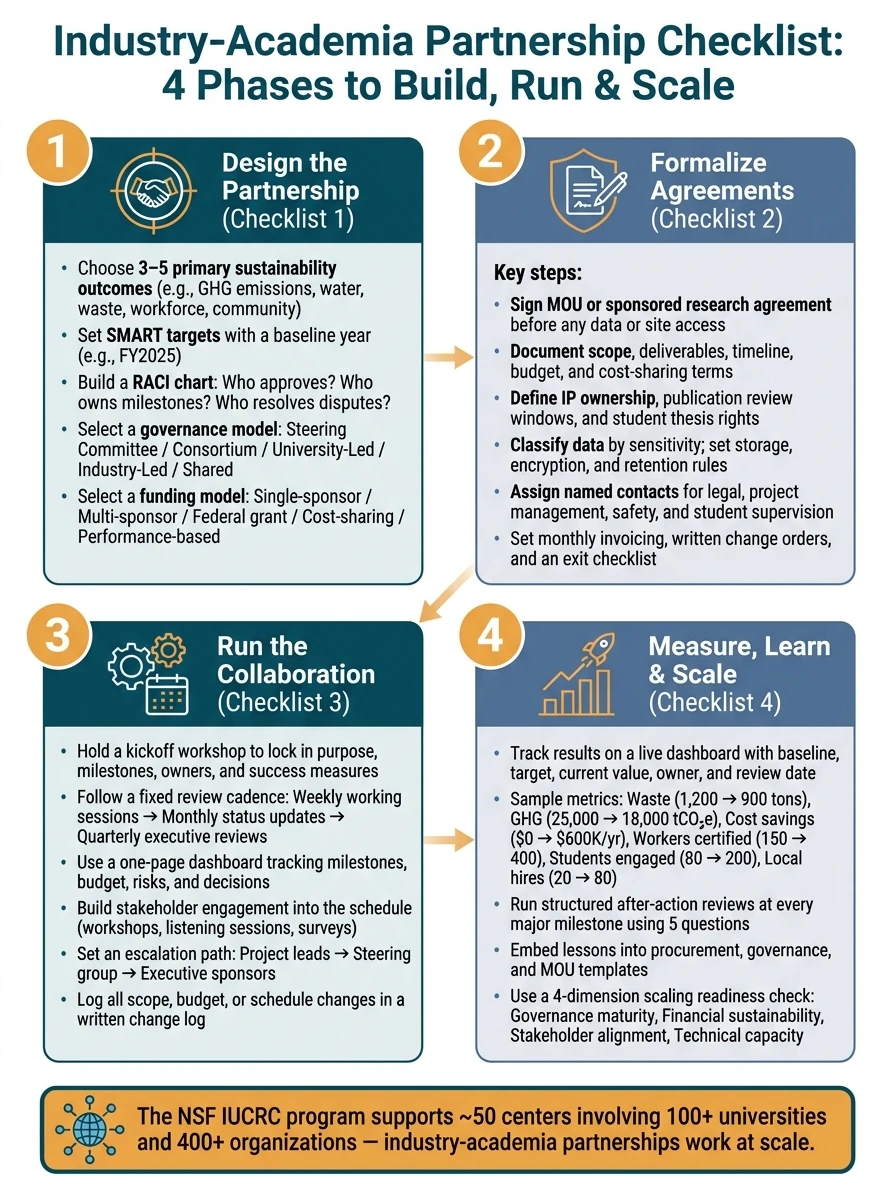
Industry-Academia Partnership Checklist: 4 Phases to Build, Run & Scale
Successful Academia-Industry Collaborations
Checklist 1: Design the Partnership Around Shared Outcomes and Clear Governance
Before the work begins, get aligned on three basics: outcomes, roles, and decision rights.
Agree on Shared Sustainability Outcomes
Start with the problem statement from the introduction and turn it into a short set of targets. The best targets serve both the company’s goals and the university’s mission. In most cases, that means choosing 3–5 primary sustainability outcomes across areas like climate mitigation, water stewardship, circularity and waste, workforce development, and community resilience.
A few examples make this concrete:
Climate mitigation: reducing CO₂e from a specific facility
Water stewardship: gallons saved against a baseline
Circularity and waste: tons diverted from landfill
Workforce development: students completing sustainability credentials
Community resilience: measurable gains in local air quality
To keep those targets grounded, set a baseline year such as FY2025 and apply SMART criteria to each goal. Use the GHG Protocol for emissions, EPA guidance for air and water, and BLS categories for workforce metrics. Write down your data sources and how results will be checked before the project starts, including whether you’ll rely on third-party audits or internal reporting. It also helps to name public-interest outcomes outright, such as environmental justice priorities or community health indicators. That can strengthen the case for funding and regulatory support.
Use these shared outcomes as the basis for roles and decision rights.
Map Stakeholders, Roles, and Decision Rights
Hold an early stakeholder workshop with people from both sides. Include anyone who shapes the project, feels its effects, or has formal authority over it. Then sort them into plain groups: strategic sponsors, project leads, technical and operations teams, students and early-career professionals, community and public-sector partners, and legal and compliance staff.
For each group, spell out core responsibilities, expected time commitments, and how communication should work. This kind of clarity cuts down on delays when research, operations, and compliance pull in different directions.
Next, build a RACI chart - Responsible, Accountable, Consulted, Informed. It should answer four direct questions:
Who approves budgets and contracts?
Who owns each milestone?
Who manages external communications?
Who has authority to resolve disputes?
Document these roles in a short stakeholder charter, and update it as the project shifts over time.[1]
Use the RACI chart to pick the governance model below.
Choose a Governance and Funding Model
A small pilot with two partners can often move fast under an industry-led or university-led setup. A multi-site, multi-stakeholder project with a strong public-interest dimension usually needs a steering committee or shared governance model to stay fair and accountable.[2] That’s why it helps to compare the options before locking one in.
Match the model to the project’s size, risk, and funding source. The goal is simple: find the structure that balances speed, accountability, and stakeholder voice.
Governance Models
Model | Speed | Transparency | Stakeholder Representation | Advantages | Tradeoffs |
|---|---|---|---|---|---|
Steering Committee | Moderate | High if minutes are shared | Good multi-group representation | Predictable decision cycles; broad buy-in | Not suited for rapid pivots |
Consortium | Slow | High for members | Broad; individual voices can be diluted | Shared risk; larger budgets | Complex governance; slower decisions |
University-Led | Moderate | Strong on academic outputs | Strong for students and faculty | Credibility; open-science norms | May underweight industry priorities |
Industry-Led | Fast | Variable; limited by IP concerns | Skewed toward business unless corrected | Reflects corporate decision cycles | Risk of sidelining academic and community interests |
Shared Governance | Moderate | High if co-governed processes are documented | Strong across all groups | Equitable; suited for public-interest projects | Balancing interests takes time |
Funding Structures
Structure | Stability | Transparency | Advantages | Tradeoffs |
|---|---|---|---|---|
Single-Sponsor Industry | High when aligned | Variable | Simple contracting; clear accountability | Vulnerable to business cycles; potential agenda imbalance |
Multi-Sponsor Consortium | Moderate; diversified | High for members | Shared risk; broader perspectives | Complex governance; competing interests |
Stable over grant term | High; open-science norms | Supports public-interest outcomes; enhances legitimacy | Administrative burden; strict compliance; limited flexibility | |
Cost-Sharing (cash + in-kind) | Tied to both parties' budgets | Moderate | Shared ownership; reduces financial risk | Requires careful valuation of in-kind contributions |
Performance-Based / Impact-Linked | Contingent on hitting targets | High | Strong incentive alignment; focuses on measurable impact | Risk of underfunding early phases; may favor easily quantified outcomes |
As a rule of thumb, shared governance paired with public funding fits community-facing projects well. For small, fast pilots, an industry-led cost-sharing setup is often a better fit.
Once the governance model is in place, you can formalize scope, budgets, and risk controls.
Checklist 2: Formalize Agreements, Infrastructure, and Risk Controls
Once outcomes and governance are set, the next step is simple: put the legal and operating terms in writing before any research starts, any data moves, or anyone gets site access. The shared plan needs to become a signed agreement package before proprietary data, materials, or facilities are exchanged. That includes the rules for scope, deliverables, confidentiality, IP ownership, publication rights, and liability - so the partnership’s sustainability assets are protected from day one, from facility data and emissions records to field samples and community data.
Document Scope, Deliverables, and Budget Commitments
For a small pilot, an MOU may be enough. For heavier work, a sponsored research package usually makes more sense. Either way, the document set should spell out the partnership’s purpose, scope, deliverables, timeline, milestones, reporting expectations, cost-sharing terms, and whether the agreement is nonbinding or legally binding.
Keep the scope tight. That’s one of the best ways to stop mission drift before it starts. Use plain language to describe the research question, pilot site, expected prototype, or policy output so there’s little room for confusion later.
The agreement should also make the money side plain. State who covers personnel time, student stipends, travel, materials, equipment, lab fees, software, and indirect costs. Note whether expenses are capped or require preapproval. Be just as clear about cost share. Faculty time, student stipends, equipment access, and lab fees may count as in-kind support, but only when both sides document and approve them up front.
For budget control, set a few hard rules:
Monthly invoicing with receipts for reimbursable costs
Written change orders for any increase above a preapproved threshold
Clear renewal terms, whether the agreement renews on its own, renews only by mutual written consent, or ends on a fixed date unless extended
An exit checklist covering return or destruction of confidential materials, data handoff, equipment return, final payments, and student responsibilities
Set Rules for IP, Data Sharing, and Confidentiality
This part needs precision. Define foreground and background IP, publication review windows, authorship rules, student thesis rights, data sensitivity levels, storage, encryption, retention, and limits on third-party sharing. Also address patent filing rights and whether students can include project work in theses or dissertations.
WIPO notes that in some university–industry collaborations, research may remain confidential until a patent filing is completed.[3] That’s why a set publication review window is such a useful standard. It gives both sides room to protect patent rights without freezing academic output.
For data, classify each dataset by sensitivity before any transfer begins. That matters most for items like emissions models, water data, waste audits, and pilot results. Then document where the data will live, who can access it, how incidents will be reported, how long the data will be kept, and what limits apply to third-party sharing.
NIH guidance specifically warns that collaborators should be engaged early so agreements don't unnecessarily restrict future data sharing.[4] In plain terms, don’t let a rushed contract create a problem you’ll spend months trying to unwind. Mark confidential materials clearly, limit access to people who need it for the project, and confirm that both parties’ IT and cybersecurity policies have been reviewed and approved.
These rules should be finished before any data transfer, publication review, or site access begins.
Assign Operational Responsibilities and Compliance Duties
Each side should name one contact for legal matters, project management, technical issues, and compliance. That step sounds small, but it cuts down on confusion when deadlines tighten or problems pop up.
A clean way to assign work is to group duties into four areas:
Legal: contract scope, amendments, IP schedule, and publication review process
Project management: scheduling, milestone tracking, deliverable approvals, and routine communications
Safety and site access: safety training, site access approvals, lab orientation, environmental health and safety compliance, permits, PPE requirements, emergency procedures, and escort rules for lab studies, site visits, environmental sampling, and facility operations
Student supervision: named faculty advisor, role descriptions, check-ins, and any required confidentiality or invention assignment agreements
If the project includes human subjects, environmental sampling, or regulated materials, note that extra institutional review or regulatory approvals may be needed before work starts.
Use the matrix below to assign owners, risks, and controls.
Domain | Responsible party | Major risks | Mitigation steps |
|---|---|---|---|
Contract scope and amendments | Joint legal/contract leads | Scope creep, delays, unclear obligations | Written scope, change-control process, version tracking |
Budget and reimbursement | Finance leads | Overruns, invoice disputes, delayed payments | Preapproved budget, monthly billing, receipt rules |
IP and publications | Research/IP leads | Loss of patent rights, blocked publication, ownership disputes | IP schedule, publication review window, invention disclosure process |
Data sharing and cybersecurity | IT/security leads | Data breach, unauthorized access, improper storage | Access controls, encryption, retention policy, incident plan |
Lab/site access and safety | Site manager and EH&S leads | Injury, equipment damage, access violations | Training, escort rules, PPE, emergency procedures |
Student supervision | Faculty advisor and project lead | Poor oversight, compliance issues, unclear expectations | Named supervisor, check-ins, role descriptions |
Procurement and equipment use | Operations/procurement leads | Delays, misuse, incompatible equipment | Approved vendors, booking rules, equipment logs |
Pull these areas into one approval flow so legal, finance, research, IT, and site teams aren’t working in silos. With the agreement package in place, the partnership can move into launch, communication, and review.
Checklist 3: Run the Collaboration With Clear Communication, Engagement, and Review Loops
Once the agreements are signed, the work shifts from planning to delivery. This is where many partnerships either find their rhythm or start to wobble. Even strong technical work can miss the mark if it lands too late or reaches the wrong people. That’s why communication, engagement, and review loops need to be part of the schedule from day one.
Co-Design the Work Plan and Launch the Project
A kickoff workshop should lock in the basics: project purpose, problem statement, deliverables, timeline, meeting cadence, owners, and success measures. It should also spell out who owns each workstream and who makes each decision.
The work plan should begin with a clear business or sustainability need, such as cutting facility emissions, and connect each milestone to a real decision the industry partner needs to make. In plain terms, every step should help move one of the partnership’s target outcomes forward. Industry partners should pressure-test the scope against day-to-day limits, while academic partners confirm the method is rigorous enough to be credible. That back-and-forth is what separates useful research from a polished report that shows up after the window to act has closed.
For reporting, consistency matters more than flair. A steady cadence keeps everyone on the same page:
Weekly working sessions
Monthly status updates
Quarterly executive reviews
A one-page dashboard that tracks milestones, budget, risks, decisions, and assumption changes will usually flag delays and dependencies faster than a long narrative update. A solid kickoff should end with a written project charter, a milestone calendar, and a risk log.
Tie every milestone to the shared outcomes defined earlier.
Build Stakeholder Engagement Into the Process
Engagement should not be treated like a side task. Build it into the schedule from the start, and match the method to the decision at hand. Workshops are useful when the group needs to shape solutions together. Listening sessions can bring out concerns from employees, students, or community members before those concerns turn into conflict. Technical reviews help subject-matter experts check the method. Short surveys help when many people need to weigh in fast.
If the project touches land use, environmental exposure, or workforce transitions, community engagement needs to be named outright in the plan. Use the stakeholder chart to decide who should join each touchpoint and when.
Engagement approach | When stakeholders are involved | Likely outcome |
|---|---|---|
Reactive monitoring | After problems arise; occasional check-ins; informal updates | Higher risk of misalignment, rework, and loss of trust; easier to miss drift |
Proactive monitoring | Early and throughout; scheduled touchpoints; documented decisions | Better alignment, stronger buy-in, more usable deliverables, and easier adaptation |
A UNIDO partnership review found that several public-private partnerships performed well at the output level but were weaker or underreported at the outcome and impact levels. [5]
That gap is exactly what proactive, steady engagement is meant to close.
Use scheduled touchpoints to bring issues into the open before they turn into change requests.
Review Progress, Resolve Conflicts, and Adjust Terms
Use the same meeting cadence to check whether the project still serves its original goal. Monthly or quarterly reviews should look at milestone status, budget burn, data quality, stakeholder feedback, and alignment with the shared sustainability goal. If the partnership is tied to climate or resilience work, those reviews should also ask whether outside conditions, such as supply chain shocks, policy shifts, or extreme weather events, call for a revised approach. Each review should end with clear decisions, named action owners, and deadlines.
It also helps to set an escalation path before anything goes wrong. Technical issues should move first to project leads, then to the steering group, and then to executive sponsors if needed. If leadership changes midstream, prepare a formal transition brief so the incoming sponsor understands the project’s purpose, current status, and obligations.
Any change should be tested against the agreed scope, budget, and outcomes. If scope, budget, schedule, data access, staffing, or deliverables change, record it in a change log or amendment. That record should show what changed, why it changed, who approved it, and what it means for scope, schedule, or budget. Written documentation protects both sides and keeps the reasoning out in the open.
Checklist 4: Measure Impact, Build Long-Term Value, and Scale What Works
Define and Track Results Across Key Outcome Areas
Once the collaboration is in motion, the next job is simple in theory and often messy in practice: check whether the partnership is producing results. Impact has to show up in numbers, dates, and named owners. Take the outcomes already agreed on and turn them into a dashboard with a baseline, target, data source, review date, and one person who owns each line.
The table below gives you a practical starting point.[7] Shape the rows around your partnership’s scope. This is the monitoring layer for the goals set in Checklist 1, not a new set of goals.
Outcome Area | Metric | Baseline (Value/Year) | Target (Value/Year) | Current value/date | Responsible Owner | Data Source/System | Next Review Date |
|---|---|---|---|---|---|---|---|
Waste Reduction | Tons of landfill waste/year | 1,200 tons (2024) | 900 tons (2027) | 1,050 tons (Q2 2026) | Facilities Director | Waste hauler reports | Oct 15, 2026 |
Energy Use | kWh per sq ft/year | 14 kWh/sq ft (2024) | 11 kWh/sq ft (2028) | 13 kWh/sq ft (2025) | Plant Manager | Utility bills, EMS | Sep 30, 2026 |
GHG Emissions | Metric tons CO₂e/year | 25,000 tCO₂e (2024) | 18,000 tCO₂e (2030) | 23,500 tCO₂e (2025) | Joint Sustainability Lead | GHG inventory tool | Dec 1, 2026 |
Workforce development | Workers with green skills certification | 150 workers (2024) | 400 workers (2027) | 260 workers (2026) | HR Director | Training platform, HR records | Nov 1, 2026 |
Student Outcomes | Students in applied projects | 80 students (2024) | 200 students (2026) | 140 students (2025) | Academic Program Lead | Registrar, project logs | Aug 30, 2026 |
Cost Savings | Annual operating savings (USD) | $0 (pre-project) | $600,000/year (2027) | $180,000 (2025) | Joint Finance Lead | Financial reports | Jan 15, 2027 |
Community Benefit | Local hires in project roles | 20 hires (2024) | 80 hires (2027) | 45 hires (2025) | Community Engagement Officer | HR system, partner reports | Oct 1, 2026 |
Store this table in a shared platform and update it at every governance review. If the dashboard lives in one person’s files, it won’t guide decisions when things drift.
Capture Lessons and Embed Them in Policy and Practice
Every review cycle should do more than report progress. It should turn lessons into changes in procurement, governance, and day-to-day operations. Most partnerships learn a lot as they go. Far fewer turn that learning into repeatable practice. That’s where teams need to get more deliberate.
A useful way to do that is to ask a few blunt questions: What worked? What slowed us down? What should we never do again? Those questions cut through vague status updates and get people talking about what the partnership is actually teaching them.
Run a structured after-action review at each major milestone, not only at the end. Use five questions:
What was supposed to happen?
What actually happened?
What worked?
What didn't?
What will we do differently next time?
Log the answers by category: procurement, research administration, community engagement, risk management, and governance. Over time, those records start to show patterns. And patterns matter. If the same problem keeps surfacing, that’s usually a sign the system needs to change, not just the project team.
That change might look very practical: a pre-approved data-sharing clause added to the standard MOU template, a faster ethics review path for environmental pilots, or a community engagement protocol that applies to every future project involving local neighborhoods. The point is to move what worked out of meeting notes and into the way the institution operates - inside procurement criteria, sustainability plans, and research administration workflows.
Build a Combined Lifecycle Checklist and Scaling Plan
Once results are validated, the next test is whether the model can be repeated under the same governance, funding, and stakeholder conditions. Scaling is not just about doing more. It’s about showing that the model holds up when repeated. Before expanding to more sites, campuses, business units, or regions, use the table below to check readiness.
Scaling Dimension | What "Ready" Looks Like | Common Gap to Address |
|---|---|---|
Governance Maturity | Formalized steering committee with clear decision rights and conflict resolution protocols | Informal leadership that doesn't transfer when key people leave |
Financial Sustainability | Proven cost savings or ROI that can seed ongoing funding (e.g., a Green Revolving Fund); multiple funding sources stacked | Over-reliance on a single grant with no transition plan |
Stakeholder Alignment | Pragmatic leaders engaged; community partners hold real decision-making authority | Broad outreach without meaningful buy-in from those most affected |
Technical Capacity | Documented standard practices and modular design that can be replicated without starting from scratch | Tacit knowledge held by a few individuals rather than written into procedures |
A regional example shows what this can look like when alignment is already in place. A coalition of 35 organizations - 14 municipalities, 12 businesses, 5 NGOs, and 4 academic institutions - coordinated $280 million in climate investments and launched a clean energy procurement collaborative that aggregated 420 GWh of demand, saving participants $12 million annually.[6] Results like that do not come from luck. They depend on governance, financing, and stakeholder groundwork being in place before expansion starts.
Academic leads, industry leads, and partnership facilitators should keep tracking the metrics and actions they already own from Checklists 1 and 2, then feed those findings into the scaling assessment above.
FAQs
How do I choose the right governance model?
Choose a governance model that lines up with your institution’s climate goals and can support long-term collaboration, decision-making, and resource management. In plain terms, this is about picking a setup that works on paper and in day-to-day practice. A contractual agreement, joint venture, or hybrid model may each make sense, depending on your goals, risk tolerance, and how closely you want partners to work together.
The right model should balance clear accountability with enough flexibility to work across different organizational cultures and priorities. That balance matters. If the structure is too rigid, teams can get stuck. If it’s too loose, ownership gets blurry and progress can drift. Council Fire helps partners build governance structures that support shared decision-making and transparent metrics.
What should be signed before the project starts?
Before the project starts, partners should sign a Memorandum of Understanding (MOU). It puts the partnership in writing and gives the work a clear frame from day one.
A strong MOU spells out roles and responsibilities, lines up each partner’s efforts, supports accountability, and keeps the project pointed toward shared sustainability goals.
Which metrics matter most for partnership success?
Focus on metrics that tie day-to-day work to long-term impact, not just simple output counts like the number of meetings held. That shift matters. A packed calendar can look busy on paper, but it doesn’t tell you much about what changed, for whom, or whether the work is moving in the right direction.
The Impact Pathway Framework helps make that link clear by connecting actions to intermediate results and then to final outcomes. In plain terms, it shows how an activity is supposed to lead to change over time, so teams can track progress with more than surface-level numbers.
It also helps to lean on standardized metrics where possible. Use measures such as science-based targets or intensity-based indicators like CO₂ equivalent per megawatt-hour. These metrics make performance easier to compare across time periods, projects, and teams.
Stakeholder engagement needs the same level of care. Don’t just track whether engagement happened. Track its quality through measures like participation diversity and stakeholder satisfaction. Those signals give a better read on whether people were meaningfully involved or just present.
Related Blog Posts
Latest Articles
©2026

Narrative Change and Power Building: The Missing Half of Advocacy
Narrative change is the process of disrupting dominant narratives that normalize inequity and advancing new narratives from historically marginalized communities.

Funding Resilience Without Federal Grants
BRIC is unreliable and FEMA is shrinking. Here's how cities fund climate resilience with dedicated revenue, blended finance, and a coordinating authority.

The ESG Blind Spot: How AI Is Finding Risks in Companies Nobody Else Is Watching
Norway's sovereign wealth fund uses AI to screen 7,200 portfolio companies for forced labor and corruption within 24 hours. The real story is the emerging-market coverage gap that traditional ESG data vendors miss — and what it means for any company with a global supply chain.
Narrative Change and Power Building: The Missing Half of Advocacy
Narrative change is the process of disrupting dominant narratives that normalize inequity and advancing new narratives from historically marginalized communities.
Funding Resilience Without Federal Grants
BRIC is unreliable and FEMA is shrinking. Here's how cities fund climate resilience with dedicated revenue, blended finance, and a coordinating authority.
The ESG Blind Spot: How AI Is Finding Risks in Companies Nobody Else Is Watching
Norway's sovereign wealth fund uses AI to screen 7,200 portfolio companies for forced labor and corruption within 24 hours. The real story is the emerging-market coverage gap that traditional ESG data vendors miss — and what it means for any company with a global supply chain.
FAQ
01
What does it really mean to “redefine profit”?
02
What makes Council Fire different?
03
Who does Council Fire work with?
04
What does working with Council Fire actually look like?
05
How does Council Fire help organizations turn big goals into action?
06
How does Council Fire define and measure success?
07
How does technology fit into Council Fire’s work?
Jul 10, 2026
Checklist for Building Industry-Academia Partnerships
Sustainability Strategy
In This Article
Practical checklist for industry–academic sustainability partnerships: set targets, governance, contracts, metrics, reviews, and scale plans.
Checklist for Building Industry-Academia Partnerships
If I want an industry-academia partnership to work, I need four things in place from the start: a clear goal, clear roles, signed rules, and a way to track results. This article shows how to do that step by step for projects tied to emissions, water, waste, jobs, and community outcomes.
I’d boil it down like this:
Pick one specific problem first.
Think:
cut facility greenhouse gas emissions by 30% by 2030 instead of “improve sustainability.”
Set shared targets and decision rules.
The article recommends
3–5 main outcome areas and a RACI chart so everyone knows who approves, who does the work, and who settles disputes.
Choose a governance and funding setup that fits the job.
Small pilots may work with a simple industry-led setup. Larger projects with public impact may need shared governance, a steering group, or grant support.
Put scope, budget, IP, data, and confidentiality in writing before work starts.
That includes deliverables, publication review timing, data access, site access, safety rules, and who pays for what.
Run the project on a fixed review cycle.
Weekly working sessions, monthly updates, and quarterly leadership reviews help keep work on time and cut drift.
Track results with a live dashboard.
The sample metrics cover waste, energy, GHG emissions,
workforce training, student outcomes, cost savings, and community hiring.
Turn lessons into the next playbook.
The article closes with after-action reviews and a scale-up check so one pilot can inform the next one.
One stat helps show why this matters: the NSF IUCRC program supports about 50 centers, involving 100+ universities and 400 organizations. So this is not a fringe model - it is already being used at scale.
If I’m building one of these partnerships, this piece gives me a plain checklist for planning, contracting, running, measuring, and expanding the work without losing control of scope or results.
Industry-Academia Partnership Checklist: 4 Phases to Build, Run & Scale
Successful Academia-Industry Collaborations
Checklist 1: Design the Partnership Around Shared Outcomes and Clear Governance
Before the work begins, get aligned on three basics: outcomes, roles, and decision rights.
Agree on Shared Sustainability Outcomes
Start with the problem statement from the introduction and turn it into a short set of targets. The best targets serve both the company’s goals and the university’s mission. In most cases, that means choosing 3–5 primary sustainability outcomes across areas like climate mitigation, water stewardship, circularity and waste, workforce development, and community resilience.
A few examples make this concrete:
Climate mitigation: reducing CO₂e from a specific facility
Water stewardship: gallons saved against a baseline
Circularity and waste: tons diverted from landfill
Workforce development: students completing sustainability credentials
Community resilience: measurable gains in local air quality
To keep those targets grounded, set a baseline year such as FY2025 and apply SMART criteria to each goal. Use the GHG Protocol for emissions, EPA guidance for air and water, and BLS categories for workforce metrics. Write down your data sources and how results will be checked before the project starts, including whether you’ll rely on third-party audits or internal reporting. It also helps to name public-interest outcomes outright, such as environmental justice priorities or community health indicators. That can strengthen the case for funding and regulatory support.
Use these shared outcomes as the basis for roles and decision rights.
Map Stakeholders, Roles, and Decision Rights
Hold an early stakeholder workshop with people from both sides. Include anyone who shapes the project, feels its effects, or has formal authority over it. Then sort them into plain groups: strategic sponsors, project leads, technical and operations teams, students and early-career professionals, community and public-sector partners, and legal and compliance staff.
For each group, spell out core responsibilities, expected time commitments, and how communication should work. This kind of clarity cuts down on delays when research, operations, and compliance pull in different directions.
Next, build a RACI chart - Responsible, Accountable, Consulted, Informed. It should answer four direct questions:
Who approves budgets and contracts?
Who owns each milestone?
Who manages external communications?
Who has authority to resolve disputes?
Document these roles in a short stakeholder charter, and update it as the project shifts over time.[1]
Use the RACI chart to pick the governance model below.
Choose a Governance and Funding Model
A small pilot with two partners can often move fast under an industry-led or university-led setup. A multi-site, multi-stakeholder project with a strong public-interest dimension usually needs a steering committee or shared governance model to stay fair and accountable.[2] That’s why it helps to compare the options before locking one in.
Match the model to the project’s size, risk, and funding source. The goal is simple: find the structure that balances speed, accountability, and stakeholder voice.
Governance Models
Model | Speed | Transparency | Stakeholder Representation | Advantages | Tradeoffs |
|---|---|---|---|---|---|
Steering Committee | Moderate | High if minutes are shared | Good multi-group representation | Predictable decision cycles; broad buy-in | Not suited for rapid pivots |
Consortium | Slow | High for members | Broad; individual voices can be diluted | Shared risk; larger budgets | Complex governance; slower decisions |
University-Led | Moderate | Strong on academic outputs | Strong for students and faculty | Credibility; open-science norms | May underweight industry priorities |
Industry-Led | Fast | Variable; limited by IP concerns | Skewed toward business unless corrected | Reflects corporate decision cycles | Risk of sidelining academic and community interests |
Shared Governance | Moderate | High if co-governed processes are documented | Strong across all groups | Equitable; suited for public-interest projects | Balancing interests takes time |
Funding Structures
Structure | Stability | Transparency | Advantages | Tradeoffs |
|---|---|---|---|---|
Single-Sponsor Industry | High when aligned | Variable | Simple contracting; clear accountability | Vulnerable to business cycles; potential agenda imbalance |
Multi-Sponsor Consortium | Moderate; diversified | High for members | Shared risk; broader perspectives | Complex governance; competing interests |
Stable over grant term | High; open-science norms | Supports public-interest outcomes; enhances legitimacy | Administrative burden; strict compliance; limited flexibility | |
Cost-Sharing (cash + in-kind) | Tied to both parties' budgets | Moderate | Shared ownership; reduces financial risk | Requires careful valuation of in-kind contributions |
Performance-Based / Impact-Linked | Contingent on hitting targets | High | Strong incentive alignment; focuses on measurable impact | Risk of underfunding early phases; may favor easily quantified outcomes |
As a rule of thumb, shared governance paired with public funding fits community-facing projects well. For small, fast pilots, an industry-led cost-sharing setup is often a better fit.
Once the governance model is in place, you can formalize scope, budgets, and risk controls.
Checklist 2: Formalize Agreements, Infrastructure, and Risk Controls
Once outcomes and governance are set, the next step is simple: put the legal and operating terms in writing before any research starts, any data moves, or anyone gets site access. The shared plan needs to become a signed agreement package before proprietary data, materials, or facilities are exchanged. That includes the rules for scope, deliverables, confidentiality, IP ownership, publication rights, and liability - so the partnership’s sustainability assets are protected from day one, from facility data and emissions records to field samples and community data.
Document Scope, Deliverables, and Budget Commitments
For a small pilot, an MOU may be enough. For heavier work, a sponsored research package usually makes more sense. Either way, the document set should spell out the partnership’s purpose, scope, deliverables, timeline, milestones, reporting expectations, cost-sharing terms, and whether the agreement is nonbinding or legally binding.
Keep the scope tight. That’s one of the best ways to stop mission drift before it starts. Use plain language to describe the research question, pilot site, expected prototype, or policy output so there’s little room for confusion later.
The agreement should also make the money side plain. State who covers personnel time, student stipends, travel, materials, equipment, lab fees, software, and indirect costs. Note whether expenses are capped or require preapproval. Be just as clear about cost share. Faculty time, student stipends, equipment access, and lab fees may count as in-kind support, but only when both sides document and approve them up front.
For budget control, set a few hard rules:
Monthly invoicing with receipts for reimbursable costs
Written change orders for any increase above a preapproved threshold
Clear renewal terms, whether the agreement renews on its own, renews only by mutual written consent, or ends on a fixed date unless extended
An exit checklist covering return or destruction of confidential materials, data handoff, equipment return, final payments, and student responsibilities
Set Rules for IP, Data Sharing, and Confidentiality
This part needs precision. Define foreground and background IP, publication review windows, authorship rules, student thesis rights, data sensitivity levels, storage, encryption, retention, and limits on third-party sharing. Also address patent filing rights and whether students can include project work in theses or dissertations.
WIPO notes that in some university–industry collaborations, research may remain confidential until a patent filing is completed.[3] That’s why a set publication review window is such a useful standard. It gives both sides room to protect patent rights without freezing academic output.
For data, classify each dataset by sensitivity before any transfer begins. That matters most for items like emissions models, water data, waste audits, and pilot results. Then document where the data will live, who can access it, how incidents will be reported, how long the data will be kept, and what limits apply to third-party sharing.
NIH guidance specifically warns that collaborators should be engaged early so agreements don't unnecessarily restrict future data sharing.[4] In plain terms, don’t let a rushed contract create a problem you’ll spend months trying to unwind. Mark confidential materials clearly, limit access to people who need it for the project, and confirm that both parties’ IT and cybersecurity policies have been reviewed and approved.
These rules should be finished before any data transfer, publication review, or site access begins.
Assign Operational Responsibilities and Compliance Duties
Each side should name one contact for legal matters, project management, technical issues, and compliance. That step sounds small, but it cuts down on confusion when deadlines tighten or problems pop up.
A clean way to assign work is to group duties into four areas:
Legal: contract scope, amendments, IP schedule, and publication review process
Project management: scheduling, milestone tracking, deliverable approvals, and routine communications
Safety and site access: safety training, site access approvals, lab orientation, environmental health and safety compliance, permits, PPE requirements, emergency procedures, and escort rules for lab studies, site visits, environmental sampling, and facility operations
Student supervision: named faculty advisor, role descriptions, check-ins, and any required confidentiality or invention assignment agreements
If the project includes human subjects, environmental sampling, or regulated materials, note that extra institutional review or regulatory approvals may be needed before work starts.
Use the matrix below to assign owners, risks, and controls.
Domain | Responsible party | Major risks | Mitigation steps |
|---|---|---|---|
Contract scope and amendments | Joint legal/contract leads | Scope creep, delays, unclear obligations | Written scope, change-control process, version tracking |
Budget and reimbursement | Finance leads | Overruns, invoice disputes, delayed payments | Preapproved budget, monthly billing, receipt rules |
IP and publications | Research/IP leads | Loss of patent rights, blocked publication, ownership disputes | IP schedule, publication review window, invention disclosure process |
Data sharing and cybersecurity | IT/security leads | Data breach, unauthorized access, improper storage | Access controls, encryption, retention policy, incident plan |
Lab/site access and safety | Site manager and EH&S leads | Injury, equipment damage, access violations | Training, escort rules, PPE, emergency procedures |
Student supervision | Faculty advisor and project lead | Poor oversight, compliance issues, unclear expectations | Named supervisor, check-ins, role descriptions |
Procurement and equipment use | Operations/procurement leads | Delays, misuse, incompatible equipment | Approved vendors, booking rules, equipment logs |
Pull these areas into one approval flow so legal, finance, research, IT, and site teams aren’t working in silos. With the agreement package in place, the partnership can move into launch, communication, and review.
Checklist 3: Run the Collaboration With Clear Communication, Engagement, and Review Loops
Once the agreements are signed, the work shifts from planning to delivery. This is where many partnerships either find their rhythm or start to wobble. Even strong technical work can miss the mark if it lands too late or reaches the wrong people. That’s why communication, engagement, and review loops need to be part of the schedule from day one.
Co-Design the Work Plan and Launch the Project
A kickoff workshop should lock in the basics: project purpose, problem statement, deliverables, timeline, meeting cadence, owners, and success measures. It should also spell out who owns each workstream and who makes each decision.
The work plan should begin with a clear business or sustainability need, such as cutting facility emissions, and connect each milestone to a real decision the industry partner needs to make. In plain terms, every step should help move one of the partnership’s target outcomes forward. Industry partners should pressure-test the scope against day-to-day limits, while academic partners confirm the method is rigorous enough to be credible. That back-and-forth is what separates useful research from a polished report that shows up after the window to act has closed.
For reporting, consistency matters more than flair. A steady cadence keeps everyone on the same page:
Weekly working sessions
Monthly status updates
Quarterly executive reviews
A one-page dashboard that tracks milestones, budget, risks, decisions, and assumption changes will usually flag delays and dependencies faster than a long narrative update. A solid kickoff should end with a written project charter, a milestone calendar, and a risk log.
Tie every milestone to the shared outcomes defined earlier.
Build Stakeholder Engagement Into the Process
Engagement should not be treated like a side task. Build it into the schedule from the start, and match the method to the decision at hand. Workshops are useful when the group needs to shape solutions together. Listening sessions can bring out concerns from employees, students, or community members before those concerns turn into conflict. Technical reviews help subject-matter experts check the method. Short surveys help when many people need to weigh in fast.
If the project touches land use, environmental exposure, or workforce transitions, community engagement needs to be named outright in the plan. Use the stakeholder chart to decide who should join each touchpoint and when.
Engagement approach | When stakeholders are involved | Likely outcome |
|---|---|---|
Reactive monitoring | After problems arise; occasional check-ins; informal updates | Higher risk of misalignment, rework, and loss of trust; easier to miss drift |
Proactive monitoring | Early and throughout; scheduled touchpoints; documented decisions | Better alignment, stronger buy-in, more usable deliverables, and easier adaptation |
A UNIDO partnership review found that several public-private partnerships performed well at the output level but were weaker or underreported at the outcome and impact levels. [5]
That gap is exactly what proactive, steady engagement is meant to close.
Use scheduled touchpoints to bring issues into the open before they turn into change requests.
Review Progress, Resolve Conflicts, and Adjust Terms
Use the same meeting cadence to check whether the project still serves its original goal. Monthly or quarterly reviews should look at milestone status, budget burn, data quality, stakeholder feedback, and alignment with the shared sustainability goal. If the partnership is tied to climate or resilience work, those reviews should also ask whether outside conditions, such as supply chain shocks, policy shifts, or extreme weather events, call for a revised approach. Each review should end with clear decisions, named action owners, and deadlines.
It also helps to set an escalation path before anything goes wrong. Technical issues should move first to project leads, then to the steering group, and then to executive sponsors if needed. If leadership changes midstream, prepare a formal transition brief so the incoming sponsor understands the project’s purpose, current status, and obligations.
Any change should be tested against the agreed scope, budget, and outcomes. If scope, budget, schedule, data access, staffing, or deliverables change, record it in a change log or amendment. That record should show what changed, why it changed, who approved it, and what it means for scope, schedule, or budget. Written documentation protects both sides and keeps the reasoning out in the open.
Checklist 4: Measure Impact, Build Long-Term Value, and Scale What Works
Define and Track Results Across Key Outcome Areas
Once the collaboration is in motion, the next job is simple in theory and often messy in practice: check whether the partnership is producing results. Impact has to show up in numbers, dates, and named owners. Take the outcomes already agreed on and turn them into a dashboard with a baseline, target, data source, review date, and one person who owns each line.
The table below gives you a practical starting point.[7] Shape the rows around your partnership’s scope. This is the monitoring layer for the goals set in Checklist 1, not a new set of goals.
Outcome Area | Metric | Baseline (Value/Year) | Target (Value/Year) | Current value/date | Responsible Owner | Data Source/System | Next Review Date |
|---|---|---|---|---|---|---|---|
Waste Reduction | Tons of landfill waste/year | 1,200 tons (2024) | 900 tons (2027) | 1,050 tons (Q2 2026) | Facilities Director | Waste hauler reports | Oct 15, 2026 |
Energy Use | kWh per sq ft/year | 14 kWh/sq ft (2024) | 11 kWh/sq ft (2028) | 13 kWh/sq ft (2025) | Plant Manager | Utility bills, EMS | Sep 30, 2026 |
GHG Emissions | Metric tons CO₂e/year | 25,000 tCO₂e (2024) | 18,000 tCO₂e (2030) | 23,500 tCO₂e (2025) | Joint Sustainability Lead | GHG inventory tool | Dec 1, 2026 |
Workforce development | Workers with green skills certification | 150 workers (2024) | 400 workers (2027) | 260 workers (2026) | HR Director | Training platform, HR records | Nov 1, 2026 |
Student Outcomes | Students in applied projects | 80 students (2024) | 200 students (2026) | 140 students (2025) | Academic Program Lead | Registrar, project logs | Aug 30, 2026 |
Cost Savings | Annual operating savings (USD) | $0 (pre-project) | $600,000/year (2027) | $180,000 (2025) | Joint Finance Lead | Financial reports | Jan 15, 2027 |
Community Benefit | Local hires in project roles | 20 hires (2024) | 80 hires (2027) | 45 hires (2025) | Community Engagement Officer | HR system, partner reports | Oct 1, 2026 |
Store this table in a shared platform and update it at every governance review. If the dashboard lives in one person’s files, it won’t guide decisions when things drift.
Capture Lessons and Embed Them in Policy and Practice
Every review cycle should do more than report progress. It should turn lessons into changes in procurement, governance, and day-to-day operations. Most partnerships learn a lot as they go. Far fewer turn that learning into repeatable practice. That’s where teams need to get more deliberate.
A useful way to do that is to ask a few blunt questions: What worked? What slowed us down? What should we never do again? Those questions cut through vague status updates and get people talking about what the partnership is actually teaching them.
Run a structured after-action review at each major milestone, not only at the end. Use five questions:
What was supposed to happen?
What actually happened?
What worked?
What didn't?
What will we do differently next time?
Log the answers by category: procurement, research administration, community engagement, risk management, and governance. Over time, those records start to show patterns. And patterns matter. If the same problem keeps surfacing, that’s usually a sign the system needs to change, not just the project team.
That change might look very practical: a pre-approved data-sharing clause added to the standard MOU template, a faster ethics review path for environmental pilots, or a community engagement protocol that applies to every future project involving local neighborhoods. The point is to move what worked out of meeting notes and into the way the institution operates - inside procurement criteria, sustainability plans, and research administration workflows.
Build a Combined Lifecycle Checklist and Scaling Plan
Once results are validated, the next test is whether the model can be repeated under the same governance, funding, and stakeholder conditions. Scaling is not just about doing more. It’s about showing that the model holds up when repeated. Before expanding to more sites, campuses, business units, or regions, use the table below to check readiness.
Scaling Dimension | What "Ready" Looks Like | Common Gap to Address |
|---|---|---|
Governance Maturity | Formalized steering committee with clear decision rights and conflict resolution protocols | Informal leadership that doesn't transfer when key people leave |
Financial Sustainability | Proven cost savings or ROI that can seed ongoing funding (e.g., a Green Revolving Fund); multiple funding sources stacked | Over-reliance on a single grant with no transition plan |
Stakeholder Alignment | Pragmatic leaders engaged; community partners hold real decision-making authority | Broad outreach without meaningful buy-in from those most affected |
Technical Capacity | Documented standard practices and modular design that can be replicated without starting from scratch | Tacit knowledge held by a few individuals rather than written into procedures |
A regional example shows what this can look like when alignment is already in place. A coalition of 35 organizations - 14 municipalities, 12 businesses, 5 NGOs, and 4 academic institutions - coordinated $280 million in climate investments and launched a clean energy procurement collaborative that aggregated 420 GWh of demand, saving participants $12 million annually.[6] Results like that do not come from luck. They depend on governance, financing, and stakeholder groundwork being in place before expansion starts.
Academic leads, industry leads, and partnership facilitators should keep tracking the metrics and actions they already own from Checklists 1 and 2, then feed those findings into the scaling assessment above.
FAQs
How do I choose the right governance model?
Choose a governance model that lines up with your institution’s climate goals and can support long-term collaboration, decision-making, and resource management. In plain terms, this is about picking a setup that works on paper and in day-to-day practice. A contractual agreement, joint venture, or hybrid model may each make sense, depending on your goals, risk tolerance, and how closely you want partners to work together.
The right model should balance clear accountability with enough flexibility to work across different organizational cultures and priorities. That balance matters. If the structure is too rigid, teams can get stuck. If it’s too loose, ownership gets blurry and progress can drift. Council Fire helps partners build governance structures that support shared decision-making and transparent metrics.
What should be signed before the project starts?
Before the project starts, partners should sign a Memorandum of Understanding (MOU). It puts the partnership in writing and gives the work a clear frame from day one.
A strong MOU spells out roles and responsibilities, lines up each partner’s efforts, supports accountability, and keeps the project pointed toward shared sustainability goals.
Which metrics matter most for partnership success?
Focus on metrics that tie day-to-day work to long-term impact, not just simple output counts like the number of meetings held. That shift matters. A packed calendar can look busy on paper, but it doesn’t tell you much about what changed, for whom, or whether the work is moving in the right direction.
The Impact Pathway Framework helps make that link clear by connecting actions to intermediate results and then to final outcomes. In plain terms, it shows how an activity is supposed to lead to change over time, so teams can track progress with more than surface-level numbers.
It also helps to lean on standardized metrics where possible. Use measures such as science-based targets or intensity-based indicators like CO₂ equivalent per megawatt-hour. These metrics make performance easier to compare across time periods, projects, and teams.
Stakeholder engagement needs the same level of care. Don’t just track whether engagement happened. Track its quality through measures like participation diversity and stakeholder satisfaction. Those signals give a better read on whether people were meaningfully involved or just present.
Related Blog Posts
Latest Articles
©2026
Narrative Change and Power Building: The Missing Half of Advocacy
Narrative change is the process of disrupting dominant narratives that normalize inequity and advancing new narratives from historically marginalized communities.
Funding Resilience Without Federal Grants
BRIC is unreliable and FEMA is shrinking. Here's how cities fund climate resilience with dedicated revenue, blended finance, and a coordinating authority.
The ESG Blind Spot: How AI Is Finding Risks in Companies Nobody Else Is Watching
Norway's sovereign wealth fund uses AI to screen 7,200 portfolio companies for forced labor and corruption within 24 hours. The real story is the emerging-market coverage gap that traditional ESG data vendors miss — and what it means for any company with a global supply chain.
FAQ
01
What does it really mean to “redefine profit”?
02
What makes Council Fire different?
03
Who does Council Fire work with?
04
What does working with Council Fire actually look like?
05
How does Council Fire help organizations turn big goals into action?
06
How does Council Fire define and measure success?
07
How does technology fit into Council Fire’s work?
Jul 10, 2026
Checklist for Building Industry-Academia Partnerships
Sustainability Strategy
In This Article
Practical checklist for industry–academic sustainability partnerships: set targets, governance, contracts, metrics, reviews, and scale plans.
Checklist for Building Industry-Academia Partnerships
If I want an industry-academia partnership to work, I need four things in place from the start: a clear goal, clear roles, signed rules, and a way to track results. This article shows how to do that step by step for projects tied to emissions, water, waste, jobs, and community outcomes.
I’d boil it down like this:
Pick one specific problem first.
Think:
cut facility greenhouse gas emissions by 30% by 2030 instead of “improve sustainability.”
Set shared targets and decision rules.
The article recommends
3–5 main outcome areas and a RACI chart so everyone knows who approves, who does the work, and who settles disputes.
Choose a governance and funding setup that fits the job.
Small pilots may work with a simple industry-led setup. Larger projects with public impact may need shared governance, a steering group, or grant support.
Put scope, budget, IP, data, and confidentiality in writing before work starts.
That includes deliverables, publication review timing, data access, site access, safety rules, and who pays for what.
Run the project on a fixed review cycle.
Weekly working sessions, monthly updates, and quarterly leadership reviews help keep work on time and cut drift.
Track results with a live dashboard.
The sample metrics cover waste, energy, GHG emissions,
workforce training, student outcomes, cost savings, and community hiring.
Turn lessons into the next playbook.
The article closes with after-action reviews and a scale-up check so one pilot can inform the next one.
One stat helps show why this matters: the NSF IUCRC program supports about 50 centers, involving 100+ universities and 400 organizations. So this is not a fringe model - it is already being used at scale.
If I’m building one of these partnerships, this piece gives me a plain checklist for planning, contracting, running, measuring, and expanding the work without losing control of scope or results.
Industry-Academia Partnership Checklist: 4 Phases to Build, Run & Scale
Successful Academia-Industry Collaborations
Checklist 1: Design the Partnership Around Shared Outcomes and Clear Governance
Before the work begins, get aligned on three basics: outcomes, roles, and decision rights.
Agree on Shared Sustainability Outcomes
Start with the problem statement from the introduction and turn it into a short set of targets. The best targets serve both the company’s goals and the university’s mission. In most cases, that means choosing 3–5 primary sustainability outcomes across areas like climate mitigation, water stewardship, circularity and waste, workforce development, and community resilience.
A few examples make this concrete:
Climate mitigation: reducing CO₂e from a specific facility
Water stewardship: gallons saved against a baseline
Circularity and waste: tons diverted from landfill
Workforce development: students completing sustainability credentials
Community resilience: measurable gains in local air quality
To keep those targets grounded, set a baseline year such as FY2025 and apply SMART criteria to each goal. Use the GHG Protocol for emissions, EPA guidance for air and water, and BLS categories for workforce metrics. Write down your data sources and how results will be checked before the project starts, including whether you’ll rely on third-party audits or internal reporting. It also helps to name public-interest outcomes outright, such as environmental justice priorities or community health indicators. That can strengthen the case for funding and regulatory support.
Use these shared outcomes as the basis for roles and decision rights.
Map Stakeholders, Roles, and Decision Rights
Hold an early stakeholder workshop with people from both sides. Include anyone who shapes the project, feels its effects, or has formal authority over it. Then sort them into plain groups: strategic sponsors, project leads, technical and operations teams, students and early-career professionals, community and public-sector partners, and legal and compliance staff.
For each group, spell out core responsibilities, expected time commitments, and how communication should work. This kind of clarity cuts down on delays when research, operations, and compliance pull in different directions.
Next, build a RACI chart - Responsible, Accountable, Consulted, Informed. It should answer four direct questions:
Who approves budgets and contracts?
Who owns each milestone?
Who manages external communications?
Who has authority to resolve disputes?
Document these roles in a short stakeholder charter, and update it as the project shifts over time.[1]
Use the RACI chart to pick the governance model below.
Choose a Governance and Funding Model
A small pilot with two partners can often move fast under an industry-led or university-led setup. A multi-site, multi-stakeholder project with a strong public-interest dimension usually needs a steering committee or shared governance model to stay fair and accountable.[2] That’s why it helps to compare the options before locking one in.
Match the model to the project’s size, risk, and funding source. The goal is simple: find the structure that balances speed, accountability, and stakeholder voice.
Governance Models
Model | Speed | Transparency | Stakeholder Representation | Advantages | Tradeoffs |
|---|---|---|---|---|---|
Steering Committee | Moderate | High if minutes are shared | Good multi-group representation | Predictable decision cycles; broad buy-in | Not suited for rapid pivots |
Consortium | Slow | High for members | Broad; individual voices can be diluted | Shared risk; larger budgets | Complex governance; slower decisions |
University-Led | Moderate | Strong on academic outputs | Strong for students and faculty | Credibility; open-science norms | May underweight industry priorities |
Industry-Led | Fast | Variable; limited by IP concerns | Skewed toward business unless corrected | Reflects corporate decision cycles | Risk of sidelining academic and community interests |
Shared Governance | Moderate | High if co-governed processes are documented | Strong across all groups | Equitable; suited for public-interest projects | Balancing interests takes time |
Funding Structures
Structure | Stability | Transparency | Advantages | Tradeoffs |
|---|---|---|---|---|
Single-Sponsor Industry | High when aligned | Variable | Simple contracting; clear accountability | Vulnerable to business cycles; potential agenda imbalance |
Multi-Sponsor Consortium | Moderate; diversified | High for members | Shared risk; broader perspectives | Complex governance; competing interests |
Stable over grant term | High; open-science norms | Supports public-interest outcomes; enhances legitimacy | Administrative burden; strict compliance; limited flexibility | |
Cost-Sharing (cash + in-kind) | Tied to both parties' budgets | Moderate | Shared ownership; reduces financial risk | Requires careful valuation of in-kind contributions |
Performance-Based / Impact-Linked | Contingent on hitting targets | High | Strong incentive alignment; focuses on measurable impact | Risk of underfunding early phases; may favor easily quantified outcomes |
As a rule of thumb, shared governance paired with public funding fits community-facing projects well. For small, fast pilots, an industry-led cost-sharing setup is often a better fit.
Once the governance model is in place, you can formalize scope, budgets, and risk controls.
Checklist 2: Formalize Agreements, Infrastructure, and Risk Controls
Once outcomes and governance are set, the next step is simple: put the legal and operating terms in writing before any research starts, any data moves, or anyone gets site access. The shared plan needs to become a signed agreement package before proprietary data, materials, or facilities are exchanged. That includes the rules for scope, deliverables, confidentiality, IP ownership, publication rights, and liability - so the partnership’s sustainability assets are protected from day one, from facility data and emissions records to field samples and community data.
Document Scope, Deliverables, and Budget Commitments
For a small pilot, an MOU may be enough. For heavier work, a sponsored research package usually makes more sense. Either way, the document set should spell out the partnership’s purpose, scope, deliverables, timeline, milestones, reporting expectations, cost-sharing terms, and whether the agreement is nonbinding or legally binding.
Keep the scope tight. That’s one of the best ways to stop mission drift before it starts. Use plain language to describe the research question, pilot site, expected prototype, or policy output so there’s little room for confusion later.
The agreement should also make the money side plain. State who covers personnel time, student stipends, travel, materials, equipment, lab fees, software, and indirect costs. Note whether expenses are capped or require preapproval. Be just as clear about cost share. Faculty time, student stipends, equipment access, and lab fees may count as in-kind support, but only when both sides document and approve them up front.
For budget control, set a few hard rules:
Monthly invoicing with receipts for reimbursable costs
Written change orders for any increase above a preapproved threshold
Clear renewal terms, whether the agreement renews on its own, renews only by mutual written consent, or ends on a fixed date unless extended
An exit checklist covering return or destruction of confidential materials, data handoff, equipment return, final payments, and student responsibilities
Set Rules for IP, Data Sharing, and Confidentiality
This part needs precision. Define foreground and background IP, publication review windows, authorship rules, student thesis rights, data sensitivity levels, storage, encryption, retention, and limits on third-party sharing. Also address patent filing rights and whether students can include project work in theses or dissertations.
WIPO notes that in some university–industry collaborations, research may remain confidential until a patent filing is completed.[3] That’s why a set publication review window is such a useful standard. It gives both sides room to protect patent rights without freezing academic output.
For data, classify each dataset by sensitivity before any transfer begins. That matters most for items like emissions models, water data, waste audits, and pilot results. Then document where the data will live, who can access it, how incidents will be reported, how long the data will be kept, and what limits apply to third-party sharing.
NIH guidance specifically warns that collaborators should be engaged early so agreements don't unnecessarily restrict future data sharing.[4] In plain terms, don’t let a rushed contract create a problem you’ll spend months trying to unwind. Mark confidential materials clearly, limit access to people who need it for the project, and confirm that both parties’ IT and cybersecurity policies have been reviewed and approved.
These rules should be finished before any data transfer, publication review, or site access begins.
Assign Operational Responsibilities and Compliance Duties
Each side should name one contact for legal matters, project management, technical issues, and compliance. That step sounds small, but it cuts down on confusion when deadlines tighten or problems pop up.
A clean way to assign work is to group duties into four areas:
Legal: contract scope, amendments, IP schedule, and publication review process
Project management: scheduling, milestone tracking, deliverable approvals, and routine communications
Safety and site access: safety training, site access approvals, lab orientation, environmental health and safety compliance, permits, PPE requirements, emergency procedures, and escort rules for lab studies, site visits, environmental sampling, and facility operations
Student supervision: named faculty advisor, role descriptions, check-ins, and any required confidentiality or invention assignment agreements
If the project includes human subjects, environmental sampling, or regulated materials, note that extra institutional review or regulatory approvals may be needed before work starts.
Use the matrix below to assign owners, risks, and controls.
Domain | Responsible party | Major risks | Mitigation steps |
|---|---|---|---|
Contract scope and amendments | Joint legal/contract leads | Scope creep, delays, unclear obligations | Written scope, change-control process, version tracking |
Budget and reimbursement | Finance leads | Overruns, invoice disputes, delayed payments | Preapproved budget, monthly billing, receipt rules |
IP and publications | Research/IP leads | Loss of patent rights, blocked publication, ownership disputes | IP schedule, publication review window, invention disclosure process |
Data sharing and cybersecurity | IT/security leads | Data breach, unauthorized access, improper storage | Access controls, encryption, retention policy, incident plan |
Lab/site access and safety | Site manager and EH&S leads | Injury, equipment damage, access violations | Training, escort rules, PPE, emergency procedures |
Student supervision | Faculty advisor and project lead | Poor oversight, compliance issues, unclear expectations | Named supervisor, check-ins, role descriptions |
Procurement and equipment use | Operations/procurement leads | Delays, misuse, incompatible equipment | Approved vendors, booking rules, equipment logs |
Pull these areas into one approval flow so legal, finance, research, IT, and site teams aren’t working in silos. With the agreement package in place, the partnership can move into launch, communication, and review.
Checklist 3: Run the Collaboration With Clear Communication, Engagement, and Review Loops
Once the agreements are signed, the work shifts from planning to delivery. This is where many partnerships either find their rhythm or start to wobble. Even strong technical work can miss the mark if it lands too late or reaches the wrong people. That’s why communication, engagement, and review loops need to be part of the schedule from day one.
Co-Design the Work Plan and Launch the Project
A kickoff workshop should lock in the basics: project purpose, problem statement, deliverables, timeline, meeting cadence, owners, and success measures. It should also spell out who owns each workstream and who makes each decision.
The work plan should begin with a clear business or sustainability need, such as cutting facility emissions, and connect each milestone to a real decision the industry partner needs to make. In plain terms, every step should help move one of the partnership’s target outcomes forward. Industry partners should pressure-test the scope against day-to-day limits, while academic partners confirm the method is rigorous enough to be credible. That back-and-forth is what separates useful research from a polished report that shows up after the window to act has closed.
For reporting, consistency matters more than flair. A steady cadence keeps everyone on the same page:
Weekly working sessions
Monthly status updates
Quarterly executive reviews
A one-page dashboard that tracks milestones, budget, risks, decisions, and assumption changes will usually flag delays and dependencies faster than a long narrative update. A solid kickoff should end with a written project charter, a milestone calendar, and a risk log.
Tie every milestone to the shared outcomes defined earlier.
Build Stakeholder Engagement Into the Process
Engagement should not be treated like a side task. Build it into the schedule from the start, and match the method to the decision at hand. Workshops are useful when the group needs to shape solutions together. Listening sessions can bring out concerns from employees, students, or community members before those concerns turn into conflict. Technical reviews help subject-matter experts check the method. Short surveys help when many people need to weigh in fast.
If the project touches land use, environmental exposure, or workforce transitions, community engagement needs to be named outright in the plan. Use the stakeholder chart to decide who should join each touchpoint and when.
Engagement approach | When stakeholders are involved | Likely outcome |
|---|---|---|
Reactive monitoring | After problems arise; occasional check-ins; informal updates | Higher risk of misalignment, rework, and loss of trust; easier to miss drift |
Proactive monitoring | Early and throughout; scheduled touchpoints; documented decisions | Better alignment, stronger buy-in, more usable deliverables, and easier adaptation |
A UNIDO partnership review found that several public-private partnerships performed well at the output level but were weaker or underreported at the outcome and impact levels. [5]
That gap is exactly what proactive, steady engagement is meant to close.
Use scheduled touchpoints to bring issues into the open before they turn into change requests.
Review Progress, Resolve Conflicts, and Adjust Terms
Use the same meeting cadence to check whether the project still serves its original goal. Monthly or quarterly reviews should look at milestone status, budget burn, data quality, stakeholder feedback, and alignment with the shared sustainability goal. If the partnership is tied to climate or resilience work, those reviews should also ask whether outside conditions, such as supply chain shocks, policy shifts, or extreme weather events, call for a revised approach. Each review should end with clear decisions, named action owners, and deadlines.
It also helps to set an escalation path before anything goes wrong. Technical issues should move first to project leads, then to the steering group, and then to executive sponsors if needed. If leadership changes midstream, prepare a formal transition brief so the incoming sponsor understands the project’s purpose, current status, and obligations.
Any change should be tested against the agreed scope, budget, and outcomes. If scope, budget, schedule, data access, staffing, or deliverables change, record it in a change log or amendment. That record should show what changed, why it changed, who approved it, and what it means for scope, schedule, or budget. Written documentation protects both sides and keeps the reasoning out in the open.
Checklist 4: Measure Impact, Build Long-Term Value, and Scale What Works
Define and Track Results Across Key Outcome Areas
Once the collaboration is in motion, the next job is simple in theory and often messy in practice: check whether the partnership is producing results. Impact has to show up in numbers, dates, and named owners. Take the outcomes already agreed on and turn them into a dashboard with a baseline, target, data source, review date, and one person who owns each line.
The table below gives you a practical starting point.[7] Shape the rows around your partnership’s scope. This is the monitoring layer for the goals set in Checklist 1, not a new set of goals.
Outcome Area | Metric | Baseline (Value/Year) | Target (Value/Year) | Current value/date | Responsible Owner | Data Source/System | Next Review Date |
|---|---|---|---|---|---|---|---|
Waste Reduction | Tons of landfill waste/year | 1,200 tons (2024) | 900 tons (2027) | 1,050 tons (Q2 2026) | Facilities Director | Waste hauler reports | Oct 15, 2026 |
Energy Use | kWh per sq ft/year | 14 kWh/sq ft (2024) | 11 kWh/sq ft (2028) | 13 kWh/sq ft (2025) | Plant Manager | Utility bills, EMS | Sep 30, 2026 |
GHG Emissions | Metric tons CO₂e/year | 25,000 tCO₂e (2024) | 18,000 tCO₂e (2030) | 23,500 tCO₂e (2025) | Joint Sustainability Lead | GHG inventory tool | Dec 1, 2026 |
Workforce development | Workers with green skills certification | 150 workers (2024) | 400 workers (2027) | 260 workers (2026) | HR Director | Training platform, HR records | Nov 1, 2026 |
Student Outcomes | Students in applied projects | 80 students (2024) | 200 students (2026) | 140 students (2025) | Academic Program Lead | Registrar, project logs | Aug 30, 2026 |
Cost Savings | Annual operating savings (USD) | $0 (pre-project) | $600,000/year (2027) | $180,000 (2025) | Joint Finance Lead | Financial reports | Jan 15, 2027 |
Community Benefit | Local hires in project roles | 20 hires (2024) | 80 hires (2027) | 45 hires (2025) | Community Engagement Officer | HR system, partner reports | Oct 1, 2026 |
Store this table in a shared platform and update it at every governance review. If the dashboard lives in one person’s files, it won’t guide decisions when things drift.
Capture Lessons and Embed Them in Policy and Practice
Every review cycle should do more than report progress. It should turn lessons into changes in procurement, governance, and day-to-day operations. Most partnerships learn a lot as they go. Far fewer turn that learning into repeatable practice. That’s where teams need to get more deliberate.
A useful way to do that is to ask a few blunt questions: What worked? What slowed us down? What should we never do again? Those questions cut through vague status updates and get people talking about what the partnership is actually teaching them.
Run a structured after-action review at each major milestone, not only at the end. Use five questions:
What was supposed to happen?
What actually happened?
What worked?
What didn't?
What will we do differently next time?
Log the answers by category: procurement, research administration, community engagement, risk management, and governance. Over time, those records start to show patterns. And patterns matter. If the same problem keeps surfacing, that’s usually a sign the system needs to change, not just the project team.
That change might look very practical: a pre-approved data-sharing clause added to the standard MOU template, a faster ethics review path for environmental pilots, or a community engagement protocol that applies to every future project involving local neighborhoods. The point is to move what worked out of meeting notes and into the way the institution operates - inside procurement criteria, sustainability plans, and research administration workflows.
Build a Combined Lifecycle Checklist and Scaling Plan
Once results are validated, the next test is whether the model can be repeated under the same governance, funding, and stakeholder conditions. Scaling is not just about doing more. It’s about showing that the model holds up when repeated. Before expanding to more sites, campuses, business units, or regions, use the table below to check readiness.
Scaling Dimension | What "Ready" Looks Like | Common Gap to Address |
|---|---|---|
Governance Maturity | Formalized steering committee with clear decision rights and conflict resolution protocols | Informal leadership that doesn't transfer when key people leave |
Financial Sustainability | Proven cost savings or ROI that can seed ongoing funding (e.g., a Green Revolving Fund); multiple funding sources stacked | Over-reliance on a single grant with no transition plan |
Stakeholder Alignment | Pragmatic leaders engaged; community partners hold real decision-making authority | Broad outreach without meaningful buy-in from those most affected |
Technical Capacity | Documented standard practices and modular design that can be replicated without starting from scratch | Tacit knowledge held by a few individuals rather than written into procedures |
A regional example shows what this can look like when alignment is already in place. A coalition of 35 organizations - 14 municipalities, 12 businesses, 5 NGOs, and 4 academic institutions - coordinated $280 million in climate investments and launched a clean energy procurement collaborative that aggregated 420 GWh of demand, saving participants $12 million annually.[6] Results like that do not come from luck. They depend on governance, financing, and stakeholder groundwork being in place before expansion starts.
Academic leads, industry leads, and partnership facilitators should keep tracking the metrics and actions they already own from Checklists 1 and 2, then feed those findings into the scaling assessment above.
FAQs
How do I choose the right governance model?
Choose a governance model that lines up with your institution’s climate goals and can support long-term collaboration, decision-making, and resource management. In plain terms, this is about picking a setup that works on paper and in day-to-day practice. A contractual agreement, joint venture, or hybrid model may each make sense, depending on your goals, risk tolerance, and how closely you want partners to work together.
The right model should balance clear accountability with enough flexibility to work across different organizational cultures and priorities. That balance matters. If the structure is too rigid, teams can get stuck. If it’s too loose, ownership gets blurry and progress can drift. Council Fire helps partners build governance structures that support shared decision-making and transparent metrics.
What should be signed before the project starts?
Before the project starts, partners should sign a Memorandum of Understanding (MOU). It puts the partnership in writing and gives the work a clear frame from day one.
A strong MOU spells out roles and responsibilities, lines up each partner’s efforts, supports accountability, and keeps the project pointed toward shared sustainability goals.
Which metrics matter most for partnership success?
Focus on metrics that tie day-to-day work to long-term impact, not just simple output counts like the number of meetings held. That shift matters. A packed calendar can look busy on paper, but it doesn’t tell you much about what changed, for whom, or whether the work is moving in the right direction.
The Impact Pathway Framework helps make that link clear by connecting actions to intermediate results and then to final outcomes. In plain terms, it shows how an activity is supposed to lead to change over time, so teams can track progress with more than surface-level numbers.
It also helps to lean on standardized metrics where possible. Use measures such as science-based targets or intensity-based indicators like CO₂ equivalent per megawatt-hour. These metrics make performance easier to compare across time periods, projects, and teams.
Stakeholder engagement needs the same level of care. Don’t just track whether engagement happened. Track its quality through measures like participation diversity and stakeholder satisfaction. Those signals give a better read on whether people were meaningfully involved or just present.
Related Blog Posts
Latest Articles
©2026
Narrative Change and Power Building: The Missing Half of Advocacy
Narrative change is the process of disrupting dominant narratives that normalize inequity and advancing new narratives from historically marginalized communities.
Funding Resilience Without Federal Grants
BRIC is unreliable and FEMA is shrinking. Here's how cities fund climate resilience with dedicated revenue, blended finance, and a coordinating authority.
The ESG Blind Spot: How AI Is Finding Risks in Companies Nobody Else Is Watching
Norway's sovereign wealth fund uses AI to screen 7,200 portfolio companies for forced labor and corruption within 24 hours. The real story is the emerging-market coverage gap that traditional ESG data vendors miss — and what it means for any company with a global supply chain.
FAQ
What does it really mean to “redefine profit”?
What makes Council Fire different?
Who does Council Fire work with?
What does working with Council Fire actually look like?
How does Council Fire help organizations turn big goals into action?
How does Council Fire define and measure success?
How does technology fit into Council Fire’s work?