
Aug 21, 2026
Bridging Gap in Streamlined Life Cycle Assessment
Sustainability Strategy
In This Article
Use streamlined LCA for early direction: tighten data and scope, collect primary data for hotspots, and run basic sensitivity checks.
Bridging Gap in Streamlined Life Cycle Assessment
A screening LCA can point you in the right direction, but it can also miss a lot. In some cases, simplified building methods show an average 77.9% lower impact than a full study, while a tighter cutoff can still keep about 90% of total impact coverage when core stages stay in scope.
If I need a short takeaway, it is this:
I should use streamlined LCA for early direction, not as final proof.
I should tighten three weak spots: data, scope, and assumptions.
I should collect primary data only for hotspots.
I should keep major life cycle stages in the model when they can change the ranking.
I should run basic sensitivity checks before using results for procurement, design, or capital decisions.
A simple screening model is often enough to compare options at the start. But if weak proxy data, missing stages, or hidden modeling choices sit inside the study, the result can point to the wrong supplier, material, or design path. A few low-effort controls - like a 1–4 data-quality score, an assumption log, and testing the top three drivers - can make a streamlined LCA much more useful for decisions.
Here’s the core comparison:
Area | Basic screening | Tightened streamlined LCA |
|---|---|---|
Data | Generic averages | Primary data for hotspots |
Scope | More cutoffs | Main impact stages kept in |
Assumptions | Often unclear | Logged and reviewed |
Uncertainty | Little or none | Simple scenario or sensitivity tests |
Use case | Early option filtering | Decisions with money, design, or suppliers attached |
If I want speed without bad calls, I do not need a full study every time. I need a smaller model with better control over the parts that can change the answer.
Development of a Streamlined Framework for Probabilistic and Comparative Life Cycle Assessment
The Main Gaps Between Fast Screening and Reliable Results
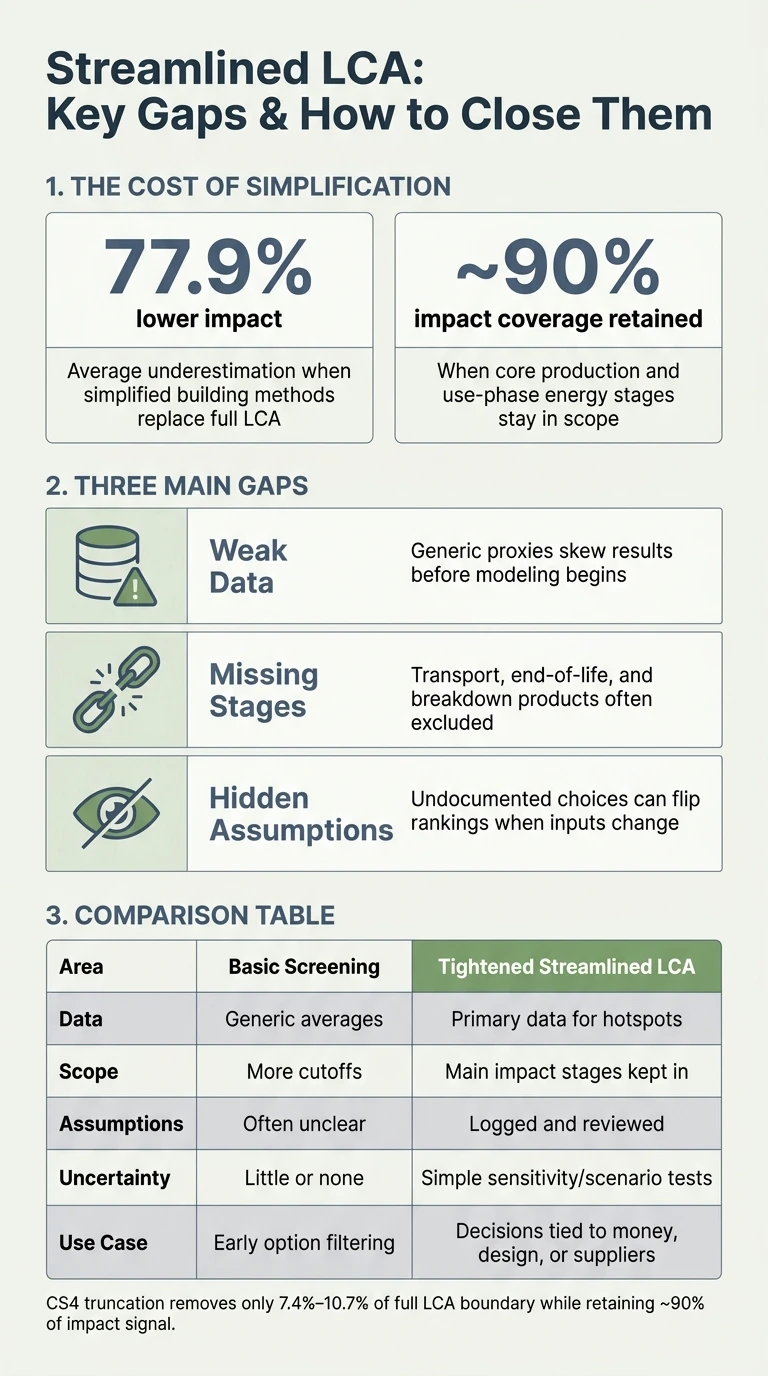
Streamlined LCA vs. Full LCA: Closing the Gap
Three issues tend to weaken streamlined LCA: weak data, missing stages, and assumptions that never get written down. The job here is simple in theory, but hard in practice: figure out which shortcuts save time and which ones change the answer.
Weak Data and Overreliance on Generic Datasets
Generic, industry-average datasets are a practical place to start. But they can steer a study off course when the product, process, or geography doesn't line up with the source. Proxy data can help fill gaps, yet a mismatch in region, process, or product can skew results before the model even gets going.
That’s the trap. Proxy error often shows up only after a decision has already been made. A simple data-quality score can flag when proxy data is too weak to support the decision [3]. That matters most when the result will shape supplier, material, or design choices.
Missing Stages, Cutoffs, and Circular Pathways
Leaving out life cycle stages is the fastest way to make a study look cleaner than it is. Transport to the job site, installation, maintenance, repairs, and end-of-life disposal are often dropped from streamlined assessments to save time. In chemical and manufacturing work, transformation products - what a substance breaks down into - are often left out too. That can lead a team to approve a material even though its downstream breakdown products carry major ecotoxicity impacts [3].
The scale of this problem is hard to ignore. Simplifications used in standard building energy certifications lead to an average 77.9% drop in calculated environmental impacts compared to a full LCA [1]. By contrast, a narrower cutoff can still capture about 90% of full-impact coverage when production and use-phase energy stay in scope [1]. That gap is not small; it can push a team toward the wrong call.
Hidden Assumptions and No Uncertainty Testing
Every LCA model depends on choices: how shared impacts are allocated, which energy mix gets used, and how much recycled content is assumed. In a streamlined study, those choices may be made fast and never documented. The result is a study that looks precise on the surface while hiding the basis underneath.
Most environmental impact and cost are locked in at the design stage, so early assumptions carry a lot of weight in the final outcome. Without sensitivity checks, rankings can flip when one key assumption changes. That’s where streamlined LCA needs simple checks rather than full-model depth.
A few basic guardrails go a long way:
tighten the data used for high-stakes decisions
keep major life cycle stages inside the boundary
test a few key scenarios to see whether the ranking holds
Those steps can narrow the gap without requiring a full assessment.
How to Tighten a Streamlined LCA Without Running a Full Assessment
You do not need to run a full LCA every time. Add detail only where it might change the decision. The three gaps noted earlier - weak data, missing stages, and undocumented assumptions - each have a direct fix. The point is simple: tighten the parts of the model that can shift the ranking, not every single part.
Use Hotspot Screening to Focus Primary Data Collection
Use primary data for hotspots and screening data for the rest. That keeps collection costs low while protecting the parts of the model that drive the result. In plain terms, spend your effort where it matters most, not where it just adds paperwork.
Apply Modular, Parametric, and Scenario-Based Modeling
Once you know the hotspots, parametric modeling helps you test whether design changes actually shift the outcome. That makes it easier to check options without rebuilding the whole model from scratch. For buildings and infrastructure, BIM can feed bills of quantities into LCA tools for fast scenario updates [2].
Limit Simplification to Parts That Do Not Change the Decision
The CS4 stage-truncation approach leaves out transport, construction site activities, demolition, and final waste disposal, while still keeping about 90% of the impact found in a full LCA [1]. In practice, it removes only 7.4%–10.7% of the full boundary [1]. That is a pretty clear tradeoff: less work, while most of the signal stays in place.
The rule here is straightforward:
Omit only stages that do not affect the decision.
Add depth only where the ranking could change.
Used together, hotspot screening, parametric modeling, and selective truncation keep a streamlined study credible without the depth of a full assessment.
These shortcuts hold up only when teams track data quality, assumptions, and uncertainty.
Data Quality and Governance Steps That Build Confidence
Once the model is stripped down to what matters most, governance is what keeps that shortcut defensible. It doesn't have to turn into a giant compliance exercise. A small set of repeatable checks can make the output solid enough to guide real decisions.
Use Simple Data-Quality Scoring and Assumption Logs
A simple 1–4 data-quality score helps teams spot weak inputs fast [3]. It gives people a plain way to see where the model rests on thin data and where the numbers are on firmer ground.
Pair that score with a short assumption log. Keep it simple: note the modeling choices, data sources, and any simplifications made along the way. That creates a clear record for later review instead of leaving people to guess why a result looks the way it does.
Add Sensitivity and Uncertainty Checks Before Major Decisions
Before a team acts on the model, test the top three drivers and check whether the preferred option still comes out on top [1]. This is one of those small habits that can save a lot of pain later. If a ranking flips after a minor input change, that tells you something important right away.
For deeper checks, use Monte Carlo simulation or another uncertainty method [3]. Some governance frameworks also adjust simplified LCA outputs by a factor of 1.2 to account for neglected elements and simplified data [2]. That kind of adjustment won't fix a weak model on its own, but it can help account for what was left out.
Set Review Gates for Procurement, Design, and Capital Planning
A short sign-off gate before procurement, design, or capital decisions can keep simplified LCAs from being used too casually. The point isn't to slow people down. It's to make sure the model has enough support behind it before money or design choices are locked in.
Control Area | Low-Effort Action | More Rigorous Action | What It Shows |
|---|---|---|---|
Data reliability | Apply a 1–4 quality score to top inputs [3] | Add unit standardization and data-harmonization checks [3] | Where the model leans on weaker data |
Assumptions | Keep a short assumption log | Expand the log into a formal review of key modeling choices | An auditable trail for later review |
Uncertainty | Test the top three drivers [1] | Use Monte Carlo simulation or another uncertainty method [3] | Whether the preferred option holds under variance |
Scope completeness | Verify main impact stages are included before sign-off | Apply a 1.2 multiplier to simplified results per DGNB guidance [2] | Reduces the risk of underreporting important impacts |
Decision gates | Require named data sources before the LCA informs procurement | Set a minimum internal review confirming documented boundaries and at least one sensitivity check | Keeps simplifications defensible when results are used |
These checks are not paperwork for its own sake. They help confirm that the shortcuts kept in the model are the right ones. And when internal review still leaves open questions on method or governance, outside support can help close those gaps.
When Outside Support Makes Sense
An internal review can take a streamlined LCA a long way. But when questions still sit in the data, system boundaries, or core assumptions, outside help can close those gaps faster and with less back-and-forth.
Cases Where a Partner Can Close Method and Review Gaps
Start with the decision the result needs to support. If a simplified LCA will shape public claims, capital allocation, or supplier choices - and especially if a third-party review is likely - the stakes shift. A result that feels sound inside the team can get much harder to defend once outside reviewers start pulling at the edges.
That’s usually where an outside partner earns their keep. A fresh review can spot weak assumptions, missing data, or boundary issues before they become a problem. Without that extra check, small gaps can sit quietly in the work and chip away at trust in the result.
Council Fire helps teams turn streamlined LCA into defensible guidance for procurement, design, and investment decisions.
Conclusion: Closing the Gap Between Speed and Credibility
Streamlined LCA only holds up when teams deal head-on with weak data, missing stages, and hidden assumptions. The gap between a screening study and a decision-grade result can be handled, but only if teams state their assumptions and limits plainly.
The answer is not more complexity. It is tighter control over the small set of inputs that can shift the outcome. That means putting primary data collection on hotspots, keeping life cycle boundaries complete enough to affect the result, writing down assumptions in plain terms, and running proportionate uncertainty checks before findings shape actual decisions. A streamlined study can still keep most of the signal if it includes the stages that drive the choice at hand.
None of that works if teams can't document their choices and pressure-test them. Credibility starts to slip when simplification stays hidden. Even a technically sound result gets tough to defend in review when assumptions aren't documented and boundaries aren't explained. Assumption logs and sensitivity checks don't add much time, and they do a lot to improve trust.
That is where disciplined support can help. Council Fire helps organizations turn streamlined LCA into practical frameworks that support circularity, resilience, and defensible decisions.
FAQs
When is a streamlined LCA enough?
A streamlined LCA works well when you need fast, decision-ready direction instead of publication-grade rigor. Think of it as a practical first pass: good for spotting hotspots or comparing options as you improve a product or process. In many cases, teams can finish one in about 4–8 weeks by using screening-level methods and secondary data.
If you're planning major design changes, or you need full, multi-impact, decision-grade results with strong data transparency and rigor, it's time to move to a full LCA. That kind of work usually takes 3–6 months or longer.
Which life cycle stages should never be cut?
There are no universal life cycle stages that should always stay in a streamlined LCA. The right scope depends on the study’s purpose and on which stages drive the biggest environmental impacts.
Some methods or project standards may require certain modules. Even so, stages like transport, maintenance, or end-of-life should be left out only when doing so would not materially change the findings or create misleading trade-offs.
How much primary data do I really need?
You usually don’t need full primary-data coverage to get started. For fast screening, secondary database data can deliver usable results in about 4–8 weeks.
For decision-grade work, add primary supplier data where it matters most, then fill the remaining gaps with reputable database averages. A full LCA with broad primary data often takes 3–6 months or longer. In practice, data quality comes from clear system boundaries and transparent assumptions - not from trying to collect every parameter all at once.
Related Blog Posts
Latest Articles
©2026

Narrative Change and Power Building: The Missing Half of Advocacy
Narrative change is the process of disrupting dominant narratives that normalize inequity and advancing new narratives from historically marginalized communities.

Funding Resilience Without Federal Grants
BRIC is unreliable and FEMA is shrinking. Here's how cities fund climate resilience with dedicated revenue, blended finance, and a coordinating authority.

The ESG Blind Spot: How AI Is Finding Risks in Companies Nobody Else Is Watching
Norway's sovereign wealth fund uses AI to screen 7,200 portfolio companies for forced labor and corruption within 24 hours. The real story is the emerging-market coverage gap that traditional ESG data vendors miss — and what it means for any company with a global supply chain.
Narrative Change and Power Building: The Missing Half of Advocacy
Narrative change is the process of disrupting dominant narratives that normalize inequity and advancing new narratives from historically marginalized communities.
Funding Resilience Without Federal Grants
BRIC is unreliable and FEMA is shrinking. Here's how cities fund climate resilience with dedicated revenue, blended finance, and a coordinating authority.
The ESG Blind Spot: How AI Is Finding Risks in Companies Nobody Else Is Watching
Norway's sovereign wealth fund uses AI to screen 7,200 portfolio companies for forced labor and corruption within 24 hours. The real story is the emerging-market coverage gap that traditional ESG data vendors miss — and what it means for any company with a global supply chain.
FAQ
01
What does it really mean to “redefine profit”?
02
What makes Council Fire different?
03
Who does Council Fire work with?
04
What does working with Council Fire actually look like?
05
How does Council Fire help organizations turn big goals into action?
06
How does Council Fire define and measure success?
07
How does technology fit into Council Fire’s work?
Aug 21, 2026
Bridging Gap in Streamlined Life Cycle Assessment
Sustainability Strategy
In This Article
Use streamlined LCA for early direction: tighten data and scope, collect primary data for hotspots, and run basic sensitivity checks.
Bridging Gap in Streamlined Life Cycle Assessment
A screening LCA can point you in the right direction, but it can also miss a lot. In some cases, simplified building methods show an average 77.9% lower impact than a full study, while a tighter cutoff can still keep about 90% of total impact coverage when core stages stay in scope.
If I need a short takeaway, it is this:
I should use streamlined LCA for early direction, not as final proof.
I should tighten three weak spots: data, scope, and assumptions.
I should collect primary data only for hotspots.
I should keep major life cycle stages in the model when they can change the ranking.
I should run basic sensitivity checks before using results for procurement, design, or capital decisions.
A simple screening model is often enough to compare options at the start. But if weak proxy data, missing stages, or hidden modeling choices sit inside the study, the result can point to the wrong supplier, material, or design path. A few low-effort controls - like a 1–4 data-quality score, an assumption log, and testing the top three drivers - can make a streamlined LCA much more useful for decisions.
Here’s the core comparison:
Area | Basic screening | Tightened streamlined LCA |
|---|---|---|
Data | Generic averages | Primary data for hotspots |
Scope | More cutoffs | Main impact stages kept in |
Assumptions | Often unclear | Logged and reviewed |
Uncertainty | Little or none | Simple scenario or sensitivity tests |
Use case | Early option filtering | Decisions with money, design, or suppliers attached |
If I want speed without bad calls, I do not need a full study every time. I need a smaller model with better control over the parts that can change the answer.
Development of a Streamlined Framework for Probabilistic and Comparative Life Cycle Assessment
The Main Gaps Between Fast Screening and Reliable Results
Streamlined LCA vs. Full LCA: Closing the Gap
Three issues tend to weaken streamlined LCA: weak data, missing stages, and assumptions that never get written down. The job here is simple in theory, but hard in practice: figure out which shortcuts save time and which ones change the answer.
Weak Data and Overreliance on Generic Datasets
Generic, industry-average datasets are a practical place to start. But they can steer a study off course when the product, process, or geography doesn't line up with the source. Proxy data can help fill gaps, yet a mismatch in region, process, or product can skew results before the model even gets going.
That’s the trap. Proxy error often shows up only after a decision has already been made. A simple data-quality score can flag when proxy data is too weak to support the decision [3]. That matters most when the result will shape supplier, material, or design choices.
Missing Stages, Cutoffs, and Circular Pathways
Leaving out life cycle stages is the fastest way to make a study look cleaner than it is. Transport to the job site, installation, maintenance, repairs, and end-of-life disposal are often dropped from streamlined assessments to save time. In chemical and manufacturing work, transformation products - what a substance breaks down into - are often left out too. That can lead a team to approve a material even though its downstream breakdown products carry major ecotoxicity impacts [3].
The scale of this problem is hard to ignore. Simplifications used in standard building energy certifications lead to an average 77.9% drop in calculated environmental impacts compared to a full LCA [1]. By contrast, a narrower cutoff can still capture about 90% of full-impact coverage when production and use-phase energy stay in scope [1]. That gap is not small; it can push a team toward the wrong call.
Hidden Assumptions and No Uncertainty Testing
Every LCA model depends on choices: how shared impacts are allocated, which energy mix gets used, and how much recycled content is assumed. In a streamlined study, those choices may be made fast and never documented. The result is a study that looks precise on the surface while hiding the basis underneath.
Most environmental impact and cost are locked in at the design stage, so early assumptions carry a lot of weight in the final outcome. Without sensitivity checks, rankings can flip when one key assumption changes. That’s where streamlined LCA needs simple checks rather than full-model depth.
A few basic guardrails go a long way:
tighten the data used for high-stakes decisions
keep major life cycle stages inside the boundary
test a few key scenarios to see whether the ranking holds
Those steps can narrow the gap without requiring a full assessment.
How to Tighten a Streamlined LCA Without Running a Full Assessment
You do not need to run a full LCA every time. Add detail only where it might change the decision. The three gaps noted earlier - weak data, missing stages, and undocumented assumptions - each have a direct fix. The point is simple: tighten the parts of the model that can shift the ranking, not every single part.
Use Hotspot Screening to Focus Primary Data Collection
Use primary data for hotspots and screening data for the rest. That keeps collection costs low while protecting the parts of the model that drive the result. In plain terms, spend your effort where it matters most, not where it just adds paperwork.
Apply Modular, Parametric, and Scenario-Based Modeling
Once you know the hotspots, parametric modeling helps you test whether design changes actually shift the outcome. That makes it easier to check options without rebuilding the whole model from scratch. For buildings and infrastructure, BIM can feed bills of quantities into LCA tools for fast scenario updates [2].
Limit Simplification to Parts That Do Not Change the Decision
The CS4 stage-truncation approach leaves out transport, construction site activities, demolition, and final waste disposal, while still keeping about 90% of the impact found in a full LCA [1]. In practice, it removes only 7.4%–10.7% of the full boundary [1]. That is a pretty clear tradeoff: less work, while most of the signal stays in place.
The rule here is straightforward:
Omit only stages that do not affect the decision.
Add depth only where the ranking could change.
Used together, hotspot screening, parametric modeling, and selective truncation keep a streamlined study credible without the depth of a full assessment.
These shortcuts hold up only when teams track data quality, assumptions, and uncertainty.
Data Quality and Governance Steps That Build Confidence
Once the model is stripped down to what matters most, governance is what keeps that shortcut defensible. It doesn't have to turn into a giant compliance exercise. A small set of repeatable checks can make the output solid enough to guide real decisions.
Use Simple Data-Quality Scoring and Assumption Logs
A simple 1–4 data-quality score helps teams spot weak inputs fast [3]. It gives people a plain way to see where the model rests on thin data and where the numbers are on firmer ground.
Pair that score with a short assumption log. Keep it simple: note the modeling choices, data sources, and any simplifications made along the way. That creates a clear record for later review instead of leaving people to guess why a result looks the way it does.
Add Sensitivity and Uncertainty Checks Before Major Decisions
Before a team acts on the model, test the top three drivers and check whether the preferred option still comes out on top [1]. This is one of those small habits that can save a lot of pain later. If a ranking flips after a minor input change, that tells you something important right away.
For deeper checks, use Monte Carlo simulation or another uncertainty method [3]. Some governance frameworks also adjust simplified LCA outputs by a factor of 1.2 to account for neglected elements and simplified data [2]. That kind of adjustment won't fix a weak model on its own, but it can help account for what was left out.
Set Review Gates for Procurement, Design, and Capital Planning
A short sign-off gate before procurement, design, or capital decisions can keep simplified LCAs from being used too casually. The point isn't to slow people down. It's to make sure the model has enough support behind it before money or design choices are locked in.
Control Area | Low-Effort Action | More Rigorous Action | What It Shows |
|---|---|---|---|
Data reliability | Apply a 1–4 quality score to top inputs [3] | Add unit standardization and data-harmonization checks [3] | Where the model leans on weaker data |
Assumptions | Keep a short assumption log | Expand the log into a formal review of key modeling choices | An auditable trail for later review |
Uncertainty | Test the top three drivers [1] | Use Monte Carlo simulation or another uncertainty method [3] | Whether the preferred option holds under variance |
Scope completeness | Verify main impact stages are included before sign-off | Apply a 1.2 multiplier to simplified results per DGNB guidance [2] | Reduces the risk of underreporting important impacts |
Decision gates | Require named data sources before the LCA informs procurement | Set a minimum internal review confirming documented boundaries and at least one sensitivity check | Keeps simplifications defensible when results are used |
These checks are not paperwork for its own sake. They help confirm that the shortcuts kept in the model are the right ones. And when internal review still leaves open questions on method or governance, outside support can help close those gaps.
When Outside Support Makes Sense
An internal review can take a streamlined LCA a long way. But when questions still sit in the data, system boundaries, or core assumptions, outside help can close those gaps faster and with less back-and-forth.
Cases Where a Partner Can Close Method and Review Gaps
Start with the decision the result needs to support. If a simplified LCA will shape public claims, capital allocation, or supplier choices - and especially if a third-party review is likely - the stakes shift. A result that feels sound inside the team can get much harder to defend once outside reviewers start pulling at the edges.
That’s usually where an outside partner earns their keep. A fresh review can spot weak assumptions, missing data, or boundary issues before they become a problem. Without that extra check, small gaps can sit quietly in the work and chip away at trust in the result.
Council Fire helps teams turn streamlined LCA into defensible guidance for procurement, design, and investment decisions.
Conclusion: Closing the Gap Between Speed and Credibility
Streamlined LCA only holds up when teams deal head-on with weak data, missing stages, and hidden assumptions. The gap between a screening study and a decision-grade result can be handled, but only if teams state their assumptions and limits plainly.
The answer is not more complexity. It is tighter control over the small set of inputs that can shift the outcome. That means putting primary data collection on hotspots, keeping life cycle boundaries complete enough to affect the result, writing down assumptions in plain terms, and running proportionate uncertainty checks before findings shape actual decisions. A streamlined study can still keep most of the signal if it includes the stages that drive the choice at hand.
None of that works if teams can't document their choices and pressure-test them. Credibility starts to slip when simplification stays hidden. Even a technically sound result gets tough to defend in review when assumptions aren't documented and boundaries aren't explained. Assumption logs and sensitivity checks don't add much time, and they do a lot to improve trust.
That is where disciplined support can help. Council Fire helps organizations turn streamlined LCA into practical frameworks that support circularity, resilience, and defensible decisions.
FAQs
When is a streamlined LCA enough?
A streamlined LCA works well when you need fast, decision-ready direction instead of publication-grade rigor. Think of it as a practical first pass: good for spotting hotspots or comparing options as you improve a product or process. In many cases, teams can finish one in about 4–8 weeks by using screening-level methods and secondary data.
If you're planning major design changes, or you need full, multi-impact, decision-grade results with strong data transparency and rigor, it's time to move to a full LCA. That kind of work usually takes 3–6 months or longer.
Which life cycle stages should never be cut?
There are no universal life cycle stages that should always stay in a streamlined LCA. The right scope depends on the study’s purpose and on which stages drive the biggest environmental impacts.
Some methods or project standards may require certain modules. Even so, stages like transport, maintenance, or end-of-life should be left out only when doing so would not materially change the findings or create misleading trade-offs.
How much primary data do I really need?
You usually don’t need full primary-data coverage to get started. For fast screening, secondary database data can deliver usable results in about 4–8 weeks.
For decision-grade work, add primary supplier data where it matters most, then fill the remaining gaps with reputable database averages. A full LCA with broad primary data often takes 3–6 months or longer. In practice, data quality comes from clear system boundaries and transparent assumptions - not from trying to collect every parameter all at once.
Related Blog Posts
Latest Articles
©2026
Narrative Change and Power Building: The Missing Half of Advocacy
Narrative change is the process of disrupting dominant narratives that normalize inequity and advancing new narratives from historically marginalized communities.
Funding Resilience Without Federal Grants
BRIC is unreliable and FEMA is shrinking. Here's how cities fund climate resilience with dedicated revenue, blended finance, and a coordinating authority.
The ESG Blind Spot: How AI Is Finding Risks in Companies Nobody Else Is Watching
Norway's sovereign wealth fund uses AI to screen 7,200 portfolio companies for forced labor and corruption within 24 hours. The real story is the emerging-market coverage gap that traditional ESG data vendors miss — and what it means for any company with a global supply chain.
FAQ
01
What does it really mean to “redefine profit”?
02
What makes Council Fire different?
03
Who does Council Fire work with?
04
What does working with Council Fire actually look like?
05
How does Council Fire help organizations turn big goals into action?
06
How does Council Fire define and measure success?
07
How does technology fit into Council Fire’s work?
Aug 21, 2026
Bridging Gap in Streamlined Life Cycle Assessment
Sustainability Strategy
In This Article
Use streamlined LCA for early direction: tighten data and scope, collect primary data for hotspots, and run basic sensitivity checks.
Bridging Gap in Streamlined Life Cycle Assessment
A screening LCA can point you in the right direction, but it can also miss a lot. In some cases, simplified building methods show an average 77.9% lower impact than a full study, while a tighter cutoff can still keep about 90% of total impact coverage when core stages stay in scope.
If I need a short takeaway, it is this:
I should use streamlined LCA for early direction, not as final proof.
I should tighten three weak spots: data, scope, and assumptions.
I should collect primary data only for hotspots.
I should keep major life cycle stages in the model when they can change the ranking.
I should run basic sensitivity checks before using results for procurement, design, or capital decisions.
A simple screening model is often enough to compare options at the start. But if weak proxy data, missing stages, or hidden modeling choices sit inside the study, the result can point to the wrong supplier, material, or design path. A few low-effort controls - like a 1–4 data-quality score, an assumption log, and testing the top three drivers - can make a streamlined LCA much more useful for decisions.
Here’s the core comparison:
Area | Basic screening | Tightened streamlined LCA |
|---|---|---|
Data | Generic averages | Primary data for hotspots |
Scope | More cutoffs | Main impact stages kept in |
Assumptions | Often unclear | Logged and reviewed |
Uncertainty | Little or none | Simple scenario or sensitivity tests |
Use case | Early option filtering | Decisions with money, design, or suppliers attached |
If I want speed without bad calls, I do not need a full study every time. I need a smaller model with better control over the parts that can change the answer.
Development of a Streamlined Framework for Probabilistic and Comparative Life Cycle Assessment
The Main Gaps Between Fast Screening and Reliable Results
Streamlined LCA vs. Full LCA: Closing the Gap
Three issues tend to weaken streamlined LCA: weak data, missing stages, and assumptions that never get written down. The job here is simple in theory, but hard in practice: figure out which shortcuts save time and which ones change the answer.
Weak Data and Overreliance on Generic Datasets
Generic, industry-average datasets are a practical place to start. But they can steer a study off course when the product, process, or geography doesn't line up with the source. Proxy data can help fill gaps, yet a mismatch in region, process, or product can skew results before the model even gets going.
That’s the trap. Proxy error often shows up only after a decision has already been made. A simple data-quality score can flag when proxy data is too weak to support the decision [3]. That matters most when the result will shape supplier, material, or design choices.
Missing Stages, Cutoffs, and Circular Pathways
Leaving out life cycle stages is the fastest way to make a study look cleaner than it is. Transport to the job site, installation, maintenance, repairs, and end-of-life disposal are often dropped from streamlined assessments to save time. In chemical and manufacturing work, transformation products - what a substance breaks down into - are often left out too. That can lead a team to approve a material even though its downstream breakdown products carry major ecotoxicity impacts [3].
The scale of this problem is hard to ignore. Simplifications used in standard building energy certifications lead to an average 77.9% drop in calculated environmental impacts compared to a full LCA [1]. By contrast, a narrower cutoff can still capture about 90% of full-impact coverage when production and use-phase energy stay in scope [1]. That gap is not small; it can push a team toward the wrong call.
Hidden Assumptions and No Uncertainty Testing
Every LCA model depends on choices: how shared impacts are allocated, which energy mix gets used, and how much recycled content is assumed. In a streamlined study, those choices may be made fast and never documented. The result is a study that looks precise on the surface while hiding the basis underneath.
Most environmental impact and cost are locked in at the design stage, so early assumptions carry a lot of weight in the final outcome. Without sensitivity checks, rankings can flip when one key assumption changes. That’s where streamlined LCA needs simple checks rather than full-model depth.
A few basic guardrails go a long way:
tighten the data used for high-stakes decisions
keep major life cycle stages inside the boundary
test a few key scenarios to see whether the ranking holds
Those steps can narrow the gap without requiring a full assessment.
How to Tighten a Streamlined LCA Without Running a Full Assessment
You do not need to run a full LCA every time. Add detail only where it might change the decision. The three gaps noted earlier - weak data, missing stages, and undocumented assumptions - each have a direct fix. The point is simple: tighten the parts of the model that can shift the ranking, not every single part.
Use Hotspot Screening to Focus Primary Data Collection
Use primary data for hotspots and screening data for the rest. That keeps collection costs low while protecting the parts of the model that drive the result. In plain terms, spend your effort where it matters most, not where it just adds paperwork.
Apply Modular, Parametric, and Scenario-Based Modeling
Once you know the hotspots, parametric modeling helps you test whether design changes actually shift the outcome. That makes it easier to check options without rebuilding the whole model from scratch. For buildings and infrastructure, BIM can feed bills of quantities into LCA tools for fast scenario updates [2].
Limit Simplification to Parts That Do Not Change the Decision
The CS4 stage-truncation approach leaves out transport, construction site activities, demolition, and final waste disposal, while still keeping about 90% of the impact found in a full LCA [1]. In practice, it removes only 7.4%–10.7% of the full boundary [1]. That is a pretty clear tradeoff: less work, while most of the signal stays in place.
The rule here is straightforward:
Omit only stages that do not affect the decision.
Add depth only where the ranking could change.
Used together, hotspot screening, parametric modeling, and selective truncation keep a streamlined study credible without the depth of a full assessment.
These shortcuts hold up only when teams track data quality, assumptions, and uncertainty.
Data Quality and Governance Steps That Build Confidence
Once the model is stripped down to what matters most, governance is what keeps that shortcut defensible. It doesn't have to turn into a giant compliance exercise. A small set of repeatable checks can make the output solid enough to guide real decisions.
Use Simple Data-Quality Scoring and Assumption Logs
A simple 1–4 data-quality score helps teams spot weak inputs fast [3]. It gives people a plain way to see where the model rests on thin data and where the numbers are on firmer ground.
Pair that score with a short assumption log. Keep it simple: note the modeling choices, data sources, and any simplifications made along the way. That creates a clear record for later review instead of leaving people to guess why a result looks the way it does.
Add Sensitivity and Uncertainty Checks Before Major Decisions
Before a team acts on the model, test the top three drivers and check whether the preferred option still comes out on top [1]. This is one of those small habits that can save a lot of pain later. If a ranking flips after a minor input change, that tells you something important right away.
For deeper checks, use Monte Carlo simulation or another uncertainty method [3]. Some governance frameworks also adjust simplified LCA outputs by a factor of 1.2 to account for neglected elements and simplified data [2]. That kind of adjustment won't fix a weak model on its own, but it can help account for what was left out.
Set Review Gates for Procurement, Design, and Capital Planning
A short sign-off gate before procurement, design, or capital decisions can keep simplified LCAs from being used too casually. The point isn't to slow people down. It's to make sure the model has enough support behind it before money or design choices are locked in.
Control Area | Low-Effort Action | More Rigorous Action | What It Shows |
|---|---|---|---|
Data reliability | Apply a 1–4 quality score to top inputs [3] | Add unit standardization and data-harmonization checks [3] | Where the model leans on weaker data |
Assumptions | Keep a short assumption log | Expand the log into a formal review of key modeling choices | An auditable trail for later review |
Uncertainty | Test the top three drivers [1] | Use Monte Carlo simulation or another uncertainty method [3] | Whether the preferred option holds under variance |
Scope completeness | Verify main impact stages are included before sign-off | Apply a 1.2 multiplier to simplified results per DGNB guidance [2] | Reduces the risk of underreporting important impacts |
Decision gates | Require named data sources before the LCA informs procurement | Set a minimum internal review confirming documented boundaries and at least one sensitivity check | Keeps simplifications defensible when results are used |
These checks are not paperwork for its own sake. They help confirm that the shortcuts kept in the model are the right ones. And when internal review still leaves open questions on method or governance, outside support can help close those gaps.
When Outside Support Makes Sense
An internal review can take a streamlined LCA a long way. But when questions still sit in the data, system boundaries, or core assumptions, outside help can close those gaps faster and with less back-and-forth.
Cases Where a Partner Can Close Method and Review Gaps
Start with the decision the result needs to support. If a simplified LCA will shape public claims, capital allocation, or supplier choices - and especially if a third-party review is likely - the stakes shift. A result that feels sound inside the team can get much harder to defend once outside reviewers start pulling at the edges.
That’s usually where an outside partner earns their keep. A fresh review can spot weak assumptions, missing data, or boundary issues before they become a problem. Without that extra check, small gaps can sit quietly in the work and chip away at trust in the result.
Council Fire helps teams turn streamlined LCA into defensible guidance for procurement, design, and investment decisions.
Conclusion: Closing the Gap Between Speed and Credibility
Streamlined LCA only holds up when teams deal head-on with weak data, missing stages, and hidden assumptions. The gap between a screening study and a decision-grade result can be handled, but only if teams state their assumptions and limits plainly.
The answer is not more complexity. It is tighter control over the small set of inputs that can shift the outcome. That means putting primary data collection on hotspots, keeping life cycle boundaries complete enough to affect the result, writing down assumptions in plain terms, and running proportionate uncertainty checks before findings shape actual decisions. A streamlined study can still keep most of the signal if it includes the stages that drive the choice at hand.
None of that works if teams can't document their choices and pressure-test them. Credibility starts to slip when simplification stays hidden. Even a technically sound result gets tough to defend in review when assumptions aren't documented and boundaries aren't explained. Assumption logs and sensitivity checks don't add much time, and they do a lot to improve trust.
That is where disciplined support can help. Council Fire helps organizations turn streamlined LCA into practical frameworks that support circularity, resilience, and defensible decisions.
FAQs
When is a streamlined LCA enough?
A streamlined LCA works well when you need fast, decision-ready direction instead of publication-grade rigor. Think of it as a practical first pass: good for spotting hotspots or comparing options as you improve a product or process. In many cases, teams can finish one in about 4–8 weeks by using screening-level methods and secondary data.
If you're planning major design changes, or you need full, multi-impact, decision-grade results with strong data transparency and rigor, it's time to move to a full LCA. That kind of work usually takes 3–6 months or longer.
Which life cycle stages should never be cut?
There are no universal life cycle stages that should always stay in a streamlined LCA. The right scope depends on the study’s purpose and on which stages drive the biggest environmental impacts.
Some methods or project standards may require certain modules. Even so, stages like transport, maintenance, or end-of-life should be left out only when doing so would not materially change the findings or create misleading trade-offs.
How much primary data do I really need?
You usually don’t need full primary-data coverage to get started. For fast screening, secondary database data can deliver usable results in about 4–8 weeks.
For decision-grade work, add primary supplier data where it matters most, then fill the remaining gaps with reputable database averages. A full LCA with broad primary data often takes 3–6 months or longer. In practice, data quality comes from clear system boundaries and transparent assumptions - not from trying to collect every parameter all at once.
Related Blog Posts
Latest Articles
©2026
Narrative Change and Power Building: The Missing Half of Advocacy
Narrative change is the process of disrupting dominant narratives that normalize inequity and advancing new narratives from historically marginalized communities.
Funding Resilience Without Federal Grants
BRIC is unreliable and FEMA is shrinking. Here's how cities fund climate resilience with dedicated revenue, blended finance, and a coordinating authority.
The ESG Blind Spot: How AI Is Finding Risks in Companies Nobody Else Is Watching
Norway's sovereign wealth fund uses AI to screen 7,200 portfolio companies for forced labor and corruption within 24 hours. The real story is the emerging-market coverage gap that traditional ESG data vendors miss — and what it means for any company with a global supply chain.
FAQ
What does it really mean to “redefine profit”?
What makes Council Fire different?
Who does Council Fire work with?
What does working with Council Fire actually look like?
How does Council Fire help organizations turn big goals into action?
How does Council Fire define and measure success?
How does technology fit into Council Fire’s work?