
Jun 29, 2026
Lifecycle Assessment for Policy Decisions
Sustainability Strategy
In This Article
Explains how LCA guides policy, procurement, and standards by revealing trade-offs, data limits, and best practices.
Lifecycle Assessment for Policy Decisions
A policy can cut emissions in one place and add waste, cost, or pollution somewhere else. I see LCA as the tool that helps avoid that mistake by looking at a product or project from raw materials to end-of-life.
If I had to sum up the article in a few lines, it comes down to this:
LCA helps compare options side by side, not by one number alone.
The result depends on scope choices like the functional unit, system boundary, and allocation rules.
Weak data and hidden assumptions can flip the answer.
Policy teams use LCA in rules, procurement, funding, and public disclosure.
Buy Clean is a major U.S. example, especially for concrete, steel, and other building materials.
LCA works best early in the policy cycle, before big choices are locked in.
Good practice means ISO 14040/14044, transparency, peer review, and sensitivity testing.
The goal is not to hide trade-offs, but to make them visible.
One fact stands out: the U.S. federal government buys more than $630 billion each year. When spending at that scale is tied to lifecycle data, agencies can compare materials and suppliers on a common basis instead of relying only on upfront price.
I’d frame the article this way: use LCA to ask better policy questions, test claims before they become rules, and check whether a program is solving one problem without causing another.
Social Life Cycle Assessment for better-informed decision-making at policy and business levels
LCA foundations for public and organizational policy
Before LCA can shape a regulation or a procurement rule, the people using it need a clear grasp of what the method asks for - and why those steps are not mere box-checking. ISO 14040 sets the framework for LCA, and ISO 14044 sets the requirements [1][3]. In policy work, that shared structure helps support public trust and decisions that can stand up to scrutiny. Clear documentation of assumptions and cutoff rules matters for that trust [3]. Those early design choices often decide whether an LCA can guide policy in a credible way.
The four phases of lifecycle assessment
LCA moves through four phases, and each one answers a different kind of policy question.
Phase | Purpose in Policy Context | Typical Policy Questions |
|---|---|---|
Goal and Scope Definition | Establishes the foundation, boundaries, and basis for comparison. | What is the specific environmental problem we are trying to solve? What are the system boundaries? |
Life Cycle Inventory (LCI) | Quantifies all physical inputs (energy, water) and outputs (emissions, waste). | What is the total carbon and water footprint of the supply chain? Where is the data coming from? |
Life Cycle Impact Assessment (LCIA) | Translates inventory data into environmental impact scores. | Which stage of the product life cycle causes the most damage? Are we trading off water use for carbon savings? |
Interpretation | Synthesizes findings to identify hotspots and test assumptions via sensitivity analysis. | Do the conclusions hold if energy prices or recycling rates change? What are the most effective intervention points for regulation? |
If the goal and scope are framed badly, the rest of the study starts to wobble. Every later finding depends on that first step. And without sensitivity analysis, a policy can look sound on paper, then fall apart when conditions shift.
Functional unit, system boundaries, and allocation rules
The functional unit sets the basis for comparison, which matters because policy often has to compare options that do not look alike at first glance. Pick the wrong unit - for example, compare a durable product with a disposable one without accounting for service life - and the policy result can lean in the wrong direction [4][3].
System boundaries decide what stays inside the study and what gets left out. A cradle-to-gate boundary covers raw material extraction through manufacturing, while a cradle-to-grave boundary goes through use and end-of-life disposal. For policy, cradle-to-grave boundaries help prevent impact shifting outside the analysis [3]. This is often the point where policy assumptions start steering the outcome.
Allocation rules come into play when one process produces more than one output, or when a recycled material moves into a second life. These rules decide how environmental burdens are divided, and that can change the final result in a big way. In policy LCAs, uneven modeling of recycled content and co-products often skews conclusions [4].
Data quality, assumptions, and uncertainty
Even a well-built LCA stands or falls on its data. The key factors are data age, geographic relevance, and technological specificity [4]. If the data are weak, the policy recommendation can swing with them.
For policy use, sensitivity analysis should always be part of the work. It tests whether the conclusion still holds when core assumptions change - recycling rates, energy prices, transportation distances. If a recommendation flips because of a small input change, that is a warning sign. It suggests the analysis is not strong enough to support a rule [3][4].
These basics shape whether LCA can back regulations, procurement rules, funding criteria, and public reporting. Once those pieces are in place, LCA can move from a study method to a direct policy tool.
How LCA is used in policy design
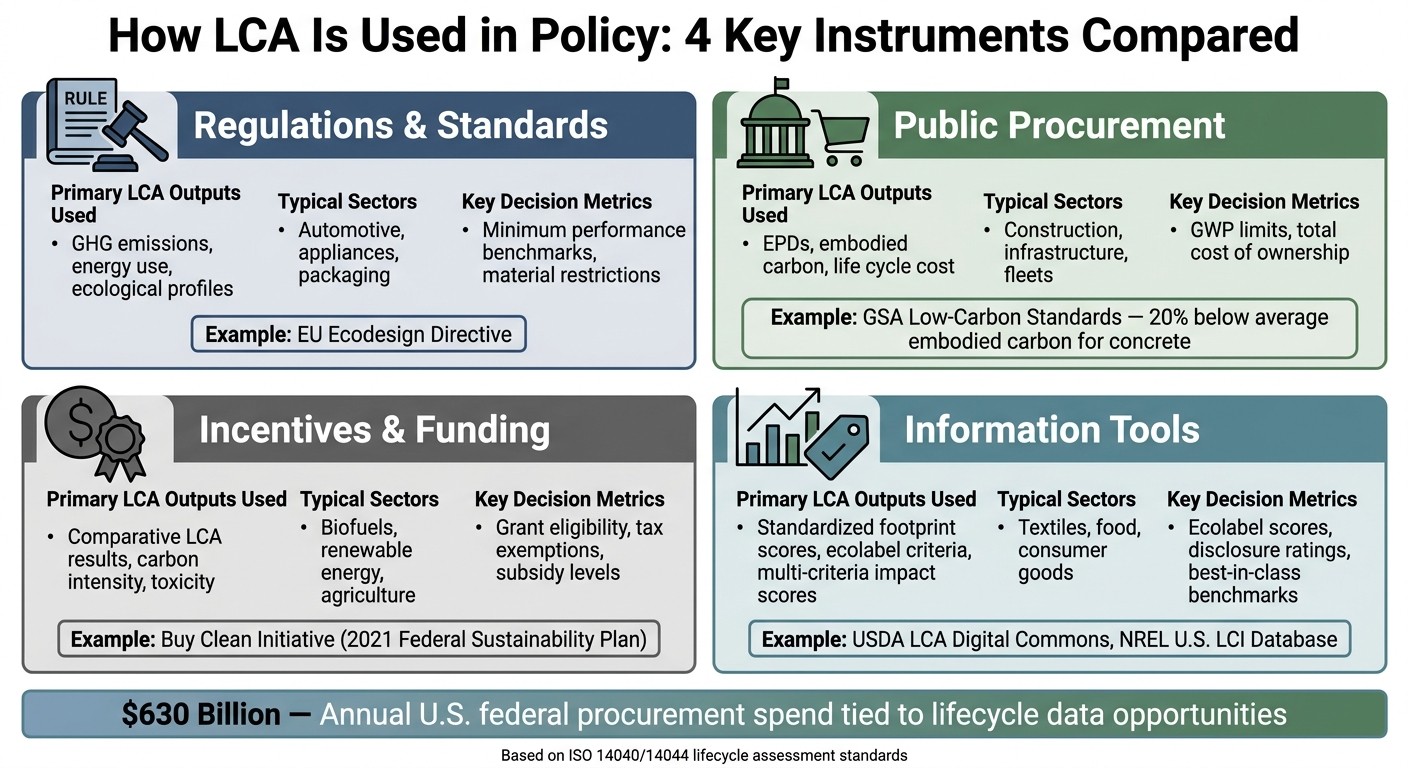
How LCA Is Used in Policy: 4 Key Instruments Compared
LCA starts to matter in policy when agencies turn study results into rules people can actually follow. That usually means thresholds, rankings, and eligibility screens. The key issue is simple: how does a lifecycle result become something enforceable?
In most cases, policy uses LCA in two main ways. One route sets minimum standards and blocks the weakest products from the market. The other rewards top performers through funding, procurement preference, or public recognition. In day-to-day policy work, those uses tend to show up through four channels.
Instrument Type | Primary LCA Outputs Used | Typical Sectors | Key Decision Metrics |
|---|---|---|---|
Regulations & Standards | GHG emissions, energy use, ecological profiles | Automotive, appliances, packaging | Minimum performance benchmarks, material restrictions |
Public Procurement | EPDs, embodied carbon, life cycle cost | Construction, infrastructure, fleets | GWP limits, total cost of ownership |
Incentives & Funding | Comparative LCA results, carbon intensity, toxicity | Biofuels, renewable energy, agriculture | Grant eligibility, tax exemptions, subsidy levels |
Information Tools | Standardized footprint scores, ecolabel criteria, multi-criteria impact scores | Textiles, food, consumer goods | Ecolabel scores, disclosure ratings, best-in-class benchmarks |
Regulations, standards, and product rules
Lifecycle-based rules aim to stop one common policy mistake: cutting harm in one stage only to push it somewhere else. That is the core value of LCA in regulation. Instead of looking only at manufacturing, or only at disposal, agencies can judge the product across its full life.
The EU Ecodesign Directive is a well-known case of this approach in action.[5]
"The Ecodesign Directive was also a first worldwide example of the introduction of mandatory requirements for new products following on a life cycle approach." - Sala et al. [5]
That same line of thinking is taking hold in the United States, especially in rules tied to embodied carbon in construction materials. The logic is familiar: if concrete, steel, insulation, and glass carry major emissions before a building even opens, policy has to account for those upstream impacts too.
Public procurement, incentives, and funding criteria
Procurement is often where lifecycle data hit the ground. Agencies buy at scale, so even a narrow rule can shift supplier behavior fast. That is exactly what Buy Clean efforts are trying to do.[1]
In 2021, the Federal Sustainability Plan launched the Buy Clean Initiative and directed agencies to give priority to low-carbon construction materials.[1] California, Colorado, and Washington have each passed similar Buy Clean bills that require EPDs for state-funded infrastructure projects.[1]
The federal push moved further in 2022. The GSA's Low-Carbon Standards required contractors to submit EPDs and meet embodied carbon limits 20% lower than average for concrete.[1] That kind of rule turns LCA from a reporting exercise into a bid requirement.
Agencies also pair LCA with Life Cycle Costing (LCC) when purchase prices do not tell the whole story.[5] A material may cost more upfront but last longer, need less maintenance, or cut operating costs over time. Looking at the full service life gives public buyers a stronger basis for best-value decisions, not just lowest-price picks.
Information tools and public reporting
Not every program needs a custom LCA for every product. That would be too slow and too expensive. Many policies work instead through standard disclosure tools that make lifecycle data easier to compare.
EPDs and standardized footprint scores give agencies a way to use LCA data at scale.[5][6] They also make it easier to set benchmarks across many suppliers without asking each one to run a new full study from scratch. For policymakers, that is the difference between a rule that sounds good on paper and one that can be used across an entire market.
Public data sources help support that system. USDA's LCA Digital Commons and the NREL U.S. Life Cycle Inventory Database provide secondary data that improve consistency in EPDs and procurement decisions.[1][2]
Integrating LCA into decision-making and circular economy policy
Where LCA fits in the policy cycle
After disclosure and procurement tools, the next step is deciding when LCA should shape the decision itself.
LCA works best when it shows up early, not after the hard calls are already locked in. It can help frame the problem, compare options, and check results once a policy is in motion. At the problem-framing stage, LCA points to environmental hotspots and gives agencies a science-based baseline for target setting. During options analysis, it helps compare alternatives before the policy choice becomes hard to change [1]. Later, once a policy is underway, LCA can test whether the results line up with the original environmental goals.
Different teams use it in different ways. Policy staff use LCA to shape decisions. Procurement teams use it to compare bids. Auditors use it to check outcomes.
That timing becomes especially important when a policy has to choose between reuse, recycling, or new production. Those decisions can look simple on paper, but the lifecycle picture often tells a different story.
Circular economy, materials, and embodied carbon
Circular economy policy is one of the clearest places for LCA, because it’s hard to tell which option cuts total lifecycle harm without looking at the full chain from material extraction to end of use.
In buildings, reuse and deconstruction often do a better job of preserving embodied carbon and cutting demand for virgin materials than standard demolition and rebuild. Design for disassembly pushes that idea further by keeping materials in play for future use instead of turning them into waste.
The same pattern shows up in infrastructure. Early decisions can lock in emissions and material demand for decades, so a poor choice at the front end can keep showing up in the carbon ledger for years.
Infrastructure and community planning in the U.S. context
In energy, water, and transportation infrastructure, lifecycle thinking changes what agencies mean by cost-effective. A project that looks cheaper at the start may carry higher environmental costs over its full life. LCA helps agencies weigh those trade-offs before contracts are signed.
Community planning adds another layer. Land use choices and infrastructure decisions come with embedded emissions and long-term resource commitments that standard project budgets usually miss. When agencies apply lifecycle thinking at the planning stage, they can spot high-impact intervention points before designs are finalized.
Best practices, common pitfalls, and conclusion
Once LCA moves into policy design, the hard part is no longer whether to use it. It’s how to use it without acting more certain than the evidence allows.
Best practices for policy-oriented LCA
For policy use, LCA carries weight only when it follows ISO 14040/14044. The functional unit should match the same service being compared, and system boundaries should fit the policy decision at hand. If the study will support public claims, it also needs independent review.
The table below shows what good practice looks like, the mistake that often undercuts it, and what that means for policy credibility:
Best Practice | Corresponding Pitfall | Implications for Policy Credibility |
|---|---|---|
Scope alignment: Match functional units and boundaries to the policy need | Applying findings from one technology or region to a broader policy | Misaligned scope weakens credibility |
Comprehensive indicators: Assess carbon, water, toxicity, and other relevant categories | Relying solely on carbon as the deciding metric | Risks burden-shifting - solving one problem while creating another |
Transparent assumptions: Document all data sources, energy models, and biogenic carbon treatment | Hidden assumptions or inconsistent data sets | Hidden assumptions weaken defensibility |
Independent peer review: Use a third-party panel to verify ISO compliance | Internal-only review without a public review statement | Undermines authority and increases the risk of challenge |
Sensitivity analysis: Show how results change under different assumptions | Presenting single-point results without uncertainty ranges | Overstates confidence and obscures the real range of policy outcomes |
A good policy LCA doesn’t just produce numbers. It shows why those numbers look the way they do, what could change them, and where the limits are.
Common mistakes that weaken policy decisions
These mistakes are simply the flip side of the practices above.
The biggest one is mismatch. The study answers one question, while the policy is trying to answer another. That gap can sink the whole effort. If the scope is off, even polished results won’t help much.
A close second is relying on a single indicator. Carbon matters, of course, but policy choices can’t stop there. If a study ignores water use, land use, or toxicity, it may cut harm in one place only to push it somewhere else. That’s like fixing a leak in the roof by sending the water into the basement.
Another common problem is comparing options with uneven system boundaries or different use-phase assumptions. That can tilt the comparison and make one option seem better than it is. On paper, the gap may look clean. In practice, it’s apples to oranges.
Transparency is non-negotiable. When assumptions are buried or data sources aren’t disclosed, other people can’t check the work. And once that happens, critics don’t have to prove the study wrong. They only have to show that no one can tell how the result was reached.
Conclusion: What leaders should take forward
The takeaway is simple: use LCA to narrow choices, not to cover up trade-offs.
LCA helps when the scope, boundaries, and assumptions match the decision in front of you. That means documenting them clearly, testing them under different conditions, and bringing policy staff, stakeholders, and technical experts in early rather than at the end.
"One of the most important aspects of incorporating LCA into public policy decisions is to encourage life cycle thinking among policy makers." - Christina Seidel, Sonnevera International Corp. [2]
Bringing stakeholders, policy staff, and technical experts into the process early - rather than handing over a finished study - is what helps LCA results turn into decisions that hold up over time.
FAQs
What makes an LCA credible enough for policy use?
A policy-ready LCA should follow recognized international standards, especially ISO 14040 and ISO 14044, and use a transparent, open process.
That means using high-quality, region-specific data and setting clear system boundaries from the start. It should also go through independent third-party peer review, with a public review statement that confirms the methodology, addresses potential bias, and covers the relevant impact categories without collapsing the results into a single score.
When should policymakers use LCA in the policy cycle?
Policymakers should use Life Cycle Assessment (LCA) across the full policy cycle, from early problem definition through final policy evaluation.
Used this way, LCA helps spot environmental hot spots early, reduce the risk of burden shifting between impact categories, and weigh trade-offs across policy options with more care.
How can LCA prevent burden-shifting in policy decisions?
Lifecycle assessment (LCA) helps prevent burden-shifting by tracking impacts across a product or process’s entire lifecycle - from raw material extraction to final disposal.
That broader view gives policymakers a clearer picture of tradeoffs. A change that cuts one impact can sometimes increase another. LCA helps surface those unintended effects early, so decisions can better reduce harm across the full system.
Related Blog Posts
Latest Articles
©2025

Narrative Change and Power Building: The Missing Half of Advocacy
Narrative change is the process of disrupting dominant narratives that normalize inequity and advancing new narratives from historically marginalized communities.

Funding Resilience Without Federal Grants
BRIC is unreliable and FEMA is shrinking. Here's how cities fund climate resilience with dedicated revenue, blended finance, and a coordinating authority.

The ESG Blind Spot: How AI Is Finding Risks in Companies Nobody Else Is Watching
Norway's sovereign wealth fund uses AI to screen 7,200 portfolio companies for forced labor and corruption within 24 hours. The real story is the emerging-market coverage gap that traditional ESG data vendors miss — and what it means for any company with a global supply chain.
Narrative Change and Power Building: The Missing Half of Advocacy
Narrative change is the process of disrupting dominant narratives that normalize inequity and advancing new narratives from historically marginalized communities.
Funding Resilience Without Federal Grants
BRIC is unreliable and FEMA is shrinking. Here's how cities fund climate resilience with dedicated revenue, blended finance, and a coordinating authority.
The ESG Blind Spot: How AI Is Finding Risks in Companies Nobody Else Is Watching
Norway's sovereign wealth fund uses AI to screen 7,200 portfolio companies for forced labor and corruption within 24 hours. The real story is the emerging-market coverage gap that traditional ESG data vendors miss — and what it means for any company with a global supply chain.
FAQ
01
What does it really mean to “redefine profit”?
02
What makes Council Fire different?
03
Who does Council Fire work with?
04
What does working with Council Fire actually look like?
05
How does Council Fire help organizations turn big goals into action?
06
How does Council Fire define and measure success?
Jun 29, 2026
Lifecycle Assessment for Policy Decisions
Sustainability Strategy
In This Article
Explains how LCA guides policy, procurement, and standards by revealing trade-offs, data limits, and best practices.
Lifecycle Assessment for Policy Decisions
A policy can cut emissions in one place and add waste, cost, or pollution somewhere else. I see LCA as the tool that helps avoid that mistake by looking at a product or project from raw materials to end-of-life.
If I had to sum up the article in a few lines, it comes down to this:
LCA helps compare options side by side, not by one number alone.
The result depends on scope choices like the functional unit, system boundary, and allocation rules.
Weak data and hidden assumptions can flip the answer.
Policy teams use LCA in rules, procurement, funding, and public disclosure.
Buy Clean is a major U.S. example, especially for concrete, steel, and other building materials.
LCA works best early in the policy cycle, before big choices are locked in.
Good practice means ISO 14040/14044, transparency, peer review, and sensitivity testing.
The goal is not to hide trade-offs, but to make them visible.
One fact stands out: the U.S. federal government buys more than $630 billion each year. When spending at that scale is tied to lifecycle data, agencies can compare materials and suppliers on a common basis instead of relying only on upfront price.
I’d frame the article this way: use LCA to ask better policy questions, test claims before they become rules, and check whether a program is solving one problem without causing another.
Social Life Cycle Assessment for better-informed decision-making at policy and business levels
LCA foundations for public and organizational policy
Before LCA can shape a regulation or a procurement rule, the people using it need a clear grasp of what the method asks for - and why those steps are not mere box-checking. ISO 14040 sets the framework for LCA, and ISO 14044 sets the requirements [1][3]. In policy work, that shared structure helps support public trust and decisions that can stand up to scrutiny. Clear documentation of assumptions and cutoff rules matters for that trust [3]. Those early design choices often decide whether an LCA can guide policy in a credible way.
The four phases of lifecycle assessment
LCA moves through four phases, and each one answers a different kind of policy question.
Phase | Purpose in Policy Context | Typical Policy Questions |
|---|---|---|
Goal and Scope Definition | Establishes the foundation, boundaries, and basis for comparison. | What is the specific environmental problem we are trying to solve? What are the system boundaries? |
Life Cycle Inventory (LCI) | Quantifies all physical inputs (energy, water) and outputs (emissions, waste). | What is the total carbon and water footprint of the supply chain? Where is the data coming from? |
Life Cycle Impact Assessment (LCIA) | Translates inventory data into environmental impact scores. | Which stage of the product life cycle causes the most damage? Are we trading off water use for carbon savings? |
Interpretation | Synthesizes findings to identify hotspots and test assumptions via sensitivity analysis. | Do the conclusions hold if energy prices or recycling rates change? What are the most effective intervention points for regulation? |
If the goal and scope are framed badly, the rest of the study starts to wobble. Every later finding depends on that first step. And without sensitivity analysis, a policy can look sound on paper, then fall apart when conditions shift.
Functional unit, system boundaries, and allocation rules
The functional unit sets the basis for comparison, which matters because policy often has to compare options that do not look alike at first glance. Pick the wrong unit - for example, compare a durable product with a disposable one without accounting for service life - and the policy result can lean in the wrong direction [4][3].
System boundaries decide what stays inside the study and what gets left out. A cradle-to-gate boundary covers raw material extraction through manufacturing, while a cradle-to-grave boundary goes through use and end-of-life disposal. For policy, cradle-to-grave boundaries help prevent impact shifting outside the analysis [3]. This is often the point where policy assumptions start steering the outcome.
Allocation rules come into play when one process produces more than one output, or when a recycled material moves into a second life. These rules decide how environmental burdens are divided, and that can change the final result in a big way. In policy LCAs, uneven modeling of recycled content and co-products often skews conclusions [4].
Data quality, assumptions, and uncertainty
Even a well-built LCA stands or falls on its data. The key factors are data age, geographic relevance, and technological specificity [4]. If the data are weak, the policy recommendation can swing with them.
For policy use, sensitivity analysis should always be part of the work. It tests whether the conclusion still holds when core assumptions change - recycling rates, energy prices, transportation distances. If a recommendation flips because of a small input change, that is a warning sign. It suggests the analysis is not strong enough to support a rule [3][4].
These basics shape whether LCA can back regulations, procurement rules, funding criteria, and public reporting. Once those pieces are in place, LCA can move from a study method to a direct policy tool.
How LCA is used in policy design
How LCA Is Used in Policy: 4 Key Instruments Compared
LCA starts to matter in policy when agencies turn study results into rules people can actually follow. That usually means thresholds, rankings, and eligibility screens. The key issue is simple: how does a lifecycle result become something enforceable?
In most cases, policy uses LCA in two main ways. One route sets minimum standards and blocks the weakest products from the market. The other rewards top performers through funding, procurement preference, or public recognition. In day-to-day policy work, those uses tend to show up through four channels.
Instrument Type | Primary LCA Outputs Used | Typical Sectors | Key Decision Metrics |
|---|---|---|---|
Regulations & Standards | GHG emissions, energy use, ecological profiles | Automotive, appliances, packaging | Minimum performance benchmarks, material restrictions |
Public Procurement | EPDs, embodied carbon, life cycle cost | Construction, infrastructure, fleets | GWP limits, total cost of ownership |
Incentives & Funding | Comparative LCA results, carbon intensity, toxicity | Biofuels, renewable energy, agriculture | Grant eligibility, tax exemptions, subsidy levels |
Information Tools | Standardized footprint scores, ecolabel criteria, multi-criteria impact scores | Textiles, food, consumer goods | Ecolabel scores, disclosure ratings, best-in-class benchmarks |
Regulations, standards, and product rules
Lifecycle-based rules aim to stop one common policy mistake: cutting harm in one stage only to push it somewhere else. That is the core value of LCA in regulation. Instead of looking only at manufacturing, or only at disposal, agencies can judge the product across its full life.
The EU Ecodesign Directive is a well-known case of this approach in action.[5]
"The Ecodesign Directive was also a first worldwide example of the introduction of mandatory requirements for new products following on a life cycle approach." - Sala et al. [5]
That same line of thinking is taking hold in the United States, especially in rules tied to embodied carbon in construction materials. The logic is familiar: if concrete, steel, insulation, and glass carry major emissions before a building even opens, policy has to account for those upstream impacts too.
Public procurement, incentives, and funding criteria
Procurement is often where lifecycle data hit the ground. Agencies buy at scale, so even a narrow rule can shift supplier behavior fast. That is exactly what Buy Clean efforts are trying to do.[1]
In 2021, the Federal Sustainability Plan launched the Buy Clean Initiative and directed agencies to give priority to low-carbon construction materials.[1] California, Colorado, and Washington have each passed similar Buy Clean bills that require EPDs for state-funded infrastructure projects.[1]
The federal push moved further in 2022. The GSA's Low-Carbon Standards required contractors to submit EPDs and meet embodied carbon limits 20% lower than average for concrete.[1] That kind of rule turns LCA from a reporting exercise into a bid requirement.
Agencies also pair LCA with Life Cycle Costing (LCC) when purchase prices do not tell the whole story.[5] A material may cost more upfront but last longer, need less maintenance, or cut operating costs over time. Looking at the full service life gives public buyers a stronger basis for best-value decisions, not just lowest-price picks.
Information tools and public reporting
Not every program needs a custom LCA for every product. That would be too slow and too expensive. Many policies work instead through standard disclosure tools that make lifecycle data easier to compare.
EPDs and standardized footprint scores give agencies a way to use LCA data at scale.[5][6] They also make it easier to set benchmarks across many suppliers without asking each one to run a new full study from scratch. For policymakers, that is the difference between a rule that sounds good on paper and one that can be used across an entire market.
Public data sources help support that system. USDA's LCA Digital Commons and the NREL U.S. Life Cycle Inventory Database provide secondary data that improve consistency in EPDs and procurement decisions.[1][2]
Integrating LCA into decision-making and circular economy policy
Where LCA fits in the policy cycle
After disclosure and procurement tools, the next step is deciding when LCA should shape the decision itself.
LCA works best when it shows up early, not after the hard calls are already locked in. It can help frame the problem, compare options, and check results once a policy is in motion. At the problem-framing stage, LCA points to environmental hotspots and gives agencies a science-based baseline for target setting. During options analysis, it helps compare alternatives before the policy choice becomes hard to change [1]. Later, once a policy is underway, LCA can test whether the results line up with the original environmental goals.
Different teams use it in different ways. Policy staff use LCA to shape decisions. Procurement teams use it to compare bids. Auditors use it to check outcomes.
That timing becomes especially important when a policy has to choose between reuse, recycling, or new production. Those decisions can look simple on paper, but the lifecycle picture often tells a different story.
Circular economy, materials, and embodied carbon
Circular economy policy is one of the clearest places for LCA, because it’s hard to tell which option cuts total lifecycle harm without looking at the full chain from material extraction to end of use.
In buildings, reuse and deconstruction often do a better job of preserving embodied carbon and cutting demand for virgin materials than standard demolition and rebuild. Design for disassembly pushes that idea further by keeping materials in play for future use instead of turning them into waste.
The same pattern shows up in infrastructure. Early decisions can lock in emissions and material demand for decades, so a poor choice at the front end can keep showing up in the carbon ledger for years.
Infrastructure and community planning in the U.S. context
In energy, water, and transportation infrastructure, lifecycle thinking changes what agencies mean by cost-effective. A project that looks cheaper at the start may carry higher environmental costs over its full life. LCA helps agencies weigh those trade-offs before contracts are signed.
Community planning adds another layer. Land use choices and infrastructure decisions come with embedded emissions and long-term resource commitments that standard project budgets usually miss. When agencies apply lifecycle thinking at the planning stage, they can spot high-impact intervention points before designs are finalized.
Best practices, common pitfalls, and conclusion
Once LCA moves into policy design, the hard part is no longer whether to use it. It’s how to use it without acting more certain than the evidence allows.
Best practices for policy-oriented LCA
For policy use, LCA carries weight only when it follows ISO 14040/14044. The functional unit should match the same service being compared, and system boundaries should fit the policy decision at hand. If the study will support public claims, it also needs independent review.
The table below shows what good practice looks like, the mistake that often undercuts it, and what that means for policy credibility:
Best Practice | Corresponding Pitfall | Implications for Policy Credibility |
|---|---|---|
Scope alignment: Match functional units and boundaries to the policy need | Applying findings from one technology or region to a broader policy | Misaligned scope weakens credibility |
Comprehensive indicators: Assess carbon, water, toxicity, and other relevant categories | Relying solely on carbon as the deciding metric | Risks burden-shifting - solving one problem while creating another |
Transparent assumptions: Document all data sources, energy models, and biogenic carbon treatment | Hidden assumptions or inconsistent data sets | Hidden assumptions weaken defensibility |
Independent peer review: Use a third-party panel to verify ISO compliance | Internal-only review without a public review statement | Undermines authority and increases the risk of challenge |
Sensitivity analysis: Show how results change under different assumptions | Presenting single-point results without uncertainty ranges | Overstates confidence and obscures the real range of policy outcomes |
A good policy LCA doesn’t just produce numbers. It shows why those numbers look the way they do, what could change them, and where the limits are.
Common mistakes that weaken policy decisions
These mistakes are simply the flip side of the practices above.
The biggest one is mismatch. The study answers one question, while the policy is trying to answer another. That gap can sink the whole effort. If the scope is off, even polished results won’t help much.
A close second is relying on a single indicator. Carbon matters, of course, but policy choices can’t stop there. If a study ignores water use, land use, or toxicity, it may cut harm in one place only to push it somewhere else. That’s like fixing a leak in the roof by sending the water into the basement.
Another common problem is comparing options with uneven system boundaries or different use-phase assumptions. That can tilt the comparison and make one option seem better than it is. On paper, the gap may look clean. In practice, it’s apples to oranges.
Transparency is non-negotiable. When assumptions are buried or data sources aren’t disclosed, other people can’t check the work. And once that happens, critics don’t have to prove the study wrong. They only have to show that no one can tell how the result was reached.
Conclusion: What leaders should take forward
The takeaway is simple: use LCA to narrow choices, not to cover up trade-offs.
LCA helps when the scope, boundaries, and assumptions match the decision in front of you. That means documenting them clearly, testing them under different conditions, and bringing policy staff, stakeholders, and technical experts in early rather than at the end.
"One of the most important aspects of incorporating LCA into public policy decisions is to encourage life cycle thinking among policy makers." - Christina Seidel, Sonnevera International Corp. [2]
Bringing stakeholders, policy staff, and technical experts into the process early - rather than handing over a finished study - is what helps LCA results turn into decisions that hold up over time.
FAQs
What makes an LCA credible enough for policy use?
A policy-ready LCA should follow recognized international standards, especially ISO 14040 and ISO 14044, and use a transparent, open process.
That means using high-quality, region-specific data and setting clear system boundaries from the start. It should also go through independent third-party peer review, with a public review statement that confirms the methodology, addresses potential bias, and covers the relevant impact categories without collapsing the results into a single score.
When should policymakers use LCA in the policy cycle?
Policymakers should use Life Cycle Assessment (LCA) across the full policy cycle, from early problem definition through final policy evaluation.
Used this way, LCA helps spot environmental hot spots early, reduce the risk of burden shifting between impact categories, and weigh trade-offs across policy options with more care.
How can LCA prevent burden-shifting in policy decisions?
Lifecycle assessment (LCA) helps prevent burden-shifting by tracking impacts across a product or process’s entire lifecycle - from raw material extraction to final disposal.
That broader view gives policymakers a clearer picture of tradeoffs. A change that cuts one impact can sometimes increase another. LCA helps surface those unintended effects early, so decisions can better reduce harm across the full system.
Related Blog Posts
Latest Articles
©2025
Narrative Change and Power Building: The Missing Half of Advocacy
Narrative change is the process of disrupting dominant narratives that normalize inequity and advancing new narratives from historically marginalized communities.
Funding Resilience Without Federal Grants
BRIC is unreliable and FEMA is shrinking. Here's how cities fund climate resilience with dedicated revenue, blended finance, and a coordinating authority.
The ESG Blind Spot: How AI Is Finding Risks in Companies Nobody Else Is Watching
Norway's sovereign wealth fund uses AI to screen 7,200 portfolio companies for forced labor and corruption within 24 hours. The real story is the emerging-market coverage gap that traditional ESG data vendors miss — and what it means for any company with a global supply chain.
FAQ
01
What does it really mean to “redefine profit”?
02
What makes Council Fire different?
03
Who does Council Fire work with?
04
What does working with Council Fire actually look like?
05
How does Council Fire help organizations turn big goals into action?
06
How does Council Fire define and measure success?
Jun 29, 2026
Lifecycle Assessment for Policy Decisions
Sustainability Strategy
In This Article
Explains how LCA guides policy, procurement, and standards by revealing trade-offs, data limits, and best practices.
Lifecycle Assessment for Policy Decisions
A policy can cut emissions in one place and add waste, cost, or pollution somewhere else. I see LCA as the tool that helps avoid that mistake by looking at a product or project from raw materials to end-of-life.
If I had to sum up the article in a few lines, it comes down to this:
LCA helps compare options side by side, not by one number alone.
The result depends on scope choices like the functional unit, system boundary, and allocation rules.
Weak data and hidden assumptions can flip the answer.
Policy teams use LCA in rules, procurement, funding, and public disclosure.
Buy Clean is a major U.S. example, especially for concrete, steel, and other building materials.
LCA works best early in the policy cycle, before big choices are locked in.
Good practice means ISO 14040/14044, transparency, peer review, and sensitivity testing.
The goal is not to hide trade-offs, but to make them visible.
One fact stands out: the U.S. federal government buys more than $630 billion each year. When spending at that scale is tied to lifecycle data, agencies can compare materials and suppliers on a common basis instead of relying only on upfront price.
I’d frame the article this way: use LCA to ask better policy questions, test claims before they become rules, and check whether a program is solving one problem without causing another.
Social Life Cycle Assessment for better-informed decision-making at policy and business levels
LCA foundations for public and organizational policy
Before LCA can shape a regulation or a procurement rule, the people using it need a clear grasp of what the method asks for - and why those steps are not mere box-checking. ISO 14040 sets the framework for LCA, and ISO 14044 sets the requirements [1][3]. In policy work, that shared structure helps support public trust and decisions that can stand up to scrutiny. Clear documentation of assumptions and cutoff rules matters for that trust [3]. Those early design choices often decide whether an LCA can guide policy in a credible way.
The four phases of lifecycle assessment
LCA moves through four phases, and each one answers a different kind of policy question.
Phase | Purpose in Policy Context | Typical Policy Questions |
|---|---|---|
Goal and Scope Definition | Establishes the foundation, boundaries, and basis for comparison. | What is the specific environmental problem we are trying to solve? What are the system boundaries? |
Life Cycle Inventory (LCI) | Quantifies all physical inputs (energy, water) and outputs (emissions, waste). | What is the total carbon and water footprint of the supply chain? Where is the data coming from? |
Life Cycle Impact Assessment (LCIA) | Translates inventory data into environmental impact scores. | Which stage of the product life cycle causes the most damage? Are we trading off water use for carbon savings? |
Interpretation | Synthesizes findings to identify hotspots and test assumptions via sensitivity analysis. | Do the conclusions hold if energy prices or recycling rates change? What are the most effective intervention points for regulation? |
If the goal and scope are framed badly, the rest of the study starts to wobble. Every later finding depends on that first step. And without sensitivity analysis, a policy can look sound on paper, then fall apart when conditions shift.
Functional unit, system boundaries, and allocation rules
The functional unit sets the basis for comparison, which matters because policy often has to compare options that do not look alike at first glance. Pick the wrong unit - for example, compare a durable product with a disposable one without accounting for service life - and the policy result can lean in the wrong direction [4][3].
System boundaries decide what stays inside the study and what gets left out. A cradle-to-gate boundary covers raw material extraction through manufacturing, while a cradle-to-grave boundary goes through use and end-of-life disposal. For policy, cradle-to-grave boundaries help prevent impact shifting outside the analysis [3]. This is often the point where policy assumptions start steering the outcome.
Allocation rules come into play when one process produces more than one output, or when a recycled material moves into a second life. These rules decide how environmental burdens are divided, and that can change the final result in a big way. In policy LCAs, uneven modeling of recycled content and co-products often skews conclusions [4].
Data quality, assumptions, and uncertainty
Even a well-built LCA stands or falls on its data. The key factors are data age, geographic relevance, and technological specificity [4]. If the data are weak, the policy recommendation can swing with them.
For policy use, sensitivity analysis should always be part of the work. It tests whether the conclusion still holds when core assumptions change - recycling rates, energy prices, transportation distances. If a recommendation flips because of a small input change, that is a warning sign. It suggests the analysis is not strong enough to support a rule [3][4].
These basics shape whether LCA can back regulations, procurement rules, funding criteria, and public reporting. Once those pieces are in place, LCA can move from a study method to a direct policy tool.
How LCA is used in policy design
How LCA Is Used in Policy: 4 Key Instruments Compared
LCA starts to matter in policy when agencies turn study results into rules people can actually follow. That usually means thresholds, rankings, and eligibility screens. The key issue is simple: how does a lifecycle result become something enforceable?
In most cases, policy uses LCA in two main ways. One route sets minimum standards and blocks the weakest products from the market. The other rewards top performers through funding, procurement preference, or public recognition. In day-to-day policy work, those uses tend to show up through four channels.
Instrument Type | Primary LCA Outputs Used | Typical Sectors | Key Decision Metrics |
|---|---|---|---|
Regulations & Standards | GHG emissions, energy use, ecological profiles | Automotive, appliances, packaging | Minimum performance benchmarks, material restrictions |
Public Procurement | EPDs, embodied carbon, life cycle cost | Construction, infrastructure, fleets | GWP limits, total cost of ownership |
Incentives & Funding | Comparative LCA results, carbon intensity, toxicity | Biofuels, renewable energy, agriculture | Grant eligibility, tax exemptions, subsidy levels |
Information Tools | Standardized footprint scores, ecolabel criteria, multi-criteria impact scores | Textiles, food, consumer goods | Ecolabel scores, disclosure ratings, best-in-class benchmarks |
Regulations, standards, and product rules
Lifecycle-based rules aim to stop one common policy mistake: cutting harm in one stage only to push it somewhere else. That is the core value of LCA in regulation. Instead of looking only at manufacturing, or only at disposal, agencies can judge the product across its full life.
The EU Ecodesign Directive is a well-known case of this approach in action.[5]
"The Ecodesign Directive was also a first worldwide example of the introduction of mandatory requirements for new products following on a life cycle approach." - Sala et al. [5]
That same line of thinking is taking hold in the United States, especially in rules tied to embodied carbon in construction materials. The logic is familiar: if concrete, steel, insulation, and glass carry major emissions before a building even opens, policy has to account for those upstream impacts too.
Public procurement, incentives, and funding criteria
Procurement is often where lifecycle data hit the ground. Agencies buy at scale, so even a narrow rule can shift supplier behavior fast. That is exactly what Buy Clean efforts are trying to do.[1]
In 2021, the Federal Sustainability Plan launched the Buy Clean Initiative and directed agencies to give priority to low-carbon construction materials.[1] California, Colorado, and Washington have each passed similar Buy Clean bills that require EPDs for state-funded infrastructure projects.[1]
The federal push moved further in 2022. The GSA's Low-Carbon Standards required contractors to submit EPDs and meet embodied carbon limits 20% lower than average for concrete.[1] That kind of rule turns LCA from a reporting exercise into a bid requirement.
Agencies also pair LCA with Life Cycle Costing (LCC) when purchase prices do not tell the whole story.[5] A material may cost more upfront but last longer, need less maintenance, or cut operating costs over time. Looking at the full service life gives public buyers a stronger basis for best-value decisions, not just lowest-price picks.
Information tools and public reporting
Not every program needs a custom LCA for every product. That would be too slow and too expensive. Many policies work instead through standard disclosure tools that make lifecycle data easier to compare.
EPDs and standardized footprint scores give agencies a way to use LCA data at scale.[5][6] They also make it easier to set benchmarks across many suppliers without asking each one to run a new full study from scratch. For policymakers, that is the difference between a rule that sounds good on paper and one that can be used across an entire market.
Public data sources help support that system. USDA's LCA Digital Commons and the NREL U.S. Life Cycle Inventory Database provide secondary data that improve consistency in EPDs and procurement decisions.[1][2]
Integrating LCA into decision-making and circular economy policy
Where LCA fits in the policy cycle
After disclosure and procurement tools, the next step is deciding when LCA should shape the decision itself.
LCA works best when it shows up early, not after the hard calls are already locked in. It can help frame the problem, compare options, and check results once a policy is in motion. At the problem-framing stage, LCA points to environmental hotspots and gives agencies a science-based baseline for target setting. During options analysis, it helps compare alternatives before the policy choice becomes hard to change [1]. Later, once a policy is underway, LCA can test whether the results line up with the original environmental goals.
Different teams use it in different ways. Policy staff use LCA to shape decisions. Procurement teams use it to compare bids. Auditors use it to check outcomes.
That timing becomes especially important when a policy has to choose between reuse, recycling, or new production. Those decisions can look simple on paper, but the lifecycle picture often tells a different story.
Circular economy, materials, and embodied carbon
Circular economy policy is one of the clearest places for LCA, because it’s hard to tell which option cuts total lifecycle harm without looking at the full chain from material extraction to end of use.
In buildings, reuse and deconstruction often do a better job of preserving embodied carbon and cutting demand for virgin materials than standard demolition and rebuild. Design for disassembly pushes that idea further by keeping materials in play for future use instead of turning them into waste.
The same pattern shows up in infrastructure. Early decisions can lock in emissions and material demand for decades, so a poor choice at the front end can keep showing up in the carbon ledger for years.
Infrastructure and community planning in the U.S. context
In energy, water, and transportation infrastructure, lifecycle thinking changes what agencies mean by cost-effective. A project that looks cheaper at the start may carry higher environmental costs over its full life. LCA helps agencies weigh those trade-offs before contracts are signed.
Community planning adds another layer. Land use choices and infrastructure decisions come with embedded emissions and long-term resource commitments that standard project budgets usually miss. When agencies apply lifecycle thinking at the planning stage, they can spot high-impact intervention points before designs are finalized.
Best practices, common pitfalls, and conclusion
Once LCA moves into policy design, the hard part is no longer whether to use it. It’s how to use it without acting more certain than the evidence allows.
Best practices for policy-oriented LCA
For policy use, LCA carries weight only when it follows ISO 14040/14044. The functional unit should match the same service being compared, and system boundaries should fit the policy decision at hand. If the study will support public claims, it also needs independent review.
The table below shows what good practice looks like, the mistake that often undercuts it, and what that means for policy credibility:
Best Practice | Corresponding Pitfall | Implications for Policy Credibility |
|---|---|---|
Scope alignment: Match functional units and boundaries to the policy need | Applying findings from one technology or region to a broader policy | Misaligned scope weakens credibility |
Comprehensive indicators: Assess carbon, water, toxicity, and other relevant categories | Relying solely on carbon as the deciding metric | Risks burden-shifting - solving one problem while creating another |
Transparent assumptions: Document all data sources, energy models, and biogenic carbon treatment | Hidden assumptions or inconsistent data sets | Hidden assumptions weaken defensibility |
Independent peer review: Use a third-party panel to verify ISO compliance | Internal-only review without a public review statement | Undermines authority and increases the risk of challenge |
Sensitivity analysis: Show how results change under different assumptions | Presenting single-point results without uncertainty ranges | Overstates confidence and obscures the real range of policy outcomes |
A good policy LCA doesn’t just produce numbers. It shows why those numbers look the way they do, what could change them, and where the limits are.
Common mistakes that weaken policy decisions
These mistakes are simply the flip side of the practices above.
The biggest one is mismatch. The study answers one question, while the policy is trying to answer another. That gap can sink the whole effort. If the scope is off, even polished results won’t help much.
A close second is relying on a single indicator. Carbon matters, of course, but policy choices can’t stop there. If a study ignores water use, land use, or toxicity, it may cut harm in one place only to push it somewhere else. That’s like fixing a leak in the roof by sending the water into the basement.
Another common problem is comparing options with uneven system boundaries or different use-phase assumptions. That can tilt the comparison and make one option seem better than it is. On paper, the gap may look clean. In practice, it’s apples to oranges.
Transparency is non-negotiable. When assumptions are buried or data sources aren’t disclosed, other people can’t check the work. And once that happens, critics don’t have to prove the study wrong. They only have to show that no one can tell how the result was reached.
Conclusion: What leaders should take forward
The takeaway is simple: use LCA to narrow choices, not to cover up trade-offs.
LCA helps when the scope, boundaries, and assumptions match the decision in front of you. That means documenting them clearly, testing them under different conditions, and bringing policy staff, stakeholders, and technical experts in early rather than at the end.
"One of the most important aspects of incorporating LCA into public policy decisions is to encourage life cycle thinking among policy makers." - Christina Seidel, Sonnevera International Corp. [2]
Bringing stakeholders, policy staff, and technical experts into the process early - rather than handing over a finished study - is what helps LCA results turn into decisions that hold up over time.
FAQs
What makes an LCA credible enough for policy use?
A policy-ready LCA should follow recognized international standards, especially ISO 14040 and ISO 14044, and use a transparent, open process.
That means using high-quality, region-specific data and setting clear system boundaries from the start. It should also go through independent third-party peer review, with a public review statement that confirms the methodology, addresses potential bias, and covers the relevant impact categories without collapsing the results into a single score.
When should policymakers use LCA in the policy cycle?
Policymakers should use Life Cycle Assessment (LCA) across the full policy cycle, from early problem definition through final policy evaluation.
Used this way, LCA helps spot environmental hot spots early, reduce the risk of burden shifting between impact categories, and weigh trade-offs across policy options with more care.
How can LCA prevent burden-shifting in policy decisions?
Lifecycle assessment (LCA) helps prevent burden-shifting by tracking impacts across a product or process’s entire lifecycle - from raw material extraction to final disposal.
That broader view gives policymakers a clearer picture of tradeoffs. A change that cuts one impact can sometimes increase another. LCA helps surface those unintended effects early, so decisions can better reduce harm across the full system.
Related Blog Posts
Latest Articles
©2025
Narrative Change and Power Building: The Missing Half of Advocacy
Narrative change is the process of disrupting dominant narratives that normalize inequity and advancing new narratives from historically marginalized communities.
Funding Resilience Without Federal Grants
BRIC is unreliable and FEMA is shrinking. Here's how cities fund climate resilience with dedicated revenue, blended finance, and a coordinating authority.
The ESG Blind Spot: How AI Is Finding Risks in Companies Nobody Else Is Watching
Norway's sovereign wealth fund uses AI to screen 7,200 portfolio companies for forced labor and corruption within 24 hours. The real story is the emerging-market coverage gap that traditional ESG data vendors miss — and what it means for any company with a global supply chain.
FAQ
What does it really mean to “redefine profit”?
What makes Council Fire different?
Who does Council Fire work with?
What does working with Council Fire actually look like?
How does Council Fire help organizations turn big goals into action?
How does Council Fire define and measure success?