
Jul 2, 2026
How Blended Finance Addresses Renewable Energy Risks
Sustainability Strategy
In This Article
Blended finance reallocates early project, revenue, and country risks to make renewable projects bankable in emerging markets.
How Blended Finance Addresses Renewable Energy Risks
Many renewable energy projects do not fail on demand - they fail on risk setup. I’d sum it up this way: blended finance helps get deals funded by shifting early losses, revenue uncertainty, policy shocks, and currency exposure away from private lenders that will not take them alone.
If you want the short answer, here it is:
Good projects can still miss funding when construction, grid, off-taker, or FX risk looks too high.
Blended finance mixes public, philanthropic, DFI, and private capital so each party takes the risk it can handle.
Common tools include grants, concessional debt, first-loss capital, guarantees, political risk insurance, and local-currency lending.
The biggest pain points are project risk, revenue risk, and country risk.
This matters most in emerging markets, where renewable energy capital costs can be up to 7x higher and only about 20% of global renewable investment flows there, excluding China.
It works best when cash flow is clear and the risk-sharing structure is simple, measured, and enforced.
A few numbers make the case fast: more than 55% of blended finance deals use guarantees or risk insurance, FX hedging can add 6 to 7 percentage points to loan costs, and India alone needs over $25 billion for transmission in the next seven years. That tells me the issue is often not the power plant - it is the financing stack around it.
What I take from the article is simple: blended finance does not remove risk; it assigns risk. When that allocation is done well, more renewable projects move from idea stage to finance-ready pipeline.
Why Green Technology Needs Blended Finance in Africa and Developing Markets | Episode 2
The Main Risk Barriers in Renewable Energy Finance
Investors do not turn away from renewable projects as a category. They turn away when the risk does not fit the kind of capital they can provide. That distinction matters. The core job of blended finance is to sort each risk and place it with the capital source most able to take it on.
Project-Level Risks: Construction, Technology, Resource, and Grid Integration
At the project level, the main barriers are construction execution, technology performance, resource uncertainty, and grid interconnection. Each one affects whether a project will produce power on time and at the level promised. When output is uncertain, debt service gets weaker, which is why performance-based financing often ties support to verified generation [2].
Grid interconnection is another major hurdle. In some markets, transmission and distribution systems are not ready when a project is completed. A plant may be built, but if it cannot deliver power to the grid, revenue gets delayed and lender confidence drops. India, for example, needs more than $25 billion in added investment over the next seven years for electricity transmission alone [3]. That helps explain why early-stage support often focuses first on construction and interconnection risk.
Revenue Risks: Off-Taker Credit, Price Volatility, and Demand Uncertainty
A project can be technically sound and still fail to secure financing if the buyer of its power is weak or if tariff terms keep shifting. In many emerging markets, that buyer is a state-owned utility with poor financial health. Lenders are not just judging the solar panels, wind resource, or engineering plan. They are asking a simpler question: Will the buyer keep paying over the full life of the project?
They underwrite cash flow, borrower strength, and contract stability. If the off-taker is weak or the PPA is unstable, financing often stalls. Without a buyer that lenders trust and tariff terms that hold up, the project cannot turn power output into steady cash flow.
For distributed generation and mini-grid projects, demand risk adds another layer. If power demand is uncertain, projects may struggle to show the revenue needed for commercial scale. That creates a bankability gap, especially for smaller systems trying to move beyond pilot stage [1].
Country-Level Risks: Policy, Regulation, Currency, and Liquidity
Some risks sit well beyond the sponsor's control. Policy and regulatory shifts can change project economics fast, especially when tariff rules move. Currency volatility can also drive borrowing costs much higher, which is a serious issue when project revenue is local-currency based but debt is priced in foreign currency.
Local capital markets can make things harder too. When those markets are thin, projects are pushed toward higher-cost international capital [1]. That also narrows refinancing paths, since smaller projects are often harder to sell or refinance later [4].
Because these risks pile up rather than appear one at a time, blended finance has to pair each barrier with the right tool. The next section looks at how grants, concessional debt, guarantees, insurance, and hedging can reduce those barriers.
How Blended Finance Reduces Those Risks
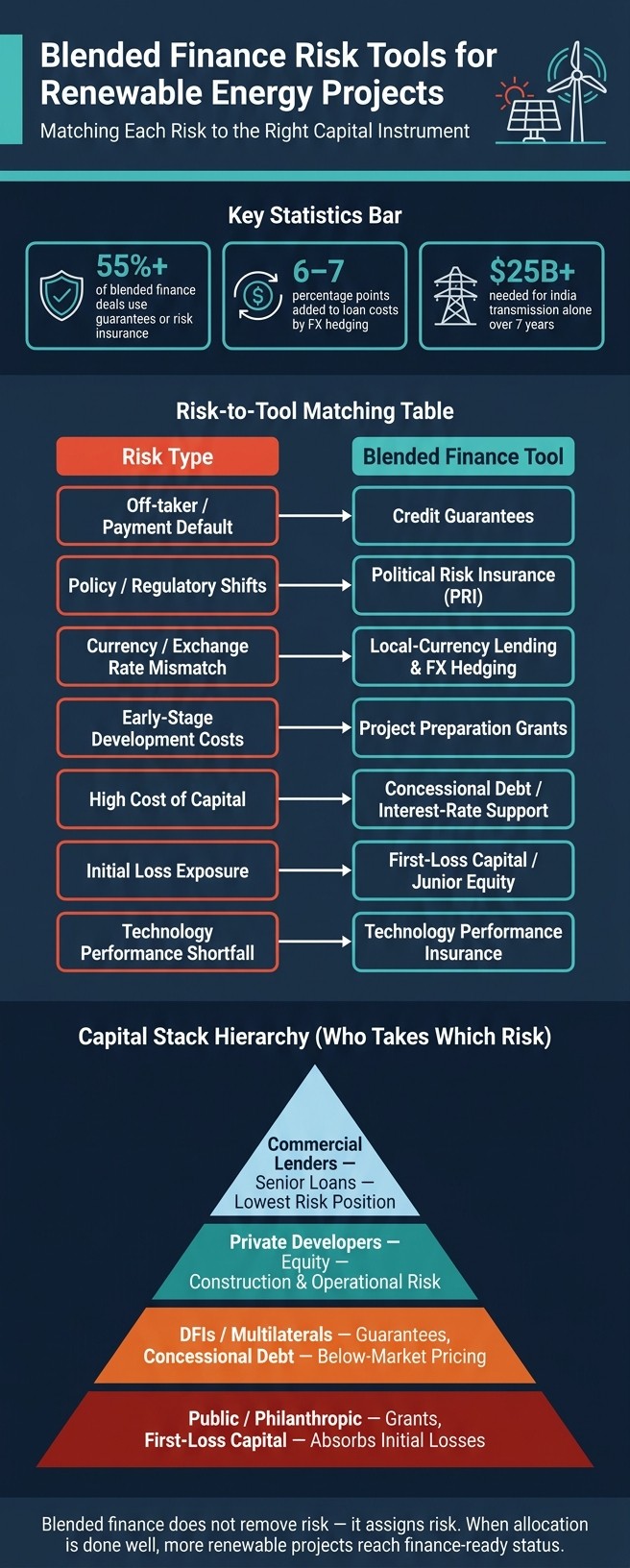
Blended Finance Risk Tools for Renewable Energy Projects
Blended finance works by pairing each risk with the type of capital best suited to carry it. That way, private investors don’t have to absorb every downside at the same time. In simple terms, the toolkit breaks into two buckets: catalytic capital that improves project economics, and risk-transfer tools that shield investors from specific losses.
Catalytic Capital Tools: Grants, Concessional Debt, and First-Loss Capital
Grants help with early-stage development risk. Getting a project off the ground costs money long before it starts operating, and commercial lenders usually won’t pay for that phase. The U.S.-Africa Clean Energy Finance Initiative (US-ACEF) tackled this head-on: a $20 million early-stage project development fund gave grants to cover non-operational expenses for early-stage clean energy companies across 10 African nations. Those grants helped move projects to the investment stage and reportedly produced a 75x leverage effect [2].
Concessional debt from development finance institutions (DFIs) tackles the high cost of capital. It brings borrowing costs down through below-market interest rates, longer repayment periods, or both. Sometimes that small shift is the difference between a deal that stalls out and one that gets financed.
First-loss capital protects the downside for private investors. Public or philanthropic funders agree to absorb the first losses if things go wrong, giving senior private investors more protection higher up in the capital stack. The Africa Renewable Energy Fund (AREF), managed by Berkeley Energy, uses this kind of layered structure: DFI equity contributions act as first-loss capital, while technical assistance grants support small- to medium-scale renewable projects in Sub-Saharan Africa [2].
Put together, these tools help reduce pressure on both project economics and repayment.
Risk Transfer Tools: Guarantees, Insurance, and Local-Currency Hedging
Risk-transfer tools handle the hazards that can sink an otherwise sound project. Credit guarantees deal with off-taker risk. Political risk insurance helps cover policy instability. Hedging helps with currency mismatch. It’s telling that more than 55% of blended finance deals use guarantees or risk insurance, compared with 34% in the broader market [2].
Political risk insurance is aimed at policy uncertainty, expropriation, and government breach of contract. Currency risk is usually addressed through local-currency lending or FX hedging facilities. That matters because commercial hedging products can add 6 to 7 percentage points to the cost of foreign currency loans [5]. At that point, the extra cost can wipe out the value of concessional pricing. DFI lending in local currency can sidestep that problem.
Comparison Table: Which Instrument Fits Which Risk
Risk Type | Matching Blended Finance Tool |
|---|---|
Off-taker / payment default | Credit guarantees |
Policy / regulatory shifts | Political risk insurance (PRI) |
Currency / exchange rate mismatch | Local-currency lending, FX hedging facilities |
Early-stage development costs | Project preparation grants |
High cost of capital | Concessional debt / interest-rate support |
Initial loss exposure | First-loss capital / junior equity |
Technology performance shortfall | Technology performance insurance |
In practice, these tools tend to work best when public and private partners split risk through a clear project structure.
How Public-Private Partnerships Turn Risk Sharing Into Bankable Projects
Getting the capital structure right is only half the work. The other half is putting each risk where it belongs and making sure every party has a clear reason to perform.
Who Takes Which Risk in a Blended Structure
In a blended finance deal, risk does not sit with one player. It is spread across a layered structure, with each group taking the part it is best set up to handle. The aim is simple: match construction, revenue, and country risks to the right layer of capital.
Stakeholder | Typical Instrument | Risk Position | Primary Role |
|---|---|---|---|
Public/Philanthropic | Grants, first-loss capital, equity | Junior / Highest risk | Absorbs initial losses and helps defray upfront planning costs |
DFIs / Multilaterals | Guarantees, concessional debt, mezzanine, insurance | Intermediate | Provides below-market pricing and technical support |
Commercial Lenders | Senior loans, project finance | Senior / Lowest risk | Provides the bulk of capital once risks are mitigated |
Private Developers | Equity, concessional agreements | High risk | Manages construction, technical, and operational risks |
Public and philanthropic actors usually take junior positions in the capital stack. That setup gives senior lenders room to come in only after junior capital is there to absorb early losses. In practice, that is how project risk, revenue risk, and country risk get split up instead of dumped on one balance sheet.
Mechanics That Unlock Financing: Credit Support, Early-Stage Funding, and Aggregation
Once the risk stack is in place, three tools tend to carry most of the load: credit support, early funding, and scale.
Credit enhancement - through guarantees or insurance - can strengthen a project's credit profile enough for commercial lenders to join, including by covering risks such as off-taker credit or currency volatility [2]. Project preparation grants pay for early development work and help move projects to the stage where private financing can step in.
Aggregation deals with the scale problem. Smaller distributed projects, such as mini-grids, are often too scattered to draw institutional investors on their own. Blended finance can group them into one portfolio that reaches commercial scale [1].
Why Collaboration Design Matters
Even a well-built capital stack can fall apart if the parties are not lined up. Commercial lenders look for proven business models and clear cash flow. Early-stage or small-scale clean energy projects often do not have either one in a form lenders can underwrite with confidence [1]. That gap has to be closed with terms that fit lender needs.
Results-Based Financing (RBF) is one practical way to do that. It links funding disbursements to set milestones like energy output or installed capacity, so each party is working toward the same performance targets rather than just getting the project built [2]. Long-term concession agreements can help too, because they give lenders better visibility into operations and future cash flow [2].
Local engagement matters just as much as contract structure. Local developers help connect projects to permits, regulation, and market conditions on the ground. More often than not, that fit is what turns a good idea into something lenders will back.
Even then, these structures only work when the market can take the risk that remains.
Limits, Design Conditions, and Key Takeaways
Where Blended Finance Can Fall Short
The same structures that help bring in capital can also break down when core risks are still too high or too vague. Blended finance cannot save projects with weak tariffs, unstable regulation, or fragile revenue models.
Foreign-currency debt without hedging, plus dependence on a weak single off-taker, can leave cash flow exposed [2]. Blended finance also falls short when credit enhancement does not fully cover off-taker risk. Smaller projects still need portfolio aggregation to reach commercial scale [6].
The point is simple: each tool only works if it is matched to the specific constraint it is meant to address.
Comparison Table: Benefits vs. Practical Constraints
Instrument | Primary Benefit | Practical Constraint |
|---|---|---|
Guarantees / Risk Insurance | Strengthens the credit profile and helps commercial lenders participate [2] | Requires scarce public or multilateral risk capital |
Concessional Debt | Lowers overall cost of capital and can extend repayment tenors [2] | May distort local markets if not priced carefully [2] |
First-Loss Capital | Absorbs initial losses and builds private investor confidence [2] | Limited availability of public and philanthropic funds [2] |
Grants / Technical Assistance | Covers early-stage costs and strengthens project bankability [2] | Often limited to early-stage or non-operational expenses [2] |
Local-Currency Hedging | Protects revenue models from exchange-rate swings [2] | Can be expensive or unavailable in frontier markets [2] |
Those gains only turn into bankable projects when the structure stays disciplined.
Conclusion: From Risk Barriers to Finance-Ready Project Pipelines
Blended finance works when project, revenue, and country risks are clearly allocated and monitored. The structure only holds up when risks can be measured, revenue models offer clear cash-flow visibility, public and private roles are clearly defined, and private investors can see a believable path to reasonable returns.
When risks are measurable and shared cleanly, blended finance can turn promising renewable projects into finance-ready pipelines.
FAQs
What is blended finance in renewable energy?
Blended finance in renewable energy brings together public, philanthropic, and private capital to fund projects that commercial investors might pass on because they look too risky or not profitable enough.
The basic idea is simple: use concessional funding - such as below-market loans, guarantees, or first-loss capital - to absorb part of the risk. That can help address issues like political instability, currency swings, and default. As a result, the project’s risk-return profile looks better, which can draw in private investment that might not have come in otherwise.
Which renewable energy risks matter most to lenders?
Lenders tend to zero in on a few risks first: off-taker risk, currency risk, and policy or regulatory instability. They also look closely at liquidity and scale risk, along with technology uncertainty that can weaken project viability.
In emerging markets, political instability often adds another layer of concern. So does limited visibility into cash flow and a lack of proven business models. Put together, those factors can push up risk perceptions and drive a higher cost of capital.
When does blended finance make a project bankable?
Blended finance helps make a project bankable by improving its risk-return profile enough for commercial lenders to step in.
In plain terms, it uses concessional capital to take on risks that private investors often shy away from - political instability, currency swings, or first-loss positions, to name a few. That risk cushion changes the math for lenders. A deal that once looked too shaky can start to look financeable.
Tools like guarantees play a big part here. They give investors more confidence, cut some of the downside, and help unlock the capital a project needs to move ahead.
Related Blog Posts
Latest Articles
©2025

Narrative Change and Power Building: The Missing Half of Advocacy
Narrative change is the process of disrupting dominant narratives that normalize inequity and advancing new narratives from historically marginalized communities.

Funding Resilience Without Federal Grants
BRIC is unreliable and FEMA is shrinking. Here's how cities fund climate resilience with dedicated revenue, blended finance, and a coordinating authority.

The ESG Blind Spot: How AI Is Finding Risks in Companies Nobody Else Is Watching
Norway's sovereign wealth fund uses AI to screen 7,200 portfolio companies for forced labor and corruption within 24 hours. The real story is the emerging-market coverage gap that traditional ESG data vendors miss — and what it means for any company with a global supply chain.
Narrative Change and Power Building: The Missing Half of Advocacy
Narrative change is the process of disrupting dominant narratives that normalize inequity and advancing new narratives from historically marginalized communities.
Funding Resilience Without Federal Grants
BRIC is unreliable and FEMA is shrinking. Here's how cities fund climate resilience with dedicated revenue, blended finance, and a coordinating authority.
The ESG Blind Spot: How AI Is Finding Risks in Companies Nobody Else Is Watching
Norway's sovereign wealth fund uses AI to screen 7,200 portfolio companies for forced labor and corruption within 24 hours. The real story is the emerging-market coverage gap that traditional ESG data vendors miss — and what it means for any company with a global supply chain.
FAQ
01
What does it really mean to “redefine profit”?
02
What makes Council Fire different?
03
Who does Council Fire work with?
04
What does working with Council Fire actually look like?
05
How does Council Fire help organizations turn big goals into action?
06
How does Council Fire define and measure success?
Jul 2, 2026
How Blended Finance Addresses Renewable Energy Risks
Sustainability Strategy
In This Article
Blended finance reallocates early project, revenue, and country risks to make renewable projects bankable in emerging markets.
How Blended Finance Addresses Renewable Energy Risks
Many renewable energy projects do not fail on demand - they fail on risk setup. I’d sum it up this way: blended finance helps get deals funded by shifting early losses, revenue uncertainty, policy shocks, and currency exposure away from private lenders that will not take them alone.
If you want the short answer, here it is:
Good projects can still miss funding when construction, grid, off-taker, or FX risk looks too high.
Blended finance mixes public, philanthropic, DFI, and private capital so each party takes the risk it can handle.
Common tools include grants, concessional debt, first-loss capital, guarantees, political risk insurance, and local-currency lending.
The biggest pain points are project risk, revenue risk, and country risk.
This matters most in emerging markets, where renewable energy capital costs can be up to 7x higher and only about 20% of global renewable investment flows there, excluding China.
It works best when cash flow is clear and the risk-sharing structure is simple, measured, and enforced.
A few numbers make the case fast: more than 55% of blended finance deals use guarantees or risk insurance, FX hedging can add 6 to 7 percentage points to loan costs, and India alone needs over $25 billion for transmission in the next seven years. That tells me the issue is often not the power plant - it is the financing stack around it.
What I take from the article is simple: blended finance does not remove risk; it assigns risk. When that allocation is done well, more renewable projects move from idea stage to finance-ready pipeline.
Why Green Technology Needs Blended Finance in Africa and Developing Markets | Episode 2
The Main Risk Barriers in Renewable Energy Finance
Investors do not turn away from renewable projects as a category. They turn away when the risk does not fit the kind of capital they can provide. That distinction matters. The core job of blended finance is to sort each risk and place it with the capital source most able to take it on.
Project-Level Risks: Construction, Technology, Resource, and Grid Integration
At the project level, the main barriers are construction execution, technology performance, resource uncertainty, and grid interconnection. Each one affects whether a project will produce power on time and at the level promised. When output is uncertain, debt service gets weaker, which is why performance-based financing often ties support to verified generation [2].
Grid interconnection is another major hurdle. In some markets, transmission and distribution systems are not ready when a project is completed. A plant may be built, but if it cannot deliver power to the grid, revenue gets delayed and lender confidence drops. India, for example, needs more than $25 billion in added investment over the next seven years for electricity transmission alone [3]. That helps explain why early-stage support often focuses first on construction and interconnection risk.
Revenue Risks: Off-Taker Credit, Price Volatility, and Demand Uncertainty
A project can be technically sound and still fail to secure financing if the buyer of its power is weak or if tariff terms keep shifting. In many emerging markets, that buyer is a state-owned utility with poor financial health. Lenders are not just judging the solar panels, wind resource, or engineering plan. They are asking a simpler question: Will the buyer keep paying over the full life of the project?
They underwrite cash flow, borrower strength, and contract stability. If the off-taker is weak or the PPA is unstable, financing often stalls. Without a buyer that lenders trust and tariff terms that hold up, the project cannot turn power output into steady cash flow.
For distributed generation and mini-grid projects, demand risk adds another layer. If power demand is uncertain, projects may struggle to show the revenue needed for commercial scale. That creates a bankability gap, especially for smaller systems trying to move beyond pilot stage [1].
Country-Level Risks: Policy, Regulation, Currency, and Liquidity
Some risks sit well beyond the sponsor's control. Policy and regulatory shifts can change project economics fast, especially when tariff rules move. Currency volatility can also drive borrowing costs much higher, which is a serious issue when project revenue is local-currency based but debt is priced in foreign currency.
Local capital markets can make things harder too. When those markets are thin, projects are pushed toward higher-cost international capital [1]. That also narrows refinancing paths, since smaller projects are often harder to sell or refinance later [4].
Because these risks pile up rather than appear one at a time, blended finance has to pair each barrier with the right tool. The next section looks at how grants, concessional debt, guarantees, insurance, and hedging can reduce those barriers.
How Blended Finance Reduces Those Risks
Blended Finance Risk Tools for Renewable Energy Projects
Blended finance works by pairing each risk with the type of capital best suited to carry it. That way, private investors don’t have to absorb every downside at the same time. In simple terms, the toolkit breaks into two buckets: catalytic capital that improves project economics, and risk-transfer tools that shield investors from specific losses.
Catalytic Capital Tools: Grants, Concessional Debt, and First-Loss Capital
Grants help with early-stage development risk. Getting a project off the ground costs money long before it starts operating, and commercial lenders usually won’t pay for that phase. The U.S.-Africa Clean Energy Finance Initiative (US-ACEF) tackled this head-on: a $20 million early-stage project development fund gave grants to cover non-operational expenses for early-stage clean energy companies across 10 African nations. Those grants helped move projects to the investment stage and reportedly produced a 75x leverage effect [2].
Concessional debt from development finance institutions (DFIs) tackles the high cost of capital. It brings borrowing costs down through below-market interest rates, longer repayment periods, or both. Sometimes that small shift is the difference between a deal that stalls out and one that gets financed.
First-loss capital protects the downside for private investors. Public or philanthropic funders agree to absorb the first losses if things go wrong, giving senior private investors more protection higher up in the capital stack. The Africa Renewable Energy Fund (AREF), managed by Berkeley Energy, uses this kind of layered structure: DFI equity contributions act as first-loss capital, while technical assistance grants support small- to medium-scale renewable projects in Sub-Saharan Africa [2].
Put together, these tools help reduce pressure on both project economics and repayment.
Risk Transfer Tools: Guarantees, Insurance, and Local-Currency Hedging
Risk-transfer tools handle the hazards that can sink an otherwise sound project. Credit guarantees deal with off-taker risk. Political risk insurance helps cover policy instability. Hedging helps with currency mismatch. It’s telling that more than 55% of blended finance deals use guarantees or risk insurance, compared with 34% in the broader market [2].
Political risk insurance is aimed at policy uncertainty, expropriation, and government breach of contract. Currency risk is usually addressed through local-currency lending or FX hedging facilities. That matters because commercial hedging products can add 6 to 7 percentage points to the cost of foreign currency loans [5]. At that point, the extra cost can wipe out the value of concessional pricing. DFI lending in local currency can sidestep that problem.
Comparison Table: Which Instrument Fits Which Risk
Risk Type | Matching Blended Finance Tool |
|---|---|
Off-taker / payment default | Credit guarantees |
Policy / regulatory shifts | Political risk insurance (PRI) |
Currency / exchange rate mismatch | Local-currency lending, FX hedging facilities |
Early-stage development costs | Project preparation grants |
High cost of capital | Concessional debt / interest-rate support |
Initial loss exposure | First-loss capital / junior equity |
Technology performance shortfall | Technology performance insurance |
In practice, these tools tend to work best when public and private partners split risk through a clear project structure.
How Public-Private Partnerships Turn Risk Sharing Into Bankable Projects
Getting the capital structure right is only half the work. The other half is putting each risk where it belongs and making sure every party has a clear reason to perform.
Who Takes Which Risk in a Blended Structure
In a blended finance deal, risk does not sit with one player. It is spread across a layered structure, with each group taking the part it is best set up to handle. The aim is simple: match construction, revenue, and country risks to the right layer of capital.
Stakeholder | Typical Instrument | Risk Position | Primary Role |
|---|---|---|---|
Public/Philanthropic | Grants, first-loss capital, equity | Junior / Highest risk | Absorbs initial losses and helps defray upfront planning costs |
DFIs / Multilaterals | Guarantees, concessional debt, mezzanine, insurance | Intermediate | Provides below-market pricing and technical support |
Commercial Lenders | Senior loans, project finance | Senior / Lowest risk | Provides the bulk of capital once risks are mitigated |
Private Developers | Equity, concessional agreements | High risk | Manages construction, technical, and operational risks |
Public and philanthropic actors usually take junior positions in the capital stack. That setup gives senior lenders room to come in only after junior capital is there to absorb early losses. In practice, that is how project risk, revenue risk, and country risk get split up instead of dumped on one balance sheet.
Mechanics That Unlock Financing: Credit Support, Early-Stage Funding, and Aggregation
Once the risk stack is in place, three tools tend to carry most of the load: credit support, early funding, and scale.
Credit enhancement - through guarantees or insurance - can strengthen a project's credit profile enough for commercial lenders to join, including by covering risks such as off-taker credit or currency volatility [2]. Project preparation grants pay for early development work and help move projects to the stage where private financing can step in.
Aggregation deals with the scale problem. Smaller distributed projects, such as mini-grids, are often too scattered to draw institutional investors on their own. Blended finance can group them into one portfolio that reaches commercial scale [1].
Why Collaboration Design Matters
Even a well-built capital stack can fall apart if the parties are not lined up. Commercial lenders look for proven business models and clear cash flow. Early-stage or small-scale clean energy projects often do not have either one in a form lenders can underwrite with confidence [1]. That gap has to be closed with terms that fit lender needs.
Results-Based Financing (RBF) is one practical way to do that. It links funding disbursements to set milestones like energy output or installed capacity, so each party is working toward the same performance targets rather than just getting the project built [2]. Long-term concession agreements can help too, because they give lenders better visibility into operations and future cash flow [2].
Local engagement matters just as much as contract structure. Local developers help connect projects to permits, regulation, and market conditions on the ground. More often than not, that fit is what turns a good idea into something lenders will back.
Even then, these structures only work when the market can take the risk that remains.
Limits, Design Conditions, and Key Takeaways
Where Blended Finance Can Fall Short
The same structures that help bring in capital can also break down when core risks are still too high or too vague. Blended finance cannot save projects with weak tariffs, unstable regulation, or fragile revenue models.
Foreign-currency debt without hedging, plus dependence on a weak single off-taker, can leave cash flow exposed [2]. Blended finance also falls short when credit enhancement does not fully cover off-taker risk. Smaller projects still need portfolio aggregation to reach commercial scale [6].
The point is simple: each tool only works if it is matched to the specific constraint it is meant to address.
Comparison Table: Benefits vs. Practical Constraints
Instrument | Primary Benefit | Practical Constraint |
|---|---|---|
Guarantees / Risk Insurance | Strengthens the credit profile and helps commercial lenders participate [2] | Requires scarce public or multilateral risk capital |
Concessional Debt | Lowers overall cost of capital and can extend repayment tenors [2] | May distort local markets if not priced carefully [2] |
First-Loss Capital | Absorbs initial losses and builds private investor confidence [2] | Limited availability of public and philanthropic funds [2] |
Grants / Technical Assistance | Covers early-stage costs and strengthens project bankability [2] | Often limited to early-stage or non-operational expenses [2] |
Local-Currency Hedging | Protects revenue models from exchange-rate swings [2] | Can be expensive or unavailable in frontier markets [2] |
Those gains only turn into bankable projects when the structure stays disciplined.
Conclusion: From Risk Barriers to Finance-Ready Project Pipelines
Blended finance works when project, revenue, and country risks are clearly allocated and monitored. The structure only holds up when risks can be measured, revenue models offer clear cash-flow visibility, public and private roles are clearly defined, and private investors can see a believable path to reasonable returns.
When risks are measurable and shared cleanly, blended finance can turn promising renewable projects into finance-ready pipelines.
FAQs
What is blended finance in renewable energy?
Blended finance in renewable energy brings together public, philanthropic, and private capital to fund projects that commercial investors might pass on because they look too risky or not profitable enough.
The basic idea is simple: use concessional funding - such as below-market loans, guarantees, or first-loss capital - to absorb part of the risk. That can help address issues like political instability, currency swings, and default. As a result, the project’s risk-return profile looks better, which can draw in private investment that might not have come in otherwise.
Which renewable energy risks matter most to lenders?
Lenders tend to zero in on a few risks first: off-taker risk, currency risk, and policy or regulatory instability. They also look closely at liquidity and scale risk, along with technology uncertainty that can weaken project viability.
In emerging markets, political instability often adds another layer of concern. So does limited visibility into cash flow and a lack of proven business models. Put together, those factors can push up risk perceptions and drive a higher cost of capital.
When does blended finance make a project bankable?
Blended finance helps make a project bankable by improving its risk-return profile enough for commercial lenders to step in.
In plain terms, it uses concessional capital to take on risks that private investors often shy away from - political instability, currency swings, or first-loss positions, to name a few. That risk cushion changes the math for lenders. A deal that once looked too shaky can start to look financeable.
Tools like guarantees play a big part here. They give investors more confidence, cut some of the downside, and help unlock the capital a project needs to move ahead.
Related Blog Posts
Latest Articles
©2025
Narrative Change and Power Building: The Missing Half of Advocacy
Narrative change is the process of disrupting dominant narratives that normalize inequity and advancing new narratives from historically marginalized communities.
Funding Resilience Without Federal Grants
BRIC is unreliable and FEMA is shrinking. Here's how cities fund climate resilience with dedicated revenue, blended finance, and a coordinating authority.
The ESG Blind Spot: How AI Is Finding Risks in Companies Nobody Else Is Watching
Norway's sovereign wealth fund uses AI to screen 7,200 portfolio companies for forced labor and corruption within 24 hours. The real story is the emerging-market coverage gap that traditional ESG data vendors miss — and what it means for any company with a global supply chain.
FAQ
01
What does it really mean to “redefine profit”?
02
What makes Council Fire different?
03
Who does Council Fire work with?
04
What does working with Council Fire actually look like?
05
How does Council Fire help organizations turn big goals into action?
06
How does Council Fire define and measure success?
Jul 2, 2026
How Blended Finance Addresses Renewable Energy Risks
Sustainability Strategy
In This Article
Blended finance reallocates early project, revenue, and country risks to make renewable projects bankable in emerging markets.
How Blended Finance Addresses Renewable Energy Risks
Many renewable energy projects do not fail on demand - they fail on risk setup. I’d sum it up this way: blended finance helps get deals funded by shifting early losses, revenue uncertainty, policy shocks, and currency exposure away from private lenders that will not take them alone.
If you want the short answer, here it is:
Good projects can still miss funding when construction, grid, off-taker, or FX risk looks too high.
Blended finance mixes public, philanthropic, DFI, and private capital so each party takes the risk it can handle.
Common tools include grants, concessional debt, first-loss capital, guarantees, political risk insurance, and local-currency lending.
The biggest pain points are project risk, revenue risk, and country risk.
This matters most in emerging markets, where renewable energy capital costs can be up to 7x higher and only about 20% of global renewable investment flows there, excluding China.
It works best when cash flow is clear and the risk-sharing structure is simple, measured, and enforced.
A few numbers make the case fast: more than 55% of blended finance deals use guarantees or risk insurance, FX hedging can add 6 to 7 percentage points to loan costs, and India alone needs over $25 billion for transmission in the next seven years. That tells me the issue is often not the power plant - it is the financing stack around it.
What I take from the article is simple: blended finance does not remove risk; it assigns risk. When that allocation is done well, more renewable projects move from idea stage to finance-ready pipeline.
Why Green Technology Needs Blended Finance in Africa and Developing Markets | Episode 2
The Main Risk Barriers in Renewable Energy Finance
Investors do not turn away from renewable projects as a category. They turn away when the risk does not fit the kind of capital they can provide. That distinction matters. The core job of blended finance is to sort each risk and place it with the capital source most able to take it on.
Project-Level Risks: Construction, Technology, Resource, and Grid Integration
At the project level, the main barriers are construction execution, technology performance, resource uncertainty, and grid interconnection. Each one affects whether a project will produce power on time and at the level promised. When output is uncertain, debt service gets weaker, which is why performance-based financing often ties support to verified generation [2].
Grid interconnection is another major hurdle. In some markets, transmission and distribution systems are not ready when a project is completed. A plant may be built, but if it cannot deliver power to the grid, revenue gets delayed and lender confidence drops. India, for example, needs more than $25 billion in added investment over the next seven years for electricity transmission alone [3]. That helps explain why early-stage support often focuses first on construction and interconnection risk.
Revenue Risks: Off-Taker Credit, Price Volatility, and Demand Uncertainty
A project can be technically sound and still fail to secure financing if the buyer of its power is weak or if tariff terms keep shifting. In many emerging markets, that buyer is a state-owned utility with poor financial health. Lenders are not just judging the solar panels, wind resource, or engineering plan. They are asking a simpler question: Will the buyer keep paying over the full life of the project?
They underwrite cash flow, borrower strength, and contract stability. If the off-taker is weak or the PPA is unstable, financing often stalls. Without a buyer that lenders trust and tariff terms that hold up, the project cannot turn power output into steady cash flow.
For distributed generation and mini-grid projects, demand risk adds another layer. If power demand is uncertain, projects may struggle to show the revenue needed for commercial scale. That creates a bankability gap, especially for smaller systems trying to move beyond pilot stage [1].
Country-Level Risks: Policy, Regulation, Currency, and Liquidity
Some risks sit well beyond the sponsor's control. Policy and regulatory shifts can change project economics fast, especially when tariff rules move. Currency volatility can also drive borrowing costs much higher, which is a serious issue when project revenue is local-currency based but debt is priced in foreign currency.
Local capital markets can make things harder too. When those markets are thin, projects are pushed toward higher-cost international capital [1]. That also narrows refinancing paths, since smaller projects are often harder to sell or refinance later [4].
Because these risks pile up rather than appear one at a time, blended finance has to pair each barrier with the right tool. The next section looks at how grants, concessional debt, guarantees, insurance, and hedging can reduce those barriers.
How Blended Finance Reduces Those Risks
Blended Finance Risk Tools for Renewable Energy Projects
Blended finance works by pairing each risk with the type of capital best suited to carry it. That way, private investors don’t have to absorb every downside at the same time. In simple terms, the toolkit breaks into two buckets: catalytic capital that improves project economics, and risk-transfer tools that shield investors from specific losses.
Catalytic Capital Tools: Grants, Concessional Debt, and First-Loss Capital
Grants help with early-stage development risk. Getting a project off the ground costs money long before it starts operating, and commercial lenders usually won’t pay for that phase. The U.S.-Africa Clean Energy Finance Initiative (US-ACEF) tackled this head-on: a $20 million early-stage project development fund gave grants to cover non-operational expenses for early-stage clean energy companies across 10 African nations. Those grants helped move projects to the investment stage and reportedly produced a 75x leverage effect [2].
Concessional debt from development finance institutions (DFIs) tackles the high cost of capital. It brings borrowing costs down through below-market interest rates, longer repayment periods, or both. Sometimes that small shift is the difference between a deal that stalls out and one that gets financed.
First-loss capital protects the downside for private investors. Public or philanthropic funders agree to absorb the first losses if things go wrong, giving senior private investors more protection higher up in the capital stack. The Africa Renewable Energy Fund (AREF), managed by Berkeley Energy, uses this kind of layered structure: DFI equity contributions act as first-loss capital, while technical assistance grants support small- to medium-scale renewable projects in Sub-Saharan Africa [2].
Put together, these tools help reduce pressure on both project economics and repayment.
Risk Transfer Tools: Guarantees, Insurance, and Local-Currency Hedging
Risk-transfer tools handle the hazards that can sink an otherwise sound project. Credit guarantees deal with off-taker risk. Political risk insurance helps cover policy instability. Hedging helps with currency mismatch. It’s telling that more than 55% of blended finance deals use guarantees or risk insurance, compared with 34% in the broader market [2].
Political risk insurance is aimed at policy uncertainty, expropriation, and government breach of contract. Currency risk is usually addressed through local-currency lending or FX hedging facilities. That matters because commercial hedging products can add 6 to 7 percentage points to the cost of foreign currency loans [5]. At that point, the extra cost can wipe out the value of concessional pricing. DFI lending in local currency can sidestep that problem.
Comparison Table: Which Instrument Fits Which Risk
Risk Type | Matching Blended Finance Tool |
|---|---|
Off-taker / payment default | Credit guarantees |
Policy / regulatory shifts | Political risk insurance (PRI) |
Currency / exchange rate mismatch | Local-currency lending, FX hedging facilities |
Early-stage development costs | Project preparation grants |
High cost of capital | Concessional debt / interest-rate support |
Initial loss exposure | First-loss capital / junior equity |
Technology performance shortfall | Technology performance insurance |
In practice, these tools tend to work best when public and private partners split risk through a clear project structure.
How Public-Private Partnerships Turn Risk Sharing Into Bankable Projects
Getting the capital structure right is only half the work. The other half is putting each risk where it belongs and making sure every party has a clear reason to perform.
Who Takes Which Risk in a Blended Structure
In a blended finance deal, risk does not sit with one player. It is spread across a layered structure, with each group taking the part it is best set up to handle. The aim is simple: match construction, revenue, and country risks to the right layer of capital.
Stakeholder | Typical Instrument | Risk Position | Primary Role |
|---|---|---|---|
Public/Philanthropic | Grants, first-loss capital, equity | Junior / Highest risk | Absorbs initial losses and helps defray upfront planning costs |
DFIs / Multilaterals | Guarantees, concessional debt, mezzanine, insurance | Intermediate | Provides below-market pricing and technical support |
Commercial Lenders | Senior loans, project finance | Senior / Lowest risk | Provides the bulk of capital once risks are mitigated |
Private Developers | Equity, concessional agreements | High risk | Manages construction, technical, and operational risks |
Public and philanthropic actors usually take junior positions in the capital stack. That setup gives senior lenders room to come in only after junior capital is there to absorb early losses. In practice, that is how project risk, revenue risk, and country risk get split up instead of dumped on one balance sheet.
Mechanics That Unlock Financing: Credit Support, Early-Stage Funding, and Aggregation
Once the risk stack is in place, three tools tend to carry most of the load: credit support, early funding, and scale.
Credit enhancement - through guarantees or insurance - can strengthen a project's credit profile enough for commercial lenders to join, including by covering risks such as off-taker credit or currency volatility [2]. Project preparation grants pay for early development work and help move projects to the stage where private financing can step in.
Aggregation deals with the scale problem. Smaller distributed projects, such as mini-grids, are often too scattered to draw institutional investors on their own. Blended finance can group them into one portfolio that reaches commercial scale [1].
Why Collaboration Design Matters
Even a well-built capital stack can fall apart if the parties are not lined up. Commercial lenders look for proven business models and clear cash flow. Early-stage or small-scale clean energy projects often do not have either one in a form lenders can underwrite with confidence [1]. That gap has to be closed with terms that fit lender needs.
Results-Based Financing (RBF) is one practical way to do that. It links funding disbursements to set milestones like energy output or installed capacity, so each party is working toward the same performance targets rather than just getting the project built [2]. Long-term concession agreements can help too, because they give lenders better visibility into operations and future cash flow [2].
Local engagement matters just as much as contract structure. Local developers help connect projects to permits, regulation, and market conditions on the ground. More often than not, that fit is what turns a good idea into something lenders will back.
Even then, these structures only work when the market can take the risk that remains.
Limits, Design Conditions, and Key Takeaways
Where Blended Finance Can Fall Short
The same structures that help bring in capital can also break down when core risks are still too high or too vague. Blended finance cannot save projects with weak tariffs, unstable regulation, or fragile revenue models.
Foreign-currency debt without hedging, plus dependence on a weak single off-taker, can leave cash flow exposed [2]. Blended finance also falls short when credit enhancement does not fully cover off-taker risk. Smaller projects still need portfolio aggregation to reach commercial scale [6].
The point is simple: each tool only works if it is matched to the specific constraint it is meant to address.
Comparison Table: Benefits vs. Practical Constraints
Instrument | Primary Benefit | Practical Constraint |
|---|---|---|
Guarantees / Risk Insurance | Strengthens the credit profile and helps commercial lenders participate [2] | Requires scarce public or multilateral risk capital |
Concessional Debt | Lowers overall cost of capital and can extend repayment tenors [2] | May distort local markets if not priced carefully [2] |
First-Loss Capital | Absorbs initial losses and builds private investor confidence [2] | Limited availability of public and philanthropic funds [2] |
Grants / Technical Assistance | Covers early-stage costs and strengthens project bankability [2] | Often limited to early-stage or non-operational expenses [2] |
Local-Currency Hedging | Protects revenue models from exchange-rate swings [2] | Can be expensive or unavailable in frontier markets [2] |
Those gains only turn into bankable projects when the structure stays disciplined.
Conclusion: From Risk Barriers to Finance-Ready Project Pipelines
Blended finance works when project, revenue, and country risks are clearly allocated and monitored. The structure only holds up when risks can be measured, revenue models offer clear cash-flow visibility, public and private roles are clearly defined, and private investors can see a believable path to reasonable returns.
When risks are measurable and shared cleanly, blended finance can turn promising renewable projects into finance-ready pipelines.
FAQs
What is blended finance in renewable energy?
Blended finance in renewable energy brings together public, philanthropic, and private capital to fund projects that commercial investors might pass on because they look too risky or not profitable enough.
The basic idea is simple: use concessional funding - such as below-market loans, guarantees, or first-loss capital - to absorb part of the risk. That can help address issues like political instability, currency swings, and default. As a result, the project’s risk-return profile looks better, which can draw in private investment that might not have come in otherwise.
Which renewable energy risks matter most to lenders?
Lenders tend to zero in on a few risks first: off-taker risk, currency risk, and policy or regulatory instability. They also look closely at liquidity and scale risk, along with technology uncertainty that can weaken project viability.
In emerging markets, political instability often adds another layer of concern. So does limited visibility into cash flow and a lack of proven business models. Put together, those factors can push up risk perceptions and drive a higher cost of capital.
When does blended finance make a project bankable?
Blended finance helps make a project bankable by improving its risk-return profile enough for commercial lenders to step in.
In plain terms, it uses concessional capital to take on risks that private investors often shy away from - political instability, currency swings, or first-loss positions, to name a few. That risk cushion changes the math for lenders. A deal that once looked too shaky can start to look financeable.
Tools like guarantees play a big part here. They give investors more confidence, cut some of the downside, and help unlock the capital a project needs to move ahead.
Related Blog Posts
Latest Articles
©2025
Narrative Change and Power Building: The Missing Half of Advocacy
Narrative change is the process of disrupting dominant narratives that normalize inequity and advancing new narratives from historically marginalized communities.
Funding Resilience Without Federal Grants
BRIC is unreliable and FEMA is shrinking. Here's how cities fund climate resilience with dedicated revenue, blended finance, and a coordinating authority.
The ESG Blind Spot: How AI Is Finding Risks in Companies Nobody Else Is Watching
Norway's sovereign wealth fund uses AI to screen 7,200 portfolio companies for forced labor and corruption within 24 hours. The real story is the emerging-market coverage gap that traditional ESG data vendors miss — and what it means for any company with a global supply chain.
FAQ
What does it really mean to “redefine profit”?
What makes Council Fire different?
Who does Council Fire work with?
What does working with Council Fire actually look like?
How does Council Fire help organizations turn big goals into action?
How does Council Fire define and measure success?