
Aug 14, 2026
DFI Blended Finance For Clean Power
Sustainability Strategy
In This Article
DFIs must match guarantees, concessional loans, or first-loss capital to unlock private finance for solar, wind and grid projects.
DFI Blended Finance For Clean Power
If you want private money to fund clean power in emerging markets, the deal has to remove the risk private lenders fear most. That is the core message here.
I see three clear takeaways:
Solar is usually the simplest place to start because long PPAs, standard auction terms, and debt-heavy structures can support finance with less subsidy.
Wind often needs more support around payment risk and revenue swings, even when the project itself looks sound.
Grid and transmission need the deepest public backing because income depends on regulation, tariffs, and public-sector payment strength.
The article also makes one point very clear: the right tool depends on the bottleneck. If the problem is high financing cost, concessional debt can help. If the problem is buyer nonpayment, guarantees matter more. If the problem is build-stage risk, first-loss or subordinated capital can help pull in senior lenders.
A live example is MIGA’s May 2024 support for CODELCO, which included guarantees linked to up to $1.2 billion in non-shareholder loans. That shows how public risk cover can help move private capital into renewable power supply.
Highlights from the State of Blended Finance 2025
Quick Comparison
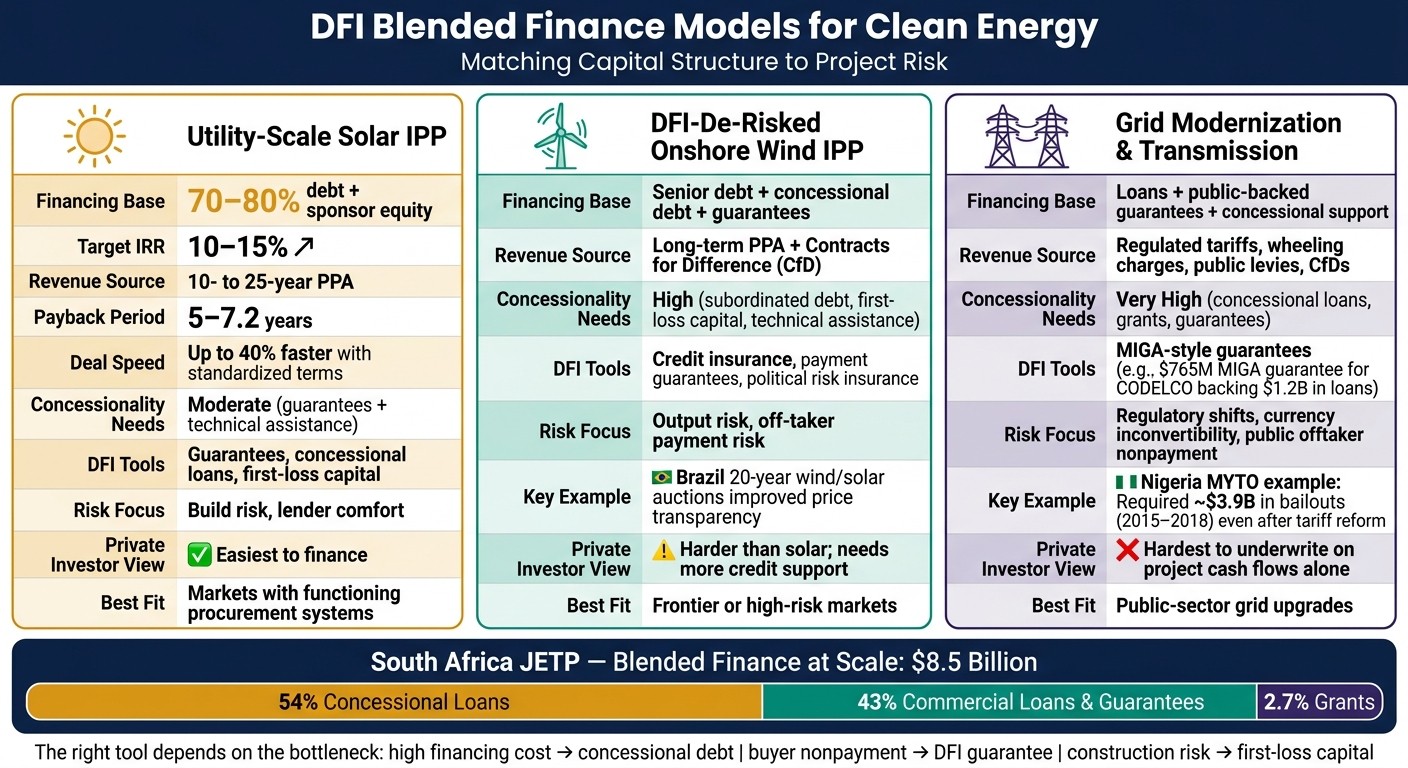
Blended Finance Models for Clean Energy: Solar vs Wind vs Grid
Model | Main financing base | Main risk focus | Revenue source | Typical private investor view |
|---|---|---|---|---|
Solar IPP | 70%–80% debt plus sponsor equity | Build risk and lender comfort | 10- to 25-year PPA | Easiest of the three to finance |
Onshore wind IPP | Senior debt plus concessional debt and guarantees | Output risk and off-taker payment risk | Long-term PPA, sometimes CfD | Harder than solar; needs more credit support |
Grid / transmission | Loans plus public-backed guarantees and concessional support | Regulation, currency, and public payment risk | Tariffs, wheeling charges, public levies | Hardest to underwrite on project cash flow alone |
Bottom line: I’d read this as a guide to matching each clean power deal with the right risk-sharing tool, capital layer, and revenue setup - so the project can move from paper to close.
1. Utility-Scale Solar IPP Auction Model
In this model, a private developer builds the solar plant under a BOO or BOT setup, usually through an SPV that walls off project risk. That choice shapes how risk and returns move across the capital stack.
Capital Stack
Debt usually funds 70% to 80% of total project cost. The rest comes from sponsor equity and, in some markets, tax equity. Target IRRs are usually 10% to 15% [2].
Risk Sharing
DFIs help de-risk the project for commercial lenders through guarantees, concessional loans, and first-loss capital. In plain terms, these tools make the project look safer on paper and in practice. That can lower borrowing costs and make participation by institutional investors more likely.
Revenue Model
Revenue usually comes through a 10- to 25-year PPA with a utility or another creditworthy offtaker. For lenders, that means a steadier stream of cash to support senior debt. Payback often lands in the 5 to 7.2 year range [2].
Deal Speed
When terms are standardized and cash-flow rules are set in advance, deal closure time can fall by up to 40%.
Wind follows the same blended-finance model, but lower output certainty shifts the risk split.
2. DFI-De-Risked Onshore Wind IPP Model
Onshore wind uses many of the same blended-finance tools as solar, but the center of gravity is a bit different. Here, DFI support tends to focus less on pure build risk and more on revenue stability and buyer credit risk. In plain terms, lenders want to know two things: will the project generate cash as expected, and will the buyer actually pay? Compared with solar, wind deals often lean harder on payment security because output risk and off-taker risk carry more weight in lender decisions.
Capital Stack
A DFI-backed wind stack usually combines senior debt with concessional debt, guarantees, and political risk insurance. The goal is simple: reduce downside risk for both lenders and equity investors. That mix can make the deal easier to finance and improve terms that might otherwise look too harsh for the project.
Risk Sharing
Off-taker credit risk is often the main stress point in a wind deal. If a utility or government buyer misses payments, the whole structure starts to wobble. DFIs step in with credit insurance or guarantees against utility or government nonpayment [1]. That backstop gives lenders more comfort and can lower financing costs.
Revenue Model
Long-term PPAs are the base of the revenue model. They give the project a steady path for contracted income, which matters a lot when debt has to be repaid over many years. CfDs add another layer of price protection by topping up or refunding the gap between market prices and a fixed strike price. This helps smooth revenue when power prices move around.
As wind portfolios get bigger, the bottleneck often changes. The main issue is no longer just generation revenue. It becomes grid access and delivery - whether the power can move where it needs to go, when it needs to go.
Mobilization Outcome
Brazil offers a useful example. Its technology-specific wind auctions and 20-year PPAs improved price transparency and financing conditions for wind and solar [3]. That logic works best when auctions are transparent and contract length is long enough to support debt.
3. Grid Modernization and Transmission Blended Facility
Grid and transmission projects don't make money by selling power. They make money by moving electricity through the system, so their income usually comes from regulated network revenue. That's why, once generation is financed, transmission often becomes the next bankability choke point.
Capital Stack
In May 2024, MIGA approved a $765 million guarantee for CODELCO, backing up to $1.2 billion in non-shareholder loans for renewable PPAs and grid-linked supply [1].
Risk Sharing
The main risks here are regulatory shifts, currency inconvertibility, and nonpayment by public offtakers. MIGA's CODELCO guarantee covered non-honoring of public debt, breach of contract, and currency inconvertibility [1]. Those are exactly the kinds of exposures DFIs are built to take on directly or move around so private lenders can step in with more confidence.
Revenue Model
Most grid projects earn revenue through regulated tariffs, wheeling charges, or public levies tied to delivering renewable electricity to end users. CfDs can also help smooth cash flow.
Still, tariff reform alone doesn't fix everything. Nigeria's MYTO makes that plain: even after reform, the system still needed about $3.9 billion in bailouts from 2015 to 2018 [3].
Mobilization Outcome
Mobilization in transmission is usually slower and tougher to track than in an IPP deal. You tend to see progress in the financing terms rather than in one headline number:
More private lenders joining the deal
Longer tenors
Better pricing and other lending terms
In practice, these transactions often hinge just as much on deal design as on the capital itself.
4. Council Fire Strategic Design and Implementation Support

The hard part isn’t getting to a bankable structure on paper. It’s getting that structure all the way to a live transaction that works across governments, DFIs, lenders, and communities. In solar, wind, and grid projects, the same pattern shows up again and again: even a well-shaped deal can fall apart when procurement, governance, and reporting aren’t set early. At that point, the focus moves from how the deal is built to how the deal gets done. That’s where Council Fire steps in, helping move projects from term sheet to operating asset.
Program Design: Sequencing Capital by Risk
The core idea is simple: match each source of capital to the stage of the project where it fits best. Feasibility and structuring often need public or philanthropic capital. DFI capital fits the de-risking stage. Senior debt should come in only after permits, contracts, and cash flows are in place. In plain terms, capital should follow project risk instead of being pushed into every phase whether it belongs there or not.
Minimum concessionality matters here. It’s not just a finance concept; it’s a discipline in execution. Use only the amount of public subsidy needed to make the project viable. More than that drains scarce public funds and can push private finance to the sidelines. Council Fire also builds a clear exit path from the start, so concessional support can phase out as the market matures.
Stakeholder Alignment and Governance
The toughest part is often risk allocation. Governments, DFIs, developers, and communities do not come to the table with the same goals, and that tension has to be managed directly. Council Fire works across the full transaction group to line up incentives and decision rights, especially when governments are seeking development outcomes, private investors are looking for market-rate returns, and DFIs are trying to balance both.
Council Fire also puts reporting and measurement frameworks in place that track social and environmental performance alongside financial metrics. KPIs, baselines, and reporting schedules need to be set upfront. That gives everyone a shared view of whether the structure added value and offers clear proof of additionality. Once those rules are in place, the transaction can move into procurement and close.
Implementation: From Close to Operations
Execution after close depends on a lot of small design choices that carry big effects later. Council Fire sets up procurement through standardized PPAs and RfPs to cut transaction costs, coordinates regulatory pathways that can mobilize local pension and insurance fund capital, and supports local capacity through technical assistance.
For grid and transmission projects, the firm also puts payment security mechanisms or government-backed guarantees in place to protect revenue streams when off-taker risk is high.
Those design choices set the terms for the trade-offs that come next.
Trade-Offs, Advantages, and Limitations
These structures tackle the same financing gap, but they do it in very different ways. The trade-off usually comes down to speed, deal complexity, and how much subsidy support is needed. DFI participation helps move risk off private investors so commercial capital can step in. The catch is that the level of risk transfer - and the price of making it work - changes a lot across solar, wind, and grid projects.
Model | Major Advantages | Main Limitations | Concessionality Needs | Best-Fit Context |
|---|---|---|---|---|
Utility-Scale Solar IPP Auction | Fast to close; replicable structure; scalable | Depends on clear procurement rules and reliable payment structures | Moderate - guarantees and technical assistance | Markets with functioning procurement systems |
DFI-De-Risked Onshore Wind IPP | Handles higher construction risk and frontier market conditions better | Complex capital stack; longer close timelines; higher transaction costs | High - subordinated debt, first-loss capital, technical assistance | Frontier or high-risk markets where commercial lenders need DFI de-risking |
Grid Modernization / Transmission | Enables system-level infrastructure; unlocks renewable integration at scale | Hardest to structure; public-sector governance slows execution; revenue harder to underwrite | Very high - concessional loans, grants, guarantees | Public-sector grid upgrades |
The pattern is pretty clear. Solar is the easiest to repeat across markets, which makes it the cleanest starting point when procurement systems already work. Wind asks for heavier de-risking, especially where construction risk and market uncertainty make lenders nervous. Grid deals sit in a different league: they often need the deepest public backing because the assets are harder to finance on project cash flows alone.
One point matters more than it may seem at first glance. In many cases, the biggest obstacle is not the plant itself. It’s payment risk. When that’s the issue, guarantees can make the difference between a public-sector offtake that looks shaky on paper and an asset a private lender is willing to back.
Conclusion
Across solar, wind, and grid deals, the financing bottleneck shifts, and the capital stack has to shift with it. Blended finance only works when the mix of capital fits the main constraint in front of the project. Solar is the easiest to standardize. Wind usually needs more de-risking. Grid projects need the deepest level of public backing.
When the main problem is a high cost of capital, concessional debt is the most direct answer. When the issue is buyer nonpayment risk, a DFI-backed guarantee or another payment-security tool tied to the PPA does more than debt on its own. And when projects run into construction risk or weak-market conditions, first-loss capital and subordinated debt can make the deal bankable.
Grid and transmission projects need a heavier layer of de-risking because political and regulatory risk is much harder to underwrite.
South Africa’s $8.5 billion JETP shows what this looks like at scale: 54% concessional loans, 43% commercial loans and guarantees, and 2.7% grants [4].
The strongest deals begin with the constraint and then pick the instrument.
FAQs
What is blended finance in clean power?
Blended finance brings together public, philanthropic, and private capital to pay for clean power and climate resilience projects. The basic idea is simple: stack different sources of money in a way that makes a project less risky and more appealing to private investors that might otherwise stay on the sidelines.
This structure changes the project's risk-return profile by spreading risk across different participants. In practice, public agencies or philanthropic groups often take on the earlier or higher-risk layer through first-loss capital, guarantees, or concessional loans. That cushion gives private investors more confidence and makes it easier to bring in capital at scale.
Why is solar easier to finance than wind or grid?
Solar is often easier to finance because the market is more mature, the project model is more standardized, and cash flows are usually steadier and easier to forecast. It also tends to move from development to operation on a shorter timeline and can scale more smoothly, which makes it appealing to private investors.
Wind and grid projects usually come with a tougher risk profile. They often need higher upfront spending, deeper technical review, and more work to sort out project risk. Because of that, they may need extra derisking and stronger support from DFIs.
Which DFI tool fits each project risk?
DFIs and other public entities use different tools for different kinds of risk:
Credit/default risk: guarantees and first-loss capital
High financing costs: concessional loans
Low bankability or technical maturity: technical assistance
Operational or political risks: insurance
In practice, many clean power projects stack several of these tools at once. That mix helps cover more than one risk, improves deal terms, and makes private investors more willing to come in.
Related Blog Posts
Latest Articles
©2025

Narrative Change and Power Building: The Missing Half of Advocacy
Narrative change is the process of disrupting dominant narratives that normalize inequity and advancing new narratives from historically marginalized communities.

Funding Resilience Without Federal Grants
BRIC is unreliable and FEMA is shrinking. Here's how cities fund climate resilience with dedicated revenue, blended finance, and a coordinating authority.

The ESG Blind Spot: How AI Is Finding Risks in Companies Nobody Else Is Watching
Norway's sovereign wealth fund uses AI to screen 7,200 portfolio companies for forced labor and corruption within 24 hours. The real story is the emerging-market coverage gap that traditional ESG data vendors miss — and what it means for any company with a global supply chain.
Narrative Change and Power Building: The Missing Half of Advocacy
Narrative change is the process of disrupting dominant narratives that normalize inequity and advancing new narratives from historically marginalized communities.
Funding Resilience Without Federal Grants
BRIC is unreliable and FEMA is shrinking. Here's how cities fund climate resilience with dedicated revenue, blended finance, and a coordinating authority.
The ESG Blind Spot: How AI Is Finding Risks in Companies Nobody Else Is Watching
Norway's sovereign wealth fund uses AI to screen 7,200 portfolio companies for forced labor and corruption within 24 hours. The real story is the emerging-market coverage gap that traditional ESG data vendors miss — and what it means for any company with a global supply chain.
FAQ
01
What does it really mean to “redefine profit”?
02
What makes Council Fire different?
03
Who does Council Fire work with?
04
What does working with Council Fire actually look like?
05
How does Council Fire help organizations turn big goals into action?
06
How does Council Fire define and measure success?
Aug 14, 2026
DFI Blended Finance For Clean Power
Sustainability Strategy
In This Article
DFIs must match guarantees, concessional loans, or first-loss capital to unlock private finance for solar, wind and grid projects.
DFI Blended Finance For Clean Power
If you want private money to fund clean power in emerging markets, the deal has to remove the risk private lenders fear most. That is the core message here.
I see three clear takeaways:
Solar is usually the simplest place to start because long PPAs, standard auction terms, and debt-heavy structures can support finance with less subsidy.
Wind often needs more support around payment risk and revenue swings, even when the project itself looks sound.
Grid and transmission need the deepest public backing because income depends on regulation, tariffs, and public-sector payment strength.
The article also makes one point very clear: the right tool depends on the bottleneck. If the problem is high financing cost, concessional debt can help. If the problem is buyer nonpayment, guarantees matter more. If the problem is build-stage risk, first-loss or subordinated capital can help pull in senior lenders.
A live example is MIGA’s May 2024 support for CODELCO, which included guarantees linked to up to $1.2 billion in non-shareholder loans. That shows how public risk cover can help move private capital into renewable power supply.
Highlights from the State of Blended Finance 2025
Quick Comparison
Blended Finance Models for Clean Energy: Solar vs Wind vs Grid
Model | Main financing base | Main risk focus | Revenue source | Typical private investor view |
|---|---|---|---|---|
Solar IPP | 70%–80% debt plus sponsor equity | Build risk and lender comfort | 10- to 25-year PPA | Easiest of the three to finance |
Onshore wind IPP | Senior debt plus concessional debt and guarantees | Output risk and off-taker payment risk | Long-term PPA, sometimes CfD | Harder than solar; needs more credit support |
Grid / transmission | Loans plus public-backed guarantees and concessional support | Regulation, currency, and public payment risk | Tariffs, wheeling charges, public levies | Hardest to underwrite on project cash flow alone |
Bottom line: I’d read this as a guide to matching each clean power deal with the right risk-sharing tool, capital layer, and revenue setup - so the project can move from paper to close.
1. Utility-Scale Solar IPP Auction Model
In this model, a private developer builds the solar plant under a BOO or BOT setup, usually through an SPV that walls off project risk. That choice shapes how risk and returns move across the capital stack.
Capital Stack
Debt usually funds 70% to 80% of total project cost. The rest comes from sponsor equity and, in some markets, tax equity. Target IRRs are usually 10% to 15% [2].
Risk Sharing
DFIs help de-risk the project for commercial lenders through guarantees, concessional loans, and first-loss capital. In plain terms, these tools make the project look safer on paper and in practice. That can lower borrowing costs and make participation by institutional investors more likely.
Revenue Model
Revenue usually comes through a 10- to 25-year PPA with a utility or another creditworthy offtaker. For lenders, that means a steadier stream of cash to support senior debt. Payback often lands in the 5 to 7.2 year range [2].
Deal Speed
When terms are standardized and cash-flow rules are set in advance, deal closure time can fall by up to 40%.
Wind follows the same blended-finance model, but lower output certainty shifts the risk split.
2. DFI-De-Risked Onshore Wind IPP Model
Onshore wind uses many of the same blended-finance tools as solar, but the center of gravity is a bit different. Here, DFI support tends to focus less on pure build risk and more on revenue stability and buyer credit risk. In plain terms, lenders want to know two things: will the project generate cash as expected, and will the buyer actually pay? Compared with solar, wind deals often lean harder on payment security because output risk and off-taker risk carry more weight in lender decisions.
Capital Stack
A DFI-backed wind stack usually combines senior debt with concessional debt, guarantees, and political risk insurance. The goal is simple: reduce downside risk for both lenders and equity investors. That mix can make the deal easier to finance and improve terms that might otherwise look too harsh for the project.
Risk Sharing
Off-taker credit risk is often the main stress point in a wind deal. If a utility or government buyer misses payments, the whole structure starts to wobble. DFIs step in with credit insurance or guarantees against utility or government nonpayment [1]. That backstop gives lenders more comfort and can lower financing costs.
Revenue Model
Long-term PPAs are the base of the revenue model. They give the project a steady path for contracted income, which matters a lot when debt has to be repaid over many years. CfDs add another layer of price protection by topping up or refunding the gap between market prices and a fixed strike price. This helps smooth revenue when power prices move around.
As wind portfolios get bigger, the bottleneck often changes. The main issue is no longer just generation revenue. It becomes grid access and delivery - whether the power can move where it needs to go, when it needs to go.
Mobilization Outcome
Brazil offers a useful example. Its technology-specific wind auctions and 20-year PPAs improved price transparency and financing conditions for wind and solar [3]. That logic works best when auctions are transparent and contract length is long enough to support debt.
3. Grid Modernization and Transmission Blended Facility
Grid and transmission projects don't make money by selling power. They make money by moving electricity through the system, so their income usually comes from regulated network revenue. That's why, once generation is financed, transmission often becomes the next bankability choke point.
Capital Stack
In May 2024, MIGA approved a $765 million guarantee for CODELCO, backing up to $1.2 billion in non-shareholder loans for renewable PPAs and grid-linked supply [1].
Risk Sharing
The main risks here are regulatory shifts, currency inconvertibility, and nonpayment by public offtakers. MIGA's CODELCO guarantee covered non-honoring of public debt, breach of contract, and currency inconvertibility [1]. Those are exactly the kinds of exposures DFIs are built to take on directly or move around so private lenders can step in with more confidence.
Revenue Model
Most grid projects earn revenue through regulated tariffs, wheeling charges, or public levies tied to delivering renewable electricity to end users. CfDs can also help smooth cash flow.
Still, tariff reform alone doesn't fix everything. Nigeria's MYTO makes that plain: even after reform, the system still needed about $3.9 billion in bailouts from 2015 to 2018 [3].
Mobilization Outcome
Mobilization in transmission is usually slower and tougher to track than in an IPP deal. You tend to see progress in the financing terms rather than in one headline number:
More private lenders joining the deal
Longer tenors
Better pricing and other lending terms
In practice, these transactions often hinge just as much on deal design as on the capital itself.
4. Council Fire Strategic Design and Implementation Support
The hard part isn’t getting to a bankable structure on paper. It’s getting that structure all the way to a live transaction that works across governments, DFIs, lenders, and communities. In solar, wind, and grid projects, the same pattern shows up again and again: even a well-shaped deal can fall apart when procurement, governance, and reporting aren’t set early. At that point, the focus moves from how the deal is built to how the deal gets done. That’s where Council Fire steps in, helping move projects from term sheet to operating asset.
Program Design: Sequencing Capital by Risk
The core idea is simple: match each source of capital to the stage of the project where it fits best. Feasibility and structuring often need public or philanthropic capital. DFI capital fits the de-risking stage. Senior debt should come in only after permits, contracts, and cash flows are in place. In plain terms, capital should follow project risk instead of being pushed into every phase whether it belongs there or not.
Minimum concessionality matters here. It’s not just a finance concept; it’s a discipline in execution. Use only the amount of public subsidy needed to make the project viable. More than that drains scarce public funds and can push private finance to the sidelines. Council Fire also builds a clear exit path from the start, so concessional support can phase out as the market matures.
Stakeholder Alignment and Governance
The toughest part is often risk allocation. Governments, DFIs, developers, and communities do not come to the table with the same goals, and that tension has to be managed directly. Council Fire works across the full transaction group to line up incentives and decision rights, especially when governments are seeking development outcomes, private investors are looking for market-rate returns, and DFIs are trying to balance both.
Council Fire also puts reporting and measurement frameworks in place that track social and environmental performance alongside financial metrics. KPIs, baselines, and reporting schedules need to be set upfront. That gives everyone a shared view of whether the structure added value and offers clear proof of additionality. Once those rules are in place, the transaction can move into procurement and close.
Implementation: From Close to Operations
Execution after close depends on a lot of small design choices that carry big effects later. Council Fire sets up procurement through standardized PPAs and RfPs to cut transaction costs, coordinates regulatory pathways that can mobilize local pension and insurance fund capital, and supports local capacity through technical assistance.
For grid and transmission projects, the firm also puts payment security mechanisms or government-backed guarantees in place to protect revenue streams when off-taker risk is high.
Those design choices set the terms for the trade-offs that come next.
Trade-Offs, Advantages, and Limitations
These structures tackle the same financing gap, but they do it in very different ways. The trade-off usually comes down to speed, deal complexity, and how much subsidy support is needed. DFI participation helps move risk off private investors so commercial capital can step in. The catch is that the level of risk transfer - and the price of making it work - changes a lot across solar, wind, and grid projects.
Model | Major Advantages | Main Limitations | Concessionality Needs | Best-Fit Context |
|---|---|---|---|---|
Utility-Scale Solar IPP Auction | Fast to close; replicable structure; scalable | Depends on clear procurement rules and reliable payment structures | Moderate - guarantees and technical assistance | Markets with functioning procurement systems |
DFI-De-Risked Onshore Wind IPP | Handles higher construction risk and frontier market conditions better | Complex capital stack; longer close timelines; higher transaction costs | High - subordinated debt, first-loss capital, technical assistance | Frontier or high-risk markets where commercial lenders need DFI de-risking |
Grid Modernization / Transmission | Enables system-level infrastructure; unlocks renewable integration at scale | Hardest to structure; public-sector governance slows execution; revenue harder to underwrite | Very high - concessional loans, grants, guarantees | Public-sector grid upgrades |
The pattern is pretty clear. Solar is the easiest to repeat across markets, which makes it the cleanest starting point when procurement systems already work. Wind asks for heavier de-risking, especially where construction risk and market uncertainty make lenders nervous. Grid deals sit in a different league: they often need the deepest public backing because the assets are harder to finance on project cash flows alone.
One point matters more than it may seem at first glance. In many cases, the biggest obstacle is not the plant itself. It’s payment risk. When that’s the issue, guarantees can make the difference between a public-sector offtake that looks shaky on paper and an asset a private lender is willing to back.
Conclusion
Across solar, wind, and grid deals, the financing bottleneck shifts, and the capital stack has to shift with it. Blended finance only works when the mix of capital fits the main constraint in front of the project. Solar is the easiest to standardize. Wind usually needs more de-risking. Grid projects need the deepest level of public backing.
When the main problem is a high cost of capital, concessional debt is the most direct answer. When the issue is buyer nonpayment risk, a DFI-backed guarantee or another payment-security tool tied to the PPA does more than debt on its own. And when projects run into construction risk or weak-market conditions, first-loss capital and subordinated debt can make the deal bankable.
Grid and transmission projects need a heavier layer of de-risking because political and regulatory risk is much harder to underwrite.
South Africa’s $8.5 billion JETP shows what this looks like at scale: 54% concessional loans, 43% commercial loans and guarantees, and 2.7% grants [4].
The strongest deals begin with the constraint and then pick the instrument.
FAQs
What is blended finance in clean power?
Blended finance brings together public, philanthropic, and private capital to pay for clean power and climate resilience projects. The basic idea is simple: stack different sources of money in a way that makes a project less risky and more appealing to private investors that might otherwise stay on the sidelines.
This structure changes the project's risk-return profile by spreading risk across different participants. In practice, public agencies or philanthropic groups often take on the earlier or higher-risk layer through first-loss capital, guarantees, or concessional loans. That cushion gives private investors more confidence and makes it easier to bring in capital at scale.
Why is solar easier to finance than wind or grid?
Solar is often easier to finance because the market is more mature, the project model is more standardized, and cash flows are usually steadier and easier to forecast. It also tends to move from development to operation on a shorter timeline and can scale more smoothly, which makes it appealing to private investors.
Wind and grid projects usually come with a tougher risk profile. They often need higher upfront spending, deeper technical review, and more work to sort out project risk. Because of that, they may need extra derisking and stronger support from DFIs.
Which DFI tool fits each project risk?
DFIs and other public entities use different tools for different kinds of risk:
Credit/default risk: guarantees and first-loss capital
High financing costs: concessional loans
Low bankability or technical maturity: technical assistance
Operational or political risks: insurance
In practice, many clean power projects stack several of these tools at once. That mix helps cover more than one risk, improves deal terms, and makes private investors more willing to come in.
Related Blog Posts
Latest Articles
©2025
Narrative Change and Power Building: The Missing Half of Advocacy
Narrative change is the process of disrupting dominant narratives that normalize inequity and advancing new narratives from historically marginalized communities.
Funding Resilience Without Federal Grants
BRIC is unreliable and FEMA is shrinking. Here's how cities fund climate resilience with dedicated revenue, blended finance, and a coordinating authority.
The ESG Blind Spot: How AI Is Finding Risks in Companies Nobody Else Is Watching
Norway's sovereign wealth fund uses AI to screen 7,200 portfolio companies for forced labor and corruption within 24 hours. The real story is the emerging-market coverage gap that traditional ESG data vendors miss — and what it means for any company with a global supply chain.
FAQ
01
What does it really mean to “redefine profit”?
02
What makes Council Fire different?
03
Who does Council Fire work with?
04
What does working with Council Fire actually look like?
05
How does Council Fire help organizations turn big goals into action?
06
How does Council Fire define and measure success?
Aug 14, 2026
DFI Blended Finance For Clean Power
Sustainability Strategy
In This Article
DFIs must match guarantees, concessional loans, or first-loss capital to unlock private finance for solar, wind and grid projects.
DFI Blended Finance For Clean Power
If you want private money to fund clean power in emerging markets, the deal has to remove the risk private lenders fear most. That is the core message here.
I see three clear takeaways:
Solar is usually the simplest place to start because long PPAs, standard auction terms, and debt-heavy structures can support finance with less subsidy.
Wind often needs more support around payment risk and revenue swings, even when the project itself looks sound.
Grid and transmission need the deepest public backing because income depends on regulation, tariffs, and public-sector payment strength.
The article also makes one point very clear: the right tool depends on the bottleneck. If the problem is high financing cost, concessional debt can help. If the problem is buyer nonpayment, guarantees matter more. If the problem is build-stage risk, first-loss or subordinated capital can help pull in senior lenders.
A live example is MIGA’s May 2024 support for CODELCO, which included guarantees linked to up to $1.2 billion in non-shareholder loans. That shows how public risk cover can help move private capital into renewable power supply.
Highlights from the State of Blended Finance 2025
Quick Comparison
Blended Finance Models for Clean Energy: Solar vs Wind vs Grid
Model | Main financing base | Main risk focus | Revenue source | Typical private investor view |
|---|---|---|---|---|
Solar IPP | 70%–80% debt plus sponsor equity | Build risk and lender comfort | 10- to 25-year PPA | Easiest of the three to finance |
Onshore wind IPP | Senior debt plus concessional debt and guarantees | Output risk and off-taker payment risk | Long-term PPA, sometimes CfD | Harder than solar; needs more credit support |
Grid / transmission | Loans plus public-backed guarantees and concessional support | Regulation, currency, and public payment risk | Tariffs, wheeling charges, public levies | Hardest to underwrite on project cash flow alone |
Bottom line: I’d read this as a guide to matching each clean power deal with the right risk-sharing tool, capital layer, and revenue setup - so the project can move from paper to close.
1. Utility-Scale Solar IPP Auction Model
In this model, a private developer builds the solar plant under a BOO or BOT setup, usually through an SPV that walls off project risk. That choice shapes how risk and returns move across the capital stack.
Capital Stack
Debt usually funds 70% to 80% of total project cost. The rest comes from sponsor equity and, in some markets, tax equity. Target IRRs are usually 10% to 15% [2].
Risk Sharing
DFIs help de-risk the project for commercial lenders through guarantees, concessional loans, and first-loss capital. In plain terms, these tools make the project look safer on paper and in practice. That can lower borrowing costs and make participation by institutional investors more likely.
Revenue Model
Revenue usually comes through a 10- to 25-year PPA with a utility or another creditworthy offtaker. For lenders, that means a steadier stream of cash to support senior debt. Payback often lands in the 5 to 7.2 year range [2].
Deal Speed
When terms are standardized and cash-flow rules are set in advance, deal closure time can fall by up to 40%.
Wind follows the same blended-finance model, but lower output certainty shifts the risk split.
2. DFI-De-Risked Onshore Wind IPP Model
Onshore wind uses many of the same blended-finance tools as solar, but the center of gravity is a bit different. Here, DFI support tends to focus less on pure build risk and more on revenue stability and buyer credit risk. In plain terms, lenders want to know two things: will the project generate cash as expected, and will the buyer actually pay? Compared with solar, wind deals often lean harder on payment security because output risk and off-taker risk carry more weight in lender decisions.
Capital Stack
A DFI-backed wind stack usually combines senior debt with concessional debt, guarantees, and political risk insurance. The goal is simple: reduce downside risk for both lenders and equity investors. That mix can make the deal easier to finance and improve terms that might otherwise look too harsh for the project.
Risk Sharing
Off-taker credit risk is often the main stress point in a wind deal. If a utility or government buyer misses payments, the whole structure starts to wobble. DFIs step in with credit insurance or guarantees against utility or government nonpayment [1]. That backstop gives lenders more comfort and can lower financing costs.
Revenue Model
Long-term PPAs are the base of the revenue model. They give the project a steady path for contracted income, which matters a lot when debt has to be repaid over many years. CfDs add another layer of price protection by topping up or refunding the gap between market prices and a fixed strike price. This helps smooth revenue when power prices move around.
As wind portfolios get bigger, the bottleneck often changes. The main issue is no longer just generation revenue. It becomes grid access and delivery - whether the power can move where it needs to go, when it needs to go.
Mobilization Outcome
Brazil offers a useful example. Its technology-specific wind auctions and 20-year PPAs improved price transparency and financing conditions for wind and solar [3]. That logic works best when auctions are transparent and contract length is long enough to support debt.
3. Grid Modernization and Transmission Blended Facility
Grid and transmission projects don't make money by selling power. They make money by moving electricity through the system, so their income usually comes from regulated network revenue. That's why, once generation is financed, transmission often becomes the next bankability choke point.
Capital Stack
In May 2024, MIGA approved a $765 million guarantee for CODELCO, backing up to $1.2 billion in non-shareholder loans for renewable PPAs and grid-linked supply [1].
Risk Sharing
The main risks here are regulatory shifts, currency inconvertibility, and nonpayment by public offtakers. MIGA's CODELCO guarantee covered non-honoring of public debt, breach of contract, and currency inconvertibility [1]. Those are exactly the kinds of exposures DFIs are built to take on directly or move around so private lenders can step in with more confidence.
Revenue Model
Most grid projects earn revenue through regulated tariffs, wheeling charges, or public levies tied to delivering renewable electricity to end users. CfDs can also help smooth cash flow.
Still, tariff reform alone doesn't fix everything. Nigeria's MYTO makes that plain: even after reform, the system still needed about $3.9 billion in bailouts from 2015 to 2018 [3].
Mobilization Outcome
Mobilization in transmission is usually slower and tougher to track than in an IPP deal. You tend to see progress in the financing terms rather than in one headline number:
More private lenders joining the deal
Longer tenors
Better pricing and other lending terms
In practice, these transactions often hinge just as much on deal design as on the capital itself.
4. Council Fire Strategic Design and Implementation Support
The hard part isn’t getting to a bankable structure on paper. It’s getting that structure all the way to a live transaction that works across governments, DFIs, lenders, and communities. In solar, wind, and grid projects, the same pattern shows up again and again: even a well-shaped deal can fall apart when procurement, governance, and reporting aren’t set early. At that point, the focus moves from how the deal is built to how the deal gets done. That’s where Council Fire steps in, helping move projects from term sheet to operating asset.
Program Design: Sequencing Capital by Risk
The core idea is simple: match each source of capital to the stage of the project where it fits best. Feasibility and structuring often need public or philanthropic capital. DFI capital fits the de-risking stage. Senior debt should come in only after permits, contracts, and cash flows are in place. In plain terms, capital should follow project risk instead of being pushed into every phase whether it belongs there or not.
Minimum concessionality matters here. It’s not just a finance concept; it’s a discipline in execution. Use only the amount of public subsidy needed to make the project viable. More than that drains scarce public funds and can push private finance to the sidelines. Council Fire also builds a clear exit path from the start, so concessional support can phase out as the market matures.
Stakeholder Alignment and Governance
The toughest part is often risk allocation. Governments, DFIs, developers, and communities do not come to the table with the same goals, and that tension has to be managed directly. Council Fire works across the full transaction group to line up incentives and decision rights, especially when governments are seeking development outcomes, private investors are looking for market-rate returns, and DFIs are trying to balance both.
Council Fire also puts reporting and measurement frameworks in place that track social and environmental performance alongside financial metrics. KPIs, baselines, and reporting schedules need to be set upfront. That gives everyone a shared view of whether the structure added value and offers clear proof of additionality. Once those rules are in place, the transaction can move into procurement and close.
Implementation: From Close to Operations
Execution after close depends on a lot of small design choices that carry big effects later. Council Fire sets up procurement through standardized PPAs and RfPs to cut transaction costs, coordinates regulatory pathways that can mobilize local pension and insurance fund capital, and supports local capacity through technical assistance.
For grid and transmission projects, the firm also puts payment security mechanisms or government-backed guarantees in place to protect revenue streams when off-taker risk is high.
Those design choices set the terms for the trade-offs that come next.
Trade-Offs, Advantages, and Limitations
These structures tackle the same financing gap, but they do it in very different ways. The trade-off usually comes down to speed, deal complexity, and how much subsidy support is needed. DFI participation helps move risk off private investors so commercial capital can step in. The catch is that the level of risk transfer - and the price of making it work - changes a lot across solar, wind, and grid projects.
Model | Major Advantages | Main Limitations | Concessionality Needs | Best-Fit Context |
|---|---|---|---|---|
Utility-Scale Solar IPP Auction | Fast to close; replicable structure; scalable | Depends on clear procurement rules and reliable payment structures | Moderate - guarantees and technical assistance | Markets with functioning procurement systems |
DFI-De-Risked Onshore Wind IPP | Handles higher construction risk and frontier market conditions better | Complex capital stack; longer close timelines; higher transaction costs | High - subordinated debt, first-loss capital, technical assistance | Frontier or high-risk markets where commercial lenders need DFI de-risking |
Grid Modernization / Transmission | Enables system-level infrastructure; unlocks renewable integration at scale | Hardest to structure; public-sector governance slows execution; revenue harder to underwrite | Very high - concessional loans, grants, guarantees | Public-sector grid upgrades |
The pattern is pretty clear. Solar is the easiest to repeat across markets, which makes it the cleanest starting point when procurement systems already work. Wind asks for heavier de-risking, especially where construction risk and market uncertainty make lenders nervous. Grid deals sit in a different league: they often need the deepest public backing because the assets are harder to finance on project cash flows alone.
One point matters more than it may seem at first glance. In many cases, the biggest obstacle is not the plant itself. It’s payment risk. When that’s the issue, guarantees can make the difference between a public-sector offtake that looks shaky on paper and an asset a private lender is willing to back.
Conclusion
Across solar, wind, and grid deals, the financing bottleneck shifts, and the capital stack has to shift with it. Blended finance only works when the mix of capital fits the main constraint in front of the project. Solar is the easiest to standardize. Wind usually needs more de-risking. Grid projects need the deepest level of public backing.
When the main problem is a high cost of capital, concessional debt is the most direct answer. When the issue is buyer nonpayment risk, a DFI-backed guarantee or another payment-security tool tied to the PPA does more than debt on its own. And when projects run into construction risk or weak-market conditions, first-loss capital and subordinated debt can make the deal bankable.
Grid and transmission projects need a heavier layer of de-risking because political and regulatory risk is much harder to underwrite.
South Africa’s $8.5 billion JETP shows what this looks like at scale: 54% concessional loans, 43% commercial loans and guarantees, and 2.7% grants [4].
The strongest deals begin with the constraint and then pick the instrument.
FAQs
What is blended finance in clean power?
Blended finance brings together public, philanthropic, and private capital to pay for clean power and climate resilience projects. The basic idea is simple: stack different sources of money in a way that makes a project less risky and more appealing to private investors that might otherwise stay on the sidelines.
This structure changes the project's risk-return profile by spreading risk across different participants. In practice, public agencies or philanthropic groups often take on the earlier or higher-risk layer through first-loss capital, guarantees, or concessional loans. That cushion gives private investors more confidence and makes it easier to bring in capital at scale.
Why is solar easier to finance than wind or grid?
Solar is often easier to finance because the market is more mature, the project model is more standardized, and cash flows are usually steadier and easier to forecast. It also tends to move from development to operation on a shorter timeline and can scale more smoothly, which makes it appealing to private investors.
Wind and grid projects usually come with a tougher risk profile. They often need higher upfront spending, deeper technical review, and more work to sort out project risk. Because of that, they may need extra derisking and stronger support from DFIs.
Which DFI tool fits each project risk?
DFIs and other public entities use different tools for different kinds of risk:
Credit/default risk: guarantees and first-loss capital
High financing costs: concessional loans
Low bankability or technical maturity: technical assistance
Operational or political risks: insurance
In practice, many clean power projects stack several of these tools at once. That mix helps cover more than one risk, improves deal terms, and makes private investors more willing to come in.
Related Blog Posts
Latest Articles
©2025
Narrative Change and Power Building: The Missing Half of Advocacy
Narrative change is the process of disrupting dominant narratives that normalize inequity and advancing new narratives from historically marginalized communities.
Funding Resilience Without Federal Grants
BRIC is unreliable and FEMA is shrinking. Here's how cities fund climate resilience with dedicated revenue, blended finance, and a coordinating authority.
The ESG Blind Spot: How AI Is Finding Risks in Companies Nobody Else Is Watching
Norway's sovereign wealth fund uses AI to screen 7,200 portfolio companies for forced labor and corruption within 24 hours. The real story is the emerging-market coverage gap that traditional ESG data vendors miss — and what it means for any company with a global supply chain.
FAQ
What does it really mean to “redefine profit”?
What makes Council Fire different?
Who does Council Fire work with?
What does working with Council Fire actually look like?
How does Council Fire help organizations turn big goals into action?
How does Council Fire define and measure success?