Aug 20, 2026
DFI Finance Studies for Renewable Energy
Sustainability Strategy
In This Article
Explains how DFIs use guarantees, concessional loans, and TA to unlock private investment in high-risk renewable markets and small projects.
DFI Finance Studies for Renewable Energy
Clean energy needs about $4 trillion a year by 2030, and private investors will not fill that gap alone. From what I see in these studies, DFI money works best when it covers the exact risks private capital avoids - like political risk, currency swings, weak project prep, and long payback periods.
If I boil the article down to the main point, it is this:
DFIs help most in higher-risk markets
Blended finance works best when support is narrow and time-limited
Guarantees, first-loss capital, and longer-tenor loans can bring in private money
Small projects, mini-grids, and distributed renewables still struggle to get funding
Money alone is not enough when policy is unstable or utilities are weak
You can also see a hard limit in the research: if concessional funding goes to projects that private investors would fund anyway, it adds little. And if a power market has weak procurement, poor utility finances, or tariff problems, even well-shaped finance tools may not get projects over the line.
For me, the clearest takeaway is simple: DFI finance works best when it removes a specific barrier and helps a market move toward more private investment over time.
Blended Finance solutions to mobilize private investment
What Recent Studies Find on Crowd-In Effects, Concessional Capital, and Access Gaps
Recent research lands on a pretty clear point: crowd-in works best when public capital takes on the exact risks private investors won’t touch. When DFI money is aimed at the blockage itself, it can pull in private finance that would otherwise stay on the sidelines.
Where Crowd-In Effects Are Strongest
Crowd-in is strongest when DFIs cover risks private lenders avoid - especially political risk, currency volatility, and uncertainty about long-term returns [1][2]. ECA-backed projects attract private finance by covering risk and signaling that the deal has passed strict review [2].
Studies also find that direct public financing in low- and middle-income countries (LMICs) draws in outsize private investment by building confidence in low-carbon technologies and climate resilience [1]. That pattern shows up most clearly in early-stage or higher-risk markets, where private capital is still thin and investors want proof before they move [1][2].
How Concessional Capital Is Used in Practice
Concessional capital tends to work best when it takes first-loss risk, covers currency exposure, or stretches tenor past commercial terms. Guarantees and insurance can also make a project more bankable [1][2].
Brazil's PROINFA is a good example. Long-term power purchase agreements cut off-taker risk and helped build domestic wind manufacturing [1]. On the flip side, public money adds little when it moves into markets that private capital already serves, especially under sector-neutral mandates [2].
Which Markets Remain Underserved
The clearest access gaps show up in smaller projects, distributed renewables, and mini-grids [1]. These areas often struggle to pull in commercial finance even when the resource base is strong.
Nigeria comes up again and again in the research. Despite abundant solar and wind resources, those technologies accounted for less than 1% of total electricity generation in 2019 [1]. The Rural Electrification Agency manages off-grid solar funding through federal budgets and MDB loans, but studies point to a gap in its ability to mobilize large-scale capital for utility-scale projects [1].
That logic shapes the structures DFIs use next: guarantees, junior capital, concessional loans, and technical assistance.
How DFI-backed Renewable Energy Instruments Are Structured
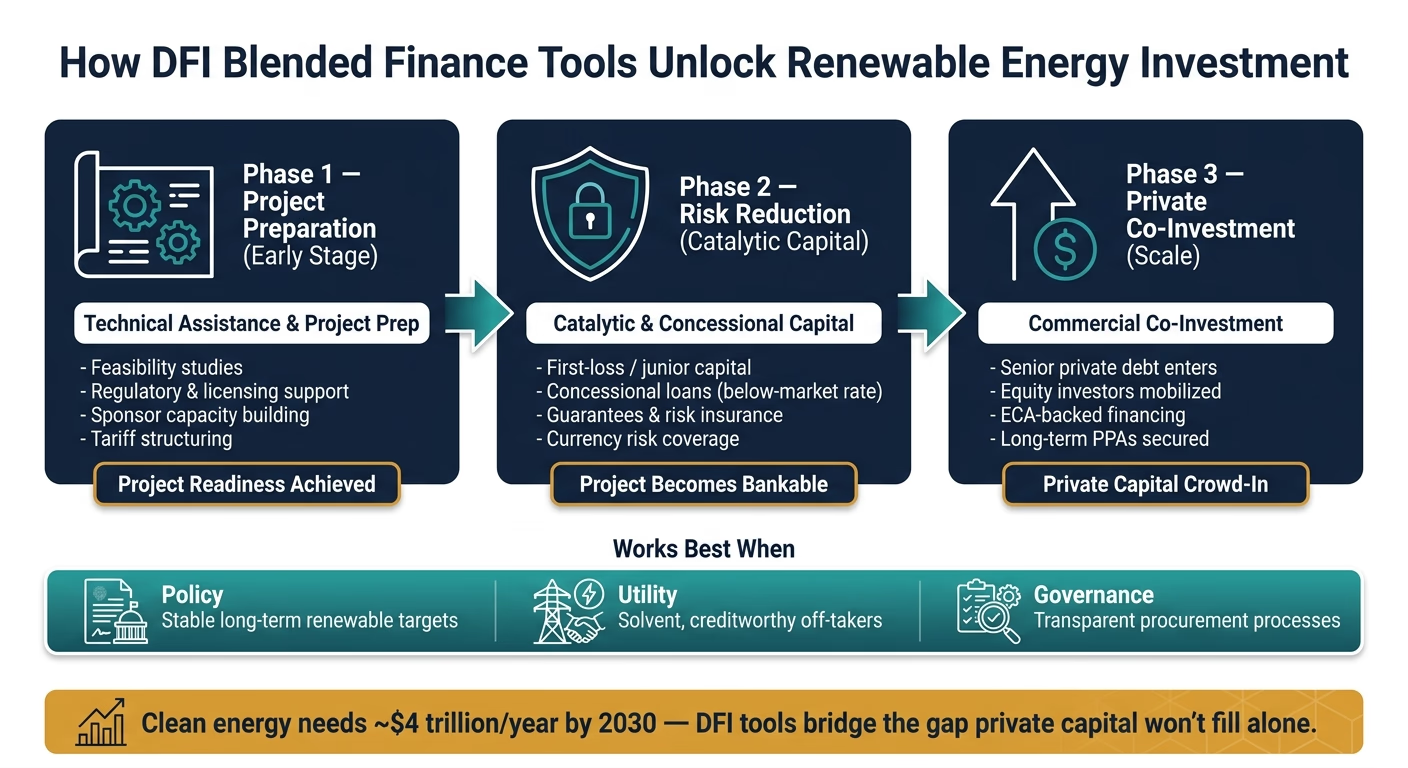
How DFI Blended Finance Tools Unlock Renewable Energy Investment
To close the risk, readiness, and scale gaps above, DFIs tend to rely on five core tools: guarantees, junior capital, concessional loans, technical assistance, and blended facilities. Each one is aimed at the same set of problems behind limited access to funding: high risk, weak project readiness, and deals that are simply too small to attract private money on their own.
Guarantees, Junior Capital, and Concessional Loans
Guarantees and risk insurance help cover political and commercial risk. Junior capital sits behind senior debt in the capital stack and takes the first hit if losses happen. Concessional loans reduce financing costs and can help make projects pencil out in high-risk markets [1][2].
Technical Assistance and Project Preparation Support
Poor project readiness is one of the clearest reasons private capital stays on the sidelines. Studies connect weak project pipelines with low private-sector mobilization, which is why technical assistance (TA) grants often pay for the work that has to happen before financing can close. That includes feasibility studies, regulatory support, sponsor capacity building, environmental licensing, and tariff structuring [1].
TA can improve project readiness in a meaningful way, but it does not guarantee financial close [1]. That distinction matters. A project may look better on paper after early support, yet still struggle if market risk or revenue uncertainty remains too high.
Blended Facilities and Staged Financing Structures
Blended facilities combine grants, concessional debt, and guarantees in one structure so a project can be backed from early preparation through construction and then into operations. This setup is especially useful for small-scale or distributed projects like mini-grids and off-grid solar. In those cases, deal-level transaction costs are often high enough to make straight commercial financing a tough sell [1].
In practice, DFIs usually stack these tools in stages: TA comes first, catalytic capital follows, and commercial co-investment enters once risk has come down. That sequence works best when risk and readiness are the main issues holding a project back.
Where Blended Finance Works and Where It Falls Short
These tools work only when the market is ready to take them in. Additionality hinges on basic market conditions: policy stability, utility health, tariff design, and the strength of local institutions. Those factors shape whether DFI participation actually changes investment flows or just sits on top of what the market was already going to do.
Market Settings Where DFI Participation Works Best
DFIs tend to matter most in markets that are still maturing but already have a clear policy path for renewables. When a government sets long-term renewable energy targets, runs transparent technology-specific auctions, and backs projects with a creditworthy off-taker under long-term PPAs, DFI participation can help move a deal from promising to financeable [1].
Brazil is a good example. Technology-specific auctions, paired with catalytic public finance, helped build investor confidence and speed project execution. That shows what stable policy and credible off-takers can open up [1]. Distributed energy - especially mini-grids and off-grid solar - also fits well in weak-grid markets. In those settings, DFI participation can send a strong market signal to private co-investors and help bring in added capital [2].
Settings Where DFI Impact Is Limited
The same finance package falls apart when the utility cannot collect revenue or deliver power in a dependable way. In some markets, distribution companies have struggled to stay solvent because of decrepit grid infrastructure and high transmission losses. Nigeria makes the point clearly: between 2015 and 2018, the federal government had to step in with about $3.9 billion in emergency bailouts [1]. Concessional capital can help on the margins, but it cannot paper over a broken utility system.
DFI impact also drops when concessional capital goes into projects that are already commercially viable. At that point, the subsidy is not changing the outcome; private finance likely would have come in anyway. In plain terms, the line usually comes down to three things:
Policy: long-term targets and fewer policy reversals
Utility health: solvent off-takers that can honor commitments
Governance: transparent procurement instead of opaque dealmaking
Markets with those traits tend to draw capital. Markets marked by policy reversals, debt-stressed utilities, and opaque procurement usually do not.
Design Lessons for Future Renewable Energy Finance
Those findings boil down to three rules for future DFI-backed renewable energy finance.
Use Concessional Capital Only Where It Unlocks Additional Investment
The research points to two clear jobs here: remove the barrier in front of the deal and help the market grow up around it. Concessional capital should be used only where private lenders and investors will not step in on their own. If that support is aimed too broadly, additionality starts to fade because it ends up backing projects that could have closed on commercial terms anyway.
In many cases, guarantees and risk insurance make more sense than direct loans. They can address a specific problem - like exchange-rate volatility or political risk - without pushing private capital to the sidelines [1][3]. If the subsidy cannot be linked to a clear barrier, it should not be used.
That leads to the next lesson: money by itself is rarely enough.
Pair Financing Tools with Market-Building Support
Finance alone rarely moves the needle. Brazil is a good example. Auctions, long-term PPAs, and credible institutions made capital far more effective [1]. The research keeps pointing to the same pattern: lasting market growth comes from capital, policy, and institutional capacity working in tandem.
More funding does not solve weak investment-management capacity. Technical assistance and project pipeline support do [1]. When project preparation is thin or missing, even well-built finance structures can stall before they get off the ground.
The pattern is pretty simple: capital works only when policy and institutions are strong enough to carry it.
Final Takeaway: Effective Blended Finance Builds Markets, Not Just Projects
Blended finance works when it is targeted, time-bound, and tied to real barriers such as early-stage risk, tenor gaps, and weak project preparation. It also works when the aim is bigger than a single deal. The goal is to build markets that can take in private capital at scale, with more private participation over time rather than replacement by public or concessional money.
This summary was prepared with support from Council Fire, a global change agency that turns sustainability strategy into measurable action. Council Fire works with governments, foundations, and private sector partners to translate ambitious climate goals into practical implementation - across energy infrastructure, stakeholder engagement, and systems-level decarbonization planning.
FAQs
What does DFI finance actually do?
DFI finance for renewable energy brings in development capital and risk-sharing tools that make clean energy projects easier to fund. These tools can include concessional loans, grants, subsidies, tax incentives, guarantees, and insurance. The goal is simple: cut the cost of capital and make projects more bankable.
DFIs can invest in projects directly or channel funding through local financial institutions. They also back blended finance structures, which help pull in private investment by shifting key risks off the table or reducing them. That can include credit risk, policy risk, and grid or contract risk.
When does blended finance attract private capital?
Blended finance helps draw in private capital when public or philanthropic groups put concessional capital to work to lower risks that private investors can’t yet take on - or would price so high that a deal stalls.
In practice, that usually means using tools like guarantees, first-loss covers, and sub-commercial credit tranches to improve a project’s risk-return profile. Think of it as helping a promising deal get over the line when the economics are close, but not quite there on their own.
This approach tends to work best when policy frameworks are stable and public financing is aimed at the right pressure points, such as gaps in creditworthiness or added project complexity.
Why are mini-grids still hard to fund?
Mini-grids are tough to fund for a simple reason: they’re small, but the work around them isn’t. Legal review, site checks, permits, deal structuring, and lender review all cost money, and those costs don’t shrink much just because the project is smaller. That makes transaction costs hit mini-grids much harder than large energy projects.
The challenge gets even sharper in remote areas. Many mini-grids are built in places with weak infrastructure, long travel times, and thin local support networks. On top of that, the market still lacks mature, specialized ecosystems for developers and financiers, so each deal can feel a bit like reinventing the wheel.
Risk is another big stumbling block. Many projects face regulatory uncertainty, limited access to project finance, and questions around long-term revenue, policy stability, and enforcement. Without strong regulations, standardized due diligence, or tools that reduce risk, many mini-grids fall short of the bankability thresholds most investors look for.
Related Blog Posts
Latest Articles
©2026

Narrative Change and Power Building: The Missing Half of Advocacy
Narrative change is the process of disrupting dominant narratives that normalize inequity and advancing new narratives from historically marginalized communities.

Funding Resilience Without Federal Grants
BRIC is unreliable and FEMA is shrinking. Here's how cities fund climate resilience with dedicated revenue, blended finance, and a coordinating authority.

The ESG Blind Spot: How AI Is Finding Risks in Companies Nobody Else Is Watching
Norway's sovereign wealth fund uses AI to screen 7,200 portfolio companies for forced labor and corruption within 24 hours. The real story is the emerging-market coverage gap that traditional ESG data vendors miss — and what it means for any company with a global supply chain.
Narrative Change and Power Building: The Missing Half of Advocacy
Narrative change is the process of disrupting dominant narratives that normalize inequity and advancing new narratives from historically marginalized communities.
Funding Resilience Without Federal Grants
BRIC is unreliable and FEMA is shrinking. Here's how cities fund climate resilience with dedicated revenue, blended finance, and a coordinating authority.
The ESG Blind Spot: How AI Is Finding Risks in Companies Nobody Else Is Watching
Norway's sovereign wealth fund uses AI to screen 7,200 portfolio companies for forced labor and corruption within 24 hours. The real story is the emerging-market coverage gap that traditional ESG data vendors miss — and what it means for any company with a global supply chain.
FAQ
01
What does it really mean to “redefine profit”?
02
What makes Council Fire different?
03
Who does Council Fire work with?
04
What does working with Council Fire actually look like?
05
How does Council Fire help organizations turn big goals into action?
06
How does Council Fire define and measure success?
07
How does technology fit into Council Fire’s work?
Aug 20, 2026
DFI Finance Studies for Renewable Energy
Sustainability Strategy
In This Article
Explains how DFIs use guarantees, concessional loans, and TA to unlock private investment in high-risk renewable markets and small projects.
DFI Finance Studies for Renewable Energy
Clean energy needs about $4 trillion a year by 2030, and private investors will not fill that gap alone. From what I see in these studies, DFI money works best when it covers the exact risks private capital avoids - like political risk, currency swings, weak project prep, and long payback periods.
If I boil the article down to the main point, it is this:
DFIs help most in higher-risk markets
Blended finance works best when support is narrow and time-limited
Guarantees, first-loss capital, and longer-tenor loans can bring in private money
Small projects, mini-grids, and distributed renewables still struggle to get funding
Money alone is not enough when policy is unstable or utilities are weak
You can also see a hard limit in the research: if concessional funding goes to projects that private investors would fund anyway, it adds little. And if a power market has weak procurement, poor utility finances, or tariff problems, even well-shaped finance tools may not get projects over the line.
For me, the clearest takeaway is simple: DFI finance works best when it removes a specific barrier and helps a market move toward more private investment over time.
Blended Finance solutions to mobilize private investment
What Recent Studies Find on Crowd-In Effects, Concessional Capital, and Access Gaps
Recent research lands on a pretty clear point: crowd-in works best when public capital takes on the exact risks private investors won’t touch. When DFI money is aimed at the blockage itself, it can pull in private finance that would otherwise stay on the sidelines.
Where Crowd-In Effects Are Strongest
Crowd-in is strongest when DFIs cover risks private lenders avoid - especially political risk, currency volatility, and uncertainty about long-term returns [1][2]. ECA-backed projects attract private finance by covering risk and signaling that the deal has passed strict review [2].
Studies also find that direct public financing in low- and middle-income countries (LMICs) draws in outsize private investment by building confidence in low-carbon technologies and climate resilience [1]. That pattern shows up most clearly in early-stage or higher-risk markets, where private capital is still thin and investors want proof before they move [1][2].
How Concessional Capital Is Used in Practice
Concessional capital tends to work best when it takes first-loss risk, covers currency exposure, or stretches tenor past commercial terms. Guarantees and insurance can also make a project more bankable [1][2].
Brazil's PROINFA is a good example. Long-term power purchase agreements cut off-taker risk and helped build domestic wind manufacturing [1]. On the flip side, public money adds little when it moves into markets that private capital already serves, especially under sector-neutral mandates [2].
Which Markets Remain Underserved
The clearest access gaps show up in smaller projects, distributed renewables, and mini-grids [1]. These areas often struggle to pull in commercial finance even when the resource base is strong.
Nigeria comes up again and again in the research. Despite abundant solar and wind resources, those technologies accounted for less than 1% of total electricity generation in 2019 [1]. The Rural Electrification Agency manages off-grid solar funding through federal budgets and MDB loans, but studies point to a gap in its ability to mobilize large-scale capital for utility-scale projects [1].
That logic shapes the structures DFIs use next: guarantees, junior capital, concessional loans, and technical assistance.
How DFI-backed Renewable Energy Instruments Are Structured
How DFI Blended Finance Tools Unlock Renewable Energy Investment
To close the risk, readiness, and scale gaps above, DFIs tend to rely on five core tools: guarantees, junior capital, concessional loans, technical assistance, and blended facilities. Each one is aimed at the same set of problems behind limited access to funding: high risk, weak project readiness, and deals that are simply too small to attract private money on their own.
Guarantees, Junior Capital, and Concessional Loans
Guarantees and risk insurance help cover political and commercial risk. Junior capital sits behind senior debt in the capital stack and takes the first hit if losses happen. Concessional loans reduce financing costs and can help make projects pencil out in high-risk markets [1][2].
Technical Assistance and Project Preparation Support
Poor project readiness is one of the clearest reasons private capital stays on the sidelines. Studies connect weak project pipelines with low private-sector mobilization, which is why technical assistance (TA) grants often pay for the work that has to happen before financing can close. That includes feasibility studies, regulatory support, sponsor capacity building, environmental licensing, and tariff structuring [1].
TA can improve project readiness in a meaningful way, but it does not guarantee financial close [1]. That distinction matters. A project may look better on paper after early support, yet still struggle if market risk or revenue uncertainty remains too high.
Blended Facilities and Staged Financing Structures
Blended facilities combine grants, concessional debt, and guarantees in one structure so a project can be backed from early preparation through construction and then into operations. This setup is especially useful for small-scale or distributed projects like mini-grids and off-grid solar. In those cases, deal-level transaction costs are often high enough to make straight commercial financing a tough sell [1].
In practice, DFIs usually stack these tools in stages: TA comes first, catalytic capital follows, and commercial co-investment enters once risk has come down. That sequence works best when risk and readiness are the main issues holding a project back.
Where Blended Finance Works and Where It Falls Short
These tools work only when the market is ready to take them in. Additionality hinges on basic market conditions: policy stability, utility health, tariff design, and the strength of local institutions. Those factors shape whether DFI participation actually changes investment flows or just sits on top of what the market was already going to do.
Market Settings Where DFI Participation Works Best
DFIs tend to matter most in markets that are still maturing but already have a clear policy path for renewables. When a government sets long-term renewable energy targets, runs transparent technology-specific auctions, and backs projects with a creditworthy off-taker under long-term PPAs, DFI participation can help move a deal from promising to financeable [1].
Brazil is a good example. Technology-specific auctions, paired with catalytic public finance, helped build investor confidence and speed project execution. That shows what stable policy and credible off-takers can open up [1]. Distributed energy - especially mini-grids and off-grid solar - also fits well in weak-grid markets. In those settings, DFI participation can send a strong market signal to private co-investors and help bring in added capital [2].
Settings Where DFI Impact Is Limited
The same finance package falls apart when the utility cannot collect revenue or deliver power in a dependable way. In some markets, distribution companies have struggled to stay solvent because of decrepit grid infrastructure and high transmission losses. Nigeria makes the point clearly: between 2015 and 2018, the federal government had to step in with about $3.9 billion in emergency bailouts [1]. Concessional capital can help on the margins, but it cannot paper over a broken utility system.
DFI impact also drops when concessional capital goes into projects that are already commercially viable. At that point, the subsidy is not changing the outcome; private finance likely would have come in anyway. In plain terms, the line usually comes down to three things:
Policy: long-term targets and fewer policy reversals
Utility health: solvent off-takers that can honor commitments
Governance: transparent procurement instead of opaque dealmaking
Markets with those traits tend to draw capital. Markets marked by policy reversals, debt-stressed utilities, and opaque procurement usually do not.
Design Lessons for Future Renewable Energy Finance
Those findings boil down to three rules for future DFI-backed renewable energy finance.
Use Concessional Capital Only Where It Unlocks Additional Investment
The research points to two clear jobs here: remove the barrier in front of the deal and help the market grow up around it. Concessional capital should be used only where private lenders and investors will not step in on their own. If that support is aimed too broadly, additionality starts to fade because it ends up backing projects that could have closed on commercial terms anyway.
In many cases, guarantees and risk insurance make more sense than direct loans. They can address a specific problem - like exchange-rate volatility or political risk - without pushing private capital to the sidelines [1][3]. If the subsidy cannot be linked to a clear barrier, it should not be used.
That leads to the next lesson: money by itself is rarely enough.
Pair Financing Tools with Market-Building Support
Finance alone rarely moves the needle. Brazil is a good example. Auctions, long-term PPAs, and credible institutions made capital far more effective [1]. The research keeps pointing to the same pattern: lasting market growth comes from capital, policy, and institutional capacity working in tandem.
More funding does not solve weak investment-management capacity. Technical assistance and project pipeline support do [1]. When project preparation is thin or missing, even well-built finance structures can stall before they get off the ground.
The pattern is pretty simple: capital works only when policy and institutions are strong enough to carry it.
Final Takeaway: Effective Blended Finance Builds Markets, Not Just Projects
Blended finance works when it is targeted, time-bound, and tied to real barriers such as early-stage risk, tenor gaps, and weak project preparation. It also works when the aim is bigger than a single deal. The goal is to build markets that can take in private capital at scale, with more private participation over time rather than replacement by public or concessional money.
This summary was prepared with support from Council Fire, a global change agency that turns sustainability strategy into measurable action. Council Fire works with governments, foundations, and private sector partners to translate ambitious climate goals into practical implementation - across energy infrastructure, stakeholder engagement, and systems-level decarbonization planning.
FAQs
What does DFI finance actually do?
DFI finance for renewable energy brings in development capital and risk-sharing tools that make clean energy projects easier to fund. These tools can include concessional loans, grants, subsidies, tax incentives, guarantees, and insurance. The goal is simple: cut the cost of capital and make projects more bankable.
DFIs can invest in projects directly or channel funding through local financial institutions. They also back blended finance structures, which help pull in private investment by shifting key risks off the table or reducing them. That can include credit risk, policy risk, and grid or contract risk.
When does blended finance attract private capital?
Blended finance helps draw in private capital when public or philanthropic groups put concessional capital to work to lower risks that private investors can’t yet take on - or would price so high that a deal stalls.
In practice, that usually means using tools like guarantees, first-loss covers, and sub-commercial credit tranches to improve a project’s risk-return profile. Think of it as helping a promising deal get over the line when the economics are close, but not quite there on their own.
This approach tends to work best when policy frameworks are stable and public financing is aimed at the right pressure points, such as gaps in creditworthiness or added project complexity.
Why are mini-grids still hard to fund?
Mini-grids are tough to fund for a simple reason: they’re small, but the work around them isn’t. Legal review, site checks, permits, deal structuring, and lender review all cost money, and those costs don’t shrink much just because the project is smaller. That makes transaction costs hit mini-grids much harder than large energy projects.
The challenge gets even sharper in remote areas. Many mini-grids are built in places with weak infrastructure, long travel times, and thin local support networks. On top of that, the market still lacks mature, specialized ecosystems for developers and financiers, so each deal can feel a bit like reinventing the wheel.
Risk is another big stumbling block. Many projects face regulatory uncertainty, limited access to project finance, and questions around long-term revenue, policy stability, and enforcement. Without strong regulations, standardized due diligence, or tools that reduce risk, many mini-grids fall short of the bankability thresholds most investors look for.
Related Blog Posts
Latest Articles
©2026
Narrative Change and Power Building: The Missing Half of Advocacy
Narrative change is the process of disrupting dominant narratives that normalize inequity and advancing new narratives from historically marginalized communities.
Funding Resilience Without Federal Grants
BRIC is unreliable and FEMA is shrinking. Here's how cities fund climate resilience with dedicated revenue, blended finance, and a coordinating authority.
The ESG Blind Spot: How AI Is Finding Risks in Companies Nobody Else Is Watching
Norway's sovereign wealth fund uses AI to screen 7,200 portfolio companies for forced labor and corruption within 24 hours. The real story is the emerging-market coverage gap that traditional ESG data vendors miss — and what it means for any company with a global supply chain.
FAQ
01
What does it really mean to “redefine profit”?
02
What makes Council Fire different?
03
Who does Council Fire work with?
04
What does working with Council Fire actually look like?
05
How does Council Fire help organizations turn big goals into action?
06
How does Council Fire define and measure success?
07
How does technology fit into Council Fire’s work?
Aug 20, 2026
DFI Finance Studies for Renewable Energy
Sustainability Strategy
In This Article
Explains how DFIs use guarantees, concessional loans, and TA to unlock private investment in high-risk renewable markets and small projects.
DFI Finance Studies for Renewable Energy
Clean energy needs about $4 trillion a year by 2030, and private investors will not fill that gap alone. From what I see in these studies, DFI money works best when it covers the exact risks private capital avoids - like political risk, currency swings, weak project prep, and long payback periods.
If I boil the article down to the main point, it is this:
DFIs help most in higher-risk markets
Blended finance works best when support is narrow and time-limited
Guarantees, first-loss capital, and longer-tenor loans can bring in private money
Small projects, mini-grids, and distributed renewables still struggle to get funding
Money alone is not enough when policy is unstable or utilities are weak
You can also see a hard limit in the research: if concessional funding goes to projects that private investors would fund anyway, it adds little. And if a power market has weak procurement, poor utility finances, or tariff problems, even well-shaped finance tools may not get projects over the line.
For me, the clearest takeaway is simple: DFI finance works best when it removes a specific barrier and helps a market move toward more private investment over time.
Blended Finance solutions to mobilize private investment
What Recent Studies Find on Crowd-In Effects, Concessional Capital, and Access Gaps
Recent research lands on a pretty clear point: crowd-in works best when public capital takes on the exact risks private investors won’t touch. When DFI money is aimed at the blockage itself, it can pull in private finance that would otherwise stay on the sidelines.
Where Crowd-In Effects Are Strongest
Crowd-in is strongest when DFIs cover risks private lenders avoid - especially political risk, currency volatility, and uncertainty about long-term returns [1][2]. ECA-backed projects attract private finance by covering risk and signaling that the deal has passed strict review [2].
Studies also find that direct public financing in low- and middle-income countries (LMICs) draws in outsize private investment by building confidence in low-carbon technologies and climate resilience [1]. That pattern shows up most clearly in early-stage or higher-risk markets, where private capital is still thin and investors want proof before they move [1][2].
How Concessional Capital Is Used in Practice
Concessional capital tends to work best when it takes first-loss risk, covers currency exposure, or stretches tenor past commercial terms. Guarantees and insurance can also make a project more bankable [1][2].
Brazil's PROINFA is a good example. Long-term power purchase agreements cut off-taker risk and helped build domestic wind manufacturing [1]. On the flip side, public money adds little when it moves into markets that private capital already serves, especially under sector-neutral mandates [2].
Which Markets Remain Underserved
The clearest access gaps show up in smaller projects, distributed renewables, and mini-grids [1]. These areas often struggle to pull in commercial finance even when the resource base is strong.
Nigeria comes up again and again in the research. Despite abundant solar and wind resources, those technologies accounted for less than 1% of total electricity generation in 2019 [1]. The Rural Electrification Agency manages off-grid solar funding through federal budgets and MDB loans, but studies point to a gap in its ability to mobilize large-scale capital for utility-scale projects [1].
That logic shapes the structures DFIs use next: guarantees, junior capital, concessional loans, and technical assistance.
How DFI-backed Renewable Energy Instruments Are Structured
How DFI Blended Finance Tools Unlock Renewable Energy Investment
To close the risk, readiness, and scale gaps above, DFIs tend to rely on five core tools: guarantees, junior capital, concessional loans, technical assistance, and blended facilities. Each one is aimed at the same set of problems behind limited access to funding: high risk, weak project readiness, and deals that are simply too small to attract private money on their own.
Guarantees, Junior Capital, and Concessional Loans
Guarantees and risk insurance help cover political and commercial risk. Junior capital sits behind senior debt in the capital stack and takes the first hit if losses happen. Concessional loans reduce financing costs and can help make projects pencil out in high-risk markets [1][2].
Technical Assistance and Project Preparation Support
Poor project readiness is one of the clearest reasons private capital stays on the sidelines. Studies connect weak project pipelines with low private-sector mobilization, which is why technical assistance (TA) grants often pay for the work that has to happen before financing can close. That includes feasibility studies, regulatory support, sponsor capacity building, environmental licensing, and tariff structuring [1].
TA can improve project readiness in a meaningful way, but it does not guarantee financial close [1]. That distinction matters. A project may look better on paper after early support, yet still struggle if market risk or revenue uncertainty remains too high.
Blended Facilities and Staged Financing Structures
Blended facilities combine grants, concessional debt, and guarantees in one structure so a project can be backed from early preparation through construction and then into operations. This setup is especially useful for small-scale or distributed projects like mini-grids and off-grid solar. In those cases, deal-level transaction costs are often high enough to make straight commercial financing a tough sell [1].
In practice, DFIs usually stack these tools in stages: TA comes first, catalytic capital follows, and commercial co-investment enters once risk has come down. That sequence works best when risk and readiness are the main issues holding a project back.
Where Blended Finance Works and Where It Falls Short
These tools work only when the market is ready to take them in. Additionality hinges on basic market conditions: policy stability, utility health, tariff design, and the strength of local institutions. Those factors shape whether DFI participation actually changes investment flows or just sits on top of what the market was already going to do.
Market Settings Where DFI Participation Works Best
DFIs tend to matter most in markets that are still maturing but already have a clear policy path for renewables. When a government sets long-term renewable energy targets, runs transparent technology-specific auctions, and backs projects with a creditworthy off-taker under long-term PPAs, DFI participation can help move a deal from promising to financeable [1].
Brazil is a good example. Technology-specific auctions, paired with catalytic public finance, helped build investor confidence and speed project execution. That shows what stable policy and credible off-takers can open up [1]. Distributed energy - especially mini-grids and off-grid solar - also fits well in weak-grid markets. In those settings, DFI participation can send a strong market signal to private co-investors and help bring in added capital [2].
Settings Where DFI Impact Is Limited
The same finance package falls apart when the utility cannot collect revenue or deliver power in a dependable way. In some markets, distribution companies have struggled to stay solvent because of decrepit grid infrastructure and high transmission losses. Nigeria makes the point clearly: between 2015 and 2018, the federal government had to step in with about $3.9 billion in emergency bailouts [1]. Concessional capital can help on the margins, but it cannot paper over a broken utility system.
DFI impact also drops when concessional capital goes into projects that are already commercially viable. At that point, the subsidy is not changing the outcome; private finance likely would have come in anyway. In plain terms, the line usually comes down to three things:
Policy: long-term targets and fewer policy reversals
Utility health: solvent off-takers that can honor commitments
Governance: transparent procurement instead of opaque dealmaking
Markets with those traits tend to draw capital. Markets marked by policy reversals, debt-stressed utilities, and opaque procurement usually do not.
Design Lessons for Future Renewable Energy Finance
Those findings boil down to three rules for future DFI-backed renewable energy finance.
Use Concessional Capital Only Where It Unlocks Additional Investment
The research points to two clear jobs here: remove the barrier in front of the deal and help the market grow up around it. Concessional capital should be used only where private lenders and investors will not step in on their own. If that support is aimed too broadly, additionality starts to fade because it ends up backing projects that could have closed on commercial terms anyway.
In many cases, guarantees and risk insurance make more sense than direct loans. They can address a specific problem - like exchange-rate volatility or political risk - without pushing private capital to the sidelines [1][3]. If the subsidy cannot be linked to a clear barrier, it should not be used.
That leads to the next lesson: money by itself is rarely enough.
Pair Financing Tools with Market-Building Support
Finance alone rarely moves the needle. Brazil is a good example. Auctions, long-term PPAs, and credible institutions made capital far more effective [1]. The research keeps pointing to the same pattern: lasting market growth comes from capital, policy, and institutional capacity working in tandem.
More funding does not solve weak investment-management capacity. Technical assistance and project pipeline support do [1]. When project preparation is thin or missing, even well-built finance structures can stall before they get off the ground.
The pattern is pretty simple: capital works only when policy and institutions are strong enough to carry it.
Final Takeaway: Effective Blended Finance Builds Markets, Not Just Projects
Blended finance works when it is targeted, time-bound, and tied to real barriers such as early-stage risk, tenor gaps, and weak project preparation. It also works when the aim is bigger than a single deal. The goal is to build markets that can take in private capital at scale, with more private participation over time rather than replacement by public or concessional money.
This summary was prepared with support from Council Fire, a global change agency that turns sustainability strategy into measurable action. Council Fire works with governments, foundations, and private sector partners to translate ambitious climate goals into practical implementation - across energy infrastructure, stakeholder engagement, and systems-level decarbonization planning.
FAQs
What does DFI finance actually do?
DFI finance for renewable energy brings in development capital and risk-sharing tools that make clean energy projects easier to fund. These tools can include concessional loans, grants, subsidies, tax incentives, guarantees, and insurance. The goal is simple: cut the cost of capital and make projects more bankable.
DFIs can invest in projects directly or channel funding through local financial institutions. They also back blended finance structures, which help pull in private investment by shifting key risks off the table or reducing them. That can include credit risk, policy risk, and grid or contract risk.
When does blended finance attract private capital?
Blended finance helps draw in private capital when public or philanthropic groups put concessional capital to work to lower risks that private investors can’t yet take on - or would price so high that a deal stalls.
In practice, that usually means using tools like guarantees, first-loss covers, and sub-commercial credit tranches to improve a project’s risk-return profile. Think of it as helping a promising deal get over the line when the economics are close, but not quite there on their own.
This approach tends to work best when policy frameworks are stable and public financing is aimed at the right pressure points, such as gaps in creditworthiness or added project complexity.
Why are mini-grids still hard to fund?
Mini-grids are tough to fund for a simple reason: they’re small, but the work around them isn’t. Legal review, site checks, permits, deal structuring, and lender review all cost money, and those costs don’t shrink much just because the project is smaller. That makes transaction costs hit mini-grids much harder than large energy projects.
The challenge gets even sharper in remote areas. Many mini-grids are built in places with weak infrastructure, long travel times, and thin local support networks. On top of that, the market still lacks mature, specialized ecosystems for developers and financiers, so each deal can feel a bit like reinventing the wheel.
Risk is another big stumbling block. Many projects face regulatory uncertainty, limited access to project finance, and questions around long-term revenue, policy stability, and enforcement. Without strong regulations, standardized due diligence, or tools that reduce risk, many mini-grids fall short of the bankability thresholds most investors look for.
Related Blog Posts
Latest Articles
©2026
Narrative Change and Power Building: The Missing Half of Advocacy
Narrative change is the process of disrupting dominant narratives that normalize inequity and advancing new narratives from historically marginalized communities.
Funding Resilience Without Federal Grants
BRIC is unreliable and FEMA is shrinking. Here's how cities fund climate resilience with dedicated revenue, blended finance, and a coordinating authority.
The ESG Blind Spot: How AI Is Finding Risks in Companies Nobody Else Is Watching
Norway's sovereign wealth fund uses AI to screen 7,200 portfolio companies for forced labor and corruption within 24 hours. The real story is the emerging-market coverage gap that traditional ESG data vendors miss — and what it means for any company with a global supply chain.
FAQ
What does it really mean to “redefine profit”?
What makes Council Fire different?
Who does Council Fire work with?
What does working with Council Fire actually look like?
How does Council Fire help organizations turn big goals into action?
How does Council Fire define and measure success?
How does technology fit into Council Fire’s work?